EP1069289B1 - Improvement to a flexible decoupling joint in an exhaust line of a motor vehicle engine - Google Patents
Improvement to a flexible decoupling joint in an exhaust line of a motor vehicle engine Download PDFInfo
- Publication number
- EP1069289B1 EP1069289B1 EP00401996A EP00401996A EP1069289B1 EP 1069289 B1 EP1069289 B1 EP 1069289B1 EP 00401996 A EP00401996 A EP 00401996A EP 00401996 A EP00401996 A EP 00401996A EP 1069289 B1 EP1069289 B1 EP 1069289B1
- Authority
- EP
- European Patent Office
- Prior art keywords
- sleeve according
- decoupling
- flexible
- sleeve
- decoupling sleeve
- Prior art date
- Legal status (The legal status is an assumption and is not a legal conclusion. Google has not performed a legal analysis and makes no representation as to the accuracy of the status listed.)
- Expired - Lifetime
Links
Images
Classifications
-
- F—MECHANICAL ENGINEERING; LIGHTING; HEATING; WEAPONS; BLASTING
- F16—ENGINEERING ELEMENTS AND UNITS; GENERAL MEASURES FOR PRODUCING AND MAINTAINING EFFECTIVE FUNCTIONING OF MACHINES OR INSTALLATIONS; THERMAL INSULATION IN GENERAL
- F16L—PIPES; JOINTS OR FITTINGS FOR PIPES; SUPPORTS FOR PIPES, CABLES OR PROTECTIVE TUBING; MEANS FOR THERMAL INSULATION IN GENERAL
- F16L59/00—Thermal insulation in general
- F16L59/14—Arrangements for the insulation of pipes or pipe systems
- F16L59/16—Arrangements specially adapted to local requirements at flanges, junctions, valves or the like
- F16L59/21—Arrangements specially adapted to local requirements at flanges, junctions, valves or the like adapted for expansion-compensation devices
-
- F—MECHANICAL ENGINEERING; LIGHTING; HEATING; WEAPONS; BLASTING
- F01—MACHINES OR ENGINES IN GENERAL; ENGINE PLANTS IN GENERAL; STEAM ENGINES
- F01N—GAS-FLOW SILENCERS OR EXHAUST APPARATUS FOR MACHINES OR ENGINES IN GENERAL; GAS-FLOW SILENCERS OR EXHAUST APPARATUS FOR INTERNAL-COMBUSTION ENGINES
- F01N13/00—Exhaust or silencing apparatus characterised by constructional features
- F01N13/14—Exhaust or silencing apparatus characterised by constructional features having thermal insulation
-
- F—MECHANICAL ENGINEERING; LIGHTING; HEATING; WEAPONS; BLASTING
- F01—MACHINES OR ENGINES IN GENERAL; ENGINE PLANTS IN GENERAL; STEAM ENGINES
- F01N—GAS-FLOW SILENCERS OR EXHAUST APPARATUS FOR MACHINES OR ENGINES IN GENERAL; GAS-FLOW SILENCERS OR EXHAUST APPARATUS FOR INTERNAL-COMBUSTION ENGINES
- F01N13/00—Exhaust or silencing apparatus characterised by constructional features
- F01N13/18—Construction facilitating manufacture, assembly, or disassembly
- F01N13/1805—Fixing exhaust manifolds, exhaust pipes or pipe sections to each other, to engine or to vehicle body
- F01N13/1811—Fixing exhaust manifolds, exhaust pipes or pipe sections to each other, to engine or to vehicle body with means permitting relative movement, e.g. compensation of thermal expansion or vibration
- F01N13/1816—Fixing exhaust manifolds, exhaust pipes or pipe sections to each other, to engine or to vehicle body with means permitting relative movement, e.g. compensation of thermal expansion or vibration the pipe sections being joined together by flexible tubular elements only, e.g. using bellows or strip-wound pipes
-
- F—MECHANICAL ENGINEERING; LIGHTING; HEATING; WEAPONS; BLASTING
- F16—ENGINEERING ELEMENTS AND UNITS; GENERAL MEASURES FOR PRODUCING AND MAINTAINING EFFECTIVE FUNCTIONING OF MACHINES OR INSTALLATIONS; THERMAL INSULATION IN GENERAL
- F16L—PIPES; JOINTS OR FITTINGS FOR PIPES; SUPPORTS FOR PIPES, CABLES OR PROTECTIVE TUBING; MEANS FOR THERMAL INSULATION IN GENERAL
- F16L27/00—Adjustable joints; Joints allowing movement
- F16L27/10—Adjustable joints; Joints allowing movement comprising a flexible connection only
- F16L27/1004—Adjustable joints; Joints allowing movement comprising a flexible connection only introduced in exhaust pipes for hot gases
-
- F—MECHANICAL ENGINEERING; LIGHTING; HEATING; WEAPONS; BLASTING
- F16—ENGINEERING ELEMENTS AND UNITS; GENERAL MEASURES FOR PRODUCING AND MAINTAINING EFFECTIVE FUNCTIONING OF MACHINES OR INSTALLATIONS; THERMAL INSULATION IN GENERAL
- F16L—PIPES; JOINTS OR FITTINGS FOR PIPES; SUPPORTS FOR PIPES, CABLES OR PROTECTIVE TUBING; MEANS FOR THERMAL INSULATION IN GENERAL
- F16L27/00—Adjustable joints; Joints allowing movement
- F16L27/10—Adjustable joints; Joints allowing movement comprising a flexible connection only
- F16L27/107—Adjustable joints; Joints allowing movement comprising a flexible connection only the ends of the pipe being interconnected by a flexible sleeve
- F16L27/11—Adjustable joints; Joints allowing movement comprising a flexible connection only the ends of the pipe being interconnected by a flexible sleeve the sleeve having the form of a bellows with multiple corrugations
- F16L27/111—Adjustable joints; Joints allowing movement comprising a flexible connection only the ends of the pipe being interconnected by a flexible sleeve the sleeve having the form of a bellows with multiple corrugations the bellows being reinforced
Definitions
- the invention relates to a decoupling hose mounted in an exhaust line of a motor of motor vehicle.
- a line exhaust of a motor vehicle engine is mounted at the outlet of the exhaust manifold of the engine.
- This line usually includes one or more "pots" (catalytic, relaxing, acoustic) constituting as much masses along a pipe in one or more rigidly connected pieces.
- the whole, suspended at the vehicle body with moderately flexible links which are formed by straps or studs suspension generally based on elastomer, must to withstand engine travel related to vertical accelerations, to sudden changes in speed, thermal expansion, tolerances of mounting,...
- an exhaust line most often includes a flexible tubular connection so-called “decoupling hose” which avoids the deterioration or destruction of the exhaust line by the various solicitations mentioned above.
- This flexible provides the flexibility to decouple vibration of the engine in relation to the exhaust line on the one hand, and on the other hand, and improves the comfort in the passenger compartment of the vehicle.
- the hose In general, the hose must support the flow of hot gases that can reach or exceed 900 ° C continuously and external conditions which the exhaust line is subjected to. On the other hand, the hose must not interfere with the operation of certain elements of the exhaust system, particular for gasoline engines, it must prohibit any entry of air into the catalyst.
- hoses that are made up with 0.3mm to 0.5mm stainless steel tubes, the sheet being corrugated in the form of a bellows with a sheath internal and a braid or external knit.
- flexible are stiff with vibratory modes marked and noisy.
- they do not support any tension, no torsion and no overrun permissible deformations in bending, shearing or in compression.
- the level of tightness required upstream of the catalyst requires the use of a wrapped tightly and completely sealed, otherwise it the elements of a discontinuous structure are extremely tight, and this state of affairs is difficult to maintain under all the deformations of flexible.
- the deformations of the flexible impose wrinkling and crisscrossing, and the elements continuous sheets or tubes must be extensible, under pain of mechanical destruction.
- the flexible of decoupling is made of an elastomeric material thermoresistant silicone type, protected internally by insulating, refractory and fibrous materials.
- thermoresistant silicone type protected internally by insulating, refractory and fibrous materials.
- the need for a minimum of flexural strength requires however a very thick silicone (from order of 7mm), which considerably degrades the effect relative thermal protection and flexibility that we can wait in compression.
- the flexible of decoupling includes a metal frame cylindrical which serves as a support for a set of superimposed layers, in particular an inner layer of fabrics made from mineral fibers, one layer sealing consisting of a metal strip, a thermal insulation layer and an outer layer of protection. At each end of the hose, the assembly layers is crushed by means of seams made with a wire.
- the flexible decoupling is constituted by a functional stack of materials which are preferably bellows shaped with an inner layer, a barrier layer, a layer thermal insulation and a watertight outer layer elastomer, all caught between two springs alternate internal and external helicoidals.
- both springs have adjoining turns to constitute rigid surfaces. These surfaces, which extend over a length of at least 1cm, are used for allow the connection of the hose to the ends of two pipes of the exhaust line between which the hose is inserted. Such a connection can be made by means of rigid collars or by crimping, for example.
- connection with the tubing, usually thin and metallic, aggravated by conduction the heating of the elastomer in this zone, in particular where continuity is established for sealing.
- an object of the invention is to design a flexible decoupling that does not have the disadvantages of art previous on the one hand, and which is able to satisfy at best the conditions that it must fulfill to compensate the effects of the constraints inherent in the conditions of operation of the exhaust line on the other hand.
- an object of the invention is to design a flexible decoupling hose that is capable of withstanding a gaseous flow at high temperature, and which is more particularly intended to ensure a Mechanical and vibratory decoupling in a line exhaust.
- the invention proposes a flexible decoupling device for mounting in a line exhaust system of a motor vehicle engine, this flexible including a mechanical part having two end zones intended to be connected to the exhaust line, and an isolated sealing part thermally from the inside by an insulation part and which extends substantially over the entire length of the mechanical part of the hose, and which is characterized in what the sealing part includes a central area formed of a layer made of a flexible material and thermally resistant, and two end zones rigid respectively connected to the two zones end of the mechanical part, the sealing part of the flexible forming a continuous envelope, closed and waterproof.
- the mechanical parts and sealing are dissociated from each other so as to fulfill their respective functions independently of one another.
- the layer or flexible wall of the part sealing of the hose is made of a material elastomer such as silicone which is thermally protected radially by the insulation part and axially by the two end portions of the sealing portion.
- the two end part of the game sealing consist of two long caps and thin, preferably made of a material thermally little conductive, such as stainless steel for example, these caps having the function of reducing the conduction of heat towards the flexible layer of a part, and participate in the realization of the part sealing in the form of a continuous, closed envelope and waterproof.
- the insulation part radial of the flexible wall of the sealing part extends under the caps to isolate them, and it is made from an insulating material of a thickness of the order of 5 to 20mm.
- the mechanical part of the hose can be constituted according to different structures some of which will be described later, knowing that this part is not a characteristic in itself essential of the invention.
- the connecting the decoupling hose to the line exhaust at the mechanical part of the flexible avoids crushing parts of thermal insulation and sealing on the one hand, and limit a heat transfer to these parts on the other hand.
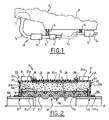
- an exhaust line LE for a motor vehicle engine V is mounted at the exit of the exhaust manifold 1 of the engine.
- This exhaust line LE includes by example an upstream or inlet tubing Te, a pot PC catalytic converter, one or more intermediate tubes Ti, a silencer S and a downstream or outlet tubing Ts.
- the different constituent elements of this LE line are metallic and connected to each other by half-collars metallic (not shown).
- the LE line is suspended at the body 3 of the vehicle V by means 4 such as straps or suspension pads made of elastomer.
- this type of LE exhaust line is complemented by a flexible hose decoupling 5 for the reasons mentioned in the preamble.
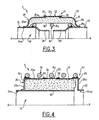
- a decoupling hose 5 according to the invention is a tubular structure of X-X axis that includes especially at least one mechanical part 10 which is intended to be connected to two adjacent pipes of the exhaust line LE, and a sealing part 11 which spans substantially the entire length of the mechanical part 10 on the one hand, and which is isolated thermally from the inside through an insulation part 12 on the other hand.
- the mechanical part 10 comprises in the axial direction two rigid and continuous end zones 15 in the form of two tubular tips of 15a metal connections, made of stainless steel example, which are joined to each other by a link flexible mechanism 16 which makes it possible to support angular deflections.
- the flexible connection 16 of the mechanical part 10 forms an internal cylindrical envelope which is exhaust gas contact and carried out from a material that must withstand heat and mechanically.
- this flexible connection 16 is made of fibers or stainless steel wire in the form of a fabric, a braid, of a knit ..., knowing that a structure oriented with long fibers holding each other is preferable.
- a fiber fabric of stainless steel oriented at 45 ° forms a mattress thin, dense and resistant that may be suitable.
- the link is conferred flexible 16 a bellows shape by imprisoning it between two alternating springs R1 and R2.
- the bellows is low amplitude and short pitch that are proportionate to his thickness.
- the flexible link 16 can have an internal diameter of the order of 40mm to 60mm, a thickness of the order of 5mm to 10mm and extend over a length of about 40mm to 100mm, while the R1 and R2 springs can be made with wires stainless steel with a diameter of about 1mm to 3mm and mounted in a step of the order of 5mm to 20mm.
- each connection tip 15a comprises an annular portion forming an RA connection with the flexible connection 16 of the mechanical part 10, and a tubular part forming an RB connection with a tubing of the LE exhaust line.
- the RA connection comprises a annular housing L1 which is delimited by a wall formed by an end portion of the tip 15a and a outer cylindrical wall 17 coaxial with the end piece 15a, and by an annular transverse wall 19 forming the bottom L.
- the outer wall 17 of the housing L is separated from the tip 15a by a corresponding distance substantially to the thickness of the flexible link 16 of the mechanical part 10.
- the housing L extends over a length of the order of 20mm to 50mm, so as to receive an end portion of the flexible link 16 on this length.
- Fixing between the connection Ra and the connection flexible 16 is made by crimping for example, the external cylindrical wall 17 acting as a tube crimp that forms only one piece with the tip 15a.
- the outer cylindrical wall 17 housing could be separated from each end of connection 15a to form a crimping tube independent that we would report, before crimping on each end portion of the link flexible 16 of the mechanical part 10.
- connection RB of each endpiece 15a is formed by the other end portion of the tip 15a and whose diameter can be adapted, if necessary, to that of the tubing of the exhaust line LE to which it will be connected by crimping, welding or the like.
- the flexible decoupling 5 is attached to the exhaust line LE by through its mechanical part 10 and this, regardless of how the parts are assembled 11 and thermal insulation 12, so as to what only the mechanical part 10 ensures the transmission of forces to which the exhaust line LE is subject.
- the sealing portion 11 of the hose 5 comprises a flexible central zone 22 and two end zones 23, this assembly being intended to form a continuous, closed, waterproof envelope that surrounds the flexible.
- the flexible central zone 22 is for example constituted by at least one layer or wall 24 in one Elastomeric material, such as silicone, thin of the order of 0.5mm to 2mm.
- This wall 24 can be reinforced by an airy knit structure and advantageously thermally conductive, which can be made of glass.
- the flexible wall 24 is advantageously reinforced by a mechanical reinforcing element for ensure a better resistance to the pressure of the gas flow.
- This reinforcement can consist in giving a pleated structure with the flexible wall 24 by the presence of ribbed reliefs or by adding elements such as a light spring R3 of which the step will be short to have a low amplitude of folds.
- This spring R3 can consist of a wire stainless steel with a diameter of about 0.5mm to 1mm and mounted in steps of 4mm to 10mm around the flexible central area 22.
- Each end zone 23 of the part sealing 11 is constituted by a cap 25 which is as long and thin as possible, and in a material rigid, if possible thermally conductive but especially compatible with dilations and the environment thermal and mechanical.
- each cap 25 is made of a material that has substantially the same coefficient of thermal expansion as the tip tubular 15a on which it is fixed, steel for example, and may have a shape wavy or strongly wrinkled.
- caps 25 in addition to form with the flexible layer 24 a sealed envelope, is to provide axial isolation to limit the temperature of the layer 24 and therefore its deterioration.
- each cap 25 is constituted by a cylindrical wall 27 which is partially closed at one end by a wall transverse ring 29.
- the sealing portion 11 is isolated thermally from the inside or radially by the part insulation 12 which forms a tubular element which extends at least the entire length of the sealing part 11.
- This element is for example constituted by a mattress consisting of a sufficient thickness of fibers long refractories, fibrous elements in sheets or slats of mica or stainless steel for example, powder such a nanometric silica that one can bagging under vacuum, the thickness of this mattress being the order of 5 to 20mm.
- the insulation portion 12 extends over a longer than that of the flexible link 16 of the mechanical part 10, so as to surround not only this flexible connection 16 but also the RA fittings connecting pieces 15a.
- the two caps 25 envelop the whole thermal insulation part 12.
- the two caps 25 come respectively to fit on the RB connections of the two connecting pieces 15a, to wrap the RA fittings that support the flexible connection 16 of the mechanical part 10 of the flexible 5.
- the thermal insulation part 12 which extends beyond of the flexible connection 16 of the mechanical part 10 comes thus in contact with the bottom of each cap 25.
- each assembly cap 25 is fixed to the connection RB of the associated connection piece 15a by welding for example.
- each cap assembly 25 extends axially, on the side of its annular wall 29 forming the bottom of the cap, by a tubular portion 31 of an inner diameter barely greater than the outside diameter of the RB fitting of the mouthpiece associated connection 15, to facilitate its assembly and its fixing on said tip 15.
- the flexible central zone 22 of the part sealing 11 can also be completed by a deformable and thermally conductive element 33 which is interposed between the thermal insulation portion 12 and the flexible wall 24, or which surrounds the latter.
- This element 33 may be an aluminum layer for example, with a thickness of the order of 0.5mm, and which penetrates to inside each cap 25, while the wall flexible 24 comes to partially cover the caps 25 to be secured by means of a crimping collar 35 by example.
- This element 33 could be realized also in the form of a knit
- the caps 25 exhibit the larger area of heat evacuation possible. AT this effect, we can predict the presence of cooling A, folds or extensions thermally conductive, and / or insulating spacers between the caps 25 and the flexible wall 22, to limit the heat flow coming from the hot areas that are located at both ends of the hose.
- the flexible link 16 which connects the two connecting pieces 15a of the mechanical part 10 of the flexible, consists of a spring R4 wire thick metal of the order of 5mm to 14mm, which has basically to function to participate in the possible transmission of efforts.
- the sealing portion 11 of the hose 5 is then completed by an inner envelope 36 under the shape of a low stainless steel sheet thickness which is interposed between the spring R4 and the thermal insulation part 12.
- connection tip 15a may be a simple tubular element on which both ends R4 spring are welded to ensure continuity mechanical.
- each connecting end 15a can extend axially, within the flexible, by two tubular elements 37 axially aligned which form a deflector.
- this deflector may be constituted by a single tubular element extending the mouthpiece upstream connection 15a in consideration the direction Exhaust gas flow.
- the flexible link 16 of the mechanical part 10 of the hose 5 is also constituted by an R4 spring of the same type as shown in Figure 3, but who climbed to the outside of the sealing portion 11 to surround it and the insulation part 12 associated with it.
- each cap 25 can form two fixed elements one to the other by welding, the transverse part 25b being thicker than the axial portion 25a. Both ends of the spring R4 are welded to a flange 38 of the transverse portion 25 of each cap 25.
- the sealing part 11 is completed by a inner casing 40 thin steel stainless steel that is in contact with the exhaust.
- This envelope 40 is surrounded by the part insulation 12.
- An axial end of the envelope 40 is fixed by welding to a rigid connection piece 15a1 of the mechanical part 10 or can form only one piece with this tip 15a1 but with a lesser thickness because it does not have to transmit efforts.
- the other axial end of the envelope 40 is free and is not connected to the other end of connection 15a2 which can be advantageously formed by a flange 42 of the transverse annular portion 25b of the associated headdress.
- each cap 25 forms a part of the mechanical part 10 of the hose 5 for ensure the mechanical continuity between the ends of connection 15a1,15a2 and the spring R4, and it is for this reason that it is thicker than the part axial 25a.
- the flexible according to this third mode of realization has some dissymmetry compared to the two previous embodiments.
- the sealing portion 11 of the hose 5 according to FIGS. and 4 may have the same characteristics as those described and illustrated in Figure 2, in particular in regarding the structure of the central link flexible 22.
Landscapes
- Engineering & Computer Science (AREA)
- General Engineering & Computer Science (AREA)
- Mechanical Engineering (AREA)
- Chemical & Material Sciences (AREA)
- Combustion & Propulsion (AREA)
- Exhaust Silencers (AREA)
- Exhaust Gas After Treatment (AREA)
- Cooling, Air Intake And Gas Exhaust, And Fuel Tank Arrangements In Propulsion Units (AREA)
- Control Of Throttle Valves Provided In The Intake System Or In The Exhaust System (AREA)
Abstract
Description
L'invention concerne un flexible de découplage monté dans une ligne d'échappement d'un moteur de véhicule automobile.The invention relates to a decoupling hose mounted in an exhaust line of a motor of motor vehicle.
D'une manière générale, une ligne d'échappement d'un moteur de véhicule automobile est montée en sortie du collecteur d'échappement du moteur. Cette ligne comprend généralement un ou plusieurs "pots" (catalytique, de détente, acoustique) constituant autant de masses le long d'une tubulure en un ou plusieurs morceaux rigidement raccordés. L'ensemble, suspendu à la caisse du véhicule par des liaisons modérément souples qui sont formées par des sangles ou des plots de suspension généralement à base d'élastomère, doit supporter les débattements du moteur liés à des accélérations verticales, aux changements brutaux de vitesse, aux dilatations thermiques, aux tolérances de montage,...In general, a line exhaust of a motor vehicle engine is mounted at the outlet of the exhaust manifold of the engine. This line usually includes one or more "pots" (catalytic, relaxing, acoustic) constituting as much masses along a pipe in one or more rigidly connected pieces. The whole, suspended at the vehicle body with moderately flexible links which are formed by straps or studs suspension generally based on elastomer, must to withstand engine travel related to vertical accelerations, to sudden changes in speed, thermal expansion, tolerances of mounting,...
Pour ces raisons, une ligne d'échappement comprend le plus souvent un raccord tubulaire souple dénommé "flexible de découplage" qui évite la détérioration ou la destruction de la ligne d'échappement par les différentes sollicitations précitées. Ce flexible permet d'obtenir la souplesse nécessaire au découplage vibratoire du moteur par rapport à la ligne d'échappement d'une part et à la caisse d'autre part, et améliore le confort dans l'habitacle du véhicule.For these reasons, an exhaust line most often includes a flexible tubular connection so-called "decoupling hose" which avoids the deterioration or destruction of the exhaust line by the various solicitations mentioned above. This flexible provides the flexibility to decouple vibration of the engine in relation to the exhaust line on the one hand, and on the other hand, and improves the comfort in the passenger compartment of the vehicle.
D'une manière générale, le flexible doit supporter le flux de gaz chauds qui peut atteindre voire dépasser 900°C en continu et les conditions extérieures auxquelles la ligne d'échappement est soumise. Par contre, le flexible ne doit pas perturber le fonctionnement de certains éléments de la ligne d'échappement, en particulier pour les motorisations à essence, il doit interdire toute entrée d'air dans le catalyseur.In general, the hose must support the flow of hot gases that can reach or exceed 900 ° C continuously and external conditions which the exhaust line is subjected to. On the other hand, the hose must not interfere with the operation of certain elements of the exhaust system, particular for gasoline engines, it must prohibit any entry of air into the catalyst.
On connaít des flexibles qui sont constitués par des tubes en tôle inoxydable de 0,3mm à 0,5mm, la tôle étant ondulée en forme de soufflet avec un gainage interne et une tresse ou tricot externe. Cependant, de tels flexibles sont raides avec des modes vibratoires marqués et bruyants. En outre, ils ne supportent aucune tension, aucune torsion et aucun dépassement de déformations admissibles en flexion, en cisaillement ou en compression.There are known hoses that are made up with 0.3mm to 0.5mm stainless steel tubes, the sheet being corrugated in the form of a bellows with a sheath internal and a braid or external knit. However, such flexible are stiff with vibratory modes marked and noisy. In addition, they do not support any tension, no torsion and no overrun permissible deformations in bending, shearing or in compression.
D'une manière générale, le niveau d'étanchéité exigé à l'amont du catalyseur impose l'utilisation d'une enveloppé fermée de façon complète et étanche, sinon il faudrait que les éléments d'une structure discontinue soient extrêmement serrés, et cet état de chose est difficile à maintenir sous toutes les déformations du flexible. En outre, les déformations du flexible imposent un plissement et des croisements de plis, et les éléments en feuilles ou tubes continus doivent être extensibles, sous peine de destruction mécanique.In general, the level of tightness required upstream of the catalyst requires the use of a wrapped tightly and completely sealed, otherwise it the elements of a discontinuous structure are extremely tight, and this state of affairs is difficult to maintain under all the deformations of flexible. In addition, the deformations of the flexible impose wrinkling and crisscrossing, and the elements continuous sheets or tubes must be extensible, under pain of mechanical destruction.
Or, les matériaux souples susceptibles de satisfaire au niveau d'étanchéité exigé, les élastomères par exemple, sont limités en température. Il faut donc un élastomère thermorésistant, de type silicone ou analogue et une protection thermique.However, flexible materials likely to to meet the required level of tightness, elastomers for example, are limited in temperature. It takes a heat resistant elastomer, silicone type or the like and thermal protection.
La difficulté de l'isolation thermique est alors aggravée par les contraintes d'encombrement, le diamètre interne du flexible ne pouvant être réduit sans gêner fortement l'écoulement du flux des gaz, et le diamètre externe est limité par l'environnement très encombré de la ligne. Par ailleurs, la conduction au niveau des raccords fait de la jonction étanche, entre ceux-ci et l'enveloppe élastomère, la zone la plus chaude pour cette dernière. Enfin, les feutres réfractaires usuels ont une conductivité thermique fortement croissante quant la température s'élève.The difficulty of thermal insulation is aggravated by congestion constraints, the inner diameter of the hose can not be reduced without greatly impede the flow of the gas flow, and the outer diameter is limited by the environment very cluttered with the line. Moreover, conduction level of the fittings made of the watertight junction, between these and the elastomeric shell, the hottest area for the latter. Finally, refractory felts usually have a high thermal conductivity increasing as the temperature rises.
Selon le document FR-A-2 676 502 le flexible de découplage est constitué en un matériau élastomère thermorésistant de type silicone, protégé intérieurement par des matériaux isolants, réfractaires et fibreux. La nécessité d'un minimum de tenue en flexion nécessite cependant une très forte épaisseur de silicone (de l'ordre de 7mm), ce qui dégrade considérablement l'effet relatif de la protection thermique et la souplesse que l'on peut attendre en compression.According to the document FR-A-2 676 502 the flexible of decoupling is made of an elastomeric material thermoresistant silicone type, protected internally by insulating, refractory and fibrous materials. The need for a minimum of flexural strength requires however a very thick silicone (from order of 7mm), which considerably degrades the effect relative thermal protection and flexibility that we can wait in compression.
Selon le document EP-A-0 145 020, le flexible de découplage comprend une ossature métallique cylindrique qui sert de support pour un ensemble de couches superposées, en particulier une couche interne de tissus à base de fibres minérales, une couche d'étanchéité constituée d'un feuillard métallique, une couche d'isolation thermique et une couche externe de protection. A chaque extrémité du flexible, l'ensemble des couches est écrasé au moyen de coutures effectuées avec un fil métallique.According to EP-A-0 145 020, the flexible of decoupling includes a metal frame cylindrical which serves as a support for a set of superimposed layers, in particular an inner layer of fabrics made from mineral fibers, one layer sealing consisting of a metal strip, a thermal insulation layer and an outer layer of protection. At each end of the hose, the assembly layers is crushed by means of seams made with a wire.
Selon le document FR-A-2 758 588, le flexible de découplage est constitué par un empilement fonctionnel de matériaux qui sont de préférence conformés en soufflet avec une couche interne, une couche barrière, une couche d'isolation thermique et une couche externe étanche en élastomère, le tout étant pris entre deux ressorts hélicoïdaux alternés interne et externe.According to the document FR-A-2 758 588, the flexible decoupling is constituted by a functional stack of materials which are preferably bellows shaped with an inner layer, a barrier layer, a layer thermal insulation and a watertight outer layer elastomer, all caught between two springs alternate internal and external helicoidals.
A chacune de leurs extrémités, les deux ressorts présentent des spires jointives pour constituer des surfaces rigides. Ces surfaces, qui s'étendent sur une longueur d'au moins 1cm, sont utilisées pour permettre le raccordement du flexible aux extrémités des deux tubulures de la ligne d'échappement entre lesquelles le flexible est intercalé. Un tel raccordement peut être réalisé au moyen de colliers rigides ou par sertissage, par exemple.At each of their ends, both springs have adjoining turns to constitute rigid surfaces. These surfaces, which extend over a length of at least 1cm, are used for allow the connection of the hose to the ends of two pipes of the exhaust line between which the hose is inserted. Such a connection can be made by means of rigid collars or by crimping, for example.
Cependant, pour obtenir à la fois une bonne étanchéité et une bonne tenue mécanique, l'ensemble des couches sous l'élastomère, y compris l'isolant déjà peu épais compte tenu de l'encombrement disponible, est fortement écrasé par le sertissage et perd ainsi de son efficacité. En l'absence de joint étanche, le serrage n'assure pas une étanchéité suffisante pour une application aux moteurs catalysés par exemple.However, to get both a good tightness and good mechanical strength, all layers under the elastomer, including already insulating in view of the available space, is strongly crushed by crimping and thus loses its efficiency. In the absence of a tight seal, the tightening does not provide sufficient sealing for a application to catalyzed engines for example.
La proximité du raccord avec la tubulure, généralement mince et métallique, aggrave par conduction l'échauffement de l'élastomère dans cette zone, en particulier lorsqu'une continuité est établie pour l'étanchéité.The proximity of the connection with the tubing, usually thin and metallic, aggravated by conduction the heating of the elastomer in this zone, in particular where continuity is established for sealing.
Compte tenu de la structure des flexibles de découplage selon l'art antérieur évoqué précédemment et des différentes contraintes qu'ils sont amenés à subir, un but de l'invention est de concevoir un flexible de découplage qui ne présente pas les inconvénients de l'art antérieur d'une part, et qui soit en mesure de satisfaire au mieux aux conditions qu'il doit remplir pour pallier les effets des contraintes inhérentes aux conditions de fonctionnement de la ligne d'échappement d'autre part.Given the structure of the hoses of decoupling according to the prior art mentioned previously and different constraints they are subjected to, an object of the invention is to design a flexible decoupling that does not have the disadvantages of art previous on the one hand, and which is able to satisfy at best the conditions that it must fulfill to compensate the effects of the constraints inherent in the conditions of operation of the exhaust line on the other hand.
En d'autres termes, un but de l'invention est de concevoir un flexible de découplage souple qui soit capable de supporter un flux gazeux à haute température, et qui est plus particulièrement destiné à assurer un découplage mécanique et vibratoire dans une ligne d'échappement.In other words, an object of the invention is to design a flexible decoupling hose that is capable of withstanding a gaseous flow at high temperature, and which is more particularly intended to ensure a Mechanical and vibratory decoupling in a line exhaust.
A cet effet, l'invention propose un flexible de découplage destiné à être monté dans une ligne d'échappement d'un moteur de véhicule automobile, ce flexible comprenant notamment une partie mécanique ayant deux zones d'extrémité destinées à être raccordées à la ligne d'échappement, et une partie étanchéité isolée thermiquement de l'intérieur par une partie isolation et qui s'étend sur sensiblement sur toute la longueur de la partie mécanique du flexible, et qui est caractérisé en ce que la partie étanchéité comprend une zone centrale formée d'une couche réalisée en un matériau souple et thermiquement résistant, et de deux zones d'extrémité rigides respectivement raccordées aux deux zones d'extrémité de la partie mécanique, la partie étanchéité du flexible formant une enveloppe continue, fermée et étanche.For this purpose, the invention proposes a flexible decoupling device for mounting in a line exhaust system of a motor vehicle engine, this flexible including a mechanical part having two end zones intended to be connected to the exhaust line, and an isolated sealing part thermally from the inside by an insulation part and which extends substantially over the entire length of the mechanical part of the hose, and which is characterized in what the sealing part includes a central area formed of a layer made of a flexible material and thermally resistant, and two end zones rigid respectively connected to the two zones end of the mechanical part, the sealing part of the flexible forming a continuous envelope, closed and waterproof.
Selon une autre caractéristique de l'invention, les parties mécanique et étanchéité sont dissociées l'une de l'autre, de manière à remplir leurs fonctions respectives indépendamment l'une de l'autre.According to another characteristic of the invention, the mechanical parts and sealing are dissociated from each other so as to fulfill their respective functions independently of one another.
La couche ou paroi souple de la partie étanchéité du flexible est réalisée en un matériau élastomère tel du silicone qui est thermiquement protégée radialement par la partie isolation et axialement par les deux parties d'extrémité de la partie étanchéité.The layer or flexible wall of the part sealing of the hose is made of a material elastomer such as silicone which is thermally protected radially by the insulation part and axially by the two end portions of the sealing portion.
Les deux partie d'extrémité de la partie étanchéité sont constituées par deux coiffes longues et minces, de préférence réalisées en un matériau thermiquement peu conducteur, tel de l'acier inoxydable par exemple, ces coiffes ayant pour fonction de réduire la conduction de chaleur vers la couche souple d'une part, et de participer à la réalisation de la partie étanchéité sous la forme d'une enveloppe continue, fermée et étanche.The two end part of the game sealing consist of two long caps and thin, preferably made of a material thermally little conductive, such as stainless steel for example, these caps having the function of reducing the conduction of heat towards the flexible layer of a part, and participate in the realization of the part sealing in the form of a continuous, closed envelope and waterproof.
Selon un mode de réalisation de la partie étanchéité :
- la paroi souple a une épaisseur de l'ordre de 0,5 à 3mm, est plissé et renforcée par des spires flexibles par exemple pour assurer une meilleure tenue mécanique à la pression d'un flux gazeux, et
- chaque coiffe est relativement longue et mince, avec la présence éventuelle d'ailettes, de plis ou de prolongements conducteurs pour assurer une plus grande surface d'évacuation de la chaleur, tandis que la minceur et la faible conductivité des coiffes limitent le flux conducteur venant des deux zones chaudes de raccordement du flexible à la ligne d'échappement.
- the flexible wall has a thickness of the order of 0.5 to 3 mm, is pleated and reinforced by flexible turns for example to ensure a better mechanical resistance to the pressure of a gas flow, and
- each cap is relatively long and thin, with the possible presence of fins, folds or conductive extensions to ensure a greater heat evacuation surface, while the thinness and low conductivity of the caps limit the flow of conductor two hot zones connecting the hose to the exhaust line.
D'une manière générale, la partie d'isolation radiale de la paroi souple de la partie étanchéité s'étend sous les coiffes pour les isoler, et elle est constituée à partir d'un matériau isolant d'une épaisseur de l'ordre de 5 à 20mm.In general, the insulation part radial of the flexible wall of the sealing part extends under the caps to isolate them, and it is made from an insulating material of a thickness of the order of 5 to 20mm.
La partie mécanique du flexible peut être constituée suivant différentes structures dont certaines seront décrites plus loin, sachant que cette partie mécanique ne constitue pas en soi une caractéristique essentielle de l'invention.The mechanical part of the hose can be constituted according to different structures some of which will be described later, knowing that this part is not a characteristic in itself essential of the invention.
Selon un avantage important de l'invention, le fait de raccorder le flexible de découplage à la ligne d'échappement au niveau de la partie mécanique du flexible, permet d'éviter un écrasement des parties d'isolation thermique et d'étanchéité d'une part, et limite un transfert de chaleur vers ces parties d'autre part.According to an important advantage of the invention, the connecting the decoupling hose to the line exhaust at the mechanical part of the flexible, avoids crushing parts of thermal insulation and sealing on the one hand, and limit a heat transfer to these parts on the other hand.
D'autres avantages, caractéristiques et détails de l'invention ressortiront du complément de description qui va suivre en référence à des dessins annexés, donnés uniquement à titre d'exemple et dans lesquels :
- la figure 1 est une vue schématique d'une ligne d'échappement classique d'un moteur de véhicule automobile, qui comprend un flexible de découplage,
- la figure 2 est une demi-vue en coupe longitudinale d'un premier mode de réalisation d'un flexible de découplage selon l'invention,
- les figures 3 et 4 sont deux demi-vues en coupe de deux autres modes de réalisation d'un flexible de découplage selon l'invention.
- FIG. 1 is a schematic view of a conventional exhaust line of a motor vehicle engine, which comprises a decoupling hose,
- FIG. 2 is a half-view in longitudinal section of a first embodiment of a decoupling hose according to the invention,
- Figures 3 and 4 are two half-views in section of two other embodiments of a decoupling hose according to the invention.
D'une manière générale, une ligne d'échappement
LE pour un moteur de véhicule automobile V, comme celle
illustrée sur la figure 1, est montée à la sortie du
collecteur d'échappement 1 du moteur.In general, an exhaust line
LE for a motor vehicle engine V, such as
illustrated in Figure 1, is mounted at the exit of the
Cette ligne d'échappement LE comprend par exemple une tubulure amont ou d'entrée Te, un pot catalytique PC, une ou plusieurs tubulures intermédiaires Ti, un silencieux S et une tubulure aval ou de sortie Ts. Les différents éléments constitutifs de cette ligne LE sont métalliques et raccordés entre eux par des demi-colliers métalliques (non représentés). La ligne LE est suspendue à la caisse 3 du véhicule V par des moyens 4 tels que des sangles ou des plots de suspension en élastomère.This exhaust line LE includes by example an upstream or inlet tubing Te, a pot PC catalytic converter, one or more intermediate tubes Ti, a silencer S and a downstream or outlet tubing Ts. The different constituent elements of this LE line are metallic and connected to each other by half-collars metallic (not shown). The LE line is suspended at the body 3 of the vehicle V by means 4 such as straps or suspension pads made of elastomer.
A l'heure actuelle, la structure de ce type de ligne d'échappement LE est complétée par un flexible de découplage 5 pour les raisons évoquées en préambule.At present, the structure of this type of LE exhaust line is complemented by a flexible hose decoupling 5 for the reasons mentioned in the preamble.
Un flexible de découplage 5 selon l'invention
est une structure tubulaire d'axe X-X qui comprend
notamment au moins une partie mécanique 10 qui est
destinée à être raccordée à deux tubulures adjacentes de
la ligne d'échappement LE, et une partie étanchéité 11
qui s'étend sur sensiblement toute la longueur de la
partie mécanique 10 d'une part, et qui est isolée
thermiquement de l'intérieur par une partie isolation 12
d'autre part.A
Selon un premier mode de réalisation illustré
sur la figure 2, la partie mécanique 10 comprend dans le
sens axial deux zones d'extrémités rigides et continues
15 sous la forme de deux embouts tubulaires de
raccordement métalliques 15a, en acier inoxydable par
exemple, qui sont réunis l'un à l'autre par une liaison
mécanique souple 16 qui permet de supporter des
débattements angulaires.According to a first illustrated embodiment
in FIG. 2, the
La-liaison souple 16 de la partie mécanique 10
forme une enveloppe cylindrique interne qui est au
contact des gaz d'échappement et réalisée à partir d'un
matériau qui doit résister thermiquement et
mécaniquement. Selon ce premier mode de réalisation,
cette liaison souple 16 est réalisée par des fibres ou
fils d'acier inoxydable sous la forme d'un tissu, d'une
tresse, d'un tricot,..., sachant qu'une structure
orientée à fibres longues se tenant les unes aux autres
est préférable. A titre d'exemple, un tissu en fibres
d'acier inoxydable orientées à 45° forme un matelas
mince, dense et résistant qui peut convenir.The
Avantageusement, on confère à la liaison
souple 16 une forme en soufflet en l'emprisonnant entre
deux ressorts alternés R1 et R2. Le soufflet est à faible
amplitude et à pas court qui sont proportionnés à son
épaisseur. A titre d'exemple, la liaison souple 16 peut
avoir un diamètre interne de l'ordre de 40mm à 60mm, une
épaisseur de l'ordre de 5mm à 10mm et s'étendre sur une
longueur de l'ordre de 40mm à 100mm, alors que les
ressorts R1 et R2 peuvent être constitués avec des fils
d'acier inoxydable d'un diamètre de l'ordre de 1mm à 3mm
et montés suivant un pas de l'ordre de 5mm à 20mm.Advantageously, the link is conferred
flexible 16 a bellows shape by imprisoning it between
two alternating springs R1 and R2. The bellows is low
amplitude and short pitch that are proportionate to his
thickness. By way of example, the
Selon ce premier mode de réalisation donné à
titre d'exemple, chaque embout de raccordement 15a
comprend une partie annulaire formant un raccord RA avec
la liaison souple 16 de la partie mécanique 10, et une
partie tubulaire formant un raccord RB avec une tubulure
de la ligne d'échappement LE.According to this first embodiment given to
For example, each
Plus précisément, le raccord RA comprend un
logement annulaire L1 qui est délimité par une paroi
formée par une partie d'extrémité de l'embout 15a et une
paroi cylindrique externe 17 coaxiale à l'embout 15a, et
par une paroi transversale annulaire 19 formant le fond
du logement L. La paroi externe 17 du logement L est
séparée de l'embout 15a d'une distance correspondant
sensiblement à l'épaisseur de la liaison souple 16 de la
partie mécanique 10. Le logement L s'étend sur une
longueur de l'ordre de 20mm à 50mm, de manière à recevoir
une partie d'extrémité de la liaison souple 16 sur cette
longueur. La fixation entre le raccord Ra et la liaison
souple 16 est réalisée par sertissage par exemple, la
paroi cylindrique externe 17 jouant le rôle d'un tube
de sertissage qui ne forme qu'une seule pièce avec
l'embout 15a.More specifically, the RA connection comprises a
annular housing L1 which is delimited by a wall
formed by an end portion of the
En variante, la paroi cylindrique externe 17
du logement L pourrait être dissociée de chaque embout de
raccordement 15a pour former un tube de sertissage
indépendant que l'on viendrait rapporter, avant
sertissage, sur chaque partie d'extrémité de la liaison
souple 16 de la partie mécanique 10.Alternatively, the outer
Le raccord RB de chaque embout 15a est formé
par l'autre partie d'extrémité de l'embout 15a et dont le
diamètre peut être adapté, si nécessaire, à celui de la
tubulure de la ligne d'échappement LE à laquelle il sera
raccordé par sertissage, soudage ou analogue.The connection RB of each
Ainsi, selon l'invention, le flexible de
découplage 5 est fixé à la ligne d'échappement LE par
l'intermédiaire de sa partie mécanique 10 et ce,
indépendamment du mode d'assemblage des parties
d'étanchéité 11 et d'isolation thermique 12, de manière à
ce que seule la partie mécanique 10 assure la
transmission des efforts auxquels la ligne d'échappement
LE est soumise.Thus, according to the invention, the
La partie étanchéité 11 du flexible 5 comprend
une zone centrale souple 22 et deux zones d'extrémité
rigides 23, cet ensemble étant destiné à former une
enveloppe continue, fermée et étanche qui entoure le
flexible.The sealing
La zone centrale souple 22 est par exemple
constituée par au moins une couche ou paroi 24 en un
matériau élastomère, tel du silicone, de faible épaisseur
de l'ordre de 0,5mm à 2mm. Cette paroi 24 peut être
renforcée par une structure aérée de type tricot et
avantageusement thermiquement conductrice, qui peut être
réalisée en verre. The flexible
La paroi souple 24 est avantageusement
renforcée par un élément de renfort mécanique pour
assurer une meilleure tenue à la pression du flux gazeux.
Ce renfort peut consister à donner une structure plissée
à la paroi souple 24 par la présence de reliefs nervurés
ou par l'ajout d'éléments tels un ressort léger R3 dont
le pas sera court pour avoir une faible amplitude de
plis. Ce ressort R3 peut être constitué par un fil
d'acier inoxydable d'un diamètre de l'ordre de 0,5mm à
1mm et monté suivant un pas de l'ordre de 4mm à 10mm
autour de la zone centrale souple 22.The
Chaque zone d'extrémité 23 de la partie
étanchéité 11 est constituée par une coiffe 25 qui est
aussi longue et mince que possible, et en un matériau
rigide, si possible peu conducteur thermiquement mais
surtout compatible avec les dilatations et l'environnement
thermique et mécanique. De préférence, chaque coiffe 25
est réalisée en un matériau qui a sensiblement le même
coefficient de dilatation thermique que l'embout
tubulaire 15a sur lequel elle est fixée, en acier
inoxydable par exemple, et peut présenter une forme
ondulée ou fortement plissée.Each
La fonction de ces coiffes 25, en plus de
former avec la couche souple 24 une enveloppe étanche,
est d'assurer une isolation axiale pour limiter la
température de la couche 24 et donc sa détérioration.The function of these
Selon un exemple de réalisation, chaque coiffe
25 est constituée par une paroi cylindrique 27 qui est
partiellement fermée à une extrémité par une paroi
transversale annulaire 29.According to an exemplary embodiment, each
La partie étanchéité 11 est isolée
thermiquement de l'intérieur ou radialement par la partie
isolation 12 qui forme un élément tubulaire qui s'étend
au moins sur toute la longueur de la partie étanchéité
11. Cet élément est par exemple constitué par un matelas
constitué d'une épaisseur suffisante de fibres
réfractaires longues, d'éléments fibreux en feuilles ou
lamelles de mica ou d'acier inoxydable par exemple, de
poudre telle une silice nanométrique que l'on peut
ensacher sous vide, l'épaisseur de ce matelas étant de
l'ordre de 5 à 20mm.The sealing
La partie isolation 12 s'étend sur une
longueur supérieure à celle de la liaison souple 16 de la
partie mécanique 10, de manière à entourer non seulement
cette liaison souple 16 mais également les raccords RA
des embouts de raccordement 15a.The
Les deux coiffes 25 enveloppent toute la
partie isolation thermique 12. Avantageusement, les deux
coiffes 25 viennent respectivement s'emboíter sur les
raccords RB des deux embouts de raccordement 15a, de
manière à envelopper les raccords RA qui supportent la
liaison souple 16 de la partie mécanique 10 du flexible
5. La partie isolation thermique 12 qui s'étend au-delà
de la liaison souple 16 de la partie mécanique 10 vient
ainsi au contact avec le fond de chaque coiffe 25.The two
Enfin, chaque coiffe d'assemblage 25 est fixée
au raccord RB de l'embout de raccordement associé 15a par
soudage par exemple. Avantageusement, chaque coiffe
d'assemblage 25 se prolonge axialement, du côté de sa
paroi annulaire 29 formant le fond de la coiffe, par une
partie tubulaire 31 d'un diamètre intérieur à peine
supérieur au diamètre extérieur du raccord RB de l'embout
de raccordement associé 15, pour faciliter son montage et
sa fixation sur ledit embout 15.Finally, each
La zone centrale souple 22 de la partie
étanchéité 11 peut être également complétée par un
élément 33 déformable et thermiquement conducteur qui est
interposé entre la partie d'isolation thermique 12 et la
paroi souple 24, ou qui entoure cette dernière. Cet
élément 33 peut être une couche en aluminium par exemple,
avec une épaisseur de l'ordre de 0,5mm, et qui pénètre à
l'intérieur de chaque coiffe 25, alors que la paroi
souple 24 vient recouvrir en partie les coiffes 25 pour y
être fixée au moyen d'un collier de sertissage 35 par
exemple. Cet élément 33 pourrait être réalisé également
sous la forme d'un tricotThe flexible
Avantageusement, les coiffes 25 présentent la
plus grande surface d'évacuation de chaleur possible. A
cet effet, on peut prévoir la présence d'ailettes de
refroidissement A, de plis ou de prolongements
thermiquement conducteurs, et/ou d'intercalaires isolants
entre les coiffes 25 et la paroi souple 22, pour limiter
le flux de chaleur venant des zones chaudes qui sont
situées aux deux extrémités du flexible.Advantageously, the
A titre d'exemple :
- la paroi souple 24 présente un diamètre
externe qui est de l'ordre de 0,5 à 2 ou 3 fois le
diamètre externe de la tubulure d'échappement, une
épaisseur de l'ordre de 0,5 à 3mm, un plissage suivant un
pas de l'ordre de 3 à 10 fois son épaisseur et une
amplitude de l'ordre de 0,3 à 5 fois le pas, et une
longueur de l'ordre de 30 à
100mm ou 0,5 à 1,5 fois son propre diamètre externe, et - les coiffes 25 sont réalisées en acier inoxydable réfractaire, avec une épaisseur de l'ordre de 0,2 à 1mm, et une longueur suffisante pour faire décroítre suffisamment la température au niveau de la paroi souple 24, cette longueur étant de l'ordre de 0,5 à 2 ou trois fois le diamètre externe de la tubulure, c'est-à-dire de l'ordre de 40 à 100 mm.
- the
flexible wall 24 has an outer diameter which is of the order of 0.5 to 2 or 3 times the outer diameter of the exhaust manifold, a thickness of the order of 0.5 to 3 mm, a pleating according to a not of the order of 3 to 10 times its thickness and an amplitude of the order of 0.3 to 5 times the pitch, and a length of the order of 30 to 100mm or 0.5 to 1.5 times its own external diameter, and - the
caps 25 are made of refractory stainless steel, with a thickness of the order of 0.2 to 1 mm, and a length sufficient to decrease sufficiently the temperature at theflexible wall 24, this length being of the order of 0.5 to 2 or 3 times the outer diameter of the tubing, that is to say of the order of 40 to 100 mm.
Selon un deuxième mode de réalisation illustré
sur la figure 3, la liaison souple 16 qui relie les deux
embouts de raccordement 15a de la partie mécanique 10 du
flexible, est constituée par un ressort R4 en fil
métallique épais de l'ordre de 5mm à 14mm, qui a
essentiellement pour fonction de participer à la
transmission éventuelle d'efforts. According to a second illustrated embodiment
in FIG. 3, the
La partie étanchéité 11 du flexible 5 est
alors complétée par une enveloppe interne 36 sous la
forme d'une feuille en acier inoxydable de faible
épaisseur qui est intercalée entre le ressort R4 et la
partie isolation thermique 12.The sealing
Chaque embout de raccordement 15a peut être un
simple élément tubulaire sur lequel les deux extrémités
du ressort R4 sont soudées pour assurer une continuité
mécanique.Each
Avantageusement, chaque embout de raccordement
15a peut se prolonger axialement, à l'intérieur du
flexible, par deux éléments tubulaires 37 axialement
alignés qui forment un déflecteur.Advantageously, each connecting
En variante, ce déflecteur peut être constitué
par un seul élément tubulaire prolongeant l'embout de
raccordement amont 15a en considération la direction
d'écoulement des gaz d'échappement.Alternatively, this deflector may be constituted
by a single tubular element extending the mouthpiece
Selon un troisième mode de réalisation
illustré sur la figure 4, la liaison souple 16 de la
partie mécanique 10 du flexible 5 est également
constituée par un ressort R4 du même type que celui
illustré sur la figure 3, mais qui est monté à
l'extérieur de la partie étanchéité 11 pour entourer
celle-ci et la partie isolation 12 qui lui est associée.According to a third embodiment
illustrated in FIG. 4, the
Les parties axiale 25a et transversale 25b de
chaque coiffe 25 peuvent former deux éléments fixés l'un
à l'autre par soudage, la partie transversale 25b étant
plus épaisse que la partie axiale 25a. Les deux
extrémités du ressort R4 sont soudées sur un rebord 38 de
la partie transversale 25 de chaque coiffe 25.The
La partie étanchéité 11 est complétée par une
enveloppe interne 40 de faible épaisseur en acier
inoxydable qui est au contact des gaz d'échappement.
Cette enveloppe 40 est donc entourée par la partie
isolation 12. Une extrémité axiale de l'enveloppe 40 est
fixée par soudage à un embout de raccordement rigide 15a1
de la partie mécanique 10 ou peut former qu'une seule
pièce avec cet embout 15a1 mais avec une moindre
épaisseur, car elle n'a pas à transmettre des efforts.
Par contre, l'autre extrémité axiale de l'enveloppe 40
est libre et n'est pas raccordée à l'autre embout de
raccordement 15a2 qui peut être avantageusement formé par
un rebord 42 de la partie annulaire transversale 25b de
la coiffe associée.The sealing
Selon ce troisième mode de réalisation, la
partie transversale 25b de chaque coiffe 25 forme une
partie de la partie mécanique 10 du flexible 5 pour
assurer la continuité mécanique entré les embouts de
raccordement 15a1,15a2 et le ressort R4, et c'est pour
cette raison qu'elle est plus épaisse que la partie
axiale 25a.According to this third embodiment, the
Le flexible selon ce troisième mode de
réalisation présente une certaine dissymétrie par rapport
aux deux modes de réalisation précédents. Bien entendu,
la partie étanchéité 11 du flexible 5 selon les figures 3
et 4 peut présenter les mêmes caractéristiques que celles
décrites et illustrées sur la figure 2, notamment en
ce qui concerne la structure de la liaison centrale
souple 22.The flexible according to this third mode of
realization has some dissymmetry compared
to the two previous embodiments. Of course,
the sealing
Claims (28)
- A decoupling sleeve for mounting in a motor vehicle engine exhaust pipe (LE), the sleeve (5) comprising in particular a mechanical portion (10) having two rigid end zones (15) for connection to the exhaust pipe (LE), and a sealing portion (11) that is thermally insulated from the inside by an insulation portion (12), the sealing portion extending over substantially the entire length of the mechanical portion (10) of the sleeve, and comprising at least a central zone (22) formed by a layer or wall (24) made of a material that is flexible and that withstands temperature, the sleeve being characterized in that in order to form a covering that is continuous, closed, and leakproof, the sealing portion also comprises two long and thin, rigid end zones (23) having the function of thermally protecting the central zone (22) by insulating it from the hot connection zones between the sleeve and the exhaust pipe, and which are respectively connected firstly to the central zone (22) and secondly to the two rigid end zones (15) of the mechanical portion (10).
- A decoupling sleeve according to claim 1, characterized in that the mechanical and sealing portions (10, 11) are dissociated from each other so as to perform their respective functions independently of each other.
- A decoupling sleeve according to claim 1 or 2, characterized in that the flexible layer (24) of the central zone of the sealing portion (11) is about 0.5 mm to 2 mm thick.
- A decoupling sleeve according to any one of claims 1 to 3, characterized in that the flexible layer (24) of the central zone of the sealing portion is made of an elastomer material such as silicone.
- A decoupling sleeve according to any preceding claim, characterized in that the flexible layer (24) of the central zone of the sealing portion (11) is reinforced by a perforated structure of the knit type.
- A decoupling sleeve according to claim 5, characterized in that the reinforcement of the layer (24) is made of a material that conducts heat.
- A decoupling sleeve according to any preceding claim, characterized in that the flexible layer (24) of the central zone of the sealing portion (11) is lightly folded.
- A decoupling sleeve according to claim 7, characterized in that a spring (R3) surrounds the flexible layer (24) to give it a folded shape.
- A decoupling sleeve according to any preceding claim, characterized in that a deformable and thermally conductive element (33) surrounds the flexible layer (34) internally or externally.
- A decoupling sleeve according to any preceding claim, characterized in that the flexible wall (24) has an outside diameter that is about 0.5 to 2 or 3 times the outside diameter of the exhaust pipe segment in which the sleeve is designed to be mounted, and a length that is about 30 mm to 100 mm, i.e. 0.5 to 1.5 times its own outside diameter.
- A decoupling sleeve according to any preceding claim, characterized in that each end zone (23) of the sealing portion is made in the form of a cover (25).
- A decoupling sleeve according to claim 11, characterized in that each cover (25) is about 0.2 mm to 1 mm thick and has a length that is about 0.5 to 2 times the outside diameter of the exhaust pipe segment in which the sleeve is designed to be mounted.
- A decoupling sleeve according to claim 11 or 12, characterized in that each cover (25) supports cooling fins (A).
- A decoupling sleeve according to any one of claims 11 to 13, characterized in that each cover (25) is made of a material that is a poor conductor of heat.
- A decoupling sleeve according to any preceding claim, characterized in that the end zones (15) of the mechanical portion (10) of the sleeve are constituted by two metal tubular endpieces (15a) which are united with each other by a flexible central link (16) that enables the sleeve to be deformed angularly.
- A decoupling sleeve according to claim 15, characterized in that the sealing portion (11) extends axially beyond the flexible central link (16).
- A decoupling sleeve according to claim 15 or 16, characterized in that the flexible link (16) of the mechanical portion (10) of the sleeve includes fabric made of stainless steel wires or fibers to form a mat that is thin, dense, and strong, having a thickness of about 5 mm to 10 mm.
- A decoupling sleeve according to claim 15 or 16, characterized in that the flexible link (16) of the mechanical portion (10) of the sleeve includes an oriented structure of long fibers made of stainless steel, for example.
- A decoupling sleeve according to claim 15 or 16, characterized in that the flexible link (16) of the mechanical portion (10) of the sleeve is held captive between two interleaved springs (R1, R2) to give it a bellows shape.
- A decoupling sleeve according to claim 19, characterized in that the flexible link (16) of the mechanical portion (10) of the sleeve is constituted by a spring (R4) of a metal wire that is about 7 mm to 14 mm thick.
- A decoupling sleeve according to claim 20, characterized in that the spring (R4) is situated on the inside of the sleeve and is surrounded by the thermal insulation portion (12).
- A decoupling sleeve according to claim 21, characterized in that an inner covering (36) in the form of a thin stainless steel foil is interposed between the spring (R4) and the thermal insulation portion (12).
- A decoupling sleeve according to claim 21 or 22, characterized in that the spring (R4) surrounds a tubular deflector (37) which comes into contact with exhaust gases.
- A decoupling sleeve according to claim 22, characterized in that the deflector (37) is made up of two portions connected respectively to the two rigid end zones (15) of the sleeve.
- A decoupling sleeve according to claim 23, characterized in that the deflector (37) comprises a single portion which is connected to one of the rigid end zones (15) of the sleeve.
- A decoupling sleeve according to claim 20, characterized in that the spring (R4) is situated on the outside of the sleeve and surrounds the sealing portion (11).
- A decoupling sleeve according to claim 26, characterized in that the sealing portion (11) also includes an inner covering (40) of small thickness which is surrounded by the insulation portion (12) and which is fixed to one of the rigid end zones (15a1) of the sleeve.
- A decoupling sleeve according to any preceding claim, characterized in that the thermal insulation portion (11) is made of an insulating material and has thickness of about 5 mm to 20 mm, extending over the entire length of the sealing portion (11) of the sleeve.
Applications Claiming Priority (2)
| Application Number | Priority Date | Filing Date | Title |
|---|---|---|---|
| FR9908998 | 1999-07-12 | ||
| FR9908998A FR2796416B1 (en) | 1999-07-12 | 1999-07-12 | IMPROVEMENT TO A DECOUPLING HOSE MOUNTED IN AN EXHAUST LINE OF A MOTOR VEHICLE ENGINE |
Publications (2)
| Publication Number | Publication Date |
|---|---|
| EP1069289A1 EP1069289A1 (en) | 2001-01-17 |
| EP1069289B1 true EP1069289B1 (en) | 2003-07-02 |
Family
ID=9547987
Family Applications (1)
| Application Number | Title | Priority Date | Filing Date |
|---|---|---|---|
| EP00401996A Expired - Lifetime EP1069289B1 (en) | 1999-07-12 | 2000-07-11 | Improvement to a flexible decoupling joint in an exhaust line of a motor vehicle engine |
Country Status (6)
| Country | Link |
|---|---|
| US (1) | US6554321B1 (en) |
| EP (1) | EP1069289B1 (en) |
| AT (1) | ATE244358T1 (en) |
| DE (1) | DE60003613T2 (en) |
| ES (1) | ES2198263T3 (en) |
| FR (1) | FR2796416B1 (en) |
Families Citing this family (17)
| Publication number | Priority date | Publication date | Assignee | Title |
|---|---|---|---|---|
| KR100353123B1 (en) * | 2000-08-28 | 2002-09-16 | 주식회사 에스제이엠 | Exhaust pipe decoupler for automobiles |
| DE10130668A1 (en) * | 2001-06-28 | 2003-01-23 | Eberspaecher J Gmbh & Co | Exhaust component for a motor vehicle |
| AUPR947301A0 (en) | 2001-12-07 | 2002-01-24 | Umiastowski, Tomasz | Exhaust fume diverter |
| FR2835018B1 (en) * | 2002-01-22 | 2005-09-09 | Hutchinson | IMPROVEMENT TO A DECOUPLING HOSE FOR AN EXHAUST LINE OF A MOTOR VEHICLE ENGINE |
| FR2835017B1 (en) | 2002-01-22 | 2004-03-12 | Hutchinson | DECOUPLING HOSE FOR EXHAUST LINE OF A MOTOR VEHICLE ENGINE |
| US20040092463A1 (en) * | 2002-11-11 | 2004-05-13 | Isis Pharmaceuticals Inc. | Modulation of PIM-1 expression |
| FR2847938B1 (en) | 2002-11-28 | 2006-08-04 | Hutchinson | IMPROVEMENT IN A DECOUPLING HOSE FOR A MOTOR VEHICLE ENGINE EXHAUST LINE |
| FR2869353B1 (en) * | 2004-04-23 | 2006-06-23 | Renault Sas | PROTECTION OF A FLEXIBLE |
| KR100602770B1 (en) * | 2004-07-20 | 2006-07-20 | 주식회사 에스제이엠 | Flexible tube for automobile exhaust pipe |
| DE102005025045A1 (en) * | 2005-05-30 | 2006-12-14 | J. Eberspächer GmbH & Co. KG | exhaust system |
| KR100735940B1 (en) * | 2005-06-15 | 2007-07-06 | 주식회사 에스제이엠 | Flexible tube for car exhaust pipe |
| DE102010031043A1 (en) | 2010-07-07 | 2012-01-12 | Culimeta Textilglas-Technologie Gmbh & Co.Kg | Decoupling element i.e. exhaust gas decoupling element, for use with exhaust system of combustion engine, has insulating material inserted into slots between groove walls, where insulating material is designed as resilient ring |
| US20130015652A1 (en) * | 2011-07-13 | 2013-01-17 | Clark Thomas | Frequency-controlled exhaust bellows assembly |
| KR101405669B1 (en) * | 2012-10-09 | 2014-06-10 | 기아자동차주식회사 | EGR gas inlet pipe for vehicle |
| US9140172B2 (en) * | 2013-07-30 | 2015-09-22 | GM Global Technology Operations LLC | Gas flow distributing flexible coupling |
| GB2539248A (en) | 2015-06-12 | 2016-12-14 | Jaguar Land Rover Ltd | Vehicle exhaust assembly |
| CN108930579B (en) * | 2018-08-31 | 2023-05-30 | 安徽全柴动力股份有限公司 | Damping type diesel engine tail gas purifying device and using method thereof |
Family Cites Families (24)
| Publication number | Priority date | Publication date | Assignee | Title |
|---|---|---|---|---|
| US2666657A (en) * | 1950-02-17 | 1954-01-19 | Pyle National Co | Corrosion-resisting flexible connector |
| US3105708A (en) * | 1960-04-20 | 1963-10-01 | Howard E Esty | Water jacketed exhaust attachment for internal combustion engine |
| US3232640A (en) * | 1960-09-14 | 1966-02-01 | Calumet & Hecla | Multi-wall flexible connector with interply pressurization |
| US3420553A (en) * | 1966-02-09 | 1969-01-07 | Calumet & Hecla | Apparatus for absorbing sound and vibration in a piping system |
| US3532131A (en) * | 1968-07-17 | 1970-10-06 | Aeroquip Corp | Precharged flexible refrigeration assembly |
| US3623339A (en) * | 1969-11-28 | 1971-11-30 | Ford Motor Co | Bellows flexible joint |
| US3747367A (en) * | 1971-12-23 | 1973-07-24 | Ford Motor Co | Bellows flexible joint |
| US4162801A (en) * | 1977-12-16 | 1979-07-31 | Aeroquip Corporation | Gas line lead-in assembly |
| US4183557A (en) * | 1978-02-15 | 1980-01-15 | Duro Dyne Corporation | Insulative flexible connector |
| JPS5829437B2 (en) * | 1980-07-24 | 1983-06-22 | トヨタ自動車株式会社 | Pipe fitting with cooling fins |
| DE3146305A1 (en) * | 1981-11-23 | 1983-05-26 | Interatom Internationale Atomreaktorbau Gmbh, 5060 Bergisch Gladbach | Bellows compensator with internal insulation |
| DE3600028C1 (en) * | 1986-01-02 | 1987-01-08 | Witzenmann Metallschlauchfab | Device for the elastic connection of two jacket pipes |
| IT1217998B (en) * | 1988-02-02 | 1990-03-30 | Alfa Lancia Ind | INSULATION DEVICE FOR THE EXHAUST SYSTEM OF A C.I.MOTOR |
| DE9002752U1 (en) * | 1990-03-09 | 1991-04-25 | IWK Regler und Kompensatoren GmbH, 7513 Stutensee | Flexible piping element with thermal insulation |
| DE4214883A1 (en) * | 1992-05-05 | 1993-11-11 | Witzenmann Metallschlauchfab | Compensation element for plastic jacket pipes |
| DE4233644C2 (en) * | 1992-10-06 | 1994-08-18 | Burgmann Dichtungswerk Feodor | Flexible connection arrangement for two pipe parts, especially in exhaust systems of motor vehicles |
| JPH08326531A (en) * | 1995-06-02 | 1996-12-10 | Calsonic Corp | Vibration absorption type exhaust pipe joint |
| WO1997028359A1 (en) * | 1996-02-02 | 1997-08-07 | Calsonic Corporation | Flexible tube for automotive exhaust systems |
| JP3570814B2 (en) * | 1996-03-15 | 2004-09-29 | 三恵技研工業株式会社 | Flexible joint |
| US5882046A (en) * | 1996-10-31 | 1999-03-16 | Tru-Flex Metal Hose Corporation | Dynamic stress controlling flexible hose section |
| FR2758588B1 (en) * | 1997-01-23 | 1999-02-19 | Hutchinson | DECOUPLING FLEXIBLE MOUNTED IN AN EXHAUST LINE OF A MOTOR VEHICLE ENGINE |
| DE19706191A1 (en) * | 1997-02-18 | 1998-08-20 | Witzenmann Metallschlauchfab | Articulated connecting element for pipe parts |
| DE19707813C2 (en) * | 1997-02-27 | 2000-02-03 | Daimler Chrysler Ag | Device for connecting pipe parts |
| JPH11153267A (en) * | 1997-09-23 | 1999-06-08 | Witzenmann Gmbh Metallschlauchfab Pforzheim | Tube element |
-
1999
- 1999-07-12 FR FR9908998A patent/FR2796416B1/en not_active Expired - Fee Related
-
2000
- 2000-07-11 ES ES00401996T patent/ES2198263T3/en not_active Expired - Lifetime
- 2000-07-11 DE DE60003613T patent/DE60003613T2/en not_active Expired - Lifetime
- 2000-07-11 AT AT00401996T patent/ATE244358T1/en active
- 2000-07-11 EP EP00401996A patent/EP1069289B1/en not_active Expired - Lifetime
- 2000-07-11 US US09/614,498 patent/US6554321B1/en not_active Expired - Lifetime
Also Published As
| Publication number | Publication date |
|---|---|
| DE60003613T2 (en) | 2004-06-09 |
| ES2198263T3 (en) | 2004-02-01 |
| FR2796416B1 (en) | 2001-09-28 |
| US6554321B1 (en) | 2003-04-29 |
| ATE244358T1 (en) | 2003-07-15 |
| DE60003613D1 (en) | 2003-08-07 |
| EP1069289A1 (en) | 2001-01-17 |
| FR2796416A1 (en) | 2001-01-19 |
Similar Documents
| Publication | Publication Date | Title |
|---|---|---|
| EP1069289A1 (en) | Improvement to a flexible decoupling joint in an exhaust line of a motor vehicle engine | |
| EP0210103B1 (en) | Exhaust system for motor vehicles or the like | |
| EP1329609A1 (en) | Improvement to a flexible decoupling joint for an exhaust line of a motor vehicle engine | |
| WO1994001673A1 (en) | Device for fitting a heated member to a hollow body made of a thermoplastic material and comprising at least one cold fluid inlet, and hollow body provided therewith | |
| WO1998032957A1 (en) | Flexible uncoupling joint mounted in the exhaust line of a motor vehicle engine | |
| EP1559877B1 (en) | Muffler for exhaust line of an engine vehicle and mounting method | |
| WO2013024218A1 (en) | Exhaust cone for aircraft turbojet engine | |
| FR2816003A1 (en) | EXHAUST MANIFOLD ISOLATED BY AN AIR SLIT FOR AN INTERNAL COMBUSTION ENGINE | |
| EP0706608B1 (en) | Exhaust pipe for a catalytic exhaust device | |
| FR2676502A1 (en) | FLEXIBLE SEAL FOR AN EXHAUST PIPE OF A MOTOR VEHICLE. | |
| EP0376772A1 (en) | Movable pipe connection, especially for motor vehicle exhaust pipes | |
| EP1780398B1 (en) | Intake silencer for a turbo compressed engine | |
| FR2549529A1 (en) | EXHAUST TUBING FOR MOTOR VEHICLE ENGINES | |
| EP3793902B1 (en) | Improved fire resistance device designed to be placed between one end of a mounting strut for an aircraft turbomachine and a cowling of said turbomachine, delimiting an inter-flow compartment | |
| FR2756606A1 (en) | MODULAR INTERLOCKING METAL CONDUIT, ESPECIALLY FOR SMOKE EXHAUST | |
| WO2007118969A1 (en) | Composite exhaust manifold | |
| EP0133604B1 (en) | Boiler with a helical heat exchanger | |
| FR2568309A1 (en) | Transverse engined motor vehicle | |
| EP1496213B1 (en) | Improvement of a flexible decoupling joint for an exhaust gas line of a motor vehicle | |
| EP2941553B1 (en) | Exhaust line for a motor vehicle with an improved pivotable coupling | |
| FR2941764A1 (en) | Device for connecting ventilating case to coupler/end of duct of ventilating installation in building, has rigid collar engaged in inner space of seal and with diameter corresponding to that of sleeve, where seal is fixed on end of sleeve | |
| FR2849151A1 (en) | Connection for connecting pipes in aircraft fuel circuit comprises cylindrical collars at end of each pipe connected by sleeve on which nut is screwed, groove in collar external surface housing sealing joint | |
| WO2020161197A2 (en) | Thermal insulation element, and assembly comprising such an element | |
| FR2504645A1 (en) | ASSEMBLY OF A TUBE WITH A CONNECTING ELEMENT, PARTICULARLY FOR AN EXHAUST PIPE OF AN INTERNAL COMBUSTION ENGINE | |
| FR2835017A1 (en) | Flexible insulator for coupling sections of motor vehicle exhaust pipe has sealed outer casing with rigid corrugated ends and flexible centre |
Legal Events
| Date | Code | Title | Description |
|---|---|---|---|
| PUAI | Public reference made under article 153(3) epc to a published international application that has entered the european phase |
Free format text: ORIGINAL CODE: 0009012 |
|
| AK | Designated contracting states |
Kind code of ref document: A1 Designated state(s): AT BE CH CY DE DK ES FI FR GB GR IE IT LI LU MC NL PT SE |
|
| AX | Request for extension of the european patent |
Free format text: AL;LT;LV;MK;RO;SI |
|
| 17P | Request for examination filed |
Effective date: 20010611 |
|
| AKX | Designation fees paid |
Free format text: AT BE CH CY DE DK ES FI FR GB GR IE IT LI LU MC NL PT SE |
|
| 17Q | First examination report despatched |
Effective date: 20020114 |
|
| GRAH | Despatch of communication of intention to grant a patent |
Free format text: ORIGINAL CODE: EPIDOS IGRA |
|
| GRAH | Despatch of communication of intention to grant a patent |
Free format text: ORIGINAL CODE: EPIDOS IGRA |
|
| GRAA | (expected) grant |
Free format text: ORIGINAL CODE: 0009210 |
|
| AK | Designated contracting states |
Designated state(s): AT BE CH CY DE DK ES FI FR GB GR IE IT LI LU MC NL PT SE |
|
| PG25 | Lapsed in a contracting state [announced via postgrant information from national office to epo] |
Ref country code: FI Free format text: LAPSE BECAUSE OF FAILURE TO SUBMIT A TRANSLATION OF THE DESCRIPTION OR TO PAY THE FEE WITHIN THE PRESCRIBED TIME-LIMIT Effective date: 20030702 Ref country code: IE Free format text: LAPSE BECAUSE OF FAILURE TO SUBMIT A TRANSLATION OF THE DESCRIPTION OR TO PAY THE FEE WITHIN THE PRESCRIBED TIME-LIMIT Effective date: 20030702 Ref country code: NL Free format text: LAPSE BECAUSE OF FAILURE TO SUBMIT A TRANSLATION OF THE DESCRIPTION OR TO PAY THE FEE WITHIN THE PRESCRIBED TIME-LIMIT Effective date: 20030702 |
|
| REG | Reference to a national code |
Ref country code: GB Ref legal event code: FG4D Free format text: NOT ENGLISH |
|
| PG25 | Lapsed in a contracting state [announced via postgrant information from national office to epo] |
Ref country code: CY Free format text: LAPSE BECAUSE OF FAILURE TO SUBMIT A TRANSLATION OF THE DESCRIPTION OR TO PAY THE FEE WITHIN THE PRESCRIBED TIME-LIMIT Effective date: 20030711 Ref country code: LU Free format text: LAPSE BECAUSE OF NON-PAYMENT OF DUE FEES Effective date: 20030711 |
|
| REG | Reference to a national code |
Ref country code: CH Ref legal event code: EP |
|
| PG25 | Lapsed in a contracting state [announced via postgrant information from national office to epo] |
Ref country code: MC Free format text: LAPSE BECAUSE OF NON-PAYMENT OF DUE FEES Effective date: 20030731 Ref country code: BE Free format text: LAPSE BECAUSE OF NON-PAYMENT OF DUE FEES Effective date: 20030731 |
|
| REG | Reference to a national code |
Ref country code: CH Ref legal event code: NV Representative=s name: ISLER & PEDRAZZINI AG |
|
| REG | Reference to a national code |
Ref country code: IE Ref legal event code: FG4D Free format text: FRENCH |
|
| REF | Corresponds to: |
Ref document number: 60003613 Country of ref document: DE Date of ref document: 20030807 Kind code of ref document: P |
|
| GBT | Gb: translation of ep patent filed (gb section 77(6)(a)/1977) | ||
| PG25 | Lapsed in a contracting state [announced via postgrant information from national office to epo] |
Ref country code: PT Free format text: LAPSE BECAUSE OF FAILURE TO SUBMIT A TRANSLATION OF THE DESCRIPTION OR TO PAY THE FEE WITHIN THE PRESCRIBED TIME-LIMIT Effective date: 20031002 Ref country code: GR Free format text: LAPSE BECAUSE OF FAILURE TO SUBMIT A TRANSLATION OF THE DESCRIPTION OR TO PAY THE FEE WITHIN THE PRESCRIBED TIME-LIMIT Effective date: 20031002 Ref country code: DK Free format text: LAPSE BECAUSE OF FAILURE TO SUBMIT A TRANSLATION OF THE DESCRIPTION OR TO PAY THE FEE WITHIN THE PRESCRIBED TIME-LIMIT Effective date: 20031002 Ref country code: SE Free format text: LAPSE BECAUSE OF FAILURE TO SUBMIT A TRANSLATION OF THE DESCRIPTION OR TO PAY THE FEE WITHIN THE PRESCRIBED TIME-LIMIT Effective date: 20031002 |
|
| NLV1 | Nl: lapsed or annulled due to failure to fulfill the requirements of art. 29p and 29m of the patents act | ||
| BERE | Be: lapsed |
Owner name: *HUTCHINSON Effective date: 20030731 |
|
| REG | Reference to a national code |
Ref country code: ES Ref legal event code: FG2A Ref document number: 2198263 Country of ref document: ES Kind code of ref document: T3 |
|
| REG | Reference to a national code |
Ref country code: IE Ref legal event code: FD4D |
|
| PLBE | No opposition filed within time limit |
Free format text: ORIGINAL CODE: 0009261 |
|
| STAA | Information on the status of an ep patent application or granted ep patent |
Free format text: STATUS: NO OPPOSITION FILED WITHIN TIME LIMIT |
|
| 26N | No opposition filed |
Effective date: 20040405 |
|
| REG | Reference to a national code |
Ref country code: CH Ref legal event code: PCAR Free format text: ISLER & PEDRAZZINI AG;POSTFACH 1772;8027 ZUERICH (CH) |
|
| REG | Reference to a national code |
Ref country code: FR Ref legal event code: PLFP Year of fee payment: 16 |
|
| REG | Reference to a national code |
Ref country code: FR Ref legal event code: PLFP Year of fee payment: 17 |
|
| REG | Reference to a national code |
Ref country code: FR Ref legal event code: PLFP Year of fee payment: 18 |
|
| REG | Reference to a national code |
Ref country code: FR Ref legal event code: PLFP Year of fee payment: 19 |
|
| PGFP | Annual fee paid to national office [announced via postgrant information from national office to epo] |
Ref country code: FR Payment date: 20190626 Year of fee payment: 20 |
|
| PGFP | Annual fee paid to national office [announced via postgrant information from national office to epo] |
Ref country code: ES Payment date: 20190822 Year of fee payment: 20 Ref country code: IT Payment date: 20190730 Year of fee payment: 20 Ref country code: DE Payment date: 20190719 Year of fee payment: 20 |
|
| PGFP | Annual fee paid to national office [announced via postgrant information from national office to epo] |
Ref country code: GB Payment date: 20190719 Year of fee payment: 20 Ref country code: AT Payment date: 20190722 Year of fee payment: 20 |
|
| PGFP | Annual fee paid to national office [announced via postgrant information from national office to epo] |
Ref country code: CH Payment date: 20190719 Year of fee payment: 20 |
|
| REG | Reference to a national code |
Ref country code: DE Ref legal event code: R071 Ref document number: 60003613 Country of ref document: DE |
|
| REG | Reference to a national code |
Ref country code: CH Ref legal event code: PL |
|
| REG | Reference to a national code |
Ref country code: GB Ref legal event code: PE20 Expiry date: 20200710 |
|
| REG | Reference to a national code |
Ref country code: AT Ref legal event code: MK07 Ref document number: 244358 Country of ref document: AT Kind code of ref document: T Effective date: 20200711 |
|
| REG | Reference to a national code |
Ref country code: ES Ref legal event code: FD2A Effective date: 20201026 |
|
| PG25 | Lapsed in a contracting state [announced via postgrant information from national office to epo] |
Ref country code: GB Free format text: LAPSE BECAUSE OF EXPIRATION OF PROTECTION Effective date: 20200710 |
|
| PG25 | Lapsed in a contracting state [announced via postgrant information from national office to epo] |
Ref country code: ES Free format text: LAPSE BECAUSE OF EXPIRATION OF PROTECTION Effective date: 20200712 |