EP1069283B1 - Valve driving apparatus for internal combustion engine - Google Patents
Valve driving apparatus for internal combustion engine Download PDFInfo
- Publication number
- EP1069283B1 EP1069283B1 EP00114846A EP00114846A EP1069283B1 EP 1069283 B1 EP1069283 B1 EP 1069283B1 EP 00114846 A EP00114846 A EP 00114846A EP 00114846 A EP00114846 A EP 00114846A EP 1069283 B1 EP1069283 B1 EP 1069283B1
- Authority
- EP
- European Patent Office
- Prior art keywords
- valve
- exhaust
- intake
- exhaust gas
- gas recirculation
- Prior art date
- Legal status (The legal status is an assumption and is not a legal conclusion. Google has not performed a legal analysis and makes no representation as to the accuracy of the status listed.)
- Expired - Lifetime
Links
Images






Classifications
-
- F—MECHANICAL ENGINEERING; LIGHTING; HEATING; WEAPONS; BLASTING
- F02—COMBUSTION ENGINES; HOT-GAS OR COMBUSTION-PRODUCT ENGINE PLANTS
- F02D—CONTROLLING COMBUSTION ENGINES
- F02D13/00—Controlling the engine output power by varying inlet or exhaust valve operating characteristics, e.g. timing
- F02D13/02—Controlling the engine output power by varying inlet or exhaust valve operating characteristics, e.g. timing during engine operation
- F02D13/0203—Variable control of intake and exhaust valves
-
- F—MECHANICAL ENGINEERING; LIGHTING; HEATING; WEAPONS; BLASTING
- F01—MACHINES OR ENGINES IN GENERAL; ENGINE PLANTS IN GENERAL; STEAM ENGINES
- F01L—CYCLICALLY OPERATING VALVES FOR MACHINES OR ENGINES
- F01L9/00—Valve-gear or valve arrangements actuated non-mechanically
- F01L9/20—Valve-gear or valve arrangements actuated non-mechanically by electric means
-
- F—MECHANICAL ENGINEERING; LIGHTING; HEATING; WEAPONS; BLASTING
- F02—COMBUSTION ENGINES; HOT-GAS OR COMBUSTION-PRODUCT ENGINE PLANTS
- F02D—CONTROLLING COMBUSTION ENGINES
- F02D13/00—Controlling the engine output power by varying inlet or exhaust valve operating characteristics, e.g. timing
- F02D13/02—Controlling the engine output power by varying inlet or exhaust valve operating characteristics, e.g. timing during engine operation
- F02D13/0242—Variable control of the exhaust valves only
- F02D13/0249—Variable control of the exhaust valves only changing the valve timing only
-
- F—MECHANICAL ENGINEERING; LIGHTING; HEATING; WEAPONS; BLASTING
- F02—COMBUSTION ENGINES; HOT-GAS OR COMBUSTION-PRODUCT ENGINE PLANTS
- F02D—CONTROLLING COMBUSTION ENGINES
- F02D13/00—Controlling the engine output power by varying inlet or exhaust valve operating characteristics, e.g. timing
- F02D13/02—Controlling the engine output power by varying inlet or exhaust valve operating characteristics, e.g. timing during engine operation
- F02D13/0253—Fully variable control of valve lift and timing using camless actuation systems such as hydraulic, pneumatic or electromagnetic actuators, e.g. solenoid valves
-
- F—MECHANICAL ENGINEERING; LIGHTING; HEATING; WEAPONS; BLASTING
- F02—COMBUSTION ENGINES; HOT-GAS OR COMBUSTION-PRODUCT ENGINE PLANTS
- F02D—CONTROLLING COMBUSTION ENGINES
- F02D13/00—Controlling the engine output power by varying inlet or exhaust valve operating characteristics, e.g. timing
- F02D13/02—Controlling the engine output power by varying inlet or exhaust valve operating characteristics, e.g. timing during engine operation
- F02D13/0257—Independent control of two or more intake or exhaust valves respectively, i.e. one of two intake valves remains closed or is opened partially while the other is fully opened
-
- F—MECHANICAL ENGINEERING; LIGHTING; HEATING; WEAPONS; BLASTING
- F02—COMBUSTION ENGINES; HOT-GAS OR COMBUSTION-PRODUCT ENGINE PLANTS
- F02D—CONTROLLING COMBUSTION ENGINES
- F02D13/00—Controlling the engine output power by varying inlet or exhaust valve operating characteristics, e.g. timing
- F02D13/02—Controlling the engine output power by varying inlet or exhaust valve operating characteristics, e.g. timing during engine operation
- F02D13/0261—Controlling the valve overlap
-
- F—MECHANICAL ENGINEERING; LIGHTING; HEATING; WEAPONS; BLASTING
- F02—COMBUSTION ENGINES; HOT-GAS OR COMBUSTION-PRODUCT ENGINE PLANTS
- F02D—CONTROLLING COMBUSTION ENGINES
- F02D21/00—Controlling engines characterised by their being supplied with non-airborne oxygen or other non-fuel gas
- F02D21/06—Controlling engines characterised by their being supplied with non-airborne oxygen or other non-fuel gas peculiar to engines having other non-fuel gas added to combustion air
- F02D21/08—Controlling engines characterised by their being supplied with non-airborne oxygen or other non-fuel gas peculiar to engines having other non-fuel gas added to combustion air the other gas being the exhaust gas of engine
-
- F—MECHANICAL ENGINEERING; LIGHTING; HEATING; WEAPONS; BLASTING
- F02—COMBUSTION ENGINES; HOT-GAS OR COMBUSTION-PRODUCT ENGINE PLANTS
- F02D—CONTROLLING COMBUSTION ENGINES
- F02D41/00—Electrical control of supply of combustible mixture or its constituents
- F02D41/0025—Controlling engines characterised by use of non-liquid fuels, pluralities of fuels, or non-fuel substances added to the combustible mixtures
- F02D41/0047—Controlling exhaust gas recirculation [EGR]
- F02D41/006—Controlling exhaust gas recirculation [EGR] using internal EGR
-
- F—MECHANICAL ENGINEERING; LIGHTING; HEATING; WEAPONS; BLASTING
- F02—COMBUSTION ENGINES; HOT-GAS OR COMBUSTION-PRODUCT ENGINE PLANTS
- F02F—CYLINDERS, PISTONS OR CASINGS, FOR COMBUSTION ENGINES; ARRANGEMENTS OF SEALINGS IN COMBUSTION ENGINES
- F02F1/00—Cylinders; Cylinder heads
- F02F1/24—Cylinder heads
- F02F1/42—Shape or arrangement of intake or exhaust channels in cylinder heads
- F02F1/4214—Shape or arrangement of intake or exhaust channels in cylinder heads specially adapted for four or more valves per cylinder
-
- F—MECHANICAL ENGINEERING; LIGHTING; HEATING; WEAPONS; BLASTING
- F01—MACHINES OR ENGINES IN GENERAL; ENGINE PLANTS IN GENERAL; STEAM ENGINES
- F01L—CYCLICALLY OPERATING VALVES FOR MACHINES OR ENGINES
- F01L2303/00—Manufacturing of components used in valve arrangements
- F01L2303/01—Tools for producing, mounting or adjusting, e.g. some part of the distribution
-
- F—MECHANICAL ENGINEERING; LIGHTING; HEATING; WEAPONS; BLASTING
- F01—MACHINES OR ENGINES IN GENERAL; ENGINE PLANTS IN GENERAL; STEAM ENGINES
- F01L—CYCLICALLY OPERATING VALVES FOR MACHINES OR ENGINES
- F01L2800/00—Methods of operation using a variable valve timing mechanism
- F01L2800/13—Throttleless
-
- F—MECHANICAL ENGINEERING; LIGHTING; HEATING; WEAPONS; BLASTING
- F02—COMBUSTION ENGINES; HOT-GAS OR COMBUSTION-PRODUCT ENGINE PLANTS
- F02D—CONTROLLING COMBUSTION ENGINES
- F02D13/00—Controlling the engine output power by varying inlet or exhaust valve operating characteristics, e.g. timing
- F02D13/02—Controlling the engine output power by varying inlet or exhaust valve operating characteristics, e.g. timing during engine operation
- F02D2013/0296—Changing the valve lift only
-
- F—MECHANICAL ENGINEERING; LIGHTING; HEATING; WEAPONS; BLASTING
- F02—COMBUSTION ENGINES; HOT-GAS OR COMBUSTION-PRODUCT ENGINE PLANTS
- F02M—SUPPLYING COMBUSTION ENGINES IN GENERAL WITH COMBUSTIBLE MIXTURES OR CONSTITUENTS THEREOF
- F02M26/00—Engine-pertinent apparatus for adding exhaust gases to combustion-air, main fuel or fuel-air mixture, e.g. by exhaust gas recirculation [EGR] systems
- F02M26/01—Internal exhaust gas recirculation, i.e. wherein the residual exhaust gases are trapped in the cylinder or pushed back from the intake or the exhaust manifold into the combustion chamber without the use of additional passages
-
- Y—GENERAL TAGGING OF NEW TECHNOLOGICAL DEVELOPMENTS; GENERAL TAGGING OF CROSS-SECTIONAL TECHNOLOGIES SPANNING OVER SEVERAL SECTIONS OF THE IPC; TECHNICAL SUBJECTS COVERED BY FORMER USPC CROSS-REFERENCE ART COLLECTIONS [XRACs] AND DIGESTS
- Y02—TECHNOLOGIES OR APPLICATIONS FOR MITIGATION OR ADAPTATION AGAINST CLIMATE CHANGE
- Y02T—CLIMATE CHANGE MITIGATION TECHNOLOGIES RELATED TO TRANSPORTATION
- Y02T10/00—Road transport of goods or passengers
- Y02T10/10—Internal combustion engine [ICE] based vehicles
- Y02T10/12—Improving ICE efficiencies
-
- Y—GENERAL TAGGING OF NEW TECHNOLOGICAL DEVELOPMENTS; GENERAL TAGGING OF CROSS-SECTIONAL TECHNOLOGIES SPANNING OVER SEVERAL SECTIONS OF THE IPC; TECHNICAL SUBJECTS COVERED BY FORMER USPC CROSS-REFERENCE ART COLLECTIONS [XRACs] AND DIGESTS
- Y02—TECHNOLOGIES OR APPLICATIONS FOR MITIGATION OR ADAPTATION AGAINST CLIMATE CHANGE
- Y02T—CLIMATE CHANGE MITIGATION TECHNOLOGIES RELATED TO TRANSPORTATION
- Y02T10/00—Road transport of goods or passengers
- Y02T10/10—Internal combustion engine [ICE] based vehicles
- Y02T10/40—Engine management systems
Definitions
- the present invention relates to a valve driving apparatus for an internal combustion engine in which each cylinder is provided with a plurality of exhaust valves that are electromagnetically opened and closed.
- EGR exhaust gas recirculation
- an appropriate amount of EGR can be achieved by adjusting the open-close timing of the exhaust valves and the valve lift thereof in accordance with the operational condition of the engine, as described in Japanese Patent Application Laid-Open No. HEI 2-294547.
- each cylinder is provided with a plurality of electromagnetically driven exhaust valves.
- the flow resistance can be reduced during the exhaust stroke so as to quickly discharge exhaust gas.
- the required EGR amount is relatively small during the EGR control, it becomes necessary to open and close each exhaust valve in a very short time.
- the required EGR is small, adjustment based on the valve lift becomes necessary.
- a series of operations is performed based on the characteristics of the electromagnetically driven valve. That is, the valve body of the electromagnetically driven valve is released from a state in which the valve body is fixed at a closed valve position by controlling the electromagnetic force, and then the valve body is moved to and fixed at an open valve position by using electromagnetic force and a spring force.
- a series of operations for releasing the valve body from a state in which the valve body is fixed at the open valve position through control of the electromagnetic force and then moving the valve body to and fixing it in the closed valve position by using the electromagnetic force and the spring force is performed. Therefore, the valve opening timing is controlled based on a combination of the valve opening operation and the valve closing operation described above. Since a minimum operation time exists for each of the valve operations, the reduction of the EGR amount is also limited.
- valve body of the electromagnetically driven valve is temporarily released from the state in which the valve body is fixed at the open valve position through control of the electromagnetic force, and then the valve body is moved back to and fixed at the closed valve position by the electromagnetic force.
- the valve body temporarily undergoes a floating state. Therefore, the valve lift pattern is susceptible to environmental changes.
- prior art document GB-A-2 328 975 discloses a combustion engine with internal EGR (exhaust gas recirculation) wherein the internal combustion engine concerned comprises cylinders each having one or more intake flow paths and having the flow rate through these intake flow paths controlled by corresponding intake valves.
- the arrangement is to create a swirling motion in the intake charge in the combustion chamber.
- the known combustion engine comprises two exhaust flow paths passing through one or more exhaust valves for discharging of exhaust gas from the combustion chamber to reinforce the swirling motion of the intake charge.
- Internal EGR is increased by specifically delaying the closing time of at least one exhaust valve late into the intake stroke.
- Both exhaust flow paths together are capable of discharging the full exhaust gas flow in the forward direction to the combustion chamber.
- One of these flow paths can be blocked to reverse flow during the intake stroke so that the flow of internal EGR gases can only take place through the other flow path to promote swirl.
- at least one of the two exhaust flow paths comprises a valve means.
- prior art document US-5 870 993 A discloses a method and an apparatus for operating a spark-ignited reciprocating-piston internal combustion engine, wherein a large quantity of exhaust gas is recirculated to obtain a specific swirling flow in the combustion chamber of the internal combustion engine.
- Charge stratification is produced in the combustion chamber to increase fresh gas concentration in the vicinity of the spark plug.
- use is made of a specific charge stratification of exhaust gas and fresh gas, largely avoiding homogenisation.
- the exhaust valve operation (lift curve) in the direction of a retarded crank angle is adjusted.
- a large quantity of exhaust gas is recirculated and is introduced together with fresh gas into the combustion chamber, the amount of exhaust gas being defined on the basis of the exhaust gas lift curve to obtain the charge stratification.
- both exhaust valve lift curves are shifted in parallel with and together with the intake valve lift curve in the direction of a retarded crank angle.
- one of the exhaust valves is operated and the other exhaust valve is rendered inactive.
- the valve driving apparatus for an internal combustion engine includes a plurality of electromagnetically operated exhaust valves that are provided for each cylinder of the internal combustion engine, the plurality of exhaust valves including at least one first exhaust valve and at least one second exhaust valve.
- the valve driving apparatus comprises an exhaust valve driving means which, in a first mode when exhaust gas recirculation is performed independently of an exhaust stroke, drives the at least one first exhaust valve and does not drive the at least second exhaust valve.
- the exhaust valve driving means performs the exhaust gas recirculation by driving only a limited number of the plurality of exhaust valves of each cylinder, instead of driving all the exhaust valves, when the exhaust gas recirculation is performed independently of the exhaust stroke. Therefore, the open valve duration of the exhaust valves for achieving the required EGR amount becomes longer than the corresponding open valve duration in the case where all the exhaust valves are driven. Furthermore, the incidence of a case where adjustment based on the amount of valve lift is needed is reduced.
- the valve driving apparatus may further include an exhaust gas recirculation amount calculating means that determines a required exhaust gas recirculation amount in accordance with an operational condition of the internal combustion engine.
- the exhaust valve driving means enters a first exhaust gas recirculation mode of performing the exhaust gas recirculation by driving only the limited number of the plurality of exhaust valve of each cylinder, when the required exhaust gas recirculation amount determined by the exhaust gas recirculation amount calculating means is less than a recirculation amount criterion.
- the exhaust valve driving means enters a second exhaust gas recirculation mode of performing the exhaust gas recirculation by driving all the plurality of exhaust valves of each cylinder.
- the exhaust valve driving means enters the first exhaust gas recirculation mode, that is, performs the exhaust gas recirculation by driving only the limited number of exhaust valve of each cylinder. Therefore, the open valve duration of the exhaust valves for achieving the required EGR amount becomes relatively long, and the incidence of adjustment based on the amount of valve lift becomes relatively low. Hence, the degradation of the controllability can be substantially prevented even if the required EGR amount is small.
- the exhaust valve driving means may enter the second exhaust gas recirculation mode, that is, perform the exhaust gas recirculation by driving all the exhaust valves of each cylinder.
- the exhaust gas recirculation is performed by driving all the exhaust valves if, despite driving all the exhaust valves, the open valve duration of the exhaust valves does not become so short as to degrade the controllability. Therefore, even if the required EGR amount is considerably great, the exhaust gas recirculation can be reliably and appropriately performed.
- FIGURE 1 is a schematic block diagram of a construction of an internal combustion gasoline engine (hereinafter, referred to simply as "engine") 2 to which the invention is applied, and a control system of the engine 2.
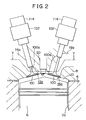
- FIGURE 2 is a longitudinal sectional view of the engine 2, taken on plane X-X in FIGURE 3.
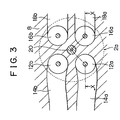
- FIGURE 3 is a sectional view of the engine 2, taken on plane Y-Y in
- FIGURE 2 is a diagrammatic representation of FIGURE 1
- the engine 2 is installed in a motor vehicle so as to drive the vehicle.
- the engine 2 has four cylinders 2a.
- Each cylinder 2a has a combustion chamber 10 that is defined by a cylinder block 4, a cylinder head 8 mounted on the cylinder block 4, and a piston 6 disposed inside the cylinder block 4 for reciprocating movements.
- Each combustion chamber 10 is provided with a first intake valve 12a, a second intake valve 12b, a first exhaust valve 16a and a second exhaust valve 16b.
- the valves 12a, 12b, 16a, 16b are formed as electromagnetically driven valves.
- the valves of each cylinder 2a are disposed so that the first intake valve 12a opens and closes a first intake port 14a, the second intake valve 12b opens and closes a second intake port 14b, the first exhaust valve 16a opens and closes a first exhaust port 18a, and the second exhaust valve 16b opens and closes a second exhaust port 18b.
- each intake port 14a and the second intake port 14b of each cylinder 2a are connected to a surge tank 32 via an intake passage 30a formed in an intake manifold 30.
- Each intake passage 30a is provided with a fuel injection valve 34 for injecting a needed amount of fuel into the first and second intake ports 14a and 14b.
- the surge tank 32 is connected to an air cleaner 42 via an intake duct 40.
- a throttle valve 46 that is driven by a motor 44 (a DC motor or a step motor) is disposed in the intake duct 40.
- the degree of opening of the throttle valve 46 (throttle opening TA) is detected by a throttle opening sensor 46a, and is controlled in accordance with operational conditions of the engine 2 and the operation of an accelerator pedal 74.
- the first exhaust port 18a and the second exhaust port 18b of each cylinder 2a are connected to an exhaust manifold 48, whereby exhaust gas is led to a catalytic converter 50 and then is released to the atmosphere.
- An electronic control unit (hereinafter, referred to as "ECU") 60 is formed by a digital computer equipped with a RAM (random access memory) 64, a ROM (read-only memory) 66, a CPU (microprocessor) 68, an input port 70, and an output port 72 that are interconnected by a bidirectional bus 62.
- a RAM random access memory
- ROM read-only memory
- CPU microprocessor
- the throttle opening sensor 46a for detecting the throttle opening TA outputs a voltage proportional to the degree of opening of the throttle valve 46, and the output voltage is inputted to the input port 70 via an A/D converter 73.
- the accelerator pedal 74 is provided with an accelerator depression sensor 76 that outputs a voltage proportional to the amount of depression of the accelerator pedal 74 (hereinafter, referred to as "accelerator depression ACCP").
- the output voltage of the accelerator depression sensor 76 is inputted to the input port 70 via an A/D converter 73.
- a top dead center sensor 80 generates an output pulse when, for example, the No. 1 cylinder of the cylinders 2a reaches the top dead center.
- the output pulse of the top dead center sensor 80 is inputted to the input port 70.
- a crank angle sensor 82 generates an output pulse every time a crankshaft turns 30°.
- the output pulse of the crank angle sensor 82 is inputted to the input port 70.
- the CPU 68 calculates a present crank angle.
- the CPU 68 calculates an engine revolution speed.
- the intake duct 40 is provided with an intake air amount sensor 84 that outputs a voltage corresponding to an amount of intake air GA flowing through the intake duct 40.
- the output voltage of the intake air amount sensor 84 is inputted to the input port 70 via an A/D converter 73.
- the cylinder block 4 of the engine 2 is provided with a water temperature senor 86 that detects the temperature THW of cooling water of the engine 2 and outputs a voltage in accordance with the cooling water temperature THW to the input port 70 via an A/D converter 73.
- the exhaust manifold 48 is provided with an air-fuel ratio sensor 88 that outputs a voltage in accordance with the air-fuel ratio, to the input port 70 via an A/D converter 73.
- the output port 72 is connected to the fuel injection valves 34 via a corresponding drive circuit 90.
- the ECU 60 performs a control of opening each fuel injection valve 34, and performs a fuel injection timing control and a fuel injection amount control.
- the output port 72 is also connected to the intake valves 12a, 12b and the exhaust valves 16a, 16b, via a drive circuit 92.
- the ECU 60 performs a control of opening the valves 12a, 12b, 16a, 16b, and performs an intake air amount control, an exhaust control, and an internal EGR control.
- the output port 72 is also connected to the motor 44 via a drive circuit 93.
- the ECU 60 controls the degree of opening of the throttle valve 46 in accordance with the operational condition of the engine 2 and the accelerator depression ACCP.
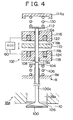
- FIGURE 4 illustrates an internal construction of the first exhaust valve 16a.
- the first exhaust valve 16a has a valve body 100, a valve shaft 100a extending from the valve body 100, and an electromagnetic drive unit 102.
- the valve shaft 100a has a lower retainer 104 that is fixed to an end portion of the valve shaft 100a opposite from the valve body 100.
- a compressed lower spring 106 is disposed between the lower retainer 104 and a spring support surface 8a that is formed on the cylinder head 8.
- the lower retainer 104 urges the valve body 100 and the valve shaft 100a in such a direction that the valve body 100 and the valve shaft 100a move away from the combustion chamber 10, that is, in such a direction that the valve body 100 closes the first exhaust port 18a.
- the electromagnetic drive unit 102 has, in a central portion thereof, an armature shaft 108 that extends coaxially with the valve shaft 100a.
- the armature shaft 108 has a high magnetic permeability material-made armature 110 that is fixed to a substantially central portion of the armature shaft 108, and an upper retainer 112 that is fixed to an end of the armature shaft 108.
- An end portion of the armature shaft 108 remote from the upper retainer 112 is in contact with an end portion of the valve shaft 100a closer to the lower retainer 104.
- An annular upper core 116 is fixed inside a casing 114 (FIGURE 2) of the electromagnetic drive unit 102, at a position between the upper retainer 112 and the armature 110, with the armature shaft 108 extending through the upper core 116.
- An annular lower core 118 is fixed inside the casing 114 of the electromagnetic drive unit 102, at a side of the armature 110 opposite from the upper core 116, with the armature shaft 108 extending through the lower core 118.
- the casing 114 is fixed to the cylinder head 8.
- the upper core 116 and the lower core 118 are supported slidably along the armature shaft 108 by bushes 116a, 118a each of which is provided in a central through-hole of the corresponding one of the upper core 116 and the lower core 118.
- a compressed upper spring 120 is disposed between the upper retainer 112 fixed to the upper end of the armature shaft 108 and an upper cap 114a provided in the casing 114.
- the upper spring 120 urges the armature shaft 108 to the valve shaft 100a. Therefore, the valve shaft 100a and the valve body 100 receive forces from the lower spring 106 and the upper spring 120 in opposite directions.
- the upper core 116 is formed from a high magnetic permeability material, and has an annular groove 116b that extends around the armature shaft 108 extending through the upper core 116 in a slidable manner.
- the annular groove 116b opens toward the armature 110.
- An exciting upper coil 122 is disposed in the annular groove 116b.
- the lower core 118 is formed from a high magnetic permeability material, and has an annular groove 118b that extends around the armature shaft 108 extending through the lower core 118 in a slidable manner.
- the annular groove 118b opens toward the armature 110.
- An exciting upper coil 124 is disposed in the annular groove 118b.
- FIGURE 4 shows a state in which neither the upper coil 122 nor the lower coil 124 is supplied with an exciting current.
- the armature 110 since the armature 110 is not magnetically attracted toward either the upper core 116 or the lower core 118, the armature shaft 108 and the valve shaft 100a exist at a position where the forces mainly from the upper spring 120 and the lower spring 106 balance each other.
- the valve body 100 is slightly apart from a valve seat 126, and the first exhaust port 18a is half open.
- the upper coil 122 When the upper coil 122 is supplied with an exciting current, the upper core 116 magnetized by the upper coil 122 attracts the armature 110. The attracting force moves the armature 110 to contact the upper core 116, overcoming the force from the upper spring 120.
- the exciting current is reduced to a current that is needed to hold the armature 110 in position (hereinafter, referred to as "hold current"), as indicated in a portion preceding time point t1 in a timing chart in FIGURE 5 that indicates an operation of the first exhaust valve 16a.
- hold current a current that is needed to hold the armature 110 in position
- the attraction force from the upper core 116 that holds the armature 110 is quickly removed (time t1-t2) by supplying the upper coil 122 with a reverse current (hereinafter, referred to as "release current") opposite in direction to the hold current.
- release current a reverse current
- the current supplied to the upper coil 122 is changed to zero at time point t2.
- the armature 110 starts to move toward the lower core 118, that is, toward the fully open state, due to the force from the upper spring 120.
- the valve body 100 starts to separate from the valve seat 126, and the valve lift starts to increase.
- draw current a great current supplied to the lower coil 124 (time t3-t4) to draw the armature 110, which has been released from the upper core 116, until the armature 110 contacts the lower core 118.
- the current is reduced to the hold current (time t4-t5).
- the armature 110 is held in a state where the valve body 100 is farthest apart from the valve seat 126, that is, a fully open state.
- the hold current supplied to the lower coil 124 is changed to the release current (time point t5), whereby the attraction force of the lower core 118 holding the armature 110 is rapidly removed (time t5-t6).
- the current through the lower coil 124 is set to zero.
- the armature 110 starts to move toward the upper core 116, that is, toward the completely closed state, due to the force from the lower spring 106.
- the valve body 100 starts to move toward the valve seat 126, and the valve lift starts to decrease.
- the draw current is supplied to the upper coil 122 (time t7-t8).
- the armature 110 which has been released from the lower core 118, is drawn until the armature 110 contacts the upper core 116.
- a reduced valve lift of the first exhaust valve 16a can be achieved by using a drive method that is different from the above-described drive method.
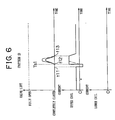
- the drive method for achieving a reduced valve lift will be described with reference to the timing chart of FIGURE 6.
- the attraction force of the upper core 116 holding the armature 110 is rapidly diminished (time t11-t12).
- the armature 110 starts to move toward the lower core 118, that is, toward the fully open sate, due to the force from the upper spring 120.
- the valve body 100 starts to move apart from the valve seat 126, and the valve lift starts to increase.
- the current supplied to the upper core 116 is changed from the release current to the draw current (time point t12).
- the armature 110 which has moved apart from the upper core 116, is stopped in partway to the lower core 118, and is drawn back toward the upper core 116.
- the valve seat 126 which has moved apart from the valve seat 126, starts to move toward the valve seat 126. That is, during this operation, the valve lift temporarily increases, and then starts to decrease before it reaches a maximum lift (i.e., the fully open state).
- the current supplied to the upper core 116 is changed from the draw current to the hold current.
- a valve pattern in which the valve lift does not reach the maximum lift (the fully open state) is achieved as indicated in FIGURE 6, thereby realizing a very small internal EGR amount.
- the internal EGR amount achieved in this method can be adjusted as indicated by a one-dot chain line in FIGURE 6, by adjusting the rate of rise of the draw current at time point t12 or adjusting the magnitude of the draw current.
- pattern 1 a valve open/close pattern as indicated in FIGURE 5 which is followed by the first exhaust valve 16a and the second exhaust valve 16b for internal EGR while the combustion chamber 10 is expanding in capacity
- pattern 2 a valve open/close pattern as indicated in FIGURE 6 that is followed by the first exhaust valve 16a and the second exhaust valve 16b
- pattern 1 an internal EGR is determined by the length of time during which the armature 110 is held to the lower core 118 by the magnetic attraction force produced by the lower coil 124.
- pattern 2 an internal EGR amount is determined by the lift pattern followed by the valve body 100 during the operation of temporarily moving the valve body 100 apart from the valve seat 126 and then moving the valve body 100 back to the valve seat 126. Therefore, pattern 2 tends to allow a control range less than that of pattern 1, in which the valve body 100 is opened by the magnetic attraction force that is actively produced by the lower coil 124. Pattern 2 has this tendency probably because during a period between the release from the magnetic attraction and the return to the upper core 116 in pattern 2, the armature 110 temporarily undergoes a floating state, and therefore is susceptible to ambient conditions.
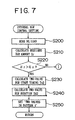
- FIGURES 7 and 8 are flowcharts illustrating an internal EGR control setting operation. This operation is executed periodically at every 180°CA (crank angle) provided that a condition for executing the internal EGR control is met. Steps in the flowcharts corresponding to various processings are indicated by "S".
- the ECU 60 When the internal EGR control setting operation is started, the ECU 60 first reads the engine revolution speed NE detected based on the signal from the crank angle sensor 82, and the load (more specifically, the intake air amount GA detected by the intake air amount sensor 84 in this embodiment) into a work area of the RAM 64 (S200).
- the ECU 60 calculates a required EGR amount Er from the engine revolution speed NE and the intake air amount GA read in step S200, based on a map illustrated in FIGURE 9 (S210). To form this map, suitable EGR amounts corresponding to various operational conditions are empirically determined. Therefore, in the map, the EGR amount is determined in relation to the parameters of the engine revolution speed NE and the intake air amount GA. The map is pre-stored in the ROM 66.
- the ECU 60 determines whether the required EGR amount Er is greater than a recirculation amount criterion Es (S220).
- the recirculation amount criterion Es is a value used to determine whether the internal EGR control can be performed by using both the first exhaust valve 16a and the second exhaust valve 16b or must be performed by using only one of the first exhaust valve 16a and the second exhaust valve 16b in order to achieve a high precision in the internal EGR control. If both the first exhaust valve 16a and the second exhaust valve 16b were used to perform the internal EGR control in all the operational regions, the control based on pattern 2 could become necessary in the case of a relatively small required EGR amount Er.
- the control be based on pattern 1 as much as possible. Therefore, in order to increase the incidence of the control based on pattern 1, the required EGR amount Er is evaluated in magnitude by using the recirculation amount criterion Es, and it is accordingly determined whether to perform the internal EGR control using both the valves or the internal EGR control using only one of the two valves.
- the ECU 60 calculates an EGR start timing Ts2 for the internal EGR control performed by driving both the first exhaust valve 16a and the second exhaust valve 16b during the intake stroke (S230).
- the two-valve EGR start timing Ts2 is calculated, for example, based on a map indicated in FIGURE 10 that uses the engine revolution speed NE and the intake air amount GA as parameters. This map is empirically formed. That is, suitable two-valve EGR start timings Ts2 corresponding to various operational conditions are determined in experiments where the two exhaust valves 16a, 16b are driven. Therefore, in the map, the two-valve EGR start timing Ts2 is determined in relation to the parameters of the engine revolution speed NE and the intake air amount GA. The map is pre-stored in the ROM 66.
- the ECU 60 calculates an EGR duration Td2 for the internal EGR control performed by driving both the first exhaust valve 16a and the second exhaust valve 16b during the intake stroke (S240).
- the two-valve EGR duration Td2 is determined based on a map by using the required EGR amount Er determined in step S210 as a parameter. This map is set by empirically determining suitable two-valve EGR durations Td2 corresponding to required EGR amounts Er in experiments where the two exhaust valves 16a, 16b are driven. The map is pre-stored in the ROM 66.
- the ECU 60 sets the information of "two-valve drive in pattern 1" as control data to be used in an exhaust valve driving routine (not shown) (S250), in order to perform the internal EGR control during the intake stroke.
- the information of "two-valve drive in pattern 1" indicates a control in which the first exhaust valve 16a and the second exhaust valve 16b are both driven based on pattern 1 (FIGURE 5). Subsequently, the ECU 60 temporarily ends this routine.
- the ECU 60 When the internal EGR control is set to the "two-valve drive in pattern 1" mode, the ECU 60, in the exhaust valve driving routine, controls the currents supplied to the upper coils 122 and the lower coils 124 of the first exhaust valve 16a and the second exhaust valve 16b in accordance with the two-valve EGR start timing Ts2 and the two-valve EGR duration Td2 during the intake stroke as indicated in FIGURE 5.
- step S220 If it is determined in step S220 that Er ⁇ Es (NO in S220), it is considered that the driving of the two exhaust valves 16a, 16b will not allow the open/close operation based on pattern 1. Therefore, the process proceeds to step S300.
- the ECU 60 calculates an EGR start timing Ts1 for the internal EGR control performed by driving one of the first exhaust valve 16a and the second exhaust valve 16b (e.g., the first exhaust valve 16a in this embodiment) during the intake stroke (S310).
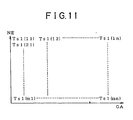
- the one-valve EGR start timing Ts1 is calculated, for example, based on a map indicated in FIGURE 11 that uses the engine revolution speed NE and the intake air amount GA as parameters. This map is empirically formed. That is, suitable one-valve EGR start timings Ts1 corresponding to various operational conditions are determined in experiments where only the first exhaust valve 16a is driven. Therefore, in the map, the one-valve EGR start timing Ts1 is determined in relation to the parameters of the engine revolution speed NE and the intake air amount GA. The map is pre-stored in the ROM 66.
- the ECU 60 calculates an EGR duration Td1 for the internal EGR control performed by driving only the first exhaust valve 16a during the intake stroke (S320).
- the one-valve EGR duration Td1 is determined based on a map by using the required EGR amount Er determined in step S210 as a parameter. This map is set by empirically determining suitable one-valve EGR durations Td1 corresponding to required EGR amounts Er in experiments where only the first exhaust valve 16a is driven. The map is pre-stored in the ROM 66.
- the ECU 60 determines whether the one-valve EGR duration Td1 is greater than a criterion a (S330).
- the criterion a is a value used to determine a situation where the changing of the current and the direction of current for achieving pattern 1 becomes difficult or impossible due to a very small one-valve EGR duration Td1 even though only one of the two exhaust valves is driven.
- the ECU 60 sets the information of "one-valve drive in pattern 1" as control data to be used in the exhaust valve driving routine (S340), in order to perform the internal EGR control during the intake stroke.
- the information of "one-valve drive in pattern 1" indicates a control in which the first exhaust valve 16a is driven based on pattern 1 (FIGURE 5) but the second exhaust valve 16b is not driven. Subsequently, the ECU 60 temporarily ends this routine.
- the ECU 60 drives only the first exhaust valve 16a in a pattern as indicated in FIGURE 5 during the intake stroke in the exhaust valve driving routine. More specifically, the ECU 60 sets a one-valve EGR start timing Ts1 and a one-valve EGR duration Td1, instead of the two-valve EGR start timing Ts2 and the two-valve EGR duration Td2, and controls the currents supplied to the upper coil 122 and the lower coil 124 as indicated in FIGURE 5.
- step S330 If it is determined in step S330 that Td1 ⁇ a (NO in S330), the ECU 60 sets the information of "one-valve drive in pattern 2" as control data to be used in the exhaust valve driving routine (S350), in order to perform the internal EGR control during the intake stroke.
- the information of "one-valve drive in pattern 2" indicates a control in which the first exhaust valve 16a is driven based on pattern 2 (FIGURE 6) but the second exhaust valve 16b is not driven. In pattern 2, the one-valve EGR duration Td1 does not exist.
- a control of the current supplied to the upper coil 122 that corresponds to the control based on the one-valve EGR duration Td1 is achieved by adjusting the rising rate of current as indicated by the one-dot chain line in FIGURE 6 or adjusting the magnitude of current. It is also possible to omit a control corresponding to the control based on the one-valve EGR duration Td1 and perform the control of current supplied to the upper coil 122 in a constant pattern, since the control range in pattern 2 is relatively narrow.
- the ECU 60 temporarily ends the routine.
- the ECU 60 drives only the first exhaust valve 16a in the pattern indicated in FIGURE 6 during the intake stroke by controlling the current supplied to the upper coil 122 in the exhaust gas driving routine.
- step S210 corresponds to a process performed by an exhaust gas recirculation amount calculating means
- steps S220 to S350 correspond to a process performed by an exhaust valve driving means.
- the second embodiment differs from the first embodiment in that the second embodiment performs an internal EGR control setting operation illustrated in FIGURE 13, instead of the internal EGR control setting operation illustrated in FIGURES 7 and 8.
- Other constructions and operations of the second embodiment are substantially the same as those of the first embodiment.
- the steps having substantially the same contents as those in the first embodiment are represented by reference numerals obtained by adding "1000" to the corresponding numerals used in FIGURES 8 and 9, unless otherwise mentioned.
- step S1210 is immediately followed by step S1300. That is, the second exhaust gas recirculation mode (steps S230 to S250) is omitted, and only the first exhaust gas recirculation mode (steps S1310 to S1350) is adopted.
- steps S1310 to S1350 correspond to a process performed by an exhaust valve driving means.
- a third embodiment of the invention will be described.
- the third embodiment performs a control as described below, by utilizing constructions of the first and second embodiments.
- the ECU 60 periodically executes an intake valve driving mode setting operation as illustrated in the flowchart of FIGURE 14 in a predetermined cycle, that is, at every 180°CA. Steps in the flowchart of FIGURE 14 corresponding to processings are represented by "S".
- the ECU 60 When the intake valve driving mode setting operation is started, the ECU 60 reads the detection values of the engine revolution speed NE and the load (e.g., the intake air amount GA in this embodiment) into a work area of the RAM 64 (S1400). Subsequently, the ECU 60 determines whether the engine operation is in a low-speed and low-load condition by comparing the detection values NE, GA with their respective thresholds (S1410).
- the detection values of the engine revolution speed NE and the load e.g., the intake air amount GA in this embodiment
- the ECU 60 If the engine operation is in the low-speed and low-load condition (YES in S1410), the ECU 60 enters a first intake mode in which the second intake valve 12b is not driven but the first intake valve 12a alone is driven to reduce the electric power for driving the valves (S1420). If the engine operation is not in the low-speed and low-load condition (NO in S1410), the ECU 60 enters a second intake mode in which the two intake valves 12a, 12b are driven, that is, the normal valve driving is performed (S1430). After step S1420 or step S1430 ends, the ECU 60 temporarily ends the intake valve driving mode setting operation.
- the ECU 60 also executes the internal EGR control setting operation as in the first or second embodiment.
- the second exhaust valve 16b is selected as an object to be driven during the first exhaust gas recirculation mode (steps S310 to S350 or steps S1310 to S1350). That is, the second exhaust valve 16b disposed diagonally opposite from the first intake valve 12a, which is opened during the first intake mode, is selected as an object to be driven during the internal EGR control.
- the intake valve driving mode setting operation illustrated in FIGURE 14 corresponds to a process performed by an intake valve driving means in the invention.
- the third embodiment achieves the following advantages.
- the electromagnetic drive unit 102 is of a type in which no permanent magnet is disposed in the upper core 116 or the lower core 118.
- the invention is also applicable to a construction having electromagnetic drive units in which a permanent magnet is disposed in at least one of an upper core and a lower core.
- the internal combustion engine is a gasoline engine
- the invention is also applicable to a diesel engine in substantially the same manner.
- the intake air amount is adjusted by the throttle valve 46
- the invention is also applicable to an engine system in which a throttle valve is not disposed in an intake duct 40 but the intake air amount can be adjusted by intake valves 12a, 12b.
- maps as indicated in FIGURES 9 to 11 may be formed by using the accelerator depression ACCP instead of the engine revolution speed NE.
- the exhaust valves 16a, 16b are driven in a valve drive mode suitably selected from the three modes, that is, the "two-valve drive in pattern 1" mode, the "one-valve drive in pattern 1" mode, and the “one-valve drive in pattern 2" mode, based on the magnitude of the required EGR amount Er, and the like.
- the valve drive mode may also be changed among four modes including the aforementioned three modes and a "two-valve drive in pattern 2" mode.
- the valve drive mode may be changed sequentially in the order of the "two-valve drive in pattern 1" mode, the "one-valve drive in pattern 1", the “two-valve drive in pattern 2" mode, and the "one-valve drive in pattern 2" mode.
- an exhaust valve disposed diagonally opposite from an intake valve used as an object to be driven during the first intake mode is set as an object to be driven during the first exhaust gas recirculation mode, while a combination of two intake valves and two exhaust valves is adopted.
- the invention is also applicable to a combination of three intake valves 152a, 152b, 152c and two exhaust valves 156a, 156b as shown in FIGURE 16. If an exhaust valve 156b disposed diagonally opposite from an intake valve 152a used as an object to be driven during the first intake mode is set as an object to be driven during the first exhaust gas recirculation mode, the formation of swirls is promoted and the combustibility improves as in the third embodiment.
- a first exhaust gas recirculation mode is entered by driving only a first exhaust valve of each cylinder.
- An open valve duration Td1 for achieving the required EGR amount Er in a one-valve drive manner is longer than a corresponding open valve duration in a two-valve drive manner. Therefore, even if the required EGR amount Er is small, a "one-valve drive in pattern 1" mode can be achieved provided that Td1 > a. That is, the incidence of performing the control in pattern 2, which allows only a narrow range of control, can be reduced. Hence, degradation of controllability can be prevented even if the required EGR amount Er is small.
Landscapes
- Engineering & Computer Science (AREA)
- Mechanical Engineering (AREA)
- General Engineering & Computer Science (AREA)
- Chemical & Material Sciences (AREA)
- Combustion & Propulsion (AREA)
- Physics & Mathematics (AREA)
- Electromagnetism (AREA)
- Output Control And Ontrol Of Special Type Engine (AREA)
- Valve Device For Special Equipments (AREA)
- Exhaust-Gas Circulating Devices (AREA)
Description
- The present invention relates to a valve driving apparatus for an internal combustion engine in which each cylinder is provided with a plurality of exhaust valves that are electromagnetically opened and closed.
- To improve the fuel economy and emission quality of internal combustion engines, exhaust gas recirculation (hereinafter, referred to as "EGR") systems for introducing exhaust gas into combustion chambers have been developed. Of the EGR systems, a generally-termed internal EGR system, in particular, controls the open-close timing of exhaust valves so that exhaust gas flows back into the combustion chambers during the intake stroke.
- In an internal combustion engine equipped with electromagnetically driven exhaust valves, in particular, an appropriate amount of EGR can be achieved by adjusting the open-close timing of the exhaust valves and the valve lift thereof in accordance with the operational condition of the engine, as described in Japanese Patent Application Laid-Open No. HEI 2-294547.
- In some engines, each cylinder is provided with a plurality of electromagnetically driven exhaust valves. By simultaneously driving the exhaust valves of each cylinder of such an engine, the flow resistance can be reduced during the exhaust stroke so as to quickly discharge exhaust gas. However, if the required EGR amount is relatively small during the EGR control, it becomes necessary to open and close each exhaust valve in a very short time. Furthermore, if the required EGR is small, adjustment based on the valve lift becomes necessary.
- To open an electromagnetically driven valve, a series of operations is performed based on the characteristics of the electromagnetically driven valve. That is, the valve body of the electromagnetically driven valve is released from a state in which the valve body is fixed at a closed valve position by controlling the electromagnetic force, and then the valve body is moved to and fixed at an open valve position by using electromagnetic force and a spring force. To close the electromagnetically driven valve, a series of operations for releasing the valve body from a state in which the valve body is fixed at the open valve position through control of the electromagnetic force and then moving the valve body to and fixing it in the closed valve position by using the electromagnetic force and the spring force is performed. Therefore, the valve opening timing is controlled based on a combination of the valve opening operation and the valve closing operation described above. Since a minimum operation time exists for each of the valve operations, the reduction of the EGR amount is also limited.
- To achieve a reduced valve lift of an electromagnetically driven valve, a series of operations is performed. That is, the valve body of the electromagnetically driven valve is temporarily released from the state in which the valve body is fixed at the open valve position through control of the electromagnetic force, and then the valve body is moved back to and fixed at the closed valve position by the electromagnetic force. During the operation of temporarily releasing the valve body and then returning the valve body to the original position, the valve body temporarily undergoes a floating state. Therefore, the valve lift pattern is susceptible to environmental changes.
- Therefore, in an engine in which a plurality of electromagnetically driven valves are provided for each cylinder, controllability of the EGR amount may degrade if the required EGR amount is relatively small.
Moreover , prior art document GB-A-2 328 975 discloses a combustion engine with internal EGR (exhaust gas recirculation) wherein the internal combustion engine concerned comprises cylinders each having one or more intake flow paths and having the flow rate through these intake flow paths controlled by corresponding intake valves. The arrangement is to create a swirling motion in the intake charge in the combustion chamber. The known combustion engine comprises two exhaust flow paths passing through one or more exhaust valves for discharging of exhaust gas from the combustion chamber to reinforce the swirling motion of the intake charge. Internal EGR is increased by specifically delaying the closing time of at least one exhaust valve late into the intake stroke. Both exhaust flow paths together are capable of discharging the full exhaust gas flow in the forward direction to the combustion chamber. One of these flow paths can be blocked to reverse flow during the intake stroke so that the flow of internal EGR gases can only take place through the other flow path to promote swirl. To this end at least one of the two exhaust flow paths comprises a valve means.
Furthermore, prior art document US-5 870 993 A discloses a method and an apparatus for operating a spark-ignited reciprocating-piston internal combustion engine, wherein a large quantity of exhaust gas is recirculated to obtain a specific swirling flow in the combustion chamber of the internal combustion engine. Charge stratification is produced in the combustion chamber to increase fresh gas concentration in the vicinity of the spark plug. Specifically, use is made of a specific charge stratification of exhaust gas and fresh gas, largely avoiding homogenisation. The exhaust valve operation (lift curve) in the direction of a retarded crank angle is adjusted. A large quantity of exhaust gas is recirculated and is introduced together with fresh gas into the combustion chamber, the amount of exhaust gas being defined on the basis of the exhaust gas lift curve to obtain the charge stratification. In case at least two exhaust valves are used, both exhaust valve lift curves are shifted in parallel with and together with the intake valve lift curve in the direction of a retarded crank angle. In a specific operation, one of the exhaust valves is operated and the other exhaust valve is rendered inactive.
In consideration of the above it is an object of the present invention to provide a valve driving apparatus for an internal combustion engine having a plurality of magnetically driven valves for each cylinder that are capable of preventing degradation of the controllability of the EGR amount even if the EGR amount is small.
According to the present invention this object is accomplished by a valve driving apparatus as set out in the appended claims.
The valve driving apparatus for an internal combustion engine according to a first aspect of the present invention includes a plurality of electromagnetically operated exhaust valves that are provided for each cylinder of the internal combustion engine, the plurality of exhaust valves including at least one first exhaust valve and at least one second exhaust valve. The valve driving apparatus comprises an exhaust valve driving means which, in a first mode when exhaust gas recirculation is performed independently of an exhaust stroke, drives the at least one first exhaust valve and does not drive the at least second exhaust valve. In this valve driving apparatus, the exhaust valve driving means performs the exhaust gas recirculation by driving only a limited number of the plurality of exhaust valves of each cylinder, instead of driving all the exhaust valves, when the exhaust gas recirculation is performed independently of the exhaust stroke. Therefore, the open valve duration of the exhaust valves for achieving the required EGR amount becomes longer than the corresponding open valve duration in the case where all the exhaust valves are driven. Furthermore, the incidence of a case where adjustment based on the amount of valve lift is needed is reduced. - Therefore, the degradation of the controllability of the EGR amount can be substantially prevented even if the required EGR amount is small.
- In the first aspect of the invention, the valve driving apparatus may further include an exhaust gas recirculation amount calculating means that determines a required exhaust gas recirculation amount in accordance with an operational condition of the internal combustion engine. During the exhaust gas recirculation performed independently of the exhaust stroke, the exhaust valve driving means enters a first exhaust gas recirculation mode of performing the exhaust gas recirculation by driving only the limited number of the plurality of exhaust valve of each cylinder, when the required exhaust gas recirculation amount determined by the exhaust gas recirculation amount calculating means is less than a recirculation amount criterion. When the required exhaust gas recirculation amount is greater than the recirculation amount criterion, the exhaust valve driving means enters a second exhaust gas recirculation mode of performing the exhaust gas recirculation by driving all the plurality of exhaust valves of each cylinder.
- That is, if the required EGR amount (required exhaust gas recirculation amount) determined by the exhaust gas recirculation amount calculating means is less than the recirculation amount criterion in the exhaust gas recirculation performed independently of the exhaust stroke, the exhaust valve driving means enters the first exhaust gas recirculation mode, that is, performs the exhaust gas recirculation by driving only the limited number of exhaust valve of each cylinder. Therefore, the open valve duration of the exhaust valves for achieving the required EGR amount becomes relatively long, and the incidence of adjustment based on the amount of valve lift becomes relatively low. Hence, the degradation of the controllability can be substantially prevented even if the required EGR amount is small.
- When the required exhaust gas recirculation amount is greater than the recirculation amount criterion, the exhaust valve driving means may enter the second exhaust gas recirculation mode, that is, perform the exhaust gas recirculation by driving all the exhaust valves of each cylinder. Thus, the exhaust gas recirculation is performed by driving all the exhaust valves if, despite driving all the exhaust valves, the open valve duration of the exhaust valves does not become so short as to degrade the controllability. Therefore, even if the required EGR amount is considerably great, the exhaust gas recirculation can be reliably and appropriately performed.
- The foregoing and further objects, features and advantages of the present invention will become apparent from the following description of preferred embodiments with reference to the accompanying drawings, wherein like numerals are used to represent like elements and wherein:
- FIGURE 1 is a schematic block diagram of an engine and its control system according to a first embodiment of the invention;
- FIGURE 2 is a longitudinal sectional view of the engine of the first embodiment:
- FIGURE 3 is a sectional view taken on plane Y-Y in FIGURE 2;
- FIGURE 4 is an illustration of a construction of a first exhaust valve in the first embodiment;
- FIGURE 5 is a timing chart indicating an operation of the first exhaust valve in
pattern 1; - FIGURE 6 is a timing chart indicating an operation of the first exhaust valve in
pattern 2; - FIGURE 7 is a flowchart illustrating an internal EGR control setting operation in the first embodiment;
- FIGURE 8 is a flowchart illustrating the internal EGR control setting operation in the first embodiment;
- FIGURE 9 illustrates a map for determining a required EGR amount Er in the first embodiment;
- FIGURE 10 illustrates a map for determining a two-valve EGR start timing Ts2 in the first embodiment;
- FIGURE 11 illustrates a map for determining a one-valve EGR start timing Ts1 in the first embodiment;
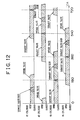
- FIGURE 12 illustrates the drive states of the intake and exhaust valves of individual cylinders in the first embodiment;
- FIGURE 13 is a flowchart illustrating an internal EGR control setting operation in a second embodiment of the invention;
- FIGURE 14 is a flowchart illustrating an intake valve drive mode setting operation in a third embodiment of the invention;
- FIGURE 15 illustrates swirls in the third embodiment; and
- FIGURE 16 illustrates swirls in a further embodiment of the invention.
- Preferred embodiments of the invention will be described in detail hereinafter with reference to the accompanying drawings. A first preferred embodiment will first be described.
- FIGURE 1 is a schematic block diagram of a construction of an internal combustion gasoline engine (hereinafter, referred to simply as "engine") 2 to which the invention is applied, and a control system of the
engine 2. FIGURE 2 is a longitudinal sectional view of theengine 2, taken on plane X-X in FIGURE 3. FIGURE 3 is a sectional view of theengine 2, taken on plane Y-Y in - The
engine 2 is installed in a motor vehicle so as to drive the vehicle. Theengine 2 has fourcylinders 2a. Eachcylinder 2a has acombustion chamber 10 that is defined by acylinder block 4, acylinder head 8 mounted on thecylinder block 4, and apiston 6 disposed inside thecylinder block 4 for reciprocating movements. - Each
combustion chamber 10 is provided with afirst intake valve 12a, asecond intake valve 12b, afirst exhaust valve 16a and asecond exhaust valve 16b. Thevalves cylinder 2a are disposed so that thefirst intake valve 12a opens and closes afirst intake port 14a, thesecond intake valve 12b opens and closes asecond intake port 14b, thefirst exhaust valve 16a opens and closes afirst exhaust port 18a, and thesecond exhaust valve 16b opens and closes asecond exhaust port 18b. - As shown in FIGURE 1, the
first intake port 14a and thesecond intake port 14b of eachcylinder 2a are connected to asurge tank 32 via anintake passage 30a formed in anintake manifold 30. Eachintake passage 30a is provided with afuel injection valve 34 for injecting a needed amount of fuel into the first andsecond intake ports - The
surge tank 32 is connected to anair cleaner 42 via anintake duct 40. Athrottle valve 46 that is driven by a motor 44 (a DC motor or a step motor) is disposed in theintake duct 40. The degree of opening of the throttle valve 46 (throttle opening TA) is detected by athrottle opening sensor 46a, and is controlled in accordance with operational conditions of theengine 2 and the operation of anaccelerator pedal 74. - The
first exhaust port 18a and thesecond exhaust port 18b of eachcylinder 2a are connected to anexhaust manifold 48, whereby exhaust gas is led to acatalytic converter 50 and then is released to the atmosphere. - An electronic control unit (hereinafter, referred to as "ECU") 60 is formed by a digital computer equipped with a RAM (random access memory) 64, a ROM (read-only memory) 66, a CPU (microprocessor) 68, an
input port 70, and anoutput port 72 that are interconnected by abidirectional bus 62. - The
throttle opening sensor 46a for detecting the throttle opening TA outputs a voltage proportional to the degree of opening of thethrottle valve 46, and the output voltage is inputted to theinput port 70 via an A/D converter 73. Theaccelerator pedal 74 is provided with anaccelerator depression sensor 76 that outputs a voltage proportional to the amount of depression of the accelerator pedal 74 (hereinafter, referred to as "accelerator depression ACCP"). The output voltage of theaccelerator depression sensor 76 is inputted to theinput port 70 via an A/D converter 73. A topdead center sensor 80 generates an output pulse when, for example, the No. 1 cylinder of thecylinders 2a reaches the top dead center. The output pulse of the topdead center sensor 80 is inputted to theinput port 70. Acrank angle sensor 82 generates an output pulse every time a crankshaft turns 30°. The output pulse of thecrank angle sensor 82 is inputted to theinput port 70. Based on the output pulse of the topdead center sensor 80 and the output pulse of thecrank angle sensor 82, theCPU 68 calculates a present crank angle. Based on the frequency of output pulses of thecrank angle sensor 82, theCPU 68 calculates an engine revolution speed. - The
intake duct 40 is provided with an intakeair amount sensor 84 that outputs a voltage corresponding to an amount of intake air GA flowing through theintake duct 40. The output voltage of the intakeair amount sensor 84 is inputted to theinput port 70 via an A/D converter 73. Thecylinder block 4 of theengine 2 is provided with awater temperature senor 86 that detects the temperature THW of cooling water of theengine 2 and outputs a voltage in accordance with the cooling water temperature THW to theinput port 70 via an A/D converter 73. Theexhaust manifold 48 is provided with an air-fuel ratio sensor 88 that outputs a voltage in accordance with the air-fuel ratio, to theinput port 70 via an A/D converter 73. - Various other signals are also inputted to the
input port 70, although they are not indicated in the drawings since they are not important for the description of the first embodiment. - The
output port 72 is connected to thefuel injection valves 34 via acorresponding drive circuit 90. In accordance with the operational condition of theengine 2, theECU 60 performs a control of opening eachfuel injection valve 34, and performs a fuel injection timing control and a fuel injection amount control. Theoutput port 72 is also connected to theintake valves exhaust valves drive circuit 92. In accordance with the operational condition, theECU 60 performs a control of opening thevalves output port 72 is also connected to themotor 44 via adrive circuit 93. TheECU 60 controls the degree of opening of thethrottle valve 46 in accordance with the operational condition of theengine 2 and the accelerator depression ACCP. - The constructions of the
intake valves exhaust valves first exhaust valve 16a of acylinder 2a will be described as a representative. FIGURE 4 illustrates an internal construction of thefirst exhaust valve 16a. - The
first exhaust valve 16a has avalve body 100, avalve shaft 100a extending from thevalve body 100, and anelectromagnetic drive unit 102. Thevalve shaft 100a has alower retainer 104 that is fixed to an end portion of thevalve shaft 100a opposite from thevalve body 100. A compressedlower spring 106 is disposed between thelower retainer 104 and aspring support surface 8a that is formed on thecylinder head 8. Thelower retainer 104 urges thevalve body 100 and thevalve shaft 100a in such a direction that thevalve body 100 and thevalve shaft 100a move away from thecombustion chamber 10, that is, in such a direction that thevalve body 100 closes thefirst exhaust port 18a. - The
electromagnetic drive unit 102 has, in a central portion thereof, anarmature shaft 108 that extends coaxially with thevalve shaft 100a. Thearmature shaft 108 has a high magnetic permeability material-madearmature 110 that is fixed to a substantially central portion of thearmature shaft 108, and anupper retainer 112 that is fixed to an end of thearmature shaft 108. An end portion of thearmature shaft 108 remote from theupper retainer 112 is in contact with an end portion of thevalve shaft 100a closer to thelower retainer 104. - An annular
upper core 116 is fixed inside a casing 114 (FIGURE 2) of theelectromagnetic drive unit 102, at a position between theupper retainer 112 and thearmature 110, with thearmature shaft 108 extending through theupper core 116. An annularlower core 118 is fixed inside thecasing 114 of theelectromagnetic drive unit 102, at a side of thearmature 110 opposite from theupper core 116, with thearmature shaft 108 extending through thelower core 118. Thecasing 114 is fixed to thecylinder head 8. Theupper core 116 and thelower core 118 are supported slidably along thearmature shaft 108 bybushes upper core 116 and thelower core 118. - A compressed
upper spring 120 is disposed between theupper retainer 112 fixed to the upper end of thearmature shaft 108 and anupper cap 114a provided in thecasing 114. Theupper spring 120 urges thearmature shaft 108 to thevalve shaft 100a. Therefore, thevalve shaft 100a and thevalve body 100 receive forces from thelower spring 106 and theupper spring 120 in opposite directions. - The
upper core 116 is formed from a high magnetic permeability material, and has anannular groove 116b that extends around thearmature shaft 108 extending through theupper core 116 in a slidable manner. Theannular groove 116b opens toward thearmature 110. An excitingupper coil 122 is disposed in theannular groove 116b. - Similarly, the
lower core 118 is formed from a high magnetic permeability material, and has anannular groove 118b that extends around thearmature shaft 108 extending through thelower core 118 in a slidable manner. Theannular groove 118b opens toward thearmature 110. An excitingupper coil 124 is disposed in theannular groove 118b. - FIGURE 4 shows a state in which neither the
upper coil 122 nor thelower coil 124 is supplied with an exciting current. In this state, since thearmature 110 is not magnetically attracted toward either theupper core 116 or thelower core 118, thearmature shaft 108 and thevalve shaft 100a exist at a position where the forces mainly from theupper spring 120 and thelower spring 106 balance each other. In the state shown in FIGURE 4, therefore, thevalve body 100 is slightly apart from avalve seat 126, and thefirst exhaust port 18a is half open. - Next described will be a
first exhaust valve 16a-closing operation performed by supplying a control current from theECU 60. - When the
upper coil 122 is supplied with an exciting current, theupper core 116 magnetized by theupper coil 122 attracts thearmature 110. The attracting force moves thearmature 110 to contact theupper core 116, overcoming the force from theupper spring 120. - After the
armature 110 is brought into contact with theupper core 116, the exciting current is reduced to a current that is needed to hold thearmature 110 in position (hereinafter, referred to as "hold current"), as indicated in a portion preceding time point t1 in a timing chart in FIGURE 5 that indicates an operation of thefirst exhaust valve 16a. Thus, the contact state is maintained. When thearmature 110 is held in contact with theupper core 116 by the magnetic force from theupper coil 122, thevalve body 100 contacts thevalve seat 126, thereby completely closing thefirst exhaust port 18a. - The operation of opening the
first exhaust valve 16a from the completely closed state will be described. - As shown in FIGURE 5, the attraction force from the
upper core 116 that holds thearmature 110 is quickly removed (time t1-t2) by supplying theupper coil 122 with a reverse current (hereinafter, referred to as "release current") opposite in direction to the hold current. The current supplied to theupper coil 122 is changed to zero at time point t2. Upon the discontinuation of the force drawing thearmature 110 toward theupper core 116, thearmature 110 starts to move toward thelower core 118, that is, toward the fully open state, due to the force from theupper spring 120. Thus, thevalve body 100 starts to separate from thevalve seat 126, and the valve lift starts to increase. - In order to draw the
armature 110 into contact with thelower core 118, a great current (hereinafter, referred to as "draw current") is supplied to the lower coil 124 (time t3-t4) to draw thearmature 110, which has been released from theupper core 116, until thearmature 110 contacts thelower core 118. - When the
armature 110 contacts the lower core 118 (time point t4), the current is reduced to the hold current (time t4-t5). By holding thearmature 110 in contact with thelower core 118 in this manner, thearmature 110 is held in a state where thevalve body 100 is farthest apart from thevalve seat 126, that is, a fully open state. - The operation of closing the
first exhaust valve 16a from the fully open state will be described below. - To end the open valve period of the
first exhaust valve 16a, the hold current supplied to thelower coil 124 is changed to the release current (time point t5), whereby the attraction force of thelower core 118 holding thearmature 110 is rapidly removed (time t5-t6). At time point t6, the current through thelower coil 124 is set to zero. Upon discontinuation of the attraction force in the direction to thelower core 118, thearmature 110 starts to move toward theupper core 116, that is, toward the completely closed state, due to the force from thelower spring 106. Thus, thevalve body 100 starts to move toward thevalve seat 126, and the valve lift starts to decrease. - Then, to draw the
armature 110 into contact with theupper core 116, the draw current is supplied to the upper coil 122 (time t7-t8). Thus, thearmature 110, which has been released from thelower core 118, is drawn until thearmature 110 contacts theupper core 116. - When the
armature 110 contacts the upper core 116 (time point t8), the current through theupper coil 122 is reduced to the hold current (from time t8 on). By holding thearmature 110 in contact with theupper core 116 in this manner, thevalve body 100 is held in contact with thevalve seat 126, that is, the completely closed state. - The operations of opening and closing the
first exhaust valve 16a are performed as described above. - A reduced valve lift of the
first exhaust valve 16a can be achieved by using a drive method that is different from the above-described drive method. The drive method for achieving a reduced valve lift will be described with reference to the timing chart of FIGURE 6. - By supplying the release current to the upper coil 122 (time point t11), which has been held in contact with the
upper core 116 by the hold current, the attraction force of theupper core 116 holding thearmature 110 is rapidly diminished (time t11-t12). Upon discontinuation of the attraction force in the direction to theupper core 116, thearmature 110 starts to move toward thelower core 118, that is, toward the fully open sate, due to the force from theupper spring 120. Thus, thevalve body 100 starts to move apart from thevalve seat 126, and the valve lift starts to increase. - Then, the current supplied to the
upper core 116 is changed from the release current to the draw current (time point t12). Upon the supply of the draw current to theupper core 116, thearmature 110, which has moved apart from theupper core 116, is stopped in partway to thelower core 118, and is drawn back toward theupper core 116. Thus, thevalve seat 126, which has moved apart from thevalve seat 126, starts to move toward thevalve seat 126. That is, during this operation, the valve lift temporarily increases, and then starts to decrease before it reaches a maximum lift (i.e., the fully open state). - When the
armature 110 comes back into contact with the upper core 116 (time t13), the current supplied to theupper core 116 is changed from the draw current to the hold current. In this manner, a valve pattern in which the valve lift does not reach the maximum lift (the fully open state) is achieved as indicated in FIGURE 6, thereby realizing a very small internal EGR amount. The internal EGR amount achieved in this method can be adjusted as indicated by a one-dot chain line in FIGURE 6, by adjusting the rate of rise of the draw current at time point t12 or adjusting the magnitude of the draw current. - Hereinafter, a valve open/close pattern as indicated in FIGURE 5 which is followed by the
first exhaust valve 16a and thesecond exhaust valve 16b for internal EGR while thecombustion chamber 10 is expanding in capacity will be referred to as "pattern 1", and a valve open/close pattern as indicated in FIGURE 6 that is followed by thefirst exhaust valve 16a and thesecond exhaust valve 16b will be referred to as "pattern 2". Inpattern 1, an internal EGR is determined by the length of time during which thearmature 110 is held to thelower core 118 by the magnetic attraction force produced by thelower coil 124. Inpattern 2, an internal EGR amount is determined by the lift pattern followed by thevalve body 100 during the operation of temporarily moving thevalve body 100 apart from thevalve seat 126 and then moving thevalve body 100 back to thevalve seat 126. Therefore,pattern 2 tends to allow a control range less than that ofpattern 1, in which thevalve body 100 is opened by the magnetic attraction force that is actively produced by thelower coil 124.Pattern 2 has this tendency probably because during a period between the release from the magnetic attraction and the return to theupper core 116 inpattern 2, thearmature 110 temporarily undergoes a floating state, and therefore is susceptible to ambient conditions. - Of various operations performed by the
ECU 60 in theengine 2 constructed as described above, the internal EGR control will be described below. FIGURES 7 and 8 are flowcharts illustrating an internal EGR control setting operation. This operation is executed periodically at every 180°CA (crank angle) provided that a condition for executing the internal EGR control is met. Steps in the flowcharts corresponding to various processings are indicated by "S". - When the internal EGR control setting operation is started, the
ECU 60 first reads the engine revolution speed NE detected based on the signal from thecrank angle sensor 82, and the load (more specifically, the intake air amount GA detected by the intakeair amount sensor 84 in this embodiment) into a work area of the RAM 64 (S200). - Then, the
ECU 60 calculates a required EGR amount Er from the engine revolution speed NE and the intake air amount GA read in step S200, based on a map illustrated in FIGURE 9 (S210). To form this map, suitable EGR amounts corresponding to various operational conditions are empirically determined. Therefore, in the map, the EGR amount is determined in relation to the parameters of the engine revolution speed NE and the intake air amount GA. The map is pre-stored in theROM 66. - Then, the
ECU 60 determines whether the required EGR amount Er is greater than a recirculation amount criterion Es (S220). The recirculation amount criterion Es is a value used to determine whether the internal EGR control can be performed by using both thefirst exhaust valve 16a and thesecond exhaust valve 16b or must be performed by using only one of thefirst exhaust valve 16a and thesecond exhaust valve 16b in order to achieve a high precision in the internal EGR control. If both thefirst exhaust valve 16a and thesecond exhaust valve 16b were used to perform the internal EGR control in all the operational regions, the control based onpattern 2 could become necessary in the case of a relatively small required EGR amount Er. For high precision in the internal EGR control, however, it is desirable that the control be based onpattern 1 as much as possible. Therefore, in order to increase the incidence of the control based onpattern 1, the required EGR amount Er is evaluated in magnitude by using the recirculation amount criterion Es, and it is accordingly determined whether to perform the internal EGR control using both the valves or the internal EGR control using only one of the two valves. - If Er > Es (YES in S220), it is considered that the two
exhaust valves pattern 1. Therefore, a second exhaust gas recirculation mode (steps S230 to step 250) is entered. - In the second exhaust gas recirculation mode, the
ECU 60 calculates an EGR start timing Ts2 for the internal EGR control performed by driving both thefirst exhaust valve 16a and thesecond exhaust valve 16b during the intake stroke (S230). The two-valve EGR start timing Ts2 is calculated, for example, based on a map indicated in FIGURE 10 that uses the engine revolution speed NE and the intake air amount GA as parameters. This map is empirically formed. That is, suitable two-valve EGR start timings Ts2 corresponding to various operational conditions are determined in experiments where the twoexhaust valves ROM 66. - Subsequently, the
ECU 60 calculates an EGR duration Td2 for the internal EGR control performed by driving both thefirst exhaust valve 16a and thesecond exhaust valve 16b during the intake stroke (S240). The two-valve EGR duration Td2 is determined based on a map by using the required EGR amount Er determined in step S210 as a parameter. This map is set by empirically determining suitable two-valve EGR durations Td2 corresponding to required EGR amounts Er in experiments where the twoexhaust valves ROM 66. - Then, the
ECU 60 sets the information of "two-valve drive inpattern 1" as control data to be used in an exhaust valve driving routine (not shown) (S250), in order to perform the internal EGR control during the intake stroke. The information of "two-valve drive inpattern 1" indicates a control in which thefirst exhaust valve 16a and thesecond exhaust valve 16b are both driven based on pattern 1 (FIGURE 5). Subsequently, theECU 60 temporarily ends this routine. - When the internal EGR control is set to the "two-valve drive in
pattern 1" mode, theECU 60, in the exhaust valve driving routine, controls the currents supplied to theupper coils 122 and thelower coils 124 of thefirst exhaust valve 16a and thesecond exhaust valve 16b in accordance with the two-valve EGR start timing Ts2 and the two-valve EGR duration Td2 during the intake stroke as indicated in FIGURE 5. - If it is determined in step S220 that Er ≤ Es (NO in S220), it is considered that the driving of the two
exhaust valves pattern 1. Therefore, the process proceeds to step S300. In step S300, theECU 60 determines whether the required EGR amount Er is greater than "0". If Er = 0 (NO in S300), which means that there is no need for EGR, theECU 60 immediately ends the present cycle of the routine. - If Er > 0 (YES in S300), a first exhaust gas recirculation mode is entered (steps S310 to S350).
- In the first exhaust gas recirculation mode, the
ECU 60 calculates an EGR start timing Ts1 for the internal EGR control performed by driving one of thefirst exhaust valve 16a and thesecond exhaust valve 16b (e.g., thefirst exhaust valve 16a in this embodiment) during the intake stroke (S310). The one-valve EGR start timing Ts1 is calculated, for example, based on a map indicated in FIGURE 11 that uses the engine revolution speed NE and the intake air amount GA as parameters. This map is empirically formed. That is, suitable one-valve EGR start timings Ts1 corresponding to various operational conditions are determined in experiments where only thefirst exhaust valve 16a is driven. Therefore, in the map, the one-valve EGR start timing Ts1 is determined in relation to the parameters of the engine revolution speed NE and the intake air amount GA. The map is pre-stored in theROM 66. - Subsequently, the
ECU 60 calculates an EGR duration Td1 for the internal EGR control performed by driving only thefirst exhaust valve 16a during the intake stroke (S320). The one-valve EGR duration Td1 is determined based on a map by using the required EGR amount Er determined in step S210 as a parameter. This map is set by empirically determining suitable one-valve EGR durations Td1 corresponding to required EGR amounts Er in experiments where only thefirst exhaust valve 16a is driven. The map is pre-stored in theROM 66. - Subsequently, the
ECU 60 determines whether the one-valve EGR duration Td1 is greater than a criterion a (S330). The criterion a is a value used to determine a situation where the changing of the current and the direction of current for achievingpattern 1 becomes difficult or impossible due to a very small one-valve EGR duration Td1 even though only one of the two exhaust valves is driven. - If Td1 > a (YES in S330), the
ECU 60 sets the information of "one-valve drive inpattern 1" as control data to be used in the exhaust valve driving routine (S340), in order to perform the internal EGR control during the intake stroke. The information of "one-valve drive inpattern 1" indicates a control in which thefirst exhaust valve 16a is driven based on pattern 1 (FIGURE 5) but thesecond exhaust valve 16b is not driven. Subsequently, theECU 60 temporarily ends this routine. - When the internal EGR control is set to the "one-valve drive in
pattern 1" mode, theECU 60 drives only thefirst exhaust valve 16a in a pattern as indicated in FIGURE 5 during the intake stroke in the exhaust valve driving routine. More specifically, theECU 60 sets a one-valve EGR start timing Ts1 and a one-valve EGR duration Td1, instead of the two-valve EGR start timing Ts2 and the two-valve EGR duration Td2, and controls the currents supplied to theupper coil 122 and thelower coil 124 as indicated in FIGURE 5. - If it is determined in step S330 that Td1 ≤ a (NO in S330), the
ECU 60 sets the information of "one-valve drive inpattern 2" as control data to be used in the exhaust valve driving routine (S350), in order to perform the internal EGR control during the intake stroke. The information of "one-valve drive inpattern 2" indicates a control in which thefirst exhaust valve 16a is driven based on pattern 2 (FIGURE 6) but thesecond exhaust valve 16b is not driven. Inpattern 2, the one-valve EGR duration Td1 does not exist. Therefore, a control of the current supplied to theupper coil 122 that corresponds to the control based on the one-valve EGR duration Td1 is achieved by adjusting the rising rate of current as indicated by the one-dot chain line in FIGURE 6 or adjusting the magnitude of current. It is also possible to omit a control corresponding to the control based on the one-valve EGR duration Td1 and perform the control of current supplied to theupper coil 122 in a constant pattern, since the control range inpattern 2 is relatively narrow. - Then, the
ECU 60 temporarily ends the routine. - When the internal EGR control is set to the "one-valve drive in
pattern 1" mode, theECU 60 drives only thefirst exhaust valve 16a in the pattern indicated in FIGURE 6 during the intake stroke by controlling the current supplied to theupper coil 122 in the exhaust gas driving routine. - When the engine operation condition becomes a condition that needs internal EGR as a result of the above-described operation, only the
first exhaust valve 16a or both thefirst exhaust valve 16a and thesecond exhaust valve 16b are opened for the internal EGR control during the intake stroke as indicated in the graph of FIGURE 12. Therefore, a necessary amount of the exhaust gas discharged from thecombustion chamber 10 can be returned into thecombustion chamber 10 via theexhaust ports surge tank 32 into thecombustion chamber 10 via the openedintake valves - In the first embodiment, step S210 corresponds to a process performed by an exhaust gas recirculation amount calculating means, and steps S220 to S350 correspond to a process performed by an exhaust valve driving means.
- The above-described first embodiment achieves the following advantages.
- (a) If the required EGR amount Er determined in step S210 is less than the recirculation amount criterion Es (NO in S220) and is not equal to "0" (YES in S300) during the exhaust gas recirculation performed independently of the exhaust stroke, the first exhaust gas recirculation mode (steps S310 to S350) is entered. That is, the exhaust gas recirculation is performed by driving only the
first exhaust valve 16a of all theexhaust valves cylinder 2a.
The open valve duration of thefirst exhaust valve 16a during the exhaust gas recirculation using only that exhaust valve is longer than the open valve duration of theexhaust valves pattern 1" mode in step S340 provided that Td1 > a (YES in S330). That is, the incidence of execution of the control based on pattern 2 (S350), which allows only a reduced range of control, decreases. Hence, degradation of the controllability can be substantially prevented even if the required EGR amount Er is small. - (b) If the required EGR amount Er is greater than the recirculation amount criterion Es (YES in S220), the "two-valve drive in
pattern 1" mode (S230 to S250) is entered. That is, the exhaust gas recirculation is performed by driving all theexhaust valves cylinder 2a. Since all theexhaust valves - A second embodiment of the invention will be described below.
- The second embodiment differs from the first embodiment in that the second embodiment performs an internal EGR control setting operation illustrated in FIGURE 13, instead of the internal EGR control setting operation illustrated in FIGURES 7 and 8. Other constructions and operations of the second embodiment are substantially the same as those of the first embodiment. In the flowchart of FIGURE 13, the steps having substantially the same contents as those in the first embodiment are represented by reference numerals obtained by adding "1000" to the corresponding numerals used in FIGURES 8 and 9, unless otherwise mentioned.
- In the internal EGR control setting operation illustrated in FIGURE 13, the process of steps S220 to S250 in the internal EGR control setting operation of FIGURES 7 and 8 is omitted, so that step S1210 is immediately followed by step S1300. That is, the second exhaust gas recirculation mode (steps S230 to S250) is omitted, and only the first exhaust gas recirculation mode (steps S1310 to S1350) is adopted.
- Therefore, in the internal EGR control of the second embodiment, not all the
exhaust valves first exhaust valve 16a is driven in any case due to the process of steps S1310 to S1350. - In the second embodiment, steps S1310 to S1350 correspond to a process performed by an exhaust valve driving means.
- The above-described second embodiment achieves the following advantages.
- (a) The second embodiment achieves substantially the same advantage (a) of the first embodiment.
- A third embodiment of the invention will be described. The third embodiment performs a control as described below, by utilizing constructions of the first and second embodiments.
- In the third embodiment, the
ECU 60 periodically executes an intake valve driving mode setting operation as illustrated in the flowchart of FIGURE 14 in a predetermined cycle, that is, at every 180°CA. Steps in the flowchart of FIGURE 14 corresponding to processings are represented by "S". - When the intake valve driving mode setting operation is started, the
ECU 60 reads the detection values of the engine revolution speed NE and the load (e.g., the intake air amount GA in this embodiment) into a work area of the RAM 64 (S1400). Subsequently, theECU 60 determines whether the engine operation is in a low-speed and low-load condition by comparing the detection values NE, GA with their respective thresholds (S1410). - If the engine operation is in the low-speed and low-load condition (YES in S1410), the
ECU 60 enters a first intake mode in which thesecond intake valve 12b is not driven but thefirst intake valve 12a alone is driven to reduce the electric power for driving the valves (S1420). If the engine operation is not in the low-speed and low-load condition (NO in S1410), theECU 60 enters a second intake mode in which the twointake valves ECU 60 temporarily ends the intake valve driving mode setting operation. - The
ECU 60 also executes the internal EGR control setting operation as in the first or second embodiment. In the third embodiment, however, only thesecond exhaust valve 16b is selected as an object to be driven during the first exhaust gas recirculation mode (steps S310 to S350 or steps S1310 to S1350). That is, thesecond exhaust valve 16b disposed diagonally opposite from thefirst intake valve 12a, which is opened during the first intake mode, is selected as an object to be driven during the internal EGR control. - Therefore, if the first exhaust gas recirculation mode is entered during the first intake mode, intake air and exhaust gas swirl in the same directions, thereby promoting formation of swirls in the
combustion chamber 10, as indicated by arrows in FIGURE 15 (showing a state in thecombustion chamber 10 in a view taken from the bottom of the cylinder head 8). - In the above-described third embodiment, the intake valve driving mode setting operation illustrated in FIGURE 14 corresponds to a process performed by an intake valve driving means in the invention.
- The third embodiment achieves the following advantages.
- (a) Swirls of intake air introduced only via the
first intake valve 12a during the first intake mode is accelerated by a reverse flow of exhaust gas only via thesecond exhaust valve 16b if the first exhaust gas recirculation mode is entered. In that case, the combustibility further improves. - (b) The third embodiment achieves substantially the same advantages of the first or second embodiments.
- Other embodiments of the invention will be described.
- In the first to third embodiments, the
electromagnetic drive unit 102 is of a type in which no permanent magnet is disposed in theupper core 116 or thelower core 118. However, the invention is also applicable to a construction having electromagnetic drive units in which a permanent magnet is disposed in at least one of an upper core and a lower core. - Although in the first to third embodiment, the internal combustion engine is a gasoline engine, the invention is also applicable to a diesel engine in substantially the same manner.
- Although in the gasoline engine in each of the first to third embodiment, the intake air amount is adjusted by the
throttle valve 46, the invention is also applicable to an engine system in which a throttle valve is not disposed in anintake duct 40 but the intake air amount can be adjusted byintake valves - In the first embodiment, the
exhaust valves pattern 1" mode, the "one-valve drive inpattern 1" mode, and the "one-valve drive inpattern 2" mode, based on the magnitude of the required EGR amount Er, and the like. However, the valve drive mode may also be changed among four modes including the aforementioned three modes and a "two-valve drive inpattern 2" mode. In such a case, based on the magnitude of the required EGR amount Er and the like, more specifically, as the required EGR amount Er decreases, the valve drive mode may be changed sequentially in the order of the "two-valve drive inpattern 1" mode, the "one-valve drive inpattern 1", the "two-valve drive inpattern 2" mode, and the "one-valve drive inpattern 2" mode. - In the third embodiment, an exhaust valve disposed diagonally opposite from an intake valve used as an object to be driven during the first intake mode is set as an object to be driven during the first exhaust gas recirculation mode, while a combination of two intake valves and two exhaust valves is adopted. The invention is also applicable to a combination of three
intake valves intake valve 152a used as an object to be driven during the first intake mode is set as an object to be driven during the first exhaust gas recirculation mode, the formation of swirls is promoted and the combustibility improves as in the third embodiment. - While the present invention has been described with reference to what are presently considered to be preferred embodiments thereof, it is to be understood that the present invention is not limited to the disclosed embodiments or constructions. On the contrary, the present invention is intended to cover various modifications and equivalent arrangements. In addition, while the various elements of the disclosed invention are shown in various combinations and configurations, which are exemplary, other combinations and configurations, including more, less or only a single embodiment, are also within the spirit and scope of the present invention.
- In an internal combustion engine having a plurality of electromagnetically driven valves for each cylinder, when a required EGR amount Er is relatively small during an exhaust gas recirculation performed independently of the exhaust stroke, a first exhaust gas recirculation mode is entered by driving only a first exhaust valve of each cylinder. An open valve duration Td1 for achieving the required EGR amount Er in a one-valve drive manner is longer than a corresponding open valve duration in a two-valve drive manner. Therefore, even if the required EGR amount Er is small, a "one-valve drive in
pattern 1" mode can be achieved provided that Td1 > a. That is, the incidence of performing the control inpattern 2, which allows only a narrow range of control, can be reduced. Hence, degradation of controllability can be prevented even if the required EGR amount Er is small.
Claims (6)
- A valve driving apparatus for an internal combustion engine including a plurality of electromagnetically operated exhaust valves (16a, 16b) for each cylinder of the engine, the plurality of exhaust valves including a least one first exhaust valve (16a) and a least one second exhaust valve (16b),
the valve driving apparatus comprising:an exhaust gas recirculation amount calculating means (S210) for determining a required exhaust gas recirculation amount in accordance with an operational condition of the engine, andan exhaust valve driving means (S220 - S350, S1310 - S1350) for controlling operations of the exhaust valves so that exhaust gas flows back into a combustion chamber, independently of controlling operations of the exhaust valves during the exhaust stroke of the internal combustion engine, and for, in a first exhaust gas recirculation mode when exhaust gas recirculation is performed independently of an exhaust stroke, driving the at least one first exhaust valve (16a) and does not drive the at least one second exhaust valve (16b), whereinthe exhaust valve driving means (S220 - S350) operates exhaust gas recirculation under the first mode when the required exhaust gas recirculation amount (Er) is less than a recirculation amount criterion and in that, when the required exhaust gas recirculation amount (Er) is greater than the recirculation amount criterion, the exhaust valve driving means (S220 - S350) operates under a second exhaust gas recirculation mode exhaust gas recirculation driving all of the exhaust valves (16a,16b). - A valve driving apparatus for an internal combustion engine according to claim 1, wherein an amount of lift by which the exhaust valve driving means (S220 - S350) moves the exhaust valves is determined based on a quantity related to the required exhaust gas recirculation amount (Er).
- A valve driving apparatus for an internal combustion engine according to claim 2, wherein the quantity related to the required exhaust gas recirculation amount (Er) is a required control duration for performing the exhaust gas recirculation.
- A valve driving apparatus for an internal combustion engine according to claim 3, wherein
when the required exhaust gas recirculation amount (Er) is less than the recirculation amount criterion and the required control duration (Td1) is greater than a predetermined threshold, the exhaust valve driving means (S220 - S350) moves only the at least one first exhaust valve (16a) to a fully open state and wherein,
when the required exhaust gas recirculation amount (Er) is less than the recirculation amount criterion and the required control duration (Td1) is less than the predetermined threshold, the exhaust valve driving means (S220 - S350) moves only the at least one first exhaust valve (16a) in a valve opening direction and then moves the at least one first exhaust valve (16a) in a valve closing direction before the at least one first exhaust valve reach the fully open state. - A valve driving apparatus for an internal combustion engine as claimed in any of claims 1 to 4, wherein
the engine includes a plurality of intake valves (12a, 12b) for each cylinder of the engine, the plurality of intake valves including at least one first intake valve (12a) and at least one second intake valve (12b), and
the valve driving apparatus further comprising an intake valve driving means (S1400 - S1430) for, in a first intake mode, driving the at least one first intake valve (12a) for each cylinder and not driving the at least one second intake valve (12b) for each cylinder and for, in a second intake mode, driving all of the intake valves (12a, 12b), the intake valve driving means (S1400 - S1430) for switching between the first and second intake modes based on an operational condition of the engine, and wherein
the exhaust valve driving means (S1400 - S1430) selects, as one of the first exhaust valves for each cylinder, an exhaust valve positioned to promote a swirl in a combustion chamber during the first intake mode. - A valve driving apparatus for an internal combustion engine according to claim 5, wherein each cylinder is provided with two intake valves (12a, 12b) and two exhaust valves (16a, 16b), and in that the exhaust valve driving means (S1310 - S1350) selects, as one of the first exhaust valves for each cylinder, an exhaust valve disposed diagonally opposite from an intake valve selected as one of the first intake valves for the corresponding cylinder.
Applications Claiming Priority (2)
| Application Number | Priority Date | Filing Date | Title |
|---|---|---|---|
| JP19740399A JP3994586B2 (en) | 1999-07-12 | 1999-07-12 | Valve driving device for internal combustion engine |
| JP19740399 | 1999-07-12 |
Publications (3)
| Publication Number | Publication Date |
|---|---|
| EP1069283A2 EP1069283A2 (en) | 2001-01-17 |
| EP1069283A3 EP1069283A3 (en) | 2002-11-27 |
| EP1069283B1 true EP1069283B1 (en) | 2006-08-23 |
Family
ID=16373941
Family Applications (1)
| Application Number | Title | Priority Date | Filing Date |
|---|---|---|---|
| EP00114846A Expired - Lifetime EP1069283B1 (en) | 1999-07-12 | 2000-07-11 | Valve driving apparatus for internal combustion engine |
Country Status (4)
| Country | Link |
|---|---|
| US (1) | US6374813B1 (en) |
| EP (1) | EP1069283B1 (en) |
| JP (1) | JP3994586B2 (en) |
| DE (1) | DE60030216T2 (en) |
Families Citing this family (42)
| Publication number | Priority date | Publication date | Assignee | Title |
|---|---|---|---|---|
| JP2002180894A (en) * | 2000-12-12 | 2002-06-26 | Toyota Motor Corp | Control device for internal combustion engine |
| JP3900081B2 (en) * | 2002-12-17 | 2007-04-04 | トヨタ自動車株式会社 | In-cylinder inflow exhaust gas amount calculation device for internal combustion engine and inflow exhaust gas amount calculation device for intake passage |
| US7004124B2 (en) * | 2003-07-01 | 2006-02-28 | General Motors Corporation | Valve strategy for operating a controlled auto-ignition four-stroke internal combustion engine |
| DE10338663B4 (en) * | 2003-08-22 | 2009-01-02 | Audi Ag | Control unit of an actuator having device |
| FR2859765B1 (en) * | 2003-09-15 | 2007-08-31 | Renault Sa | SYSTEM AND METHOD FOR EXHAUST GAS RECIRCULATION FOR INTERNAL COMBUSTION ENGINE |
| US6871617B1 (en) | 2004-01-09 | 2005-03-29 | Ford Global Technologies, Llc | Method of correcting valve timing in engine having electromechanical valve actuation |
| US7107947B2 (en) * | 2004-03-19 | 2006-09-19 | Ford Global Technologies, Llc | Multi-stroke cylinder operation in an internal combustion engine |
| US7128043B2 (en) | 2004-03-19 | 2006-10-31 | Ford Global Technologies, Llc | Electromechanically actuated valve control based on a vehicle electrical system |
| US7128687B2 (en) * | 2004-03-19 | 2006-10-31 | Ford Global Technologies, Llc | Electromechanically actuated valve control for an internal combustion engine |
| US7559309B2 (en) * | 2004-03-19 | 2009-07-14 | Ford Global Technologies, Llc | Method to start electromechanical valves on an internal combustion engine |
| US7055483B2 (en) * | 2004-03-19 | 2006-06-06 | Ford Global Technologies, Llc | Quick starting engine with electromechanical valves |
| US7066121B2 (en) * | 2004-03-19 | 2006-06-27 | Ford Global Technologies, Llc | Cylinder and valve mode control for an engine with valves that may be deactivated |
| US7032581B2 (en) * | 2004-03-19 | 2006-04-25 | Ford Global Technologies, Llc | Engine air-fuel control for an engine with valves that may be deactivated |
| US7140355B2 (en) * | 2004-03-19 | 2006-11-28 | Ford Global Technologies, Llc | Valve control to reduce modal frequencies that may cause vibration |
| US7383820B2 (en) * | 2004-03-19 | 2008-06-10 | Ford Global Technologies, Llc | Electromechanical valve timing during a start |
| US7240663B2 (en) * | 2004-03-19 | 2007-07-10 | Ford Global Technologies, Llc | Internal combustion engine shut-down for engine having adjustable valves |
| US7194993B2 (en) * | 2004-03-19 | 2007-03-27 | Ford Global Technologies, Llc | Starting an engine with valves that may be deactivated |
| US7079935B2 (en) * | 2004-03-19 | 2006-07-18 | Ford Global Technologies, Llc | Valve control for an engine with electromechanically actuated valves |
| US7107946B2 (en) * | 2004-03-19 | 2006-09-19 | Ford Global Technologies, Llc | Electromechanically actuated valve control for an internal combustion engine |
| US7017539B2 (en) * | 2004-03-19 | 2006-03-28 | Ford Global Technologies Llc | Engine breathing in an engine with mechanical and electromechanical valves |
| US7165391B2 (en) | 2004-03-19 | 2007-01-23 | Ford Global Technologies, Llc | Method to reduce engine emissions for an engine capable of multi-stroke operation and having a catalyst |
| US7021289B2 (en) * | 2004-03-19 | 2006-04-04 | Ford Global Technology, Llc | Reducing engine emissions on an engine with electromechanical valves |
| US7032545B2 (en) * | 2004-03-19 | 2006-04-25 | Ford Global Technologies, Llc | Multi-stroke cylinder operation in an internal combustion engine |
| US6938598B1 (en) | 2004-03-19 | 2005-09-06 | Ford Global Technologies, Llc | Starting an engine with electromechanical valves |
| US7555896B2 (en) * | 2004-03-19 | 2009-07-07 | Ford Global Technologies, Llc | Cylinder deactivation for an internal combustion engine |
| US7028650B2 (en) * | 2004-03-19 | 2006-04-18 | Ford Global Technologies, Llc | Electromechanical valve operating conditions by control method |
| US7031821B2 (en) * | 2004-03-19 | 2006-04-18 | Ford Global Technologies, Llc | Electromagnetic valve control in an internal combustion engine with an asymmetric exhaust system design |
| US7072758B2 (en) * | 2004-03-19 | 2006-07-04 | Ford Global Technologies, Llc | Method of torque control for an engine with valves that may be deactivated |
| US7063062B2 (en) * | 2004-03-19 | 2006-06-20 | Ford Global Technologies, Llc | Valve selection for an engine operating in a multi-stroke cylinder mode |
| DE102004022922A1 (en) * | 2004-05-10 | 2005-12-08 | Daimlerchrysler Ag | Device having a unit for actuating at least one outlet valve |
| JP4254614B2 (en) * | 2004-05-18 | 2009-04-15 | 株式会社豊田自動織機 | Premixed compression ignition engine |
| US7150250B2 (en) * | 2004-07-26 | 2006-12-19 | General Motors Corporation | Valve and fueling strategy for operating a controlled auto-ignition four-stroke internal combustion engine |
| US7128047B2 (en) * | 2004-07-26 | 2006-10-31 | General Motors Corporation | Valve and fueling strategy for operating a controlled auto-ignition four-stroke internal combustion engine |
| US7152559B2 (en) * | 2004-07-26 | 2006-12-26 | General Motors Corporation | Valve and fueling strategy for operating a controlled auto-ignition four-stroke internal combustion engine |
| US7089895B2 (en) * | 2005-01-13 | 2006-08-15 | Motorola, Inc. | Valve operation in an internal combustion engine |
| US7458345B2 (en) * | 2005-04-15 | 2008-12-02 | Ford Global Technologies, Llc | Adjusting ballistic valve timing |
| JP2007315293A (en) * | 2006-05-25 | 2007-12-06 | Toyota Motor Corp | Valve control device for internal combustion engine |
| US7832370B2 (en) * | 2006-11-16 | 2010-11-16 | Gm Global Technology Operations, Inc. | Low-load operation extension of a homogeneous charge compression ignition engine |
| US7565899B2 (en) * | 2007-06-12 | 2009-07-28 | Ford Global Technologies, Llc | Engine fueling control during cylinder valve mode transitions |
| DE102007037333A1 (en) * | 2007-08-08 | 2009-02-26 | Daimler Ag | actuator |
| JP2013087628A (en) * | 2011-10-13 | 2013-05-13 | Mitsubishi Motors Corp | Engine with exhaust gas recirculating device |
| GB2570335B (en) * | 2018-01-22 | 2020-03-11 | Ford Global Tech Llc | An exhaust gas recirculation valve control method |
Family Cites Families (6)
| Publication number | Priority date | Publication date | Assignee | Title |
|---|---|---|---|---|
| JPH02294547A (en) | 1989-05-09 | 1990-12-05 | Isuzu Motors Ltd | Exhaust gas recirculating flow rate detecting device for engine and exhaust gas recirculating flow rate control device |
| US5203830A (en) * | 1992-06-01 | 1993-04-20 | Caterpillar Inc. | Method and apparatus to reduce engine combustion noise utilizing unit valve actuation |
| GB9222353D0 (en) * | 1992-10-23 | 1992-12-09 | Ricardo Consulting Eng | Spark ignited internal combustion engines |
| GB2301398B (en) * | 1994-03-07 | 1998-01-14 | Komatsu Mfg Co Ltd | Variable compression ratio engine |
| DE59705848D1 (en) * | 1996-06-20 | 2002-01-31 | Volkswagen Ag | Method and device for operating a spark-ignition reciprocating internal combustion engine |
| GB2328975A (en) * | 1997-09-03 | 1999-03-10 | Ford Global Tech Inc | Combustion engine with internal EGR |
-
1999
- 1999-07-12 JP JP19740399A patent/JP3994586B2/en not_active Expired - Fee Related
-
2000
- 2000-07-11 DE DE60030216T patent/DE60030216T2/en not_active Expired - Fee Related
- 2000-07-11 EP EP00114846A patent/EP1069283B1/en not_active Expired - Lifetime
- 2000-07-12 US US09/614,609 patent/US6374813B1/en not_active Expired - Fee Related
Also Published As
| Publication number | Publication date |
|---|---|
| DE60030216D1 (en) | 2006-10-05 |
| DE60030216T2 (en) | 2007-07-12 |
| EP1069283A3 (en) | 2002-11-27 |
| JP2001020767A (en) | 2001-01-23 |
| US6374813B1 (en) | 2002-04-23 |
| EP1069283A2 (en) | 2001-01-17 |
| JP3994586B2 (en) | 2007-10-24 |
Similar Documents
| Publication | Publication Date | Title |
|---|---|---|
| EP1069283A2 (en) | Valve driving apparatus for internal combustion engine | |
| US6817349B2 (en) | Control system and method and engine control unit for compression ignition internal combustion engine | |
| US6425369B2 (en) | Control apparatus for internal combustion engines | |
| JP4015889B2 (en) | EGR control device for internal combustion engine | |
| EP0867602B1 (en) | Electromagnetically operated valve control system and the method thereof | |
| CN102787946B (en) | A kind of egr system and diagnostic method thereof | |
| US8050846B2 (en) | Apparatus and method for controlling engine | |
| US20030056497A1 (en) | Method for controlling the starting of an internal combustion engine | |
| US7051687B2 (en) | Valve operation controller | |
| US4757683A (en) | Exhaust gas recirculation method for internal combustion engines | |
| US4942851A (en) | Electromagnetic valve control system | |
| US7004125B2 (en) | Valve train system of internal combustion engine and control method thereof | |
| US6276317B1 (en) | Control apparatus and method for electromagnetically driven valves | |
| JPH07310603A (en) | Engine exhaust gas recirculation system | |
| EP3741976B1 (en) | Internal combustion engine control method and internal combustion engine control device | |
| JP4151268B2 (en) | Stop control device for internal combustion engine with electromagnetically driven valve | |
| JPH11223137A (en) | Inlet and exhaust valve control device for Miller cycle engine | |
| US6539901B2 (en) | Internal combustion engine having an electromagnetic valve drive mechanism and method for controlling the same | |
| JP3510044B2 (en) | Starting method of electromagnetically driven valve of internal combustion engine | |
| JP2004353485A (en) | Intake control method for homogeneous charge compression ignition combustion internal combustion engine | |
| JP2022150467A (en) | engine system | |
| JP4200356B2 (en) | Fuel control apparatus for in-cylinder internal combustion engine | |
| JP2000045804A (en) | Internal combustion engine torque control device | |
| JP2001159350A (en) | Engine fuel pressure control device | |
| JP2011007113A (en) | Control device for internal combustion engine of cylinder injection type |
Legal Events
| Date | Code | Title | Description |
|---|---|---|---|
| PUAI | Public reference made under article 153(3) epc to a published international application that has entered the european phase |
Free format text: ORIGINAL CODE: 0009012 |
|
| 17P | Request for examination filed |
Effective date: 20000711 |
|
| AK | Designated contracting states |
Kind code of ref document: A2 Designated state(s): AT BE CH CY DE DK ES FI FR GB GR IE IT LI LU MC NL PT SE |
|
| AX | Request for extension of the european patent |
Free format text: AL;LT;LV;MK;RO;SI |
|
| PUAL | Search report despatched |
Free format text: ORIGINAL CODE: 0009013 |
|
| AK | Designated contracting states |
Kind code of ref document: A3 Designated state(s): AT BE CH CY DE DK ES FI FR GB GR IE IT LI LU MC NL PT SE |
|
| AX | Request for extension of the european patent |
Free format text: AL;LT;LV;MK;RO;SI |
|
| AKX | Designation fees paid |
Designated state(s): DE FR GB |
|
| GRAP | Despatch of communication of intention to grant a patent |
Free format text: ORIGINAL CODE: EPIDOSNIGR1 |
|
| GRAS | Grant fee paid |
Free format text: ORIGINAL CODE: EPIDOSNIGR3 |
|
| GRAA | (expected) grant |
Free format text: ORIGINAL CODE: 0009210 |
|
| AK | Designated contracting states |
Kind code of ref document: B1 Designated state(s): DE FR GB |
|
| REG | Reference to a national code |
Ref country code: GB Ref legal event code: FG4D |
|
| REF | Corresponds to: |
Ref document number: 60030216 Country of ref document: DE Date of ref document: 20061005 Kind code of ref document: P |
|
| ET | Fr: translation filed | ||
| PLBE | No opposition filed within time limit |
Free format text: ORIGINAL CODE: 0009261 |
|
| STAA | Information on the status of an ep patent application or granted ep patent |
Free format text: STATUS: NO OPPOSITION FILED WITHIN TIME LIMIT |
|
| 26N | No opposition filed |
Effective date: 20070524 |
|
| PGFP | Annual fee paid to national office [announced via postgrant information from national office to epo] |
Ref country code: FR Payment date: 20090710 Year of fee payment: 10 |
|
| PGFP | Annual fee paid to national office [announced via postgrant information from national office to epo] |
Ref country code: DE Payment date: 20090709 Year of fee payment: 10 Ref country code: GB Payment date: 20090708 Year of fee payment: 10 |
|
| GBPC | Gb: european patent ceased through non-payment of renewal fee |
Effective date: 20100711 |
|
| REG | Reference to a national code |
Ref country code: FR Ref legal event code: ST Effective date: 20110331 |
|
| PG25 | Lapsed in a contracting state [announced via postgrant information from national office to epo] |
Ref country code: DE Free format text: LAPSE BECAUSE OF NON-PAYMENT OF DUE FEES Effective date: 20110201 |
|
| REG | Reference to a national code |
Ref country code: DE Ref legal event code: R119 Ref document number: 60030216 Country of ref document: DE Effective date: 20110201 |
|
| PG25 | Lapsed in a contracting state [announced via postgrant information from national office to epo] |
Ref country code: FR Free format text: LAPSE BECAUSE OF NON-PAYMENT OF DUE FEES Effective date: 20100802 |
|
| PG25 | Lapsed in a contracting state [announced via postgrant information from national office to epo] |
Ref country code: GB Free format text: LAPSE BECAUSE OF NON-PAYMENT OF DUE FEES Effective date: 20100711 |