EP1069171A2 - Milieu réfrigérant pour supraconduceur à haute temperature - Google Patents
Milieu réfrigérant pour supraconduceur à haute temperature Download PDFInfo
- Publication number
- EP1069171A2 EP1069171A2 EP20000810506 EP00810506A EP1069171A2 EP 1069171 A2 EP1069171 A2 EP 1069171A2 EP 20000810506 EP20000810506 EP 20000810506 EP 00810506 A EP00810506 A EP 00810506A EP 1069171 A2 EP1069171 A2 EP 1069171A2
- Authority
- EP
- European Patent Office
- Prior art keywords
- cooling medium
- cooling
- particles
- liquid
- medium according
- Prior art date
- Legal status (The legal status is an assumption and is not a legal conclusion. Google has not performed a legal analysis and makes no representation as to the accuracy of the status listed.)
- Withdrawn
Links
Images
Classifications
-
- C—CHEMISTRY; METALLURGY
- C09—DYES; PAINTS; POLISHES; NATURAL RESINS; ADHESIVES; COMPOSITIONS NOT OTHERWISE PROVIDED FOR; APPLICATIONS OF MATERIALS NOT OTHERWISE PROVIDED FOR
- C09K—MATERIALS FOR MISCELLANEOUS APPLICATIONS, NOT PROVIDED FOR ELSEWHERE
- C09K5/00—Heat-transfer, heat-exchange or heat-storage materials, e.g. refrigerants; Materials for the production of heat or cold by chemical reactions other than by combustion
- C09K5/08—Materials not undergoing a change of physical state when used
- C09K5/10—Liquid materials
Definitions
- the invention relates to a cooling medium for cooling high-temperature superconductors according to the preamble of the claim 1. It relates in particular to a cooling medium for the use of parts, components or devices based on high temperature superconductors in the field of energy supply.
- cryostat The easiest way to cool the superconductor to its operating temperature below T c is by immersing the superconductor in a cooling liquid such as liquid nitrogen, liquid helium, liquid neon or liquid nitrogen-oxygen mixtures, which is located in a special container called a cryostat.
- a cooling liquid such as liquid nitrogen, liquid helium, liquid neon or liquid nitrogen-oxygen mixtures
- a superconductor which is based on an electrical Potential of well over 100kV can be found, also opposite the cryostat are electrically isolated.
- field peaks i.e. inhomogeneous distributions of the electric field, on.
- the presence of a cooling medium or the Absence of air or gas insulation is going through a reduced electrical dielectric strength is noticeable.
- the latter is modest in large volumes in pure LN2 10kV / mm, and with boiling nitrogen with bubble formation even less. Accordingly, the maximum occurring Tension remains limited, respectively when designing of a superconducting component to avoid breakdown-prone Positions are respected.
- Superconductor-based current limiters accentuate each other the problems mentioned above.
- the superconductor enters the resistive state over. Accordingly, there is even more heat dissipates, which are dissipated by the cooling medium got to. Because in the limiting case the driving voltage for the most part drops over the superconductor, there is also a risk electrical breakdown between sections of the superconductor, which is not at the same potential are located.
- the heat transfer from the high-temperature superconductor arrangement, which, in addition to the actual superconductor, can also include shunt resistors and / or insulating layers that conduct normal conductors, into the liquid cooling medium is a crucial point. If the temperature difference between the superconductor arrangement and the cooling liquid (eg 77K for LN 2 ) is too large, you are in the film boiling range of the cooling liquid. If liquid nitrogen (LN 2 ) is used, a continuous film of gaseous nitrogen forms on the surface of the structure to be cooled. This results in a relatively poor heat transfer and on the one hand means a slow cooling of the object immersed in the coolant or, on the other hand, in the worst case a further increase in temperature if the object itself produces heat.
- the cooling liquid eg 77K for LN 2
- the invention has for its object a cooling medium for To create high temperature superconductor, which is economical their use, especially in the field of energy supply at medium and high performance, improved.
- the core of the invention is the knowledge that in addition to the design of the superconductor itself and the cooling medium surrounding it affects the economy of its application. By simple modifications of a known coolant savings in the layout and design of Achieve high temperature superconductor arrangements.
- the requirements of the cooling medium according to the invention include, for example, protection of the superconductor against thermal overload and electrical breakdowns between different sections of a superconductor or between the superconductor and one containing the cooling medium Cryostat. This is done in a coolant small particles dispersed or suspended, i.e. in one floating state finely distributed.
- the dispersed particles as condensation nuclei for the cooling liquid, causing the transition from bubble to film boiling can be delayed. Immersed in the dispersion Components are therefore better against excessive heating protected and can operate at higher rated currents become.
- the suspended Particles have a dielectric constant, which is higher than that of the coolant.
- a cooling medium based on a coolant modified with such Properties protect a component from electrical breakthroughs and allows operation at higher voltages.
- Liquid nitrogen is preferably used as the cooling liquid LN2 used.
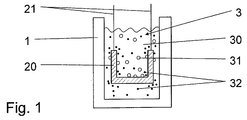
- FIG. 1 shows a cryostat with a cooling medium for high-temperature superconductors shown according to the invention.
- FIG. 1 shows a cryostat 1 which is filled with a cooling liquid 30 is filled and the latter from the area thermally insulated.
- a cooling liquid 30 is filled in the coolant 30 in the coolant 30 in the coolant 30.
- the cooling liquid 30 is one High-temperature superconductor assembly 20, which via normally conductive connecting conductor 21 into a circuit is switched.
- Vaporizing Cooling liquid 30 forms rising bubbles 31.
- a lid to complete the Cryostat 1 and any lead-throughs for the connection conductors 21 through the cryostat.
- the high temperature superconductor arrangement 20 is part of a transformer, for example, a current limiter or another component from the Area of energy transmission.
- the dispersed particles 32 act as condensation nuclei (nucleation centers) and delay the training of a continuous film of evaporated coolant 31 the surface of the object to be cooled 20. Bubble boiling with its better heat transfer properties than film boiling is also with a larger temperature gradient still prevail. Due to the improved cooling performance it is possible to make the superconductor 20 higher Load nominal current.
- the cooling medium 3 also serves to increase the dielectric strength.
- An electrical breakdown is expected at the point with the highest electrical field strength. So-called field elevations occur especially where the conductor forms peaks, corners or edges.
- Dielectrics with a high dielectric constant ⁇ generally have a higher dielectric strength.
- the desired shielding is provided by the dielectrophoretic Effect favors.
- On particles with increased dielectric constants in a less polarizable Fluid acts in the inhomogeneous electric field, which force the particles in areas with higher absolute field strength pulls.
- This effect also serves the one above mentioned improved cooling, for example at one corner of the conductor the current distribution is inhomogeneous and accordingly the losses are increased.
- the particles 32 added as an additive to the cooling liquid 30 preferably consist of ceramic materials such as SiO 2 , Al 2 O 3 , SrTiO 3 , BaSrO 3 , TiO 2 , SiC, ZnO and / or of substances which are only at the temperature of the coolant (77K for LN 2 ) are in the solid state, such as H 2 O, CO 2 , Ar, methane or ethylene.
- the dielectric constants are 1.5 (Ar) to 2.2 (H 2 O) for the latter and up to 1000 (SrTiO 3 ) or more for the ceramic materials.
- a certain roughness of the particle surface is advantageous.
- the particle size is preferably so large that agglomerations are prevented. Typical linear dimensions are between 1 and 100 ⁇ m.
- the specific density of the suspended particles is preferably in the range of the density of the cooling liquid.
- the latter is, for example, 0.8 g / cm 3 for LN 2 and still 1.2 g / cm 3 for liquid oxygen.
- means for preventing sedimentation of the particles are provided. Such means include, for example, a pump or an agitator arranged in the cryostat.
- the particle density is preferably less than 2 percent by volume.
- a steel strip 2 cm wide and 500 ⁇ m thick, on one Side coated with a varnish and on the other side was provided with a 1 mm thick glass fiber epoxy layer in liquid nitrogen immersed and connected to a power source. Up to a current of 160 A turned out a stable state, i.e. the heat generated could be dissipated by the cooling medium and the voltage drop remained constant.
- Breakdown tests according to IEEE standard 1.2 / 50 ⁇ s were carried out in liquid nitrogen. After adding small particles in the form of snowflakes and ice crystals the breakdown voltage increased by 35% compared to pure nitrogen.
- transition to higher performance can increasing requirements for cooling and dielectric strength are at least partially transferred to the cooling medium, resulting in savings when designing the component itself leads.
Landscapes
- Chemical & Material Sciences (AREA)
- Engineering & Computer Science (AREA)
- Physics & Mathematics (AREA)
- Chemical Kinetics & Catalysis (AREA)
- Combustion & Propulsion (AREA)
- Thermal Sciences (AREA)
- Materials Engineering (AREA)
- Organic Chemistry (AREA)
- Containers, Films, And Cooling For Superconductive Devices (AREA)
- Emergency Protection Circuit Devices (AREA)
- Compositions Of Oxide Ceramics (AREA)
Applications Claiming Priority (2)
| Application Number | Priority Date | Filing Date | Title |
|---|---|---|---|
| DE19932521 | 1999-07-12 | ||
| DE1999132521 DE19932521A1 (de) | 1999-07-12 | 1999-07-12 | Kühlmedium für Hochtemperatursupraleiter |
Publications (1)
| Publication Number | Publication Date |
|---|---|
| EP1069171A2 true EP1069171A2 (fr) | 2001-01-17 |
Family
ID=7914494
Family Applications (1)
| Application Number | Title | Priority Date | Filing Date |
|---|---|---|---|
| EP20000810506 Withdrawn EP1069171A2 (fr) | 1999-07-12 | 2000-06-13 | Milieu réfrigérant pour supraconduceur à haute temperature |
Country Status (6)
| Country | Link |
|---|---|
| EP (1) | EP1069171A2 (fr) |
| CN (1) | CN1280371A (fr) |
| AU (1) | AU4257800A (fr) |
| CA (1) | CA2311667A1 (fr) |
| DE (1) | DE19932521A1 (fr) |
| RU (1) | RU2000118676A (fr) |
Cited By (2)
| Publication number | Priority date | Publication date | Assignee | Title |
|---|---|---|---|---|
| EP2375483A3 (fr) * | 2004-01-13 | 2013-10-30 | Toyota Jidosha Kabushiki Kaisha | Réfrigérant et système de réfrigération |
| EP4199673A1 (fr) * | 2021-12-20 | 2023-06-21 | INTEL Corporation | Système de refroidissement par immersion avec collecte de particules de force cortico-statique |
Families Citing this family (3)
| Publication number | Priority date | Publication date | Assignee | Title |
|---|---|---|---|---|
| US6854276B1 (en) * | 2003-06-19 | 2005-02-15 | Superpower, Inc | Method and apparatus of cryogenic cooling for high temperature superconductor devices |
| GB2453734B (en) * | 2007-10-16 | 2009-10-28 | Siemens Magnet Technology Ltd | Method for cooling superconductive joints |
| FR3068707B1 (fr) * | 2017-07-10 | 2020-07-31 | Air Liquide | Composition, dispositif et procede de refroidissement a temperature cryogenique |
-
1999
- 1999-07-12 DE DE1999132521 patent/DE19932521A1/de not_active Withdrawn
-
2000
- 2000-06-13 EP EP20000810506 patent/EP1069171A2/fr not_active Withdrawn
- 2000-06-14 CA CA 2311667 patent/CA2311667A1/fr not_active Abandoned
- 2000-06-21 AU AU42578/00A patent/AU4257800A/en not_active Abandoned
- 2000-07-11 RU RU2000118676/09A patent/RU2000118676A/ru not_active Application Discontinuation
- 2000-07-12 CN CN 00122580 patent/CN1280371A/zh active Pending
Cited By (3)
| Publication number | Priority date | Publication date | Assignee | Title |
|---|---|---|---|---|
| EP2375483A3 (fr) * | 2004-01-13 | 2013-10-30 | Toyota Jidosha Kabushiki Kaisha | Réfrigérant et système de réfrigération |
| EP4199673A1 (fr) * | 2021-12-20 | 2023-06-21 | INTEL Corporation | Système de refroidissement par immersion avec collecte de particules de force cortico-statique |
| US12672256B2 (en) | 2021-12-20 | 2026-06-30 | Intel Corporation | Immersion cooling system with phoretic force particulate collection |
Also Published As
| Publication number | Publication date |
|---|---|
| RU2000118676A (ru) | 2002-07-10 |
| CN1280371A (zh) | 2001-01-17 |
| DE19932521A1 (de) | 2001-01-18 |
| CA2311667A1 (fr) | 2001-01-12 |
| AU4257800A (en) | 2001-01-18 |
Similar Documents
| Publication | Publication Date | Title |
|---|---|---|
| EP0713227B1 (fr) | Thermistance et dispositif de limitation de courant avec au moins une thermistance | |
| DE4441279C1 (de) | Vorrichtung zur Strombegrenzung | |
| DE4434819C1 (de) | Vorrichtung zur Strombegrenzung | |
| DE3887090T2 (de) | Supraleitender strombegrenzender Apparat. | |
| EP0115797B1 (fr) | Dispositif de protection pour une bobine d'électro-aimant supraconducteur | |
| DE1640750B1 (de) | Supraleitendes wechselstromkabel | |
| EP2228806B1 (fr) | Limiteur de courant | |
| DE2807809A1 (de) | Kuehlsystem fuer ein elektrisches induktionsgeraet, insbesondere einen transformator | |
| WO1999066566A1 (fr) | DISPOSITIF LIMITEUR DE COURANT COMPORTANT UN ENSEMBLE DE TRACES CONDUCTEURS REALISE DANS UN MATERIAU SUPRACONDUCTEUR A TEMPERATURE CRITIQUE (Tc) ELEVEE, ET PROCEDE DE PRODUCTION DUDIT DISPOSITIF | |
| EP2463871A1 (fr) | Noyau de transformateur amorphe | |
| DE2823758C3 (de) | Isopropylbiphenyl umfassende elektrisch isolierende Flüssigkeit | |
| EP0773562A2 (fr) | Limiteur de courant | |
| DE19932521A1 (de) | Kühlmedium für Hochtemperatursupraleiter | |
| DE69817051T2 (de) | Resistive supraleitende Anordnung zur Strombegrenzung | |
| DE102011107313A1 (de) | Isolierter Hochtemperatur-Bandsupraleiter und Verfahren zu seiner Herstellung | |
| DE19758444A1 (de) | Baugruppe zum Schalten elektrischer Leistungen | |
| DE19947410A1 (de) | Tieftemperaturvorrichtung | |
| EP1217666A1 (fr) | Limiteur de courant résistif | |
| DE19832273C1 (de) | Resistiver Strombegrenzer mit Hoch-T¶c¶-Supraleitermaterial sowie Verfahren zur Herstellung des Strombegrenzers | |
| DE1488347A1 (de) | Hochleistungs- und Hochspannungstransformator | |
| EP1160884A2 (fr) | Dispositif supraconducteur à haute température | |
| DE4226942C1 (de) | Nichtlineares induktives Bauelement, z. B. Drossel und Verfahren zur Herstellung des Drosselkerns | |
| DE2409868C3 (de) | Stromzuführung für elektrische Einrichtungen mit auf Tieftemperatur gekühlten Leitern | |
| WO2001004914A1 (fr) | Composant electrique a deconnexion de pointes de champ electriques | |
| DE1640750C (de) | Supraleitendes Wechselstromkabel |
Legal Events
| Date | Code | Title | Description |
|---|---|---|---|
| PUAI | Public reference made under article 153(3) epc to a published international application that has entered the european phase |
Free format text: ORIGINAL CODE: 0009012 |
|
| AK | Designated contracting states |
Kind code of ref document: A2 Designated state(s): AT BE CH CY DE DK ES FI FR GB GR IE IT LI LU MC NL PT SE |
|
| AX | Request for extension of the european patent |
Free format text: AL;LT;LV;MK;RO;SI |
|
| STAA | Information on the status of an ep patent application or granted ep patent |
Free format text: STATUS: THE APPLICATION IS DEEMED TO BE WITHDRAWN |
|
| 18D | Application deemed to be withdrawn |
Effective date: 20030103 |