EP1069171A2 - Cooling medium for high-temperature superconductor - Google Patents
Cooling medium for high-temperature superconductor Download PDFInfo
- Publication number
- EP1069171A2 EP1069171A2 EP20000810506 EP00810506A EP1069171A2 EP 1069171 A2 EP1069171 A2 EP 1069171A2 EP 20000810506 EP20000810506 EP 20000810506 EP 00810506 A EP00810506 A EP 00810506A EP 1069171 A2 EP1069171 A2 EP 1069171A2
- Authority
- EP
- European Patent Office
- Prior art keywords
- cooling medium
- cooling
- particles
- liquid
- medium according
- Prior art date
- Legal status (The legal status is an assumption and is not a legal conclusion. Google has not performed a legal analysis and makes no representation as to the accuracy of the status listed.)
- Withdrawn
Links
Images
Classifications
-
- C—CHEMISTRY; METALLURGY
- C09—DYES; PAINTS; POLISHES; NATURAL RESINS; ADHESIVES; COMPOSITIONS NOT OTHERWISE PROVIDED FOR; APPLICATIONS OF MATERIALS NOT OTHERWISE PROVIDED FOR
- C09K—MATERIALS FOR MISCELLANEOUS APPLICATIONS, NOT PROVIDED FOR ELSEWHERE
- C09K5/00—Heat-transfer, heat-exchange or heat-storage materials, e.g. refrigerants; Materials for the production of heat or cold by chemical reactions other than by combustion
- C09K5/08—Materials not undergoing a change of physical state when used
- C09K5/10—Liquid materials
Definitions
- the invention relates to a cooling medium for cooling high-temperature superconductors according to the preamble of the claim 1. It relates in particular to a cooling medium for the use of parts, components or devices based on high temperature superconductors in the field of energy supply.
- cryostat The easiest way to cool the superconductor to its operating temperature below T c is by immersing the superconductor in a cooling liquid such as liquid nitrogen, liquid helium, liquid neon or liquid nitrogen-oxygen mixtures, which is located in a special container called a cryostat.
- a cooling liquid such as liquid nitrogen, liquid helium, liquid neon or liquid nitrogen-oxygen mixtures
- a superconductor which is based on an electrical Potential of well over 100kV can be found, also opposite the cryostat are electrically isolated.
- field peaks i.e. inhomogeneous distributions of the electric field, on.
- the presence of a cooling medium or the Absence of air or gas insulation is going through a reduced electrical dielectric strength is noticeable.
- the latter is modest in large volumes in pure LN2 10kV / mm, and with boiling nitrogen with bubble formation even less. Accordingly, the maximum occurring Tension remains limited, respectively when designing of a superconducting component to avoid breakdown-prone Positions are respected.
- Superconductor-based current limiters accentuate each other the problems mentioned above.
- the superconductor enters the resistive state over. Accordingly, there is even more heat dissipates, which are dissipated by the cooling medium got to. Because in the limiting case the driving voltage for the most part drops over the superconductor, there is also a risk electrical breakdown between sections of the superconductor, which is not at the same potential are located.
- the heat transfer from the high-temperature superconductor arrangement, which, in addition to the actual superconductor, can also include shunt resistors and / or insulating layers that conduct normal conductors, into the liquid cooling medium is a crucial point. If the temperature difference between the superconductor arrangement and the cooling liquid (eg 77K for LN 2 ) is too large, you are in the film boiling range of the cooling liquid. If liquid nitrogen (LN 2 ) is used, a continuous film of gaseous nitrogen forms on the surface of the structure to be cooled. This results in a relatively poor heat transfer and on the one hand means a slow cooling of the object immersed in the coolant or, on the other hand, in the worst case a further increase in temperature if the object itself produces heat.
- the cooling liquid eg 77K for LN 2
- the invention has for its object a cooling medium for To create high temperature superconductor, which is economical their use, especially in the field of energy supply at medium and high performance, improved.
- the core of the invention is the knowledge that in addition to the design of the superconductor itself and the cooling medium surrounding it affects the economy of its application. By simple modifications of a known coolant savings in the layout and design of Achieve high temperature superconductor arrangements.
- the requirements of the cooling medium according to the invention include, for example, protection of the superconductor against thermal overload and electrical breakdowns between different sections of a superconductor or between the superconductor and one containing the cooling medium Cryostat. This is done in a coolant small particles dispersed or suspended, i.e. in one floating state finely distributed.
- the dispersed particles as condensation nuclei for the cooling liquid, causing the transition from bubble to film boiling can be delayed. Immersed in the dispersion Components are therefore better against excessive heating protected and can operate at higher rated currents become.
- the suspended Particles have a dielectric constant, which is higher than that of the coolant.
- a cooling medium based on a coolant modified with such Properties protect a component from electrical breakthroughs and allows operation at higher voltages.
- Liquid nitrogen is preferably used as the cooling liquid LN2 used.
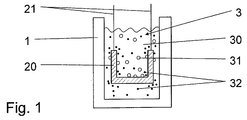
- FIG. 1 shows a cryostat with a cooling medium for high-temperature superconductors shown according to the invention.
- FIG. 1 shows a cryostat 1 which is filled with a cooling liquid 30 is filled and the latter from the area thermally insulated.
- a cooling liquid 30 is filled in the coolant 30 in the coolant 30 in the coolant 30.
- the cooling liquid 30 is one High-temperature superconductor assembly 20, which via normally conductive connecting conductor 21 into a circuit is switched.
- Vaporizing Cooling liquid 30 forms rising bubbles 31.
- a lid to complete the Cryostat 1 and any lead-throughs for the connection conductors 21 through the cryostat.
- the high temperature superconductor arrangement 20 is part of a transformer, for example, a current limiter or another component from the Area of energy transmission.
- the dispersed particles 32 act as condensation nuclei (nucleation centers) and delay the training of a continuous film of evaporated coolant 31 the surface of the object to be cooled 20. Bubble boiling with its better heat transfer properties than film boiling is also with a larger temperature gradient still prevail. Due to the improved cooling performance it is possible to make the superconductor 20 higher Load nominal current.
- the cooling medium 3 also serves to increase the dielectric strength.
- An electrical breakdown is expected at the point with the highest electrical field strength. So-called field elevations occur especially where the conductor forms peaks, corners or edges.
- Dielectrics with a high dielectric constant ⁇ generally have a higher dielectric strength.
- the desired shielding is provided by the dielectrophoretic Effect favors.
- On particles with increased dielectric constants in a less polarizable Fluid acts in the inhomogeneous electric field, which force the particles in areas with higher absolute field strength pulls.
- This effect also serves the one above mentioned improved cooling, for example at one corner of the conductor the current distribution is inhomogeneous and accordingly the losses are increased.
- the particles 32 added as an additive to the cooling liquid 30 preferably consist of ceramic materials such as SiO 2 , Al 2 O 3 , SrTiO 3 , BaSrO 3 , TiO 2 , SiC, ZnO and / or of substances which are only at the temperature of the coolant (77K for LN 2 ) are in the solid state, such as H 2 O, CO 2 , Ar, methane or ethylene.
- the dielectric constants are 1.5 (Ar) to 2.2 (H 2 O) for the latter and up to 1000 (SrTiO 3 ) or more for the ceramic materials.
- a certain roughness of the particle surface is advantageous.
- the particle size is preferably so large that agglomerations are prevented. Typical linear dimensions are between 1 and 100 ⁇ m.
- the specific density of the suspended particles is preferably in the range of the density of the cooling liquid.
- the latter is, for example, 0.8 g / cm 3 for LN 2 and still 1.2 g / cm 3 for liquid oxygen.
- means for preventing sedimentation of the particles are provided. Such means include, for example, a pump or an agitator arranged in the cryostat.
- the particle density is preferably less than 2 percent by volume.
- a steel strip 2 cm wide and 500 ⁇ m thick, on one Side coated with a varnish and on the other side was provided with a 1 mm thick glass fiber epoxy layer in liquid nitrogen immersed and connected to a power source. Up to a current of 160 A turned out a stable state, i.e. the heat generated could be dissipated by the cooling medium and the voltage drop remained constant.
- Breakdown tests according to IEEE standard 1.2 / 50 ⁇ s were carried out in liquid nitrogen. After adding small particles in the form of snowflakes and ice crystals the breakdown voltage increased by 35% compared to pure nitrogen.
- transition to higher performance can increasing requirements for cooling and dielectric strength are at least partially transferred to the cooling medium, resulting in savings when designing the component itself leads.
Landscapes
- Chemical & Material Sciences (AREA)
- Engineering & Computer Science (AREA)
- Physics & Mathematics (AREA)
- Chemical Kinetics & Catalysis (AREA)
- Combustion & Propulsion (AREA)
- Thermal Sciences (AREA)
- Materials Engineering (AREA)
- Organic Chemistry (AREA)
- Containers, Films, And Cooling For Superconductive Devices (AREA)
- Emergency Protection Circuit Devices (AREA)
- Compositions Of Oxide Ceramics (AREA)
Abstract
Description
Die Erfindung betrifft ein Kühlmedium zur Kühlung von Hochtemperatursupraleitern
gemäss dem Oberbegriff des Patentanspruchs
1. Sie bezieht sich insbesondere auf ein Kühlmedium
für den Einsatz von Bauteilen, Komponenten oder Einrichtungen
auf Hochtemperatursupraleiterbasis im Bereich der Energieversorgung.The invention relates to a cooling medium for cooling high-temperature superconductors
according to the preamble of the
Anwendungen von Hochtemperatursupraleitern im Energieversorgungssektor, beispielsweise als Übertragungskabel, Transformatoren oder Strombegrenzer im Mittelspannungsbereich, stellen bestimmte Anforderungen an die Kühlung und die elektrische Isolation. Einerseits kommt es in Supraleitern, bei welchen sich die Nominalstromdichte im Bereich der kritischen Stromdichte befindet, zu einem nicht vernachlässigbaren Spannungsabfall und entsprechender Wärmeerzeugung. Andererseits treten bei Wechselstromanwendungen noch Wechselstromverluste im Supraleiter auf, welche ebenfalls und häufig in noch viel stärkerem Masse zu einer Erwärmung des Supraleiters beitragen. Entsprechend darf im Dauerbetrieb der Nominalstrom (IN) eine gewisse Stromstärke nicht überschreiten, damit sich der Supraleiter nicht über seine kritische Temperatur (Tc) erwärmt. Die Kühlung des Supraleiters auf seine Betriebstemperatur unterhalb Tc geschieht am einfachsten durch Eintauchen des Supraleiters in eine Kühlflüssigkeit wie flüssigen Stickstoff, flüssiges Helium, flüssiges Neon oder flüssige Stickstoff-Sauerstoff-Gemische, welche sich in einem speziellen, Kryostaten genannten Behälter befindet.Applications of high-temperature superconductors in the energy supply sector, for example as transmission cables, transformers or current limiters in the medium-voltage range, place certain demands on the cooling and electrical insulation. On the one hand, there is a non-negligible voltage drop and corresponding heat generation in superconductors in which the nominal current density is in the range of the critical current density. On the other hand, alternating current losses still occur in the superconductor in alternating current applications, which likewise, and often to a much greater extent, contribute to heating the superconductor. Accordingly, the nominal current (I N ) must not exceed a certain current in continuous operation so that the superconductor does not heat up above its critical temperature (T c ). The easiest way to cool the superconductor to its operating temperature below T c is by immersing the superconductor in a cooling liquid such as liquid nitrogen, liquid helium, liquid neon or liquid nitrogen-oxygen mixtures, which is located in a special container called a cryostat.
Weiter muss ein Supraleiter, welcher sich auf einem elektrischen Potential von weit über 100kV befinden kann, auch gegenüber dem Kryostaten elektrisch isoliert werden. Insbesondere im Bereich von Spitzen oder Kanten treten Feldüberhöhungen, d.h. inhomogene Verteilungen des elektrischen Feldes, auf. Die Anwesenheit eines Kühlmediums beziehungsweise die Abwesenheit einer Luft- oder Gasisolation macht sich durch eine verminderte elektrische Durchschlagsfestigkeit bemerkbar. Letztere beträgt in reinem LN2 in grossen Volumen bescheidene 10kV/mm, und bei siedendem Stickstoff unter Blasenbildung noch weniger. Entsprechend muss die maximal auftretende Spannung begrenzt bleiben respektive bei der Auslegung eines supraleitenden Bauteiles auf die Vermeidung von durchschlagsgefährdeten Stellen geachtet werden.Furthermore, a superconductor, which is based on an electrical Potential of well over 100kV can be found, also opposite the cryostat are electrically isolated. In particular in the area of peaks or edges there are field peaks, i.e. inhomogeneous distributions of the electric field, on. The presence of a cooling medium or the Absence of air or gas insulation is going through a reduced electrical dielectric strength is noticeable. The latter is modest in large volumes in pure LN2 10kV / mm, and with boiling nitrogen with bubble formation even less. Accordingly, the maximum occurring Tension remains limited, respectively when designing of a superconducting component to avoid breakdown-prone Positions are respected.
Bei Strombegrenzern auf Supraleiterbasis akzentuieren sich die genannten Probleme noch. Im Begrenzungsfall, wenn ein Fehler- oder Überstrom grösser als der kritische Strom Ic durch den Supraleiter fliesst, tritt der Supraleiter in den resistiven Zustand über. Entsprechend wird noch mehr Wärme dissipiert, welche durch das Kühlmedium abgeführt werden muss. Da im Begrenzungsfall die treibende Spannung grösstenteils über dem Supraleiter abfällt, besteht auch die Gefahr eines elektrischen Durchschlags zwischen einzelnen Abschnitten des Supraleiters, welche sich nicht auf dem gleichen Potential befinden.Superconductor-based current limiters accentuate each other the problems mentioned above. In the case of limitation, if one Fault or overcurrent greater than the critical current Ic flowing through the superconductor, the superconductor enters the resistive state over. Accordingly, there is even more heat dissipates, which are dissipated by the cooling medium got to. Because in the limiting case the driving voltage for the most part drops over the superconductor, there is also a risk electrical breakdown between sections of the superconductor, which is not at the same potential are located.
Der Wärmeübergang von der Hochtemperatursupraleiteranordnung, welche neben dem eigentlichen Supraleiter noch normalleitende Nebenschlusswiderstände und/oder isolierende Schichten umfassen kann, in das flüssige Kühlmedium ist ein entscheidender Punkt. Ist der Temperaturunterschied zwischen der Supraleiteranordnung und der Kühlflüssigkeit (z.B. 77K für LN2) zu gross, befindet man sich im Filmsiede-Bereich der Kühlflüssigkeit. Im Falle der Verwendung von flüssigem Stickstoff (LN2) bildet sich ein durchgehender Film aus gasförmigem Stickstoff an der Oberfläche der zu kühlenden Struktur aus. Dies hat einen relativ schlechten Wärmeübergang zur Folge und bedeutet einerseits eine verlangsamte Abkühlung des in das Kühlmittel eingetauchten Objekts oder andererseits schlimmstenfalls eine weitere Temperaturerhöhung desselben, falls es selbst Wärme produziert. Im Gegensatz dazu ist ein erhöhter Wärmeübergang im Blasensiede-Bereich zu erwarten, welcher sich zumindest bei einem geringeren Temperaturgradienten zwischen Kühlflüssigkeit und zu kühlendem Objekt ausbildet. Der entsprechende Temperaturverlauf einer Proben unter konstanter Wärmeaufnahme ist beispielsweise im Artikel "Transient heat transfer from smooth surfaces into liquid nitrogen", V. Drach und J. Fricke, Cryogenics Band 36 (1996), Seiten 263-269, zu finden.The heat transfer from the high-temperature superconductor arrangement, which, in addition to the actual superconductor, can also include shunt resistors and / or insulating layers that conduct normal conductors, into the liquid cooling medium is a crucial point. If the temperature difference between the superconductor arrangement and the cooling liquid (eg 77K for LN 2 ) is too large, you are in the film boiling range of the cooling liquid. If liquid nitrogen (LN 2 ) is used, a continuous film of gaseous nitrogen forms on the surface of the structure to be cooled. This results in a relatively poor heat transfer and on the one hand means a slow cooling of the object immersed in the coolant or, on the other hand, in the worst case a further increase in temperature if the object itself produces heat. In contrast, an increased heat transfer in the bubble boiling range is to be expected, which forms at least with a lower temperature gradient between the cooling liquid and the object to be cooled. The corresponding temperature profile of a sample with constant heat absorption can be found, for example, in the article "Transient heat transfer from smooth surfaces into liquid nitrogen", V. Drach and J. Fricke, Cryogenics Volume 36 (1996), pages 263-269.
Der Erfindung liegt die Aufgabe zugrunde, ein Kühlmedium für Hochtemperatursupraleiter zu schaffen, welches die Wirschaftlichkeit ihres Einsatzes, insbesondere im Bereich der Energieversorgung bei mittleren und hohen Leistungen, verbessert.The invention has for its object a cooling medium for To create high temperature superconductor, which is economical their use, especially in the field of energy supply at medium and high performance, improved.
Die Aufgabe wird gelöst durch ein Kühlmedium für Hochtemperatursupraleiter
mit den Merkmalen des Patentanspruchs 1.The task is solved by a cooling medium for high-temperature superconductors
with the features of
Kern der Erfindung ist die Erkenntnis, dass neben der Ausgestaltung des Supraleiters selbst auch das ihn umgebende Kühlmedium die Wirtschaftlichkeit seiner Anwendung beeinflusst. Durch einfache Modifikationen einer bekannten Kühlflüssigkeit lassen sich Einsparungen in der Auslegung und im Design von Hochtemperatursupraleiteranordnungen erzielen. The core of the invention is the knowledge that in addition to the design of the superconductor itself and the cooling medium surrounding it affects the economy of its application. By simple modifications of a known coolant savings in the layout and design of Achieve high temperature superconductor arrangements.
Die erfindungsgemäss an das Kühlmedium gerichteten Anforderungen umfassen beispielsweise einen Schutz des Supraleiters vor thermischer Überbelastung sowie vor elektrischen Durchbrüchen zwischen verschiedenen Abschnitten eines Supraleiters oder zwischen dem Supraleiter und einem das Kühlmedium enthaltenden Kryostaten. Dazu werden in einer Kühlflüssigkeit kleine Teilchen dispergiert oder suspendiert, d.h. in einem schwebenden Zustand fein verteilt.The requirements of the cooling medium according to the invention include, for example, protection of the superconductor against thermal overload and electrical breakdowns between different sections of a superconductor or between the superconductor and one containing the cooling medium Cryostat. This is done in a coolant small particles dispersed or suspended, i.e. in one floating state finely distributed.
Gemäss einer ersten bevorzugten Ausführungsform wirken die dispergierten Teilchen als Kondensationskeime für die Kühlflüssigkeit, wodurch der Übergang vom Blasen- in den Filmsiedebereich hinausgezögert werden kann. In die Dispersion eingetauchte Bauteile sind also besser vor übermässiger Erwärmung geschützt und können bei höheren Nennströmen betrieben werden.According to a first preferred embodiment, the dispersed particles as condensation nuclei for the cooling liquid, causing the transition from bubble to film boiling can be delayed. Immersed in the dispersion Components are therefore better against excessive heating protected and can operate at higher rated currents become.
Gemäss einer weiteren Ausführungsform weisen die suspendierten Teilchen eine Dielektrizitätskonstante auf, welche höher ist als diejenige der Kühlflüssigkeit. Ein Kühlmedium basierend auf einer Kühlflüssigkeit mit dergestalt modifizierten Eigenschaften schützt ein Bauteil vor elektrischen Durchbrüchen und erlaubt einen Betrieb bei höheren Spannungen.According to a further embodiment, the suspended Particles have a dielectric constant, which is higher than that of the coolant. A cooling medium based on a coolant modified with such Properties protect a component from electrical breakthroughs and allows operation at higher voltages.
Vorzugsweise wird als Kühlflüssigkeit flüssiger Stickstoff LN2 verwendet.Liquid nitrogen is preferably used as the cooling liquid LN2 used.
Nachfolgend wird die Erfindung anhand von Ausführungsbeispielen im Zusammenhang mit der Zeichnung näher erläutert. Die verwendeten Bezugszeichen sind in der Bezugszeichenliste zusammengefasst.The invention is described below using exemplary embodiments explained in connection with the drawing. The Reference symbols used are summarized in the list of reference symbols.
In Fig.1 ist ein Kryostat mit einem Kühlmedium für Hochtemperatursupraleiter nach der Erfindung dargestellt. 1 shows a cryostat with a cooling medium for high-temperature superconductors shown according to the invention.
Fig.1 zeigt einen Kryostaten 1, welcher mit einer Kühlflüssigkeit
30 gefüllt ist und welcher letztere von der Umgebung
thermisch isoliert. In die Kühlflüssigkeit 30 ist eine
Hochtemperatursupraleiteranordnung 20 eingetaucht, welche
über normalleitende Anschlussleiter 21 in einen Stromkreis
geschaltet ist. In der Kühlflüssigkeit 30 sind kleine Teilchen
32 dispergiert, welche in der Kühlflüssigkeit 30 schweben
und mit letzterer zusammen das erfindungsgemässe Kühlmedium
3 in Form einer Suspension oder Dispersion bilden. Verdampfende
Kühlflüssigkeit 30 bildet aufsteigende Blasen 31.
Nicht gezeigt in Fig.1 ist ein Deckel zum Abschluss des
Kryostaten 1 sowie allfällige Durchführungen der Anschlussleiter
21 durch den Kryostaten. Die Hochtemperatursupraleiteranordnung
20 ist beispielsweise Teil eines Transformators,
eines Strombegrenzers oder eines sonstigen Bauteils aus dem
Bereich der Energieübertragung.1 shows a
Die dispergierten Teilchen 32 fungieren als Kondensationskeime
(nucleation centers) und verzögern die Ausbildung eines
kontinuierlichen Films aus verdampfter Kühlflüssigkeit 31 an
der Oberfläche des zu kühlenden Objektes 20. Das Blasensieden
mit seinen gegenüber dem Filmsieden besseren Wärmeübergangseigenschaften
wird also auch bei einem grösseren Temperaturgradienten
noch vorherrschen. Durch die verbesserte Kühlleistung
ist es möglich, den Supraleiter 20 mit einem höheren
Nennstrom zu belasten.The dispersed
Das erfindungsgemässe Kühlmedium 3 dient auch einer Erhöhung
der elektrischen Durchschlagsfestigkeit. Ein elektrischer
Durchbruch ist an der Stelle mit der höchsten elektrischen
Feldstärke zu erwarten. Insbesondere dort, wo der Leiter
Spitzen, Ecken oder Kanten formt, treten sogenannte Feldüberhöhungen
auf. Dielektrika mit hoher Dielektrizitätskonstante
ε haben im Allgemeinen eine höhere Durchschlagsfestigkeit. Um
zu vermeiden, dass zwischen dem Supraleiter 20 und dem Kryostaten
1 oder zwischen Abschnitten des Supraleiters, welche
sich möglicherweise auf verschiedenem Potential befinden, unverhältnismässig
grosse Abstände vorgesehen werden müssen,
sind der Kühlflüssigkeit 30 Teilchen 32 mit einer Dielektrizitätskonstanten
ε, welche höher ist als diejenige der
Kühlflüssigkeit 30 (z.B. ε(LN2) = 1.45) beigemischt. Dies
führt zu einer Erhöhung der Dielektrizitätskonstanten des
Kühlmediums 3 und zu einer verbesserten Abschirmung des elektrischen
Feldes.The
Zudem wird die gewünschte Abschirmung durch den dielektrophoretischen Effekt begünstigt. Auf Teilchen mit erhöhter Dielektrizitätskonstanten in einem weniger stark polarisierbaren Fluid wirkt im inhomogenen elektrischen Feld eine Kraft, welche die Teilchen in Gebiete mit höherer absoluter Feldstärke zieht. Demzufolge werden sich die Teilchen bei den erwähnten potentiell gefährdeten Stellen ansammeln und dort die Abschirmung noch vestärken. Dieser Effekt dient auch der oben angesprochenen verbesserten Kühlung, da beispielsweise bei einer Ecke des Leiters die Stromverteilung inhomogen und entsprechend die Verluste erhöht sind.In addition, the desired shielding is provided by the dielectrophoretic Effect favors. On particles with increased dielectric constants in a less polarizable Fluid acts in the inhomogeneous electric field, which force the particles in areas with higher absolute field strength pulls. As a result, the particles in the mentioned accumulate potentially endangered areas and there the shielding still strengthen. This effect also serves the one above mentioned improved cooling, for example at one corner of the conductor the current distribution is inhomogeneous and accordingly the losses are increased.
Vorzugsweise bestehen die als Additivum zur Kühlflüssigkeit
30 beigegebenen Teilchen 32 aus keramischen Materialien wie
SiO2, Al2O3, SrTiO3, BaSrO3, TiO2, SiC, ZnO und/oder aus Stoffen,
welche nur bei der Temperatur des Kühlmittels (77K für
LN2) im festen Zustand vorliegen, wie beispielsweise H2O, CO2,
Ar, Methan oder Ethylen. Die Dielektrizitätskonstanten betragen
für Letztere 1.5 (Ar) bis 2.2 (H2O) und für die keramischen
Materialien bis zu 1000 (SrTiO3) oder mehr. Eine gewisse
Rauhigkeit der Teilchenoberfläche ist von Vorteil. Die
Teilchengrösse ist vorzugsweise so gross, dass Agglomerationen
verhindert sind. Typische lineare Ausdehnungen liegen
zwischen 1 und 100 µm. Die spezifische Dichte der suspendierten
Teilchen liegt vorzugsweise im Bereich der Dichte der
Kühlflüssigkeit. Letztere beträgt beispielsweise 0.8 g/cm3
für LN2 und immerhin 1.2 g/cm3 für flüssigen Sauerstoff. In
einer anderen Ausführungsform sind Mittel zur Verhinderung
einer Sedimentation der Teilchen vorgesehen. Derartige Mittel
umfassen beispielsweise eine Pumpe oder ein im Kryostat angeordnetes
Rührwerk. Die Teilchendichte beträgt vorzugsweise
weniger als 2 Volumenprozent.The
Ein Stahlstreifen von 2 cm Breite und 500 µm Dicke, auf einer Seite mit einem Lack beschichtet und auf der anderen Seite mit einer 1 mm dicken Glasfaserepoxyschicht versehen wurde in flüssigen Stickstoff eingetaucht und an eine Stromquelle angeschlossen. Bis zu einer Stromstärke von 160 A stellte sich ein stabiler Zustand ein, d.h. die erzeugte Wärme konnte durch das Kühlmedium abgeführt werden und der Spannungsabfall blieb konstant.A steel strip 2 cm wide and 500 µm thick, on one Side coated with a varnish and on the other side was provided with a 1 mm thick glass fiber epoxy layer in liquid nitrogen immersed and connected to a power source. Up to a current of 160 A turned out a stable state, i.e. the heat generated could be dissipated by the cooling medium and the voltage drop remained constant.
Daraufhin wurde ein Al2O3 - Pulver mit einer mittleren Teilchengrösse von 10 µm in den flüssigen Stickstoff eingerührt (2Vol%) und das Experiment wiederholt. Diesmal konnte ein thermisch stabiler Zustand bis zu einer Stromstärke von 200 A etabliert werden. Dies entspricht einer Erhöhung der Kühlleistung um 56%!An Al 2 O 3 powder with an average particle size of 10 μm was then stirred into the liquid nitrogen (2% by volume) and the experiment repeated. This time it was possible to establish a thermally stable state up to a current of 200 A. This corresponds to an increase in cooling capacity of 56%!
Durchschlagstests gemäss IEEE standard 1.2/50 µs (IEC-60) wurden in flüssigem Stickstoff durchgeführt. Nach Zugabe von kleinen Teilchen in Form von Schneeflocken und Eiskristallen erhöhte sich die Durchschlagsspannung um 35% im Vergleich zu reinem Stickstoff.Breakdown tests according to IEEE standard 1.2 / 50 µs (IEC-60) were carried out in liquid nitrogen. After adding small particles in the form of snowflakes and ice crystals the breakdown voltage increased by 35% compared to pure nitrogen.
Insgesamt ergibt sich unter Verwendung eines erfindungsgemässen Kühlmediums die Möglichkeit, die Wirtschaftlichkeit des Einsatzes von Bauteilen auf Supraleiterbasis zu verbessern. Overall, using one according to the invention results Coolant the possibility of the economy of the To improve the use of components based on superconductors.
Insbesondere können beim Übergang zu höheren Leistungen die zunehmenden Anforderungen an Kühlung und Durchschlagsfestigkeit zumindest teilweise dem Kühlmedium übertragen werden, was bei der Konzeption des Bauteils selbst zu Einsparungen führt.In particular, the transition to higher performance can increasing requirements for cooling and dielectric strength are at least partially transferred to the cooling medium, resulting in savings when designing the component itself leads.
- 11
- KryostatCryostat
- 2020th
- HochtemperatursupraleiterHigh temperature superconductor
- 2121
- AnschlussleiterConnection conductor
- 33rd
- KühlmediumCooling medium
- 3030th
- KühlflüssigkeitCoolant
- 3131
- Verdampfte KühlflüssigkeitEvaporated coolant
- 3232
- suspendierte oder dispergierte Teilchensuspended or dispersed particles
Claims (9)
Applications Claiming Priority (2)
| Application Number | Priority Date | Filing Date | Title |
|---|---|---|---|
| DE19932521 | 1999-07-12 | ||
| DE1999132521 DE19932521A1 (en) | 1999-07-12 | 1999-07-12 | Cooling medium for high temperature superconductors |
Publications (1)
| Publication Number | Publication Date |
|---|---|
| EP1069171A2 true EP1069171A2 (en) | 2001-01-17 |
Family
ID=7914494
Family Applications (1)
| Application Number | Title | Priority Date | Filing Date |
|---|---|---|---|
| EP20000810506 Withdrawn EP1069171A2 (en) | 1999-07-12 | 2000-06-13 | Cooling medium for high-temperature superconductor |
Country Status (6)
| Country | Link |
|---|---|
| EP (1) | EP1069171A2 (en) |
| CN (1) | CN1280371A (en) |
| AU (1) | AU4257800A (en) |
| CA (1) | CA2311667A1 (en) |
| DE (1) | DE19932521A1 (en) |
| RU (1) | RU2000118676A (en) |
Cited By (2)
| Publication number | Priority date | Publication date | Assignee | Title |
|---|---|---|---|---|
| EP2375483A3 (en) * | 2004-01-13 | 2013-10-30 | Toyota Jidosha Kabushiki Kaisha | Coolant and cooling system |
| EP4199673A1 (en) * | 2021-12-20 | 2023-06-21 | INTEL Corporation | Immersion cooling system with phoretic force particulate collection |
Families Citing this family (3)
| Publication number | Priority date | Publication date | Assignee | Title |
|---|---|---|---|---|
| US6854276B1 (en) * | 2003-06-19 | 2005-02-15 | Superpower, Inc | Method and apparatus of cryogenic cooling for high temperature superconductor devices |
| GB2453734B (en) * | 2007-10-16 | 2009-10-28 | Siemens Magnet Technology Ltd | Method for cooling superconductive joints |
| FR3068707B1 (en) * | 2017-07-10 | 2020-07-31 | Air Liquide | COMPOSITION, DEVICE AND PROCESS FOR COOLING AT CRYOGENIC TEMPERATURE |
-
1999
- 1999-07-12 DE DE1999132521 patent/DE19932521A1/en not_active Withdrawn
-
2000
- 2000-06-13 EP EP20000810506 patent/EP1069171A2/en not_active Withdrawn
- 2000-06-14 CA CA 2311667 patent/CA2311667A1/en not_active Abandoned
- 2000-06-21 AU AU42578/00A patent/AU4257800A/en not_active Abandoned
- 2000-07-11 RU RU2000118676/09A patent/RU2000118676A/en not_active Application Discontinuation
- 2000-07-12 CN CN 00122580 patent/CN1280371A/en active Pending
Cited By (3)
| Publication number | Priority date | Publication date | Assignee | Title |
|---|---|---|---|---|
| EP2375483A3 (en) * | 2004-01-13 | 2013-10-30 | Toyota Jidosha Kabushiki Kaisha | Coolant and cooling system |
| EP4199673A1 (en) * | 2021-12-20 | 2023-06-21 | INTEL Corporation | Immersion cooling system with phoretic force particulate collection |
| US12672256B2 (en) | 2021-12-20 | 2026-06-30 | Intel Corporation | Immersion cooling system with phoretic force particulate collection |
Also Published As
| Publication number | Publication date |
|---|---|
| RU2000118676A (en) | 2002-07-10 |
| CN1280371A (en) | 2001-01-17 |
| DE19932521A1 (en) | 2001-01-18 |
| CA2311667A1 (en) | 2001-01-12 |
| AU4257800A (en) | 2001-01-18 |
Similar Documents
| Publication | Publication Date | Title |
|---|---|---|
| EP0713227B1 (en) | Thermistor and current limiting device with at least one thermistor | |
| DE4441279C1 (en) | Current suppressor | |
| DE4434819C1 (en) | Short-circuit overcurrent limiting device for electrical line | |
| DE3887090T2 (en) | Superconducting current limiting device. | |
| EP0115797B1 (en) | Protective device for a superconductive electro-magnet apparatus | |
| DE1640750B1 (en) | SUPRAL CONDUCTING AC CABLE | |
| EP2228806B1 (en) | Current limiter | |
| DE2807809A1 (en) | COOLING SYSTEM FOR AN ELECTRIC INDUCTION DEVICE, IN PARTICULAR A TRANSFORMER | |
| WO1999066566A1 (en) | CURRENT LIMITING DEVICE WITH PRINTED CONDUCTOR SYSTEM MADE OF A SUPERCONDUCTIVE MATERIAL HAVING A HIGH CRITICAL TEMPERATURE (Tc) AND METHOD FOR PRODUCING SAID DEVICE | |
| EP2463871A1 (en) | Amorphous transformer core | |
| DE2823758C3 (en) | Isopropylbiphenyl comprising electrically insulating liquid | |
| EP0773562A2 (en) | Current limiter | |
| DE19932521A1 (en) | Cooling medium for high temperature superconductors | |
| DE69817051T2 (en) | Resistive superconducting device for current limitation | |
| DE102011107313A1 (en) | Insulated high-temperature superconductor tape and method for its production | |
| DE19758444A1 (en) | Module for switching electrical power | |
| DE19947410A1 (en) | Cryogenic device | |
| EP1217666A1 (en) | Resistive current limiter | |
| DE19832273C1 (en) | Resistive current limiter e.g. for AC supply mains | |
| DE1488347A1 (en) | High power and high voltage transformer | |
| EP1160884A2 (en) | High-temperature superconductor arrangement | |
| DE4226942C1 (en) | Nonlinear inductive component, e.g. B. Choke and method of manufacturing the choke core | |
| DE2409868C3 (en) | Power supply for electrical equipment with conductors cooled to low temperatures | |
| WO2001004914A1 (en) | Electrical component with disconnection of electrical field excesses | |
| DE1640750C (en) | Superconducting alternating current cable |
Legal Events
| Date | Code | Title | Description |
|---|---|---|---|
| PUAI | Public reference made under article 153(3) epc to a published international application that has entered the european phase |
Free format text: ORIGINAL CODE: 0009012 |
|
| AK | Designated contracting states |
Kind code of ref document: A2 Designated state(s): AT BE CH CY DE DK ES FI FR GB GR IE IT LI LU MC NL PT SE |
|
| AX | Request for extension of the european patent |
Free format text: AL;LT;LV;MK;RO;SI |
|
| STAA | Information on the status of an ep patent application or granted ep patent |
Free format text: STATUS: THE APPLICATION IS DEEMED TO BE WITHDRAWN |
|
| 18D | Application deemed to be withdrawn |
Effective date: 20030103 |