EP1069093B1 - Beschichtungsmittel und Verfahren zur Beschichtung von mineralischen Formkörper - Google Patents
Beschichtungsmittel und Verfahren zur Beschichtung von mineralischen Formkörper Download PDFInfo
- Publication number
- EP1069093B1 EP1069093B1 EP00115302A EP00115302A EP1069093B1 EP 1069093 B1 EP1069093 B1 EP 1069093B1 EP 00115302 A EP00115302 A EP 00115302A EP 00115302 A EP00115302 A EP 00115302A EP 1069093 B1 EP1069093 B1 EP 1069093B1
- Authority
- EP
- European Patent Office
- Prior art keywords
- monomers
- preparation
- volume concentration
- pigment volume
- copolymers
- Prior art date
- Legal status (The legal status is an assumption and is not a legal conclusion. Google has not performed a legal analysis and makes no representation as to the accuracy of the status listed.)
- Expired - Lifetime
Links
- 229910052500 inorganic mineral Inorganic materials 0.000 title claims abstract description 65
- 239000011707 mineral Substances 0.000 title claims abstract description 65
- 238000000576 coating method Methods 0.000 title claims abstract description 38
- 238000000034 method Methods 0.000 title claims abstract description 37
- 239000011248 coating agent Substances 0.000 title claims abstract description 27
- 239000000463 material Substances 0.000 title 1
- 239000000178 monomer Substances 0.000 claims abstract description 117
- 229920001577 copolymer Polymers 0.000 claims abstract description 69
- 239000000049 pigment Substances 0.000 claims abstract description 50
- 239000000203 mixture Substances 0.000 claims abstract description 22
- -1 vinyl aromatic Chemical compound 0.000 claims abstract description 17
- 125000000391 vinyl group Chemical group [H]C([*])=C([H])[H] 0.000 claims abstract description 8
- 150000007933 aliphatic carboxylic acids Chemical class 0.000 claims abstract description 7
- 229920001567 vinyl ester resin Polymers 0.000 claims abstract description 7
- 238000002360 preparation method Methods 0.000 claims description 131
- PPBRXRYQALVLMV-UHFFFAOYSA-N Styrene Chemical compound C=CC1=CC=CC=C1 PPBRXRYQALVLMV-UHFFFAOYSA-N 0.000 claims description 40
- 238000000465 moulding Methods 0.000 claims description 38
- VVQNEPGJFQJSBK-UHFFFAOYSA-N Methyl methacrylate Chemical compound COC(=O)C(C)=C VVQNEPGJFQJSBK-UHFFFAOYSA-N 0.000 claims description 22
- CQEYYJKEWSMYFG-UHFFFAOYSA-N butyl acrylate Chemical compound CCCCOC(=O)C=C CQEYYJKEWSMYFG-UHFFFAOYSA-N 0.000 claims description 19
- GOXQRTZXKQZDDN-UHFFFAOYSA-N 2-Ethylhexyl acrylate Chemical compound CCCCC(CC)COC(=O)C=C GOXQRTZXKQZDDN-UHFFFAOYSA-N 0.000 claims description 18
- 229920000642 polymer Polymers 0.000 claims description 15
- 150000001252 acrylic acid derivatives Chemical class 0.000 claims description 8
- 238000001035 drying Methods 0.000 claims description 8
- 150000002734 metacrylic acid derivatives Chemical class 0.000 claims description 8
- 150000001875 compounds Chemical class 0.000 claims description 7
- 239000000470 constituent Substances 0.000 claims description 6
- 150000003460 sulfonic acids Chemical class 0.000 claims description 6
- 229910052739 hydrogen Inorganic materials 0.000 claims description 5
- 239000001257 hydrogen Substances 0.000 claims description 5
- 150000004756 silanes Chemical class 0.000 claims description 5
- 229910052799 carbon Inorganic materials 0.000 claims description 4
- UFHFLCQGNIYNRP-UHFFFAOYSA-N Hydrogen Chemical compound [H][H] UFHFLCQGNIYNRP-UHFFFAOYSA-N 0.000 claims description 3
- XTXRWKRVRITETP-UHFFFAOYSA-N Vinyl acetate Chemical compound CC(=O)OC=C XTXRWKRVRITETP-UHFFFAOYSA-N 0.000 claims description 3
- 229910001413 alkali metal ion Inorganic materials 0.000 claims description 2
- 150000002431 hydrogen Chemical class 0.000 claims description 2
- 239000006185 dispersion Substances 0.000 abstract description 32
- 125000005397 methacrylic acid ester group Chemical group 0.000 abstract description 11
- 229920002554 vinyl polymer Polymers 0.000 abstract description 4
- 125000005396 acrylic acid ester group Chemical group 0.000 abstract description 3
- 150000001298 alcohols Chemical class 0.000 abstract description 3
- 239000008199 coating composition Substances 0.000 abstract description 3
- 235000010755 mineral Nutrition 0.000 description 58
- 239000000243 solution Substances 0.000 description 28
- XLYOFNOQVPJJNP-UHFFFAOYSA-N water Substances O XLYOFNOQVPJJNP-UHFFFAOYSA-N 0.000 description 28
- 239000003995 emulsifying agent Substances 0.000 description 24
- 239000004568 cement Substances 0.000 description 23
- 206010037844 rash Diseases 0.000 description 21
- 238000006253 efflorescence Methods 0.000 description 20
- 230000009477 glass transition Effects 0.000 description 17
- NIXOWILDQLNWCW-UHFFFAOYSA-N 2-Propenoic acid Natural products OC(=O)C=C NIXOWILDQLNWCW-UHFFFAOYSA-N 0.000 description 14
- 239000011230 binding agent Substances 0.000 description 13
- SMZOUWXMTYCWNB-UHFFFAOYSA-N 2-(2-methoxy-5-methylphenyl)ethanamine Chemical compound COC1=CC=C(C)C=C1CCN SMZOUWXMTYCWNB-UHFFFAOYSA-N 0.000 description 12
- CERQOIWHTDAKMF-UHFFFAOYSA-N Methacrylic acid Chemical compound CC(=C)C(O)=O CERQOIWHTDAKMF-UHFFFAOYSA-N 0.000 description 12
- 238000006116 polymerization reaction Methods 0.000 description 12
- 239000002002 slurry Substances 0.000 description 12
- SOGAXMICEFXMKE-UHFFFAOYSA-N Butylmethacrylate Chemical compound CCCCOC(=O)C(C)=C SOGAXMICEFXMKE-UHFFFAOYSA-N 0.000 description 11
- VYPSYNLAJGMNEJ-UHFFFAOYSA-N Silicium dioxide Chemical compound O=[Si]=O VYPSYNLAJGMNEJ-UHFFFAOYSA-N 0.000 description 11
- 150000002148 esters Chemical class 0.000 description 11
- NIXOWILDQLNWCW-UHFFFAOYSA-M Acrylate Chemical compound [O-]C(=O)C=C NIXOWILDQLNWCW-UHFFFAOYSA-M 0.000 description 10
- 238000004132 cross linking Methods 0.000 description 10
- 239000000945 filler Substances 0.000 description 10
- DNIAPMSPPWPWGF-UHFFFAOYSA-N Propylene glycol Chemical compound CC(O)CO DNIAPMSPPWPWGF-UHFFFAOYSA-N 0.000 description 9
- 239000000839 emulsion Substances 0.000 description 9
- 239000002245 particle Substances 0.000 description 9
- 239000004576 sand Substances 0.000 description 9
- LYCAIKOWRPUZTN-UHFFFAOYSA-N Ethylene glycol Chemical compound OCCO LYCAIKOWRPUZTN-UHFFFAOYSA-N 0.000 description 8
- 238000007720 emulsion polymerization reaction Methods 0.000 description 8
- 239000000835 fiber Substances 0.000 description 8
- HEMHJVSKTPXQMS-UHFFFAOYSA-M sodium hydroxide Inorganic materials [OH-].[Na+] HEMHJVSKTPXQMS-UHFFFAOYSA-M 0.000 description 8
- 230000003746 surface roughness Effects 0.000 description 8
- 239000004927 clay Substances 0.000 description 7
- 239000004575 stone Substances 0.000 description 7
- 239000000126 substance Substances 0.000 description 7
- HRPVXLWXLXDGHG-UHFFFAOYSA-N Acrylamide Chemical compound NC(=O)C=C HRPVXLWXLXDGHG-UHFFFAOYSA-N 0.000 description 6
- LFQSCWFLJHTTHZ-UHFFFAOYSA-N Ethanol Chemical compound CCO LFQSCWFLJHTTHZ-UHFFFAOYSA-N 0.000 description 6
- OKKJLVBELUTLKV-UHFFFAOYSA-N Methanol Chemical compound OC OKKJLVBELUTLKV-UHFFFAOYSA-N 0.000 description 6
- 239000008367 deionised water Substances 0.000 description 6
- 229910021641 deionized water Inorganic materials 0.000 description 6
- MTHSVFCYNBDYFN-UHFFFAOYSA-N diethylene glycol Chemical compound OCCOCCO MTHSVFCYNBDYFN-UHFFFAOYSA-N 0.000 description 6
- 229920000536 2-Acrylamido-2-methylpropane sulfonic acid Polymers 0.000 description 5
- XHZPRMZZQOIPDS-UHFFFAOYSA-N 2-Methyl-2-[(1-oxo-2-propenyl)amino]-1-propanesulfonic acid Chemical compound OS(=O)(=O)CC(C)(C)NC(=O)C=C XHZPRMZZQOIPDS-UHFFFAOYSA-N 0.000 description 5
- LRHPLDYGYMQRHN-UHFFFAOYSA-N N-Butanol Chemical compound CCCCO LRHPLDYGYMQRHN-UHFFFAOYSA-N 0.000 description 5
- 239000013543 active substance Substances 0.000 description 5
- BTANRVKWQNVYAZ-UHFFFAOYSA-N butan-2-ol Chemical compound CCC(C)O BTANRVKWQNVYAZ-UHFFFAOYSA-N 0.000 description 5
- 239000000084 colloidal system Substances 0.000 description 5
- 239000003973 paint Substances 0.000 description 5
- 230000001681 protective effect Effects 0.000 description 5
- CHQMHPLRPQMAMX-UHFFFAOYSA-L sodium persulfate Chemical compound [Na+].[Na+].[O-]S(=O)(=O)OOS([O-])(=O)=O CHQMHPLRPQMAMX-UHFFFAOYSA-L 0.000 description 5
- VTYYLEPIZMXCLO-UHFFFAOYSA-L Calcium carbonate Chemical compound [Ca+2].[O-]C([O-])=O VTYYLEPIZMXCLO-UHFFFAOYSA-L 0.000 description 4
- 241000170793 Phalaris canariensis Species 0.000 description 4
- DKGAVHZHDRPRBM-UHFFFAOYSA-N Tert-Butanol Chemical compound CC(C)(C)O DKGAVHZHDRPRBM-UHFFFAOYSA-N 0.000 description 4
- 239000002253 acid Substances 0.000 description 4
- 150000007513 acids Chemical class 0.000 description 4
- 150000003863 ammonium salts Chemical class 0.000 description 4
- 125000000129 anionic group Chemical group 0.000 description 4
- 239000007864 aqueous solution Substances 0.000 description 4
- TZCXTZWJZNENPQ-UHFFFAOYSA-L barium sulfate Chemical compound [Ba+2].[O-]S([O-])(=O)=O TZCXTZWJZNENPQ-UHFFFAOYSA-L 0.000 description 4
- 238000009472 formulation Methods 0.000 description 4
- ZXEKIIBDNHEJCQ-UHFFFAOYSA-N isobutanol Chemical compound CC(C)CO ZXEKIIBDNHEJCQ-UHFFFAOYSA-N 0.000 description 4
- BDERNNFJNOPAEC-UHFFFAOYSA-N propan-1-ol Chemical compound CCCO BDERNNFJNOPAEC-UHFFFAOYSA-N 0.000 description 4
- 239000007787 solid Substances 0.000 description 4
- 230000000007 visual effect Effects 0.000 description 4
- IRLPACMLTUPBCL-KQYNXXCUSA-N 5'-adenylyl sulfate Chemical compound C1=NC=2C(N)=NC=NC=2N1[C@@H]1O[C@H](COP(O)(=O)OS(O)(=O)=O)[C@@H](O)[C@H]1O IRLPACMLTUPBCL-KQYNXXCUSA-N 0.000 description 3
- PEDCQBHIVMGVHV-UHFFFAOYSA-N Glycerine Chemical compound OCC(O)CO PEDCQBHIVMGVHV-UHFFFAOYSA-N 0.000 description 3
- DGAQECJNVWCQMB-PUAWFVPOSA-M Ilexoside XXIX Chemical compound C[C@@H]1CC[C@@]2(CC[C@@]3(C(=CC[C@H]4[C@]3(CC[C@@H]5[C@@]4(CC[C@@H](C5(C)C)OS(=O)(=O)[O-])C)C)[C@@H]2[C@]1(C)O)C)C(=O)O[C@H]6[C@@H]([C@H]([C@@H]([C@H](O6)CO)O)O)O.[Na+] DGAQECJNVWCQMB-PUAWFVPOSA-M 0.000 description 3
- KFZMGEQAYNKOFK-UHFFFAOYSA-N Isopropanol Chemical compound CC(C)O KFZMGEQAYNKOFK-UHFFFAOYSA-N 0.000 description 3
- KWYUFKZDYYNOTN-UHFFFAOYSA-M Potassium hydroxide Chemical compound [OH-].[K+] KWYUFKZDYYNOTN-UHFFFAOYSA-M 0.000 description 3
- GWEVSGVZZGPLCZ-UHFFFAOYSA-N Titan oxide Chemical compound O=[Ti]=O GWEVSGVZZGPLCZ-UHFFFAOYSA-N 0.000 description 3
- 125000002091 cationic group Chemical group 0.000 description 3
- 239000003795 chemical substances by application Substances 0.000 description 3
- 238000004040 coloring Methods 0.000 description 3
- 230000000052 comparative effect Effects 0.000 description 3
- 239000001023 inorganic pigment Substances 0.000 description 3
- UQSXHKLRYXJYBZ-UHFFFAOYSA-N iron oxide Inorganic materials [Fe]=O UQSXHKLRYXJYBZ-UHFFFAOYSA-N 0.000 description 3
- 238000004519 manufacturing process Methods 0.000 description 3
- 150000002763 monocarboxylic acids Chemical class 0.000 description 3
- 230000003287 optical effect Effects 0.000 description 3
- 239000003960 organic solvent Substances 0.000 description 3
- 159000000000 sodium salts Chemical class 0.000 description 3
- MYRTYDVEIRVNKP-UHFFFAOYSA-N 1,2-Divinylbenzene Chemical compound C=CC1=CC=CC=C1C=C MYRTYDVEIRVNKP-UHFFFAOYSA-N 0.000 description 2
- JAHNSTQSQJOJLO-UHFFFAOYSA-N 2-(3-fluorophenyl)-1h-imidazole Chemical compound FC1=CC=CC(C=2NC=CN=2)=C1 JAHNSTQSQJOJLO-UHFFFAOYSA-N 0.000 description 2
- YIWUKEYIRIRTPP-UHFFFAOYSA-N 2-ethylhexan-1-ol Chemical compound CCCCC(CC)CO YIWUKEYIRIRTPP-UHFFFAOYSA-N 0.000 description 2
- PGPAJJPJQNBBDR-UHFFFAOYSA-N 2-methyl-4-trimethoxysilylhex-1-en-3-one Chemical compound CC(=C)C(=O)C(CC)[Si](OC)(OC)OC PGPAJJPJQNBBDR-UHFFFAOYSA-N 0.000 description 2
- 125000003903 2-propenyl group Chemical group [H]C([*])([H])C([H])=C([H])[H] 0.000 description 2
- VHUUQVKOLVNVRT-UHFFFAOYSA-N Ammonium hydroxide Chemical compound [NH4+].[OH-] VHUUQVKOLVNVRT-UHFFFAOYSA-N 0.000 description 2
- KAKZBPTYRLMSJV-UHFFFAOYSA-N Butadiene Chemical group C=CC=C KAKZBPTYRLMSJV-UHFFFAOYSA-N 0.000 description 2
- 101100116570 Caenorhabditis elegans cup-2 gene Proteins 0.000 description 2
- CURLTUGMZLYLDI-UHFFFAOYSA-N Carbon dioxide Chemical compound O=C=O CURLTUGMZLYLDI-UHFFFAOYSA-N 0.000 description 2
- 101100116572 Drosophila melanogaster Der-1 gene Proteins 0.000 description 2
- VZCYOOQTPOCHFL-OWOJBTEDSA-N Fumaric acid Chemical compound OC(=O)\C=C\C(O)=O VZCYOOQTPOCHFL-OWOJBTEDSA-N 0.000 description 2
- DBMJMQXJHONAFJ-UHFFFAOYSA-M Sodium laurylsulphate Chemical compound [Na+].CCCCCCCCCCCCOS([O-])(=O)=O DBMJMQXJHONAFJ-UHFFFAOYSA-M 0.000 description 2
- QAOWNCQODCNURD-UHFFFAOYSA-N Sulfuric acid Chemical compound OS(O)(=O)=O QAOWNCQODCNURD-UHFFFAOYSA-N 0.000 description 2
- WYURNTSHIVDZCO-UHFFFAOYSA-N Tetrahydrofuran Chemical compound C1CCOC1 WYURNTSHIVDZCO-UHFFFAOYSA-N 0.000 description 2
- 101710137710 Thioesterase 1/protease 1/lysophospholipase L1 Proteins 0.000 description 2
- QYKIQEUNHZKYBP-UHFFFAOYSA-N Vinyl ether Chemical compound C=COC=C QYKIQEUNHZKYBP-UHFFFAOYSA-N 0.000 description 2
- XLOMVQKBTHCTTD-UHFFFAOYSA-N Zinc monoxide Chemical compound [Zn]=O XLOMVQKBTHCTTD-UHFFFAOYSA-N 0.000 description 2
- 238000007792 addition Methods 0.000 description 2
- 239000000654 additive Substances 0.000 description 2
- WNLRTRBMVRJNCN-UHFFFAOYSA-N adipic acid Chemical compound OC(=O)CCCCC(O)=O WNLRTRBMVRJNCN-UHFFFAOYSA-N 0.000 description 2
- 125000001931 aliphatic group Chemical group 0.000 description 2
- 229910052783 alkali metal Inorganic materials 0.000 description 2
- 150000008051 alkyl sulfates Chemical class 0.000 description 2
- 235000011114 ammonium hydroxide Nutrition 0.000 description 2
- 230000002528 anti-freeze Effects 0.000 description 2
- 239000002585 base Substances 0.000 description 2
- 230000015572 biosynthetic process Effects 0.000 description 2
- 230000000903 blocking effect Effects 0.000 description 2
- PVEOYINWKBTPIZ-UHFFFAOYSA-N but-3-enoic acid Chemical compound OC(=O)CC=C PVEOYINWKBTPIZ-UHFFFAOYSA-N 0.000 description 2
- CDQSJQSWAWPGKG-UHFFFAOYSA-N butane-1,1-diol Chemical compound CCCC(O)O CDQSJQSWAWPGKG-UHFFFAOYSA-N 0.000 description 2
- 239000011575 calcium Substances 0.000 description 2
- 229910000019 calcium carbonate Inorganic materials 0.000 description 2
- OSGAYBCDTDRGGQ-UHFFFAOYSA-L calcium sulfate Chemical compound [Ca+2].[O-]S([O-])(=O)=O OSGAYBCDTDRGGQ-UHFFFAOYSA-L 0.000 description 2
- 125000004432 carbon atom Chemical group C* 0.000 description 2
- 239000003086 colorant Substances 0.000 description 2
- LDHQCZJRKDOVOX-NSCUHMNNSA-N crotonic acid Chemical compound C\C=C\C(O)=O LDHQCZJRKDOVOX-NSCUHMNNSA-N 0.000 description 2
- 239000013530 defoamer Substances 0.000 description 2
- 229940052303 ethers for general anesthesia Drugs 0.000 description 2
- 238000011049 filling Methods 0.000 description 2
- ZSIAUFGUXNUGDI-UHFFFAOYSA-N hexan-1-ol Chemical compound CCCCCCO ZSIAUFGUXNUGDI-UHFFFAOYSA-N 0.000 description 2
- 235000013980 iron oxide Nutrition 0.000 description 2
- ZLNQQNXFFQJAID-UHFFFAOYSA-L magnesium carbonate Chemical compound [Mg+2].[O-]C([O-])=O ZLNQQNXFFQJAID-UHFFFAOYSA-L 0.000 description 2
- 239000001095 magnesium carbonate Substances 0.000 description 2
- 229910000021 magnesium carbonate Inorganic materials 0.000 description 2
- 235000014380 magnesium carbonate Nutrition 0.000 description 2
- FQPSGWSUVKBHSU-UHFFFAOYSA-N methacrylamide Chemical compound CC(=C)C(N)=O FQPSGWSUVKBHSU-UHFFFAOYSA-N 0.000 description 2
- LVHBHZANLOWSRM-UHFFFAOYSA-N methylenebutanedioic acid Natural products OC(=O)CC(=C)C(O)=O LVHBHZANLOWSRM-UHFFFAOYSA-N 0.000 description 2
- SNQQPOLDUKLAAF-UHFFFAOYSA-N nonylphenol Chemical class CCCCCCCCCC1=CC=CC=C1O SNQQPOLDUKLAAF-UHFFFAOYSA-N 0.000 description 2
- XNGIFLGASWRNHJ-UHFFFAOYSA-N phthalic acid Chemical compound OC(=O)C1=CC=CC=C1C(O)=O XNGIFLGASWRNHJ-UHFFFAOYSA-N 0.000 description 2
- 239000004014 plasticizer Substances 0.000 description 2
- 229920001515 polyalkylene glycol Polymers 0.000 description 2
- 229920001451 polypropylene glycol Polymers 0.000 description 2
- 239000007870 radical polymerization initiator Substances 0.000 description 2
- 150000003254 radicals Chemical class 0.000 description 2
- 239000011435 rock Substances 0.000 description 2
- 229910052708 sodium Inorganic materials 0.000 description 2
- 239000011734 sodium Substances 0.000 description 2
- 235000011121 sodium hydroxide Nutrition 0.000 description 2
- 235000019333 sodium laurylsulphate Nutrition 0.000 description 2
- 239000002904 solvent Substances 0.000 description 2
- 238000005507 spraying Methods 0.000 description 2
- 239000004094 surface-active agent Substances 0.000 description 2
- VZCYOOQTPOCHFL-UHFFFAOYSA-N trans-butenedioic acid Natural products OC(=O)C=CC(O)=O VZCYOOQTPOCHFL-UHFFFAOYSA-N 0.000 description 2
- LDHQCZJRKDOVOX-UHFFFAOYSA-N trans-crotonic acid Natural products CC=CC(O)=O LDHQCZJRKDOVOX-UHFFFAOYSA-N 0.000 description 2
- ZIBGPFATKBEMQZ-UHFFFAOYSA-N triethylene glycol Chemical compound OCCOCCOCCO ZIBGPFATKBEMQZ-UHFFFAOYSA-N 0.000 description 2
- 229960000834 vinyl ether Drugs 0.000 description 2
- 239000000080 wetting agent Substances 0.000 description 2
- PUPZLCDOIYMWBV-UHFFFAOYSA-N (+/-)-1,3-Butanediol Chemical compound CC(O)CCO PUPZLCDOIYMWBV-UHFFFAOYSA-N 0.000 description 1
- QLLUAUADIMPKIH-UHFFFAOYSA-N 1,2-bis(ethenyl)naphthalene Chemical compound C1=CC=CC2=C(C=C)C(C=C)=CC=C21 QLLUAUADIMPKIH-UHFFFAOYSA-N 0.000 description 1
- RTBFRGCFXZNCOE-UHFFFAOYSA-N 1-methylsulfonylpiperidin-4-one Chemical compound CS(=O)(=O)N1CCC(=O)CC1 RTBFRGCFXZNCOE-UHFFFAOYSA-N 0.000 description 1
- BJELTSYBAHKXRW-UHFFFAOYSA-N 2,4,6-triallyloxy-1,3,5-triazine Chemical compound C=CCOC1=NC(OCC=C)=NC(OCC=C)=N1 BJELTSYBAHKXRW-UHFFFAOYSA-N 0.000 description 1
- LCPVQAHEFVXVKT-UHFFFAOYSA-N 2-(2,4-difluorophenoxy)pyridin-3-amine Chemical compound NC1=CC=CN=C1OC1=CC=C(F)C=C1F LCPVQAHEFVXVKT-UHFFFAOYSA-N 0.000 description 1
- PRAMZQXXPOLCIY-UHFFFAOYSA-N 2-(2-methylprop-2-enoyloxy)ethanesulfonic acid Chemical compound CC(=C)C(=O)OCCS(O)(=O)=O PRAMZQXXPOLCIY-UHFFFAOYSA-N 0.000 description 1
- ISRGONDNXBCDBM-UHFFFAOYSA-N 2-chlorostyrene Chemical compound ClC1=CC=CC=C1C=C ISRGONDNXBCDBM-UHFFFAOYSA-N 0.000 description 1
- VMSBGXAJJLPWKV-UHFFFAOYSA-N 2-ethenylbenzenesulfonic acid Chemical compound OS(=O)(=O)C1=CC=CC=C1C=C VMSBGXAJJLPWKV-UHFFFAOYSA-N 0.000 description 1
- BMCSBVHAGWUAQR-UHFFFAOYSA-N 2-hydroxy-2-(2-methylprop-2-enoylamino)acetic acid Chemical compound CC(=C)C(=O)NC(O)C(O)=O BMCSBVHAGWUAQR-UHFFFAOYSA-N 0.000 description 1
- NEYTXADIGVEHQD-UHFFFAOYSA-N 2-hydroxy-2-(prop-2-enoylamino)acetic acid Chemical compound OC(=O)C(O)NC(=O)C=C NEYTXADIGVEHQD-UHFFFAOYSA-N 0.000 description 1
- GQTFHSAAODFMHB-UHFFFAOYSA-N 2-prop-2-enoyloxyethanesulfonic acid Chemical compound OS(=O)(=O)CCOC(=O)C=C GQTFHSAAODFMHB-UHFFFAOYSA-N 0.000 description 1
- BUJVPKZRXOTBGA-UHFFFAOYSA-N 2-trimethoxysilylethyl prop-2-enoate Chemical compound CO[Si](OC)(OC)CCOC(=O)C=C BUJVPKZRXOTBGA-UHFFFAOYSA-N 0.000 description 1
- KFNGWPXYNSJXOP-UHFFFAOYSA-N 3-(2-methylprop-2-enoyloxy)propane-1-sulfonic acid Chemical compound CC(=C)C(=O)OCCCS(O)(=O)=O KFNGWPXYNSJXOP-UHFFFAOYSA-N 0.000 description 1
- XDLMVUHYZWKMMD-UHFFFAOYSA-N 3-trimethoxysilylpropyl 2-methylprop-2-enoate Chemical compound CO[Si](OC)(OC)CCCOC(=O)C(C)=C XDLMVUHYZWKMMD-UHFFFAOYSA-N 0.000 description 1
- 239000005995 Aluminium silicate Substances 0.000 description 1
- NLXLAEXVIDQMFP-UHFFFAOYSA-N Ammonium chloride Substances [NH4+].[Cl-] NLXLAEXVIDQMFP-UHFFFAOYSA-N 0.000 description 1
- 229910021532 Calcite Inorganic materials 0.000 description 1
- OKTJSMMVPCPJKN-UHFFFAOYSA-N Carbon Chemical compound [C] OKTJSMMVPCPJKN-UHFFFAOYSA-N 0.000 description 1
- 241000282994 Cervidae Species 0.000 description 1
- 235000008733 Citrus aurantifolia Nutrition 0.000 description 1
- 241000195493 Cryptophyta Species 0.000 description 1
- 239000004641 Diallyl-phthalate Substances 0.000 description 1
- JIGUQPWFLRLWPJ-UHFFFAOYSA-N Ethyl acrylate Chemical compound CCOC(=O)C=C JIGUQPWFLRLWPJ-UHFFFAOYSA-N 0.000 description 1
- PWHULOQIROXLJO-UHFFFAOYSA-N Manganese Chemical compound [Mn] PWHULOQIROXLJO-UHFFFAOYSA-N 0.000 description 1
- WHNWPMSKXPGLAX-UHFFFAOYSA-N N-Vinyl-2-pyrrolidone Chemical compound C=CN1CCCC1=O WHNWPMSKXPGLAX-UHFFFAOYSA-N 0.000 description 1
- 239000004435 Oxo alcohol Substances 0.000 description 1
- 229920003171 Poly (ethylene oxide) Polymers 0.000 description 1
- 239000004952 Polyamide Substances 0.000 description 1
- 239000002202 Polyethylene glycol Substances 0.000 description 1
- OFOBLEOULBTSOW-UHFFFAOYSA-N Propanedioic acid Natural products OC(=O)CC(O)=O OFOBLEOULBTSOW-UHFFFAOYSA-N 0.000 description 1
- 235000017276 Salvia Nutrition 0.000 description 1
- 241001072909 Salvia Species 0.000 description 1
- BLRPTPMANUNPDV-UHFFFAOYSA-N Silane Chemical compound [SiH4] BLRPTPMANUNPDV-UHFFFAOYSA-N 0.000 description 1
- 229920002472 Starch Polymers 0.000 description 1
- 235000011941 Tilia x europaea Nutrition 0.000 description 1
- HCHKCACWOHOZIP-UHFFFAOYSA-N Zinc Chemical compound [Zn] HCHKCACWOHOZIP-UHFFFAOYSA-N 0.000 description 1
- 239000005083 Zinc sulfide Substances 0.000 description 1
- RMKZLFMHXZAGTM-UHFFFAOYSA-N [dimethoxy(propyl)silyl]oxymethyl prop-2-enoate Chemical compound CCC[Si](OC)(OC)OCOC(=O)C=C RMKZLFMHXZAGTM-UHFFFAOYSA-N 0.000 description 1
- 239000000853 adhesive Substances 0.000 description 1
- 230000001070 adhesive effect Effects 0.000 description 1
- 239000001361 adipic acid Substances 0.000 description 1
- 235000011037 adipic acid Nutrition 0.000 description 1
- 230000032683 aging Effects 0.000 description 1
- 150000001299 aldehydes Chemical class 0.000 description 1
- 229910001854 alkali hydroxide Inorganic materials 0.000 description 1
- 150000008044 alkali metal hydroxides Chemical class 0.000 description 1
- 150000001340 alkali metals Chemical class 0.000 description 1
- 125000005250 alkyl acrylate group Chemical group 0.000 description 1
- 125000000217 alkyl group Chemical group 0.000 description 1
- 150000004808 allyl alcohols Chemical class 0.000 description 1
- 125000005399 allylmethacrylate group Chemical group 0.000 description 1
- XYLMUPLGERFSHI-UHFFFAOYSA-N alpha-Methylstyrene Chemical compound CC(=C)C1=CC=CC=C1 XYLMUPLGERFSHI-UHFFFAOYSA-N 0.000 description 1
- 229910000323 aluminium silicate Inorganic materials 0.000 description 1
- 235000012211 aluminium silicate Nutrition 0.000 description 1
- 150000001408 amides Chemical class 0.000 description 1
- QGZKDVFQNNGYKY-UHFFFAOYSA-N ammonia Natural products N QGZKDVFQNNGYKY-UHFFFAOYSA-N 0.000 description 1
- 239000000908 ammonium hydroxide Substances 0.000 description 1
- JFCQEDHGNNZCLN-UHFFFAOYSA-N anhydrous glutaric acid Natural products OC(=O)CCCC(O)=O JFCQEDHGNNZCLN-UHFFFAOYSA-N 0.000 description 1
- 239000012874 anionic emulsifier Substances 0.000 description 1
- 239000003945 anionic surfactant Substances 0.000 description 1
- FAWGZAFXDJGWBB-UHFFFAOYSA-N antimony(3+) Chemical compound [Sb+3] FAWGZAFXDJGWBB-UHFFFAOYSA-N 0.000 description 1
- 239000013011 aqueous formulation Substances 0.000 description 1
- 239000003125 aqueous solvent Substances 0.000 description 1
- UHHXUPJJDHEMGX-UHFFFAOYSA-K azanium;manganese(3+);phosphonato phosphate Chemical compound [NH4+].[Mn+3].[O-]P([O-])(=O)OP([O-])([O-])=O UHHXUPJJDHEMGX-UHFFFAOYSA-K 0.000 description 1
- IRERQBUNZFJFGC-UHFFFAOYSA-L azure blue Chemical compound [Na+].[Na+].[Na+].[Na+].[Na+].[Na+].[Na+].[Na+].[Al+3].[Al+3].[Al+3].[Al+3].[Al+3].[Al+3].[S-]S[S-].[O-][Si]([O-])([O-])[O-].[O-][Si]([O-])([O-])[O-].[O-][Si]([O-])([O-])[O-].[O-][Si]([O-])([O-])[O-].[O-][Si]([O-])([O-])[O-].[O-][Si]([O-])([O-])[O-] IRERQBUNZFJFGC-UHFFFAOYSA-L 0.000 description 1
- ZPOLOEWJWXZUSP-AATRIKPKSA-N bis(prop-2-enyl) (e)-but-2-enedioate Chemical compound C=CCOC(=O)\C=C\C(=O)OCC=C ZPOLOEWJWXZUSP-AATRIKPKSA-N 0.000 description 1
- ZPOLOEWJWXZUSP-WAYWQWQTSA-N bis(prop-2-enyl) (z)-but-2-enedioate Chemical compound C=CCOC(=O)\C=C/C(=O)OCC=C ZPOLOEWJWXZUSP-WAYWQWQTSA-N 0.000 description 1
- QUDWYFHPNIMBFC-UHFFFAOYSA-N bis(prop-2-enyl) benzene-1,2-dicarboxylate Chemical compound C=CCOC(=O)C1=CC=CC=C1C(=O)OCC=C QUDWYFHPNIMBFC-UHFFFAOYSA-N 0.000 description 1
- 229920001400 block copolymer Polymers 0.000 description 1
- 238000009835 boiling Methods 0.000 description 1
- 230000001680 brushing effect Effects 0.000 description 1
- 238000012662 bulk polymerization Methods 0.000 description 1
- 244000309464 bull Species 0.000 description 1
- 239000000378 calcium silicate Substances 0.000 description 1
- 229910052918 calcium silicate Inorganic materials 0.000 description 1
- OYACROKNLOSFPA-UHFFFAOYSA-N calcium;dioxido(oxo)silane Chemical compound [Ca+2].[O-][Si]([O-])=O OYACROKNLOSFPA-UHFFFAOYSA-N 0.000 description 1
- 239000006229 carbon black Substances 0.000 description 1
- 239000001569 carbon dioxide Substances 0.000 description 1
- 229910002092 carbon dioxide Inorganic materials 0.000 description 1
- 150000004649 carbonic acid derivatives Chemical class 0.000 description 1
- 150000001735 carboxylic acids Chemical class 0.000 description 1
- 150000001768 cations Chemical class 0.000 description 1
- 239000001913 cellulose Substances 0.000 description 1
- 229920002678 cellulose Polymers 0.000 description 1
- 235000010980 cellulose Nutrition 0.000 description 1
- 238000006243 chemical reaction Methods 0.000 description 1
- 238000007334 copolymerization reaction Methods 0.000 description 1
- 125000004122 cyclic group Chemical group 0.000 description 1
- HPXRVTGHNJAIIH-UHFFFAOYSA-N cyclohexanol Chemical compound OC1CCCCC1 HPXRVTGHNJAIIH-UHFFFAOYSA-N 0.000 description 1
- XCIXKGXIYUWCLL-UHFFFAOYSA-N cyclopentanol Chemical compound OC1CCCC1 XCIXKGXIYUWCLL-UHFFFAOYSA-N 0.000 description 1
- 230000001627 detrimental effect Effects 0.000 description 1
- 150000001991 dicarboxylic acids Chemical class 0.000 description 1
- 150000005690 diesters Chemical class 0.000 description 1
- 238000004455 differential thermal analysis Methods 0.000 description 1
- 238000007598 dipping method Methods 0.000 description 1
- 239000002270 dispersing agent Substances 0.000 description 1
- 239000004815 dispersion polymer Substances 0.000 description 1
- 239000010459 dolomite Substances 0.000 description 1
- 229910000514 dolomite Inorganic materials 0.000 description 1
- 238000010981 drying operation Methods 0.000 description 1
- 230000000694 effects Effects 0.000 description 1
- 229920001971 elastomer Polymers 0.000 description 1
- 238000005516 engineering process Methods 0.000 description 1
- YCUBDDIKWLELPD-UHFFFAOYSA-N ethenyl 2,2-dimethylpropanoate Chemical compound CC(C)(C)C(=O)OC=C YCUBDDIKWLELPD-UHFFFAOYSA-N 0.000 description 1
- IGBZOHMCHDADGY-UHFFFAOYSA-N ethenyl 2-ethylhexanoate Chemical compound CCCCC(CC)C(=O)OC=C IGBZOHMCHDADGY-UHFFFAOYSA-N 0.000 description 1
- MEGHWIAOTJPCHQ-UHFFFAOYSA-N ethenyl butanoate Chemical compound CCCC(=O)OC=C MEGHWIAOTJPCHQ-UHFFFAOYSA-N 0.000 description 1
- CMDXMIHZUJPRHG-UHFFFAOYSA-N ethenyl decanoate Chemical compound CCCCCCCCCC(=O)OC=C CMDXMIHZUJPRHG-UHFFFAOYSA-N 0.000 description 1
- GLVVKKSPKXTQRB-UHFFFAOYSA-N ethenyl dodecanoate Chemical compound CCCCCCCCCCCC(=O)OC=C GLVVKKSPKXTQRB-UHFFFAOYSA-N 0.000 description 1
- LZWYWAIOTBEZFN-UHFFFAOYSA-N ethenyl hexanoate Chemical compound CCCCCC(=O)OC=C LZWYWAIOTBEZFN-UHFFFAOYSA-N 0.000 description 1
- AFSIMBWBBOJPJG-UHFFFAOYSA-N ethenyl octadecanoate Chemical compound CCCCCCCCCCCCCCCCCC(=O)OC=C AFSIMBWBBOJPJG-UHFFFAOYSA-N 0.000 description 1
- BLZSRIYYOIZLJL-UHFFFAOYSA-N ethenyl pentanoate Chemical compound CCCCC(=O)OC=C BLZSRIYYOIZLJL-UHFFFAOYSA-N 0.000 description 1
- UIWXSTHGICQLQT-UHFFFAOYSA-N ethenyl propanoate Chemical compound CCC(=O)OC=C UIWXSTHGICQLQT-UHFFFAOYSA-N 0.000 description 1
- NKSJNEHGWDZZQF-UHFFFAOYSA-N ethenyl(trimethoxy)silane Chemical compound CO[Si](OC)(OC)C=C NKSJNEHGWDZZQF-UHFFFAOYSA-N 0.000 description 1
- SUPCQIBBMFXVTL-UHFFFAOYSA-N ethyl 2-methylprop-2-enoate Chemical compound CCOC(=O)C(C)=C SUPCQIBBMFXVTL-UHFFFAOYSA-N 0.000 description 1
- 238000001125 extrusion Methods 0.000 description 1
- 239000010433 feldspar Substances 0.000 description 1
- 239000003205 fragrance Substances 0.000 description 1
- 238000010528 free radical solution polymerization reaction Methods 0.000 description 1
- 239000001530 fumaric acid Substances 0.000 description 1
- 239000000417 fungicide Substances 0.000 description 1
- 239000010439 graphite Substances 0.000 description 1
- 229910002804 graphite Inorganic materials 0.000 description 1
- 239000010440 gypsum Substances 0.000 description 1
- 229910052602 gypsum Inorganic materials 0.000 description 1
- ACCCMOQWYVYDOT-UHFFFAOYSA-N hexane-1,1-diol Chemical compound CCCCCC(O)O ACCCMOQWYVYDOT-UHFFFAOYSA-N 0.000 description 1
- 229920001519 homopolymer Polymers 0.000 description 1
- WGCNASOHLSPBMP-UHFFFAOYSA-N hydroxyacetaldehyde Natural products OCC=O WGCNASOHLSPBMP-UHFFFAOYSA-N 0.000 description 1
- 230000001771 impaired effect Effects 0.000 description 1
- 229910052738 indium Inorganic materials 0.000 description 1
- 239000003999 initiator Substances 0.000 description 1
- VBMVTYDPPZVILR-UHFFFAOYSA-N iron(2+);oxygen(2-) Chemical class [O-2].[Fe+2] VBMVTYDPPZVILR-UHFFFAOYSA-N 0.000 description 1
- 229960004592 isopropanol Drugs 0.000 description 1
- NLYAJNPCOHFWQQ-UHFFFAOYSA-N kaolin Chemical compound O.O.O=[Al]O[Si](=O)O[Si](=O)O[Al]=O NLYAJNPCOHFWQQ-UHFFFAOYSA-N 0.000 description 1
- 239000004571 lime Substances 0.000 description 1
- 230000007774 longterm Effects 0.000 description 1
- VZCYOOQTPOCHFL-UPHRSURJSA-N maleic acid Chemical compound OC(=O)\C=C/C(O)=O VZCYOOQTPOCHFL-UPHRSURJSA-N 0.000 description 1
- 239000011976 maleic acid Substances 0.000 description 1
- 229910052748 manganese Inorganic materials 0.000 description 1
- 239000011572 manganese Substances 0.000 description 1
- 229910052751 metal Inorganic materials 0.000 description 1
- 239000002184 metal Substances 0.000 description 1
- 150000002739 metals Chemical class 0.000 description 1
- 125000005395 methacrylic acid group Chemical group 0.000 description 1
- 239000010445 mica Substances 0.000 description 1
- 229910052618 mica group Inorganic materials 0.000 description 1
- 239000002557 mineral fiber Substances 0.000 description 1
- 239000012875 nonionic emulsifier Substances 0.000 description 1
- 229920000847 nonoxynol Polymers 0.000 description 1
- 229920001778 nylon Polymers 0.000 description 1
- 238000004806 packaging method and process Methods 0.000 description 1
- GJVFBWCTGUSGDD-UHFFFAOYSA-L pentamethonium bromide Chemical compound [Br-].[Br-].C[N+](C)(C)CCCCC[N+](C)(C)C GJVFBWCTGUSGDD-UHFFFAOYSA-L 0.000 description 1
- PNJWIWWMYCMZRO-UHFFFAOYSA-N pent‐4‐en‐2‐one Natural products CC(=O)CC=C PNJWIWWMYCMZRO-UHFFFAOYSA-N 0.000 description 1
- 229920000058 polyacrylate Polymers 0.000 description 1
- 229920002647 polyamide Polymers 0.000 description 1
- 125000003367 polycyclic group Chemical group 0.000 description 1
- 229920000728 polyester Polymers 0.000 description 1
- 229920006149 polyester-amide block copolymer Polymers 0.000 description 1
- 229920001223 polyethylene glycol Polymers 0.000 description 1
- 230000000379 polymerizing effect Effects 0.000 description 1
- 229920005862 polyol Polymers 0.000 description 1
- 150000003077 polyols Chemical class 0.000 description 1
- 229920002451 polyvinyl alcohol Polymers 0.000 description 1
- 235000019422 polyvinyl alcohol Nutrition 0.000 description 1
- 229920001290 polyvinyl ester Polymers 0.000 description 1
- 238000012673 precipitation polymerization Methods 0.000 description 1
- 238000004321 preservation Methods 0.000 description 1
- 239000000047 product Substances 0.000 description 1
- HJWLCRVIBGQPNF-UHFFFAOYSA-N prop-2-enylbenzene Chemical class C=CCC1=CC=CC=C1 HJWLCRVIBGQPNF-UHFFFAOYSA-N 0.000 description 1
- BOQSSGDQNWEFSX-UHFFFAOYSA-N propan-2-yl 2-methylprop-2-enoate Chemical compound CC(C)OC(=O)C(C)=C BOQSSGDQNWEFSX-UHFFFAOYSA-N 0.000 description 1
- NHARPDSAXCBDDR-UHFFFAOYSA-N propyl 2-methylprop-2-enoate Chemical compound CCCOC(=O)C(C)=C NHARPDSAXCBDDR-UHFFFAOYSA-N 0.000 description 1
- 238000010526 radical polymerization reaction Methods 0.000 description 1
- 239000001054 red pigment Substances 0.000 description 1
- 230000001105 regulatory effect Effects 0.000 description 1
- 238000005096 rolling process Methods 0.000 description 1
- 150000003839 salts Chemical class 0.000 description 1
- 229920006395 saturated elastomer Polymers 0.000 description 1
- 239000010865 sewage Substances 0.000 description 1
- 229910000077 silane Inorganic materials 0.000 description 1
- 150000004760 silicates Chemical class 0.000 description 1
- 239000000377 silicon dioxide Substances 0.000 description 1
- 239000002689 soil Substances 0.000 description 1
- 239000007921 spray Substances 0.000 description 1
- 239000008107 starch Substances 0.000 description 1
- 235000019698 starch Nutrition 0.000 description 1
- 238000003756 stirring Methods 0.000 description 1
- KDYFGRWQOYBRFD-UHFFFAOYSA-N succinic acid Chemical compound OC(=O)CCC(O)=O KDYFGRWQOYBRFD-UHFFFAOYSA-N 0.000 description 1
- 125000000446 sulfanediyl group Chemical group *S* 0.000 description 1
- 125000001273 sulfonato group Chemical group [O-]S(*)(=O)=O 0.000 description 1
- 150000003467 sulfuric acid derivatives Chemical class 0.000 description 1
- 239000013589 supplement Substances 0.000 description 1
- 238000010557 suspension polymerization reaction Methods 0.000 description 1
- 239000000454 talc Substances 0.000 description 1
- 229910052623 talc Inorganic materials 0.000 description 1
- 238000010345 tape casting Methods 0.000 description 1
- YLQBMQCUIZJEEH-UHFFFAOYSA-N tetrahydrofuran Natural products C=1C=COC=1 YLQBMQCUIZJEEH-UHFFFAOYSA-N 0.000 description 1
- 239000002562 thickening agent Substances 0.000 description 1
- 239000004408 titanium dioxide Substances 0.000 description 1
- 150000005691 triesters Chemical class 0.000 description 1
- 239000002966 varnish Substances 0.000 description 1
- NLVXSWCKKBEXTG-UHFFFAOYSA-N vinylsulfonic acid Chemical compound OS(=O)(=O)C=C NLVXSWCKKBEXTG-UHFFFAOYSA-N 0.000 description 1
- 239000003039 volatile agent Substances 0.000 description 1
- 239000011701 zinc Substances 0.000 description 1
- 229910052725 zinc Inorganic materials 0.000 description 1
- 239000011787 zinc oxide Substances 0.000 description 1
- 229910052984 zinc sulfide Inorganic materials 0.000 description 1
- NDKWCCLKSWNDBG-UHFFFAOYSA-N zinc;dioxido(dioxo)chromium Chemical compound [Zn+2].[O-][Cr]([O-])(=O)=O NDKWCCLKSWNDBG-UHFFFAOYSA-N 0.000 description 1
- DRDVZXDWVBGGMH-UHFFFAOYSA-N zinc;sulfide Chemical compound [S-2].[Zn+2] DRDVZXDWVBGGMH-UHFFFAOYSA-N 0.000 description 1
Classifications
-
- C—CHEMISTRY; METALLURGY
- C04—CEMENTS; CONCRETE; ARTIFICIAL STONE; CERAMICS; REFRACTORIES
- C04B—LIME, MAGNESIA; SLAG; CEMENTS; COMPOSITIONS THEREOF, e.g. MORTARS, CONCRETE OR LIKE BUILDING MATERIALS; ARTIFICIAL STONE; CERAMICS; REFRACTORIES; TREATMENT OF NATURAL STONE
- C04B41/00—After-treatment of mortars, concrete, artificial stone or ceramics; Treatment of natural stone
- C04B41/009—After-treatment of mortars, concrete, artificial stone or ceramics; Treatment of natural stone characterised by the material treated
-
- C—CHEMISTRY; METALLURGY
- C04—CEMENTS; CONCRETE; ARTIFICIAL STONE; CERAMICS; REFRACTORIES
- C04B—LIME, MAGNESIA; SLAG; CEMENTS; COMPOSITIONS THEREOF, e.g. MORTARS, CONCRETE OR LIKE BUILDING MATERIALS; ARTIFICIAL STONE; CERAMICS; REFRACTORIES; TREATMENT OF NATURAL STONE
- C04B41/00—After-treatment of mortars, concrete, artificial stone or ceramics; Treatment of natural stone
- C04B41/45—Coating or impregnating, e.g. injection in masonry, partial coating of green or fired ceramics, organic coating compositions for adhering together two concrete elements
- C04B41/52—Multiple coating or impregnating multiple coating or impregnating with the same composition or with compositions only differing in the concentration of the constituents, is classified as single coating or impregnation
-
- C—CHEMISTRY; METALLURGY
- C04—CEMENTS; CONCRETE; ARTIFICIAL STONE; CERAMICS; REFRACTORIES
- C04B—LIME, MAGNESIA; SLAG; CEMENTS; COMPOSITIONS THEREOF, e.g. MORTARS, CONCRETE OR LIKE BUILDING MATERIALS; ARTIFICIAL STONE; CERAMICS; REFRACTORIES; TREATMENT OF NATURAL STONE
- C04B41/00—After-treatment of mortars, concrete, artificial stone or ceramics; Treatment of natural stone
- C04B41/60—After-treatment of mortars, concrete, artificial stone or ceramics; Treatment of natural stone of only artificial stone
- C04B41/61—Coating or impregnation
- C04B41/70—Coating or impregnation for obtaining at least two superposed coatings having different compositions
Definitions
- the present invention relates to a method of coating mineral moldings with film-forming, aqueous preparations.
- mineral moldings here and below are shaped bodies from mineral aggregates, such as sand, clay, crushed Rock etc. and a mineral binder and, where appropriate to understand common additives.
- Mineral binders are well known. It is z. B. to finely divided inorganic Substances such as lime, gypsum, clay and / or cement, which are in the Moist condition can be shaped and left to self-abandonment in the air or under water, possibly under Exposure to elevated temperature, stony after a certain time solidify.
- the aggregates are usually made of granular or fibrous natural or artificial rock (gravel, sand, mineral fibers), in special cases also of metals or organic aggregates or from mixtures of said aggregates, with particle sizes or fiber lengths appropriate to the particular use in are adapted in a known manner. Become often to the purpose the coloring and colored pigments also used as supplements.
- Examples of mineral moldings to be coated according to the invention are z. B. concrete pipes, z. B. for sewage, concrete roof tiles or curbs, steps, floor slabs, base plates based on mineral binders and fiber cement boards, d. H. planar mineral moldings containing inorganic or organic fibers, e.g. Polyester or nylon fibers, are filled.
- the high surface roughness brings also disadvantages with itself. So the surface roughness z. B. for concrete roof tiles, the surface is more easily absorbed by algae, Moose and lichens can be overgrown, causing the visual appearance and in many cases also the durability deteriorated. In addition, the surface roughness causes that despite comparable by addition of suitable pigments Coloring generally the appearance of fired clay roof tiles can not be achieved.
- a disadvantage of mineral moldings is further that under the influence of weathering (in particular the action of water), the cationic constituents such as Ca 2+ are dissolved out over time, which reduces their strength. This often also "efflorescence" on. These are probably due to the fact that polyvalent cations such as Ca 2+ form unsightly white limescale on reaction with the carbon dioxide from the air at the surface of the mineral moldings. The appearance of efflorescence can occur both during the hardening of freshly prepared mineral moldings and under the action of weathering on already hardened mineral moldings.
- aqueous coating systems used as film-forming Component (binder)
- binders include styrene / acrylic ester copolymers, Homopolymers and copolymers of vinyl acetate, pure acrylates and similar ones (see, for example, DE 21 64 256).
- coatings were able to pass through the cationic constituents (efflorescence) are not satisfying Way to prevent. In addition, such coatings soil easy on.
- the aforementioned preparations are usually in two Layers applied to the mineral moldings. So get by twice coating with methyl methacrylate / alkyl acrylate polymers (so-called pure acrylates), which have a low pigment content have, mineral shaped body, the desired Surface properties show how such. As a high gloss, however with limited protection against efflorescence.
- the coating with a first coloring, protecting against efflorescence Preparation based on styrene / acrylate copolymers and subsequently with a second preparation based on pure acrylates Although it leads to good protection against efflorescence and ensures a high gloss, but these coatings are problematic in terms of long-term stability under weathering conditions, which manifests itself in blistering and lack of adhesion.
- DE-198 10 052.3 discloses a method for coating mineral Shaped bodies in which one after the other and one 2. Preparation is applied, the second preparation to order has at least 10 lower pigment volume concentration.
- the Selection of the copolymers of the 1st and 2nd preparation based lying monomers is done according to special selection criteria.
- the mineral moldings produced by this process show over conventional, double-coated moldings a reduced blistering tendency and improved surface properties.
- the present invention is therefore the object of a Method and a means for coating mineral moldings provide the coatings with good adhesion and good protection against efflorescence, even on mineral moldings with particularly smooth surfaces, under weathering conditions gives.
- the method or means the mineral give moldings very good surface properties and a simple design of the visual appearance, z. B. the gloss level of the surface allow.
- one coated mineral Molded body receives the desired properties without Have disadvantages, if one after the other at least three aqueous, film-forming copolymer preparations of certain pigment volume concentration applied to the mineral moldings.
- the pigment volume concentration (PVK) is referred to as 100 multiplied quotients of pigment volume plus filler volume and binder volume plus pigment volume plus filler volume (analogous to Ullmann's Encyclopedia of Industrial Chemistry, 4th Edition, Volume 15, p 667).
- the preparation is carried out in the preparations contained copolymers by free radical polymerization at least two ethylenically unsaturated monomers A, B and optionally further monomers C per copolymer.
- Suitable monomers A are vinylaromatic monomers, such as styrene, ⁇ -methylstyrene, o-chlorostyrene or vinyltoluenes, and methacrylic acid esters of C 1 -C 4 -alkanols.
- Preferred methacrylic esters C 1 -C 4 -alkanols are methyl methacrylate, ethyl methacrylate, n-propyl methacrylate, isopropyl methacrylate and n-butyl methacrylate.
- Particularly preferred as monomers A are methyl methacrylate and / or styrene.
- the monomers A are either styrene or methyl methacrylate.
- Suitable monomers B include esters of ⁇ , ⁇ -ethylenically unsaturated carboxylic acids other than A, with C 1 -C 12 -alkanols. Suitable examples are the esters of C 3 -C 8 monocarboxylic acids, such as acrylic acid, crotonic acid and vinylacetic acid. The esters of acrylic acid are preferred.
- Suitable C 1 -C 12 alkanols include methanol, ethanol, n-propanol, i-propanol, 1-butanol, 2-butanol, isobutanol, tert-butanol, n-hexanol, 2-ethylhexanol and C 5 -C 8 - Cycloalkanols, such as cyclopentanol or cyclohexanol.
- esters of acrylic acid with C 2 -C 8 -alkanols particularly preferred are ethyl acrylate, n-butyl acrylate and 2-ethylhexyl acrylate.
- Suitable monomers B are also vinyl esters of aliphatic C 1 -C 18 monocarboxylic acids, such as vinyl acetate, vinyl propionate, vinyl butyrate, vinyl valerate, vinyl hexanoate, vinyl 2-ethylhexanoate, vinyl decanoate, vinyl pivalate, vinyl laurate, vinyl stearate and commercially available monomers VEOVA® 5 -11 (VEOVA® X is a trade name of the company Shell and stands for vinyl esters of ⁇ -branched, aliphatic carboxylic acids with X C atoms, which are also referred to as Versatic® X acids).
- the monomers A and B usually make, based on the total amount of monomers, at least 65% by weight, preferably at least 80 wt .-% and in particular at least 90 wt .-% of.
- the monomers C are usually in amounts ⁇ 35 wt .-%, preferably ⁇ 10 wt .-% and in particular ⁇ 5 wt .-%, based on the total amount the monomers A, B and C used.
- the copolymers Contain monomers C in copolymerized form they usually contain at least 0.1% by weight, preferably at least 1% by weight of monomers C copolymerized.
- the copolymers preferably contain at least one further monomer C in copolymerized form.
- Suitable monomers C include, other than monomers A and B, ⁇ , ⁇ -ethylenically unsaturated monomers. These include ⁇ , ⁇ -ethylenically unsaturated C 3 -C 8 -mono- and dicarboxylic acids (monomers C1), such as acrylic acid, methacrylic acid, crotonic acid, vinylacetic acid, maleic acid, fumaric acid, itaconic acid, acrylamidoglycolic acid and methacrylamidoglycolic acid, the amides of C 3 -C 8 Monocarboxylic acids (monomers C2), in particular acrylamide and methacrylamide, ethylenically unsaturated sulfonic acids (monomers C3), such as vinylsulfonic acid, 2-acrylamido-2-methylpropanesulfonic acid, 2-acryloxyethanesulfonic acid and 2-meth
- the monomers C1 are usually in amounts of 0.1 to 10 wt .-%, preferably from 0.2 to 5 wt .-% and in particular 0.5 to 2.5 wt .-%, based on the total amount of M monomers A + B + C used.
- the monomers C2 are usually used in amounts of from 0.1 to 10% by weight, preferably from 0.2 to 5% by weight and in particular from 0.5 to 2.5% by weight, again based on the total amount of monomers A + B + C, used.
- the monomers C3 are usually used in amounts of 0.05 to 5 wt .-% and preferably from 0.1 to 3 wt .-%, based on the total amount of M onomeren A + B + C.
- the monomers C1 to C3 are the monomers C1, in particular acrylic acid, methacrylic acid and itaconic acid, and the monomers C2, in particular acrylamide and methacrylamide.
- the copolymers contain at least one monomer C1 or C3 and at least one monomer C2 in copolymerized form.
- the total amount of the monomers C1 to C3 is in the range of 0.1 to 10 wt .-%, in particular in the range of 0.2 to 5 wt .-%, based on the total amount of monomers A + B + C.
- the monomers C may also comprise monomers C4.
- Suitable monomers C4 are, for example, ethylenically unsaturated, silane-containing monomers such as vinyltrialkoxysilanes, z. Vinyltrimethoxysilane, alkylvinyldialkoxysilanes or (meth) acryloxyalkyltrialkoxysilanes, e.g. B. (meth) acryloxyethyltrimethoxysilane, (meth) acryloxypropyltrimethoxysilane. If desired, the monomers C4 are used in amounts of from 0.05 to 5% by weight, in particular from 0.1 to 2% by weight, based on the total amount of the monomers A + B + C. The monomers C4 are preferably used together with at least one of the monomers C1, C2 and / or C3.
- the monomers C may also be crosslinking Monomers include, but preferably are the copolymers the 1st and 2nd preparation free of crosslinking monomers.
- Suitable crosslinking monomers C are preferably vinyl aromatics, for. B. divinylbenzene and divinylnaphthalene, polyvinyl esters or polyallyl esters of polycarboxylic acids, eg. Diallyl maleate, diallyl fumarate and diallyl phthalate, poly (meth) acrylic esters of polyols, e.g. As di- or triesters of acrylic acid or methacrylic acid with ethylene glycol, propylene glycol, butanediol and hexanediol, z.
- B. divinylbenzene and divinylnaphthalene polyvinyl esters or polyallyl esters of polycarboxylic acids, eg. Diallyl maleate, diallyl fumarate and diallyl phthalate
- poly (meth) acrylic esters of polyols e.g. As di- or triesters of acrylic acid or methacrylic acid with ethylene glycol, propylene
- Ethylene glycol di (meth) acrylate, propylene glycol di (meth) acrylate and butanediol di (meth) acrylate, divinyl and diallyl ethers of polyalkylene glycols e.g.
- diethylene glycol di (meth) acrylate triethylene glycol di (meth) acrylate, Tripropylenglykoldi (meth) acrylate, N, N-divinylethyleneurea, triallyl cyanurate and more preferably esters of acrylic acid or methacrylic acid with C 3 -C 6 -alkenols, cyclic C 5 -C 7 -alkenols and polycyclic C 7 -C 12 -alkenols.
- the crosslinking monomers C can be amounts of 0.01 to 5 wt .-%, preferably 0.1 to 2.5 wt .-% and particularly preferably 0.5 to 1.5 wt .-% copolymerized in the copolymers.
- the copolymer contains the third preparation crosslinking monomers C, in particular the copolymerized as crosslinking monomers C mentioned above as preferred, in an amount of preferably 0.01 to 1.9% by weight, in particular 0.05 to 1.5% by weight, and particularly preferably 0.5 to 1.2 wt .-%.
- none of the copolymers contains crosslinking monomers C.
- the method is based on the 1st, 2nd and 3rd preparations lying copolymers identical or substantially the same and the preparations differ mainly by the Embodiment of the preparations, in particular by the pigment volume concentration.
- the first and the second preparation of the underlying copolymers identical or substantially the same, and the 1st and 2nd preparation differ mainly by the design, in particular by the pigment volume concentration.
- the underlying the 3rd preparation Copolymer preferably 0.01 to 1.9 wt .-% at least a crosslinking monomer, in particular at least one the ester of acrylic acid mentioned above as being preferred or methacrylic acid with alkenols.
- copolymers at least two preparations of the same monomers A and / or the same monomers B selected.
- the proportions differ of the monomers A to B in two successive applied Preparations by less than 30% and in particular by 10% until 20 %.
- the 3rd preparation underlying copolymer preferably 0.01 to 1.9 Wt .-% of at least one crosslinking monomer, in particular at least one of the above is most preferred mentioned esters of acrylic acid or methacrylic acid with alkenols.
- the same monomer B in particular n-butyl acrylate or 2-ethylhexyl acrylate, and optionally the same monomers C are used for the copolymers of the 1st, 2nd and 3rd preparation.
- the monomer A for the copolymer of each preparation is either a vinyl aromatic, in particular styrene, or a methacrylic acid ester of C 1 -C 4 -alkanols, in particular methyl methacrylate.
- the quantitative ratio A B identical for the copolymers of at least two preparations.
- the 3rd preparation crosslinking monomers C in particular the Contains ester of (meth) acrylic acid with alkenols, polymerized, it is preferably in unpigmented / unfilled form used.
- the ratio of copolymerized is Monomers A: B usually between 80:20 and 20:80 wt .-%.
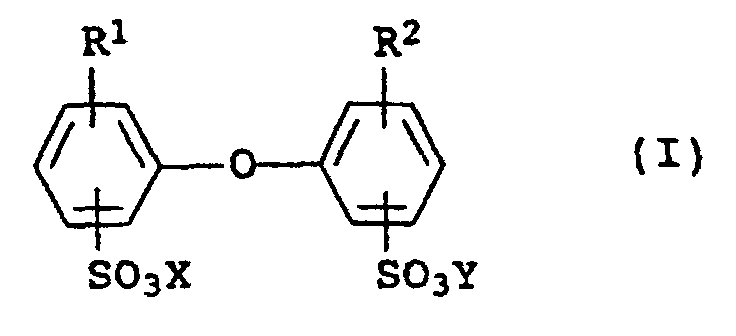
- emulsifiers which increase efflorescence safety are sodium lauryl sulfate and particularly preferably surface-active substances of the formula I, wherein R 1 and R 2 are hydrogen or C 4 -C 24 alkyl and are not simultaneously hydrogen, and X and Y are alkali metal ions and / or ammonium ions.
- the compounds I are well known, for. B. from EP-A-469 295.
- Particularly advantageous compounds I in which X and Y are sodium, R 1 is a branched alkyl radical having 12 C atoms and R 2 is hydrogen or R 1 .
- technical mixtures which have a proportion of 50 to 90% by weight of the monoalkylated product, for example Dowfax® 2A1 (trademark of the Dow Chemical Company).
- a preparation is used at least as the first preparation in which 0.5 to 10% by weight, especially 1.0 to 7.5% by weight and particularly preferably 1.5 to 5% by weight, based on the copolymer, a compound of the formula I as defined above contains.
- the efflorescence safety by a suitable selection the monomers C3 and / or C4 can be achieved. That's how you get an increased Ausblühschreib preferably by the fact that one at least for the first preparation uses a copolymer which as Monomer C at least one ethylenically unsaturated sulfonic acid (C3) and / or an ethylenically unsaturated silane (C4) copolymerized contains. Suitable such monomers C3 and C4 are above described.
- (meth) acryl deficittragende Sulfonic acids in particular 2-acrylamido-2-methylpropanesulfonic acid and (meth) acrylic group-containing silanes, in particular (meth) acryloxyalkylhydroxyalkylsilanes, and particularly preferred Methacryloylpropyltrimethoxysilane. Suitable quantity ranges for these monomers are described above.
- the first preparation contains both an emulsifier of formula I as well as a copolymer, the contains one of the aforementioned monomers C3 or C4 in copolymerized form.
- the copolymers contain 40 to 60 wt .-% of monomers A, preferably methyl methacrylate or styrene, 35 to 55% by weight of monomers B, preferably n-butyl acrylate or 2-ethylhexyl acrylate, and 0.5 to 3% by weight, in particular from 1 to 2.5% by weight of monomers C1, preferably acrylic acid or methacrylic acid, or monomers C3, preferably 2-acrylamido-2-methylpropanesulfonic acid, copolymerized.
- the copolymers in these embodiments may additionally 0.1 to 0.5 wt .-% acrylamide copolymerized.
- the first preparation about 0.5 wt .-% In copolymerized form comply with methacryloylpropyltrimethoxysilane, and although preferred if the 1st preparation is not ethylenic contains unsaturated sulfonic acid polymerized.
- the copolymer may also contain about 1% by weight. (Meth) allyl (meth) acrylate in copolymerized form.
- the copolymers have a glass transition temperature of -25 to +80 ° C. It should be noted that a high-quality coating is generally only obtained if the aqueous formulations of the film-forming copolymers have a minimum film-forming temperature below the application temperature. The minimum film-forming temperature in turn depends on the glass transition temperature T G of the copolymers (see Ullmann's Encyclopedia of Industrial Chemistry, 5 ed, Vol. A 21, 1992, p. 169). Thus, in principle, a low glass transition temperature of the copolymers leads to improved film formation. On the other hand, a low glass transition temperature results in increased tackiness of the coating and thus increased soiling of the coating.
- a low glass transition temperature usually causes a deteriorated blocking resistance.
- the minimum film-forming temperature can be influenced by so-called low-volatility, external plasticizers, for. As esters of phthalic acid and / or volatile, low-boiling organic solvents added as a film-forming aid.
- a glass transition temperature T G for the copolymers above -10 ° C and in particular above +10 ° C has proved to be advantageous for the coating of concrete blocks.
- the glass transition temperature T G +50 ° C is not exceeded.
- a glass transition temperature above +20 ° C. and in particular above +30 ° C. has proven to be advantageous.
- the glass transition temperature T G is understood here to be the midpoint temperature determined by differential thermal analysis (DSC) in accordance with ASTM D 3418-82 (compare Ullmann's Encyclopedia of Industrial Chemistry, 5th Edition, Volume A 21, VCH Weinheim 1992, page 169 and Zosel , Paint and varnish 82 (1976), pp. 125-134, see also DIN 53765).
- DSC differential thermal analysis
- T G X 1 T G 1 + X 2 T G 2 + ⁇ X n T G n
- X 1 , X 2 , ..., X n are the mass fractions of the monomers 1, 2, ..., n
- T G 1 , T G 2 , ..., T G n the glass transition temperatures of each of only one of Monomers 1, 2, ..., n constructed polymers in degrees Kelvin.
- the latter are z.
- the preparation of the copolymers can be achieved by all types of radical Copolymerization of ethylenically unsaturated monomers, z. By solution, precipitation, bulk, emulsion or suspension polymerization, respectively.
- the copolymers are preferred by means of free-radical, aqueous emulsion polymerization in the presence of at least one free radical polymerization initiator and optionally one or more surfactants Substances, performed.
- this is in water dispersible copolymer as polymer particles with middle Particle sizes in the range of 50 to 1000 nm, in particular 50 to 500 nm, more preferably 60 to 250 nm, before.
- Procedure for Adjustment of the polymer particle size are for example from EP-A-126699, EP-A-567 881, EP-A-567 819, the DE-A-31 47 008 and DE-A-42 13 967 known.
- the aqueous emulsion polymerization can be carried out in a customary manner z.
- z As for example in the "Encyclopedia of Polymer Science and Technology, Vol. 5, Wiley & Sons Inc., NY 1966, P. 847).
- Also dispersible in water copolymers in the form of multiphase particles are useful.
- Your production can z. B. by sequential methods, such as. B. in the EP-555959, EP-308753 and EP-654454.
- Radical polymerization initiators are all those in consideration, which are capable of a radical aqueous To initiate emulsion polymerization.
- the Amount of free-radical initiator systems used based to the total amount of monomers to be polymerized, 0.05 to 2 wt .-%, preferably 0.1 to 1 wt .-%.
- Surfactant suitable for carrying out the emulsion polymerization Substances are the ones commonly used for these purposes used protective colloids and emulsifiers.
- the surface-active Substances are usually added in amounts of up to 10% by weight, preferably 0.5 to 5 wt .-% and in particular 1 to 4 wt .-%, used based on the monomers to be polymerized.
- Suitable protective colloids are, for example, polyvinyl alcohols, Starch and cellulose derivatives or vinylpyrrolidone containing Copolymers. Also mixtures of emulsifiers and / or protective colloids can be used. Preferably, as surface-active Substances used exclusively emulsifiers whose relative molecular weights in contrast to the protective colloids usually below 2000. They can be both anionic, cationic as well as nonionic nature.
- the anionic emulsifiers include alkali metal and ammonium salts of alkyl sulfates (alkyl radical: C 8 -C 12 ), of sulfuric monoesters of ethoxylated alkanols (EO degree: 2 to 50, alkyl radical: C 12 to C 18 ) and ethoxylated alkylphenols (EO degree: 3 to 50, alkyl radical: C 4 -C 9 ), of alkylsulfonic acids (alkyl radical: C 12 -C 18 ) and of alkylarylsulfonic acids (alkyl radical: C 9 to C 18 ).
- the anionic surfactants include the already described above compounds of formula I.
- Suitable nonionic emulsifiers are araliphatic or aliphatic nonionic emulsifiers, for example ethoxylated mono-, di- and trialkylphenols (EO degree: 3 to 50, alkyl radical: C 4 -C 9 ), ethoxylates of long-chain alcohols (EO degree: 3 to 50, alkyl radical : C 8 -C 36 ), as well as polyethylene oxide / polypropylene oxide block copolymers.
- Preference is given to using anionic emulsifiers, in particular emulsifiers of the formula I, or combinations of at least one anionic and one nonionic emulsifier.
- the molecular weight of the polymers can be reduced by adding Quantities, usually up to 2 wt .-%, based on the polymerized Monomers, one or more, the molecular weight regulatory substances, eg. As organic thio compounds, silanes, Allyl alcohols or aldehydes can be adjusted.
- Quantities usually up to 2 wt .-%, based on the polymerized Monomers, one or more, the molecular weight regulatory substances, eg. As organic thio compounds, silanes, Allyl alcohols or aldehydes can be adjusted.
- the emulsion polymerization can be both continuous and according to the batch procedure, preferably after a semi-continuous Procedure done.
- the to be polymerized Monomers continuously, including stepwise or gradient mode, are fed to the polymerization mixture.
- the monomers can be used both as a monomer mixture and as aqueous monomer emulsion are fed to the polymerization.
- Polymerization pressure and polymerization temperature are of secondary importance Importance. In general, one works at temperatures between room temperature and 120 ° C, preferably at temperatures from 40 to 110 ° C and more preferably between 50 and 100 ° C.
- novel aqueous polymer dispersions largely free of odorants, such as Residual monomers and other organic volatiles shape. Suitable methods for deodorising dispersions are known in the art.
- the polymer dispersions with bases in particular Alkali hydroxide solutions, such as sodium or potassium hydroxide, or Ammonium hydroxide, neutralized, having a pH in the range of 7 to 8 is particularly preferred.
- bases in particular Alkali hydroxide solutions, such as sodium or potassium hydroxide, or Ammonium hydroxide, neutralized, having a pH in the range of 7 to 8 is particularly preferred.
- the preparations used according to the invention are present in particular in the form of solutions or dispersions.
- aqueous solvents ie water or mixtures of water and a water-miscible organic solvent, for.
- B a C 1 -C 4 alkanol, such as methanol, ethanol, n- or iso-propanol, n-, iso-, 2- or tert-butanol, glycol, propylene glycol, butylene glycol, glycerol, diethylene glycol, triethylene glycol, tetrahydrofuran or similar used.
- the novel copolymers preferably come in the form aqueous preparations containing not more than 50% by weight, in particular not more than 20% by weight and especially not more than 10 wt .-%, based on the total weight of the preparation, with Water-miscible solvents, for use. Most notably The preparations according to the invention preferably contain except water and apart from usual antifreeze and Film-forming aids no organic solvents. In these Preparations are the copolymers usually in the form aqueous dispersions.
- the solutions or dispersions of the copolymers can according to the invention be used as such.
- the preparations contain but usually 0.1 to 30 wt .-% of conventional auxiliaries.
- the aqueous preparations if the preparation the copolymers by free-radical, aqueous emulsion polymerization including those used for that purpose, surface-active substances, such as emulsifiers and / or protective colloids.
- Usual aids are, for example, wetting agents, fungicides, Defoamer, thickener, antifreeze, leveling agent, Plasticizers and film-forming aids.
- At least the second preparation contains fillers and / or inorganic Pigments.
- the pigment volume concentration (PVK) of the 2nd preparation is preferably in the range of 20 to 60 and in particular in the range of 25 to 50.
- the 1st preparation can Contain fillers and / or inorganic pigments, but is it is advantageous that the first preparation one by a value of at least 10, preferably at least 20, smaller pigment volume concentration as the filled and / or pigmented 2nd preparation having.
- the 1. prepare a pigment volume concentration in the range of 0.5 to 10, in a particularly preferred embodiment the first preparation is unpigmented and unfilled.
- the third preparation preferably has a pigment volume concentration of not more than 45 and in particular not more than 35.
- the pigment volume concentration the third preparation at least 10 smaller than the the previously applied second preparation.
- the third preparation essentially unfilled and unpigmented or has a pigment volume concentration in the range of 0.5 to 30, such. B. about 5, about 15 or about 25 on.
- Typical fillers include aluminosilicates, e.g. Feldspars, silicates, z. Kaolin, talc, mica, magnesite, alkaline earth carbonates, z.
- calcium carbonate for example in the form of calcite or chalk, magnesium carbonate, dolomite, alkaline earth sulfates, e.g. B. Calcium sulfate, silica, etc.
- Typical pigments are, for example Titanium dioxide, preferably in rutile form, barium sulfate, Zinc oxide or lithopone (zinc sulfide + barium sulfate).
- the preparations may also contain colored pigments, for example, iron oxides, carbon black, graphite, zinc yellow, zinc green, Ultramarine, manganese black, antimony black, manganese violet, Paris blue or Schweinfurter green included.
- the total content of copolymer is in the range of 10 to 70 wt .-%, preferably in the range from 20 to 60 wt .-%, the content of auxiliaries in the range of 0.1 to 30% by weight and preferably in the range of 0.5 to 10% by weight.
- the amount of pigments and / or fillers is in the second preparation generally between 50 and 450 parts by weight, based on 100 parts by weight of copolymer in the aqueous 2. Preparation.
- pigment-containing preparations in addition to the film-forming aids and defoamers preferably also contain a dispersing or wetting agent.
- the process according to the invention comprises the coating of mineral shaped bodies with the above-described film-forming, aqueous preparations, wherein at least one first preparation as described above comprising at least one copolymer as binder is applied to the mineral shaped body, optionally dried, then at least one second, as described above second preparation containing at least one copolymer as a binder and at least one inorganic pigment, applied to the already coated surface of the mineral molding and then dried.
- the sum of the amount of the aqueous preparations to be applied is in the range of 30 to 800 g / m 2 (wet), corresponding to a dried order of 15 to 500 g / m 2 and especially a dry application of 25 to 300 g / m 2 , wherein the first order with the first preparation preferably 10 to 60 wt .-%, in particular 15 to 50 wt .-% of the sum of the amounts to be applied.
- the second application with the second preparation is preferably 20 to 70 wt .-% and in particular 30 to 70 wt .-% of the sum of the quantities to be applied.
- the third order with the third preparation is preferably 10 to 60 wt .-% and in particular 20 to 40 wt .-%.
- Each of the jobs, the first, second and third order, each can both in a coating process by applying the total amount of the respective preparation as well as by repeated application, such as by two, three or four times application of subsets of the total amount the respective preparation.
- the order of the preparations can be done in a conventional manner by spraying, filling, knife coating, rolling or pouring.
- the drying operations which optionally follow the application of the preparations can be carried out both at room temperature and at elevated temperature, for example in the range from 40 to 100 ° C.
- the drying step after application of the third preparation is generally carried out at elevated temperature, preferably in the range of 40 to 120 ° C.
- the process according to the invention is generally applicable to all shaped bodies applicable, which contain a mineral binder. Its preferred effects unfold in mineral moldings, the cement as a binder (concrete blocks and Fiber cement panels).
- Concrete blocks are shaped objects concrete and / or aerated concrete, e.g. As plates, pipes and / or Roof tiles (concrete roof tiles).
- the concrete block becomes common Made of ready mixed concrete by an extrusion process produced in a known manner.
- the aqueous according to the invention Preparations, in particular the first preparation now offer the advantage that they not only on the ready-made, but also on the freshly prepared, not hardened, so-called "green" concrete block can be applied.
- the application a 1st preparation on a freshly prepared, mineral Shaped body represents a preferred embodiment of the According to the invention.
- the drying of the invention coated, "green” concrete blocks can be made in the usual way, optionally at room temperature or elevated temperature become.
- the coated "green” concrete block placed in a so-called chamber.
- the stone at least once with the inventive aqueous second preparation sprayed and the above-described drying step is repeated.
- the stone is at least once with the 3. Preparation sprayed. Further drying takes place afterwards in a tunnel oven at around 80 to 120 ° C lying circulating air temperatures.
- cement slurry are in the context of this invention, mineral coating compositions, the a mineral binder, especially cement.
- additives and / or fillers contain suitable cement slurry Fine sand, cement, water and optionally pigments, in particular Fine sand, cement and water.
- Advantageously have fixed Aggregates and / or fillers particle sizes in the range of 0.01 to 5 mm, in particular in the range of 0.05 to 4 mm.
- cement slurry the fine sand with particle sizes smaller than 2 mm and / or have a high content of cement.
- the production by coating can at least a surface of a mineral shaped body with a cement slurry take place, wherein the application of the slurry z. B. by Pouring, doctoring, dipping, brushing, spraying and the like ⁇ . Can take place.
- the production of mineral moldings, the at least one provided with a cement slurry surface have, by coextrusion of the mineral molding based lying mass and the cement slurry done.
- cement slurry on the or the visible surfaces applied mineral body for. B. by the above-described Method.
- aqueous preparations similarly advantageous so-called fiber cement boards, d. H. flat, mineral moldings, containing the cement as a binder and the mineral or organic fibers, e.g. B. polyester and / or polyamide fibers included as surcharges.
- the order of the inventive, aqueous Preparations are usually in the for "green" concrete blocks described way.
- the coated by the novel process mineral Shaped bodies are characterized on the one hand by good protection Efflorescence and good resistance, even under weathering conditions from, for. B. in low water intake, high Slip resistance, low aging phenomena expresses. Especially is also on particularly smooth mineral surfaces the adhesion significantly improved and the blistering tendency significantly reduced. It is easy to get the desired surface properties adjust, z. B. a desired degree of gloss between matt and high gloss, and high block resistance. These properties are particularly important for concrete roof tiles, therefore, a preferred embodiment of the invention represent.
- the inventive method is due to the comparatively low concentration of binder used Copolymers economically advantageous. Accordingly, that leads inventive method for improved preservation and improved Properties of mineral moldings.
- the agents according to the invention comprise three separate components (1st, 2nd and 3rd preparations), taken together or in separate Packaging units may be present.
- Emulsifier solution 1 In an inlet vessel 1 was exposed to an emulsion 486.0 g deionized water 29.0 g Emulsifier solution 1 13.0 g Emulsifier solution 2 675.0 g methyl methacrylate 575.0 g n-butyl acrylate 13.0 g methacrylic acid 13.0 g 50% strength by weight solution of acrylamide in water ago.
- a solution of 5.0 g of sodium peroxodisulfate in 190 g of water In a second feed vessel 2, a solution of 5.0 g of sodium peroxodisulfate in 190 g of water.
- an inlet vessel 1 was exposed to an emulsion 594.0 g deionized water 57.0 g Emulsifier solution 3 780.0 g methyl methacrylate 720.0 g n-butyl acrylate 15.0 g 50% strength by weight solution of the ammonium salt of AMPS (2-acrylamido-2-methylpropanesulfonic acid) in water 9.0 g 50% strength by weight solution of acrylamide in water ago.
- AMPS 2-acrylamido-2-methylpropanesulfonic acid
- a solution of 8.0 g of sodium peroxodisulfate in 300 g of water In a second feed vessel 2, a solution of 8.0 g of sodium peroxodisulfate in 300 g of water.
- an aqueous emulsion was made 105.0 g deionized water 54.0 g styrene 44.0 g n-butyl acrylate 2.0 g acrylic acid 0.5 g ⁇ -methacryloxypropyltrimethoxysilane 0.5 g sodium lauryl sulfate 0.5 g sodium polymerized at 90 ° C according to the emulsion feed method by the method of free-radical aqueous emulsion polymerization.
- the solids content of the dispersion obtained was about 50% by weight.
- the glass transition temperature T G of the resulting copolymer is +30 ° C, determined by DSC according to DIN 53765.
- an emulsion was prepared: 602.5 g deionized water 11.6 g Emulsifier solution 4 546.0 g n-butyl acrylate 754.0 g methyl methacrylate 19.5 g acrylic acid 23.4 g 20% strength by weight solution of acrylamide in water 13.0 g Methacrylates allylester ago.
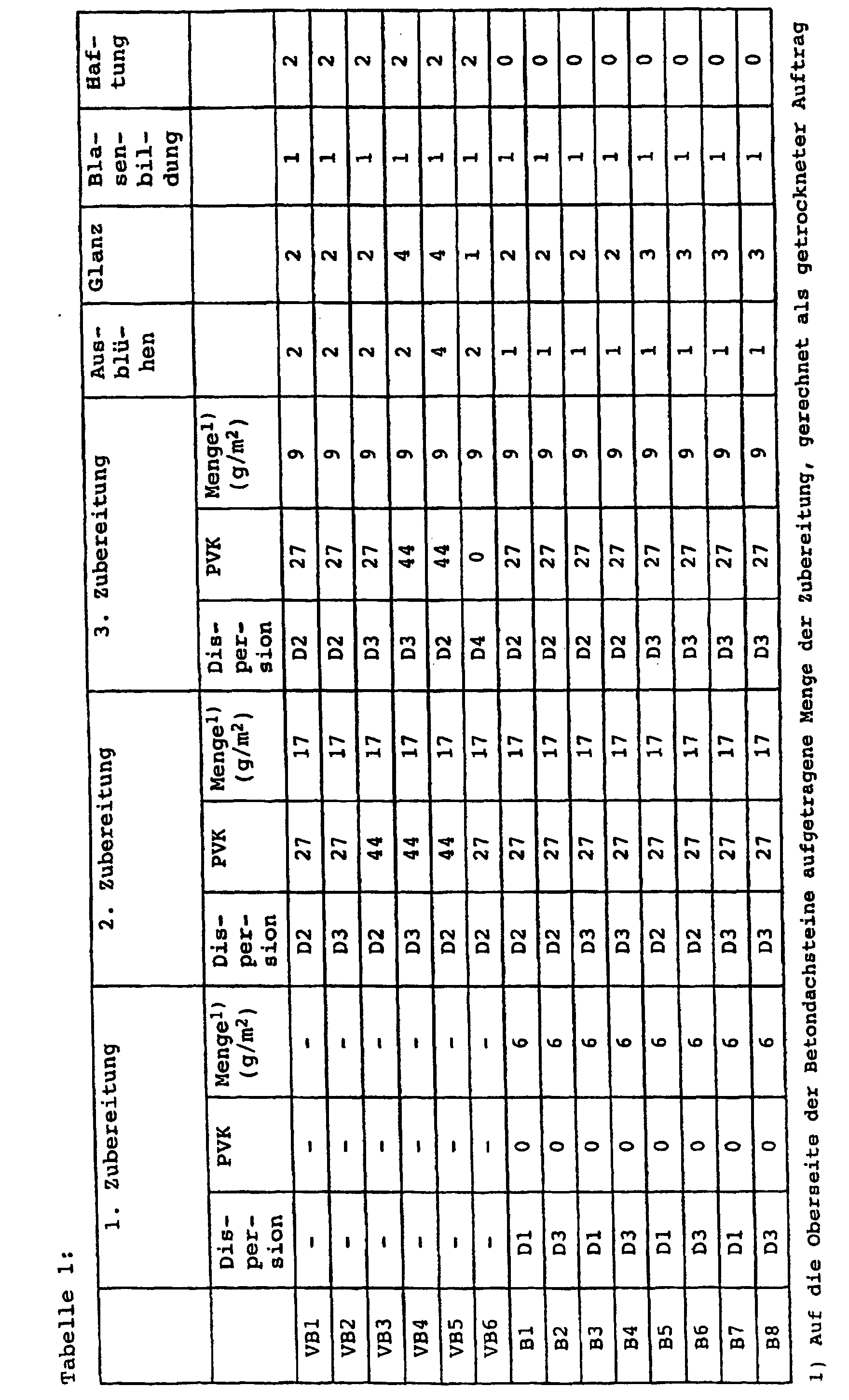
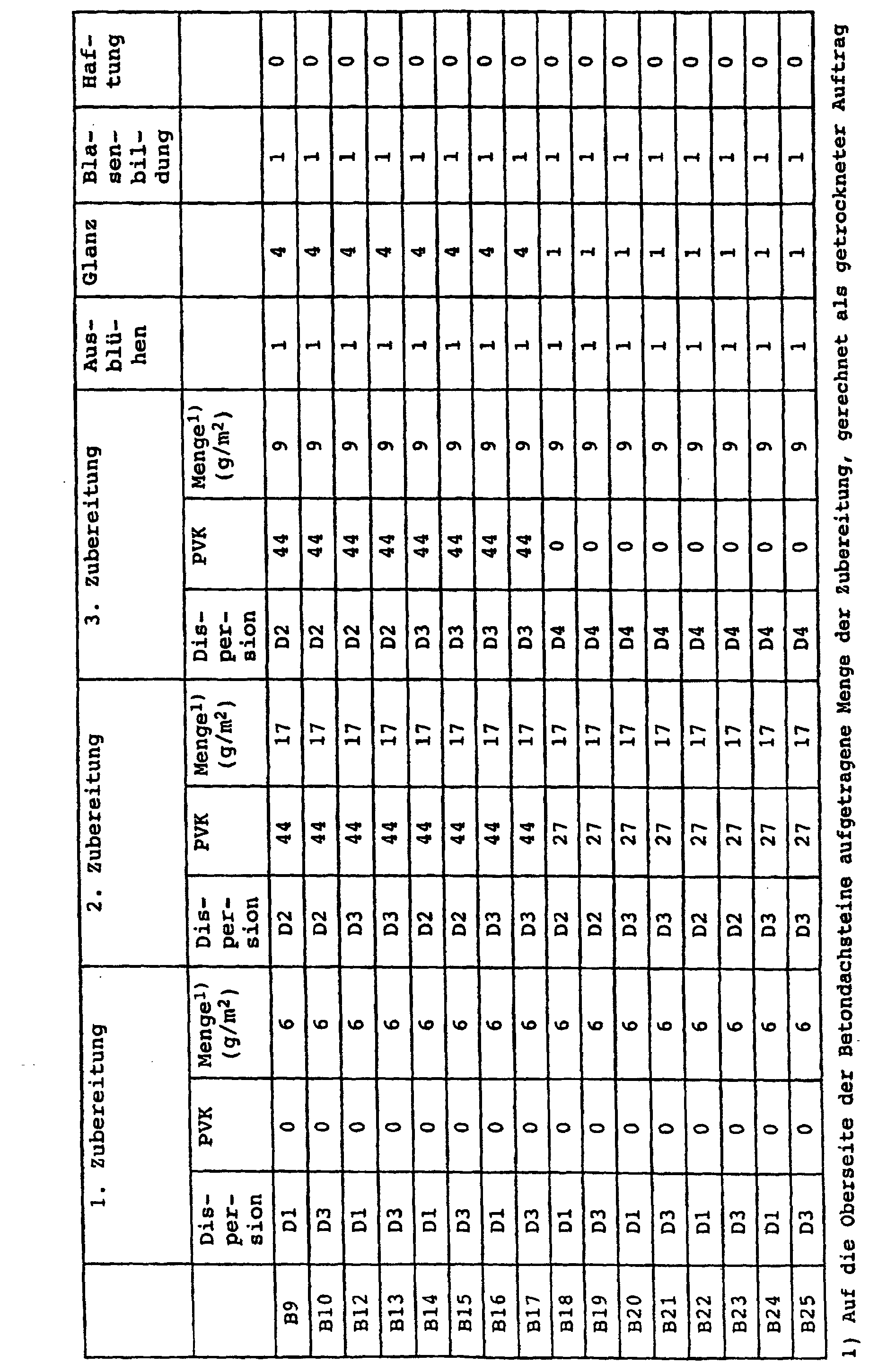
- test stones which judged already after 1st and 2nd are also used for determining the blistering tendency used.
- the formation of bubbles becomes visual assessed at so-called polluted sites (s.o.).
- the comparative examples VB1 to VB6 differ from the examples according to the invention in that on the one hand only 2 preparations are applied and on the other hand that the preparation applied first does not show a difference of at least 10 smaller pigment volume concentrations.
Landscapes
- Chemical & Material Sciences (AREA)
- Engineering & Computer Science (AREA)
- Ceramic Engineering (AREA)
- Materials Engineering (AREA)
- Structural Engineering (AREA)
- Organic Chemistry (AREA)
- Paints Or Removers (AREA)
- Application Of Or Painting With Fluid Materials (AREA)
Description
- die Monomere A ausgewählt sind unter Vinylaromaten und Methacrylsäureestern von C1-C4-Alkanolen,
- die Monomere B ausgewählt sind unter Methacrylsäureestern von C5-C12-Alkanolen, Acrylsäureestern von C1-C12-Alkanolen und Vinylestern aliphatischer Carbonsäuren und
- die Monomere C ethylenisch ungesättigte Monomere umfassen, die von den Monomeren A und B verschieden sind,
- Styrol: n-Butylacrylat im Gewichtsverhältnis 35:65 bis 80:20,
- Styrol: 2-Ethylhexylacrylat im Gewichtsverhältnis 35:65 bis 80:20,
- Methylmethacrylat: n-Butylacrylat im Gewichtsverhältnis 40:60 bis 80:20,
- Methylmethacrylat: 2-Ethylhexylacrylat im Gewichtsverhältnis 35:65 bis 80:20,
- ferner ternäre und quartäre Monomermischungen A/B, bei denen
ein Teil des Styrols durch Methylmethacrylat und/oder n-Butylmethacrylat
ersetzt ist, oder ein Teil des n-Butylacrylats
durch 2-Ethylhexylacrylat, z. B.:
- Methylmethacrylat : Styrol : 2-Ethylhexylacrylat im Gewichtsverhältnis 20:20:60,
- n-Butylmethacrylat : Styrol : 2-Ethylhexylacrylat im Gewichtsverhältnis 35:10:55,
- Methylmethacrylat : n-Butylmethacrylat : n-Butylacrylat im Gewichtsverhältnis 30:35:35,
- Styrol : n-Butylacrylat : 2-Ethylhexylacrylat im Gewichtsverhältnis 50:25:25 und
- Styrol : Methylmethacrylat : n-Butylacrylat : 2-Ethylhexylacrylat im Gewichtsverhältnis 20:20:30:30.
- die Monomere A ausgewählt sind unter Vinylaromaten und Methacrylsäureestern von C1-C4-Alkanolen,
- die Monomere B ausgewählt sind unter Methacrylsäureestern von C5-C12-Alkanolen, Acrylsäureestern von C1-C12-Alkanolen und Vinylestern aliphatischer Carbonsäuren und
- die Monomere C davon verschiedene ethylenisch ungesättigte Monomere umfassen,
| 486,0 g | entionisiertem Wasser |
| 29,0 g | Emulgatorlösung 1 |
| 13,0 g | Emulgatorlösung 2 |
| 675,0 g | Methylmethacrylat |
| 575,0 g | n-Butylacrylat |
| 13,0 g | Methacrylsäure |
| 13,0 g | 50 gew.-%ige Lösung von Acrylamid in Wasser |
- Emulgatorlösung 1:
- 35 gew.-%ige wässrige Lösung eines Schwefelsäurehalbesters eines ethoxylierten Nonylphenols (E0-Grad 25).
- Emulgatorlösung 2:
- 20 gew.-%ige wässrige Lösung eines ethoxylierten C13/C15-Oxoalkoholgemischs (gesättigt) mit einem E0-Grad von 30.
| 594,0 g | entionisiertem Wasser |
| 57,0 g | Emulgatorlösung 3 |
| 780,0 g | Methylmethacrylat |
| 720,0 g | n-Butylacrylat |
| 15,0 g | 50 gew.-%ige Lösung des Ammoniumsalzes der AMPS (2-Acrylamido-2-methylpropansulfonsäure) in Wasser |
| 9,0 g | 50 gew.-%ige Lösung von Acrylamid in Wasser |
- Emulgatorlösung 3:
- 45 gew.-%ige wässrige Lösung einer als Dowfax® 2A1 (Dow Chemical) im Handel üblichen Wirksubstanz (Gemisch von Monound Di-C1-C12-alkyl-Verbindung der allgemeinen Formel I als Natriumsalz).
| 105,0 g | entionisiertes Wasser |
| 54,0 g | Styrol |
| 44,0 g | n-Butylacrylat |
| 2,0 g | Acrylsäure |
| 0,5 g | γ-Methacryloxypropyltrimethoxysilan |
| 0,5 g | Natriumlaurylsulfat |
| 0,5 g | Natriumperoxodisulfat |
| 602,5 g | entionisiertem Wasser |
| 11,6 g | Emulgatorlösung 4 |
| 546,0 g | n-Butylacrylat |
| 754,0 g | Methylmethacrylat |
| 19,5 g | Acrylsäure |
| 23,4 g | 20 gew.-%ige Lösung von Acrylamid in Wasser |
| 13,0 g | Methacrylsäureallylester her. |
- Emulgatorlösung 4:
- 15 gew.-%ige wässrige Lösung des Natriumsalzes eines C12-Alkylsulfats
| PVK 44 | PVK 44 | |
| Dispersion | 392,4 g D2 | 392,4 g D3 |
| Wasser | 173,6 g | 173,6 g |
| Pigment | 86,8 g | 86,8 g |
| Füllstoff | 347,2 g | 347,2 g |
Claims (11)
- Verfahren zum Beschichten mineralischer Formkörper mit wässrigen Zubereitungen, die aus den Monomeren A, B und gegebenenfalls C aufgebaute Copolymerisate in dispers verteilter Form als filmbildende Bestandteile enthalten, wobeiwobei man auf den mineralischen Formkörper nacheinander eine erste Zubereitung mit einer Pigmentvolumenkonzentration von weniger als 20 aufbringt, gegebenenfalls trocknet, eine zweite Zubereitung mit einer Pigmentvolumenkonzentration von 10 bis 70 aufbringt, gegebenenfalls trocknet, und eine dritte Zubereitung mit einer PVK von weniger als 50 aufbringt, wobei die Pigmentvolumenkonzentration der ersten Zubereitung um einen Wert von mindestens 10 kleiner ist als die der zweiten Zubereitung.die Monomere A ausgewählt sind unter Vinylaromaten und Methacrylsäureestern von C1-C4-Alkanolen,die Monomere B ausgewählt sind unter Methacrylsäureestern von C5-C12-Alkanolen, Acrylsäureestern von C1-C12-Alkanolen und Vinylestern aliphatischer Carbonsäuren unddie Monomere C ethylenisch ungesättigte Monomere umfassen, die von den Monomeren A und B verschieden sind,
- Verfahren nach Anspruch 1, wobei man wenigstens für die erste Zubereitung ein Copolymer einsetzt, das als Monomer C wenigstens eine ethylenisch ungesättigte Sulfonsäure und/oder ein ethylenisch ungesättigtes Silan einpolymerisiert enthält.
- Verfahren nach Anspruch 1 oder 2, wobei man eine erste Zubereitung einsetzt, die 0,5 bis 10 Gew.-%, bezogen auf das Copolymer, einer Verbindung der Formel Ienthält, worin R1 oder R2 Wasserstoff oder C4-C24-Alkyl bedeuten und nicht gleichzeitig Wasserstoff sind, und X und Y für Alkalimetallionen und/oder Ammoniumionen stehen.
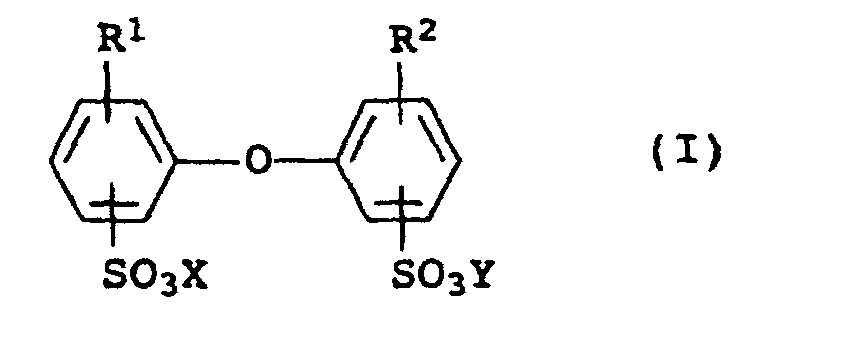
- Verfahren nach einem der vorhergehenden Ansprüche, wobei die Copolymerisate wenigstens 80 Gew.-% einpolymerisierte Monomere A und B enthalten.
- Verfahren nach einem der vorhergehenden Ansprüche, wobei man für die Copolymerisate wenigstens zweier Zubereitungen gleiche Monomere A und/oder gleiche Monomere B auswählt.
- Verfahren nach einem der vorhergehenden Ansprüche, wobei sich in den Copolymerisaten zweier nacheinander aufgetragener Zubereitungen die Mengenverhältnisse der Monomeren A zu B um weniger als 30% unterscheiden.
- Verfahren nach einem der vorhergehenden Ansprüche, wobei man wenigstens für die erste und die zweite Zubereitung gleiche Copolymerisate einsetzt.
- Verfahren nach einem der vorhergehenden Ansprüche, wobei man eine erste Zubereitung mit einer Pigmentvolumenkonzentration im Bereich von 0 bis 10, eine zweite Zubereitung mit einer Pigmentvolumenkonzentration im Bereich von 20 bis 50 und eine dritte Zubereitung mit einer Pigmentvolumenkonzentration im Bereich von 0 bis 45 einsetzt.
- Verfahren nach einem der vorhergehenden Ansprüche, wobei die Monomere A ausgewählt sind unter Methylmethacrylat und Styrol und die Monomere B ausgewählt sind unter n-Butylacrylat, 2-Ethylhexylacrylat und Vinylacetat.
- Beschichteter mineralischer Formkörper, erhältlich nach einem Verfahren gemäß einem der vorhergehenden Ansprüche.
- Mittel zur Beschichtung mineralischer Formkörper, bestehend aus drei voneinander getrennten Zubereitungen, die aus den Monomeren A, B und gegebenenfalls C aufgebaute Copolymerisate in dispers verteilter Form als filmbildende Bestandteile enthalten, wobeidie Monomere A ausgewählt sind unter Vinylaromaten und Methacrylsäureestern von C1-C4-Alkanolen,die Monomere B ausgewählt sind unter Methacrylsäureestern von C5-C12-Alkanolen, Acrylsäureestern von C1-C12-Alkanolen und Vinylestern aliphatischer Carbonsäuren unddie Monomere C davon verschiedene ethylenisch ungesättigte Monomere umfassen,
wobei die erste Zubereitung eine Pigmentvolumenkonzentration von weniger als 20, die zweite Zubereitung eine Pigmentvolumenkonzentration von 10 bis 70 und die dritte Zubereitung eine PVK von weniger als 50 aufweist, wobei die Pigmentvolumenkonzentration der ersten Zubereitung um einen Wert von mindestens 10 kleiner ist als die der zweiten Zubereitung.
Applications Claiming Priority (2)
| Application Number | Priority Date | Filing Date | Title |
|---|---|---|---|
| DE19933500 | 1999-07-16 | ||
| DE19933500A DE19933500A1 (de) | 1999-07-16 | 1999-07-16 | Verfahren zur Beschichtung von mineralischen Formkörpern |
Publications (2)
| Publication Number | Publication Date |
|---|---|
| EP1069093A1 EP1069093A1 (de) | 2001-01-17 |
| EP1069093B1 true EP1069093B1 (de) | 2005-01-19 |
Family
ID=7915087
Family Applications (1)
| Application Number | Title | Priority Date | Filing Date |
|---|---|---|---|
| EP00115302A Expired - Lifetime EP1069093B1 (de) | 1999-07-16 | 2000-07-14 | Beschichtungsmittel und Verfahren zur Beschichtung von mineralischen Formkörper |
Country Status (3)
| Country | Link |
|---|---|
| EP (1) | EP1069093B1 (de) |
| AT (1) | ATE287384T1 (de) |
| DE (2) | DE19933500A1 (de) |
Families Citing this family (5)
| Publication number | Priority date | Publication date | Assignee | Title |
|---|---|---|---|---|
| US8524822B2 (en) * | 2005-01-11 | 2013-09-03 | W. R. Grace & Co.—Conn. | Vapor permeable liquid-applied membrane |
| CN108430953B (zh) | 2015-10-20 | 2021-01-26 | 巴斯夫欧洲公司 | 用于涂覆纤维水泥板的涂料组合物 |
| SI3498783T1 (sl) | 2017-12-14 | 2021-08-31 | Monier Roofing Gmbh | Strešnik s preslojem in postopek za preslojevanje strešnika |
| WO2021209543A1 (en) | 2020-04-17 | 2021-10-21 | Basf Se | Aqueous polymer dispersions |
| WO2025103901A1 (en) | 2023-11-14 | 2025-05-22 | Basf Se | Polymer dispersions for coatings |
Family Cites Families (4)
| Publication number | Priority date | Publication date | Assignee | Title |
|---|---|---|---|---|
| AT381499B (de) * | 1985-02-27 | 1986-10-27 | Vianova Kunstharz Ag | Wasserverduennbare ueberzugsmittel, verfahren zur herstellung und ihre verwendung fuer basisschichtenbei zweischicht-decklackierung |
| GB2251246A (en) * | 1990-12-05 | 1992-07-01 | Brickmatch Ltd | A composition suitable for application to stonework or brickwork |
| US5215783A (en) * | 1991-06-24 | 1993-06-01 | E. I. Du Pont De Nemours And Company | Low voc clear epoxy acrylic coating composition for basecoat clear finish |
| US5824734A (en) * | 1996-07-10 | 1998-10-20 | Air Products And Chemicals, Inc. | Waterborne coating compositions |
-
1999
- 1999-07-16 DE DE19933500A patent/DE19933500A1/de not_active Withdrawn
-
2000
- 2000-07-14 EP EP00115302A patent/EP1069093B1/de not_active Expired - Lifetime
- 2000-07-14 AT AT00115302T patent/ATE287384T1/de active
- 2000-07-14 DE DE50009259T patent/DE50009259D1/de not_active Expired - Lifetime
Also Published As
| Publication number | Publication date |
|---|---|
| DE19933500A1 (de) | 2001-01-18 |
| ATE287384T1 (de) | 2005-02-15 |
| EP1069093A1 (de) | 2001-01-17 |
| DE50009259D1 (de) | 2005-02-24 |
Similar Documents
| Publication | Publication Date | Title |
|---|---|---|
| EP0821660B1 (de) | Verfahren zur konservierung eines mineralischen formkörpers | |
| EP1029009B1 (de) | Zubereitungen aus pigment und phosphonathaltigem harz | |
| EP2225289B1 (de) | Verfahren zur herstellung wässriger polymerisatdispersionen | |
| EP1046682B1 (de) | Wässrige, pigmenthaltige Beschichtungsmittel | |
| EP0915071B1 (de) | Verwendung von wässrigen Zubereitungen, die als filmbildenden Bestandteil ein Copolymer P enthalten | |
| DE10049791A1 (de) | Pigmenthaltige Beschichtungsmittel auf Wasserbasis | |
| EP0982279B1 (de) | Wässrige Zubereitungen, die ein Polymer als filmbildenden Bestandteil und einen anionischen Emulgator enthalten | |
| EP0941977A1 (de) | Verfahren zur Beschichtung mineralischer Formkörper | |
| EP1114806A2 (de) | Verwendung wässriger Polymerdispersionen zur Modifizierung mineralischer Beschichtungen für Betonformkörper | |
| EP1129049B1 (de) | Wässrige, filmbildende zubereitungen auf acrylat-basis zur beschichtung mineralischer formkörper | |
| EP1062186B1 (de) | Verwendung von wässrigen filmbildenden zubereitungen auf der basis von copolymeren von methacrylsaurealkylestern zur beschichtung von mineralischen formkörpern | |
| EP1069093A1 (de) | Beschichtungsmittel und Verfahren zur Beschichtung von mineralischen Formkörper | |
| EP1315687B1 (de) | Formkörper mit einer tonmineralischen beschichtung | |
| CN115461385A (zh) | 水性聚合物分散体 | |
| DE60210861T2 (de) | Wässrige Polymerzusammensetzung | |
| DE60014283T2 (de) | Verfahren zum Beschichten eines nicht ausgehärteten mineralischen Substrats | |
| EP1315685B1 (de) | Verwendung eines polymermodifizierten formkörpers aus ton zum decken von dächern | |
| DE19856148B4 (de) | Wässriges pigmenthaltiges Beschichtungsmittel, Verwendung und Verfahren zur Beschichtung bituminöser Substrate | |
| DE19810053A1 (de) | Verfahren zum Neutralisieren von wässrigen Dispersionen von filmbildenden Copolymerisaten und so erhältliche Beschichtungen | |
| DE19951068A1 (de) | Verwendung wässriger Polymerzubereitungen für Nass-in-Nass-Beschichtungen |
Legal Events
| Date | Code | Title | Description |
|---|---|---|---|
| PUAI | Public reference made under article 153(3) epc to a published international application that has entered the european phase |
Free format text: ORIGINAL CODE: 0009012 |
|
| AK | Designated contracting states |
Kind code of ref document: A1 Designated state(s): AT DE FR GB IT SE |
|
| AX | Request for extension of the european patent |
Free format text: AL;LT;LV;MK;RO;SI |
|
| 17P | Request for examination filed |
Effective date: 20010216 |
|
| AKX | Designation fees paid |
Free format text: AT DE FR GB IT SE |
|
| 17Q | First examination report despatched |
Effective date: 20030523 |
|
| GRAP | Despatch of communication of intention to grant a patent |
Free format text: ORIGINAL CODE: EPIDOSNIGR1 |
|
| GRAS | Grant fee paid |
Free format text: ORIGINAL CODE: EPIDOSNIGR3 |
|
| GRAA | (expected) grant |
Free format text: ORIGINAL CODE: 0009210 |
|
| AK | Designated contracting states |
Kind code of ref document: B1 Designated state(s): AT DE FR GB IT SE |
|
| PG25 | Lapsed in a contracting state [announced via postgrant information from national office to epo] |
Ref country code: IT Free format text: LAPSE BECAUSE OF FAILURE TO SUBMIT A TRANSLATION OF THE DESCRIPTION OR TO PAY THE FEE WITHIN THE PRESCRIBED TIME-LIMIT;WARNING: LAPSES OF ITALIAN PATENTS WITH EFFECTIVE DATE BEFORE 2007 MAY HAVE OCCURRED AT ANY TIME BEFORE 2007. THE CORRECT EFFECTIVE DATE MAY BE DIFFERENT FROM THE ONE RECORDED. Effective date: 20050119 Ref country code: GB Free format text: LAPSE BECAUSE OF FAILURE TO SUBMIT A TRANSLATION OF THE DESCRIPTION OR TO PAY THE FEE WITHIN THE PRESCRIBED TIME-LIMIT Effective date: 20050119 |
|
| REG | Reference to a national code |
Ref country code: GB Ref legal event code: FG4D Free format text: NOT ENGLISH |
|
| REF | Corresponds to: |
Ref document number: 50009259 Country of ref document: DE Date of ref document: 20050224 Kind code of ref document: P |
|
| REG | Reference to a national code |
Ref country code: SE Ref legal event code: TRGR |
|
| GBV | Gb: ep patent (uk) treated as always having been void in accordance with gb section 77(7)/1977 [no translation filed] |
Effective date: 20050119 |
|
| PLBE | No opposition filed within time limit |
Free format text: ORIGINAL CODE: 0009261 |
|
| STAA | Information on the status of an ep patent application or granted ep patent |
Free format text: STATUS: NO OPPOSITION FILED WITHIN TIME LIMIT |
|
| 26N | No opposition filed |
Effective date: 20051020 |
|
| ET | Fr: translation filed | ||
| REG | Reference to a national code |
Ref country code: FR Ref legal event code: TP |
|
| REG | Reference to a national code |
Ref country code: FR Ref legal event code: CD Ref country code: FR Ref legal event code: TP |
|
| REG | Reference to a national code |
Ref country code: FR Ref legal event code: PLFP Year of fee payment: 17 |
|
| REG | Reference to a national code |
Ref country code: FR Ref legal event code: PLFP Year of fee payment: 18 |
|
| REG | Reference to a national code |
Ref country code: FR Ref legal event code: PLFP Year of fee payment: 19 |
|
| PGFP | Annual fee paid to national office [announced via postgrant information from national office to epo] |
Ref country code: SE Payment date: 20190729 Year of fee payment: 20 Ref country code: FR Payment date: 20190726 Year of fee payment: 20 |
|
| PGFP | Annual fee paid to national office [announced via postgrant information from national office to epo] |
Ref country code: AT Payment date: 20190725 Year of fee payment: 20 |
|
| PGFP | Annual fee paid to national office [announced via postgrant information from national office to epo] |
Ref country code: DE Payment date: 20190930 Year of fee payment: 20 |
|
| REG | Reference to a national code |
Ref country code: DE Ref legal event code: R071 Ref document number: 50009259 Country of ref document: DE |
|
| REG | Reference to a national code |
Ref country code: SE Ref legal event code: EUG |
|
| REG | Reference to a national code |
Ref country code: AT Ref legal event code: MK07 Ref document number: 287384 Country of ref document: AT Kind code of ref document: T Effective date: 20200714 |
|
| REG | Reference to a national code |
Ref country code: SE Ref legal event code: EUG |