EP1068555B1 - Systeme optique, notamment lentille intraoculaire, lentille de contact - Google Patents
Systeme optique, notamment lentille intraoculaire, lentille de contact Download PDFInfo
- Publication number
- EP1068555B1 EP1068555B1 EP99911858A EP99911858A EP1068555B1 EP 1068555 B1 EP1068555 B1 EP 1068555B1 EP 99911858 A EP99911858 A EP 99911858A EP 99911858 A EP99911858 A EP 99911858A EP 1068555 B1 EP1068555 B1 EP 1068555B1
- Authority
- EP
- European Patent Office
- Prior art keywords
- optical system
- refractive index
- lens
- lenses
- intraocular lens
- Prior art date
- Legal status (The legal status is an assumption and is not a legal conclusion. Google has not performed a legal analysis and makes no representation as to the accuracy of the status listed.)
- Expired - Lifetime
Links
Images
Classifications
-
- A—HUMAN NECESSITIES
- A61—MEDICAL OR VETERINARY SCIENCE; HYGIENE
- A61F—FILTERS IMPLANTABLE INTO BLOOD VESSELS; PROSTHESES; DEVICES PROVIDING PATENCY TO, OR PREVENTING COLLAPSING OF, TUBULAR STRUCTURES OF THE BODY, e.g. STENTS; ORTHOPAEDIC, NURSING OR CONTRACEPTIVE DEVICES; FOMENTATION; TREATMENT OR PROTECTION OF EYES OR EARS; BANDAGES, DRESSINGS OR ABSORBENT PADS; FIRST-AID KITS
- A61F2/00—Filters implantable into blood vessels; Prostheses, i.e. artificial substitutes or replacements for parts of the body; Appliances for connecting them with the body; Devices providing patency to, or preventing collapsing of, tubular structures of the body, e.g. stents
- A61F2/02—Prostheses implantable into the body
- A61F2/14—Eye parts, e.g. lenses or corneal implants; Artificial eyes
- A61F2/16—Intraocular lenses
- A61F2/1613—Intraocular lenses having special lens configurations, e.g. multipart lenses; having particular optical properties, e.g. pseudo-accommodative lenses, lenses having aberration corrections, diffractive lenses, lenses for variably absorbing electromagnetic radiation, lenses having variable focus
-
- G—PHYSICS
- G02—OPTICS
- G02B—OPTICAL ELEMENTS, SYSTEMS OR APPARATUS
- G02B1/00—Optical elements characterised by the material of which they are made; Optical coatings for optical elements
- G02B1/04—Optical elements characterised by the material of which they are made; Optical coatings for optical elements made of organic materials, e.g. plastics
- G02B1/041—Lenses
- G02B1/043—Contact lenses
-
- G—PHYSICS
- G02—OPTICS
- G02C—SPECTACLES; SUNGLASSES OR GOGGLES INSOFAR AS THEY HAVE THE SAME FEATURES AS SPECTACLES; CONTACT LENSES
- G02C7/00—Optical parts
- G02C7/02—Lenses; Lens systems ; Methods of designing lenses
- G02C7/04—Contact lenses for the eyes
-
- G—PHYSICS
- G02—OPTICS
- G02C—SPECTACLES; SUNGLASSES OR GOGGLES INSOFAR AS THEY HAVE THE SAME FEATURES AS SPECTACLES; CONTACT LENSES
- G02C7/00—Optical parts
- G02C7/02—Lenses; Lens systems ; Methods of designing lenses
- G02C7/08—Auxiliary lenses; Arrangements for varying focal length
- G02C7/081—Ophthalmic lenses with variable focal length
Definitions
- the present invention relates to optical systems, in particular systems centered optics such as intraocular lenses, contact lenses, etc.
- the human eye is a complex optical system whose role is to transmit images to the brain.
- One of the essential elements is the lens.
- the lens Located behind the iris, the lens is a transparent gelatinous mass contained in the lens bag.
- Clouding of the lens can occur with age (cataracts). We are then forced to remove the deficient lens and replace it with an artificial lens or with an intraocular lens.
- the artificial lenses known to date are essentially made of materials acrylics, for example polymethyl methacrylate or its copolymers, or derivatives thereof silicones. They have relatively low indices of refraction. For silicones, we have currently refractive indices between 1.41 and 1.46 in the best of cases. For strong corrections, it is therefore necessary to use intraocular lenses whose faces have a large curvature and which, therefore, have a large thickness at their optical axis.
- the healthy eye has a lens that is capable, under the action of muscles, of zonules, which mobilize the lens sac, to modify its radius of curvature so as to adapt to near vision or far vision.
- One of the objectives of the present invention is to provide an optical system of the intraocular lens type which overcomes the disadvantages of those of the prior art.
- the present invention relates to an optical system, including intraocular lens, contact lens, according to claim 1.
- the optical system of the intraocular lens type according to the invention is produced in a material whose optical refractive index has variations in at least one direction given.
- this material is homogeneous and has a high refractive index n which varies according to its chemical composition.
- the molar refraction R is, as a first approximation, an additive function of the contributions of the various elements present in the molecule.
- those which have the most important effects in increasing R are mainly sulfur, halogens, in particular chlorine, bromine and iodine, and aromatic nuclei.
- the refractive index n of the molecule increases with R so that it is the molecules containing the above-mentioned elements which have the highest indices.
- the process of manufacturing the homogeneous material and having a high refractive index n and variable according to its chemical composition, necessary for the production of an intraocular lens according to the invention comprises the following two steps:
- groups chosen from those described above, in particular aromatic nuclei, the presence of which also gives the material obtained a capacity for filtering ultraviolet radiation, an essential property for a good quality intraocular lens, are fixed on the polymers. used for artificial lenses and lenses, this fixation being obtained by means of a flexible part in order to disturb the temperature T g as little as possible.
- This group can be obtained in two stages: reaction of 4-bromobutene on hydroquinone, then esterification with p-methoxybenzoic acid.
- the main siloxane chain presents a statistical distribution of patterns methylhydrogensiloxane substituents and dimethylsiloxane non-substitutable units in variable proportion. These copolymers are obtained by acid-catalyzed redistribution of dimethylsiloxane units introduced in an adequate amount via octamethylcyclotetrasiloxane and methylhydrogenosiloxane units brought about by homopolyméthyl-hydrogen siloxanes.
- the substituent is attached to the main chain by hydrosilylation at 60 ° C in presence of a solvent. It is entered in default with respect to the grounds methylhydrogenosiloxane (5% to 15%) in order to allow a subsequent reaction of the excess patterns during the crosslinking step.
- the polymer is rid of almost all solvent by vacuum evaporation at room temperature. It is then mixed with a crosslinking agent, and the rest of the solvent is evaporated under vacuum.
- the crosslinking agent is preferably a flexible chain and ends in two vinyl ends. Its proportion is such that the quantity of vinyl bonds corresponds to the quantity of methylhydrogenosiloxane units left free.
- the polymer / crosslinking agent mixture is poured into a mold treated so that that the material does not stick to the walls.
- the mold is placed at 60 ° C. in an oven for several hours in order to obtain a crosslinked polymer which is removed from the mold.
- This product can be washed by swelling it with a solvent, in order to eliminate the any unreacted molecules, then drying it slowly.
- This group can be obtained in four stages: reaction of 4-bromobutanol in which the alcohol function has been protected, on hydroquinone; esterification with p-methoxybenzoic acid ; deprotection of the alcohol function; esterification between this function alcohol and the carboxylic group of acrylic or methacrylic acid.
- a difunctional monomer having an acrylate or methacrylate function at two ends should also be synthesized. It can be obtained according to the following scheme: reaction of 4-bromobutanol in which the alcohol function has been protected, on the acid hydroxybenzoic; esterification by the reaction product of 4-bromobutanol in which the alcohol function has been protected, on hydroquinone; deprotection of functions alcohol; esterification of these alcohol functions by the carboxylic functions of the acid acrylic or methacrylic.
- difunctional monomers can be used: ethylene glycol dimethacrylate; triethylene glycol dimethacrylate; tetraethylene glycol dimethacrylate; 1.6 hexane diol dimethacrylate; 1.12 dodecane diol dimethacrylate.
- the polymerization is triggered by heating or UV irradiation in the presence an initiator (azobis isobutyronitrile for example) or by any other current system (chemical accelerator, microwave irradiation).
- an initiator azobis isobutyronitrile for example
- any other current system chemical accelerator, microwave irradiation
- HEMA Hydroxy ethyl methacrylate
- VP N-vinyl pyrrolidone
- the lenses or lenses can be obtained either by machining the materials final, either by carrying out the last step (polymerization / crosslinking) in a mold.
- the material final can be inflated in an aqueous medium and become more or less foldable depending on its composition.
- the materials thus obtained have, with respect to the silicones or acrylates of base, properties that allow the realization of artificial lenses, lenses intraoculars, or contact lenses according to the invention.
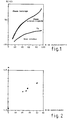
- the crosslinking agent is an alkyl chain; three lengths of crosslinking agent chains have been studied corresponding to 10, 16 or 22 carbons; three different proportions of this crosslinking agent have been introduced (5, 10, 15%). These two parameters have little influence on the evolution of the refractive index or the glass transition temperature, as can be seen in Figures 1 and 2.
- the mechanical properties are relatively undisturbed by the substituents.
- the material in which the intraocular lens according to the invention is a heterogeneous material of high and variable index in the material.
- the aromatic substituents proposed above are liquid crystals thermotropic. They bring mesomorphic properties to the polymer which carries them, that is to say in particular molecular orientation properties: in a field of given temperature, these substituents orient themselves very easily under the effect for example of a magnetic or electric field. This orientation is then "frozen" by the crosslinking process.
- the refractive index becomes anisotropic. It is therefore possible, by orientation of the substituents, to modify the refractive index in a given direction.
- the optical system is obtained from the same polymer, silicone or acrylate or methacrylate for example, by carrying out batches of indices different obtained by orientations of the substituents in different directions.
- the orientations can be obtained by placing the substituted polymer (in the in the case of silicones) or the various monomers, substituted or not, (in the case of acrylates) in a weak magnetic field of about 1 Tesla or in an electric field, or by a surface treatment of the device making it possible to manufacture the material or the lens in its final form.
- Crosslinking in the case of silicones
- polymerization / crosslinking in the case of acrylates
- an intraocular lens can be produced in two parts: a central optical zone suitable for near vision and a peripheral zone suitable for far vision.
- the material used for the realization of the optical system of the intraocular lens type according to the invention is a homogeneous material high index and variable by mechanical effect, allowing accommodation.
- the material from which the optical system is a three-dimensional liquid crystal polymer whose orientation Mesomorphic entities can easily be obtained by mechanical effect.
- the variation in index is all the more important as the temperature of use is close to T I.
- An example of the difference in index between two perpendicular directions, ⁇ n, induced by a mechanical stress is given below.
Landscapes
- Health & Medical Sciences (AREA)
- Ophthalmology & Optometry (AREA)
- Physics & Mathematics (AREA)
- Optics & Photonics (AREA)
- General Physics & Mathematics (AREA)
- General Health & Medical Sciences (AREA)
- Vascular Medicine (AREA)
- Heart & Thoracic Surgery (AREA)
- Biomedical Technology (AREA)
- Life Sciences & Earth Sciences (AREA)
- Animal Behavior & Ethology (AREA)
- Engineering & Computer Science (AREA)
- Public Health (AREA)
- Veterinary Medicine (AREA)
- Transplantation (AREA)
- Oral & Maxillofacial Surgery (AREA)
- Cardiology (AREA)
- Prostheses (AREA)
- Materials For Medical Uses (AREA)
Description
- soit par juxtaposition de deux matériaux, un central, un périphérique, de nature similaire, mais d'indices différents, grâce à des taux de greffage différents sur une même matrice;
- soit par juxtaposition de deux domaines différents d'un même matériau, les deux domaines présentant des indices de réfraction différents grâce à une orientation moléculaire;
- soit par réalisation d'un matériau dont l'indice varie sous l'effet d'une contrainte mécanique, la pression des paupières par exemple.
| Exemples | benzène | n = 1,498 |
| o-dichlorobenzène | n = 1,551 | |
| disulfure de carbone | n = 1,628 | |
| diiodométhane | n = 1,749 |
- sans substituant: n = 1,403
- avec 94% de substituants: n = 1,690
- sans substituant: Tg = -130°C
- avec 94% de substituants: Tg = entre 10°C et 20°C
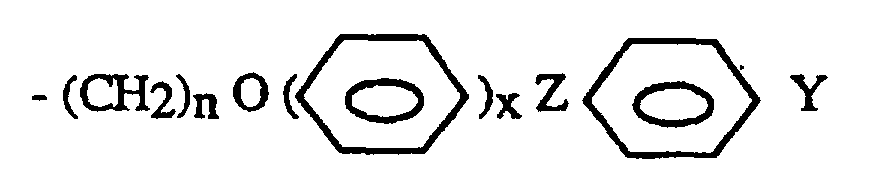
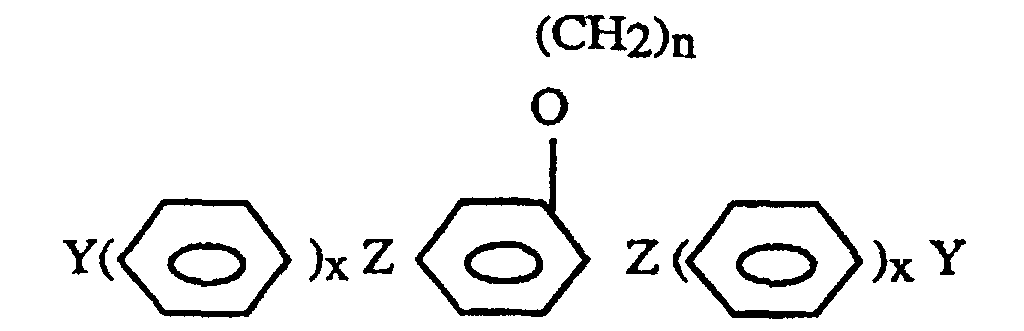
Y = H, OCmH2m+1, CmH2m+1, ...
avec n>2, m≥1, x=1, 2, 3, ...
Exemple :


| silicone non modifié | G' = 105 Pa |
| silicone avec plus de 85% de substituants | G' = 4.104 Pa |
| à TI + 4°C, | Δn = 6.10-3 pour une contrainte de 5.10-2 N.mm-2 |
| Δn = 2.10-3 pour une contrainte de 2.10-2 N.mm-2 | |
| à TI + 25°C, | Δn = 1.10-3 pour une contrainte de 5.10-2 N.mm-2 |
| Δn = 0,3.10-3 pour une contrainte de 2.10-2 N.mm-2 |
Claims (5)
- Système optique, du type lentille intraoculaire, réalisée en un matériau homogène dont l'indice de réfraction optique présente des variations suivant au moins une direction donnée, caractérisé en ce que ledit indice de réfraction est variable sous l'action d'un effet mécanique et en ce que ledit matériau homogène est constitué par au moins un matériau polymère cristaux-liquides tridimentionnel.
- Système optique selon la revendication 1, caractérisé en ce que l'effet mécanique est exercé par les zonules.
- Système optique selon l'une des revendications 1 et 2, caractérisé en ce qu'il consiste en une lentille intraoculaire.
- Système optique consistant en une lentille de contact réalisée en un matériau homogène dont l'indice de réfraction optique présente des variations suivant au moins une direction donnée, caractérisé en ce que ledit indice de réfraction est variable sous l'action d'un effet mécanique et en ce que ledit matériau homogène est constitué par au moins un matériau polymère cristaux-liquides tridimentionnel.
- Système optique selon la revendication 4, caractérisé en ce que l'effet mécanique est exercé par pression des paupières.
Applications Claiming Priority (3)
| Application Number | Priority Date | Filing Date | Title |
|---|---|---|---|
| FR9804109 | 1998-04-02 | ||
| FR9804109A FR2777091B1 (fr) | 1998-04-02 | 1998-04-02 | Systeme optique, notamment lentille intraoculaire, lentille de contact |
| PCT/FR1999/000764 WO1999052009A1 (fr) | 1998-04-02 | 1999-04-01 | Systeme optique, notamment lentille intraoculaire, lentille de contact |
Publications (2)
| Publication Number | Publication Date |
|---|---|
| EP1068555A1 EP1068555A1 (fr) | 2001-01-17 |
| EP1068555B1 true EP1068555B1 (fr) | 2004-01-07 |
Family
ID=9524783
Family Applications (1)
| Application Number | Title | Priority Date | Filing Date |
|---|---|---|---|
| EP99911858A Expired - Lifetime EP1068555B1 (fr) | 1998-04-02 | 1999-04-01 | Systeme optique, notamment lentille intraoculaire, lentille de contact |
Country Status (7)
| Country | Link |
|---|---|
| US (1) | US6733122B1 (fr) |
| EP (1) | EP1068555B1 (fr) |
| AT (1) | ATE257601T1 (fr) |
| DE (1) | DE69914067T2 (fr) |
| ES (1) | ES2214020T3 (fr) |
| FR (1) | FR2777091B1 (fr) |
| WO (1) | WO1999052009A1 (fr) |
Families Citing this family (15)
| Publication number | Priority date | Publication date | Assignee | Title |
|---|---|---|---|---|
| US20030223954A1 (en) * | 2002-05-31 | 2003-12-04 | Ruscio Dominic V. | Polymeric materials for use as photoablatable inlays |
| EP1534764B1 (fr) * | 2002-08-09 | 2014-07-16 | Carnegie Mellon University | Polymeres, elastomeres extra-doux et leurs procedes de preparation |
| IL161706A0 (en) | 2004-04-29 | 2004-09-27 | Nulens Ltd | Intraocular lens fixation device |
| EP1890650A2 (fr) | 2005-03-30 | 2008-02-27 | Nulens Ltd | Ensembles lentille intraoculaire accommodative (aiol) et composants separes pour lesdits ensembles |
| FR2913196B1 (fr) * | 2007-03-01 | 2009-05-22 | Centre Nat Rech Scient | Implant oculaire accomodatif |
| US7802883B2 (en) | 2007-12-20 | 2010-09-28 | Johnson & Johnson Vision Care, Inc. | Cosmetic contact lenses having a sparkle effect |
| US9644042B2 (en) | 2010-12-17 | 2017-05-09 | Carnegie Mellon University | Electrochemically mediated atom transfer radical polymerization |
| EP3685801B1 (fr) | 2011-02-04 | 2025-01-22 | ForSight Vision6, Inc. | Lentille d'accommodation intraoculaire |
| US20140275420A1 (en) | 2011-08-22 | 2014-09-18 | Carnegie Mellon University | Atom transfer radical polymerization under biologically compatible conditions |
| US9533297B2 (en) | 2012-02-23 | 2017-01-03 | Carnegie Mellon University | Ligands designed to provide highly active catalyst complexes |
| CA2944010C (fr) | 2014-03-28 | 2022-09-06 | Forsight Labs, Llc | Lentille intraoculaire d'accommodation |
| US9982070B2 (en) | 2015-01-12 | 2018-05-29 | Carnegie Mellon University | Aqueous ATRP in the presence of an activator regenerator |
| CN110121313B (zh) | 2016-10-28 | 2021-02-23 | 弗赛特影像6股份有限公司 | 可调节人工晶状体和植入方法 |
| WO2018132582A1 (fr) | 2017-01-12 | 2018-07-19 | Carnegie Mellon University | Formation assistée par tensioactif d'un complexe catalytique destiné à des procédés de polymérisation radicalaire en émulsion par transfert d'atome |
| AU2022208681A1 (en) | 2021-01-13 | 2023-08-17 | Forsight Vision6, Inc. | Variable thickness dynamic membrane for accommodating intraocular lenses |
Family Cites Families (8)
| Publication number | Priority date | Publication date | Assignee | Title |
|---|---|---|---|---|
| US3800594A (en) * | 1973-07-02 | 1974-04-02 | Us Navy | Laser accelerometer |
| US4373218A (en) * | 1980-11-17 | 1983-02-15 | Schachar Ronald A | Variable power intraocular lens and method of implanting into the posterior chamber |
| US4842601A (en) * | 1987-05-18 | 1989-06-27 | Smith S Gregory | Accommodating intraocular lens and method of implanting and using same |
| FR2646930B1 (fr) * | 1989-05-12 | 1993-04-09 | Essilor Int | Procede de realisation d'un element diffractif, utilisable notamment dans la fabrication de lentilles optiques artificielles, et lentilles ainsi obtenues |
| FR2649397B1 (fr) * | 1989-07-07 | 1992-01-03 | Essilor Int | Procede et dispositif pour l'obtention d'un polymere a gradient d'indice |
| US5172143A (en) * | 1990-01-22 | 1992-12-15 | Essilor International Cie Generale D'optique | Artificial optical lens and method of manufacturing it |
| US5136669A (en) * | 1991-03-15 | 1992-08-04 | Sperry Marine Inc. | Variable ratio fiber optic coupler optical signal processing element |
| US5774274A (en) * | 1995-05-12 | 1998-06-30 | Schachar; Ronald A. | Variable focus lens by small changes of the equatorial lens diameter |
-
1998
- 1998-04-02 FR FR9804109A patent/FR2777091B1/fr not_active Expired - Lifetime
-
1999
- 1999-04-01 US US09/647,546 patent/US6733122B1/en not_active Expired - Lifetime
- 1999-04-01 AT AT99911858T patent/ATE257601T1/de not_active IP Right Cessation
- 1999-04-01 ES ES99911858T patent/ES2214020T3/es not_active Expired - Lifetime
- 1999-04-01 EP EP99911858A patent/EP1068555B1/fr not_active Expired - Lifetime
- 1999-04-01 WO PCT/FR1999/000764 patent/WO1999052009A1/fr not_active Ceased
- 1999-04-01 DE DE69914067T patent/DE69914067T2/de not_active Expired - Fee Related
Also Published As
| Publication number | Publication date |
|---|---|
| EP1068555A1 (fr) | 2001-01-17 |
| FR2777091A1 (fr) | 1999-10-08 |
| US6733122B1 (en) | 2004-05-11 |
| ATE257601T1 (de) | 2004-01-15 |
| FR2777091B1 (fr) | 2003-04-11 |
| DE69914067D1 (de) | 2004-02-12 |
| ES2214020T3 (es) | 2004-09-01 |
| DE69914067T2 (de) | 2004-10-14 |
| WO1999052009A1 (fr) | 1999-10-14 |
Similar Documents
| Publication | Publication Date | Title |
|---|---|---|
| EP1068555A1 (fr) | Systeme optique, notamment lentille intraoculaire, lentille de contact | |
| JP3939927B2 (ja) | 眼用レンズ材料およびその製法 | |
| EP0643083B1 (fr) | Matériau hydrophile,transparent à haute perméabilité à l'oxygène, à base d'un polymère à réseaux interpénétrés, son mode de préparation et fabrication de lentilles de contact souples à haute perméabilité à l'oxygène. | |
| CN121800994A (zh) | 高反应指数、高色散系数的组合物 | |
| AU2002323660B2 (en) | Biomedical devices containing internal wetting agents | |
| EP0940693B1 (fr) | Lentilles de contact souples | |
| KR102927446B1 (ko) | 다초점 회절성 실리콘 하이드로겔 콘택트렌즈 | |
| US20070092830A1 (en) | Polymeric radiation-absorbing materials and ophthalmic devices comprising same | |
| WO1999029750A1 (fr) | Procede de fabrication d'un materiau polymere transparent resistant au depot de proteines, materiau obtenu par ce procede, lentilles de contact et implants intraoculaires faits de ce materiau | |
| JPWO2000070388A1 (ja) | 眼用レンズ材料およびその製法 | |
| FR2646930A1 (fr) | Procede de realisation d'un element diffractif, utilisable notamment dans la fabrication de lentilles optiques artificielles, et lentilles ainsi obtenues | |
| JP2003268055A (ja) | 表面ぬれ性シリコーンヒドロゲル | |
| JP4219485B2 (ja) | 光学性含水ゲルからなる眼科用材料 | |
| JPWO2020175382A1 (ja) | ポリマー材料 | |
| EP2220134A2 (fr) | Dispositifs biomédicaux | |
| EP0486638B1 (fr) | Procede de fabrication d'une lentille en polymere transparent a indice de refraction module | |
| JP2013517339A (ja) | 生体適合性ポリマーの調製方法、生体適合性ポリマーおよびそれらの使用 | |
| US20090192275A1 (en) | Multi-armed macromonomers | |
| JP4158493B2 (ja) | ポリマー成形品およびそれを用いた眼用レンズ | |
| JP3672370B2 (ja) | 重合性基を有しない紫外線吸収性ポリマーを含む眼用レンズ材料及びその製造方法 | |
| JP2578141B2 (ja) | 軟質眼用レンズの製造法 | |
| JPS5994731A (ja) | ソフトコンタクトレンズの製造方法 | |
| CN113527567B (zh) | 疏水性无闪光点高折光率眼科聚合物材料 | |
| KR20260025653A (ko) | 알킬 측쇄 길이가 다른 소수성 아크릴 단량체를 이용한 반짝임 변성이 감소된 소수성 아크릴 인공수정체의 제조방법 | |
| EP4396616A1 (fr) | Dispositifs ophtalmiques |
Legal Events
| Date | Code | Title | Description |
|---|---|---|---|
| PUAI | Public reference made under article 153(3) epc to a published international application that has entered the european phase |
Free format text: ORIGINAL CODE: 0009012 |
|
| 17P | Request for examination filed |
Effective date: 20000921 |
|
| AK | Designated contracting states |
Kind code of ref document: A1 Designated state(s): AT BE CH CY DE DK ES FI FR GB GR IE IT LI LU MC NL PT SE |
|
| 17Q | First examination report despatched |
Effective date: 20010307 |
|
| GRAG | Despatch of communication of intention to grant |
Free format text: ORIGINAL CODE: EPIDOS AGRA |
|
| GRAG | Despatch of communication of intention to grant |
Free format text: ORIGINAL CODE: EPIDOS AGRA |
|
| GRAP | Despatch of communication of intention to grant a patent |
Free format text: ORIGINAL CODE: EPIDOSNIGR1 |
|
| GRAU | Approval following communication of intention to grant |
Free format text: ORIGINAL CODE: EPIDOSNAGR4 |
|
| GRAS | Grant fee paid |
Free format text: ORIGINAL CODE: EPIDOSNIGR3 |
|
| GRAA | (expected) grant |
Free format text: ORIGINAL CODE: 0009210 |
|
| AK | Designated contracting states |
Kind code of ref document: B1 Designated state(s): AT BE CH CY DE DK ES FI FR GB GR IE IT LI LU MC NL PT SE |
|
| PG25 | Lapsed in a contracting state [announced via postgrant information from national office to epo] |
Ref country code: NL Free format text: LAPSE BECAUSE OF FAILURE TO SUBMIT A TRANSLATION OF THE DESCRIPTION OR TO PAY THE FEE WITHIN THE PRESCRIBED TIME-LIMIT Effective date: 20040107 Ref country code: IE Free format text: LAPSE BECAUSE OF FAILURE TO SUBMIT A TRANSLATION OF THE DESCRIPTION OR TO PAY THE FEE WITHIN THE PRESCRIBED TIME-LIMIT Effective date: 20040107 Ref country code: FI Free format text: LAPSE BECAUSE OF FAILURE TO SUBMIT A TRANSLATION OF THE DESCRIPTION OR TO PAY THE FEE WITHIN THE PRESCRIBED TIME-LIMIT Effective date: 20040107 Ref country code: CY Free format text: LAPSE BECAUSE OF FAILURE TO SUBMIT A TRANSLATION OF THE DESCRIPTION OR TO PAY THE FEE WITHIN THE PRESCRIBED TIME-LIMIT Effective date: 20040107 Ref country code: AT Free format text: LAPSE BECAUSE OF FAILURE TO SUBMIT A TRANSLATION OF THE DESCRIPTION OR TO PAY THE FEE WITHIN THE PRESCRIBED TIME-LIMIT Effective date: 20040107 |
|
| REG | Reference to a national code |
Ref country code: GB Ref legal event code: FG4D Free format text: NOT ENGLISH |
|
| REG | Reference to a national code |
Ref country code: CH Ref legal event code: EP |
|
| REG | Reference to a national code |
Ref country code: IE Ref legal event code: FG4D Free format text: FRENCH |
|
| REF | Corresponds to: |
Ref document number: 69914067 Country of ref document: DE Date of ref document: 20040212 Kind code of ref document: P |
|
| PG25 | Lapsed in a contracting state [announced via postgrant information from national office to epo] |
Ref country code: LU Free format text: LAPSE BECAUSE OF NON-PAYMENT OF DUE FEES Effective date: 20040401 |
|
| PG25 | Lapsed in a contracting state [announced via postgrant information from national office to epo] |
Ref country code: SE Free format text: LAPSE BECAUSE OF FAILURE TO SUBMIT A TRANSLATION OF THE DESCRIPTION OR TO PAY THE FEE WITHIN THE PRESCRIBED TIME-LIMIT Effective date: 20040407 Ref country code: GR Free format text: LAPSE BECAUSE OF FAILURE TO SUBMIT A TRANSLATION OF THE DESCRIPTION OR TO PAY THE FEE WITHIN THE PRESCRIBED TIME-LIMIT Effective date: 20040407 Ref country code: DK Free format text: LAPSE BECAUSE OF FAILURE TO SUBMIT A TRANSLATION OF THE DESCRIPTION OR TO PAY THE FEE WITHIN THE PRESCRIBED TIME-LIMIT Effective date: 20040407 |
|
| GBT | Gb: translation of ep patent filed (gb section 77(6)(a)/1977) | ||
| PG25 | Lapsed in a contracting state [announced via postgrant information from national office to epo] |
Ref country code: MC Free format text: LAPSE BECAUSE OF NON-PAYMENT OF DUE FEES Effective date: 20040430 Ref country code: LI Free format text: LAPSE BECAUSE OF NON-PAYMENT OF DUE FEES Effective date: 20040430 Ref country code: CH Free format text: LAPSE BECAUSE OF NON-PAYMENT OF DUE FEES Effective date: 20040430 Ref country code: BE Free format text: LAPSE BECAUSE OF NON-PAYMENT OF DUE FEES Effective date: 20040430 |
|
| NLV1 | Nl: lapsed or annulled due to failure to fulfill the requirements of art. 29p and 29m of the patents act | ||
| REG | Reference to a national code |
Ref country code: IE Ref legal event code: FD4D |
|
| REG | Reference to a national code |
Ref country code: ES Ref legal event code: FG2A Ref document number: 2214020 Country of ref document: ES Kind code of ref document: T3 |
|
| BERE | Be: lapsed |
Owner name: IOLTECH Effective date: 20040430 |
|
| PLBE | No opposition filed within time limit |
Free format text: ORIGINAL CODE: 0009261 |
|
| STAA | Information on the status of an ep patent application or granted ep patent |
Free format text: STATUS: NO OPPOSITION FILED WITHIN TIME LIMIT |
|
| REG | Reference to a national code |
Ref country code: CH Ref legal event code: PL |
|
| 26N | No opposition filed |
Effective date: 20041008 |
|
| REG | Reference to a national code |
Ref country code: FR Ref legal event code: CA |
|
| PG25 | Lapsed in a contracting state [announced via postgrant information from national office to epo] |
Ref country code: PT Free format text: LAPSE BECAUSE OF NON-PAYMENT OF DUE FEES Effective date: 20040607 |
|
| PGFP | Annual fee paid to national office [announced via postgrant information from national office to epo] |
Ref country code: ES Payment date: 20080428 Year of fee payment: 10 Ref country code: DE Payment date: 20080514 Year of fee payment: 10 |
|
| PGFP | Annual fee paid to national office [announced via postgrant information from national office to epo] |
Ref country code: IT Payment date: 20080421 Year of fee payment: 10 |
|
| PGFP | Annual fee paid to national office [announced via postgrant information from national office to epo] |
Ref country code: GB Payment date: 20090618 Year of fee payment: 11 |
|
| PG25 | Lapsed in a contracting state [announced via postgrant information from national office to epo] |
Ref country code: DE Free format text: LAPSE BECAUSE OF NON-PAYMENT OF DUE FEES Effective date: 20091103 |
|
| REG | Reference to a national code |
Ref country code: ES Ref legal event code: FD2A Effective date: 20090402 |
|
| PG25 | Lapsed in a contracting state [announced via postgrant information from national office to epo] |
Ref country code: ES Free format text: LAPSE BECAUSE OF NON-PAYMENT OF DUE FEES Effective date: 20090402 |
|
| GBPC | Gb: european patent ceased through non-payment of renewal fee |
Effective date: 20100401 |
|
| PG25 | Lapsed in a contracting state [announced via postgrant information from national office to epo] |
Ref country code: GB Free format text: LAPSE BECAUSE OF NON-PAYMENT OF DUE FEES Effective date: 20100401 Ref country code: IT Free format text: LAPSE BECAUSE OF NON-PAYMENT OF DUE FEES Effective date: 20090401 |
|
| REG | Reference to a national code |
Ref country code: FR Ref legal event code: PLFP Year of fee payment: 18 |
|
| REG | Reference to a national code |
Ref country code: FR Ref legal event code: PLFP Year of fee payment: 19 |
|
| REG | Reference to a national code |
Ref country code: FR Ref legal event code: PLFP Year of fee payment: 20 |
|
| PGFP | Annual fee paid to national office [announced via postgrant information from national office to epo] |
Ref country code: FR Payment date: 20180420 Year of fee payment: 20 |