EP1063224A1 - Continuous hydrogenation process - Google Patents
Continuous hydrogenation process Download PDFInfo
- Publication number
- EP1063224A1 EP1063224A1 EP00112634A EP00112634A EP1063224A1 EP 1063224 A1 EP1063224 A1 EP 1063224A1 EP 00112634 A EP00112634 A EP 00112634A EP 00112634 A EP00112634 A EP 00112634A EP 1063224 A1 EP1063224 A1 EP 1063224A1
- Authority
- EP
- European Patent Office
- Prior art keywords
- alpha
- process according
- solvent
- compound
- ketocarbonyl compound
- Prior art date
- Legal status (The legal status is an assumption and is not a legal conclusion. Google has not performed a legal analysis and makes no representation as to the accuracy of the status listed.)
- Granted
Links
Images

Classifications
-
- C—CHEMISTRY; METALLURGY
- C07—ORGANIC CHEMISTRY
- C07D—HETEROCYCLIC COMPOUNDS
- C07D307/00—Heterocyclic compounds containing five-membered rings having one oxygen atom as the only ring hetero atom
- C07D307/02—Heterocyclic compounds containing five-membered rings having one oxygen atom as the only ring hetero atom not condensed with other rings
- C07D307/26—Heterocyclic compounds containing five-membered rings having one oxygen atom as the only ring hetero atom not condensed with other rings having one double bond between ring members or between a ring member and a non-ring member
- C07D307/30—Heterocyclic compounds containing five-membered rings having one oxygen atom as the only ring hetero atom not condensed with other rings having one double bond between ring members or between a ring member and a non-ring member with hetero atoms or with carbon atoms having three bonds to hetero atoms with at the most one bond to halogen, e.g. ester or nitrile radicals, directly attached to ring carbon atoms
- C07D307/32—Oxygen atoms
- C07D307/33—Oxygen atoms in position 2, the oxygen atom being in its keto or unsubstituted enol form
-
- C—CHEMISTRY; METALLURGY
- C07—ORGANIC CHEMISTRY
- C07C—ACYCLIC OR CARBOCYCLIC COMPOUNDS
- C07C67/00—Preparation of carboxylic acid esters
- C07C67/30—Preparation of carboxylic acid esters by modifying the acid moiety of the ester, such modification not being an introduction of an ester group
- C07C67/31—Preparation of carboxylic acid esters by modifying the acid moiety of the ester, such modification not being an introduction of an ester group by introduction of functional groups containing oxygen only in singly bound form
-
- Y—GENERAL TAGGING OF NEW TECHNOLOGICAL DEVELOPMENTS; GENERAL TAGGING OF CROSS-SECTIONAL TECHNOLOGIES SPANNING OVER SEVERAL SECTIONS OF THE IPC; TECHNICAL SUBJECTS COVERED BY FORMER USPC CROSS-REFERENCE ART COLLECTIONS [XRACs] AND DIGESTS
- Y02—TECHNOLOGIES OR APPLICATIONS FOR MITIGATION OR ADAPTATION AGAINST CLIMATE CHANGE
- Y02P—CLIMATE CHANGE MITIGATION TECHNOLOGIES IN THE PRODUCTION OR PROCESSING OF GOODS
- Y02P20/00—Technologies relating to chemical industry
- Y02P20/50—Improvements relating to the production of bulk chemicals
- Y02P20/54—Improvements relating to the production of bulk chemicals using solvents, e.g. supercritical solvents or ionic liquids
Definitions
- the present invention relates to a continuous process for the enantioselective hydrogenation of alpha ketocarbonyl compounds.
- the invention relates to a continuous process for the enantioselective hydrogenation of alpha-ketoesters and alpha-ketolactones.
- US Patent No. 4329487 describes a method for the asymmetric hydrogenation of alpha-ketoesters which comprises subjecting an alpha-ketoester to asymmetric hydrogenation in the presence of a platinum-alumina catalyst modified with a solution of a cinchona-alkaloid selected from at least one member of the group consisting of quinine, quinidine, cinchonidine and cinchonine.
- alpha-ketoesters are reacted by batch reaction accomplished in a pressure container such as an autoclave.
- ketopantolactone over cinchonidine modified Pt-alumina catalyst has been investigated and described by A. Baiker et al in Journal of Catalysis, 176, 569-571, (1998).
- the Japanese patent publication J62158268 describes the asymmetric hydrogenation of alpha ketolactones in a batch process in the presence of a platinum-carbon catalyst modified with a solution of a cinchona-alkaloid selected from at least one member of the group consisting of quinine, cinchonine or cinchonidine.
- the preparation of the catalyst comprises e.g. mixing 0.5 g 5% Pt/C and 40 ml 1% cinchonidine/ethanol and refluxing said mixture for 3 h.
- the catalyst is separated with a centrifuge.
- a mixture of the catalyst and e.g. ketopantolactone in benzene is autoclaved to give D-pantolactone.
- the reaction temperature is about 10 to about 100 °C, preferably about room temperature.
- the hydrogen pressure is normal pressure to about 100 kg/cm 2 , preferably about 60 kg/cm 2 .
- the present invention relates to a continuous process for catalytic hydrogenation of a substrate containing or consisting of an alpha ketocarbonyl compound which process comprises the steps of:
- substrate refers to a solution of a solid alpha ketocarbonyl compound or to a liquid alpha ketocarbonyl compound. If appropriate the liquid alpha ketocarbonyl compound can be mixed with a solvent.
- alpha ketocarbonyl compound refers to alpha ketolactones such as alpha ketopantolactone or to alpha-ketoesters such as e.g. esters of alpha (C 1 -C 6 ) alkyl ketopropionic acid or esters of alpha aryl ketopropionic acid.
- alpha (C 1 -C 6 ) alkyl ketopropionic acid ester is pyruvic acid ethyl ester (CH 3 COCOOC 2 H 5 ).
- An example of an alpha aryl ketopropionic acid ester is benzoylformic acid ethyl ester. (Phenyl-COCOOC 2 H 5 ).
- a preferred solid alpha ketocarbonyl compound is alpha ketopantolactone.
- a preferred liquid alpha ketocarbonyl compound is pyruvic acid ethyl ester.
- Suitable solvents to dissolve the solid alpha ketocarbonyl compound include organic solvents and mixtures of organic solvents with water.
- Suitable solvents to be mixed with a liquid alpha ketocarbonyl compound include organic solvents, supercritical solvents and mixtures of organic solvents with water.
- Suitable organic solvents include aromatic solvents such as e.g. toluene, benzene, cumene; aliphatic solvents such as hexane, cyclohexane, pentane, cyclopentane, diethylether, tetrahydrofuran, acetic acid, alcohols, acetone, formamides and mixtures thereof.
- aromatic solvents such as e.g. toluene, benzene, cumene
- aliphatic solvents such as hexane, cyclohexane, pentane, cyclopentane, diethylether, tetrahydrofuran, acetic acid, alcohols, acetone, formamides and mixtures thereof.
- a preferred alcohol is e.g. ethanol or propanol.
- a preferred formamide is e.g. dimethylformamide.
- carboxylic acid e.g. acetic acid, trifluoracetic acid
- amine e.g. triethyl amine, quinoline
- the choice of the solvent is not critical. Any solvent capable of dissolving the alpha ketocarbonyl compound can be used in this invention. If a solvent is present the reaction is preferably carried out in a supercritical state.
- Suitable solvents or co-solvents for carrying out the reaction in a supercritical state are selected from the group consisting of methane, ethane, propane, carbon dioxide, sulfurhexafluoride, chlorinated- and fluorinated solvents and the like.
- platinum catalyst refers to platinum metal deposited onto a variety of supports such as carbon black, calcium carbonate, activated alumina, silica or zeolithes. These catalysts are well known and commercially available. Suitable catalysts contain about 0.5wt% to about 10wt% of platinum. For example a catalyst containing 5wt% of platinum deposited onto alumina is sold by Engelhard Corp. with the code number 4759. The catalyst is charged into a fixed bed reactor. A metal loading of more than 5 wt% of platinum may require dilution of the catalyst bed with inert beads.
- modified platinum catalyst refers to a platinum catalyst modified by contacting the platinum catalyst with a solution of a cinchona-alkaloid or derivatives thereof, 2-hydroxy-2-aryl-ethylamine or derivatives thereof, 1-aryl-ethylamine or derivatives thereof.
- Suitable cinchona alkaloids are e.g., quinine, hydroquinine, cinchonidine, 10-11-dihydrocinchonidine, O-methyl-cinchonidine, 10-11-dihydro-O-methyl-cinchonidine epiquinidine, epicinchonidine, cinchonine, epicinchonine, epiquinine, hydroquinidine, 4-chlorobenzoate-epiquinine or 4-chlorobenzoate-epicinchonine.
- Preferred is cinchonidine and dihydrocinchonidine.
- 2-hydroxy-2-aryl-ethylamines or derivatives thereof are 2-(1-pyrrolidinyl)-1-(1-naphthyl)ethanol, 2-(1-pyrrolidinyl)-1-(4-azanaphthyl)ethanol and 2-(1-(N,N-dimethyl) amino)-1-(1-naphtyl)ethanol.
- 1-aryl-ethylamines or derivatives thereof are 1-(1-naphtyl)-ethlyamine, 1-(1-naphtyl)-(N-methyl)-ethylamine, 1-(1-naphtyl)-(N-propyl)-ethylamine and N-[1'-(1-naphtyl)ethyl]-2-amino propionic acid ethyl ester.
- All modifiers are amine bases. They can be used as free bases or as a salt with an acid, such as HCl, HClO 4 , CF 3 COOH, etc.
- a commercially available modifier is cinchonidine hydrochloride.
- the modifier can be added to the substrate before starting the hydrogenation process, thus modifying the platinum catalyst when flowing through the reactor vessel or the platinum catalyst can be modified by immersing the platinum catalyst into a solution of the modifier before charging the reactor vessel with the catalyst. It is preferred to add the modifier to the substrate before starting the hydrogenation process.
- the modifier is generally added in form of a solution.
- Any organic solvent capable of dissolving the modifier can be added e.g. organic solvents as defined above.
- the same solvent is used to dissolve the modifier and the alpha ketocarbonyl compound.
- a suitable reactor vessel consists of a 1 to 40 ml stainless steel or inconel tube heated with electrical heating tape or cooled with a cooling jacked.
- a thermocouple measures the temperature in the center of the tube.
- the catalyst bed consists, e.g., of about 0.1 to about 20 g of catalyst depending on the volume of the reactor.
- reactors of other types and size that are appropriate for conducting a continuous hydrogenation can be used.
- reaction product is discharged from the reactor vessel and the alpha hydroxy carbonyl compound recovered by methods well known in the art such as crystallization or distillation.
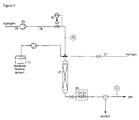
- FIGURE 1 shows the flow diagram in schematic form of a hydrogenation apparatus according to one embodiment of the invention.
- a solid alpha ketocarbonyl compound is dissolved in an organic solvent, thus forming the substrate.
- the modifier is added to the substrate.
- Examples 1 and 2 refer to a hydrogenation process carried out according to FIGURE 1.
- the process is typically initiated by dissolving the alpha ketocarbonyl compound and the modifier in vessel (1).
- the resulting solution contains from about 0.1 wt% to about 100wt% of alpha ketocarbonyl compound and from about 1 ⁇ 10 -5 wt% to about 0.5 wt% of modifier.
- the mass flow is started at reaction temperature, for example, as used in Examples 1 and 2, at 17 °C and 20 °C, respectively.
- reaction temperature for example, as used in Examples 1 and 2, at 17 °C and 20 °C, respectively.
- the above solution containing alpha ketocarbonyl compound and modifier is pumped to the fixed bed reactor (2) and contacted with hydrogen to start the hydrogenation reaction. Before catalytic runs, the reactor is flushed with nitrogen.
- the solution flow rate is preferably from about 0.1 to about 50 ml/min, the preferred flow of alpha ketocarbonyl compound is 2 ⁇ 10 -5 - 2 ⁇ 10 -2 mol/g cat /min. More preferably the solution flow rate is from about 2.5 to about 10 ml /min, and the flow of alpha ketocarbonyl compound from about 2 ⁇ 10 -4 to about 3 ⁇ 10 -3 mol/g cat /min.
- the modifier flow rate is preferably from about 2 ⁇ 10 -9 to about 2 ⁇ 10 -4 mol/g cat /min, more preferably from about 2 ⁇ 10 -8 to about 7 ⁇ 10 -6 mol/g cat /min.
- Hydrogen is continuously fed into the fixed bed reactor via flow line (3) containing a compressor (4) and a pressure control system (5).
- the inert gas e.g. nitrogen, is fed into the reactor (2) via line (7).
- the hydrogen flow rate into the reactor is metered and monitored by a rotameter. Suitable hydrogen flow rates are from about 0.0001 mol/min (2.4 ml/min) to about 1 mol/min (24000 ml/min) and from about 5 ⁇ 10 -6 to about 10 mol/g cat /min.
- the hydrogenation reaction can be carried out at a relatively low temperature ranging between about -20°C and about 100 °C, the preferred range of temperature being from about 10 °C to about 50°C., and the most preferred range being from about 0 °C to about 20°C.
- the pressure is suitably adjusted to between about 2 bar and about 150 bar, preferably from about 40 bar to about 100 bar.
- the effluent from the hydrogenation reaction zone is fed over a two-step expansion module (6) to a separator where the alpha hydroxy carbonyl compound is recovered.
- FIGURE 2 shows the flow diagram in schematic form of a hydrogenation apparatus according to another embodiment of the invention.
- the reactor vessel is charged with a supercritical solvent.
- Examples 3 and 4 refer to a hydrogenation carried out according to FIGURE 2.
- the process is initiated by dissolving the alpha ketocarbonyl compound and the modifier in vessel (1) or by adding a solution containing the modifier to a liquid alpha ketocarbonyl compound.
- the resulting solution has the following concentration: about 0.1 wt% to about 100 wt% of alpha ketocarbonyl compound and about 1 ⁇ 10 -6 wt% to about 0.5 wt% of modifier.
- the reactor vessel (2) is charged with supercritical solvent via flow line (3) containing a compressor (4) and pressure control system (5).
- the organic flow is started at reaction temperature for example as used in Examples 3 and 4 at 50 °C and 36 °C, respectively.
- the above solution is pumped to the fixed bed reactor (2) and contacted with hydrogen to start the hydrogenation reaction.
- the flow rate of the supercritical co-solvent is preferably from about 50 ml/min to about 5000 ml/min.
- the supercritical co-solvent is used with a flow rate of about 50 ml/min to about 5000 ml/min.
- the modifier flow rate is preferably from about 2 ⁇ 10 -11 to about 2 ⁇ 10 -4 mol/g cat /min.
- Hydrogen is continuously fed into the fixed bed reactor via flow line (7) containing pressure control system.
- the hydrogen flow rate into the reactor was metered and monitored by a rotameter.
- Suitable hydrogen flow rates are from about 0.000 1 mol/min (2.4 ml/min) to about 1 mol/min (24000 ml/min) and from about 5 ⁇ 10 -6 to about 10 mol/g cat /min.
- the hydrogenation reaction can be carried out at a relatively low temperature ranging between about 20 °C to about 100 °C, the preferred range of temperature being 30°C to 60°C, and the most preferred range being about 35°C to about 50°C.
- the pressure is suitably adjusted to between about 2 bar to about 150 bar, preferably about 40 bar to about 100 bar.
- Example No. 1 2 3 4 Substrate Alpha ketopantolactone Pyruvic acid ethyl ester Alpha ketopantolactone Pyruvic acid ethyl ester Solvent Toluene Toluene/Supercritical Ethane Supercritical Ethane Solvent flow (ml/min) 5 5 5/4800 750 Substrate flow (mol/min) 3.9 ⁇ 10 -4 7.6 ⁇ 10 -4 3.9 ⁇ 10 -4 4.3 ⁇ 10 -3 Modifier Cinchonidine Modifier flow (mol/min) 1.1 ⁇ 10 -6 5.7 ⁇ 10 -7 1.1 ⁇ 10 -6 4.2 ⁇ 10 -6 Hydrogen flow (ml/min) 80 80 1019 927 Temperature (°C) 17 20 50 36 Pressure (bar) 40 40 100 60 Catalyst 5 wt% Pt/alumina Engelhard 4759 Catalyst amount
Landscapes
- Chemical & Material Sciences (AREA)
- Organic Chemistry (AREA)
- Organic Low-Molecular-Weight Compounds And Preparation Thereof (AREA)
- Catalysts (AREA)
- Low-Molecular Organic Synthesis Reactions Using Catalysts (AREA)
- Production Of Liquid Hydrocarbon Mixture For Refining Petroleum (AREA)
- Nitrogen Condensed Heterocyclic Rings (AREA)
Abstract
Description
- The present invention relates to a continuous process for the enantioselective hydrogenation of alpha ketocarbonyl compounds.
- In particular the invention relates to a continuous process for the enantioselective hydrogenation of alpha-ketoesters and alpha-ketolactones.
- US Patent No. 4329487 describes a method for the asymmetric hydrogenation of alpha-ketoesters which comprises subjecting an alpha-ketoester to asymmetric hydrogenation in the presence of a platinum-alumina catalyst modified with a solution of a cinchona-alkaloid selected from at least one member of the group consisting of quinine, quinidine, cinchonidine and cinchonine.
- According to US 4329487 alpha-ketoesters are reacted by batch reaction accomplished in a pressure container such as an autoclave.
- The hydrogenation of ketopantolactone over cinchonidine modified Pt-alumina catalyst in a batch process has been investigated and described by A. Baiker et al in Journal of Catalysis, 176, 569-571, (1998).
- The Japanese patent publication J62158268 describes the asymmetric hydrogenation of alpha ketolactones in a batch process in the presence of a platinum-carbon catalyst modified with a solution of a cinchona-alkaloid selected from at least one member of the group consisting of quinine, cinchonine or cinchonidine. The preparation of the catalyst comprises e.g. mixing 0.5
g 5% Pt/C and 40ml 1% cinchonidine/ethanol and refluxing said mixture for 3 h. The catalyst is separated with a centrifuge. A mixture of the catalyst and e.g. ketopantolactone in benzene is autoclaved to give D-pantolactone. The reaction temperature is about 10 to about 100 °C, preferably about room temperature. The hydrogen pressure is normal pressure to about 100 kg/cm2, preferably about 60 kg/cm2. - The drawback of the batch process is the huge reactor volume needed for reaction and solid-liquid separation. Another drawback of the batch process is the need of a stirrer which leads to mechanical abrasion of catalyst particles [M. Garland, H.P. Jalett and H.U. Blaser, Stud. Surf Sci. Catal. 59 (1991) 177].
- It is an object of the present invention to provide a process that overcomes the aforesaid drawbacks, and still preserves the high enantioselectivity characteristic of the batch process.
- It has now been found that it is possible to carry out the hydrogenation of alphaketocarbonyl compounds continuously.
- Thus, the present invention relates to a continuous process for catalytic hydrogenation of a substrate containing or consisting of an alpha ketocarbonyl compound which process comprises the steps of:
- (i) contacting in a reactor a substrate and hydrogen in the presence of a modified platinum catalyst, optionally in the presence of a solvent and, further optionally, a supercritical cosolvent, at a temperature of from about -20 °C to about 100 °C and at pressures ranging from about 2 bar to about 150 bar to convert said alpha ketocarbonyl compound to the corresponding alpha hydroxy carbonyl compound;
- (ii) continuously feeding said substrate which optionally contains the modifier to the reactor;
- (iii) continuously feeding hydrogen to the reactor;
- (iv) continuously discharging the reaction product from the reactor; and
- (v) recovering the alpha hydroxy carbonyl compound from the reaction product.
-
- As used herein the term "substrate" refers to a solution of a solid alpha ketocarbonyl compound or to a liquid alpha ketocarbonyl compound. If appropriate the liquid alpha ketocarbonyl compound can be mixed with a solvent.
- As used herein the term "alpha ketocarbonyl compound" refers to alpha ketolactones such as alpha ketopantolactone or to alpha-ketoesters such as e.g. esters of alpha (C1-C6) alkyl ketopropionic acid or esters of alpha aryl ketopropionic acid. An example of an alpha (C1-C6) alkyl ketopropionic acid ester is pyruvic acid ethyl ester (CH3COCOOC2H5). An example of an alpha aryl ketopropionic acid ester is benzoylformic acid ethyl ester. (Phenyl-COCOOC2H5).
- A preferred solid alpha ketocarbonyl compound is alpha ketopantolactone. A preferred liquid alpha ketocarbonyl compound is pyruvic acid ethyl ester.
- Suitable solvents to dissolve the solid alpha ketocarbonyl compound include organic solvents and mixtures of organic solvents with water.
- Suitable solvents to be mixed with a liquid alpha ketocarbonyl compound include organic solvents, supercritical solvents and mixtures of organic solvents with water.
- Suitable organic solvents include aromatic solvents such as e.g. toluene, benzene, cumene; aliphatic solvents such as hexane, cyclohexane, pentane, cyclopentane, diethylether, tetrahydrofuran, acetic acid, alcohols, acetone, formamides and mixtures thereof. A preferred alcohol is e.g. ethanol or propanol. A preferred formamide is e.g. dimethylformamide.
- Addition of small amounts (0.1-5 wt%) of carboxylic acid (e.g. acetic acid, trifluoracetic acid) or amine (e.g. triethyl amine, quinoline) can also be useful.
- The choice of the solvent is not critical. Any solvent capable of dissolving the alpha ketocarbonyl compound can be used in this invention. If a solvent is present the reaction is preferably carried out in a supercritical state.
- Suitable solvents or co-solvents for carrying out the reaction in a supercritical state are selected from the group consisting of methane, ethane, propane, carbon dioxide, sulfurhexafluoride, chlorinated- and fluorinated solvents and the like.
- As used herein the term "platinum catalyst" refers to platinum metal deposited onto a variety of supports such as carbon black, calcium carbonate, activated alumina, silica or zeolithes. These catalysts are well known and commercially available. Suitable catalysts contain about 0.5wt% to about 10wt% of platinum. For example a catalyst containing 5wt% of platinum deposited onto alumina is sold by Engelhard Corp. with the code number 4759. The catalyst is charged into a fixed bed reactor. A metal loading of more than 5 wt% of platinum may require dilution of the catalyst bed with inert beads.
- As used herein the term "modified platinum catalyst" refers to a platinum catalyst modified by contacting the platinum catalyst with a solution of a cinchona-alkaloid or derivatives thereof, 2-hydroxy-2-aryl-ethylamine or derivatives thereof, 1-aryl-ethylamine or derivatives thereof.
- Suitable cinchona alkaloids are e.g., quinine, hydroquinine, cinchonidine, 10-11-dihydrocinchonidine, O-methyl-cinchonidine, 10-11-dihydro-O-methyl-cinchonidine epiquinidine, epicinchonidine, cinchonine, epicinchonine, epiquinine, hydroquinidine, 4-chlorobenzoate-epiquinine or 4-chlorobenzoate-epicinchonine. Preferred is cinchonidine and dihydrocinchonidine.
- Examples of 2-hydroxy-2-aryl-ethylamines or derivatives thereof are 2-(1-pyrrolidinyl)-1-(1-naphthyl)ethanol, 2-(1-pyrrolidinyl)-1-(4-azanaphthyl)ethanol and 2-(1-(N,N-dimethyl) amino)-1-(1-naphtyl)ethanol.
- Examples of 1-aryl-ethylamines or derivatives thereof are 1-(1-naphtyl)-ethlyamine, 1-(1-naphtyl)-(N-methyl)-ethylamine, 1-(1-naphtyl)-(N-propyl)-ethylamine and N-[1'-(1-naphtyl)ethyl]-2-amino propionic acid ethyl ester.
- All modifiers are amine bases. They can be used as free bases or as a salt with an acid, such as HCl, HClO4, CF3COOH, etc. A commercially available modifier is cinchonidine hydrochloride.
- The modifier can be added to the substrate before starting the hydrogenation process, thus modifying the platinum catalyst when flowing through the reactor vessel or the platinum catalyst can be modified by immersing the platinum catalyst into a solution of the modifier before charging the reactor vessel with the catalyst. It is preferred to add the modifier to the substrate before starting the hydrogenation process.
- The modifier is generally added in form of a solution. Any organic solvent capable of dissolving the modifier can be added e.g. organic solvents as defined above. Preferably the same solvent is used to dissolve the modifier and the alpha ketocarbonyl compound.
- There is no limit of the reactor size as long as a sufficient heat transfer is guaranteed. A suitable reactor vessel consists of a 1 to 40 ml stainless steel or inconel tube heated with electrical heating tape or cooled with a cooling jacked. A thermocouple measures the temperature in the center of the tube. The catalyst bed consists, e.g., of about 0.1 to about 20 g of catalyst depending on the volume of the reactor. However, reactors of other types and size that are appropriate for conducting a continuous hydrogenation can be used.
- At the end of the process the reaction product is discharged from the reactor vessel and the alpha hydroxy carbonyl compound recovered by methods well known in the art such as crystallization or distillation.
- The invention will now be illustrated by the figures.
- FIGURE 1 shows the flow diagram in schematic form of a hydrogenation apparatus according to one embodiment of the invention. A solid alpha ketocarbonyl compound is dissolved in an organic solvent, thus forming the substrate. The modifier is added to the substrate. Examples 1 and 2 refer to a hydrogenation process carried out according to FIGURE 1.
- The process is typically initiated by dissolving the alpha ketocarbonyl compound and the modifier in vessel (1). The resulting solution contains from about 0.1 wt% to about 100wt% of alpha ketocarbonyl compound and from about 1·10-5 wt% to about 0.5 wt% of modifier.
- The mass flow is started at reaction temperature, for example, as used in Examples 1 and 2, at 17 °C and 20 °C, respectively. The above solution containing alpha ketocarbonyl compound and modifier is pumped to the fixed bed reactor (2) and contacted with hydrogen to start the hydrogenation reaction. Before catalytic runs, the reactor is flushed with nitrogen.
- Subsequently the content of vessel (1) is continuously pumped into the fixed bed reactor. The solution flow rate is preferably from about 0.1 to about 50 ml/min, the preferred flow of alpha ketocarbonyl compound is 2·10-5 - 2·10-2 mol/gcat /min. More preferably the solution flow rate is from about 2.5 to about 10 ml /min, and the flow of alpha ketocarbonyl compound from about 2·10-4 to about 3·10-3 mol/gcat /min.
- The modifier flow rate is preferably from about 2·10-9 to about 2·10-4 mol/gcat /min, more preferably from about 2·10-8 to about 7·10-6 mol/gcat /min.
- Hydrogen is continuously fed into the fixed bed reactor via flow line (3) containing a compressor (4) and a pressure control system (5). The inert gas, e.g. nitrogen, is fed into the reactor (2) via line (7).
- The hydrogen flow rate into the reactor is metered and monitored by a rotameter. Suitable hydrogen flow rates are from about 0.0001 mol/min (2.4 ml/min) to about 1 mol/min (24000 ml/min) and from about 5·10-6 to about 10 mol/gcat /min.
- The hydrogenation reaction can be carried out at a relatively low temperature ranging between about -20°C and about 100 °C, the preferred range of temperature being from about 10 °C to about 50°C., and the most preferred range being from about 0 °C to about 20°C.
- The pressure is suitably adjusted to between about 2 bar and about 150 bar, preferably from about 40 bar to about 100 bar.
- The effluent from the hydrogenation reaction zone is fed over a two-step expansion module (6) to a separator where the alpha hydroxy carbonyl compound is recovered.
- FIGURE 2 shows the flow diagram in schematic form of a hydrogenation apparatus according to another embodiment of the invention. The reactor vessel is charged with a supercritical solvent. Examples 3 and 4 refer to a hydrogenation carried out according to FIGURE 2.
- The process is initiated by dissolving the alpha ketocarbonyl compound and the modifier in vessel (1) or by adding a solution containing the modifier to a liquid alpha ketocarbonyl compound. The resulting solution has the following concentration: about 0.1 wt% to about 100 wt% of alpha ketocarbonyl compound and about 1·10-6 wt% to about 0.5 wt% of modifier.
- The reactor vessel (2) is charged with supercritical solvent via flow line (3) containing a compressor (4) and pressure control system (5).
- The organic flow is started at reaction temperature for example as used in Examples 3 and 4 at 50 °C and 36 °C, respectively. The above solution is pumped to the fixed bed reactor (2) and contacted with hydrogen to start the hydrogenation reaction.
- Subsequently the content of vessel (1) is continuously pumped into the fixed bed reactor with the same solution flow rate as in the process according to Fig. 1.
- The flow rate of the supercritical co-solvent is preferably from about 50 ml/min to about 5000 ml/min.
- When using a liquid alpha ketocarbonyl compound the supercritical co-solvent is used with a flow rate of about 50 ml/min to about 5000 ml/min.
- The modifier flow rate is preferably from about 2·10-11 to about 2·10-4 mol/gcat /min.
- Hydrogen is continuously fed into the fixed bed reactor via flow line (7) containing pressure control system. The hydrogen flow rate into the reactor was metered and monitored by a rotameter.
- Suitable hydrogen flow rates are from about 0.000 1 mol/min (2.4 ml/min) to about 1 mol/min (24000 ml/min) and from about 5·10-6 to about 10 mol/gcat /min.
- The hydrogenation reaction can be carried out at a relatively low temperature ranging between about 20 °C to about 100 °C, the preferred range of temperature being 30°C to 60°C, and the most preferred range being about 35°C to about 50°C. The pressure is suitably adjusted to between about 2 bar to about 150 bar, preferably about 40 bar to about 100 bar.
- To more fully demonstrate the advantages of the present invention, the following examples were performed. In the Examples, a fixed bed reactor of 38 ml volume was used.
Example No. 1 2 3 4 Substrate Alpha ketopantolactone Pyruvic acid ethyl ester Alpha ketopantolactone Pyruvic acid ethyl ester Solvent Toluene Toluene Toluene/Supercritical Ethane Supercritical Ethane Solvent flow (ml/min) 5 5 5/4800 750 Substrate flow (mol/min) 3.9·10-4 7.6·10-4 3.9·10-4 4.3·10-3 Modifier Cinchonidine Modifier flow (mol/min) 1.1·10-6 5.7·10-7 1.1·10-6 4.2·10-6 Hydrogen flow (ml/min) 80 80 1019 927 Temperature (°C) 17 20 50 36 Pressure (bar) 40 40 100 60 Catalyst 5 wt% Pt/alumina Engelhard 4759 Catalyst amount (g) 1 1 1 0.5 Conversion (%) 100 86.4 100 95 ee (%) 79.7 89.9 62.1 74.8
Claims (13)
- A continuous process for catalytic hydrogenation of a substrate containing or consisting of an alpha ketocarbonyl compound which process comprises the steps of:(i) contacting in a reactor a substrate and hydrogen in the presence of a modified platinum catalyst, optionally in the presence of a solvent and, further optionally, a supercritical co-solvent, at a temperature of from about -20 °C to about 100 °C and at pressures ranging from about 2 bar to about 150 bar to convert said alpha ketocarbonyl compound to the corresponding alpha hydroxy carbonyl compound;(ii) continuously feeding said substrate which optionally contains the modifier to the reactor;(iii) continuously feeding hydrogen to the reactor;(iv) continuously discharging the reaction product from the reactor; and(v) recovering the alpha hydroxy carbonyl compound from the reaction product.
- A process according to claim 1, wherein the substrate is a liquid alpha ketocarbonyl compound or a solution of a solid alpha ketocarbonyl compound.
- A process according to claim 2, wherein the liquid alpha ketocarbonyl compound is pyruvic acid ethyl ester and the solid alpha ketocarbonyl compound is alpha ketopantolactone.
- A process according to any one of claims 1 to 3, wherein the solid alpha ketocarbonyl compound is dissolved in an organic solvent or mixture of organic solvents, or mixtures thereof with water.
- A process according to any one of claims 1 to 3, wherein the liquid alpha ketocarbonyl compound is mixed with an organic solvent or mixtures of organic solvents, or mixtures thereof with water.
- A process according to claims 4 and 5, wherein the organic solvent is toluene, benzene, cumene, hexane, cyclohexane, pentane, cyclopentane, diethylether, tetrahydrofuran, acetic acid, ethanol, propanol, acetone, dimethylformamide and mixtures thereof.
- A process according to claims 1 and 5, wherein the solvent or co-solvent is methane, ethane, propane, carbon dioxide and sulfurhexafluoride.
- A process according to any one of claims 1 to 7, wherein the substrate contains the modifier.
- A process according to any one of claims 1 to 8, wherein the modified platinum catalyst is platinum deposited onto carbon black, calcium carbonate, activated alumina, silica or zeolithes and modified by contacting the platinum catalyst with a solution of cinchona-alkaloid or derivatives thereof, 2-hydroxy-2-aryl-ethylamine or derivatives thereof, 1-aryl-ethylamine or derivatives thereof.
- A process according to claim 9, wherein the modified platinum catalyst contains about 0.5wt% to about 10 wt% of platinum deposited onto alumina and is modified by contacting the platinum catalyst with a solution of cinchonidine or dihydrocinchonidine.
- A process according to any one of claims 1 to 10, wherein the substrate solution contains from about 0.1 wt% to about 100 wt% of alpha ketocarbonyl compound and from about 1·10-6 wt% to about 0.5 wt% of modifier.
- A process according to any one of claims 1 to 11, wherein the hydrogenation reaction is carried out without a supercritical co-solvent at a temperature of from about 10 °C to about 50°C, preferably of from about 0 °C to about 20°C and at a pressure of from about 40 bar to about 100 bar.
- The invention as described hereinbefore, especially with reference to the Examples.
Priority Applications (1)
| Application Number | Priority Date | Filing Date | Title |
|---|---|---|---|
| EP00112634A EP1063224B1 (en) | 1999-06-23 | 2000-06-15 | Continuous hydrogenation process |
Applications Claiming Priority (3)
| Application Number | Priority Date | Filing Date | Title |
|---|---|---|---|
| EP99112078 | 1999-06-23 | ||
| EP99112078 | 1999-06-23 | ||
| EP00112634A EP1063224B1 (en) | 1999-06-23 | 2000-06-15 | Continuous hydrogenation process |
Publications (2)
| Publication Number | Publication Date |
|---|---|
| EP1063224A1 true EP1063224A1 (en) | 2000-12-27 |
| EP1063224B1 EP1063224B1 (en) | 2003-06-25 |
Family
ID=8238401
Family Applications (1)
| Application Number | Title | Priority Date | Filing Date |
|---|---|---|---|
| EP00112634A Expired - Lifetime EP1063224B1 (en) | 1999-06-23 | 2000-06-15 | Continuous hydrogenation process |
Country Status (11)
| Country | Link |
|---|---|
| US (1) | US6646135B1 (en) |
| EP (1) | EP1063224B1 (en) |
| JP (1) | JP2001031628A (en) |
| KR (1) | KR20010049577A (en) |
| CN (1) | CN1231455C (en) |
| AT (1) | ATE243673T1 (en) |
| BR (1) | BR0002773A (en) |
| CA (1) | CA2311996A1 (en) |
| DE (1) | DE60003493T2 (en) |
| DK (1) | DK1063224T3 (en) |
| ES (1) | ES2201975T3 (en) |
Cited By (1)
| Publication number | Priority date | Publication date | Assignee | Title |
|---|---|---|---|---|
| WO2005023737A1 (en) * | 2003-09-11 | 2005-03-17 | Avecia Pharmaceuticals Limited | Process for the hydrogenation of esters of alpha-substituted carboxylic acids |
Families Citing this family (4)
| Publication number | Priority date | Publication date | Assignee | Title |
|---|---|---|---|---|
| GB0211716D0 (en) * | 2002-05-22 | 2002-07-03 | Phoenix Chemicals Ltd | Process |
| BRPI0519615A2 (en) * | 2004-12-23 | 2009-02-25 | Shell Int Research | process for hydrogenation of a reagent, and, combustible composition |
| US20080044324A1 (en) * | 2006-08-16 | 2008-02-21 | Agency For Science, Technology And Research | Recirculating reactor |
| GB0624757D0 (en) * | 2006-12-12 | 2007-01-17 | Sosei R & D Ltd | Novel compounds |
Citations (3)
| Publication number | Priority date | Publication date | Assignee | Title |
|---|---|---|---|---|
| JPS5535060A (en) * | 1978-09-05 | 1980-03-11 | Agency Of Ind Science & Technol | Asymmetric hydrogenation of alpha-keto-acid ester |
| US4329487A (en) * | 1979-06-05 | 1982-05-11 | Director-General Of Agency Of Industrial Science And Technology | Method for the asymmetric hydrogenation of α-ketoesters |
| JPS62158268A (en) * | 1986-01-06 | 1987-07-14 | Nissan Chem Ind Ltd | Asymmetric hydrogenation of alpha-ketolactone |
Family Cites Families (1)
| Publication number | Priority date | Publication date | Assignee | Title |
|---|---|---|---|---|
| GB9607917D0 (en) * | 1996-04-17 | 1996-06-19 | Swan Thomas & Co Ltd | Supercritical hydrogenation |
-
2000
- 2000-05-10 US US09/568,353 patent/US6646135B1/en not_active Expired - Fee Related
- 2000-06-15 EP EP00112634A patent/EP1063224B1/en not_active Expired - Lifetime
- 2000-06-15 ES ES00112634T patent/ES2201975T3/en not_active Expired - Lifetime
- 2000-06-15 DK DK00112634T patent/DK1063224T3/en active
- 2000-06-15 DE DE60003493T patent/DE60003493T2/en not_active Expired - Fee Related
- 2000-06-15 AT AT00112634T patent/ATE243673T1/en not_active IP Right Cessation
- 2000-06-19 CA CA002311996A patent/CA2311996A1/en not_active Abandoned
- 2000-06-20 JP JP2000184026A patent/JP2001031628A/en not_active Withdrawn
- 2000-06-20 KR KR1020000033758A patent/KR20010049577A/en not_active Ceased
- 2000-06-21 BR BR0002773-1A patent/BR0002773A/en not_active Application Discontinuation
- 2000-06-22 CN CNB001188941A patent/CN1231455C/en not_active Expired - Fee Related
Patent Citations (3)
| Publication number | Priority date | Publication date | Assignee | Title |
|---|---|---|---|---|
| JPS5535060A (en) * | 1978-09-05 | 1980-03-11 | Agency Of Ind Science & Technol | Asymmetric hydrogenation of alpha-keto-acid ester |
| US4329487A (en) * | 1979-06-05 | 1982-05-11 | Director-General Of Agency Of Industrial Science And Technology | Method for the asymmetric hydrogenation of α-ketoesters |
| JPS62158268A (en) * | 1986-01-06 | 1987-07-14 | Nissan Chem Ind Ltd | Asymmetric hydrogenation of alpha-ketolactone |
Non-Patent Citations (2)
| Title |
|---|
| PATENT ABSTRACTS OF JAPAN vol. 004, no. 069 (C - 011) 22 May 1980 (1980-05-22) * |
| PATENT ABSTRACTS OF JAPAN vol. 011, no. 398 (C - 466) * |
Cited By (1)
| Publication number | Priority date | Publication date | Assignee | Title |
|---|---|---|---|---|
| WO2005023737A1 (en) * | 2003-09-11 | 2005-03-17 | Avecia Pharmaceuticals Limited | Process for the hydrogenation of esters of alpha-substituted carboxylic acids |
Also Published As
| Publication number | Publication date |
|---|---|
| DE60003493D1 (en) | 2003-07-31 |
| DK1063224T3 (en) | 2003-10-06 |
| JP2001031628A (en) | 2001-02-06 |
| BR0002773A (en) | 2001-01-30 |
| CN1290685A (en) | 2001-04-11 |
| ES2201975T3 (en) | 2004-04-01 |
| EP1063224B1 (en) | 2003-06-25 |
| ATE243673T1 (en) | 2003-07-15 |
| DE60003493T2 (en) | 2004-05-19 |
| CN1231455C (en) | 2005-12-14 |
| KR20010049577A (en) | 2001-06-15 |
| US6646135B1 (en) | 2003-11-11 |
| CA2311996A1 (en) | 2000-12-23 |
Similar Documents
| Publication | Publication Date | Title |
|---|---|---|
| Minder et al. | Enantioselective hydrogenation of ethyl pyruvate. Influence of oxidative treatment of cinchonidine-modified platinum catalyst and hemiketal formation in alcoholic solvents | |
| NO173275B (en) | TRAN VINYL RING REACTION | |
| EP1063224B1 (en) | Continuous hydrogenation process | |
| US5491199A (en) | One step production of low salt vinylamine polymers | |
| JPH01193246A (en) | Production of 2,3-dichloropyridine | |
| KR100594912B1 (en) | Separation method by stripping maleic anhydride from maleic anhydride containing mixture | |
| KR20090034817A (en) | Prevention of fumaric acid deposits in the production of maleic anhydride | |
| JP4609613B2 (en) | Carbon monoxide production method | |
| CN1069307C (en) | Process for the preparation of 4-methoxy-2,2',6'-trimethyldiphenylamine | |
| US6586597B1 (en) | Continuous process for the preparation of optically pure decahydroisoquinolinecarboxamide | |
| EP0337246B1 (en) | Process for preparing pyruvate | |
| EP0533378B1 (en) | Process for producing octahydrocoumarin or derivative thereof | |
| KR100710543B1 (en) | Continuous production process of pure (S) -beta-hydroxy-gamma-butyrolactone with high optical purity | |
| JP2005539078A (en) | Continuous process for optically pure (S) -β-hydroxy-γ-butyrolactone | |
| WO2002010147A1 (en) | CONTINUOUS PROCESS FOR THE PRODUCTION OF OPTICALLY PURE (S)-β-HYDROXY-η-BUTYROLACTONE | |
| JPH10139716A (en) | Hydrolysis of methyl acetate | |
| JP2000191565A (en) | Process for producing cyclododecanol and cyclododecanone | |
| JP4129765B2 (en) | Method for producing racemic aminopentanenitrile | |
| EP0841319B1 (en) | Process for preparing lactate | |
| JPH06228034A (en) | Process for producing 5,6,7,8-tetrahydronaphthols | |
| JPH0717610B2 (en) | <1> -Method for racemizing octahydroisoquinoline derivative | |
| JPH09143158A (en) | Production of 2-alkylindoline | |
| JPS63145274A (en) | Production of piperidine | |
| WO1999006350A1 (en) | Preparation of tetramethylethylenediamine | |
| JPH03236345A (en) | Production of 2-oxo-4-phenylbutyric acid |
Legal Events
| Date | Code | Title | Description |
|---|---|---|---|
| PUAI | Public reference made under article 153(3) epc to a published international application that has entered the european phase |
Free format text: ORIGINAL CODE: 0009012 |
|
| AK | Designated contracting states |
Kind code of ref document: A1 Designated state(s): AT BE CH CY DE DK ES FI FR GB GR IE IT LI LU MC NL PT SE |
|
| AX | Request for extension of the european patent |
Free format text: AL;LT;LV;MK;RO;SI |
|
| 17P | Request for examination filed |
Effective date: 20010627 |
|
| AKX | Designation fees paid |
Free format text: AT BE CH CY DE DK ES FI FR GB GR IE IT LI LU MC NL PT SE |
|
| 17Q | First examination report despatched |
Effective date: 20020228 |
|
| GRAH | Despatch of communication of intention to grant a patent |
Free format text: ORIGINAL CODE: EPIDOS IGRA |
|
| GRAH | Despatch of communication of intention to grant a patent |
Free format text: ORIGINAL CODE: EPIDOS IGRA |
|
| GRAA | (expected) grant |
Free format text: ORIGINAL CODE: 0009210 |
|
| AK | Designated contracting states |
Designated state(s): AT BE CH CY DE DK ES FI FR GB GR IE IT LI LU MC NL PT SE |
|
| PG25 | Lapsed in a contracting state [announced via postgrant information from national office to epo] |
Ref country code: FI Free format text: LAPSE BECAUSE OF FAILURE TO SUBMIT A TRANSLATION OF THE DESCRIPTION OR TO PAY THE FEE WITHIN THE PRESCRIBED TIME-LIMIT Effective date: 20030625 Ref country code: CY Free format text: LAPSE BECAUSE OF FAILURE TO SUBMIT A TRANSLATION OF THE DESCRIPTION OR TO PAY THE FEE WITHIN THE PRESCRIBED TIME-LIMIT Effective date: 20030625 Ref country code: AT Free format text: LAPSE BECAUSE OF FAILURE TO SUBMIT A TRANSLATION OF THE DESCRIPTION OR TO PAY THE FEE WITHIN THE PRESCRIBED TIME-LIMIT Effective date: 20030625 |
|
| REG | Reference to a national code |
Ref country code: GB Ref legal event code: FG4D |
|
| REG | Reference to a national code |
Ref country code: CH Ref legal event code: EP |
|
| REG | Reference to a national code |
Ref country code: IE Ref legal event code: FG4D |
|
| REF | Corresponds to: |
Ref document number: 60003493 Country of ref document: DE Date of ref document: 20030731 Kind code of ref document: P |
|
| PG25 | Lapsed in a contracting state [announced via postgrant information from national office to epo] |
Ref country code: PT Free format text: LAPSE BECAUSE OF FAILURE TO SUBMIT A TRANSLATION OF THE DESCRIPTION OR TO PAY THE FEE WITHIN THE PRESCRIBED TIME-LIMIT Effective date: 20030925 Ref country code: GR Free format text: LAPSE BECAUSE OF FAILURE TO SUBMIT A TRANSLATION OF THE DESCRIPTION OR TO PAY THE FEE WITHIN THE PRESCRIBED TIME-LIMIT Effective date: 20030925 |
|
| REG | Reference to a national code |
Ref country code: DK Ref legal event code: T3 |
|
| REG | Reference to a national code |
Ref country code: SE Ref legal event code: TRGR |
|
| REG | Reference to a national code |
Ref country code: CH Ref legal event code: PUE Owner name: DSM IP ASSETS B.V. Free format text: F. HOFFMANN-LA ROCHE AG##4070 BASEL (CH) -TRANSFER TO- DSM IP ASSETS B.V.#HET OVERLOON 1#6411 TE HEERLEN (NL) |
|
| REG | Reference to a national code |
Ref country code: ES Ref legal event code: FG2A Ref document number: 2201975 Country of ref document: ES Kind code of ref document: T3 |
|
| ET | Fr: translation filed | ||
| PLBE | No opposition filed within time limit |
Free format text: ORIGINAL CODE: 0009261 |
|
| STAA | Information on the status of an ep patent application or granted ep patent |
Free format text: STATUS: NO OPPOSITION FILED WITHIN TIME LIMIT |
|
| NLS | Nl: assignments of ep-patents |
Owner name: DSM IP ASSETS B.V. |
|
| PG25 | Lapsed in a contracting state [announced via postgrant information from national office to epo] |
Ref country code: LU Free format text: LAPSE BECAUSE OF NON-PAYMENT OF DUE FEES Effective date: 20040615 |
|
| 26N | No opposition filed |
Effective date: 20040326 |
|
| PG25 | Lapsed in a contracting state [announced via postgrant information from national office to epo] |
Ref country code: MC Free format text: LAPSE BECAUSE OF NON-PAYMENT OF DUE FEES Effective date: 20040630 |
|
| REG | Reference to a national code |
Ref country code: GB Ref legal event code: 732E |
|
| REG | Reference to a national code |
Ref country code: FR Ref legal event code: TP |
|
| PGFP | Annual fee paid to national office [announced via postgrant information from national office to epo] |
Ref country code: NL Payment date: 20050516 Year of fee payment: 6 |
|
| PGFP | Annual fee paid to national office [announced via postgrant information from national office to epo] |
Ref country code: GB Payment date: 20050608 Year of fee payment: 6 |
|
| PGFP | Annual fee paid to national office [announced via postgrant information from national office to epo] |
Ref country code: FR Payment date: 20050617 Year of fee payment: 6 |
|
| PGFP | Annual fee paid to national office [announced via postgrant information from national office to epo] |
Ref country code: SE Payment date: 20050621 Year of fee payment: 6 Ref country code: IE Payment date: 20050621 Year of fee payment: 6 |
|
| PGFP | Annual fee paid to national office [announced via postgrant information from national office to epo] |
Ref country code: CH Payment date: 20050622 Year of fee payment: 6 |
|
| PGFP | Annual fee paid to national office [announced via postgrant information from national office to epo] |
Ref country code: DK Payment date: 20050623 Year of fee payment: 6 |
|
| PGFP | Annual fee paid to national office [announced via postgrant information from national office to epo] |
Ref country code: ES Payment date: 20050708 Year of fee payment: 6 |
|
| PGFP | Annual fee paid to national office [announced via postgrant information from national office to epo] |
Ref country code: BE Payment date: 20050725 Year of fee payment: 6 |
|
| PGFP | Annual fee paid to national office [announced via postgrant information from national office to epo] |
Ref country code: DE Payment date: 20050801 Year of fee payment: 6 |
|
| PG25 | Lapsed in a contracting state [announced via postgrant information from national office to epo] |
Ref country code: IE Free format text: LAPSE BECAUSE OF NON-PAYMENT OF DUE FEES Effective date: 20060615 Ref country code: GB Free format text: LAPSE BECAUSE OF NON-PAYMENT OF DUE FEES Effective date: 20060615 |
|
| PG25 | Lapsed in a contracting state [announced via postgrant information from national office to epo] |
Ref country code: SE Free format text: LAPSE BECAUSE OF NON-PAYMENT OF DUE FEES Effective date: 20060616 Ref country code: ES Free format text: LAPSE BECAUSE OF NON-PAYMENT OF DUE FEES Effective date: 20060616 |
|
| PG25 | Lapsed in a contracting state [announced via postgrant information from national office to epo] |
Ref country code: LI Free format text: LAPSE BECAUSE OF NON-PAYMENT OF DUE FEES Effective date: 20060630 Ref country code: DK Free format text: LAPSE BECAUSE OF NON-PAYMENT OF DUE FEES Effective date: 20060630 Ref country code: CH Free format text: LAPSE BECAUSE OF NON-PAYMENT OF DUE FEES Effective date: 20060630 Ref country code: BE Free format text: LAPSE BECAUSE OF NON-PAYMENT OF DUE FEES Effective date: 20060630 |
|
| PGFP | Annual fee paid to national office [announced via postgrant information from national office to epo] |
Ref country code: IT Payment date: 20060630 Year of fee payment: 7 |
|
| PG25 | Lapsed in a contracting state [announced via postgrant information from national office to epo] |
Ref country code: NL Free format text: LAPSE BECAUSE OF NON-PAYMENT OF DUE FEES Effective date: 20070101 |
|
| PG25 | Lapsed in a contracting state [announced via postgrant information from national office to epo] |
Ref country code: DE Free format text: LAPSE BECAUSE OF NON-PAYMENT OF DUE FEES Effective date: 20070103 |
|
| REG | Reference to a national code |
Ref country code: DK Ref legal event code: EBP |
|
| REG | Reference to a national code |
Ref country code: CH Ref legal event code: PL |
|
| EUG | Se: european patent has lapsed | ||
| GBPC | Gb: european patent ceased through non-payment of renewal fee |
Effective date: 20060615 |
|
| NLV4 | Nl: lapsed or anulled due to non-payment of the annual fee |
Effective date: 20070101 |
|
| REG | Reference to a national code |
Ref country code: IE Ref legal event code: MM4A |
|
| REG | Reference to a national code |
Ref country code: FR Ref legal event code: ST Effective date: 20070228 |
|
| REG | Reference to a national code |
Ref country code: ES Ref legal event code: FD2A Effective date: 20060616 |
|
| BERE | Be: lapsed |
Owner name: *DMS IP ASSETS B.V. Effective date: 20060630 |
|
| PG25 | Lapsed in a contracting state [announced via postgrant information from national office to epo] |
Ref country code: FR Free format text: LAPSE BECAUSE OF NON-PAYMENT OF DUE FEES Effective date: 20060630 |
|
| PG25 | Lapsed in a contracting state [announced via postgrant information from national office to epo] |
Ref country code: IT Free format text: LAPSE BECAUSE OF NON-PAYMENT OF DUE FEES Effective date: 20070615 |