EP1063084A2 - Laminate comprising a sliding member layer and a substrate layer - Google Patents
Laminate comprising a sliding member layer and a substrate layer Download PDFInfo
- Publication number
- EP1063084A2 EP1063084A2 EP00305286A EP00305286A EP1063084A2 EP 1063084 A2 EP1063084 A2 EP 1063084A2 EP 00305286 A EP00305286 A EP 00305286A EP 00305286 A EP00305286 A EP 00305286A EP 1063084 A2 EP1063084 A2 EP 1063084A2
- Authority
- EP
- European Patent Office
- Prior art keywords
- weight
- parts
- laminate
- olefin elastomer
- thermoplastic olefin
- Prior art date
- Legal status (The legal status is an assumption and is not a legal conclusion. Google has not performed a legal analysis and makes no representation as to the accuracy of the status listed.)
- Granted
Links
Images
Classifications
-
- B—PERFORMING OPERATIONS; TRANSPORTING
- B32—LAYERED PRODUCTS
- B32B—LAYERED PRODUCTS, i.e. PRODUCTS BUILT-UP OF STRATA OF FLAT OR NON-FLAT, e.g. CELLULAR OR HONEYCOMB, FORM
- B32B27/00—Layered products comprising a layer of synthetic resin
- B32B27/06—Layered products comprising a layer of synthetic resin as the main or only constituent of a layer, which is next to another layer of the same or of a different material
- B32B27/08—Layered products comprising a layer of synthetic resin as the main or only constituent of a layer, which is next to another layer of the same or of a different material of synthetic resin
-
- B—PERFORMING OPERATIONS; TRANSPORTING
- B32—LAYERED PRODUCTS
- B32B—LAYERED PRODUCTS, i.e. PRODUCTS BUILT-UP OF STRATA OF FLAT OR NON-FLAT, e.g. CELLULAR OR HONEYCOMB, FORM
- B32B27/00—Layered products comprising a layer of synthetic resin
- B32B27/32—Layered products comprising a layer of synthetic resin comprising polyolefins
-
- B—PERFORMING OPERATIONS; TRANSPORTING
- B60—VEHICLES IN GENERAL
- B60J—WINDOWS, WINDSCREENS, NON-FIXED ROOFS, DOORS, OR SIMILAR DEVICES FOR VEHICLES; REMOVABLE EXTERNAL PROTECTIVE COVERINGS SPECIALLY ADAPTED FOR VEHICLES
- B60J10/00—Sealing arrangements
- B60J10/15—Sealing arrangements characterised by the material
- B60J10/17—Sealing arrangements characterised by the material provided with a low-friction material on the surface
-
- C—CHEMISTRY; METALLURGY
- C08—ORGANIC MACROMOLECULAR COMPOUNDS; THEIR PREPARATION OR CHEMICAL WORKING-UP; COMPOSITIONS BASED THEREON
- C08L—COMPOSITIONS OF MACROMOLECULAR COMPOUNDS
- C08L23/00—Compositions of homopolymers or copolymers of unsaturated aliphatic hydrocarbons having only one carbon-to-carbon double bond; Compositions of derivatives of such polymers
- C08L23/02—Compositions of homopolymers or copolymers of unsaturated aliphatic hydrocarbons having only one carbon-to-carbon double bond; Compositions of derivatives of such polymers not modified by chemical after-treatment
-
- C—CHEMISTRY; METALLURGY
- C08—ORGANIC MACROMOLECULAR COMPOUNDS; THEIR PREPARATION OR CHEMICAL WORKING-UP; COMPOSITIONS BASED THEREON
- C08L—COMPOSITIONS OF MACROMOLECULAR COMPOUNDS
- C08L23/00—Compositions of homopolymers or copolymers of unsaturated aliphatic hydrocarbons having only one carbon-to-carbon double bond; Compositions of derivatives of such polymers
- C08L23/02—Compositions of homopolymers or copolymers of unsaturated aliphatic hydrocarbons having only one carbon-to-carbon double bond; Compositions of derivatives of such polymers not modified by chemical after-treatment
- C08L23/04—Homopolymers or copolymers of ethene
- C08L23/06—Polyethylene
-
- C—CHEMISTRY; METALLURGY
- C08—ORGANIC MACROMOLECULAR COMPOUNDS; THEIR PREPARATION OR CHEMICAL WORKING-UP; COMPOSITIONS BASED THEREON
- C08L—COMPOSITIONS OF MACROMOLECULAR COMPOUNDS
- C08L23/00—Compositions of homopolymers or copolymers of unsaturated aliphatic hydrocarbons having only one carbon-to-carbon double bond; Compositions of derivatives of such polymers
- C08L23/02—Compositions of homopolymers or copolymers of unsaturated aliphatic hydrocarbons having only one carbon-to-carbon double bond; Compositions of derivatives of such polymers not modified by chemical after-treatment
- C08L23/16—Ethylene-propylene or ethylene-propylene-diene copolymers
-
- B—PERFORMING OPERATIONS; TRANSPORTING
- B32—LAYERED PRODUCTS
- B32B—LAYERED PRODUCTS, i.e. PRODUCTS BUILT-UP OF STRATA OF FLAT OR NON-FLAT, e.g. CELLULAR OR HONEYCOMB, FORM
- B32B2307/00—Properties of the layers or laminate
- B32B2307/50—Properties of the layers or laminate having particular mechanical properties
- B32B2307/554—Wear resistance
-
- C—CHEMISTRY; METALLURGY
- C08—ORGANIC MACROMOLECULAR COMPOUNDS; THEIR PREPARATION OR CHEMICAL WORKING-UP; COMPOSITIONS BASED THEREON
- C08L—COMPOSITIONS OF MACROMOLECULAR COMPOUNDS
- C08L27/00—Compositions of homopolymers or copolymers of compounds having one or more unsaturated aliphatic radicals, each having only one carbon-to-carbon double bond, and at least one being terminated by a halogen; Compositions of derivatives of such polymers
- C08L27/02—Compositions of homopolymers or copolymers of compounds having one or more unsaturated aliphatic radicals, each having only one carbon-to-carbon double bond, and at least one being terminated by a halogen; Compositions of derivatives of such polymers not modified by chemical after-treatment
- C08L27/12—Compositions of homopolymers or copolymers of compounds having one or more unsaturated aliphatic radicals, each having only one carbon-to-carbon double bond, and at least one being terminated by a halogen; Compositions of derivatives of such polymers not modified by chemical after-treatment containing fluorine atoms
-
- C—CHEMISTRY; METALLURGY
- C08—ORGANIC MACROMOLECULAR COMPOUNDS; THEIR PREPARATION OR CHEMICAL WORKING-UP; COMPOSITIONS BASED THEREON
- C08L—COMPOSITIONS OF MACROMOLECULAR COMPOUNDS
- C08L83/00—Compositions of macromolecular compounds obtained by reactions forming in the main chain of the macromolecule a linkage containing silicon with or without sulfur, nitrogen, oxygen or carbon only; Compositions of derivatives of such polymers
- C08L83/04—Polysiloxanes
-
- Y—GENERAL TAGGING OF NEW TECHNOLOGICAL DEVELOPMENTS; GENERAL TAGGING OF CROSS-SECTIONAL TECHNOLOGIES SPANNING OVER SEVERAL SECTIONS OF THE IPC; TECHNICAL SUBJECTS COVERED BY FORMER USPC CROSS-REFERENCE ART COLLECTIONS [XRACs] AND DIGESTS
- Y10—TECHNICAL SUBJECTS COVERED BY FORMER USPC
- Y10T—TECHNICAL SUBJECTS COVERED BY FORMER US CLASSIFICATION
- Y10T428/00—Stock material or miscellaneous articles
- Y10T428/25—Web or sheet containing structurally defined element or component and including a second component containing structurally defined particles
-
- Y—GENERAL TAGGING OF NEW TECHNOLOGICAL DEVELOPMENTS; GENERAL TAGGING OF CROSS-SECTIONAL TECHNOLOGIES SPANNING OVER SEVERAL SECTIONS OF THE IPC; TECHNICAL SUBJECTS COVERED BY FORMER USPC CROSS-REFERENCE ART COLLECTIONS [XRACs] AND DIGESTS
- Y10—TECHNICAL SUBJECTS COVERED BY FORMER USPC
- Y10T—TECHNICAL SUBJECTS COVERED BY FORMER US CLASSIFICATION
- Y10T428/00—Stock material or miscellaneous articles
- Y10T428/25—Web or sheet containing structurally defined element or component and including a second component containing structurally defined particles
- Y10T428/254—Polymeric or resinous material
-
- Y—GENERAL TAGGING OF NEW TECHNOLOGICAL DEVELOPMENTS; GENERAL TAGGING OF CROSS-SECTIONAL TECHNOLOGIES SPANNING OVER SEVERAL SECTIONS OF THE IPC; TECHNICAL SUBJECTS COVERED BY FORMER USPC CROSS-REFERENCE ART COLLECTIONS [XRACs] AND DIGESTS
- Y10—TECHNICAL SUBJECTS COVERED BY FORMER USPC
- Y10T—TECHNICAL SUBJECTS COVERED BY FORMER US CLASSIFICATION
- Y10T428/00—Stock material or miscellaneous articles
- Y10T428/31504—Composite [nonstructural laminate]
- Y10T428/31855—Of addition polymer from unsaturated monomers
-
- Y—GENERAL TAGGING OF NEW TECHNOLOGICAL DEVELOPMENTS; GENERAL TAGGING OF CROSS-SECTIONAL TECHNOLOGIES SPANNING OVER SEVERAL SECTIONS OF THE IPC; TECHNICAL SUBJECTS COVERED BY FORMER USPC CROSS-REFERENCE ART COLLECTIONS [XRACs] AND DIGESTS
- Y10—TECHNICAL SUBJECTS COVERED BY FORMER USPC
- Y10T—TECHNICAL SUBJECTS COVERED BY FORMER US CLASSIFICATION
- Y10T428/00—Stock material or miscellaneous articles
- Y10T428/31504—Composite [nonstructural laminate]
- Y10T428/31855—Of addition polymer from unsaturated monomers
- Y10T428/31909—Next to second addition polymer from unsaturated monomers
Definitions
- the present invention relates to a laminate comprising a sliding member layer and a substrate layer, and more particularly to a laminate which has excellent sliding properties with window glass and abrasion resistance and is favorably used for a glass run channel and the like.
- Thermoplastic olefin elastomers are lightweight, can be easily recycled and generate no harmful gas when incinerated, so that they are increasingly used for automobile parts, industrial mechanical parts, electric/electronic parts, building materials, etc. from the viewpoints conservation of energy, conservation of resources, and particularly in recent years, protection of global environment.
- the glass run channel is a guide member provided between window glass and window frame, and the glass run channel needs to facilitate a rise/fall (open/shut) operation of the window glass and to close the window glass tight (fluid-tight) on the window frame.
- a nylon film or the like to slide the window glass thereon is laminated onto a surface of a substrate made of, for example, a non-rigid synthetic resin (e.g., a non-rigid vinyl chloride resin) or an ethylene/propylene/diene copolymer rubber by using an adhesive.
- a non-rigid synthetic resin e.g., a non-rigid vinyl chloride resin
- an ethylene/propylene/diene copolymer rubber by using an adhesive.
- the nylon film is subjected to embossing before or after laminating.
- the process for producing the glass run channel includes a laminating step using an adhesive, and hence the resulting glass run channel has a drawback that the skin layer is liable to peel off from the substrate. Moreover, the process is complicated because of a large number of steps.
- thermoplastic olefin elastomers paid attention to the aforesaid thermoplastic olefin elastomers in order to solve such problems on the glass run channel as described above.
- thermoplastic olefin elastomer when used for a glass run channel as a single layer, the resulting glass run channel exhibits bad sliding properties with the window glass and is violently abraded.
- the present invention is intended to solve such problems associated with the prior art as described above, and it is an object of the invention to provide a laminate which has excellent sliding properties with window glass and excellent abrasion resistance and is favorably used for a glass run channel and the like.
- the laminate according to the invention comprises a sliding member layer composed of a resin composition and a substrate layer composed of a thermoplastic olefin elastomer (A), and is obtained by co-extruding:
- the inorganic or organic filler powder (C) is homogeneously dispersed.
- a polyolefin resin (D) may be added in an amount of 1 to 150 parts by weight, and an organopolysiloxane (E) may be added in an amount of 1 to 50 parts by weight, each amount being based on 100 parts by weight of the thermoplastic olefin elastomer (A).
- an organopolysiloxane (E) may be added in an amount of 1 to 50 parts by weight, each amount being based on 100 parts by weight of the thermoplastic olefin elastomer (A).
- a fatty acid amide (F) may be added in an amount of 1 to 50 parts by weight
- a fluororubber (G) may be added in an amount of 1 to 20 parts by weight, each amount being based on 100 parts by weight of the thermoplastic olefin elastomer (A).
- the inorganic or organic filler powder (C) is preferably an ultra-high-molecular weight polyolefin powder having an intrinsic viscosity ( ⁇ ), as measured in a decalin solvent at 135°C, of 1 to 40 dl/g.
- the laminate of the invention comprises a sliding member layer and a substrate layer.
- the resin composition for forming the sliding member layer of the laminate of the invention comprises a thermoplastic olefin elastomer (A), an ultra-high-molecular weight polyolefin (B) and an inorganic or organic filler powder (C). Further, a polyolefin resin (D), an organopolysiloxane (E), a fatty acid amide (F) and a fluororubber (G) may be contained in the resin composition, when needed.
- thermoplastic olefin elastomer (A) for use in the invention comprises a crystalline polyolefin and a rubber.
- the crystalline polyolefin for use in the invention is a homopolymer or a copolymer of an ⁇ -olefin of 2 to 20 carbon atoms.
- crystalline polyolefins examples include the following (co)polymers:
- ⁇ -olefins examples include ethylene, propylene, 1-butene, 4-methyl-1-pentene, 1-hexene and 1-octene.
- the olefin copolymer rubber is an amorphous, random, elastomeric copolymer rubber containing an ⁇ -olefin of 2 to 20 carbon atoms as its main component, and examples thereof include an amorphous ⁇ -olefin copolymer comprising two or more kinds of ⁇ -olefins and an ⁇ -olefin/non-conjugated diene copolymer comprising two or more kinds of ⁇ -olefins and a non-conjugated diene.
- olefin copolymer rubbers include the following rubbers:
- Examples of the ⁇ -olefins are the same as those for constituting the crystalline polyolefin.
- non-conjugated dienes examples include dicyclopentadiene, 1,4-hexadiene, cyclooctadiene, methylene norbornene and ethylidene norbornene.
- the copolymer rubber has a Mooney viscosity ML 1+4 (100°C) of preferably 10 to 250, particularly preferably 40 to 150.
- the copolymer rubber has an iodine value of preferably not more than 25.
- the olefin copolymer rubber can be present in the uncrosslinked state or the crosslinked state such as partially or completely crosslinked state, but in the invention, the olefin copolymer rubber is preferably present in the crosslinked state, particularly in the partially crosslinked state.
- crosslinking agent to crosslink the olefin copolymer rubber
- an organic peroxide a phenol type vulcanizing agent or the like is employed.
- Rubbers (A-3) other than the above olefin copolymer rubber (A-2) are also employable in the invention.
- diene rubbers such as styrene-butadiene rubber (SBR), nitrile rubber (NBR), natural rubber (NR) and butyl rubber (IIR), SEBS and polyisobutylene are employable.
- the weight ratio (crystalline polyolefin/rubber) of the crystalline polyolefin to the rubber is in the range of usually 90/10 to 5/95, preferably 70/30 to 10/90.
- another rubber (A-3) is used in an amount of not more than 40 parts by weight, preferably 5 to 20 parts by weight, based on 100 parts by weight of the total of the crystalline polyolefin and the olefin copolymer rubber (A-2).
- thermoplastic elastomer (A) preferably used in the invention comprises a crystalline polypropylene and an ethylene/ ⁇ -olefin copolymer rubber or an ethylene/ ⁇ -olefin/non-conjugated diene copolymer rubber.
- the rubber component is present in the partially crosslinked state, and the weight ratio (crystalline polypropylene/rubber) of the crystalline polypropylene to the rubber is in the range of 70/30 to 10/90.
- thermoplastic elastomer (A) To the thermoplastic elastomer (A), additives, such as mineral oil type softener, heat stabilizer, antistatic agent, weathering stabilizer, anti-aging agent, colorant and lubricant, can be optionally added within limits not detrimental to the object of the invention.
- additives such as mineral oil type softener, heat stabilizer, antistatic agent, weathering stabilizer, anti-aging agent, colorant and lubricant, can be optionally added within limits not detrimental to the object of the invention.
- thermoplastic elastomer (A) preferably used in the invention is, for example, a thermoplastic elastomer which is obtained by dynamically heat treating a mixture of:
- organic peroxides examples include dicumyl peroxide, di-tert-butyl peroxide, 2,5-dimethyl-2,5-di(tert-butylperoxy)hexane, 2,5-dimethyl-2,5-di(tert-butylperoxy)hexyne-3, 1,3-bis(tert-butylperoxyisopropyl)benzene, 1,1-bis(tert-butylperoxy)-3,3,5-trimethylcyclohexane, n-butyl-4,4-bis(tert-butylperoxy)valerate, benzoyl peroxide, p-chlorobenzoyl peroxide, 2,4-dichlorobenzoyl peroxide, tert-butyl peroxybenzoate, tert-butyl perbenzoate, tert-butylperoxyisopropyl carbonate, diacetyl peroxide, lauroyl peroxid
- 2,5-dimethyl-2,5-di(tert-butylperoxy)hexane 2,5-dimethyl-2,5-di(tert-butylperoxy)hexyne-3, 1,3-bis(tert-butylperoxyisopropyl)benzene, 1,1-bis(tert-butylperoxy)-3,3,5-trimethylcyclohexane and n-butyl-4,4-bis(tert-butylperoxy)valerate from the viewpoints of odor and scorch stability, and of these, most preferable is 1,3-bis(tert-butylperoxyisopropyl)benzene.
- the organic peroxide is used in an amount of 0.05 to 3 % by weight, preferably 0.1 to 1 % by weight, based on 100 % by weight of the total of the crystalline polyolefin and the rubber.
- a peroxy crosslinking assistant such as sulfur, p-quinone dioxime, p,p'-dibenzoylquinone dioxime, N-methyl-N-4-dinitrosoaniline, nitrosobenzene, diphenylguanidine or trimethylolpropane-N,N'-m-phenylenedimaleimide
- a polyfunctional methacrylate monomer such as divinylbenzene, triallyl cyanurate, ethylene glycol dimethacrylate, diethylene glycol dimethacrylate, polyethylene glycol dimethacrylate, trimethylolpropane trimethacrylate or allyl methacrylate
- a polyfunctional vinyl monomer such as vinyl butyrate or vinyl stearate
- Divinylbenzene is most preferably used in the invention. Divinylbenzene can be easily handled, exhibits good compatibility with the crystalline polyolefin and the rubber which are main components of a substance to be crosslinked, and has an action of solubilizing the organic peroxide to serve as a dispersant for the organic peroxide. Hence, a homogeneous crosslinking effect is obtained by the heat treatment and a thermoplastic elastomer well-balanced between flowability and mechanical properties can be obtained.
- the crosslinking assistant or the polyfunctional vinyl monomer is used in an amount of preferably 0.1 to 2 % by weight, particularly preferably 0.3 to 1 % by weight, based on the whole substance to be crosslinked. If the amount of the crosslinking assistant or the polyfunctional vinyl monomer exceeds 2 % by weight and if the amount of the organic peroxide is large, the crosslinking reaction proceeds too rapidly and the resulting thermoplastic elastomer has poor flowability.
- the crosslinking assistant or the polyfunctional vinyl monomer exceeds 2 % by weight and if the amount of the organic peroxide is small, the crosslinking assistant or the polyfunctional vinyl monomer remains as an unreacted monomer in the thermoplastic elastomer, and hence change in the mechanical properties of the thermoplastic elastomer due to the heat history in the molding process may occur. Therefore, the crosslinking assistant and the polyvinyl monomer should not be added in excess.
- dynamically heat treating means to knead the above components in a molten state.
- a conventional kneading device such as an open mixing roll, a closed Banbury mixer, an extruder, a kneader or a continuous mixer, is employed. Of these, a closed kneading device is preferable.
- the kneading is preferably carried out in an atmosphere of an inert gas such as a nitrogen gas or a carbonic acid gas.
- the kneading is preferably carried out at a temperature at which the half-life period of the organic peroxide used becomes less than one minute.
- the kneading temperature is in the range of usually 150 to 280°C, preferably 170 to 240°C, and the kneading time is in the range of usually 1 to 20 minutes, preferably 3 to 10 minutes.
- the shear force applied is determined to be not less than 100 sec -1 , preferably 500 to 10,000 sec -1 , in terms of shear rate.
- thermoplastic elastomer (A) particularly preferably used in the invention is a partially crosslinked one, and by the term “partially crosslinked” is meant that the gel content as measured by the following method is in the range of 20 to 98 %. In the present invention, the gel content is preferably in the range of 40 to 98 % by weight.
- thermoplastic elastomer sample About 100 mg of a thermoplastic elastomer sample is weighed out and cut into small pieces of 0.5 mm ⁇ 0.5 mm ⁇ 0.5 mm. The resulting small pieces are immersed in 30 ml of cyclohexane at 23°C for 48 hours in a closed container.
- the sample is taken out, placed on a filter and dried at room temperature for 72 hours or more until a constant weight is obtained.
- the weight of the cyclohexane-insoluble components e.g., fibrous filler, filler, pigment
- the obtained value is taken as "corrected final weight (Y)".
- the weight of the cyclohexane-soluble components (e.g., softener) other than the polymer component and the weight of the cyclohexane-insoluble components (e.g., fibrous filler, filler, pigment) other than the polymer component are subtracted, and the obtained value is taken as "corrected initial weight (X)".
- thermoplastic elastomer (A) for use in the invention comprises the crystalline polyolefin and the rubber and thereby has excellent flowability.
- thermoplastic elastomer (A) can be molded by a conventional molding device used in compression molding, transfer molding, injection molding, extrusion molding or the like.
- the ultra-high-molecular weight polyolefin (B) for use in the invention is preferably fed in the form of pellets excluding powder having a particle diameter of 1 to 100 ⁇ m, and the diameter of the pellets is in the range of usually 1 to 10 mm, preferably 2 to 6 mm, more preferably 3 to 5 mm.
- the intrinsic viscosity ( ⁇ ) of the polyolefin (B), as measured in a decalin solvent at 135°C, is in the range of 1 to 40 dl/g, preferably not less than 1 dl/g and less than 10 dl/g.
- the ultra-high-molecular weight polyolefin (B) comprises a homopolymer or a copolymer of an ⁇ -olefin such as ethylene, propylene, 1-butene, 1-pentene, 1-hexene, 1-octene, 1-decene, 1-dodecene, 4-methyl-1-pentene or 3-methyl-1-pentene.
- an ethylene homopolymer or a copolymer comprising ethylene as a main component and another ⁇ -olefin is preferable.
- the ultra-high-molecular weight polyolefin (B) is used in an amount of 10 to 250 parts by weight based on 100 parts by weight of the olefin thermoplastic elastomer (A).
- the inorganic or organic filler powder (C) for use in the invention has a particle diameter of 1 to 100 ⁇ m, preferably 1 to 50 ⁇ m, more preferably 10 to 40 ⁇ m, particularly preferably 20 to 30 ⁇ m.
- Examples of the inorganic filler powders include powers of talc, silica and graphite.
- the organic filler powder preferably used is, for example, a powder of an ultra-high-molecular weight polyolefin having an intrinsic viscosity ( ⁇ ), as measured in a decalin solvent at 135°C, of 1 to 40 dl/g, preferably 5 to 30 dl/g, more preferably 10 to 20 dl/g.
- ⁇ intrinsic viscosity
- the ultra-high-molecular weight polyolefin comprises a homopolymer or a copolymer of an ⁇ -olefin such as ethylene, propylene, 1-butene, 1-pentene, 1-hexene, 1-octene, 1-decene, 1-dodecene, 4-methyl-1-pentene or 3-methyl-1-pentene.
- an ethylene homopolymer or a copolymer comprising ethylene as a main component and another ⁇ -olefin is preferable.
- the inorganic or organic filler powder (C) is used in an amount of 1 to 300 parts by weight, preferably 10 to 200 parts by weight, based on 100 parts by weight of the thermoplastic olefin elastomer (A).
- the polyolefin resin (D) optionally used in the invention is preferably the crystalline polyolefin as used in the aforesaid thermoplastic olefin elastomer (A).
- the polyolefin resin (D) is used in an amount of 1 to 150 parts by weight, preferably 5 to 150 parts by weight, particularly preferably 5 to 100 parts by weight, based on 100 parts by weight of the thermoplastic olefin elastomer (A).
- organopolysiloxanes (E) optionally used in the invention include dimethyl polysiloxane, methylphenyl polysiloxane, fluoropolysiloxane, tetramethyltetraphenyl polysiloxane, methyl hydrogenpolysiloxane, and modified polysiloxanes such as epoxy modified, alkyl modified, amino modified, carboxyl group modified, alcohol modified, fluorine modified, alkylaralkyl polyether modified or epoxy polyether modified polysiloxanes. Of these, dimethyl polysiloxane is preferably employed.
- dimethyl polysiloxane a combination of dimethyl polysiloxane having a viscosity (JIS K 2283, 25°C) of not less than 1,000,000 cSt, preferably 1,000,000 to 50,000,000 cSt, particularly preferably 10,000,000 to 20,000,000 cSt, and dimethyl polysiloxane having a viscosity (JIS K 2283, 25°C) of not more than 1,000,000 cSt, preferably 1,000 to 50,000, is desirably employed.
- JIS K 2283, 25°C a viscosity of not less than 1,000,000 cSt, preferably 1,000,000 to 50,000,000 cSt, particularly preferably 10,000,000 to 20,000,000 cSt
- a masterbatch may be formed from this dimethyl polysiloxane and the polyolefin resin (D) in order to enhance dispersibility of the dimethyl polysiloxane in the thermoplastic olefin elastomer (A).
- the organopolysiloxane (E) is used in an amount of 1 to 50 parts by weight, preferably 10 to 50 parts by weight, based on 100 parts by weight of the thermoplastic olefin elastomer (A).
- fatty acid amides (F) optionally used in the invention include:
- erucamide oleamide and ethyelnebisoleamide.
- the fatty acid amide (F) is used in an amount of 1 to 50 parts by weight, preferably 5 to 10 parts by weight, based on 100 parts by weight of the thermoplastic olefin elastomer (A).
- fluororubbers (G) optionally used in the invention include conventional fluororubbers, such as a vinylidene fluoride rubber, a fluorosilicone rubber, a tetrafluoroethylene/propylene rubber, a fluorophosphazene rubber and a tetrafluoroethylene/perfluorovinyl ether rubber. Of these, a vinylidene fluoride rubber is preferably used.
- the fluorororubber (G) is used in an amount of 1 to 20 parts by weight, preferably 1 to 10 parts by weight, more preferably 1 to 7 parts by weight, based on 100 parts by weight of the thermoplastic olefin elastomer (A).
- additives such as mineral oil type softener, heat stabilizer, antistatic agent, weathering stabilizer, anti-aging agent, colorant and lubricant, can be optionally added within limits not detrimental to the object of the invention.
- the laminate according to the invention comprises a sliding member layer made of the above-described resin composition and a substrate layer made of a thermoplastic olefin elastomer (A).
- thermoplastic olefin elastomer (A) for forming the substrate layer is the same as the olefin thermoplastic elastomer (A) used in the aforesaid resin composition.
- the properties of the thermoplastic olefin elastomer (A) for forming the substrate layer may be the same as or different from those of the thermoplastic olefin elastomer (A) used as one component of the resin composition.
- additives such as mineral oil type softener, heat stabilizer, antistatic agent, weathering stabilizer, anti-aging agent, colorant and lubricant, can be optionally added within limits not detrimental to the object of the invention.
- the inorganic or organic filler powder (C) is found to be homogeneously dispersed.
- the inorganic or organic filler powder (C) is homogeneously dispersed in the sliding member layer, so that the laminate of the invention has excellent sliding properties with window glass.
- the laminate of the invention can be produced by co-extruding:
- the resin composition obtained by melt kneading may be a molten resin composition, or may be a resin composition in the form of pellets.
- the laminate obtained as above is favorable for automobile parts, such as a glass run channel, a window mole and a side mole.
- the resin composition used for forming the sliding member layer of the laminate of the invention has excellent extrusion moldability.
- the laminate of the invention is excellent in sliding properties with window glass and abrasion resistance because the inorganic or organic filler powder (C) is homogeneously dispersed in its sliding member layer.
- the laminate of the invention can be produced by a simple process because it requires no adhesive, and the laminate has great bonding strength between the substrate layer and the sliding member layer.
- thermoplastic olefin elastomer (referred to as "TPO").
- thermoplastic olefin elastomer (TPO) obtained was determined by the aforesaid method. As a result, the gel content was 78 % by weight.
- thermoplastic olefin elastomer (TPO) and the following materials were melt kneaded in proportions shown in Table 1 by means of a twin-screw extruder to obtain pellets of a resin composition.
- Ultra-high-molecular weight polyethylene pellets (referred to as “ultra-high-molecular weight PE pellets") having an intrinsic viscosity ( ⁇ ), as measured in a decalin solvent at 135°C, of 2 dl/g and a diameter of 3 to 5 mm.
- Ultra-high-molecular weight polyethylene powder (referred to as “ultra-high-molecular weight PE powder") having an intrinsic viscosity ( ⁇ ), as measured in a decalin solvent at 135°C, of 28 dl/g and a particle diameter of 20 to 30 ⁇ m
- Polypropylene resin (referred to as "PP") having MFR (ASTM D 1238-65T, 230°C) of 3 g/10 min and a density (ASTM D 1505) of 0.91 g/cm 3
- Erucamide (trade name: Alflow), available from Nippon Oils & Fats Co., Ltd.
- Fluororubber (trade name: Dynamer FX9613), available from Sumitomo 3M K.K.
- the pellets of the resin composition were subjected to injection molding to obtain a square plate of 150 mm ⁇ 120 mm ⁇ 3 mm. Using the square plate, measurement of a coefficient of friction and evaluation of slide abrasion properties were carried out. The evaluation method is described below, and the results are set forth in Table 1.
- the coefficient of friction with glass was measured under a load of 200 g in accordance with ASTM D1894-75.
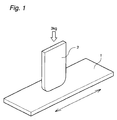
- a slide test (10,000 cycles, stroke: 100 mm) was carried out under a load of 3 kg using abrading glass 2, to measure abrasion depth ( ⁇ m) of a specimen 1.
- thermoplastic elastomer (TPO) identical with the thermoplastic elastomer (A) used for preparing the resin composition were co-extruded using a single-screw extruder having a full flighted screw (screw diameter: 30 mm, L/D: 28, compression ratio: 4.0) for the resin composition and using a single-screw extruder having a full flighted screw (screw diameter: 50 mm, L/D: 28, compression ratio: 4.0) for the thermoplastic elastomer.
- TPO thermoplastic elastomer
- the preset temperatures (zones (C1-C4), head (H) and die (D)) for the extrusion molding of the resin composition are as follows.
- thermoplastic elastomer The preset temperatures (zones (C1-C4), head (H) and die (D)) for the extrusion molding of the thermoplastic elastomer are as follows.
- the two-layer laminate thus extruded was bent in the direction of 180° and then returned to the initial state to observe a crease on the surface of the sliding member layer.
- the crease was evaluated based on the following criteria.
- the extrusion moldability of the resin composition in the co-extrusion was evaluated based on the following criteria.
Landscapes
- Chemical & Material Sciences (AREA)
- Health & Medical Sciences (AREA)
- Chemical Kinetics & Catalysis (AREA)
- Medicinal Chemistry (AREA)
- Polymers & Plastics (AREA)
- Organic Chemistry (AREA)
- Engineering & Computer Science (AREA)
- Mechanical Engineering (AREA)
- Laminated Bodies (AREA)
- Compositions Of Macromolecular Compounds (AREA)
- Extrusion Moulding Of Plastics Or The Like (AREA)
Abstract
Description
and

Claims (10)
- A laminate comprising a sliding member contacting layer composed of a resin composition and a substrate layer composed of a thermoplastic olefin elastomer (A), said laminate being obtainable by co-extruding:said resin composition which is the product of melt kneading 100 parts by weight of a thermoplastic olefin elastomer (A), 10 to 250 parts by weight of an ultra-high-molecular weight polyolefin (B) (except a powder thereof having a particle diameter of 1 to 100 µm) having an intrinsic viscosity (η), as measured in a decalin solvent at 135°C, of 1 to 40 dl/g, and 1 to 300 parts by weight of an inorganic or organic filler powder (C) having a particle diameter of 1 to 100 µm and optional additional components in a twin-screw extruder, andsaid thermoplastic olefin elastomer (A).
- The laminate as claimed in claim 1 wherein the inorganic or organic filler powder (C) is homogeneously dispersed in the sliding member layer.
- The laminate as claimed in claim 1 or 2 wherein said optional additional components include a polyolefin resin (D) in an amount of 1 to 150 parts by weight based on 100 parts by weight of the thermoplastic olefin elastomer (A).
- The laminate as claimed in any one of claims 1 to 3 wherein said optional additional components include an organopolysiloxane (E) in an amount of 1 to 50 parts by weight based on 100 parts by weight of the thermoplastic olefin elastomer (A).
- The laminate as claimed in any one of claims 1 to 4 wherein said optional additional components include a fatty acid amide (F) in an amount of 1 to 50 parts by weight based on 100 parts by weight of the thermoplastic olefin elastomer (A).
- The laminate as claimed in any one of claims 1 to 5 wherein said optional additional components include a fluororubber (G) in an amount of 1 to 20 parts by weight based on 100 parts by weight of the thermoplastic olefin elastomer (A).
- The laminate as claimed in any one of claims 1 to 6, wherein the inorganic or organic filler powder (C) is an ultra-high-molecular weight polyolefin powder having an intrinsic viscosity (η), as measured in a decalin solvent at 135°C, of 1 to 40 dl/g.
- A process for producing a laminate according to any one of claims 1 to 7 comprising co-extruding a melt kneaded resin composition and a thermoplastic olefin elastomer (A).
- A process according to claim 8 comprising melt kneading 100 parts by weight of a thermoplastic olefin elastomer (A), 10 to 250 parts by weight of an ultra-high-molecular weight polyolefin (B) (except a powder thereof having a particle diameter of 1 to 100 µm) having an intrinsic viscosity (η), as measured in a decalin solvent at 135°C, of 1 to 40 dl/g, and 1 to 300 parts by weight of an inorganic or organic filler powder (C) having a particle diameter of 1 to 100 µm and optional additional components in a twin-screw extruder and coextruding the melt kneaded resin composition and a thermoplastic olefin elastomer (A).
- Use of a laminate according to any one of claims 1 to 7 or produced according to claim 8 or claim 9 as a glass-run channel.
Applications Claiming Priority (2)
| Application Number | Priority Date | Filing Date | Title |
|---|---|---|---|
| JP11178231A JP2001001450A (en) | 1999-06-24 | 1999-06-24 | Laminate |
| JP17823199 | 1999-06-24 |
Publications (3)
| Publication Number | Publication Date |
|---|---|
| EP1063084A2 true EP1063084A2 (en) | 2000-12-27 |
| EP1063084A3 EP1063084A3 (en) | 2001-12-12 |
| EP1063084B1 EP1063084B1 (en) | 2006-06-28 |
Family
ID=16044898
Family Applications (1)
| Application Number | Title | Priority Date | Filing Date |
|---|---|---|---|
| EP00305286A Expired - Lifetime EP1063084B1 (en) | 1999-06-24 | 2000-06-22 | Laminate comprising a sliding member layer and a substrate layer |
Country Status (7)
| Country | Link |
|---|---|
| US (1) | US6706385B1 (en) |
| EP (1) | EP1063084B1 (en) |
| JP (1) | JP2001001450A (en) |
| KR (1) | KR100687547B1 (en) |
| DE (1) | DE60029053T2 (en) |
| MY (1) | MY120622A (en) |
| TW (1) | TW527280B (en) |
Cited By (2)
| Publication number | Priority date | Publication date | Assignee | Title |
|---|---|---|---|---|
| WO2009020720A1 (en) * | 2007-08-06 | 2009-02-12 | Advance Elastomer Systems, L.P. | Peroxide-cured thermoplastic vulcanizates prepared with ultrahigh molecular weight plastics |
| EP4130129A4 (en) * | 2020-03-27 | 2024-02-21 | Mitsui Chemicals, Inc. | Thermoplastic elastomer composition and molded body thereof |
Families Citing this family (15)
| Publication number | Priority date | Publication date | Assignee | Title |
|---|---|---|---|---|
| WO2002055296A1 (en) * | 2001-01-15 | 2002-07-18 | Daicel-Degussa Ltd. | Composite material and method for preparation thereof |
| DE10210314A1 (en) * | 2002-03-08 | 2003-09-25 | Ticona Gmbh | Compositions containing elastomers and high molecular weight polyethylenes with irregular particle shape, process for their preparation and their use |
| DE60317539T2 (en) * | 2002-09-26 | 2008-10-23 | Marko I.R.D.C. Inc., Saint Leonard | ELASTIC FILM WITH SLIDE-PROOF ADDITIVE |
| JP2005314544A (en) * | 2004-04-28 | 2005-11-10 | Asahi Kasei Chemicals Corp | Ultra high molecular weight polyethylene resin composition and molded product obtained therefrom |
| JP5137318B2 (en) * | 2006-04-05 | 2013-02-06 | トキワケミカル工業株式会社 | Extruded products for automobiles |
| US20080242779A1 (en) * | 2007-04-02 | 2008-10-02 | Satish Kumar Gaggar | Resinous compositions and articles made therefrom |
| WO2009049418A1 (en) * | 2007-10-15 | 2009-04-23 | Marko I.R.D.C. Inc. | Abrasion resistant thermoplastic film |
| US11118041B2 (en) | 2015-06-19 | 2021-09-14 | Exxonmobil Chemical Patents Inc. | Thermoplastic elastomer compositions comprising ultrahigh molecular weight polyethylene and methods for making the same |
| EP3425000A4 (en) * | 2016-02-29 | 2019-12-11 | Setsunankasei Co., Ltd. | RESIN COMPOSITION AND MOLDED ARTICLE USING THE RESIN COMPOSITION |
| CN110234702B (en) * | 2017-02-06 | 2022-01-04 | 日本瑞翁株式会社 | Vinyl chloride resin composition, vinyl chloride resin molded article, and laminate |
| KR102267932B1 (en) * | 2017-03-31 | 2021-06-21 | 미쓰이 가가쿠 가부시키가이샤 | Thermoplastic elastomer compositions and uses thereof |
| KR102134151B1 (en) * | 2018-11-23 | 2020-07-16 | 효성화학 주식회사 | Polyketone composition and moled article comprising the same |
| JP2022023675A (en) * | 2020-07-27 | 2022-02-08 | 信越ポリマー株式会社 | Composition and its molded product |
| JP7610403B2 (en) * | 2020-12-22 | 2025-01-08 | 三井化学株式会社 | Olefin-based polymer composition and its use |
| KR102663005B1 (en) * | 2024-04-03 | 2024-05-03 | (주) 웹스 | High-durability synthetic wood and its manufacturing method |
Family Cites Families (11)
| Publication number | Priority date | Publication date | Assignee | Title |
|---|---|---|---|---|
| JP2655350B2 (en) * | 1989-05-29 | 1997-09-17 | 富士写真フイルム株式会社 | Processing method of silver halide color photographic light-sensitive material |
| JPH0341137A (en) * | 1989-07-07 | 1991-02-21 | Hitachi Cable Ltd | polymer blend composition |
| US5441685A (en) * | 1991-01-28 | 1995-08-15 | Tokiwa Chemical Industries Co., Ltd. | Method for producing a window glass edging member for a vehicle such as an automobile |
| US5447671A (en) * | 1991-02-24 | 1995-09-05 | Tokiwa Chemical Industries & Co., Ltd. | Window glass edging member for a vehicle such as an automobile and method for manufacturing the edging member |
| CA2066501C (en) * | 1991-04-22 | 1998-12-01 | Kazuhiko Murata | Thermoplastic elastomer laminates and glass run channels molded therefrom |
| JPH06207051A (en) * | 1993-01-12 | 1994-07-26 | Bridgestone Corp | Vibrationproof rubber composition |
| JP3583216B2 (en) | 1995-12-11 | 2004-11-04 | アドバンスド エラストマー システムズ,エル.ピー. | Polyolefin resin composition for skin member and laminate thereof |
| JPH09164980A (en) * | 1995-12-19 | 1997-06-24 | Bridgestone Corp | Lug rubber composition for rubber crawler |
| JPH10193985A (en) * | 1996-11-18 | 1998-07-28 | Toyoda Gosei Co Ltd | Automotive glass run |
| CA2230332C (en) * | 1997-02-21 | 2001-01-23 | Mitsui Chemicals, Incorporated | Glass run channel |
| JP4059971B2 (en) * | 1997-02-21 | 2008-03-12 | 三井化学株式会社 | Glass run channel |
-
1999
- 1999-06-24 JP JP11178231A patent/JP2001001450A/en active Pending
-
2000
- 2000-06-21 KR KR1020000034070A patent/KR100687547B1/en not_active Expired - Fee Related
- 2000-06-22 EP EP00305286A patent/EP1063084B1/en not_active Expired - Lifetime
- 2000-06-22 DE DE60029053T patent/DE60029053T2/en not_active Expired - Lifetime
- 2000-06-23 TW TW089112430A patent/TW527280B/en not_active IP Right Cessation
- 2000-06-23 US US09/599,874 patent/US6706385B1/en not_active Expired - Lifetime
- 2000-06-24 MY MYPI20002866A patent/MY120622A/en unknown
Cited By (3)
| Publication number | Priority date | Publication date | Assignee | Title |
|---|---|---|---|---|
| WO2009020720A1 (en) * | 2007-08-06 | 2009-02-12 | Advance Elastomer Systems, L.P. | Peroxide-cured thermoplastic vulcanizates prepared with ultrahigh molecular weight plastics |
| US8846815B2 (en) | 2007-08-06 | 2014-09-30 | Exxonmobil Chemical Patents Inc. | Peroxide-cured thermoplastic vulcanizates prepared with ultrahigh molecular weight plastics |
| EP4130129A4 (en) * | 2020-03-27 | 2024-02-21 | Mitsui Chemicals, Inc. | Thermoplastic elastomer composition and molded body thereof |
Also Published As
| Publication number | Publication date |
|---|---|
| EP1063084B1 (en) | 2006-06-28 |
| US6706385B1 (en) | 2004-03-16 |
| KR100687547B1 (en) | 2007-02-27 |
| JP2001001450A (en) | 2001-01-09 |
| DE60029053D1 (en) | 2006-08-10 |
| EP1063084A3 (en) | 2001-12-12 |
| DE60029053T2 (en) | 2006-12-07 |
| TW527280B (en) | 2003-04-11 |
| KR20010007461A (en) | 2001-01-26 |
| MY120622A (en) | 2005-11-30 |
Similar Documents
| Publication | Publication Date | Title |
|---|---|---|
| US6706385B1 (en) | High lubricity, multi-layer polyolefin laminate | |
| EP0860314B1 (en) | Glass run channel | |
| KR100677835B1 (en) | Olefin Thermoplastic Elastomer Laminates and Construction Gaskets | |
| JP3952350B2 (en) | Resin composition for skin member, laminated body thereof, method for reducing the amount of creaking at the time of extrusion molding of the composition, and method for producing molded body | |
| EP1793998B1 (en) | Slip-coat compositions and polymeric laminates | |
| JP4059971B2 (en) | Glass run channel | |
| EP0974617B1 (en) | Resin compositions for skin members and laminates thereof | |
| JP3994611B2 (en) | Olefin-based thermoplastic elastomer laminate and automotive glass run channel | |
| JP3945248B2 (en) | Olefinic foam laminates and applications | |
| JP4226772B2 (en) | Olefin-based thermoplastic elastomer laminate and architectural gasket | |
| JP3910313B2 (en) | Resin composition for skin member and laminate thereof | |
| JP3429013B2 (en) | Architectural gasket | |
| JP3055111B2 (en) | Thermoplastic elastomer laminate | |
| JP3210066B2 (en) | Glass run channel | |
| JP3083009B2 (en) | Architectural gasket | |
| JP3055113B2 (en) | Glass run channel | |
| JP3110141B2 (en) | Thermoplastic elastomer laminate | |
| JP3055112B2 (en) | Ultra-high molecular weight polyolefin composition for thermoplastic elastomer laminate | |
| JPH11323044A (en) | Thermoplastic elastomer composition for skin member | |
| JP2000053826A (en) | Resin composition for skin member and its laminate |
Legal Events
| Date | Code | Title | Description |
|---|---|---|---|
| PUAI | Public reference made under article 153(3) epc to a published international application that has entered the european phase |
Free format text: ORIGINAL CODE: 0009012 |
|
| AK | Designated contracting states |
Kind code of ref document: A2 Designated state(s): AT BE CH CY DE DK ES FI FR GB GR IE IT LI LU MC NL PT SE Kind code of ref document: A2 Designated state(s): DE FR GB NL |
|
| AX | Request for extension of the european patent |
Free format text: AL;LT;LV;MK;RO;SI |
|
| PUAL | Search report despatched |
Free format text: ORIGINAL CODE: 0009013 |
|
| AK | Designated contracting states |
Kind code of ref document: A3 Designated state(s): AT BE CH CY DE DK ES FI FR GB GR IE IT LI LU MC NL PT SE |
|
| AX | Request for extension of the european patent |
Free format text: AL;LT;LV;MK;RO;SI |
|
| RIC1 | Information provided on ipc code assigned before grant |
Free format text: 7B 32B 27/32 A, 7C 08L 23/16 B, 7C 08L 23/02 B, 7B 60J 10/00 B |
|
| 17P | Request for examination filed |
Effective date: 20020306 |
|
| AKX | Designation fees paid |
Free format text: DE FR GB NL |
|
| 17Q | First examination report despatched |
Effective date: 20040623 |
|
| RAP1 | Party data changed (applicant data changed or rights of an application transferred) |
Owner name: MITSUI CHEMICALS, INC. |
|
| GRAP | Despatch of communication of intention to grant a patent |
Free format text: ORIGINAL CODE: EPIDOSNIGR1 |
|
| GRAS | Grant fee paid |
Free format text: ORIGINAL CODE: EPIDOSNIGR3 |
|
| GRAA | (expected) grant |
Free format text: ORIGINAL CODE: 0009210 |
|
| AK | Designated contracting states |
Kind code of ref document: B1 Designated state(s): DE FR GB NL |
|
| PG25 | Lapsed in a contracting state [announced via postgrant information from national office to epo] |
Ref country code: NL Free format text: LAPSE BECAUSE OF FAILURE TO SUBMIT A TRANSLATION OF THE DESCRIPTION OR TO PAY THE FEE WITHIN THE PRESCRIBED TIME-LIMIT Effective date: 20060628 |
|
| REG | Reference to a national code |
Ref country code: GB Ref legal event code: FG4D |
|
| REF | Corresponds to: |
Ref document number: 60029053 Country of ref document: DE Date of ref document: 20060810 Kind code of ref document: P |
|
| NLV1 | Nl: lapsed or annulled due to failure to fulfill the requirements of art. 29p and 29m of the patents act | ||
| ET | Fr: translation filed | ||
| PLBE | No opposition filed within time limit |
Free format text: ORIGINAL CODE: 0009261 |
|
| STAA | Information on the status of an ep patent application or granted ep patent |
Free format text: STATUS: NO OPPOSITION FILED WITHIN TIME LIMIT |
|
| 26N | No opposition filed |
Effective date: 20070329 |
|
| PGFP | Annual fee paid to national office [announced via postgrant information from national office to epo] |
Ref country code: GB Payment date: 20090617 Year of fee payment: 10 |
|
| GBPC | Gb: european patent ceased through non-payment of renewal fee |
Effective date: 20100622 |
|
| PG25 | Lapsed in a contracting state [announced via postgrant information from national office to epo] |
Ref country code: GB Free format text: LAPSE BECAUSE OF NON-PAYMENT OF DUE FEES Effective date: 20100622 |
|
| REG | Reference to a national code |
Ref country code: FR Ref legal event code: PLFP Year of fee payment: 17 |
|
| REG | Reference to a national code |
Ref country code: FR Ref legal event code: PLFP Year of fee payment: 18 |
|
| REG | Reference to a national code |
Ref country code: FR Ref legal event code: PLFP Year of fee payment: 19 |
|
| PGFP | Annual fee paid to national office [announced via postgrant information from national office to epo] |
Ref country code: DE Payment date: 20190619 Year of fee payment: 20 |
|
| PGFP | Annual fee paid to national office [announced via postgrant information from national office to epo] |
Ref country code: FR Payment date: 20190619 Year of fee payment: 20 |
|
| REG | Reference to a national code |
Ref country code: DE Ref legal event code: R071 Ref document number: 60029053 Country of ref document: DE |