EP1055997A1 - A floating-point unit which utilizes standard MAC units for performing SIMD operations - Google Patents
A floating-point unit which utilizes standard MAC units for performing SIMD operations Download PDFInfo
- Publication number
- EP1055997A1 EP1055997A1 EP99122964A EP99122964A EP1055997A1 EP 1055997 A1 EP1055997 A1 EP 1055997A1 EP 99122964 A EP99122964 A EP 99122964A EP 99122964 A EP99122964 A EP 99122964A EP 1055997 A1 EP1055997 A1 EP 1055997A1
- Authority
- EP
- European Patent Office
- Prior art keywords
- bit
- multiply accumulate
- unit
- register file
- units
- Prior art date
- Legal status (The legal status is an assumption and is not a legal conclusion. Google has not performed a legal analysis and makes no representation as to the accuracy of the status listed.)
- Withdrawn
Links
Images

Classifications
-
- G—PHYSICS
- G06—COMPUTING OR CALCULATING; COUNTING
- G06F—ELECTRIC DIGITAL DATA PROCESSING
- G06F9/00—Arrangements for program control, e.g. control units
- G06F9/06—Arrangements for program control, e.g. control units using stored programs, i.e. using an internal store of processing equipment to receive or retain programs
- G06F9/30—Arrangements for executing machine instructions, e.g. instruction decode
- G06F9/38—Concurrent instruction execution, e.g. pipeline or look ahead
- G06F9/3885—Concurrent instruction execution, e.g. pipeline or look ahead using a plurality of independent parallel functional units
-
- G—PHYSICS
- G06—COMPUTING OR CALCULATING; COUNTING
- G06F—ELECTRIC DIGITAL DATA PROCESSING
- G06F7/00—Methods or arrangements for processing data by operating upon the order or content of the data handled
- G06F7/38—Methods or arrangements for performing computations using exclusively denominational number representation, e.g. using binary, ternary, decimal representation
- G06F7/48—Methods or arrangements for performing computations using exclusively denominational number representation, e.g. using binary, ternary, decimal representation using non-contact-making devices, e.g. tube, solid state device; using unspecified devices
- G06F7/483—Computations with numbers represented by a non-linear combination of denominational numbers, e.g. rational numbers, logarithmic number system or floating-point numbers
-
- G—PHYSICS
- G06—COMPUTING OR CALCULATING; COUNTING
- G06F—ELECTRIC DIGITAL DATA PROCESSING
- G06F9/00—Arrangements for program control, e.g. control units
- G06F9/06—Arrangements for program control, e.g. control units using stored programs, i.e. using an internal store of processing equipment to receive or retain programs
- G06F9/30—Arrangements for executing machine instructions, e.g. instruction decode
- G06F9/30003—Arrangements for executing specific machine instructions
- G06F9/30007—Arrangements for executing specific machine instructions to perform operations on data operands
- G06F9/3001—Arithmetic instructions
- G06F9/30014—Arithmetic instructions with variable precision
-
- G—PHYSICS
- G06—COMPUTING OR CALCULATING; COUNTING
- G06F—ELECTRIC DIGITAL DATA PROCESSING
- G06F9/00—Arrangements for program control, e.g. control units
- G06F9/06—Arrangements for program control, e.g. control units using stored programs, i.e. using an internal store of processing equipment to receive or retain programs
- G06F9/30—Arrangements for executing machine instructions, e.g. instruction decode
- G06F9/30003—Arrangements for executing specific machine instructions
- G06F9/30007—Arrangements for executing specific machine instructions to perform operations on data operands
- G06F9/30036—Instructions to perform operations on packed data, e.g. vector, tile or matrix operations
-
- G—PHYSICS
- G06—COMPUTING OR CALCULATING; COUNTING
- G06F—ELECTRIC DIGITAL DATA PROCESSING
- G06F2207/00—Indexing scheme relating to methods or arrangements for processing data by operating upon the order or content of the data handled
- G06F2207/38—Indexing scheme relating to groups G06F7/38 - G06F7/575
- G06F2207/3804—Details
- G06F2207/3808—Details concerning the type of numbers or the way they are handled
- G06F2207/3812—Devices capable of handling different types of numbers
- G06F2207/382—Reconfigurable for different fixed word lengths
-
- G—PHYSICS
- G06—COMPUTING OR CALCULATING; COUNTING
- G06F—ELECTRIC DIGITAL DATA PROCESSING
- G06F2207/00—Indexing scheme relating to methods or arrangements for processing data by operating upon the order or content of the data handled
- G06F2207/38—Indexing scheme relating to groups G06F7/38 - G06F7/575
- G06F2207/3804—Details
- G06F2207/3808—Details concerning the type of numbers or the way they are handled
- G06F2207/3828—Multigauge devices, i.e. capable of handling packed numbers without unpacking them
Definitions
- the present invention relates to a floating-point unit and, more particularly, to a floating-point unit that is capable of utilizing standard MAC units for performing operations on traditional data type formats and on SIMD data type formats.
- SIMD single instruction, multiple data
- a SIMD instruction causes identical operations to be performed on multiple pieces of data at the same time, i.e. , in parallel.
- Storing smaller pieces of data in one larger register is a more efficient use of die area than storing the smaller pieces of data in a plurality of smaller registers. Therefore, SIMD operations are normally performed on the smaller data pieces in a single, larger register simultaneously. Also, it is necessary to perform the SIMD operations on the smaller data pieces at the same time in order to meet the requirements of SIMD operations.
- SIMD and standard functional units have been implemented in these architectures for processing traditional and SIMD data type formats.
- These functional units one type of which is commonly referred to as multiply accumulate (MAC) blocks, perform various types of arithmetic functions, such as, for example, adds, subtracts and multiplies on the data presented to them.
- MAC multiply accumulate
- the present invention provides a method and apparatus for performing floating-point operations.
- the apparatus of the present invention comprises a floating point unit which comprises two standard multiply accumulate units (MACs) which are capable of performing multiply accumulate operations on a plurality of data type formats.
- the standard MACs are configured to operate on traditional data type formats and on single instruction multiple data (SIMD) type formats. Therefore, dedicated SIMD MAC units are not needed, thus allowing a significant savings in die area to be realized.
- the data is presented to the upper and lower MAC units as 64-bit words.
- Each MAC unit also receives one or more bits which cause the MAC units to each select either the upper or lower halves of the 64-bit words, depending on the MAC unit.
- the lower 32-bit words may be processed by the upper MAC unit and the upper 32-bit words may be processed by the lower MAC unit.
- Each MAC unit operates on its respective 32-bit words.
- the results of the operations performed by the MAC units are then coalesced by the bypass blocks of the floating-point unit into a 64-bit word.
- the results are coalesced in such a manner that the results appear identical to the results obtained in floating-point units which utilize dedicated SIMD hardware.
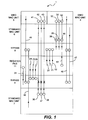
- Fig. 1 is a functional block diagram of a floating-point unit 1 which is capable of operating on traditional data type formats and on an SIMD data type formats.
- the floating-point unit 1 comprises two SIMD MAC units 3 and 4, two standard MAC units 6 and 7, two bypass blocks 8 and 9 and a register file block 11.
- the standard MAC units 6 and 7 perform floating-point operations on traditional data type formats.
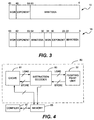
- the SIMD MAC units 3 and 4 perform mathematical operations on SIMD data type formats. Therefore, the floating-point unit 1 shown in Fig. 1 has dedicated SIMD MAC units 3 and 4 which perform SIMD operations and standard MAC units 6 and 7 which perform operations on standard, or traditional, data type formats. These two data type formats are shown in Fig. 3.
- a typical data type format 15 to be operated on comprises a 64-bit mantissa value, a 17-bit exponent value and a 1-bit sign value.
- a SIMD data type format 16 comprises two 23-bit mantissa values, two 8-bit exponent values (i.e. , one associated with each of the mantissa values), and two sign bits (i.e. , one bit associated with each mantissa value and its exponent).
- the SIMD data type format is well known in the art and are documented in the IEEE standards for floating-point operations. The manner in which operations are performed on these data type formats is also well known in the art. Therefore, a detailed discussion of these floating-point data type operations will not be provided herein in the interest of brevity.
- each of the standard MAC units 6 and 7 are capable of performing a multiply accumulate operation.
- a multiply accumulate operation is to be performed on the typical data type format 15 shown in Fig. 3, the operands A, B and C are delivered to the bypass blocks 8 and 9. Since the floating-point unit 1 comprises two standard MAC units 6 and 7, two multiply accumulate operations can be performed simultaneously ( i.e. , one multiply accumulate operation is performed in standard MAC unit 6 and the other is performed in standard MAC unit 7).
- Each of the standard MAC units 6 and 7 comprises one 82-bit adder and one 82-bit multiplier.
- the operands to be operated on are received by the register file block 11 from an instruction decoder (not shown) comprised by the processor architecture.
- the instruction decoder provides control bits to the register file block 11 along with the operands and these control bits are utilized by the MAC units to determine the type of arithmetic operation to be performed on the operands, e.g. , adds, subtracts, multiplies, etc.
- the register file block 11 comprises a plurality of registers in which the operands received by the register file block 11 are stored.
- the control bits received by the register file block 11 indicate which registers in the register file block 11 are to be utilized for reading and writing the operands.
- Each of the bypass blocks 8 and 9 handles one set of operands.
- the bypass blocks 8 and 9 also utilize control bits provided to them to determine which register contents are to be routed to a particular destination in the floating-point unit 1.
- the bypass blocks 8 and 9 perform functions which are well known in the art of processor architecture. Therefore, a detailed discussion of the functions performed by the bypass blocks 8 and 9 will not be provided herein.
- the register file block 11 After the operands have been loaded in the appropriate registers in the register file block 11, the register file block 11 reads the operands out of the appropriate registers and the register file block 11 routes them to the appropriate bypass block, as indicated by the arrows on lines 20, 21 and 22 directed from the register file block 11 to the bypass block 8.
- the lines 20, 21 and 22 correspond to the bus comprised in the floating-point unit 1 and each of the lines 20, 21 and 22 corresponds to a plurality of lines needed for transporting the multi-bit operands A, B and C.
- the circles in Fig. 1 are intended to denote bus inputs to the blocks on which they are located.
- the register file block 11 reads the second set of operands A, B and C out of the appropriate registers in the register file block 11 and the bypass block 9 routes them to the appropriate MAC unit, as indicated by the arrows on lines 24, 25 and 26. These lines also represent a plurality of bus lines.
- the bypass block 8 delivers its set of operands, which have been read from the register file block 11, either to the standard MAC unit 6 via bus inputs 28, 29 and 30 or to the SIMD MAC unit 4 via the bus inputs 32, 33 and 34.
- the bypass block 9 either delivers its set of operands to the standard MAC unit 7 via bus inputs 36, 37 and 38 or to the SIMD MAC unit 3 via bus inputs 41, 42 and 43.
- bypass blocks 8 and 9 will provide the operands to the standard MAC units 6 and 7, respectively.
- the results are delivered by the standard MAC units 6 and 7 to the bypass blocks 8 and 9.
- the bypass blocks 8 and 9 pass the results of the arithmetic operations to the register file block 11 via buses 51 and 52, which then stores the results in one or more registers in the register file block 11.
- control bits received by the register file block 11 indicate which registers the results of the associated operations are to be stored in once the operations have been performed.
- the bypass blocks 8 and 9 also receive control bits which the bypass blocks 8 and 9 utilize to determine the registers in which the results of the operations are to be stored.
- Each of the SIMD MAC units 3 and 4 comprises two 32-bit adders and two 32-bit multipliers. Each SIMD MAC unit 3 and 4 is capable of processing three operands A, B and C to perform the arithmetic operation indicated by the instruction decoder.
- the manners in which the SIMD MAC units 3 and 4 and the standard MAC units 6 and 7 operate on the data type formats 15 and 16 shown in Fig. 3 are well-known to those skilled in the art. Therefore, a detailed discussion of the manner in which these units perform their multiply accumulate operations ( i.e. , A+BxC ) will not be discussed herein.
- the floating-point unit 1 is capable of processing traditional data type formats and SIMD data type formats, implementing the SIMD MAC units 3 and 4 is costly in terms of the amount of die area required for their implementation. Furthermore, SIMD operations are performed rarely and the SIMD MAC units 3 and 4 are dormant whenever traditional data type formats are being processed by the standard MAC units 6 and 7. Similarly, the standard MAC units 6 and 7 are dormant whenever SIMD operations are being performed by the SIMD MAC units 3 and 4. Therefore, the SIMD MAC units 3 and 4 and the standard MAC units 6 and 7 consume a relatively large amount of die area, even though they are not utilized for all operations.
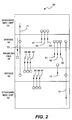
- a floating-point unit 50 (Fig. 2) which utilizes standard MAC units 51 and 52 for performing all arithmetic operations, including operations to be performed on SIMD data type formats. Therefore, the need for the dedicated SIMD MAC units 3 and 4 shown in Fig. 1 has been eliminated, thus allowing a significant savings in the amount of die area required for the floating-point unit 50 to be realized.
- the standard MAC units 51 and 52 preferably are very similar to the standard MAC units 6 and 7 shown in Fig. 1. Therefore, the standard MAC units 51 and 52 preferably each comprise one 82-bit adder and one 82-bit multiplier (not shown). However, the standard MAC units 51 and 52 are each configured to receive a particular bit and to utilize this bit to cause the standard MAC units to select the appropriate half of a 64-bit word, as described below in more detail.
- the standard MAC units 51 and 52 When a traditional data type format 15 is to be processed by the floating-point unit 50, the standard MAC units 51 and 52 perform their normal operations. However, when a SIMD data type format 16 is to be processed by the floating-point unit 50, the SIMD bit field is split into two 32-bit words and the lower 32 bits of the SIMD word are processed by standard MAC unit 51 and the upper 32 bits of the SIMD word are processed by standard MAC unit 52. Although the entire 64-bit word is provided to both of the standard MAC units 51 and 52, the aforementioned bits received by the standard MAC units 51 and 52 cause the standard MAC units 51 and 52 to select the appropriate 32-bit word. The standard MAC units 51 and 52 then perform their respective operations on these 32-bit words.
- the standard MAC units 51 and 52 normally process 82-bit words. When processing SIMD words, only the lower 64 bits are utilized by the standard MAC units 51 and 52. The upper 18 bits are set to a constant value and generally are ignored. Once the standard MAC units 51 and 52 have processed their respective portions of the 64-bit SIMD word, the bypass blocks 54 and 55 coalesce the 32-bit results into a 64-bit SIMD result.
- the bypass blocks 54 and 55 write the lower and upper 32-bit words, respectively, to the register file block 56 by writing the bits to adjacent bit fields in the register file block 56 in such a manner that the 64-bit result written to the register file block 56 is as it would have been if it had been processed by an SIMD MAC unit such as SIMD MAC unit 3 or 4 shown in Fig. 1.
- the lines shown in the floating-point unit 50 of Fig. 2 are being used in the same manner in which they were used in Fig. 1 to denote buses.
- the arrows are being used to indicate the direction of flow of the data and the circles are being used to indicate bus inputs.
- the lines 61, 62 and 63 represent the lower 32 bits of the SIMD word. Therefore, in SIMD mode, each of the buses 61, 62 and 63 transports a 32-bit operand (i.e., A, B and C).
- the register file block 56 loads the SIMD bits into the appropriate registers of the register file block 56 in accordance with control bits received by the register file block 56.
- the bypass block 54 selects the lower 32-bit portions of the SIMD words and routes the 32-bit words over buses 61, 62 and 63 from the register file block 56 to the standard MAC unit 51. Simultaneously, the bypass block 55 routes the upper 32-bit portions of the SIMD words over bus lines 65, 66 and 67 to the standard MAC unit 52.
- the standard MAC unit 51 and the standard MAC unit 52 simultaneously perform multiply accumulate operations on their respective portions of the SIMD word.
- the standard MAC units 51 and 52 both produce 32-bit results, which are routed over bus lines 71 and 72, respectively, to the bypass blocks 54 and 55.
- the results are then coalesced by the bypass blocks 54 and 55 to produce a 64-bit SIMD result, which is then written to the appropriate registers in the register file block 56.
- the floating-point unit 1 shown in Fig. 1 is capable of performing two SIMD operations simultaneously to generate four SIMD results, which are in pairs of two.
- the floating-point unit 50 shown in Fig. 2 With the floating-point unit 50 shown in Fig. 2, only one SIMD operation is capable of being performed at a time. Therefore, with respect to the performance of SIMD operations, the floating-point unit 50 shown in Fig. 2 generally has half the throughput of the floating-point unit 1 shown in Fig. 1. If SIMD operations were performed frequently, the overall throughput of the floating-point unit 50 would be much less than the overall throughput of the floating-point unit 1. However, SIMD operations typically only represent less than five percent of the total operations performed by floating-point units. Therefore, the decrease in the throughput of the floating-point unit 50 resulting from the performance of SIMD operations in the standard MAC units 51 and 52 is not greatly significant.
- the decrease in throughput of the floating-point unit 50 in comparison to the floating-point unit 1 is deemed justifiable in view of the significant savings in die area realized as a result of the elimination of the dedicated SIMD MAC units 3 and 4 shown in Fig. 1.
- the floating-point unit 50 is designed to further reduce the effects of the decreased throughput resulting from the elimination of the SIMD MAC units 3 and 4, as discussed below in detail with reference to Figs. 4 and 5.
- Fig. 4 illustrates a circuit 80 of the processor architecture which controls the loading of instructions and data from a cache memory component 81 into the floating-point unit 50 and the storing of data from the floating-point unit 50 and storage of the data in the cache memory component 81.
- the circuit 80 comprises an instruction decoder 83 which controls the retrieval of data from and storage of data in the cache memory component 81 and the loading of data in and retrieval of data from the floating-point unit 50.
- the circuit 80 communicates with a memory component 85 which preferably is off-chip which stores instructions and data when they are not residing in the cache memory component 81.
- the memory component 85 could be an on-chip memory component. However, implementing the memory component 85 on-chip may be expensive in terms of die area, and therefore, preferably is implemented as an off-chip component.
- a compiler 87 which is external to the circuit 80 controls which instruction and data are to reside in the cache memory component 81 and which are to reside in memory element 85.
- the compiler 87 typically is a software component which optimizes program execution by utilizing various optimization techniques such as, for example, code reordering.
- the compiler 87 utilizes these optimization techniques and causes particular pieces of code and data to be moved from memory element 85 into the cache memory component 81, and vice versa.
- the instruction decoder 83 reads instructions and data out of the cache memory component 81 and determines the type of operation to be performed on the data. The instruction decoder 83 then causes the data to be loaded into the appropriate registers in the register file block 56 of the floating-point unit 50. The instruction decoder 83 provides control bits to the floating-point unit 50 which instruct the register file block 56 of the registers in which the data is to be stored and of the manner in which the data stored in those registers is to be processed. The instruction decoder 83 causes the floating-point unit 50 to store the data after it has been processed and provides it either to the memory element 85 or to the cache memory component 81. The instruction decoder 83 utilizes information from the compiler 87 to determine whether the data is to be stored in the memory element 85 or in the cache component 81.
- Fig. 5 illustrates a high-level timing diagram of the performance of a SIMD operation from the point at which the instruction decoder 83 decodes a SIMD instruction to the point at which the coalesced 64-bit SIMD result has been written back to a register in the register file block 56.
- the time periods T0 through T7 do not necessarily represent cycles occurring in the processor architecture, but are merely intended to demonstrate the relative timing of the performance of various tasks with respect to one another.
- the floating-point unit 50 and the instruction decoder 83 are designed so that they maximize the speed at which operations are performed.
- a SIMD operation begins when the instruction decoder 83 decodes an instruction read out of cache memory component 81 and determines which registers in the register file block 56 are to be used as the operands in a SIMD operation. This step is indicated by block 91 in the timing diagram of Fig. 5. This decode step, which is represented by block 91, occurs in a first unit of time T0 to T1. In a second time period T1 to T2, the instruction decoder 83 causes the operands of the SIMD word to be dumped from the appropriate registers in the register file block 56.
- the operand dump step is represented by block 92.
- the SIMD word is split into a lower portion and an upper portion, the lower and upper portions are provided by the bypass block 54 and 55 to the standard MAC units 51 and 52, respectively, and the arithmetic operation is performed in the standard MAC units 51 and 52.
- This sequence of steps is represented by block 93.
- the SIMD results 71 and 72 (Fig. 2) are driven by the standard MAC units 51 and 52 to the bypass blocks 54 and 55.
- the results 71 and 72 are coalesced in the bypass blocks 54 and 55 into a single 64-bit SIMD result and the 64-bit SIMD result is written to the appropriate register in the register file block 56.
- the floating-point unit 50 must wait for the results of an operation to be written back to the appropriate register in the register file block 56 before the floating-point unit 50 can begin performing a subsequent operation.
- the operands A, B and C may be stored in registers R4, R6 and R8, respectively, and the results of the operation are to be stored in register R11.
- a second operation must utilize the contents of registers R11, R14 and R19 for performing an operation for which the results will be stored in register R60.
- the floating-point unit 50 must wait until the results of the first operation have been written to register R11 before it can begin performing the second operation, since the contents of register R11 must be utilized in the second operation.
- the floating-point unit 50 can launch the second operation by as early as time T1 because the standard MAC units 51 and 52 employ pipeline designs.
- the decode step 96 of the second operation can begin. Therefore, the decode step 96 can begin before the write-back step 95 occurs in the previous operation.
- the operand dump step 97 of the second operation will occur during the write-back step 95 of the previous operation so that the results of the previous operation and operands for the next operation will be available at the same time for the processing steps of block 98.
- the instruction decoder 83 keeps track of these types of operation dependencies and launches instructions at the appropriate times such that throughput of the floating-point unit 50 is maximized while preserving the integrity of the data of the operations to be performed by the floating-point unit 50. Therefore, although the floating-point unit 50 incurs a performance penalty by not utilizing dedicated SIMD MAC units, the significance of this performance penalty is minimized while realizing significant savings in terms of the amount of die area required for implementation of the floating-point unit 50.
Landscapes
- Engineering & Computer Science (AREA)
- Theoretical Computer Science (AREA)
- Physics & Mathematics (AREA)
- General Physics & Mathematics (AREA)
- Software Systems (AREA)
- General Engineering & Computer Science (AREA)
- Computational Mathematics (AREA)
- Mathematical Analysis (AREA)
- Mathematical Optimization (AREA)
- Pure & Applied Mathematics (AREA)
- Computing Systems (AREA)
- Mathematical Physics (AREA)
- Nonlinear Science (AREA)
- Advance Control (AREA)
- Multi Processors (AREA)
Applications Claiming Priority (2)
| Application Number | Priority Date | Filing Date | Title |
|---|---|---|---|
| US316340 | 1999-05-21 | ||
| US09/316,340 US6493817B1 (en) | 1999-05-21 | 1999-05-21 | Floating-point unit which utilizes standard MAC units for performing SIMD operations |
Publications (1)
| Publication Number | Publication Date |
|---|---|
| EP1055997A1 true EP1055997A1 (en) | 2000-11-29 |
Family
ID=23228645
Family Applications (1)
| Application Number | Title | Priority Date | Filing Date |
|---|---|---|---|
| EP99122964A Withdrawn EP1055997A1 (en) | 1999-05-21 | 1999-11-18 | A floating-point unit which utilizes standard MAC units for performing SIMD operations |
Country Status (3)
| Country | Link |
|---|---|
| US (1) | US6493817B1 (enExample) |
| EP (1) | EP1055997A1 (enExample) |
| JP (1) | JP3683773B2 (enExample) |
Families Citing this family (19)
| Publication number | Priority date | Publication date | Assignee | Title |
|---|---|---|---|---|
| TWI361379B (en) * | 2006-02-06 | 2012-04-01 | Via Tech Inc | Dual mode floating point multiply accumulate unit |
| US20080133895A1 (en) * | 2006-05-16 | 2008-06-05 | Alexey Yurievich Sivtsov | Floating Point Addition |
| US8261025B2 (en) * | 2007-11-12 | 2012-09-04 | International Business Machines Corporation | Software pipelining on a network on chip |
| US8526422B2 (en) | 2007-11-27 | 2013-09-03 | International Business Machines Corporation | Network on chip with partitions |
| US8327120B2 (en) * | 2007-12-29 | 2012-12-04 | Intel Corporation | Instructions with floating point control override |
| US8473667B2 (en) | 2008-01-11 | 2013-06-25 | International Business Machines Corporation | Network on chip that maintains cache coherency with invalidation messages |
| US8490110B2 (en) | 2008-02-15 | 2013-07-16 | International Business Machines Corporation | Network on chip with a low latency, high bandwidth application messaging interconnect |
| US20090271172A1 (en) * | 2008-04-24 | 2009-10-29 | International Business Machines Corporation | Emulating A Computer Run Time Environment |
| US8423715B2 (en) | 2008-05-01 | 2013-04-16 | International Business Machines Corporation | Memory management among levels of cache in a memory hierarchy |
| US8392664B2 (en) | 2008-05-09 | 2013-03-05 | International Business Machines Corporation | Network on chip |
| US8494833B2 (en) | 2008-05-09 | 2013-07-23 | International Business Machines Corporation | Emulating a computer run time environment |
| US8214845B2 (en) | 2008-05-09 | 2012-07-03 | International Business Machines Corporation | Context switching in a network on chip by thread saving and restoring pointers to memory arrays containing valid message data |
| US8230179B2 (en) | 2008-05-15 | 2012-07-24 | International Business Machines Corporation | Administering non-cacheable memory load instructions |
| US8438578B2 (en) | 2008-06-09 | 2013-05-07 | International Business Machines Corporation | Network on chip with an I/O accelerator |
| US8195884B2 (en) * | 2008-09-18 | 2012-06-05 | International Business Machines Corporation | Network on chip with caching restrictions for pages of computer memory |
| CN101986264B (zh) * | 2010-11-25 | 2013-07-31 | 中国人民解放军国防科学技术大学 | 用于simd向量微处理器的多功能浮点乘加运算装置 |
| JP2012174016A (ja) | 2011-02-22 | 2012-09-10 | Renesas Electronics Corp | データ処理装置およびそのデータ処理方法 |
| WO2019005088A1 (en) * | 2017-06-30 | 2019-01-03 | Intel Corporation | HETEROGENEOUS MULTIPLIER |
| CN115545179A (zh) * | 2022-10-13 | 2022-12-30 | 中国人民解放军国防科技大学 | Gpdsp中面向深度学习的高效计算装置 |
Citations (3)
| Publication number | Priority date | Publication date | Assignee | Title |
|---|---|---|---|---|
| US4901268A (en) * | 1988-08-19 | 1990-02-13 | General Electric Company | Multiple function data processor |
| EP0380099A2 (en) * | 1989-01-27 | 1990-08-01 | Hughes Aircraft Company | Register and arithmetic logic unit |
| WO2000022512A1 (en) * | 1998-10-12 | 2000-04-20 | Intel Corporation | Scalar hardware for performing simd operations |
Family Cites Families (3)
| Publication number | Priority date | Publication date | Assignee | Title |
|---|---|---|---|---|
| DE69519449T2 (de) * | 1994-05-05 | 2001-06-21 | Conexant Systems, Inc. | Raumzeigersdatenpfad |
| DE69927075T2 (de) * | 1998-02-04 | 2006-06-14 | Texas Instruments Inc | Rekonfigurierbarer Koprozessor mit mehreren Multiplizier-Akkumulier-Einheiten |
| US6205462B1 (en) * | 1999-10-06 | 2001-03-20 | Cradle Technologies | Digital multiply-accumulate circuit that can operate on both integer and floating point numbers simultaneously |
-
1999
- 1999-05-21 US US09/316,340 patent/US6493817B1/en not_active Expired - Fee Related
- 1999-11-18 EP EP99122964A patent/EP1055997A1/en not_active Withdrawn
-
2000
- 2000-05-22 JP JP2000149271A patent/JP3683773B2/ja not_active Expired - Fee Related
Patent Citations (3)
| Publication number | Priority date | Publication date | Assignee | Title |
|---|---|---|---|---|
| US4901268A (en) * | 1988-08-19 | 1990-02-13 | General Electric Company | Multiple function data processor |
| EP0380099A2 (en) * | 1989-01-27 | 1990-08-01 | Hughes Aircraft Company | Register and arithmetic logic unit |
| WO2000022512A1 (en) * | 1998-10-12 | 2000-04-20 | Intel Corporation | Scalar hardware for performing simd operations |
Non-Patent Citations (1)
| Title |
|---|
| SPADERNA D ET AL: "AN INTEGRATED FLOATING POINT VECTOR PROCESSOR FOR DSP AND SCIENTIFIC COMPUTING", PROCEEDINGS OF THE INTERNATIONAL CONFERENCE ON COMPUTER DESIGN: VLSI IN COMPUTERS AND PROCESSORS. (ICCD),US,WASHINGTON, IEEE COMP. SOC. PRESS, vol. -, 2 October 1989 (1989-10-02), pages 8 - 13, XP000090433, ISBN: 0-8186-1971-6 * |
Also Published As
| Publication number | Publication date |
|---|---|
| JP3683773B2 (ja) | 2005-08-17 |
| JP2001027945A (ja) | 2001-01-30 |
| US6493817B1 (en) | 2002-12-10 |
Similar Documents
| Publication | Publication Date | Title |
|---|---|---|
| US6493817B1 (en) | Floating-point unit which utilizes standard MAC units for performing SIMD operations | |
| US6611856B1 (en) | Processing multiply-accumulate operations in a single cycle | |
| US6349319B1 (en) | Floating point square root and reciprocal square root computation unit in a processor | |
| US6334176B1 (en) | Method and apparatus for generating an alignment control vector | |
| US8074058B2 (en) | Providing extended precision in SIMD vector arithmetic operations | |
| US5996057A (en) | Data processing system and method of permutation with replication within a vector register file | |
| US7593978B2 (en) | Processor reduction unit for accumulation of multiple operands with or without saturation | |
| US6122721A (en) | Reservation station for a floating point processing unit | |
| US6671796B1 (en) | Converting an arbitrary fixed point value to a floating point value | |
| US6401190B1 (en) | Parallel computing units having special registers storing large bit widths | |
| US20030014457A1 (en) | Method and apparatus for vector processing | |
| US20060041610A1 (en) | Processor having parallel vector multiply and reduce operations with sequential semantics | |
| US20040268094A1 (en) | Method and apparatus for floating point operations and format conversion operations | |
| WO2000022512A1 (en) | Scalar hardware for performing simd operations | |
| US6341300B1 (en) | Parallel fixed point square root and reciprocal square root computation unit in a processor | |
| US20030005261A1 (en) | Method and apparatus for attaching accelerator hardware containing internal state to a processing core | |
| US6446193B1 (en) | Method and apparatus for single cycle processing of data associated with separate accumulators in a dual multiply-accumulate architecture | |
| US6351760B1 (en) | Division unit in a processor using a piece-wise quadratic approximation technique | |
| US5958000A (en) | Two-bit booth multiplier with reduced data path width | |
| US6282558B1 (en) | Data processing system and register file | |
| US6678710B1 (en) | Logarithmic number system for performing calculations in a processor | |
| US6055628A (en) | Microprocessor with a nestable delayed branch instruction without branch related pipeline interlocks | |
| US7668897B2 (en) | Result partitioning within SIMD data processing systems | |
| US6393452B1 (en) | Method and apparatus for performing load bypasses in a floating-point unit | |
| US20040230633A1 (en) | Decimal multiplication for superscaler processors |
Legal Events
| Date | Code | Title | Description |
|---|---|---|---|
| PUAI | Public reference made under article 153(3) epc to a published international application that has entered the european phase |
Free format text: ORIGINAL CODE: 0009012 |
|
| AK | Designated contracting states |
Kind code of ref document: A1 Designated state(s): DE FR GB |
|
| AX | Request for extension of the european patent |
Free format text: AL;LT;LV;MK;RO;SI |
|
| 17P | Request for examination filed |
Effective date: 20010202 |
|
| RAP1 | Party data changed (applicant data changed or rights of an application transferred) |
Owner name: HEWLETT-PACKARD COMPANY, A DELAWARE CORPORATION |
|
| AKX | Designation fees paid |
Free format text: DE FR GB |
|
| 17Q | First examination report despatched |
Effective date: 20080226 |
|
| STAA | Information on the status of an ep patent application or granted ep patent |
Free format text: STATUS: THE APPLICATION IS DEEMED TO BE WITHDRAWN |
|
| 18D | Application deemed to be withdrawn |
Effective date: 20090603 |