EP1055610A1 - Polyolefin stretch film - Google Patents
Polyolefin stretch film Download PDFInfo
- Publication number
- EP1055610A1 EP1055610A1 EP00304368A EP00304368A EP1055610A1 EP 1055610 A1 EP1055610 A1 EP 1055610A1 EP 00304368 A EP00304368 A EP 00304368A EP 00304368 A EP00304368 A EP 00304368A EP 1055610 A1 EP1055610 A1 EP 1055610A1
- Authority
- EP
- European Patent Office
- Prior art keywords
- meth
- film
- stretch film
- acrylic acid
- ethylene
- Prior art date
- Legal status (The legal status is an assumption and is not a legal conclusion. Google has not performed a legal analysis and makes no representation as to the accuracy of the status listed.)
- Withdrawn
Links
- 229920006302 stretch film Polymers 0.000 title claims abstract description 42
- 229920000098 polyolefin Polymers 0.000 title claims abstract description 17
- -1 acrylic ester Chemical class 0.000 claims abstract description 45
- CERQOIWHTDAKMF-UHFFFAOYSA-N Methacrylic acid Chemical compound CC(=C)C(O)=O CERQOIWHTDAKMF-UHFFFAOYSA-N 0.000 claims abstract description 36
- VGGSQFUCUMXWEO-UHFFFAOYSA-N Ethene Chemical compound C=C VGGSQFUCUMXWEO-UHFFFAOYSA-N 0.000 claims abstract description 34
- 239000005977 Ethylene Substances 0.000 claims abstract description 34
- 239000011342 resin composition Substances 0.000 claims abstract description 24
- 229920005989 resin Polymers 0.000 claims abstract description 23
- 239000011347 resin Substances 0.000 claims abstract description 23
- 229920001897 terpolymer Polymers 0.000 claims abstract description 16
- 229920002126 Acrylic acid copolymer Polymers 0.000 claims abstract description 12
- 239000003795 chemical substances by application Substances 0.000 claims abstract description 11
- 239000000203 mixture Substances 0.000 claims abstract description 10
- 238000000034 method Methods 0.000 claims description 34
- 229920005672 polyolefin resin Polymers 0.000 claims description 17
- 238000001125 extrusion Methods 0.000 claims description 15
- 238000004519 manufacturing process Methods 0.000 claims description 5
- 230000008569 process Effects 0.000 claims description 5
- 239000005022 packaging material Substances 0.000 claims 1
- 238000004806 packaging method and process Methods 0.000 description 11
- 238000005259 measurement Methods 0.000 description 9
- 238000012360 testing method Methods 0.000 description 9
- 239000013032 Hydrocarbon resin Substances 0.000 description 7
- 229920006270 hydrocarbon resin Polymers 0.000 description 7
- 239000010410 layer Substances 0.000 description 6
- 230000037373 wrinkle formation Effects 0.000 description 6
- 238000000137 annealing Methods 0.000 description 5
- 229920001577 copolymer Polymers 0.000 description 5
- 235000013305 food Nutrition 0.000 description 5
- 239000000463 material Substances 0.000 description 5
- 238000011084 recovery Methods 0.000 description 5
- 206010000060 Abdominal distension Diseases 0.000 description 4
- 239000004793 Polystyrene Substances 0.000 description 4
- PPBRXRYQALVLMV-UHFFFAOYSA-N Styrene Chemical class C=CC1=CC=CC=C1 PPBRXRYQALVLMV-UHFFFAOYSA-N 0.000 description 4
- 239000000654 additive Substances 0.000 description 4
- 230000000996 additive effect Effects 0.000 description 4
- 229920006272 aromatic hydrocarbon resin Polymers 0.000 description 4
- 235000014113 dietary fatty acids Nutrition 0.000 description 4
- 239000005038 ethylene vinyl acetate Substances 0.000 description 4
- 239000000194 fatty acid Substances 0.000 description 4
- 229930195729 fatty acid Natural products 0.000 description 4
- 229920001200 poly(ethylene-vinyl acetate) Polymers 0.000 description 4
- 229920002223 polystyrene Polymers 0.000 description 4
- 229920000915 polyvinyl chloride Polymers 0.000 description 4
- 239000004800 polyvinyl chloride Substances 0.000 description 4
- SMZOUWXMTYCWNB-UHFFFAOYSA-N 2-(2-methoxy-5-methylphenyl)ethanamine Chemical compound COC1=CC=C(C)C=C1CCN SMZOUWXMTYCWNB-UHFFFAOYSA-N 0.000 description 3
- NIXOWILDQLNWCW-UHFFFAOYSA-N 2-Propenoic acid Natural products OC(=O)C=C NIXOWILDQLNWCW-UHFFFAOYSA-N 0.000 description 3
- 239000004215 Carbon black (E152) Substances 0.000 description 3
- 239000004698 Polyethylene Substances 0.000 description 3
- 125000002723 alicyclic group Chemical group 0.000 description 3
- 229940105990 diglycerin Drugs 0.000 description 3
- GPLRAVKSCUXZTP-UHFFFAOYSA-N diglycerol Chemical compound OCC(O)COCC(O)CO GPLRAVKSCUXZTP-UHFFFAOYSA-N 0.000 description 3
- 229930195733 hydrocarbon Natural products 0.000 description 3
- 229920000573 polyethylene Polymers 0.000 description 3
- JHPBZFOKBAGZBL-UHFFFAOYSA-N (3-hydroxy-2,2,4-trimethylpentyl) 2-methylprop-2-enoate Chemical compound CC(C)C(O)C(C)(C)COC(=O)C(C)=C JHPBZFOKBAGZBL-UHFFFAOYSA-N 0.000 description 2
- VXNZUUAINFGPBY-UHFFFAOYSA-N 1-Butene Chemical compound CCC=C VXNZUUAINFGPBY-UHFFFAOYSA-N 0.000 description 2
- 229920000089 Cyclic olefin copolymer Polymers 0.000 description 2
- RTZKZFJDLAIYFH-UHFFFAOYSA-N Diethyl ether Chemical compound CCOCC RTZKZFJDLAIYFH-UHFFFAOYSA-N 0.000 description 2
- RRHGJUQNOFWUDK-UHFFFAOYSA-N Isoprene Chemical compound CC(=C)C=C RRHGJUQNOFWUDK-UHFFFAOYSA-N 0.000 description 2
- BAPJBEWLBFYGME-UHFFFAOYSA-N Methyl acrylate Chemical compound COC(=O)C=C BAPJBEWLBFYGME-UHFFFAOYSA-N 0.000 description 2
- 125000003158 alcohol group Chemical group 0.000 description 2
- 125000001931 aliphatic group Chemical group 0.000 description 2
- 229920006271 aliphatic hydrocarbon resin Polymers 0.000 description 2
- 125000004432 carbon atom Chemical group C* 0.000 description 2
- 230000000052 comparative effect Effects 0.000 description 2
- 238000001816 cooling Methods 0.000 description 2
- 238000005336 cracking Methods 0.000 description 2
- 230000001627 detrimental effect Effects 0.000 description 2
- 231100000206 health hazard Toxicity 0.000 description 2
- 150000002430 hydrocarbons Chemical class 0.000 description 2
- 150000002469 indenes Chemical class 0.000 description 2
- 238000010030 laminating Methods 0.000 description 2
- 239000000155 melt Substances 0.000 description 2
- 239000003208 petroleum Substances 0.000 description 2
- 229920000642 polymer Polymers 0.000 description 2
- 238000010526 radical polymerization reaction Methods 0.000 description 2
- 238000009877 rendering Methods 0.000 description 2
- 239000002344 surface layer Substances 0.000 description 2
- 238000009864 tensile test Methods 0.000 description 2
- 150000003505 terpenes Chemical class 0.000 description 2
- 235000007586 terpenes Nutrition 0.000 description 2
- 239000004711 α-olefin Substances 0.000 description 2
- WTARULDDTDQWMU-RKDXNWHRSA-N (+)-β-pinene Chemical compound C1[C@H]2C(C)(C)[C@@H]1CCC2=C WTARULDDTDQWMU-RKDXNWHRSA-N 0.000 description 1
- WTARULDDTDQWMU-IUCAKERBSA-N (-)-Nopinene Natural products C1[C@@H]2C(C)(C)[C@H]1CCC2=C WTARULDDTDQWMU-IUCAKERBSA-N 0.000 description 1
- JNYAEWCLZODPBN-JGWLITMVSA-N (2r,3r,4s)-2-[(1r)-1,2-dihydroxyethyl]oxolane-3,4-diol Chemical compound OC[C@@H](O)[C@H]1OC[C@H](O)[C@H]1O JNYAEWCLZODPBN-JGWLITMVSA-N 0.000 description 1
- PMJHHCWVYXUKFD-SNAWJCMRSA-N (E)-1,3-pentadiene Chemical compound C\C=C\C=C PMJHHCWVYXUKFD-SNAWJCMRSA-N 0.000 description 1
- ZORQXIQZAOLNGE-UHFFFAOYSA-N 1,1-difluorocyclohexane Chemical compound FC1(F)CCCCC1 ZORQXIQZAOLNGE-UHFFFAOYSA-N 0.000 description 1
- CMCBDXRRFKYBDG-UHFFFAOYSA-N 1-dodecoxydodecane Chemical compound CCCCCCCCCCCCOCCCCCCCCCCCC CMCBDXRRFKYBDG-UHFFFAOYSA-N 0.000 description 1
- VBICKXHEKHSIBG-UHFFFAOYSA-N 1-monostearoylglycerol Chemical compound CCCCCCCCCCCCCCCCCC(=O)OCC(O)CO VBICKXHEKHSIBG-UHFFFAOYSA-N 0.000 description 1
- RZRNAYUHWVFMIP-KTKRTIGZSA-N 1-oleoylglycerol Chemical compound CCCCCCCC\C=C/CCCCCCCC(=O)OCC(O)CO RZRNAYUHWVFMIP-KTKRTIGZSA-N 0.000 description 1
- GOXQRTZXKQZDDN-UHFFFAOYSA-N 2-Ethylhexyl acrylate Chemical compound CCCCC(CC)COC(=O)C=C GOXQRTZXKQZDDN-UHFFFAOYSA-N 0.000 description 1
- NKFNBVMJTSYZDV-UHFFFAOYSA-N 2-[dodecyl(2-hydroxyethyl)amino]ethanol Chemical compound CCCCCCCCCCCCN(CCO)CCO NKFNBVMJTSYZDV-UHFFFAOYSA-N 0.000 description 1
- RUMACXVDVNRZJZ-UHFFFAOYSA-N 2-methylpropyl 2-methylprop-2-enoate Chemical compound CC(C)COC(=O)C(C)=C RUMACXVDVNRZJZ-UHFFFAOYSA-N 0.000 description 1
- CFVWNXQPGQOHRJ-UHFFFAOYSA-N 2-methylpropyl prop-2-enoate Chemical compound CC(C)COC(=O)C=C CFVWNXQPGQOHRJ-UHFFFAOYSA-N 0.000 description 1
- XZIIFPSPUDAGJM-UHFFFAOYSA-N 6-chloro-2-n,2-n-diethylpyrimidine-2,4-diamine Chemical compound CCN(CC)C1=NC(N)=CC(Cl)=N1 XZIIFPSPUDAGJM-UHFFFAOYSA-N 0.000 description 1
- RSWGJHLUYNHPMX-UHFFFAOYSA-N Abietic-Saeure Natural products C12CCC(C(C)C)=CC2=CCC2C1(C)CCCC2(C)C(O)=O RSWGJHLUYNHPMX-UHFFFAOYSA-N 0.000 description 1
- 241000251468 Actinopterygii Species 0.000 description 1
- JIGUQPWFLRLWPJ-UHFFFAOYSA-N Ethyl acrylate Chemical compound CCOC(=O)C=C JIGUQPWFLRLWPJ-UHFFFAOYSA-N 0.000 description 1
- 239000001293 FEMA 3089 Substances 0.000 description 1
- PEDCQBHIVMGVHV-UHFFFAOYSA-N Glycerol Natural products OCC(O)CO PEDCQBHIVMGVHV-UHFFFAOYSA-N 0.000 description 1
- 239000004831 Hot glue Substances 0.000 description 1
- VVQNEPGJFQJSBK-UHFFFAOYSA-N Methyl methacrylate Chemical compound COC(=O)C(C)=C VVQNEPGJFQJSBK-UHFFFAOYSA-N 0.000 description 1
- WTAYIFXKJBMZLY-XZABIIKCSA-N OCC(O)CO.OCC(O)CO.OCC(O)CO.OCC(O)CO.OCC(O)CO.OCC(O)CO.CCCCCCCC\C=C/CCCCCCCC(O)=O Chemical compound OCC(O)CO.OCC(O)CO.OCC(O)CO.OCC(O)CO.OCC(O)CO.OCC(O)CO.CCCCCCCC\C=C/CCCCCCCC(O)=O WTAYIFXKJBMZLY-XZABIIKCSA-N 0.000 description 1
- 239000004743 Polypropylene Substances 0.000 description 1
- WTARULDDTDQWMU-UHFFFAOYSA-N Pseudopinene Natural products C1C2C(C)(C)C1CCC2=C WTARULDDTDQWMU-UHFFFAOYSA-N 0.000 description 1
- KHPCPRHQVVSZAH-HUOMCSJISA-N Rosin Natural products O(C/C=C/c1ccccc1)[C@H]1[C@H](O)[C@@H](O)[C@@H](O)[C@@H](CO)O1 KHPCPRHQVVSZAH-HUOMCSJISA-N 0.000 description 1
- 206010040007 Sense of oppression Diseases 0.000 description 1
- HVUMOYIDDBPOLL-XWVZOOPGSA-N Sorbitan monostearate Chemical compound CCCCCCCCCCCCCCCCCC(=O)OC[C@@H](O)[C@H]1OC[C@H](O)[C@H]1O HVUMOYIDDBPOLL-XWVZOOPGSA-N 0.000 description 1
- 239000002390 adhesive tape Substances 0.000 description 1
- XCPQUQHBVVXMRQ-UHFFFAOYSA-N alpha-Fenchene Natural products C1CC2C(=C)CC1C2(C)C XCPQUQHBVVXMRQ-UHFFFAOYSA-N 0.000 description 1
- 229920006125 amorphous polymer Polymers 0.000 description 1
- 125000003118 aryl group Chemical group 0.000 description 1
- 229930006722 beta-pinene Natural products 0.000 description 1
- CQEYYJKEWSMYFG-UHFFFAOYSA-N butyl acrylate Chemical compound CCCCOC(=O)C=C CQEYYJKEWSMYFG-UHFFFAOYSA-N 0.000 description 1
- 229910052799 carbon Inorganic materials 0.000 description 1
- 230000008859 change Effects 0.000 description 1
- 239000011280 coal tar Substances 0.000 description 1
- 150000001875 compounds Chemical class 0.000 description 1
- 238000009833 condensation Methods 0.000 description 1
- 230000005494 condensation Effects 0.000 description 1
- ZBCBWPMODOFKDW-UHFFFAOYSA-N diethanolamine Chemical compound OCCNCCO ZBCBWPMODOFKDW-UHFFFAOYSA-N 0.000 description 1
- 238000003912 environmental pollution Methods 0.000 description 1
- 150000002148 esters Chemical class 0.000 description 1
- 150000004665 fatty acids Chemical class 0.000 description 1
- 230000002349 favourable effect Effects 0.000 description 1
- 235000012055 fruits and vegetables Nutrition 0.000 description 1
- LCWMKIHBLJLORW-UHFFFAOYSA-N gamma-carene Natural products C1CC(=C)CC2C(C)(C)C21 LCWMKIHBLJLORW-UHFFFAOYSA-N 0.000 description 1
- 235000011187 glycerol Nutrition 0.000 description 1
- 239000000383 hazardous chemical Substances 0.000 description 1
- 238000005984 hydrogenation reaction Methods 0.000 description 1
- 238000003475 lamination Methods 0.000 description 1
- 235000013372 meat Nutrition 0.000 description 1
- 238000002156 mixing Methods 0.000 description 1
- 239000000178 monomer Substances 0.000 description 1
- FATBGEAMYMYZAF-KTKRTIGZSA-N oleamide Chemical compound CCCCCCCC\C=C/CCCCCCCC(N)=O FATBGEAMYMYZAF-KTKRTIGZSA-N 0.000 description 1
- FATBGEAMYMYZAF-UHFFFAOYSA-N oleicacidamide-heptaglycolether Natural products CCCCCCCCC=CCCCCCCCC(N)=O FATBGEAMYMYZAF-UHFFFAOYSA-N 0.000 description 1
- 239000003973 paint Substances 0.000 description 1
- PNJWIWWMYCMZRO-UHFFFAOYSA-N pent‐4‐en‐2‐one Natural products CC(=O)CC=C PNJWIWWMYCMZRO-UHFFFAOYSA-N 0.000 description 1
- PMJHHCWVYXUKFD-UHFFFAOYSA-N piperylene Natural products CC=CC=C PMJHHCWVYXUKFD-UHFFFAOYSA-N 0.000 description 1
- 229920003023 plastic Polymers 0.000 description 1
- 239000004033 plastic Substances 0.000 description 1
- 229920001155 polypropylene Polymers 0.000 description 1
- QQONPFPTGQHPMA-UHFFFAOYSA-N propylene Natural products CC=C QQONPFPTGQHPMA-UHFFFAOYSA-N 0.000 description 1
- 125000004805 propylene group Chemical group [H]C([H])([H])C([H])([*:1])C([H])([H])[*:2] 0.000 description 1
- 239000002994 raw material Substances 0.000 description 1
- 238000007665 sagging Methods 0.000 description 1
- 238000000926 separation method Methods 0.000 description 1
- 239000007787 solid Substances 0.000 description 1
- 229940100515 sorbitan Drugs 0.000 description 1
- 229940035044 sorbitan monolaurate Drugs 0.000 description 1
- 235000011069 sorbitan monooleate Nutrition 0.000 description 1
- 239000001593 sorbitan monooleate Substances 0.000 description 1
- 229940035049 sorbitan monooleate Drugs 0.000 description 1
- 235000011076 sorbitan monostearate Nutrition 0.000 description 1
- 239000001587 sorbitan monostearate Substances 0.000 description 1
- 229940035048 sorbitan monostearate Drugs 0.000 description 1
- 238000003892 spreading Methods 0.000 description 1
- 230000007480 spreading Effects 0.000 description 1
- 150000003440 styrenes Chemical class 0.000 description 1
- 239000004094 surface-active agent Substances 0.000 description 1
- KHPCPRHQVVSZAH-UHFFFAOYSA-N trans-cinnamyl beta-D-glucopyranoside Natural products OC1C(O)C(O)C(CO)OC1OCC=CC1=CC=CC=C1 KHPCPRHQVVSZAH-UHFFFAOYSA-N 0.000 description 1
- XLYOFNOQVPJJNP-UHFFFAOYSA-N water Substances O XLYOFNOQVPJJNP-UHFFFAOYSA-N 0.000 description 1
- 230000037303 wrinkles Effects 0.000 description 1
Classifications
-
- C—CHEMISTRY; METALLURGY
- C08—ORGANIC MACROMOLECULAR COMPOUNDS; THEIR PREPARATION OR CHEMICAL WORKING-UP; COMPOSITIONS BASED THEREON
- C08J—WORKING-UP; GENERAL PROCESSES OF COMPOUNDING; AFTER-TREATMENT NOT COVERED BY SUBCLASSES C08B, C08C, C08F, C08G or C08H
- C08J5/00—Manufacture of articles or shaped materials containing macromolecular substances
- C08J5/18—Manufacture of films or sheets
-
- B—PERFORMING OPERATIONS; TRANSPORTING
- B29—WORKING OF PLASTICS; WORKING OF SUBSTANCES IN A PLASTIC STATE IN GENERAL
- B29C—SHAPING OR JOINING OF PLASTICS; SHAPING OF MATERIAL IN A PLASTIC STATE, NOT OTHERWISE PROVIDED FOR; AFTER-TREATMENT OF THE SHAPED PRODUCTS, e.g. REPAIRING
- B29C55/00—Shaping by stretching, e.g. drawing through a die; Apparatus therefor
- B29C55/02—Shaping by stretching, e.g. drawing through a die; Apparatus therefor of plates or sheets
- B29C55/10—Shaping by stretching, e.g. drawing through a die; Apparatus therefor of plates or sheets multiaxial
- B29C55/12—Shaping by stretching, e.g. drawing through a die; Apparatus therefor of plates or sheets multiaxial biaxial
-
- C—CHEMISTRY; METALLURGY
- C08—ORGANIC MACROMOLECULAR COMPOUNDS; THEIR PREPARATION OR CHEMICAL WORKING-UP; COMPOSITIONS BASED THEREON
- C08J—WORKING-UP; GENERAL PROCESSES OF COMPOUNDING; AFTER-TREATMENT NOT COVERED BY SUBCLASSES C08B, C08C, C08F, C08G or C08H
- C08J2323/00—Characterised by the use of homopolymers or copolymers of unsaturated aliphatic hydrocarbons having only one carbon-to-carbon double bond; Derivatives of such polymers
- C08J2323/02—Characterised by the use of homopolymers or copolymers of unsaturated aliphatic hydrocarbons having only one carbon-to-carbon double bond; Derivatives of such polymers not modified by chemical after treatment
- C08J2323/04—Homopolymers or copolymers of ethene
- C08J2323/08—Copolymers of ethene
-
- C—CHEMISTRY; METALLURGY
- C08—ORGANIC MACROMOLECULAR COMPOUNDS; THEIR PREPARATION OR CHEMICAL WORKING-UP; COMPOSITIONS BASED THEREON
- C08L—COMPOSITIONS OF MACROMOLECULAR COMPOUNDS
- C08L23/00—Compositions of homopolymers or copolymers of unsaturated aliphatic hydrocarbons having only one carbon-to-carbon double bond; Compositions of derivatives of such polymers
- C08L23/02—Compositions of homopolymers or copolymers of unsaturated aliphatic hydrocarbons having only one carbon-to-carbon double bond; Compositions of derivatives of such polymers not modified by chemical after-treatment
- C08L23/04—Homopolymers or copolymers of ethene
- C08L23/08—Copolymers of ethene
- C08L23/0846—Copolymers of ethene with unsaturated hydrocarbons containing atoms other than carbon or hydrogen
- C08L23/0869—Copolymers of ethene with unsaturated hydrocarbons containing atoms other than carbon or hydrogen with unsaturated acids, e.g. [meth]acrylic acid; with unsaturated esters, e.g. [meth]acrylic acid esters
Definitions
- the present invention relates to a stretch film (cling film) for packaging food and other items and a method for manufacturing the same.
- Poly(vinyl chloride) film would pose problems associated with environmental pollution and sanitary and health hazards. It is under said circumstance that polyolefin resins such as polyethylene, ethylene 1-butene copolymer, ethylene vinyl acetate copolymer have come to be used as raw materials for the stretch wrap film in these years.
- the object of the present invention is to provide a polyolefin stretch film which possesses (a) a large elongation, cut property of traverse direction, adherence/conformance property (cling property), elastic recovery after distention by fingertips, etc., which are essential properties required of the stretch wrap film material to be used on the automatic wrapping machine, (b) a good balance between the stress at 100% elongation in the longitudinal direction and the stress at 100% elongation in the transverse direction, (c) the ability to accomplish wrinkle-free packaging, and (d) an excellent productivity; and to provide a process for manufacturing such film.
- the polyolefin stretch film of the present invention is produced from a resin composition comprising a polyolefin resin either consisting entirely of ethylene (meth)acrylic acid copolymer or ethylene (meth)acrylic acid (meth)acrylic ester terpolymer or consisting of a mixture of both, as a base resin and being, insofar as necessary, compounded with an anti-fogging agent and a tackifier, which is characterized in that the stress at 100 % elongation in the longitudinal direction (the machine direction) is 12-30 MPa and the stress at 100 % elongation in the transverse direction (the cross direction) is 5-11 MPa.
- a polyolefin resin either consisting entirely of ethylene (meth)acrylic acid copolymer or ethylene (meth)acrylic acid (meth)acrylic ester terpolymer or consisting of a mixture of both, as a base resin and being, insofar as necessary, compounded with an anti
- a preferred embodiment of the present invention is a polyolefin stretch film produced from a resin composition comprising 100 parts by weight of said polyolefin resin, 0.5-12 parts by weight of a tackifier and 1-5 parts by weight of an anti-fogging agent.
- the preferred polyolefin stretch film of the present invention comprises a film produced from said resin composition by the extrusion film forming technique employing a straight manifold die. Furthermore, the preferred polyolefin stretch film of the present invention also comprises a film produced from said resin composition by the extrusion film forming technique employing a straight manifold die which has undergone an orientation preventing treatment.
- the process for manufacturing the polyolefin stretch film of the present invention comprises carrying out an orientation preventing treatment in the course of producing a film by the extrusion film forming technique employing a straight manifold die from a resin composition comprising a polyolefin resin either consisting entirely of ethylene (meth)acrylic acid copolymer or ethylene (meth)acrylic acid (meth)acrylic ester terpolymer or consisting of a mixture of both, as a base resin and being, insofar as necessary, compounded with an anti-fogging agent and a tackifier either during the film forming step or after the film has been formed.
- polyolefin stretch film of the present invention a detailed description is given in the following as for the polyolefin resin composition constituting such film, the process for manufacturing the film and the stretch film thereby obtained.
- the resin composition from which the film was produced of the present invention is comprising a polyolefin resin either consisting entirely of ethylene (meth)acrylic acid copolymer or ethylene (meth)acrylic acid (meth)acrylic ester terpolymer or consisting of a mixture of both, as a base resin and being, insofar as necessary, compounded with an anti-fogging agent and a tackifier.
- a polyolefin resin either consisting entirely of ethylene (meth)acrylic acid copolymer or ethylene (meth)acrylic acid (meth)acrylic ester terpolymer or consisting of a mixture of both, as a base resin and being, insofar as necessary, compounded with an anti-fogging agent and a tackifier.
- the ethylene (meth)acrylic acid copolymer is manufactured by copolymerizing ethylene with methacrylic acid or copolymerizing ethylene with acrylic acid by the well-known radical polymerization process, etc., and the ratio of the structural unit component (hereinafter referred to simply as "component") derived from (meth)acrylic acid is preferably 3-20 mole %.
- component structural unit component
- the melt flow rate of ethylene (meth)acrylic acid copolymer (as determined in accordance with ASTM D1238 at a temperature of 190°C) is generally 0.5-30 g/10 min.
- the ethylene (meth)acrylic acid (meth)acrylic ester terpolymer is obtained by either copolymerizing ethylene with acrylic acid and (meth)acrylic ester or copolymerizing ethylene with acrylic acid and (meth)acrylic ester by the well-known radical polymerization process, etc.
- the (meth)acrylic ester in this case is represented by acrylic ester or methacrylic ester whose alcohol residue is a hydrocarbon having 1-8 carbon atoms.
- examples of such (meth)acrylic ester there can be cited methyl acrylate, ethyl acrylate, isobutyl acrylate, n-butyl acrylate, 2-ethylhexyl acrylate, methyl methacrylate, isobutyl methacrylate, etc.
- the preferred ones are acrylic ester or methacrylic ester whose alcohol residue is a hydrocarbon having 4-6 carbon atoms.
- a preferred ethylene (meth)acrylic acid (meth)acrylic ester terpolymer contains 3-20 mole % or preferably 5-15 mole % of a component derived from (meth)acrylic acid and 0.3-20 mole %, or preferably 0.7-15 mole %, or more preferably 1.0-15 mole % of a component derived from (meth)acrylic ester.
- an ethylene (meth)acrylic acid (meth)acrylic ester terpolymer containing 2 or less mole %, or preferably 0.3-2 mole % of a component derived from (meth)acrylic ester is preferred, inasmuch as it imparts an excellent tensile strength, and hence is by far less susceptible to breakage during the wrapping operation.
- the melt flow rate of ethylene (meth)acrylic acid (meth)acrylic ester terpolymer is generally 0.5-30 g/10 min.
- ethylene (meth)acrylic acid (meth)acrylic ester terpolymer is contained in 100 parts by weight of the polyolefin resin component in the resin composition constituting the stretch film of the present invention.
- a film having an excellent tensile strength and a good balance between the stress at 100% elongation in the longitudinal direction and the stress at 100% elongation in the transverse direction can be obtained as long as the resin composition remains in said range, particularly in the range of a low (meth)acrylic ester component content, or more particularly at 7 % by weight or less of (meth)acrylic ester component content in the polyolefin resin.
- the polyolefin resin substantially comprises ethylene (meth)acrylic acid (meth)acrylic ester terpolymer.
- Said polyolefin resin either consisting entirely of ethylene (meth)acrylic acid copolymer or ethylene (meth)acrylic acid (meth)acrylic ester terpolymer, or consisting of a mixture of both constitutes the base resin for the polyolefin stretch film of the present invention, and by way of using it as the base resin, there can be achieved the cut property of traverse direction, adherence/conformance property and elastic recovery after distention by fingertips, which are properties essentially required of the stretch wrap film material, while such base resin exhibits an excellent processibility in the extrusion film forming system employing a straight manifold die.
- other resin(s) may be added to said base resin to an extent not detrimental to the object of the present invention.
- other resin(s) there can be cited an individual copolymer or a mixture of 2 or more kinds of copolymer selected from among polyethylene, ethylene- ⁇ -olefin copolymer, ethylene vinyl acetate copolymer, etc.
- the ratio of (meth)acrylic ester component to said base resin is 7 % by weight or less, or more preferably 5 % by weight or less, inasmuch as the tensile strength of the film remains high within such range.
- the (meth)acrylic ester component content of the base resin it is generally 0.1 % by weight or more, or preferably 1 % by weight or more, or more preferably 2 % by weight or more.
- a resin composition be prepared by adding 0.5-12 parts by weight, or preferably 2-10 parts by weight of a tackifier, and 1-5 parts by weight, or preferably 1.5-4 parts by weight of an anti-fogging agent to 100 parts by weight of a polyolefin resin consisting either entirely of said ethylene (meth)acrylic acid copolymer or ethylene (meth)acrylic acid (meth)acrylic ester terpolymer, or consisting of a mixture of both.
- the tackifier is a solid amorphous polymer and is of such type that is generally used in adhesive tapes, paint, hot melt adhesive, and for similar applications. According to the type of starting monomer to be polymerized, there can be cited the following resins as examples of such tackifier.
- Aliphatic hydrocarbon resin principally produced from C4 fraction, C5 fraction, and a mixture thereof obtained by cracking petroleum, naphtha, etc., or optional fraction(s) thereof, for example, isoprene, 1,3-pentadiene, etc.
- aliphatic hydrocarbon resin and alicyclic hydrocarbon resin obtained by hydrogenating aromatic hydrocarbon resin are preferably used, inasmuch as they possess favorable miscibility with ethylene (meth)acrylic acid copolymer. Furthermore, it is preferable to use alicyclic hydrocarbon having a softening point (as determined by a ring-and-ball test) of 105-150°C, or particularly 110-140°C, and a ratio of hydrogenation to the aromatic nucleus is 80 % or more, or particularly 85 % or more.
- the anti-fogging agent is an additive compounded with the resin composition for the purpose of preventing the moisture in the air from fogging the film after it is condensed on the surface of the film. So long as the additive is capable of rendering the film surface hydrophilic and thus spreading water drops produced by condensation of the moisture, such additive will sufficiently serve as an anti-fogging agent without any limitation.
- surface-active agents may be used as such anti-fogging agent.
- sorbitan fatty acid ester such as sorbitan monooleate, sorbitan monolaurate, sorbitan monobehenate, sorbitan monostearate, etc.
- glycerin fatty acid ester such as glycerin monooleate, glycerin monostearate, etc.
- polyglycerin fatty acid ester such as diglycerin monooleate, diglycerin sesquilaurate, diglycerin sesquioleate, tetraglycerin monooleate, tetraglycerin monostearate, hexaglycerin monooleate, decaglycerin monooleate, decaglycerin monolaurate, etc.
- polyoxialkylene ether such as polyoxiethylene lauryl ether, etc.
- aliphatic amine such as lauryl diethanol amine
- fatty acid ester
- the stretch film of the present invention may include other additive(s) to an extent not detrimental to the object of this invention.
- the stretch film of the present invention is manufactured from said resin composition by the extrusion film forming technique employing a straight manifold die.
- the operation be carried out at a forming temperature of 200-250°C, at a draft (drawdown) ratio (the stretching ratio within the draft (drawdown) distance) of 60 or less, at a draft (drawdown) distance between the tip of the die and the point where the film contacts the chilled roll of 50 mm or longer, while the film is taken off at a film temperature of 40°C or more and a stretching ratio of 1.2 times or less as the means to prevent the film from being oriented.
- annealing as a further means for preventing orientation of the film, for instance, at a film temperature of 50-90°C so as to limit the dimensional change of the film in the longitudinal direction (the shrinkage ratio) within a range of 1-5 %.
- the orientation preventing treatment may be carried out either by carrying out the former film forming method during the film forming step, or by carrying out the latter method which comprises the annealing treatment.
- an orientation preventing treatment may be carried out by a combination of the said two methods.
- the annealing treatment may be carried out after the film is formed.
- the stretch film of the present invention thus formed has a thickness of 10-200 ⁇ m, a stress at 100 % elongation in the longitudinal direction of 12-30 MPa, or preferably 16-30 MPa, or more preferably 18-25 MPa, or particularly preferably 18-24 MPa, a stress at 100 % elongation in the transverse direction of 5-11 MPa, or preferably 6-10 MPa, or more preferably 6-8 MPa.
- the stretch film of the present invention can be manufactured by the extrusion film forming technique employing a straight manifold die which affords a high productivity without going through the route of the conventional blown (inflation) film extrusion system, it is preferred for the economical reason, too.
- the stretch film of the present invention may be finished, insofar as necessary, by laminating on one side or both sides of the film layer composed of said resin composition a film layer or film layers composed of other resin(s). In such case, the stresses at 100 % elongation as a laminated film are within said range.
- polyolefins mainly comprising ethylene or propylene.
- polymer which can be formed into film such as polyethylene, polypropylene, ethylene- ⁇ -olefin copolymer, propylene-ethylene-butene copolymer, etc.
- Melt flow rates (as determined in accordance with ASTM D1238 at a temperature of 190°C) of those polymers generally fall within a range of 0.5-30 g/10 min.
- the total thickness of other resin layers constituting surface layer(s) is generally 1-50 ⁇ m, or preferably 2-30 ⁇ m.
- the method for forming the laminated film there may be employed well-known techniques such as the coextrusion method and the extrusion lamination method, both of which employing a straight manifold die.
- the stress at 100 % elongation and the tensile strength are determined by an Instron-type (i. e., the constant-rate-of-jaw-separation type) tensile testing machine, at a distance between grips of 50 mm, a speed of testing of 500 mm/min, using the tension test specimen having the dimensions designated as Type I in ASTM D638.
- Instron-type i. e., the constant-rate-of-jaw-separation type
- An average thickness was calculated on the basis of the thickness measured in the transverse direction at 2-cm intervals, and said measurements were taken 5 times consecutively at every 10-m interval in the longitudinal direction. Lastly, the average value of such measurements was defined as the film thickness. A standard deviation was calculated on the basis of variances among all measurements.
- Shrinkage (%) [(Film speed on the Feed roll) - (Film speed on the Takeoff roll)/Film speed on the Feed roll] x 100
- a film was formed by the extrusion film forming technique employing a straight manifold die under extruding conditions of a resin temperature of 220°C, a draft (drawdown) ratio of 50, and a draft (drawdown) distance of 80 mm. Then, after annealing the thus formed film at a film temperature of 80°C as far as the shrinkage ratio in the longitudinal direction settles at 2 % in the pre-windup stage and cooling the resultant film to a temperature of 30°C or less, a stretch film having a thickness of 12 ⁇ m was obtained at a takeoff speed of 250 m/min.
- the recipe of the resin composition from which the film was produced is as follows.
- a stretch film was formed in the same procedure as in EXAMPLE 1, except that the recipe of the resin composition was modified as follows. Automatic wrapping operation was carried out in the same procedure as in EXAMPLE 1, using the film thereby obtained, and the wrapped trays were closely examined with respect to the frequency of film breakage and the frequency of surface wrinkle formation. Test results are shown in Table 1 along with measurements of the stresses at 100 % elongation in the longitudinal direction and in the transverse direction, respectively. The obtained film exhibited good adherence/conformance to the polystyrene tray.
- the recipe of the resin composition from which the film was produced is as follows.
- a film was formed by the extrusion film forming technique employing a straight manifold die under extruding conditions of a resin temperature of 220°C, a draft (drawdown) ratio of 50, and a draft (drawdown) distance of 80 mm, and then after orienting the thus formed film at a temperature of 45°C (at a cast roll temperature of 30°C) by an orientation ratio of 1.1 times and annealing the obtained film at a film temperature of 60°C as far as the shrinkage ratio in the longitudinal direction settled at 4% and cooling the resultant film to a temperature of 30°C or less, a stretch film having a thickness of 12 ⁇ m was formed at a takeoff speed of 250 m/min.
- the recipe of the resin composition from which the film was produced is as follows.
- a stretch film was formed in the same procedure as in EXAMPLE 3, except that the recipe of the resin composition was modified as follows. Automatic wrapping operation was carried out in the same procedure as in EXAMPLE 3, using the film thereby obtained, and the wrapped trays were closely examined with respect to the frequency of film breakage and the frequency of surface wrinkle formation during the packaging stage. Test results are shown in Table 2 along with precision of film thickness (standard deviation), measurements of the stresses at 100 % elongation in the longitudinal direction and in the transverse direction, respectively, and measurements of the tensile strength.
- the recipe of the resin composition from which the film was produced is as follows.
- a film was formed in the same procedure as in EXAMPLE 3, except that the film was formed by the extrusion film forming technique employing a straight manifold die under extruding conditions of a resin temperature of 220°C, a draft (drawdown) ratio of 70, and a draft (drawdown) distance of 40 mm. Then, after orienting the formed film at an orientation ratio of 1.3 times at a temperature of 30°C (a cast roll temperature of 20°C), the film was wound up. Automatic wrapping operation was carried out in the same procedure as in EXAMPLE 3, using the film thereby obtained, and the wrapped trays were closely examined with respect to the frequency of film breakage and the frequency of surface wrinkle formation during the packaging stage. Test results are shown in Table 2 along with precision of film thickness (standard deviation), measurements of the stresses at 100 % elongation in the longitudinal direction and in the transverse direction, respectively, and measurements of the tensile strength.
- the stretch film of the present invention can be suitably used as a stretch wrap film material for packaging food and other items, inasmuch as it is produced from olefin polymer, which is free of the environment pollution and sanitary/health hazard problems that have turned up from the use of poly(vinyl chloride); possesses a large elongation, an excellent cut property of traverse direction, adherence/conformance (cling property), elastic recovery after distention by fingertips, a good balance between the stress at 100 % elongation in the longitudinal direction and in the transverse direction, respectively, etc.; is capable of being packaged virtually free of surface wrinkles as well as breakage in the continuous stretch wrapping operation, thus rendering itself fully compatible with the automatic wrapping machine. Besides, it has the merit of a high productivity, since it can be formed by the extrusion film forming technique employing a straight manifold die at a high speed.
- the film forming method of the present invention is a highly economical method, since said stretch film can be manufactured at a high productivity.
Landscapes
- Chemical & Material Sciences (AREA)
- Engineering & Computer Science (AREA)
- Manufacturing & Machinery (AREA)
- Medicinal Chemistry (AREA)
- Health & Medical Sciences (AREA)
- Chemical Kinetics & Catalysis (AREA)
- Materials Engineering (AREA)
- Polymers & Plastics (AREA)
- Organic Chemistry (AREA)
- Mechanical Engineering (AREA)
- Wrappers (AREA)
- Laminated Bodies (AREA)
- Manufacture Of Macromolecular Shaped Articles (AREA)
- Compositions Of Macromolecular Compounds (AREA)
- Shaping By String And By Release Of Stress In Plastics And The Like (AREA)
Abstract
A polyolefin stretch film obtainable by forming a film from a resin
composition comprising
Description
- The present invention relates to a stretch film (cling film) for packaging food and other items and a method for manufacturing the same.
- The stretch wrap film material utilized to prepackage various kinds of food such as fruit and vegetables, fresh fish, meat, delicatessen, etc. by stretch wrapping the item to be packaged either directly or after placing the item on a light weight tray made of plastic, etc. used to be produced mainly from poly(vinyl chloride). Poly(vinyl chloride) film, however, would pose problems associated with environmental pollution and sanitary and health hazards. It is under said circumstance that polyolefin resins such as polyethylene, ethylene 1-butene copolymer, ethylene vinyl acetate copolymer have come to be used as raw materials for the stretch wrap film in these years.
- Nonetheless, problems that ensued from the diversion from poly(vinyl chloride) to polyolefin were such that films produced from polyethylene and ethylene 1-butene copolymer are relatively hard, and hence not readily stretched and that ethylene vinyl acetate copolymer film is susceptible to breakage after the wrapping operation. Accordingly, there has been proposed a stretch wrap film material obtained by laminating a ethylene vinyl acetate copolymer layer onto both sides of a 1-butene-based resin layer (Japanese Laid-open Patent Application No. 1986 (Sho 61)-89040). Although the aforesaid problem associated with relatively high hardness and low stretchability of the film was thereby resolved, there still remained unresolved such further problem that the film gives only a narrow latitude of compatibility with the automatic wrapping machine. Another drawback was that sagging tends to occur when the item to be wrapped was loaded on the film.
- For the purpose of remedying said shortcomings, there was proposed a film produced from a resin obtained by mixing ethylene (meth)acrylic acid (meth)acrylic ester copolymer with ethylene (meth)acrylic acid copolymer (Japanese Laid-open Patent Application No. 1994 (Hei 6)-322192). Nevertheless, said film did not give a satisfactory stress at elongation, etc., and hence, there still remained a need for such film that will have a further satisfactory compatibility with the automatic wrapping machine. Moreover, said film had the demerit of affording only a low productivity inherent to the blown (inflation) film extrusion system by which said film can be obtained.
- The object of the present invention is to provide a polyolefin stretch film which possesses (a) a large elongation, cut property of traverse direction, adherence/conformance property (cling property), elastic recovery after distention by fingertips, etc., which are essential properties required of the stretch wrap film material to be used on the automatic wrapping machine, (b) a good balance between the stress at 100% elongation in the longitudinal direction and the stress at 100% elongation in the transverse direction, (c) the ability to accomplish wrinkle-free packaging, and (d) an excellent productivity; and to provide a process for manufacturing such film.
- Other and further objects, features and advantages of the invention will appear more fully from the following description.
- According to the present invention, the polyolefin stretch film of the present invention is produced from a resin composition comprising a polyolefin resin either consisting entirely of ethylene (meth)acrylic acid copolymer or ethylene (meth)acrylic acid (meth)acrylic ester terpolymer or consisting of a mixture of both, as a base resin and being, insofar as necessary, compounded with an anti-fogging agent and a tackifier, which is characterized in that the stress at 100 % elongation in the longitudinal direction (the machine direction) is 12-30 MPa and the stress at 100 % elongation in the transverse direction (the cross direction) is 5-11 MPa.
- A preferred embodiment of the present invention is a polyolefin stretch film produced from a resin composition comprising 100 parts by weight of said polyolefin resin, 0.5-12 parts by weight of a tackifier and 1-5 parts by weight of an anti-fogging agent.
- The preferred polyolefin stretch film of the present invention comprises a film produced from said resin composition by the extrusion film forming technique employing a straight manifold die. Furthermore, the preferred polyolefin stretch film of the present invention also comprises a film produced from said resin composition by the extrusion film forming technique employing a straight manifold die which has undergone an orientation preventing treatment.
- The process for manufacturing the polyolefin stretch film of the present invention comprises carrying out an orientation preventing treatment in the course of producing a film by the extrusion film forming technique employing a straight manifold die from a resin composition comprising a polyolefin resin either consisting entirely of ethylene (meth)acrylic acid copolymer or ethylene (meth)acrylic acid (meth)acrylic ester terpolymer or consisting of a mixture of both, as a base resin and being, insofar as necessary, compounded with an anti-fogging agent and a tackifier either during the film forming step or after the film has been formed.
- Referring to the polyolefin stretch film of the present invention, a detailed description is given in the following as for the polyolefin resin composition constituting such film, the process for manufacturing the film and the stretch film thereby obtained.
- The resin composition from which the film was produced of the present invention is comprising a polyolefin resin either consisting entirely of ethylene (meth)acrylic acid copolymer or ethylene (meth)acrylic acid (meth)acrylic ester terpolymer or consisting of a mixture of both, as a base resin and being, insofar as necessary, compounded with an anti-fogging agent and a tackifier.
- The ethylene (meth)acrylic acid copolymer is manufactured by copolymerizing ethylene with methacrylic acid or copolymerizing ethylene with acrylic acid by the well-known radical polymerization process, etc., and the ratio of the structural unit component (hereinafter referred to simply as "component") derived from (meth)acrylic acid is preferably 3-20 mole %. When the ratio of (meth)acrylic acid component declines to an excessively low level deviating from said range, the flexibility and the elastic recovery after distention by fingertips of the obtained film tend to prove insufficient. On the contrary, when the ratio of (meth)acrylic acid component exceeds said range, the cut property of traverse direction of the obtained film often turns out to be insufficient.
- The melt flow rate of ethylene (meth)acrylic acid copolymer (as determined in accordance with ASTM D1238 at a temperature of 190°C) is generally 0.5-30 g/10 min.
- The ethylene (meth)acrylic acid (meth)acrylic ester terpolymer is obtained by either copolymerizing ethylene with acrylic acid and (meth)acrylic ester or copolymerizing ethylene with acrylic acid and (meth)acrylic ester by the well-known radical polymerization process, etc.
- The (meth)acrylic ester in this case is represented by acrylic ester or methacrylic ester whose alcohol residue is a hydrocarbon having 1-8 carbon atoms. As examples of such (meth)acrylic ester, there can be cited methyl acrylate, ethyl acrylate, isobutyl acrylate, n-butyl acrylate, 2-ethylhexyl acrylate, methyl methacrylate, isobutyl methacrylate, etc. Among the above-exemplified ester, the preferred ones are acrylic ester or methacrylic ester whose alcohol residue is a hydrocarbon having 4-6 carbon atoms.
- A preferred ethylene (meth)acrylic acid (meth)acrylic ester terpolymer contains 3-20 mole % or preferably 5-15 mole % of a component derived from (meth)acrylic acid and 0.3-20 mole %, or preferably 0.7-15 mole %, or more preferably 1.0-15 mole % of a component derived from (meth)acrylic ester. In particular, an ethylene (meth)acrylic acid (meth)acrylic ester terpolymer containing 2 or less mole %, or preferably 0.3-2 mole % of a component derived from (meth)acrylic ester is preferred, inasmuch as it imparts an excellent tensile strength, and hence is by far less susceptible to breakage during the wrapping operation.
- The melt flow rate of ethylene (meth)acrylic acid (meth)acrylic ester terpolymer (as determined in accordance with ASTM D1238 at a temperature of 190°C) is generally 0.5-30 g/10 min.
- It is preferable that 50-100 parts, or more preferably 60-100 parts by weight of ethylene (meth)acrylic acid (meth)acrylic ester terpolymer is contained in 100 parts by weight of the polyolefin resin component in the resin composition constituting the stretch film of the present invention. A film having an excellent tensile strength and a good balance between the stress at 100% elongation in the longitudinal direction and the stress at 100% elongation in the transverse direction can be obtained as long as the resin composition remains in said range, particularly in the range of a low (meth)acrylic ester component content, or more particularly at 7 % by weight or less of (meth)acrylic ester component content in the polyolefin resin.
- It is furthermore preferable that the polyolefin resin substantially comprises ethylene (meth)acrylic acid (meth)acrylic ester terpolymer.
- Said polyolefin resin either consisting entirely of ethylene (meth)acrylic acid copolymer or ethylene (meth)acrylic acid (meth)acrylic ester terpolymer, or consisting of a mixture of both constitutes the base resin for the polyolefin stretch film of the present invention, and by way of using it as the base resin, there can be achieved the cut property of traverse direction, adherence/conformance property and elastic recovery after distention by fingertips, which are properties essentially required of the stretch wrap film material, while such base resin exhibits an excellent processibility in the extrusion film forming system employing a straight manifold die.
- For the purpose of the present invention, other resin(s) may be added to said base resin to an extent not detrimental to the object of the present invention. As examples of such other resin(s), there can be cited an individual copolymer or a mixture of 2 or more kinds of copolymer selected from among polyethylene, ethylene-α-olefin copolymer, ethylene vinyl acetate copolymer, etc.
- For the purpose of the present invention, it is preferably that the ratio of (meth)acrylic ester component to said base resin is 7 % by weight or less, or more preferably 5 % by weight or less, inasmuch as the tensile strength of the film remains high within such range. Although there is no particular lower limit for the (meth)acrylic ester component content of the base resin, it is generally 0.1 % by weight or more, or preferably 1 % by weight or more, or more preferably 2 % by weight or more.
- For the purpose of improving the adherence/conformance property and clarity of the stretch film, it is preferable that a resin composition be prepared by adding 0.5-12 parts by weight, or preferably 2-10 parts by weight of a tackifier, and 1-5 parts by weight, or preferably 1.5-4 parts by weight of an anti-fogging agent to 100 parts by weight of a polyolefin resin consisting either entirely of said ethylene (meth)acrylic acid copolymer or ethylene (meth)acrylic acid (meth)acrylic ester terpolymer, or consisting of a mixture of both.
- The tackifier is a solid amorphous polymer and is of such type that is generally used in adhesive tapes, paint, hot melt adhesive, and for similar applications. According to the type of starting monomer to be polymerized, there can be cited the following resins as examples of such tackifier.
- Aliphatic hydrocarbon resin principally produced from C4 fraction, C5 fraction, and a mixture thereof obtained by cracking petroleum, naphtha, etc., or optional fraction(s) thereof, for example, isoprene, 1,3-pentadiene, etc. derived from C5 fraction; aromatic hydrocarbon resin produced from a styrene derivative(s) and indenes derived from C9 fraction obtained by cracking petroleum, naphtha, etc.; aliphatic - aromatic copolymerized hydrocarbon resin obtained by copolymerizing optional fractions selected from C4 fraction and C5 fraction with C9 fraction; alicyclic hydrocarbon resin obtained by hydrogenating an aromatic hydrocarbon resin; synthetic terpene hydrocarbon resin having a structure containing aliphatic, alicyclic and aromatic hydrocarbon resins; and terpene hydrocarbon resin produced from α,β-pinene in turpentine oil; cumarone-indene hydrocarbon resin produced from indenes and styrenes in coal tar-based naphtha; low molecular weight styrene resin; rosin-based hydrocarbon resin, etc.
- Among said tackifiers, aliphatic hydrocarbon resin and alicyclic hydrocarbon resin obtained by hydrogenating aromatic hydrocarbon resin are preferably used, inasmuch as they possess favorable miscibility with ethylene (meth)acrylic acid copolymer. Furthermore, it is preferable to use alicyclic hydrocarbon having a softening point (as determined by a ring-and-ball test) of 105-150°C, or particularly 110-140°C, and a ratio of hydrogenation to the aromatic nucleus is 80 % or more, or particularly 85 % or more.
- The anti-fogging agent is an additive compounded with the resin composition for the purpose of preventing the moisture in the air from fogging the film after it is condensed on the surface of the film. So long as the additive is capable of rendering the film surface hydrophilic and thus spreading water drops produced by condensation of the moisture, such additive will sufficiently serve as an anti-fogging agent without any limitation.
- For example, surface-active agents may be used as such anti-fogging agent. There can be cited as specific examples sorbitan fatty acid ester such as sorbitan monooleate, sorbitan monolaurate, sorbitan monobehenate, sorbitan monostearate, etc.; glycerin fatty acid ester such as glycerin monooleate, glycerin monostearate, etc.; polyglycerin fatty acid ester such as diglycerin monooleate, diglycerin sesquilaurate, diglycerin sesquioleate, tetraglycerin monooleate, tetraglycerin monostearate, hexaglycerin monooleate, decaglycerin monooleate, decaglycerin monolaurate, etc.; polyoxialkylene ether such as polyoxiethylene lauryl ether, etc.; aliphatic amine such as lauryl diethanol amine; fatty acid amide such as oleamide, etc. The above-identified compounds may be used either individually or as a mixture of two or more kinds.
- The stretch film of the present invention may include other additive(s) to an extent not detrimental to the object of this invention.
- It is preferable that the stretch film of the present invention is manufactured from said resin composition by the extrusion film forming technique employing a straight manifold die. In the course of the film extruding operation employing a straight manifold die, it is preferable that the operation be carried out at a forming temperature of 200-250°C, at a draft (drawdown) ratio (the stretching ratio within the draft (drawdown) distance) of 60 or less, at a draft (drawdown) distance between the tip of the die and the point where the film contacts the chilled roll of 50 mm or longer, while the film is taken off at a film temperature of 40°C or more and a stretching ratio of 1.2 times or less as the means to prevent the film from being oriented. It is preferable to carry out annealing as a further means for preventing orientation of the film, for instance, at a film temperature of 50-90°C so as to limit the dimensional change of the film in the longitudinal direction (the shrinkage ratio) within a range of 1-5 %. The orientation preventing treatment may be carried out either by carrying out the former film forming method during the film forming step, or by carrying out the latter method which comprises the annealing treatment. Furthermore, an orientation preventing treatment may be carried out by a combination of the said two methods. Alternatively, the annealing treatment may be carried out after the film is formed.
- The stretch film of the present invention thus formed has a thickness of 10-200 µm, a stress at 100 % elongation in the longitudinal direction of 12-30 MPa, or preferably 16-30 MPa, or more preferably 18-25 MPa, or particularly preferably 18-24 MPa, a stress at 100 % elongation in the transverse direction of 5-11 MPa, or preferably 6-10 MPa, or more preferably 6-8 MPa. In consequence of the oppression of orientation in the longitudinal direction of the film, there can be achieved a good balance between the stress at 100% elongation in the longitudinal direction and the stress at 100% elongation in the transverse direction, and the ratio of [the stress at 100 % elongation in the longitudinal direction] to [the stress at 100 % elongation in the transverse direction] (LD/TD) settles preferably in a range of 1.5-3.0, or more preferably 1.7-2.5.
- It is by the aforesaid procedure that there can be obtained a stretch film having excellent cut property of traverse direction, adherence/conformance property, and elastic recovery after distension by fingertips which is less susceptible to wrinkle formation in the package operation and has an excellent compatibility with the automatic packaging machine, thus permitting continuous stretch packaging operation interrupted only by least frequent film breakage.
- Additionally, inasmuch as the stretch film of the present invention can be manufactured by the extrusion film forming technique employing a straight manifold die which affords a high productivity without going through the route of the conventional blown (inflation) film extrusion system, it is preferred for the economical reason, too.
- The stretch film of the present invention may be finished, insofar as necessary, by laminating on one side or both sides of the film layer composed of said resin composition a film layer or film layers composed of other resin(s). In such case, the stresses at 100 % elongation as a laminated film are within said range.
- As an example of such other resin to constitute the surface layer in the laminated film, there can be cited polyolefins mainly comprising ethylene or propylene. As specific examples thereof, there can be cited at least one kind of polymer which can be formed into film such as polyethylene, polypropylene, ethylene-α-olefin copolymer, propylene-ethylene-butene copolymer, etc. Melt flow rates (as determined in accordance with ASTM D1238 at a temperature of 190°C) of those polymers generally fall within a range of 0.5-30 g/10 min.
- In case the stretch film of the present invention is a laminated film, the total thickness of other resin layers constituting surface layer(s) is generally 1-50 µm, or preferably 2-30 µm.
- As the method for forming the laminated film, there may be employed well-known techniques such as the coextrusion method and the extrusion lamination method, both of which employing a straight manifold die.
- In the following examples are described several preferred embodiments to illustrate the invention. However, it is to be understood that the invention is not intended to be limited to the specific embodiments.
- The method for evaluating test items covered by Examples and Comparative Example are explained as follows.
- The stress at 100 % elongation and the tensile strength are determined by an Instron-type (i. e., the constant-rate-of-jaw-separation type) tensile testing machine, at a distance between grips of 50 mm, a speed of testing of 500 mm/min, using the tension test specimen having the dimensions designated as Type I in ASTM D638.
- An average thickness was calculated on the basis of the thickness measured in the transverse direction at 2-cm intervals, and said measurements were taken 5 times consecutively at every 10-m interval in the longitudinal direction. Lastly, the average value of such measurements was defined as the film thickness. A standard deviation was calculated on the basis of variances among all measurements.
- The shrinkage ratio was calculated according to the following equation.
- A film was formed by the extrusion film forming technique employing a straight manifold die under extruding conditions of a resin temperature of 220°C, a draft (drawdown) ratio of 50, and a draft (drawdown) distance of 80 mm. Then, after annealing the thus formed film at a film temperature of 80°C as far as the shrinkage ratio in the longitudinal direction settles at 2 % in the pre-windup stage and cooling the resultant film to a temperature of 30°C or less, a stretch film having a thickness of 12 µm was obtained at a takeoff speed of 250 m/min. On an automatic wrapping machine (AW-3600 manufactured by Teraoka Seiko Co., Tokyo, Japan) charged with the obtained film (having a width of 350 mm), polystyrene trays (length x width = 100 mm x 150 mm) loaded with food were automatically packaged. In the packaging step, the film was stretched about 1.2 times in the transverse direction. 100 units of packaged trays were closely examined with respect to the frequency of film breakage and the frequency of surface wrinkle formation during the packaging stage. Test results are shown in Table 1 along with stresses at 100 % elongation in the longitudinal direction and in the transverse direction, respectively. The obtained film exhibited good adherence/conformance (cling property) to the polystyrene tray.
- The recipe of the resin composition from which the film was produced is as follows.

- A stretch film was formed in the same procedure as in EXAMPLE 1, except that the recipe of the resin composition was modified as follows. Automatic wrapping operation was carried out in the same procedure as in EXAMPLE 1, using the film thereby obtained, and the wrapped trays were closely examined with respect to the frequency of film breakage and the frequency of surface wrinkle formation. Test results are shown in Table 1 along with measurements of the stresses at 100 % elongation in the longitudinal direction and in the transverse direction, respectively. The obtained film exhibited good adherence/conformance to the polystyrene tray.
- The recipe of the resin composition from which the film was produced is as follows.
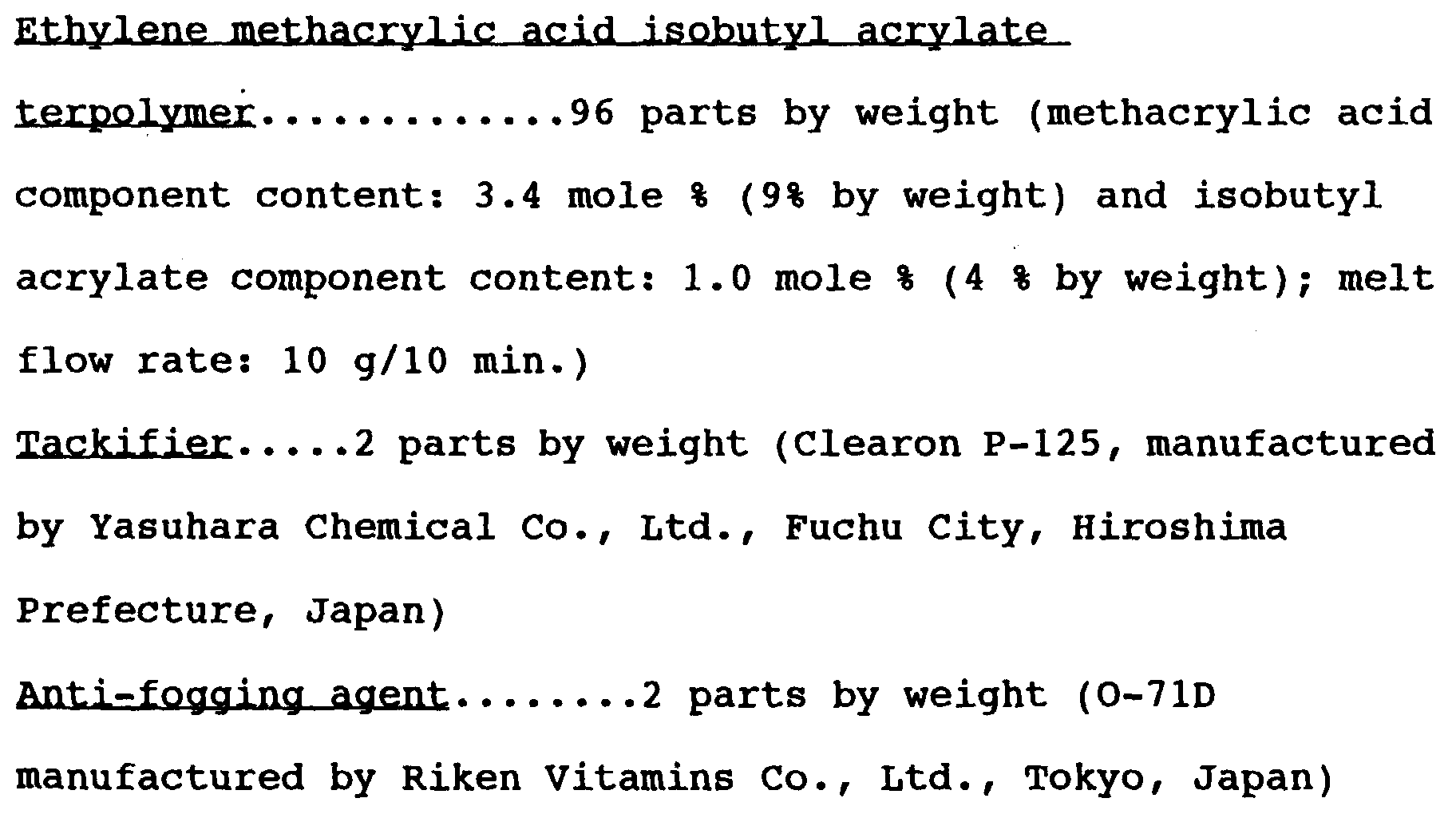

- A film was formed by the extrusion film forming technique employing a straight manifold die under extruding conditions of a resin temperature of 220°C, a draft (drawdown) ratio of 50, and a draft (drawdown) distance of 80 mm, and then after orienting the thus formed film at a temperature of 45°C (at a cast roll temperature of 30°C) by an orientation ratio of 1.1 times and annealing the obtained film at a film temperature of 60°C as far as the shrinkage ratio in the longitudinal direction settled at 4% and cooling the resultant film to a temperature of 30°C or less, a stretch film having a thickness of 12 µm was formed at a takeoff speed of 250 m/min. On an automatic wrapping machine (AW-3600 manufactured by Teraoka Seiko Co., Tokyo, Japan) charged with the obtained film (having a width of 350 mm), polystyrene trays (length x width = 150 mm x 200 mm) loaded with food were automatically packaged. In the packaging step, the film was stretched about 1.7 times in the transverse direction. 100 units of packaged trays were closely examined with respect to the frequency of film breakage and the frequency of surface wrinkle formation during the packaging stage. Test results are shown in Table 2 along with the precision of thickness (standard deviation), stresses at 100 % elongation in the longitudinal direction and in the transverse direction, respectively, and measurements of the tensile strength.
- The recipe of the resin composition from which the film was produced is as follows.

- A stretch film was formed in the same procedure as in EXAMPLE 3, except that the recipe of the resin composition was modified as follows. Automatic wrapping operation was carried out in the same procedure as in EXAMPLE 3, using the film thereby obtained, and the wrapped trays were closely examined with respect to the frequency of film breakage and the frequency of surface wrinkle formation during the packaging stage. Test results are shown in Table 2 along with precision of film thickness (standard deviation), measurements of the stresses at 100 % elongation in the longitudinal direction and in the transverse direction, respectively, and measurements of the tensile strength.
- The recipe of the resin composition from which the film was produced is as follows.

- A film was formed in the same procedure as in EXAMPLE 3, except that the film was formed by the extrusion film forming technique employing a straight manifold die under extruding conditions of a resin temperature of 220°C, a draft (drawdown) ratio of 70, and a draft (drawdown) distance of 40 mm. Then, after orienting the formed film at an orientation ratio of 1.3 times at a temperature of 30°C (a cast roll temperature of 20°C), the film was wound up. Automatic wrapping operation was carried out in the same procedure as in EXAMPLE 3, using the film thereby obtained, and the wrapped trays were closely examined with respect to the frequency of film breakage and the frequency of surface wrinkle formation during the packaging stage. Test results are shown in Table 2 along with precision of film thickness (standard deviation), measurements of the stresses at 100 % elongation in the longitudinal direction and in the transverse direction, respectively, and measurements of the tensile strength.

- The stretch film of the present invention can be suitably used as a stretch wrap film material for packaging food and other items, inasmuch as it is produced from olefin polymer, which is free of the environment pollution and sanitary/health hazard problems that have turned up from the use of poly(vinyl chloride); possesses a large elongation, an excellent cut property of traverse direction, adherence/conformance (cling property), elastic recovery after distention by fingertips, a good balance between the stress at 100 % elongation in the longitudinal direction and in the transverse direction, respectively, etc.; is capable of being packaged virtually free of surface wrinkles as well as breakage in the continuous stretch wrapping operation, thus rendering itself fully compatible with the automatic wrapping machine. Besides, it has the merit of a high productivity, since it can be formed by the extrusion film forming technique employing a straight manifold die at a high speed.
- The film forming method of the present invention is a highly economical method, since said stretch film can be manufactured at a high productivity.
Claims (11)
- A polyolefin stretch film obtainable by forming a film from a resin composition comprisingwherein the stress of the stretch film at 100% elongation in the longitudinal direction is from 12 to 30 MPa and the stress of the stretch film at 100% elongation in the transverse direction is from 5 to 11 MPa.(A) polyolefin base resin which is ethylene (meth)acrylic acid copolymer, ethylene (meth)acrylic acid (meth)acrylic ester terpolymer, or a mixture thereof; optionally(B) anti-fogging agent; and optionally(C) tackifier;
- A stretch film according to claim 1 wherein the resin composition comprises 100 parts by weight of the polyolefin resin (A), from 0.5 to 12 parts by weight of the tackifier (C), and from 1 to 5 parts by weight of the anti-fogging agent (B).
- A stretch film according to claim 1 or claim 2 wherein the polyolefin resin (A) comprises ethylene (meth)acrylic acid copolymer having (meth) acrylic acid unit content of from 3 to 20 mole % and/or the polyolefin resin (A) comprises ethylene (meth)acrylic acid (meth)acrylic ester terpolymer having (meth)acrylic acid unit content of from 3 to 20 mole % and (meth)acrylic ester unit content of from 0.3 to 20 mole %.
- A stretch film according to any one of claims 1 to 3 wherein the (meth) acrylic ester unit content of the polyolefin resin (A) is 7% by weight or less.
- A stretch film according to any one of claims 1 to 4 wherein the ethylene (meth)acrylic acid (meth)acrylic ester terpolymer content of the polyolefin resin (A) is 60% by weight or more.
- A stretch film according to any one of claims 1 to 4 wherein the polyolefin resin (A) substantially comprises ethylene (meth)acrylic acid (meth)acrylic ester terpolymer.
- A stretch film according to any one of the preceding claims wherein the ratio of stress at 100% elongation in the longitudinal direction to stress at 100% elongation in the transverse direction is from 1.5 to 3.0.
- A stretch film according to any one of the preceding claims wherein the film is obtainable by carrying out an extrusion film forming technique on the resin composition using a straight manifold die.
- A stretch film according to claim 8, wherein the film has undergone an orientation preventing treatment.
- A process for the production of a polyolefin stretch film, which process comprises forming a film by an extrusion film forming technique using a straight manifold die from a resin composition as defined in claim 1,
wherein an orientation preventing treatment is carried out during the film forming step or thereafter. - Use of a stretch film according to any one of claims 1 to 9 as a packaging material.
Applications Claiming Priority (2)
| Application Number | Priority Date | Filing Date | Title |
|---|---|---|---|
| JP14289599 | 1999-05-24 | ||
| JP14289599 | 1999-05-24 |
Publications (1)
| Publication Number | Publication Date |
|---|---|
| EP1055610A1 true EP1055610A1 (en) | 2000-11-29 |
Family
ID=15326106
Family Applications (1)
| Application Number | Title | Priority Date | Filing Date |
|---|---|---|---|
| EP00304368A Withdrawn EP1055610A1 (en) | 1999-05-24 | 2000-05-24 | Polyolefin stretch film |
Country Status (6)
| Country | Link |
|---|---|
| US (1) | US6353067B1 (en) |
| EP (1) | EP1055610A1 (en) |
| KR (1) | KR100628899B1 (en) |
| CN (1) | CN1183197C (en) |
| ID (2) | ID26141A (en) |
| TW (1) | TWI227717B (en) |
Cited By (1)
| Publication number | Priority date | Publication date | Assignee | Title |
|---|---|---|---|---|
| EP1152027A1 (en) * | 2000-05-04 | 2001-11-07 | Ciba SC Holding AG | Polyolefin film compositions with permanent antifog properties |
Families Citing this family (2)
| Publication number | Priority date | Publication date | Assignee | Title |
|---|---|---|---|---|
| US7594586B2 (en) * | 2006-08-05 | 2009-09-29 | Cai Edward Z | Vacuum generating device for sealing perishable products and method of use |
| CN106220983A (en) * | 2016-06-18 | 2016-12-14 | 赵月 | The preparation method of electronic devices and components protecting film |
Citations (5)
| Publication number | Priority date | Publication date | Assignee | Title |
|---|---|---|---|---|
| EP0109512A2 (en) * | 1982-09-29 | 1984-05-30 | The Dow Chemical Company | Olefin polymer stretch/cling film |
| WO1991016376A1 (en) * | 1990-04-24 | 1991-10-31 | E.I. Du Pont De Nemours And Company | Film for packaging fresh food |
| EP0521426A1 (en) * | 1991-07-05 | 1993-01-07 | BASF Aktiengesellschaft | N,N'-hexamethylen-1,6-bis-erucamid containing thermoplastic polyolefin moulding composition |
| JPH06322192A (en) * | 1993-05-11 | 1994-11-22 | Shin Etsu Polymer Co Ltd | Film for stretch packaging |
| WO2000061663A1 (en) * | 1999-04-09 | 2000-10-19 | Du Pont-Mitsui Polychemicals Co., Ltd. | Film for wrapping |
Family Cites Families (4)
| Publication number | Priority date | Publication date | Assignee | Title |
|---|---|---|---|---|
| US4629657A (en) * | 1982-12-13 | 1986-12-16 | Enron Chemical Company | Biaxially oriented polypropylene film construction for special lamination |
| US5093194A (en) * | 1989-11-01 | 1992-03-03 | Mobil Oil Corporation | Oriented multilayer heat sealable packaging film |
| US5192620A (en) * | 1991-11-08 | 1993-03-09 | Mobil Oil Corporation | Metallized composite film structure and method |
| US6013353A (en) * | 1996-05-07 | 2000-01-11 | Mobil Oil Corporation | Metallized multilayer packaging film |
-
2000
- 2000-05-15 TW TW089109261A patent/TWI227717B/en not_active IP Right Cessation
- 2000-05-17 KR KR1020000026289A patent/KR100628899B1/en not_active Expired - Fee Related
- 2000-05-23 US US09/576,805 patent/US6353067B1/en not_active Expired - Fee Related
- 2000-05-24 EP EP00304368A patent/EP1055610A1/en not_active Withdrawn
- 2000-05-24 CN CNB001176757A patent/CN1183197C/en not_active Expired - Fee Related
- 2000-05-24 ID IDP20000445D patent/ID26141A/en unknown
- 2000-05-26 ID IDP20000455A patent/ID27642A/en unknown
Patent Citations (5)
| Publication number | Priority date | Publication date | Assignee | Title |
|---|---|---|---|---|
| EP0109512A2 (en) * | 1982-09-29 | 1984-05-30 | The Dow Chemical Company | Olefin polymer stretch/cling film |
| WO1991016376A1 (en) * | 1990-04-24 | 1991-10-31 | E.I. Du Pont De Nemours And Company | Film for packaging fresh food |
| EP0521426A1 (en) * | 1991-07-05 | 1993-01-07 | BASF Aktiengesellschaft | N,N'-hexamethylen-1,6-bis-erucamid containing thermoplastic polyolefin moulding composition |
| JPH06322192A (en) * | 1993-05-11 | 1994-11-22 | Shin Etsu Polymer Co Ltd | Film for stretch packaging |
| WO2000061663A1 (en) * | 1999-04-09 | 2000-10-19 | Du Pont-Mitsui Polychemicals Co., Ltd. | Film for wrapping |
Non-Patent Citations (1)
| Title |
|---|
| DATABASE WPI Section Ch Week 199506, Derwent World Patents Index; Class A17, AN 1995-041430, XP002141953 * |
Cited By (3)
| Publication number | Priority date | Publication date | Assignee | Title |
|---|---|---|---|---|
| EP1152027A1 (en) * | 2000-05-04 | 2001-11-07 | Ciba SC Holding AG | Polyolefin film compositions with permanent antifog properties |
| US6784235B2 (en) | 2000-05-04 | 2004-08-31 | Ciba Specialty Chemicals Corporation | Polyolefin film compositions with permanent antifog properties |
| US7037964B2 (en) | 2000-05-04 | 2006-05-02 | Ciba Specialty Chemicals Corporation | Polyolefin film compositions with permanent antifog properties |
Also Published As
| Publication number | Publication date |
|---|---|
| ID27642A (en) | 2001-04-19 |
| CN1283652A (en) | 2001-02-14 |
| CN1183197C (en) | 2005-01-05 |
| KR20000077291A (en) | 2000-12-26 |
| TWI227717B (en) | 2005-02-11 |
| ID26141A (en) | 2000-11-30 |
| KR100628899B1 (en) | 2006-09-27 |
| US6353067B1 (en) | 2002-03-05 |
Similar Documents
| Publication | Publication Date | Title |
|---|---|---|
| EP0080198A2 (en) | Polymeric films having one-sided cling and compositions useful in their preparation | |
| NZ207210A (en) | Fog-resistant polyethylene films | |
| EP0780214B1 (en) | Food packaging stretch film | |
| JPWO2019244708A1 (en) | Polypropylene laminated film | |
| EP2666631B1 (en) | Stretch packaging film | |
| KR100688674B1 (en) | Laminated Film for Stretch Packaging | |
| JP4287084B2 (en) | Mushroom packaging film | |
| US20250256491A1 (en) | Polyolefin-based multilayer elastic films | |
| US6353067B1 (en) | Polyolefin stretch film | |
| JP2016516615A (en) | Film containing an extrudable adhesive formulation | |
| KR20050059107A (en) | Polypropylene wrap film | |
| JP3497767B2 (en) | Polyolefin stretch packaging film | |
| JPH09274439A (en) | Stretch label | |
| EP2918409B1 (en) | Stretch wrapping film | |
| JP2007289147A (en) | Agricultural film | |
| JP2000044696A (en) | Polyolefin stretch packaging film | |
| JP2001040116A (en) | Polyolefinic stretch film | |
| JP2007224280A (en) | Propylene resin unstretched film | |
| EP1772260B1 (en) | Propylene-based multilayered wrapping film | |
| JPH11314300A (en) | Stretch film | |
| JPH11254612A (en) | Agricultural film and method for producing the same | |
| JP2000234028A (en) | Polyolefin stretch film | |
| JP3557274B2 (en) | Stretch film for food packaging | |
| JP3499333B2 (en) | Polyolefin-based wrap stretch film | |
| JPH11152376A (en) | Polyethylene composition for biaxially stretched film and biaxially stretched film comprising this composition |
Legal Events
| Date | Code | Title | Description |
|---|---|---|---|
| PUAI | Public reference made under article 153(3) epc to a published international application that has entered the european phase |
Free format text: ORIGINAL CODE: 0009012 |
|
| AK | Designated contracting states |
Kind code of ref document: A1 Designated state(s): AT BE CH CY DE DK ES FI FR GB GR IE IT LI LU MC NL PT SE |
|
| AX | Request for extension of the european patent |
Free format text: AL;LT;LV;MK;RO;SI |
|
| 17P | Request for examination filed |
Effective date: 20001222 |
|
| AKX | Designation fees paid |
Free format text: DE FR GB |
|
| 17Q | First examination report despatched |
Effective date: 20030414 |
|
| STAA | Information on the status of an ep patent application or granted ep patent |
Free format text: STATUS: THE APPLICATION IS DEEMED TO BE WITHDRAWN |
|
| 18D | Application deemed to be withdrawn |
Effective date: 20040329 |