EP1053215B1 - Verfahren zur darstellung makrocyclischer produkte durch ringschliessende diin-metathese - Google Patents
Verfahren zur darstellung makrocyclischer produkte durch ringschliessende diin-metathese Download PDFInfo
- Publication number
- EP1053215B1 EP1053215B1 EP99910180A EP99910180A EP1053215B1 EP 1053215 B1 EP1053215 B1 EP 1053215B1 EP 99910180 A EP99910180 A EP 99910180A EP 99910180 A EP99910180 A EP 99910180A EP 1053215 B1 EP1053215 B1 EP 1053215B1
- Authority
- EP
- European Patent Office
- Prior art keywords
- cme
- process according
- alkyl
- aryl
- diyne
- Prior art date
- Legal status (The legal status is an assumption and is not a legal conclusion. Google has not performed a legal analysis and makes no representation as to the accuracy of the status listed.)
- Expired - Lifetime
Links
- 238000000034 method Methods 0.000 title claims abstract description 38
- 238000005649 metathesis reaction Methods 0.000 title abstract description 11
- 239000003054 catalyst Substances 0.000 claims abstract description 38
- 239000000758 substrate Substances 0.000 claims abstract description 30
- 238000006243 chemical reaction Methods 0.000 claims abstract description 19
- 238000007302 alkyne metathesis reaction Methods 0.000 claims abstract description 17
- 230000015572 biosynthetic process Effects 0.000 claims abstract description 12
- 150000001925 cycloalkenes Chemical class 0.000 claims abstract description 11
- 239000012429 reaction media Substances 0.000 claims abstract description 10
- 229930013356 epothilone Natural products 0.000 claims abstract description 9
- 150000003883 epothilone derivatives Chemical class 0.000 claims abstract description 9
- 229910052751 metal Inorganic materials 0.000 claims abstract description 9
- 239000002184 metal Substances 0.000 claims abstract description 9
- 239000000654 additive Substances 0.000 claims abstract description 7
- 125000006413 ring segment Chemical group 0.000 claims abstract description 6
- 229910052723 transition metal Inorganic materials 0.000 claims abstract description 6
- 150000003624 transition metals Chemical class 0.000 claims abstract description 6
- 125000000524 functional group Chemical group 0.000 claims abstract description 5
- 125000000999 tert-butyl group Chemical group [H]C([H])([H])C(*)(C([H])([H])[H])C([H])([H])[H] 0.000 claims description 32
- 230000008569 process Effects 0.000 claims description 28
- 125000003118 aryl group Chemical group 0.000 claims description 25
- 125000003837 (C1-C20) alkyl group Chemical group 0.000 claims description 24
- 239000000047 product Substances 0.000 claims description 17
- 150000002148 esters Chemical class 0.000 claims description 16
- 125000001449 isopropyl group Chemical group [H]C([H])([H])C([H])(*)C([H])([H])[H] 0.000 claims description 11
- 238000006798 ring closing metathesis reaction Methods 0.000 claims description 10
- YMWUJEATGCHHMB-UHFFFAOYSA-N Dichloromethane Chemical compound ClCCl YMWUJEATGCHHMB-UHFFFAOYSA-N 0.000 claims description 9
- 229910052794 bromium Inorganic materials 0.000 claims description 9
- 229910052801 chlorine Inorganic materials 0.000 claims description 9
- 229910052731 fluorine Inorganic materials 0.000 claims description 9
- -1 gem-dialkyl groups Chemical class 0.000 claims description 9
- 229910052740 iodine Inorganic materials 0.000 claims description 9
- IZUPBVBPLAPZRR-UHFFFAOYSA-N pentachloro-phenol Natural products OC1=C(Cl)C(Cl)=C(Cl)C(Cl)=C1Cl IZUPBVBPLAPZRR-UHFFFAOYSA-N 0.000 claims description 9
- 238000002360 preparation method Methods 0.000 claims description 9
- 229910052739 hydrogen Inorganic materials 0.000 claims description 8
- 125000006736 (C6-C20) aryl group Chemical group 0.000 claims description 7
- IJGRMHOSHXDMSA-UHFFFAOYSA-N Atomic nitrogen Chemical compound N#N IJGRMHOSHXDMSA-UHFFFAOYSA-N 0.000 claims description 6
- ISWSIDIOOBJBQZ-UHFFFAOYSA-N Phenol Chemical compound OC1=CC=CC=C1 ISWSIDIOOBJBQZ-UHFFFAOYSA-N 0.000 claims description 6
- 125000003342 alkenyl group Chemical group 0.000 claims description 6
- IJOOHPMOJXWVHK-UHFFFAOYSA-N chlorotrimethylsilane Chemical compound C[Si](C)(C)Cl IJOOHPMOJXWVHK-UHFFFAOYSA-N 0.000 claims description 6
- 125000001997 phenyl group Chemical group [H]C1=C([H])C([H])=C(*)C([H])=C1[H] 0.000 claims description 6
- 239000006227 byproduct Substances 0.000 claims description 5
- 239000003814 drug Substances 0.000 claims description 5
- 125000000623 heterocyclic group Chemical group 0.000 claims description 5
- 238000011065 in-situ storage Methods 0.000 claims description 5
- 229910052757 nitrogen Inorganic materials 0.000 claims description 5
- 150000002989 phenols Chemical class 0.000 claims description 5
- VZGDMQKNWNREIO-UHFFFAOYSA-N tetrachloromethane Chemical compound ClC(Cl)(Cl)Cl VZGDMQKNWNREIO-UHFFFAOYSA-N 0.000 claims description 5
- HEDRZPFGACZZDS-UHFFFAOYSA-N Chloroform Chemical compound ClC(Cl)Cl HEDRZPFGACZZDS-UHFFFAOYSA-N 0.000 claims description 4
- 150000001336 alkenes Chemical class 0.000 claims description 4
- DIKBFYAXUHHXCS-UHFFFAOYSA-N bromoform Chemical compound BrC(Br)Br DIKBFYAXUHHXCS-UHFFFAOYSA-N 0.000 claims description 4
- 229910052799 carbon Inorganic materials 0.000 claims description 4
- 150000001875 compounds Chemical class 0.000 claims description 4
- KPUWHANPEXNPJT-UHFFFAOYSA-N disiloxane Chemical class [SiH3]O[SiH3] KPUWHANPEXNPJT-UHFFFAOYSA-N 0.000 claims description 4
- OKJPEAGHQZHRQV-UHFFFAOYSA-N iodoform Chemical compound IC(I)I OKJPEAGHQZHRQV-UHFFFAOYSA-N 0.000 claims description 4
- XBNGYFFABRKICK-UHFFFAOYSA-N 2,3,4,5,6-pentafluorophenol Chemical compound OC1=C(F)C(F)=C(F)C(F)=C1F XBNGYFFABRKICK-UHFFFAOYSA-N 0.000 claims description 3
- UMPSXRYVXUPCOS-UHFFFAOYSA-N 2,3-dichlorophenol Chemical compound OC1=CC=CC(Cl)=C1Cl UMPSXRYVXUPCOS-UHFFFAOYSA-N 0.000 claims description 3
- RPEPGIOVXBBUMJ-UHFFFAOYSA-N 2,3-difluorophenol Chemical compound OC1=CC=CC(F)=C1F RPEPGIOVXBBUMJ-UHFFFAOYSA-N 0.000 claims description 3
- ISPYQTSUDJAMAB-UHFFFAOYSA-N 2-chlorophenol Chemical compound OC1=CC=CC=C1Cl ISPYQTSUDJAMAB-UHFFFAOYSA-N 0.000 claims description 3
- HFHFGHLXUCOHLN-UHFFFAOYSA-N 2-fluorophenol Chemical compound OC1=CC=CC=C1F HFHFGHLXUCOHLN-UHFFFAOYSA-N 0.000 claims description 3
- CAHQGWAXKLQREW-UHFFFAOYSA-N Benzal chloride Chemical compound ClC(Cl)C1=CC=CC=C1 CAHQGWAXKLQREW-UHFFFAOYSA-N 0.000 claims description 3
- 125000000217 alkyl group Chemical group 0.000 claims description 3
- 125000004414 alkyl thio group Chemical group 0.000 claims description 3
- 125000000753 cycloalkyl group Chemical group 0.000 claims description 3
- 125000004663 dialkyl amino group Chemical group 0.000 claims description 3
- 150000002118 epoxides Chemical class 0.000 claims description 3
- 150000002170 ethers Chemical class 0.000 claims description 3
- 229910052736 halogen Inorganic materials 0.000 claims description 3
- 239000001257 hydrogen Substances 0.000 claims description 3
- 239000004615 ingredient Substances 0.000 claims description 3
- 239000002304 perfume Substances 0.000 claims description 3
- 239000003016 pheromone Substances 0.000 claims description 3
- HJUGFYREWKUQJT-UHFFFAOYSA-N tetrabromomethane Chemical compound BrC(Br)(Br)Br HJUGFYREWKUQJT-UHFFFAOYSA-N 0.000 claims description 3
- 239000005051 trimethylchlorosilane Substances 0.000 claims description 3
- ZOQOPXVJANRGJZ-UHFFFAOYSA-N 2-(trifluoromethyl)phenol Chemical compound OC1=CC=CC=C1C(F)(F)F ZOQOPXVJANRGJZ-UHFFFAOYSA-N 0.000 claims description 2
- 229910019142 PO4 Inorganic materials 0.000 claims description 2
- ABLZXFCXXLZCGV-UHFFFAOYSA-N Phosphorous acid Chemical class OP(O)=O ABLZXFCXXLZCGV-UHFFFAOYSA-N 0.000 claims description 2
- OAICVXFJPJFONN-UHFFFAOYSA-N Phosphorus Chemical compound [P] OAICVXFJPJFONN-UHFFFAOYSA-N 0.000 claims description 2
- NINIDFKCEFEMDL-UHFFFAOYSA-N Sulfur Chemical compound [S] NINIDFKCEFEMDL-UHFFFAOYSA-N 0.000 claims description 2
- 150000001241 acetals Chemical class 0.000 claims description 2
- 150000001298 alcohols Chemical class 0.000 claims description 2
- 150000001299 aldehydes Chemical class 0.000 claims description 2
- 150000001408 amides Chemical class 0.000 claims description 2
- 150000001412 amines Chemical class 0.000 claims description 2
- 150000003863 ammonium salts Chemical class 0.000 claims description 2
- 150000008064 anhydrides Chemical class 0.000 claims description 2
- 239000003242 anti bacterial agent Substances 0.000 claims description 2
- 229940088710 antibiotic agent Drugs 0.000 claims description 2
- QVGXLLKOCUKJST-UHFFFAOYSA-N atomic oxygen Chemical compound [O] QVGXLLKOCUKJST-UHFFFAOYSA-N 0.000 claims description 2
- IYYIVELXUANFED-UHFFFAOYSA-N bromo(trimethyl)silane Chemical compound C[Si](C)(C)Br IYYIVELXUANFED-UHFFFAOYSA-N 0.000 claims description 2
- 229950005228 bromoform Drugs 0.000 claims description 2
- 150000004657 carbamic acid derivatives Chemical class 0.000 claims description 2
- 235000013877 carbamide Nutrition 0.000 claims description 2
- 150000004649 carbonic acid derivatives Chemical class 0.000 claims description 2
- 150000001735 carboxylic acids Chemical class 0.000 claims description 2
- 150000003983 crown ethers Chemical class 0.000 claims description 2
- FJBFPHVGVWTDIP-UHFFFAOYSA-N dibromomethane Chemical compound BrCBr FJBFPHVGVWTDIP-UHFFFAOYSA-N 0.000 claims description 2
- NZZFYRREKKOMAT-UHFFFAOYSA-N diiodomethane Chemical compound ICI NZZFYRREKKOMAT-UHFFFAOYSA-N 0.000 claims description 2
- LIKFHECYJZWXFJ-UHFFFAOYSA-N dimethyldichlorosilane Chemical compound C[Si](C)(Cl)Cl LIKFHECYJZWXFJ-UHFFFAOYSA-N 0.000 claims description 2
- 150000002019 disulfides Chemical class 0.000 claims description 2
- 230000000694 effects Effects 0.000 claims description 2
- 150000002366 halogen compounds Chemical class 0.000 claims description 2
- 150000002367 halogens Chemical class 0.000 claims description 2
- 125000005842 heteroatom Chemical group 0.000 claims description 2
- 150000002466 imines Chemical class 0.000 claims description 2
- 239000011261 inert gas Substances 0.000 claims description 2
- 150000002576 ketones Chemical class 0.000 claims description 2
- 150000002825 nitriles Chemical class 0.000 claims description 2
- 125000000449 nitro group Chemical group [O-][N+](*)=O 0.000 claims description 2
- 150000001282 organosilanes Chemical group 0.000 claims description 2
- 229910052760 oxygen Inorganic materials 0.000 claims description 2
- 239000001301 oxygen Substances 0.000 claims description 2
- 125000005010 perfluoroalkyl group Chemical group 0.000 claims description 2
- 235000021317 phosphate Nutrition 0.000 claims description 2
- 150000003013 phosphoric acid derivatives Chemical class 0.000 claims description 2
- 229910052698 phosphorus Inorganic materials 0.000 claims description 2
- 239000011574 phosphorus Substances 0.000 claims description 2
- 239000000126 substance Substances 0.000 claims description 2
- 125000001424 substituent group Chemical group 0.000 claims description 2
- 229940124530 sulfonamide Drugs 0.000 claims description 2
- 150000003456 sulfonamides Chemical class 0.000 claims description 2
- 150000003871 sulfonates Chemical class 0.000 claims description 2
- 150000003457 sulfones Chemical class 0.000 claims description 2
- 150000003462 sulfoxides Chemical class 0.000 claims description 2
- 239000011593 sulfur Substances 0.000 claims description 2
- 229910052717 sulfur Inorganic materials 0.000 claims description 2
- BCNZYOJHNLTNEZ-UHFFFAOYSA-N tert-butyldimethylsilyl chloride Chemical compound CC(C)(C)[Si](C)(C)Cl BCNZYOJHNLTNEZ-UHFFFAOYSA-N 0.000 claims description 2
- 150000003555 thioacetals Chemical class 0.000 claims description 2
- 150000003568 thioethers Chemical class 0.000 claims description 2
- 150000003672 ureas Chemical class 0.000 claims description 2
- 150000003673 urethanes Chemical class 0.000 claims description 2
- KWYZNESIGBQHJK-UHFFFAOYSA-N chloro-dimethyl-phenylsilane Chemical compound C[Si](C)(Cl)C1=CC=CC=C1 KWYZNESIGBQHJK-UHFFFAOYSA-N 0.000 claims 1
- 239000000796 flavoring agent Substances 0.000 claims 1
- 235000013355 food flavoring agent Nutrition 0.000 claims 1
- 239000002904 solvent Substances 0.000 abstract description 18
- 239000012041 precatalyst Substances 0.000 abstract description 9
- 238000003786 synthesis reaction Methods 0.000 abstract description 7
- 150000003623 transition metal compounds Chemical class 0.000 abstract description 6
- 238000006074 cyclodimerization reaction Methods 0.000 abstract description 5
- VLKZOEOYAKHREP-UHFFFAOYSA-N n-Hexane Chemical compound CCCCCC VLKZOEOYAKHREP-UHFFFAOYSA-N 0.000 description 42
- XEKOWRVHYACXOJ-UHFFFAOYSA-N Ethyl acetate Chemical compound CCOC(C)=O XEKOWRVHYACXOJ-UHFFFAOYSA-N 0.000 description 27
- YXFVVABEGXRONW-UHFFFAOYSA-N Toluene Chemical compound CC1=CC=CC=C1 YXFVVABEGXRONW-UHFFFAOYSA-N 0.000 description 18
- XKRFYHLGVUSROY-UHFFFAOYSA-N Argon Chemical compound [Ar] XKRFYHLGVUSROY-UHFFFAOYSA-N 0.000 description 14
- MVPPADPHJFYWMZ-UHFFFAOYSA-N chlorobenzene Chemical compound ClC1=CC=CC=C1 MVPPADPHJFYWMZ-UHFFFAOYSA-N 0.000 description 14
- 238000004440 column chromatography Methods 0.000 description 13
- 239000000243 solution Substances 0.000 description 13
- LAWHHRXCBUNWFI-UHFFFAOYSA-N 2-pentylpropanedioic acid Chemical compound CCCCCC(C(O)=O)C(O)=O LAWHHRXCBUNWFI-UHFFFAOYSA-N 0.000 description 12
- 238000007363 ring formation reaction Methods 0.000 description 11
- 238000001644 13C nuclear magnetic resonance spectroscopy Methods 0.000 description 10
- 239000011541 reaction mixture Substances 0.000 description 10
- 229910052786 argon Inorganic materials 0.000 description 7
- 239000013078 crystal Substances 0.000 description 7
- 229910052750 molybdenum Inorganic materials 0.000 description 7
- 238000005160 1H NMR spectroscopy Methods 0.000 description 6
- WYURNTSHIVDZCO-UHFFFAOYSA-N Tetrahydrofuran Chemical compound C1CCOC1 WYURNTSHIVDZCO-UHFFFAOYSA-N 0.000 description 6
- 229920002521 macromolecule Polymers 0.000 description 6
- 229910052721 tungsten Inorganic materials 0.000 description 6
- 239000000203 mixture Substances 0.000 description 5
- NVIPUOMWGQAOIT-DUXPYHPUSA-N 7-hexadecen-1,16-olide Chemical compound O=C1CCCCC\C=C\CCCCCCCCO1 NVIPUOMWGQAOIT-DUXPYHPUSA-N 0.000 description 4
- 239000003480 eluent Substances 0.000 description 4
- PBKONEOXTCPAFI-UHFFFAOYSA-N 1,2,4-trichlorobenzene Chemical compound ClC1=CC=C(Cl)C(Cl)=C1 PBKONEOXTCPAFI-UHFFFAOYSA-N 0.000 description 3
- WXNZTHHGJRFXKQ-UHFFFAOYSA-N 4-chlorophenol Chemical compound OC1=CC=C(Cl)C=C1 WXNZTHHGJRFXKQ-UHFFFAOYSA-N 0.000 description 3
- WEVYAHXRMPXWCK-UHFFFAOYSA-N Acetonitrile Chemical compound CC#N WEVYAHXRMPXWCK-UHFFFAOYSA-N 0.000 description 3
- BZLVMXJERCGZMT-UHFFFAOYSA-N Methyl tert-butyl ether Chemical compound COC(C)(C)C BZLVMXJERCGZMT-UHFFFAOYSA-N 0.000 description 3
- ZMXDDKWLCZADIW-UHFFFAOYSA-N N,N-Dimethylformamide Chemical compound CN(C)C=O ZMXDDKWLCZADIW-UHFFFAOYSA-N 0.000 description 3
- 238000005481 NMR spectroscopy Methods 0.000 description 3
- 229910004298 SiO 2 Inorganic materials 0.000 description 3
- 150000001345 alkine derivatives Chemical class 0.000 description 3
- 125000002496 methyl group Chemical group [H]C([H])([H])* 0.000 description 3
- 238000006116 polymerization reaction Methods 0.000 description 3
- 238000012552 review Methods 0.000 description 3
- 239000000725 suspension Substances 0.000 description 3
- 239000006188 syrup Substances 0.000 description 3
- 235000020357 syrup Nutrition 0.000 description 3
- NVIPUOMWGQAOIT-UHFFFAOYSA-N (E)-7-Hexadecen-16-olide Natural products O=C1CCCCCC=CCCCCCCCCO1 NVIPUOMWGQAOIT-UHFFFAOYSA-N 0.000 description 2
- FTLGWRPYMKVHOE-UHFFFAOYSA-N 2,3-bis(trifluoromethyl)phenol Chemical compound OC1=CC=CC(C(F)(F)F)=C1C(F)(F)F FTLGWRPYMKVHOE-UHFFFAOYSA-N 0.000 description 2
- XNMQEEKYCVKGBD-UHFFFAOYSA-N 2-butyne Chemical compound CC#CC XNMQEEKYCVKGBD-UHFFFAOYSA-N 0.000 description 2
- VTYYLEPIZMXCLO-UHFFFAOYSA-L Calcium carbonate Chemical compound [Ca+2].[O-]C([O-])=O VTYYLEPIZMXCLO-UHFFFAOYSA-L 0.000 description 2
- RTZKZFJDLAIYFH-UHFFFAOYSA-N Diethyl ether Chemical compound CCOCC RTZKZFJDLAIYFH-UHFFFAOYSA-N 0.000 description 2
- IAZDPXIOMUYVGZ-UHFFFAOYSA-N Dimethylsulphoxide Chemical compound CS(C)=O IAZDPXIOMUYVGZ-UHFFFAOYSA-N 0.000 description 2
- PIICEJLVQHRZGT-UHFFFAOYSA-N Ethylenediamine Chemical compound NCCN PIICEJLVQHRZGT-UHFFFAOYSA-N 0.000 description 2
- SMWDFEZZVXVKRB-UHFFFAOYSA-N Quinoline Chemical compound N1=CC=CC2=CC=CC=C21 SMWDFEZZVXVKRB-UHFFFAOYSA-N 0.000 description 2
- 238000005865 alkene metathesis reaction Methods 0.000 description 2
- QARVLSVVCXYDNA-UHFFFAOYSA-N bromobenzene Chemical compound BrC1=CC=CC=C1 QARVLSVVCXYDNA-UHFFFAOYSA-N 0.000 description 2
- 244000309464 bull Species 0.000 description 2
- 239000000470 constituent Substances 0.000 description 2
- RWGFKTVRMDUZSP-UHFFFAOYSA-N cumene Chemical compound CC(C)C1=CC=CC=C1 RWGFKTVRMDUZSP-UHFFFAOYSA-N 0.000 description 2
- NNBZCPXTIHJBJL-UHFFFAOYSA-N decalin Chemical compound C1CCCC2CCCCC21 NNBZCPXTIHJBJL-UHFFFAOYSA-N 0.000 description 2
- OREAFAJWWJHCOT-UHFFFAOYSA-N dimethylmalonic acid Chemical compound OC(=O)C(C)(C)C(O)=O OREAFAJWWJHCOT-UHFFFAOYSA-N 0.000 description 2
- 238000004821 distillation Methods 0.000 description 2
- 238000000605 extraction Methods 0.000 description 2
- 239000003205 fragrance Substances 0.000 description 2
- 239000007789 gas Substances 0.000 description 2
- 238000005984 hydrogenation reaction Methods 0.000 description 2
- 238000010656 hydrometalation reaction Methods 0.000 description 2
- 150000002736 metal compounds Chemical class 0.000 description 2
- 230000003647 oxidation Effects 0.000 description 2
- 238000007254 oxidation reaction Methods 0.000 description 2
- 238000000746 purification Methods 0.000 description 2
- 230000009467 reduction Effects 0.000 description 2
- YLQBMQCUIZJEEH-UHFFFAOYSA-N tetrahydrofuran Natural products C=1C=COC=1 YLQBMQCUIZJEEH-UHFFFAOYSA-N 0.000 description 2
- 230000007704 transition Effects 0.000 description 2
- GETTZEONDQJALK-UHFFFAOYSA-N (trifluoromethyl)benzene Chemical compound FC(F)(F)C1=CC=CC=C1 GETTZEONDQJALK-UHFFFAOYSA-N 0.000 description 1
- POILWHVDKZOXJZ-ARJAWSKDSA-M (z)-4-oxopent-2-en-2-olate Chemical compound C\C([O-])=C\C(C)=O POILWHVDKZOXJZ-ARJAWSKDSA-M 0.000 description 1
- RELMFMZEBKVZJC-UHFFFAOYSA-N 1,2,3-trichlorobenzene Chemical compound ClC1=CC=CC(Cl)=C1Cl RELMFMZEBKVZJC-UHFFFAOYSA-N 0.000 description 1
- WSLDOOZREJYCGB-UHFFFAOYSA-N 1,2-Dichloroethane Chemical compound ClCCCl WSLDOOZREJYCGB-UHFFFAOYSA-N 0.000 description 1
- RYHBNJHYFVUHQT-UHFFFAOYSA-N 1,4-Dioxane Chemical compound C1COCCO1 RYHBNJHYFVUHQT-UHFFFAOYSA-N 0.000 description 1
- OCJBOOLMMGQPQU-UHFFFAOYSA-N 1,4-dichlorobenzene Chemical compound ClC1=CC=C(Cl)C=C1 OCJBOOLMMGQPQU-UHFFFAOYSA-N 0.000 description 1
- DQQNMIPXXNPGCV-UHFFFAOYSA-N 3-hexyne Chemical compound CCC#CCC DQQNMIPXXNPGCV-UHFFFAOYSA-N 0.000 description 1
- OKTJSMMVPCPJKN-UHFFFAOYSA-N Carbon Chemical compound [C] OKTJSMMVPCPJKN-UHFFFAOYSA-N 0.000 description 1
- 0 Cc(cccc1C(OCCCC#CCCO2)=*)c1C2=O Chemical compound Cc(cccc1C(OCCCC#CCCO2)=*)c1C2=O 0.000 description 1
- XTHFKEDIFFGKHM-UHFFFAOYSA-N Dimethoxyethane Chemical compound COCCOC XTHFKEDIFFGKHM-UHFFFAOYSA-N 0.000 description 1
- UFHFLCQGNIYNRP-UHFFFAOYSA-N Hydrogen Chemical compound [H][H] UFHFLCQGNIYNRP-UHFFFAOYSA-N 0.000 description 1
- ZOKXTWBITQBERF-UHFFFAOYSA-N Molybdenum Chemical compound [Mo] ZOKXTWBITQBERF-UHFFFAOYSA-N 0.000 description 1
- CUJRVFIICFDLGR-UHFFFAOYSA-N acetylacetonate Chemical compound CC(=O)[CH-]C(C)=O CUJRVFIICFDLGR-UHFFFAOYSA-N 0.000 description 1
- 125000002015 acyclic group Chemical group 0.000 description 1
- 239000003905 agrochemical Substances 0.000 description 1
- 229910052782 aluminium Inorganic materials 0.000 description 1
- MCOQHIWZJUDQIC-UHFFFAOYSA-N barban Chemical class ClCC#CCOC(=O)NC1=CC=CC(Cl)=C1 MCOQHIWZJUDQIC-UHFFFAOYSA-N 0.000 description 1
- 125000000484 butyl group Chemical group [H]C([*])([H])C([H])([H])C([H])([H])C([H])([H])[H] 0.000 description 1
- 229910000019 calcium carbonate Inorganic materials 0.000 description 1
- 125000002837 carbocyclic group Chemical group 0.000 description 1
- 238000010655 carbometalation reaction Methods 0.000 description 1
- 230000003197 catalytic effect Effects 0.000 description 1
- 238000006555 catalytic reaction Methods 0.000 description 1
- 238000001311 chemical methods and process Methods 0.000 description 1
- 238000004587 chromatography analysis Methods 0.000 description 1
- 238000005686 cross metathesis reaction Methods 0.000 description 1
- 238000002425 crystallisation Methods 0.000 description 1
- 230000008025 crystallization Effects 0.000 description 1
- 238000006352 cycloaddition reaction Methods 0.000 description 1
- 229940117389 dichlorobenzene Drugs 0.000 description 1
- 150000001993 dienes Chemical group 0.000 description 1
- 238000010790 dilution Methods 0.000 description 1
- 239000012895 dilution Substances 0.000 description 1
- 238000006471 dimerization reaction Methods 0.000 description 1
- 238000006735 epoxidation reaction Methods 0.000 description 1
- 239000000706 filtrate Substances 0.000 description 1
- 238000001914 filtration Methods 0.000 description 1
- 150000008282 halocarbons Chemical class 0.000 description 1
- 229910052734 helium Inorganic materials 0.000 description 1
- 239000001307 helium Substances 0.000 description 1
- SWQJXJOGLNCZEY-UHFFFAOYSA-N helium atom Chemical compound [He] SWQJXJOGLNCZEY-UHFFFAOYSA-N 0.000 description 1
- 239000002638 heterogeneous catalyst Substances 0.000 description 1
- MELUCTCJOARQQG-UHFFFAOYSA-N hex-2-yne Chemical compound CCCC#CC MELUCTCJOARQQG-UHFFFAOYSA-N 0.000 description 1
- 239000002815 homogeneous catalyst Substances 0.000 description 1
- 229930195733 hydrocarbon Natural products 0.000 description 1
- 150000002430 hydrocarbons Chemical class 0.000 description 1
- 239000011981 lindlar catalyst Substances 0.000 description 1
- 238000002156 mixing Methods 0.000 description 1
- 239000011733 molybdenum Substances 0.000 description 1
- PYLWMHQQBFSUBP-UHFFFAOYSA-N monofluorobenzene Chemical compound FC1=CC=CC=C1 PYLWMHQQBFSUBP-UHFFFAOYSA-N 0.000 description 1
- 229930014626 natural product Natural products 0.000 description 1
- TVMXDCGIABBOFY-UHFFFAOYSA-N octane Chemical compound CCCCCCCC TVMXDCGIABBOFY-UHFFFAOYSA-N 0.000 description 1
- 239000012074 organic phase Substances 0.000 description 1
- 239000003960 organic solvent Substances 0.000 description 1
- 229910052763 palladium Inorganic materials 0.000 description 1
- 239000003208 petroleum Substances 0.000 description 1
- WAOFCMLWIXKOLP-UHFFFAOYSA-N phenol;2-(trifluoromethyl)phenol Chemical compound OC1=CC=CC=C1.OC1=CC=CC=C1C(F)(F)F WAOFCMLWIXKOLP-UHFFFAOYSA-N 0.000 description 1
- 230000000704 physical effect Effects 0.000 description 1
- 229920000642 polymer Polymers 0.000 description 1
- 239000002243 precursor Substances 0.000 description 1
- 230000001681 protective effect Effects 0.000 description 1
- 230000005588 protonation Effects 0.000 description 1
- 150000003254 radicals Chemical class 0.000 description 1
- 230000035484 reaction time Effects 0.000 description 1
- 238000006722 reduction reaction Methods 0.000 description 1
- 238000010992 reflux Methods 0.000 description 1
- 230000004044 response Effects 0.000 description 1
- 238000007151 ring opening polymerisation reaction Methods 0.000 description 1
- 239000007787 solid Substances 0.000 description 1
- 239000007858 starting material Substances 0.000 description 1
- 238000000859 sublimation Methods 0.000 description 1
- 230000008022 sublimation Effects 0.000 description 1
- PXXNTAGJWPJAGM-UHFFFAOYSA-N vertaline Natural products C1C2C=3C=C(OC)C(OC)=CC=3OC(C=C3)=CC=C3CCC(=O)OC1CC1N2CCCC1 PXXNTAGJWPJAGM-UHFFFAOYSA-N 0.000 description 1
- 239000008096 xylene Substances 0.000 description 1
- 150000003738 xylenes Chemical class 0.000 description 1
Classifications
-
- C—CHEMISTRY; METALLURGY
- C07—ORGANIC CHEMISTRY
- C07D—HETEROCYCLIC COMPOUNDS
- C07D315/00—Heterocyclic compounds containing rings having one oxygen atom as the only ring hetero atom according to more than one of groups C07D303/00 - C07D313/00
-
- C—CHEMISTRY; METALLURGY
- C07—ORGANIC CHEMISTRY
- C07B—GENERAL METHODS OF ORGANIC CHEMISTRY; APPARATUS THEREFOR
- C07B37/00—Reactions without formation or introduction of functional groups containing hetero atoms, involving either the formation of a carbon-to-carbon bond between two carbon atoms not directly linked already or the disconnection of two directly linked carbon atoms
- C07B37/10—Cyclisation
-
- C—CHEMISTRY; METALLURGY
- C07—ORGANIC CHEMISTRY
- C07D—HETEROCYCLIC COMPOUNDS
- C07D245/00—Heterocyclic compounds containing rings of more than seven members having two nitrogen atoms as the only ring hetero atoms
- C07D245/02—Heterocyclic compounds containing rings of more than seven members having two nitrogen atoms as the only ring hetero atoms not condensed with other rings
-
- C—CHEMISTRY; METALLURGY
- C07—ORGANIC CHEMISTRY
- C07D—HETEROCYCLIC COMPOUNDS
- C07D321/00—Heterocyclic compounds containing rings having two oxygen atoms as the only ring hetero atoms, not provided for by groups C07D317/00 - C07D319/00
-
- C—CHEMISTRY; METALLURGY
- C07—ORGANIC CHEMISTRY
- C07D—HETEROCYCLIC COMPOUNDS
- C07D491/00—Heterocyclic compounds containing in the condensed ring system both one or more rings having oxygen atoms as the only ring hetero atoms and one or more rings having nitrogen atoms as the only ring hetero atoms, not provided for by groups C07D451/00 - C07D459/00, C07D463/00, C07D477/00 or C07D489/00
- C07D491/02—Heterocyclic compounds containing in the condensed ring system both one or more rings having oxygen atoms as the only ring hetero atoms and one or more rings having nitrogen atoms as the only ring hetero atoms, not provided for by groups C07D451/00 - C07D459/00, C07D463/00, C07D477/00 or C07D489/00 in which the condensed system contains two hetero rings
- C07D491/04—Ortho-condensed systems
Definitions
- the present invention relates to methods for representing macrocyclic Products with 9 or more ring atoms by ring closing metathesis of Diyne substrates.
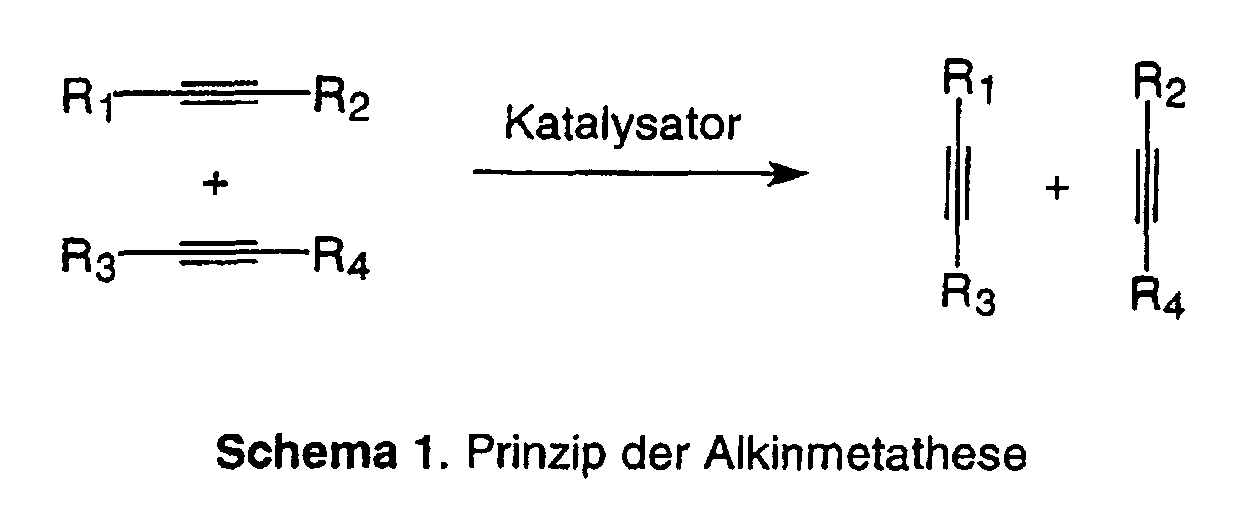
- Alkyne metathesis means the mutual transalkylidation of alkynes according to Scheme 1. Such reactions are usually catalyzed by metal compounds (reviews: Schrock, RR Polyhedron 1995, 14, 3177; Ivin, KJ; Mol, JC Olefin Metathesis and Metathesis Polymerization , Academic Press, New York, 1997, pp. 192-223) , In contrast to the metathesis of alkenes, which is now a well-established field of research and has found numerous applications in the representation of technically important products (reviews: Ivin, KJ; Mol, JC Olefin Metathesis and Metathesis Polymerization, Academic Press, New York, 1997; Schuster , M. et al., Angew. Chem .
- alkyne metathesis in organic chemistry is limited to the preparation of special polymers (Weiss, K. et al., Angew. Chem. 1997, 109, 522), the ring-opening polymerization of cycloalkynes (Krouse, SA et al., Macromolecules 1989, 22 , 2569; Zhang, XP. Et al., Macromolecules 1994, 27 , 4627), as well as the dimerization or the cross-metathesis of acyclic Alkynes (Kaneta, N. et al., Chem. Lett. 1995, 1055; Sancho, J. et al., J. Mol. Cat.
- Transition metal-alkylidine complexes or transition metal-carbyne complexes are considered as catalytically active species (Katz, TJ et al., J. Am. Chem. Soc. 1975, 97 , 1592), which are either added to the reaction mixtures in isolated form or in situ can be formed from suitable pre-catalysts.
- the catalytic activity of transition metal compounds in alkyne metathesis can be increased by adding suitable additives such as phenol derivatives (Mortreux, A. et al., J. Chem. Soc. Chem. Commun.
- Preferred catalysts or pre-catalysts for alkyne metathesis are Mo (CO) 6 (Mortreux, A. et al., J. Chem. Soc. Chem. Commun. 1974, 786; Mortreux, A. et al., J. Mol. Cat . 1977, 2 , 73; Villemin, D. et al Tetrahedron Lett. 1982, 5139; Tsonis, C. React. Kinet. Catal. Lett. 1992, 46 , 359), MoO 2 (acac) 2 / Et 3 Al ( Petit, M. et al., J. Chem. Soc. Chem. Commun.
- the invention relates to a Process for the preparation of carbocyclic or heterocyclic products with 12 or more ring atoms through ring-closing metathesis reactions, characterized in that Diln substrates in the presence of a or more homogeneous or heterogeneous in the reaction medium existing alkyne metathesis catalysts are implemented.
- the selectivity of this reaction depends in particular on the structure of the substrates, the catalyst used, the reaction conditions and the ring strain in the cycloalkyne produced.
- the formation of the cycloalkynes is promoted when the reaction is carried out at high dilution in an organic solvent which does not deactivate the catalyst.
- concentration of the substrate in the reaction medium its "effective molarity parameter" must be taken into account (Mandolini, L. Adv. Phys. Org. Chem. 1986, 22 , 1).
- cycloalkadiene products can also be obtained with the aid of the present invention by cyclodimerization of the diyne substrates according to scheme 3.
- catalysts or pre-catalysts come in the present invention all metal compounds active in alkyne metathesis are considered, independently whether they are homogeneous or heterogeneous in the reaction medium.
- the Catalysts can be used in isolated form or in situ in the Reaction medium can be generated from suitable precursors. The one used The amount of catalyst is not critical, with preferred amounts of catalyst in the Range of 0.01 - 10% based on the substrate used.
- Transition metal alkylidine complexes serve as preferred catalysts or pre-catalysts, Transition metal compounds under reaction conditions Form alkylidine complexes, and transition metal compounds with Metal ⁇ Metal triple bonds.
- i-Pr isopropyl
- t-Bu tertiary butyl
- Ph phenyl
- acac acetylacetonate
- Ar aryl
- gem geminal
- Me methyl.
- phenols geminal-dihaloalkanes (gem-dihaloalkanes) or Halogen silanes used, e.g. phenol Trifluoromethylphenol, bis (trifluoromethyl) phenol, fluorophenol, difluorophenol, Pentafluorophenol, chlorophenol, dichlorophenol, pentachlorophenol, Dichloromethane, dibromomethane, diiodomethane, chloroform, bromoform, iodoform, carbon tetrachloride, carbon tetrabromide, Carbon tetraiodo, ⁇ , ⁇ -dichlorotoluene, trimethylchlorosilane, Dimethyldichlorosilane, trimethylbromosilane, dimethyl (t-butyl) chlorosilane, Dimethyphenylchlorosilane.
- phenol Trifluoromethylphenol bis (trifluoromethyl) phenol
- the diynes used as substrates in the present invention can be one or several functional groups in the form of substituents on the chain or Heteroatoms contained within the chain. This includes branched ones or unbranched alkyl radicals, aromatic or non-aromatic carbocyclic rings, aromatic or non-aromatic nitrogen, oxygen, Heterocyclic rings containing sulfur or phosphorus, carboxylic acids, Esters, ethers, epoxides, silyl ethers, thioethers, thioacetals, disulfides, alcohols, Anhydrides, imines, silyl ethers, silyl enol ethers, ammonium salts, amines, amides, Nitriles, perfluoroalkyl groups, gem-dialkyl groups, alkenes, halogens, ketones, Ketals, aldehydes, acetals, carbamates, carbonates, urethanes, ureas, Sulfonates, sul
- the diynes used as substrates can be replaced by structural elements such as e.g. chiral centers, hydrogen bonds, supramolecular structures, rigid backbones, coordination at metal centers conformative for ring closure be pre-organized.
- Substrates can also be used which none these have structural elements and are therefore conformationally flexible.
- the Substrates can be in carrier-bound form.
- Preferred substrates are diynes with R 1 , R 2 ⁇ H.
- Particularly preferred substrates are those diines in which the radicals R 1 and R 2 in schemes 2 and 3 are chosen so that a low molecular weight and thus volatile alkyne R 1 C ⁇ CR 2 (e.g. 2-butyne, 2-hexyne, 3-hexyne) arises as a by-product of the formation of the macrocyclic cycloalkyne.
- the reactions are carried out so that the respective substrates with the homogeneous or heterogeneous catalyst are brought into contact. In the Usually this is done by mixing a solution or suspension of the Substrate with a solution or suspension of the catalyst. Depending on the used The reaction temperature of the catalyst and substrate can fluctuate, preferably working at -30 ° C to + 200 ° C. The response time is not critical and can range from a few minutes to a few days.
- the Reactions are preferred under a protective gas atmosphere (e.g. argon, Nitrogen, helium).
- ring-closing diathatheses become macrocyclic Cycloalkynes hydrocarbons (e.g. hexane, octane, petroleum ether, toluene, xylenes, Cumene, decalin) or halogenated hydrocarbons (e.g. chlorobenzene, Bromobenzene, fluorobenzene, trifluoromethylbenzene, dichlorobenzene, trichlorobenzene, Carbon tetrachloride, 1,2-dichloroethane) is preferred as the solvent.
- Suitable catalysts are other solvents such as. B. acetonitrile, Tetrahydrofuran, 1,4-dioxane, dimethoxyethane, dimethylformamide, Dimethyl sulfoxide, phenol can be used. Mixtures of these solvents can be used.
- the reactions can be carried out at pressures below atmospheric pressure.
- the application of negative pressure can lead to the removal of volatile by-products R 1 C ⁇ CR 2 and thus improve the yield of cycloalkyne achieved.
- the vacuum that can be used depends on the specific properties of the substrate, the cycloalkyne formed, the alkyne R 1 C ⁇ CR 2 obtained as a by-product according to schemes 2 and 3, the solvent used, and any additives.
- the low molecular weight by-product R 1 C ⁇ CR 2 can also be driven out of the reaction mixture by passing an inert gas stream through the reaction solution, thus improving the yield of cycloalkyne.
- the processing of the reaction mixtures and the purification of the products is not critical and depends on the respective physical properties the products produced and / or the unreacted substrates.
- preferred Processing and purification methods are distillation, sublimation, Crystallization, chromatography, filtration, and extraction.
- the macrocyclic cycloalkynes obtainable according to the present invention can be used for the synthesis of numerous secondary products, e.g. B. by reduction, oxidation, or cycloaddition of the triple bond, and by adding to the triple bond.
- the is of particular importance Possibility that the macrocyclic accessible by the present invention Cycloalkynes through suitable reactions (e.g. semi-hydrogenation, hydrometalation, Carbometalation) to macrocyclic cycloalkenes with uniform configuration of the double bond can be implemented.
- RCM diene ring-closing metathesis
- the present invention makes it possible to selectively prepare macrocyclic, (Z) -configured cycloalkenes by the cycloalkynes obtained by ring-closing metathesis of diynes with the aid of suitable reactions, such as.
- B. Semi-hydrogenation or hydrometalation / protonation (reviews: March, J. Advanced Organic Chemistry , 4 th Ed., Wiley, New York, 1992, pp. 771ff; Marvell, EN et al. Synthesis 1973, 457; Fürstner, A. et al. J. Org. Chem. 1997, 62, 2332).
- the cycloalkynes accessible by the present invention can first be isolated and then converted into the (Z) -configured cycloalkene by a suitable method.
- the formation of the macrocyclic cycloalkyne by ring-closing alkyne metathesis of a diyne substrate and its conversion into a macrocyclic, (Z) -configured cycloalkene can be carried out successively in a single reaction batch in the sense of an integrated chemical process.
- Macrocyclic cycloalkenes with a (Z) -configured double bond are widely used as antibiotics, pharmaceuticals for human or veterinary medicine, pheromones, odorants, perfume ingredients etc.
- a representative example of the synthesis of a pharmaceutically relevant macrocyclic product by oxidation of a macrocyclic cycloalkene are epothilone or analogues of this compound.
- a solution of hexanedicarboxylic acid bis (3-pentinyl) ester (155 mg, 0.56 mmol) in 1,2,4-trichlorobenzene (30 mL) is placed in an apparatus consisting of a two-necked flask with a distillation bridge and a receiver cooled to -78 ° C.
- W ( ⁇ CCMe 3 ) (OCMe 3 ) 3 (8 mg) was added.
- the apparatus is evacuated to 2000 Pa (20 mbar) and the reaction mixture is heated to 80 ° C. After 4 hours, further W ( ⁇ CCMe 3 ) (OCMe 3 ) 3 (8 mg) is added and the solution is then stirred for 13 hours at 80 ° C. 2000 Pa (20 mbar).
- reaction mixture consisting of hexanedicarboxylic acid bis (3-pentinyl) ester (60 mg) and Mo [N (t-Bu) (3,5-C 6 H 3 Me 2 )] 3 (13.5 mg) (shown according to the literature: CE Laplaza et al. J. Am. Chem. Soc. 1996, 118 , 8623) in toluene (15 mL) and CH 2 Cl 2 (50 ⁇ L) is heated to reflux under argon for 19 h.
Landscapes
- Chemical & Material Sciences (AREA)
- Organic Chemistry (AREA)
- Chemical Kinetics & Catalysis (AREA)
- Organic Low-Molecular-Weight Compounds And Preparation Thereof (AREA)
- Catalysts (AREA)
- Heterocyclic Compounds That Contain Two Or More Ring Oxygen Atoms (AREA)
- Nitrogen Condensed Heterocyclic Rings (AREA)
- Pyrane Compounds (AREA)
- Low-Molecular Organic Synthesis Reactions Using Catalysts (AREA)
- Nitrogen And Oxygen Or Sulfur-Condensed Heterocyclic Ring Systems (AREA)
Description


- M=Mo
- R1 = t-Bu, i-Pr
- Ar = C6H5, C6H4Me, C6H3Me2, C6H3(iPr)2, C6H3(t-Bu)2, C6H2Me3
- R2=H,F,Cl,Br,I,C6H5
- R3=Me, t-Bu, Ph, i-Pr.


Daten des Cycloalkins: 1H-NMR: δ = 4.12 (t, 2H, J = 5.8), 2.32 (t, 2H, J = 6.8), 2.16 (m, 4H), 1.64 (m, 4H), [1.46 (m), 1.32 (m); 18H].- 13C-NMR: δ = 173.8, 80.7, 80.5, 63.9, 34.6, 29.39,29.36, 29.2, 28.8 (2C), 28.6 (2C), 28.4 (2C), 28.3, 28.1, 25.9, 25.3, 18.5, 18.4.- MS, m/z (rel. Intensität): 306 (35) [M+], 277 (4), 264 (5), 250 (3), 209 (6), 192 (19), 178 (34), 164 (40), 149 (24), 135 (54), 121 (61), 107 (43), 95 (71), 81 (97), 67 (98), 55 (100), 41 (82), 29 (25). C20H34O2 (306.5) ber.: C 78.37. H 11.19; gefunden: C 77.55. H 11.07.
Daten des Cycloalkadiins: 1H-NMR: δ = 4.07 (t, 4H, J = 6.6), 2.29 (t, 4H, J = 7.4), 2.14 (m, 8H), 1.62 (m, 8H), 1.47 (m, 8H), 1.4-1.2 (36H).- 13C-NMR: δ = 173.9, 80.27, 80.25, 64.3, 34.4, 29.3, 29.1, 29.06, 28.98, 28.96, 28.88, 28.62, 28.57, 25.9, 25.0, 18.7.- MS, m/z (rel. Intensität): 612 (99) [M+], 584 (7), 557 (5), 515 (6), 469 (5), 401 (8), 387 (11), 373 (13), 359 (18), 345 (19), 147 (16), 135 (26), 121 (32), 107 (33), 95 (65), 81 (88), 67 (87), 55 (100).


Ein Reaktionsgemisch bestehend aus Cycloalkin 4 (154 mg), Chinolin (60 µL) und Lindlar Katalysator (= 5% Pd auf Calciumcarbonat, vergiftet mit Blei) (60 mg) in Hexan (3 mL) wird 1.5 h unter einer Atmosphäre von Wasserstoff (1 atm) gerührt. Man filtriert den Katalysator ab, wäscht das Filtrat mit wässiger HCl (5%), trocknet die organische Phase über Na2SO4 und entfernt das Lösungsmittel im Vakuum. Anschließende Säulenchromatographie (Eluationsmittel Hexan/t-Butylmethylether 20/1) ergibt Ambrettolid 5 (138 mg, 92%). 13C-NMR: δ = 174.3, 130.5, 130.4, 64.1, 34.9, 29.8, 29.1, 29.0, 28.9, 28.8, 28.7, 28.0, 27.3, 27.1, 25.7, 25.6.
Anstelle von CH2Cl2 können zur Aktivierung der Molybdänkomponente auch CHCl3, CCl4, CH2Br2, CH2I2, α,α-Dichlortoluol oder Trimethylchlorsilan verwendet werden. Die Reaktion kann analog in Dichlormethan als Lösungsmittel durchgeführt werden.
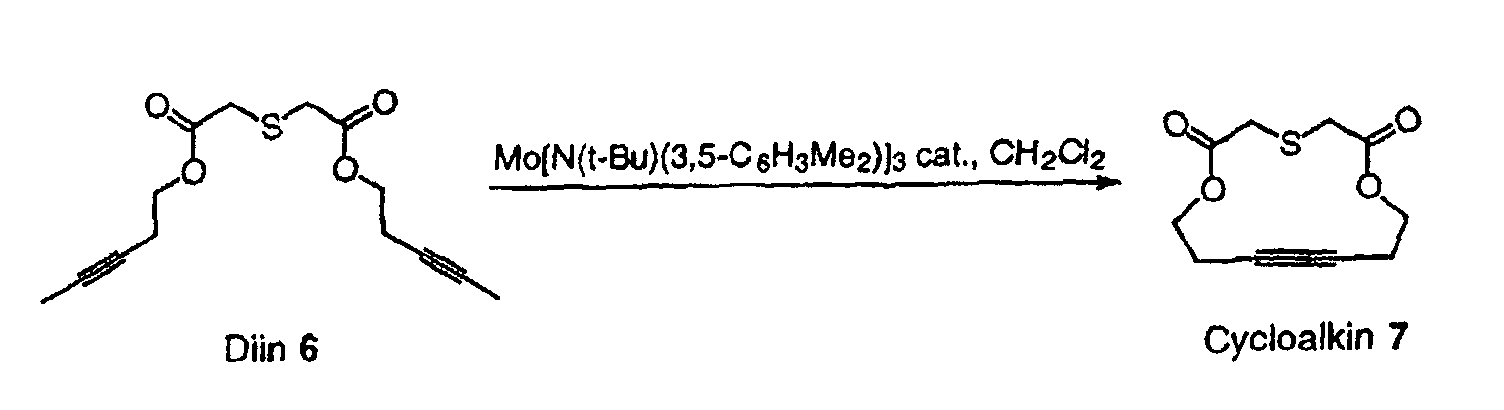
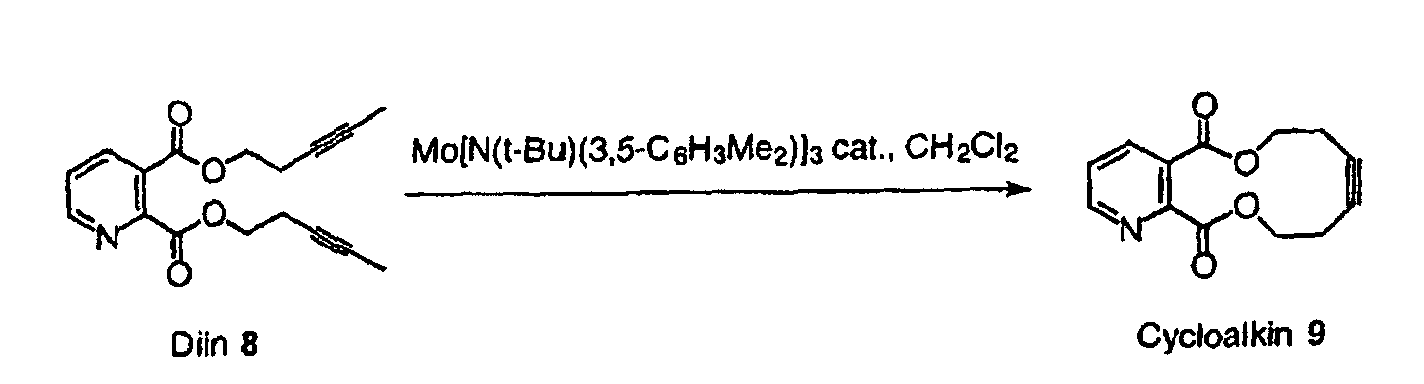

Daten des Cycloalkins 11: 1H-NMR: δ = 4.29 (t, 4H, J = 5.8), 2.43 (t, 4H), 1.43 (s, 6H).- 13C-NMR: δ= 172.0, 79.8, 61.8, 50.0, 22.1, 19.7, - MS, m/z (rel. Intensität): 152 (2) [M-58], 137 (3), 111 (5), 87 (5), 78 (100), 70 (49), 66 (17), 65 (18), 41 (16).-C11H14O4(210.2) ber.:C 62.85. H 6.71; gef.: C 63.01. H 6 67.
Daten des Cycloalkadiins 12: 1H-NMR: δ = 4.15 (t, 8H, J = 6.8), 2.53 (t, 8H), 1.43 (s, 12H). - 13C-NMR: δ = 172.4, 77.3, 63.5, 49.4, 22.5, 18.8.- MS, m/z (rel. Intensität): 420 (5) [M+], 174 (8), 156 (48), 141 (14), 115 (7), 87 (10), 78 (100), 70 (34), 69 (31), 66 (13), 65 (11), 41 (19).

Claims (27)
- Verfahren zur Darstellung von carbo- oder heterocyclischen Produkten mit 12 oder mehr Ringatomen durch ringschließende Metathesereaktionen, dadurch gekennzeichnet, daß Diin-Substrate in Gegenwart von einem oder mehreren homogen oder heterogen im Reaktionsmedium vorliegenden Alkinmetathese-Katatysatoren umgesetzt werden.
- Verfahren nach Anspruch 1, wobei die Diin-Substrate eine oder mehrere funktionelle Gruppen In Form von Substituenten an der Kette oder Heteroatomen innerhalb der Kette enthalten; die genannten funktionellen Gruppen umfassen verzweigte oder unverzweigte Alkylreste, aromatische oder nicht aromatische carbocyclische Ringe, aromatische oder nicht aromatische Stickstoff-, Sauerstoff-, Schwefel- oder Phosphorhaltige heterocyclische Ringe, Carbonsäuren, Ester, Ether, Epoxide, Silylether, Thioether, Thioacetale, Disulfide, Alkohole, Anhydride, Imine, Silylether, Silylenolether, Ammoniumsalze, Amine, Amide, Nitrile, Perfluoralkyl-Gruppen, gem-Dialkytgruppen, Alkene, Halogene, Ketone, Ketale, Aldehyde, Acetale, Carbamate, Carbonate, Urethane, Harnstoffe, Sulfonate, Sulfohe, Sulfonamide, Sulfoxide, Phosphate, Phosphonate, Nitro-Gruppen, Organosilan-Einheiten oder Metallzentren.
- Verfahren nach Anspruch 1-2, wobei der verwendete Alkin-Metathesekatalysator ein Übergangsmetall-Alkylidin Komplex ist.
- Verfahren nach Anspruch3, wobei der Übergangsmetall-Alkylidinkomplex in situ im Reaktionsmedium gebildet wird.
- Verfahren nach Anspruch3, wobei der als Katalysator verwendete Übergangsmetall-Alkylidin Komplex eine Verbindung vom Typ M(≡ CR1)(OR2)3 ist, mitM=Mo,WR1 = C1-C20 Alkyl, Aryl, Alkenyl, Alkylthio, DialkylaminoR2 = C1-C20 Alkyl, Aryl, CMe3, CH(CF3)2, CMe2CF3, CMe(CF3)2, C(CF3)3, C6H3Me2, C6H3i-Pr2, C6H3t-Bu2.
- Verfahren nach Anspruch 5 mitM=WR1 = CMe3, PhR2 = CMe3, CH(CF3)2, CMe2CF3, CMe(CF3)2, C(CF3)3, C6H3Me2, C6H3i-Pr2, C6H3t-Bu2.
- Verfahren nach Anspruch 3, wobei der als Katalysator verwendete Übergangsmetall-Alkylidin Komplex eine Verbindung vom Typ Re(≡ CR1)(=NAr)(OR2)2 ist, mitR1 = C1-C20 Alkyl, Aryl, AlkenylAr = C6-C20 ArylR2 = C1-C20 Alkyl, Aryl, CMe3, CH(CF3)2, CMe2CF3, CMe(CF3)2, C(CF3)3, C6H3Me2, C6H3i-Pr2, C6H3t-Bu2.
- Verfahren nach Anspruch 7 mitR1 = CMe3, PhAr = C6-C20 ArylR2 = CMe3, CH(CF3)2, CMe2CF3, CMe(CF3)2, C(CF3)3, C6H3Me2, C6H3i-Pr2, C6H3t-Bu2.
- Verfahren nach Anspruch 1-3, wobei der verwendete Alkin-Metathesekatalysator ein Komplex mit Metall≡Metall Dreifachbindung ist.
- Verfahren nach Anspruch 9', wobei der verwendete Alkin-Metathesekatalysator ein Komplex vom Typ (RO)3M≡M(OR)3 ist, mitM = Mo, WR = C1-C20 Alkyl, CMe3, CH(CF3)2, CMe2CF3, CMe(CF3)2, C(CF3)3.
- Verfahren nach Anspruch 10 mitR = CMe3, CH(CF3)2, CMe2CF3, CMe(CF3)2, C(CF3)3.
- Verfahren nach Anspruch 1-3, wobei der Alkinmetathesekatalysator aus M[N(R1)Ar]3 und einer Halogenverbindung vom Typ R2 2EX2 oder R3 3SiX gebildet wird, mitM = Mo, WR1 = C1-C20 Alkyl, sec-Alkyl, t-Alkyl, CycloalkylAr = C6-C20 ArylR2 = H, F, Cl, Br, I, C1-C20 Alkyl, ArylE = C, SiR3 = C1-C20 Alkyl, ArylX = F, Cl, Br, I.
- Verfahren nach Anspruch 12. mitM = MoR1 = t-Bu, i-PrAr = C6H5, C6H4Me, C6H3Me2, C6H3(iPr)2, C6H3(t-Bu)2, C6H2Me3R2 = H, F, Cl, Br, I, C6H5R3 = Me, t-Bu, Ph, i-Pr.
- Verfahren nach Anspruch 1-13, wobei die Diin-Substrate durch ein oder mehrere strukturelle Elemente konformativ für den Ringschluß prä-organisiert sind; die genannten strukturellen Elemente umfassen chirale Zentren, Wasserstoffbrückenbindungen, supramolekulare Strukturen, rigide Rückgrade, Koordination an Metallzentren.
- Verfahren nach Anspruch 143, wobei die Diin-Substrate konformativ flexibel sind.
- Verfahren nach Anspruch 1-15, wobei die Diin-Substrate in trägergebundener Form eingesetzt werden.
- Verfahren nach Anspruch 1-16, wobei durch Wahl der Konzentration der Diin-Substrate in Lösung die Bildung des makrocyclischen Cycloalkins begünstigt ist.
- Verfahren nach Anspruch 1-17) wobei die Reaktion bei Drücken kleiner als Atmosphärendruck durchgeführt wird.
- Verfahren nach Anspruch 1-17, wobei durch das Durchleiten eines inerten Gasstroms durch das Reaktionsmedium Nebenprodukte abgeführt werden.
- Verfahren nach Anspruch 1-10, wobei durch Additiva die Aktiviät der verwendeten Katalysatoren erhöht wird.
- Verfahren nach Anspruch 20, wobei als Additiva Phenole, geminal-Dihalogenalkane (gem-Dihalogenalkane) oder Halogensilane eingesetzt werden.
- Verfahren nach Anspruch 21, wobei als Additiva Phenol, Trifluormethylphenol, Bis(trifluormethyl)phenol, Fluorphenol, Difluorphenol, Pentafluorphenol, Chlorphenol, Dichlorphenol, Pentachlorphenol, Dichlormethan, Dibrommethan, Difodmethan, Chloroform, Bromoform, lodoform, Tetrachlorkohlenstoff, Tetrabromkohlenstoff, Tetraiodkohlenstoff, α,α-Dichlortoluol, Trimethylchlorsilan, Dimethyldichlorsilan, Trimethylbromsilan, Dimethyl(t-butyl)chlorsilan, Dimethylphenylchlorsilan eingesetzt werden.
- Verfahren nach Anspruch 1-22, wobei die Diin-Substrate cyclodimerisiert werden.
- Verfahren zur Darstellung von carbo- oder heterocyclischen Cycloalkenen mit 12 oder mehr Ringatomen, dadurch gekennzeichnet, daß nach Anspruch 1-23 dargestellte Cycloalkine selektiv in Cycloalkene mit einheitlicher Konfiguration der Doppelbindung überführt werden.
- Verfahren nach Anspruch 24 zur Herstellung von Cycloalkenen mit (Z)-konfigurierter Doppelbindung.
- Verfahren zur Darstellung von Epothilon oder Epothilon-Analoga, dadurch gekennzeichnet, daß ein funktionalisiertes Cycloalkin nach Anspruch 2 hergestellt und im Anschluß nach bekannten Verfahren in Epothilon oder Epothilon-Analoga umgesetzt wird.
- Verfahren nach Anspruch 1-26, wobei die carbo- oder heterocyclischen Produkte Antibiotika, Pharmaka für die Human- oder Veterinärmedizin, Agrochemikalien, Pheromone, Kronenether, Geruchsstoffe, Parfuminhaltsstoffe, oder Geschmacksstoffe sind.
Applications Claiming Priority (3)
| Application Number | Priority Date | Filing Date | Title |
|---|---|---|---|
| DE19804673A DE19804673A1 (de) | 1998-02-06 | 1998-02-06 | Verfahren zur Darstellung makrocyclischer Produkte durch ringschliessende Diin-Metathese |
| DE19804673 | 1998-02-06 | ||
| PCT/EP1999/000674 WO1999040047A1 (de) | 1998-02-06 | 1999-02-02 | Verfahren zur darstellung makrocyclischer produkte durch ringschliessende diin-metathese |
Publications (2)
| Publication Number | Publication Date |
|---|---|
| EP1053215A1 EP1053215A1 (de) | 2000-11-22 |
| EP1053215B1 true EP1053215B1 (de) | 2002-05-22 |
Family
ID=7856807
Family Applications (1)
| Application Number | Title | Priority Date | Filing Date |
|---|---|---|---|
| EP99910180A Expired - Lifetime EP1053215B1 (de) | 1998-02-06 | 1999-02-02 | Verfahren zur darstellung makrocyclischer produkte durch ringschliessende diin-metathese |
Country Status (7)
| Country | Link |
|---|---|
| US (1) | US6525197B1 (de) |
| EP (1) | EP1053215B1 (de) |
| JP (1) | JP2002502832A (de) |
| AT (1) | ATE217857T1 (de) |
| CA (1) | CA2325370A1 (de) |
| DE (2) | DE19804673A1 (de) |
| WO (1) | WO1999040047A1 (de) |
Cited By (1)
| Publication number | Priority date | Publication date | Assignee | Title |
|---|---|---|---|---|
| US8946364B2 (en) | 2012-07-24 | 2015-02-03 | Empire Technology Development Llc | Solution phase polydiacetylene synthesis by alkyne metathesis |
Families Citing this family (20)
| Publication number | Priority date | Publication date | Assignee | Title |
|---|---|---|---|---|
| US6204388B1 (en) * | 1996-12-03 | 2001-03-20 | Sloan-Kettering Institute For Cancer Research | Synthesis of epothilones, intermediates thereto and analogues thereof |
| US20050043376A1 (en) * | 1996-12-03 | 2005-02-24 | Danishefsky Samuel J. | Synthesis of epothilones, intermediates thereto, analogues and uses thereof |
| US6867305B2 (en) * | 1996-12-03 | 2005-03-15 | Sloan-Kettering Institute For Cancer Research | Synthesis of epothilones, intermediates thereto and analogues thereof |
| US6242469B1 (en) | 1996-12-03 | 2001-06-05 | Sloan-Kettering Institute For Cancer Research | Synthesis of epothilones, intermediates thereto, analogues and uses thereof |
| US6410301B1 (en) | 1998-11-20 | 2002-06-25 | Kosan Biosciences, Inc. | Myxococcus host cells for the production of epothilones |
| KR100851418B1 (ko) | 1998-11-20 | 2008-08-08 | 코산 바이오사이언시즈, 인코포레이티드 | 에포틸론 및 에포틸론 유도체의 생산을 위한 재조합 방법 및 물질 |
| US20020058286A1 (en) * | 1999-02-24 | 2002-05-16 | Danishefsky Samuel J. | Synthesis of epothilones, intermediates thereto and analogues thereof |
| KR20010045418A (ko) * | 1999-11-05 | 2001-06-05 | 박종섭 | 신규한 포토레지스트 단량체, 그의 중합체 및 이를함유하는 포토레지스트 조성물 |
| DE10015452A1 (de) * | 2000-03-29 | 2001-10-04 | Bayer Ag | Verfahren zur Polymerisation von polar substituierten Cycloalkenen |
| US7432371B2 (en) | 2002-02-07 | 2008-10-07 | Covalent Partners, Llc | Nanofilm and membrane compositions |
| WO2004018478A2 (en) * | 2002-08-23 | 2004-03-04 | Sloan-Kettering Institute For Cancer Research | Synthesis of epothilones, intermediates thereto, analogues and uses thereof |
| US7649006B2 (en) | 2002-08-23 | 2010-01-19 | Sloan-Kettering Institute For Cancer Research | Synthesis of epothilones, intermediates thereto and analogues thereof |
| US6921769B2 (en) | 2002-08-23 | 2005-07-26 | Sloan-Kettering Institute For Cancer Research | Synthesis of epothilones, intermediates thereto and analogues thereof |
| US6967256B2 (en) | 2002-09-19 | 2005-11-22 | Massachusetts Institute Of Technology | Formation of enediynes by reductive coupling followed by alkyne metathesis |
| JP4741938B2 (ja) * | 2005-11-25 | 2011-08-10 | 三井化学株式会社 | 有機半導体デバイス用材料、有機半導体デバイス及び有機トランジスタ |
| EP2014667A1 (de) * | 2007-07-11 | 2009-01-14 | Technische Universität Braunschweig | Katalysator zur Alkyn-Metathese |
| GB0718806D0 (en) | 2007-09-27 | 2007-11-07 | Givaudan Sa | Organic compounds |
| US9206266B2 (en) * | 2011-12-07 | 2015-12-08 | University Of Florida Research Foundation, Inc. | Tridentate pincer ligand supported metal-alkylidyne and metallacycloalkylene complexes for alkyne polymerization |
| US10730972B2 (en) | 2017-09-22 | 2020-08-04 | University Of Florida Research Foundation, Inc. | Cyclic polyolefins derived from hexyne, octyne, nonyne, pentadecyne and their copolymers with acetylene |
| CN110669229B (zh) * | 2019-11-12 | 2021-07-02 | 中北大学 | 基于动态亚胺大环的超分子聚合物及其制备方法 |
Family Cites Families (1)
| Publication number | Priority date | Publication date | Assignee | Title |
|---|---|---|---|---|
| US5391726A (en) * | 1992-04-30 | 1995-02-21 | The Dow Chemical Company | Preparation of giant ring compounds |
-
1998
- 1998-02-06 DE DE19804673A patent/DE19804673A1/de not_active Withdrawn
-
1999
- 1999-02-02 JP JP2000530479A patent/JP2002502832A/ja not_active Withdrawn
- 1999-02-02 WO PCT/EP1999/000674 patent/WO1999040047A1/de not_active Ceased
- 1999-02-02 DE DE59901493T patent/DE59901493D1/de not_active Expired - Fee Related
- 1999-02-02 US US09/601,632 patent/US6525197B1/en not_active Expired - Fee Related
- 1999-02-02 AT AT99910180T patent/ATE217857T1/de not_active IP Right Cessation
- 1999-02-02 EP EP99910180A patent/EP1053215B1/de not_active Expired - Lifetime
- 1999-02-02 CA CA002325370A patent/CA2325370A1/en not_active Abandoned
Cited By (1)
| Publication number | Priority date | Publication date | Assignee | Title |
|---|---|---|---|---|
| US8946364B2 (en) | 2012-07-24 | 2015-02-03 | Empire Technology Development Llc | Solution phase polydiacetylene synthesis by alkyne metathesis |
Also Published As
| Publication number | Publication date |
|---|---|
| US6525197B1 (en) | 2003-02-25 |
| CA2325370A1 (en) | 1999-08-12 |
| ATE217857T1 (de) | 2002-06-15 |
| WO1999040047A1 (de) | 1999-08-12 |
| DE19804673A1 (de) | 1999-08-12 |
| JP2002502832A (ja) | 2002-01-29 |
| DE59901493D1 (de) | 2002-06-27 |
| EP1053215A1 (de) | 2000-11-22 |
Similar Documents
| Publication | Publication Date | Title |
|---|---|---|
| EP1053215A1 (de) | Verfahren zur darstellung makrocyclischer produkte durch ringschliessende diin-metathese | |
| EP0975622B1 (de) | Selektive olefinmetathese von bi- oder polyfunktionellen substraten in komprimiertem kohlendioxid als reaktionsmedium | |
| US5936100A (en) | Synthesis of functionalized macrocycles by ring closing metathesis | |
| DE69806053T2 (de) | Hochwirksame kationische ruthenium und osmiumkomplexe für die metathesereaktionen | |
| EP1414833B1 (de) | Neue übergangsmetall-komplexe und deren einsatz in übergangsmetall-katalysierten reaktionen | |
| EP0385210A2 (de) | Amidierung von Pyridinen | |
| JPH0827136A (ja) | エポキシ化合物の製造方法 | |
| NL2029460B1 (en) | Tetrahydrofuroindole compound and preparation method and application thereof | |
| JPH04112877A (ja) | 新規シアノピラジン誘導体及びその製造方法 | |
| Bey et al. | Stereospecific alkylation of the Schiff base ester of alanine with 2-substituted-(E)-and-(Z)-vinyl bromides. An efficient synthesis of 2-methyl-(E)-3, 4-didehydroglutamic acid, a potent substrate-induced irreversible inhibitor of L-glutamate-1-decarboxylase | |
| DE60129211T2 (de) | Imidazolidinonen-saureadditionssalze als reaktionskatalysatoren | |
| EP1035093B1 (de) | Metathese in Gegenwart ionischer Flüssigkeiten | |
| JPH10175882A (ja) | 閉環メタセシスによる機能化された大環状化合物の合成 | |
| HU194173B (en) | Process for preparing substituted pyridine | |
| EP1371657A1 (de) | Übergangsmetall-Komplexe und deren Einsatz in Übergangsmetallkatalysierten Reaktionen | |
| EP0968177B1 (de) | Verfahren zur herstellung von aromatischen nitrilen | |
| JP3072314B2 (ja) | γ−アルキリデン−γ−ブチロラクトン誘導体の製造方法 | |
| DE19720798A1 (de) | Selektive Olefinmetathese von bi- oder polyfunktionellen Substraten in komprimiertem Kohlendioxid als Reaktionsmedium | |
| EP0936220A1 (de) | Verfahren zur katalytischen Herstellung von 3-Isochromanonen aus Phthalanen | |
| US2566815A (en) | Epoxy-hexenylidene imines and insecticidal compositions thereof | |
| EP3233768B1 (de) | 1,3-butadien-synthese | |
| EP1683791B1 (de) | Verfahren zur Ruthenium-katalysierten Epoxidierung von Olefinen mit Wasserstoffperoxid | |
| US4681892A (en) | Isoxazolidine insecticides and fungicides | |
| DE19838516A1 (de) | Verfahren zur Herstellung von Sulfonylhalogeniden | |
| WO2003091199A1 (de) | Verfahren zur chlorierung tertiärer alkohole |
Legal Events
| Date | Code | Title | Description |
|---|---|---|---|
| PUAI | Public reference made under article 153(3) epc to a published international application that has entered the european phase |
Free format text: ORIGINAL CODE: 0009012 |
|
| 17P | Request for examination filed |
Effective date: 20000722 |
|
| AK | Designated contracting states |
Kind code of ref document: A1 Designated state(s): AT BE CH DE DK ES FR GB IE IT LI LU NL SE |
|
| 17Q | First examination report despatched |
Effective date: 20010726 |
|
| GRAG | Despatch of communication of intention to grant |
Free format text: ORIGINAL CODE: EPIDOS AGRA |
|
| GRAG | Despatch of communication of intention to grant |
Free format text: ORIGINAL CODE: EPIDOS AGRA |
|
| GRAH | Despatch of communication of intention to grant a patent |
Free format text: ORIGINAL CODE: EPIDOS IGRA |
|
| GRAH | Despatch of communication of intention to grant a patent |
Free format text: ORIGINAL CODE: EPIDOS IGRA |
|
| GRAA | (expected) grant |
Free format text: ORIGINAL CODE: 0009210 |
|
| PG25 | Lapsed in a contracting state [announced via postgrant information from national office to epo] |
Ref country code: IT Free format text: LAPSE BECAUSE OF FAILURE TO SUBMIT A TRANSLATION OF THE DESCRIPTION OR TO PAY THE FEE WITHIN THE PRESCRIBED TIME-LIMIT;WARNING: LAPSES OF ITALIAN PATENTS WITH EFFECTIVE DATE BEFORE 2007 MAY HAVE OCCURRED AT ANY TIME BEFORE 2007. THE CORRECT EFFECTIVE DATE MAY BE DIFFERENT FROM THE ONE RECORDED. Effective date: 20020522 |
|
| REF | Corresponds to: |
Ref document number: 217857 Country of ref document: AT Date of ref document: 20020615 Kind code of ref document: T |
|
| REG | Reference to a national code |
Ref country code: GB Ref legal event code: FG4D Free format text: NOT ENGLISH |
|
| REG | Reference to a national code |
Ref country code: CH Ref legal event code: NV Representative=s name: A. BRAUN, BRAUN, HERITIER, ESCHMANN AG PATENTANWAE Ref country code: CH Ref legal event code: EP |
|
| REG | Reference to a national code |
Ref country code: IE Ref legal event code: FG4D Free format text: GERMAN |
|
| REF | Corresponds to: |
Ref document number: 59901493 Country of ref document: DE Date of ref document: 20020627 |
|
| GBT | Gb: translation of ep patent filed (gb section 77(6)(a)/1977) |
Effective date: 20020720 |
|
| PG25 | Lapsed in a contracting state [announced via postgrant information from national office to epo] |
Ref country code: SE Free format text: LAPSE BECAUSE OF FAILURE TO SUBMIT A TRANSLATION OF THE DESCRIPTION OR TO PAY THE FEE WITHIN THE PRESCRIBED TIME-LIMIT Effective date: 20020822 Ref country code: DK Free format text: LAPSE BECAUSE OF FAILURE TO SUBMIT A TRANSLATION OF THE DESCRIPTION OR TO PAY THE FEE WITHIN THE PRESCRIBED TIME-LIMIT Effective date: 20020822 |
|
| ET | Fr: translation filed | ||
| PG25 | Lapsed in a contracting state [announced via postgrant information from national office to epo] |
Ref country code: ES Free format text: LAPSE BECAUSE OF FAILURE TO SUBMIT A TRANSLATION OF THE DESCRIPTION OR TO PAY THE FEE WITHIN THE PRESCRIBED TIME-LIMIT Effective date: 20021128 |
|
| PG25 | Lapsed in a contracting state [announced via postgrant information from national office to epo] |
Ref country code: LU Free format text: LAPSE BECAUSE OF NON-PAYMENT OF DUE FEES Effective date: 20030202 |
|
| PLBE | No opposition filed within time limit |
Free format text: ORIGINAL CODE: 0009261 |
|
| STAA | Information on the status of an ep patent application or granted ep patent |
Free format text: STATUS: NO OPPOSITION FILED WITHIN TIME LIMIT |
|
| 26N | No opposition filed |
Effective date: 20030225 |
|
| PGFP | Annual fee paid to national office [announced via postgrant information from national office to epo] |
Ref country code: IE Payment date: 20040126 Year of fee payment: 6 |
|
| PGFP | Annual fee paid to national office [announced via postgrant information from national office to epo] |
Ref country code: AT Payment date: 20040204 Year of fee payment: 6 |
|
| PGFP | Annual fee paid to national office [announced via postgrant information from national office to epo] |
Ref country code: BE Payment date: 20040401 Year of fee payment: 6 |
|
| PG25 | Lapsed in a contracting state [announced via postgrant information from national office to epo] |
Ref country code: IE Free format text: LAPSE BECAUSE OF NON-PAYMENT OF DUE FEES Effective date: 20050202 Ref country code: AT Free format text: LAPSE BECAUSE OF NON-PAYMENT OF DUE FEES Effective date: 20050202 |
|
| PG25 | Lapsed in a contracting state [announced via postgrant information from national office to epo] |
Ref country code: BE Free format text: LAPSE BECAUSE OF NON-PAYMENT OF DUE FEES Effective date: 20050228 |
|
| BERE | Be: lapsed |
Owner name: STUDIENG.- *KOHLE M.B.H. Effective date: 20050228 |
|
| REG | Reference to a national code |
Ref country code: IE Ref legal event code: MM4A |
|
| PGFP | Annual fee paid to national office [announced via postgrant information from national office to epo] |
Ref country code: DE Payment date: 20060214 Year of fee payment: 8 |
|
| PGFP | Annual fee paid to national office [announced via postgrant information from national office to epo] |
Ref country code: NL Payment date: 20060215 Year of fee payment: 8 Ref country code: CH Payment date: 20060215 Year of fee payment: 8 |
|
| PGFP | Annual fee paid to national office [announced via postgrant information from national office to epo] |
Ref country code: FR Payment date: 20060216 Year of fee payment: 8 |
|
| PG25 | Lapsed in a contracting state [announced via postgrant information from national office to epo] |
Ref country code: LI Free format text: LAPSE BECAUSE OF NON-PAYMENT OF DUE FEES Effective date: 20070228 Ref country code: CH Free format text: LAPSE BECAUSE OF NON-PAYMENT OF DUE FEES Effective date: 20070228 |
|
| REG | Reference to a national code |
Ref country code: CH Ref legal event code: PL |
|
| GBPC | Gb: european patent ceased through non-payment of renewal fee |
Effective date: 20070202 |
|
| NLV4 | Nl: lapsed or anulled due to non-payment of the annual fee |
Effective date: 20070901 |
|
| REG | Reference to a national code |
Ref country code: FR Ref legal event code: ST Effective date: 20071030 |
|
| BERE | Be: lapsed |
Owner name: STUDIENG.- *KOHLE M.B.H. Effective date: 20050228 |
|
| PG25 | Lapsed in a contracting state [announced via postgrant information from national office to epo] |
Ref country code: NL Free format text: LAPSE BECAUSE OF NON-PAYMENT OF DUE FEES Effective date: 20070901 Ref country code: DE Free format text: LAPSE BECAUSE OF NON-PAYMENT OF DUE FEES Effective date: 20070901 |
|
| PG25 | Lapsed in a contracting state [announced via postgrant information from national office to epo] |
Ref country code: GB Free format text: LAPSE BECAUSE OF NON-PAYMENT OF DUE FEES Effective date: 20070202 Ref country code: FR Free format text: LAPSE BECAUSE OF NON-PAYMENT OF DUE FEES Effective date: 20070228 |
|
| PGFP | Annual fee paid to national office [announced via postgrant information from national office to epo] |
Ref country code: GB Payment date: 20060221 Year of fee payment: 8 |