EP1049552B1 - Steel powder for the preparation of sintered products - Google Patents
Steel powder for the preparation of sintered products Download PDFInfo
- Publication number
- EP1049552B1 EP1049552B1 EP99904004A EP99904004A EP1049552B1 EP 1049552 B1 EP1049552 B1 EP 1049552B1 EP 99904004 A EP99904004 A EP 99904004A EP 99904004 A EP99904004 A EP 99904004A EP 1049552 B1 EP1049552 B1 EP 1049552B1
- Authority
- EP
- European Patent Office
- Prior art keywords
- weight
- powder
- amount
- iron
- water
- Prior art date
- Legal status (The legal status is an assumption and is not a legal conclusion. Google has not performed a legal analysis and makes no representation as to the accuracy of the status listed.)
- Expired - Lifetime
Links
Images
Classifications
-
- C—CHEMISTRY; METALLURGY
- C22—METALLURGY; FERROUS OR NON-FERROUS ALLOYS; TREATMENT OF ALLOYS OR NON-FERROUS METALS
- C22C—ALLOYS
- C22C33/00—Making ferrous alloys
- C22C33/02—Making ferrous alloys by powder metallurgy
- C22C33/0257—Making ferrous alloys by powder metallurgy characterised by the range of the alloying elements
- C22C33/0264—Making ferrous alloys by powder metallurgy characterised by the range of the alloying elements the maximum content of each alloying element not exceeding 5%
-
- B—PERFORMING OPERATIONS; TRANSPORTING
- B22—CASTING; POWDER METALLURGY
- B22F—WORKING METALLIC POWDER; MANUFACTURE OF ARTICLES FROM METALLIC POWDER; MAKING METALLIC POWDER; APPARATUS OR DEVICES SPECIALLY ADAPTED FOR METALLIC POWDER
- B22F1/00—Metallic powder; Treatment of metallic powder, e.g. to facilitate working or to improve properties
-
- C—CHEMISTRY; METALLURGY
- C21—METALLURGY OF IRON
- C21D—MODIFYING THE PHYSICAL STRUCTURE OF FERROUS METALS; GENERAL DEVICES FOR HEAT TREATMENT OF FERROUS OR NON-FERROUS METALS OR ALLOYS; MAKING METAL MALLEABLE, e.g. BY DECARBURISATION OR TEMPERING
- C21D3/00—Diffusion processes for extraction of non-metals; Furnaces therefor
- C21D3/02—Extraction of non-metals
-
- C—CHEMISTRY; METALLURGY
- C22—METALLURGY; FERROUS OR NON-FERROUS ALLOYS; TREATMENT OF ALLOYS OR NON-FERROUS METALS
- C22C—ALLOYS
- C22C38/00—Ferrous alloys, e.g. steel alloys
- C22C38/18—Ferrous alloys, e.g. steel alloys containing chromium
- C22C38/22—Ferrous alloys, e.g. steel alloys containing chromium with molybdenum or tungsten
-
- B—PERFORMING OPERATIONS; TRANSPORTING
- B22—CASTING; POWDER METALLURGY
- B22F—WORKING METALLIC POWDER; MANUFACTURE OF ARTICLES FROM METALLIC POWDER; MAKING METALLIC POWDER; APPARATUS OR DEVICES SPECIALLY ADAPTED FOR METALLIC POWDER
- B22F2998/00—Supplementary information concerning processes or compositions relating to powder metallurgy
- B22F2998/10—Processes characterised by the sequence of their steps
-
- B—PERFORMING OPERATIONS; TRANSPORTING
- B22—CASTING; POWDER METALLURGY
- B22F—WORKING METALLIC POWDER; MANUFACTURE OF ARTICLES FROM METALLIC POWDER; MAKING METALLIC POWDER; APPARATUS OR DEVICES SPECIALLY ADAPTED FOR METALLIC POWDER
- B22F2999/00—Aspects linked to processes or compositions used in powder metallurgy
Definitions
- the present invention concerns a chromium base alloy steel powder. More specifically the invention concerns a low oxygen, low carbon alloy steel powder including in addition to iron and chromium also Mo and Mn as well as the preparation thereof. The invention also concerns a method of preparing sintered components from this powder as well as the sintered components.
- the effective amounts of the alloying elements according to the US patent are between 0.2 and 5.0% by weight of chromium, 0.1 and 7.0% by weight of molybdenum and 0.35 and 1.50% by weight of manganese.
- the EP publication discloses that the effective amounts should be between 0.5 and 3% by weight of chromium, 0.1 and 2% by weight of molybdenum and at most 0.08% by weight of manganese.
- the purpose of the invention according to the US patent is to provide a powder satisfying the demands of high compressibility and moldability of the powder and good heat-treatment properties, such as carburising, hardenability, in the sintered body.
- a serious drawback when using the invention disclosed in the EP application is that cheap scrap cannot be used as this scrap normally includes more than 0.08% by weight of manganese.
- the EP application teaches that a specific treatment has to be used in order to reduce the Mn content to a level not larger than 0.08 % by weight.
- Another problem is that nothing is taught about the reduction annealing and the possibility to obtain the low oxygen and carbon content in water-atomised iron powders including elements sensitive to oxidation, such as chromium, manganese. The only information given in this respect seems to be in example 1, which discloses that a final reduction has to be performed.
- JP-A-6 306 403 disclosed a water atomized steel powder comprising Cr 0.5-3.0%, Mo 0.1-2.0% and optionally Mn 0.08-1.0%, reduction annealed to C ⁇ 0.01% for sintering products having improved tensile strength and Charpy impact energy.
- the present invention as defined in claim 1 concerns a chromium-based low oxygen, low carbon iron powder including 2.5 to 3.5% by weight of chromium, 0.3 to 0.7% by weight of molybdenum and 0.09 to 0.3% by weight of manganese.
- This composition permits the production of sintered components having excellent mechanical properties from an inexpensive water-atomised and reduction annealed raw material.
- sintered products prepared from the powder according to the invention as defined in claim 3 are distinguished by a combination of high tensile strength, high toughness and high dimensional accuracy. Even more surprising is the fact that these properties can be obtained without thermal treatments of the sintered products. It has thus been found that sintered products combining a tensile strength of at least 800 MPa and an impact strength of at least 19 J can be obtained in cost effective sintering equipment, such as high output belt furnaces, operating at about 1120°C with sintering times of about 30 minutes.
- the amount of Cr varies between 2.7 and 3.3% by weight
- the amount of Mo varies between 0.4 and 0.6% by weight
- the amount of Mn varies between 0.09 and 0.3% by weight.
- the alloy steel powder of the invention can be readily produced by subjecting ingot steel prepared to have the above-defined composition of alloying elements to any known water-atomising method. It is preferred that the water-atomised powder is prepared in such a way that, before annealing, the water-atomised powder has a weight ratio O:C between 1 and 4, preferably between 1.5 and 3.5 and most, preferably between 2 and 3, and a carbon content between 0.1 and 0.9 % by weight. For the further processing according to the present invention this water-atomised powder could be annealed according to methods described in PCT/SE97/01292 and which more specifically concerns a process including the following steps
- the annealed low oxygen, low carbon powder is then mixed with graphite powder and optionally at least one alloying element selected from the group Cu, P, B, Nb, V, Ni and W in an amount, which is determined by the final use of the sintered product.
- the amount of graphite added usually varies between 0.15 and 0.65 % by weight of the iron-based powder, and a lubricant, such as zinc stearate or H-wax, in an amount up to 1 % by weight of the iron-based powder.
- This mixture is then compacted at conventional compacting pressures, i.e. at pressures from 400 - 800 MPa, and sintered at temperatures between 1100 and 1300°C.
- products prepared from the powder according to the invention exhibit excellent mechanical properties also when the powders are sintered at low temperatures, i.e. temperatures below about 1220°C, preferably below 1200°C or even below about 1150°C, and comparatively short sintering times, i.e. sintering times below 1 h, such as 45.
- the sintering time is about 30 minutes.
- C in the alloy steel powder is not larger than 0.01% is that C is an element which serves to harden the ferrite matrix through formation of a solid solution as penetrated in the steel. If the C content exceeds 0.01% by weight, the powder is hardened considerably, which results in a too poor compressibility for a powder intended for commercial use.
- the amount of C in the sintered product is determined by the amount of graphite powder mixed with the alloy steel powder of the invention. Typically the amount of graphite added to the powders is between 0.15 and 0.65 % by weight. For powders having Cr contents between 3 and 3.5% the amount of graphite added is somewhat lower and preferably between 0.15 and 0.5%. The amount of C in the sintered product is essentially the same as the amount of graphite added to the powder.
- the limited amounts of the following components are common to both the alloy steel powder and the sintered body.
- the component Mn improves the strength of steel by improving hardenability and through solution hardening. However, if the amount of Mn exceeds 0.3%, the ferrite hardness will increase through solid solution hardening, and this, in turn, results in powders having poor compressibility. If the amount of Mn is less than 0.08 it is not possible to use cheap scrap that normally has an Mn content above 0.08 %, unless a specific treatment for the reduction of Mn during the course of the steel manufacturing is carried out (cf EP 653 262 p.4, lines 42-44). Thus, the preferred amount of Mn according to the present invention is 0.09-0.3%. In combination with C contents below 0.007% this Mn interval gives the most interesting results.
- the component Cr is a suitable alloying element in steel powders, since it provides sintered products having an improved hardenability but not significantly increased ferrite hardness. To obtain a sufficient strength after sintering a Cr content of 2.5% or higher is preferred. Cr contents above 3.5 % result in problems with oxide and/or carbide formation. Additionally the hardenability of becomes too high for practical applications of the sintered products if the Cr content exceeds 3.5 % by weight.
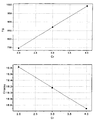
- the criticality of selecting the narrow range of 2.5 - 3.5 % of Cr for achieving a combination of high tensile and impact strength is furthermore disclosed on the enclosed figure 1.
- the component Mo serves to improve the strength of steel through the improvement of hardenability and also through solution and precipitation hardening.
- a Mo content below 0.3% has only negligible effect on the properties.
- the Mo amount should not exceed 0.7% due to the costs of this alloying element.
- the component O has a large influence on the mechanical strength of the sintered body and generally it is preferred that the amount of O should be kept as low as possible. O forms stable oxides with Cr and this brings about that a proper sintering mechanism is prevented. The amount of O should therefor preferably not exceed 0.2%. If the amount exceeds 0.25%, large amounts of the oxides are generated.
- the sintering of the compacted body is preferably carried out at a temperature lower than 1220°C, more preferably at temperatures below 1200°C and most preferably at temperatures below 1150°C.
- a temperature lower than 1220°C more preferably at temperatures below 1200°C and most preferably at temperatures below 1150°C.
- a cooling rate below 0.5°C/s results in the formation of ferrite and cooling rates exceeding 2°C/s result in martensite formation.
- the composition of the iron powder and the amount of graphite added cooling rates typical for belt furnaces i.e. 0.5-2°C/s lead to fully bainitic structures which is desirable for a good combination of strength and toughness.
- the sintering process according to the present invention is preferably carried out in belt furnaces.
- the following tables 1, 2 and 3 disclose the green density (GD), the dimensional change (dl/L), the hardness (Hv10), the tensile strength (TS), the yield strength(YS) and the impact energy (Charpy) for the products prepared.
Landscapes
- Chemical & Material Sciences (AREA)
- Engineering & Computer Science (AREA)
- Materials Engineering (AREA)
- Mechanical Engineering (AREA)
- Metallurgy (AREA)
- Organic Chemistry (AREA)
- Physics & Mathematics (AREA)
- Thermal Sciences (AREA)
- Crystallography & Structural Chemistry (AREA)
- Powder Metallurgy (AREA)
- Manufacture Of Metal Powder And Suspensions Thereof (AREA)
Abstract
Description
- The present invention concerns a chromium base alloy steel powder. More specifically the invention concerns a low oxygen, low carbon alloy steel powder including in addition to iron and chromium also Mo and Mn as well as the preparation thereof. The invention also concerns a method of preparing sintered components from this powder as well as the sintered components.
- There have recently been developed various techniques for strengthening materials for sintered machine parts produced from various alloy steel powders through powder metallurgy. The use of the alloying elements chromium, molybdenum and manganese in low oxygen, low carbon iron powders has been suggested in e.g. the US patent 4 266 974 and EP 0 653 262. The base material for the powder in both publications is a water atomised and reduction-annealed powder. The US publication discloses that the most important step in order to obtain a powder having low oxygen and carbon contents is the annealing step, which preferably should be performed under reduced pressure, specifically by vacuum induction heating. The US patent also discloses that other methods of reduction annealing involve drawbacks limiting their commercial scale installation. Nothing is disclosed in the EP application about the reduction annealing. The effective amounts of the alloying elements according to the US patent are between 0.2 and 5.0% by weight of chromium, 0.1 and 7.0% by weight of molybdenum and 0.35 and 1.50% by weight of manganese. The EP publication discloses that the effective amounts should be between 0.5 and 3% by weight of chromium, 0.1 and 2% by weight of molybdenum and at most 0.08% by weight of manganese. The purpose of the invention according to the US patent is to provide a powder satisfying the demands of high compressibility and moldability of the powder and good heat-treatment properties, such as carburising, hardenability, in the sintered body. A serious drawback when using the invention disclosed in the EP application is that cheap scrap cannot be used as this scrap normally includes more than 0.08% by weight of manganese. In this context the EP application teaches that a specific treatment has to be used in order to reduce the Mn content to a level not larger than 0.08 % by weight. Another problem is that nothing is taught about the reduction annealing and the possibility to obtain the low oxygen and carbon content in water-atomised iron powders including elements sensitive to oxidation, such as chromium, manganese. The only information given in this respect seems to be in example 1, which discloses that a final reduction has to be performed. JP-A-6 306 403 disclosed a water atomized steel powder comprising Cr 0.5-3.0%, Mo 0.1-2.0% and optionally Mn 0.08-1.0%, reduction annealed to C < 0.01% for sintering products having improved tensile strength and Charpy impact energy.
- In brief the present invention as defined in claim 1 concerns a chromium-based low oxygen, low carbon iron powder including 2.5 to 3.5% by weight of chromium, 0.3 to 0.7% by weight of molybdenum and 0.09 to 0.3% by weight of manganese. This composition permits the production of sintered components having excellent mechanical properties from an inexpensive water-atomised and reduction annealed raw material.
- Unexpectedly it has been found that sintered products prepared from the powder according to the invention as defined in claim 3 are distinguished by a combination of high tensile strength, high toughness and high dimensional accuracy. Even more surprising is the fact that these properties can be obtained without thermal treatments of the sintered products. It has thus been found that sintered products combining a tensile strength of at least 800 MPa and an impact strength of at least 19 J can be obtained in cost effective sintering equipment, such as high output belt furnaces, operating at about 1120°C with sintering times of about 30 minutes.
- Preferably the amount of Cr varies between 2.7 and 3.3% by weight, the amount of Mo varies between 0.4 and 0.6% by weight and the amount of Mn varies between 0.09 and 0.3% by weight.
- The alloy steel powder of the invention can be readily produced by subjecting ingot steel prepared to have the above-defined composition of alloying elements to any known water-atomising method. It is preferred that the water-atomised powder is prepared in such a way that, before annealing, the water-atomised powder has a weight ratio O:C between 1 and 4, preferably between 1.5 and 3.5 and most, preferably between 2 and 3, and a carbon content between 0.1 and 0.9 % by weight. For the further processing according to the present invention this water-atomised powder could be annealed according to methods described in PCT/SE97/01292 and which more specifically concerns a process including the following steps
- a) preparing a water atomised powder essentially consisting of iron and optionally at least one alloying element selected from the group consisting of chromium, manganese, copper, nickel, vanadium, niobium, boron, silicon, molybdenum and tungsten.
- b)annealing the powder in an atmosphere containing at least H2 and H2O gases;
- c)measuring the concentration of at least one of the carbon oxides formed during the decarburisation process; or
- d)measuring the oxygen potential essentially simultaneously in at least 2 points located at a predetermined distance from each other in the longitudinal direction of the furnace; or
- e)measuring the concentration according to c) in combination with measuring the oxygen potential in at least one point in the furnace
- f) adjusting the content of the H2O gas in the de-carburising atmosphere with the aid of the measurement.
-
- Another process which can be used for the preparation of low oxygen, low carbon iron-based powders including low amounts of easily oxidised alloying elements is disclosed in the co-pending Swedish application 9800153-0. This process includes the steps of
- charging a gas tight furnace with the water-atomised powder in an essentially inert gas atmosphere and closing the furnace;
- increasing the furnace temperature, preferably by direct electrical or gas heating to a temperature of 800-1350°C;
- monitoring the increase of the formation of CO gas and evacuating gas from the furnace when a significant increase of the CO formation is observed; and
- cooling the powder when the increase of the formation of CO gas diminishes.
- The annealed low oxygen, low carbon powder is then mixed with graphite powder and optionally at least one alloying element selected from the group Cu, P, B, Nb, V, Ni and W in an amount, which is determined by the final use of the sintered product. The amount of graphite added usually varies between 0.15 and 0.65 % by weight of the iron-based powder, and a lubricant, such as zinc stearate or H-wax, in an amount up to 1 % by weight of the iron-based powder. This mixture is then compacted at conventional compacting pressures, i.e. at pressures from 400 - 800 MPa, and sintered at temperatures between 1100 and 1300°C. Preferably and most unexpectedly, however, products prepared from the powder according to the invention exhibit excellent mechanical properties also when the powders are sintered at low temperatures, i.e. temperatures below about 1220°C, preferably below 1200°C or even below about 1150°C, and comparatively short sintering times, i.e. sintering times below 1 h, such as 45. Usually the sintering time is about 30 minutes.
- The reasons why the respective components in the alloy steel powder and sintered body of the invention are limited within certain ranges are as follows.
- The reason why C in the alloy steel powder is not larger than 0.01% is that C is an element which serves to harden the ferrite matrix through formation of a solid solution as penetrated in the steel. If the C content exceeds 0.01% by weight, the powder is hardened considerably, which results in a too poor compressibility for a powder intended for commercial use.
- The amount of C in the sintered product is determined by the amount of graphite powder mixed with the alloy steel powder of the invention. Typically the amount of graphite added to the powders is between 0.15 and 0.65 % by weight. For powders having Cr contents between 3 and 3.5% the amount of graphite added is somewhat lower and preferably between 0.15 and 0.5%. The amount of C in the sintered product is essentially the same as the amount of graphite added to the powder.
- The limited amounts of the following components are common to both the alloy steel powder and the sintered body.
- The component Mn improves the strength of steel by improving hardenability and through solution hardening. However, if the amount of Mn exceeds 0.3%, the ferrite hardness will increase through solid solution hardening, and this, in turn, results in powders having poor compressibility. If the amount of Mn is less than 0.08 it is not possible to use cheap scrap that normally has an Mn content above 0.08 %, unless a specific treatment for the reduction of Mn during the course of the steel manufacturing is carried out (cf EP 653 262 p.4, lines 42-44). Thus, the preferred amount of Mn according to the present invention is 0.09-0.3%. In combination with C contents below 0.007% this Mn interval gives the most interesting results.
- The component Cr is a suitable alloying element in steel powders, since it provides sintered products having an improved hardenability but not significantly increased ferrite hardness. To obtain a sufficient strength after sintering a Cr content of 2.5% or higher is preferred. Cr contents above 3.5 % result in problems with oxide and/or carbide formation. Additionally the hardenability of becomes too high for practical applications of the sintered products if the Cr content exceeds 3.5 % by weight. The criticality of selecting the narrow range of 2.5 - 3.5 % of Cr for achieving a combination of high tensile and impact strength is furthermore disclosed on the enclosed figure 1.
- The component Mo serves to improve the strength of steel through the improvement of hardenability and also through solution and precipitation hardening. A Mo content below 0.3% has only negligible effect on the properties. Furthermore, it is preferred that the Mo amount should not exceed 0.7% due to the costs of this alloying element.
- In general low amounts, i.e. amounts below 0.01, of S and P are required in order to obtain high strength sintered bodies and powders having high compressibility and the amounts of S and P in the powders used according to the present invention are preferably below 0.01% by weight.
- The component O has a large influence on the mechanical strength of the sintered body and generally it is preferred that the amount of O should be kept as low as possible. O forms stable oxides with Cr and this brings about that a proper sintering mechanism is prevented. The amount of O should therefor preferably not exceed 0.2%. If the amount exceeds 0.25%, large amounts of the oxides are generated.
- The sintering of the compacted body is preferably carried out at a temperature lower than 1220°C, more preferably at temperatures below 1200°C and most preferably at temperatures below 1150°C. As disclosed in the following examples unexpectedly good tensile strength without any subsequent heat treatment is obtained when sintering at temperatures as low as 1120°C for periods of only 30 minutes. At high temperatures, i.e. temperatures above 1220°C sintering costs undesirably increase which makes the powders and method according to the present invention very attractive from an industrial point of view.
- A cooling rate below 0.5°C/s results in the formation of ferrite and cooling rates exceeding 2°C/s result in martensite formation. Depending on i.a. the composition of the iron powder and the amount of graphite added cooling rates typical for belt furnaces, i.e. 0.5-2°C/s lead to fully bainitic structures which is desirable for a good combination of strength and toughness. In this context it should also be mentioned that the sintering process according to the present invention is preferably carried out in belt furnaces.
- The invention is further illustrated by the following examples.
- Steel powders having Cr contents between 2 and 3 % by weight, an Mo content of 0.5 % by weight and an Mn content of 0.11 % by weight were water-atomised and annealed as described in the patent application PCT/ SE 97/01292. Graphite (C-UF4) in amounts varying from 0.3 to 0.7% by weight was added as well as 0.8% by weight of a lubricant, H-wax. The powders were compacted at 700 MPa and then sintered in an atmosphere of 90%N2/10H2 for 30 minutes at 1120°C. The following tables 1, 2 and 3 disclose the green density (GD), the dimensional change (dl/L), the hardness (Hv10), the tensile strength (TS), the yield strength(YS) and the impact energy (Charpy) for the products prepared.
Powder:2Cr 0.5Mo 0.11Mn Graphite added % GD g/cc dl/L Hv10 TS MPa YS MPa Charpy J 0.3 7.14 -0.072 200 669 521 23.5 0.4 7.11 -0.085 210 720 538 20.8 0.5 7.12 -0.072 221 761 576 21.2 0.6 7.10 -0.056 237 808 612 18.6 0.7 7.12 -0.025 261 861 698 16.8 Powder:2.5Cr 0.5Mo 0.11Mn Graphite added % GD g/cc dl/L Hv10 TS Mpa YS MPa Charpy J 0.3 7.13 -0.089 218 731 534 25.8 0.4 7.12 -0.077 227 762 561 22.1 0.5 7.11 -0.065 251 814 595 20.4 0.6 7.11 -0.044 268 877 679 18.5 0.7 7.07 -0.019 361 1007 732 16.1 Powder:3Cr 0.5Mo 0.11Mn Graphite added % GD g/cc dl/L Hv10 TS MPa YS MPa Charpy J 0.3 7.10 -0.106 234 754 526 24.0 0.4 7,10 -0.076 247 804 563 20.7 0.5 7.10 -0.034 257 856 623 18.0 0.6 7.09 -0.001 315 969 704 16.4 0.7 7.04 508 685 15.6 - A too high Mn content has a negative influence on compressibility due to increase of the ferrite hardness through solid solution hardening. This is illustrated in table 4, which discloses the compressibility of Fe-3Cr-0.5Mo powder with lubricated die at 600Mpa.
Powder C [%] O [%] Mn [%] GD [g/cc] A 0.003 0.12 0.09 7.00 B 0.004 0.14 0.12 6.98 C 0.004 0.13 0.18 6.90 D 0.004 0.13 0.28 6.81
Claims (10)
- A water-atomised, annealed iron-based powder comprising, by weight %,the balance being iron and, an amount of not more than 0.5 %, inevitable impurities.Cr 2.5-3.5Mo 0.3-0.7Mn 0.09-0.3Cu < 0.10Ni < 0.15S and P < 0.02N < 0.01V < 0.10Si < 0.10W < 0.10O < 0.25C < 0.01
- The water-atomised, annealed iron-based powder according to claim 1 comprising, by weight %,the balance being iron and, an amount of not more that 0.2%, inevitable impurities.Cr 2.7-3.3Mo 0.4-0.6Mn 0.09-0.25O < 0.15C < 0.007
- Method of preparing a sintered product having a tensile strength of at least 750 MPa without subsequent heat treatment comprising the steps of
water-atomising an iron-based powder comprising the alloying elements Cr, Mo and Mn in the amounts according to any one of the above claims and having a starting carbon content of 0.1 - 0.9% by weight;
reducing the water-atomised powder to achieve the composition according to claim 1 or 2 at atmospheric pressure in a.reducing atmosphere in the precence of H2 and controlled amounts of H2O;
adding 0.25 - 0.75% by weight of graphite and optionally at least one alloying element selected from the group Cu, P, V, Ni and W in an amount, which is determined by the final use of the sintered product and which is within the limits of claim 1;
compacting the annealed powder at a pressure of at least 600 MPa;
and subjecting the compacted body to sintering. - Method according to claim 3 wherein the reduction is performed at low pressure in an essentially inert atmosphere and CO evacuation.
- The method according to anyone of the claims 3-4, wherein the water-atomised powder before annealing has a weight ratio O:C between 1 and 4, preferably between 1.5 and 3.5 and most preferably between 2 and 3.
- The method according to any one of the claims 3-5 wherein the amount of graphite is 0.3 to 0.5% by weight.
- The method according to any one of the claims 3-6 wherein for powders having a Cr content of 3-3.5 the amount of graphite is 0.25 to 0.5 % by weight.
- The method according to claim 3 wherein the sintering temperature is at most 1220°C, preferably less than 1200°C and most preferably less than 1150°C.
- The method according to claim 3 wherein the sintering times are less than 60 minutes, preferably less than 50 minutes and most preferably less than 40 minutes.
- A sintered product prepared according to any one of the claims 3-9 having a combined carbon content of at least 0.25 %, preferably at least 0.3.
Applications Claiming Priority (3)
| Application Number | Priority Date | Filing Date | Title |
|---|---|---|---|
| SE9800154 | 1998-01-21 | ||
| SE9800154A SE9800154D0 (en) | 1998-01-21 | 1998-01-21 | Steel powder for the preparation of sintered products |
| PCT/SE1999/000092 WO1999037424A1 (en) | 1998-01-21 | 1999-01-21 | Steel powder for the preparation of sintered products |
Publications (2)
| Publication Number | Publication Date |
|---|---|
| EP1049552A1 EP1049552A1 (en) | 2000-11-08 |
| EP1049552B1 true EP1049552B1 (en) | 2003-12-17 |
Family
ID=20409929
Family Applications (1)
| Application Number | Title | Priority Date | Filing Date |
|---|---|---|---|
| EP99904004A Expired - Lifetime EP1049552B1 (en) | 1998-01-21 | 1999-01-21 | Steel powder for the preparation of sintered products |
Country Status (16)
| Country | Link |
|---|---|
| US (1) | US6348080B1 (en) |
| EP (1) | EP1049552B1 (en) |
| JP (2) | JP4909460B2 (en) |
| KR (1) | KR100601498B1 (en) |
| CN (1) | CN1116944C (en) |
| AT (1) | ATE256520T1 (en) |
| AU (1) | AU738667B2 (en) |
| BR (1) | BR9907190A (en) |
| CA (1) | CA2318112C (en) |
| DE (1) | DE69913650T2 (en) |
| ES (1) | ES2212523T3 (en) |
| PL (1) | PL189271B1 (en) |
| RU (1) | RU2216433C2 (en) |
| SE (1) | SE9800154D0 (en) |
| TW (1) | TW450855B (en) |
| WO (1) | WO1999037424A1 (en) |
Cited By (1)
| Publication number | Priority date | Publication date | Assignee | Title |
|---|---|---|---|---|
| EP2408943A4 (en) * | 2009-03-20 | 2012-08-29 | Hoeganaes Ab Publ | ALLOY OF IRON POWDER AND VANADIUM |
Families Citing this family (31)
| Publication number | Priority date | Publication date | Assignee | Title |
|---|---|---|---|---|
| US6261514B1 (en) | 2000-05-31 | 2001-07-17 | Höganäs Ab | Method of preparing sintered products having high tensile strength and high impact strength |
| US6514307B2 (en) * | 2000-08-31 | 2003-02-04 | Kawasaki Steel Corporation | Iron-based sintered powder metal body, manufacturing method thereof and manufacturing method of iron-based sintered component with high strength and high density |
| SE0201824D0 (en) * | 2002-06-14 | 2002-06-14 | Hoeganaes Ab | Pre-alloyed iron based powder |
| CN1410208B (en) * | 2002-11-25 | 2011-01-19 | 莱芜钢铁集团粉末冶金有限公司 | Manufacturing method of alloy steel powder by spraying |
| US20060226729A1 (en) * | 2003-09-05 | 2006-10-12 | Du Hung T | Field assemblies and methods of making same with field coils having multiple coils |
| US7211920B2 (en) * | 2003-09-05 | 2007-05-01 | Black & Decker Inc. | Field assemblies having pole pieces with axial lengths less than an axial length of a back iron portion and methods of making same |
| EP1661228A4 (en) | 2003-09-05 | 2016-11-23 | Black & Decker Inc | EXCITATION ASSEMBLIES AND PROCESS FOR PRODUCING THE SAME |
| US7205696B2 (en) * | 2003-09-05 | 2007-04-17 | Black & Decker Inc. | Field assemblies having pole pieces with ends that decrease in width, and methods of making same |
| US20050189844A1 (en) * | 2003-09-05 | 2005-09-01 | Du Hung T. | Field assemblies having pole pieces with dovetail features for attaching to a back iron piece(s) and methods of making same |
| TW200514334A (en) * | 2003-09-05 | 2005-04-16 | Black & Decker Inc | Field assemblies and methods of making same |
| US20060002812A1 (en) * | 2004-06-14 | 2006-01-05 | Hoganas Ab | Sintered metal parts and method for the manufacturing thereof |
| SE0401535D0 (en) * | 2004-06-14 | 2004-06-14 | Hoeganaes Ab | Sintered metal parts and method of manufacturing thereof |
| EP2568573A3 (en) * | 2005-03-07 | 2014-06-04 | Black & Decker Inc. | Power Tools with Motor Having a Multi-Piece Stator |
| JP5453251B2 (en) * | 2007-06-14 | 2014-03-26 | ホガナス アクチボラグ (パブル) | Iron-based powder and composition thereof |
| RU2462524C2 (en) * | 2007-09-28 | 2012-09-27 | Хеганес Аб (Пабл) | Metallurgical powder composition, method of manufacturing and detail obtained from it |
| CN104711472A (en) * | 2007-12-27 | 2015-06-17 | 霍加纳斯股份有限公司 | Low alloyed steel powder |
| EP2231891A4 (en) | 2007-12-27 | 2017-03-29 | Höganäs Ab (publ) | Low alloyed steel powder |
| RU2359056C1 (en) * | 2008-01-09 | 2009-06-20 | Юлия Алексеевна Щепочкина | Wearproof sintered alloy on basis of iron |
| TWI506145B (en) * | 2008-06-06 | 2015-11-01 | Hoganas Ab Publ | Iron-based pre-alloyed powder |
| TWI482865B (en) * | 2009-05-22 | 2015-05-01 | 胡格納斯股份有限公司 | High strength low alloyed sintered steel |
| RU2391434C1 (en) * | 2009-06-03 | 2010-06-10 | Юлия Алексеевна Щепочкина | Wear resistant sintered iron-based alloy |
| RU2559603C2 (en) * | 2010-06-04 | 2015-08-10 | Хеганес Аб (Пабл) | Nitride-hardened sintered steels |
| CN103537677A (en) * | 2013-10-11 | 2014-01-29 | 芜湖市鸿坤汽车零部件有限公司 | Sintered alloy containing chromium and preparation method thereof |
| BR112017004710B1 (en) | 2014-09-16 | 2021-09-21 | Höganäs Ab (Publ) | PRE-ALLOUS IRON-BASED SPRAYED, IRON-BASED SPRAYED MIXTURE, PROCESS FOR THE MANUFACTURING OF A SINTERED AND CARBURED COMPONENT AND SINTERED GEAR |
| JP6417573B2 (en) * | 2014-12-24 | 2018-11-07 | 住友電工焼結合金株式会社 | Sintered material |
| CN104858444B (en) * | 2015-06-11 | 2017-04-26 | 四川理工学院 | Hypoxic manganese-containing water atomized steel powder reduction process |
| KR102064146B1 (en) | 2015-09-11 | 2020-01-08 | 제이에프이 스틸 가부시키가이샤 | Method for producing alloyed steel powder for sintered member starting material |
| WO2017051541A1 (en) | 2015-09-24 | 2017-03-30 | Jfeスチール株式会社 | Method for manufacturing alloy steel powder for sintered member raw material |
| KR101869152B1 (en) * | 2016-07-19 | 2018-06-20 | 한국생산기술연구원 | Method for manufacturing Fe-Cr based alloy using mixed reduction gas |
| KR102288887B1 (en) * | 2017-04-10 | 2021-08-12 | 현대자동차주식회사 | Method of manufacturing iron powder and iron powder manufactured thereby |
| CN108746647A (en) * | 2018-06-27 | 2018-11-06 | 北京金物科技发展有限公司 | A kind of preparation method and Powder High-speed Steels of Powder High-speed Steels |
Citations (1)
| Publication number | Priority date | Publication date | Assignee | Title |
|---|---|---|---|---|
| JPH06306403A (en) * | 1993-04-23 | 1994-11-01 | Kawasaki Steel Corp | High-strength and high-toughness cr alloy steel powder sintered compact and its production |
Family Cites Families (10)
| Publication number | Priority date | Publication date | Assignee | Title |
|---|---|---|---|---|
| US4382818A (en) * | 1975-12-08 | 1983-05-10 | Ford Motor Company | Method of making sintered powder alloy compacts |
| JPS58481B2 (en) * | 1976-03-12 | 1983-01-06 | 川崎製鉄株式会社 | Method and apparatus for producing low-oxygen iron-based metal powder |
| US4069044A (en) * | 1976-08-06 | 1978-01-17 | Stanislaw Mocarski | Method of producing a forged article from prealloyed-premixed water atomized ferrous alloy powder |
| JPS5810962B2 (en) * | 1978-10-30 | 1983-02-28 | 川崎製鉄株式会社 | Alloy steel powder with excellent compressibility, formability and heat treatment properties |
| JPS5935602A (en) * | 1982-08-23 | 1984-02-27 | Sumitomo Metal Ind Ltd | Production of low oxygen low carbon alloy steel powder |
| JPS59173201A (en) * | 1983-03-19 | 1984-10-01 | Sumitomo Metal Ind Ltd | Method for producing highly compressible alloy steel powder |
| DE4030054C2 (en) * | 1990-09-20 | 1995-11-02 | Mannesmann Ag | Process and plant for the reduction annealing of iron powder |
| JP3258765B2 (en) * | 1993-06-02 | 2002-02-18 | 川崎製鉄株式会社 | Manufacturing method of high-strength iron-based sintered body |
| RU2043868C1 (en) * | 1993-07-06 | 1995-09-20 | Тамара Ароновна Пумпянская | Method to produce sintered pieces from diffusion alloyed iron powders |
| SE9602835D0 (en) * | 1996-07-22 | 1996-07-22 | Hoeganaes Ab | Process for the preparation of an iron-based powder |
-
1998
- 1998-01-21 SE SE9800154A patent/SE9800154D0/en unknown
- 1998-07-15 TW TW087111489A patent/TW450855B/en not_active IP Right Cessation
-
1999
- 1999-01-21 PL PL99341981A patent/PL189271B1/en unknown
- 1999-01-21 AU AU24466/99A patent/AU738667B2/en not_active Ceased
- 1999-01-21 RU RU2000121966/02A patent/RU2216433C2/en not_active IP Right Cessation
- 1999-01-21 EP EP99904004A patent/EP1049552B1/en not_active Expired - Lifetime
- 1999-01-21 ES ES99904004T patent/ES2212523T3/en not_active Expired - Lifetime
- 1999-01-21 CN CN99802316A patent/CN1116944C/en not_active Expired - Lifetime
- 1999-01-21 KR KR1020007007945A patent/KR100601498B1/en not_active Expired - Lifetime
- 1999-01-21 AT AT99904004T patent/ATE256520T1/en active
- 1999-01-21 JP JP2000528389A patent/JP4909460B2/en not_active Expired - Lifetime
- 1999-01-21 WO PCT/SE1999/000092 patent/WO1999037424A1/en not_active Ceased
- 1999-01-21 CA CA002318112A patent/CA2318112C/en not_active Expired - Lifetime
- 1999-01-21 DE DE1999613650 patent/DE69913650T2/en not_active Expired - Lifetime
- 1999-01-21 BR BR9907190-8A patent/BR9907190A/en not_active IP Right Cessation
-
2000
- 2000-07-18 US US09/618,939 patent/US6348080B1/en not_active Expired - Lifetime
-
2010
- 2010-02-15 JP JP2010029952A patent/JP2010159495A/en active Pending
Patent Citations (1)
| Publication number | Priority date | Publication date | Assignee | Title |
|---|---|---|---|---|
| JPH06306403A (en) * | 1993-04-23 | 1994-11-01 | Kawasaki Steel Corp | High-strength and high-toughness cr alloy steel powder sintered compact and its production |
Cited By (1)
| Publication number | Priority date | Publication date | Assignee | Title |
|---|---|---|---|---|
| EP2408943A4 (en) * | 2009-03-20 | 2012-08-29 | Hoeganaes Ab Publ | ALLOY OF IRON POWDER AND VANADIUM |
Also Published As
| Publication number | Publication date |
|---|---|
| WO1999037424A1 (en) | 1999-07-29 |
| JP2010159495A (en) | 2010-07-22 |
| ATE256520T1 (en) | 2004-01-15 |
| KR20010052151A (en) | 2001-06-25 |
| EP1049552A1 (en) | 2000-11-08 |
| AU738667B2 (en) | 2001-09-20 |
| PL341981A1 (en) | 2001-05-07 |
| TW450855B (en) | 2001-08-21 |
| ES2212523T3 (en) | 2004-07-16 |
| DE69913650D1 (en) | 2004-01-29 |
| BR9907190A (en) | 2000-10-17 |
| JP4909460B2 (en) | 2012-04-04 |
| CA2318112A1 (en) | 1999-07-29 |
| CN1116944C (en) | 2003-08-06 |
| CA2318112C (en) | 2008-12-30 |
| DE69913650T2 (en) | 2004-11-18 |
| KR100601498B1 (en) | 2006-07-19 |
| JP2002501122A (en) | 2002-01-15 |
| US6348080B1 (en) | 2002-02-19 |
| SE9800154D0 (en) | 1998-01-21 |
| CN1288402A (en) | 2001-03-21 |
| RU2216433C2 (en) | 2003-11-20 |
| AU2446699A (en) | 1999-08-09 |
| PL189271B1 (en) | 2005-07-29 |
Similar Documents
| Publication | Publication Date | Title |
|---|---|---|
| US6348080B1 (en) | Steel powder for the preparation of sintered products | |
| US7341689B2 (en) | Pre-alloyed iron based powder | |
| GB2035376A (en) | Alloy steel powder | |
| US4437891A (en) | Oil-atomized low-alloy steel powder | |
| US5605559A (en) | Alloy steel powders, sintered bodies and method | |
| EP0726332B1 (en) | Sulfur-containing powder-metallurgy tool steel article | |
| EP0653262B1 (en) | Alloy steel powder for sinter with high strength, high fatigue strength and high toughness, sinter, and process for producing the sinter | |
| KR100505933B1 (en) | Low alloy steel manufacturing powder by sinter hardening method | |
| EP0274542B1 (en) | Alloy steel powder for powder metallurgy | |
| JP3517505B2 (en) | Raw material powder for sintered wear resistant material | |
| EP0648851B1 (en) | Sulfur-containing powder-metallurgy tool steel article and its method of manufacture | |
| US20090142220A1 (en) | Sinter-hardening powder and their sintered compacts | |
| JPH04165002A (en) | High compressibility cr base alloy steel powder and manufacture of high strength sintered material using it | |
| JPH08218101A (en) | Mixed steel powder for powder metallurgy and sintering material containing the same | |
| JPS6333541A (en) | Manufacture of sintered alloy steel | |
| MXPA00007198A (en) | Steel powder for the preparation of sintered products | |
| JPS59129753A (en) | Alloy steel powder for high strength sintered material | |
| JPH0568522B2 (en) | ||
| JPS6077901A (en) | Alloy steel powder for powder metallurgy |
Legal Events
| Date | Code | Title | Description |
|---|---|---|---|
| PUAI | Public reference made under article 153(3) epc to a published international application that has entered the european phase |
Free format text: ORIGINAL CODE: 0009012 |
|
| 17P | Request for examination filed |
Effective date: 20000717 |
|
| AK | Designated contracting states |
Kind code of ref document: A1 Designated state(s): AT CH DE ES FR GB IT LI SE |
|
| 17Q | First examination report despatched |
Effective date: 20021127 |
|
| GRAH | Despatch of communication of intention to grant a patent |
Free format text: ORIGINAL CODE: EPIDOS IGRA |
|
| GRAS | Grant fee paid |
Free format text: ORIGINAL CODE: EPIDOSNIGR3 |
|
| GRAA | (expected) grant |
Free format text: ORIGINAL CODE: 0009210 |
|
| AK | Designated contracting states |
Kind code of ref document: B1 Designated state(s): AT CH DE ES FR GB IT LI SE |
|
| REG | Reference to a national code |
Ref country code: GB Ref legal event code: FG4D |
|
| REG | Reference to a national code |
Ref country code: CH Ref legal event code: EP |
|
| REG | Reference to a national code |
Ref country code: CH Ref legal event code: NV Representative=s name: BRAUN & PARTNER PATENT-, MARKEN-, RECHTSANWAELTE |
|
| REF | Corresponds to: |
Ref document number: 69913650 Country of ref document: DE Date of ref document: 20040129 Kind code of ref document: P |
|
| REG | Reference to a national code |
Ref country code: SE Ref legal event code: TRGR |
|
| REG | Reference to a national code |
Ref country code: ES Ref legal event code: FG2A Ref document number: 2212523 Country of ref document: ES Kind code of ref document: T3 |
|
| ET | Fr: translation filed | ||
| PLBE | No opposition filed within time limit |
Free format text: ORIGINAL CODE: 0009261 |
|
| STAA | Information on the status of an ep patent application or granted ep patent |
Free format text: STATUS: NO OPPOSITION FILED WITHIN TIME LIMIT |
|
| 26N | No opposition filed |
Effective date: 20040920 |
|
| REG | Reference to a national code |
Ref country code: FR Ref legal event code: PLFP Year of fee payment: 18 |
|
| PGFP | Annual fee paid to national office [announced via postgrant information from national office to epo] |
Ref country code: FR Payment date: 20151208 Year of fee payment: 18 |
|
| PGFP | Annual fee paid to national office [announced via postgrant information from national office to epo] |
Ref country code: CH Payment date: 20160111 Year of fee payment: 18 Ref country code: IT Payment date: 20160127 Year of fee payment: 18 |
|
| PGFP | Annual fee paid to national office [announced via postgrant information from national office to epo] |
Ref country code: SE Payment date: 20160112 Year of fee payment: 18 Ref country code: GB Payment date: 20160120 Year of fee payment: 18 |
|
| REG | Reference to a national code |
Ref country code: CH Ref legal event code: PL |
|
| GBPC | Gb: european patent ceased through non-payment of renewal fee |
Effective date: 20170121 |
|
| REG | Reference to a national code |
Ref country code: FR Ref legal event code: ST Effective date: 20170929 |
|
| PG25 | Lapsed in a contracting state [announced via postgrant information from national office to epo] |
Ref country code: CH Free format text: LAPSE BECAUSE OF NON-PAYMENT OF DUE FEES Effective date: 20170131 Ref country code: LI Free format text: LAPSE BECAUSE OF NON-PAYMENT OF DUE FEES Effective date: 20170131 Ref country code: FR Free format text: LAPSE BECAUSE OF NON-PAYMENT OF DUE FEES Effective date: 20170131 |
|
| PG25 | Lapsed in a contracting state [announced via postgrant information from national office to epo] |
Ref country code: GB Free format text: LAPSE BECAUSE OF NON-PAYMENT OF DUE FEES Effective date: 20170121 Ref country code: SE Free format text: LAPSE BECAUSE OF NON-PAYMENT OF DUE FEES Effective date: 20170122 |
|
| PG25 | Lapsed in a contracting state [announced via postgrant information from national office to epo] |
Ref country code: IT Free format text: LAPSE BECAUSE OF NON-PAYMENT OF DUE FEES Effective date: 20170121 |
|
| PGFP | Annual fee paid to national office [announced via postgrant information from national office to epo] |
Ref country code: DE Payment date: 20180110 Year of fee payment: 20 Ref country code: ES Payment date: 20180201 Year of fee payment: 20 |
|
| PGFP | Annual fee paid to national office [announced via postgrant information from national office to epo] |
Ref country code: AT Payment date: 20171228 Year of fee payment: 20 |
|
| REG | Reference to a national code |
Ref country code: DE Ref legal event code: R071 Ref document number: 69913650 Country of ref document: DE |
|
| REG | Reference to a national code |
Ref country code: AT Ref legal event code: MK07 Ref document number: 256520 Country of ref document: AT Kind code of ref document: T Effective date: 20190121 |
|
| REG | Reference to a national code |
Ref country code: ES Ref legal event code: FD2A Effective date: 20210129 |
|
| PG25 | Lapsed in a contracting state [announced via postgrant information from national office to epo] |
Ref country code: ES Free format text: LAPSE BECAUSE OF EXPIRATION OF PROTECTION Effective date: 20190122 |