EP1046260B1 - Home-network autoconfiguration - Google Patents
Home-network autoconfiguration Download PDFInfo
- Publication number
- EP1046260B1 EP1046260B1 EP99941549A EP99941549A EP1046260B1 EP 1046260 B1 EP1046260 B1 EP 1046260B1 EP 99941549 A EP99941549 A EP 99941549A EP 99941549 A EP99941549 A EP 99941549A EP 1046260 B1 EP1046260 B1 EP 1046260B1
- Authority
- EP
- European Patent Office
- Prior art keywords
- sub
- registry
- resource
- service
- proxy
- Prior art date
- Legal status (The legal status is an assumption and is not a legal conclusion. Google has not performed a legal analysis and makes no representation as to the accuracy of the status listed.)
- Expired - Lifetime
Links
- 238000000034 method Methods 0.000 claims description 17
- 230000010365 information processing Effects 0.000 claims description 15
- 238000010586 diagram Methods 0.000 description 7
- 230000006855 networking Effects 0.000 description 5
- 230000001419 dependent effect Effects 0.000 description 2
- 238000001514 detection method Methods 0.000 description 2
- 230000007257 malfunction Effects 0.000 description 2
- 238000003780 insertion Methods 0.000 description 1
- 230000037431 insertion Effects 0.000 description 1
- 230000008520 organization Effects 0.000 description 1
- 230000002093 peripheral effect Effects 0.000 description 1
Images


Classifications
-
- H—ELECTRICITY
- H04—ELECTRIC COMMUNICATION TECHNIQUE
- H04L—TRANSMISSION OF DIGITAL INFORMATION, e.g. TELEGRAPHIC COMMUNICATION
- H04L41/00—Arrangements for maintenance, administration or management of data switching networks, e.g. of packet switching networks
- H04L41/08—Configuration management of networks or network elements
- H04L41/0803—Configuration setting
- H04L41/0806—Configuration setting for initial configuration or provisioning, e.g. plug-and-play
-
- H—ELECTRICITY
- H04—ELECTRIC COMMUNICATION TECHNIQUE
- H04L—TRANSMISSION OF DIGITAL INFORMATION, e.g. TELEGRAPHIC COMMUNICATION
- H04L12/00—Data switching networks
- H04L12/28—Data switching networks characterised by path configuration, e.g. LAN [Local Area Networks] or WAN [Wide Area Networks]
-
- H—ELECTRICITY
- H04—ELECTRIC COMMUNICATION TECHNIQUE
- H04L—TRANSMISSION OF DIGITAL INFORMATION, e.g. TELEGRAPHIC COMMUNICATION
- H04L12/00—Data switching networks
- H04L12/28—Data switching networks characterised by path configuration, e.g. LAN [Local Area Networks] or WAN [Wide Area Networks]
- H04L12/2803—Home automation networks
- H04L12/2805—Home Audio Video Interoperability [HAVI] networks
Definitions
- the invention relates to a method and system for networking information processing sub-systems.
- the invention relates especially to configuring a network of PC's in the home environment.
- Jini is a Java-based software technology that assists in networking PC's and peripherals.
- a Jini-enabled device When plugged into a network, a Jini-enabled device will broadcast its presence. Network clients that are ready to use that device can request the necessary software from the device, bypassing a server or a network administrator.
- This architecture builds on top of an existing network. The network itself is assumed to have been configured in advance.
- the first problem relating to the detection has been solved by plug-and-play technology.
- the Windows95 OS allows many Ethernet cards / token ring cards to work automatically upon insertion in the system.
- the second problem relating to address assignment is currently being worked on in the industry.
- a known solution is a configuration management protocol, an example of which is the DHCP protocol (Dynamic Host Configuration Protocol) that lets network administrators manage centrally and automate the assignment of Internet Protocol (IP) addresses in an organization's network.
- DHCP protocol Dynamic Host Configuration Protocol
- An object of the invention is to provide a solution for the third problem, that is, for the implementing of a sharing protocol.
- An embodiment of the invention relates to an information processing system that has a first information processing sub-system (e.g., a PC) coupled to a second information processing sub-system (e.g., another PC).
- the first sub-system has a first registry for registering at least a first resource or service local to the first sub-system.
- the second sub-system has a second registry for registering at least a second resource or service local to the second sub-system.
- the first sub-system has a first proxy client registered with the first registry and representing the second sub-system.
- the second sub-system has a second proxy server for communicating with the first proxy client and for providing the first sub-system with access to the second resource or service.
- the registering of services and resources of one PC at the other one through the proxy clients thus enables automatic configuration of a network in order to share resources.
- the registering hides the idea of whether a resource or a service is local or is residing at another apparatus.
- the invention uses the registering as a tool for autoconfiguration of a network.
- Jini focuses on the process of adding a device to the network and broadcasting information about the device to other machines. In this way, Jini provides a "Lookup" service that allows applications on other machines to use the newly added device.
- the approach of Jini assumes the network and operating system have already been configured so that each computer already knows about other computers. Jini's functionality occurs at a layer above the network. It does not, for example, solve the problems of automatic configuration of the network upon connection, disconnection, or reconnection. It assumes that the network is up or down, independent of Jini. Jini leverages the services provided by the network to implement its services. In other words, the invention uses the registering as a tool for autoconfiguration.
- This publication relates to a mechanism in object-oriented technology for protecting against invalid usage of proxy objects after malfunction of a server and also for transparently re-creating proxy objects in a client of a client-server distributed processing system.
- a proxy class is used that has additional attributes indicating the name of the target object in the server, an indication as to whether the name is presently valid and an alternate pointer to the target object.
- a proxy register object in the client maintains pointers to all the proxy objects, which point to objects in the server. On malfunction of the server, and consequent invalidity of the proxy objects, the proxy register object causes all proxy objects to be refreshed.
- the first proxy client represents the second sub-system at the first sub-system
- the first proxy client is registered with the registry of the first sub-system.
- the registry of the first sub-system also registers resources local to the first sub-system.
- GB-A 2 305 271 neither teaches nor suggests the first registry registering resources or services local to the first sub-system as well as registering the proxy client representative of the second sub-system.
- GB-A 2 305 271 neither teaches nor suggests that the second sub-system has a second registry for registering resources local to the second sub-system
- the problem that the invention seeks to solve also differs from the problem addressed in GB-A 2 305 271.
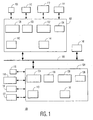
- Fig.1 is a block diagram with the main components of an operational system 100 in the invention.
- System 100 comprises a first PC 102 and a second PC 104 coupled via a bus 106.
- Bus 106 may be a wired bus or a wireless bus or a combination thereof.
- PC 102 has resources and provides services.
- PC 102 has a hard drive 108, an email capability 110, a web browser 112, a printer 114, etc.
- PC 104 has resources and services, such as a hard drive 116, a wordprocessing service 118, a graphics program 120, a printer 122, etc.
- the terms "resource” and “service” are used interchangeably below for the sake of brevity.
- PC 102 has a registry 124 for registering interfaces to resources and services 108-114 local to PC 102. Applications running on PC 102 can get access to these interfaces. The interfaces handle the messages or requests to local resources or services 108-114.
- PC 104 has a registry 126 for registering interfaces to resources and services 116-122 local to PC 104.
- PC 102 further comprises the following entities that are concurrent and may be threads or processes: a broadcaster 128, a port listener 130 and a broadcast listener 132.
- PC 104 has a broadcaster 134, a port listener 136 and a broadcast listener 138.
- PC 102 further comprises a proxy client 142 and a proxy server 144.
- PC 104 has a proxy client 140 and a proxy server 144.
- Proxy client 142 communicates with proxy server 146
- proxy client 140 communicates with proxy server 146.
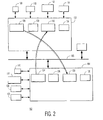
- Fig.2 is a diagram of the initial configuration of system 100 when PC's 102 and 104 have been functionally connected to bus 106.
- broadcasters 128 sends out on bus 106 a network address for PC 102, say "X”, and a port number, say "x", on an established channel.
- broadcaster 134 sends out a broadcast on bus 106 with a network address for PC 104, "Y", and a port number "y” on another established channel.
- Broadcast listener 138 of PC 104 receives the message broadcasted by PC 102.
- Broadcast listener 132 of PC 102 receives the message broadcasted by PC 104.
- Fig.3 illustrates a next step of the autoconfiguration process.
- broadcast listener 132 of PC 102 Having received the broadcast message from PC 104, broadcast listener 132 of PC 102 generates a proxy client 142. Proxy client 142 thereupon establishes a connection with port listener 136 of PC 104 at port "y". Similarly, broadcast listener 138 of PC 104 generates proxy client 140 that establishes a connection with port listener 130 at port "x".
- Fig.4 shows a further step in the autoconfiguration process.
- Port listener 130 starts up a proxy server 144 to handle requests from remote client 140.
- Proxy server 144 sends information about resources 108-114, e.g., as contained in registry 124, to proxy client 140.
- Proxy client 140 registers this information with registry 126.
- port listener 136 starts up a proxy server 146 to handle requests from remote client 142.
- Proxy server 146 sends information about resources 116-122 to proxy client 142, which thereupon registers this with registry 124.
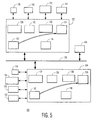
- Fig.5 shows the step wherein proxy client 142 registers with registry 124 as a local service for each resource or service available in registry 126, and wherein proxy client 140 registers with registry 126 for each resource or service available in registry 124.
- PC 102 has now copied its registry 124 specifying the addresses of its local resources and services to PC 104, where the copy is added to registry 126.
- PC 104 has copied its registry 126 to PC 102 where it gets added to registry 124. Both PC's 102 and 104 have now been registered with each other.
- a third PC 148 is connected to bus 106, a process similar as the one discussed above occurs automatically.
- Registries 124 and 126 thus hide the idea of whether a resource or a service is local or is residing at another apparatus.
- Each of the addresses in registry 124 is unique throughout registry 124.
- each of the addresses in registry 126 is unique throughout registry 126.
- a user working at PC 102 and requesting a local resource or service i.e., one of resources or services 108-114 has the request passed on directly to the resource or service requested indicated by the corresponding address in registry 124.
- the user requests a remote service or remote resource, i.e., one of resources or services 116-122 that is local to remote PC 104.
- the request is forwarded to proxy client 142 and processed by proxy server 146 as discussed below with reference to Fig.7.
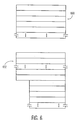
- Fig.6 gives diagrams 600 and 602 as an example of the registering of proxy client 142 with registry 124.
- Diagram 600 represents initial registry 126 with a list of local resources and services available at PC 104 and their respective local addresses.
- Diagram 602 represents registry 124 after client 142 has registered with it.
- Registry 124 initially comprises the list of resources and services 108-114 with local addresses #1 to #K.
- registry 124 has an entry for PC 104 as proxy device at address #Q.
- Remote resources and services 116-122 now have addresses dependent on address #Q.
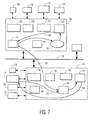
- Fig.7 illustrates this address-based operation involving proxy client 142 and proxy server 146.
- a software application 702 running on PC 102 generates a request for resource 118 at remote PC 104.
- a reference to resource 118 has been added to registry 124 as discussed above. The reference has a pointer (arrow 704) to proxy client 142.
- Proxy client 142 on PC 102 contacts (arrow 706) proxy server 146 on remote PC 104.
- Proxy server 146 has an address, or: handle, (arrow 708) to resource 118 via local registry 126. Results of the processing by resource 118 are routed back (arrow 708) via proxy server 146 and proxy client 142 (arrow 706) to application 702 (arrow 712).
- Proxy client 142 and proxy server 146 serve as a pipe.
- a request or message generated at PC 102 has an address for one of local resources or services 108-114, the message gets passed on directly to the service or device driver (not shown) of the relevant resource.
- the message is sent (702) to proxy client 142, which in turn passes on (704) the request to proxy server 146 at the dedicated port.
- Proxy server 146 processes the request and routes it (706) to the relevant one of resources 116-122 via registry 126.
- the result of the request being processed is then communicated (708) from proxy server 146 to proxy client 142 from which the result is routed to, e.g., a local application at PC 102 or a display driver (not shown) local to PC 102.
- the address of remote clients 142 and 140 can be removed from local registries 124 and 126, respectively.
- This autoconfiguration system can be demonstrated using a java-based system.
- two stand-alone PC's have java, a network card, and a TCP/IP stack installed on their machines.
- a respective random IP number is used for each respective one of the machines.
- the idea here is that the IP address and standard TCP/IP settings have not been pre-configured by the user.
- a unique id is generated -- this could be a random number of sufficient complexity so that a collision is statistically improbable (a working example of this is Microsoft's Global Unique IDentifier [GUID]).
- the IP address is used to allow TCP/IP to identify each PC and the UID is used to ensure that the randomly generated IPs are not the same. This is established since the same IP address must necessarily be connected to the same UID.
- a runtime executable is started that spawns off three objects; a Broadcaster, a Broadcast Listener, and a Port Listener - each as a java thread.
- the Broadcast Listener could use a java multicast socket to subscribe to a multicast.
- the Broadcaster could also use a java multicast socket to send information to a multicast group.
- the Port Listener could be implemented as a java ServerSocket.
- the Broadcast Listener receives a message and the IP address is the same as its own IP address and the UID is not the same, it brings down each of its Proxy Servers, randomly generates a new IP address, and automatically reconfigures itself. In this way, the IP addresses of each machine are eventually ensured to be unique.
- the Broadcast Listener receives a message and the IP address is the same as its own IP address and the UID is the same, then the message is ignored since the message was generated by its own Broadcaster.
- a new java thread is generated: a Proxy Client which connects to the Port Listener on the other machine.
- the broadcast message contains port and IP address for the Proxy Client to connect as a java Socket.
- the Port Listener through the java accept() method spawns a new java thread to handle this request: a Proxy Server. Resource information flows from the Proxy Server to the Proxy Client back to the registry.
- the registry can be organized as a hash table, where each resource is identifiable by a unique address generated when the resource or service is added to the registry.
- the Proxy Server sends information about the current registry.
- the Proxy Client then adds this information to the registry local to the Proxy Client.
- the important idea is that a handle gets associated with the Proxy Client in the registry, so that the process or thread local to the new address is the Proxy Client rather than a local process or thread.
- control information is passed to the Proxy Client which passes this same information to the Proxy Server which then passes this information to the resource or service on the other machine.
- each of these services consists of a java object that receives ByteData either from another object using the service or resource or from the Proxy Server. In this way, both the client application using the service and the service itself appear local on the same machine.
- the important idea behind the registry used is that it associates services/resources with addresses and it takes packets of data which it transmits to the appropriate service or resource based on this address.
- this data is passed using a java data input streams and data output streams.
- the address of remote clients 142 and 140 can be removed from local registries 124 and 126, respectively.
- a heartbeat protocol between the PC's ensures that each is kept aware of the other until the heartbeat of one of the PC's disappears.
- a timer expires and automatically triggers the procedure to disable the registry's entry to the relevant client.
Landscapes
- Engineering & Computer Science (AREA)
- Computer Networks & Wireless Communication (AREA)
- Signal Processing (AREA)
- Multimedia (AREA)
- Automation & Control Theory (AREA)
- Computer And Data Communications (AREA)
- Small-Scale Networks (AREA)
- Data Exchanges In Wide-Area Networks (AREA)
Applications Claiming Priority (3)
| Application Number | Priority Date | Filing Date | Title |
|---|---|---|---|
| US133622 | 1998-08-13 | ||
| US09/133,622 US6314459B1 (en) | 1998-08-13 | 1998-08-13 | Home-network autoconfiguration |
| PCT/EP1999/005767 WO2000010295A1 (en) | 1998-08-13 | 1999-08-04 | Home-network autoconfiguration |
Publications (2)
| Publication Number | Publication Date |
|---|---|
| EP1046260A1 EP1046260A1 (en) | 2000-10-25 |
| EP1046260B1 true EP1046260B1 (en) | 2006-11-02 |
Family
ID=22459532
Family Applications (1)
| Application Number | Title | Priority Date | Filing Date |
|---|---|---|---|
| EP99941549A Expired - Lifetime EP1046260B1 (en) | 1998-08-13 | 1999-08-04 | Home-network autoconfiguration |
Country Status (9)
| Country | Link |
|---|---|
| US (1) | US6314459B1 (https=) |
| EP (1) | EP1046260B1 (https=) |
| JP (1) | JP2002523925A (https=) |
| KR (1) | KR100699701B1 (https=) |
| CN (1) | CN1201524C (https=) |
| DE (1) | DE69933852T2 (https=) |
| ES (1) | ES2276527T3 (https=) |
| IL (1) | IL135561A (https=) |
| WO (1) | WO2000010295A1 (https=) |
Families Citing this family (60)
| Publication number | Priority date | Publication date | Assignee | Title |
|---|---|---|---|---|
| US6490623B1 (en) * | 1998-08-24 | 2002-12-03 | International Business Machines Corporation | System, method and computer readable code for encapsulating system, language and device independent communications socket functionality in a lightweight uniform communications object model |
| US6961748B2 (en) * | 1998-10-27 | 2005-11-01 | Murrell Stephen J | Uniform network access |
| US7039688B2 (en) * | 1998-11-12 | 2006-05-02 | Ricoh Co., Ltd. | Method and apparatus for automatic network configuration |
| KR100275707B1 (ko) * | 1998-11-26 | 2000-12-15 | 윤종용 | 홈네트웍 시스템 및 그 노드 아이디 할당방법 |
| US6976267B1 (en) * | 1999-04-09 | 2005-12-13 | Sony Corporation | Method and apparatus for controlling connections between devices |
| US6490616B1 (en) * | 1999-06-14 | 2002-12-03 | Wind River International, Ltd. | Method and apparatus for incremental download from server to client |
| US6594700B1 (en) * | 1999-06-14 | 2003-07-15 | International Business Machines Corporation | System and method for implementing a universal service broker interchange mechanism |
| US6823519B1 (en) * | 1999-06-24 | 2004-11-23 | Microsoft Corporation | Control object and user interface for controlling networked devices |
| EP1266507B1 (en) * | 2000-03-17 | 2004-06-02 | America Online, Inc. | Home-networking |
| KR100369318B1 (ko) * | 2000-03-22 | 2003-01-24 | 강순주 | 가정 자동화를 위한 홈 네트웍 룸 브릿지 시스템 및 제어방법 |
| US8505024B2 (en) | 2000-12-18 | 2013-08-06 | Shaw Parsing Llc | Storing state in a dynamic content routing network |
| US7051070B2 (en) * | 2000-12-18 | 2006-05-23 | Timothy Tuttle | Asynchronous messaging using a node specialization architecture in the dynamic routing network |
| US7325030B2 (en) * | 2001-01-25 | 2008-01-29 | Yahoo, Inc. | High performance client-server communication system |
| JP4029629B2 (ja) * | 2001-03-27 | 2008-01-09 | セイコーエプソン株式会社 | 通信機器、通信方法およびプログラム |
| KR100429618B1 (ko) * | 2001-05-02 | 2004-05-03 | 엘지전자 주식회사 | 가전기기 네트워킹 방법 및 메시지 송수신방법 |
| US8001594B2 (en) * | 2001-07-30 | 2011-08-16 | Ipass, Inc. | Monitoring computer network security enforcement |
| US20030126248A1 (en) * | 2001-12-28 | 2003-07-03 | Chambers Paul S. | Method to automatically configure network routing device |
| US7103671B2 (en) * | 2002-03-14 | 2006-09-05 | Yahoo! Inc. | Proxy client-server communication system |
| US7363358B2 (en) * | 2002-05-09 | 2008-04-22 | Gateway Inc. | Transporting a WAN configuration from a PC to a residential gateway |
| KR100444970B1 (ko) * | 2002-07-22 | 2004-08-18 | 삼성전자주식회사 | 론웍 네트워크의 디바이스 설치 방법 |
| US7383339B1 (en) | 2002-07-31 | 2008-06-03 | Aol Llc, A Delaware Limited Liability Company | Local proxy server for establishing device controls |
| JP2004096478A (ja) * | 2002-08-30 | 2004-03-25 | Fujitsu Ltd | コンテンツ視聴履歴サービスプログラム |
| US8775675B2 (en) * | 2002-08-30 | 2014-07-08 | Go Daddy Operating Company, LLC | Domain name hijack protection |
| US7130878B2 (en) * | 2002-08-30 | 2006-10-31 | The Go Daddy Group, Inc. | Systems and methods for domain name registration by proxy |
| US7627633B2 (en) * | 2002-08-30 | 2009-12-01 | The Go Daddy Group, Inc. | Proxy email method and system |
| WO2004021203A1 (en) * | 2002-08-30 | 2004-03-11 | Parsons Advanced Holdings, Inc. | Method and system for domain name registration and email by proxy |
| US7283505B1 (en) | 2002-10-31 | 2007-10-16 | Aol Llc, A Delaware Limited Liability Company | Configuring wireless access points |
| US7752329B1 (en) * | 2002-10-31 | 2010-07-06 | Aol Inc. | Migrating configuration information based on user identity information |
| US7313384B1 (en) | 2002-10-31 | 2007-12-25 | Aol Llc, A Delaware Limited Liability Company | Configuring wireless devices |
| US7734735B2 (en) * | 2002-11-01 | 2010-06-08 | Hewlett-Packard Development Company, L.P. | Automatic configuration system and method |
| US20040088398A1 (en) * | 2002-11-06 | 2004-05-06 | Barlow Douglas B. | Systems and methods for providing autoconfiguration and management of nodes |
| KR100775691B1 (ko) * | 2002-11-13 | 2007-11-09 | 엘지노텔 주식회사 | 통신 네트웍에서의 메쉬 그룹 설정 방법 |
| US7962581B2 (en) * | 2002-12-12 | 2011-06-14 | International Business Machines Corporation | Client device configuration with vendor association of configuration parameters |
| US7437432B2 (en) * | 2002-12-12 | 2008-10-14 | International Business Machines Corporation | Client device configuration with configuration services providers |
| US20040117462A1 (en) * | 2002-12-12 | 2004-06-17 | International Business Machines Corporation | Client device configuration with user entry of configuration parameters |
| US20040139226A1 (en) * | 2002-12-13 | 2004-07-15 | Dany Margalit | Method for assigning an IP address to a network connectable device |
| AU2003297433A1 (en) * | 2002-12-24 | 2004-07-22 | Samrat Vasisht | Method, system and device for automatically configuring a communications network |
| US7315886B1 (en) | 2002-12-30 | 2008-01-01 | Aol Llc, A Delaware Limited Liability Company | Capability spoofing using a local proxy server |
| US7756928B1 (en) | 2002-12-30 | 2010-07-13 | Aol Inc. | Interoperability using a local proxy server |
| US7398305B2 (en) * | 2003-02-06 | 2008-07-08 | International Business Machines Corporation | Client device configuration with hooks |
| KR20050014629A (ko) * | 2003-05-30 | 2005-02-07 | 엘지전자 주식회사 | 홈 네트워크 시스템 |
| US7337219B1 (en) | 2003-05-30 | 2008-02-26 | Aol Llc, A Delaware Limited Liability Company | Classifying devices using a local proxy server |
| US7346344B2 (en) | 2003-05-30 | 2008-03-18 | Aol Llc, A Delaware Limited Liability Company | Identity-based wireless device configuration |
| US7418486B2 (en) * | 2003-06-06 | 2008-08-26 | Microsoft Corporation | Automatic discovery and configuration of external network devices |
| CN100338916C (zh) * | 2003-12-08 | 2007-09-19 | 鸿富锦精密工业(深圳)有限公司 | 整合式网络元件管理系统及方法 |
| KR101164698B1 (ko) | 2004-08-17 | 2012-07-11 | 쇼 파싱 엘엘씨 | 업스트림 실패 검출 및 실패 복구를 위한 기술들 |
| JP5162240B2 (ja) * | 2004-08-17 | 2013-03-13 | ショー パーシング リミティド ライアビリティ カンパニー | リアルタイム配信ネットワークによって個別コンテンツを配信する技法 |
| TWI264658B (en) * | 2004-11-04 | 2006-10-21 | Universal Scient Ind Co Ltd | Method for universal storage |
| US20060168020A1 (en) | 2004-12-10 | 2006-07-27 | Network Solutions, Llc | Private domain name registration |
| US7292579B2 (en) * | 2005-04-29 | 2007-11-06 | Scenera Technologies, Llc | Processing operations associated with resources on a local network |
| US20080126521A1 (en) * | 2006-09-21 | 2008-05-29 | Hanes David H | Network device management system and method |
| US20080082667A1 (en) * | 2006-09-28 | 2008-04-03 | Microsoft Corporation | Remote provisioning of information technology |
| US8402110B2 (en) | 2006-09-28 | 2013-03-19 | Microsoft Corporation | Remote provisioning of information technology |
| US20080215450A1 (en) * | 2006-09-28 | 2008-09-04 | Microsoft Corporation | Remote provisioning of information technology |
| JP4347358B2 (ja) * | 2007-03-29 | 2009-10-21 | 株式会社沖データ | 画像処理装置及び画像処理システム |
| US8681961B2 (en) | 2011-04-18 | 2014-03-25 | Zetron, Inc. | Call center system with assisted-configuration and method of operation thereof |
| US9141789B1 (en) | 2013-07-16 | 2015-09-22 | Go Daddy Operating Company, LLC | Mitigating denial of service attacks |
| US10673852B2 (en) * | 2014-12-23 | 2020-06-02 | Mcafee, Llc | Self-organizing trusted networks |
| FR3067895A1 (fr) | 2017-06-14 | 2018-12-21 | Overkiz | Procede de configuration d’une unite centrale de commande appartenant a une installation domotique |
| FR3067893A1 (fr) | 2017-06-14 | 2018-12-21 | Overkiz | Procede de configuration d’un dispositif domotique appartenant a une installation domotique |
Family Cites Families (7)
| Publication number | Priority date | Publication date | Assignee | Title |
|---|---|---|---|---|
| GB2305271A (en) | 1995-09-15 | 1997-04-02 | Ibm | Proxy object recovery in an object-oriented environment |
| US6098116A (en) * | 1996-04-12 | 2000-08-01 | Fisher-Rosemont Systems, Inc. | Process control system including a method and apparatus for automatically sensing the connection of devices to a network |
| US5852666A (en) * | 1996-07-01 | 1998-12-22 | Sun Microsystems, Inc. | Capability security for distributed object systems |
| US5867667A (en) * | 1997-03-24 | 1999-02-02 | Pfn, Inc. | Publication network control system using domain and client side communications resource locator lists for managing information communications between the domain server and publication servers |
| US5867665A (en) * | 1997-03-24 | 1999-02-02 | Pfn, Inc | Domain communications server |
| US6026430A (en) * | 1997-03-24 | 2000-02-15 | Butman; Ronald A. | Dynamic client registry apparatus and method |
| US5884035A (en) * | 1997-03-24 | 1999-03-16 | Pfn, Inc. | Dynamic distributed group registry apparatus and method for collaboration and selective sharing of information |
-
1998
- 1998-08-13 US US09/133,622 patent/US6314459B1/en not_active Expired - Fee Related
-
1999
- 1999-08-04 ES ES99941549T patent/ES2276527T3/es not_active Expired - Lifetime
- 1999-08-04 IL IL13556199A patent/IL135561A/en not_active IP Right Cessation
- 1999-08-04 DE DE69933852T patent/DE69933852T2/de not_active Expired - Fee Related
- 1999-08-04 EP EP99941549A patent/EP1046260B1/en not_active Expired - Lifetime
- 1999-08-04 KR KR1020007004010A patent/KR100699701B1/ko not_active Expired - Fee Related
- 1999-08-04 CN CNB998018260A patent/CN1201524C/zh not_active Expired - Fee Related
- 1999-08-04 WO PCT/EP1999/005767 patent/WO2000010295A1/en not_active Ceased
- 1999-08-04 JP JP2000565644A patent/JP2002523925A/ja active Pending
Also Published As
| Publication number | Publication date |
|---|---|
| DE69933852T2 (de) | 2007-07-12 |
| EP1046260A1 (en) | 2000-10-25 |
| DE69933852D1 (de) | 2006-12-14 |
| US6314459B1 (en) | 2001-11-06 |
| KR100699701B1 (ko) | 2007-03-27 |
| CN1201524C (zh) | 2005-05-11 |
| WO2000010295A1 (en) | 2000-02-24 |
| CN1287736A (zh) | 2001-03-14 |
| JP2002523925A (ja) | 2002-07-30 |
| KR20010031119A (ko) | 2001-04-16 |
| IL135561A0 (en) | 2001-05-20 |
| ES2276527T3 (es) | 2007-06-16 |
| IL135561A (en) | 2004-06-20 |
Similar Documents
| Publication | Publication Date | Title |
|---|---|---|
| EP1046260B1 (en) | Home-network autoconfiguration | |
| US6578198B2 (en) | Personal computer upgrade | |
| JP4058845B2 (ja) | ゲートウェイ装置 | |
| JP4965574B2 (ja) | 複数のプロセスにおけるポートの共有 | |
| US5854901A (en) | Method and apparatus for serverless internet protocol address discovery using source address of broadcast or unicast packet | |
| US6772420B1 (en) | System for obtaining appropriate device drivers by accessing table having list of manufacturers and link-layer addresses assigned to device drivers | |
| US6249814B1 (en) | Method and apparatus for identifying devices on a network | |
| JP4041218B2 (ja) | ネットワーク構成設定実施方法 | |
| US7583686B2 (en) | Notification method, connection apparatus, communication method, and program | |
| US7231660B1 (en) | Method and system for preventing unauthorized server interference in an internet protocol network | |
| US20020147856A1 (en) | Method and apparatus for managing multiple instances of server code on a machine | |
| US20030050955A1 (en) | Method and apparatus to perform automated task handling | |
| US20040249906A1 (en) | Device discovery and configuration utilizing DHCP protocol | |
| US6385648B1 (en) | Method for initializing a box on a data communications network | |
| EP1198101A1 (en) | Provisioning mechanism for a service gateway | |
| WO2000070478A1 (en) | Uniform network access | |
| EP1530320B1 (en) | System and method for avoiding duplication of proxy functions in a home network | |
| CN115333933B (zh) | 一种机房上架的服务器的自动管理方法、介质及设备 | |
| EP1258127A2 (en) | Method and apparatus for making a computational service highly available | |
| JP3211776B2 (ja) | ネットワーク接続機器情報取得システム | |
| CN101491020B (zh) | 用于提供通用即插即用资源代理的方法和系统 | |
| CN115333932B (zh) | 一种服务器的自动联网方法、存储介质及电子设备 | |
| JPH10154980A (ja) | Ipマルチキャスト・サービスシステムおよびそのアドレス割り当て方法 | |
| JP2002271367A (ja) | ネットワークの接続システム | |
| WO2011039481A1 (fr) | Surveillance d'un reseau upnp |
Legal Events
| Date | Code | Title | Description |
|---|---|---|---|
| PUAI | Public reference made under article 153(3) epc to a published international application that has entered the european phase |
Free format text: ORIGINAL CODE: 0009012 |
|
| 17P | Request for examination filed |
Effective date: 20000824 |
|
| AK | Designated contracting states |
Kind code of ref document: A1 Designated state(s): AT BE CH CY DE DK ES FI FR GB GR IE IT LI LU MC NL PT SE |
|
| RBV | Designated contracting states (corrected) |
Designated state(s): DE ES FR GB IT |
|
| 17Q | First examination report despatched |
Effective date: 20050608 |
|
| GRAP | Despatch of communication of intention to grant a patent |
Free format text: ORIGINAL CODE: EPIDOSNIGR1 |
|
| GRAS | Grant fee paid |
Free format text: ORIGINAL CODE: EPIDOSNIGR3 |
|
| GRAA | (expected) grant |
Free format text: ORIGINAL CODE: 0009210 |
|
| AK | Designated contracting states |
Kind code of ref document: B1 Designated state(s): DE ES FR GB IT |
|
| REG | Reference to a national code |
Ref country code: GB Ref legal event code: FG4D |
|
| REF | Corresponds to: |
Ref document number: 69933852 Country of ref document: DE Date of ref document: 20061214 Kind code of ref document: P |
|
| ET | Fr: translation filed | ||
| REG | Reference to a national code |
Ref country code: ES Ref legal event code: FG2A Ref document number: 2276527 Country of ref document: ES Kind code of ref document: T3 |
|
| PLBE | No opposition filed within time limit |
Free format text: ORIGINAL CODE: 0009261 |
|
| STAA | Information on the status of an ep patent application or granted ep patent |
Free format text: STATUS: NO OPPOSITION FILED WITHIN TIME LIMIT |
|
| 26N | No opposition filed |
Effective date: 20070803 |
|
| GBPC | Gb: european patent ceased through non-payment of renewal fee |
Effective date: 20070804 |
|
| REG | Reference to a national code |
Ref country code: FR Ref legal event code: ST Effective date: 20080430 |
|
| PG25 | Lapsed in a contracting state [announced via postgrant information from national office to epo] |
Ref country code: DE Free format text: LAPSE BECAUSE OF NON-PAYMENT OF DUE FEES Effective date: 20080301 |
|
| PG25 | Lapsed in a contracting state [announced via postgrant information from national office to epo] |
Ref country code: FR Free format text: LAPSE BECAUSE OF NON-PAYMENT OF DUE FEES Effective date: 20070831 |
|
| REG | Reference to a national code |
Ref country code: ES Ref legal event code: FD2A Effective date: 20070806 |
|
| PG25 | Lapsed in a contracting state [announced via postgrant information from national office to epo] |
Ref country code: GB Free format text: LAPSE BECAUSE OF NON-PAYMENT OF DUE FEES Effective date: 20070804 |
|
| PG25 | Lapsed in a contracting state [announced via postgrant information from national office to epo] |
Ref country code: ES Free format text: LAPSE BECAUSE OF NON-PAYMENT OF DUE FEES Effective date: 20070806 |
|
| PG25 | Lapsed in a contracting state [announced via postgrant information from national office to epo] |
Ref country code: IT Free format text: LAPSE BECAUSE OF NON-PAYMENT OF DUE FEES Effective date: 20070804 |