BACKGROUND OF THE INVENTION
(1) Field of the Invention
The present invention relates to a thermosetting
powder paint composition, more particularly, to a
thermosetting powder paint composition which has
excellent storage stabilities (blocking-resistance and
the like), appearance properties (cratering-resistance,
cissing-resistance, smoothness, sharpness and the like),
physical properties (hardness, scratch-resistance and the
like) and chemical properties (weather-resistance, acid-resistance,
solvent-resistance and the like) and
particularly can provide a baked paint film suitable for
vehicle painting use.
(2) Description of the Prior Art
Conventionally, solvent type paints are used for
painting articles, and paints satisfying various
requirements for use in fields such as automobiles and
the like wherein strict qualities are required have been
developed and used.
Recently, in the technical field of paints, change
from solvent type paints to powder type paints
(hereinafter, referred to as "powder paint") has been
expected from the standpoints of local or global
environmental protection, labor safety hygiene
environment improvement, prevention of fire and explosion,
resource saving and the like. Further, along increase in
expectation of high ability and variety of powder paints
owing to historical or social requirements, powder paints
have been required also to reveal high-grade paint film
abilities (e.g., weather-resistance, acid rain-resistance,
scratch-resistance and the like) corresponding to those
of solvent type paints. However, irrespective of
increased strictness of paint film abilities required for
powder paints, it is not necessarily admitted that powder
paints completely satisfying these requirements have been
available commercially. As specific examples of
conventional type powder paints, epoxy resin and
polyester resin powder paints are, for example, listed.
However, these paints had not only poor weather
resistance but also poor resistance against acid rain
which had turned into problems particularly recently,
causing problems in the fields of automobile body
paintings and the like.
For improving these defects, US-Patent No. 3954898
(Japanese Patent Application Publication (JP-B) No. 48-38617)
suggested an acrylic powder paint and realized
remarkable improvement of weather-resistance. Thereafter,
various studies have been made regarding acrylic powder
paints. However, these acrylic powder paints did not
fully satisfy simultaneously appearance properties,
physical properties, chemical properties and storage
stabilities, particularly smoothness and blocking-resistance.
For improving smoothness, it is most
effective to decrease melt viscosity. However, for
decreasing melt viscosity, glass transition temperature
should be lowered, and in such a method, it is impossible
to satisfy both smoothness and blocking-resistance
simultaneously.
Therefore, in usual acrylic powder paints, an acryl
polymer which is liquid at normal temperature (having low
Tg) is used as a flow controlling agent for the purposed
of improving smoothness and preventing cratering. Such
studies have long been conducted, and there have been
suggested pains or resin compositions for improving
appearance properties, physical properties and chemical
properties (Japanese Patent Application Laid-Open (JP-A)
No. 57-49672, US-Patent Nos. 5523349 and 5648117 (JP-A No.
7-179789) and the like). Further, as reactive flow
controlling agents, there have been suggested
compositions which contain reactive functional groups
such as an amino group, carboxyl group, hydroxyl group,
epoxy group and the like, in the molecule, and improve
paint film physical properties by reacting with main
components or hardener components in forming a paint film
(US-Patent No. 5212245 (JP-A No. 8-325480), WO 97/23573
(JP-A No. 9-227799) and the like). However, these flow
controlling agents are all liquids at normal temperature
(having low Tg), and are causes of reduction in the
blocking-resistance of a paint. Further, these flow
controlling agents are viscous liquids at normal
temperature, causing problems also in workability in
producing paints.
Recently, for improving such problems, flow
controlling agents have been developed in which flow
controlling components are adsorbed onto silica particles
or wax to formulate them as a solid form (US-Patent No.
5735944). However, also regarding these solid flow
controlling agents, those in which flow controlling
components are adsorbed onto silica particles have
problems in the transparency, appearance and the like of
a paint film, and those in which flow controlling
components are adsorbed onto wax have problems in
scratch-resistance, re-coating property and the like.
Therefore, such solid flow controlling agents have not
provided a thermosetting powder paint composition
satisfying all of storage stabilities, appearance
properties, physical properties, chemical properties and
the like.
SUMMARY OF THE INVENTION
The present invention provides, in view of the
above-described problems of the conventional prior arts,
a thermosetting powder paint composition (for example, an
acrylic thermosetting powder paint composition) having
excellent storage stabilities, appearance properties,
physical properties and chemical properties.
Particularly, the present invention provides a
thermosetting powder paint composition (for example, an
acrylic thermosetting powder paint composition) which is
suitably applied to painting, particularly to top
painting of bodies of vehicles such as automobiles and
the like and parts of vehicles such as automabiles and
the like (aluminum wheel, wiper, pillar, door handle,
fender, bonnet, air spoiler, stabilizer, front grill and
the like).
More specifically, a thermosetting powder paint
composition is provided which enables manifestation of
excellent blocking-resistance in storing of a powder
paint composition simultaneously with manifestation of
excellent appearance properties when the paint
composition is coated to give a paint film, which has
been difficult to be realized by compounding a solid flow
controlling agent of the prior art or a liquid flow
controlling agent of the prior art into a powder paint
composition.
The present inventors have intensively studied for
solving the above-described problems of the prior arts,
and resultantly have developed a solid flow controlling
agent (C) which is solid at 20°C only composed of a
vinyl-based polymer, particularly, a (meth)acrylic vinyl
polymer without using sub raw materials such as silica
particles, wax and the like and have found that a
thermosetting powder paint composition (for example, an
acrylic thermosetting powder paint composition) having
excellent storage stabilities, appearance properties,
physical properties and chemical properties can be
provided by using the component (C), completing the
present invention.
The present invention is specified by the following
subjects [1] to [16].
According to the present invention, a thermosetting
powder paint composition (for example, an acrylic
thermosetting powder paint composition) having storage
stabilities, appearance properties, physical properties
and chemical properties which have been difficult to be
attained by the prior arts can be provided. Particularly,
a thermosetting powder paint composition (for example, an
acrylic thermosetting powder paint composition) which is
suitably applied to painting, particularly to top
painting of bodies of vehicles such as automobiles and
the like and parts of vehicles such as automobiles and
the like (aluminum wheel, wiper, pillar, door handle,
fender, bonnet, air spoiler, stabilizer, front grill and
the like) can be provided.
More specifically, the thermosetting powder paint
composition of the present invention containing a novel
solid flow controlling agent compounded therein enables
manifestation of excellent blocking-resistance in storing
of a powder paint composition simultaneously with
manifestation of excellent appearance properties when the
paint composition is coated to give a paint film, which
has been difficult to be realized simultaneously by
compounding a solid flow controlling agent of the prior
art or a liquid flow controlling agent of the prior art
into a powder paint composition.
DETAILED DESCRIPTION OF THE PREFERRED EMBODIMENTS
[Resin composition component (A)]
The resin composition(A) is not particularly
restricted providing it has reactivity with the component
(B) and has a solubility parameter satisfying the formula
8≦SPA≦13. Those materials which can be used in the
thermosetting powder paint such as vinyl-based polymers,
polyester resins, epoxy resins and the like are not
particularly restricted. Preferably, vinyl-based
polymers can be used.
[Vinyl-based polymer used in component (A)]
[Monomer constituting (a-1)]
In the vinyl-based polymer (A), the monomer
constituting the component (a-1) is not particularly
restricted providing it is at least one monomer which has
at least one radical polymerizable unsaturated double
bond in one molecule and does not have other reactive
functional group than the radical polymerizable
unsaturated double bond.
Specific examples of the vinyl monomer constituting
the component (a-1) include acrylic acid derivatives or
methacrylic acid derivatives containing acrylate or
methacrylate monomers having an alkyl group 1 to 14
carbon atoms or cyclohexyl group, for example, acrylates
or methacrylates such as methyl, ethyl, n-propyl,
isopropyl, n-butyl, isobutyl, n-amyl, isoamyl, n-hexyl,
cyclohexyl, 2-ethylhexyl, octyl, 2-ethyloctyl, decyl,
dodecyl and cyclohexyl acrylates or methacrylates, and
these can be used alone or in admixture or in combination
of two or more.
Other specific examples of the vinyl monomer
constituting the component (a-1) include other ethylene-based
unsaturated monomers such as aromatic vinyls such
as styrene, α-methylstyrene, vinyltoluene and the like,
esters of dicarboxylic acids such as maleic acid,
itaconic acid and the like, halogenated ethylene-based
unsaturated monomers such as vinyl chloride, vinylidene
chloride, vinyl fluoride, monochlorotrifluoroethylene,
tetrafluoroethylene, chloroprene and the like, nitriles
such as acrylonitrile, methacrylonitrile and the like,
vinyl esters such as vinyl acetate, vinyl propionate and
the like, α-olefins such as ethylene, propylene,
isoprene, butadiene, α-olefins having 4 to 20 carbon
atoms and the like, alkyl vinyl ethers such as lauryl
vinyl ether and the like, nitrogen-containing vinyls such
as vinylpyrrolidone, 4-vinylpyrrolidone and the like, and
these can be used alone or in admixture or in combination
of two or more.
[Derivative]
The concept of the term "derivative" used in the
instant application includes those obtained by
substituting a hydrogen atom of specific compounds with
other atom or atom group R. Herein, R is a monovalent
hydrocarbon group containing at least one carbon atom,
more specifically, may be an aliphatic group, alicyclic
group having substantially lower degree of aromatization,
combination thereof, or divalent residue obtained by
bonding them via nitrogen, sulfur, silicon, phosphorus or
the like, and among them, particularly, those having
aliphatic structure in narrow definition are preferable.
R may also be a group obtained by substitution of, for
example, an alkyl group, cycloalkyl group, allyl group,
alkoxyl group, cycloalkoxyl group, allyloxyl group,
halogen (F, Cl, Br or the like) group or the like on the
above-descried groups. By appropriately selecting these
substituents, the various properties of a paint film
formed by the powder paint composition of the present
invention can be controlled.
It is believed that the component (a-1) contributes
to improved weather-resistance, close adhesion to a
substrate, and hardness of the resultant paint film.
In general, also when aromatic vinyls such as
styrene and the like or conjugated dienes such as
butadiene and the like are used in significant
proportions (for example, 40% by weight or more based on
the total amount of (A)) in the component (a-1), the
weather-resistance of the resultant paint film may tend
to lower, undesirably. Preferably, the amount thereof
should be 20% by weight or less, further preferably 10%
by weight or less. When nitriles such as acrylonitrile
and the like are used in significant proportions in the
component (a-1), coloring of a paint film may tend to
increase, being undesirable from the standpoint of
appearance.
[Monomer constituting (a-2)]
The monomer constituting (a-2) in the vinyl-based
polymer (A) is not particularly restricted providing it
is at least one monomer containing in the molecule at
least one radical-polymerizable unsaturated double bond
and at least one non-radical polymerizable reactive
functional group.
"Non-radical polymerizable reactive functional
group" is a glycidyl group, epoxy group, hydroxyl group,
amino group or the like and is not particularly
restricted, and a glycidyl group is preferably listed.
Specific examples of the ethylenically unsaturated
monomer containing in the molecule at least one glycidyl
group and at least one unsaturated double bond include
glycidyl methacrylate, glycidyl acrylate, β-methylglycidyl
methacrylate, β-methylglycidyl acrylate,
acryl glycidyl ether and the like, and these can be used
alone or in combination of two or more.
[Use amount of (a-2)]
The use amount of (a-2) is from 20 to 60% by weight,
preferably from 30 to 55% by weight, more preferably from
40 to 50% by weight based on the total amount of (a-1)
and (a-2). When less than 20% by weight, scratch-resistance,
acid rain-resistance and the like are poor.
On the other and, when over 60% by weight, sufficient
melting time can not be obtained, deteriorating
appearance properties.
[Glass transition temperature]
The glass transition temperature of the component
(A) is from 30 to 120°C, preferably from 40 to 110°C,
further preferably from 50 to 100°C, in view of the
storage stabilities of a powder paint composition, paint
film smoothness due to reduction in the flowability of
the paint composition in baking the powder paint, and the
like. When the glass transition temperature is less than
30°C, the storage stabilities decrease. On the other
hand, when over 120°C, preferable melt viscosity is not
obtained, lowering appearance properties.
[Glass transition temperature]
The glass transition temperature of a polymer
having a specific monomer composition can be calculated
according to the Fox formula. The Fox formula is used
for calculating the glass transition temperature of a
copolymer based on the glass transition temperatures of
the homopolymers of respective monomers constituting the
copolymer, and the details thereof are described in
Bulletin of the American Physical Society, Series 2, vol.
1, no. 3, pp. 123 - (1956). Regarding the glass
transition temperatures of various ethylenically
unsaturated monomers which are bases for evaluating the
glass transition temperature of a copolymer according to
the Fox formula, numerical values can be adopted
described in, for example, Novel Polymer Library (Shin
Kobunshi Bunko), vol. 7, Guide of Synthetic Resin for
Paint (Toryo yo Goseijushi Nyumon) (Kyozo Kitaoka ed.,
published by Polymer Publishing Institute (Kobunshi
Kankokai), Kyoto, 1974), pp. 168 - 169, table 10-2 (main
raw material monomers of acrylic resins for paints).
[Calculation method of solubility parameter]
In the present invention, solubility parameter is
determined by the Fedors method. This method is
described in "Polymer Engineering and Science, vol. 14,
no. February, pp. 147 - 154, 1974".
[Solubility parameter SPA of resin composition component
(A)]
The solubility parameter SPA of resin composition
component (A) is within a range of 8 or more and 13 or
less.
The solubility parameter SPA of resin composition
component (A) is generally within a range of 7.0 to 14.0.
[Number-average molecular weight of resin composition
component (A)]
The number-average molecular weight of the
component (A) is preferably from about 1,000 to about
10,000, more preferably from about 1,500 to about 5,000.
When the number-average molecular weight is less than
about 1,000, storage stabilities, physical properties and
chemical properties decrease. On the other hand, when
over 10,000, preferable melt viscosity is not obtained,
lowering appearance properties.
As the method for controlling the molecular weight
of the vinyl-based copolymer (A), there can be used means
such as polymerization in the presence of a chain
transfer agent of halogenated hydrocarbons such as
mercaptans such as dodecylmercaptan and the like,
disulfides such as dibenzoylsulfide and the like, esters
of alkyl of 1 to 18 carbon atoms with thioglycolic acid
such as 2-ethylhexyl thioglycolate, urea tetrabromide,
and the like, or an organic solvent having large chain
transfer effect such as isopropyl alcohol,
isopropylbenzene, toluene and the like.
In the present invention, the number-average
molecular weight can be evaluated by gel permeation
chromatography (GPC) using polystyrene as a standard.
[Synthesis method of resin composition component (A)]
The synthesis method of (A) is not particularly
restricted provided a component having substantially
desired properties is obtained, and a solution
polymerization method is suitably used.
[Hardener component (B)]
In the present invention, the hardener component
(B) is not particularly restricted providing it is a
hardener having reactivity with the resin composition
component (A). Preferably, the hardener component is at
least one compound selected from the group consisting of
polyvalent carboxylic acids and/or linear anhydrides
thereof. This compound is a hardener component which
reacts with an epoxy group (glycidyl group) present in
the molecule of the powder paint resin composition of the
present invention.
As the polyvalent carboxylic acid-based compound,
any of aliphatic, aromatic and alicyclic compounds can be
used. Specific examples of the aromatic polyvalent
carboxylic acid include isophthalic acid, trimellitic
acid and the like, and these can be used alone or in
combination. Specific examples of the alicyclic
polyvalent carboxylic acid include hexahydrophthalic acid,
tetrahydrophahtlic acid and the like, and these can be
used alone or in combination. Also, polyester resins
having a carboxyl group, and the like can be used. In
the present invention, it is preferable to use an
aliphatic polycarboxylic acid compound from the
standpoints of paint film properties such as smoothness,
weather-resistance and the like.
The concept of the "term" aliphatic used in the
specification of the instant application includes not
only aliphatic in narrow definition but also alicyclic
having substantially lower degree of aromatization.
Namely, the concept of this term "aliphatic compound"
includes also a group consisting of compounds having
substantially lower degree of aromatization containing in
the molecule a divalent hydrocarbon group having at least
one carbon atom, and specifically includes also a group
consisting of compounds containing in the molecule not
only an aliphatic group in narrow definition but also an
alicyclic group having substantially lower degree of
aromatization, combination thereof, or divalent residue
obtained by bonding them via a hydroxyl group, nitrogen,
sulfur, silicon, phosphorus and the like, and more
specifically, also includes a group consisting of
compounds containing in the molecule a group obtained by
substitution with an alkyl group, cycloalkyl group, allyl
group, alkoxyl group, cycloalkoxyl group, allyloxy group,
halogen (F, Cl, Br and the like) group or the like on the
above-described group. By appropriately selecting these
substituents, the various properties (heat-resistance,
toughness, decomposability, strength property and the
like) of the copolymer according to the present invention
can be controlled. The concept of the term "aliphatic
compound" used in the specification of the instant
application includes not only one compound of compound
but also a combination of two or more compounds.
Examples of this aliphatic polyvalent carboxylic
acid-based compound will be described below.
[Aliphatic polyvalent carboxylic acid-based hardener
component]
The aliphatic polyvalent carboxylic acid is not
particularly restricted providing it is an aliphatic
compound substantially having at least two carboxyl
groups in the molecule, and one or more of them can be
used.
As the specific example of the aliphatic polyvalent
carboxylic acid, aliphatic dicarboxylic acid and the like
are listed. Specific examples of the aliphatic
dicarboxylic acid include succinic acid, glutaric acid,
adipic acid, pymelic acid, suberic acid, azelaic acid,
sebacic acid, citric acid, brassilic acid, undecane dioic
acid, dodecane dioic acid, eicosane dioic acid,
octadecane dioic acid and the like, and among them,
dodecane dioic acid is preferable, and these can be used
alone or in combination.
Paint film properties such as smoothness, impact-resistance,
weather-resistance and the like deteriorate
when degree of aromatization increases, in an alicyclic
polyvalent carboxylic acid.
[Use amount of hardener component (B)]
The amount of a carboxyl group in the polyvalent
carboxylic acid (B) per 1 equivalent of a glycidyl group
in the component (A) is desirably from 0.3 to 1.2,
preferably from 0.5 to 1.1, more preferably from 0.7 to
1.0. When the carboxyl group equivalent is less than 0.3,
scratch-resistance, acid-resistance and the like lower,
and when over 1.2, appearance properties such as
smoothness, sharpness and the like lower.
[Solid flow controlling agent component (C)]
[Vinyl-based polymer used in component (C)]
The component (C) is not particularly restricted
providing it is a vinyl-based polymer which is solid at
20°C and has a solubility parameter of 7≦SPC<SPA.
[Glass transition temperature of (C)]
The glass transition temperature of the component
(C) is preferably from 30 to 80°C, further preferably
from 40 to 75°C, in view of the storage stabilities of a
powder paint composition, paint film smoothness due to
reduction in the flowability of the paint composition in
baking the powder paint, and the like. When the glass
transition temperature is less than 30°C, the storage
stabilities decrease. On the other hand, when over 80°C,
preferable melt viscosity is not obtained, lowering
appearance properties.
[Solubility parameter SPC of component (C)]
The preferable numerical range of the solubility
parameter SPC of the component (C) is defined by the
numerical formula (1) and the numerical formula (2). In
the numerical formula (1) and the numerical formula (2),
SPA represents the solubility parameter of the component
(A).
8≦SPA≦13 7≦SPC<SPA
The more preferable numerical range of the
solubility parameter SPC of the component (C) is defined
by the numerical formula (3) and the numerical formula
(4). In the numerical formula (3) and the numerical
formula (4), SPA represents the solubility parameter of
the component (A).
8≦SPA≦13 7≦SPC<SPA―1.2
When the solubility parameter SPC of the component
(C) is over than SPA, the effect of the component (C) is
not sufficiently manifested, and appearance properties,
physical properties and chemical properties lower.
The solubility parameter SPC of the component (C) is
preferably 9.4 or less, more preferably 9.1 or less,
further preferably 8.9 or less.
The solubility parameter SPC of the component (C) is
preferably 9.4 to 7.0, more preferably 9.1 to 7.0,
further preferably 8.9 to 7.0.
Generally, when over 9.4, the effect to decrease
surface tension is not sufficiently manifested and
cratering-resistance, cissing-resistance and appearance
properties deteriorate. Further, the effect to render a
paint film hydrophobic is lost to lower acid rain-resistance,
and the effect can not be fully manifested.
The solubility parameter SPC of the component (C) is
usually in a range of 7.0 to 14.0.
[Use amount of component (C)]
The use amount of the component (C) is preferably
from 0.01 to 10 parts by weight, further preferably from
0.1 to 5 parts by weight, particularly preferably from
0.5 to 2 parts by weight based on 100 parts by weight of
the total weight of the component (A) and the component
(B). When less than 0.01, the effect to decrease surface
tension is not sufficiently manifested and cratering-resistance,
cissing-resistance and appearance properties
deteriorate. Further, the effect to render a paint film
hydrophobic is lost to lower acid rain-resistance, and
the effect can not be fully manifested. On the other
hand, when over 10 parts by weight, physical properties,
chemical properties and the like lower due to reduction
in cross-linked density of the surface of a paint film.
[Number-average molecular weight of component (C)]
The number-average molecular weight is preferably
from 1000 to 20000, further preferably from 2000 to 10000.
When the molecular weight is less than 1000, physical
properties, chemical properties and the like lower, and
the effect is not sufficiently manifested. When over
20000, appearance properties deteriorate.
[Component (C)]
The component (C) is not particularly restricted
providing it is a vinyl-based polymer which is solid at
20°C and has a solubility parameter of 7≦SPC<SPA.
In the present invention, as the component (C),
(meth)acrylic polymers (for example, (meth)acrylate-based
vinyl polymer and the like) can preferably be used.
In the present invention, as the preferable
embodiment of the component (C), isobutyl methacrylate,
isobornyl acrylate and the like having higher Tg and
lower SP value may be listed.
As the monomer to be used for polymerization of the
component (C), there may be listed ethylenically
unsaturated monomers such as, acrylic acid derivatives or
methacrylic acid derivatives containing acrylate or
methacrylate monomers having an alkyl group 1 to 14
carbon atoms or cyclohexyl group, for example, acrylates
or methacrylates such as methyl, ethyl, n-propyl,
isopropyl, n-butyl, isobutyl, n-amyl, isoamyl, n-hexyl,
cyclohexyl, 2-ethylhexyl, octyl, 2-ethyloctyl, decyl,
dodecyl and cyclohexyl acrylates or methacrylates,
aromatic vinyls such as styrene, α-methylstyrene,
vinyltoluene and the like, esters of dicarboxylic acids
such as maleic acid, itaconic acid and the like,
halogenated ethylene-based unsaturated monomers such as
vinyl chloride, vinylidene chloride, vinyl fluoride,
monochlorotrifluoroethylene, tetrafluoroethylene,
chloroprene and the like, nitriles such as acrylonitrile,
methacrylonitrile and the like, vinyl esters such as
vinyl acetate, vinyl propionate and the like, α-olefins
such as ethylene, propylene, isoprene, butadiene, α-olefins
having 4 to 20 carbon atoms and the like, alkyl
vinyl ethers such as lauryl vinyl ether and the like,
nitrogen-containing vinyls such as vinylpyrrolidone, 4-vinylpyrrolidone
and the like, amides such as vinylamide,
acrylamide, methacrylamide and the like, hydroxyl group-containing
vinyl monomers such as hydroxyethyl
methacrylate, 2-hydroxypropyl methacrylate and the like,
glycidyl group-containing vinyl monomers such as glycidyl
methacrylate, glycidyl acrylate, β-methylglycidyl
methacrylate, β-methylglycidyl acrylate, acryl glycidyl
ether and the like, carboxyl group-containing vinyl
monomers such as acrylic acid, methacrylic acid and the
like, amino group-containing vinyl monomers such as
dimethylaminoethyl methacrylate, diethylaminoethyl
methacryalte and the like, and these can be used alone or
in admixture or in combination of two or more.
[Synthesis method of component (C)]
The synthesis method of the component (C) is not
particularly restricted providing a component having
substantially desired property can be obtained. Emulsion
polymerization, suspension polymerization and solution
polymerization methods are suitably used.
[Additive]
In the method of the present invention, there are
added various additives which are usually added to paints.
In the thermosetting powder paint composition of
the present invention, a synthetic resin composition
containing an epoxy resin, polyester resin, polyamide or
the like, a natural resin or a semi-synthetic resin
composition containing fibrin or fibrin derivative can be
appropriately compounded according to the object to
improve the appearance or physical properties of a paint
film.
In the thermosetting powder paint of the present
invention, additives such as a hardening catalyst,
pigment, flow controlling agent, thixotropy controlling
agent, charge controlling agent, surface controlling
agent, gloss imparting agent, blocking-preventing agent,
plasticizer, ultraviolet absorber, side opening-preventing
agent, antioxidant and the like may be
appropriately compounded according to the object. When
used as a clear coat, a small amount of a pigment may
also be compounded for coloration to such extent that
hiding property is not manifested completely.
[Regarding kneading of powder paint composition]
When a composition containing the resin composition
component (A), the hardener component (B) and the solid
flow controlling agent component (C) is mechanically
kneaded, the temperature of the composition to be kneaded
is not particularly restricted providing a substantially
uniform powder paint composition can be prepared. As the
melt-kneading apparatus, a heat roll, heat kneader,
extruder and the like are usually used.
The component (C) is previously dispersed uniformly
in the component (A), then the component (B) is mixed
with this, and the mixture can be kneaded according to
the above-described method and the like. As the specific
example of the method for previously dispersing the
component (C) uniformly in the component (A), there are
listed, for example, a method in which the component (C)
and the component (A) are dissolved at given temperature
and mixed, a method in which the component (C) and the
component (A) are dissolved using a suitable organic
solvent, then, the solvent is removed, as well as other
methods.
Specific examples of the method for compounding the
thermosetting powder paint composition of the present
invention include, but are not limited to, methods in
which, for example, kneading machines and mixing machines
such as a roll, kneader, mixer (Banbury type, transfer
type and the like), calendering apparatus, extruder and
the like are appropriately combined, conditions of
respective steps (temperature, melting or non-melting,
revolution, vacuum atmosphere, inert gas atmosphere and
the like) are appropriately set, mixing is conducted
fully uniformly, then, a powder paint composition in the
form of a fine powder is obtained by a grinding apparatus.
[Regarding grinding of powder paint composition]
A paint in the form of a block obtained by kneading
is cooled before ground to give an average particle size
from about 10 to 90 µm. Specific examples of the
grinding apparatus used included a hammer mill and the
like.
[Coating method and baking method]
A powder paint obtained by grinding is subjected to
a coating method such as a static coating method, flow
immersion method and the like to allow the powder of the
thermosetting powder paint composition to adhere to a
subject to be coated, and this is heated for
thermosetting to form a paint film. The thermosetting
powder paint composition of the present invention can be
baked usually at a temperature from about 100°C to about
180°C, more preferably at from about 120°C to about 160°C
for usually about 10 minutes to about 60 minutes, to
conduct cross-linking reaction. After the baking, the
composition is cooled to room temperature, then, a paint
film having excellent properties can be obtained.
When the thermosetting powder paint composition of
the present invention is used as a top coating, even if
not only a conventional solvent type paint but also an
aqueous paint is used as the primer paint thereof, a
paint film after baking the paint of the present
invention has excellent properties as in the case using a
solvent type paint.
Namely, an aqueous primer paint (including a
pigment-containing paint and/or a metal powder-containing
paint) is coated, dried for given time, then, the
thermosetting powder paint composition of the present
invention is allowed to adhere onto the primer paint
according to the above-described method, and the
composition is heated for hardening to form a paint film.
The method for coating the thermosetting powder
paint composition of the present invention is applied
also to bodies or parts of automobiles (aluminum wheel,
wiper, center pillar and the like).
A paint film formed by a suitable or known
publicly-used coating method using the thermosetting
powder paint composition of the present invention has
excellent abilities regarding storage stabilities
(blocking-resistance and the like), appearance properties
(cratering-resistance, cissing-resistance, smoothness,
clearness and the like), physical properties (hardness,
scratch-resistance and the like) and chemical properties
(weather-resistance, acid-resistance, solvent-resistance
and the like).
EXAMPLE
In the specification of the instant application,
production examples, examples and embodiments are to help
understanding of the invention of the instant application
and should not be construed to limit the scope of the
present invention.
"Parts" and "%" in the descriptions are by weight
unless otherwise stated.
[Preparation of coated plate]
A polyester-melamine cross-linked black paint was
coated in a thickness of 20 µm on a bonderized steel
plate having a thickness of 0.8 mm on which a zinc
phosphating process had been performed, then, the coated
film was baked at 170°C for 30 minutes to prepare a
primer-treated steel plate.
[Evaluation of ability]
Evaluations of abilities were conducted as follows.
1 ○ Blocking-resistance test of powder paint
6.0 g of a powder paint was placed in a cylindrical
vessel having an internal diameter of 20 mm, stored at
30°C for 7 days, then, the powder was taken out and the
blocking condition of the powder paint was observed by
eyes and finger touch, and evaluated by o ○ through X.
- o○
- no failure at all
- ○
- somewhat inferior
- X
- inferior
2 ○ Visual appearance (smoothness, sharpness)
The appearance of a film was judged visually, and
evaluated by o ○ through X.
- o○
- particularly excellent
- ○
- excellent
- X
- inferior
3 ○ Gloss
It was represented by measured (60° gloss) value by
a gloss meter.
4 ○ Cratering-resistance
The cratering of a film was judged visually, and
evaluated by ○ and X.
- ○
- Cratering recognized
- X
- No cratering
5 ○ Paint film hardness test
It was evaluated by pencil scratch test (according
to JIS K5400 6.14). Indication was represented by pencil
hardness mark.
6 ○ Scratch-resistance
A scratch test was conducted in which the surface
of a paint film was rubbed with a brush using a 3%
abrasive suspension, and evaluation of gloss (20° gloss)
was conducted before and after the rubbing, and gloss
retention was calculated.
The gloss retention was evaluated by o ○, ○ and X.
- o○
- 60% or more
- ○
- 40% or more and less than 60%
- X
- less than 40%
7 ○ Acid rain-resistance
10% by volume of sulfuric acid was dropped on the
surface of a paint film, and left for one day at room
temperature. Then, the sulfuric acid drop was wiped off,
and appearance was observed and evaluated by o ○, ○ and X.
- o○
- no imprint
- ○
- extremely slight imprint
- X
- imprint recognized
8 ○ Solvent-resistance
The surface of a paint film was rubbed back and
forth 50 times with a gauze impregnated with xylol, then,
the paint film was observed and evaluated by o ○, ○ and X.
- o○
- no imprint
- ○
- extremely slight imprint
- X
- imprint recognized
8 ○ Weather-resistance test
2000 hours promotion test was conducted using a QUV
tester, and glossiness of the paint film was measures
before and after the promotion test to give gloss
remaining ratio (%). The gloss remaining ratio was
calculated according to the following formula.
Gloss remaining ratio [%] = (20° glossiness after
irradiation)÷(20° glossiness before irradiation)×100
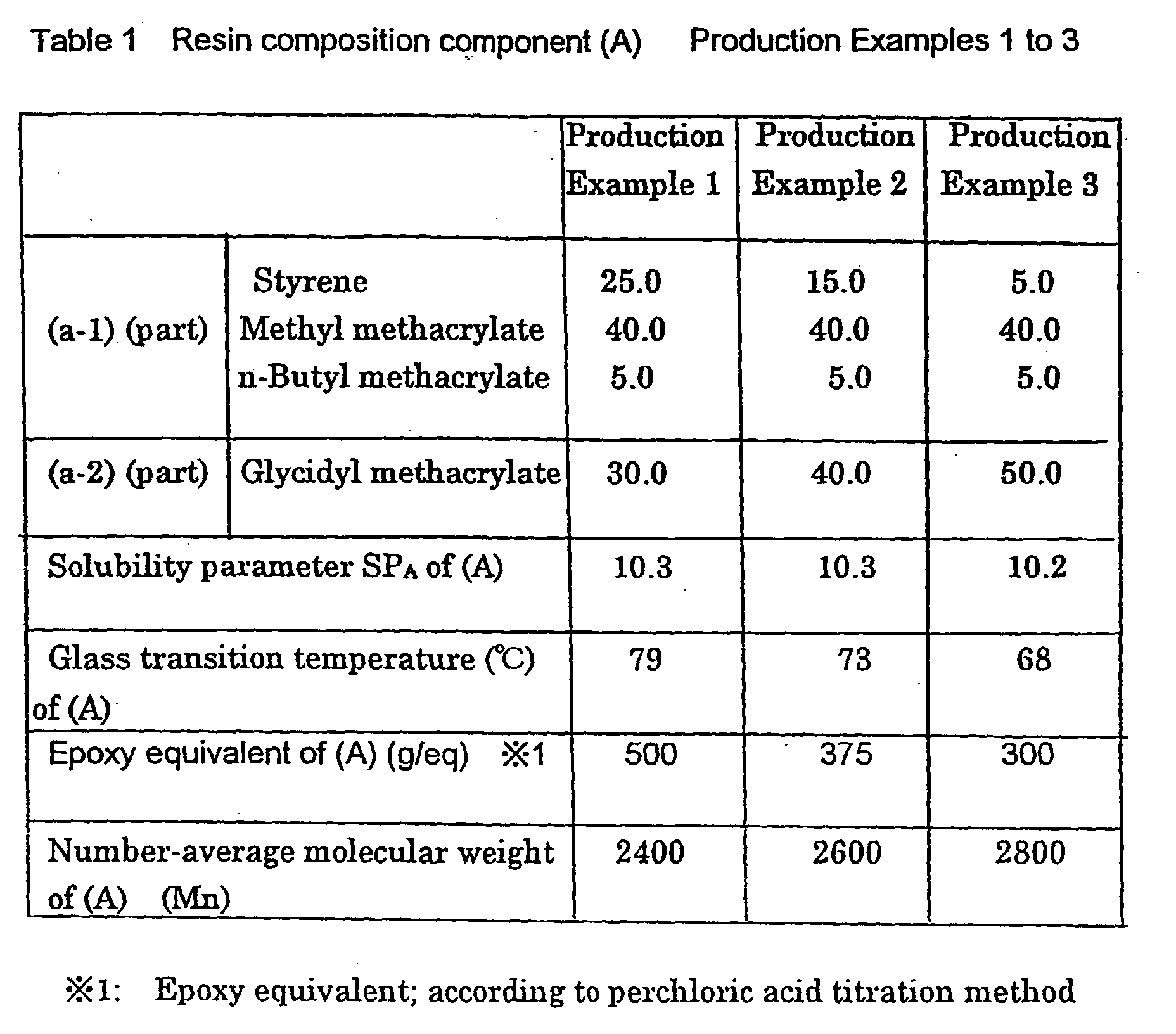
[Vinyl-based polymer (A) production examples 1 to 3]
Into a four-necked flask equipped with a stirrer,
thermometer, reflux condenser and nitrogen introducing
tube was charged 66.7 parts of xylene, and was heated to
reflux temperature. 6.0 parts of tert-butyl peroxy-2-ethyl
hexanoate as a polymerization initiator was
dissolved in monomers (parts) shown in Table 1 and the
mixed solution was added dropwise into the xylene in the
flask over 5 hours, further, subsequently kept at 100°C
for 5 hours. The solvent in the resulted polymerization
solution was removed to obtain a vinyl-based copolymer
(Production Examples 1 to 3). The properties of the
resulted copolymers are also described in Table 1.
[Vinyl-based polymer (A) comparative production examples
1, 2]
Into a four-necked flask equipped with a stirrer,
thermometer, reflux condenser and nitrogen introducing
tube was charged 66.7 parts of xylene, and heated to
reflux temperature. 6.0 parts of tert-butyl peroxy-2-ethyl
hexanoate as a polymerization initiator was
dissolved in monomers (parts) shown in Table 2 and the
mixed solution was added dropwise into the xylene in the
flask over 5 hours, further, subsequently kept at 100°C
for 5 hours. The solvent in the resulted polymerization
solution was removed to obtain a vinyl-based copolymer
(Comparative Production Examples 1, 2). The properties
of the resulted copolymers are also described in Table 2.
[Vinyl-based polymer (C) production examples 1 to 7]
Into a four-necked flask equipped with a stirrer,
thermometer, reflux condenser and nitrogen introducing
tube was charged 66.7 parts of xylene, and heated to
reflux temperature. 1.2 parts of tert-butyl peroxy-2-ethyl
hexanoate as a polymerization initiator was
dissolved in a monomer or monomers (parts) shown in Table
3 and the mixed solution was added dropwise into the
xylene in the flask over 5 hours, further, subsequently
kept at 100°C for 5 hours. The solvent in the resulted
polymerization solution was removed to obtain a vinyl-based
copolymer (Production Examples 1 to 7). The
properties of the resulted copolymers are also described
in Table 3.
[Vinyl-based polymer (C) comparative production examples
1 to 5]
Into a four-necked flask equipped with a stirrer,
thermometer, reflux condenser and nitrogen introducing
tube was charged 66.7 parts of xylene, and heated to
reflux temperature. 1.2 parts of tert-butyl peroxy-2-ethyl
hexanoate as a polymerization initiator was
dissolved in a monomer or monomers (parts) shown in Table
4 and the mixed solution was added dropwise into the
xylene in the flask over 5 hours, further, subsequently
kept at 100°C for 5 hours. The solvent in the resulted
polymerization solution was removed to obtain a vinyl-based
copolymer (Comparative Production Examples 1 to 5).
The properties of the resulted copolymers are also
described in Table 4.
[Examples 1 to 11]
The resin composition component (A) (Production
Examples 1 to 3) and (B) were mixed in ratio (parts) as
shown in Table 5, and to 100 parts by weight of the total
amount of the components (A) and (B) were added the solid
flow controlling agent (C) (Production Examples 1 to 7)
in a ratio (parts) shown in Table 5, 1 part of Tinuvin
144 (manufactured by Chiba Geigy, photo stabilizer) and 1
part of Benzoin (side opening-preventing agent) an 2
parts of Tinuvin 900 (manufactured by Chiba Geigy,
ultraviolet absorber), and the mixture was melt-kneaded
under condition of 90°C by a heat roll, cooled, then,
ground finely by a grinding machine, and fractions passed
through a 150 mesh sieve were collected to obtain a
powder paint. The powder paint was coated by an
electrostatic spray on a primer-treated steel plate to
give a paint film of 60 to 70 µm, then, the paint film
was heated at 150°C for 30 minutes to obtain a test plate.
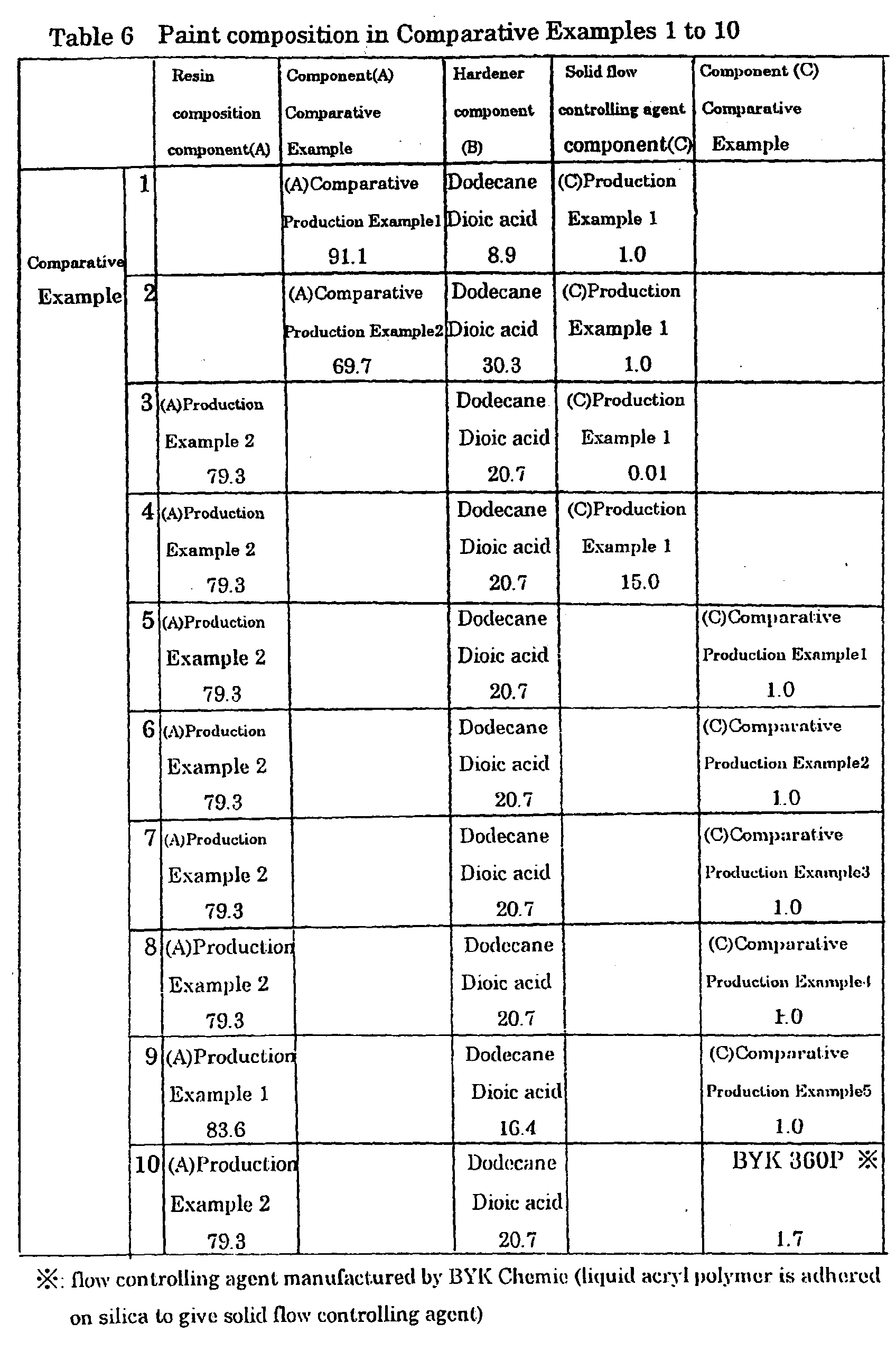
[Comparative Examples 1 to 10]
A test plate was obtained in the same manner as in
Example 1 except that the vinyl-based copolymer (A)
(Production Examples 1 to 2) or (A) Comparative
Production Examples 1 to 2 and (B) were mixed in ratio
(parts) as shown in Table 6, and to 100 parts by weight
of the total amount of the components (A) or (A)
Comparative Production Example and (B) was added the
solid flow controlling agent (C) (Production Example 1)
or (C) Comparative Production Example (Comparative
Production Examples 1 to 5 or BYK360P) in a ratio (parts)
shown in Table 6.
[Example, Comparative Example evaluation results]
Results of evaluation of the powder paints and the
paint films produced in Examples 1 to 11 are shown in
Table 7. Also, results of evaluation of the powder
paints and the paint films produced in Comparative
Examples 1 to 10 relating to Examples 1 to 11 are shown
in Table 8. Powder paint compositions of Examples 1 to
11 shown in Table 7 satisfy the numerical ranges
according to the present invention, and these results
indicate that the present invention is a thermosetting
powder paint composition which can give a paint film
having excellent storage stabilities (blocking-resistance
and the like), appearance properties (cratering-resistance,
smoothness, sharpness and the like), physical
properties (hardness, scratch-resistance and the like)
and chemical properties (weather-resistance, acid-resistance,
solvent-resistance and the like).
In Comparative Examples 1 and 2, the use amount of
(a-2) is out of the range defined in the claims of the
present invention, and in this case, when less than the
claimed range, scratch-resistance and solvent-resistance
were poor. On the other hand, when over the claimed
range, appearance was poor.
In Comparative Examples 3 and 4, the use amount of
(C) is out of the range defined in the claims of the
present invention, and when less than the claimed range,
appearance, cratering-resistance and acid-resistance were
poor. On the other hand, when over the claimed range,
scratch-resistance, acid-resistance and solvent-resistance
were poor.
In Comparative Example 5, the solubility parameter
is over (SPA-1), and appearance and cratering-resistance
were poor.
In Comparative Examples 6, 7 and 8, the glass
transition temperature of (C) is out of the range defined
in the claims of the present invention, and in this case,
when less than the claimed range, blocking-resistance was
poor. On the other hand, when over the claimed range,
and appearance and cratering-resistance were poor.
In Comparative Example 9, (C) is a component having
a reactive group to (B), and when (C) has a surplus
amount of reactive groups, appearance and cratering-resistance
lowered.
In Comparative Example 10, a liquid acryl polymer
was adsorbed on silica to obtain a solid flow controlling
agent which was used. In this case, appearance and
cratering-resistance were inferior.
Table 7 shows evaluation results of Examples 1 to
11.
Table 8 shows evaluation results of Comparative
| Resin composition component (A)
Comparative Production Examples 1, 2 |
| | Comparative Production Example |
| | 1 | 2 |
| (a-1)(part) | Styrene | 30.0 | 5.0 |
| Methyl methacrylate | 40.0 | 25.0 |
| n-Butyl methacrylate | 15.0 | 5.0 |
| (a-2)(part) | Glycidyl methacrylate | 15.0 | 65.0 |
| Solubility parameter SPA of (A) | 10.3 | 10.0 |
| Glass transition temperature (°C) of (A) | 79 | 60 |
| Epoxy equivalent of (A) (g/eq) | 1000 | 225 |
| Number-average molecular weight of (A) (Mn) | 2400 | 3000 |
| Solid flow controlling agent component (C)
Production Examples 1 to 7 |
| | Production Example |
| | 1 | 2 | 3 | 4 | 5 | 6 | 7 |
| Monomer composition (part) | Methyl methacrylate | | 20 |
| Isobutyl methacrylate | 100 | 80 | 40 | 87 | 96 | 85 | 70 |
| 2-Ethylhexyl acrylate | | | | 13 |
| Isobornyl acrylate | | | 60 |
| Glycidyl methacrylate | | | | | 4 | 15 | 30 |
| Solubility parameter SPC | 8.6 | 9.1 | 8.5 | 8.6 | 8.6 | 8.8 | 8.9 |
| Glass transition temperature (°C) | 53 | 67 | 76 | 34 | 52 | 51 | 50 |
| Solid flow controlling agent component (C)
Comparative Production Examples 1 to 5 |
| | Comparative Production Example |
| | 1 | 2 | 3 | 4 | 5 |
| Monomer composition (part) | Methyl methacrylate | 30 |
| Isobutyl methacrylate | 70 | 20 | 80 | | 40 |
| 2-Ethylhexyl acrylate | | | 20 | 100 |
| Isobornyl acrylate | | 80 |
| Glycidyl methacrylate | | | | | 60 |
| Solubility parameter SPC | 9.4 | 8.4 | 8.6 | 8.4 | 9.1 |
| Glass transition temperature (°C) | 67 | 84 | 25 | ―70 | 50 |
| Paint composition in Examples 1 to 11 |
| | Resin composition component (A) | Hardener component (B) | Solid flow controlling agent component (C) |
| Example | 1 | (A) Production Example 1 83.6 | Dodecane dioic acid 16.4 | (C) Production Example 1 1.0 |
| 2 | (A) Production Example 2 79.3 | Dodecane dioic acid 20.7 | (C) Production Example 1 1.0 |
| 3 | (A) Production Example 3 75.4 | Dodecane dioic acid 24.6 | (C) Production Example 1 1.0 |
| 4 | (A) Production Example 2 79.3 | Dodecane dioic acid 20.7 | (C) Production Example 1 0.1 |
| 5 | (A) Production Example 2 79.3 | Dodecane dioic acid 20.7 | (C) Production Example 1 5.0 |
| 6 | (A) Production Example 2 79.3 | Dodecane dioic acid 20.7 | (C) Production Example 2 1.0 |
| 7 | (A) Production Example 2 79.3 | Dodecane dioic acid 20.7 | (C) Production Example 3 1.0 |
| 8 | (A) Production Example 2 79.3 | Dodecane dioic acid 20.7 | (C) Production Example 4 1.0 |
| 9 | (A) Production Example 2 79.3 | Dodecane dioic acid 20.7 | (C) Production Example 5 1.0 |
| 10 | (A) Production Example 1 83.6 | Dodecane dioic acid 16.4 | (C) Production Example 6 1.0 |
| 11 | (A) Production Example 1 83.6 | Dodecane dioic acid 16.4 | (C) Production Example 7 1.0 |
| Evaluation results in Examples |
| | Example |
| | 1 | 2 | 3 | 4 | 5 | 6 | 7 | 8 | 9 | 10 | 11 |
| Blocking-resistance | ○ | o ○ | o ○ | o ○ | o ○ | o ○ | o ○ | ○ | o ○ | o ○ | o ○ |
| Appearance | o ○ | o ○ | o ○ | o ○ | o ○ | o ○ | ○ | o ○ | o ○ | ○ | ○ |
| Gloss (60° gloss) | 92 | 92 | 91 | 91 | 92 | 92 | 92 | 92 | 92 | 92 | 92 |
| Cratering-resistance | ○ | ○ | ○ | ○ | ○ | ○ | ○ | ○ | ○ | ○ | ○ |
| Paint film hardness | H | H | H | H | H | H | H | H | H | H | H |
| Scratch-resistance | ○ | o ○ | o ○ | o ○ | ○ | ○ | o ○ | o ○ | o ○ | o ○ | o ○ |
| Add-resistance | ○ | o ○ | o ○ | ○ | ○ | ○ | o ○ | o ○ | o ○ | o ○ | o ○ |
| Solvent-resistance | ○ | o ○ | o ○ | o ○ | ○ | o ○ | o ○ | o ○ | o ○ | o ○ | o ○ |
| Weather-resistance, Gloss retention (%) | 91 | 92 | 93 | 92 | 91 | 92 | 92 | 92 | 92 | 92 | 93 |
| General evaluation | | | | | | | | | | | |
| [Common Example] General evaluation; When number of o ○ is larger
than number of ○, general evaluation is , and when number of o ○
is smaller than number of ○, general evaluation is . |
| Evaluation results of Comparative Examples |
| | Comparative Example |
| | 1 | 2 | 3 | 4 | 5 | 6 | 7 | 8 | 9 | 10 |
| Blocking-resistance | X | o ○ | o ○ | o ○ | o ○ | o ○ | X | X | ○ | o ○ |
| Appearance | o ○ | X | X | o ○ | X | X | o ○ | o ○ | X | X |
| Gloss (60° gloss) | 92 | 92 | 92 | 92 | 92 | 92 | 92 | 92 | 92 | 92 |
| Cratering-resistance | ○ | ○ | X | ○ | X | X | ○ | ○ | X | X |
| Paint film hardness | F | H | H | F | H | H | H | H | H | H |
| Scratch-resistance | X | o ○ | ○ | X | ○ | o ○ | o ○ | o ○ | ○ | ○ |
| Acid-resistance | X | o ○ | X | X | ○ | ○ | o ○ | o ○ | ○ | ○ |
| Solvent-resistance | X | o ○ | o ○ | X | o ○ | o ○ | o ○ | o ○ | o ○ | o ○ |
| Weather-resistance, Gloss retention (%) | 91 | 93 | 92 | 91 | 92 | 92 | 92 | 93 | 93 | 92 |
| General evaluation | | ▵ | | | ▵ | ▵ | ▵ | ▵ | ▵ | ▵ |
| [Common Example] General evaluation; When number of X is 1 to 2,
general evaluation is ▵, and when number of X is 3 or more, general
evaluation is . |