EP1035439A2 - Photosensitive resin composition, color filter, and copolymer resin useful for them - Google Patents
Photosensitive resin composition, color filter, and copolymer resin useful for them Download PDFInfo
- Publication number
- EP1035439A2 EP1035439A2 EP00103385A EP00103385A EP1035439A2 EP 1035439 A2 EP1035439 A2 EP 1035439A2 EP 00103385 A EP00103385 A EP 00103385A EP 00103385 A EP00103385 A EP 00103385A EP 1035439 A2 EP1035439 A2 EP 1035439A2
- Authority
- EP
- European Patent Office
- Prior art keywords
- constituent units
- formula
- mole
- units represented
- copolymer resin
- Prior art date
- Legal status (The legal status is an assumption and is not a legal conclusion. Google has not performed a legal analysis and makes no representation as to the accuracy of the status listed.)
- Granted
Links
- 229920006026 co-polymeric resin Polymers 0.000 title claims abstract description 137
- 239000011342 resin composition Substances 0.000 title claims abstract description 50
- 239000000470 constituent Substances 0.000 claims abstract description 119
- 239000004593 Epoxy Substances 0.000 claims abstract description 62
- -1 isocyanate compound Chemical class 0.000 claims abstract description 53
- 238000000576 coating method Methods 0.000 claims abstract description 42
- 239000011248 coating agent Substances 0.000 claims abstract description 40
- 239000002253 acid Substances 0.000 claims abstract description 38
- 239000003513 alkali Substances 0.000 claims abstract description 37
- 239000011241 protective layer Substances 0.000 claims abstract description 36
- 239000012948 isocyanate Substances 0.000 claims abstract description 30
- 125000003647 acryloyl group Chemical group O=C([*])C([H])=C([H])[H] 0.000 claims abstract description 29
- 239000010410 layer Substances 0.000 claims abstract description 29
- 239000000758 substrate Substances 0.000 claims abstract description 28
- 125000002887 hydroxy group Chemical group [H]O* 0.000 claims abstract description 24
- 239000004793 Polystyrene Substances 0.000 claims abstract description 21
- 239000000178 monomer Substances 0.000 claims abstract description 21
- 229920002223 polystyrene Polymers 0.000 claims abstract description 21
- 125000004432 carbon atom Chemical group C* 0.000 claims abstract description 20
- NIXOWILDQLNWCW-UHFFFAOYSA-M Acrylate Chemical compound [O-]C(=O)C=C NIXOWILDQLNWCW-UHFFFAOYSA-M 0.000 claims abstract description 19
- 125000003178 carboxy group Chemical group [H]OC(*)=O 0.000 claims abstract description 17
- 125000000217 alkyl group Chemical group 0.000 claims abstract description 14
- 238000010438 heat treatment Methods 0.000 claims abstract description 12
- 125000002947 alkylene group Chemical group 0.000 claims abstract description 11
- 239000001257 hydrogen Substances 0.000 claims abstract description 9
- 229910052739 hydrogen Inorganic materials 0.000 claims abstract description 9
- 125000004435 hydrogen atom Chemical group [H]* 0.000 claims abstract description 9
- 230000001588 bifunctional effect Effects 0.000 claims abstract description 8
- 239000003999 initiator Substances 0.000 claims abstract description 6
- 125000003118 aryl group Chemical group 0.000 claims description 6
- 125000003710 aryl alkyl group Chemical group 0.000 claims description 4
- OKTJSMMVPCPJKN-UHFFFAOYSA-N Carbon Chemical group [C] OKTJSMMVPCPJKN-UHFFFAOYSA-N 0.000 claims description 3
- KWYUFKZDYYNOTN-UHFFFAOYSA-M Potassium hydroxide Chemical compound [OH-].[K+] KWYUFKZDYYNOTN-UHFFFAOYSA-M 0.000 description 55
- 239000000203 mixture Substances 0.000 description 36
- 239000000243 solution Substances 0.000 description 30
- 229920000642 polymer Polymers 0.000 description 25
- 238000006243 chemical reaction Methods 0.000 description 23
- QMYGFTJCQFEDST-UHFFFAOYSA-N 3-methoxybutyl acetate Chemical compound COC(C)CCOC(C)=O QMYGFTJCQFEDST-UHFFFAOYSA-N 0.000 description 20
- 239000007787 solid Substances 0.000 description 19
- 238000000034 method Methods 0.000 description 17
- 229920005989 resin Polymers 0.000 description 17
- 239000011347 resin Substances 0.000 description 17
- XLYOFNOQVPJJNP-UHFFFAOYSA-N water Substances O XLYOFNOQVPJJNP-UHFFFAOYSA-N 0.000 description 16
- 239000002904 solvent Substances 0.000 description 14
- WOBHKFSMXKNTIM-UHFFFAOYSA-N Hydroxyethyl methacrylate Chemical compound CC(=C)C(=O)OCCO WOBHKFSMXKNTIM-UHFFFAOYSA-N 0.000 description 13
- 238000012360 testing method Methods 0.000 description 13
- 230000015572 biosynthetic process Effects 0.000 description 11
- OZAIFHULBGXAKX-UHFFFAOYSA-N 2-(2-cyanopropan-2-yldiazenyl)-2-methylpropanenitrile Chemical compound N#CC(C)(C)N=NC(C)(C)C#N OZAIFHULBGXAKX-UHFFFAOYSA-N 0.000 description 10
- AOJOEFVRHOZDFN-UHFFFAOYSA-N benzyl 2-methylprop-2-enoate Chemical compound CC(=C)C(=O)OCC1=CC=CC=C1 AOJOEFVRHOZDFN-UHFFFAOYSA-N 0.000 description 10
- 229920001577 copolymer Polymers 0.000 description 10
- 239000004973 liquid crystal related substance Substances 0.000 description 10
- VSYIJNDEXXBJFH-UHFFFAOYSA-N 5-isocyanato-2-methylpent-1-en-3-one Chemical compound CC(=C)C(=O)CCN=C=O VSYIJNDEXXBJFH-UHFFFAOYSA-N 0.000 description 9
- PPBRXRYQALVLMV-UHFFFAOYSA-N Styrene Chemical compound C=CC1=CC=CC=C1 PPBRXRYQALVLMV-UHFFFAOYSA-N 0.000 description 9
- 239000003822 epoxy resin Substances 0.000 description 9
- 239000011521 glass Substances 0.000 description 9
- 229920000647 polyepoxide Polymers 0.000 description 9
- 230000035945 sensitivity Effects 0.000 description 9
- NIXOWILDQLNWCW-UHFFFAOYSA-N 2-Propenoic acid Natural products OC(=O)C=C NIXOWILDQLNWCW-UHFFFAOYSA-N 0.000 description 7
- 238000006116 polymerization reaction Methods 0.000 description 7
- 239000007870 radical polymerization initiator Substances 0.000 description 7
- VVQNEPGJFQJSBK-UHFFFAOYSA-N Methyl methacrylate Chemical compound COC(=O)C(C)=C VVQNEPGJFQJSBK-UHFFFAOYSA-N 0.000 description 6
- HEMHJVSKTPXQMS-UHFFFAOYSA-M Sodium hydroxide Chemical compound [OH-].[Na+] HEMHJVSKTPXQMS-UHFFFAOYSA-M 0.000 description 6
- UKLDJPRMSDWDSL-UHFFFAOYSA-L [dibutyl(dodecanoyloxy)stannyl] dodecanoate Chemical compound CCCCCCCCCCCC(=O)O[Sn](CCCC)(CCCC)OC(=O)CCCCCCCCCCC UKLDJPRMSDWDSL-UHFFFAOYSA-L 0.000 description 6
- 238000004043 dyeing Methods 0.000 description 6
- IQPQWNKOIGAROB-UHFFFAOYSA-N isocyanate group Chemical group [N-]=C=O IQPQWNKOIGAROB-UHFFFAOYSA-N 0.000 description 6
- 239000011159 matrix material Substances 0.000 description 6
- 125000001997 phenyl group Chemical group [H]C1=C([H])C([H])=C(*)C([H])=C1[H] 0.000 description 6
- 230000001105 regulatory effect Effects 0.000 description 6
- SMZOUWXMTYCWNB-UHFFFAOYSA-N 2-(2-methoxy-5-methylphenyl)ethanamine Chemical compound COC1=CC=C(C)C=C1CCN SMZOUWXMTYCWNB-UHFFFAOYSA-N 0.000 description 5
- FDSUVTROAWLVJA-UHFFFAOYSA-N 2-[[3-hydroxy-2,2-bis(hydroxymethyl)propoxy]methyl]-2-(hydroxymethyl)propane-1,3-diol;prop-2-enoic acid Chemical compound OC(=O)C=C.OC(=O)C=C.OC(=O)C=C.OC(=O)C=C.OC(=O)C=C.OCC(CO)(CO)COCC(CO)(CO)CO FDSUVTROAWLVJA-UHFFFAOYSA-N 0.000 description 5
- YYTNQIHMFFPVME-UHFFFAOYSA-N 2-methylprop-2-enoic acid;oxetane Chemical class C1COC1.CC(=C)C(O)=O YYTNQIHMFFPVME-UHFFFAOYSA-N 0.000 description 5
- 238000000862 absorption spectrum Methods 0.000 description 5
- 150000001875 compounds Chemical class 0.000 description 5
- SBZXBUIDTXKZTM-UHFFFAOYSA-N diglyme Chemical compound COCCOCCOC SBZXBUIDTXKZTM-UHFFFAOYSA-N 0.000 description 5
- VOZRXNHHFUQHIL-UHFFFAOYSA-N glycidyl methacrylate Chemical compound CC(=C)C(=O)OCC1CO1 VOZRXNHHFUQHIL-UHFFFAOYSA-N 0.000 description 5
- 239000000126 substance Substances 0.000 description 5
- 238000003786 synthesis reaction Methods 0.000 description 5
- CERQOIWHTDAKMF-UHFFFAOYSA-N Methacrylic acid Chemical compound CC(=C)C(O)=O CERQOIWHTDAKMF-UHFFFAOYSA-N 0.000 description 4
- DAKWPKUUDNSNPN-UHFFFAOYSA-N Trimethylolpropane triacrylate Chemical compound C=CC(=O)OCC(CC)(COC(=O)C=C)COC(=O)C=C DAKWPKUUDNSNPN-UHFFFAOYSA-N 0.000 description 4
- 239000003054 catalyst Substances 0.000 description 4
- 239000003086 colorant Substances 0.000 description 4
- 230000007547 defect Effects 0.000 description 4
- 238000004070 electrodeposition Methods 0.000 description 4
- 238000004519 manufacturing process Methods 0.000 description 4
- 239000000463 material Substances 0.000 description 4
- 238000007639 printing Methods 0.000 description 4
- YVXDRFYHWWPSOA-BQYQJAHWSA-N 1-methyl-4-[(e)-2-phenylethenyl]pyridin-1-ium Chemical compound C1=C[N+](C)=CC=C1\C=C\C1=CC=CC=C1 YVXDRFYHWWPSOA-BQYQJAHWSA-N 0.000 description 3
- MHDULSOPQSUKBQ-UHFFFAOYSA-N 2-(2-chlorophenyl)-1-[2-(2-chlorophenyl)-4,5-diphenylimidazol-2-yl]-4,5-diphenylimidazole Chemical compound ClC1=CC=CC=C1C(N1C2(N=C(C(=N2)C=2C=CC=CC=2)C=2C=CC=CC=2)C=2C(=CC=CC=2)Cl)=NC(C=2C=CC=CC=2)=C1C1=CC=CC=C1 MHDULSOPQSUKBQ-UHFFFAOYSA-N 0.000 description 3
- 102100033806 Alpha-protein kinase 3 Human genes 0.000 description 3
- 101710082399 Alpha-protein kinase 3 Proteins 0.000 description 3
- 239000004372 Polyvinyl alcohol Substances 0.000 description 3
- 239000006087 Silane Coupling Agent Substances 0.000 description 3
- DTQVDTLACAAQTR-UHFFFAOYSA-M Trifluoroacetate Chemical compound [O-]C(=O)C(F)(F)F DTQVDTLACAAQTR-UHFFFAOYSA-M 0.000 description 3
- 238000004132 cross linking Methods 0.000 description 3
- 238000001723 curing Methods 0.000 description 3
- 125000003700 epoxy group Chemical group 0.000 description 3
- 125000001495 ethyl group Chemical group [H]C([H])([H])C([H])([H])* 0.000 description 3
- 125000002496 methyl group Chemical group [H]C([H])([H])* 0.000 description 3
- 229920003986 novolac Polymers 0.000 description 3
- 238000000016 photochemical curing Methods 0.000 description 3
- 239000000049 pigment Substances 0.000 description 3
- 239000003505 polymerization initiator Substances 0.000 description 3
- 229920002451 polyvinyl alcohol Polymers 0.000 description 3
- 230000008569 process Effects 0.000 description 3
- 238000004528 spin coating Methods 0.000 description 3
- 238000003756 stirring Methods 0.000 description 3
- 239000004094 surface-active agent Substances 0.000 description 3
- JOXIMZWYDAKGHI-UHFFFAOYSA-N toluene-4-sulfonic acid Chemical compound CC1=CC=C(S(O)(=O)=O)C=C1 JOXIMZWYDAKGHI-UHFFFAOYSA-N 0.000 description 3
- WLOQLWBIJZDHET-UHFFFAOYSA-N triphenylsulfonium Chemical compound C1=CC=CC=C1[S+](C=1C=CC=CC=1)C1=CC=CC=C1 WLOQLWBIJZDHET-UHFFFAOYSA-N 0.000 description 3
- JZDQKBZKFIWSNW-UHFFFAOYSA-N (4-methoxyphenyl)-phenyliodanium Chemical compound C1=CC(OC)=CC=C1[I+]C1=CC=CC=C1 JZDQKBZKFIWSNW-UHFFFAOYSA-N 0.000 description 2
- XXCQVFAKDMZVLF-UHFFFAOYSA-M (4-methoxyphenyl)-phenyliodanium;2,2,2-trifluoroacetate Chemical compound [O-]C(=O)C(F)(F)F.C1=CC(OC)=CC=C1[I+]C1=CC=CC=C1 XXCQVFAKDMZVLF-UHFFFAOYSA-M 0.000 description 2
- YXSLFXLNXREQFW-UHFFFAOYSA-M (4-methoxyphenyl)-phenyliodanium;trifluoromethanesulfonate Chemical compound [O-]S(=O)(=O)C(F)(F)F.C1=CC(OC)=CC=C1[I+]C1=CC=CC=C1 YXSLFXLNXREQFW-UHFFFAOYSA-M 0.000 description 2
- KYLXYSWUYYPCHF-UHFFFAOYSA-N (diphenyl-lambda3-iodanyl) 2,2,2-trifluoroacetate Chemical compound C=1C=CC=CC=1I(OC(=O)C(F)(F)F)C1=CC=CC=C1 KYLXYSWUYYPCHF-UHFFFAOYSA-N 0.000 description 2
- JYEUMXHLPRZUAT-UHFFFAOYSA-N 1,2,3-triazine Chemical compound C1=CN=NN=C1 JYEUMXHLPRZUAT-UHFFFAOYSA-N 0.000 description 2
- PMBXCGGQNSVESQ-UHFFFAOYSA-N 1-Hexanethiol Chemical compound CCCCCCS PMBXCGGQNSVESQ-UHFFFAOYSA-N 0.000 description 2
- QTUVQQKHBMGYEH-UHFFFAOYSA-N 2-(trichloromethyl)-1,3,5-triazine Chemical class ClC(Cl)(Cl)C1=NC=NC=N1 QTUVQQKHBMGYEH-UHFFFAOYSA-N 0.000 description 2
- XLLIQLLCWZCATF-UHFFFAOYSA-N 2-methoxyethyl acetate Chemical compound COCCOC(C)=O XLLIQLLCWZCATF-UHFFFAOYSA-N 0.000 description 2
- CURLTUGMZLYLDI-UHFFFAOYSA-N Carbon dioxide Chemical compound O=C=O CURLTUGMZLYLDI-UHFFFAOYSA-N 0.000 description 2
- HEDRZPFGACZZDS-UHFFFAOYSA-N Chloroform Chemical compound ClC(Cl)Cl HEDRZPFGACZZDS-UHFFFAOYSA-N 0.000 description 2
- IAYPIBMASNFSPL-UHFFFAOYSA-N Ethylene oxide Chemical compound C1CO1 IAYPIBMASNFSPL-UHFFFAOYSA-N 0.000 description 2
- MHAJPDPJQMAIIY-UHFFFAOYSA-N Hydrogen peroxide Chemical compound OO MHAJPDPJQMAIIY-UHFFFAOYSA-N 0.000 description 2
- QIGBRXMKCJKVMJ-UHFFFAOYSA-N Hydroquinone Chemical compound OC1=CC=C(O)C=C1 QIGBRXMKCJKVMJ-UHFFFAOYSA-N 0.000 description 2
- ISWSIDIOOBJBQZ-UHFFFAOYSA-N Phenol Chemical compound OC1=CC=CC=C1 ISWSIDIOOBJBQZ-UHFFFAOYSA-N 0.000 description 2
- GOOHAUXETOMSMM-UHFFFAOYSA-N Propylene oxide Chemical compound CC1CO1 GOOHAUXETOMSMM-UHFFFAOYSA-N 0.000 description 2
- VYPSYNLAJGMNEJ-UHFFFAOYSA-N Silicium dioxide Chemical compound O=[Si]=O VYPSYNLAJGMNEJ-UHFFFAOYSA-N 0.000 description 2
- MOYAFQVGZZPNRA-UHFFFAOYSA-N Terpinolene Chemical compound CC(C)=C1CCC(C)=CC1 MOYAFQVGZZPNRA-UHFFFAOYSA-N 0.000 description 2
- WYURNTSHIVDZCO-UHFFFAOYSA-N Tetrahydrofuran Chemical compound C1CCOC1 WYURNTSHIVDZCO-UHFFFAOYSA-N 0.000 description 2
- HVVWZTWDBSEWIH-UHFFFAOYSA-N [2-(hydroxymethyl)-3-prop-2-enoyloxy-2-(prop-2-enoyloxymethyl)propyl] prop-2-enoate Chemical compound C=CC(=O)OCC(CO)(COC(=O)C=C)COC(=O)C=C HVVWZTWDBSEWIH-UHFFFAOYSA-N 0.000 description 2
- MPIAGWXWVAHQBB-UHFFFAOYSA-N [3-prop-2-enoyloxy-2-[[3-prop-2-enoyloxy-2,2-bis(prop-2-enoyloxymethyl)propoxy]methyl]-2-(prop-2-enoyloxymethyl)propyl] prop-2-enoate Chemical compound C=CC(=O)OCC(COC(=O)C=C)(COC(=O)C=C)COCC(COC(=O)C=C)(COC(=O)C=C)COC(=O)C=C MPIAGWXWVAHQBB-UHFFFAOYSA-N 0.000 description 2
- 230000002378 acidificating effect Effects 0.000 description 2
- 125000003277 amino group Chemical group 0.000 description 2
- 125000001797 benzyl group Chemical group [H]C1=C([H])C([H])=C(C([H])=C1[H])C([H])([H])* 0.000 description 2
- DNFSNYQTQMVTOK-UHFFFAOYSA-N bis(4-tert-butylphenyl)iodanium Chemical compound C1=CC(C(C)(C)C)=CC=C1[I+]C1=CC=C(C(C)(C)C)C=C1 DNFSNYQTQMVTOK-UHFFFAOYSA-N 0.000 description 2
- IISBACLAFKSPIT-UHFFFAOYSA-N bisphenol A Chemical compound C=1C=C(O)C=CC=1C(C)(C)C1=CC=C(O)C=C1 IISBACLAFKSPIT-UHFFFAOYSA-N 0.000 description 2
- 230000000052 comparative effect Effects 0.000 description 2
- 238000010276 construction Methods 0.000 description 2
- 239000013078 crystal Substances 0.000 description 2
- 238000010586 diagram Methods 0.000 description 2
- 125000005520 diaryliodonium group Chemical group 0.000 description 2
- 239000006185 dispersion Substances 0.000 description 2
- 238000001035 drying Methods 0.000 description 2
- 230000000694 effects Effects 0.000 description 2
- 238000011156 evaluation Methods 0.000 description 2
- 238000013007 heat curing Methods 0.000 description 2
- 238000007654 immersion Methods 0.000 description 2
- 239000007788 liquid Substances 0.000 description 2
- QSHDDOUJBYECFT-UHFFFAOYSA-N mercury Chemical compound [Hg] QSHDDOUJBYECFT-UHFFFAOYSA-N 0.000 description 2
- 229910052753 mercury Inorganic materials 0.000 description 2
- 239000003607 modifier Substances 0.000 description 2
- 238000000059 patterning Methods 0.000 description 2
- 150000002978 peroxides Chemical class 0.000 description 2
- 125000000286 phenylethyl group Chemical group [H]C1=C([H])C([H])=C(C([H])=C1[H])C([H])([H])C([H])([H])* 0.000 description 2
- 238000001556 precipitation Methods 0.000 description 2
- LLHKCFNBLRBOGN-UHFFFAOYSA-N propylene glycol methyl ether acetate Chemical compound COCC(C)OC(C)=O LLHKCFNBLRBOGN-UHFFFAOYSA-N 0.000 description 2
- 229920005604 random copolymer Polymers 0.000 description 2
- 230000009467 reduction Effects 0.000 description 2
- 229920006395 saturated elastomer Polymers 0.000 description 2
- FZHAPNGMFPVSLP-UHFFFAOYSA-N silanamine Chemical compound [SiH3]N FZHAPNGMFPVSLP-UHFFFAOYSA-N 0.000 description 2
- 125000003011 styrenyl group Chemical group [H]\C(*)=C(/[H])C1=C([H])C([H])=C([H])C([H])=C1[H] 0.000 description 2
- HJUGFYREWKUQJT-UHFFFAOYSA-N tetrabromomethane Chemical compound BrC(Br)(Br)Br HJUGFYREWKUQJT-UHFFFAOYSA-N 0.000 description 2
- 125000000383 tetramethylene group Chemical group [H]C([H])([*:1])C([H])([H])C([H])([H])C([H])([H])[*:2] 0.000 description 2
- CWERGRDVMFNCDR-UHFFFAOYSA-N thioglycolic acid Chemical compound OC(=O)CS CWERGRDVMFNCDR-UHFFFAOYSA-N 0.000 description 2
- 125000005409 triarylsulfonium group Chemical group 0.000 description 2
- 239000012953 triphenylsulfonium Substances 0.000 description 2
- UKRDPEFKFJNXQM-UHFFFAOYSA-N vinylsilane Chemical compound [SiH3]C=C UKRDPEFKFJNXQM-UHFFFAOYSA-N 0.000 description 2
- DTGKSKDOIYIVQL-WEDXCCLWSA-N (+)-borneol Chemical group C1C[C@@]2(C)[C@@H](O)C[C@@H]1C2(C)C DTGKSKDOIYIVQL-WEDXCCLWSA-N 0.000 description 1
- HGXJDMCMYLEZMJ-UHFFFAOYSA-N (2-methylpropan-2-yl)oxy 2,2-dimethylpropaneperoxoate Chemical compound CC(C)(C)OOOC(=O)C(C)(C)C HGXJDMCMYLEZMJ-UHFFFAOYSA-N 0.000 description 1
- WYTZZXDRDKSJID-UHFFFAOYSA-N (3-aminopropyl)triethoxysilane Chemical compound CCO[Si](OCC)(OCC)CCCN WYTZZXDRDKSJID-UHFFFAOYSA-N 0.000 description 1
- RSHKWPIEJYAPCL-UHFFFAOYSA-N (3-ethyloxetan-3-yl)methyl 2-methylprop-2-enoate Chemical compound CC(=C)C(=O)OCC1(CC)COC1 RSHKWPIEJYAPCL-UHFFFAOYSA-N 0.000 description 1
- PYEYLPDXIYOCJK-UHFFFAOYSA-N (3-ethyloxetan-3-yl)methyl prop-2-enoate Chemical compound C=CC(=O)OCC1(CC)COC1 PYEYLPDXIYOCJK-UHFFFAOYSA-N 0.000 description 1
- CGILRHVKKLYKNE-UHFFFAOYSA-N (3-methyloxetan-3-yl)methyl 2-methylprop-2-enoate Chemical compound CC(=C)C(=O)OCC1(C)COC1 CGILRHVKKLYKNE-UHFFFAOYSA-N 0.000 description 1
- LQANLNZCIDSHKI-UHFFFAOYSA-N (3-methyloxetan-3-yl)methyl prop-2-enoate Chemical compound C=CC(=O)OCC1(C)COC1 LQANLNZCIDSHKI-UHFFFAOYSA-N 0.000 description 1
- WMHLKXSYGGEXNQ-UHFFFAOYSA-M (4-methoxyphenyl)-phenyliodanium;4-methylbenzenesulfonate Chemical compound CC1=CC=C(S([O-])(=O)=O)C=C1.C1=CC(OC)=CC=C1[I+]C1=CC=CC=C1 WMHLKXSYGGEXNQ-UHFFFAOYSA-M 0.000 description 1
- RRQYJINTUHWNHW-UHFFFAOYSA-N 1-ethoxy-2-(2-ethoxyethoxy)ethane Chemical compound CCOCCOCCOCC RRQYJINTUHWNHW-UHFFFAOYSA-N 0.000 description 1
- CNJRPYFBORAQAU-UHFFFAOYSA-N 1-ethoxy-2-(2-methoxyethoxy)ethane Chemical compound CCOCCOCCOC CNJRPYFBORAQAU-UHFFFAOYSA-N 0.000 description 1
- RUFPHBVGCFYCNW-UHFFFAOYSA-N 1-naphthylamine Chemical compound C1=CC=C2C(N)=CC=CC2=C1 RUFPHBVGCFYCNW-UHFFFAOYSA-N 0.000 description 1
- HDYFAPRLDWYIBU-UHFFFAOYSA-N 1-silylprop-2-en-1-one Chemical class [SiH3]C(=O)C=C HDYFAPRLDWYIBU-UHFFFAOYSA-N 0.000 description 1
- WYMUYYZQUXYMJI-UHFFFAOYSA-M 2,2,2-trifluoroacetate;triphenylsulfanium Chemical compound [O-]C(=O)C(F)(F)F.C1=CC=CC=C1[S+](C=1C=CC=CC=1)C1=CC=CC=C1 WYMUYYZQUXYMJI-UHFFFAOYSA-M 0.000 description 1
- VUBUXALTYMBEQO-UHFFFAOYSA-N 2,2,3,3,3-pentafluoro-1-phenylpropan-1-one Chemical compound FC(F)(F)C(F)(F)C(=O)C1=CC=CC=C1 VUBUXALTYMBEQO-UHFFFAOYSA-N 0.000 description 1
- YAJYJWXEWKRTPO-UHFFFAOYSA-N 2,3,3,4,4,5-hexamethylhexane-2-thiol Chemical compound CC(C)C(C)(C)C(C)(C)C(C)(C)S YAJYJWXEWKRTPO-UHFFFAOYSA-N 0.000 description 1
- QWQNFXDYOCUEER-UHFFFAOYSA-N 2,3-ditert-butyl-4-methylphenol Chemical compound CC1=CC=C(O)C(C(C)(C)C)=C1C(C)(C)C QWQNFXDYOCUEER-UHFFFAOYSA-N 0.000 description 1
- BTJPUDCSZVCXFQ-UHFFFAOYSA-N 2,4-diethylthioxanthen-9-one Chemical compound C1=CC=C2C(=O)C3=CC(CC)=CC(CC)=C3SC2=C1 BTJPUDCSZVCXFQ-UHFFFAOYSA-N 0.000 description 1
- BFQFFNWLTHFJOZ-UHFFFAOYSA-N 2-(1,3-benzodioxol-5-yl)-4,6-bis(trichloromethyl)-1,3,5-triazine Chemical compound ClC(Cl)(Cl)C1=NC(C(Cl)(Cl)Cl)=NC(C=2C=C3OCOC3=CC=2)=N1 BFQFFNWLTHFJOZ-UHFFFAOYSA-N 0.000 description 1
- PFHOSZAOXCYAGJ-UHFFFAOYSA-N 2-[(2-cyano-4-methoxy-4-methylpentan-2-yl)diazenyl]-4-methoxy-2,4-dimethylpentanenitrile Chemical compound COC(C)(C)CC(C)(C#N)N=NC(C)(C#N)CC(C)(C)OC PFHOSZAOXCYAGJ-UHFFFAOYSA-N 0.000 description 1
- WYGWHHGCAGTUCH-UHFFFAOYSA-N 2-[(2-cyano-4-methylpentan-2-yl)diazenyl]-2,4-dimethylpentanenitrile Chemical compound CC(C)CC(C)(C#N)N=NC(C)(C#N)CC(C)C WYGWHHGCAGTUCH-UHFFFAOYSA-N 0.000 description 1
- JENKIIWNWASCFW-VOTSOKGWSA-N 2-[(e)-2-(4-methylphenyl)ethenyl]-4,6-bis(trichloromethyl)-1,3,5-triazine Chemical compound C1=CC(C)=CC=C1\C=C\C1=NC(C(Cl)(Cl)Cl)=NC(C(Cl)(Cl)Cl)=N1 JENKIIWNWASCFW-VOTSOKGWSA-N 0.000 description 1
- FEUFEGJTJIHPOF-UHFFFAOYSA-N 2-butyl acrylic acid Chemical compound CCCCC(=C)C(O)=O FEUFEGJTJIHPOF-UHFFFAOYSA-N 0.000 description 1
- ZNQVEEAIQZEUHB-UHFFFAOYSA-N 2-ethoxyethanol Chemical class CCOCCO ZNQVEEAIQZEUHB-UHFFFAOYSA-N 0.000 description 1
- WROUWQQRXUBECT-UHFFFAOYSA-N 2-ethylacrylic acid Chemical compound CCC(=C)C(O)=O WROUWQQRXUBECT-UHFFFAOYSA-N 0.000 description 1
- OMIGHNLMNHATMP-UHFFFAOYSA-N 2-hydroxyethyl prop-2-enoate Chemical compound OCCOC(=O)C=C OMIGHNLMNHATMP-UHFFFAOYSA-N 0.000 description 1
- VHSHLMUCYSAUQU-UHFFFAOYSA-N 2-hydroxypropyl methacrylate Chemical compound CC(O)COC(=O)C(C)=C VHSHLMUCYSAUQU-UHFFFAOYSA-N 0.000 description 1
- GWZMWHWAWHPNHN-UHFFFAOYSA-N 2-hydroxypropyl prop-2-enoate Chemical compound CC(O)COC(=O)C=C GWZMWHWAWHPNHN-UHFFFAOYSA-N 0.000 description 1
- LANHEKZGKDEWLK-UHFFFAOYSA-N 2-methylideneheptanoic acid Chemical compound CCCCCC(=C)C(O)=O LANHEKZGKDEWLK-UHFFFAOYSA-N 0.000 description 1
- HEBDGRTWECSNNT-UHFFFAOYSA-N 2-methylidenepentanoic acid Chemical compound CCCC(=C)C(O)=O HEBDGRTWECSNNT-UHFFFAOYSA-N 0.000 description 1
- QTWJRLJHJPIABL-UHFFFAOYSA-N 2-methylphenol;3-methylphenol;4-methylphenol Chemical compound CC1=CC=C(O)C=C1.CC1=CC=CC(O)=C1.CC1=CC=CC=C1O QTWJRLJHJPIABL-UHFFFAOYSA-N 0.000 description 1
- LZMNXXQIQIHFGC-UHFFFAOYSA-N 3-[dimethoxy(methyl)silyl]propyl 2-methylprop-2-enoate Chemical compound CO[Si](C)(OC)CCCOC(=O)C(C)=C LZMNXXQIQIHFGC-UHFFFAOYSA-N 0.000 description 1
- OXYZDRAJMHGSMW-UHFFFAOYSA-N 3-chloropropyl(trimethoxy)silane Chemical compound CO[Si](OC)(OC)CCCCl OXYZDRAJMHGSMW-UHFFFAOYSA-N 0.000 description 1
- KEZMLECYELSZDC-UHFFFAOYSA-N 3-chloropropyl-diethoxy-methylsilane Chemical compound CCO[Si](C)(OCC)CCCCl KEZMLECYELSZDC-UHFFFAOYSA-N 0.000 description 1
- KNTKCYKJRSMRMZ-UHFFFAOYSA-N 3-chloropropyl-dimethoxy-methylsilane Chemical compound CO[Si](C)(OC)CCCCl KNTKCYKJRSMRMZ-UHFFFAOYSA-N 0.000 description 1
- MFKRHJVUCZRDTF-UHFFFAOYSA-N 3-methoxy-3-methylbutan-1-ol Chemical compound COC(C)(C)CCO MFKRHJVUCZRDTF-UHFFFAOYSA-N 0.000 description 1
- JIGUICYYOYEXFS-UHFFFAOYSA-N 3-tert-butylbenzene-1,2-diol Chemical compound CC(C)(C)C1=CC=CC(O)=C1O JIGUICYYOYEXFS-UHFFFAOYSA-N 0.000 description 1
- UUEWCQRISZBELL-UHFFFAOYSA-N 3-trimethoxysilylpropane-1-thiol Chemical compound CO[Si](OC)(OC)CCCS UUEWCQRISZBELL-UHFFFAOYSA-N 0.000 description 1
- XDLMVUHYZWKMMD-UHFFFAOYSA-N 3-trimethoxysilylpropyl 2-methylprop-2-enoate Chemical compound CO[Si](OC)(OC)CCCOC(=O)C(C)=C XDLMVUHYZWKMMD-UHFFFAOYSA-N 0.000 description 1
- YKXAYLPDMSGWEV-UHFFFAOYSA-N 4-hydroxybutyl 2-methylprop-2-enoate Chemical compound CC(=C)C(=O)OCCCCO YKXAYLPDMSGWEV-UHFFFAOYSA-N 0.000 description 1
- NDWUBGAGUCISDV-UHFFFAOYSA-N 4-hydroxybutyl prop-2-enoate Chemical compound OCCCCOC(=O)C=C NDWUBGAGUCISDV-UHFFFAOYSA-N 0.000 description 1
- FOMNBFSRHKJALH-UHFFFAOYSA-N 5-isocyanatopent-1-en-3-one Chemical compound C=CC(=O)CCN=C=O FOMNBFSRHKJALH-UHFFFAOYSA-N 0.000 description 1
- RZVAJINKPMORJF-UHFFFAOYSA-N Acetaminophen Chemical compound CC(=O)NC1=CC=C(O)C=C1 RZVAJINKPMORJF-UHFFFAOYSA-N 0.000 description 1
- 239000004342 Benzoyl peroxide Substances 0.000 description 1
- OMPJBNCRMGITSC-UHFFFAOYSA-N Benzoylperoxide Chemical compound C=1C=CC=CC=1C(=O)OOC(=O)C1=CC=CC=C1 OMPJBNCRMGITSC-UHFFFAOYSA-N 0.000 description 1
- WKBOTKDWSSQWDR-UHFFFAOYSA-N Bromine atom Chemical compound [Br] WKBOTKDWSSQWDR-UHFFFAOYSA-N 0.000 description 1
- ZAMOUSCENKQFHK-UHFFFAOYSA-N Chlorine atom Chemical compound [Cl] ZAMOUSCENKQFHK-UHFFFAOYSA-N 0.000 description 1
- VYZAMTAEIAYCRO-UHFFFAOYSA-N Chromium Chemical compound [Cr] VYZAMTAEIAYCRO-UHFFFAOYSA-N 0.000 description 1
- XDTMQSROBMDMFD-UHFFFAOYSA-N Cyclohexane Chemical compound C1CCCCC1 XDTMQSROBMDMFD-UHFFFAOYSA-N 0.000 description 1
- BWGNESOTFCXPMA-UHFFFAOYSA-N Dihydrogen disulfide Chemical compound SS BWGNESOTFCXPMA-UHFFFAOYSA-N 0.000 description 1
- FVCPXLWAKNJIKK-UHFFFAOYSA-N Dimexano Chemical compound COC(=S)SSC(=S)OC FVCPXLWAKNJIKK-UHFFFAOYSA-N 0.000 description 1
- YIVJZNGAASQVEM-UHFFFAOYSA-N Lauroyl peroxide Chemical compound CCCCCCCCCCCC(=O)OOC(=O)CCCCCCCCCCC YIVJZNGAASQVEM-UHFFFAOYSA-N 0.000 description 1
- SECXISVLQFMRJM-UHFFFAOYSA-N N-Methylpyrrolidone Chemical compound CN1CCCC1=O SECXISVLQFMRJM-UHFFFAOYSA-N 0.000 description 1
- NBIIXXVUZAFLBC-UHFFFAOYSA-N Phosphoric acid Chemical group OP(O)(O)=O NBIIXXVUZAFLBC-UHFFFAOYSA-N 0.000 description 1
- 239000004820 Pressure-sensitive adhesive Substances 0.000 description 1
- 239000007983 Tris buffer Substances 0.000 description 1
- XLOMVQKBTHCTTD-UHFFFAOYSA-N Zinc monoxide Chemical compound [Zn]=O XLOMVQKBTHCTTD-UHFFFAOYSA-N 0.000 description 1
- LNBZWBNYIKPDFQ-UHFFFAOYSA-N [4,4-bis(diethylamino)cyclohexa-1,5-dien-1-yl]-phenylmethanone Chemical compound C1=CC(N(CC)CC)(N(CC)CC)CC=C1C(=O)C1=CC=CC=C1 LNBZWBNYIKPDFQ-UHFFFAOYSA-N 0.000 description 1
- 150000007513 acids Chemical class 0.000 description 1
- 230000009471 action Effects 0.000 description 1
- 239000000956 alloy Substances 0.000 description 1
- 229910045601 alloy Inorganic materials 0.000 description 1
- XYLMUPLGERFSHI-UHFFFAOYSA-N alpha-Methylstyrene Chemical compound CC(=C)C1=CC=CC=C1 XYLMUPLGERFSHI-UHFFFAOYSA-N 0.000 description 1
- 150000004945 aromatic hydrocarbons Chemical class 0.000 description 1
- 239000012298 atmosphere Substances 0.000 description 1
- 235000019400 benzoyl peroxide Nutrition 0.000 description 1
- 230000005540 biological transmission Effects 0.000 description 1
- UHGVULRLVZYBQE-UHFFFAOYSA-M bis(4-tert-butylphenyl)iodanium;2,2,2-trifluoroacetate Chemical compound [O-]C(=O)C(F)(F)F.C1=CC(C(C)(C)C)=CC=C1[I+]C1=CC=C(C(C)(C)C)C=C1 UHGVULRLVZYBQE-UHFFFAOYSA-M 0.000 description 1
- UEJFJTOGXLEPIV-UHFFFAOYSA-M bis(4-tert-butylphenyl)iodanium;4-methylbenzenesulfonate Chemical compound CC1=CC=C(S([O-])(=O)=O)C=C1.C1=CC(C(C)(C)C)=CC=C1[I+]C1=CC=C(C(C)(C)C)C=C1 UEJFJTOGXLEPIV-UHFFFAOYSA-M 0.000 description 1
- 229920001400 block copolymer Polymers 0.000 description 1
- 239000001055 blue pigment Substances 0.000 description 1
- GDTBXPJZTBHREO-UHFFFAOYSA-N bromine Substances BrBr GDTBXPJZTBHREO-UHFFFAOYSA-N 0.000 description 1
- 229910052794 bromium Inorganic materials 0.000 description 1
- 125000000484 butyl group Chemical group [H]C([*])([H])C([H])([H])C([H])([H])C([H])([H])[H] 0.000 description 1
- 239000001569 carbon dioxide Substances 0.000 description 1
- 229910002092 carbon dioxide Inorganic materials 0.000 description 1
- 125000002843 carboxylic acid group Chemical group 0.000 description 1
- 239000003638 chemical reducing agent Substances 0.000 description 1
- 239000000460 chlorine Substances 0.000 description 1
- 229910052801 chlorine Inorganic materials 0.000 description 1
- 229910052804 chromium Inorganic materials 0.000 description 1
- 239000011651 chromium Substances 0.000 description 1
- 230000001276 controlling effect Effects 0.000 description 1
- VVOLVFOSOPJKED-UHFFFAOYSA-N copper phthalocyanine Chemical compound [Cu].N=1C2=NC(C3=CC=CC=C33)=NC3=NC(C3=CC=CC=C33)=NC3=NC(C3=CC=CC=C33)=NC3=NC=1C1=CC=CC=C12 VVOLVFOSOPJKED-UHFFFAOYSA-N 0.000 description 1
- 229930003836 cresol Natural products 0.000 description 1
- 125000004093 cyano group Chemical group *C#N 0.000 description 1
- 125000000113 cyclohexyl group Chemical group [H]C1([H])C([H])([H])C([H])([H])C([H])(*)C([H])([H])C1([H])[H] 0.000 description 1
- 125000004663 dialkyl amino group Chemical group 0.000 description 1
- OTARVPUIYXHRRB-UHFFFAOYSA-N diethoxy-methyl-[3-(oxiran-2-ylmethoxy)propyl]silane Chemical compound CCO[Si](C)(OCC)CCCOCC1CO1 OTARVPUIYXHRRB-UHFFFAOYSA-N 0.000 description 1
- 229940019778 diethylene glycol diethyl ether Drugs 0.000 description 1
- 238000006471 dimerization reaction Methods 0.000 description 1
- ICKXHPFFRLCMMS-UHFFFAOYSA-M diphenyl-(4-phenylsulfanylphenyl)sulfanium;2,2,2-trifluoroacetate Chemical compound [O-]C(=O)C(F)(F)F.C=1C=C([S+](C=2C=CC=CC=2)C=2C=CC=CC=2)C=CC=1SC1=CC=CC=C1 ICKXHPFFRLCMMS-UHFFFAOYSA-M 0.000 description 1
- OZLBDYMWFAHSOQ-UHFFFAOYSA-N diphenyliodanium Chemical compound C=1C=CC=CC=1[I+]C1=CC=CC=C1 OZLBDYMWFAHSOQ-UHFFFAOYSA-N 0.000 description 1
- UMIKAXKFQJWKCV-UHFFFAOYSA-M diphenyliodanium;4-methylbenzenesulfonate Chemical compound CC1=CC=C(S([O-])(=O)=O)C=C1.C=1C=CC=CC=1[I+]C1=CC=CC=C1 UMIKAXKFQJWKCV-UHFFFAOYSA-M 0.000 description 1
- WNAHIZMDSQCWRP-UHFFFAOYSA-N dodecane-1-thiol Chemical compound CCCCCCCCCCCCS WNAHIZMDSQCWRP-UHFFFAOYSA-N 0.000 description 1
- 150000002148 esters Chemical class 0.000 description 1
- 238000005530 etching Methods 0.000 description 1
- FWDBOZPQNFPOLF-UHFFFAOYSA-N ethenyl(triethoxy)silane Chemical compound CCO[Si](OCC)(OCC)C=C FWDBOZPQNFPOLF-UHFFFAOYSA-N 0.000 description 1
- NKSJNEHGWDZZQF-UHFFFAOYSA-N ethenyl(trimethoxy)silane Chemical compound CO[Si](OC)(OC)C=C NKSJNEHGWDZZQF-UHFFFAOYSA-N 0.000 description 1
- WOXXJEVNDJOOLV-UHFFFAOYSA-N ethenyl-tris(2-methoxyethoxy)silane Chemical compound COCCO[Si](OCCOC)(OCCOC)C=C WOXXJEVNDJOOLV-UHFFFAOYSA-N 0.000 description 1
- 150000002170 ethers Chemical class 0.000 description 1
- PLYDMIIYRWUYBP-UHFFFAOYSA-N ethyl 4-[[2-chloro-4-[3-chloro-4-[(3-ethoxycarbonyl-5-oxo-1-phenyl-4h-pyrazol-4-yl)diazenyl]phenyl]phenyl]diazenyl]-5-oxo-1-phenyl-4h-pyrazole-3-carboxylate Chemical compound CCOC(=O)C1=NN(C=2C=CC=CC=2)C(=O)C1N=NC(C(=C1)Cl)=CC=C1C(C=C1Cl)=CC=C1N=NC(C(=N1)C(=O)OCC)C(=O)N1C1=CC=CC=C1 PLYDMIIYRWUYBP-UHFFFAOYSA-N 0.000 description 1
- LYCAIKOWRPUZTN-UHFFFAOYSA-N ethylene glycol Natural products OCCO LYCAIKOWRPUZTN-UHFFFAOYSA-N 0.000 description 1
- JRJLLXQDXANQEC-UHFFFAOYSA-N fastogen green y Chemical compound [Cu+2].[N-]1C(N=C2C3=C(Cl)C(Cl)=C(Br)C(Cl)=C3C(N=C3C4=C(Br)C(Cl)=C(Br)C(Cl)=C4C(=N4)[N-]3)=N2)=C(C(Br)=C(Cl)C(Br)=C2Cl)C2=C1N=C1C2=C(Cl)C(Cl)=C(Cl)C(Br)=C2C4=N1 JRJLLXQDXANQEC-UHFFFAOYSA-N 0.000 description 1
- 239000007789 gas Substances 0.000 description 1
- 239000001056 green pigment Substances 0.000 description 1
- 150000008282 halocarbons Chemical class 0.000 description 1
- 125000005843 halogen group Chemical group 0.000 description 1
- LNEPOXFFQSENCJ-UHFFFAOYSA-N haloperidol Chemical compound C1CC(O)(C=2C=CC(Cl)=CC=2)CCN1CCCC(=O)C1=CC=C(F)C=C1 LNEPOXFFQSENCJ-UHFFFAOYSA-N 0.000 description 1
- WGCNASOHLSPBMP-UHFFFAOYSA-N hydroxyacetaldehyde Natural products OCC=O WGCNASOHLSPBMP-UHFFFAOYSA-N 0.000 description 1
- AMGQUBHHOARCQH-UHFFFAOYSA-N indium;oxotin Chemical compound [In].[Sn]=O AMGQUBHHOARCQH-UHFFFAOYSA-N 0.000 description 1
- 239000003112 inhibitor Substances 0.000 description 1
- 239000000976 ink Substances 0.000 description 1
- 125000000959 isobutyl group Chemical group [H]C([H])([H])C([H])(C([H])([H])[H])C([H])([H])* 0.000 description 1
- 125000001449 isopropyl group Chemical group [H]C([H])([H])C([H])(*)C([H])([H])[H] 0.000 description 1
- 150000002576 ketones Chemical class 0.000 description 1
- 230000031700 light absorption Effects 0.000 description 1
- 125000005395 methacrylic acid group Chemical group 0.000 description 1
- KBJFYLLAMSZSOG-UHFFFAOYSA-N n-(3-trimethoxysilylpropyl)aniline Chemical compound CO[Si](OC)(OC)CCCNC1=CC=CC=C1 KBJFYLLAMSZSOG-UHFFFAOYSA-N 0.000 description 1
- 125000004108 n-butyl group Chemical group [H]C([H])([H])C([H])([H])C([H])([H])C([H])([H])* 0.000 description 1
- 125000000740 n-pentyl group Chemical group [H]C([H])([H])C([H])([H])C([H])([H])C([H])([H])C([H])([H])* 0.000 description 1
- 125000004123 n-propyl group Chemical group [H]C([H])([H])C([H])([H])C([H])([H])* 0.000 description 1
- 125000001624 naphthyl group Chemical group 0.000 description 1
- ZWWQICJTBOCQLA-UHFFFAOYSA-N o-propan-2-yl (propan-2-yloxycarbothioyldisulfanyl)methanethioate Chemical compound CC(C)OC(=S)SSC(=S)OC(C)C ZWWQICJTBOCQLA-UHFFFAOYSA-N 0.000 description 1
- KZCOBXFFBQJQHH-UHFFFAOYSA-N octane-1-thiol Chemical compound CCCCCCCCS KZCOBXFFBQJQHH-UHFFFAOYSA-N 0.000 description 1
- 230000003287 optical effect Effects 0.000 description 1
- 150000001451 organic peroxides Chemical class 0.000 description 1
- 239000003960 organic solvent Substances 0.000 description 1
- QHGUPRQTQITEPO-UHFFFAOYSA-N oxan-2-yl 2-methylprop-2-enoate Chemical compound CC(=C)C(=O)OC1CCCCO1 QHGUPRQTQITEPO-UHFFFAOYSA-N 0.000 description 1
- FGWRVVZMNXRWDQ-UHFFFAOYSA-N oxan-2-yl prop-2-enoate Chemical compound C=CC(=O)OC1CCCCO1 FGWRVVZMNXRWDQ-UHFFFAOYSA-N 0.000 description 1
- RVIDFGAZNGPDTB-UHFFFAOYSA-N oxetane;prop-2-enoic acid Chemical class C1COC1.OC(=O)C=C RVIDFGAZNGPDTB-UHFFFAOYSA-N 0.000 description 1
- NWVVVBRKAWDGAB-UHFFFAOYSA-N p-methoxyphenol Chemical compound COC1=CC=C(O)C=C1 NWVVVBRKAWDGAB-UHFFFAOYSA-N 0.000 description 1
- 229920002120 photoresistant polymer Polymers 0.000 description 1
- 229920001296 polysiloxane Polymers 0.000 description 1
- 238000002360 preparation method Methods 0.000 description 1
- 125000002924 primary amino group Chemical group [H]N([H])* 0.000 description 1
- FZYCEURIEDTWNS-UHFFFAOYSA-N prop-1-en-2-ylbenzene Chemical compound CC(=C)C1=CC=CC=C1.CC(=C)C1=CC=CC=C1 FZYCEURIEDTWNS-UHFFFAOYSA-N 0.000 description 1
- RQAGEUFKLGHJPA-UHFFFAOYSA-N prop-2-enoylsilicon Chemical compound [Si]C(=O)C=C RQAGEUFKLGHJPA-UHFFFAOYSA-N 0.000 description 1
- 239000005297 pyrex Substances 0.000 description 1
- 239000010453 quartz Substances 0.000 description 1
- 239000001054 red pigment Substances 0.000 description 1
- 230000005070 ripening Effects 0.000 description 1
- 238000007761 roller coating Methods 0.000 description 1
- 150000003839 salts Chemical class 0.000 description 1
- 125000002914 sec-butyl group Chemical group [H]C([H])([H])C([H])([H])C([H])(*)C([H])([H])[H] 0.000 description 1
- 239000007921 spray Substances 0.000 description 1
- 238000005507 spraying Methods 0.000 description 1
- 238000004544 sputter deposition Methods 0.000 description 1
- 238000003860 storage Methods 0.000 description 1
- 125000001424 substituent group Chemical group 0.000 description 1
- 125000000542 sulfonic acid group Chemical group 0.000 description 1
- 125000000999 tert-butyl group Chemical group [H]C([H])([H])C(*)(C([H])([H])[H])C([H])([H])[H] 0.000 description 1
- YLQBMQCUIZJEEH-UHFFFAOYSA-N tetrahydrofuran Natural products C=1C=COC=1 YLQBMQCUIZJEEH-UHFFFAOYSA-N 0.000 description 1
- XOLBLPGZBRYERU-UHFFFAOYSA-N tin dioxide Chemical compound O=[Sn]=O XOLBLPGZBRYERU-UHFFFAOYSA-N 0.000 description 1
- 229910001887 tin oxide Inorganic materials 0.000 description 1
- 150000003918 triazines Chemical class 0.000 description 1
- GQIUQDDJKHLHTB-UHFFFAOYSA-N trichloro(ethenyl)silane Chemical compound Cl[Si](Cl)(Cl)C=C GQIUQDDJKHLHTB-UHFFFAOYSA-N 0.000 description 1
- 238000005829 trimerization reaction Methods 0.000 description 1
- DQZNLOXENNXVAD-UHFFFAOYSA-N trimethoxy-[2-(7-oxabicyclo[4.1.0]heptan-4-yl)ethyl]silane Chemical compound C1C(CC[Si](OC)(OC)OC)CCC2OC21 DQZNLOXENNXVAD-UHFFFAOYSA-N 0.000 description 1
- BPSIOYPQMFLKFR-UHFFFAOYSA-N trimethoxy-[3-(oxiran-2-ylmethoxy)propyl]silane Chemical compound CO[Si](OC)(OC)CCCOCC1CO1 BPSIOYPQMFLKFR-UHFFFAOYSA-N 0.000 description 1
- FAYMLNNRGCYLSR-UHFFFAOYSA-M triphenylsulfonium triflate Chemical compound [O-]S(=O)(=O)C(F)(F)F.C1=CC=CC=C1[S+](C=1C=CC=CC=1)C1=CC=CC=C1 FAYMLNNRGCYLSR-UHFFFAOYSA-M 0.000 description 1
- 238000001771 vacuum deposition Methods 0.000 description 1
- 238000007740 vapor deposition Methods 0.000 description 1
- 239000005050 vinyl trichlorosilane Substances 0.000 description 1
- 238000004065 wastewater treatment Methods 0.000 description 1
Images

Classifications
-
- C—CHEMISTRY; METALLURGY
- C08—ORGANIC MACROMOLECULAR COMPOUNDS; THEIR PREPARATION OR CHEMICAL WORKING-UP; COMPOSITIONS BASED THEREON
- C08F—MACROMOLECULAR COMPOUNDS OBTAINED BY REACTIONS ONLY INVOLVING CARBON-TO-CARBON UNSATURATED BONDS
- C08F220/00—Copolymers of compounds having one or more unsaturated aliphatic radicals, each having only one carbon-to-carbon double bond, and only one being terminated by only one carboxyl radical or a salt, anhydride ester, amide, imide or nitrile thereof
- C08F220/62—Monocarboxylic acids having ten or more carbon atoms; Derivatives thereof
-
- G—PHYSICS
- G03—PHOTOGRAPHY; CINEMATOGRAPHY; ANALOGOUS TECHNIQUES USING WAVES OTHER THAN OPTICAL WAVES; ELECTROGRAPHY; HOLOGRAPHY
- G03F—PHOTOMECHANICAL PRODUCTION OF TEXTURED OR PATTERNED SURFACES, e.g. FOR PRINTING, FOR PROCESSING OF SEMICONDUCTOR DEVICES; MATERIALS THEREFOR; ORIGINALS THEREFOR; APPARATUS SPECIALLY ADAPTED THEREFOR
- G03F7/00—Photomechanical, e.g. photolithographic, production of textured or patterned surfaces, e.g. printing surfaces; Materials therefor, e.g. comprising photoresists; Apparatus specially adapted therefor
- G03F7/004—Photosensitive materials
- G03F7/038—Macromolecular compounds which are rendered insoluble or differentially wettable
- G03F7/0388—Macromolecular compounds which are rendered insoluble or differentially wettable with ethylenic or acetylenic bands in the side chains of the photopolymer
Definitions
- the present invention relates to a photosensitive resin composition and a color filter provided with a protective layer formed of the photosensitive resin composition, and more particularly to a color filter which can realize color liquid-crystal displays having excellent display quality and high reliability.
- the present invention also relates to a novel epoxy-containing copolymer resin usable in the photosensitive resin composition.
- color liquid-crystal displays have drawn attention as flat displays. They generally have a structure comprising: a color filter; a counter electrode substrate facing the color filter; and a liquid-crystal layer provided in a gap (1 to 10 ⁇ m) between the color filter and the counter electrode substrate.
- the structure of the color filter is such that a colored layer of a black matrix and a plurality of colors (generally three primary colors, red (R), green (G), and blue (B)) or, in recent years, a color hologram is provided on a transparent substrate and a protective layer and a transparent electrode are stacked thereon in that order.
- These color liquid-crystal displays are constructed so that a color image is obtained by controlling the light transmission of the liquid-crystal layer in its portions corresponding to pixels of respective colored layers R, G, and B or a color hologram.
- the protective layer when the color filter comprises the colored layer, functions to protect and flatten the color filter.
- color liquid-crystal displays have a problem that the presence of uneven gap attributable to the waviness of the surface of the transparent substrate in the color filter, uneven gap among R, G, and B pixels, or uneven gap within pixels of R, G, and B lowers the flatness of the transparent electrode. This causes uneven colors and uneven contrast, leading to lowered image quality.
- the flatness greatly affects the image quality. This renders flattening by the protective layer very important.
- the color filter is adhered to the counter electrode.
- the assembly is then tested for display quality.
- the protective layer is preferably provided only in specific regions so as to cover the colored layers on the transparent substrate.
- the protective layer has been formed using a photocurable resin which permits portions to be cured to be easily limited through a mask.
- the present inventors have proposed, in Japanese Patent Application No. 99240/1998, a copolymer resin which, as an alkali-developable photocurable copolymer resin, enables alkali-soluble groups, such as carboxylic acid groups, and radically polymerizable groups specifying curability, such as acryloyl group, to be regulated by taking into consideration curability, alkali solubility and the like. Further, in Japanese Patent Application No. 216868/1998, the present inventors have proposed a photosensitive resin composition comprising this alkali-developable photocurable copolymer resin and an epoxy resin, such as a cresol novolak type epoxy resin, and a color filter.
- an epoxy resin such as a cresol novolak type epoxy resin
- an epoxy-containing copolymer resin comprising 0 to 55% by mole of constituent units represented by formula (1), 5 to 95% by mole of constituent units represented by formula (2), and 5 to 95% by mole of constituent units represented by formula (3), the constituent units represented by formula (1) having been partially reacted, through carboxyl groups thereof, with a (meth)acryloylalkyl isocyanate compound, the constituent units represented by formula (2) having been partially reacted, through hydroxyl groups thereof, with a (meth)acryloylalkyl isocyanate compound, said copolymer resin containing 5 to 95% by mole of (meth)acryloyl groups and having an acid value of 0 to 400 mg KOH/g and a weight average molecular weight of 5,000 to 1,000,000 as determined using polystyrene as a standard: wherein R represents hydrogen or an alkyl group having 1 to 5 carbon atoms; R 1
- the copolymer resin further comprises 0 to 75% by mole of constituent units represented by formula (4) and 0 to 75% by mole of constituent units represented by formula (5): wherein R represents hydrogen or an alkyl group having 1 to 5 carbon atoms, R 2 represents an aromatic carbon ring, R 3 represents an alkyl or aralkyl group, and d and e are integers corresponding respectively to contents in terms of % by mole of the constituent units.
- a photosensitive resin composition comprising: the above epoxy-containing copolymer resin; an alkali-developable photocurable copolymer resin; a bifunctional or higher polyfunctional photopolymerizable acrylate monomer; and an initiator,
- the alkali-developable photocurable copolymer resin and the epoxy-containing copolymer resin each further comprise 0 to 75% by mole of constituent units represented by formula (4) and 0 to 75% by mole of constituent units represented by formula (5).
- a color filter comprising: a transparent substrate; a colored layer provided on the transparent substrate; and a protective layer provided so as to cover the colored layer, the protective layer having been formed by coating the above photosensitive resin composition, exposing the coating, developing the exposed coating with an alkali, and heating the developed coating.
- the epoxy-containing copolymer resin according to the present invention has higher miscibility with an alkali-developable photocurable copolymer resin by virtue of the similarity of the structure, and, when used in a protective layer of a color filter, upon crosslinking at the time of heat curing, can form a pattern possessing excellent strength, alkali resistance, and water resistance.
- the photosensitive resin composition of the present invention by virtue of the use of an alkali-developable photocurable copolymer resin having controlled alkali solubility and curability and an epoxy-containing copolymer resin possessing excellent miscibility with the alkali-developable photocurable copolymer resin, possesses excellent hot pure water resistance, solvent resistance, heat resistance, alkali resistance, sensitivity, and pencil hardness.
- the use of this photosensitive resin composition in the formation of a protective layer can realize a color filter which can be produced by a simple process, has excellent flatness, and exhibits excellent display quality and reliability.
- the photosensitive resin composition of the present invention comprises an alkali-developable photocurable copolymer resin, an epoxy-containing copolymer resin, a bifunctional or higher polyfunctional photopolymerizable acrylate monomer, and an initiator.
- the alkali-developable photocurable copolymer resin and the epoxy-containing copolymer resin each basically contain constituent units comprising (meth)acryloyl groups introduced into constituent units represented by formula (1) and constituent units comprising (meth)acryloyl groups introduced into constituent units represented by formula (2). If necessary, these copolymer resins may further contain constituent units represented by formula (4) and constituent units represented by formula (5).
- the term "(meth)acryloyl group” refers to a methacryloyl group or an acryloyl group
- the term "(meth)acrylic acid” refers to methacrylic acid or acrylic acid.
- the epoxy-containing copolymer resin according to the present invention will be first described.
- R represents hydrogen or an alkyl group having 1 to 5 carbon atoms.
- alkyl groups usable herein include methyl, ethyl, n-propyl, isopropyl, n-butyl, isobutyl, sec-butyl, tert-butyl, and n-pentyl groups.
- the constituent unit represented by formula (1) is an optional component in the epoxy-containing copolymer resin.
- the epoxy-containing copolymer resin containing the constituent units represented by formula (1) will be described by way of example.
- Monomers usable for introducing the constituent units represented by formula (1) include, for example, acrylic acid, methacrylic acid, 2-carboxy-1-butene, 2-carboxy-1-pentene, 2-carboxy-1-hexene, and 2-carboxy-1-heptene.
- the photocurability and the alkali solubility are imparted by the alkali-developable photocurable copolymer resin described below.
- the epoxy-containing copolymer resin also can improve the alkali solubility by adding the constituent units represented by formula (1) thereto.
- the content of the constituent units represented by formula (I) is preferably such that the stability of the epoxy-containing copolymer resin is not deteriorated, that is, 0 to 55% by mole, preferably 5 to 30% by mole.
- the constituent units represented by formula (2) are basically those in which (meth)acryloyl groups are introduced.
- R 1 include ethylene, propylene, and butylene groups.
- Specific examples of monomers usable for introducing the constituent units represented by formula (2) include 2-hydroxyethyl acrylate, 2-hydroxyethyl methacrylate, 2-hydroxypropyl acrylate, 2-hydroxypropyl methacrylate, 4-hydroxybutyl acrylate, and 4-hydroxybutyl methacrylate.
- the constituent units represented by formula (2) have been partially reacted through hydroxyl groups thereof with the (meth)acryloylalkyl isocyanate compound to introduce (meth)acryloyl groups therein.
- the content of the constituent units represented by formula (2) is regulated according to the level of photopolymerizability required of the copolymer resin and is 5 to 95% by mole, preferably 10 to 50% by mole.
- the constituent units represented by formula (3) are those for introducing epoxy groups into the copolymer resin.
- R 2 may represent an alkylene group having 1 to 4 carbon atoms, such as a methylene, ethylene, propylene, or butylene group; and Z may represent a 1,2-epoxy, 1,3-epoxy, or 1,4-epoxy group.
- the constituent units represented by formula (3) may have, as a substituent, a bulky ballast group, such as an aromatic ring, which can improve the mechanical properties of the coating.
- Monomers usable for the introduction of the epoxy group into the copolymer resin include: oxetane acrylates, such as glycidyl methacrylate, (3-methyl-3-oxetanyl)methyl acrylate, and (3-ethyl-3-oxetanyl)methyl acrylate; oxetane methacrylates, such as (3-methyl-3-oxetanyl)methyl methacrylate, and (3-ethyl-3-oxetanyl)methyl methacrylate; and 2-tetrahydropyranyl acrylate and 2-tetrahydropyranyl methacrylate. Since the constituent units represented by formula (3) do not react with the (meth)acryloylalkyl isocyanate compound used in the introduction of the (meth)acryloyl group into the constituent units represented by formulae (1) and (2), the epoxy group is left.
- the content of the constituent units represented by formula (3) is regulated by the amount of the carboxyl group left in the pattern after the development with an alkali.
- the content is 5 to 95% by mole, preferably 10 to 50% by mole.
- the epoxy-containing copolymer resin according to the present invention comprises the constituent units represented by formulae (1), (2), and (3).
- Other constituent units, which may be contained in the epoxy-containing copolymer resin include constituent units represented by formulae (4) and (5).
- the constituent units represented by formula (4) function to impart coatability to the copolymer resin.
- R 2 usable herein include aromatic rings, such as phenyl and naphthyl groups.
- Monomers usable for introducing the constituent units represented by formula (4) include, for example, styrene and ⁇ -methylstyrene.
- the aromatic ring may be substituted by a halogen atom, such as chlorine or bromine, an alkyl group, such as a methyl or ethyl group, an amino group, such as an amino or dialkylamino group, a cyano group, a carboxyl group, a sulfonic acid group, phosphoric acid group or the like.
- the content of the constituent units represented by formula (4) is 0 to 75% by mole, preferably 5 to 50% by mole.
- the constituent units represented by formula (5) inhibit alkali development.
- R 3 usable herein include alkyl groups having 1 to 12 carbon atoms and aralkyl groups, such as benzyl and phenylethyl groups.
- Monomers usable for introducing the constituent units represented by formula (5) include, for example, (meth)acrylic esters, such as methyl (meth)acrylate, ethyl (meth)acrylate, butyl (meth)acrylate, 2-ethylhexyl (meth)acrylate, phenyl (meth)acrylate, cyclohexyl (meth)acrylate, dicyclopentanyl (meth)acrylate, dicyclopentanyloxyethyl (meth)acrylate.
- the content of the constituent units represented by formula (5) is 0 to 75% by mole, preferably 5 to 50% by mole.
- the monomers exemplified above respectively for these constituent units may be used alone or as a mixture of two or more.
- Preferred polymerization solvents usable for the production of the copolymer resin comprising constituent units represented by formulae (1) to (5) include solvents free from active hydrogen, such as hydroxyl and amino groups.
- solvents free from active hydrogen such as hydroxyl and amino groups.
- examples thereof include: ethers, such as tetrahydrofuran; glycol ethers, such as diethylene glycol dimethyl ether, diethylene glycol diethyl ether, diethylene glycol methyl ethyl ether; cellosolve esters, such as methyl cellosolve acetate; propylene glycol monomethyl ether acetate; and 3-methoxybutyl acetate.
- Aromatic hydrocarbons, ketones, esters and the like are also usable.
- Polymerization initiators commonly known as radical polymerization initiators may be used. Specific examples thereof include: azo compounds, such as 2,2'-azobisisobutylonitrile, 2,2'-azobis-(2,4-dimethylvaleronitrile), 2,2'-azobis-(4-methoxy-2,4-dimethylvaleronitrile); organic peroxides, such as benzoyl peroxide, lauroyl peroxide, tert-butyl peroxypivalate, and 1,1'-bis-(tert-butylperoxy)cyclohexane; and hydrogen peroxide.
- the peroxide may be used in combination with a reducing agent for use as a redox type polymerization initiator.
- molecular weight modifiers may be used to modify the weight average molecular weight.
- molecular weight modifiers usable herein include: halogenated hydrocarbons, such as chloroform and carbon tetrabromide; marcaptans, such as n-hexylmercaptan, n-octylmercaptan, n-dodecylmercaptan, tert - dodecylmercaptan, and thioglycolic acid; xanthogens, such as dimethylxanthogen disulfide and diisopropylxanthogen disulfide; terpinolene; and ⁇ - methylstyrene dimer.
- the copolymer resin comprising constituent units represented by formulae (1) to (5) may be a random or block copolymer of monomers for the constituent units represented by formulae (1) to (5).
- the random copolymer may be produced by adding dropwise a composition comprising monomers and a catalyst to a polymerizer containing a solvent at a temperature of 80 to 110°C over a period of 2 to 5 hr, followed by ripening.
- the copolymer resin comprising the constituent units represented by formulae (1) to (5) has a weight average molecular weight, as determined using polystyrene as the standard (hereinafter referred to simply as "weight average molecular weight” or "Mw"), in the range of 5,000 to 1,000,000, an acid value of 0 to 400 mg KOH/g, and a hydroxyl value of 5 to 400 mg KOH/g.
- Mw weight average molecular weight
- the epoxy-containing copolymer resin according to the present invention is obtained by reacting the copolymer comprising constituent units represented by formulae (1) to (5) with a (meth)acryloyl-containing isocyanate compound.
- the (meth)acryloylalkyl isocyanate compounds usable herein is one wherein a (meth)acryloyl group is bonded to an isocyanate group (-NCO) through an alkylene group having 2 to 6 carbon atoms.
- a (meth)acryloyl group is bonded to an isocyanate group (-NCO) through an alkylene group having 2 to 6 carbon atoms.
- Specific examples thereof include 2-acryloylethyl isocyanate and 2-methacryloylethyl isocyanate.
- 2 -Methacryloylethyl isocyanate is commercially available from Showa Denko K.K. under the designation of "Karenz MOI" and the like.
- the reaction of the copolymer comprising the constituent units represented by formulae (1) to (5) with the (meth)acryloylalkyl isocyanate compound may be carried out by adding dropwise the isocyanate compound to a solution of the copolymer in the presence of a minor amount of a catalyst.
- Catalysts usable herein include dibutyltin laurate.
- polymerization inhibitors such as p-methoxyphenol, hydroquinone, naphthylamine, tert-butyl catechol, and 2,3-di-tert-butyl p-cresol, may be used according to need.
- the (meth)acryloylalkyl isocyanate compound is bonded to hydroxyl groups of the constituent units represented by formula (2) through a urethane bond, and bonded to a part of carboxyl groups in the constituent units represented by formula (1) through an amido bond with the evolution of carbon dioxide gas.
- a product of a reaction between the copolymer comprising the constituent units represented by formulae (1) and (2) and the (meth)acryloylalkyl isocyanate compound is represented by formula (6).
- the constituent units represented by formula (1) are unnecessary, the (meth)acryloylalkyl isocyanate compound is entirely bonded to the constituent units represented by formula (2).
- the constituent units represented by formula (3) are unreactive. Therefore, the description thereof will be omitted.
- R and R 1 each are as defined above in connection with formulae (1) to (4), R' represents an alkylene group having 2 to 6 carbon atoms, a 1 + a 2 is a defined in formula (1), and b 1 + b 2 is b defined in formula (2).
- the rate of the reaction of the (meth)acryloylalkyl isocyanate compound with hydroxyl groups in the constituent units represented by formula (2) is about 20 times higher than that of the reaction of the (meth)acryloylalkyl isocyanate compound with carboxyl groups in the constituent units represented by formula (1). Therefore, the (meth)acryloyl group is mainly introduced into the constituent units represented by formula (2), and, in the constituent units represented by formula (1), most of the carboxyl groups remains unreacted even though the (meth)acryloyl group is introduced into a part of the carboxyl groups.
- the proportion of units with an index b 1 in the copolymer resin may be 0 to 10% by mole, and the proportion of units with an index b2 in the copolymer resin may be 5 to 95% by mole, provided that total of the proportion of units with an index b 1 and the proportion of units with an index b 2 is 5 to 95% by mole, while regarding the portion derived from formula (1), the proportion of units with an index a 1 in the copolymer resin may be 5 to 55% by mole, and the proportion of units with an index a 2 in the copolymer resin may be 0 to 10% by mole, provided that the total of the proportion of units with an index a 1 and the proportion of units with an index a 2 is 5 to 55% by mole.
- the amount of the (meth)acryloyl group introduced can be regulated.
- the weight average molecular weight of the copolymer resin according to the present invention is generally 5,000 to 1,000,000, preferably 10,000 to 100,000, from the viewpoint of suitability for use in the formation of a protective layer for a color filter and, in addition, of alkali solubility and photocurability.
- the weight average molecular weight is smaller than 5,000, the developability is excessively good. This makes it difficult to control pattern shapes at the time of pattern-wise exposure. Even though patterns could be formed, a problem occurs such as a reduction in final coating thickness.
- the weight average molecular weight exceeds 1,000,000, the viscosity of the copolymer resin in the form of a resist is so high that the coatability is lowered. Further, in this case, the developability is deteriorated. This makes it difficult to form sharp patterns.
- the amount of the (meth)acryloyl group introduced is generally 5 to 95% by mole, preferably 10 to 50% by mole. When the amount is less than 5% by mole, the photocurability is low and the effect of improving coating adhesion and resist properties is small.
- the acid value of the epoxy-containing copolymer resin is 0 to 400 mg KOH/g.
- the acid value may be determined by taking into consideration the relationship between the acid value of the epoxy-containing copolymer resin and that of the alkali-developable photocurable copolymer resin described below.
- the acid value is excessively high, the stability of the epoxy-containing copolymer resin is unfavorably lowered.
- the hydroxyl group in the constituent units represented by formula (2) is not always required to be left, and the hydroxyl value may be 0 to 200 mg KOH/g. However, the hydroxyl group may be left to effectively regulate the solubility of the copolymer resin in the solvent.
- the epoxy-containing copolymer resin according to the present invention Upon heating after the exposure and the development, the epoxy-containing copolymer resin according to the present invention is reacted with the acidic group remaining unreacted. Thus, alkali resistance is imparted to the protective layer.
- the epoxy-containing copolymer resin has high miscibility with the alkali-developable photocurable copolymer resin by virtue of similarity of the structure, and, upon crosslinking at the time of heat curing, can be brought to a strong pattern. Further, the epoxy-containing copolymer resin can form a pattern possessing excellent alkali resistance and water resistance and thus can be brought to a photosensitive resin composition possessing excellent sensitivity.
- the content of the epoxy-containing copolymer resin in the resin composition is 5 to 60% by weight on solid basis.
- the content of the epoxy-containing copolymer resin is less than 5% by weight, satisfactory alkali resistance cannot be imparted to the protective layer.
- the content exceeds 60% by weight the amount of the epoxy resin, which does not contribute to photocuring, is excessively increased. This unfavorably deteriorates the storage stability and developability of the resin composition.
- the alkali-developable photocurable copolymer resin comprises the same constituent units as the epoxy-containing copolymer resin, except that the constituent units represented by formula (3) is omitted from the constituent units represented by formulae (1) to (5).
- the alkali-developable photocurable copolymer resin comprises 5 to 55% by mole of constituent units represented by formula (1) and 5 to 95% by mole of constituent units represented by formula (2), the constituent units represented by formula (1) having been partially reacted, through carboxyl groups thereof, with a (meth)acryloylalkyl isocyanate compound, the constituent units represented by formula (2) having been partially reacted, through hydroxyl groups thereof, with a (meth)acryloylalkyl isocyanate compound, said copolymer resin containing 5 to 95% by mole of (meth)acryloyl groups and having an acid value of 5 to 400 mg KOH/g and a weight average molecular weight of 5,000 to 1,000,000 as determined using polystyrene as a standard.
- the constituent units represented by formula (1) are indispensable and function to render the copolymer resin alkali-soluble.
- Monomers for the constituent units represented by formula (1) include those described above in connection with the epoxy-containing copolymer resin.
- the content of the constituent units represented by formula (1) is 5 to 55% by mole, preferably 10 to 25% by mole.
- the constituent units represented by formula (2) are the same as those described above in connection with the epoxy-containing copolymer resin, and have been partially reacted through hydroxyl groups with a (meth)acryloylalkyl isocyanate compound to introduce (meth)acryloyl groups thereinto.
- the content of the constituent units represented by formula (2) is regulated according to the level of the photopolymerizability required of the copolymer resin, and is 5 to 95% by mole, preferably 10 to 50% by mole.
- the alkali-developable photocurable copolymer resin comprises the constituent units represented by formulae (1) and (2).
- Other constituent units usable for the alkali-developable photocurable copolymer resin include constituent units represented by formulae (4) and (5) which are the same as those described above in connection with the epoxy-containing copolymer resin.
- the content of the constituent units represented by formula (4) is 0 to 75% by mole, preferably 5 to 50% by mole.
- the content of the constituent units represented by formula (5) is 0 to 75% by mole, preferably 5 to 50% by mole.
- the alkali-developable photocurable copolymer resin may be produced in the same manner as described above in connection with the epoxy-containing copolymer resin, and the same catalyst, polymerization initiator, and molecular weight regulator as used in the production of the epoxy-containing copolymer resin may be used in the production of the alkali-developable photocurable copolymer resin.
- the weight average molecular weight of the alkali-developable copolymer resin comprising the constituent units represented by formulae (1), (2), (4), and (5) as determined using polystyrene as a standard (hereinafter referred to simply as "weight average molecular weight” or "Mw") may be the same as that of the epoxy-containing copolymer resin.
- the copolymer resin has an acid value of 5 to 400 mg KOH/g and a hydroxyl value of 5 to 400 mg KOH/g.
- the alkali-developable photocurable copolymer resin may be produced by reacting the copolymer resin comprising the constituent units represented by formulae (1), (2), (4), and (5) with a (meth)acryloyl-containing isocyanate compound.
- the (meth)acryloylalkyl isocyanate compound may be the same as described above in connection with the epoxy-containing copolymer resin, and the (meth)acryloyl group may be introduced by the same reaction.
- the weight average molecular weight of the alkali-developable photocurable copolymer resin is 5,000 to 1,000,000, preferably 10,000 to 100,000.
- the weight average molecular weight is smaller than 5,000, the developability is excessively good. This makes it difficult to control pattern shapes at the time of pattern-wise exposure. Even though patterns could be formed, a problem occurs such as a reduction in final coating thickness.
- the weight average molecular weight exceeds 1,000,000, the viscosity of the copolymer resin in the form of a resist is so high that the coatability is lowered. Further, in this case, the developability is deteriorated. This makes it difficult to form sharp patterns.
- the amount of the (meth)acryloyl group introduced is 5 to 95% by mole, preferably 10 to 50% by mole. Then the amount is less than 5% by mole, the photocurability is low and the effect of improving coating adhesion and resist properties is small.
- the acid value of the alkali-developable, photocurable copolymer resin is 5 to 400 mg KOH/g, preferably 10 to 200 mg KOH/g.
- the acid value correlates with the alkali developability. Specifically, an acid value below the lower limit of the above range leads to problems such as poor developability and poor adhesion to the substrate and the color filter resin. On the other hand, an acid value above the upper limit of the above range provides excessively good developability, posing problems including the difficulty of regulating pattern shapes at the time of pattern-wise exposure.
- the hydroxyl group in the constituent units represented by formula (2) is not always required to be left, and the hydroxyl value may be 0 to 200 mg KOH/g. However, the hydroxyl group may be left to effectively regulate the solubility of the copolymer resin in the solvent.
- Alkali-developable photocurable copolymer resins suitable for the present invention will be exemplified.
- the constituent units represented by formula (1) are derived from 2-hydroxyethyl methacrylate (HEMA) as the monomer
- the constituent units represented by formula (2) are derived from acrylic acid (AA) as the monomer.
- the constituent units represented by formula (1) have been partially reacted, through carboxyl groups thereof, with 2-methacryloylethyl isocyanate (Karenz MOI, manufactured by Showa Denko K.K.), and the constituent units represented by formula (2) have been partially reacted, through hydroxyl groups thereof, with 2-methacryloylethyl isocyanate (Karenz MOI, manufactured by Showa Denko K.K.).
- the constituent units represented by formula (3) are derived from styrene (St) as the monomer, and the constituent units represented by formula (4) are derived from benzyl methacrylate (BzMA) as the monomer.
- copolymer resins the chemical composition (% by mole) is shown in Table 1, and the acryloyl group content (% by mole), the acid value (mg KOH/g), and the weight average molecular weight (Mw) as determined using polystyrene as the standard are shown in Table 2.
- the content of the alkali-developable, photocurable copolymer resin in the photosensitive resin composition according to the present invention is in an amount of 5 to 80% by weight, preferably 10 to 50% by weight, on a solid basis.
- the content of the copolymer resin is more than 80% by weight, the viscosity of the composition is excessively high, leading to lowered fluidity. This poses a problem of coatability.
- the content of the copolymer is less than 5% by weight, the viscosity of the composition is excessively low, leading to unsatisfactory stability of a coating of the composition after coating and drying. This poses problems such as deteriorated suitability for exposure and development.
- Bifunctional or higher polyfunctional polymerizable acrylate monomers usable herein include ethylene oxide (3 mol) adducts, ethylene oxide (6 mol) adducts, propylene oxide (3 mol) adducts, and propylene oxide (6 mol) adducts of dipentaerythritol hexaacrylate (DPHA), dipentaerythritol pentaacrylate (DPPA), pentaerythritol triacrylate (PETTA), trimethylolpropane triacrylate (TMPTA), and trimethylolpropane triacrylate (TMPTA).
- DPHA dipentaerythritol hexaacrylate
- DPPA dipentaerythritol pentaacrylate
- PETTA pentaerythritol triacrylate
- TMPTA trimethylolpropane triacrylate
- TMPTA trimethylolpropane triacrylate
- the content of the bifunctional or higher polyfunctional polymerizable acrylate monomer in the photosensitive resin composition is generally 3 to 50% by weight, preferably 5 to 20% by weight, on a solid basis.
- the bifunctional or higher polyfunctional polymerizable acrylate monomer content is more than 50% by weight, the viscosity of the composition is excessively low, leading to unsatisfactory stability of a coating of the composition after coating and drying. This poses problems such as deteriorated suitability for exposure and development.
- a bifunctional or higher polyfunctional polymerizable acrylate monomer content of less than 3% by weight poses a problem that unexposed portions cannot be fully removed in the development.
- Initiators usable herein include: radical polymerization initiators; and photo-induced acid generators which can generate acids upon exposure to light (particularly light with wavelengths of 190 to 410 nm).
- Radical polymerization initiators include 2-methyl-1-[(4-methylthio)phenyl]-2-morpholinopropanone-1,2-benzyl-2-dimethylamino-1-(4-morpholinophenyl)-butanone-1,2,2'-bis(o-chlorophenyl)-4,5,4',5'-tetraphenyl-1,2'-biimidazole, 2,4-diethylthioxanthone, and 4,4-bisdiethylaminobenzophenone.
- the amount of the radical polymerization initiator used is generally 0.1 to 100 parts by weight, preferably 0.5 to 50 parts by weight, based on 100 parts by weight of the copolymer resin.
- the amount of the radical polymerization initiator used is less than 0.1 part by weight, a photocuring reaction does not proceed. This results in lowered thickness of the final coating, heating resistance, chemical resistance or other properties.
- the solubility thereof in the copolymer resin is saturated. This causes the precipitation of crystals of the initiator at the time of spin coating or leveling of the coating. This in turn makes it impossible to maintain the homogeneity of the coating in its surface and roughens the coating.
- Photo-induced acid generators include the following compounds.
- preferred trichloromethyl-s-triazines include 2-(3-chlorophenyl)-bis(4,6-trichloromethyl)-s-triazine, 2-(4-methoxyphenyl)-bis(4,6-trichloromethyl)-s-triazine, 2-(4-methylthiophenyl)-bis-(4,6-trichloromethyl)-s-triazine, 2-(4-methoxy-( ⁇ -styryl)-bis(4,6-trichloromethyl)-s-triazine, and 2-(4-methoxynaphthyl)-bis (4,6-trichloromethyl)-s-triazine.
- Preferred diaryliodonium salts include diphenyliodonium trifluoroacetate, 4 -methoxyphenylphenyliodonium trifluoromethanesulfonate, 4-methoxyphenylphenyliodonium trifluorophosphonate, and 4-methoxyphenylphenyliodonium trifluoroacetate.
- Preferred triarylsulfonium salts include triphenylsulfonium trifluoromethanesulfonate, triphenylsulfonium trifluoroacetate, 4-methoxydiphenylsulfonium tetrafluoromethanesulfonate, 4-methoxydiphenylsulfonium tetrafluoroacetate, and 4-phenylthiophenyldiphenyl-sulfonium trifluoroacetate.
- the amount of the photo-induced acid generator added is generally 0.001 to 30 parts by weight, preferably 0.01 to 10 parts by weight, based on 100 parts by weight of the copolymer resin.
- the amount of the photo-induced acid generator added is less than 0.001 part by weight, the amount of the acid generated upon the exposure of the photo-induced acid generator to light is too small to progress a photocuring reaction or crosslinking. This is likely to cause lowered thickness of the final coating, heating resistance, chemical resistance or other properties.
- the amount of the photo-induced acid generator added exceeds 30 parts by weight, the solubility thereof in the composition (containing a solvent) is saturated.
- Photo-induced acid generators may be used as a mixture of two or more.
- photo-induced acid generators include those manufactured by Midori Kagaku Co., Ltd., for example, triazines including TAZ-100, TAZ-101, TAZ-102, TAZ-104, TAZ-106, TAZ-107, TAZ-110, TAZ-111, TAZ-113, TAZ-114, TAZ-118, TAZ-119, and TAZ-120 and onium salts, for example, triphenylsulfonium salts including TPS-102, TPS-103, TPS-105, MDS-103, MDS-105, MDS-305, BDS-105, DTS-102, DTS-103, MAT-103, MAT-105, NDS-103, and NDS-105.
- triazines including TAZ-100, TAZ-101, TAZ-102, TAZ-104, TAZ-106, TAZ-107, TAZ-110, TAZ-111, TAZ-113, TAZ-114, TAZ-118, TAZ-119, and TAZ-120 and
- Silane coupling agents may be added to improve the adhesion of the color filter layer to the substrate glass.
- Silane coupling agents usable herein include vinylsilane, acrylsilane, epoxysilane, and aminosilane. More specifically, examples of vinylsilanes usable herein include vinyltrichlorosilane, vinyltris( ⁇ - methoxyethoxy)silane, vinyltriethoxysilane, and vinyltrimethoxysilane. Examples of acrylsilanes usable herein include ⁇ -methacryloxypropyltrimethoxysilane and ⁇ -methacryloxypropylmethyldimethoxysilane.
- epoxysilanes usable herein include ⁇ -(3,4-epoxycyclohexyl ) ethyltrimethoxysilane, ⁇ - glycidoxypropyltrimethoxysilane, and ⁇ -glycidoxypropylmethyldiethoxysilane.
- aminosilanes usable herein include N- ⁇ -(aminoethyl)- ⁇ - aminopropyltrimethoxysilane, N- ⁇ -(aminoethyl)- ⁇ -aminopropylmethylditrimethoxysilane, ⁇ -aminopropyltriethoxysilane, and N-phenyl- ⁇ -aminopropyltrimethoxysilane.
- silane coupling agents examples include ⁇ -mercaptopropyltrimethoxysilane, ⁇ -chloropropyltrimethoxysilane, ⁇ - chloropropylmethyldimethoxysilane, ⁇ -chloropropylmethyldimethoxysiliane, and ⁇ -chloropropylmethyldiethoxysilane.
- a surfactant may be added, and examples of surfactants usable herein include fluorosurfactants and silicone surfactants.
- diethylene glycol dimethyl ether, 3-methoxybutyl acetate, propylene glycol monomethyl ether acetate, and 3-methyl-3-methoxybutanol may be used as a solvent to give a concentration of 5 to 50% by weight on a solid basis.
- an alkali-developable photocurable copolymer resin having controlled alkali solubility and curability is used in combination with an epoxy-containing copolymer resin having excellent miscibility with the resin. Therefore, the photosensitive resin composition of the present invention possesses excellent hot pure water resistance, solvent resistance, heat resistance, alkali resistance, sensitivity, and pencil hardness.
- a color filter 1 according to the present invention comprises: a transparent substrate 2; a colored layer 3 and a black matrix 4 each having a predetermined pattern provided on the transparent substrate 2; a protective layer 5 provided so as to cover the colored layer 3; and a transparent electrode 6 provided on the protective layer 5, for a liquid-crystal drive.
- nonflexible rigid materials such as quartz glass, Pyrex glass, and synthetic quartz plates, or flexible materials, such as transparent resin films and resin plates for optical purposes, may be used for constituting the transparent substrate 2.
- Glass 7059 manufactured by Corning has a low coefficient of thermal expansion, has excellent dimensional stability and workability in heat treatment at high temperatures, and, because of an alkali-free glass, is particularly suitable for color filters used in color liquid-crystal displays.
- the colored layer 3 in the color filter 1 has a red pattern 3R, a green pattern 3G. and a blue pattern 3B arranged in a desired form such as mosaic, stripe, triangular, or four-pixel placement.
- the black matrix 4 is provided between adjacent color patterns and the outside of the colored layer 3 forming region in its predetermined portion.
- the colored layer 3 may be formed by any method, for example, a dyeing method which comprises coating a dyeing substrate, exposing the dyeing substrate through a photomask, developing the exposed dyeing substrate to form a pattern, and dyeing the pattern, a pigment dispersion method which comprises previously dispersing a color pigment in a photosensitive resist, exposing the resist through a photomask, and developing the exposed resist, a printing method wherein each color is printed using printing inks, or an electrodeposition method which comprises previously forming a transparent conductive layer on a transparent substrate, forming a positive-working resist layer on the transparent conductive layer, exposing the resist layer through a photomask, developing the exposed resist layer to expose predetermined portions of the transparent conductive layer, immersing the transparent substrate in an electrodeposition liquid, and, in this state, energizing the transparent conductive layer to perform electrodeposition, thereby forming a colored layer.
- a dyeing method which comprises coating a dyeing substrate, exposing the dyeing substrate through a photomask,
- the black matrix 4 also may be formed by any one of the dyeing method, pigment dispersion method, printing method, and electrodeposition method. Further, chromium vapor deposition or the like may be used for the formation of the black matrix 4.
- the protective layer may be formed by coating the photosensitive resin composition of the present invention onto the transparent substrate, with the colored layer and the black matrix formed thereon, by spin coating, roller coating, spray coating, printing or the like to a thickness of 0.5 to 20 ⁇ m, preferably 1 to 8 ⁇ m, on a dry basis, exposing the coating through a predetermined photomask, and then developing the exposed coating.
- the number of revolutions of the spin coater is preferably 500 to 1500 rpm.
- the exposure of the coating is carried out by applying ultraviolet light through a photomask. After the exposure, alkali development is carried out, followed by heat treatment (post-baking). Thus, the protective layer is formed.
- the photosensitive resin composition After the exposure and the development with an alkali, unreacted acid groups are present in the photosensitive resin composition. According to the present invention, however, since the epoxy resin contained in the photosensitive resin composition is reacted with the residual acid groups upon heat treatment, any acid group reactive with an alkali is absent in the formed protective layer. Therefore, the protective layer has excellent alkali resistance.
- Heat treatment (post-baking) after the completion of the exposure of the coating of the photosensitive resin composition and the alkali development may be generally carried out under conditions of 120 to 250°C and about 5 to 90 min. This heat treatment permits the epoxy resin contained in the photosensitive resin composition to be reacted with the remaining acid groups.
- the transparent electrode may be provided on the protective layer by a conventional film forming method, such as sputtering, vacuum deposition, or CVD, using indium tin oxide (ITO), zinc oxide (ZnO), tin oxide (SnO), or an alloy thereof and optionally performing etching using a photoresist to form a predetermined pattern.
- a conventional film forming method such as sputtering, vacuum deposition, or CVD, using indium tin oxide (ITO), zinc oxide (ZnO), tin oxide (SnO), or an alloy thereof and optionally performing etching using a photoresist to form a predetermined pattern.
- the thickness of the transparent electrode is about 20 to 500 nm, preferably about 100 to 300 nm.
- This composition together with 5 g of azobisisobutyronitrile, was dissolved in 650 g of 3-methoxybutyl acetate. The solution was then added dropwise to a polymerizer containing 1000 g of 3-methoxybutyl acetate at 100°C over a period of 6 hr. Thus, polymerization was carried out to prepare a polymer solution.
- the polymer solution had a solid content of 33% by weight and a viscosity of 31.8 mPa ⁇ s (25°C, Brookfield viscometer).
- the polymer had a weight average molecular weight of 10,000 as determined using polystyrene as a standard.
- the copolymer thus obtained comprised 75.8% by mole of methyl methacrylate units, 16.7% by mole of 2-hydroxyethyl methacrylate units, and 7.5% by mole of glycidyl methacrylate units.
- the reaction solution thus obtained had a solid content of 22% by weight and a viscosity of 20 mPa ⁇ s (25°C, Brookfield viscometer).
- the polymer had a weight average molecular weight of 11,000 as determined using polystyrene as a standard.
- This composition together with 5 g of azobisisobutyronitrile, was dissolved in 650 g of 3-methoxybutyl acetate. The solution was then added dropwise to a polymerizer containing 1000 g of 3-methoxybutyl acetate at 100°C over a period of 6 hr. Thus, polymerization was carried out to prepare a polymer solution.
- the polymer solution had a solid content of 33% by weight and a viscosity of 41.3 mPa ⁇ s (25°C, Brookfield viscometer).
- the polymer had a weight average molecular weight of 11,000 as determined using polystyrene as a standard.
- the copolymer thus obtained comprised 18.3% by mole of benzyl methacrylate units, 43.6% by mole of styrene units, 19.9% by mole of 2-hydroxyethyl methacrylate units, and 18.2% by mole of glycidyl methacrylate units.
- the reaction solution thus obtained had a solid content of 21% by weight and a viscosity of 25 mPa ⁇ s (25°C, Brookfield viscometer).
- the polymer had a weight average molecular weight of 12,000 as determined using polystyrene as a standard.
- This composition together with 5 g of azobisisobutyronitrile, was dissolved in 650 g of 3-methoxybutyl acetate. The solution was then added dropwise to a polymerizer containing 1000 g of 3-methoxybutyl acetate at 100°C over a period of 6 hr. Thus, polymerization was carried out to prepare a polymer solution.
- the polymer solution had a solid content of 33% by weight and a viscosity of 40.3 mPa ⁇ s (25°C, Brookfield viscometer).
- the polymer had a weight average molecular weight of 10,000 as determined using polystyrene as a standard.
- the copolymer thus obtained comprised 69.5% by mole of methyl methacrylate units, 17.9% by mole of 2-hydroxyethyl methacrylate units, and 12.6% by mole of oxetane methacrylate units.
- the reaction solution thus obtained had a solid content of 21% by weight and a viscosity of 27 mPa ⁇ s (25°C, Brookfield viscometer).
- the polymer had a weight average molecular weight of 12,000 as determined using polystyrene as a standard.
- This composition together with 5 g of azobisisobutyronitrile, was dissolved in 800 g of 3-methoxybutyl acetate. The solution was then added dropwise to a polymerizer containing 1000 g of 3-methoxybutyl acetate at 80°C over a period of 5 hr. Thus, polymerization was carried out to prepare a polymer solution.
- the polymer solution had a solid content of 34% by weight and a viscosity of 34.7 mPa ⁇ s (25°C, Brookfield viscometer).
- the polymer had a weight average molecular weight of 8,600 as determined using polystyrene as a standard.
- the copolymer thus obtained comprised 70.9% by mole of methyl methacrylate units, 16.8% by mole of 2-hydroxyethyl methacrylate units, 6.4% by mole of methacrylic acid units, and 5.9% by mole of oxetane methacrylate units.
- the reaction solution thus obtained had a solid content of 21% by weight and a viscosity of 24 mPa ⁇ s (25°C, Brookfield viscometer).
- the polymer had an acid value of 23.2 mg KOH/g, and a weight average molecular weight of 9,300 as determined using polystyrene as a standard.
- This composition together with 5 g of azobisisobutyronitrile, was dissolved in 650 g of 3-methoxybutyl acetate. The solution was then added dropwise to a polymerizer containing 1,000 g of 3-methoxybutyl acetate at 100°C over a period of 6 hr. Thus, polymerization was carried out to prepare a polymer solution.
- the polymer solution had a solid content of 40% by weight and a viscosity of 1,050 mPa ⁇ s (30°C, Brookfield viscometer).
- the polymer had an acid value of 152 mg KOH/g, a hydroxyl value of 90 mg KOH/g, and a weight average molecular weight of 37,000 as determined using polystyrene as a standard.
- the copolymer thus obtained comprised 15% by mole of styrene units, 37% by mole of benzyl methacrylate units, 30% by mole of acrylic acid units, and 18% by mole of 2-hydroxyethyl methacrylate units.
- the reaction solution thus obtained had a solid content of 26% by weight and a viscosity of 500 mPa ⁇ s (30°C, Brookfield viscometer).
- the polymer had an acid value of 120 mg KOH/g, a hydroxyl value of 5 mg KOH/g, and a weight average molecular weight of 45,000 as determined using polystyrene as a standard and contained 17% by mole of (meth)acryloyl groups.
- a red photosensitive resin having the following composition was spin coated on a 1.1 mm-thick glass substrate (AL material, manufactured by Asahi Glass Co., Ltd.) to a coating thickness of 1.5 ⁇ m.
- the coated substrate was dried for 30 min in an oven of 70°C.
- the coated surface was exposed to light from a mercury lamp through a photomask having a predetermined pattern, followed by spray development with water for one min to form a red relief pattern in regions where red pixels are to be formed. Thereafter, curing treatment was carried out at 150°C for 30 min.
- red (R), green (G), and blue (B) were prepared.
- Lionol Green 2Y-301 (green pigment) 9 pts.wt. Polyvinyl alcohol/5% stilbazolium quinolium (photosensitive resin) 5 pts.wt. Water 86 pts.wt.
- a photosensitive resin composition prepared by the following method was spin coated onto the glass substrate, with the colored layers formed thereon, to a coating thickness of 1.2 ⁇ m on a dry basis.
- Alkali-developable photocurable copolymer resin (1) synthesized above solid content 26 wt%) 8.1 pts.wt.
- Dipentaerythritol pentaacrylate (SR 399, manufactured by Sartomer) 6.3 pts. wt.
- 2-Methyl-1-[(4-methylthio)phenyl]-2-morpholinopropanone-1 1.2 pts.wt.
- the coatings of the photosensitive resin compositions were fully air dried, and then prebaked on a hot plate at 80°C for 5 min. Thereafter, a photomask was disposed at a position 100 ⁇ m distant from the coating of the photosensitive resin composition.
- Ultraviolet light was applied by a proximity aligner from a 2.0 kW ultrahigh-pressure mercury lamp at an exposure of 100 mJ/cm 2 only to regions corresponding to colored layer-forming regions.
- the exposed assembly was then immersed in a 0.05% aqueous potassium hydroxide solution (liquid temperature 23°C) for one min to perform alkali development. Thus, only uncured portions in the coating of the photosensitive resin composition were removed.
- the assembly was allowed to stand in a clean oven in an atmosphere of 180°C for 30 min to perform final curing, thereby forming a transparent protective layer.
- the thickness of the transparent protective layer after the final curing was about 1.5 ⁇ m.
- a photosensitive resin composition B was prepared in the same manner as in Example 1, except that the epoxy-containing copolymer resin 2 ⁇ was used instead of the epoxy-containing copolymer resin 1 ⁇ prepared above.
- a color filter was then prepared in the same manner as in Example 1, except that the photosensitive resin composition B prepared just above was used.
- a photosensitive resin composition C was prepared in the sane manner as in Example 1, except that the epoxy-containing copolymer resin 3 ⁇ was used instead of the epoxy-containing copolymer resin 1 ⁇ prepared above.
- a color filter was then prepared in the same manner as in Example 1, except that the photosensitive resin composition C prepared just above was used.
- a color filter was prepared in the same manner as in Example 1, except that the following photosensitive resin composition D was used instead of the photosensitive resin composition in Example 1.
- Alkali-developable photocurable copolymer resin (1) synthesized above solid content 26 wt%) 10.0 pts.wt.
- Dipentaerythritol pentaacrylate SR 399, manufactured by Sartomer
- 2-Methyl-1-[(4-methylthio)phenyl]-2-morpholinopropanone-1 1.2 pts.wt.
- 2,2'-Bis(o-chlorophenyl)-4,5,4',5'-tetraphenyl-1,2'-biimidazole 0.9 pt.wt.
- Triazine (TAZ 110, manufactured by Midori Kagaku Co., Ltd. 0.3 pt.wt.
- Diethylene glycol dimethyl ether 34.6 pts.wt. 3-Methoxybutyl acetate 37.0 pts.wt.
- a color filter was prepared in the same manner as in Example 1, except that the following photosensitive resin composition E was used instead of the photosensitive resin composition in Example 1.
- Alkali - developable photocurable copolymer resin (1) synthesized above solid content 26 wt%) 8.1 pts.wt.
- Dipentaerythritol pentaacrylate SR 399, manufactured by Sartomer
- Bisphenol A type epoxy resin (as a solid content) 10.8 pts.wt.
- 2-Methyl-1-[(4-methylthio)phenyl]-2-morpholinopropanone-1 1.2 pts.wt. 2,2'-Bis(o-chlorophenyl)-4,5,4',5'-tetraphenyl-1,2'-biimidazole 0.9 pt.wt.
- Diethylene glycol dimethyl ether 34.6 pts.wt. 3-Methoxybutyl acetate 37.0 pts.wt.
- the photosensitive resin compositions A to E were coated directly on a 1.1 mm-thick glass substrate (AL material, manufactured by Asahi Glass Co., Ltd.) in the same manner as described above, and the coatings were treated in the same manner as described above to form protective layers.
- the protective layers on the color filters and the protective layers on the glass plate were evaluated for hot pure water resistance, solvent resistance, heat resistance, alkali resistance, sensitivity, and pencil hardness under the following conditions.
- the samples were immersed in pure water of 80°C for one hr, and a cross-cut tape peel test was then carried out.
- the samples were immersed in a 1% aqueous sodium hydroxide solution of 23°C for 24 hr, and a cross-cut tape peel test was then carried out.
- the sensitivity was evaluated in terms of exposure which can resolve a 30- ⁇ m line-and-space pattern which can withstand development.
- the pencil hardness was measured according to the testing method 8.4.1 in a pencil scratch test specified in JIS K 5400-1990.
- the cross-cut tape peel test in the evaluation for the hot pure water resistance, the solvent resistance, the heat resistance, and the alkali resistance was carried out by the following method according to JIS K 5400-1990 8.5.
Landscapes
- Physics & Mathematics (AREA)
- Chemical & Material Sciences (AREA)
- Spectroscopy & Molecular Physics (AREA)
- General Physics & Mathematics (AREA)
- Medicinal Chemistry (AREA)
- Chemical Kinetics & Catalysis (AREA)
- Health & Medical Sciences (AREA)
- Polymers & Plastics (AREA)
- Organic Chemistry (AREA)
- Macromonomer-Based Addition Polymer (AREA)
- Materials For Photolithography (AREA)
- Optical Filters (AREA)
- Addition Polymer Or Copolymer, Post-Treatments, Or Chemical Modifications (AREA)
Abstract

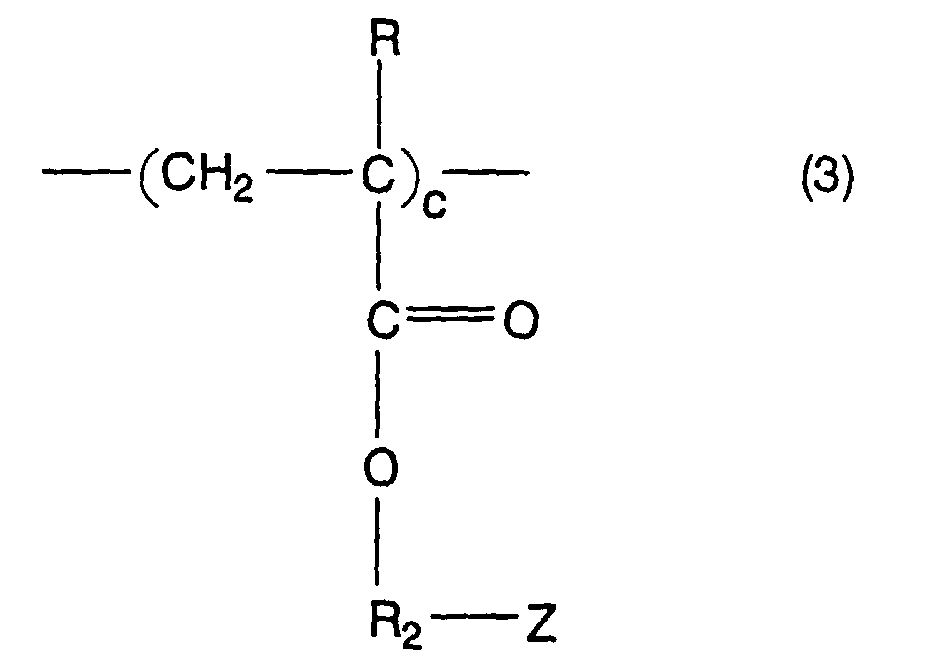
Description

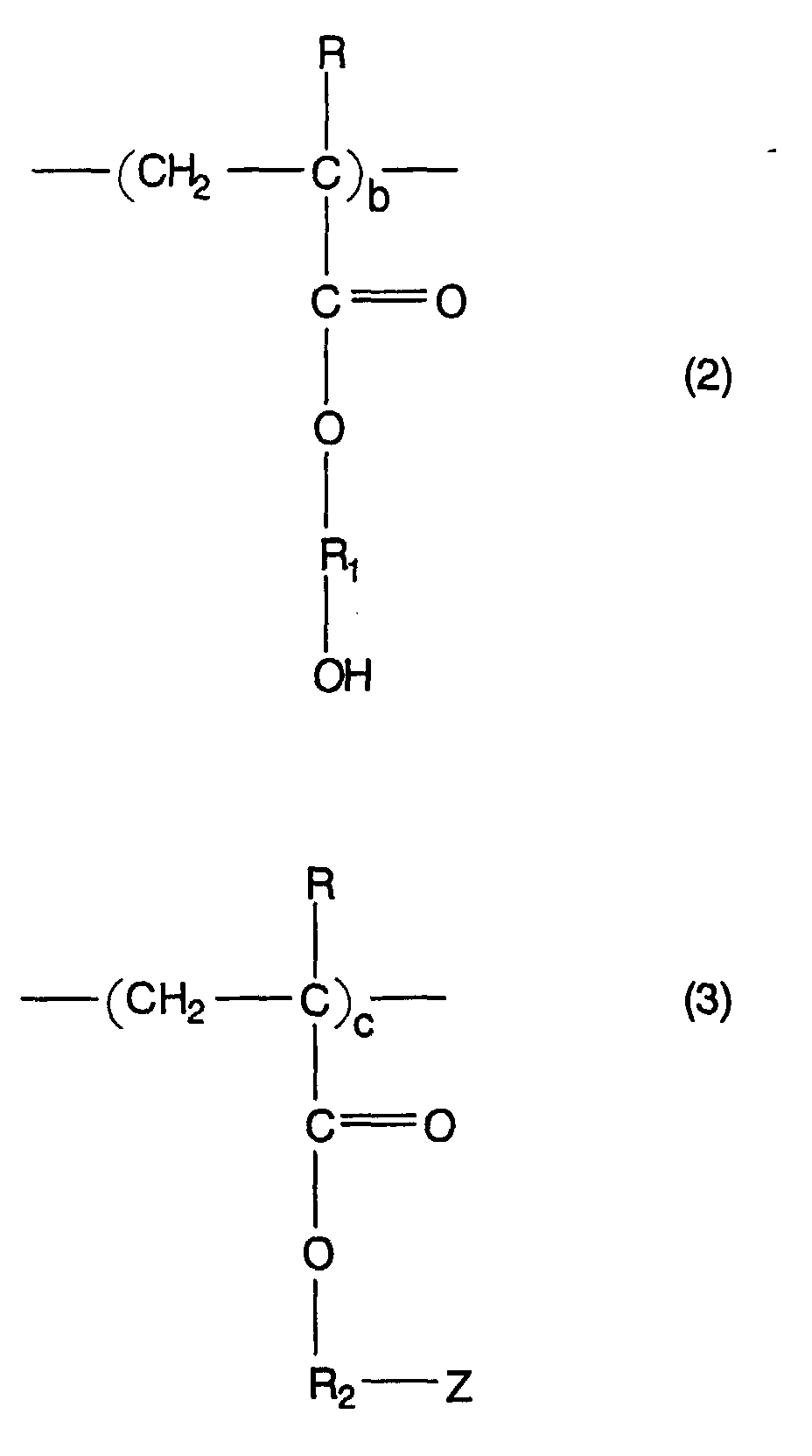


| Copolymer resin No. | HEMA | AA | St | BzMA |
| (1) | 18 | 30 | 37 | 15 |
| (2) | 20 | 20 | 35 | 25 |
| (3) | 18 | 30 | 52 | 0 |
| (4) | 18 | 30 | 0 | 52 |
| Copolymer resin No. | Mw | Content of acryloyl group | Acid value |
| (1) | 45,000 | 17.0 | 120 |
| (2) | 45,000 | 14.5 | 100 |
| (3) | 45,000 | 14.5 | 120 |
| (4) | 45,000 | 14.5 | 120 |
| Methyl methacrylate | 571 g |
| 2-Hydroxyethyl methacrylate | 163 g |
| Glycidyl methacrylate | 81 g |
| 2-Methacryloylethyl isocyanate | 270 g |
| Dibutyltin laurate | 1 g |
| 3-Methoxybutyl acetate | 2230 g |
| Benzyl methacrylate | 204 g |
| Styrene | 286 g |
| 2-Hydroxyethyl methacrylate | 163 g |
| Glycidyl methacrylate | 163 g |
| 2-Methacryloylethyl isocyanate | 270 g |
| Dibutyltin laurate | 1 g |
| 3-Methoxybutyl acetate | 2230 g |
| Methyl methacrylate | 489 g |
| 2-Hydroxyethyl methacrylate | 163 g |
| Oxetane methacrylate (OXE-30, manufactured by Osaka Organic Chemical Industry Ltd.) | 163 g |
| 2-Methacryloylethyl isocyanate | 270 g |
| Dibutyltin laurate | 1 g |
| 3-Methoxybutyl acetate | 2230 g |
| Methyl methacrylate | 530 g |
| 2-Hydroxyethyl methacrylate | 163 g |
| Methacrylic acid | 41 g |
| Oxetane methacrylate (OXE-30, manufactured by Osaka Organic Chemical Industry Ltd.) | 184 g |
| 2-Methacryloylethyl isocyanate | 270 g |
| Dibutyltin laurate | 1 g |
| 3-Methoxybutyl acetate | 2230 g |
| Benzyl methacrylate | 264 g |
| Styrene | 385 g |
| Acrylic acid | 216 g |
| 2-Hydroxyethyl methacrylate | 234 g |
| 2-Methacryloylethyl isocyanate | 270 g |
| Dibutyltin laurate | 1 g |
| 3-Methoxybutyl acetate | 2230 g |
| Pyrazolone Red (red pigment) | 10 pts.wt. |
| Polyvinyl alcohol/5% stilbazolium quinolium (photosensitive resin) | 5 pts.wt. |
| Water | 85 pts.wt. |
| Lionol Green 2Y-301 (green pigment) | 9 pts.wt. |
| Polyvinyl alcohol/5% stilbazolium quinolium (photosensitive resin) | 5 pts.wt. |
| Water | 86 pts.wt. |
| Fastogen Blue (blue pigment) | 3 pts.wt. |
| Polyvinyl alcohol/5% stilbazolium quinolium (photosensitive resin) | 5 pts.wt. |
| Water | 92 pts.wt. |
| Alkali-developable photocurable copolymer resin (1) synthesized above (solid content 26 wt%) | 8.1 pts.wt. |
| Dipentaerythritol pentaacrylate (SR 399, manufactured by Sartomer) | 6.3 pts. wt. |
| Epoxy-containing copolymer resin 1 ○ synthesized above (on a solid basis) | 10.8 pts.wt. |
| 2-Methyl-1-[(4-methylthio)phenyl]-2-morpholinopropanone-1 | 1.2 pts.wt. |
| 2,2'-Bis(o-chlorophenyl)-4,5,4',5'-tetraphenyl-1,2'-biimidazole | 0.9 pt.wt. |
| Triazine (TAZ 110, manufactured by Midori Kagaku Co., Ltd. | 0.3 pt.wt. |
| Diethylene glycol dimethyl ether | 34.6 pts.wt. |
| 3-Methoxybutyl acetate | 37.0 pts.wt. |
| Alkali-developable photocurable copolymer resin (1) synthesized above (solid content 26 wt%) | 10.0 pts.wt. |
| Dipentaerythritol pentaacrylate (SR 399, manufactured by Sartomer) | 15.2 pts.wt. |
| 2-Methyl-1-[(4-methylthio)phenyl]-2-morpholinopropanone-1 | 1.2 pts.wt. |
| 2,2'-Bis(o-chlorophenyl)-4,5,4',5'-tetraphenyl-1,2'-biimidazole | 0.9 pt.wt. |
| Triazine (TAZ 110, manufactured by Midori Kagaku Co., Ltd. | 0.3 pt.wt. |
| Diethylene glycol dimethyl ether | 34.6 pts.wt. |
| 3-Methoxybutyl acetate | 37.0 pts.wt. |
| Alkali - developable photocurable copolymer resin (1) synthesized above (solid content 26 wt%) | 8.1 pts.wt. |
| Dipentaerythritol pentaacrylate (SR 399, manufactured by Sartomer) | 6.3 pts.wt. |
| Bisphenol A type epoxy resin (as a solid content) | 10.8 pts.wt. |
| 2-Methyl-1-[(4-methylthio)phenyl]-2-morpholinopropanone-1 | 1.2 pts.wt. |
| 2,2'-Bis(o-chlorophenyl)-4,5,4',5'-tetraphenyl-1,2'-biimidazole | 0.9 pt.wt. |
| Diethylene glycol dimethyl ether | 34.6 pts.wt. |
| 3-Methoxybutyl acetate | 37.0 pts.wt. |
| Resin | Hot pure water resistance | Solvent resistance | Heat resistance | Alkali resistance | Pencil hardness | Sensitivity, mJ/cm2 | |
| Protective layer on glass substrate | A | 10 | 10 | 10 | 8 | 3H | 75 |
| B | 10 | 10 | 10 | 8 | 3H | 75 | |
| C | 10 | 10 | 10 | 8 | 3H | 75 | |
| D | 0 | 4 | 6 | 0 | H | 75 | |
| |
6 | 6 | 6 | 6 | 2H | 150 | |
| Protective layer on color filter | A | 8 | 8 | 8 | - | - | - |
| B | 8 | 8 | 8 | - | - | - | |
| C | 8 | 8 | 8 | - | - | - | |
| D | 0 | 4 | 6 | - | - | - | |
| |
4 | 6 | 6 | - | - | - |
Claims (5)
- An epoxy-containing copolymer resin comprising 0 to 55% by mole of constituent units represented by formula (1), 5 to 95% by mole of constituent units represented by formula (2), and 5 to 95% by mole of constituent units represented by formula (3), the constituent units represented by formula (1) having been partially reacted, through carboxyl groups thereof, with a (meth)acryloylalkyl isocyanate compound, the constituent units represented by formula (2) having been partially reacted, through hydroxyl groups thereof, with a (meth)acryloylalkyl isocyanate compound, said copolymer resin containing 5 to 95% by mole of (meth)acryloyl groups and having an acid value of 0 to 400 mg KOH/g and a weight average molecular weight of 5.000 to 1,000,000 as determined using polystyrene as a standard:
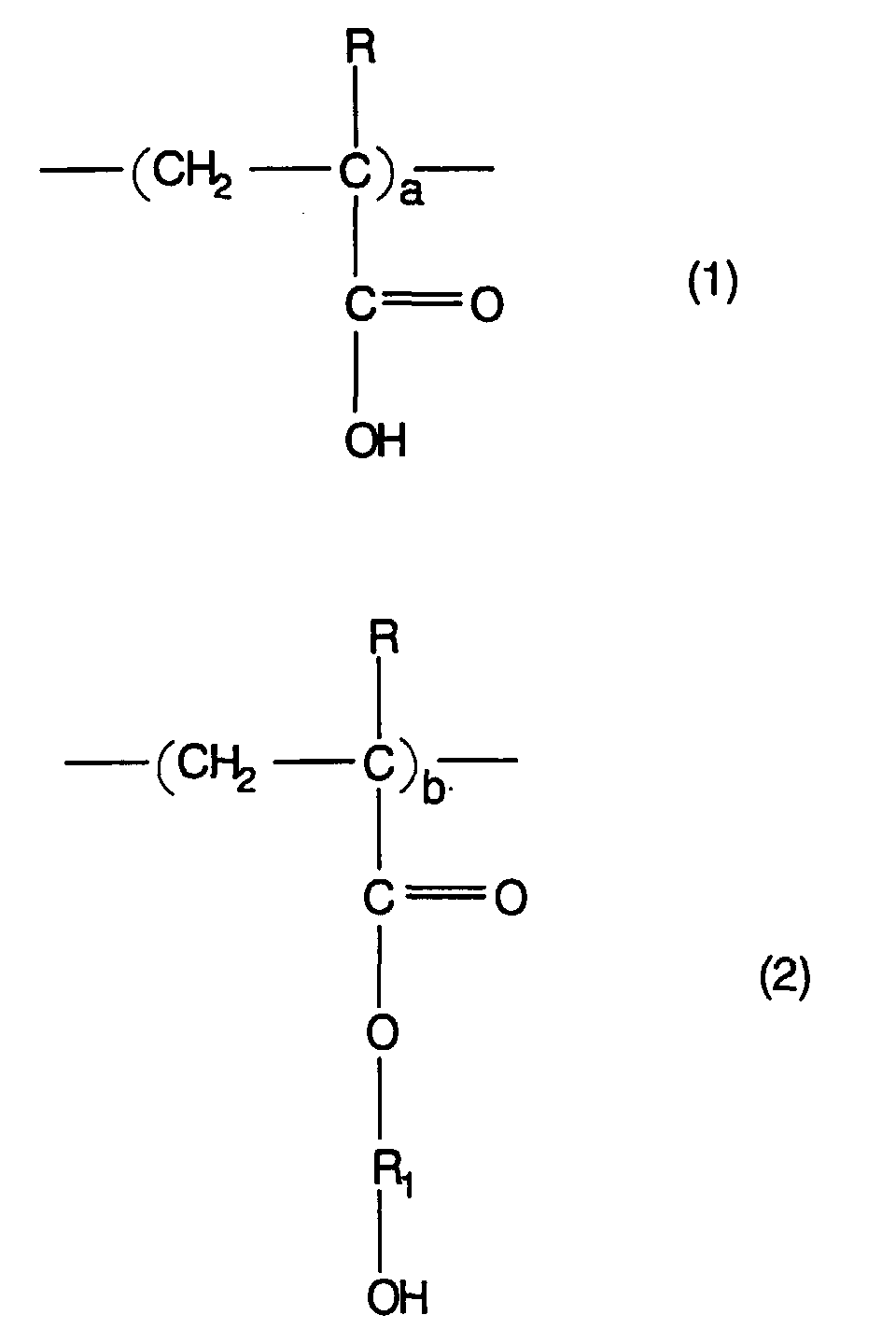 wherein R represents hydrogen or an alkyl group having 1 to 5 carbon atoms; R1 represents an alkylene group having 2 to 4 carbon atoms; R2 represents an alkylene group having 1 to 4 carbon atoms; Z represents a 1,2-epoxy, 1,3-epoxy, or 1,4-epoxy group; and a, b, and c are integers respectively corresponding to said molar percentages.

- The copolymer resin according to claim 1, wherein the copolymer resin further comprises 0 to 75% by mole of constituent units represented by formula (4) and 0 to 75% by mole of constituent units represented by formula (5):wherein R represents hydrogen or an alkyl group having 1 to 5 carbon atoms, R2 represents an aromatic carbon ring, R3 represents an alkyl or aralkyl group, and d and e are integers corresponding respectively to contents in terms of % by mole of the constituent units.
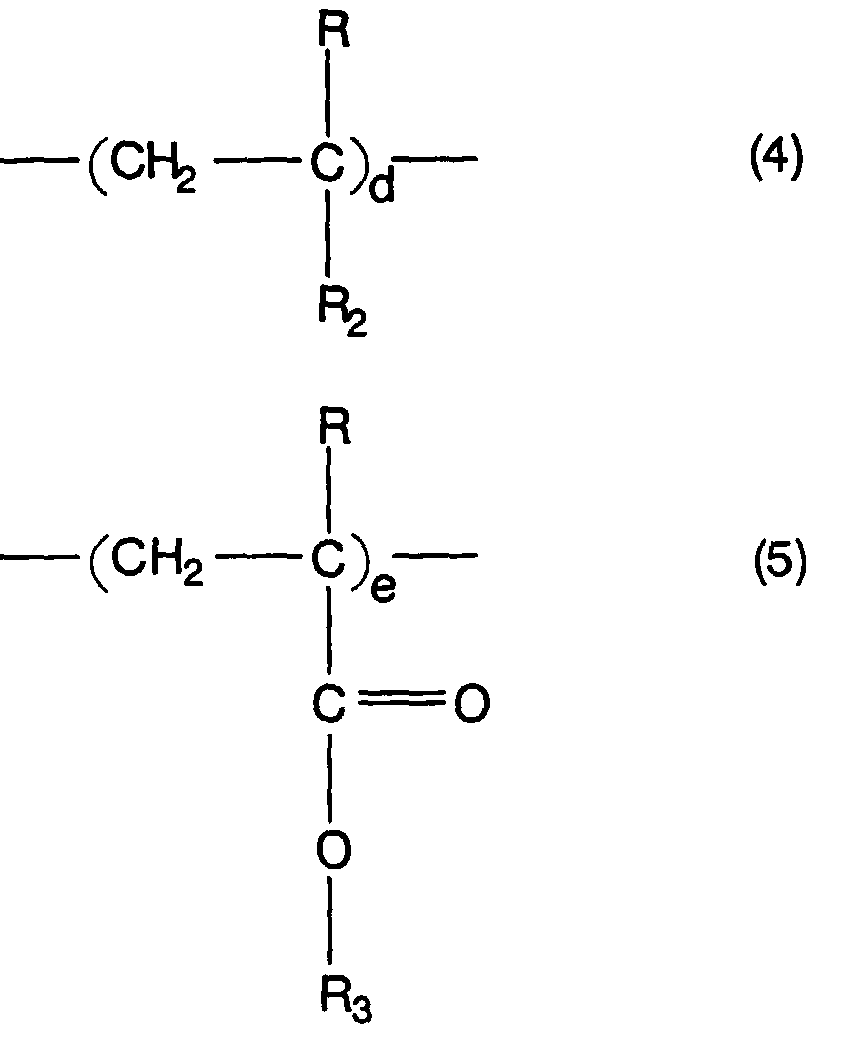
- A photosensitive resin composition comprising: an alkali-developable photocurable copolymer resin; an epoxy-containing copolymer resin; a bifunctional or higher polyfunctional photopolymerizable acrylate monomer; and an initiator,said alkali-developable photocurable copolymer resin comprising 5 to 55% by mole of constituent units represented by formula (1) and 5 to 95% by mole of constituent units represented by formula (2), the constituent units represented by formula (1) having been partially reacted, through carboxyl groups thereof, with a (meth)acryloylalkyl isocyanate compound, the constituent units represented by formula (2) having been partially reacted, through hydroxyl groups thereof, with a (meth)acryloylalkyl isocyanate compound, said copolymer resin containing 5 to 95% by mole of (meth)acryloyl groups and having an acid value of 5 to 400 mg KOH/g and a weight average molecular weight of 5,000 to 1,000,000 as determined using polystyrene as a standard,said epoxy-containing copolymer resin comprising 0 to 55% by mole of constituent units represented by formula (1), 5 to 95% by mole of constituent units represented by formula (2), and 5 to 95% by mole of constituent units represented by formula (3), the constituent units represented by formula (1) having been partially reacted, through carboxyl groups thereof, with a (meth)acryloylalkyl isocyanate compound, the constituent units represented by formula (2) having been partially reacted, through hydroxyl groups thereof, with a (meth)acryloylalkyl isocyanate compound, said copolymer resin containing 5 to 95% by mole of (meth)acryloyl groups and having an acid value of 0 to 400 mg KOH/g and a weight average molecular weight of 5,000 to 1,000,000 as determined using polystyrene as a standard:wherein R represents hydrogen or an alkyl group having 1 to 5 carbon atoms; R1 represents an alkylene group having 2 to 4 carbon atoms; R2 represents an alkylene group having 1 to 4 carbon atoms; Z represents a 1,2-epoxy, 1,3-epoxy, or 1,4-epoxy group; and a, b, and c are integers corresponding respectively to contents in terms of % by mole of the constituent units.

- The photosensitive resin composition according to claim 3, wherein the alkali-developable photocurable copolymer resin and the epoxy-containing copolymer resin further comprise 0 to 75% by mole of constituent units represented by formula (4) and 0 to 75% by mole of constituent units represented by formula (5):wherein R represents hydrogen or an alkyl group having 1 to 5 carbon atoms, R2 represents an aromatic carbon ring, R3 represents an alkyl or aralkyl group, and d and e are integers corresponding respectively to contents in terms of % by mole of the constituent units.

- A color filter comprising: a transparent substrate; a colored layer provided on the transparent substrate; and a protective layer provided so as to cover the colored layer,said protective layer having been formed by coating the photosensitive resin composition according to claim 3 or 4, exposing the coating, developing the exposed coating with an alkali, and heating the developed coating.
Applications Claiming Priority (4)
| Application Number | Priority Date | Filing Date | Title |
|---|---|---|---|
| JP4917899A JP4218851B2 (en) | 1999-02-25 | 1999-02-25 | Photosensitive resin composition for forming color filter protective film |
| JP4917899 | 1999-02-25 | ||
| JP04917799A JP4257758B2 (en) | 1999-02-25 | 1999-02-25 | Photosensitive resin composition and color filter |
| JP4917799 | 1999-02-25 |
Publications (3)
| Publication Number | Publication Date |
|---|---|
| EP1035439A2 true EP1035439A2 (en) | 2000-09-13 |
| EP1035439A3 EP1035439A3 (en) | 2002-02-13 |
| EP1035439B1 EP1035439B1 (en) | 2005-06-15 |
Family
ID=26389539
Family Applications (1)
| Application Number | Title | Priority Date | Filing Date |
|---|---|---|---|
| EP00103385A Expired - Lifetime EP1035439B1 (en) | 1999-02-25 | 2000-02-24 | Photosensitive resin composition, color filter, and copolymer resin useful for them |
Country Status (5)
| Country | Link |
|---|---|
| US (2) | US6410206B1 (en) |
| EP (1) | EP1035439B1 (en) |
| KR (1) | KR100354333B1 (en) |
| DE (1) | DE60020762T2 (en) |
| TW (1) | TWI255944B (en) |
Cited By (4)
| Publication number | Priority date | Publication date | Assignee | Title |
|---|---|---|---|---|
| WO2002046840A1 (en) * | 2000-12-04 | 2002-06-13 | Kanagawa University | Photocurable and thermosetting resin composition |
| US6582862B1 (en) * | 1999-10-08 | 2003-06-24 | Dai Nippon Printing Co., Ltd. | High photo-sensitivity curable resin, photo-curable resin composition, production method thereof, color filter and liquid crystal display panel |
| WO2005103822A3 (en) * | 2004-04-22 | 2006-12-14 | Showa Denko Kk | Photosensitive resin composition, cured product thereof and production method of printed circuit board using the same |
| TWI406093B (en) * | 2007-12-04 | 2013-08-21 | Lg Chemical Ltd | Alkali-soluble photoresist composition |
Families Citing this family (52)
| Publication number | Priority date | Publication date | Assignee | Title |
|---|---|---|---|---|
| JP2001181579A (en) * | 1999-12-27 | 2001-07-03 | Clariant (Japan) Kk | Coating composition |
| TWI227374B (en) * | 2001-01-24 | 2005-02-01 | Sumitomo Chemical Co | Colored photosensitive composition, method for making a color pattern and the use thereof |
| TWI252356B (en) * | 2001-06-01 | 2006-04-01 | Sony Corp | Semi-transmission/reflection type liquid crystal display device |
| KR100481014B1 (en) * | 2002-10-04 | 2005-04-07 | 주식회사 동진쎄미켐 | Photosensitive resin composition using photopolymer |
| KR100481015B1 (en) * | 2002-10-04 | 2005-04-07 | 주식회사 동진쎄미켐 | Photosensitive resin composition having superior development margin and adhesive property with substrate |
| JP3879651B2 (en) * | 2002-10-21 | 2007-02-14 | ソニー株式会社 | Multilayer wiring board, touch panel, and manufacturing method thereof |
| KR100888780B1 (en) * | 2002-12-13 | 2009-03-13 | 주식회사 코오롱 | Photocurable resin composition for column spacer |
| TWI241330B (en) * | 2003-03-20 | 2005-10-11 | Toyo Ink Mfg Co | Pressure sensitive adhesive composition and sheet |
| TWI312882B (en) * | 2003-03-24 | 2009-08-01 | Dainippon Printing Co Ltd | Curable resin composition, curable resin composition for photo-process patterning, color filter, substrate for liquid crystal panel and liquid crystal panel |
| KR101252321B1 (en) | 2005-06-30 | 2013-04-08 | 도레이 카부시키가이샤 | Photosensitive Resin Composition and Adhesion Enhancer |
| KR100805688B1 (en) * | 2005-09-15 | 2008-02-21 | 제일모직주식회사 | Protective film composition for thermosetting one-component color filter and color filter using the same |
| KR100777965B1 (en) | 2005-12-22 | 2007-11-28 | 제일모직주식회사 | Protective film composition for thermosetting one-component color filter and color filter using the same |
| KR101223627B1 (en) | 2006-02-03 | 2013-01-17 | 삼성에스디아이 주식회사 | Apparatus for reforming fuel and manufacturing method of the same |
| SG137817A1 (en) * | 2006-05-29 | 2007-12-28 | Jsr Corp | Radiation sensitive composition for forming a colored layer, color filter and color liquid crystal display device |
| WO2008050715A1 (en) * | 2006-10-23 | 2008-05-02 | Fujifilm Corporation | Metal-film-coated material and process for producing the same, metallic-pattern-bearing material and process for producing the same, composition for polymer layer formation, nitrile polymer and method of synthesizing the same, composition containing nitrile polymer, and layered product |
| CN103588930B (en) * | 2006-10-23 | 2017-04-26 | 富士胶片株式会社 | Nitrile group-containing polymer, method for synthesizing same, composition using nitrile group-containing polymer, and laminate |
| KR100920603B1 (en) * | 2006-12-28 | 2009-10-08 | 제일모직주식회사 | Photosensitive resin composition and color filter manufactured therefrom |
| KR100881860B1 (en) * | 2007-01-17 | 2009-02-06 | 제일모직주식회사 | Photosensitive resin composition for color filter and image sensor color filter using same |
| KR100900138B1 (en) * | 2007-02-08 | 2009-06-01 | 주식회사 엘지화학 | Alkali-developable resins, method for preparing the same and photosensitive composition comprising the alkali-developable resins |
| KR101506535B1 (en) * | 2007-02-28 | 2015-03-27 | 제이엔씨 주식회사 | Positive photosensitive resin composition |
| US7759048B2 (en) * | 2007-07-09 | 2010-07-20 | Tokyo Ohka Kogyo Co., Ltd. | Photosensitive resin composition and microlens formed with use thereof |
| US20090035704A1 (en) * | 2007-08-03 | 2009-02-05 | Hong Zhuang | Underlayer Coating Composition Based on a Crosslinkable Polymer |
| KR101462275B1 (en) * | 2007-09-27 | 2014-11-20 | 동우 화인켐 주식회사 | Colored photosensitive resin composition, color filter, and liquid crystal display device having the same |
| KR101024205B1 (en) * | 2007-11-05 | 2011-03-23 | 주식회사 엘지화학 | Ink composition for roll printing |
| US8039201B2 (en) * | 2007-11-21 | 2011-10-18 | Az Electronic Materials Usa Corp. | Antireflective coating composition and process thereof |
| JP2009128862A (en) * | 2007-11-28 | 2009-06-11 | Seiko Epson Corp | Color filter ink, color filter ink set, color filter, image display device, and electronic device |
| JP2009127027A (en) * | 2007-11-28 | 2009-06-11 | Seiko Epson Corp | Color filter ink, color filter ink set, color filter, image display device, and electronic device |
| JP4466725B2 (en) * | 2007-11-28 | 2010-05-26 | セイコーエプソン株式会社 | Color filter ink, color filter ink set, color filter, image display device, and electronic device |
| JP2009144087A (en) * | 2007-12-17 | 2009-07-02 | Seiko Epson Corp | Color filter ink, color filter ink set, color filter, image display device, and electronic device |
| JP5115205B2 (en) * | 2008-01-15 | 2013-01-09 | Jnc株式会社 | Positive photosensitive polymer composition |
| JP2009169214A (en) * | 2008-01-18 | 2009-07-30 | Seiko Epson Corp | Color filter ink set, color filter, image display device, and electronic device |
| US20100015550A1 (en) * | 2008-07-17 | 2010-01-21 | Weihong Liu | Dual damascene via filling composition |
| JP2010044273A (en) * | 2008-08-14 | 2010-02-25 | Fujifilm Corp | Color filter and production method thereof, and solid-state image sensor using the same |
| US8486591B2 (en) * | 2008-10-24 | 2013-07-16 | Cheil Industries Inc. | Photosensitive resin composition for color filter and color filter prepared using the same |
| KR101321417B1 (en) * | 2009-12-28 | 2013-10-30 | 제일모직주식회사 | Resin composition for protection layer of color filter, protection layer of color filter using same and image sensor including same |
| KR20110077881A (en) * | 2009-12-30 | 2011-07-07 | 제일모직주식회사 | Phosphorus acrylic copolymer resin excellent in transparency and flame retardancy and its composition |
| KR101290057B1 (en) * | 2010-07-19 | 2013-07-26 | 주식회사 엘지화학 | Thermosetting protective film composition with excellent coating and recoating properties |
| KR101293787B1 (en) | 2010-07-28 | 2013-08-06 | 제일모직주식회사 | Transparent Thermoplastic Resin Composition with Excellent Flame-resistance and Heat-resistance |
| KR101351614B1 (en) | 2010-11-05 | 2014-02-17 | 제일모직주식회사 | Polycarbonate resin composition with flame retardancy and scratch resistance |
| KR101400193B1 (en) | 2010-12-10 | 2014-05-28 | 제일모직 주식회사 | Photosensitive resin composition for color filter and color filter using same |
| KR101374360B1 (en) | 2010-12-14 | 2014-03-18 | 제일모직주식회사 | Polycarbonate resin composition with flame retardancy and scratch resistance |
| JP5786451B2 (en) * | 2011-05-19 | 2015-09-30 | Jsr株式会社 | Color filter, liquid crystal display element, and method of manufacturing color filter |
| KR20130002789A (en) | 2011-06-29 | 2013-01-08 | 제일모직주식회사 | Photosensitive resin composition for color filter and color filter using the same |
| CN104823082B (en) * | 2012-11-29 | 2017-07-28 | 富士胶片株式会社 | Composition, infrared ray pass through optical filter and its manufacture method, infrared ray sensor and dyed layer |
| KR101674990B1 (en) | 2012-12-07 | 2016-11-10 | 제일모직 주식회사 | Photosensitive resin composition for color filter, and color filter using the same |
| KR20140083620A (en) | 2012-12-26 | 2014-07-04 | 제일모직주식회사 | Photosensitive resin composition for light blocking layer and light blocking layer using the same |
| JP6008760B2 (en) * | 2013-03-05 | 2016-10-19 | 富士フイルム株式会社 | Colored photosensitive composition, color filter and method for producing color filter |
| CN103130955B (en) * | 2013-03-07 | 2015-06-17 | 京东方科技集团股份有限公司 | Photosensitive oligomer for photoresist, preparation method and negative photoresist composition thereof |
| JP6274498B2 (en) * | 2013-11-08 | 2018-02-07 | 日東電工株式会社 | Photosensitive resin composition for optical waveguide, photocurable film for forming optical waveguide core layer, optical waveguide using the same, mixed flexible printed wiring board for optical / electrical transmission |
| US10040965B2 (en) | 2013-11-20 | 2018-08-07 | Osaka Organic Chemical Industry Ltd. | Clear coating composition |
| CN106061739B (en) * | 2014-02-20 | 2018-08-03 | 加卢斯费迪南德吕施股份公司 | Printing screen and method for being imaged printing screen |
| CN115315482B (en) | 2020-03-11 | 2024-07-05 | 富士胶片株式会社 | Resin composition, film, optical filter, solid-state imaging element, and image display device |
Family Cites Families (9)
| Publication number | Priority date | Publication date | Assignee | Title |
|---|---|---|---|---|
| US4025348A (en) * | 1974-05-10 | 1977-05-24 | Hitachi Chemical Company, Ltd. | Photosensitive resin compositions |
| US4742121A (en) * | 1985-04-29 | 1988-05-03 | The Glidden Company | Acrylate resin gel coat composition |
| US4999136A (en) * | 1988-08-23 | 1991-03-12 | Westinghouse Electric Corp. | Ultraviolet curable conductive resin |
| US5153102A (en) * | 1990-08-10 | 1992-10-06 | Industrial Technology Research Institute | Alkalline-solution-developable liquid photographic composition |
| JP2764480B2 (en) * | 1991-05-17 | 1998-06-11 | 日本化薬株式会社 | Photopolymer composition for color filter |
| WO1995000573A1 (en) * | 1993-06-23 | 1995-01-05 | Union Carbide Chemicals & Plastics | Reactive polymers having pendant flexible side chains prepared from ethylenically unsaturated isocyanates |
| US5882842A (en) * | 1996-02-16 | 1999-03-16 | Kansai Paint Co., Ltd. | Active energy ray-curable resin composition |
| DE19757090A1 (en) * | 1997-12-20 | 1999-04-01 | Herberts Gmbh | Strengthening fibrous material, useful for paper or cardboard for packaging |
| KR100334426B1 (en) * | 1998-07-31 | 2002-05-03 | 기타지마 요시토시 | Photosensitive resin composition and colour filter |
-
2000
- 2000-02-24 US US09/512,347 patent/US6410206B1/en not_active Expired - Lifetime
- 2000-02-24 DE DE60020762T patent/DE60020762T2/en not_active Expired - Fee Related
- 2000-02-24 EP EP00103385A patent/EP1035439B1/en not_active Expired - Lifetime
- 2000-02-25 TW TW089103422A patent/TWI255944B/en not_active IP Right Cessation
- 2000-02-25 KR KR1020000009383A patent/KR100354333B1/en not_active Expired - Fee Related
-
2002
- 2002-04-03 US US10/114,466 patent/US6517980B2/en not_active Expired - Fee Related
Cited By (6)
| Publication number | Priority date | Publication date | Assignee | Title |
|---|---|---|---|---|
| US6582862B1 (en) * | 1999-10-08 | 2003-06-24 | Dai Nippon Printing Co., Ltd. | High photo-sensitivity curable resin, photo-curable resin composition, production method thereof, color filter and liquid crystal display panel |
| WO2002046840A1 (en) * | 2000-12-04 | 2002-06-13 | Kanagawa University | Photocurable and thermosetting resin composition |
| KR100830019B1 (en) * | 2000-12-04 | 2008-05-15 | 각고우호우진 가나가와 다이가쿠 | Photocurable and Thermosetting Resin Compositions |
| WO2005103822A3 (en) * | 2004-04-22 | 2006-12-14 | Showa Denko Kk | Photosensitive resin composition, cured product thereof and production method of printed circuit board using the same |
| US7790354B2 (en) | 2004-04-22 | 2010-09-07 | Showa Denko K.K. | Photosensitive resin composition, cured product thereof and production method of printed circuit board using the same |
| TWI406093B (en) * | 2007-12-04 | 2013-08-21 | Lg Chemical Ltd | Alkali-soluble photoresist composition |
Also Published As
| Publication number | Publication date |
|---|---|
| KR100354333B1 (en) | 2002-09-28 |
| US20020172873A1 (en) | 2002-11-21 |
| DE60020762D1 (en) | 2005-07-21 |
| KR20000058201A (en) | 2000-09-25 |
| US6517980B2 (en) | 2003-02-11 |
| DE60020762T2 (en) | 2006-05-04 |
| EP1035439B1 (en) | 2005-06-15 |
| TWI255944B (en) | 2006-06-01 |
| US6410206B1 (en) | 2002-06-25 |
| EP1035439A3 (en) | 2002-02-13 |
Similar Documents
| Publication | Publication Date | Title |
|---|---|---|
| EP1035439B1 (en) | Photosensitive resin composition, color filter, and copolymer resin useful for them | |
| EP0977085B1 (en) | Photosensitive resin composition and color filter | |
| US6299949B1 (en) | Liquid crystal display devices and processes for producing the same | |
| JP4257758B2 (en) | Photosensitive resin composition and color filter | |
| EP0520626B1 (en) | Radiation-sensitive resin composition | |
| JP2961722B2 (en) | Radiation-sensitive resin composition | |
| CN101646698B (en) | Alkali-soluble resin and negative photosensitive resin composition containing the same | |
| JP4218851B2 (en) | Photosensitive resin composition for forming color filter protective film | |
| JP2004126600A (en) | Photosensitive resin composition for controlling dissolution characteristics and method for forming two-layer structure pattern using the same | |
| JP2000298339A (en) | Photosensitive resin composition | |
| JP2021063933A (en) | Resin composition, photosensitive resin composition, film, color filter, black matrix, display device, and image sensor | |
| JP2000105456A (en) | Photosensitive resin composition and color filter | |
| KR101082479B1 (en) | Alkali-soluble binder, preparing method thereof, and photoresist composition contanining the same | |
| JPH09176240A (en) | Photopolymerizable composition | |
| JP4196562B2 (en) | Radiation curable composition for forming optical waveguide, optical waveguide and method for producing optical waveguide | |
| JPH0643643A (en) | Heat resistant radiosensitive resin composition | |
| JP2000034319A (en) | Copolymer resin | |
| KR20030028392A (en) | Partition Wall for Ink Jet Method Color Filter | |
| KR101420868B1 (en) | A colored photosensitive resin composition, color filter and liquid crystal display device having the same | |
| JP2000298337A (en) | Photosensitive resin composition | |
| JPH11292930A (en) | Copolymer resin | |
| JP5275596B2 (en) | Photocurable resin composition and pattern forming method | |
| JP2010020158A (en) | Negative resist, color filter, and liquid crystal display device | |
| JP2007304544A (en) | Negative resist for liquid crystal alignment protrusion formation, liquid crystal alignment protrusion, color filter, liquid crystal display element, and method of manufacturing liquid crystal display element | |
| JP2008145987A (en) | Photocurable resin composition, liquid crystal alignment protrusion, color filter, and liquid crystal display device |
Legal Events
| Date | Code | Title | Description |
|---|---|---|---|
| PUAI | Public reference made under article 153(3) epc to a published international application that has entered the european phase |
Free format text: ORIGINAL CODE: 0009012 |
|
| AK | Designated contracting states |
Kind code of ref document: A2 Designated state(s): DE FR GB Kind code of ref document: A2 Designated state(s): AT BE CH CY DE DK ES FI FR GB GR IE IT LI LU MC NL PT SE |
|
| AX | Request for extension of the european patent |
Free format text: AL;LT;LV;MK;RO;SI |
|
| PUAL | Search report despatched |
Free format text: ORIGINAL CODE: 0009013 |
|
| AK | Designated contracting states |
Kind code of ref document: A3 Designated state(s): AT BE CH CY DE DK ES FI FR GB GR IE IT LI LU MC NL PT SE |
|
| AX | Request for extension of the european patent |
Free format text: AL;LT;LV;MK;RO;SI |
|
| RIC1 | Information provided on ipc code assigned before grant |
Free format text: 7G 03F 7/038 A, 7G 03F 7/032 B |
|
| 17P | Request for examination filed |
Effective date: 20020516 |
|
| AKX | Designation fees paid |
Free format text: DE FR GB |
|
| GRAP | Despatch of communication of intention to grant a patent |
Free format text: ORIGINAL CODE: EPIDOSNIGR1 |
|
| GRAS | Grant fee paid |
Free format text: ORIGINAL CODE: EPIDOSNIGR3 |
|
| GRAA | (expected) grant |
Free format text: ORIGINAL CODE: 0009210 |
|
| AK | Designated contracting states |
Kind code of ref document: B1 Designated state(s): DE FR GB |
|
| REG | Reference to a national code |
Ref country code: GB Ref legal event code: FG4D |
|
| REF | Corresponds to: |
Ref document number: 60020762 Country of ref document: DE Date of ref document: 20050721 Kind code of ref document: P |
|
| ET | Fr: translation filed | ||
| PLBE | No opposition filed within time limit |
Free format text: ORIGINAL CODE: 0009261 |
|
| STAA | Information on the status of an ep patent application or granted ep patent |
Free format text: STATUS: NO OPPOSITION FILED WITHIN TIME LIMIT |
|
| 26N | No opposition filed |
Effective date: 20060316 |
|
| PGFP | Annual fee paid to national office [announced via postgrant information from national office to epo] |
Ref country code: DE Payment date: 20090219 Year of fee payment: 10 |
|
| PGFP | Annual fee paid to national office [announced via postgrant information from national office to epo] |
Ref country code: GB Payment date: 20090119 Year of fee payment: 10 |
|
| PGFP | Annual fee paid to national office [announced via postgrant information from national office to epo] |
Ref country code: FR Payment date: 20090129 Year of fee payment: 10 |
|
| GBPC | Gb: european patent ceased through non-payment of renewal fee |
Effective date: 20100224 |
|
| REG | Reference to a national code |
Ref country code: FR Ref legal event code: ST Effective date: 20101029 |
|
| PG25 | Lapsed in a contracting state [announced via postgrant information from national office to epo] |
Ref country code: FR Free format text: LAPSE BECAUSE OF NON-PAYMENT OF DUE FEES Effective date: 20100301 |
|
| PG25 | Lapsed in a contracting state [announced via postgrant information from national office to epo] |
Ref country code: DE Free format text: LAPSE BECAUSE OF NON-PAYMENT OF DUE FEES Effective date: 20100901 |
|
| PG25 | Lapsed in a contracting state [announced via postgrant information from national office to epo] |
Ref country code: GB Free format text: LAPSE BECAUSE OF NON-PAYMENT OF DUE FEES Effective date: 20100224 |