EP1034857A2 - System and method for preventing scale defects during hot rolling - Google Patents
System and method for preventing scale defects during hot rolling Download PDFInfo
- Publication number
- EP1034857A2 EP1034857A2 EP00103817A EP00103817A EP1034857A2 EP 1034857 A2 EP1034857 A2 EP 1034857A2 EP 00103817 A EP00103817 A EP 00103817A EP 00103817 A EP00103817 A EP 00103817A EP 1034857 A2 EP1034857 A2 EP 1034857A2
- Authority
- EP
- European Patent Office
- Prior art keywords
- descaler
- oxide film
- film thickness
- stage
- cooler
- Prior art date
- Legal status (The legal status is an assumption and is not a legal conclusion. Google has not performed a legal analysis and makes no representation as to the accuracy of the status listed.)
- Granted
Links
Images





Classifications
-
- B—PERFORMING OPERATIONS; TRANSPORTING
- B21—MECHANICAL METAL-WORKING WITHOUT ESSENTIALLY REMOVING MATERIAL; PUNCHING METAL
- B21B—ROLLING OF METAL
- B21B45/00—Devices for surface or other treatment of work, specially combined with or arranged in, or specially adapted for use in connection with, metal-rolling mills
- B21B45/02—Devices for surface or other treatment of work, specially combined with or arranged in, or specially adapted for use in connection with, metal-rolling mills for lubricating, cooling, or cleaning
- B21B45/0203—Cooling
- B21B45/0209—Cooling devices, e.g. using gaseous coolants
- B21B45/0215—Cooling devices, e.g. using gaseous coolants using liquid coolants, e.g. for sections, for tubes
- B21B45/0218—Cooling devices, e.g. using gaseous coolants using liquid coolants, e.g. for sections, for tubes for strips, sheets, or plates
-
- B—PERFORMING OPERATIONS; TRANSPORTING
- B21—MECHANICAL METAL-WORKING WITHOUT ESSENTIALLY REMOVING MATERIAL; PUNCHING METAL
- B21B—ROLLING OF METAL
- B21B1/00—Metal-rolling methods or mills for making semi-finished products of solid or profiled cross-section; Sequence of operations in milling trains; Layout of rolling-mill plant, e.g. grouping of stands; Succession of passes or of sectional pass alternations
- B21B1/22—Metal-rolling methods or mills for making semi-finished products of solid or profiled cross-section; Sequence of operations in milling trains; Layout of rolling-mill plant, e.g. grouping of stands; Succession of passes or of sectional pass alternations for rolling plates, strips, bands or sheets of indefinite length
- B21B1/24—Metal-rolling methods or mills for making semi-finished products of solid or profiled cross-section; Sequence of operations in milling trains; Layout of rolling-mill plant, e.g. grouping of stands; Succession of passes or of sectional pass alternations for rolling plates, strips, bands or sheets of indefinite length in a continuous or semi-continuous process
- B21B1/26—Metal-rolling methods or mills for making semi-finished products of solid or profiled cross-section; Sequence of operations in milling trains; Layout of rolling-mill plant, e.g. grouping of stands; Succession of passes or of sectional pass alternations for rolling plates, strips, bands or sheets of indefinite length in a continuous or semi-continuous process by hot-rolling, e.g. Steckel hot mill
-
- B—PERFORMING OPERATIONS; TRANSPORTING
- B21—MECHANICAL METAL-WORKING WITHOUT ESSENTIALLY REMOVING MATERIAL; PUNCHING METAL
- B21B—ROLLING OF METAL
- B21B45/00—Devices for surface or other treatment of work, specially combined with or arranged in, or specially adapted for use in connection with, metal-rolling mills
- B21B45/04—Devices for surface or other treatment of work, specially combined with or arranged in, or specially adapted for use in connection with, metal-rolling mills for de-scaling, e.g. by brushing
- B21B45/08—Devices for surface or other treatment of work, specially combined with or arranged in, or specially adapted for use in connection with, metal-rolling mills for de-scaling, e.g. by brushing hydraulically
Definitions
- the present invention relates to a system and a method for preventing scale defects on a finish rolling line of hot rolling equipment by descaling or cooling a surface of a material to be rolled (hot rolled steel plate) to suppress the formation of scale (oxide film).
- oxide film may grow after scale removal at an entry side of a row of finishing mills.
- scale defects occur in a hot rolled steel plate to decrease the yield of the product and deteriorate its surface quality.
- it has been performed empirically to set the temperature of the steel plate surface, or to control the temperature of the steel plate surface at the entry side of the row of finishing mills.
- FIG. 8 is a view showing another conventional method for preventing scale defects.
- a hot rolled steel plate 1 as a material to be rolled, passes, while being rolled, between a first stage rolling mill F1 and a seventh stage rolling mill F7 from an entry side to a delivery side (from left to right in the drawing) .
- a scale breaker FSB is placed for removing oxide film of the hot rolled steel plate 1 rough rolled by a roughing mill (not shown).
- High pressure water from a header 2 of the scale breaker FSB removes oxide film on the surface of the hot rolled steel plate 1.
- descaling devices 12, 13 are placed at an entry side of each of the second stage rolling mill F2 and the third stage rolling mill F3. These descaling devices 12, 13 jet spray water when the thickness of oxide film on the surface of the steel plate is more than 10 ⁇ m. After being so descaled, the steel plate is rolled.
- the thickness of oxide film at the entry side of the third stage rolling mill F3 may exceed 5 ⁇ m as shown in FIG. 9.
- Finish rolling performed at an oxide film thickness of more than 5 ⁇ m results in the occurrence of scale defects on the surface of the hot rolled steel plate 1, debasing the quality of the product.
- a thermometer 11 is provided at the entry side of the row of finishing mills so that the thickness of oxide film is predicted from the temperature of the steel plate detected, as well as the speed of the steel plate. Actually, the distance from the position of temperature detection to the descaling devices is so short that descaling control tends to be performed with some delay.
- the present invention controls an operating state of a descaler or a cooler placed between finishing mills.
- the invention aims to restrict the thickness of oxide film, which occurs on a material to be rolled, to not more than a limiting oxide film thickness, thereby preventing the occurrence of scale defects of the material to be rolled.
- the invention also intends to suppress overcooling of the material to be rolled. Through these measures, the invention is to improve the quality of the product.
- a system for preventing scale defects during hot rolling by hot rolling equipment having a scale breaker provided at an entry side of a finishing mill line composed of a plurality of rolling mills arranged in tandem, comprising:
- a system for preventing scale defects during hot rolling by hot rolling equipment having a scale breaker provided at an entry side of a finishing mill line composed of a plurality of rolling mills arranged in tandem, comprising:
- the limiting oxide film thickness may be 5 ⁇ m.
- scale defects of the material to be rolled can be prevented reliably.
- water at a low pressure of at least about 70 kgf/cm 2 may be jetted by the descaler.
- economic descaling can be performed.
- control device may function as follows: The control device computes the oxide film thickness of the material at the entry side of the third stage rolling mill based on a temperature of the material at a delivery side of a roughing mill, and if the computed oxide film thickness is not more than the limiting oxide film thickness, the control device actuates neither of the descaler and the cooler;
- the descaler and the cooler are controlled to be efficiently operative according to rolling conditions, so that scale defects in the material to be rolled can be prevented reliably.
- control device may have the following functions: The control device computes the oxide film thickness of the material at the entry side of the third stage rolling mill based on a temperature of the material at a delivery side of a roughing mill, and if the computed oxide film thickness is not more than the limiting oxide film thickness, the control device actuates neither of the descaler at the preceding stage and the descaler at the succeeding stage;
- the descalers at the preceding stage and the succeeding stage are controlled to be operative efficiently according to rolling conditions, so that scale defects in the material to be rolled can be prevented reliably.
- a method for preventing scale defects during hot rolling by hot rolling equipment having a scale breaker provided at an entry side of a finishing mill line composed of a plurality of rolling mills arranged in tandem comprising:
- a method for preventing scale defects during hot rolling by hot rolling equipment having a scale breaker provided at an entry side of a finishing mill line composed of a plurality of rolling mills arranged in tandem comprising:
- FIGS. 1 to 5 A first embodiment of the present invention is described with reference to FIGS. 1 to 5.
- the same members as those in FIG. 8 explained in connection with the earlier technology are assigned the same reference numerals, and overlapping explanations are omitted.
- a descaler (scale removing device) D is placed between a first stage rolling mill F1 and a second stage rolling mill F2, and a cooler C is placed between the second stage rolling mill F2 and a third stage rolling mill F3.
- the descaler D and the cooler C are controlled to be capable of restricting the thickness of oxide film (scale thickness) to fall within allowable values.
- FIG. 5 shows test values with the third stage rolling mill F3.
- ⁇ , ⁇ , and ⁇ represent the appearances of the surface of a steel plate in each of Test Examples (1), (2) and (3), which are expressed as scale defect ratings.
- Re (%) when the thickness of oxide film is more than 5 ⁇ m, the scale defect rating is 2 or 4.5, meaning "Minor defects” or "Defects", respectively.
- the scale defect rating is 0, meaning "No defects”.
- the present invention has set a limiting oxide film thickness, at more than which scale defects occur during hot rolling, to be about 5 ⁇ m at an entry side of the third stage rolling mill F3, and performs descaling and water cooling of a hot rolled steel plate while maintaining the set thickness.
- a hot rolled steel plate (strip plate) 1 passes, while being rolled, between the respective rolling mills of a finishing mill line F comprising the first stage rolling mill F1 to a seventh stage rolling mill F7, from an entry side to a delivery side (from left to right in the drawing).
- a pair of work rolls 6, 6 and a pair of backup rolls 5, 5 are arranged at upper and lower positions, with the hot rolled steel plate 1 being sandwiched between the work rolls 6 and 6.
- a descaler (scale removing device) D is placed between the first stage rolling mill F1 and the second stage rolling mill F2.
- the descaler D comprises headers 3, 3 for a jet medium arranged at upper and lower positions, with the hot rolled steel plate 1 being sandwiched between the headers 3 and 3. From a nozzle at the tip of the header 3, a jet medium can be jetted toward the hot rolled steel plate 1.
- a cooler C for a steel plate surface is disposed, which comprises headers 4, 4 for cooling water arranged at upper and lower positions, with the hot rolled steel plate 1 being sandwiched between the headers 4 and 4. From a nozzle at the tip of the header 4, cooling water can be jetted toward the hot rolled steel plate 1.
- a scale breaker FSB is placed for removing scale of the hot rolled steel plate 1 that has been rough rolled.
- the scale breaker FSB comprises headers 2, 2 disposed at upper and lower positions, with the hot rolled steel plate 1 being sandwiched between the headers 2 and 2. From a nozzle at the tip of the header 2, high pressure water is jetted toward the hot rolled steel plate 1 to remove scale on the surface of the hot rolled steel plate 1.
- a radiation thermometer 7 is disposed near a delivery side of a roughing mill R which is placed on the hot rolling line at a location several tens of meters to several hundreds of meters upstream from the first stage rolling mill F1.
- a control device 8 receives, whenever necessary, information on the operating conditions and the temperature of the steel plate surface at the delivery side of the roughing mill R, and computes the thickness of oxide film by simulation. Control signals based on the results of computation are fed to the cooler C and the descaler D.
- the hot rolled steel plate 1 rough rolled by the roughing mill R is fed from left to right in the drawing.
- High pressure water at a jet pressure of, say, 150 kgf/cm 2 is jetted from the nozzle at the tip of the header 2 of the scale breaker FSB toward the hot rolled steel plate 1 to remove scale on the surface of the hot rolled steel plate 1.
- the descaler D and the cooler C are actuated, where necessary, so as to restrict the oxide film thickness at the entry side of the third stage rolling mill F3 to the allowable value or less.
- the hot rolled steel plate 1 is rolled by the first stage rolling mill F1 to the seventh stage rolling mill F7 to prevent its scale defects.
- the operating conditions [FSB operation pattern (width of high pressure water jet, heat transfer coefficient, etc.), percentage reduction in thickness, duration of passage of the hot rolled steel plate 1 between stands, type of roll (coefficient of friction between hot rolled steel plate and roll, etc.), atmospheric conditions (temperature, emissivity of hot rolled steel plate, etc.), type of steel] are read into the control device 8.
- the surface temperature of the hot rolled steel plate 1 near the delivery side of the roughing mill R is taken into the control device 8 by means of the radiation temperature 7.
- the oxide film thickness at the entry side of the third stage rolling mill F3 when the descaler D and the cooler C are inactive is computed at Step 3.
- Step 4 if the computed oxide film thickness is not more than the limiting film thickness, operation is continued, without actuating the descaler D and the cooler C, at step P5. If the computed oxide film thickness is more than the limiting film thickness at Step 4, conditions including the actuation of the descaler D are incorporated into the aforementioned operating conditions, and the oxide film thickness at the entry side of the third stage rolling mill F3 is computed again.
- Step 7 if the computed oxide film thickness is not more than the limiting film thickness, operation is continued, with the descaler D being actuated, at step P8. If the computed oxide film thickness is more than the limiting film thickness at Step 7, conditions including the actuation of the descaler D and the cooler C are incorporated into the aforementioned operating conditions, and the oxide film thickness at the entry side of the third stage rolling mill F3 is computed again.
- Step 10 if the computed oxide film thickness is not more than the limiting film thickness, operation is continued, with the descaler D and the cooler C being actuated, at step P11. If the computed oxide film thickness is more than the limiting film thickness at Step 10, a judgment is made, at Step 12, that the current operation surpasses a normal operational state. Thus, the working ability of the descaler D and the cooler C is increased, and the recomputation at Step 9 is repeated to restrict the film thickness to the limiting film thickness or less. In this state, the descaler D and the cooler C are actuated, and operation is performed.
- the descaler D actuated in this manner allows the nozzle at the tip off the header 3 thereof to jet low pressure water at a jet pressure of, say, 70 kgf/cm 2 toward the hot rolled steel plate 1.
- a jet pressure of, say, 70 kgf/cm 2 toward the hot rolled steel plate 1.
- cooling water in an amount determined in consideration of recuperation (temperature recovery) on the steel plate surface is jetted from the nozzle at the tip of the header 4 of the cooler C toward the hot rolled steel plate 1 rolled by the second stage rolling mill F2 and heading for the third stage rolling mill F3.
- recuperation temperature recovery
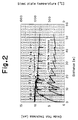
- Fig. 2 shows an example of the relation between the steel plate temperature and the oxide film thickness during the above-described hot rolling.
- the oxide film thickness at the entry side of the third stage rolling mill F3 is shown to be restricted to about 5 ⁇ m.
- This diagram also shows that the oxide film thickness at the entry side of the rolling mill F3 is restricted to about 5 ⁇ m, when the oxide film thickness after actuation of the descaler D is about 1.7 ⁇ m.
- Fig. 9 shows an example of the relation between the steel plate temperature and the oxide film thickness when the cooler C is not actuated.
- the oxide film thickness at the entry side of the third stage rolling mill F3 is shown to exceed about 5 ⁇ m.
- the descaler D is provided between the first stage rolling mill F1 and the second stage rolling mill F2, and the cooler is provided between the second stage rolling mill F2 and the third stage rolling mill F3.
- the descaler D and the cooler C are actuated so that the oxide film thickness can be restricted to fall within the allowable range.
- rolling is carried out, with the oxide film thickness being restricted to the limiting oxide film thickness or less at the entry side of the third stage rolling mill F3. Consequently, scale defects of the hot rolled steel plate 1 can be prevented, and a drop in the plate temperature of the hot rolled steel plate 1 can be minimized. Since scale defects are absent, moreover, the quality of a hot rolled steel plate product can be improved, and its yield can be increased.
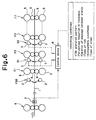
- FIG. 6 A second embodiment of the present invention is described with reference to FIG. 6.
- the same members as those in FIG. 1 explained in connection with the First Embodiment are assigned the same reference numerals, and overlapping explanations are omitted.
- the cooler C placed between the second stage rolling mill F2 and the third stage rolling mill F3 in the First Embodiment is abolished.
- another descaler (scale removing device) D2 is disposed, and the other constitutions are the same as in the First Embodiment.
- a descaler (scale removing device) D1 is placed between a first stage rolling mill F1 and a second stage rolling mill F2.
- the descaler D comprises headers 3, 3 for a jet medium disposed above and below a hot rolled steel plate 1, with the hot rolled steel plate 1 being sandwiched between the headers 3 and 3. From a nozzle at the tip of the header 3, a jet medium can be jetted toward the hot rolled steel plate 1.
- a descaler (scale removing device) D2 is placed between the second stage rolling mill F2 and the third stage rolling mill F3.
- the descaler D2 comprises headers 3, 3 for a jet medium disposed above and below the hot rolled steel plate 1, with the hot rolled steel plate 1 being sandwiched between the headers 3 and 3. From a nozzle at the tip of the header 3, a jet medium can be jetted toward the hot rolled steel plate 1.
- the descaler D1 and the descaler D2 are arranged as described above, and the oxide film thickness at an entry side of the third stage rolling mill F3 is computed from the steel plate surface temperature from a radiation thermometer 7 and the operating conditions, as in the First Embodiment.
- the actuation of the descalers D1 and D2 is controlled such that this oxide film thickness can be restricted to the limiting oxide film thickness or less.
- the hot rolled steel plate 1 rough rolled by a roughing mill R is fed from left to right in the drawing.
- High pressure water at a jet pressure of, say, 150 kgf/cm 2 is jetted from a nozzle at the tip of a header 2 of a scale breaker FSB toward the hot rolled steel plate 1 to remove scale on the surface of the hot rolled steel plate 1.
- the descaler D1 and the descaler D2 are actuated, where necessary, so as to restrict the oxide film thickness at an entry side of the third stage rolling mill F3 to the limiting oxide film thickness or less.
- the hot rolled steel plate 1 is rolled by the first stage rolling mill F1 to a seventh stage rolling mill F7 to prevent its scale defects.
- a control device 8 computes the oxide film thickness at the entry side of the rolling mill F3 in a state in which the descaler D1 and the descaler D2 are inactive.
- the computed oxide film thickness is not more than the limiting film thickness, operation is continued, without actuating the descaler D1 and the descaler D2. If the computed oxide film thickness is more than the limiting film thickness, conditions including the actuation of the descaler D1 are incorporated into the aforementioned operating conditions, and the oxide film thickness at the entry side of the rolling mill F3 is computed again.
- the oxide film thickness is not more than the limiting film thickness
- operation is continued, with the descaler D1 being actuated. If the computed oxide film thickness is more than the limiting film thickness, conditions including the actuation of the descaler D1 and the descaler D2 are incorporated into the aforementioned operating conditions, and the oxide film thickness at the entry side of the third stage rolling mill F3 is computed again.
- the descaler D1 actuated in this manner jets low pressure water at a jet pressure of, say, 70 kgf/cm 2 toward the hot rolled steel plate 1. Hence, even if oxide film on the hot rolled steel plate 1 rolled by the first stage rolling mill F1 grows because of recuperation (temperature recovery), the descaler D1 can decrease the thickness of oxide film on the surface of the hot rolled steel plate 1.
- the descaler D2 when actuated, jets low pressure water at a jet pressure of, say, 70 kgf/cm 2 toward the hot rolled steel plate 1. Hence, even if oxide film on the hot rolled steel plate 1 rolled by the second stage rolling mill F2 grows because of recuperation (temperature recovery), the descaler D2 can decrease the thickness of oxide film on the surface of the hot rolled steel plate 1.
- Fig. 7 is a diagram showing the relation between the steel plate temperature and the oxide film thickness in accordance with the above-described hot rolling method.
- the oxide film thickness at the entry side of the third stage rolling mill F3 is shown to be restricted to about 5 ⁇ m or less.
- This diagram also shows that oxide film is descaled to about 1.7 ⁇ m by actuation of the descaler D1 and the descaler D2, whereby the oxide film thickness at the entry side of the third stage rolling mill F3 is restricted to about 4.3 ⁇ m, a value less than the limiting oxide film thickness (about 5 ⁇ m).
- the jet pressure (descaling pressure) of the descaler D1 and the descaler D2 on this occasion may be a low pressure of about 70 kgf/cm 2 as in the First Embodiment.
- economical descaling can be achieved by low pressure jetting.
- the oxide film thickness at the entry side of the third stage rolling mill F3 can be made smaller than the limiting oxide film thickness (about 5 ⁇ m) by actuating the descaler D1 and the descaler D2 with low pressure jets.
- the descaler D1 and the descaler D2 with low pressure jets.
Landscapes
- Engineering & Computer Science (AREA)
- Mechanical Engineering (AREA)
- Metal Rolling (AREA)
Abstract
Description
Claims (10)
- A system for preventing scale defects during hot rolling by hot rolling equipment having a scale breaker (FSB) provided at an entry side of a finishing mill line (F) composed of a plurality of rolling mills (F1 to F7) arranged in tandem, comprising:adescaler (D) provided between a first stage rolling mill (F1) and a second stage rolling mill (F2) of the finishing mill line (F);a cooler (C), provided between the second stage rolling mill (F2) and a third stage rolling mill (F3) of the finishing mill line (F), for cooling a material (1) to be rolled; anda control device (8) for controlling the descaler (D) and the cooler (C) to be selectively driven such that neither of the descaler (D) and the cooler (C) is actuated, one of the descaler (D) and the cooler (C) is actuated, or both of the descaler (D) and the cooler (C) are actuated, according to rolling conditions,whereby the material (1) to be rolled is rolled, with an oxide film thickness of the material (1) at an entry side of the third stage rolling mill (F3) being restricted to not more than a limiting oxide film thickness.
- The system for preventing scale defects during hot rolling as claimed in claim 1, wherein the limiting oxide film thickness is 5 µm.
- The system for preventing scale defects during hot rolling as claimed in claim 1, wherein the descaler (D) jets water at a low pressure of at least about 70 kgf/cm2.
- The system for preventing scale defects during hot rolling as claimed in claim 1, wherein:the control device (8) computes the oxide film thickness of the material (1) at the entry side of the third stage rolling mill (F3) based on a temperature of the material (1) at a delivery side of a roughing mill (R), and if the computed oxide film thickness is not more than the limiting oxide film thickness, the control device (8) actuates neither of the descaler (D) and the cooler (C);if the computed oxide film thickness is more than the limiting oxide film thickness, the control device (8) incorporates the descaler (D) into operating conditions and computes the oxide film thickness, and if the computed oxide film thickness is not more than the limiting oxide film thickness, the control device (8) actuates only the descaler (D);if the oxide film thickness computed after incorporating the descaler (D) into the operating conditions is more than the limiting oxide film thickness, the control device (8) incorporates both the descaler (D) and the cooler (C) into the operating conditions and computes the oxide film thickness, and if the computed oxide film thickness is not more than the limiting oxide film thickness, the control device (8) actuates both the descaler (D) and the cooler (C); andif the oxide film thickness computed after incorporating both the descaler (D) and the cooler (C) into the operating conditions is more than the limiting oxide film thickness, the control device (8) actuates both the descaler (D) and the cooler (C) while increasing the ability of both the descaler (D) and the cooler (C).
- A system for preventing scale defects during hot rolling by hot rolling equipment having a scale breaker (FSB) provided at an entry side of a finishing mill line (F) composed of a plurality of rolling mills (F1 to F7) arranged in tandem, comprising:a descaler (D1) provided between a first stage rolling mill (F1) and a second stage rolling mill (F2) of the finishing mill line (F);a descaler (D2) provided between the second stage rolling mill (F2) and a third stage rolling mill (F3) of the finishing mill line (F); anda control device (8) for controlling the descalers (D1, D2) to be selectively driven such that neither of the descalers (D1, D2) is actuated, one of the descalers (D1, D2) is actuated, or both of the descalers (D1, D2) are actuated, according to rolling conditions,whereby a material (1) to be rolled is rolled, with an oxide film thickness of the material (1) at an entry side of the third stage rolling mill (F3) being restricted to not more than a limiting oxide film thickness.
- The system for preventing scale defects during hot rolling as claimed in claim 5, wherein the limiting oxide film thickness is 5 µm.
- The system for preventing scale defects during hot rolling as claimed in claim 5, wherein the descalers (D1, D2) jet water at a low pressure of at least about 70 kgf/cm2.
- The system for preventing scale defects during hot rolling as claimed in claim 5, wherein:the control device (8) computes the oxide film thickness of the material (1) at the entry side of the third stage rolling mill (F3) based on a temperature of the material (1) at a delivery side of a roughing mill (R), and if the computed oxide film thickness is not more than the limiting oxide film thickness, the control device (8) actuates neither of the descaler (D1) at the preceding stage and the descaler (D2) at the succeeding stage;if the computed oxide film thickness is more than the limiting oxide film thickness, the control device (8) incorporates the descaler (D1) at the preceding stage into operating conditions and computes the oxide film thickness, and if the computed oxide film thickness is not more than the limiting oxide film thickness, the control device (8) actuates only the descaler (D1) at the preceding stage;if the oxide film thickness computed after incorporating the descaler (D1) at the preceding stage into the operating conditions is more than the limiting oxide film thickness, the control device (8) incorporates both the descaler (D1) at the preceding stage and the descaler (D2) at the succeeding stage into the operating conditions and computes the oxide film thickness, and if the computed oxide film thickness is not more than the limiting oxide film thickness, the control device (8) actuates both the descaler (D1) at the preceding stage and the descaler (D2) at the succeeding stage; andif the oxide film thickness computed after incorporating both the descaler (D1) at the preceding stage and the descaler (D2) at the succeeding stage into the operating conditions is more than the limiting oxide film thickness, the control device (8) actuates both the descaler (D1) at the preceding stage and the descaler (D2) at the succeeding stage while increasing the ability of both the descaler (D1) at the preceding stage and the descaler (D2) at the succeeding stage.
- A method for preventing scale defects during hot rolling by hot rolling equipment having a scale breaker (FSB) provided at an entry side of a finishing mill line (F) composed of a plurality of rolling mills (F1 to F7) arranged in tandem, comprising:providing a descaler (D) between a first stage rolling mill (F1) and a second stage rolling mill (F2) of the finishing mill line (F);providing a cooler (C) between the second stage rolling mill (F2) and a third stage rolling mill (F3) of the finishing mill line (F) for cooling a material (1) to be rolled; andcontrolling the descaler (D) and the cooler (C) to be selectively driven such that neither of the descaler (D) and the cooler (C) is actuated, one of the descaler (D) and the cooler (C) is actuated, or both of the descaler (D)and the cooler (C) are actuated, according to rolling conditions,thereby rolling the material (1) to be rolled, while restricting an oxide film thickness of the material (1) at an entry side of the third stage rolling mill (F3) to not more than a limiting oxide film thickness.
- A method for preventing scale defects during hot rolling by hot rolling equipment having a scale breaker (FSB) provided at an entry side of a finishing mill line (F) composed of a plurality of rolling mills (F1 to F7) arranged in tandem, comprising:providing a descaler (D1) between a first stage rolling mill (F1) and a second stage rolling mill (F2) of the finishing mill line (F);providing a descaler (D2) between the second stage rolling mill (F2) and a third stage rolling mill (F3) of the finishing mill line (F); andcontrolling the descalers (D1, D2) to be selectively driven such that neither of the descalers (D1, D2) is actuated, one of the descalers (D1, D2) is actuated, or both of the descalers (D1, D2) are actuated, according to rolling conditions,thereby rolling a material (1) to be rolled, while restricting an oxide film thickness of the material (1) at an entry side of the third stage rolling mill (F3) to not more than a limiting oxide film thickness.
Applications Claiming Priority (2)
| Application Number | Priority Date | Filing Date | Title |
|---|---|---|---|
| JP4577899 | 1999-02-24 | ||
| JP11045778A JP2000246325A (en) | 1999-02-24 | 1999-02-24 | Device and method for preventing scale flaw at hot rolling |
Publications (3)
| Publication Number | Publication Date |
|---|---|
| EP1034857A2 true EP1034857A2 (en) | 2000-09-13 |
| EP1034857A3 EP1034857A3 (en) | 2001-09-05 |
| EP1034857B1 EP1034857B1 (en) | 2003-12-03 |
Family
ID=12728762
Family Applications (1)
| Application Number | Title | Priority Date | Filing Date |
|---|---|---|---|
| EP00103817A Revoked EP1034857B1 (en) | 1999-02-24 | 2000-02-23 | System and method for preventing scale defects during hot rolling |
Country Status (5)
| Country | Link |
|---|---|
| US (1) | US6257034B1 (en) |
| EP (1) | EP1034857B1 (en) |
| JP (1) | JP2000246325A (en) |
| CN (1) | CN1264628A (en) |
| DE (1) | DE60006874T2 (en) |
Cited By (6)
| Publication number | Priority date | Publication date | Assignee | Title |
|---|---|---|---|---|
| EP2028290A1 (en) * | 2007-08-21 | 2009-02-25 | ArcelorMittal France | Method and device for secondary descaling steel strip with low pressure water jets |
| CN102665948A (en) * | 2009-10-21 | 2012-09-12 | 东芝三菱电机产业系统株式会社 | Control setting device and control setting method |
| CN102794317A (en) * | 2012-08-16 | 2012-11-28 | 莱芜钢铁集团有限公司 | Device and method for descaling surface of casting blank |
| WO2013159786A1 (en) * | 2012-04-24 | 2013-10-31 | Gaydoul Juergen | Method and system for aftertreatment of a cast and/or warm-rolled steel product |
| WO2013162412A1 (en) * | 2012-04-25 | 2013-10-31 | Ltd "Tehnopromenergo" | Method of continuous rolling on a wide-strip hot mill |
| WO2020053268A1 (en) | 2018-09-12 | 2020-03-19 | Sms Group Gmbh | Method for producing a metal article |
Families Citing this family (14)
| Publication number | Priority date | Publication date | Assignee | Title |
|---|---|---|---|---|
| AU739659B2 (en) * | 1999-01-26 | 2001-10-18 | Nippon Steel Corporation | Method of removing scales and preventing scale formation on metal materials and apparatus therefor |
| DE10110324A1 (en) * | 2001-03-03 | 2002-09-05 | Sms Demag Ag | Process for descaling tapes |
| US7077724B1 (en) | 2005-06-06 | 2006-07-18 | The Material Works, Ltd. | Sheet metal scale removing water jet process |
| DE102005047936A1 (en) * | 2005-10-06 | 2007-04-12 | Sms Demag Ag | Method and device for cleaning slabs, thin slabs, profiles or the like |
| US8062095B2 (en) * | 2006-09-14 | 2011-11-22 | The Material Works, Ltd. | Method of producing rust inhibitive sheet metal through scale removal with a slurry blasting descaling cell having improved grit flow |
| US8066549B2 (en) * | 2006-09-14 | 2011-11-29 | The Material Works, Ltd. | Method of producing rust inhibitive sheet metal through scale removal with a slurry blasting descaling cell having improved grit flow |
| US8128460B2 (en) * | 2006-09-14 | 2012-03-06 | The Material Works, Ltd. | Method of producing rust inhibitive sheet metal through scale removal with a slurry blasting descaling cell |
| CN103191937B (en) * | 2012-01-10 | 2014-12-03 | 宝山钢铁股份有限公司 | Segmental descaling control method for hot continuous rolling mill |
| CN104107833B (en) * | 2014-06-06 | 2016-05-11 | 浙江九龙厨具集团有限公司 | A kind of milling method of cold-rolled thin steel strip |
| CN107155315B (en) * | 2014-12-30 | 2019-10-18 | 首要金属科技德国有限责任公司 | Sliding transport with friction adjustment for rolled products |
| CN105080981A (en) * | 2015-09-07 | 2015-11-25 | 苏州莱测检测科技有限公司 | Steel plate thickness measurement device provided with cleaning device |
| CN105598172A (en) * | 2016-03-23 | 2016-05-25 | 攀钢集团西昌钢钒有限公司 | Method for preventing oxide film on roller surface of hot strip continuous mill from peeling |
| WO2019228507A1 (en) * | 2018-05-31 | 2019-12-05 | 长沙矿冶研究院有限责任公司 | High-pressure water jet cleaning device for sandblasting and descaling plate strip material, cleaning line and system |
| EP3838432B1 (en) * | 2019-09-12 | 2023-01-04 | Toshiba Mitsubishi-Electric Industrial Systems Corporation | System for predicting contraction |
Family Cites Families (6)
| Publication number | Priority date | Publication date | Assignee | Title |
|---|---|---|---|---|
| US3779054A (en) * | 1972-03-02 | 1973-12-18 | Wean United Inc | Coolant control for hot strip mill |
| US5235840A (en) * | 1991-12-23 | 1993-08-17 | Hot Rolling Consultants, Ltd. | Process to control scale growth and minimize roll wear |
| JPH07171610A (en) | 1993-10-26 | 1995-07-11 | Sumitomo Metal Ind Ltd | Method and apparatus for rolling hot-rolled steel sheet |
| CN1087665C (en) * | 1996-03-04 | 2002-07-17 | 三菱重工业株式会社 | Hot-rolling arrangement |
| JPH09262602A (en) * | 1996-03-28 | 1997-10-07 | Kawasaki Steel Corp | Manufacturing method of hot rolled steel sheet |
| JP3094911B2 (en) * | 1996-04-11 | 2000-10-03 | 住友金属工業株式会社 | Descaling method of hot rolled steel sheet |
-
1999
- 1999-02-24 JP JP11045778A patent/JP2000246325A/en not_active Withdrawn
-
2000
- 2000-02-11 US US09/501,789 patent/US6257034B1/en not_active Expired - Fee Related
- 2000-02-23 DE DE60006874T patent/DE60006874T2/en not_active Revoked
- 2000-02-23 EP EP00103817A patent/EP1034857B1/en not_active Revoked
- 2000-02-24 CN CN00102612.7A patent/CN1264628A/en active Pending
Cited By (9)
| Publication number | Priority date | Publication date | Assignee | Title |
|---|---|---|---|---|
| EP2028290A1 (en) * | 2007-08-21 | 2009-02-25 | ArcelorMittal France | Method and device for secondary descaling steel strip with low pressure water jets |
| WO2009056712A3 (en) * | 2007-08-21 | 2009-07-16 | Arcelormittal France | Method and equipment for secondary descaling of metallic strips by hydraulic low-pressure spraying of water |
| US10378115B2 (en) | 2007-08-21 | 2019-08-13 | Arcelormittal France | Economic secondary descaling |
| CN102665948A (en) * | 2009-10-21 | 2012-09-12 | 东芝三菱电机产业系统株式会社 | Control setting device and control setting method |
| CN102665948B (en) * | 2009-10-21 | 2014-11-05 | 东芝三菱电机产业系统株式会社 | Control setting device and control setting method |
| WO2013159786A1 (en) * | 2012-04-24 | 2013-10-31 | Gaydoul Juergen | Method and system for aftertreatment of a cast and/or warm-rolled steel product |
| WO2013162412A1 (en) * | 2012-04-25 | 2013-10-31 | Ltd "Tehnopromenergo" | Method of continuous rolling on a wide-strip hot mill |
| CN102794317A (en) * | 2012-08-16 | 2012-11-28 | 莱芜钢铁集团有限公司 | Device and method for descaling surface of casting blank |
| WO2020053268A1 (en) | 2018-09-12 | 2020-03-19 | Sms Group Gmbh | Method for producing a metal article |
Also Published As
| Publication number | Publication date |
|---|---|
| JP2000246325A (en) | 2000-09-12 |
| US6257034B1 (en) | 2001-07-10 |
| EP1034857B1 (en) | 2003-12-03 |
| CN1264628A (en) | 2000-08-30 |
| DE60006874T2 (en) | 2004-10-14 |
| EP1034857A3 (en) | 2001-09-05 |
| DE60006874D1 (en) | 2004-01-15 |
Similar Documents
| Publication | Publication Date | Title |
|---|---|---|
| EP1034857B1 (en) | System and method for preventing scale defects during hot rolling | |
| US5235840A (en) | Process to control scale growth and minimize roll wear | |
| EP0320846A1 (en) | Apparatus and method for hot-rolling slab into sheets | |
| EP0920929B1 (en) | Method and System for suppressing surface oxide film during hot finish rolling | |
| CN112872050B (en) | Method for preventing head of thin-gauge strip steel from being folded in laminar cooling mode | |
| JP3994582B2 (en) | Steel sheet descaling method | |
| CA2255243C (en) | Method and system for suppressing formation of scale defects during hot finish rolling | |
| JPS6048241B2 (en) | Rolling method for hot-rolled steel sheets with few scale defects | |
| JPS61269925A (en) | Descaling method in hot rolling | |
| KR100406372B1 (en) | Apparatus for Hot Rolling and Method for Hot Rolling Using It | |
| JP3764350B2 (en) | Thick plate manufacturing method and rolling mill | |
| JP3296374B2 (en) | Descaling method during hot rolling of austenitic stainless steel | |
| JP3491605B2 (en) | Manufacturing method and equipment for hot rolled steel sheet with excellent surface properties | |
| JP3475785B2 (en) | Hot rolling method and apparatus for thin steel sheet | |
| JP3607792B2 (en) | Descaling method for manufacturing thin scale steel sheet | |
| JP3294138B2 (en) | Hot rolling equipment and hot rolling method | |
| JP3526763B2 (en) | Warpage prevention method in steel plate rolling | |
| JPH0985318A (en) | Nose bending prevention method for hot rolled material | |
| JP2008221315A (en) | Method for detecting biting of two crops in finish rolling mill in hot rolling line and method for preventing trouble of sheet passing by biting of two crops | |
| Kaya et al. | Development of control technique for scale defects restraining by interstand cooling device | |
| CN113909297A (en) | Rolling forming method for ultrathin corrosion-resistant hot rolled strip steel | |
| JPH10180338A (en) | Scale flaw prevention method in hot finish rolling | |
| KR100787584B1 (en) | How to optimize bar progress speed by using descaling header separation by bar position | |
| JP3200504B2 (en) | Hot rolling equipment and hot rolling method | |
| JP2871392B2 (en) | Coolant supply device and supply method for steel strip cold rolling mill |
Legal Events
| Date | Code | Title | Description |
|---|---|---|---|
| PUAI | Public reference made under article 153(3) epc to a published international application that has entered the european phase |
Free format text: ORIGINAL CODE: 0009012 |
|
| 17P | Request for examination filed |
Effective date: 20000322 |
|
| AK | Designated contracting states |
Kind code of ref document: A2 Designated state(s): AT BE CH CY DE DK ES FI FR GB GR IE IT LI LU MC NL PT SE |
|
| AX | Request for extension of the european patent |
Free format text: AL;LT;LV;MK;RO;SI |
|
| RIN1 | Information on inventor provided before grant (corrected) |
Inventor name: CHOI, YONG WOON, POHANG IRON & STEEL CO. LTD. Inventor name: MIN, KYUNG ZOON, POHANG IRON & STEEL CO. LTD. Inventor name: LEE, JOHN WON, POHANG IRON & STEEL CO. LTD. Inventor name: KAYA, AKIRA, MITSUBISHI HEAVY IND. LTD. Inventor name: KAWAMIZU, TSUTOMU, MITSUBISHI HEAVY IND. LTD. Inventor name: FUKUMORI, JUNSO, MITSUBISHI HEAVY IND. LTD. |
|
| RIN1 | Information on inventor provided before grant (corrected) |
Inventor name: CHOI, WOON YONG, POHANG IRON & STEEL CO. LTD. Inventor name: MIN, KYUNG ZOON, POHANG IRON & STEEL CO. LTD. Inventor name: LEE, JOHN WON, POHANG IRON & STEEL CO. LTD. Inventor name: KAYA, AKIRA, MITSUBISHI HEAVY IND. LTD. Inventor name: KAWAMIZU, TSUTOMU, MITSUBISHI HEAVY IND. LTD. Inventor name: FUKUMORI, JUNSO, MITSUBISHI HEAVY IND. LTD. |
|
| PUAL | Search report despatched |
Free format text: ORIGINAL CODE: 0009013 |
|
| AK | Designated contracting states |
Kind code of ref document: A3 Designated state(s): AT BE CH CY DE DK ES FI FR GB GR IE IT LI LU MC NL PT SE |
|
| AX | Request for extension of the european patent |
Free format text: AL;LT;LV;MK;RO;SI |
|
| 17Q | First examination report despatched |
Effective date: 20011130 |
|
| AKX | Designation fees paid |
Free format text: DE FR GB IT |
|
| GRAH | Despatch of communication of intention to grant a patent |
Free format text: ORIGINAL CODE: EPIDOS IGRA |
|
| RIN1 | Information on inventor provided before grant (corrected) |
Inventor name: CHOI, WOON YONG,POHANG IRON & STEEL CO. LTD. Inventor name: MIN, KYUNG ZOON,POHANG IRON & STEEL CO. LTD. Inventor name: LEE, JONG WON,POHANG IRON & STEEL CO. LTD. Inventor name: KAYA, AKIRA,MITSUBISHI HEAVY IND. LTD. Inventor name: KAWAMIZU, TSUTOMU,MITSUBISHI HEAVY IND. LTD. Inventor name: FUKUMORI, JUNSO,MITSUBISHI HEAVY IND. LTD. |
|
| GRAS | Grant fee paid |
Free format text: ORIGINAL CODE: EPIDOSNIGR3 |
|
| GRAA | (expected) grant |
Free format text: ORIGINAL CODE: 0009210 |
|
| AK | Designated contracting states |
Kind code of ref document: B1 Designated state(s): DE FR GB IT |
|
| REG | Reference to a national code |
Ref country code: GB Ref legal event code: FG4D |
|
| REF | Corresponds to: |
Ref document number: 60006874 Country of ref document: DE Date of ref document: 20040115 Kind code of ref document: P |
|
| PGFP | Annual fee paid to national office [announced via postgrant information from national office to epo] |
Ref country code: GB Payment date: 20040213 Year of fee payment: 5 Ref country code: DE Payment date: 20040213 Year of fee payment: 5 |
|
| PGFP | Annual fee paid to national office [announced via postgrant information from national office to epo] |
Ref country code: FR Payment date: 20040226 Year of fee payment: 5 |
|
| PLBQ | Unpublished change to opponent data |
Free format text: ORIGINAL CODE: EPIDOS OPPO |
|
| PLBI | Opposition filed |
Free format text: ORIGINAL CODE: 0009260 |
|
| ET | Fr: translation filed | ||
| RDAF | Communication despatched that patent is revoked |
Free format text: ORIGINAL CODE: EPIDOSNREV1 |
|
| 26 | Opposition filed |
Opponent name: SMS DEMAG AG Effective date: 20040902 |
|
| RDAG | Patent revoked |
Free format text: ORIGINAL CODE: 0009271 |
|
| STAA | Information on the status of an ep patent application or granted ep patent |
Free format text: STATUS: PATENT REVOKED |
|
| 27W | Patent revoked |
Effective date: 20041017 |
|
| GBPR | Gb: patent revoked under art. 102 of the ep convention designating the uk as contracting state |
Free format text: 20041017 |