EP1034832A2 - Catalyst for purification of an exhaust gas from diesel engines - Google Patents
Catalyst for purification of an exhaust gas from diesel engines Download PDFInfo
- Publication number
- EP1034832A2 EP1034832A2 EP00104429A EP00104429A EP1034832A2 EP 1034832 A2 EP1034832 A2 EP 1034832A2 EP 00104429 A EP00104429 A EP 00104429A EP 00104429 A EP00104429 A EP 00104429A EP 1034832 A2 EP1034832 A2 EP 1034832A2
- Authority
- EP
- European Patent Office
- Prior art keywords
- catalyst
- catalytic layer
- part formed
- zirconium dioxide
- temperature active
- Prior art date
- Legal status (The legal status is an assumption and is not a legal conclusion. Google has not performed a legal analysis and makes no representation as to the accuracy of the status listed.)
- Withdrawn
Links
- 239000003054 catalyst Substances 0.000 title claims abstract description 170
- 238000000746 purification Methods 0.000 title claims abstract description 40
- MWUXSHHQAYIFBG-UHFFFAOYSA-N Nitric oxide Chemical compound O=[N] MWUXSHHQAYIFBG-UHFFFAOYSA-N 0.000 claims abstract description 159
- 230000003197 catalytic effect Effects 0.000 claims abstract description 60
- RVTZCBVAJQQJTK-UHFFFAOYSA-N oxygen(2-);zirconium(4+) Chemical group [O-2].[O-2].[Zr+4] RVTZCBVAJQQJTK-UHFFFAOYSA-N 0.000 claims abstract description 47
- BASFCYQUMIYNBI-UHFFFAOYSA-N platinum Chemical compound [Pt] BASFCYQUMIYNBI-UHFFFAOYSA-N 0.000 claims abstract description 34
- 239000007789 gas Substances 0.000 claims abstract description 32
- XEEYBQQBJWHFJM-UHFFFAOYSA-N Iron Chemical compound [Fe] XEEYBQQBJWHFJM-UHFFFAOYSA-N 0.000 claims abstract description 30
- 239000010949 copper Substances 0.000 claims abstract description 30
- KDLHZDBZIXYQEI-UHFFFAOYSA-N Palladium Chemical compound [Pd] KDLHZDBZIXYQEI-UHFFFAOYSA-N 0.000 claims abstract description 24
- QPLDLSVMHZLSFG-UHFFFAOYSA-N Copper oxide Chemical compound [Cu]=O QPLDLSVMHZLSFG-UHFFFAOYSA-N 0.000 claims abstract description 18
- 239000005751 Copper oxide Substances 0.000 claims abstract description 15
- 229910000431 copper oxide Inorganic materials 0.000 claims abstract description 15
- 229910052697 platinum Inorganic materials 0.000 claims abstract description 14
- 239000003426 co-catalyst Substances 0.000 claims abstract description 12
- MCMNRKCIXSYSNV-UHFFFAOYSA-N ZrO2 Inorganic materials O=[Zr]=O MCMNRKCIXSYSNV-UHFFFAOYSA-N 0.000 claims abstract description 11
- 229910052802 copper Inorganic materials 0.000 claims abstract description 10
- 229910052763 palladium Inorganic materials 0.000 claims abstract description 10
- 229910052718 tin Inorganic materials 0.000 claims abstract description 10
- RYGMFSIKBFXOCR-UHFFFAOYSA-N Copper Chemical compound [Cu] RYGMFSIKBFXOCR-UHFFFAOYSA-N 0.000 claims abstract description 7
- ATJFFYVFTNAWJD-UHFFFAOYSA-N Tin Chemical compound [Sn] ATJFFYVFTNAWJD-UHFFFAOYSA-N 0.000 claims abstract description 7
- 229910052742 iron Inorganic materials 0.000 claims abstract description 7
- 239000002245 particle Substances 0.000 claims description 12
- PNEYBMLMFCGWSK-UHFFFAOYSA-N aluminium oxide Inorganic materials [O-2].[O-2].[O-2].[Al+3].[Al+3] PNEYBMLMFCGWSK-UHFFFAOYSA-N 0.000 claims description 10
- 229910052751 metal Inorganic materials 0.000 claims description 6
- 239000002184 metal Substances 0.000 claims description 6
- 239000000919 ceramic Substances 0.000 claims description 4
- LBJNMUFDOHXDFG-UHFFFAOYSA-N copper;hydrate Chemical compound O.[Cu].[Cu] LBJNMUFDOHXDFG-UHFFFAOYSA-N 0.000 claims description 2
- COUNCWOLUGAQQG-UHFFFAOYSA-N copper;hydrogen peroxide Chemical compound [Cu].OO COUNCWOLUGAQQG-UHFFFAOYSA-N 0.000 claims description 2
- RAHZWNYVWXNFOC-UHFFFAOYSA-N Sulphur dioxide Chemical compound O=S=O RAHZWNYVWXNFOC-UHFFFAOYSA-N 0.000 description 64
- 230000000052 comparative effect Effects 0.000 description 30
- 230000000694 effects Effects 0.000 description 28
- 239000000843 powder Substances 0.000 description 26
- 230000003647 oxidation Effects 0.000 description 24
- 238000007254 oxidation reaction Methods 0.000 description 24
- 230000009467 reduction Effects 0.000 description 24
- GWEVSGVZZGPLCZ-UHFFFAOYSA-N Titan oxide Chemical compound O=[Ti]=O GWEVSGVZZGPLCZ-UHFFFAOYSA-N 0.000 description 23
- 238000002485 combustion reaction Methods 0.000 description 13
- 229930195733 hydrocarbon Natural products 0.000 description 12
- 150000002430 hydrocarbons Chemical class 0.000 description 12
- XLYOFNOQVPJJNP-UHFFFAOYSA-N water Substances O XLYOFNOQVPJJNP-UHFFFAOYSA-N 0.000 description 11
- 239000010970 precious metal Substances 0.000 description 10
- LYCAIKOWRPUZTN-UHFFFAOYSA-N Ethylene glycol Chemical compound OCCO LYCAIKOWRPUZTN-UHFFFAOYSA-N 0.000 description 9
- UGFAIRIUMAVXCW-UHFFFAOYSA-N Carbon monoxide Chemical compound [O+]#[C-] UGFAIRIUMAVXCW-UHFFFAOYSA-N 0.000 description 8
- 229910002091 carbon monoxide Inorganic materials 0.000 description 8
- 229910052760 oxygen Inorganic materials 0.000 description 8
- 230000010718 Oxidation Activity Effects 0.000 description 7
- 230000001590 oxidative effect Effects 0.000 description 7
- 239000002002 slurry Substances 0.000 description 7
- 239000000126 substance Substances 0.000 description 7
- 230000010757 Reduction Activity Effects 0.000 description 6
- 239000001301 oxygen Substances 0.000 description 6
- 239000000243 solution Substances 0.000 description 6
- 229910001868 water Inorganic materials 0.000 description 6
- QVGXLLKOCUKJST-UHFFFAOYSA-N atomic oxygen Chemical compound [O] QVGXLLKOCUKJST-UHFFFAOYSA-N 0.000 description 5
- 239000008367 deionised water Substances 0.000 description 5
- 229910021641 deionized water Inorganic materials 0.000 description 5
- 238000000034 method Methods 0.000 description 5
- MGWGWNFMUOTEHG-UHFFFAOYSA-N 4-(3,5-dimethylphenyl)-1,3-thiazol-2-amine Chemical compound CC1=CC(C)=CC(C=2N=C(N)SC=2)=C1 MGWGWNFMUOTEHG-UHFFFAOYSA-N 0.000 description 4
- VYPSYNLAJGMNEJ-UHFFFAOYSA-N Silicium dioxide Chemical compound O=[Si]=O VYPSYNLAJGMNEJ-UHFFFAOYSA-N 0.000 description 4
- 238000003915 air pollution Methods 0.000 description 4
- 239000011248 coating agent Substances 0.000 description 4
- 238000000576 coating method Methods 0.000 description 4
- 239000003344 environmental pollutant Substances 0.000 description 4
- JCXJVPUVTGWSNB-UHFFFAOYSA-N nitrogen dioxide Inorganic materials O=[N]=O JCXJVPUVTGWSNB-UHFFFAOYSA-N 0.000 description 4
- 231100000719 pollutant Toxicity 0.000 description 4
- 230000008569 process Effects 0.000 description 4
- 229910002089 NOx Inorganic materials 0.000 description 3
- 230000008901 benefit Effects 0.000 description 3
- 229910052799 carbon Inorganic materials 0.000 description 3
- 238000006388 chemical passivation reaction Methods 0.000 description 3
- 229940093476 ethylene glycol Drugs 0.000 description 3
- 238000011068 loading method Methods 0.000 description 3
- 239000000203 mixture Substances 0.000 description 3
- 239000008188 pellet Substances 0.000 description 3
- 239000007787 solid Substances 0.000 description 3
- 239000004408 titanium dioxide Substances 0.000 description 3
- 229910052723 transition metal Inorganic materials 0.000 description 3
- 150000003624 transition metals Chemical class 0.000 description 3
- OKTJSMMVPCPJKN-UHFFFAOYSA-N Carbon Chemical compound [C] OKTJSMMVPCPJKN-UHFFFAOYSA-N 0.000 description 2
- UQSXHKLRYXJYBZ-UHFFFAOYSA-N Iron oxide Chemical compound [Fe]=O UQSXHKLRYXJYBZ-UHFFFAOYSA-N 0.000 description 2
- NINIDFKCEFEMDL-UHFFFAOYSA-N Sulfur Chemical compound [S] NINIDFKCEFEMDL-UHFFFAOYSA-N 0.000 description 2
- XHCLAFWTIXFWPH-UHFFFAOYSA-N [O-2].[O-2].[O-2].[O-2].[O-2].[V+5].[V+5] Chemical class [O-2].[O-2].[O-2].[O-2].[O-2].[V+5].[V+5] XHCLAFWTIXFWPH-UHFFFAOYSA-N 0.000 description 2
- 238000006243 chemical reaction Methods 0.000 description 2
- 239000002131 composite material Substances 0.000 description 2
- 238000006073 displacement reaction Methods 0.000 description 2
- TXKMVPPZCYKFAC-UHFFFAOYSA-N disulfur monoxide Inorganic materials O=S=S TXKMVPPZCYKFAC-UHFFFAOYSA-N 0.000 description 2
- 230000007613 environmental effect Effects 0.000 description 2
- 238000002347 injection Methods 0.000 description 2
- 239000007924 injection Substances 0.000 description 2
- 238000004519 manufacturing process Methods 0.000 description 2
- 238000011056 performance test Methods 0.000 description 2
- 230000009257 reactivity Effects 0.000 description 2
- 235000012239 silicon dioxide Nutrition 0.000 description 2
- 239000000377 silicon dioxide Substances 0.000 description 2
- 239000004071 soot Substances 0.000 description 2
- 229910052717 sulfur Inorganic materials 0.000 description 2
- 239000011593 sulfur Substances 0.000 description 2
- XTQHKBHJIVJGKJ-UHFFFAOYSA-N sulfur monoxide Chemical compound S=O XTQHKBHJIVJGKJ-UHFFFAOYSA-N 0.000 description 2
- AKEJUJNQAAGONA-UHFFFAOYSA-N sulfur trioxide Chemical compound O=S(=O)=O AKEJUJNQAAGONA-UHFFFAOYSA-N 0.000 description 2
- 238000012360 testing method Methods 0.000 description 2
- 231100000419 toxicity Toxicity 0.000 description 2
- 230000001988 toxicity Effects 0.000 description 2
- 229910001935 vanadium oxide Inorganic materials 0.000 description 2
- 239000004215 Carbon black (E152) Substances 0.000 description 1
- 229910052684 Cerium Inorganic materials 0.000 description 1
- 229910003206 NH4VO3 Inorganic materials 0.000 description 1
- CBENFWSGALASAD-UHFFFAOYSA-N Ozone Chemical compound [O-][O+]=O CBENFWSGALASAD-UHFFFAOYSA-N 0.000 description 1
- 229910052777 Praseodymium Inorganic materials 0.000 description 1
- QAOWNCQODCNURD-UHFFFAOYSA-L Sulfate Chemical compound [O-]S([O-])(=O)=O QAOWNCQODCNURD-UHFFFAOYSA-L 0.000 description 1
- 238000003916 acid precipitation Methods 0.000 description 1
- 230000003213 activating effect Effects 0.000 description 1
- 230000002776 aggregation Effects 0.000 description 1
- 238000004220 aggregation Methods 0.000 description 1
- 125000003118 aryl group Chemical group 0.000 description 1
- 230000015572 biosynthetic process Effects 0.000 description 1
- 238000001354 calcination Methods 0.000 description 1
- 239000003183 carcinogenic agent Substances 0.000 description 1
- 150000001875 compounds Chemical class 0.000 description 1
- RKTYLMNFRDHKIL-UHFFFAOYSA-N copper;5,10,15,20-tetraphenylporphyrin-22,24-diide Chemical compound [Cu+2].C1=CC(C(=C2C=CC([N-]2)=C(C=2C=CC=CC=2)C=2C=CC(N=2)=C(C=2C=CC=CC=2)C2=CC=C3[N-]2)C=2C=CC=CC=2)=NC1=C3C1=CC=CC=C1 RKTYLMNFRDHKIL-UHFFFAOYSA-N 0.000 description 1
- 239000013078 crystal Substances 0.000 description 1
- 230000003247 decreasing effect Effects 0.000 description 1
- 238000007598 dipping method Methods 0.000 description 1
- 238000001035 drying Methods 0.000 description 1
- 230000008030 elimination Effects 0.000 description 1
- 238000003379 elimination reaction Methods 0.000 description 1
- 230000005484 gravity Effects 0.000 description 1
- 238000005470 impregnation Methods 0.000 description 1
- 230000006872 improvement Effects 0.000 description 1
- 230000000977 initiatory effect Effects 0.000 description 1
- JEIPFZHSYJVQDO-UHFFFAOYSA-N iron(III) oxide Inorganic materials O=[Fe]O[Fe]=O JEIPFZHSYJVQDO-UHFFFAOYSA-N 0.000 description 1
- 239000007788 liquid Substances 0.000 description 1
- 238000005259 measurement Methods 0.000 description 1
- 229910044991 metal oxide Inorganic materials 0.000 description 1
- 150000004706 metal oxides Chemical class 0.000 description 1
- 150000002739 metals Chemical class 0.000 description 1
- RXCVUXLCNLVYIA-UHFFFAOYSA-N orthocarbonic acid Chemical compound OC(O)(O)O RXCVUXLCNLVYIA-UHFFFAOYSA-N 0.000 description 1
- -1 oxygen ions Chemical class 0.000 description 1
- 238000004321 preservation Methods 0.000 description 1
- 229910052761 rare earth metal Inorganic materials 0.000 description 1
- 229910001404 rare earth metal oxide Inorganic materials 0.000 description 1
- 150000002910 rare earth metals Chemical class 0.000 description 1
- 238000011160 research Methods 0.000 description 1
- 230000000284 resting effect Effects 0.000 description 1
- 238000003900 soil pollution Methods 0.000 description 1
- 150000004763 sulfides Chemical class 0.000 description 1
- 239000003930 superacid Substances 0.000 description 1
- 230000001629 suppression Effects 0.000 description 1
- 230000002195 synergetic effect Effects 0.000 description 1
- 230000002123 temporal effect Effects 0.000 description 1
- 230000007704 transition Effects 0.000 description 1
- 229910052720 vanadium Inorganic materials 0.000 description 1
- 238000003911 water pollution Methods 0.000 description 1
Images




Classifications
-
- B—PERFORMING OPERATIONS; TRANSPORTING
- B01—PHYSICAL OR CHEMICAL PROCESSES OR APPARATUS IN GENERAL
- B01J—CHEMICAL OR PHYSICAL PROCESSES, e.g. CATALYSIS OR COLLOID CHEMISTRY; THEIR RELEVANT APPARATUS
- B01J23/00—Catalysts comprising metals or metal oxides or hydroxides, not provided for in group B01J21/00
- B01J23/70—Catalysts comprising metals or metal oxides or hydroxides, not provided for in group B01J21/00 of the iron group metals or copper
- B01J23/72—Copper
-
- B—PERFORMING OPERATIONS; TRANSPORTING
- B01—PHYSICAL OR CHEMICAL PROCESSES OR APPARATUS IN GENERAL
- B01J—CHEMICAL OR PHYSICAL PROCESSES, e.g. CATALYSIS OR COLLOID CHEMISTRY; THEIR RELEVANT APPARATUS
- B01J37/00—Processes, in general, for preparing catalysts; Processes, in general, for activation of catalysts
- B01J37/02—Impregnation, coating or precipitation
- B01J37/024—Multiple impregnation or coating
- B01J37/0248—Coatings comprising impregnated particles
-
- B—PERFORMING OPERATIONS; TRANSPORTING
- B01—PHYSICAL OR CHEMICAL PROCESSES OR APPARATUS IN GENERAL
- B01D—SEPARATION
- B01D53/00—Separation of gases or vapours; Recovering vapours of volatile solvents from gases; Chemical or biological purification of waste gases, e.g. engine exhaust gases, smoke, fumes, flue gases, aerosols
- B01D53/34—Chemical or biological purification of waste gases
-
- B—PERFORMING OPERATIONS; TRANSPORTING
- B01—PHYSICAL OR CHEMICAL PROCESSES OR APPARATUS IN GENERAL
- B01D—SEPARATION
- B01D53/00—Separation of gases or vapours; Recovering vapours of volatile solvents from gases; Chemical or biological purification of waste gases, e.g. engine exhaust gases, smoke, fumes, flue gases, aerosols
- B01D53/34—Chemical or biological purification of waste gases
- B01D53/92—Chemical or biological purification of waste gases of engine exhaust gases
- B01D53/94—Chemical or biological purification of waste gases of engine exhaust gases by catalytic processes
- B01D53/944—Simultaneously removing carbon monoxide, hydrocarbons or carbon making use of oxidation catalysts
-
- B—PERFORMING OPERATIONS; TRANSPORTING
- B01—PHYSICAL OR CHEMICAL PROCESSES OR APPARATUS IN GENERAL
- B01J—CHEMICAL OR PHYSICAL PROCESSES, e.g. CATALYSIS OR COLLOID CHEMISTRY; THEIR RELEVANT APPARATUS
- B01J23/00—Catalysts comprising metals or metal oxides or hydroxides, not provided for in group B01J21/00
- B01J23/70—Catalysts comprising metals or metal oxides or hydroxides, not provided for in group B01J21/00 of the iron group metals or copper
- B01J23/76—Catalysts comprising metals or metal oxides or hydroxides, not provided for in group B01J21/00 of the iron group metals or copper combined with metals, oxides or hydroxides provided for in groups B01J23/02 - B01J23/36
-
- B—PERFORMING OPERATIONS; TRANSPORTING
- B01—PHYSICAL OR CHEMICAL PROCESSES OR APPARATUS IN GENERAL
- B01J—CHEMICAL OR PHYSICAL PROCESSES, e.g. CATALYSIS OR COLLOID CHEMISTRY; THEIR RELEVANT APPARATUS
- B01J23/00—Catalysts comprising metals or metal oxides or hydroxides, not provided for in group B01J21/00
- B01J23/70—Catalysts comprising metals or metal oxides or hydroxides, not provided for in group B01J21/00 of the iron group metals or copper
- B01J23/89—Catalysts comprising metals or metal oxides or hydroxides, not provided for in group B01J21/00 of the iron group metals or copper combined with noble metals
- B01J23/8933—Catalysts comprising metals or metal oxides or hydroxides, not provided for in group B01J21/00 of the iron group metals or copper combined with noble metals also combined with metals, or metal oxides or hydroxides provided for in groups B01J23/02 - B01J23/36
- B01J23/8966—Catalysts comprising metals or metal oxides or hydroxides, not provided for in group B01J21/00 of the iron group metals or copper combined with noble metals also combined with metals, or metal oxides or hydroxides provided for in groups B01J23/02 - B01J23/36 with germanium, tin or lead
-
- B—PERFORMING OPERATIONS; TRANSPORTING
- B01—PHYSICAL OR CHEMICAL PROCESSES OR APPARATUS IN GENERAL
- B01J—CHEMICAL OR PHYSICAL PROCESSES, e.g. CATALYSIS OR COLLOID CHEMISTRY; THEIR RELEVANT APPARATUS
- B01J37/00—Processes, in general, for preparing catalysts; Processes, in general, for activation of catalysts
- B01J37/02—Impregnation, coating or precipitation
- B01J37/024—Multiple impregnation or coating
- B01J37/0244—Coatings comprising several layers
-
- B—PERFORMING OPERATIONS; TRANSPORTING
- B01—PHYSICAL OR CHEMICAL PROCESSES OR APPARATUS IN GENERAL
- B01D—SEPARATION
- B01D2255/00—Catalysts
- B01D2255/10—Noble metals or compounds thereof
- B01D2255/102—Platinum group metals
- B01D2255/1021—Platinum
-
- B—PERFORMING OPERATIONS; TRANSPORTING
- B01—PHYSICAL OR CHEMICAL PROCESSES OR APPARATUS IN GENERAL
- B01D—SEPARATION
- B01D2255/00—Catalysts
- B01D2255/10—Noble metals or compounds thereof
- B01D2255/102—Platinum group metals
- B01D2255/1023—Palladium
-
- B—PERFORMING OPERATIONS; TRANSPORTING
- B01—PHYSICAL OR CHEMICAL PROCESSES OR APPARATUS IN GENERAL
- B01D—SEPARATION
- B01D2255/00—Catalysts
- B01D2255/20—Metals or compounds thereof
- B01D2255/207—Transition metals
- B01D2255/20715—Zirconium
-
- B—PERFORMING OPERATIONS; TRANSPORTING
- B01—PHYSICAL OR CHEMICAL PROCESSES OR APPARATUS IN GENERAL
- B01D—SEPARATION
- B01D2255/00—Catalysts
- B01D2255/20—Metals or compounds thereof
- B01D2255/207—Transition metals
- B01D2255/20738—Iron
-
- B—PERFORMING OPERATIONS; TRANSPORTING
- B01—PHYSICAL OR CHEMICAL PROCESSES OR APPARATUS IN GENERAL
- B01D—SEPARATION
- B01D2255/00—Catalysts
- B01D2255/20—Metals or compounds thereof
- B01D2255/207—Transition metals
- B01D2255/20761—Copper
Definitions
- the present invention relates to a catalyst for purification of an exhaust gas, e.g. of an exhaust gas emitted from a diesel engine of a vehicle.
- diesel engines have greatly increased due to the high combustion efficiency of diesel and its low cost compared to gasoline.
- diesel engines Due to the combustion principle of diesel engines which burn diesel under high-pressure and in an oxygen-rich atmosphere, diesel engines emit solid and liquid composite pollutants such as soot particles (particulates), nitrogen oxides, soluble organic substances, sulfides, etc.
- soot particles particles
- nitrogen oxides soluble organic substances
- sulfides etc.
- particulates containing a carcinogenic substance such as a multinucleate aromatic substance are considered to be the most harmful exhaust emissions, and are emitted in the form of an undesirable visible smog.
- research into an exhaust gas purification system for diesel engines has been focused on a catalyst for removing such particulates.
- nitrogen oxides another major component of the exhaust emissions from diesel engines, are considered to be the main cause of air pollution, which causes acid rain, and the formation of ozone and smog by a reaction with hydrocarbons. Nitrogen oxides are eliminated by reduction. However, the presence of excessive oxygen relative to the oxygen equivalent required for oxidizing combustible carbonic compounds, such as unburnt hydrocarbons or carbon monoxide, hinders the reduction of nitrogen oxides for elimination. Also, it is difficult to purify nitrogen oxides under a sulfur oxide (SO x ) atmosphere, and particularly, under a sulfur dioxide (SO 2 ) atmosphere.
- SO x sulfur oxide
- SO 2 sulfur dioxide
- the existing flow-through type catalyst mainly burns the soluble organic substances
- the reduction activity of the catalyst with respect to nitrogen oxides is merely at 20-30 percent of its oxidation activity with respect to particulates. This is regarded to be because sulfur in diesel produces excessive sulfur dioxide, oxygen and water in the exhaust emissions, which results in reduced activity and durability of the catalyst.
- Catalysts for purification of exhaust gas from vehicles are comprised of a carrier and a main catalyst.
- Typical examples of the carrier which has its inherent activity and is a decisive factor in determining the characteristics of the purification catalyst, include alumina, titanium dioxide, zirconium dioxide, silicon dioxide and the like.
- alumina for diesel engines adsorbs sulfur dioxide at low temperatures and emits sulfur trioxide at high temperatures via oxidation, which increases particulates in the exhaust emissions and reduces the activity and durability of the catalyst.
- titanium dioxide and zirconium dioxide which are used alone or in a mixture, adsorb a small amount of sulfur dioxide and produces a small amount of sulfate, but exhibit a sharp reduction in their specific surface area at high temperatures, so that they cannot sufficiently exert their functions as a carrier.
- titanium dioxide and zirconium dioxide lower the activity of a precious metal and a transition metal, and in turn deteriorate the catalyst.
- Silicon dioxide has a strong resistance against the toxicity of both sulfur dioxide and water, but due to its low activity, a large amount of catalyst needs to be impregnated therein.
- Pt and Pd are typical precious metals used as a three way catalyst for gasoline engines, due to their considerably high purification activity with respect to nitrogen oxides in addition to hydrocarbons and carbon monoxide. Accordingly, Pt and Pd have also been used widely for purification of the exhaust gas from diesel engines.
- Pt has an advantage of good purification activity for nitrogen oxide in diesel engines operating under an oxygen-rich atmosphere, but has a disadvantage in that it facilitates oxidation of sulfur dioxide at a temperature of 300°C or more and in turn serves as crystal nuclei for particulates, increasing the amount of particulates in the exhaust.
- vanadium oxides for suppression of the oxidizing power of sulfur dioxide has been suggested.
- vanadium oxides reduce the oxidation activity for pollutants including particulates, hydrocarbons and carbon monoxide along with the oxidizing power of sulfur dioxide, thereby lowering the durability of the catalyst.
- Pd has an advantage in that it facilitates the oxidation activity for sulfur dioxide at fairly high temperatures, for example, at at least 450°C, but has a low oxidation activity for pollutants at low temperatures and a reduced durability at low temperatures.
- a catalyst for purification of an exhaust gas e.g. from diesel engines, with the capability of improving oxidation efficiency of soot particles (particulates) and capable of preventing additional production of the particulates by suppressing oxidation of sulfur dioxide.
- a high-temperature active catalyst for purification of exhaust gas from diesel engines comprising: a first catalytic layer for reducing nitrogen oxide, the first catalytic layer including a carrier part formed of iron (Fe)-doped modified zirconium dioxide, and a catalyst part formed of copper (Cu) or copper oxide; and a second catalytic layer for removing particulates, the second catalytic layer including a carrier part formed of Cu-doped modified zirconium dioxide, a main catalyst part formed of platinum (Pt) and tin (Sn), and a co-catalyst part formed of copper oxide.
- the amount of Cu or copper oxide in the first catalytic layer is in the range of 0.5 to 5 wt% based on the weight of the carrier part formed of Fe-doped modified zirconium dioxide.
- a low-temperature active catalyst for purification of exhaust gas from diesel engines comprising: a first catalytic layer for reducing nitrogen oxide, the first catalytic layer including a carrier part formed of iron (Fe)-doped modified zirconium dioxide, and a catalytic part formed of palladium (Pd); and a second catalytic layer for removing particulates, the second catalytic layer including a carrier part formed of copper (Cu)-doped zirconium dioxide, a main catalyst part formed of platinum (Pt) and tin (Sn), and a co-catalyst part formed of copper oxide.
- a first catalytic layer for reducing nitrogen oxide comprising: a first catalytic layer for reducing nitrogen oxide, the first catalytic layer including a carrier part formed of iron (Fe)-doped modified zirconium dioxide, and a catalytic part formed of palladium (Pd); and a second catalytic layer for removing particulates, the second catalytic layer including
- the amount of Pd in the first catalytic layer is in the range of 0.2 to 0.8 wt% based on the weight of the carrier part formed of Fe-doped modified zirconium dioxide.
- the Fe-doped modified zirconium dioxide or the Cu-doped modified zirconium dioxide comprises SO 2- / 4 of 1 to 5wt% based on the weight of the modified zirconium dioxide, and has a specific surface area of 80 to 130 m 2 /gram.
- the amount of Fe in the carrier part of the first catalytic layer is in the range of 3 to 6 wt% based on the weight of the modified zirconium dioxide.
- the amount of Cu in the carrier part of the second catalytic layer is in the range of 3 to 6 wt% based on the weight of the modified zirconium dioxide.
- the amount of each of Pt and Sn of the second catalytic layer is in the range of 0.05 to 0.3 wt% based on the weight of the carrier part formed of Cu-doped modified zirconium dioxide.
- the copper oxide in the co-catalyst part of the second catalytic layer has a particle size of 0.1 to 10 ⁇ m, and the amount of the copper dioxide is in the range of 10 to 30 wt% based on the weight of the main catalyst part of the second catalytic layer.
- the first catalytic layer is coated on a heat-resistance three-dimensional structure along with alumina spheres with a size of 50 to 100 ⁇ m, and the second catalytic layer is coated on the first catalytic layer.
- the amount of alumina spheres is in the range of 5 to 30 wt% based on the weight of the carrier part formed of Fe-doped modified zirconium dioxide.
- the heat-resistance three-dimensional structure is one selected from the group consisting of an open-flow ceramic honeycombed structure, a wall-flow ceramic honeycomb monolithic structure and an open-flow metal honeycombed structure.
- the present invention provides a catalyst for purification of exhaust gas from diesel engines, prepared by linking the high-temperature active catalyst and the low-temperature active catalyst in series, such that the high-temperature active catalyst is located at an exhaust gas inlet portion and the low-temperature active catalyst is located at an exhaust gas outlet portion.
- Zirconium dioxide powder initially has a low solid acidity, but shows a catalytic activity by addition of a metal oxide.
- zirconium dioxide reduces the activity of a precious metal and a transition metal which are impregnated into the carrier as a main catalyst.
- the catalytic activity of zirconium dioxide disappears at a temperature of 600°C due to a reduction in the specific surface area at the same temperature, which results in a reduced durability of the catalyst.
- the present invention provides a modified zirconium dioxide with an improved activity at high temperatures, and the specific surface area of which is not reduced at high temperatures, wherein the modified zirconium dioxide is obtained by adding a predetermined amount of SO 2- / 4 into the lattice of zirconium dioxide powder.
- the low acidity of the modified zirconia of -5 or more (Hammet acidity function), which is fairly low compared to the activity of solid super acid of -14, enables partial oxidation of hydrocarbons or carbon monoxide with an improved reduction activity for nitrogen oxides and a higher degree of oxidation for particulates including carbon and soluble organic substances.
- modified zirconium dioxide is doped with iron (Fe) and copper (Cu), which have their own active sites, and thermal treated, phase transition from a monoclinic to a tetragonal shape occurs due to excessive electrons produced in modified zirconium dioxide.
- Fe iron
- Cu copper
- Iron is a metal which is good at partially oxidizing hydrocarbon.
- a carrier prepared by impregnating the modified zirconium dioxide with iron oxide is also good at partially oxidizing hydrocarbons.
- carbon monoxide produced by the partial oxidation of hydrocarbons increases a reduction activity for nitrogen oxide, but more particularly, increases the reduction activity for nitrogen oxide in a temperature range of 400 to 500°C.
- the power of oxidation for sulfur dioxide is relatively low at any temperature.
- Cu is used for the activity at high temperatures and palladium (Pd) for the activity at low temperatures.
- Cu is a metal having a higher reduction activity for nitrogen oxide.
- a carrier prepared by impregnating the modified zirconium dioxide with copper oxide reduction of nitrogen oxide and consumption of hydrocarbons occur at the same temperature range.
- Fe that produces carbon monoxide by oxidizing hydrocarbons, and Cu having a higher power of reduction for nitrogen oxide in a predetermined ratio the power of reduction for nitrogen oxide can be improved even in an oxidation atmosphere.
- a first catalyst layer of a low-temperature active catalyst which is located at an exhaust gas outlet portion due to its activity, for example, in a temperature range of 250 to 320°C
- Pd which has good activity at low temperatures and oxidation inhibition capability for sulfur dioxide is preferred as a main catalyst for a higher purification efficiency for nitrogen oxide at a specific temperature.
- a second catalyst layer includes a carrier part formed of modified zirconium dioxide doped with Cu, a main catalyst part formed of a mixture of Pt and tin (Sn), and a co-catalyst part formed of copper oxide.
- the carrier of modified zirconium dioxide doped with Cu a main catalyst including Pt having a good oxidation activity at high temperatures and Sn having a good activity in the presence of moisture with oxidation inhibition capability for sulfur dioxide, and a copper oxide (CuO) as a co-catalyst
- the toxicity of the exhaust can be suppressed and a large amount of oxygen ions is produced, resulting in an improved oxidation activity for particulates.
- the presence of CuO with a large particle size (ranging from 0.1 to 10 ⁇ m) in the main catalyst prevents aggregation of Pt particles having activity at low temperatures, which results in an improved durability at high temperatures.
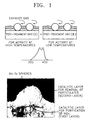
- the first catalyst layer for purification of nitrogen oxide which has the foregoing feature
- the second catalyst layer for purification of particulates thereon
- oxidation of hydrocarbons and reduction of nitrogen oxide occurs, which generates heat, and particulates are burnt, which results in a localized reduction atmosphere with a synergistic effect in that the reduction efficiency of nitrogen oxide is improved and the combustion temperature of particulates is lowered.
- alumina spheres When coating the catalyst for nitrogen oxide purification and the catalyst for particulate purification on a heat-resistance honeycombed 3-dimensional structure, alumina spheres may be coated thereon at the same time, which allows the gaseous and particle substances of the exhaust gas in catalyst layers to be temporarily held. As a result, the purification ratio for nitrogen oxide and the combustion capability for particulates are further improved.
- the amount of alumina spheres is in the range of 5-30 wt% based on the weight of the carrier formed of a modified zirconium dioxide doped with Fe. If the amount of alumina spheres added exceeds this range, the catalytic activity may be lowered.
- two catalysts for purification of nitrogen oxide each having a first catalytic layer capable of reducing nitrogen oxide at different temperature ranges, are linked in series, the one having high-temperature catalytic activity being at an exhaust gas inlet portion and the one having low temperature catalytic activity being at an exhaust gas outlet portion, whereby the activity temperature range for nitrogen oxide reduction is extended, which results in an improved activity for nitrogen oxide reduction.
- Example 1 Catalyst for removal of particulates
- CuO powder having a particle size of 0.1 to 10 ⁇ m was added in an amount of 30% by weight of the main catalyst added to the Cu-Z4 carrier powder, to afford a catalyst 0.1Pt-0.1Sn/Cu-Z4/30CuO for use in removing particulates in exhaust emissions.
- Example 2 High-temperature active catalyst for purification of nitrogen oxide
- a modified zirconium oxide with 4 wt% SO 2- / 4 (specific surface area of 80-130 m 2 /g) was mixed with a Fe(NO 3 ) 2 solution, dried and calcined at 500°C for 3 hours to afford carrier powder doped with 3 wt% Fe 2 O 3 (hereinafter, referred to as Fe-Z4).
- Example 3 Low-temperature active catalyst for purification of nitrogen oxide
- Example 2 The process of Example 2 was followed except that 0.6 wt% Pd was used instead of 3wt% Cu, to afford a catalyst 0.6Pd/Fe-Z4 which has activity at low temperatures for nitrogen oxide.
- Example 2 2.0 g of the catalyst powder obtained in Example 1 and 0.1 g of particulates from exhaust emissions were compressed by a force of 0.5 kgf/cm 2 to form pellets. The pellets were milled and sieved to obtain particles having a size of 1-2 mm. A removal ratio of particles was measured.
- Example 2 200 g of the catalyst powder obtained in Example 1 was mixed with 500 ml of deionized water to obtain a catalyst slurry.
- the slurry was coated on a honeycomb structure having 400 cells per square inch of cross-section.
- the honeycomb coated with the slurry was dried and then calcined at 500°C for 2 hours), resulting in a catalytic layer for removing particulates on the honeycomb structure.
- a catalytic layer for purification of nitrogen oxide at high temperatures was prepared as in Example 5, except that 200 g of the catalyst powder obtained in Example 2 was mixed with 500 ml of deionized water to obtain a catalyst slurry, and alumina spheres having a particle size of 50 to 100 ⁇ m were added in an amount of 10 wt% based on the weight of the carrier powder.
- a catalytic layer for purification of nitrogen oxide at low temperatures was prepared as in Example 6, except that the catalyst powder obtained in Example 3 was used instead of the catalyst powder from Example 2.
- a high-temperature active catalyst for use in an exhaust gas inlet portion of diesel engines and a low-temperature active catalyst for use in an exhaust gas outlet portion of diesel engines were prepared.
- the catalytic layer formed in Example 6 was coated with the catalyst slurry for removing particulates prepared in Example 5 by a dipping method.
- the catalytic layer formed in Example 7 was also dipped in the catalyst slurry for removing particulates prepared in Example 5.
- the high-temperature active catalyst and the low-temperature active catalyst were linked in series to form a flow-through type catalyst expressed as (0.1Pt-0.1Sn/Cu-Z4)/(3Cu/Fe-Z4)+(0.1Pt-0.1Sn/Cu-Z4)/(0.6Pd/Fe-Z4) .
- catalysts having about twice the particulate removal efficiency (approximately 40%) relative to a general post-treatment catalyst were selected from the catalysts prepared in the above examples.
- each catalyst was loaded into a supercharged direct injection type I-6-cylinder diesel engine (displacement 11,100cc) and diesel containing 0.25wt% sulfur was supplied. Then, a predetermined particulate removal performance test was carried out.
- a solution of Cr(NO 3 ) 3 .9H 2 O was dissolved in deionized water of 200 wt% based on the weight of TiO 2 powder, mixed with TiO 2 powder having a specific surface area of 250 to 350 m 2 /g, and stirred to impregnate the TiO 2 powder with Cr to a loading of 3 wt%.
- the resulting slurry was dried and calcined at 500°C for 5 hours to obtain Cr-doped carrier powder.
- Fe(NO 3 ) 2 and Pt(NH 3 ) 4 Cl 2 .H 2 O were dissolved in an ethyleneglycol solution of 40 wt% based on the weight of the initial TiO 2 to impregnate the Cr-doped TiO 2 carrier powder with Fe and Pt, respectively, to a loading of 3 wt% and 0.5 wt%, respectively. After the Fe and Pt impregnation, the same drying and calcination procedure was repeated.
- NiO powder having a particle size of 0.1 to 10 ⁇ m was added in an amount of 30 wt% based on the weight of the Cr-doped TiO 2 carrier powder to afford a composite catalyst expressed as 3Fe-0.5Pt/Cr-TiO 2 +30NiO .
- Catalyst pellets with particulates were prepared following the process of Example 4, except that the catalyst powders from Comparative Examples 1 and 2 were used respectively.
- Example 5 The process of Example 5 was followed except that the catalyst powders from Comparative Examples 1 and 2 were used respectively.
- the combustion activity for particulates and the purification activity for nitrogen oxide were measured in the following conditions:
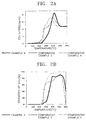
- FIGS. 2A and 2B illustrate the analysis results for Example 4 and Comparative Examples 3 and 4.
- the combustion temperature of particulates for the catalyst of Example 4 is similar to that of Comparative Example 3 at about 425°C.
- FIG. 2A also clearly shows that the catalyst of Example 4 has a vigorous reactivity to produce CO 2 from particulates while the catalysts of Comparative Examples 3 and 4 has a temporal resting stage near 270°C in the combustion of particulates.
- the catalyst of Example 3 exhibits a good SO 2 oxidation inhibition effect at low temperatures compared to the catalysts of Comparative Examples 3 and 4.
- FIGS. 3A and 3B illustrate the analysis results for Examples 2 and 3 and Comparative Examples 1 and 2.
- the degree of nitrogen oxide reduction by the catalysts of Examples 2 and 3 is about 25 to 40 %, which is lower than that by the catalyst of Comparative Example 1.
- the catalyst of Example 3 shows the highest degree of nitrogen oxide reduction at 370°C which is close to the average temperature of exhaust gas during traveling of diesel engines.
- the catalyst of Example 2 shows the highest reduction of nitrogen oxide at a lower temperature of 290°C than for Example 3, its effects on SO 2 oxidation is advantageous with a lower degree of SO 2 oxidation.
- FIGS. 4A and 4B illustrate the analysis results for Example 4 and Comparative Examples 5 and 6.
- the combustion temperature of particulates is lower at about 405°C for the catalyst of Example 5 compared to that of Comparative Examples 5 and 6, and the steep curve for Example 5 assures a good reactivity during the burning of particulates.
- the degree of SO 2 oxidation for Example 5 is as low as about 20% at a temperature of 400°C or less.
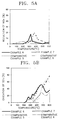
- FIGS. 5A and 5B illustrate the analysis results for Examples 6 and 7 and Comparative Examples 5 and 6.
- the degree of nitrogen oxide reduction is 19% at 370°C for the catalyst of Example 7 and 17% at 320°C for the catalyst of Example 6, which is two or three times the reduction of nitrogen oxide for the catalysts of Comparative Examples 5 and 6.
- the degree of SO 2 oxidation for these catalysts is slightly higher than that for Comparative Examples 5 and 6, but this SO 2 oxidation can be improved by coating additional catalytic layer for particulate reduction on the carrier.
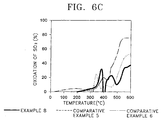
- FIGS. 6A through 6C illustrate the analysis results for Example 8 and Comparative Examples 5 and 6.
- the combustion temperature of particulates is 400°C for the catalyst of Example 8, which is lower compared to the catalysts of Comparative Examples 5 and 6 as shown in FIG. 6A.
- the catalyst of Example 8 shows a high nitrogen oxide reduction of 18% in a wide temperature range from 300 to 400°C. Also, the degree of SO 2 oxidation is very low for the catalyst of Example 8 as shown in FIG. 6C.
- the smog removal performance during a sudden speed rise was measured for the catalysts of Example 8 and Comparative Examples 5 and 6.
- the catalysts were loaded separately to a vehicle carrying a supercharged direct injection type 4-cylinder diesel engine (displacement 2600cc) and each vehicle was driven at a speed of 40, 60 and 80 km/h.
- a predetermined portion of exhaust gas through an exhaust pipe was sucked with a pump and filtered off with a filter paper.
- the concentration of smog was read by converting light reflection by the contaminated filter paper to a current.
- FIG. 7 the catalyst of Example 8 shows a fairly higher smog removal efficiency for the entire speed range compared to the catalysts of Comparative Examples 1 and 2.
- the smog removal efficiency by the catalyst of Example 8 is about 10% even at a speed of 40 km/h at which particulates are barely removed.
- the use of Pt and Pd which are precious metals, is restricted to be lower than 0.3 wt% and 0.8 wt%, respectively, based on the weight of carrier.
- the combustion temperature of particulates is decreased to 400°C or less, which is considerably low relative to that of 500°C or more by a common catalyst, under a simulated exhaust gas atmosphere containing 10% or more moisture and 200 ppm SO 2 .
- the particulate burning efficiency by the catalysts of the present invention is better than that by the catalysts of the comparative examples which are considered to have a good particulate burning efficiency.
- the catalysts of the present invention exhibit a purification efficiency of 18% or more in a temperature range of 300 to 400°C, which is 8% higher than the purification efficiency of a common catalyst for nitrogen dioxide.
- the catalysts of the present invention contribute to reducing the oxidation of SO 2 , so that there is no concern about secondary production of particulates.
- the catalysts of the present invention show a higher smog removal efficiency of 20% or more on average during a sudden speed rise from 40 to 100 km/h.
Landscapes
- Chemical & Material Sciences (AREA)
- Engineering & Computer Science (AREA)
- Chemical Kinetics & Catalysis (AREA)
- Materials Engineering (AREA)
- Organic Chemistry (AREA)
- Environmental & Geological Engineering (AREA)
- Health & Medical Sciences (AREA)
- Biomedical Technology (AREA)
- Analytical Chemistry (AREA)
- General Chemical & Material Sciences (AREA)
- Oil, Petroleum & Natural Gas (AREA)
- Combustion & Propulsion (AREA)
- Catalysts (AREA)
- Exhaust Gas After Treatment (AREA)
- Processes For Solid Components From Exhaust (AREA)
- Exhaust Gas Treatment By Means Of Catalyst (AREA)
Abstract
Description
- Gas Composition: 500 ppm NOx; 800 ppm HC; 2000 ppm CO; 200 ppm SO2; 10% H2O; 10% O2; He balance
- Reaction Temperature: 200 to 600°C
- Space Velocity: 40,000/h
Claims (13)
- A high-temperature active catalyst for purification of an exhaust gas, e.g. from diesel engines, characterized by:a first catalytic layer for reducing nitrogen oxide, the first catalytic layer including a carrier part formed of iron (Fe)-doped modified zirconium dioxide, and a catalyst part formed of copper (Cu) or copper oxide; anda second catalytic layer for removing particulates, the second catalytic layer including a carrier part formed of Cu-doped modified zirconium dioxide, a main catalyst part formed of platinum (Pt) and tin (Sn), and a co-catalyst part formed of copper oxide.
- The catalyst of claim 1, wherein the amount of Cu or copper oxide in the first catalytic layer is in the range of 0.5 to 5 wt% based on the weight of the carrier part formed of Fe-doped modified zirconium dioxide.
- A low-temperature active catalyst for purification of an exhaust gas, e.g. from diesel engines, characterized by:a first catalytic layer for reducing nitrogen oxide, the first catalytic layer including a carrier part formed of iron (Fe)-doped modified zirconium dioxide, and a catalytic part formed of palladium (Pd); anda second catalytic layer for removing particulates, the second catalytic layer including a carrier part formed of copper (Cu)-doped zirconium dioxide, a main catalyst part formed of platinum (Pt) and tin (Sn), and a co-catalyst part formed of copper oxide.
- The catalyst of claim 3, wherein the amount of Pd in the first catalytic layer is in the range of 0.2 to 0.8 wt% based on the weight of the carrier part formed of Fe-doped modified zirconium dioxide.
- The catalyst of any one of claims 1 to 4, wherein the Fe-doped or Cu-doped modified zirconium dioxide comprises SO 2- / 4 of 1wt% to 5wt% based on the weight of the modified zirconium dioxide, and has a specific surface area of 80 m2/gram to 130 m2/gram.
- The high-temperature active catalyst of any one of claim 1 to 5, wherein the amount of Fe in the carrier part of the first catalytic layer is in the range of 3 wt% to 6 wt% based on the weight of the modified zirconium dioxide.
- The high-temperature active catalyst of any one of claims 1 to 6, wherein the amount of Cu in the carrier part of the second catalytic layer is in the range of 3 wt% to 6 wt% based on the weight of the modified zirconium dioxide.
- The high-temperature active catalyst of any one of claims 1 to 7, wherein the amount of each of Pt and Sn of the second catalytic layer is in the range of 0.05 wt% to 0.3 wt% based on the weight of the carrier part formed of Cu-doped modified zirconium dioxide.
- The high-temperature active catalyst of any one of claims 1 to 8, wherein the copper oxide in the co-catalyst part of the second catalytic layer has a particle size of 0.1 µm to 10 µm, and the amount of the copper dioxide is in the range of 10 wt% to 30 wt% based on the weight of the main catalyst part of the second catalytic layer.
- The high-temperature active catalyst of any one of claims 1 to 9, wherein the first catalytic layer is coated on a heat-resistance three-dimensional structure along with alumina spheres with a size of 50 µm to 100 µm, and the second catalytic layer is coated on the first catalytic layer.
- The high-temperature active catalyst of claim 10, wherein the amount of alumina spheres is in the range of 5 wt% to 30 wt% based on the weight of the carrier part formed of Fe-doped modified zirconium dioxide.
- The high-temperature active catalyst of claim 8 or 9, wherein the heat-resistance three-dimensional structure is one selected from the group consisting of an open-flow ceramic honeycombed structure, a wall-flow ceramic honeycomb monolithic structure and an open-flow metal honeycombed structure.
- A catalyst for purification of exhaust gas, e.g. from diesel engines, prepared by linking the high-temperature active catalyst according to any of claims 1, 2, and 5 to 12, and the low-temperature active catalyst according to any of claims 3, 4, and 5 to 12, in series, such that the high-temperature active catalyst is located at an exhaust gas inlet portion and the low-temperature active catalyst is located at an exhaust gas outlet portion.
Applications Claiming Priority (2)
| Application Number | Priority Date | Filing Date | Title |
|---|---|---|---|
| KR9907254 | 1999-03-05 | ||
| KR1019990007254A KR100319922B1 (en) | 1999-03-05 | 1999-03-05 | catalyst for reduction of exhaust gas from diesel engine |
Publications (2)
| Publication Number | Publication Date |
|---|---|
| EP1034832A2 true EP1034832A2 (en) | 2000-09-13 |
| EP1034832A3 EP1034832A3 (en) | 2007-04-04 |
Family
ID=19575628
Family Applications (1)
| Application Number | Title | Priority Date | Filing Date |
|---|---|---|---|
| EP00104429A Withdrawn EP1034832A3 (en) | 1999-03-05 | 2000-03-03 | Catalyst for purification of an exhaust gas from diesel engines |
Country Status (4)
| Country | Link |
|---|---|
| US (1) | US6265342B1 (en) |
| EP (1) | EP1034832A3 (en) |
| JP (1) | JP2000271483A (en) |
| KR (1) | KR100319922B1 (en) |
Cited By (5)
| Publication number | Priority date | Publication date | Assignee | Title |
|---|---|---|---|---|
| US6911414B2 (en) * | 2000-11-27 | 2005-06-28 | Cataler Corporation | Catalyst for purifying exhaust gas |
| WO2005075059A1 (en) * | 2004-02-06 | 2005-08-18 | Hte Aktiengesellschaft The High Throughput Experimentation Company | Precious metal catalyst stabilized with iron oxide for the removal of pollutants from exhaust gases from leanburn engines |
| EP1657410A3 (en) * | 2004-11-11 | 2006-08-16 | Cataler Corporation | Filter catalyst |
| WO2007124865A1 (en) * | 2006-04-28 | 2007-11-08 | Haldor Topsøe A/S | Process for the removal of hydrogen cyanide and formic acid from synthesis gas |
| US8889089B2 (en) | 2007-10-26 | 2014-11-18 | Haldor Topsoe A/S | Process for a reduction in the amount of sulphur compounds, hydrogen cyanide, and formic acid in synthesis gas |
Families Citing this family (16)
| Publication number | Priority date | Publication date | Assignee | Title |
|---|---|---|---|---|
| JP3733834B2 (en) * | 2000-05-02 | 2006-01-11 | 日産自動車株式会社 | Exhaust gas purification device for internal combustion engine |
| US7037615B2 (en) * | 2001-02-12 | 2006-05-02 | Delphi Technologies, Inc. | Trapping method and system for energy conversion devices |
| US6706660B2 (en) * | 2001-12-18 | 2004-03-16 | Caterpillar Inc | Metal/metal oxide doped oxide catalysts having high deNOx selectivity for lean NOx exhaust aftertreatment systems |
| US7390768B2 (en) * | 2002-01-22 | 2008-06-24 | The United States Of America As Represented By The Administrator Of The National Aeronautics And Space Administration | Stabilized tin-oxide-based oxidation/reduction catalysts |
| JP4356324B2 (en) * | 2003-01-22 | 2009-11-04 | 日立造船株式会社 | Method for producing carrier for methane selective denitration catalyst |
| US6938412B2 (en) * | 2003-08-07 | 2005-09-06 | General Motors Corporation | Removing nitrogen oxides during a lean-burn engine cold start |
| US20090004083A1 (en) * | 2003-12-17 | 2009-01-01 | Valentine James M | NOx control for IC engines |
| US20070212271A1 (en) * | 2006-02-17 | 2007-09-13 | Kennedy Paul E | Process air desulfurization for syngas production |
| US7709541B2 (en) * | 2006-07-14 | 2010-05-04 | Headwaters Technology Innovation, Llc | Fischer-Tropsch catalysts incorporating promoter for increasing yields of C5+ hydrocarbons and methods for making and using same |
| JP2008168228A (en) * | 2007-01-12 | 2008-07-24 | Okayama Univ | Catalyst and method for purifying nitrogen oxides in diesel engine exhaust gas using unburned carbon |
| WO2010068059A2 (en) * | 2008-12-12 | 2010-06-17 | 한국에너지기술연구원 | Dual functional catalysts for decomposition and oxidation of nitrogen monoxide, mixed catalysts for exhaust-gas reducing device including the same, and preparation method thereof |
| WO2010079854A1 (en) * | 2009-01-08 | 2010-07-15 | 주식회사 엘지하우시스 | Catalyst for removing nitrogen oxides from exhaust gas, preparation method thereof, and method for removing nitrogen oxides from exhaust gas using the same |
| GB201021649D0 (en) * | 2010-12-21 | 2011-02-02 | Johnson Matthey Plc | NOx Absorber catalyst |
| JP5331177B2 (en) * | 2011-01-14 | 2013-10-30 | トヨタ自動車株式会社 | Base metal exhaust gas purification system for internal combustion engine |
| JP5320426B2 (en) * | 2011-04-04 | 2013-10-23 | トヨタ自動車株式会社 | Exhaust gas purification catalyst and exhaust gas purification device |
| US8962897B2 (en) * | 2012-12-19 | 2015-02-24 | Celanese International Corporation | Catalysts and processes for producing butanol |
Family Cites Families (15)
| Publication number | Priority date | Publication date | Assignee | Title |
|---|---|---|---|---|
| US3873469A (en) * | 1972-04-12 | 1975-03-25 | Corning Glass Works | Support coatings for catalysts |
| US4117082A (en) * | 1974-04-19 | 1978-09-26 | Figaro Giken Co., Ltd. | Method of completely oxidizing carbon monoxide |
| GB1568391A (en) * | 1976-04-14 | 1980-05-29 | Atomic Energy Authority Uk | Catalysts having metallic substrates |
| GB1604246A (en) * | 1977-06-08 | 1981-12-02 | Johnson Matthey Co Ltd | Catalysts for oxidation and reduction processes |
| US4483940A (en) * | 1981-11-24 | 1984-11-20 | Nippon Shokubai Kagaku Kogyo Co., Ltd. | Method for manufacture of honeycomb catalyst |
| FR2530489B1 (en) * | 1982-07-26 | 1987-02-27 | Pro Catalyse | PROCESS FOR THE MANUFACTURE OF CATALYSTS FOR THE TREATMENT OF EXHAUST GASES FROM INTERNAL COMBUSTION ENGINES |
| CA1260909A (en) * | 1985-07-02 | 1989-09-26 | Koichi Saito | Exhaust gas cleaning catalyst and process for production thereof |
| US4786625A (en) * | 1987-02-25 | 1988-11-22 | Uop Inc. | Dehydrogenation catalyst compositon |
| JPH0724774B2 (en) * | 1988-11-25 | 1995-03-22 | 株式会社日本触媒 | Exhaust gas treatment catalyst carrier, method for producing the same, and exhaust gas treatment catalyst containing the carrier |
| GB8913978D0 (en) * | 1989-06-17 | 1989-08-09 | Atomic Energy Authority Uk | Catalytic treatment |
| JP3098083B2 (en) * | 1991-12-26 | 2000-10-10 | マツダ株式会社 | Exhaust gas purification catalyst |
| JP3219480B2 (en) * | 1992-08-31 | 2001-10-15 | 三菱重工業株式会社 | Exhaust gas treatment method and catalyst |
| JP3185448B2 (en) * | 1993-03-11 | 2001-07-09 | 日産自動車株式会社 | Exhaust gas purification catalyst |
| JP3129377B2 (en) * | 1994-08-12 | 2001-01-29 | 三菱重工業株式会社 | Exhaust gas purification catalyst |
| IT1271312B (en) * | 1994-12-21 | 1997-05-27 | Enirisorse Spa | SOL-GEL PROCESS FOR OBTAINING SPHERES, MICROSPHERES OR COATINGS OF CELL-SHAPED MONOLITES, CONSTITUTED FROM PURE OR ZIRCONIUM OXIDE WITH OTHER OXIDES, USEFUL AS CATALYSTS OR SUPPORTS FOR CATALYSTS |
-
1999
- 1999-03-05 KR KR1019990007254A patent/KR100319922B1/en not_active Expired - Fee Related
-
2000
- 2000-03-03 EP EP00104429A patent/EP1034832A3/en not_active Withdrawn
- 2000-03-06 US US09/519,621 patent/US6265342B1/en not_active Expired - Lifetime
- 2000-03-06 JP JP2000060133A patent/JP2000271483A/en active Pending
Cited By (10)
| Publication number | Priority date | Publication date | Assignee | Title |
|---|---|---|---|---|
| US6911414B2 (en) * | 2000-11-27 | 2005-06-28 | Cataler Corporation | Catalyst for purifying exhaust gas |
| WO2005075059A1 (en) * | 2004-02-06 | 2005-08-18 | Hte Aktiengesellschaft The High Throughput Experimentation Company | Precious metal catalyst stabilized with iron oxide for the removal of pollutants from exhaust gases from leanburn engines |
| EP1657410A3 (en) * | 2004-11-11 | 2006-08-16 | Cataler Corporation | Filter catalyst |
| US7781371B2 (en) | 2004-11-11 | 2010-08-24 | Cataler Corporation | Filter catalyst |
| WO2007124865A1 (en) * | 2006-04-28 | 2007-11-08 | Haldor Topsøe A/S | Process for the removal of hydrogen cyanide and formic acid from synthesis gas |
| EA013870B1 (en) * | 2006-04-28 | 2010-08-30 | Хальдор Топсёэ А/С | Process for the removal of hydrogen cyanide and formic acid from synthesis gas |
| AU2007245907B2 (en) * | 2006-04-28 | 2011-02-10 | Haldor Topsoe A/S | Process for the removal of hydrogen cyanide and formic acid from synthesis gas |
| CN101484230B (en) * | 2006-04-28 | 2012-12-26 | 赫多特普索化工设备公司 | Process for the removal of hydrogen cyanide and formic acid from synthesis gas |
| US8623303B2 (en) | 2006-04-28 | 2014-01-07 | Haldor Topsoe A/S | Process for the removal of hydrogen cyanide and formic acid from synthesis gas |
| US8889089B2 (en) | 2007-10-26 | 2014-11-18 | Haldor Topsoe A/S | Process for a reduction in the amount of sulphur compounds, hydrogen cyanide, and formic acid in synthesis gas |
Also Published As
| Publication number | Publication date |
|---|---|
| JP2000271483A (en) | 2000-10-03 |
| KR100319922B1 (en) | 2002-01-09 |
| EP1034832A3 (en) | 2007-04-04 |
| KR20000059559A (en) | 2000-10-05 |
| US6265342B1 (en) | 2001-07-24 |
Similar Documents
| Publication | Publication Date | Title |
|---|---|---|
| US6265342B1 (en) | Catalyst for purification of exhaust gas from diesel engine | |
| CA2044984C (en) | Catalyst for purifying exhaust gas from diesel engines | |
| US5824621A (en) | Exhaust gas cleaner | |
| EP2045010B1 (en) | Exhaust gas purifying catalyst | |
| US5656249A (en) | Exhaust gas cleaner and method for removing nitrogen oxides | |
| JP2007534467A (en) | Noble metal catalyst stabilized with iron oxide for removing pollutants from exhaust gas from lean burn engine | |
| US6685899B1 (en) | Catalyst and method for purifying exhaust gas from vehicle engines | |
| ZA200503956B (en) | Exhaust gas purifying catalyst and method for purifying exhaust gas | |
| JP2015521540A (en) | Catalyst composition | |
| JPH0884911A (en) | Catalyst for decomposing nitrogen oxides and method for purifying exhaust gas of diesel engine using the same | |
| WO1998051401A1 (en) | Gold based catalyst for exhaust gas purification | |
| JP2578219B2 (en) | Method for producing exhaust gas purifying catalyst | |
| JP3267862B2 (en) | Diesel engine exhaust gas purification catalyst and exhaust gas purification method using the same | |
| CN113181910B (en) | Marine diesel engine high-sulfur tail gas particle trapping catalyst and preparation method thereof | |
| WO1992020445A1 (en) | Re-catalyst and carrier | |
| JP3408905B2 (en) | Diesel engine exhaust gas purification catalyst and diesel engine exhaust gas purification method | |
| KR100446599B1 (en) | Catalyst for purifying exhaust gas of automobiles | |
| JPH08229350A (en) | Catalyst for decomposing nitrogen oxide and purifying method of diesel engine exhaust gas using the same | |
| KR19980069257A (en) | Catalyst for purification of automobile exhaust | |
| KR19990071157A (en) | Catalyst for purification of automobile exhaust | |
| CA2245970C (en) | Exhaust emission control catalyst and method for controlling exhaust emission | |
| JPH08257405A (en) | Catalyst for decomposition of nitrogen oxide and method for removing nitrogen oxide in exhaust gas from diesel engine by using the same | |
| KR100588858B1 (en) | Manufacturing method of diesel particulate catalyst | |
| JPH11319566A (en) | Nitrogen oxide removal catalyst and nitrogen oxide removal method | |
| KR20030007993A (en) | A composition of diesel oxidation catalyst |
Legal Events
| Date | Code | Title | Description |
|---|---|---|---|
| PUAI | Public reference made under article 153(3) epc to a published international application that has entered the european phase |
Free format text: ORIGINAL CODE: 0009012 |
|
| AK | Designated contracting states |
Kind code of ref document: A2 Designated state(s): AT BE CH CY DE DK ES FI FR GB GR IE IT LI LU MC NL PT SE |
|
| AX | Request for extension of the european patent |
Free format text: AL;LT;LV;MK;RO;SI |
|
| PUAL | Search report despatched |
Free format text: ORIGINAL CODE: 0009013 |
|
| AK | Designated contracting states |
Kind code of ref document: A3 Designated state(s): AT BE CH CY DE DK ES FI FR GB GR IE IT LI LU MC NL PT SE |
|
| AX | Request for extension of the european patent |
Extension state: AL LT LV MK RO SI |
|
| RIC1 | Information provided on ipc code assigned before grant |
Ipc: F01N 3/28 20060101ALI20070223BHEP Ipc: B01J 21/06 20060101ALI20070223BHEP Ipc: B01J 23/89 20060101ALI20070223BHEP Ipc: B01J 23/62 20060101ALI20070223BHEP Ipc: B01J 37/025 20060101ALI20070223BHEP Ipc: B01D 53/94 20060101AFI20000624BHEP |
|
| AKX | Designation fees paid | ||
| STAA | Information on the status of an ep patent application or granted ep patent |
Free format text: STATUS: THE APPLICATION IS DEEMED TO BE WITHDRAWN |
|
| 18D | Application deemed to be withdrawn |
Effective date: 20071005 |
|
| REG | Reference to a national code |
Ref country code: DE Ref legal event code: 8566 |