EP1034797A2 - Verfahren zur Herstellung eines 18 F-markierten Glykosylierungsreagenz sowie 18 F-Glykosylierungsreagenz und dessen Verwendung - Google Patents
Verfahren zur Herstellung eines 18 F-markierten Glykosylierungsreagenz sowie 18 F-Glykosylierungsreagenz und dessen Verwendung Download PDFInfo
- Publication number
- EP1034797A2 EP1034797A2 EP00103937A EP00103937A EP1034797A2 EP 1034797 A2 EP1034797 A2 EP 1034797A2 EP 00103937 A EP00103937 A EP 00103937A EP 00103937 A EP00103937 A EP 00103937A EP 1034797 A2 EP1034797 A2 EP 1034797A2
- Authority
- EP
- European Patent Office
- Prior art keywords
- glucose
- deoxy
- labeled
- fluoro
- hexose
- Prior art date
- Legal status (The legal status is an assumption and is not a legal conclusion. Google has not performed a legal analysis and makes no representation as to the accuracy of the status listed.)
- Granted
Links
- 0 *CC[C@]1C(C*)O[C@@](*)C(C*)*1 Chemical compound *CC[C@]1C(C*)O[C@@](*)C(C*)*1 0.000 description 1
Images


Classifications
-
- A—HUMAN NECESSITIES
- A61—MEDICAL OR VETERINARY SCIENCE; HYGIENE
- A61K—PREPARATIONS FOR MEDICAL, DENTAL OR TOILETRY PURPOSES
- A61K51/00—Preparations containing radioactive substances for use in therapy or testing in vivo
- A61K51/02—Preparations containing radioactive substances for use in therapy or testing in vivo characterised by the carrier, i.e. characterised by the agent or material covalently linked or complexing the radioactive nucleus
- A61K51/04—Organic compounds
- A61K51/0491—Sugars, nucleosides, nucleotides, oligonucleotides, nucleic acids, e.g. DNA, RNA, nucleic acid aptamers
-
- C—CHEMISTRY; METALLURGY
- C07—ORGANIC CHEMISTRY
- C07H—SUGARS; DERIVATIVES THEREOF; NUCLEOSIDES; NUCLEOTIDES; NUCLEIC ACIDS
- C07H3/00—Compounds containing only hydrogen atoms and saccharide radicals having only carbon, hydrogen, and oxygen atoms
- C07H3/02—Monosaccharides
-
- Y—GENERAL TAGGING OF NEW TECHNOLOGICAL DEVELOPMENTS; GENERAL TAGGING OF CROSS-SECTIONAL TECHNOLOGIES SPANNING OVER SEVERAL SECTIONS OF THE IPC; TECHNICAL SUBJECTS COVERED BY FORMER USPC CROSS-REFERENCE ART COLLECTIONS [XRACs] AND DIGESTS
- Y02—TECHNOLOGIES OR APPLICATIONS FOR MITIGATION OR ADAPTATION AGAINST CLIMATE CHANGE
- Y02P—CLIMATE CHANGE MITIGATION TECHNOLOGIES IN THE PRODUCTION OR PROCESSING OF GOODS
- Y02P20/00—Technologies relating to chemical industry
- Y02P20/50—Improvements relating to the production of bulk chemicals
- Y02P20/55—Design of synthesis routes, e.g. reducing the use of auxiliary or protecting groups
Definitions
- the invention relates to a method for producing an 18 F-labeled glycosylation reagent and a glycosylation reagent and its use.
- the new labeling reagent enables the production of 18 F-labeled glycosylated peptides and glycosylated proteins as well as 18 F-labeled polysaccharides and low molecular weight or oligosaccharides.
- the method according to the invention for the production of the 18 F-labeling reagent enables short synthesis times, with the consequence of a longer remaining usage time of the labeling reagent.
- the yields are 30 to 35%.
- the marking substances according to the invention can be made available with a low carrier, that is to say largely without shares in 19 F (with a low carrier).
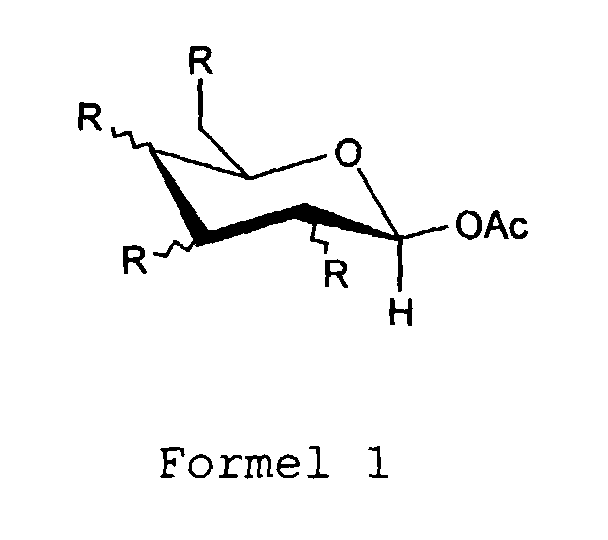
- a hexose of the general formula 1 used as a starting material has four residues R, which are positioned in 2, 3, 4 and 6 positions. Of the four residues, three represent a protective group which is bonded to the six-membered ring via an oxygen atom. The fourth residue is an 18 F atom, which is in one of the positions from the groups 2, 3, 4, and 6. OAc groups are particularly suitable as protective groups, but other protective groups accessible to hydrolysis can also be introduced.
- a preferred starting material is 1.3.4.6-tetra-O-acetyl-2- [ 18 F] fluoro-2-deoxy-D-glucose, which is the intermediate for the synthesis of fluorodeesoxy-D-glucose.
- a low-carrier compound of formula 1 is converted under anhydrous conditions in a phosphoric acid melt to the tri-O-acetyl [ 18 F] fluorodesoxy-D-glucose-1-phosphate, which in the next reaction step under basic conditions in aqueous System is deacetylated.
- the preferred base is LiOH, since the phosphate residue is not split off by LiOH. Furthermore, excess phosphate is precipitated by Li + .
- the reaction product uridine diphosphate [ 18 F] fluorodesoxy-D-glucose according to the invention can be synthesized in an enzymatically catalyzed reaction of uridine triphosphate with the [ 18 F] fluorodesoxy-D-glucose-1-phosphate in the presence of uridine diphosphate glucose pyrophosphorylase.
- Mg 2+ is used as a cofactor for the enzymatic reaction.
- protected sugars are the tetraacetylated deoxyhexoses in the 3,4 and 6-position 18 F-labeled.
- protected sugars are the tetraacetylated deoxyhexoses in the 3,4 and 6-position 18 F-labeled.
- 1,2,4,6-tetra-O-acetyl-3- [ 18 F] fluoro-3-deoxy-D-glucose, 1,2,3,4-tetra-O-acetyl-6- [ 18 F] fluoro-6-deoxy-D-glucose or 1,2,3,6-tetra-O-acetyl-4- [ 18 F] fluoro-4-deoxy-D-glucose can be used as starting compounds.
- Uridine diphosphate glucose pyrophosphorylases used (EC 2.7.7.9).
- the pyrophosphorylases from Beef liver and baker's yeast (Sigma, TypX) are commercial available and therefore particularly accessible.
- Formula 2 shown in FIG. 2 denotes the structure of the 18 F labeling reagent according to the invention, which has four R groups.
- the residues are in positions 2, 3, 4 and 6, with three of the residues being OH groups.
- a remainder is 18 F and can be in one of the positions from 2, 3, 4 and 6.
- a preferred product is uridine diphosphate 2- [ 18 F] fluoro-2-deoxy-D-glucose.
- Other products include: uridine diphosphate 3- [ 18 F] fluoro-3-deoxy-D-glucose, uridine diphosphate 4- [ 18 F] fluoro-4-deoxy-D-glucose and uridine diphosphate 6- [ 18 F] fluorine 6-deoxy-D-glucose.
- the 18 F-labeled coenzyme uridine diphosphate- [ 18 F] fluorodesoxy-D-glucose can be synthesized with little support.
- the production process allows the synthesis of the compound according to the invention with a synthesis time which leads to a good radiochemical yield of the 18 F-labeled coenzyme, so that the use for the enzymatic 18 F glycosylation of glycoproteins and oligosaccharides can be realized.
- 1,3,4,6-Tetra-O-acetyl-2- [ 18 F] fluoro-2-deoxy-D-glucose is used dried.
- the vacuum melt with crystalline phosphoric acid (10-20 mg) takes place at the reaction temperature of 70 ° C. and provides a radiochemical yield for 3,4,6-tri-O-acetyl-2- [ 18 F] fluoro-2-deoxy-D- 40-60% glucose-1-phosphate (with respect to 1,3,4,6-tetra-O-acetyl-2- [ 18 F] fluorodeesoxy-D-glucose).
- the basic hydrolysis is carried out after absorption of the phosphoric acid melt in 0.2-0.3 ml of tetrahydrofuran with 0.2 ml 2N lithium hydroxide solution performed in the cold.
- the enzymatic reaction with uridine diphosphate glucose pyrophosphorylase takes place in the intermediate grain volume of the polymer matrix on which the phosphorylated 2- [ 18 F] fluoro-2-deoxy-D-glucose is fixed.
- the intermediate grain volume of the exchange resin 50 ... 100 ⁇ l
- a substrate-enzyme cocktail which contains the following components: Uridine triphosphate, uridine diphosphate glucose pyrophosphorylase, inorganic pyrophosphatase, Mg 2+ in Tris buffer.
- the anionic components of the substrate-enzyme cocktail lead to desorption and homogeneous distribution of 2- [ 18 F] fluoro-2-deoxy-D-glucose-1-phosphate in the liquid phase of the intermediate grain volume.
- the phosphorylase (EC 2.7.7.9) comes from beef liver and, like the inorganic pyrophosphatase (EC 3.6.1.1) used to accelerate the reaction, can be obtained from Sigma-Aldrich.
- the enzyme concentrations for uridine diphosphate glucose pyrophosphorylase are 0.5 mg / ml and for inorganic Pyrophosphatase 0.03 mg / ml.
- the magnesium concentration used is 0.5 mM.
- the substrate concentration used for uridine triphosphate is 0.5 mM and 2- [ 18 F] fluoro-2-deoxy-D-glucose-1-phosphate is used in a low-carrier form in submicromolar concentrations.
- the pH of the aqueous solution is 8.0 (100 mM Tris buffer), the reaction temperature is 40 ° C.
- the release of 2- [ 18 F] fluoro-2-deoxy-D-glucose-1-phosphate in the small amounts per se leads to a high local concentration, which accelerates product formation. Therefore, the response time is shortened and there is a longer period of time for using the short-lived product.
- the enzymatic solid phase reaction provides a radiochemical yield of 30% for low-carrier uridine diphosphate 2- [ 18 F] fluoro-2-deoxy-D-glucose. The enzymatic conversion can be accelerated by increasing the enzyme concentration.
Landscapes
- Chemical & Material Sciences (AREA)
- Health & Medical Sciences (AREA)
- Life Sciences & Earth Sciences (AREA)
- Organic Chemistry (AREA)
- Engineering & Computer Science (AREA)
- Biochemistry (AREA)
- Biotechnology (AREA)
- General Health & Medical Sciences (AREA)
- Molecular Biology (AREA)
- Proteomics, Peptides & Aminoacids (AREA)
- Animal Behavior & Ethology (AREA)
- Physics & Mathematics (AREA)
- Medicinal Chemistry (AREA)
- Optics & Photonics (AREA)
- Pharmacology & Pharmacy (AREA)
- Epidemiology (AREA)
- Genetics & Genomics (AREA)
- Public Health (AREA)
- Veterinary Medicine (AREA)
- Saccharide Compounds (AREA)
- Preparation Of Compounds By Using Micro-Organisms (AREA)
- Medicines Containing Antibodies Or Antigens For Use As Internal Diagnostic Agents (AREA)
- Steroid Compounds (AREA)
Abstract
Description
- Fig.1:
- Eine Reaktionsgleichung
- Fig.2:
- Strukturformel des erfindungsgemäßen Produkts
- Fig.3:
- Reaktionsgleichungen für die Herstellung von 18F-markierten Biopolymeren.

Bei den in Figur 3 aufgeführten Reaktionen bedeuten:
In den O-Glykoproteinen, N-Glykoproteinen und Oligosacchariden bedeuten:
Die Vakuumschmelze mit kristalliner Phosphorsäure (10-20 mg) erfolgt bei der Reaktionstemperatur 70 °C und liefert eine radiochemische Ausbeute für 3,4,6-Tri-O-acetyl-2-[18F]fluor-2-desoxy-D-glucose-1-phosphat von 40-60% (bzgl. 1,3,4,6-Tetra-O-acetyl-2-[18F] fluordesoxy-D-glucose).
Die Phosphorylase (E.C. 2.7.7.9) stammt aus Rinderleber und kann, ebenso wie die zur Beschleunigung der Reaktion eingesetzte anorganische Pyrophosphatase (E.C. 3.6.1.1), von Sigma-Aldrich bezogen werden.
Die enzymatische Festphasenreaktion liefert nach einer Reaktionszeit von 60 Minuten eine radiochemische Ausbeute von 30% für trägerarmes Uridindiphosphat-2-[18F]fluor-2-desoxy-D-glucose. Die enzymatische Umsetzung kann durch Erhöhung der Enzymkonzentration beschleunigt werden.
Claims (11)
- Verfahren zur Herstellung eines 18F-markierten Glykosylierungsagenz,
dadurch gekennzeichnet,
daß eine Hexose der allgemeinen Formel 1 mit 4 Re-sten R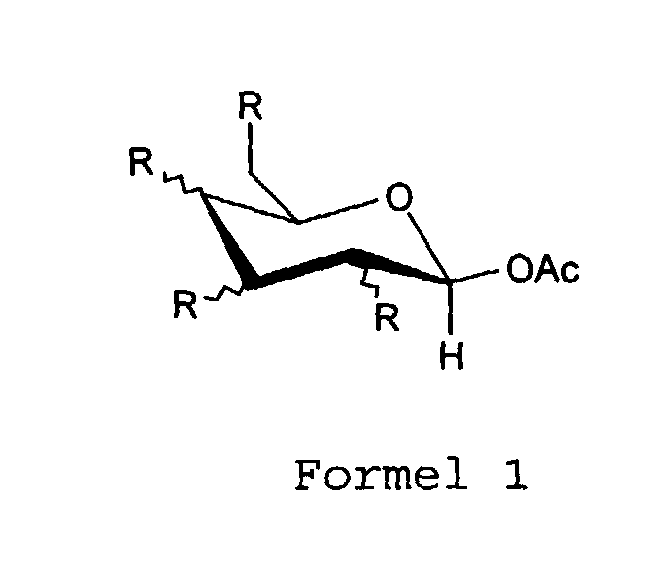 wobei drei von den vier Resten eine Schutzgruppe bedeuten, die über Sauerstoffatome an den Sechsring gebunden sind,und ein Rest R 18F bedeutet, wobei sich R = 18F in der Position 2,3,4 oder 6 der Hexose befindet,1. mit H3PO4 umgesetzt wird,2. anschließend mit einer Base hydrolysiert wird,3. und danach unter Zugabe von UTP mittels einer Pyrophosphorylase in Anwesenheit von Mg2+ umgesetzt wird.
 - Verfahren nach Anspruch 1,
dadurch gekennzeichnet,
daß eine Hexose der allgemeinen Formel 1 eingesetzt wird, deren Schutzgruppe R eine OAc-Gruppe ist. - Verfahren nach einem der Ansprüche 1 oder 2,
dadurch gekennzeichnet,
daß die Umsetzung gemäß Schritt 1. mit H3PO4 durch Verschmelzung erfolgt. - Verfahren nach einem der Ansprüche 1 bis 3,
dadurch gekennzeichnet,
daß die Hydrolyse mit einer Base gemäß Schritt 2. mittels LiOH erfolgt. - Verfahren nach einem der Ansprüche 1 bis 4,
dadurch gekennzeichnet,
daß in Schritt 3. eine Uridindiphosphatglucosepyrophosphorylase (EC 2.7.7.9) eingesetzt wird. - Verfahren nach Anspruch 6,
dadurch gekennzeichnet,
daß eine Uridindiphosphatglucosepyrophosphorylase aus Rinderleber oder Bäckerhefe eingesetzt wird. - Verfahren nach einem der Ansprüche 1 bis 6,
dadurch gekennzeichnet,
daß als Verbindung gemäß Formel 1 1.3.4.6-Tetra-O-acetyl-2-[18F]fluor-2-desoxy-D-glucose eingesetzt wird. - Verfahren nach einem der Ansprüche 1 bis 7,
dadurch gekennzeichnet,
daß die Verbindung nach Formel 1 trägerfrei ist. - Glycosylierungsreagenz,
dadurch gekennzeichnet,
daß es eine Struktur der allgemeinen Formel 2 hat,bei welcher der Hexoserest in den Postionen 2,3,4 und 6 Reste R besitzt, von denen drei Reste R eine OH-Gruppe und ein Rest R ein 18F-Atom bedeuten, wobei sich das 18F-Atom in der Position 2,3,4 oder 6 des Hexoserings befindet.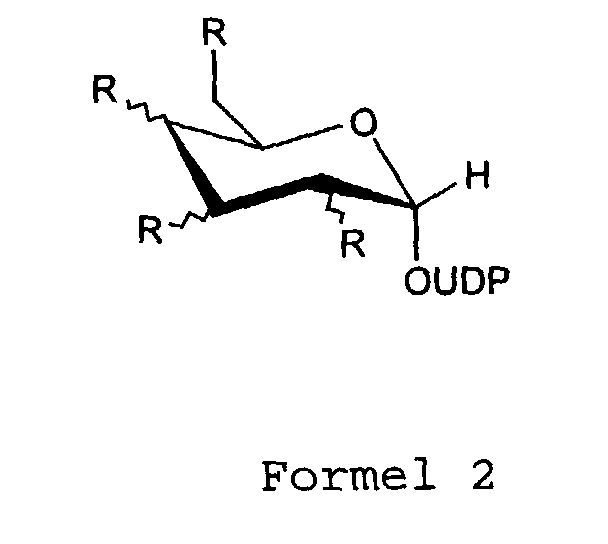
- Glycosylierungsreagenz nach Anspruch 9,
dadurch gekennzeichnet,
daß sich das 18F-Atom des Hexoserings in Position 2 befindet. - Verwendung eines Glycosylierungsreagenz nach einem der Ansprüche 9 oder 10 für die 18F-Markierung von glykosylierten Peptiden, glykosylierten Proteinen und Oligosacchariden sowie Sacchariden.
Applications Claiming Priority (2)
| Application Number | Priority Date | Filing Date | Title |
|---|---|---|---|
| DE19908712A DE19908712C2 (de) | 1999-03-01 | 1999-03-01 | Verfahren zur Herstellung eines ·1··8·F-markierten Glykosylierungsreagenz |
| DE19908712 | 1999-03-01 |
Publications (3)
| Publication Number | Publication Date |
|---|---|
| EP1034797A2 true EP1034797A2 (de) | 2000-09-13 |
| EP1034797A3 EP1034797A3 (de) | 2000-09-20 |
| EP1034797B1 EP1034797B1 (de) | 2004-04-28 |
Family
ID=7899196
Family Applications (1)
| Application Number | Title | Priority Date | Filing Date |
|---|---|---|---|
| EP00103937A Expired - Lifetime EP1034797B1 (de) | 1999-03-01 | 2000-02-25 | Verfahren zur Herstellung eines 18 F-markierten Glykosylierungsreagenz sowie 18 F-Glykosylierungsreagenz und dessen Verwendung |
Country Status (3)
| Country | Link |
|---|---|
| EP (1) | EP1034797B1 (de) |
| AT (1) | ATE265235T1 (de) |
| DE (2) | DE19908712C2 (de) |
Cited By (2)
| Publication number | Priority date | Publication date | Assignee | Title |
|---|---|---|---|---|
| EP1660519A4 (de) * | 2003-07-29 | 2010-09-29 | Immunomedics Inc | Konjugate fluorierter kohlenhydrate |
| US8845999B2 (en) * | 2005-05-23 | 2014-09-30 | The Regents Of The University Of California | Tracers for monitoring the activity of sodium/glucose cotransporters in health and disease |
Family Cites Families (4)
| Publication number | Priority date | Publication date | Assignee | Title |
|---|---|---|---|---|
| DE3424525A1 (de) * | 1984-07-04 | 1986-01-16 | Kernforschungsanlage Jülich GmbH, 5170 Jülich | Verfahren zur herstellung von (pfeil hoch)1(pfeil hoch)(pfeil hoch)8(pfeil hoch)f-alkyl- und arylverbindungen durch halogenaustausch |
| AU675209B2 (en) * | 1991-10-15 | 1997-01-30 | Scripps Research Institute, The | Production of fucosylated carbohydrates by enzymatic fucosylation synthesis of sugar nucleotides; and in situ regeneration of GDP-fucose |
| US5770407A (en) * | 1996-12-10 | 1998-06-23 | The Scripps Research Institute | Process for preparing nucleotide inhibitors of glycosyltransferases |
| DE19703031C2 (de) * | 1997-01-29 | 1998-10-29 | Forschungszentrum Juelich Gmbh | Verfahren zur Herstellung von NDP-Zucker |
-
1999
- 1999-03-01 DE DE19908712A patent/DE19908712C2/de not_active Expired - Fee Related
-
2000
- 2000-02-25 AT AT00103937T patent/ATE265235T1/de not_active IP Right Cessation
- 2000-02-25 DE DE50006204T patent/DE50006204D1/de not_active Expired - Fee Related
- 2000-02-25 EP EP00103937A patent/EP1034797B1/de not_active Expired - Lifetime
Cited By (3)
| Publication number | Priority date | Publication date | Assignee | Title |
|---|---|---|---|---|
| EP1660519A4 (de) * | 2003-07-29 | 2010-09-29 | Immunomedics Inc | Konjugate fluorierter kohlenhydrate |
| US8038983B2 (en) | 2003-07-29 | 2011-10-18 | Immunomedics, Inc. | Fluorinated carbohydrate conjugates |
| US8845999B2 (en) * | 2005-05-23 | 2014-09-30 | The Regents Of The University Of California | Tracers for monitoring the activity of sodium/glucose cotransporters in health and disease |
Also Published As
| Publication number | Publication date |
|---|---|
| ATE265235T1 (de) | 2004-05-15 |
| DE19908712A1 (de) | 2000-09-14 |
| EP1034797A3 (de) | 2000-09-20 |
| DE19908712C2 (de) | 2002-02-07 |
| EP1034797B1 (de) | 2004-04-28 |
| DE50006204D1 (de) | 2004-06-03 |
Similar Documents
| Publication | Publication Date | Title |
|---|---|---|
| DE69232138T2 (de) | Methode zur isolation von glykosyltransferasen | |
| DE69611442T2 (de) | Enzymatische synthese von glykosidischen verbindungen | |
| DE68923177T2 (de) | Verfahren zur herstellung von oligosacchariden. | |
| DE2816340C2 (de) | Verfahren zur Herstellung von 0-geschützten 2-Azido-2-desoxyglycosylnitraten 3,4,6-Tri-0-acetyl-2-azido-2-desoxy-D-galactopyranosylnitrat und 3,6-Di-0-acetyl-4-0-(2,3,4,6-tetra-0-acetyl-β-D-galactopyranosyl)-2-azido-2-desoxy-D-glucopyranosylnitrat sowie deren Verwendung | |
| DE60013161T2 (de) | Neue fucosylierte oligosaccharide und verfahren zu deren herstellung | |
| DE69623005T2 (de) | Verbesserte verfahren zur enzymatischen synthese von oligosacchariden | |
| DE4009630A1 (de) | Cmp-aktivierte fluoreszierende sialinsaeuren sowie verfahren zu ihrer herstellung | |
| EP0371414A2 (de) | Glykosphingolipide mit kopplungsfähiger Gruppe im Sphingoidanteil, ihre Herstellung und Verwendung | |
| DE69228692T2 (de) | Methode zur enzymatischen synthese von kohlenhydraten | |
| DE69228005T2 (de) | Herstellung von fucosylierten Kohlenhydraten durch enzymatische Fucosylierungs-Synthese der Zuckernukleotide; und in situ Regeneration von GDP-fucose | |
| DE3937891A1 (de) | Enzymatisches verfahren zur herstellung von n-acetylneuraminsaeure | |
| DE2627111C2 (de) | Verfahren zur chemischen oder enzymatischen Isomerisierung einer Aldose oder eines Aldosederivates zur entsprechenden Ketose oder zum entsprechenden Ketosederivat | |
| DE1803978C2 (de) | Verfahren zur Gewinnung von S-Adenosyl-l-methionin und S-Adenosyl-l-ethionin | |
| DE19642751A1 (de) | Saccharid-Bibliothek | |
| DE69316754T2 (de) | Schrittweise entfernung von monosacchariden vom reduzierenden ende von oligosacchariden und verwendungen davon | |
| EP1034797B1 (de) | Verfahren zur Herstellung eines 18 F-markierten Glykosylierungsreagenz sowie 18 F-Glykosylierungsreagenz und dessen Verwendung | |
| EP0255691A2 (de) | Enzymatische Synthese von Cyclodextrinen mit alpha-Glucosylfluorid als Substrat für Cyclodextrin-alpha (1-4)glucosyl-transferase | |
| DE69019086T2 (de) | Verfahren zur Herstellung von künstlichen N-verbundenen Glycoconjugaten. | |
| DE4396846B4 (de) | Verfahren zur Isomerisierung einer Verbindung mit Aldosestruktur zu einer Verbindung mit Ketosestruktur | |
| US6355453B1 (en) | Method for making fluorinated sugars having a side chain and use thereof | |
| EP0298438B1 (de) | Disaccharidfluoride, Verfahren zur enzymatischen Herstellung mit alpha-glycosylfluoriden als Substraten | |
| Resch et al. | Osmium-labeled polysaccharides for atomic microscopy | |
| DE3850191T2 (de) | Verfahren zur Herstellung von Glukose-1-Phosphat. | |
| DE3884744T2 (de) | Hämoglobinkomplexe. | |
| WO1993000914A1 (de) | Metabolisierbarer plasmaersatz |
Legal Events
| Date | Code | Title | Description |
|---|---|---|---|
| PUAI | Public reference made under article 153(3) epc to a published international application that has entered the european phase |
Free format text: ORIGINAL CODE: 0009012 |
|
| PUAL | Search report despatched |
Free format text: ORIGINAL CODE: 0009013 |
|
| AK | Designated contracting states |
Kind code of ref document: A2 Designated state(s): AT BE CH CY DE DK ES FI FR GB GR IE IT LI LU MC NL PT SE |
|
| AX | Request for extension of the european patent |
Free format text: AL;LT;LV;MK;RO;SI |
|
| AK | Designated contracting states |
Kind code of ref document: A3 Designated state(s): AT BE CH CY DE DK ES FI FR GB GR IE IT LI LU MC NL PT SE |
|
| AX | Request for extension of the european patent |
Free format text: AL;LT;LV;MK;RO;SI |
|
| 17P | Request for examination filed |
Effective date: 20010307 |
|
| AKX | Designation fees paid |
Free format text: AT BE CH CY DE DK ES FI FR GB GR IE IT LI LU MC NL PT SE |
|
| RAP1 | Party data changed (applicant data changed or rights of an application transferred) |
Owner name: FORSCHUNGSZENTRUM JUELICH GMBH |
|
| GRAP | Despatch of communication of intention to grant a patent |
Free format text: ORIGINAL CODE: EPIDOSNIGR1 |
|
| GRAS | Grant fee paid |
Free format text: ORIGINAL CODE: EPIDOSNIGR3 |
|
| GRAA | (expected) grant |
Free format text: ORIGINAL CODE: 0009210 |
|
| AK | Designated contracting states |
Kind code of ref document: B1 Designated state(s): AT BE CH CY DE DK ES FI FR GB GR IE IT LI LU MC NL PT SE |
|
| PG25 | Lapsed in a contracting state [announced via postgrant information from national office to epo] |
Ref country code: IT Free format text: LAPSE BECAUSE OF FAILURE TO SUBMIT A TRANSLATION OF THE DESCRIPTION OR TO PAY THE FEE WITHIN THE PRESCRIBED TIME-LIMIT;WARNING: LAPSES OF ITALIAN PATENTS WITH EFFECTIVE DATE BEFORE 2007 MAY HAVE OCCURRED AT ANY TIME BEFORE 2007. THE CORRECT EFFECTIVE DATE MAY BE DIFFERENT FROM THE ONE RECORDED. Effective date: 20040428 Ref country code: FR Free format text: LAPSE BECAUSE OF FAILURE TO SUBMIT A TRANSLATION OF THE DESCRIPTION OR TO PAY THE FEE WITHIN THE PRESCRIBED TIME-LIMIT Effective date: 20040428 Ref country code: FI Free format text: LAPSE BECAUSE OF FAILURE TO SUBMIT A TRANSLATION OF THE DESCRIPTION OR TO PAY THE FEE WITHIN THE PRESCRIBED TIME-LIMIT Effective date: 20040428 Ref country code: NL Free format text: LAPSE BECAUSE OF FAILURE TO SUBMIT A TRANSLATION OF THE DESCRIPTION OR TO PAY THE FEE WITHIN THE PRESCRIBED TIME-LIMIT Effective date: 20040428 Ref country code: GB Free format text: LAPSE BECAUSE OF FAILURE TO SUBMIT A TRANSLATION OF THE DESCRIPTION OR TO PAY THE FEE WITHIN THE PRESCRIBED TIME-LIMIT Effective date: 20040428 Ref country code: IE Free format text: LAPSE BECAUSE OF FAILURE TO SUBMIT A TRANSLATION OF THE DESCRIPTION OR TO PAY THE FEE WITHIN THE PRESCRIBED TIME-LIMIT Effective date: 20040428 |
|
| REG | Reference to a national code |
Ref country code: GB Ref legal event code: FG4D Free format text: NOT ENGLISH |
|
| REG | Reference to a national code |
Ref country code: CH Ref legal event code: EP |
|
| REG | Reference to a national code |
Ref country code: IE Ref legal event code: FG4D Free format text: GERMAN |
|
| REF | Corresponds to: |
Ref document number: 50006204 Country of ref document: DE Date of ref document: 20040603 Kind code of ref document: P |
|
| PG25 | Lapsed in a contracting state [announced via postgrant information from national office to epo] |
Ref country code: GR Free format text: LAPSE BECAUSE OF FAILURE TO SUBMIT A TRANSLATION OF THE DESCRIPTION OR TO PAY THE FEE WITHIN THE PRESCRIBED TIME-LIMIT Effective date: 20040728 Ref country code: DK Free format text: LAPSE BECAUSE OF FAILURE TO SUBMIT A TRANSLATION OF THE DESCRIPTION OR TO PAY THE FEE WITHIN THE PRESCRIBED TIME-LIMIT Effective date: 20040728 Ref country code: SE Free format text: LAPSE BECAUSE OF FAILURE TO SUBMIT A TRANSLATION OF THE DESCRIPTION OR TO PAY THE FEE WITHIN THE PRESCRIBED TIME-LIMIT Effective date: 20040728 |
|
| PG25 | Lapsed in a contracting state [announced via postgrant information from national office to epo] |
Ref country code: ES Free format text: LAPSE BECAUSE OF FAILURE TO SUBMIT A TRANSLATION OF THE DESCRIPTION OR TO PAY THE FEE WITHIN THE PRESCRIBED TIME-LIMIT Effective date: 20040808 |
|
| NLV1 | Nl: lapsed or annulled due to failure to fulfill the requirements of art. 29p and 29m of the patents act | ||
| GBV | Gb: ep patent (uk) treated as always having been void in accordance with gb section 77(7)/1977 [no translation filed] |
Effective date: 20040428 |
|
| REG | Reference to a national code |
Ref country code: IE Ref legal event code: FD4D |
|
| PG25 | Lapsed in a contracting state [announced via postgrant information from national office to epo] |
Ref country code: CY Free format text: LAPSE BECAUSE OF FAILURE TO SUBMIT A TRANSLATION OF THE DESCRIPTION OR TO PAY THE FEE WITHIN THE PRESCRIBED TIME-LIMIT Effective date: 20050225 Ref country code: LU Free format text: LAPSE BECAUSE OF NON-PAYMENT OF DUE FEES Effective date: 20050225 Ref country code: AT Free format text: LAPSE BECAUSE OF NON-PAYMENT OF DUE FEES Effective date: 20050225 |
|
| PG25 | Lapsed in a contracting state [announced via postgrant information from national office to epo] |
Ref country code: CH Free format text: LAPSE BECAUSE OF NON-PAYMENT OF DUE FEES Effective date: 20050228 Ref country code: MC Free format text: LAPSE BECAUSE OF NON-PAYMENT OF DUE FEES Effective date: 20050228 Ref country code: BE Free format text: LAPSE BECAUSE OF NON-PAYMENT OF DUE FEES Effective date: 20050228 Ref country code: LI Free format text: LAPSE BECAUSE OF NON-PAYMENT OF DUE FEES Effective date: 20050228 |
|
| PLBE | No opposition filed within time limit |
Free format text: ORIGINAL CODE: 0009261 |
|
| STAA | Information on the status of an ep patent application or granted ep patent |
Free format text: STATUS: NO OPPOSITION FILED WITHIN TIME LIMIT |
|
| EN | Fr: translation not filed | ||
| 26N | No opposition filed |
Effective date: 20050131 |
|
| BERE | Be: lapsed |
Owner name: FORSCHUNGSZENTRUM *JULICH G.M.B.H. Effective date: 20050228 |
|
| PG25 | Lapsed in a contracting state [announced via postgrant information from national office to epo] |
Ref country code: DE Free format text: LAPSE BECAUSE OF NON-PAYMENT OF DUE FEES Effective date: 20050901 |
|
| REG | Reference to a national code |
Ref country code: CH Ref legal event code: PL |
|
| BERE | Be: lapsed |
Owner name: FORSCHUNGSZENTRUM *JULICH G.M.B.H. Effective date: 20050228 |
|
| PG25 | Lapsed in a contracting state [announced via postgrant information from national office to epo] |
Ref country code: PT Free format text: LAPSE BECAUSE OF NON-PAYMENT OF DUE FEES Effective date: 20040928 |