EP1030527A2 - Vermittlungseinrichtung - Google Patents
Vermittlungseinrichtung Download PDFInfo
- Publication number
- EP1030527A2 EP1030527A2 EP00103160A EP00103160A EP1030527A2 EP 1030527 A2 EP1030527 A2 EP 1030527A2 EP 00103160 A EP00103160 A EP 00103160A EP 00103160 A EP00103160 A EP 00103160A EP 1030527 A2 EP1030527 A2 EP 1030527A2
- Authority
- EP
- European Patent Office
- Prior art keywords
- network
- local
- signaling
- subscriber
- connection
- Prior art date
- Legal status (The legal status is an assumption and is not a legal conclusion. Google has not performed a legal analysis and makes no representation as to the accuracy of the status listed.)
- Withdrawn
Links
Images
Classifications
-
- H—ELECTRICITY
- H04—ELECTRIC COMMUNICATION TECHNIQUE
- H04W—WIRELESS COMMUNICATION NETWORKS
- H04W76/00—Connection management
- H04W76/20—Manipulation of established connections
-
- H—ELECTRICITY
- H04—ELECTRIC COMMUNICATION TECHNIQUE
- H04W—WIRELESS COMMUNICATION NETWORKS
- H04W92/00—Interfaces specially adapted for wireless communication networks
- H04W92/02—Inter-networking arrangements
-
- H—ELECTRICITY
- H04—ELECTRIC COMMUNICATION TECHNIQUE
- H04W—WIRELESS COMMUNICATION NETWORKS
- H04W92/00—Interfaces specially adapted for wireless communication networks
- H04W92/16—Interfaces between hierarchically similar devices
- H04W92/24—Interfaces between hierarchically similar devices between backbone network devices
Definitions
- the invention relates to a switching device for a Telecommunications network, in which for participants in the network Local connections can be set up and which to exchange and processing of subscriber signaling with over the Local connections connected terminals according to a predetermined Local signaling protocol is set up.
- Telecommunication networks are as fixed networks or mobile networks, like the well-known GSM network ('Global System for Mobile communications') - see. the GSM standards of the European Standards Institute for Telecommunications (ETSI) -, trained and have networked switching facilities. Public mobile radio networks are intended within the scope of the invention to be viewed as.
- GSM Global System for Mobile communications
- ETSI European Standards Institute for Telecommunications
- base stations connected with the help of an air interface can be connected to telecommunications terminals are. These end devices enable a subscriber to Mobile network access.
- the switching centers are also for the transition to other networks, e.g. a data transmission network or a fixed network.
- HLR home location register
- VLR visitor register
- the switching between the cells is ensured by protocols set up for this purpose, via which the subscriber data can be exchanged, for example, between a the subscriber's home register and the visit register of the current cell can be exchanged.
- a change of participant stay between telecommunication networks cannot easily follow the example of the Switch between the cells of a cellular radio network be carried out because, on the one hand, the telecommunications networks each completely, essentially independently and are in principle equal to each other - at least with regard to the management of subscriber data - to others generally different architectures and protocols exhibit.
- a known solution for controlling the accessibility of the The subscriber uses call forwarding from the unusable Connections to the one that the participant wants to use.
- the call diversions must be made by the subscriber Enter or leave the area assigned to the connection be activated and deactivated.
- This solution that actually for an occasional or temporary one Stay with a third party connection is designed annoying for the participant and especially with a larger one Cumbersome number of connections.
- Another solution is to carry out a call delivery attempt for an incoming call for the connections assigned to the user.
- a service can be provided in a so-called intelligent network, in which additional services are known to be carried out by a special network node provided for this purpose, the so-called service control point (SCP); however, this requires appropriate signaling between the network nodes of a network and the service control node, in which a corresponding database that is independent of the data base of the exchange must be set up.
- SCP service control point
- signaling must first be established between the switching center assigned to the connection and the service control node.
- this type of call delivery is not possible in networks that do not have a service control node or similar devices. It is not uncommon for the network in which the subscriber's first connection is set up to be a landline without Intelligent "resources.
- the transfer module is set up to a via a local connection, for which a connection assignment set up for a subscriber identification of a foreign network is, incoming registration notification in a registration message of the external signaling protocol for the through implement the connection assignment of specified subscribers and to transmit to the relevant external network.
- the switching device is advantageously for this purpose set up, one arriving via a local connection Call request for a given number of a local service as a booking notification of the assigned to the local connection To process the participant. This allows one Realization of a booking notification based on the existing subscriber signaling and thus eliminates the need Extension of the signaling.
- a local visitor register is provided, in which based on a booking notification arriving via a local connection the assigned subscriber as on the local line is registered. In this way, the Switching device to the external network according to Art act of a mobile network node.
- the local visitor register realized as a data register independent of the database is.
- a preferred embodiment of the switching device according to the invention, where the advantages mentioned are special is expressed as a landline switch for a Fixed telephone network implemented.
- connection assignments are different each on a mobile subscriber identifier for a terminal a third-party network implemented as a mobile network.
- the local connection is included in the Management of the mobile accessibility of the mobile network.
- the third-party signaling protocol is advantageously implemented as a signaling protocol for mobile radio networks, and the transfer module is set up to exchange signals according to this mobile radio signaling protocol with a home location register of an external network implemented as a mobile radio network. This corresponds to one Connection "of the switching device to a (foreign) mobile network without the subscriber signaling having to be raised to the mobile signaling protocol.
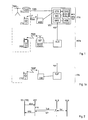
- Fig. 1 is a switching center VST of a fixed telephone network FTN shown according to the invention via an interface MIF with a second telephone network, namely a GSM network MFN, is connected and the mobility of fixed network subscribers TNR, which in addition to your landline connection FAN MAN connection in the GSM network.
- a User TNR is representative with its landline connection FAN shown, via which his wired telephone terminal TEL is connected.
- the Connection FAN led to the switching center VST usually the connection is routed via feeder devices such as. a connection concentrator, which of course for the invention is of no further importance and therefore in FIG. 1 are not shown.
- the user TNR is also logged on as a subscriber in the GSM network MFN and thus has a mobile connection MAN and a mobile device MOG (so-called Representing the known cellular network architecture, the home location register HLR and a base station BST are shown in FIG. 1, with which the mobile device MOG is currently logged in and which is linked to the home location register HLR.
- a mobile device MOG so-called Representing the known cellular network architecture, the home location register HLR and a base station BST are shown in FIG. 1, with which the mobile device MOG is currently logged in and which is linked to the home location register HLR.
- the switching center VST has a transmission routine UTR for performing the interoffice signaling in the fixed network FTN and for handling the subscriber signaling for the connections FAN (managed by the switching center). Local connections ").
- the signaling takes place in the fixed network FTN in accordance with a fixed network signaling protocol such as, for example, the DSS1 in accordance with ETSI standards Q.931 and Q.932 ( Local signaling protocol "); here the transmission routine UTR accesses the subscriber data held in the database DAB.
- the exchange VST is linked via an interface MIF to the GSM network MFN, which in the example is Foreign network "in the sense of the invention.
- the signaling takes place in the GSM network on the basis of the MAP protocol (cf. GSM standard 09.02).
- the switching center signals via the interface MIF by means of a mobile communication module KMR provided on the part of the switching center VST.
- KMR mobile communication module
- a transfer module IWU is provided to implement the signaling between the fixed network protocol DSS1 and the mobile protocol MAP.
- the communication module KMR and the transfer module IWU are implemented programmatically as switching functions, but can in principle also be implemented in the form of, for example, electronic devices represents a switching node for the GSM network MFN, which is why it is also assigned a visitor register identification (so-called 'vlrId') and has a visitor database VDB.
- the visitor database VDB holds subscriber information relating to those mobile subscribers of the GSM -Network, which are booked via the switching center VST on the relevant landline connection FAN.
- the transfer module IWU accesses the database DAB and / or the visitor database VDB indirectly via the transfer routine UTR or the communication module KMR; in a variant, the access could also take place directly.
- the visitor database VDB is designed as a memory which is separate from the mediation database DAB - which facilitates independent access and simplifies administration and maintenance - but can also be implemented as part of the database DAB.
- a subscriber is logged into the switching center VST via his landline connection FAN.
- the subscriber TNR logs on to the fixed network connection FAN by manually logging on to the terminal TEL. This is done, for example, by the user TNR dialing a predetermined number via his terminal TEL.
- this call number is assigned to a local service, for example implemented by a digit evaluation, which checks the sequence of digits specified in the call request and, if it matches the specified number for the booking process, recognizes it as a booking message.
- the FAN connection is in the visitor register VDB an entry regarding the location of the participant TNR created.
- the FAN connection is a subscriber ID of the GSM network MFN permanently assigned.
- This connection assignment In the example, anz is in the form of an entry in the database DAB realized which e.g. one identifier each fan for the FAN landline connection, e.g. its port address, and a subscriber identifier mkg relating to the MAN mobile connection or the mobile device MOG of the user TNR.
- the subscriber identifier mkg is e.g. in the form of the IMSI number of the mobile device Given MOG.
- the IMSI number ('International Mobile As is known to the person skilled in the art, station identity ') serves for identification of a subscriber or his mobile terminal in a cellular network.
- the transfer module IWU then updates the Stay area (regarding the TNR mobile subscriber) the home location register HLR of the cellular network MFN.
- the update procedure is carried out by means of the communication routine KMR after the well-known location update of the GSM network carried out, which with a 'LocationUpdate' message lup, in which the IMSI number and that of the exchange Identification assigned as a mobile network node (so-called 'vlrId') contains. Accordingly, the new lounge area of the participant in the home register HLR and the Deletion lsc of the previous residence information, for example in the visitor register assigned to the base station BST VLR, initiated.
- the home location register HLR sends an update confirmation in the form of a so-called 'UpdateLocationResult' message ulr back to the exchange VST. If desired, finally enters the exchange to the subscriber Acknowledgment signal qsg off or confirms the successful execution Registration process in another way, for example through a corresponding, predetermined announcement.
- the invention enables the management of subscriber mobility between subscriber lines of different networks, especially between a connection in a conventional one Fixed network and a connection to another network, where known devices can continue to be used. services intelligent networks are not required. This is one Realization also in networks that have no functionality more intelligent Have or do not provide networks, possible; thus the invention is particularly useful for operation such digital networks and analog networks interesting. It it should be noted that there is currently a considerable number of these networks Share of telephone networks counts.
- the invention enables simple and reliable Way a connection of a landline with a Mobile network. This is achieved by emulating a MAP interface for the purposes of mobility management, which are based on those stored in the switching device Mobility data - display the connection assignments the subscriber identifiers mkg - through the own of the fixed network Subscriber signaling is initiated. Also can be implement a so-called 'one number' solution through the invention, where the participant is under a single Number - in this case under the MSISDN number of the GSM network - can be reached in the participating networks.
- the invention for reasons of Simplicity does not provide that when subscribing to the participant TNR on the FAN landline connection on the part of the mobile device Data held by MOG, e.g. a TMSI number ('Temporary Mobile Station Identity '). This can do that cause that when you re-register in the MFN mobile network the deleted TMSI number for failure of the authentication procedure leads. Conveniently, mobile devices should are used, which reset in such a case and start a new booking procedure.
- the invention is of course suitable for other types of networks than those mentioned in the example above.
- Another example is, with reference to FIG. 1a Variant of the exemplary embodiment discussed above, in which instead of a GSM network the foreign network as intelligent network ITN is executed and the subscriber TNR via a cordless, for example in one based on the DECT standard based wireless system CBS realized mobile connection MAN 'of the intelligent network. That about the Mobile connection MAN 'connected cordless part CTG' starts Location of the mobile device MOG in the example above; it can in special cases with the landline connection FAN ' and a base station HBS connected cordless device CTG be identical.
- the intelligent network ITN is known after Kind of a service control point SCP to control Services of the intelligent network ITN, such as a mobility service to support cordless mobility Participants, provided.
- the SCP replaces the home register HLR in the example above.
- the signaling in the intelligent network ITN and the signaling via the The MIF interface takes place, for example, via the INAP protocol according to the ETSI standard EN 301 140-1.
- the Subscriber identification which specifies in the connection assignment is, according to the DECT standards e.g. an IPUI identifier ('International Portable User Identity').
- the fixed network can remain the same (which is why this part is not shown in Fig. 1a); the signaling takes place analogously to what has been said above in the intelligent Network ITN using the for the specialist common INAP signaling messages.
Landscapes
- Engineering & Computer Science (AREA)
- Computer Networks & Wireless Communication (AREA)
- Signal Processing (AREA)
- Mobile Radio Communication Systems (AREA)
- Telephonic Communication Services (AREA)
Abstract
Description

- einer Datenbasis, in welcher Anschlusszuordnungen zwischen jeweils einem Lokalanschluss und einer Teilnehmerkennung eines Fremdnetzes, welche zur Identifikation eines Teilnehmers bzw. dessen Endgerätes in dem Fremdnetz verwendbar ist, einrichtbar sind,
- zumindest einer Überleitschnittstelle zum Austausch von Signalisierungsinformation mit Netzknoten eines oder mehrerer Fremdnetze gemäß einem Fremd-Signalisierungsprotokoll, welches von dem Lokal-Signalisierungsprotokoll verschieden ist, sowie
- zumindest einem Überleitmodul, welches dazu eingerichtet
ist, über einen Lokalanschluss ausgetauschte Teilnehmersignalisierungen
und über die zumindest eine Überleitschnittstelle
gemäß dem Fremdsignalisierungsprotokoll ausgetauschte
Signalisierungen ineinander umzusetzen,
gelöst.
- Fig. 1
- eine erfindungsgemäße Vermittlungsstelle und die angebundenen Netze in einer schematischen Darstellung nach Art eines Blockdiagramms;
- Fig. 2
- ein Signalablaufsdiagramm eines Registriervorgangs eines Festnetzteilnehmers.
Claims (9)
- Vermittlungseinrichtung (VST) für ein Telekommunikationsnetz (FTN), in welcher für Teilnehmer des Netzes (FTN) Lokalanschlüsse (FAN) einrichtbar sind und welches zum Austauschen und Verarbeiten von Teilnehmersignalisierungen mit über die Lokalanschlüsse angeschlossenen Endgeräten (TEL,CTG) gemäß einem vorgegebenen Lokal-Signalisierungsprotokoll eingerichtet ist,
gekennzeichnet durcheine Datenbasis (DAB), in welcher Anschlusszuordnungen (anz) zwischen jeweils einem Lokalanschluss (FAN,fan) und einer Teilnehmerkennung (mkg) eines Fremdnetzes (MFN), welche zur Identifikation eines Teilnehmers bzw. dessen Endgerätes (MOG) in dem Fremdnetz (MFN) verwendbar ist, einrichtbar sind,zumindest eine Schnittstelle (MIF) zum Austausch von Signalisierungsinformation mit Netzknoten eines oder mehrerer Fremdnetze (MFN) gemäß einem Fremd-Signalisierungsprotokoll, welches von dem Lokal-Signalisierungsprotokoll verschieden ist, sowiezumindest ein Überleitmodul (IWU), welches dazu eingerichtet ist, über einen Lokalanschluss (FAN) ausgetauschte Teilnehmersignalisierungen und über die zumindest eine Schnittstelle (MIF) gemäß dem Fremdsignalisierungsprotokoll ausgetauschte Signalisierungen ineinander umzusetzen. - Vermittlungseinrichtung nach Anspruch 1,
dadurch gekennzeichnet, dass das Überleitmodul (IWU) dazu eingerichtet ist, eine über einen Lokalanschluss (FAN), für welchen eine Anschlusszuordnung (anz) zu einer Teilnehmerkennung (mkg) eines Fremdnetzes eingerichtet ist, eintreffende Einbuchungsmeldung in eine Einbuchungsnachricht des Fremdsignalisierungsprotokolls für den durch die Anschlusszuordnung spezifizierten Teilnehmer (MAN) umzusetzen und an das betreffende Fremdnetz (MFN) zu übermitteln. - Vermittlungseinrichtung nach Anspruch 1 oder 2,
dadurch gekennzeichnet, dass sie dazu eingerichtet ist, eine über einen Lokalanschluss (FAN) eintreffende Rufanforderung (ebm) für eine vorgegebene Rufnummer eines Lokaldienstes als Einbuchungsmeldung des dem Lokalanschluss zugeordneten Teilnehmers zu verarbeiten. - Vermittlungseinrichtung nach einem der Ansprüche 1 bis 3,
dadurch gekennzeichnet, dass ein lokales Besucherregister (VDB) vorgesehen ist, in welches aufgrund einer über einen Lokalanschluss (FAN) eintreffenden Einbuchungsmeldung (ebm) der zugeordnete Teilnehmer als am Lokalanschluss eingebucht eingetragen wird. - Vermittlungseinrichtung nach Anspruch 4,
dadurch gekennzeichnet, dass das lokale Besucherregister (VDB) als von der Datenbasis (DAB) unabhängiges Datenregister realisiert ist. - Vermittlungseinrichtung nach Anspruch 1 bis 5,
dadurch gekennzeichnet, dass sieals Festnetzvermittlung für ein Telefon-Festnetz (FTN) realisiert ist. - Vermittlungseinrichtung nach einem der Ansprüche 1 bis 6,
dadurch gekennzeichnet, dass die Anschlusszuordnungen sich jeweils auf eine Mobilteilnehmerkennung für ein Endgerät (MOG) eines als Mobilnetz realisierten Fremdnetzes (MFN) beziehen. - Vermittlungseinrichtung nach einem der Ansprüche 1 bis 7,
dadurch gekennzeichnet, dass das Fremdsignalisierungsprotokoll als Signalisierungsprotokoll für Mobilfunknetze (MAP) realisiert ist und das Überleitmodul (IWU) zum Austausch von Signalisierungen gemäß diesem Mobilfunksignalisierungsprotokoll mit einem Heimatregister (HLR) eines als Mobilfunknetz realisierten Fremdnetzes (MFN) eingerichtet ist. - Vermittlungseinrichtung nach einem der Ansprüche 1 bis 7,
dadurch gekennzeichnet, das Fremdsignalisierungsprotokoll als Signalisierungsprotokoll für intelligente Netze (ITN) realisiert ist und das Überleitmodul (IWU) zum Austausch von Signalisierungen gemäß diesem Signalisierungsprotokoll mit einem Dienstesteuerknoten (SCP) eines als intelligentes Netz realisierten Fremdnetzes (ITN) eingerichtet ist.
Applications Claiming Priority (2)
| Application Number | Priority Date | Filing Date | Title |
|---|---|---|---|
| DE19906470A DE19906470A1 (de) | 1999-02-16 | 1999-02-16 | Vermittlungseinrichtung |
| DE19906470 | 1999-02-16 |
Publications (2)
| Publication Number | Publication Date |
|---|---|
| EP1030527A2 true EP1030527A2 (de) | 2000-08-23 |
| EP1030527A3 EP1030527A3 (de) | 2001-01-17 |
Family
ID=7897694
Family Applications (1)
| Application Number | Title | Priority Date | Filing Date |
|---|---|---|---|
| EP00103160A Withdrawn EP1030527A3 (de) | 1999-02-16 | 2000-02-16 | Vermittlungseinrichtung |
Country Status (2)
| Country | Link |
|---|---|
| EP (1) | EP1030527A3 (de) |
| DE (1) | DE19906470A1 (de) |
Family Cites Families (1)
| Publication number | Priority date | Publication date | Assignee | Title |
|---|---|---|---|---|
| SE9401879L (sv) * | 1994-05-31 | 1995-12-01 | Ericsson Telefon Ab L M | Anordning vid telekommunikationssystem |
-
1999
- 1999-02-16 DE DE19906470A patent/DE19906470A1/de not_active Ceased
-
2000
- 2000-02-16 EP EP00103160A patent/EP1030527A3/de not_active Withdrawn
Also Published As
| Publication number | Publication date |
|---|---|
| DE19906470A1 (de) | 2000-08-24 |
| EP1030527A3 (de) | 2001-01-17 |
Similar Documents
| Publication | Publication Date | Title |
|---|---|---|
| EP0727914B1 (de) | Verfahren zum Aufbau einer Anrufverbindung für einen Gruppenanruf zu einer Gruppe von Mobilfunkteilnehmern in einem Mobilfunknetz | |
| DE69108454T2 (de) | Verfahren zur Anrufsvermittlung für einen Teilnehmer eines schnurlosen Telefondienstes. | |
| DE19823074C2 (de) | Mobilstation, Mobilfunk-Kommunikationsnetz und Kommunikationsverfahren unter Verwendung von mehreren Teilnehmerprofilen | |
| EP0979586B1 (de) | Verfahren und kommunikationsnetz zur administrierung von teilnehmerdaten, insbesondere dienstedaten | |
| DE69332611T2 (de) | Mobiltelefonsystem | |
| DE69733318T2 (de) | Datenübertragungsverfahren und einrichtung | |
| DE69532297T2 (de) | Verfahren zur besseren gebührenerfassung in einem mobiltelefonnetz | |
| DE69732519T2 (de) | Mobilitätsverwaltungssystem in einem persönlichen Kommunikationssystem | |
| DE19831086C2 (de) | Telekommunikationssystem | |
| DE4317143A1 (de) | Verfahren zum Betrieb eines Mobilfunknetzes | |
| DE69433628T2 (de) | Einrichtung in einem telekommunikationssystem | |
| EP0988766B1 (de) | Verfahren und anordnung zum anschluss von teilnehmern in mehreren telekommunikationsnetzen unter einer rufnummer | |
| DE69534611T2 (de) | Kommunikationsverfahren mit allgemeiner benutzung eines mobilkommunikationsendgerätes und kommunikationssystemsteuereinrichtung dafür | |
| DE10012945A1 (de) | Verfahren, Endgerät und Infrastruktureinrichtung zur Bildung von Endgerätegruppen in einem Mobilfunk-Telekommunikationsnetz | |
| DE19647627C2 (de) | Verfahren und Mobil-Kommunikationssystem zum Routen von Anrufverbindungen | |
| EP0928120B1 (de) | Verwaltung der Erreichbarkeit eines Endgerätes in einem Mobilfunknetz und einem intelligenten Netz | |
| DE69324989T2 (de) | Verbindungssteuerverfahren für persönliche Kommunikationen | |
| EP1114550A1 (de) | Sequentielles anrufen mit priorisierung der zuletzt erfolgreich erreichbaren telefonnummer | |
| EP1083761A2 (de) | Verfahren zur Änderung von Servicedaten | |
| EP0943215A2 (de) | Verfahren und einrichtung zur ermöglichung eines zugriffs auf dienste und einrichtungen eines gsm-mobilfunknetzes über ein externes telekommunikationsnetz | |
| EP1108341B1 (de) | Verfahren und mobil-kommunikationssystem zur steuerung eines verbindungsaufbaus | |
| DE19906470A1 (de) | Vermittlungseinrichtung | |
| EP0762794A2 (de) | Verfahren und System zur Übertragung von Nachrichten zwischen Einrichtungen eines Mobilfunknetzes | |
| DE19852774B4 (de) | Telefonvermittlungssystem zur Eingliederung von Mobilnetzteilnehmern in eine CENTREX-Gruppe | |
| EP1040690B1 (de) | Verfahren zur behandlung von calls in pcs kommunikationsnetzen |
Legal Events
| Date | Code | Title | Description |
|---|---|---|---|
| PUAI | Public reference made under article 153(3) epc to a published international application that has entered the european phase |
Free format text: ORIGINAL CODE: 0009012 |
|
| AK | Designated contracting states |
Kind code of ref document: A2 Designated state(s): DE FR GB |
|
| AX | Request for extension of the european patent |
Free format text: AL;LT;LV;MK;RO;SI |
|
| PUAL | Search report despatched |
Free format text: ORIGINAL CODE: 0009013 |
|
| AK | Designated contracting states |
Kind code of ref document: A3 Designated state(s): AT BE CH CY DE DK ES FI FR GB GR IE IT LI LU MC NL PT SE |
|
| AX | Request for extension of the european patent |
Free format text: AL;LT;LV;MK;RO;SI |
|
| 17P | Request for examination filed |
Effective date: 20010103 |
|
| AKX | Designation fees paid |
Free format text: DE FR GB |
|
| 17Q | First examination report despatched |
Effective date: 20030909 |
|
| RAP1 | Party data changed (applicant data changed or rights of an application transferred) |
Owner name: NOKIA SIEMENS NETWORKS GMBH & CO. KG |
|
| RAP3 | Party data changed (applicant data changed or rights of an application transferred) |
Owner name: NOKIA SIEMENS NETWORKS S.P.A. |
|
| RAP3 | Party data changed (applicant data changed or rights of an application transferred) |
Owner name: NOKIA SIEMENS NETWORKS GMBH & CO. KG |
|
| STAA | Information on the status of an ep patent application or granted ep patent |
Free format text: STATUS: THE APPLICATION IS DEEMED TO BE WITHDRAWN |
|
| 18D | Application deemed to be withdrawn |
Effective date: 20090901 |