EP1030011A1 - Dispositif d'embrayage d'une béquille extérieure de serrure avec son pêne mobile - Google Patents
Dispositif d'embrayage d'une béquille extérieure de serrure avec son pêne mobile Download PDFInfo
- Publication number
- EP1030011A1 EP1030011A1 EP20000400419 EP00400419A EP1030011A1 EP 1030011 A1 EP1030011 A1 EP 1030011A1 EP 20000400419 EP20000400419 EP 20000400419 EP 00400419 A EP00400419 A EP 00400419A EP 1030011 A1 EP1030011 A1 EP 1030011A1
- Authority
- EP
- European Patent Office
- Prior art keywords
- crowns
- housing
- clutch device
- ball
- movable
- Prior art date
- Legal status (The legal status is an assumption and is not a legal conclusion. Google has not performed a legal analysis and makes no representation as to the accuracy of the status listed.)
- Granted
Links
- 230000008878 coupling Effects 0.000 claims 1
- 238000010168 coupling process Methods 0.000 claims 1
- 238000005859 coupling reaction Methods 0.000 claims 1
- 230000005284 excitation Effects 0.000 description 3
- 230000000903 blocking effect Effects 0.000 description 2
- 239000008188 pellet Substances 0.000 description 2
- 229910000831 Steel Inorganic materials 0.000 description 1
- 230000000694 effects Effects 0.000 description 1
- 239000000463 material Substances 0.000 description 1
- 238000000034 method Methods 0.000 description 1
- 239000010959 steel Substances 0.000 description 1
- 238000005303 weighing Methods 0.000 description 1
Images
Classifications
-
- E—FIXED CONSTRUCTIONS
- E05—LOCKS; KEYS; WINDOW OR DOOR FITTINGS; SAFES
- E05B—LOCKS; ACCESSORIES THEREFOR; HANDCUFFS
- E05B47/00—Operating or controlling locks or other fastening devices by electric or magnetic means
- E05B47/06—Controlling mechanically-operated bolts by electro-magnetically-operated detents
- E05B47/0676—Controlling mechanically-operated bolts by electro-magnetically-operated detents by disconnecting the handle
- E05B47/0684—Controlling mechanically-operated bolts by electro-magnetically-operated detents by disconnecting the handle radially
- E05B47/0692—Controlling mechanically-operated bolts by electro-magnetically-operated detents by disconnecting the handle radially with a rectilinearly moveable coupling element
-
- E—FIXED CONSTRUCTIONS
- E05—LOCKS; KEYS; WINDOW OR DOOR FITTINGS; SAFES
- E05B—LOCKS; ACCESSORIES THEREFOR; HANDCUFFS
- E05B47/00—Operating or controlling locks or other fastening devices by electric or magnetic means
- E05B47/06—Controlling mechanically-operated bolts by electro-magnetically-operated detents
- E05B47/0611—Cylinder locks with electromagnetic control
- E05B47/0619—Cylinder locks with electromagnetic control by blocking the rotor
- E05B47/0626—Cylinder locks with electromagnetic control by blocking the rotor radially
- E05B47/063—Cylinder locks with electromagnetic control by blocking the rotor radially with a rectilinearly moveable blocking element
-
- E—FIXED CONSTRUCTIONS
- E05—LOCKS; KEYS; WINDOW OR DOOR FITTINGS; SAFES
- E05B—LOCKS; ACCESSORIES THEREFOR; HANDCUFFS
- E05B63/00—Locks or fastenings with special structural characteristics
- E05B63/0065—Operating modes; Transformable to different operating modes
- E05B63/0069—Override systems, e.g. allowing opening from inside without the key, even when locked from outside
- E05B63/0073—Override systems, e.g. allowing opening from inside without the key, even when locked from outside by withdrawal of the entire lock unit
-
- E—FIXED CONSTRUCTIONS
- E05—LOCKS; KEYS; WINDOW OR DOOR FITTINGS; SAFES
- E05B—LOCKS; ACCESSORIES THEREFOR; HANDCUFFS
- E05B47/00—Operating or controlling locks or other fastening devices by electric or magnetic means
- E05B2047/0084—Key or electric means; Emergency release
- E05B2047/0085—Key and electromagnet
-
- E—FIXED CONSTRUCTIONS
- E05—LOCKS; KEYS; WINDOW OR DOOR FITTINGS; SAFES
- E05B—LOCKS; ACCESSORIES THEREFOR; HANDCUFFS
- E05B47/00—Operating or controlling locks or other fastening devices by electric or magnetic means
- E05B47/0001—Operating or controlling locks or other fastening devices by electric or magnetic means with electric actuators; Constructional features thereof
- E05B47/0002—Operating or controlling locks or other fastening devices by electric or magnetic means with electric actuators; Constructional features thereof with electromagnets
- E05B47/0003—Operating or controlling locks or other fastening devices by electric or magnetic means with electric actuators; Constructional features thereof with electromagnets having a movable core
- E05B47/0004—Operating or controlling locks or other fastening devices by electric or magnetic means with electric actuators; Constructional features thereof with electromagnets having a movable core said core being linearly movable
-
- G—PHYSICS
- G07—CHECKING-DEVICES
- G07C—TIME OR ATTENDANCE REGISTERS; REGISTERING OR INDICATING THE WORKING OF MACHINES; GENERATING RANDOM NUMBERS; VOTING OR LOTTERY APPARATUS; ARRANGEMENTS, SYSTEMS OR APPARATUS FOR CHECKING NOT PROVIDED FOR ELSEWHERE
- G07C9/00—Individual registration on entry or exit
- G07C9/00174—Electronically operated locks; Circuits therefor; Nonmechanical keys therefor, e.g. passive or active electrical keys or other data carriers without mechanical keys
- G07C2009/00753—Electronically operated locks; Circuits therefor; Nonmechanical keys therefor, e.g. passive or active electrical keys or other data carriers without mechanical keys operated by active electrical keys
- G07C2009/00769—Electronically operated locks; Circuits therefor; Nonmechanical keys therefor, e.g. passive or active electrical keys or other data carriers without mechanical keys operated by active electrical keys with data transmission performed by wireless means
Definitions
- the invention relates to a device to completely protect against vandalism a door lock, and more specifically relates to a device clutch of an outside stand with its movable bolt.
- the kickstand outside and the bolt are connected directly, too, for limit acts of vandalism, we imagined and carried out systems that lock the stand by blocking it. But that does not prevent that one can force it and destroy it.
- the device according to the invention makes it possible to separate the outside handle of the lock bolt, which allows condemn access to a room, to anyone who does not have not an appropriate badge.
- the main object of the invention is therefore a clutch device for an outside lock handle with a movable bolt, device according to which, in the same case are mounted coaxially two pierced crowns each of a follower receiving on one side a crutch outside and on the other an inside stand direct with a movable bolt, the two crowns being coupled together by a mechanism actuated by a externally controlled magnetic system, means additional optional lock protection being connected directly to the clutch mechanism of the two crowns.
- the mechanism activated by the magnetic system consists of a ball placed in a housing provided in the housing, said ball being able to move, thanks to the action of the magnetic system, and place yourself in a cell common to the two crowns to secure them between them.
- the magnetic system is consisting of a movable frame carrying a lug disposed at the base of the housing and able to move the ball towards the cell, the movable frame enveloping a fixed electromagnet whose movable core is anchored to the base of the frame.
- the optional additional means of protection consists of a rotating pad mounted opposite the key cylinder and locked by a linked locking pin to the movement of the movable frame.
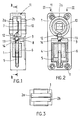
- FIGS 1 to 3 show the device stand clutch in the rest position for which the outside stand is uncoupled from the lock bolt.
- the entire mechanism is included in a box 1 in two parts joined together by a set of screws 11.
- a follower 10 intended to receive on the outside a crutch not shown, and on the other side a crutch interior in direct contact with the mobile bolt.
- Both crowns rotate relative to each other by through friction washers 7, and they are hollowed out at the base of a common cell 12 plumb a housing 13 provided in the housing 1, serving receptacle for a ball 3.
- a movable frame 4 Inside the housing, under the crowns, is arranged a movable frame 4 whose face upper carries a lug 14 which can penetrate the base of the housing 13 and move the ball 3.
- the frame 4 made of material antimagnetic envelops a fixed electromagnet 6 and its movable core 5 anchored to the base of the frame.
- Lights 8 are provided in the housing for the output of the wires feed.
- the system will be controlled by any electronic process of access control such as a magnetic card, a transponder, radio or infrared control, etc.
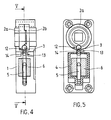
- the core 5 When providing electrical excitation to the electromagnet 6 via a command mentioned above, the core 5 is moved towards the high and carries with it the frame 4 ( Figures 4 and 5). The lug 14 then raises the ball 3 which comes position in cell 12 common to the crowns (2a, 2b). Throughout the excitation of the coil electromagnet 6, the ball will be held in position high. Being made of high strength steel, the ball thus secures the two crowns (2a, 2b) while resisting to shear forces. Therefore the crutch “crazy" exterior is connected with the bolt of the lock which allows the door to be opened from the outside.
- the movable core 5 falls by its own weight with the frame 4 which is attached to it associated.
- the ball 3 released by the lug 14 may fall back in housing 13 as soon as the crutches have found their rest position. The two crowns are again uncoupled.
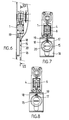
- a pad 15 capable of turning on its axis inside its housing 16.
- the pellet is hollowed out at its upper part with a notch 17 located just below a locking lug 18. This is mounted at the end of a rod 19 extending the movable frame 4 down.
- This combined device of condemnation at a time of the stand clutch and access to the cylinder lock therefore provides double security against vandalism.
Landscapes
- Physics & Mathematics (AREA)
- Electromagnetism (AREA)
- Engineering & Computer Science (AREA)
- Structural Engineering (AREA)
- Lock And Its Accessories (AREA)
- Rehabilitation Tools (AREA)
- Fittings On The Vehicle Exterior For Carrying Loads, And Devices For Holding Or Mounting Articles (AREA)
- Driving Mechanisms And Operating Circuits Of Arc-Extinguishing High-Tension Switches (AREA)
- Clamps And Clips (AREA)
Abstract
Description
Claims (4)
- Dispositif d'embrayage d'une béquille extérieure de serrure avec un pêne mobile comportant dans un même boítier deux couronnes montées coaxialement et percées chacune d'un fouillot recevant d'un côté une béquille extérieure et de l'autre une béquille intérieure en prise directe avec un pêne mobile, un mécanisme d'accouplement des couronnes étant actionné par un système magnétique commandé de l'extérieur, caractérisé en ce que les deux couronnes (2a, 2b) sont creusées à leur base d'une alvéole commune (12) à l'aplomb d'un logement (13) prévu dans le boítier (1), en ce que le mécanisme actionné par le système magnétique est constitué par une bille (3) qui repose par son propre poids au fond dudit logement prévu dans le boítier, ladite bille pouvant se déplacer vers le haut, grâce à l'action du système magnétique (4, 16) et se placer dans l'alvéole commune aux deux couronnes pour les solidariser entre elles, et en ce que des moyens optionnels complémentaires de protection (15, 18) de la serrure sont connectés directement au mécanisme d'embrayage des deux couronnes.
- Dispositif d'embrayage selon la revendication 1 caractérisé en ce que le système magnétique est constitué d'un cadre mobile (4) portant un ergot (14) disposé à la base du logement (13) et pouvant déplacer la bille (3) vers l'alvéole (12), le cadre mobile enveloppant un électroaimant fixe (6) dont le noyau mobile (5) est ancré sur la base du cadre.
- Dispositif d'embrayage selon les revendications 1 et 2 caractérisé en ce que le moyen optionnel complémentaire de protection est constitué d'une pastille rotative (15) montée en face du cylindre de clef et bloquée par un ergot de verrouillage (18) lié au mouvement du cadre mobile (4).
- Dispositif d'embrayage selon la revendication 3 caractérisé en ce que l'ergot de verrouillage (18) est monté en bout d'une tige (19) prolongeant le cadre mobile (4), et pénètre dans une échancrure (17) de la pastille (15).
Applications Claiming Priority (2)
| Application Number | Priority Date | Filing Date | Title |
|---|---|---|---|
| FR9901982 | 1999-02-18 | ||
| FR9901982A FR2790026B1 (fr) | 1999-02-18 | 1999-02-18 | Dispositif d'embrayage d'une bequille exterieure de serrure avec son pene mobile |
Publications (2)
| Publication Number | Publication Date |
|---|---|
| EP1030011A1 true EP1030011A1 (fr) | 2000-08-23 |
| EP1030011B1 EP1030011B1 (fr) | 2004-03-31 |
Family
ID=9542190
Family Applications (1)
| Application Number | Title | Priority Date | Filing Date |
|---|---|---|---|
| EP20000400419 Expired - Lifetime EP1030011B1 (fr) | 1999-02-18 | 2000-02-15 | Dispositif d'embrayage d'une béquille extérieure de serrure avec son pêne mobile |
Country Status (4)
| Country | Link |
|---|---|
| EP (1) | EP1030011B1 (fr) |
| AT (1) | ATE263298T1 (fr) |
| DE (1) | DE60009372D1 (fr) |
| FR (1) | FR2790026B1 (fr) |
Cited By (11)
| Publication number | Priority date | Publication date | Assignee | Title |
|---|---|---|---|---|
| WO2003018937A1 (fr) * | 2001-08-30 | 2003-03-06 | Investigación Y Transferencia De Tecnología, S.L. | Fermeture de securite et de commande |
| US6598909B2 (en) * | 2001-10-15 | 2003-07-29 | Ez Trend Technology Co., Ltd. | Electric door lock |
| FR2841583A1 (fr) * | 2002-07-01 | 2004-01-02 | Jacques Paul Breton | Mecanisme d'embrayage pour la commande d'une serrure, et porte le comportant |
| FR2884272A1 (fr) * | 2005-04-11 | 2006-10-13 | Dubois Ind Sa Sa | Serrure a embrayage |
| WO2010121808A1 (fr) * | 2009-04-22 | 2010-10-28 | G. Schwepper Beschlag Gmbh & Co. | Boîtier de verrouillage |
| EP2818611A3 (fr) * | 2013-06-25 | 2015-01-07 | Evva Sicherheitstechnologie GmbH | Dispositif de sécurité pour cylindre de fermeture |
| EP2754794A3 (fr) * | 2013-01-11 | 2015-11-18 | Carl Fuhr GmbH & Co. KG | Dispositif d'embrayage |
| CN105239843A (zh) * | 2015-09-30 | 2016-01-13 | 南京东屋电子科技有限公司 | 一种电子门锁 |
| CN105386645A (zh) * | 2015-09-30 | 2016-03-09 | 南京东屋电气有限公司 | 一种电子门锁离合器组件 |
| CN109519048A (zh) * | 2018-12-19 | 2019-03-26 | 珠海优特电力科技股份有限公司 | 面板锁 |
| GB2587434A (en) * | 2019-03-28 | 2021-03-31 | Wenzhou Jinfu Locks Co Ltd | Novel anti-forced entry transmission mechanism |
Families Citing this family (1)
| Publication number | Priority date | Publication date | Assignee | Title |
|---|---|---|---|---|
| US10738506B2 (en) * | 2018-07-24 | 2020-08-11 | Schlage Lock Company Llc | Modular clutching mechanism |
Citations (3)
| Publication number | Priority date | Publication date | Assignee | Title |
|---|---|---|---|---|
| FR2552809A1 (fr) * | 1983-10-04 | 1985-04-05 | Deny Cie Ets | Serrure a pene demi-tour |
| US5475996A (en) * | 1994-08-29 | 1995-12-19 | Chen; Tsun-Hsing | Electromagnetic door lock |
| WO1998023830A1 (fr) * | 1996-11-26 | 1998-06-04 | Ilco Unican Inc. | Mecanisme de loquet destine a des serrures |
-
1999
- 1999-02-18 FR FR9901982A patent/FR2790026B1/fr not_active Expired - Lifetime
-
2000
- 2000-02-15 EP EP20000400419 patent/EP1030011B1/fr not_active Expired - Lifetime
- 2000-02-15 AT AT00400419T patent/ATE263298T1/de not_active IP Right Cessation
- 2000-02-15 DE DE60009372T patent/DE60009372D1/de not_active Expired - Lifetime
Patent Citations (3)
| Publication number | Priority date | Publication date | Assignee | Title |
|---|---|---|---|---|
| FR2552809A1 (fr) * | 1983-10-04 | 1985-04-05 | Deny Cie Ets | Serrure a pene demi-tour |
| US5475996A (en) * | 1994-08-29 | 1995-12-19 | Chen; Tsun-Hsing | Electromagnetic door lock |
| WO1998023830A1 (fr) * | 1996-11-26 | 1998-06-04 | Ilco Unican Inc. | Mecanisme de loquet destine a des serrures |
Cited By (17)
| Publication number | Priority date | Publication date | Assignee | Title |
|---|---|---|---|---|
| WO2003018937A1 (fr) * | 2001-08-30 | 2003-03-06 | Investigación Y Transferencia De Tecnología, S.L. | Fermeture de securite et de commande |
| ES2184635A1 (es) * | 2001-08-30 | 2003-04-01 | Invest Y Transferancia De Tecn | Cerradura de seguridad y control |
| US6598909B2 (en) * | 2001-10-15 | 2003-07-29 | Ez Trend Technology Co., Ltd. | Electric door lock |
| FR2841583A1 (fr) * | 2002-07-01 | 2004-01-02 | Jacques Paul Breton | Mecanisme d'embrayage pour la commande d'une serrure, et porte le comportant |
| EP1378621A1 (fr) * | 2002-07-01 | 2004-01-07 | Jacques Paul Breton | Mécanisme d'embrayage pour la commande d'une serrure, et porte le comportant |
| FR2884272A1 (fr) * | 2005-04-11 | 2006-10-13 | Dubois Ind Sa Sa | Serrure a embrayage |
| WO2010121808A1 (fr) * | 2009-04-22 | 2010-10-28 | G. Schwepper Beschlag Gmbh & Co. | Boîtier de verrouillage |
| EP2754794A3 (fr) * | 2013-01-11 | 2015-11-18 | Carl Fuhr GmbH & Co. KG | Dispositif d'embrayage |
| EP2818611A3 (fr) * | 2013-06-25 | 2015-01-07 | Evva Sicherheitstechnologie GmbH | Dispositif de sécurité pour cylindre de fermeture |
| CN105239843A (zh) * | 2015-09-30 | 2016-01-13 | 南京东屋电子科技有限公司 | 一种电子门锁 |
| CN105386645A (zh) * | 2015-09-30 | 2016-03-09 | 南京东屋电气有限公司 | 一种电子门锁离合器组件 |
| CN105239843B (zh) * | 2015-09-30 | 2019-07-12 | 南京东屋电子科技有限公司 | 一种电子门锁 |
| CN105386645B (zh) * | 2015-09-30 | 2019-08-09 | 南京东屋电气有限公司 | 一种电子门锁离合器组件 |
| CN109519048A (zh) * | 2018-12-19 | 2019-03-26 | 珠海优特电力科技股份有限公司 | 面板锁 |
| CN109519048B (zh) * | 2018-12-19 | 2024-04-09 | 珠海优特电力科技股份有限公司 | 面板锁 |
| GB2587434A (en) * | 2019-03-28 | 2021-03-31 | Wenzhou Jinfu Locks Co Ltd | Novel anti-forced entry transmission mechanism |
| GB2587434B (en) * | 2019-03-28 | 2023-12-13 | Wenzhou Jinfu Locks Ltd | Novel anti-forced entry transmission mechanism |
Also Published As
| Publication number | Publication date |
|---|---|
| FR2790026A1 (fr) | 2000-08-25 |
| EP1030011B1 (fr) | 2004-03-31 |
| ATE263298T1 (de) | 2004-04-15 |
| FR2790026B1 (fr) | 2004-08-20 |
| DE60009372D1 (de) | 2004-05-06 |
Similar Documents
| Publication | Publication Date | Title |
|---|---|---|
| EP1030011B1 (fr) | Dispositif d'embrayage d'une béquille extérieure de serrure avec son pêne mobile | |
| FR2707690A1 (fr) | Ensemble de verrouillage de porte. | |
| FR2652375A1 (fr) | Serrure de securite. | |
| EP1950364B1 (fr) | Dispositif d'actionnement de pene et porte équipée dudit dispositif | |
| FR3033237A3 (fr) | Unite de detection pour boites aux lettres | |
| FR2721912A1 (fr) | Dispositif de verrouillage du couvercle d'un bac destine a etre vide par basculement | |
| FR2749343A1 (fr) | Dispositif de fermeture de porte a commande electrique | |
| EP1030008B1 (fr) | Dispositif de protection du cylindre d'une serrure de porte | |
| EP0396471A1 (fr) | Dispositif de verrouillage électrique et déverrouillage par coupure de courant, adaptable aux issues de secours | |
| FR2717932A1 (fr) | Dispositif pour la délivrance sélective et la récupération contrôlée d'objets. | |
| EP2250332B1 (fr) | Boitier de stockage securise avec une alarme integree | |
| FR2758153A1 (fr) | Dispositif de surverrouillage de porte a deverrouillage automatique en cas d'epuisement de la pile electrique d'alimentation | |
| EP1766169B1 (fr) | Procede de commande du verrouillage d'une serrure motorisee et serrure pour sa mise en oeuvre | |
| FR2721341A1 (fr) | Dispositif de blocage d'un verrou de porte en position verrouillée. | |
| EP3894646A1 (fr) | Poignée de porte a double système d'ouverture | |
| FR3069877A3 (fr) | Structure de commande d'un verrou electronique | |
| FR2650024A1 (fr) | Dispositif de verrouillage et de deverrouillage d'issue de secours | |
| EP0262262B1 (fr) | Dispositif pour actionner une serrure de sécurité et serrure équipée d'un tel dispositif | |
| FR2662734A1 (fr) | Serrure decondamnable a distance. | |
| BE1006442A5 (fr) | Procede et dispositif d'ouverture de portes de locaux, notamment de portes blindees, pour l'acces de secours. | |
| FR2699570A1 (fr) | Dispositif de fermeture de sûreté, en particulier pour capot-regard. | |
| FR2647149A1 (en) | Security trunk | |
| FR2616567A1 (fr) | Dispositif de detection de tentative d'effraction | |
| FR2664640A1 (fr) | Verrou electromagnetique et systeme pour controler des portes comprenant un tel verrou. | |
| FR2535386A1 (fr) | Tourniquet debrayable |
Legal Events
| Date | Code | Title | Description |
|---|---|---|---|
| PUAI | Public reference made under article 153(3) epc to a published international application that has entered the european phase |
Free format text: ORIGINAL CODE: 0009012 |
|
| AK | Designated contracting states |
Kind code of ref document: A1 Designated state(s): AT BE CH CY DE DK ES FI FR GB GR IE IT LI LU MC NL PT SE |
|
| AX | Request for extension of the european patent |
Free format text: AL;LT;LV;MK;RO;SI |
|
| 17P | Request for examination filed |
Effective date: 20010221 |
|
| AKX | Designation fees paid |
Free format text: AT BE CH CY DE DK ES FI FR GB GR IE IT LI LU MC NL PT SE |
|
| GRAP | Despatch of communication of intention to grant a patent |
Free format text: ORIGINAL CODE: EPIDOSNIGR1 |
|
| RIN1 | Information on inventor provided before grant (corrected) |
Inventor name: DECAYEUX, ETIENNE |
|
| GRAS | Grant fee paid |
Free format text: ORIGINAL CODE: EPIDOSNIGR3 |
|
| GRAA | (expected) grant |
Free format text: ORIGINAL CODE: 0009210 |
|
| GRAL | Information related to payment of fee for publishing/printing deleted |
Free format text: ORIGINAL CODE: EPIDOSDIGR3 |
|
| GRAS | Grant fee paid |
Free format text: ORIGINAL CODE: EPIDOSNIGR3 |
|
| AK | Designated contracting states |
Kind code of ref document: B1 Designated state(s): AT BE CH CY DE DK ES FI FR GB GR IE IT LI LU MC NL PT SE |
|
| PG25 | Lapsed in a contracting state [announced via postgrant information from national office to epo] |
Ref country code: IT Free format text: LAPSE BECAUSE OF FAILURE TO SUBMIT A TRANSLATION OF THE DESCRIPTION OR TO PAY THE FEE WITHIN THE PRESCRIBED TIME-LIMIT;WARNING: LAPSES OF ITALIAN PATENTS WITH EFFECTIVE DATE BEFORE 2007 MAY HAVE OCCURRED AT ANY TIME BEFORE 2007. THE CORRECT EFFECTIVE DATE MAY BE DIFFERENT FROM THE ONE RECORDED. Effective date: 20040331 Ref country code: GB Free format text: LAPSE BECAUSE OF FAILURE TO SUBMIT A TRANSLATION OF THE DESCRIPTION OR TO PAY THE FEE WITHIN THE PRESCRIBED TIME-LIMIT Effective date: 20040331 Ref country code: NL Free format text: LAPSE BECAUSE OF FAILURE TO SUBMIT A TRANSLATION OF THE DESCRIPTION OR TO PAY THE FEE WITHIN THE PRESCRIBED TIME-LIMIT Effective date: 20040331 Ref country code: ES Free format text: LAPSE BECAUSE OF FAILURE TO SUBMIT A TRANSLATION OF THE DESCRIPTION OR TO PAY THE FEE WITHIN THE PRESCRIBED TIME-LIMIT Effective date: 20040331 Ref country code: IE Free format text: LAPSE BECAUSE OF FAILURE TO SUBMIT A TRANSLATION OF THE DESCRIPTION OR TO PAY THE FEE WITHIN THE PRESCRIBED TIME-LIMIT Effective date: 20040331 Ref country code: AT Free format text: LAPSE BECAUSE OF FAILURE TO SUBMIT A TRANSLATION OF THE DESCRIPTION OR TO PAY THE FEE WITHIN THE PRESCRIBED TIME-LIMIT Effective date: 20040331 Ref country code: FI Free format text: LAPSE BECAUSE OF FAILURE TO SUBMIT A TRANSLATION OF THE DESCRIPTION OR TO PAY THE FEE WITHIN THE PRESCRIBED TIME-LIMIT Effective date: 20040331 |
|
| REG | Reference to a national code |
Ref country code: GB Ref legal event code: FG4D Free format text: NOT ENGLISH Ref country code: CH Ref legal event code: EP |
|
| REG | Reference to a national code |
Ref country code: IE Ref legal event code: FG4D Free format text: FRENCH |
|
| REF | Corresponds to: |
Ref document number: 60009372 Country of ref document: DE Date of ref document: 20040506 Kind code of ref document: P |
|
| PG25 | Lapsed in a contracting state [announced via postgrant information from national office to epo] |
Ref country code: SE Free format text: LAPSE BECAUSE OF FAILURE TO SUBMIT A TRANSLATION OF THE DESCRIPTION OR TO PAY THE FEE WITHIN THE PRESCRIBED TIME-LIMIT Effective date: 20040630 Ref country code: GR Free format text: LAPSE BECAUSE OF FAILURE TO SUBMIT A TRANSLATION OF THE DESCRIPTION OR TO PAY THE FEE WITHIN THE PRESCRIBED TIME-LIMIT Effective date: 20040630 Ref country code: DK Free format text: LAPSE BECAUSE OF FAILURE TO SUBMIT A TRANSLATION OF THE DESCRIPTION OR TO PAY THE FEE WITHIN THE PRESCRIBED TIME-LIMIT Effective date: 20040630 |
|
| PG25 | Lapsed in a contracting state [announced via postgrant information from national office to epo] |
Ref country code: DE Free format text: LAPSE BECAUSE OF FAILURE TO SUBMIT A TRANSLATION OF THE DESCRIPTION OR TO PAY THE FEE WITHIN THE PRESCRIBED TIME-LIMIT Effective date: 20040701 |
|
| GBV | Gb: ep patent (uk) treated as always having been void in accordance with gb section 77(7)/1977 [no translation filed] |
Effective date: 20040331 |
|
| NLV1 | Nl: lapsed or annulled due to failure to fulfill the requirements of art. 29p and 29m of the patents act | ||
| REG | Reference to a national code |
Ref country code: IE Ref legal event code: FD4D |
|
| PLBE | No opposition filed within time limit |
Free format text: ORIGINAL CODE: 0009261 |
|
| STAA | Information on the status of an ep patent application or granted ep patent |
Free format text: STATUS: NO OPPOSITION FILED WITHIN TIME LIMIT |
|
| PG25 | Lapsed in a contracting state [announced via postgrant information from national office to epo] |
Ref country code: LU Free format text: LAPSE BECAUSE OF NON-PAYMENT OF DUE FEES Effective date: 20050215 Ref country code: CY Free format text: LAPSE BECAUSE OF FAILURE TO SUBMIT A TRANSLATION OF THE DESCRIPTION OR TO PAY THE FEE WITHIN THE PRESCRIBED TIME-LIMIT Effective date: 20050215 |
|
| PG25 | Lapsed in a contracting state [announced via postgrant information from national office to epo] |
Ref country code: BE Free format text: LAPSE BECAUSE OF NON-PAYMENT OF DUE FEES Effective date: 20050228 Ref country code: CH Free format text: LAPSE BECAUSE OF NON-PAYMENT OF DUE FEES Effective date: 20050228 Ref country code: MC Free format text: LAPSE BECAUSE OF NON-PAYMENT OF DUE FEES Effective date: 20050228 Ref country code: LI Free format text: LAPSE BECAUSE OF NON-PAYMENT OF DUE FEES Effective date: 20050228 |
|
| 26N | No opposition filed |
Effective date: 20050104 |
|
| BERE | Be: lapsed |
Owner name: ETS *DECAYEUX Effective date: 20050228 |
|
| REG | Reference to a national code |
Ref country code: CH Ref legal event code: PL |
|
| PG25 | Lapsed in a contracting state [announced via postgrant information from national office to epo] |
Ref country code: FR Free format text: LAPSE BECAUSE OF NON-PAYMENT OF DUE FEES Effective date: 20051031 |
|
| REG | Reference to a national code |
Ref country code: FR Ref legal event code: ST Effective date: 20051031 |
|
| BERE | Be: lapsed |
Owner name: ETS *DECAYEUX Effective date: 20050228 |
|
| PG25 | Lapsed in a contracting state [announced via postgrant information from national office to epo] |
Ref country code: PT Free format text: LAPSE BECAUSE OF NON-PAYMENT OF DUE FEES Effective date: 20040831 |