BACKGROUND OF THE INVENTION
1. Field of the Invention
The present invention relates to a vacuum interrupter
that performs interruption/conduction of current in vacuum,
and to a vacuum switch wherein this vacuum interrupter is
mounted, more particularly, it relates to improvements in
the contact resistance characteristic and restriking
characteristic of the contacts of the vacuum interrupter.
2. Description of the Related Art
In order to maintain or improve, apart from the three
fundamental requirements typified by the anti-welding
characteristic, voltage withstanding characteristic and
interruption characteristic, the current chopping
characteristic, erosion characteristic, contact resistance
characteristic and temperature rising characteristic etc.,
the contacts of vacuum interrupters mounted in a vacuum
switch or vacuum circuit breaker are constituted of various
base materials. However, it is considered to be impossible
for these to be fully satisfied by a single element, since
the above required characteristics often demand mutually
contradictory material properties.
Accordingly, contact materials have been developed for
specific applications such as large current interruption
applications or high withstand-voltage applications, by use
of composite materials or by base material cladding etc.,
and these exhibit excellent characteristics in their own way.
For example, as contact materials for large current
interruption satisfying the three fundamental requirements,
there are known Cu-Bi alloys, or Cu-Te alloys containing 5
weight% or less of anti-welding constituents such as Bi or
Te (Issued Japanese patent Sho. 41-12131, and Issued
Japanese patent number Sho. 44-23751).
Cu-Bi alloy has excellent large-current interruption
characteristics, since a low welding separation force is
achieved by the embrittlement of the alloy itself which is
produced by the presence of brittle Bi segregated at grain
boundaries. Likewise, Cu-Te alloy has excellent large-current
interruption characteristics, since a low welding
separation force is achieved by the embrittlement of the
alloy itself which is produced by the presence of brittle
Cu2Te segregated at grain boundaries and inner grains.
In contrast, Cu-Cr alloy is known as a contact material
for high withstand-voltage/large current interruption use.
This alloy has a smaller vapor pressure difference between
its structural constituents than have the aforementioned Cu-Bi
alloy or Cu-Te alloy, and so has the advantage that it
can be expected to exhibit uniform performance, and indeed
is excellent, depending on the application. Cu-W is also
known as a high withstand-voltage contact material. These
alloys exhibit excellent anti-arcing characteristics, on
account of the effect of the high melting point materials.
In a vacuum circuit breaker and/or vacuum switch, the
phenomenon may be induced that, after current interruption,
flashover occurs within the vacuum interrupter, causing a
conductive condition between the contacts to be re-established
(subsequent discharge does not continue). This
phenomenon is called the restriking phenomenon, but the
mechanism of its occurrence has not yet been elucidated.
Abnormal over-voltages frequently occur on account of the
rapid change to a conductive condition after the electrical
circuit was first put in the current-interrupted condition.
In particular, in tests wherein restriking was produced on
interruption of a condenser bank, the occurrence of
extremely large over-voltages and/or excessive high-frequency
current was observed. The development of a
technique for lowering the probability of restriking is
therefore sought.
Although, as described above, the mechanism of
occurrence of the restriking phenomenon is not known,
according to the experimental results of the inventors,
restriking occurs with fairly high frequency between one
contact and another contact or between the contacts and the
arc shield within the vacuum interrupter. Accordingly, the
inventors succeeded in greatly reducing the number of
occurrences of restriking by discovering that techniques for
suppressing abrupt gas that is discharged for example when
the contacts are subjected to arcing and techniques for
optimization of the contact surface condition are extremely
effective in lowering the probability of restriking.
In recent years, however, to meet demands for improving
the voltage withstanding performance and demands for
improving the large current interruption performance of
vacuum interrupters, in particular demands for
miniaturization, further reductions in restriking of the
contacts are required. Specifically, in recent years,
severity of the conditions of use demanded by users and of
the variety of loads have increased. A marked recent trend
is increasingly frequent application to reactor circuits and
capacitor circuits. The development and improvement of
contact materials for this has become an urgent task.
In the case of capacitor circuits, about two or three
times of the usual voltages are applied, so the surface of
the contacts is severely damaged by arcing during the
current interruption or current switching, and, as a result,
surface roughening and exfoliative erosion of the contacts
is promoted. Such surface roughness and/or exfoliation
increases contact resistance, and is believed to be a factor
causing restriking. Thus, although it is unclear which is
the initial trigger, cause and effect are repeated, with the
result that the frequency of occurrence of restriking and
the contact resistance both increase. However,
notwithstanding the importance of the phenomenon of
restriking from the point of view of product reliability,
and neither a way of preventing it nor its direct causes
have yet been elucidated.
When the inventors observed in detail the correlation
with occurrence of restriking of the total quantity of gas
discharged in the heating step of Cu-W alloy or Cu-Mo alloy,
the type of gas and its mode of discharge, they discovered
that, in the case of contacts where there was considerable
abrupt discharge of gas in pulse fashion in the vicinity of
the melting point, albeit for a very short time, the rate of
restriking was also high.
Accordingly, the restriking phenomenon was reduced by
subjecting the Cu, W raw material or Cu, Mo raw material or
Cu-W contact alloy or Cu, Mo contact alloy beforehand to
heating in the vicinity of the melting temperature or above
the melting temperature, or removing beforehand factors
causing the discharge of abrupt gas in the Cu-W alloy or Cu,
Mo contact alloy, or high temperature aging of the Cu-W
contact surface layer or Cu-Mo contact surface layer or by
improving sintering techniques so as to suppress pores
and/or structural segregation in the Cu-W alloy or Cu-Mo
alloy.
However, with the further demands for suppression of
restriking in recent years, the need for further
improvements has been recognized and in particular
development of other strategies has become important.
As described above, for high withstand-voltage contact
materials, Cu-W alloy or Cu-Mo alloy were used in preference
to the Cu-Bi alloy, Cu-Te alloy or Cu-Cr alloy described
above, but in fact they cannot be described as contact
materials that can fully meet the increasingly severe
requirements for reduction of restriking. Specifically, even
in the case of Cu-W alloy or Cu-Mo alloy which have been
preferentially used hitherto, occurrence of restriking in
more severe high voltage regions and in circuits where there
is rush current, or the existence of instability of the
contact resistance characteristic caused by the material
properties of the Cu-W alloy or Cu-Mo alloy have been
identified as problems.
Accordingly, the development of contact material for
vacuum interrupters having in particular excellent
restriking characteristics and contact resistance
characteristics, while still maintaining a certain level of
the aforementioned fundamental three requirements, is
desired.
SUMMARY OF THE INVENTION
Accordingly, one object of the present invention is to
provide a novel vacuum interrupter and vacuum switch in
which this is mounted, comprising contacts whose contact
resistance characteristic and restriking characteristic can
be simultaneously improved, by optimizing the metallurgical
conditions of the Cu-W alloy or Cu-Mo alloy.
In order to achieve the above object, in a vacuum
interrupter that performs current interruption/conduction by
opening/closure of contacts in vacuum, the contacts referred
to above are manufactured of contact material constituted by,
as anti-arcing constituent, W of mean grain size 0.4 to 9 µm
arid 65 to 85 weight%, as restriking stabilization auxiliary
constituent, 0.09 to 1.4 weight% of CuxSb chemical compound,
and, as conductive constituent, Cu or CuSb alloy as the
balance.
If the mean grain size of the W exceeds 6 µm, uniform
dispersion of the CuxSb chemical compound is impeded. If
this is less than 0.4 µm, there is a considerable amount of
gas left in the base material, which is undesirable for
contact material. If the W content is in the range 65 to 82
weight%, the contact resistance characteristic and
restriking characteristic coexist in a desired range. If the
W content is more than 92 weight%, the contact resistance
characteristic is impaired, while if the W content is less
than 70 weight% the restriking characteristic is impaired.
If the content of CuxSb chemical compound is in the range
0.09 to 1.4%, the contact resistance characteristic and
restriking characteristic coexist in a desired range. If the
content of CuxSb chemical compound is more than 1.4%, the
contact resistance characteristic and restriking
characteristic are both adversely affected. It the content
of CuxSb chemical compound is less than 0.09%, control of
the Sb content in the contacts alloy is difficult, a uniform
dispersion and distribution of the Sb constituent at the
contact surface is not obtained, and the contact resistance
characteristic and restriking characteristic are both
adversely affected.
Furthermore, in a vacuum interrupter that performs
current interruption/conduction by opening/closure of
contacts in vacuum, the contacts referred to above are
manufactured of contact material constituted by, as anti-arcing
constituent, in integrated form and size in the range
0.4 to 10 µm, W of mean grain size 0.4 to 9 µm and 65 to 85
weight% and Mo of mean grain size 0.4 to 9 µm of 0.001 to 5
weight% and as restriking stabilization auxiliary
constituent, 0.09 to 1.4 weight% of CuxSb chemical compound,
and, as conductive constituent, Cu or CuSb alloy as the
balance.
The presence of a prescribed small content of Mo
improves the plastic deformation capability of W in regard
to thermal or mechanical shock to which the W as subjected
during circuit braking action or switching action, and thus
has the benefit of suppressing chipping of W in extremely
minute, micro-scale portions. It therefore contributes to
reduction of in particular the range of variability of the
frequency of occurrence of restriking. If the Mo content
exceeds 5 weight%, its benefit is lessened.
Yet further, in a vacuum interrupter that performs
current interruption/conduction by opening/closure of
contacts in vacuum, the contacts referred to above are
manufactured of contact material constituted by, as anti-arcing
constituent, Mo of mean grain size 0.4 to 9 µm and 50
to 75 weight%, as restriking stabilization auxiliary
constituent, 0.09 to 1.4 weight% of CuxSb chemical compound,
and, as conductive constituent, Cu or CuSb alloy as the
balance.
If the mean grain size (diameter) of the Mo exceeds 9 µm,
uniform dispersion of the CuxSb chemical compound is impeded.
If this is less than 0.4 µm, there is a considerable amount
of gas left in the base material, which is undesirable for
contact material. If the Mo content is in the range 50 to 75
weight%, the contact resistance characteristic and
restriking characteristic coexist in a desired range. If the
Mo content is more than 75 weight%, the contact resistance
characteristic is impaired, while if the Mo content is less
than 50 weight% the restriking characteristic is impaired.
If the content of CuxSb chemical compound is in the range
0.09 to 1.4%, the contact resistance characteristic and
restriking characteristic coexist in a desired range. If the
content of CuxSb chemical compound is more than 1.4%, the
contact resistance characteristic and restriking
characteristic are both adversely affected. If the content
of CuxSb chemical compound is less than 0.09%, control of
the Sb content in the contacts alloy is difficult, a uniform
dispersion and distribution of the Sb constituent at the
contact surface is not obtained, and the contact resistance
characteristic and restriking characteristic are both
adversely affected.
Yet further, in a vacuum interrupter that performs
current interruption/conduction by opening/closure of
contacts in vacuum, the contacts referred to above are
manufactured of material constituted by, as anti-arcing
constituent, in integrated form and size in the range 0.4 to
10 µm, Mo of mean grain size 0.4 to 9 µm and 50 to 75
weight% and W of mean grain size 0.4 to 9 µm and 0.001 to 5
weight% and as restriking stabilization auxiliary
constituent, 0.09 to 1.4 weight% of CuxSb chemical compound,
and, as conductive constituent, Cu or CuSb alloy as the
balance.
The presence of a prescribed small content of W (forming
MoW in integrated form with Mo) improves the plastic
deformation capability of Mo in regard to thermal or
mechanical shock to which the W is subjected during circuit
braking action or switching action, and thus has the benefit
of suppressing chipping of Mo occurring at the contact
surface in extremely minute, micro-scale portions. It
therefore contributes to reduction of in particular the
range of variability of the frequency of occurrence of
restriking. If the W content exceeds 5 weight%, its benefit
is lessened.
In another preferred mode of the present invention, the
CuSb alloy referred to above contains in solid solution less
than 0.5 weight% of Sb.
CuSb alloy containing more than 0.5 weight% of Sb in
solid solution has severely impaired conductivity and cannot
be utilized for contact material.
In another preferred mode of the present invention, the
x in the chemical compound CuxSb referred to above is x =
1.9 to 5.5.
If the ratio x in regard to the Cu is outside the range
1.9 to 5.5, smoothness of the contact surface is difficult
to obtain.
In another preferred mode of the present invention, the
chemical compound CuxSb referred to above may be any one or
more selected from the group consisting of: Cu5.5Sb, Cu4.5Sb,
Cu3 65Sb, Cu3.5Sb, Cu3Sb, Cu11Sb4, or Cu2Sb.
When indicating these modes, even after heating such as
after the silver soldering step/after circuit breaking, the
Sb constituent in the contacts is stable and readily remains
behind in uniform fashion.
In another preferred mode of the present invention, the
mean grain size (if the planar shape is circular, this is
the diameter. If it is rectangular, ellipsoidal, or
polygonal, it is the diameter calculated as of the circle of
that area) of the chemical compound CuxSb referred to above
is of grain dimensions 0.02 to 20 µm.
It it is more than the 20 µm, the restriking
characteristic is severely impaired and the contact
resistance characteristic is also severely impaired. Base
material wherein this is less than 0.02 µm is difficult to
manufacture economically as a uniform base material.
Furthermore, when portions wherein the mean grain size was
under 0.02 µm were selected and evaluated, although their
contact resistance characteristic showed no abnormality,
there was severe variability of their restriking
characteristic.
In another preferred mode of the present invention, the
mean distance between grains of the chemical compound CuxSb
referred to above is highly dispersed, these being isolated
by 0.2 to 300 µm.
Isolation of the chemical compound grains by less than
0.2 µm was difficult to achieve with contact manufacturing
technology. If they are isolated by more than 300 µm, the
CuxSb chemical compound grains tend to aggregate and become
of large size, making it difficult to achieve smoothness of
the contact surface, due to exfoliation of the chemical
compound grains. Also, there is severe variability of the
frequency of restriking.
In another preferred mode of the present invention, the
mean surface roughness (Rave.(= roughness average)) of the
contact surfaces of the contacts referred to above is less
than 10 µm, with a minimum value (Rmin.) of at least 0.05 µm.
If the mean surface roughness is more than 10 µm, severe
variability of the contact resistance characteristic is seen.
Obtaining a contact surface of surface roughness under 0.05
µm presents problems regarding productivity.
In another preferred mode of the present invention, a Cu
layer having a thickness of at least 0.3 mm is applied to
the surface on the opposite side to the contact surface of
the contacts referred to above.
This facilitates the operation of silver soldering with
the electrode and/or conductive shaft.
In another preferred mode of the present invention,
surface finishing is performed on the contact surface of the
contacts described above by interrupting a current of 1 to
10 mA in a condition with a voltage of at least 10 kV
applied.
In a range of 1 to 10 mA, the frequency of occurrence of
restriking is greatly diminished. At under 1 mA, no benefit
is found. If 10 mA is exceeded, surface irregularity is
produced at the contact surface, which has the opposite
effect of producing variability of the frequency of
occurrence of restriking and variability of the contact
resistance.
(Action)
General conditions of occurrence of restriking in the
working examples:
In general, the arc tends to stagnate and concentrate in
regions of low arc voltage. If current interruption is
performed whilst applying a magnetic field (for example by
the axial magnetic field technique) to the contact, the arc
that is generated by the interruption moves over the contact
electrode surface instead of stagnating and concentrating in
regions of low arc voltage. Transient damage at the contact
surface is thereby reduced, improving the interruption
characteristic and contributing to a reduction in the
probability of restriking. Specifically, since the arc
easily moves over the contact electrode, dispersion of the
arc is promoted; this is associated with a substantial
increase in the area of the contact electrode that is
involved in the process of current interruption, thereby
contributing to an improvement in the current interruption
characteristic. Furthermore, since stagnation and
concentration of the arc are reduced, the benefits of
prevention of local abnormal evaporation of the contact
electrode and reduction of its surface roughness are
obtained, contributing to reduction of the probability of
restriking.
However, if current of more than a certain value is
interrupted, the arc stagnates at one or more points, which
cannot be predicted, on the contact surface, causing
abnormal melting, and the current interruption limit is
reached. Also, the abnormal melting induces instantaneous
explosions or evaporation of the contact electrode material,
and the metallic vapor that is thereby generated severely
impairs insulation recovery of the vacuum circuit breaker in
the contact separation step (during contact separation),
further lowering the limit of interruption.
Furthermore, the abnormal melting produces giant molten
drops, which produce roughness of the contact electrode
surface, tending to lower its voltage withstanding ability,
increase the probability of occurrence of restriking, and
cause abnormal erosion of the material. It is desirable that
the contact should be given surface conditions such that the
locations of stagnation on the contact electrode surface of
the arc which causes occurrence of these phenomena should be
completely incapable of being predicted, as described above,
and also that the arc generated should be moved and
dispersed without stagnation.
Period of occurrence of restriking according to the
present invention:
Although, as described above, the mechanism of
generation of the restriking phenomenon is not known,
according to the experimental results of the inventors,
restriking occurs with fairly high frequency between one
contact and another contact within (inside) the vacuum
interrupter, and between the contacts and the arc shield.
Accordingly, the inventors were able to achieve a large
reduction in the rate of occurrence of restriking by
elucidating an extremely effective technique to suppress the
generation of restriking by suppressing abrupt gas which is
discharged when for example the contacts are subjected to
arcing and by promoting optimization of the condition of the
contact surface. According to the results of detailed
analysis of the aforementioned simulated test of generation
of restriking carried out by the inventors in respect of the
occurrence of restriking, this was found to be related to
cases directly influenced by the contact material, cases
influenced by design aspects of the electrode construction
and shield construction etc., and external
mechanical/electrical conditions such as exposure to
unanticipated high voltage. However, it is thought that the
limit has been reached in respect of improvement of
electrodes as aforementioned in regard to demands for higher
voltage withstanding ability, larger current interruption
capability, and further miniaturization that are being made
in recent years, so some improvement/optimization other than
these has become necessary.
As a result of simulated restriking tests conducted by
the inventors involving appropriate mounting and removal
within the vacuum interrupter of various structural members
such as the ceramic insulating container sleeve, contacts,
arc shield, metal covers, conductive rod, sealing metal, and
bellows, they obtained the discovery that the composition of
the contacts that are subjected to direct arcing, their
material and condition, and the conditions of their
manufacture are vitally important in regard to the rate of
occurrence of restriking. In particular, they obtained the
discovery that Cu-W or Cu-Mo, which are of high hardness and
high melting point, are more advantageous than Cu-Bi, Cu-Te
or Cu-Cr alloy, which are observed to display considerable
discharge and dispersion of fine metallic particles into the
inter-electrode space when subjected to shock as on power-up
or interruption, due to the brittle nature of their
materials. A further important observational discovery was
that, even for the same Cu-W or Cu-Mo, there was variability
in regard to the degree of occurrence of discharge and
dispersion of fine metallic particles into the inter
electrode space, and that, in particular, a high sintering
temperature in the process of manufacturing Cu-W or Cu-Mo
tended to be beneficial in suppressing occurrence of
restriking.
Also, a characteristic feature in the observational
results of the inventors regarding the relationship between
the time of occurrence of restriking and the material
condition of the Cu-W or Cu-Mo was that (a) the contacts
composition and their condition (segregation/uniformity) was
related to optimization of in particular the mixing
conditions of the manufacturing process, and that restriking
occurred randomly without regard to the number of times of
previous current interruption/switching. (b) A further
characteristic feature was that, although the
quantity/condition of gas or moisture adhering to or
absorbed on the contact surface is a problem of the storage
environment (management environment) after processing of the
previously finished contacts which does not directly concern
sintering technique, restriking is seen from a comparatively
early stage in terms of the number of times of current
interruption/switching. (c) The importance of the
manufacturing process is suggested by the fact that the
quality of the raw-material powder (selection of Cu powder,
W powder or Mo powder) and the mixing condition of the raw
materials are important points in determining the contact
interior conditions such as the condition and quntity of
impurities incorporated in the interior of the contacts, and
it is suggested that these are causes of restriking which
occurs comparatively late in terms of number of times of
current interruption.
Thus, although the time of occurrence of restriking is
apparently unrelated to the history in terms of number of
times of current interruption, it was found that the causes
thereof differ depending on the time of occurrence as under
(a), (b), (c). It is thought that this is an important
reason for the manifestation of variability in the
occurrence of restriking, between different vacuum
interrupters.
Action of the alloy of the present invention:
An alloy according to the present invention is
constituted by: W (WMo) or Mo (MoW) having the function of
improving the mechanical erosion characteristic under
interruption power-up operation or switching operation and
anti-arcing performance (arc erosion) of the contacts as a
whole; Cu (CuSb solid solution) having a function of
maintaining a low and stable value of the contact resistance
and ensuring conductivity of the contacts as a whole; Cu or
CuSb solid solution produced by overheating of W (WMo) or Mo
(MoW); and Cu
xSb chemical compound that bears the function
of acting as a restriking stabilization constituent, by
mitigating transient evaporation loss of the Cu
xSb chemical
compound. The Cu
xSb chemical compound functions effectively
as a restriking stabilization constituent.
Due to the synergetic effect of these desired actions,
with the CuxSb chemical compound in this alloy, while
maintaining the current interruption characteristic, a
stable contact resistance characteristic of the Cu-W or Cu-Mo
alloy and suppression of the rate of occurrence of
restriking are obtained.
BRIEF DESCRIPTION OF THE DRAWINGS
A more complete appreciation of the present invention
and many of the attendant advantages thereof will be readily
obtained as the same becomes better understood by reference
to the following detailed description when considered in
connection with the accompanying drawings, wherein:
DETAILED DESCRIPTION OF THE PREFERRED EMBODIMENTS
Referring now to the drawings, wherein like reference
numerals designate identical or corresponding parts
throughout the several views, and more particularly to
Figure 1 thereof, one embodiment of the present invention
will be described.
The essence of a first embodiment of the present
invention consists in a contact material constituted, in a
vacuum interrupter in which Cu-W based contacts are mounted,
by prescribed amounts of W (WMo), CuxSb chemical compound,
and Cu (CuSb solid solution), in order to suppress and
reduce occurrence of restriking of the vacuum interrupter
and to stabilize the contact resistance, the effect being
obtained by optimal management of the contents, size and
condition of the constituents. The vital point is therefore
the control of the contents, size and condition (grain size
and/or mean distance between grains) of the constituents.
Next, evaluation conditions and methods of evaluation
etc. clarifying the benefits of this embodiment will be
indicated.
(1) Restriking characteristic
Disc-shaped contacts of diameter 30 mm, thickness 5 mm,
arranged to be brought into contact facing each other, their
contacting faces being finished with mean surface roughness
10 µm, one of these being of radius of curvature 250 mm,
while the other is flat were mounted in a demountable type
vacuum interrupter, and the frequency of occurrence of
restriking was measured on interrupting a circuit of 6 kV ×
500 A 20,000 times. When mounting the contacts, only baking
(450 °C × 30 minutes) was performed; use of solder and the
concomitant heating was not performed.
(2) Contact resistance characteristic
The contact resistance immediately after mounting the
above contacts in a demountable vacuum interrupter was found
in a condition with a load of 1 kg applied between these two,
the voltage drop between the contacting surfaces being found
in a condition with 24 V × 110 A applied thereto, and the
contact resistance (x) of a new product (prior to the test)
was calculated. Furthermore, immediately after completion of
the restriking test described above in which a circuit of 6
kV × 500 A was interrupted 20,000 times, the contact
resistance (y) after the test was calculated by finding the
potential drop under the same voltage/current conditions as
mentioned above.
However, with the contact material of this example, even
for a new product, the contact resistance varied in the
range 30 to 200 µΩ, depending on the conditions of the
contact and/or the condition of finishing processing.
Accordingly, the contact resistance characteristic was
evaluated in terms of the ratio of that prior to the test
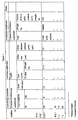
and that after the test. The (y/x) value shown in the table
of Figure 1 as the contact resistance characteristic
indicates by what factor the contact resistance value (y)
after the test has changed with respect to the contact
resistance value (x) of a new product.
(3) Example of method of manufacturing contacts
When manufacturing [Cu-W-CuxSb] alloy, the following
five methods may be selectively applied industrially.
According to the first method, first of all CuxSb
chemical compound is manufactured beforehand, and this CuxSb
chemical compound is then pulverized to manufacture CuxSb
chemical compound powder. Next, Cu powder (or CuSb solid
solution powder), W powder, and CuxSb chemical compound
powder, respectively, are weighed out in prescribed amounts,
thoroughly mixed, and molded and sintered under applied
pressure of for example 4 ton/cm2 to produce contact blanks.
In a second method, first of all a (CuW) skeleton , a
(CuSb solid solution W) skeleton, and a (W) skeleton
prepared with prescribed porosities are manufactured at for
example 1200 °C. Separately, CuxSb chemical compound and
CuSb alloy are manufactured. Contact blanks are then
produced by infiltrating the Sb constituent (the
aforementioned CuxSb chemical compound or CuSb alloy) and Cu
constituent into the prescribed voids of any of these
skeletons, at for example 1150 °C.
In the third method, since the content of CuxSb chemical
compound in the Cu-W alloy is enormously smaller than the
(Cu + W) content, it is necessary to achieve uniform mixture
of the CuxSb chemical compound in the alloy. As a means of
achieving this, for example some or all of the CuxSb
chemical compound content which will be finally necessary is
mixed with practically the same volume of W (if necessary
with addition of Cu) to obtain a primary mixed powder (if
necessary, this may be repeated up to an nth mixture).
This primary mixed powder (or nth mixed powder) and the
remaining W powder are again mixed to produce finally (W +
CuxSb chemical compound) mixed powder in a thoroughly
satisfactorily mixed condition. This (W + CuxSb chemical
compound) mixed powder and a prescribed quantity of Cu
powder are mixed and then subjected to sintering and
pressurization at for example a temperature of 1060 °C in a
hydrogen atmosphere (vacuum is also possible), once or a
plurality of times, to manufacture Cu-W-CuxSb contact blanks,
which are then used to make contacts by processing to the
prescribed shape.
Also, some or all of the CuxSb chemical compound content
which will be finally necessary is mixed with practically
the same volume of Cu (if necessary with addition of W) to
obtain a primary mixed powder (if necessary, this may be
repeated up to an nth mixture).
This primary mixed powder (or nth mixed powder) and the
remaining Cu powder are again mixed to produce finally (Cu +
CuxSb chemical compound) mixed powder in a thoroughly
satisfactorily mixed condition. This (Cu + CuxSb chemical
compound) mixed powder and a prescribed quantity of W powder
are mixed and then subjected to sintering and pressurization
at for example a temperature of 1060 °C in a hydrogen
atmosphere (vacuum is also possible), once or a plurality of
times, to manufacture {Cu-W-CuxSb} contact blanks, which are
then used to make contacts by processing to the prescribed
shape.
The fourth method is a physical method using an ion
plating device or sputtering device or a mechanical method
using a ball mill; W powder is obtained by coating the
surface of W powder with CuxSb chemical compound, and this
CuxSb chemical compound-coated W powder and Cu powder are
mixed and {Cu-W-CuxSb} contact blanks are then manufactured
by combining, once or a plurality of times, sintering and
pressurization at a temperature of for example 1060 °C, in a
hydrogen atmosphere (vacuum is also possible).
In the fifth method, in the technique of uniformly
mixing in particular Cu powder, W powder and CuxSb chemical
compound powder, a method in which rocking vibration and
mixing are superimposed is advantageous. By this means, the
phenomenon of formation of lumps or aggregates, which is
found when solvents such as the commonly-used acetone are
employed with mixed powder is eliminated, improving ease of
working.
Also, if the ratio R/S of the number of times of mixing
R of the mixing movement of the mixing container in the
mixing operation and the number of times S of rocking of the
rocking vibration applied to the mixing container is
selected in a preferred range of approximately 10 to 0.1, a
preferred range of energy input to the powder during
crushing, dispersion and mixing is achieved, resulting in
the characteristic feature that the extent of denaturing of
the powder or the degree of contamination thereof in the
mixing operation can be kept low.
Although a crushing action is applied to the powder in
mixing and pulverization using a conventional mixer, with
the present method, in which rocking vibration and mixing
movement are superimposed, the aforesaid R/S ratio being
distributed at about 10 to 0.1, mixing is produced to the
extent that the powders become intimately entangled with
each other, thereby achieving good permeability and so
improving sintering characteristics and enabling an
excellent molding, sintered body or skeleton to be obtained.
Furthermore, since there is no energy input beyond what is
needed, denaturing of the powder cannot occur. If such a
mixed powder is used as raw material, low gas evolution from
the alloy after sintering and infiltration can be achieved,
contributing to stabilization of the restriking
characteristic.
Next, a second embodiment of the present invention will
be described in detail with reference to working examples.
Working examples 1 to 3
First of all, an outline of assembly of a test valve for
interruption tests will be described. A ceramic insulated
container (chief constituent: Al2O3) was prepared, with the
mean end-face surface roughness ground to about 1.5 µm; pre-heating
treatment of this ceramic insulated container at
1650 °C was performed prior to assembly.
As sealing metal, 42 weight% Ni-Fe alloy of sheet
thickness 2 mm was employed.
As soldering material, 72 weight% Ag-Cu alloy of
thickness 0.1 mm was employed.
Members prepared as above were arranged so as to be
capable of effecting vacuum sealing joining between the
items to be joined (end face of the ceramic insulated
container and sealing metal), and supplied to a vacuum
sealing step of the sealing metal and ceramic insulated
container in a vacuum atmosphere of 5 × 10⁻⁴ Pa.
Next, details of the test contact materials and
evaluation details and results etc. will be described.
For the {Cu - W - CuxSb - balance Cu} alloy (x=2), W of
mean grain size 1.5 µm was prepared as raw material powder,
and contact blanks of {60 to 92 weight% N - CuxSb balance
Cu} were prepared by suitable selection of the above first
to fifth methods of manufacture. These blanks were processed
to contact test pieces of prescribed shape and finished to a
surface thickness of the contact surfaces of 2 µm to be
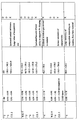
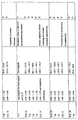
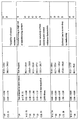
employed as rest pieces. Their details are shown in the
table of Figure 1, while the evaluation conditions and
results are shown in the table of Figure 2.
First of all, the restriking characteristic and contact
resistance characteristic of the {75 weight% W - Cu2Sb
balance Cu} alloy shown in working example 2 of the table of
Figure 1 were measured, these values being taken as standard
values.
In contrast, in the case of the alloy {60 weight% W -
Cu2Sb - balance Cu} of comparative example 1, the restriking
characteristic when a 6 kV × 500 A circuit was interrupted
20,000 times showed the high frequency of occurrence and
variability of restriking of 1.34 to 2.16% i.e. it was much
worse than the case of the standard working example 2 of {75
weight% W - Cu2Sb-balance Cu} alloy and so was undesirable.
Regarding the contact resistance characteristic after
measurement of the restriking characteristic, in working
example 1, due to the effect of the Cu content in the alloy,
this was approximately halved (42.4 to 61.8), taking the
value in the case of working example 1 as 100 i.e. it
exhibited in most regions a low and stable contact
resistance characteristic.
In contrast, in the case of alloy of W content {65
weight% W - Cu2Sb - balance Cu} as in working example 1 and
the alloy {85 weight% W - Cu2Sb - balance Cu} as in working
example 3, restriking frequencies of occurrence in the
allowed ranges of 0.96 to 0.99 and 0.93 to 0.95 were
displayed. The contact resistance ranges shown were 100.1 to
128, and 118.6 to 142.5, which present no practical problems,
taking the value of practical example 2 as 100.
In contrast, in the case of the alloy {92 weight% W -
Cu2Sb - balance Cu} of comparative example 2, although a
stable frequency of occurrence of restriking and variability
characteristic in the range 0.91 to 0.94 was displayed, the
contact resistance was extremely high at 719 to 1634, and
showed large variability, to the extent that this could not
be practically used. In addition, in a further test, it was
found that the temperature rise during conduction was high.
It was found that interruption of 500 A produced local
tortoise shell-shaped cracks by overheating at the contact
surfaces. Generation of enormous cracks and partial
exfoliation thereof at the interruption surface were seen.
Although the restriking characteristic was in the desired
range, the contact resistance was, in some places, very high,
caused chiefly by deterioration of conductivity and
occurrence of Joule heating, due to insufficiency of the Cu
content.
Thus, in the case of the alloy {60 weight% W - Cu2Sb -
balance Cu} of comparative example 1, frequent occurrence of
restriking and a considerable increase in the contact
resistance are seen, and, in the case of the alloy {92
weight% W - Cu2Sb - balance Cu} of comparative example 2, a
further large increase in contact resistance is seen; these
are therefore undesirable. It was found that, in accordance
with the object of the present invention, overall stability
was shown when the W content was in the range 65 to 85
weight% (working examples 1 to 3).
Working examples 4 to 7
In the working examples 1 to 3 described above, the
benefits were illustrated where the Mo content in the alloy
{W - Cu2Sb - balance Cu} is 0 (zero), but the benefits of
the present invention are not displayed solely in this case.
Specifically, when the Mo content was made 0.001 to 5%
in the alloy {75 weight% W - Cu2Sb - balance Cu}, relative
values of 0.94 to 0.98 were displayed, taking the restriking
characteristic of working example 2 as 1.00 i.e. a
restriking characteristic of the same stability as the
characteristic of the standard working example 2 was
displayed. Also, taking the contact resistance of working
example 2 as 100, relative values of 95.4 to 159.6 were
displayed i.e. a contact resistance characteristic of the
same stability as the characteristic of the standard working
example 2 was displayed.
On observation of the contact surface, it is found that
the presence of a prescribed content of Mo tends to suppress,
to a certain degree, chipping of W. However, in the case of
comparative example 3, where the Mo content was 12%, a
restriking characteristic of 0.96 to 1.36 was displayed,
which is undesirable, and more frequent occurrence of
restriking and larger variability than in the case of the
characteristic of working example 2 which was taken as
standard are seen, which is also undesirable. Also, contact
resistance values of 128.7 to 273.2 are displayed and there
is larger variability than in the case of working example 2
which was taken as standard; this is therefore undesirable.
Also, in observations of the contact surface, the benefit in
terms of suppression of chipping of W was found to be small.
Integrated grains of WMo were found to be in a
compositionally segregated condition. When such segregation
is present, variability of the restriking characteristic and
contact resistance tended to occur. It was therefore judged
that overall stability was displayed in a range of Mo
content of 0.001 to 5% as shown in working examples 4 to 7
of the table of Figure 1.
Working examples 8 to 9
In working examples 1 to 3 and comparative examples 1 to
2 described above, the benefits were described when the W
content in the alloy {W - Cu2Sb - balance Cu} was 60 to 92
weight%, the mean grain size of the W being 1.5 µm, and also
in the case where, in working examples 4 to 7 and
comparative example 3, the Mo content in the {WMo - Cu2Sb -
balance Cu} alloy was 0.001 to 12 weight%, the mean grain
size of the WMo integrated grains being 1.5 µm. However, the
benefits of the present invention are not displayed solely
when the mean grain size is restricted to 1.5 µm.
Specifically, when, as in the working examples 8 to 9 of
the table of Figure 1, {75 weight% W - Cu2Sb - balance Cu}
alloy is employed in which the Mo content is 0 and the W
content is 75 weight%, even though the mean grain size was
0.4 µm to 9 µm, relative values of the rate of occurrence of
restriking of 0.88 to 1.02 were displayed, i.e. a
characteristic was displayed of the same stability as the
characteristic of the standard working example 2.
Regarding the contact resistance percentage multiple
also, relative values of 95.2 to 138.2 were displayed,
taking working example 2 as 100; this is a substantially
desirable range.
In contrast, when the mean grain size of the W was made
0.1 µm (comparative example 4), although the contact
resistance percentage multiple was in the very desirable
range of 90.5 to 99.6, the restriking rate of occurrence was
2.66 to 3.18 i.e. there was a severe deterioration of the
restriking characteristic from the characteristic of the
standard working example 2; this was therefore undesirable.
The reasons for this are believed to be that, when the gas
content of the contact blanks was examined it was found that
this had not been fully removed and residual gas was left,
caused by the fact that the mean grain size of the W that
was used was extremely fine at 0.1 µm; it is thought that
this influenced in particular the frequent occurrence of
restriking.
Also, the rate of occurrence of restriking when the mean
grain size was comparatively coarse at 15 µm showed the
relative values of 3.42 to 6.26 (times) i.e. it displayed
considerable variability in comparison with the
characteristic of working example 2 which was taken as
standard; thus it displayed a characteristic which was
inferior in regard to stability. The contact resistance
percentage multiple also showed relative values of 118 to
784 times, taking that of working example 2 as 100 i.e. it
showed a substantially undesirable range (comparative
examples 4 to 5). It should be noted that, owing to the
frequent occurrence of restriking, evaluation was not made
for the prescribed 20,000 times, but was discontinued at
2000 times. The gas content in the contact blanks was much
larger.
Practical examples 10 to 15
In regard to the auxiliary constituent in the alloy {W -
CuxSb - balance Cu}, working examples 1 to 9 described above
were indicated in terms of the effect when x = 2, but the
benefits of the present invention are not shown solely when
this is the case.
Specifically, when x in the auxiliary constituent CuxSb
was taken as 1.9 to 5.5, as in the case of working examples
10 to 15 of the table of Figure 1, relative values of 0.98
to 1.04 times were obtained, taking the restriking
characteristic of working example 2 as 1.00 i.e. restriking
characteristics were obtained of the same stability as the
restriking characteristic of working example 2, which was
taken as standard. Taking the contact resistance of working
example 2 as 100, relative values of 95.4 to 124.1 times
were displayed i.e. a contact resistance characteristic of
the same stability as the characteristic of the standard
working example 2 was displayed.
In contrast, where, as in the case of comparative
example 6, x in CuxSb W was less than 1.9, although the
contact resistance percentage multiple was in the range 98.0
to 124.1 i.e. represented an equivalent characteristic to
that of the working example 2 which was taken as standard,
the percentage multiple of occurrence of restriking showed
values of 0.98 to 4.18 i.e. it showed large variability in
comparison with the characteristic of the standard working
example 2; this was therefore undesirable.
The reason for this is that if x in CuxSb W is less than
1.9, the Sb distribution cannot be fully uniformly dispersed,
so, depending on the location, wide regions exist in which
Sb is not present (segregation of Sb).
From the above, it was concluded that x in the alloy {W
- CuxSb - Cu} is preferably in the range x = 2.75 to 5.5.
Working examples 15 to 18
Although, in working examples 1 to 15 described above,
the benefits were indicated when the content of auxiliary
constituent CuxSb in the alloy {W - CuxSb - balance Cu} was
0.11 weight%, the benefits of the present invention are not
shown solely when this is the case.
Specifically, as shown in working examples 16 to 18 of
the table of Figure 1, when the content of CuxSb is made
0.09 to 1.4%, relative values of 0.94 to 1.01 times are
displayed, taking the restriking characteristic of working
example 2 as 1.00 i.e. a restriking characteristic is
displayed of the same stability as the restriking
characteristic of the standard working example 2. Taking the
contact resistance of working example 2 as 100, relative
values of 99.7 to 146.6 times are displayed i.e. a contact
resistance characteristic of the same stability as the
characteristic of working example 2, which is taken as
standard, is displayed.
On the other hand, when, as in the case of comparative
example 7, x in CuxSb is made 0.03%, relative values of 90.0
to 95.9 times are displayed, taking the contact resistance
of working example 2 as 100 i.e. a contact resistance
characteristic is displayed which is of the same stability
as the characteristic of working example 2, which is taken
as standard. However, taking the restriking characteristic
of working example 2 as 1.00, a restriking percentage
multiple of 0.31 to 3.36 times is displayed i.e. severe
variability is displayed in comparison with the
characteristic of working example 2, which is taken as
standard. The reason is that, due to technical reasons
during the manufacture of the alloy, it was not possible to
obtain economically an alloy in which the CuxSb was fully
uniformly dispersed.
Furthermore, when, as in the case of comparative example
8, x in the CuxSb was made 2.3%, taking the contact
resistance of working example 2 as 100, relative values of
181.5 to 446.0 times were displayed i.e. a contact
resistance characteristic of severe variability in
comparison with the characteristic of working example 2
which was taken as standard is displayed. Also, in this
example, taking the restriking characteristic of working
example 2 as 1.00, a restriking percentage multiple of 2.02
to 6.62 times was displayed i.e. severe variability was
displayed in comparison with the characteristic of working
example 2, which was taken as standard. This was due to the
silver soldering tending to be poor, due to excess CuxSb
content, and to it not being possible to obtain economically
an alloy in which the CuxSb was uniformly dispersed.
From the above, it was concluded that the content of
auxiliary constituent CuxSb in the {W - CuxSb - Cu} alloy
should preferably be in the range 0.09 to 1.4 weight%.
Working examples 19 to 20
Although, in the working examples 1 to 18 described
above, the benefits were illustrated in the case where the
size of the auxiliary constituent CuxSb grains in the {W -
CuxSb - balance Cu} alloy was 7 µm, the benefits of the
present invention are not solely manifested where this is
the case.
Specifically, as shown in working examples 19 to 20 of
the table of Figure 1, when the size of the CuxSb grains was
made 0.02 to 20 µm, taking the restriking characteristic of
working example 2 as 1.00, relative values of 0.94 to 0.99
times were displayed i.e. a restriking characteristic of the
same stability as the characteristic of working example 2,
which was taken as standard, was displayed. Regarding the
contact resistance characteristic also, taking the contact
resistance of working example 2 as 100, relative values of
97.1 to 124.8 times were displayed i.e. a contact resistance
characteristic was displayed of same stability as the
characteristic of working example 2, taken as standard.
In contrast, as shown in comparative example 9, if the
size of the auxiliary constituent CuxSb grains was made less
than 0.02 µm, taking the contact resistance of working
example 2 as 100, the test was discontinued and excluded
from the effective range, since it was difficult to mass
produce contact blanks having a structure in which the CuxSb
grains were uniformly dispersed at the micro level.
Furthermore, as shown in comparative example 10, if the
size of the CuxSb grains is taken as 34 µm, taking the
contact resistance of working example 2 as 100, relative
values of 216.3 to 417.1 times are displayed i.e. the
contact resistance characteristic showed severe
deterioration and large variability compared with the
characteristic of working example 2 taken as standard. Also,
taking the restriking characteristic of working example 2 as
1.00, restriking percentage multiples of 0.99 to 2.46 times
are displayed, representing considerable variability in
comparison with the characteristic of working example 2
taken as standard.
The reasons for this are: due to the presence of coarse
CuxSb grains of large contact resistance, the problem of the
probability of the contact point being located exactly above
one of these coarse CuxSb grains, resulting in large
variability of the contact resistance being displayed; poor
silver soldering tending to occur due to the large content
of CuxSb grains which are of poor joining characteristics;
and it not being possible to obtain economically an alloy in
which the CuxSb is sufficiently uniformly dispersed.
For these reasons, it is preferable that the size of the
auxiliary constituent CuxSb in the {W - CuxSb - Cu} should
be in the range 0.02 to 20.0%.
Working examples 21 to 24
In working examples 1 to 20 described above, the
benefits were described of the case where the mean distance
between grains of the auxiliary constituent CuxSb grains in
the {W - CuxSb - balance Cu} alloy was 25 µm, but the
benefits of the present invention are not shown solely in
this case.
Specifically, if the mean distance between grains of
CuxSb grains of working examples 21 to 24 of the table of
Figure 1 is taken as 0.2 to 300 µm, taking the restriking
characteristic of working example 2 as 1.00, relative values
of 0.98 to 1.24 times are displayed i.e. a restriking
characteristic is displayed which is of the same stability
as the characteristic of working example 2, taken as
standard. Also in the case of the contact resistance
characteristic, if the contact resistance of working example
2 is taken as 100, relative values of 95.3 to 144.7 times
are displayed i.e. a contact resistance characteristic of
the same stability as the characteristic of working example
2 taken as standard is displayed.
In contrast, as shown in comparative example 11, if the
mean distance between grains of the auxiliary CuxSb grains
was made less than 0.2 µm, just as in the case of
comparative example 9 described above, i.e. when the mean
distance between CuxSb grains was made less than 0.2 µm, the
test was discontinued and excluded from the effective range
of invention, since it was difficult to mass produce contact
blanks having a structure in which these were uniformly
dispersed at the micro level.
Furthermore, when, as in comparative example 11, the
mean distance between grains of the CuxSb grains was made
600 µm, taking the restriking characteristic of working
example 2 as 1.00, a restriking percentage multiple of 2.16
to 5.58 times was displayed i.e., compared with the
characteristic of working example 2 which was taken as
standard, severe deterioration and large variability were
displayed.
Also, taking the contact resistance of working example 2
as 100, relative values of 128.7 to 275.5 times are
displayed i.e. a contact resistance characteristic which is
markedly inferior and shows considerable variability is
displayed, compared with the characteristic of working
example 2 which was taken as standard.
Since the distance between adjacent grains of the CuxSb,
which are of high contact resistance is made large, the
distance between Cu phase or CuSb alloy phase, which is of
comparatively low contact resistance, also becomes large;
consequently, a coarse structural condition is produced, in
which there is large variability of contact resistance,
depending on the position of the contact point. Regarding
the restriking characteristic also, similar variability is
displayed, dependent on the position of the cathode spot,
due to the coarse structural condition; thus, the restriking
value also shows considerable variability.
From the above, it is desirable that the mean distance
between grains of the auxiliary constituent CuxSb in the {W
- CuxSb - Cu} alloy should be in the range 0.2 to 300 µm.
Working examples 25 to 27
In working examples 1 to 24 described above, the
benefits were described of the case where the content of Sb
(content of Sb in solid solution in the CuSb solid solution)
in the conductive constituent in the {W - CuxSb - balance
Cu} alloy was 0.01 weight%, but the benefits of the present
invention are not restricted to this case.
Specifically, as shown in working examples 25 to 27 of
the table of Figure 1, when the Sb content in the conductive
constituent was made 0.004 to 0.5 µm, taking the restriking
characteristic of working example 2 as 1.00, relative values
of 0.90 to 1.02 times were displayed i.e. a restriking
characteristic of the same stability as the characteristic
of working example 2 which was taken as standard is
displayed. Regarding the contact resistance characteristic
also, taking the contact resistance of working example 2 as
100, relative values of 98.3 to 145.5 times were displayed
i.e. a contact resistance characteristic of the same
stability as the characteristic of working example 2 taken
as standard was displayed.
However, when, as in the case of comparative example 13,
the content of Sb in the conductive constituent was made
more than 0.5 µm, taking the restriking characteristic of
working example 2 as 1.00, restriking percentage multiples
of 1.00 to 2.24 times were displayed; thus it will be seen
that this was inferior to the characteristic of working
example 2, which was taken as standard. Also, in this
comparative example 13, taking the contact resistance of
working example 2 as 100, relative values of 392.4 to 617.7
times were displayed i.e. considerable deterioration and
large variability of contact resistance characteristic were
displayed compared with the characteristic of working
example 2, which was taken as standard.
Working examples 28 and 29
In working examples 1 to 27 described above, the
benefits when CuSb solid solution was employed as the
conductive constituent in {W - CuxSb - balance Cu} alloy
were illustrated, but the benefits of the present invention
are not restricted to this case.
Specifically, in both the case where the conductive
constituent is {Cu + CuSb solid solution} and where it is
{Cu}, taking the restriking characteristic of working
example 2 as 1.00, relative values of 0.96 to 0.99 times are
displayed i.e. a restriking characteristic of the same
stability as the characteristic of working example 2 taken
as standard is obtained. Regarding the contact resistance
characteristic also, taking the contact resistance of
working example 2 as 100, relative values of 90.8 to 123.3
times are displayed i.e. a contact resistance characteristic
of the same stability as working example 2 taken as standard
are displayed.
It should be noted that, although, in the above working
examples 1 to 29, the benefits in terms of restriking
characteristic and contact resistance characteristic when
the surface roughness (Rave.) of the contact surfaces after
manufacture of the {W - CuxSb - balance Cu} alloy was made
to be 2 µm were illustrated, the benefits of the present
invention are not restricted to this case.
Specifically, even when the mean surface roughness
(Rave.) is made less than 10 µm, down to a minimum value
(Rmin.) of more than 0.05 µm, a contact resistance
characteristic of the same stability as the characteristic
of working example 2 taken as standard is displayed.
Although, in the above working examples 1 to 29, the
benefits in terms of restriking characteristic and contact
resistance characteristic when the electrical circuit was
constituted by direct silver soldering of {W - CuxSb -
balance Cu} alloy on the electrode or conductive rod were
illustrated, the benefits of the present invention are not
manifested solely in this case.
Specifically, even when silver solderability is improved
by applying a Cu layer having a thickness of at least 0.3 mm
to the faces of the {W - CuxSb - balance Cu} alloy other
than the contact surface, restriking characteristics and
contact resistance characteristics of the same stability as
the characteristics of working example 2, which was taken as
standard, are displayed.
In the above working examples 1 to 29, the benefits in
terms of the restriking characteristic and contact
resistance characteristic when the surface roughness (Rave.)
of the contact surface was made to be 2 µm after manufacture
of the {W - CuxSb - balance Cu} alloy were indicated, but an
even more stable restriking characteristic and contact
resistance characteristic can be obtained by surface
finishing performed by interrupting of currents of 1 to 10
mA in a condition with at least 10 kV applied, at the
contact surface formed by the {W - CuxSb - balance Cu} alloy.
A second embodiment of a vacuum interrupter according to
the present invention is described below.
In a vacuum interrupter in which are mounted Cu - Mo -
based contacts, the essence of the second embodiment of the
present invention consists in contact material wherein
benefits are obtained by optimal management of the content,
size and condition of the constituents, by constituting it
of a prescribed amount of Mo (or MoW), CuxSb chemical
compound, and Cu (CuSb solid solution), in order to suppress
and reduce occurrence of the restriking phenomenon of the
vacuum interrupter and to stabilize the contact resistance.
Control of the content, size and condition (grain size
and/or mean distance between grains) of the constituents is
therefore the vital point.
The evaluation in order to elucidate the benefits of
this embodiment is carried out in terms of restriking
characteristic and contact resistance characteristic and is
the same as that of the preceding embodiment given on pages
24-25, to which the reader is referred.
Next, an example of a method of manufacturing Cu - Mo
contacts will be described.
When manufacturing [Mo - CuxSb - Cu] alloy, the
following five methods may be selectively applied
industrially.
According to the first method, first of all CuxSb
chemical compound is beforehand manufactured, and this CuxSb
chemical compound is then pulverized to manufacture CuxSb
chemical compound powder. Next, Cu powder (or CuSb solid
solution powder), Mo powder, and CuxSb chemical compound
powder, respectively, are weighed out in prescribed amounts,
thoroughly mixed, and molded and sintered under applied
pressure of for example 4 ton/cm2 to produce contact blanks.
In the second method, first of all a (MoCu) skeleton , a
(Mo-CuSb solid solution) skeleton, and a (Mo) skeleton
prepared with prescribed porosities are beforehand
manufactured at for example 1200 °C. Separately, CuSb
chemical compound and CuSb alloy are manufactured. Contact
blanks are then produced by infiltrating the Sb constituent
(the aforementioned CuxSb chemical compound or CuSb alloy)
and Cu constituent into the prescribed voids of any of these
skeletons, at for example 1150 °C.
In the third method, since the content of CuxSb chemical
compound in the Cu-Mo alloy is enormously smaller than the
(Cu + Mo) content, it is necessary to achieve uniform
mixture of the CuxSb chemical compound in the alloy. As a
means of achieving this, for example some or all of the
CuxSb chemical compound content which will be finally
necessary is mixed with practically the same volume of Mc
(if necessary with addition of Cu) to obtain a primary mixed
powder (if necessary, this may be repeated up to an nth
mixture).
This primary mixed powder (or nth mixed powder) and the
remaining Mo powder are again mixed to produce finally (Mo +
CuxSb chemical compound) mixed powder in a thoroughly
satisfactorily mixed condition. This (Mo + CuxSb chemical
compound) mixed powder and a prescribed quantity of Cu
powder are mixed and then subjected to sintering and
pressurization at for example a temperature of 1060 °C in a
hydrogen atmosphere (vacuum is also possible), once or a
plurality of times, to manufacture {Mo - CuxSb - Cu} contact
blanks, which are then used to make contacts by processing
to the prescribed shape.
Also, some or all of the CuxSb chemical compound content
which will be finally necessary is mixed with practically
the same volume of Cu (if necessary with addition of Mo) to
obtain a primary mixed powder (if necessary, this may be
repeated up to an nth mixture).
This primary mixed powder (or nth mixed powder) and the
remaining Cu powder are again mixed to produce finally (Cu +
CuxSb chemical compound) mixed powder in a thoroughly
satisfactorily mixed condition. This (Cu + CuxSb chemical
compound) mixed powder and a prescribed quantity of Mo
powder are mixed and then subjected to sintering and
pressurization at for example a temperature of 1060 °C in a
hydrogen atmosphere (vacuum is also possible), once or a
plurality of times, to manufacture {Mo - CuxSb - Cu} contact
blanks, which are then used to make contacts by processing
to the prescribed shape.
The fourth method is a physical method using an ion
plating device or sputtering device or a mechanical method
using a ball mill; Mo powder is obtained by coating the
surface of Mo powder with CuxSb chemical compound, and this
CuxSb chemical compound-coated W powder and Cu powder are
mixed and {Mo - CuxSb - Cu} contact blanks are then
manufactured by combining, once or a plurality of times,
sintering and pressurization at a temperature of for example
1060 °C, in a hydrogen atmosphere (vacuum is also possible).
In the fifth method, in the technique of uniformly
mixing in particular Cu powder, No powder and CuxSb chemical
compound powder, a method in which rocking vibration and
mixing are superimposed is advantageous. By this means, the
phenomenon of formation of lumps or aggregates, which is
found when solvents such as the commonly-used acetone are
employed with mixed powder is eliminated, improving ease of
working.
Also, if the ratio R/S of the number of times of mixing
R of the mixing movement of the mixing container in the
mixing operation and the number of times S of rocking of the
rocking vibration applied to the mixing container is
selected in a preferred range of approximately 10 to 0.1, a
preferred range of energy input to the powder during
crushing, dispersion and mixing is achieved, resulting in
the characteristic feature that the extent of denaturing of
the powder or the degree of contamination thereof in the
mixing operation can be kept low.
Although a crushing action is applied to the powder in
mixing and pulverization using a conventional mixer, with
the present method, in which rocking vibration and mixing
movement are superimposed, the beforementioned R/S ratio
being distributed at about 10 to 0.1, mixing is produced to
the extent that the powders become intimately entangled with
each other, thereby achieving good permeability and so
improving sintering characteristics and enabling an
excellent molding, sintered body or skeleton to be obtained.
Furthermore, since there is no energy input beyond what
is needed, denaturing of the powder cannot occur. If such a
mixed powder is used as raw material, low gas evolution from
the alloy after sintering and infiltration can be achieved,
contributing to stabilization of the restriking
characteristic.
Next, the second embodiment of the present invention is
described in detail with reference to the working examples
indicated below.
Working examples 30 to 32
First of all, the restriking characteristic and contact
resistance characteristic of the {60 weight% Mo - Cu2Sb
balance Cu} alloy shown in working example 31 of the table
of Figure 3 were likewise measured, these values being taken
as standard values.
In contrast, in the case of the alloy {44 weight% Mo -
Cu2Sb - balance Cu} of comparative example 14, the
restriking characteristic when a 6 kV × 500 A circuit was
interrupted 20,000 times showed the high frequency of
occurrence and variability of restriking of 1.31 to 2.05%-i.e.
it was much worse than the case of the working example
31, taken as standard, of {60 weight% Mo - Cu2Sb balance Cu}
alloy and so was undesirable.
Regarding the contact resistance characteristic after
measurement of the restriking characteristic, in working
example 30, due to the Cu content in the alloy, this was
approximately halved (40.2 to 58.7), taking the value in the
case of working example 30 as 100 i.e. it exhibited in most
regions a low and stable contact resistance characteristic.
In contrast, in the case of alloy of Mo content {50
weight% Mo - Cu2Sb - balance Cu} as in working example 30
and the alloy {60 weight% Mo - Cu2Sb - balance Cu} as in
working example 32, restriking frequencies of occurrence in
the allowed ranges of 0.86 to 0.90 and 0.83 to 0.85 were
displayed. The contact resistance ranges shown were 95.1 to
121, and 112.6 to 135.4, which present no practical problems,
taking the value of practical example 31 as 100.
In contrast, in the case of the alloy {82 weight% Mo -
Cu2Sb - balance Cu} of comparative example 15, although a
stable frequency of occurrence of restriking characteristic
in the range 0.8 to 0.84 was displayed, the contact
resistance was extremely high at 683.5 to 1553.1, and showed
large variability, to the extent that this could not be
practically used. In addition, in an another test, it was
found that the temperature rise during conduction was high.
It was found that interruption of 500 A produced local
tortoise shell-shaped cracks by overheating at the contact
surfaces. In addition, generation of enormous cracks and
partial exfoliation thereof at the interruption surface were
seen. As a result, although the restriking characteristic in
comparative example 15 was in the desired range, the contact
resistance was, in some places, very high, caused chiefly by
deterioration of conductivity and generation of Joule
heating, due to insufficiency of the Cu content.
Thus, in the case of the alloy {44% Mo - Cu2Sb - balance
Cu} of comparative example 14, frequent occurrence of
restriking and a considerable increase in the contact
resistance are seen, and, in the case of the alloy {82% Mo -
Cu2Sb - balance Cu} of comparative example 15, a further
large increase in contact resistance is seen; these are
therefore undesirable. It was found that, in accordance with
the object of the present invention, overall stability was
shown when the Mo content was in the range 50 to 75 weight%
as shown in working examples 30 to 32.
Working examples 33 to 36
In the working examples 30 to 32 described above, the
benefits were illustrated where the W content in the alloy
{Mo - Cu2Sb - balance Cu} is 0 (zero), but the benefits of
the present invention are not displayed solely in this case.
Specifically, when the W content was made 0.001 to 5% in
the alloy {60 weight% Mo - Cu2Sb - balance Cu} in working
examples 33 to 36 as shown in the table of Figure 4,
relative values of 0.84 to 0.88 were displayed, taking the
restriking characteristic of working example 31 as 1.00 i.e.
a restriking characteristic of the same stability as the
characteristic of the standard working example 31 was
displayed. Also, taking the contact resistance of working
example 31 as 100, relative values of 90.6 to 129.0 were
displayed i.e. a contact resistance characteristic of the
same stability as the characteristic of the standard working
example 31 was displayed.
On observation of the contact surface, it is found that
the presence of a prescribed content of W tends to suppress,
to a certain degree, chipping of Mo. However, in the case of
comparative example 16, where the Mo content was 12%, a
restriking characteristic of 0.86 to 1.36 was displayed,
which is in the desired range, and a restriking
characteristic which was practically the same as the
characteristic of working example 31, which was taken as
standard, was displayed.
However, the contact resistance percentage multiple of
comparative example 16 displayed values of 122.3 to 259.5
i.e. considerable variability was observed from the
characteristic of working example 1, which was taken as
standard, which was undesirable. Also, in observations of
the contact surface, the benefit in terms of suppression of
chipping of Mo was found to be small, integrated grains of
WMo being found to be in a compositionally segregated
condition. When such segregation is present, variability of
the restriking characteristic and contact resistance tended
to occur. It was therefore judged that overall stability was
displayed an a range of added W content of 0.001 to 5% as
shown in working examples 33 to 36.
Working examples 37 and 38
In working examples 30 to 32 and comparative examples 14
and 15 described above, the benefits were described when the
Mo content in the alloy {Mo - Cu2Sb - balance Cu} was 44 to
82 weight%, the mean grain size of the Mo being 1.5 µm, and
also in the case where, in working examples 33 to 36 and
comparative example 16, the W content in the {MoW - Cu2Sb -
balance Cu} alloy was 0.001 to 12 weight%, the mean grain
size of the MoW integrated grains being 1.5 µm. However, the
benefits of the present invention are not displayed solely
when the mean grain size is restricted to 1.5 µm.
Specifically, when, as in the working examples 37 and 38
of the table of Figure 3, {60 weight% W - Cu2Sb - balance
Cu} alloy is employed in which the W content is 0 and the Mo
content is 60 weight%, even though the mean grain size was
0.4 µm to 9 µm, relative values of the rate of occurrence of
restriking of 0.79 to 0.97 were displayed, i.e. a
characteristic was displayed of the same stability as the
characteristic of the standard working example 31.
Regarding the contact resistance percentage multiple
also, relative values of 90.4 to 131.3 were displayed,
taking working example 31 as 100; it can be seen that this
is a substantially desirable range.
In contrast, when the mean grain size of the Mo was made
0.1 µm as shown in comparative example 17, although the
contact resistance percentage multiple was in the very
desirable range of 86.0 to 94.6, the restriking rate of
occurrence percentage multiple was 2.39 to 2.86 i.e. there
was a severe deterioration of the restriking characteristic
from the characteristic of the standard working example 31,
this was therefore undesirable. The reasons for this are
believed to be that, when the gas content of the contact
blanks was examined it was found that this had not been
fully removed and residual gas was left, caused by the fact
that the mean grain site of the Mo that was used was
extremely fine at 0.1 µm; it is thought that this influenced
in particular the frequent occurrence of restriking.
Also, as shown in comparative example 18, the percentage
multiple of the rate of occurrence of restriking when the
mean grain size was comparatively coarse at 15 µm showed the
relative values of 3.08 to 5.65 (times) i.e. it displayed
considerable variability in comparison with the
characteristic of working example 2 which was taken as
standard; thus it displayed a characteristic which was
inferior in regard to stability. The contact resistance
percentage multiple in comparative example 18 also showed
relative values of 112.9 to 745.4 times, taking that of
working example 31 as 100 i.e. it showed a substantially
undesirable range. It should be noted that, owing to the
frequent occurrence of restriking, evaluation was not made
for the prescribed 20,000 times, but was discontinued at
2000 times. The gas content in the contact blanks was much
larger.
Working examples 39 to 44
In regard to the auxiliary constituent in the alloy {Mo
- CuxSb - balance Cu}, working examples 30 to 38 described
above were indicated in terms of the effect when x = 2, but
the benefits of the present invention are solely not
displayed in this case.
Specifically, when x in the auxiliary constituent CuxSb
was taken as 1.9 to 5.5, as in the case of working examples
39 to 44 of the table of Figure 4, relative values of 0.86
to 1.0 times were obtained, taking the restriking
characteristic of working example 31 as 1.00 i.e. restriking
characteristics were obtained of the same stability as the
restriking characteristic of working example 31, which was
taken as standard. Taking the contact resistance of working
example 31 as 100, in the case of working examples 39 to 44
relative values of 0.6. to 117.3 times were displayed i.e. a
contact resistance characteristic of the same stability as
the characteristic of the standard working example 31 was
displayed.
In contrast, where, as in the case of comparative
example 19, x in CuxSb W was less than 1.9, although the
contact resistance percentage multiple was in the range 93.1
to 117.9 i.e. represented an equivalent characteristic to
that of the working example 31 which was taken as standard,
the percentage multiple of occurrence of restriking showed
values of 0.88 to 3.97 i.e. it showed large variability in
comparison with the characteristic of the standard working
example 31; this was therefore undesirable.
The reason for this is that because x in CuxSb W in
comparative example 19 was made less than 1.9, the Sb
distribution cannot be fully uniformly dispersed, so,
depending on the location, wide regions exist in which Sb is
not present (segregation of Sb).
From the above, it was concluded that x in the alloy {Mo
- CuxSb - Cu} is preferably in the range x = 1.9 to 5.5.
Working examples 45 to 47
Although, in working examples 30 to 44 described above,
the benefits were indicated when the content of auxiliary
constituent CuxSb in the alloy {Mo - CuxSb - balance Cu} was
0.11 weight%, the benefits of the present invention are not
solely shown in this case.
Specifically, as shown in working examples 45 to 47 of
the table of Figure 4, when the content of CuxSb is made
0.09 to 1.4%, relative values of 0.84 to 0.96 times are
displayed, taking the restriking characteristic of working
example 31 as 1.00 i.e. a restriking characteristic is
displayed of the same stability as the restriking
characteristic of the standard working example 31. Taking
the contact resistance of working example 31 as 100,
relative values of 99.7 to 146.6 times are displayed i.e. a
contact resistance characteristic of the same stability as
the characteristic of working example 31, which is taken as
standard, is displayed.
On the other hand, when, as in the case of comparative
example 20, x in CuxSb is made 2 and its content is made
0.03 weight%, relative values of 85.5 to 91.1 times are
displayed, taking the contact resistance of working example
31 as 100 i.e. a contact resistance characteristic is
displayed which is of the same stability as the
characteristic of working example 31, which is taken as
standard. However, also in comparative example 20, taking
the restriking characteristic of working example 31 as 1.00,
a restriking percentage multiple of 0.21 to 2.36 times is
displayed i.e. severe variability is displayed in comparison
with the characteristic of working example 31, which is
taken as standard. The reason is that, due to technical
reasons during the manufacture of the alloy, it was not
possible to obtain economically an alloy in which the CuxSb
was fully uniformly dispersed.
Furthermore, when, as in the case of comparative example
21, x in the CuxSb was made 2 and its content was made 2.3
weight%, taking the contact resistance of working example 31
as 100, relative values of 172.4 to 423.7 times were
displayed i.e. a contact resistance characteristic of severe
variability in comparison with the characteristic of working
example 31 which was taken as standard is displayed.
Also, in comparative example 21, taking the restriking
characteristic of working example 31 as 1.00, a restriking
percentage multiple of 1.92 to 6.26 times was displayed i.e.
severe variability was displayed in comparison with the
characteristic of working example 31, which was taken as
standard. This was due to the silver soldering tending to be
poor, due to excess CuxSb content, and to it not being
possible to obtain economically an alloy in which the CuxSb
was uniformly dispersed.
From the above, it was concluded that, as shown in the
working examples 45 to 47, the content of auxiliary
constituent CuxSb in the {Mo - CuxSb - Cu} alloy should
preferably be in the range 0.09 to 1.4 weight%.
Working examples 48, 49
Although, in the working examples 30 to 47 described
above, the benefits were illustrated in the case where the
size of the auxiliary constituent CuxSb grains in the {Mo -
CuxSb - balance Cu} alloy was 7 µm, the benefits of the
present invention are not solely displayed in this case.
Specifically, as shown in working examples 30 to 44 of
the table of Figure 4, when the size of the CuxSb grains was
made 0.02 to 20 µm, taking the restriking characteristic of
working example 31 as 1.00, relative values of 0.85 to 0.90
times were displayed i.e. a restriking characteristic of the
same stability as the characteristic of working example 31,
which was taken as standard, was displayed. Regarding the
contact resistance characteristic also, taking the contact
resistance of working example 31 as 100, relative values of
92.0 to 118.6 times were displayed i.e. a contact resistance
characteristic was displayed of same stability as the
characteristic of working example 31, taken as standard.
In contrast, as shown in comparative example 22, if the
size of the auxiliary constituent CuxSb grains was made less
than 0.02 µm, taking the contact resistance of working
example 31 as 100, the test was discontinued and excluded
from the effective range, since it was difficult to mass
produce contact blanks having a structure in which the CuxSb
grains were uniformly dispersed at the micro level.
Furthermore, as shown in comparative example 23, if the
size of the CuxSb grains is taken as 34 µm, taking the
contact resistance of working example 31 as 100, relative
values of 205.5 to 396.5 times are displayed i.e. the
contact resistance characteristic showed severe
deterioration and large variability compared with the
characteristic of working example 31 taken as standard. Also,
taking the restriking characteristic of working example 31
as 1.00, restriking percentage multiples of 0.89 to 2.34
times are displayed, representing considerable variability
in comparison with the characteristic of working example 31
taken as standard.
The reasons for this are: due to the presence of coarse
CuxSb grains of large contact resistance, the problem of the
probability of the contact point being located exactly above
one of these coarse CuxSb grains, resulting in large
variability of the contact resistance being displayed; poor
silver soldering tending to occur due to the large content
of CuxSb grains which are of poor joining characteristics;
and it not being possible to obtain economically an alloy an
which the CuxSb is sufficiently uniformly dispersed.
For these reasons, it is preferable that the size of the
auxiliary constituent CuxSb in the {Mo - CuxSb - Cu} should
be in the range 0.02 to 20.0%.
Working examples 50 to 53
In working examples 30 to 49 described above, the
benefits were described of the case where the mean distance
between grains of the auxiliary constituent CuxSb grains in
the {Mo - CuxSb - balance Cu} alloy was 25 µm, but the
benefits of the present invention are not solely shown in
this case.
Specifically, if the mean distance between grains of
CuxSb grains of working examples 50 to 53 of the table of
Figure 4 is taken as 0.2 to 300 µm, taking the restriking
characteristic of working example 31 as 1.00, relative
values of 0.82 to 1.11 times are displayed i.e. a restriking
characteristic is displayed which is of the same stability
as the characteristic of working example 31, taken as
standard. Also in the case of the contact resistance
characteristic, if the contact resistance of working example
31 is taken as 100, relative values of 90.5 to 137.5 times
are displayed i.e. a contact resistance characteristic of
the same stability as the characteristic of working example
31 taken as standard is displayed.
In contrast, as shown in comparative example 24, if the
mean distance between grains of the auxiliary CuxSb grains
was made less than 0.2 µm, just as in the case of
comparative example 22 described above, i.e. when the mean
distance between CuxSb grains was made less than 0.2 µm, the
test was discontinued and excluded from the effective range
of invention, since it was difficult to mass produce contact
blanks having a structure in which these were uniformly
dispersed at the micro level.
Furthermore, when, as in comparative example 25, the
mean distance between grains of the CuxSb grains was made
600 µm, taking the restriking characteristic of working
example 31 as 1.00, a restriking percentage multiple of 1.94
to 5.30 times was displayed. Also, in comparative example 25,
compared with the characteristic of working example 31 which
was taken as standard, severe deterioration and large
variability were displayed. Also, taking the contact
resistance of working example 31 as 100, relative values of
122.3 to 261.7 times are displayed i.e. a contact resistance
characteristic which is markedly inferior and shows
considerable variability is displayed, compared with the
characteristic of working example 31 which was taken as
standard.
Since the distance between adjacent grains of the CuxSb,
which are of high contact resistance is made large, the
distance between Cu phase or CuSb alloy phase, which is of
comparatively low contact resistance, also becomes large;
consequently, a coarse structural condition is produced,
resulting in large variability of contact resistance,
depending on the position of the contact point. Regarding
the restriking characteristic also, similar variability is
displayed, dependent on the position of the cathode spot,
due to the coarse structural condition; thus, the restriking
value also shows considerable variability.
From the above, it is desirable that the mean distance
between grains of the auxiliary constituent CuxSb in the {Mo
- CuxSb - Cu} alloy should be in the range 0.2 to 300 µm, as
shown in working examples 50 to 53.
Working examples 54 to 56
In working examples 1 to 53 described above, the
benefits were described of the case where the content of Sb
(content of Sb in solid solution in the CuSb solid solution)
in the conductive constituent in the {Mo - CuxSb - balance
Cu} alloy was 0.01 weight%, but the benefits of the present
invention are not restricted to this case.
Specifically, as shown in working examples 54 to 56 of
the table of Figure 4, when the Sb content in the conductive
constituent was made 0.004 to 0.5 µm, taking the restriking
characteristic of working example 31 as 1.00, relative
values of 0.86 to 0.97 times were displayed i.e. a
restriking characteristic of the same stability as the
characteristic of working example 31 which was taken as
standard is displayed. Regarding the contact resistance
characteristic also, taking the contact resistance of
working example 31 as 100, relative values of 95.7 to 138.2
times were displayed i.e. a contact resistance
characteristic of the same stability as the characteristic
of working example 31 taken as standard was displayed.
However, when, as in the case of comparative example 26,
the content of Sb in the conductive constituent was made
more than 0.5 µm, taking the restriking characteristic of
working example 31 as 1.00, restriking percentage multiples
of 0.90 to 2.01 times were displayed; thus it will be seen
that this was inferior to the characteristic of working
example 31, which was taken as standard. Also, in this
comparative example 26, taking the contact resistance of
working example 31 as 100, relative values of 372.4 to 586.8
times were displayed i.e. considerable deterioration and
large variability of contact resistance characteristic were
displayed compared with the characteristic of working
example 31, which was taken as standard.
Working examples 57, 58
In working examples 30 to 56 described above, the
benefits when CuSb solid solution was employed as the
conductive constituent in {Mo - CuxSb - balance Cu} alloy
were illustrated, but the benefits of the present invention
are not restricted to this case.
Specifically, in both the case where the conductive
constituent is {Cu + CuSb solid solution} as it is in
working example 57 of the table of Figure 4, and where it is
{Cu} as it is in working example 58, taking the restriking
characteristic of working example 31 as 1.00, relative
values of 0.86 to 0.96 times are displayed i.e. a restriking
characteristic of the same stability as the characteristic
of working example 31 taken as standard is obtained.
Regarding the contact resistance characteristic also, taking
the contact resistance of working example 31 as 100,
relative values of 86.3 to 117.0 times are displayed i.e. a
contact resistance characteristic of the same stability as
working example 2 taken as standard are displayed.
It should be noted that, although, in the above working
examples 1 to 56, the benefits in terms of restriking
characteristic and contact resistance characteristic when
the surface roughness (Rave.) of the contact surfaces after
manufacture of the {Mo - CuxSb - balance Cu} alloy was made
to be 2 µm were illustrated, the benefits of the present
invention are not restricted to this case.
Specifically, even when the mean surface roughness
(Rave.) is made less than 10 µm, down to a minimum value
(Rmin.) of more than 0.05 µm, a contact resistance
characteristic of the same stability as the characteristic
of working example 31 taken as standard is displayed.
Although, in the above working examples 1 to 58, the
benefits in terms of restriking characteristic and contact
resistance characteristic when the electrical circuit was
constituted by direct silver soldering of {Mo - CuxSb -
balance Cu} alloy on the electrode or conductive rod were
illustrated, the benefits of the present invention are not
manifested solely in this case.
Specifically, even when silver solderability is improved
by applying a Cu layer having a thickness of at least 0.3 mm
to the faces of the {Mo - CuxSb - balance Cu} alloy other
than the contact surface, restriking characteristics and
contact resistance characteristics of the same stability as
the characteristics of working example 31, which was taken
as standard, are displayed.
In the above working examples 1 to 58, the benefits in
terms of the restriking characteristic and contact
resistance characteristic when the surface roughness (Rave.)
of the contact surface was made to be 2 µm after manufacture
of the {Mo - CuxSb - balance Cu} alloy were indicated, but
an even more stable restriking characteristic and contact
resistance characteristic can be obtained by surface
finishing performed by interrupting of currents of 1 to 10
mA in a condition with a voltage of at least 10 KV applied,
at the contact surface formed by the {Mo - CuxSb - balance
Cu} alloy.
It should be noted that the same benefits can be
obtained whether a vacuum interrupter provided with contacts
as described in the first and second embodiment described
above is mounted in a vacuum switch or in a vacuum circuit
breaker.
As described in detail above, with the present invention,
{W - CuxSb - balance Cu} alloy contacts are mounted, and as
the anti-arcing constituent in the alloy W or WMo is
employed; furthermore, a content thereof of 65 to 85%, of
grain size 0.4 to 9 µm is employed. Furthermore, as
auxiliary constituent, CuxSb is employed, the content of the
CuxSb being 0.09 to 1.4 weight%, the x in CuxSb being x=1.9
to 5.5, the grain size being 0.02 to 20 µm, and the mean
distance between grains being 0.2 to 300 µm. Furthermore, as
conductive constituent, Cu or CuSb solid solution is
employed, the Sb content present in solid solution form in
the CuSb solid solution being less than 0.5%. As a result,
not only is dispersion of CuxSb, which is selectively and
preferentially evaporated on subjection to arcing, reduced,
but also generation of severe cracks, which have an adverse
effect in terms of occurrence of restriking, in the contacts
surface by heat shock when subjected to arcing, is prevented,
suppressing dispersion and exfoliation of W grains. In this
way, improvements can be achieved such as making the alloy
structure more uniform due to the CuxSb, enabling damage due
to melting and dispersion at the contacts surfaces to be
reduced even after being subjected to arcing, and enabling
restriking to be prevented and the contact resistance
characteristic to be improved.
Furthermore, {Mo - CuxSb - balance Cu} alloy contacts
are mounted, and as the anti-arcing constituent in the alloy
Mo or MoW is employed; furthermore, a content thereof of 50
to 75 weight%, of grain size 0.4 to 9 µm is employed.
Furthermore, as auxiliary constituent, CuxSb is employed,
the content of the CuxSb being 0.09 to 1.4 weight%, the x in
CuxSb being x=1.9 to 5.5, the grain size being 0.02 to 20 µm,
and the mean distance between grains being 0.2 to 300 µm.
Furthermore, as conductive constituent, Cu or CuSb solid
solution is employed, the Sb content present in solid
solution form in the CuSb solid solution being less than 0.5
weight%. As a result, not only is dispersion of CuxSb, which
is selectively and preferentially evaporated on subjection
to arcing, reduced, but also generation of severe cracks,
which have an adverse effect in terms of occurrence of
restriking, in the contacts surface by heat shock when
subjected to arcing, is prevented, suppressing dispersion
and exfoliation of Mo grains. In this way, improvements can
be achieved such as making the alloy structure more uniform
due to the CuxSb, enabling damage due to melting and
dispersion at the contacts surfaces to be reduced even after
being subjected to arcing, and enabling restriking to be
prevented and the contact resistance characteristic to be
improved.
Obviously, numerous additional modifications and
variations of the present invention are possible in light of
the above teachings. It is therefore to be understood that
within the scope of the appended claims, the present
invention may be practiced otherwise than as specially
described herein.