EP1025375B1 - Elastisches federelement - Google Patents
Elastisches federelement Download PDFInfo
- Publication number
- EP1025375B1 EP1025375B1 EP98959776A EP98959776A EP1025375B1 EP 1025375 B1 EP1025375 B1 EP 1025375B1 EP 98959776 A EP98959776 A EP 98959776A EP 98959776 A EP98959776 A EP 98959776A EP 1025375 B1 EP1025375 B1 EP 1025375B1
- Authority
- EP
- European Patent Office
- Prior art keywords
- spring element
- ceramic
- elastic spring
- spring
- elastic
- Prior art date
- Legal status (The legal status is an assumption and is not a legal conclusion. Google has not performed a legal analysis and makes no representation as to the accuracy of the status listed.)
- Expired - Lifetime
Links
- 239000000919 ceramic Substances 0.000 claims description 21
- 239000000835 fiber Substances 0.000 claims description 12
- 229910010293 ceramic material Inorganic materials 0.000 claims description 10
- OKTJSMMVPCPJKN-UHFFFAOYSA-N Carbon Chemical compound [C] OKTJSMMVPCPJKN-UHFFFAOYSA-N 0.000 claims description 6
- 229910052799 carbon Inorganic materials 0.000 claims description 6
- 239000000463 material Substances 0.000 claims description 5
- 239000011159 matrix material Substances 0.000 claims description 4
- 229910021332 silicide Inorganic materials 0.000 claims description 4
- FVBUAEGBCNSCDD-UHFFFAOYSA-N silicide(4-) Chemical compound [Si-4] FVBUAEGBCNSCDD-UHFFFAOYSA-N 0.000 claims description 4
- 239000011226 reinforced ceramic Substances 0.000 claims description 2
- 230000002787 reinforcement Effects 0.000 claims 1
- 238000007789 sealing Methods 0.000 description 8
- 238000000034 method Methods 0.000 description 5
- HBMJWWWQQXIZIP-UHFFFAOYSA-N silicon carbide Chemical compound [Si+]#[C-] HBMJWWWQQXIZIP-UHFFFAOYSA-N 0.000 description 5
- 229910010271 silicon carbide Inorganic materials 0.000 description 5
- 238000010276 construction Methods 0.000 description 3
- 230000000930 thermomechanical effect Effects 0.000 description 3
- 229920000049 Carbon (fiber) Polymers 0.000 description 2
- 238000005452 bending Methods 0.000 description 2
- 239000002775 capsule Substances 0.000 description 2
- 239000004917 carbon fiber Substances 0.000 description 2
- 239000007769 metal material Substances 0.000 description 2
- VNWKTOKETHGBQD-UHFFFAOYSA-N methane Chemical compound C VNWKTOKETHGBQD-UHFFFAOYSA-N 0.000 description 2
- 239000002243 precursor Substances 0.000 description 2
- 238000003825 pressing Methods 0.000 description 2
- 241000196324 Embryophyta Species 0.000 description 1
- 241001295925 Gegenes Species 0.000 description 1
- 241000405147 Hermes Species 0.000 description 1
- 235000018821 Rhododendron arboreum Nutrition 0.000 description 1
- 244000218234 Rhododendron arboreum Species 0.000 description 1
- 238000004458 analytical method Methods 0.000 description 1
- 238000004364 calculation method Methods 0.000 description 1
- 239000000969 carrier Substances 0.000 description 1
- 239000002131 composite material Substances 0.000 description 1
- 230000008602 contraction Effects 0.000 description 1
- 238000004132 cross linking Methods 0.000 description 1
- 238000005516 engineering process Methods 0.000 description 1
- 239000004744 fabric Substances 0.000 description 1
- 230000010006 flight Effects 0.000 description 1
- 239000000446 fuel Substances 0.000 description 1
- 230000008595 infiltration Effects 0.000 description 1
- 238000001764 infiltration Methods 0.000 description 1
- 238000003475 lamination Methods 0.000 description 1
- 239000007788 liquid Substances 0.000 description 1
- 238000005259 measurement Methods 0.000 description 1
- 238000002844 melting Methods 0.000 description 1
- 238000010327 methods by industry Methods 0.000 description 1
- 238000000197 pyrolysis Methods 0.000 description 1
- 239000012783 reinforcing fiber Substances 0.000 description 1
- 238000005475 siliconizing Methods 0.000 description 1
Images


Classifications
-
- F—MECHANICAL ENGINEERING; LIGHTING; HEATING; WEAPONS; BLASTING
- F16—ENGINEERING ELEMENTS AND UNITS; GENERAL MEASURES FOR PRODUCING AND MAINTAINING EFFECTIVE FUNCTIONING OF MACHINES OR INSTALLATIONS; THERMAL INSULATION IN GENERAL
- F16F—SPRINGS; SHOCK-ABSORBERS; MEANS FOR DAMPING VIBRATION
- F16F1/00—Springs
- F16F1/02—Springs made of steel or other material having low internal friction; Wound, torsion, leaf, cup, ring or the like springs, the material of the spring not being relevant
- F16F1/021—Springs made of steel or other material having low internal friction; Wound, torsion, leaf, cup, ring or the like springs, the material of the spring not being relevant characterised by their composition, e.g. comprising materials providing for particular spring properties
- F16F1/022—Springs made of steel or other material having low internal friction; Wound, torsion, leaf, cup, ring or the like springs, the material of the spring not being relevant characterised by their composition, e.g. comprising materials providing for particular spring properties made of ceramic materials
-
- B—PERFORMING OPERATIONS; TRANSPORTING
- B32—LAYERED PRODUCTS
- B32B—LAYERED PRODUCTS, i.e. PRODUCTS BUILT-UP OF STRATA OF FLAT OR NON-FLAT, e.g. CELLULAR OR HONEYCOMB, FORM
- B32B18/00—Layered products essentially comprising ceramics, e.g. refractory products
-
- B—PERFORMING OPERATIONS; TRANSPORTING
- B64—AIRCRAFT; AVIATION; COSMONAUTICS
- B64C—AEROPLANES; HELICOPTERS
- B64C5/00—Stabilising surfaces
-
- B—PERFORMING OPERATIONS; TRANSPORTING
- B64—AIRCRAFT; AVIATION; COSMONAUTICS
- B64C—AEROPLANES; HELICOPTERS
- B64C7/00—Structures or fairings not otherwise provided for
-
- C—CHEMISTRY; METALLURGY
- C04—CEMENTS; CONCRETE; ARTIFICIAL STONE; CERAMICS; REFRACTORIES
- C04B—LIME, MAGNESIA; SLAG; CEMENTS; COMPOSITIONS THEREOF, e.g. MORTARS, CONCRETE OR LIKE BUILDING MATERIALS; ARTIFICIAL STONE; CERAMICS; REFRACTORIES; TREATMENT OF NATURAL STONE
- C04B35/00—Shaped ceramic products characterised by their composition; Ceramics compositions; Processing powders of inorganic compounds preparatory to the manufacturing of ceramic products
- C04B35/01—Shaped ceramic products characterised by their composition; Ceramics compositions; Processing powders of inorganic compounds preparatory to the manufacturing of ceramic products based on oxide ceramics
-
- C—CHEMISTRY; METALLURGY
- C04—CEMENTS; CONCRETE; ARTIFICIAL STONE; CERAMICS; REFRACTORIES
- C04B—LIME, MAGNESIA; SLAG; CEMENTS; COMPOSITIONS THEREOF, e.g. MORTARS, CONCRETE OR LIKE BUILDING MATERIALS; ARTIFICIAL STONE; CERAMICS; REFRACTORIES; TREATMENT OF NATURAL STONE
- C04B35/00—Shaped ceramic products characterised by their composition; Ceramics compositions; Processing powders of inorganic compounds preparatory to the manufacturing of ceramic products
- C04B35/515—Shaped ceramic products characterised by their composition; Ceramics compositions; Processing powders of inorganic compounds preparatory to the manufacturing of ceramic products based on non-oxide ceramics
- C04B35/56—Shaped ceramic products characterised by their composition; Ceramics compositions; Processing powders of inorganic compounds preparatory to the manufacturing of ceramic products based on non-oxide ceramics based on carbides or oxycarbides
-
- C—CHEMISTRY; METALLURGY
- C04—CEMENTS; CONCRETE; ARTIFICIAL STONE; CERAMICS; REFRACTORIES
- C04B—LIME, MAGNESIA; SLAG; CEMENTS; COMPOSITIONS THEREOF, e.g. MORTARS, CONCRETE OR LIKE BUILDING MATERIALS; ARTIFICIAL STONE; CERAMICS; REFRACTORIES; TREATMENT OF NATURAL STONE
- C04B35/00—Shaped ceramic products characterised by their composition; Ceramics compositions; Processing powders of inorganic compounds preparatory to the manufacturing of ceramic products
- C04B35/515—Shaped ceramic products characterised by their composition; Ceramics compositions; Processing powders of inorganic compounds preparatory to the manufacturing of ceramic products based on non-oxide ceramics
- C04B35/58—Shaped ceramic products characterised by their composition; Ceramics compositions; Processing powders of inorganic compounds preparatory to the manufacturing of ceramic products based on non-oxide ceramics based on borides, nitrides, i.e. nitrides, oxynitrides, carbonitrides or oxycarbonitrides or silicides
-
- C—CHEMISTRY; METALLURGY
- C04—CEMENTS; CONCRETE; ARTIFICIAL STONE; CERAMICS; REFRACTORIES
- C04B—LIME, MAGNESIA; SLAG; CEMENTS; COMPOSITIONS THEREOF, e.g. MORTARS, CONCRETE OR LIKE BUILDING MATERIALS; ARTIFICIAL STONE; CERAMICS; REFRACTORIES; TREATMENT OF NATURAL STONE
- C04B35/00—Shaped ceramic products characterised by their composition; Ceramics compositions; Processing powders of inorganic compounds preparatory to the manufacturing of ceramic products
- C04B35/515—Shaped ceramic products characterised by their composition; Ceramics compositions; Processing powders of inorganic compounds preparatory to the manufacturing of ceramic products based on non-oxide ceramics
- C04B35/58—Shaped ceramic products characterised by their composition; Ceramics compositions; Processing powders of inorganic compounds preparatory to the manufacturing of ceramic products based on non-oxide ceramics based on borides, nitrides, i.e. nitrides, oxynitrides, carbonitrides or oxycarbonitrides or silicides
- C04B35/5805—Shaped ceramic products characterised by their composition; Ceramics compositions; Processing powders of inorganic compounds preparatory to the manufacturing of ceramic products based on non-oxide ceramics based on borides, nitrides, i.e. nitrides, oxynitrides, carbonitrides or oxycarbonitrides or silicides based on borides
-
- C—CHEMISTRY; METALLURGY
- C04—CEMENTS; CONCRETE; ARTIFICIAL STONE; CERAMICS; REFRACTORIES
- C04B—LIME, MAGNESIA; SLAG; CEMENTS; COMPOSITIONS THEREOF, e.g. MORTARS, CONCRETE OR LIKE BUILDING MATERIALS; ARTIFICIAL STONE; CERAMICS; REFRACTORIES; TREATMENT OF NATURAL STONE
- C04B35/00—Shaped ceramic products characterised by their composition; Ceramics compositions; Processing powders of inorganic compounds preparatory to the manufacturing of ceramic products
- C04B35/515—Shaped ceramic products characterised by their composition; Ceramics compositions; Processing powders of inorganic compounds preparatory to the manufacturing of ceramic products based on non-oxide ceramics
- C04B35/58—Shaped ceramic products characterised by their composition; Ceramics compositions; Processing powders of inorganic compounds preparatory to the manufacturing of ceramic products based on non-oxide ceramics based on borides, nitrides, i.e. nitrides, oxynitrides, carbonitrides or oxycarbonitrides or silicides
- C04B35/58085—Shaped ceramic products characterised by their composition; Ceramics compositions; Processing powders of inorganic compounds preparatory to the manufacturing of ceramic products based on non-oxide ceramics based on borides, nitrides, i.e. nitrides, oxynitrides, carbonitrides or oxycarbonitrides or silicides based on silicides
-
- C—CHEMISTRY; METALLURGY
- C04—CEMENTS; CONCRETE; ARTIFICIAL STONE; CERAMICS; REFRACTORIES
- C04B—LIME, MAGNESIA; SLAG; CEMENTS; COMPOSITIONS THEREOF, e.g. MORTARS, CONCRETE OR LIKE BUILDING MATERIALS; ARTIFICIAL STONE; CERAMICS; REFRACTORIES; TREATMENT OF NATURAL STONE
- C04B35/00—Shaped ceramic products characterised by their composition; Ceramics compositions; Processing powders of inorganic compounds preparatory to the manufacturing of ceramic products
- C04B35/71—Ceramic products containing macroscopic reinforcing agents
- C04B35/78—Ceramic products containing macroscopic reinforcing agents containing non-metallic materials
- C04B35/80—Fibres, filaments, whiskers, platelets, or the like
-
- C—CHEMISTRY; METALLURGY
- C04—CEMENTS; CONCRETE; ARTIFICIAL STONE; CERAMICS; REFRACTORIES
- C04B—LIME, MAGNESIA; SLAG; CEMENTS; COMPOSITIONS THEREOF, e.g. MORTARS, CONCRETE OR LIKE BUILDING MATERIALS; ARTIFICIAL STONE; CERAMICS; REFRACTORIES; TREATMENT OF NATURAL STONE
- C04B35/00—Shaped ceramic products characterised by their composition; Ceramics compositions; Processing powders of inorganic compounds preparatory to the manufacturing of ceramic products
- C04B35/71—Ceramic products containing macroscopic reinforcing agents
- C04B35/78—Ceramic products containing macroscopic reinforcing agents containing non-metallic materials
- C04B35/80—Fibres, filaments, whiskers, platelets, or the like
- C04B35/83—Carbon fibres in a carbon matrix
-
- F—MECHANICAL ENGINEERING; LIGHTING; HEATING; WEAPONS; BLASTING
- F16—ENGINEERING ELEMENTS AND UNITS; GENERAL MEASURES FOR PRODUCING AND MAINTAINING EFFECTIVE FUNCTIONING OF MACHINES OR INSTALLATIONS; THERMAL INSULATION IN GENERAL
- F16F—SPRINGS; SHOCK-ABSORBERS; MEANS FOR DAMPING VIBRATION
- F16F1/00—Springs
- F16F1/36—Springs made of rubber or other material having high internal friction, e.g. thermoplastic elastomers
- F16F1/366—Springs made of rubber or other material having high internal friction, e.g. thermoplastic elastomers made of fibre-reinforced plastics, i.e. characterised by their special construction from such materials
- F16F1/368—Leaf springs
-
- C—CHEMISTRY; METALLURGY
- C04—CEMENTS; CONCRETE; ARTIFICIAL STONE; CERAMICS; REFRACTORIES
- C04B—LIME, MAGNESIA; SLAG; CEMENTS; COMPOSITIONS THEREOF, e.g. MORTARS, CONCRETE OR LIKE BUILDING MATERIALS; ARTIFICIAL STONE; CERAMICS; REFRACTORIES; TREATMENT OF NATURAL STONE
- C04B2235/00—Aspects relating to ceramic starting mixtures or sintered ceramic products
- C04B2235/02—Composition of constituents of the starting material or of secondary phases of the final product
- C04B2235/50—Constituents or additives of the starting mixture chosen for their shape or used because of their shape or their physical appearance
- C04B2235/52—Constituents or additives characterised by their shapes
- C04B2235/5208—Fibers
- C04B2235/5216—Inorganic
- C04B2235/522—Oxidic
-
- C—CHEMISTRY; METALLURGY
- C04—CEMENTS; CONCRETE; ARTIFICIAL STONE; CERAMICS; REFRACTORIES
- C04B—LIME, MAGNESIA; SLAG; CEMENTS; COMPOSITIONS THEREOF, e.g. MORTARS, CONCRETE OR LIKE BUILDING MATERIALS; ARTIFICIAL STONE; CERAMICS; REFRACTORIES; TREATMENT OF NATURAL STONE
- C04B2235/00—Aspects relating to ceramic starting mixtures or sintered ceramic products
- C04B2235/02—Composition of constituents of the starting material or of secondary phases of the final product
- C04B2235/50—Constituents or additives of the starting mixture chosen for their shape or used because of their shape or their physical appearance
- C04B2235/52—Constituents or additives characterised by their shapes
- C04B2235/5208—Fibers
- C04B2235/5216—Inorganic
- C04B2235/524—Non-oxidic, e.g. borides, carbides, silicides or nitrides
-
- C—CHEMISTRY; METALLURGY
- C04—CEMENTS; CONCRETE; ARTIFICIAL STONE; CERAMICS; REFRACTORIES
- C04B—LIME, MAGNESIA; SLAG; CEMENTS; COMPOSITIONS THEREOF, e.g. MORTARS, CONCRETE OR LIKE BUILDING MATERIALS; ARTIFICIAL STONE; CERAMICS; REFRACTORIES; TREATMENT OF NATURAL STONE
- C04B2235/00—Aspects relating to ceramic starting mixtures or sintered ceramic products
- C04B2235/02—Composition of constituents of the starting material or of secondary phases of the final product
- C04B2235/50—Constituents or additives of the starting mixture chosen for their shape or used because of their shape or their physical appearance
- C04B2235/52—Constituents or additives characterised by their shapes
- C04B2235/5208—Fibers
- C04B2235/5216—Inorganic
- C04B2235/524—Non-oxidic, e.g. borides, carbides, silicides or nitrides
- C04B2235/5248—Carbon, e.g. graphite
-
- C—CHEMISTRY; METALLURGY
- C04—CEMENTS; CONCRETE; ARTIFICIAL STONE; CERAMICS; REFRACTORIES
- C04B—LIME, MAGNESIA; SLAG; CEMENTS; COMPOSITIONS THEREOF, e.g. MORTARS, CONCRETE OR LIKE BUILDING MATERIALS; ARTIFICIAL STONE; CERAMICS; REFRACTORIES; TREATMENT OF NATURAL STONE
- C04B2235/00—Aspects relating to ceramic starting mixtures or sintered ceramic products
- C04B2235/70—Aspects relating to sintered or melt-casted ceramic products
- C04B2235/94—Products characterised by their shape
-
- C—CHEMISTRY; METALLURGY
- C04—CEMENTS; CONCRETE; ARTIFICIAL STONE; CERAMICS; REFRACTORIES
- C04B—LIME, MAGNESIA; SLAG; CEMENTS; COMPOSITIONS THEREOF, e.g. MORTARS, CONCRETE OR LIKE BUILDING MATERIALS; ARTIFICIAL STONE; CERAMICS; REFRACTORIES; TREATMENT OF NATURAL STONE
- C04B2235/00—Aspects relating to ceramic starting mixtures or sintered ceramic products
- C04B2235/70—Aspects relating to sintered or melt-casted ceramic products
- C04B2235/96—Properties of ceramic products, e.g. mechanical properties such as strength, toughness, wear resistance
-
- C—CHEMISTRY; METALLURGY
- C04—CEMENTS; CONCRETE; ARTIFICIAL STONE; CERAMICS; REFRACTORIES
- C04B—LIME, MAGNESIA; SLAG; CEMENTS; COMPOSITIONS THEREOF, e.g. MORTARS, CONCRETE OR LIKE BUILDING MATERIALS; ARTIFICIAL STONE; CERAMICS; REFRACTORIES; TREATMENT OF NATURAL STONE
- C04B2237/00—Aspects relating to ceramic laminates or to joining of ceramic articles with other articles by heating
- C04B2237/30—Composition of layers of ceramic laminates or of ceramic or metallic articles to be joined by heating, e.g. Si substrates
- C04B2237/32—Ceramic
- C04B2237/36—Non-oxidic
- C04B2237/365—Silicon carbide
-
- C—CHEMISTRY; METALLURGY
- C04—CEMENTS; CONCRETE; ARTIFICIAL STONE; CERAMICS; REFRACTORIES
- C04B—LIME, MAGNESIA; SLAG; CEMENTS; COMPOSITIONS THEREOF, e.g. MORTARS, CONCRETE OR LIKE BUILDING MATERIALS; ARTIFICIAL STONE; CERAMICS; REFRACTORIES; TREATMENT OF NATURAL STONE
- C04B2237/00—Aspects relating to ceramic laminates or to joining of ceramic articles with other articles by heating
- C04B2237/30—Composition of layers of ceramic laminates or of ceramic or metallic articles to be joined by heating, e.g. Si substrates
- C04B2237/32—Ceramic
- C04B2237/38—Fiber or whisker reinforced
-
- C—CHEMISTRY; METALLURGY
- C04—CEMENTS; CONCRETE; ARTIFICIAL STONE; CERAMICS; REFRACTORIES
- C04B—LIME, MAGNESIA; SLAG; CEMENTS; COMPOSITIONS THEREOF, e.g. MORTARS, CONCRETE OR LIKE BUILDING MATERIALS; ARTIFICIAL STONE; CERAMICS; REFRACTORIES; TREATMENT OF NATURAL STONE
- C04B2237/00—Aspects relating to ceramic laminates or to joining of ceramic articles with other articles by heating
- C04B2237/50—Processing aspects relating to ceramic laminates or to the joining of ceramic articles with other articles by heating
- C04B2237/70—Forming laminates or joined articles comprising layers of a specific, unusual thickness
- C04B2237/704—Forming laminates or joined articles comprising layers of a specific, unusual thickness of one or more of the ceramic layers or articles
-
- F—MECHANICAL ENGINEERING; LIGHTING; HEATING; WEAPONS; BLASTING
- F16—ENGINEERING ELEMENTS AND UNITS; GENERAL MEASURES FOR PRODUCING AND MAINTAINING EFFECTIVE FUNCTIONING OF MACHINES OR INSTALLATIONS; THERMAL INSULATION IN GENERAL
- F16F—SPRINGS; SHOCK-ABSORBERS; MEANS FOR DAMPING VIBRATION
- F16F2224/00—Materials; Material properties
- F16F2224/02—Materials; Material properties solids
- F16F2224/0275—Ceramics
Definitions
- the invention relates to an elastic spring element.
- the temperature of 1000 ° C therefore serves as a mark, since from this temperature high-melting metallic materials also begin to creep and their elastic ones Loss of behavior. At high temperatures their deteriorates elastic behavior increasingly because their tensile strength drops dramatically.
- US 4,585,897 discloses a cylinder spring made of a monolithic ceramic.
- the high temperature resistant elastic spring element according to the invention Claim 1 made of fiber-ceramic material solves this problem in excellent Wise. Leave with the continuous fiber reinforced spring element according to the invention moving high-temperature seals are good for temperatures above 1000 ° C realize. In contrast to all metallic materials, the Tensile strength of a fiber-ceramic material does not increase with increasing temperature, but even increases slightly. The rigidity of the spring element thus remains obtained at high temperatures up to at least 1600 ° C and there is none Loss of spring function.
- the fiber-ceramic material can be produced, for example, by lamination technology using continuous fiber prepregs or fabrics infiltrated with matrix precursors.
- the dimensionally stable green body formed by crosslinking the matrix precursor can be converted into the fiber-reinforced ceramic body by a subsequent pyrolysis process.
- the fiber-ceramic material can also be produced by the liquid siliconizing process of C / C materials or the civil vapor infiltration process or a combination of these processes.
- the fiber-ceramic spring element according to the invention is characterized in that its shape can take place independently of the structure or layer structure of the fiber-ceramic material.
- the elastic element according to the invention has a wavy shape.
- the component according to the invention can be arranged exposed with movable ends be, e.g. a corrugated tongue that is inserted into a groove. But it is the same possible to clamp it firmly on one or more sides or ends.
- P is the contact pressure on the spring element.
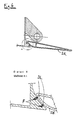
- Fig. 5 shows an example of a design of a seal of a control valve SK, which is pivotally mounted at the stern of a re-entry missile and this seals against the incoming hypersonic flow.
- the control flap SK is coated against the tail area of the missile with the help of sealing strips DL Sealed C / SiC ceramic material, which is inserted into grooves in the rear are.
- an inventive one acts Female connector F (corrugated spring) made of carbon fiber ceramic as a spring element and presses the sealing strip against the movable sealing surface DL with cylinder jacket geometry on the rear of the SK control flap (Fig. 6).
- inventive Spring element can be used wherever high temperature resistant Springs or pressure elements are required (process engineering, plant construction, High temperature fuel cell stacks, engine construction, engine construction).
Landscapes
- Engineering & Computer Science (AREA)
- Chemical & Material Sciences (AREA)
- Ceramic Engineering (AREA)
- Materials Engineering (AREA)
- Manufacturing & Machinery (AREA)
- Structural Engineering (AREA)
- Organic Chemistry (AREA)
- General Engineering & Computer Science (AREA)
- Aviation & Aerospace Engineering (AREA)
- Mechanical Engineering (AREA)
- Chemical Kinetics & Catalysis (AREA)
- Composite Materials (AREA)
- Springs (AREA)
- Laminated Bodies (AREA)
- Gasket Seals (AREA)
Description
Das erfindungsgemäße faserkeramische Federelement zeichnet sich dadurch aus, daß seine Formgebung unabhängig vom Gefügeaufbau oder Schichtaufbau des faserkeramischen Materials erfolgen kann.
- Fig. 1
- Skizze zum Einsatz einer beweglichen Heißabdichtung gegen Hyperschalldurchströmung, wie in der Beschreibungseinleitung erläutert;
- Fig. 2
- Gittermodell eines erfindungsgemäßen elastischen Federelements;
- Fig. 3
- die Federkennlinie eines erfindungsgemäßen elastischen-Federelements aus einer C/SiC-Faserkeramik bei RT
- Fig. 4
- eine weitere Ausführung eines erfindungsgemäßen elastischen Federelements in verschiedenen Ansichten;
- Fig. 5
- die Abdichtung einer Steuerklappe, in der das erfindungsgemäße Federelement verwendet wird,
- Fig. 6
- Querschnittsdarstellungen der Anordnung nach Fig. 5.
Elastizitätsmodul E1 = 130000 Mpa,
Elastizitätsmodul E2 = 10000 Mpa,
Querkontraktionszahl ν12 = 0,3,
Schubmodul G12 = 6800 Mpa,
wurde der effektive Elastizitätsmodul mit E = 70360 Mpa berechnet.
Claims (4)
- Elastisches Federelement, dadurch gekennzeichnet, daß es aus einer faserverstärkten Keramik besteht, wobei die Fasern als Endlosfasern vorliegen, und daß es eine gewellte geometrische Form aufweist.
- Elastisches Federelement nach Anspruch 1, dadurch gekennzeichnet, daß die Faserkeramik aus folgenden Materialien besteht:Verstärkungsfasern: Kohlenstoff oder Keramikfasern aus oxidischen oder nitridischen oder boridischen oder karbidischen oder siliziden Keramikmaterialien oder daraus gebildeten Mischkeramiken,Keramikmatrix: Kohlenstoff oder oxidische oder nitridische oder boridische oder karbidische oder silizide Keramikmaterialien oder daraus gebildete Mischkeramiken.
- Elastisches Federelement nach einem der vorangehenden Ansprüche, dadurch gekennzeichnet, daß es freiaufliegend mit beweglichen Enden oder an einem oder mehreren Enden eingespannt ist.
- Verwendung eines elastischen Federelements nach einem der vorangehenden Ansprüche als Anpreßelement in einer beweglichen Hochtemperaturabdichtung.
Applications Claiming Priority (3)
| Application Number | Priority Date | Filing Date | Title |
|---|---|---|---|
| DE19747650A DE19747650C2 (de) | 1997-10-29 | 1997-10-29 | Elastisches Federelement |
| DE19747650 | 1997-10-29 | ||
| PCT/DE1998/003173 WO1999022163A1 (de) | 1997-10-29 | 1998-10-29 | Elastisches federelement |
Publications (2)
| Publication Number | Publication Date |
|---|---|
| EP1025375A1 EP1025375A1 (de) | 2000-08-09 |
| EP1025375B1 true EP1025375B1 (de) | 2002-09-25 |
Family
ID=7846914
Family Applications (1)
| Application Number | Title | Priority Date | Filing Date |
|---|---|---|---|
| EP98959776A Expired - Lifetime EP1025375B1 (de) | 1997-10-29 | 1998-10-29 | Elastisches federelement |
Country Status (4)
| Country | Link |
|---|---|
| US (1) | US6357733B1 (de) |
| EP (1) | EP1025375B1 (de) |
| DE (2) | DE19747650C2 (de) |
| WO (1) | WO1999022163A1 (de) |
Families Citing this family (9)
| Publication number | Priority date | Publication date | Assignee | Title |
|---|---|---|---|---|
| FR2842313B1 (fr) * | 2002-07-12 | 2004-10-22 | Gideon Levingston | Oscilliateur mecanique (systeme balancier et ressort spiral) en materiaux permettant d'atteindre un niveau superieur de precision, applique a un mouvement d'horlogerie ou autre instrument de precision |
| GB0324439D0 (en) * | 2003-10-20 | 2003-11-19 | Levingston Gideon R | Minimal thermal variation and temperature compensating non-magnetic balance wheels and methods of production of these and their associated balance springs |
| DE102004018999B4 (de) * | 2004-04-20 | 2006-04-20 | Forschungszentrum Jülich GmbH | Federelement sowie Herstellung und Verwendung derselben |
| US8333501B2 (en) | 2005-05-14 | 2012-12-18 | Carbontime Limited | Balance spring, regulated balance wheel assembly and methods of manufacture thereof |
| US7354033B1 (en) * | 2006-08-01 | 2008-04-08 | The United States Of America As Represented By The Secretary Of The Air Force | Tape-spring deployable hinge |
| US8100579B2 (en) * | 2006-09-08 | 2012-01-24 | Gideon Levingston | Thermally compensating balance wheel |
| DE102010043703A1 (de) | 2010-11-10 | 2012-05-10 | Arwed Theuer | Teller- oder Wellfeder |
| CN109131950B (zh) * | 2018-10-24 | 2024-12-24 | 中国航天空气动力技术研究院 | 一种基于新型襟翼舵面的旋成体飞行器 |
| WO2021247538A1 (en) * | 2020-06-02 | 2021-12-09 | Opterus Research and Development Inc. | Living hinge boom |
Family Cites Families (13)
| Publication number | Priority date | Publication date | Assignee | Title |
|---|---|---|---|---|
| US4209334A (en) * | 1976-04-15 | 1980-06-24 | Brunswick Corporation | Porous ceramic seals and method of making same |
| JPS5635735A (en) | 1979-08-29 | 1981-04-08 | Sumitomo Chem Co Ltd | Heat resistant spring |
| US4441726A (en) * | 1981-12-14 | 1984-04-10 | Shan-Rod, Inc. | Heat and vibration resistant seal |
| US5251917A (en) * | 1987-06-22 | 1993-10-12 | The Boeing Company | Fire-resistant seal |
| US4854765A (en) | 1987-07-13 | 1989-08-08 | The Boeing Company | Reversible thermal compensation joint |
| US4858897A (en) * | 1987-11-16 | 1989-08-22 | Hideki Irifune | Spring |
| US5352512A (en) | 1989-03-15 | 1994-10-04 | The United States Of America As Represented By The Secretary Of The Air Force | Microscopic tube material and its method of manufacture |
| DE4133712C2 (de) * | 1991-10-11 | 1994-06-30 | Dyko Industriekeramik Gmbh | Verfahren zur Herstellung eines Verbundwerkstoffs aus mindestens zwei Schichten |
| CA2089424A1 (en) * | 1992-03-02 | 1993-09-03 | Michael Garkawe | Expansion seal assembly |
| US5366942A (en) | 1992-04-13 | 1994-11-22 | American Premier, Inc. | Ceramic fiber product and structure for high temperature severe application environments and method of making same |
| US5332239A (en) * | 1993-01-22 | 1994-07-26 | The United States Of America As Represented By The Administrator Of The National Aeronautics And Space Administration | High-temperature, bellows hybrid seal |
| US5417441A (en) | 1993-01-26 | 1995-05-23 | The United States Of America As Represented By The Secretary Of The Air Force | Low friction seal between relatively moving parts |
| US5678809A (en) * | 1994-06-01 | 1997-10-21 | Across Co., Ltd. | Spring members |
-
1997
- 1997-10-29 DE DE19747650A patent/DE19747650C2/de not_active Expired - Fee Related
-
1998
- 1998-10-29 EP EP98959776A patent/EP1025375B1/de not_active Expired - Lifetime
- 1998-10-29 US US09/530,427 patent/US6357733B1/en not_active Expired - Lifetime
- 1998-10-29 DE DE59805737T patent/DE59805737D1/de not_active Expired - Lifetime
- 1998-10-29 WO PCT/DE1998/003173 patent/WO1999022163A1/de not_active Ceased
Also Published As
| Publication number | Publication date |
|---|---|
| EP1025375A1 (de) | 2000-08-09 |
| DE59805737D1 (de) | 2002-10-31 |
| WO1999022163A1 (de) | 1999-05-06 |
| DE19747650C2 (de) | 2003-04-17 |
| DE19747650A1 (de) | 1999-05-20 |
| US6357733B1 (en) | 2002-03-19 |
Similar Documents
| Publication | Publication Date | Title |
|---|---|---|
| DE19928179B4 (de) | Piezoaktor | |
| DE19747650C2 (de) | Elastisches Federelement | |
| DE19602731C1 (de) | Wandstruktur für treibstoffgekühlte Triebwerkswände | |
| DE10326366B4 (de) | Zellulare Aktuatoreinrichtung | |
| DE3531686A1 (de) | Steuerblock | |
| DE102004044852A1 (de) | Heißgaskammer und Schindel für eine Heißgaskammer | |
| DE102007036642A1 (de) | Verspannung eines Hochtemperaturbrennstoffzellenstacks | |
| DE19937812A1 (de) | Bauelement mit einem bei erhöhter Temperatur belastbaren Teil aus Verbundwerkstoff mit Fluidumwälzkühlung | |
| WO2000067333A1 (de) | Piezoelektrischer biegewandler | |
| DE19631026C2 (de) | Verformbare Vorrichtung | |
| DE102011120547A1 (de) | Brennhilfsmittel, als Träger für Bauteile bei einer Wärmebehandlung | |
| EP1959124B1 (de) | Vorrichtung zur Steuerung der Düsenschubrichtung eines Raketentriebwerks | |
| DE102009013150B4 (de) | Bauteil zum Einsatz in Heißgasströmungen | |
| DE102007061804A1 (de) | Verbindungselement zur Verbindung von zwei Bauteilen | |
| EP1988012B1 (de) | Tragflügel für ein Luftfahrzeug mit einer in Faserverbundbauweise ausgebildeten tragenden Struktur | |
| DE19801407C2 (de) | Brennkammer für Hochleistungstriebwerke und Düsen | |
| DE3913561C2 (de) | ||
| DE10325030A1 (de) | Abgasanlage für ein Kraftfahrzeug | |
| WO2021052517A1 (de) | Federelemente aus keramischen fasern | |
| EP2048344B1 (de) | Raketen- oder Strahltriebwerk mit Wärmeisolierter Schubdüse | |
| WO2010031795A1 (de) | Lagerelement zum lagern eines abgaselements, lagersystem bestehend aus mehreren lagerelementen sowie abgassystem bestehend aus lagersystem und abgaselement | |
| DE102004044203B4 (de) | Materialverbundfenster | |
| EP1909339B1 (de) | Aktormodul mit einem umhüllten Piezoaktor | |
| DE202005014561U1 (de) | Piezo-Biegewandler | |
| DE3606179A1 (de) | Thermisch isolierter gaskanal |
Legal Events
| Date | Code | Title | Description |
|---|---|---|---|
| PUAI | Public reference made under article 153(3) epc to a published international application that has entered the european phase |
Free format text: ORIGINAL CODE: 0009012 |
|
| 17P | Request for examination filed |
Effective date: 20000224 |
|
| AK | Designated contracting states |
Kind code of ref document: A1 Designated state(s): DE FR GB IT |
|
| RAP1 | Party data changed (applicant data changed or rights of an application transferred) |
Owner name: ASTRIUM GMBH |
|
| 17Q | First examination report despatched |
Effective date: 20010323 |
|
| GRAG | Despatch of communication of intention to grant |
Free format text: ORIGINAL CODE: EPIDOS AGRA |
|
| GRAG | Despatch of communication of intention to grant |
Free format text: ORIGINAL CODE: EPIDOS AGRA |
|
| GRAH | Despatch of communication of intention to grant a patent |
Free format text: ORIGINAL CODE: EPIDOS IGRA |
|
| GRAH | Despatch of communication of intention to grant a patent |
Free format text: ORIGINAL CODE: EPIDOS IGRA |
|
| GRAA | (expected) grant |
Free format text: ORIGINAL CODE: 0009210 |
|
| AK | Designated contracting states |
Kind code of ref document: B1 Designated state(s): DE FR GB IT |
|
| REG | Reference to a national code |
Ref country code: GB Ref legal event code: FG4D Free format text: NOT ENGLISH |
|
| REF | Corresponds to: |
Ref document number: 59805737 Country of ref document: DE Date of ref document: 20021031 |
|
| GBT | Gb: translation of ep patent filed (gb section 77(6)(a)/1977) |
Effective date: 20021130 |
|
| ET | Fr: translation filed | ||
| PLBE | No opposition filed within time limit |
Free format text: ORIGINAL CODE: 0009261 |
|
| STAA | Information on the status of an ep patent application or granted ep patent |
Free format text: STATUS: NO OPPOSITION FILED WITHIN TIME LIMIT |
|
| 26N | No opposition filed |
Effective date: 20030626 |
|
| REG | Reference to a national code |
Ref country code: DE Ref legal event code: R082 Ref document number: 59805737 Country of ref document: DE Representative=s name: PATENT- UND RECHTSANWALTSKANZLEI DAUB, DE Ref country code: DE Ref legal event code: R081 Ref document number: 59805737 Country of ref document: DE Owner name: AIRBUS DEFENCE AND SPACE GMBH, DE Free format text: FORMER OWNER: ASTRIUM GMBH, 81667 MUENCHEN, DE Ref country code: DE Ref legal event code: R081 Ref document number: 59805737 Country of ref document: DE Owner name: AIRBUS DS GMBH, DE Free format text: FORMER OWNER: ASTRIUM GMBH, 81667 MUENCHEN, DE |
|
| REG | Reference to a national code |
Ref country code: FR Ref legal event code: CD Owner name: AIRBUS DS GMBH Effective date: 20150916 |
|
| REG | Reference to a national code |
Ref country code: FR Ref legal event code: PLFP Year of fee payment: 18 |
|
| REG | Reference to a national code |
Ref country code: FR Ref legal event code: PLFP Year of fee payment: 19 |
|
| REG | Reference to a national code |
Ref country code: DE Ref legal event code: R082 Ref document number: 59805737 Country of ref document: DE Representative=s name: PATENT- UND RECHTSANWALTSKANZLEI DAUB, DE Ref country code: DE Ref legal event code: R081 Ref document number: 59805737 Country of ref document: DE Owner name: AIRBUS DEFENCE AND SPACE GMBH, DE Free format text: FORMER OWNER: AIRBUS DS GMBH, 82024 TAUFKIRCHEN, DE |
|
| REG | Reference to a national code |
Ref country code: FR Ref legal event code: PLFP Year of fee payment: 20 |
|
| PGFP | Annual fee paid to national office [announced via postgrant information from national office to epo] |
Ref country code: DE Payment date: 20171019 Year of fee payment: 20 Ref country code: FR Payment date: 20171024 Year of fee payment: 20 |
|
| PGFP | Annual fee paid to national office [announced via postgrant information from national office to epo] |
Ref country code: IT Payment date: 20171023 Year of fee payment: 20 Ref country code: GB Payment date: 20171019 Year of fee payment: 20 |
|
| REG | Reference to a national code |
Ref country code: DE Ref legal event code: R071 Ref document number: 59805737 Country of ref document: DE |
|
| REG | Reference to a national code |
Ref country code: GB Ref legal event code: PE20 Expiry date: 20181028 |
|
| PG25 | Lapsed in a contracting state [announced via postgrant information from national office to epo] |
Ref country code: GB Free format text: LAPSE BECAUSE OF EXPIRATION OF PROTECTION Effective date: 20181028 |