EP1024290A1 - Vakuumpumpsystem - Google Patents
Vakuumpumpsystem Download PDFInfo
- Publication number
- EP1024290A1 EP1024290A1 EP00300641A EP00300641A EP1024290A1 EP 1024290 A1 EP1024290 A1 EP 1024290A1 EP 00300641 A EP00300641 A EP 00300641A EP 00300641 A EP00300641 A EP 00300641A EP 1024290 A1 EP1024290 A1 EP 1024290A1
- Authority
- EP
- European Patent Office
- Prior art keywords
- vacuum pump
- stage
- handling means
- cyclone
- exhaust
- Prior art date
- Legal status (The legal status is an assumption and is not a legal conclusion. Google has not performed a legal analysis and makes no representation as to the accuracy of the status listed.)
- Withdrawn
Links
Images


Classifications
-
- B—PERFORMING OPERATIONS; TRANSPORTING
- B04—CENTRIFUGAL APPARATUS OR MACHINES FOR CARRYING-OUT PHYSICAL OR CHEMICAL PROCESSES
- B04C—APPARATUS USING FREE VORTEX FLOW, e.g. CYCLONES
- B04C5/00—Apparatus in which the axial direction of the vortex is reversed
- B04C5/08—Vortex chamber constructions
- B04C5/081—Shapes or dimensions
-
- B—PERFORMING OPERATIONS; TRANSPORTING
- B01—PHYSICAL OR CHEMICAL PROCESSES OR APPARATUS IN GENERAL
- B01D—SEPARATION
- B01D45/00—Separating dispersed particles from gases or vapours by gravity, inertia, or centrifugal forces
- B01D45/12—Separating dispersed particles from gases or vapours by gravity, inertia, or centrifugal forces by centrifugal forces
-
- B—PERFORMING OPERATIONS; TRANSPORTING
- B04—CENTRIFUGAL APPARATUS OR MACHINES FOR CARRYING-OUT PHYSICAL OR CHEMICAL PROCESSES
- B04C—APPARATUS USING FREE VORTEX FLOW, e.g. CYCLONES
- B04C9/00—Combinations with other devices, e.g. fans, expansion chambers, diffusors, water locks
-
- F—MECHANICAL ENGINEERING; LIGHTING; HEATING; WEAPONS; BLASTING
- F04—POSITIVE - DISPLACEMENT MACHINES FOR LIQUIDS; PUMPS FOR LIQUIDS OR ELASTIC FLUIDS
- F04C—ROTARY-PISTON, OR OSCILLATING-PISTON, POSITIVE-DISPLACEMENT MACHINES FOR LIQUIDS; ROTARY-PISTON, OR OSCILLATING-PISTON, POSITIVE-DISPLACEMENT PUMPS
- F04C29/00—Component parts, details or accessories of pumps or pumping installations, not provided for in groups F04C18/00 - F04C28/00
- F04C29/0092—Removing solid or liquid contaminants from the gas under pumping, e.g. by filtering or deposition; Purging; Scrubbing; Cleaning
-
- F—MECHANICAL ENGINEERING; LIGHTING; HEATING; WEAPONS; BLASTING
- F04—POSITIVE - DISPLACEMENT MACHINES FOR LIQUIDS; PUMPS FOR LIQUIDS OR ELASTIC FLUIDS
- F04C—ROTARY-PISTON, OR OSCILLATING-PISTON, POSITIVE-DISPLACEMENT MACHINES FOR LIQUIDS; ROTARY-PISTON, OR OSCILLATING-PISTON, POSITIVE-DISPLACEMENT PUMPS
- F04C2220/00—Application
- F04C2220/10—Vacuum
- F04C2220/12—Dry running
-
- F—MECHANICAL ENGINEERING; LIGHTING; HEATING; WEAPONS; BLASTING
- F04—POSITIVE - DISPLACEMENT MACHINES FOR LIQUIDS; PUMPS FOR LIQUIDS OR ELASTIC FLUIDS
- F04C—ROTARY-PISTON, OR OSCILLATING-PISTON, POSITIVE-DISPLACEMENT MACHINES FOR LIQUIDS; ROTARY-PISTON, OR OSCILLATING-PISTON, POSITIVE-DISPLACEMENT PUMPS
- F04C23/00—Combinations of two or more pumps, each being of rotary-piston or oscillating-piston type, specially adapted for elastic fluids; Pumping installations specially adapted for elastic fluids; Multi-stage pumps specially adapted for elastic fluids
- F04C23/005—Combinations of two or more pumps, each being of rotary-piston or oscillating-piston type, specially adapted for elastic fluids; Pumping installations specially adapted for elastic fluids; Multi-stage pumps specially adapted for elastic fluids of dissimilar working principle
Definitions
- This invention relates to vacuum pump system and in particular to ones including particle handling means.
- a typical oil free or dry pump ie one having an oil free swept volume, is disclosed and described in our British patent Specification No. 2,088,957.
- the particular pump described therein can comprise a plurality of, for example four, pumping chambers, each containing intermeshing pairs of rotors to effect a pumping action.
- Some of the chambers, particularly the one at the pump inlet, can have rotors of the 'Roots' type whereas other can have rotors of the 'Claw' type.
- Shafts for driving the rotor pairs are interconnected by meshing gears enclosed in a housing at one end of the pump casing, one of the shafts extending beyond the housing for connection to a prime mover such as an electric motor.
- the housing, and the seals relating thereto, are such that oils or lubricants associated with the gears, etc. are prevented from leaking into the pumping chambers.
- Oil free, multi-stage mechanical pumps of this type can generally provide a high volumetric pumping efficiency and are normally capable of evacuating an enclosure to a pressure of the order of 10 -2 torr.
- Dry vacuum pumps are currently employed in many industrial processes including for example, plasma enhanced chemical vapour deposition (PECVD) processes in the semiconductor industry in which exhaust gas streams from a high vacuum process chamber have a high particulate loading.
- PECVD plasma enhanced chemical vapour deposition
- Dry vacuum pump mechanisms including those of the Roots and Claw intermeshing rotor variety
- the gas flow in the exhaust of the pump or of any stage thereof may be pulsed by virtue of the mechanism itself. Such pulsing occurs due to specific volumes of exhaust gas being expelled through the exhaust when the exhaust port is uncovered or opened; thereafter the flow falls rapidly as the exhaust port opens further.
- Roots rotor stages arranged for exhaust port valving, ie the Roots rotors are arranged relative to exhaust port(s) in the pump body such that discrete pulsed volumes of gas are exhausted through the port(s), and also including screw mechanism pumps in which a certain level of pulsing occurs at the exhaust end of the pump.
- the invention is concerned with a new type of pump system incorporating a dry pump together with a particle handling feature.
- a vacuum pump system including a dry vacuum pump having pulsed gas flow characteristics at its exhaust and particle handling means attached to the pump exhaust, wherein the particle handling means is designed to operate on the basis of the instantaneous or peak gas flow rate.
- the invention is based on the surprising discovery that the design, in particular the sizing, of the particle handling means on the basis of instantaneous exhaust gas flow rates allow the particle handling means to be operated by the inherent energy of the gas pulses.
- Previous attempts to handle particles entrained in exhaust gas stream by means of particle handling means attached to a vacuum pump exhaust have failed due primarily to the design of particle handling means being based on average gas flow rates through the pump exhaust.
- the pump mechanism at the pump exhaust is a Claw mechanism.
- the particle handling means may be positioned at the exhaust of a single or multi-stage vacuum pump or may be positioned at the outlet of an earlier (up-stream) stage of a multi stage vacuum pump. In the latter case, the cleansed gas stream will advantageously be returned to the pump at the inlet to a subsequent (down-stream) stage.
- the particle handling means comprises a cyclone.
- the dust laden gas stream exhausted from the vacuum pump (or vacuum stage) enters a cylindrical or conical chamber tangentially at one or more points and leaves through a central opening, normally at the top of the chamber.
- the particles by virtue of their inertia and by centrifugal force, will tend to move to the outside of the chamber wall from which they are led, for example by gravitational force into a particle receiver usually positioned at the bottom end of the chamber.
- Cyclones are usually sized to suit the flow of gas therethrough.
- 'sizing' is meant the determination of the physical dimensions of the cyclone, in particular inlet orifice dimension, longitudinal length of the cyclone chamber, diameter of the cyclone chamber, degree of conicity of the cyclone chamber (if any) and outlet orifice dimension, to suit the anticipated overall gas flow through the cyclone.
- Determination of the pressure pulses at the outlet of a vacuum pump (or stage) can be made using a fast acting pressure transducer and associated storage oscilloscope from the results of which the instantaneous flow rate can be established.
- the cyclone (or other particle handling means) should be positioned as close as possible to the vacuum pump outlet so as to maximise the pulsed gas flow at the cyclone inlet.
- the vacuum pump system of the invention comprises a multi-stage vacuum pump and the particle handling means is connected at an inter-stage position of the pump.
- the (gas) outlet of the particle handling means is preferably connected to a stage of the vacuum pump subsequent to this inter-stage position, ie a stage closer to the pump exhaust.
- systems in accordance with these embodiments offer the advantage of preventing, or at least minimising adherence of certain types of particle on the internal walls of the pump which might otherwise occur at the higher pressures towards the pump outlet.
- the mechanism in the pump inter-stage connected to the cyclone inlet is preferably a Claw mechanism.
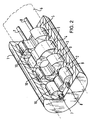
- FIG. 1 a vacuum pump system of the invention comprising a vacuum pump 1 having four separate stages 2, 3, 4, 5 in each of which is a pair of intermeshing rotors, one rotor of each pair being mounted on a first shaft and the other rotor of each pair being mounted as a second rotor.
- Stage 2 is at the pump inlet and stage 5 is at the pump outlet.
- the rotors in the inlet stage 2 are a pair of Roots rotors whereas those in each of the stages 3, 4, 5 are Claw rotors.
- a particle handling means in the form of a cyclone 11 is connected to the exhaust line 12 from the fourth stage 5 at the outlet end of the vacuum pump 1.
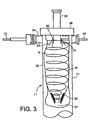
- the cyclone 11 is shown in more detail in Figure 3 and comprises a hollow cyclone body 31 having a cylindrical portion 32 and a conical portion 33.
- Gas from the exhaust line 12 from the vacuum pump 1 enters the cyclone via the cyclone inlet 34 tangentially to the cylindrical portion 32.
- the gas flow therefore tends to be in the form of a helix H in a general downward direction by virtue of the size and shape of the body 1, especially that of the cylindrical portion 32 and the conical portion 33 during which flow entrained particles tend to be urged by centrifugal forces against the side of the portions 32, 33.
- a gas outlet 35 in the form of a tube set in to an upper wall 36 of the cyclone body 31 allows gas to exit the body 31.
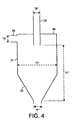
- the gas outlet 35 may have a downwardly extending portion - see Figure 4 - positioned such that the outlet itself is at the base of this portion at a longitudinal position below that of the tangential cyclone inlet 34.
- a particle outlet 37 in the base of the conical portion 33 allows particles to exit the body 31 under gravitational force and be collected in a container 38.
- the container 38 can be disengaged from the system and a valve 38 is present to do this.
- the exit from the cyclone may be at the bottom of the cyclone (not shown). In this case the dust is separated from the gas by passing through an annular slit while allowing the gas to flow through a more central path.
- gas pulses formed by the Claw stage rotors in stages 3, 4 and especially 5 enter the cyclone inlet 34 and set up a vortex gas flow within the body 31 in both the cylindrical portion 32 and moreover in the conical portion 33 in which entrained particles are urged against the wall of the body 31 and either remain on the wall or fall therefrom under gravitational forces towards the outlet 36. Gas exits the cyclone via the outlet 35.
- the relative dimensions of the cyclone components are important and advantageously the diameter A of the inlet 34 and the diameter B of the outlet 35 are both half that of the diameter D cylindrical portion 32.
- the longitudinal length of E of the cylindrical portion 32 plus the conical portion 33 is twice or three times, for example 2.5 times, that of the diameter D of the cylindrical portion 32
- the diameter F of the particle outlet 37 is preferably about 0.35 to 0.4, for example 0.375, times the diameter D of the cylindrical portion 32.
- Equally important is the overall sizing of the cyclone dimensions to suit the instantaneous flow (or maximum flow) from the vacuum pump (or stage) to which the cyclone is connected.
- the particles exiting the chamber 31 via the outlet 36 pass to a particle collection chamber 37 via the open valve 38 from which they can be removed from time to time when the valve 38 has been closed.
- FIG. 5 a system in which a particle handling means again in the form of a cyclone 41 is connected at an interstage position of a multi-stage vacuum pump 1, in particular between the stages 3 and 4 so that the inlet to the cyclone 41 is connected to the outlet of stage 3.
- the outlet of the cyclone 41 is preferably connected to the inlet of stage 4 of the pump 1.
- the collection of particles in the cyclone 41 avoids the potential problems associated with certain types of particle adhering to the pump walls as the pressure in the pump increases towards its outlet.
- the mechanism in the stage connected to the cyclone inlet is advantageously a Claw mechanism.
Landscapes
- Engineering & Computer Science (AREA)
- Physics & Mathematics (AREA)
- Geometry (AREA)
- Chemical & Material Sciences (AREA)
- Chemical Kinetics & Catalysis (AREA)
- Mechanical Engineering (AREA)
- General Engineering & Computer Science (AREA)
- Applications Or Details Of Rotary Compressors (AREA)
- Compressors, Vaccum Pumps And Other Relevant Systems (AREA)
Applications Claiming Priority (2)
| Application Number | Priority Date | Filing Date | Title |
|---|---|---|---|
| GBGB9902083.6A GB9902083D0 (en) | 1999-01-29 | 1999-01-29 | Vacuum pump systems |
| GB9902083 | 1999-01-29 |
Publications (1)
| Publication Number | Publication Date |
|---|---|
| EP1024290A1 true EP1024290A1 (de) | 2000-08-02 |
Family
ID=10846801
Family Applications (1)
| Application Number | Title | Priority Date | Filing Date |
|---|---|---|---|
| EP00300641A Withdrawn EP1024290A1 (de) | 1999-01-29 | 2000-01-28 | Vakuumpumpsystem |
Country Status (3)
| Country | Link |
|---|---|
| EP (1) | EP1024290A1 (de) |
| JP (1) | JP2000265952A (de) |
| GB (1) | GB9902083D0 (de) |
Cited By (3)
| Publication number | Priority date | Publication date | Assignee | Title |
|---|---|---|---|---|
| WO2002050867A3 (en) * | 2000-12-20 | 2002-10-17 | Axcelis Tech Inc | Centrifugal type contaminant collector trap for ion implanter |
| CN102828952A (zh) * | 2012-07-24 | 2012-12-19 | 中国科学院沈阳科学仪器股份有限公司 | 干式真空泵单元及具有该干式真空泵单元的干式真空泵 |
| CN115434902A (zh) * | 2022-11-07 | 2022-12-06 | 中国空气动力研究与发展中心超高速空气动力研究所 | 一种大流量高真空抽气系统及其设计方法 |
Citations (8)
| Publication number | Priority date | Publication date | Assignee | Title |
|---|---|---|---|---|
| GB2088957A (en) | 1980-12-05 | 1982-06-16 | Boc Ltd | Rotary positive-displacement Fluid-machines |
| EP0087778A2 (de) * | 1982-02-27 | 1983-09-07 | Forschungszentrum Jülich Gmbh | Zyklon zur Reinigung von Gas mit innerhalb des Zyklons angeordnetem Filter |
| EP0332741A1 (de) * | 1988-02-29 | 1989-09-20 | Leybold Aktiengesellschaft | Mehrstufige Vakuumpumpe |
| US5131825A (en) * | 1990-03-27 | 1992-07-21 | Leybold Aktiengesellschaft | Multi-stage vacuum pump with reaction chamber between stages |
| US5312466A (en) * | 1992-05-22 | 1994-05-17 | Alcatel Cit | Pumping installation for pumping out an enclosure containing gases which are mixed with solid particles or which generate solid condensates or particles |
| JPH09221381A (ja) * | 1996-02-08 | 1997-08-26 | Komatsu Electron Metals Co Ltd | 単結晶引上装置の真空排気装置 |
| US5857840A (en) * | 1994-03-31 | 1999-01-12 | Komatsu Electronic Metals Co., Ltd. | Vacuum pump with a centrifugal dust collector and a metal mesh dust collector mounted in parallel |
| EP0931938A1 (de) * | 1998-01-26 | 1999-07-28 | Unozawa-Gumi Iron Works, Ltd. | Vakuumpumpe mit Staubabscheidungsmitteln |
-
1999
- 1999-01-29 GB GBGB9902083.6A patent/GB9902083D0/en not_active Ceased
-
2000
- 2000-01-28 EP EP00300641A patent/EP1024290A1/de not_active Withdrawn
- 2000-01-31 JP JP2000061158A patent/JP2000265952A/ja active Pending
Patent Citations (8)
| Publication number | Priority date | Publication date | Assignee | Title |
|---|---|---|---|---|
| GB2088957A (en) | 1980-12-05 | 1982-06-16 | Boc Ltd | Rotary positive-displacement Fluid-machines |
| EP0087778A2 (de) * | 1982-02-27 | 1983-09-07 | Forschungszentrum Jülich Gmbh | Zyklon zur Reinigung von Gas mit innerhalb des Zyklons angeordnetem Filter |
| EP0332741A1 (de) * | 1988-02-29 | 1989-09-20 | Leybold Aktiengesellschaft | Mehrstufige Vakuumpumpe |
| US5131825A (en) * | 1990-03-27 | 1992-07-21 | Leybold Aktiengesellschaft | Multi-stage vacuum pump with reaction chamber between stages |
| US5312466A (en) * | 1992-05-22 | 1994-05-17 | Alcatel Cit | Pumping installation for pumping out an enclosure containing gases which are mixed with solid particles or which generate solid condensates or particles |
| US5857840A (en) * | 1994-03-31 | 1999-01-12 | Komatsu Electronic Metals Co., Ltd. | Vacuum pump with a centrifugal dust collector and a metal mesh dust collector mounted in parallel |
| JPH09221381A (ja) * | 1996-02-08 | 1997-08-26 | Komatsu Electron Metals Co Ltd | 単結晶引上装置の真空排気装置 |
| EP0931938A1 (de) * | 1998-01-26 | 1999-07-28 | Unozawa-Gumi Iron Works, Ltd. | Vakuumpumpe mit Staubabscheidungsmitteln |
Non-Patent Citations (1)
| Title |
|---|
| PATENT ABSTRACTS OF JAPAN vol. 1997, no. 12 25 December 1997 (1997-12-25) * |
Cited By (6)
| Publication number | Priority date | Publication date | Assignee | Title |
|---|---|---|---|---|
| WO2002050867A3 (en) * | 2000-12-20 | 2002-10-17 | Axcelis Tech Inc | Centrifugal type contaminant collector trap for ion implanter |
| CN102828952A (zh) * | 2012-07-24 | 2012-12-19 | 中国科学院沈阳科学仪器股份有限公司 | 干式真空泵单元及具有该干式真空泵单元的干式真空泵 |
| WO2014015710A1 (zh) * | 2012-07-24 | 2014-01-30 | 中国科学院沈阳科学仪器股份有限公司 | 干式真空泵单元及具有该干式真空泵单元的干式真空泵 |
| CN102828952B (zh) * | 2012-07-24 | 2015-04-08 | 中国科学院沈阳科学仪器股份有限公司 | 干式真空泵单元及具有该干式真空泵单元的干式真空泵 |
| CN115434902A (zh) * | 2022-11-07 | 2022-12-06 | 中国空气动力研究与发展中心超高速空气动力研究所 | 一种大流量高真空抽气系统及其设计方法 |
| CN115434902B (zh) * | 2022-11-07 | 2022-12-30 | 中国空气动力研究与发展中心超高速空气动力研究所 | 一种大流量高真空抽气系统的设计方法 |
Also Published As
| Publication number | Publication date |
|---|---|
| JP2000265952A (ja) | 2000-09-26 |
| GB9902083D0 (en) | 1999-03-24 |
Similar Documents
| Publication | Publication Date | Title |
|---|---|---|
| EP1023932B1 (de) | Gasreinigungszyklon | |
| EP0763182B1 (de) | Nicht-konzentrischer ölabscheider | |
| EP1721556B1 (de) | Multi-Zyklon-Abscheider und Staubsauger mit demselben | |
| EP0942785B1 (de) | Vorrichtung zum abtrennen von partikeln aus einem fluidstrom | |
| KR100597549B1 (ko) | 사이클로닉 분리 장치 | |
| CN109011854B (zh) | 压缩空气用净化装置 | |
| EP1779760A2 (de) | Staubsammelvorrichtung für einen Staubsauger | |
| US5000766A (en) | Suction system gas separator from fluid | |
| WO1985005403A1 (en) | Lubricant separation in a scroll compressor | |
| EP0338764B1 (de) | Vakuumpumpen | |
| CN108474377B (zh) | 压缩装置以及控制质量流的分离方法 | |
| US20060137313A1 (en) | Adjustable, self-cleaning rotary machine which is intended to produce a flow of purefied fluid | |
| EP1024290A1 (de) | Vakuumpumpsystem | |
| GB2339452A (en) | Wet gas compression device having liquid/gas separation features | |
| KR100617124B1 (ko) | 싸이클론 집진장치 | |
| CN116981506A (zh) | 供与真空泵一起使用的过滤模块 | |
| GB2337473A (en) | A boundary layer separator | |
| CN113426590B (zh) | 具有多段涡管组合的分类式旋风收尘装置及其实施方法 | |
| EP3877075B1 (de) | Vorrichtung zum abscheiden von festen und/oder flüssigen partikeln aus luft- oder gasströmen | |
| CA2131513C (en) | Method and apparatus for selectively varying the flow rate of service liquid through a two stage liquid ring vacuum pump | |
| KR100550490B1 (ko) | 라인내 오일 분리기 | |
| EP1820558A1 (de) | Zyklonabscheider mit internem Filter | |
| EP0295846A1 (de) | Einrichtung zur Trennung von festen oder flüssigen Teilchen aus einem Gasstrom | |
| EP0933066A3 (de) | Eine Abscheider-Zentrifuge | |
| CN219701386U (zh) | 一种双进口湍流袋式除尘器 |
Legal Events
| Date | Code | Title | Description |
|---|---|---|---|
| PUAI | Public reference made under article 153(3) epc to a published international application that has entered the european phase |
Free format text: ORIGINAL CODE: 0009012 |
|
| AK | Designated contracting states |
Kind code of ref document: A1 Designated state(s): CH DE FR GB LI NL |
|
| AX | Request for extension of the european patent |
Free format text: AL;LT;LV;MK;RO;SI |
|
| 17P | Request for examination filed |
Effective date: 20001207 |
|
| AKX | Designation fees paid |
Free format text: CH DE FR GB LI NL |
|
| 17Q | First examination report despatched |
Effective date: 20040702 |
|
| STAA | Information on the status of an ep patent application or granted ep patent |
Free format text: STATUS: THE APPLICATION IS DEEMED TO BE WITHDRAWN |
|
| 18D | Application deemed to be withdrawn |
Effective date: 20041113 |