EP1024104A1 - Auxiliary emergency escape device of elevator - Google Patents
Auxiliary emergency escape device of elevator Download PDFInfo
- Publication number
- EP1024104A1 EP1024104A1 EP99101484A EP99101484A EP1024104A1 EP 1024104 A1 EP1024104 A1 EP 1024104A1 EP 99101484 A EP99101484 A EP 99101484A EP 99101484 A EP99101484 A EP 99101484A EP 1024104 A1 EP1024104 A1 EP 1024104A1
- Authority
- EP
- European Patent Office
- Prior art keywords
- compression
- elevator
- elevator cab
- fastened
- decompression
- Prior art date
- Legal status (The legal status is an assumption and is not a legal conclusion. Google has not performed a legal analysis and makes no representation as to the accuracy of the status listed.)
- Withdrawn
Links
- 230000006835 compression Effects 0.000 claims abstract description 33
- 238000007906 compression Methods 0.000 claims abstract description 33
- 230000006837 decompression Effects 0.000 claims abstract description 25
- 239000012530 fluid Substances 0.000 claims abstract description 9
- 230000003213 activating effect Effects 0.000 claims 1
- 238000012423 maintenance Methods 0.000 description 2
- 230000015556 catabolic process Effects 0.000 description 1
- 238000010276 construction Methods 0.000 description 1
Images



Classifications
-
- B—PERFORMING OPERATIONS; TRANSPORTING
- B66—HOISTING; LIFTING; HAULING
- B66B—ELEVATORS; ESCALATORS OR MOVING WALKWAYS
- B66B5/00—Applications of checking, fault-correcting, or safety devices in elevators
- B66B5/02—Applications of checking, fault-correcting, or safety devices in elevators responsive to abnormal operating conditions
- B66B5/027—Applications of checking, fault-correcting, or safety devices in elevators responsive to abnormal operating conditions to permit passengers to leave an elevator car in case of failure, e.g. moving the car to a reference floor or unlocking the door
-
- B—PERFORMING OPERATIONS; TRANSPORTING
- B66—HOISTING; LIFTING; HAULING
- B66B—ELEVATORS; ESCALATORS OR MOVING WALKWAYS
- B66B5/00—Applications of checking, fault-correcting, or safety devices in elevators
- B66B5/02—Applications of checking, fault-correcting, or safety devices in elevators responsive to abnormal operating conditions
- B66B5/028—Safety devices separate from control system in case of power failure, for hydraulical lifts, e.g. braking the hydraulic jack
Definitions
- the present invention relates generally to an elevator, and more particularly to an auxiliary emergency escape device of the elevator.
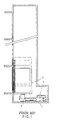
- a prior art elevator comprises an oil pressure mechanism 1 for actuating an oil pressure cylinder 2 to move up and down.
- the oil pressure cylinder 2 is fastened at one end thereof with an elevator cab 3.
- the oil pressure mechanism 1 is provided with a decompression valve 4, which is intended for use by an elevator maintenance personnel to lower the elevator cab 3 in the event of a power outage, an elevator breakdown, or an elevator maintenance work.
- the elevator cab 3 may be caused by a power outage or accident to stop somewhere between two floors such that the door of the elevator cab 3 can not be opened, and that the passengers are trapped in the disabled cab.
- the primary objective of the present invention is therefore to provide an elevator with an auxiliary emergency escape device, which comprises a manually-operated compression-decompression device located at the emergency window of the elevator cab.
- the compression-decompression device is fastened at one end thereof with an oil pipe which is in turn fastened at another end thereof with a compression valve.
- the compression valve is fastened at one end thereof with an oil pressure mechanism.
- the compression-decompression device is exerted on by the pressure of a person's hand so as to actuate the compression valve or the decompression valve, thereby causing the oil pressure cylinder to move up or down.
- the elevator cab can be manually driven to a desired floor where the trapped passengers can escape.
- FIG. 1 shows a schematic view of the operating mechanism of a prior art elevator.
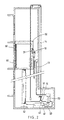
- FIG. 2 shows a schematic view of the operating mechanism of an elevator of the present invention.
- FIG. 3 shows an enlarged schematic view of a manually-operated compression device of the present invention.
- FIG. 4 shows a schematic view of a compression valve of the present invention.
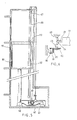
- FIG. 5 shows a schematic view of a manually-operated compression device of another embodiment of the present invention.
- FIG. 6 shows a partial schematic plan view of the compression device as shown in FIG. 5.
- FIG. 7 shows a schematic view of an emergency window of the embodiment as shown in FIG. 5.
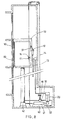
- FIG. 8 shows a schematic view of the construction of still another embodiment of the present invention.
- FIG. 9 shows a partial enlarged schematic view of the embodiment as shown in FIG. 8.
- FIG. 10 shows a side view of the embodiment as shown in FIG. 8.
- FIG. 11 shows a schematic view of the operation of the embodiment as shown in FIG. 10.
- FIG. 12 shows a perspective view of a cab door of the elevator of the present invention.
- an elevator auxiliary emergency escape device embodied in the present invention is composed of a manually-operated compression apparatus 10 and a compression valve 20.
- the manually-operated compression apparatus 10 is made up of a handle 11 and a piston 12.
- the compression apparatus 10 is fastened at one end thereof with an oil pipe 13 and is located at an emergency window 31 of an elevator cab 30 of the present invention.
- the compression valve 20 is composed of a piston 21 and a push rod 22.
- the compression valve 20 is fastened at one end thereof with the oil pipe 13.
- the compression valve 20 is connected with an oil pressure mechanism 41 by a lever apparatus 50.
- the oil pressure mechanism 41 is located over an oil tank 40.
- the push rod 22 of the compression valve 20 is engaged with an arcuate hole 51 of the longer end of the lever apparatus 50.
- the oil pressure mechanism 41 is engaged with the short end of the lever apparatus 50 by means of a linking rod 52.
- the lever apparatus 50 is intended to provide a leverage to facilitate the efficient action of the compression valve 20 on the oil pressure mechanism 41.
- the length of the oil pipe 13 depends on the height of a building in which the elevator is located.
- the midpoint of the oil pipe 13 is corresponding in location to the midpoint of the building.
- a trapped passenger can reach for the handle 11 of the manually-operated compression device 10 from the emergency window 31 of the elevator cab 30.
- the piston 12 can be actuated by an external pressure exerting on the handle 11 by the hand of the trapped passenger such that the fluid contained in the oil pipe 13 is compressed by the piston 12 to act on the compression valve 20.
- the piston 21 of the compression valve 20 is at work such that the push rod 22 is actuated to cause the linking rod 52 of the lever apparatus 50 to act on the oil pressure mechanism 41, which in turn gives an added pressure to the oil pressure cylinder 42.
- the elevator cab 30 is thus lifted by the oil pressure cylinder 42.
- a manually-operated compression device 60 of another embodiment of the present invention is located over the oil tank 40.
- a pulley set 61 is mounted over the oil tank 40 and is provided with a driving sector gear 611 and a driven sector gear 62 which is engaged with the driving sector gear 611 and is provided at one end thereof with two bearings 63 opposite to each other.
- One of the bearings 63 is fastened pivotally with the driven sector gear 62.
- the bearings 63 are provided therebetween with an eccentric shaft 64 with a push rod 65 being fastened pivotally therewith.
- the push rod 65 is fastened with the oil pressure mechanism 41.
- An action cable 66 is fastened at one end thereof with a revolving wheel 66 which is located at the top end of the elevator shaft.
- the action cable 66 is wound on the pulley set 61.
- the elevator cab 30 is provided with an emergency window 32 and a mask 33 fitted over the action cable 66.
- a decompression valve 70 can be actuated by an external force exerting on an action cable 14 by a passenger trapped in the disabled cab 30.
- the decompression valve 70 is activated by the pressure of a hand of the trapped passenger, the fluid contained in the oil pressure cylinder 42 is so drained that the fluid flows back into the fluid storage tank.
- the elevator cab 30 is caused to descend gradually.
- the trapped passenger can observe through the see-through window 81 of the inner door 80 of the elevator cab 30, as illustrated in FIG. 12.
- the action cable 14 is released to interrupt the draining of the fluid of the oil pressure cylinder 42. In other words, as soon as the action cable 14 is let go by the trapped passenger, the elevator cab 30 in motion is stopped at once.
- one end of the action cable 14 in located securely at the bottom of the elevator shaft.
- the elevator cab 30 is provided therein with an action rod 16 which is engaged through the wall of the cab 30 with two balance wheels 17.
- the action cable 14 is put through between the two balance wheels 17.
- the balance wheels 17 can be actuated by the action rod 16 to engage in a planetary motion such that the action cable 14 is curved and that the decompression valve 70 is actuated to bring about the draining of the fluid of the oil pressure cylinder 42, thereby causing the elevator cab 30 to descend slowly.
- Located at the junction of the action cable 14 and the decompression valve 70 is a coil spring 18 for balancing the torsion of the action cable 14 and the balance wheels 17.
- the decompression valve 70 can not be accidentally activated as long as the action cable 14 is not exerted on by the force of the action rod 16 which is located inside the elevator cab 30 to safeguard the operator.
- the embodiments of the present invention described above are to be deemed in all respects as being merely illustrative and not restrictive. Accordingly, the present invention may be embodied in other specific forms without deviating from the spirit thereof. The present invention is therefore to be limited only by the scopes of the following appended claims.
Landscapes
- Engineering & Computer Science (AREA)
- Automation & Control Theory (AREA)
- Maintenance And Inspection Apparatuses For Elevators (AREA)
Abstract
An elevator is provided with an auxiliary escape
device consisting of a manually-operated
compression-decompression apparatus located at an
emergency window of the elevator cab. The
compression-decompression apparatus has a fluid pipe
and a compression or decompression valve which
is fastened at one end thereof with an oil pressure
mechanism. In the event of an accident or power
outage causing the elevator to incapacitate, the
compression-decompression apparatus is exerted on by
the pressure of a person's hand so as to actuate
the compression or decompression valve, thereby causing
the oil pressure cylinder to move up or down to drive
the elevator cab upwards or downwards to a
desired floor where the trapped passengers can escape.
Description
- The present invention relates generally to an elevator, and more particularly to an auxiliary emergency escape device of the elevator.
- As shown in FIG. 1, a prior art elevator comprises an
oil pressure mechanism 1 for actuating anoil pressure cylinder 2 to move up and down. Theoil pressure cylinder 2 is fastened at one end thereof with an elevator cab 3. Theoil pressure mechanism 1 is provided with adecompression valve 4, which is intended for use by an elevator maintenance personnel to lower the elevator cab 3 in the event of a power outage, an elevator breakdown, or an elevator maintenance work. However, the elevator cab 3 may be caused by a power outage or accident to stop somewhere between two floors such that the door of the elevator cab 3 can not be opened, and that the passengers are trapped in the disabled cab. - The primary objective of the present invention is therefore to provide an elevator with an auxiliary emergency escape device, which comprises a manually-operated compression-decompression device located at the emergency window of the elevator cab. The compression-decompression device is fastened at one end thereof with an oil pipe which is in turn fastened at another end thereof with a compression valve. The compression valve is fastened at one end thereof with an oil pressure mechanism. In the event of an accident or power outage causing the elevator to incapacitate, the compression-decompression device is exerted on by the pressure of a person's hand so as to actuate the compression valve or the decompression valve, thereby causing the oil pressure cylinder to move up or down. As a result, the elevator cab can be manually driven to a desired floor where the trapped passengers can escape.
- FIG. 1 shows a schematic view of the operating mechanism of a prior art elevator.
- FIG. 2 shows a schematic view of the operating mechanism of an elevator of the present invention.
- FIG. 3 shows an enlarged schematic view of a manually-operated compression device of the present invention.
- FIG. 4 shows a schematic view of a compression valve of the present invention.
- FIG. 5 shows a schematic view of a manually-operated compression device of another embodiment of the present invention.
- FIG. 6 shows a partial schematic plan view of the compression device as shown in FIG. 5.
- FIG. 7 shows a schematic view of an emergency window of the embodiment as shown in FIG. 5.
- FIG. 8 shows a schematic view of the construction of still another embodiment of the present invention.
- FIG. 9 shows a partial enlarged schematic view of the embodiment as shown in FIG. 8.
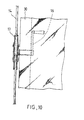
- FIG. 10 shows a side view of the embodiment as shown in FIG. 8.
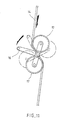
- FIG. 11 shows a schematic view of the operation of the embodiment as shown in FIG. 10.
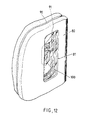
- FIG. 12 shows a perspective view of a cab door of the elevator of the present invention.
- As shown in FIGS. 2, 3 and 4, an elevator auxiliary emergency escape device embodied in the present invention is composed of a manually-operated
compression apparatus 10 and acompression valve 20. - The manually-operated
compression apparatus 10 is made up of ahandle 11 and apiston 12. Thecompression apparatus 10 is fastened at one end thereof with anoil pipe 13 and is located at anemergency window 31 of anelevator cab 30 of the present invention. - The
compression valve 20 is composed of apiston 21 and apush rod 22. Thecompression valve 20 is fastened at one end thereof with theoil pipe 13. Thecompression valve 20 is connected with anoil pressure mechanism 41 by alever apparatus 50. Theoil pressure mechanism 41 is located over anoil tank 40. Thepush rod 22 of thecompression valve 20 is engaged with anarcuate hole 51 of the longer end of thelever apparatus 50. Theoil pressure mechanism 41 is engaged with the short end of thelever apparatus 50 by means of a linkingrod 52. Thelever apparatus 50 is intended to provide a leverage to facilitate the efficient action of thecompression valve 20 on theoil pressure mechanism 41. The length of theoil pipe 13 depends on the height of a building in which the elevator is located. The midpoint of theoil pipe 13 is corresponding in location to the midpoint of the building. - In the event that the elevator is disabled by a fire, power outage, or accident, a trapped passenger can reach for the
handle 11 of the manually-operatedcompression device 10 from theemergency window 31 of theelevator cab 30. Thepiston 12 can be actuated by an external pressure exerting on thehandle 11 by the hand of the trapped passenger such that the fluid contained in theoil pipe 13 is compressed by thepiston 12 to act on thecompression valve 20. As a result, thepiston 21 of thecompression valve 20 is at work such that thepush rod 22 is actuated to cause the linkingrod 52 of thelever apparatus 50 to act on theoil pressure mechanism 41, which in turn gives an added pressure to theoil pressure cylinder 42. Theelevator cab 30 is thus lifted by theoil pressure cylinder 42. - As shown in FIGS. 5, 6 and 7, a manually-operated
compression device 60 of another embodiment of the present invention is located over theoil tank 40. Apulley set 61 is mounted over theoil tank 40 and is provided with adriving sector gear 611 and a drivensector gear 62 which is engaged with thedriving sector gear 611 and is provided at one end thereof with twobearings 63 opposite to each other. One of thebearings 63 is fastened pivotally with the drivensector gear 62. Thebearings 63 are provided therebetween with aneccentric shaft 64 with apush rod 65 being fastened pivotally therewith. Thepush rod 65 is fastened with theoil pressure mechanism 41. Anaction cable 66 is fastened at one end thereof with a revolvingwheel 66 which is located at the top end of the elevator shaft. Theaction cable 66 is wound on the pulley set 61.Theelevator cab 30 is provided with anemergency window 32 and amask 33 fitted over theaction cable 66. - In the event that the elevator is disabled by a fire, power outage or accident, a passenger trapped in the
cab 30 can reach for theaction cable 66 at theemergency window 32 of thecab 30 such that theaction cable 66 is exerted on by the pressure of a hand of the trapped passenger, and that thepulley set 61 is rotated to force thedriving sector gear 611 to actuate the drivensector gear 62. As the drivensector gear 62. As the drivensector gear 62 is driven, theeccentric shaft 64 is thus actuated to turn so as to force thepush rod 65 to act on theoil pressure mechanism 41. As theoil pressure mechanism 41 is under pressure, theoil pressure cylinder 42 is acted on by the pressure which is increased gradually. As a result, theelevator cab 30 is lifted by theoil pressure cylinder 42 in motion. - As shown in FIGS. 2 and 5, a
decompression valve 70 can be actuated by an external force exerting on anaction cable 14 by a passenger trapped in thedisabled cab 30. As soon as thedecompression valve 70 is activated by the pressure of a hand of the trapped passenger, the fluid contained in theoil pressure cylinder 42 is so drained that the fluid flows back into the fluid storage tank. As a result of the decompression of theoil pressure cylinder 42, theelevator cab 30 is caused to descend gradually. In the meantime, the trapped passenger can observe through the see-throughwindow 81 of theinner door 80 of theelevator cab 30, as illustrated in FIG. 12. As the see- throughwindow 81 of theinner door 80 is exactly opposite to the see-throughwindow 91 of theouter door 90 of a given floor and the floor number "100" is flush with theouter door 90, theaction cable 14 is released to interrupt the draining of the fluid of theoil pressure cylinder 42. In other words, as soon as theaction cable 14 is let go by the trapped passenger, theelevator cab 30 in motion is stopped at once. - As shown in FIGS. 8, 9 10 and 11, one end of the
action cable 14 in located securely at the bottom of the elevator shaft. Theelevator cab 30 is provided therein with anaction rod 16 which is engaged through the wall of thecab 30 with twobalance wheels 17. Theaction cable 14 is put through between the twobalance wheels 17. Thebalance wheels 17 can be actuated by theaction rod 16 to engage in a planetary motion such that theaction cable 14 is curved and that thedecompression valve 70 is actuated to bring about the draining of the fluid of theoil pressure cylinder 42, thereby causing theelevator cab 30 to descend slowly. Located at the junction of theaction cable 14 and thedecompression valve 70 is acoil spring 18 for balancing the torsion of theaction cable 14 and thebalance wheels 17. Thedecompression valve 70 can not be accidentally activated as long as theaction cable 14 is not exerted on by the force of theaction rod 16 which is located inside theelevator cab 30 to safeguard the operator. The embodiments of the present invention described above are to be deemed in all respects as being merely illustrative and not restrictive. Accordingly, the present invention may be embodied in other specific forms without deviating from the spirit thereof. The present invention is therefore to be limited only by the scopes of the following appended claims.
Claims (8)
- An auxiliary escape device of a elevator, said escape device comprising:a manually-operated compression or decompression apparatus located at an emergency window of an elevator cab such that said compression or decompression apparatus is in communication with a fluid pipe;a compression or decompression valve fastened with said fluid pipe; andan oil pressure mechanism provided with a pressure cylinder and connected with said compression or decompression valve such that said oil pressure mechanism is activated by said compression or decompression valve at such time when said compression or decompression apparatus is exerted on by an external force, and that said pressure cylinder of said oil pressure mechanism is capable of lifting the elevator cab at such time when said pressure cylinder is compressed, and further that said pressure cylinder of said oil pressure mechanism is capable of causing the elevator cab to descend at such time when said pressure cylinder is decompressed.
- The escape device as defined in claim 1, wherein said manually-operated compression or decompression apparatus is provided with an action cable fastened at one end thereof with a decompression valve of said pressure cylinder such that said action cable is located at another end thereof with a weight located at the bottom of the elevator shaft; and wherein the elevator cab is provided with an emergency window through which a passenger trapped in the disabled elevator cab can activate said action cable so as t actuate said decompression valve to decompress said pressure cylinder, thereby causing the disabled elevator cab to descend.
- The escape device as defined in claim 1, wherein said compression or decompression valve is provided with a piston.
- The escape device as defined in claim 1, wherein said compression or decompression valve and said oil pressure mechanism are linked by a lever apparatus; wherein said compression or decompression valve is provided with a push rod which is fastened with one end of said lever apparatus; and wherein said oil pressure mechanism is provided with a linking rod which is fastened with another end of said lever apparatus.
- The escape device as defined in claim 1, wherein the manually-operated compression or decompression apparatus is composed of a pulley set having a driving sector gear, a driven sector gear, two bearings, an eccentric shaft, an action cable, and a pulley, said eccentric shaft being fastened pivotally between said two bearings such that said eccentric shaft is provided with a push rod fastened pivotally therewith, said push rod being fastened at another end thereof with said oil pressure mechanism, said driven sector gear being fastened pivotally with one of said two bearings, said action cable being fastened at one end thereof with a rotary wheel located at the top of the elevator shaft.
- The escape device as defined in claim 1, wherein said action cable has a free end which is located at the bottom of the elevator shaft; and wherein said elevator cab is provided therein with an action rod which is engaged through a wall of the elevator cab with two balance wheels between which said action cable is put through, said action rod being capable of actuating said balance wheels to engage in a planetary motion for curving saidaction cable, thereby activating the decompression valve to drain said pressure cylinder so as to cause said elevator cab to descend.
- The escape device as defined in claim 6, wherein said action cable and said decompression valve are provided therebetween with a coil spring for balancing the torsion of said action cable and said balance wheels.
- The escape device as defined in claim 1, wherein said elevator cab is provided with an inner door and an outer door, said inner door and said outer door having a see-through window enabling a passenger trapped in the disabled elevator cab to see a floor number marked on the outer door.
Priority Applications (1)
| Application Number | Priority Date | Filing Date | Title |
|---|---|---|---|
| EP99101484A EP1024104A1 (en) | 1999-01-27 | 1999-01-27 | Auxiliary emergency escape device of elevator |
Applications Claiming Priority (1)
| Application Number | Priority Date | Filing Date | Title |
|---|---|---|---|
| EP99101484A EP1024104A1 (en) | 1999-01-27 | 1999-01-27 | Auxiliary emergency escape device of elevator |
Publications (1)
| Publication Number | Publication Date |
|---|---|
| EP1024104A1 true EP1024104A1 (en) | 2000-08-02 |
Family
ID=8237427
Family Applications (1)
| Application Number | Title | Priority Date | Filing Date |
|---|---|---|---|
| EP99101484A Withdrawn EP1024104A1 (en) | 1999-01-27 | 1999-01-27 | Auxiliary emergency escape device of elevator |
Country Status (1)
| Country | Link |
|---|---|
| EP (1) | EP1024104A1 (en) |
Citations (5)
| Publication number | Priority date | Publication date | Assignee | Title |
|---|---|---|---|---|
| US4434875A (en) * | 1981-05-12 | 1984-03-06 | Sergio Scarzella | Emergency levelling device for a lift car |
| WO1987005282A1 (en) * | 1986-03-03 | 1987-09-11 | Oly Fischer Dos Santos | Emergency device for elevators |
| US5370206A (en) * | 1993-09-24 | 1994-12-06 | Chao; Wen-Ping | Driving system for elevator |
| EP0820954A1 (en) * | 1996-07-25 | 1998-01-28 | Chiu Nan Wang | Elevator emergency escape device |
| DE19646453A1 (en) * | 1996-10-29 | 1998-05-14 | Chiu Nan Wang | Hydraulic safety brake for lift |
-
1999
- 1999-01-27 EP EP99101484A patent/EP1024104A1/en not_active Withdrawn
Patent Citations (5)
| Publication number | Priority date | Publication date | Assignee | Title |
|---|---|---|---|---|
| US4434875A (en) * | 1981-05-12 | 1984-03-06 | Sergio Scarzella | Emergency levelling device for a lift car |
| WO1987005282A1 (en) * | 1986-03-03 | 1987-09-11 | Oly Fischer Dos Santos | Emergency device for elevators |
| US5370206A (en) * | 1993-09-24 | 1994-12-06 | Chao; Wen-Ping | Driving system for elevator |
| EP0820954A1 (en) * | 1996-07-25 | 1998-01-28 | Chiu Nan Wang | Elevator emergency escape device |
| DE19646453A1 (en) * | 1996-10-29 | 1998-05-14 | Chiu Nan Wang | Hydraulic safety brake for lift |
Similar Documents
| Publication | Publication Date | Title |
|---|---|---|
| US5906252A (en) | Oil pressure auxiliary escape device of elevator | |
| AU5015599A (en) | Emergency release device | |
| US4493396A (en) | Winch for safely lowering a person at a controlled rate | |
| CN105819310B (en) | A kind of double tracking-driven elevators with slow drop function of saving oneself manually | |
| US5878845A (en) | Auxiliary emergency escape device of elevator | |
| JP4672017B2 (en) | Lifesaving equipment | |
| CN110759271B (en) | Crane power-off descending object hanging device | |
| US20020125076A1 (en) | Elevator emergency escape device | |
| CN1972856B (en) | An emergency device for raising and lowering a trapped elevator | |
| US20150123056A1 (en) | Tackle for displacing a load | |
| EP1024104A1 (en) | Auxiliary emergency escape device of elevator | |
| US6557670B2 (en) | Double brake protection device for elevator | |
| CN101823658A (en) | Manual wire-drawing type rescue device without machine room for elevator | |
| CN112299200A (en) | Safety protection device and safety protection method for hydraulic elevator | |
| JP2000229770A (en) | Elevator emergency evacuation aid | |
| CN105347213A (en) | Reel | |
| CN1169948A (en) | Elevator safety release device | |
| GB2407554A (en) | Emergency descent of lift cage | |
| KR100763830B1 (en) | Rope Braking System for Elevator | |
| US7607515B2 (en) | Elevator evacuation apparatus | |
| CN2417085Y (en) | Telescopic, quick lifting and wheel type hydraulic jack | |
| KR100468877B1 (en) | Sprag jack winch | |
| JPH09286574A (en) | Elevator device | |
| JP3025296U (en) | Simple power drive with manual handle | |
| JP6422562B1 (en) | High place evacuation device |
Legal Events
| Date | Code | Title | Description |
|---|---|---|---|
| PUAI | Public reference made under article 153(3) epc to a published international application that has entered the european phase |
Free format text: ORIGINAL CODE: 0009012 |
|
| AK | Designated contracting states |
Kind code of ref document: A1 Designated state(s): CH DE FI FR GB IT LI NL |
|
| AX | Request for extension of the european patent |
Free format text: AL;LT;LV;MK;RO;SI |
|
| 17P | Request for examination filed |
Effective date: 20010125 |
|
| AKX | Designation fees paid |
Free format text: CH DE FI FR GB IT LI NL |
|
| STAA | Information on the status of an ep patent application or granted ep patent |
Free format text: STATUS: THE APPLICATION HAS BEEN WITHDRAWN |
|
| 18W | Application withdrawn |
Withdrawal date: 20020927 |