EP1023647B1 - A neurofuzzy based device for programmable hearing aids - Google Patents
A neurofuzzy based device for programmable hearing aids Download PDFInfo
- Publication number
- EP1023647B1 EP1023647B1 EP98953507A EP98953507A EP1023647B1 EP 1023647 B1 EP1023647 B1 EP 1023647B1 EP 98953507 A EP98953507 A EP 98953507A EP 98953507 A EP98953507 A EP 98953507A EP 1023647 B1 EP1023647 B1 EP 1023647B1
- Authority
- EP
- European Patent Office
- Prior art keywords
- user
- hearing aid
- targets
- hearing
- neural network
- Prior art date
- Legal status (The legal status is an assumption and is not a legal conclusion. Google has not performed a legal analysis and makes no representation as to the accuracy of the status listed.)
- Expired - Lifetime
Links
- 238000000034 method Methods 0.000 claims abstract description 32
- 230000004044 response Effects 0.000 claims abstract description 27
- 238000013528 artificial neural network Methods 0.000 claims abstract description 21
- 238000011065 in-situ storage Methods 0.000 claims abstract description 6
- 238000012545 processing Methods 0.000 claims description 15
- 238000011156 evaluation Methods 0.000 claims description 11
- 208000032041 Hearing impaired Diseases 0.000 claims description 9
- 208000016354 hearing loss disease Diseases 0.000 claims description 9
- 230000001419 dependent effect Effects 0.000 claims description 3
- 230000008569 process Effects 0.000 abstract description 15
- 230000006735 deficit Effects 0.000 abstract description 5
- 230000002452 interceptive effect Effects 0.000 abstract description 2
- 230000001537 neural effect Effects 0.000 description 6
- 238000012549 training Methods 0.000 description 6
- 238000010586 diagram Methods 0.000 description 3
- 206010011878 Deafness Diseases 0.000 description 2
- 230000008859 change Effects 0.000 description 2
- 238000013479 data entry Methods 0.000 description 2
- 230000003247 decreasing effect Effects 0.000 description 2
- 230000006870 function Effects 0.000 description 2
- 238000005259 measurement Methods 0.000 description 2
- 230000007246 mechanism Effects 0.000 description 2
- 238000012986 modification Methods 0.000 description 2
- 230000004048 modification Effects 0.000 description 2
- 210000002569 neuron Anatomy 0.000 description 2
- 230000005236 sound signal Effects 0.000 description 2
- 238000012360 testing method Methods 0.000 description 2
- 230000008094 contradictory effect Effects 0.000 description 1
- 238000009795 derivation Methods 0.000 description 1
- 230000003467 diminishing effect Effects 0.000 description 1
- 230000003203 everyday effect Effects 0.000 description 1
- 230000005484 gravity Effects 0.000 description 1
- 230000010370 hearing loss Effects 0.000 description 1
- 231100000888 hearing loss Toxicity 0.000 description 1
- 239000007943 implant Substances 0.000 description 1
- 230000010365 information processing Effects 0.000 description 1
- 230000003993 interaction Effects 0.000 description 1
- 238000004519 manufacturing process Methods 0.000 description 1
- 238000012544 monitoring process Methods 0.000 description 1
- 230000008447 perception Effects 0.000 description 1
- 230000002093 peripheral effect Effects 0.000 description 1
- 238000004904 shortening Methods 0.000 description 1
- 230000000007 visual effect Effects 0.000 description 1
Images


Classifications
-
- H—ELECTRICITY
- H04—ELECTRIC COMMUNICATION TECHNIQUE
- H04R—LOUDSPEAKERS, MICROPHONES, GRAMOPHONE PICK-UPS OR LIKE ACOUSTIC ELECTROMECHANICAL TRANSDUCERS; DEAF-AID SETS; PUBLIC ADDRESS SYSTEMS
- H04R25/00—Deaf-aid sets, i.e. electro-acoustic or electro-mechanical hearing aids; Electric tinnitus maskers providing an auditory perception
- H04R25/70—Adaptation of deaf aid to hearing loss, e.g. initial electronic fitting
-
- G—PHYSICS
- G05—CONTROLLING; REGULATING
- G05B—CONTROL OR REGULATING SYSTEMS IN GENERAL; FUNCTIONAL ELEMENTS OF SUCH SYSTEMS; MONITORING OR TESTING ARRANGEMENTS FOR SUCH SYSTEMS OR ELEMENTS
- G05B13/00—Adaptive control systems, i.e. systems automatically adjusting themselves to have a performance which is optimum according to some preassigned criterion
- G05B13/02—Adaptive control systems, i.e. systems automatically adjusting themselves to have a performance which is optimum according to some preassigned criterion electric
- G05B13/0265—Adaptive control systems, i.e. systems automatically adjusting themselves to have a performance which is optimum according to some preassigned criterion electric the criterion being a learning criterion
- G05B13/0285—Adaptive control systems, i.e. systems automatically adjusting themselves to have a performance which is optimum according to some preassigned criterion electric the criterion being a learning criterion using neural networks and fuzzy logic
-
- H—ELECTRICITY
- H04—ELECTRIC COMMUNICATION TECHNIQUE
- H04R—LOUDSPEAKERS, MICROPHONES, GRAMOPHONE PICK-UPS OR LIKE ACOUSTIC ELECTROMECHANICAL TRANSDUCERS; DEAF-AID SETS; PUBLIC ADDRESS SYSTEMS
- H04R25/00—Deaf-aid sets, i.e. electro-acoustic or electro-mechanical hearing aids; Electric tinnitus maskers providing an auditory perception
- H04R25/50—Customised settings for obtaining desired overall acoustical characteristics
- H04R25/505—Customised settings for obtaining desired overall acoustical characteristics using digital signal processing
- H04R25/507—Customised settings for obtaining desired overall acoustical characteristics using digital signal processing implemented by neural network or fuzzy logic
Definitions
- the present invention is directed towards fitting a programmable hearing aid by providing electroacoustic targets based on hearing impairments, on the learned information from previous successful fittings and on user comments/responses while listening to different sound environments and those targets are to be matched by the response of the hearing aid.
- Programmable hearing aids offer the possibility of making choices for the values of multiple parameters, hence allowing for a very wide range of electroacoustic responses capable of accommodating many different kinds of hearing impairments.
- the audiologist/hearing aid practitioner using audiometric measurements decides on the objectives/targets that the hearing device should match in order to compensate for the impairment.
- the targets are derived from prescriptive procedures, based on theoretical or empirical considerations, originally proposed for linear nonprogrammable hearing devices. Lately, new prescriptive formulas intended for nonlinear programmable devices such as DSLi/o and Fig. 6 are being used. Nevertheless, their targets are based on artificial listening environments (i.e., speech weighted noise) and do not adequately characterize hearing aid performance in realistic environments.
- the audiologist is then often faced with user complaints that reflect the performance of the device in everyday environments and he/she then must adjust the operating parameters of the device with suboptimal tools and methods. Setting those parameters one at a time (e.g., AGC for the low channel, Gain for the high channel) is a suboptimal procedure because there is a great degree of interdependence between the parameters. Furthermore, the user responses and complaints are imprecise and uncertain and they need to be deciphered by the audiologist.
- EP-A-0712261 discloses a hearing aid which incorporates a neural network for processing received audio signals to produce processed output signals.
- 'Hearing Aids for the Profoundly Deaf based on Neural Net Speech Processing' discloses the use of neural net-type processing of speech for cochlear implants.
- US-A-4972487 discloses a hearing aid with a data logging capability to keep track of the use of a plurality of user selected settings of a hearing aid.
- a device for programming a hearing aid to fit a hearing impaired user including: means for entering audiological and other relevant data that characterize aspects of the user and of his/her hearing impairment; neural network means for generating initial targets addressing at least one aspect of the user's hearing impairment in at least one environment in which the hearing aid may be used; characterized by means for generating sound stimuli for in situ evaluation of the performance of the hearing aid as experienced by the hearing impaired user; means for receiving responses from the user to sound stimuli generated during the evaluation; fuzzy logic means incorporating rule generating commands for modifying the initial targets into modified targets, the modifying being dependent on the user responses; data processing means for using the modified targets to optimize at least some operational parameters of the hearing aid as a group; means for downloading the operational parameters to the hearing aid; and means for entering fuzzy processing rules to the fuzzy logic means.
- a method of programming a hearing aid for a hearing impaired user including: entering audiological and other relevant data; and generating an initial set of targets addressing at least one aspect of the user's hearing impairment in at least one environment in which the hearing aid may be used; characterized by generating sound stimuli for in situ evaluation of the performance of the hearing aid as experienced by the hearing impaired user; receiving responses from the user to sound stimuli generated during the evaluation; modifying the initial targets, with fuzzy logic-type processing, into modified targets in response to the user responses; using the modified targets to optimize at least some operational parameters of the hearing aid as a group; and downloading the operational parameters to the hearing aid.
- an embodiment of the invention provides for a neurofuzzy device that as a first step in the fitting process, generates initial targets for compensating a particular hearing loss. These targets are based both on collected individualized audiometric and other data and on the accumulated learning from previous successful fittings. Starting the fitting process with efficient initial targets could significantly shorten the process.
- Targets could have the form of gain curves for different input levels, signal to noise curves, etc. These curves are not directly dependent on the particular hearing device used, rather they represent the electroacoustic response of an "ideal" prosthesis for the particular impairment.
- the targets are generated by a multilayer neural network which is a "black box" information processing system trained to generate an optimum match between a set of audiometric measurements such as the auditory thresholds and the corresponding best frequency and gain curves at different input levels for each subject.
- the neural network requires a priori knowledge and acquiring it requires large amounts of data in order to converge to a solution.
- the required a priori knowledge is entered into the network during an off line training session performed during manufacturing using data collected from hearing aid dispensing outlets from selected geographical areas.
- the currently available prescriptive rationales such as NAL and Fig. 6 are based on such data and are used in fitting traditional non programmable hearing aids as well as starting frequency/gain target curves for programmable devices.
- Training the network is also an ongoing process which is enabled after the fine tuning process that culminated in a successful fitting.
- the modified targets, resulting from the fuzzy logic based fine tuning process described later on, are used for retraining the neural network.
- Such on-line training allows for the neurofuzzy fitting device to be biased toward the peculiarities of a particular clientele.
- the fine-tuning process in this neurofuzzy methodology closes the loop of the fitting process.
- the settings of all the parameters of the hearing prosthesis are derived and transmitted to the hearing aid.
- the user is then asked to listen to different sound stimuli (e.g.., speech at different levels, speech and noise at different signal to noise ratio etc.) and rate the performance of the hearing aid using qualities of sound perception such as loudness, tonality, comfort, distortion, clarity etc.
- the fuzzy interface modifies the targets taking as inputs the user response as well as certain objective characteristics of the sound stimuli (e.g.., overall sound pressure level and signal to noise Ratio) and using preentered rules.
- the preentered fuzzy rules could be provided by the manufacturer or locally by the audiologist.
- the new modified targets are used for the derivation of a new set of values, for all the parameters, which in turn are downloaded to the hearing aid. A new battery of tests is completed and the circle is repeated until satisfactory results are achieved.
- the hearing aid parameters are a function of both the sound characteristics of the input to the hearing aid and the target curves (which, at the limit, are identical to the electroacoustic response of the hearing aid). This relationship can be encoded in a neural network by pretraining it using the targets and the sound characteristics as inputs and the corresponding parameters as outputs. At the end of the fitting process, and depending on the measure of satisfaction, the audiologist/hearing aid professional can use the final targets for the automatic retraining of the neural network that generates the initial targets.
- the device shown in Fig. 1 is a block diagram representation of the neurofuzzy system of the present invention used in optimizing the performance of a programmable hearing aid.
- This methodology can be realized on a personal computer with computer peripherals such the keyboard, the touch screen and the ports used as data entry and monitoring points and the sound card and the CD-ROM used for generating the sound signals used in the fine tuning process.
- the blocks in Fig. 1 are separate subroutines in a software package provided to the audiologist by the hearing aid manufacturer.
- the audiometric data 1 is entered into the system via the computer keyboard and it includes, among others 2, audiometric threshold data at different frequencies.
- the above data is entered into a pretrained neural network 4 and a portion of this network is shown in Fig. 2.
- the network generates the necessary target values that the hearing aid needs to match the given input level in order to compensate for the impairment of that particular user.
- Fig. 2 gives an example of target values for three different frequency regions. Each of these values is a function of the user audiometric data (only thresholds are shown here for simplicity) and the information embedded in the hidden neural layers. This information is put there during the training session 3 of the neural network. Such training procedure is well known to those familiar with the field.
- the training of the neural net 3 is done off line 14 before the device (software package) is sent for use to the audiologist. In the present configuration, retraining of the neural net is possible after a successful fitting.
- retraining can take place by updating the embedded information in the hidden neurons of the neural net and using the set of modified targets 15 derived after a successful fine tuning process. Before retraining, the hidden neurons will produce an initial set of target curves based on the audiometric data 1 and other patient data 2.
- the future target curves will be closer to the ones resulting from the past successful fine tuning processes. Subsequently, for a user with similar audiometric data, the system will produce initial targets closer to the needs of this particular impairment, thus shortening the fine-tuning process.
- the parameters of the hearing aid must be changed in order for its electroacoustic response to match the targets.
- Generating the appropriate parameters 6 could take the form of pattern matching searches or, if computation time is a constrain, implementation with a pretrained neural network.
- the parameters are generated they are sent to the hearing aid 13 via the programmer unit 7.
- the programmed hearing aid 13 is worn by the user and he/she is asked to evaluate its performance while listening to specific speech/sound stimuli 12. The user then quantitatively rates it in terms of certain sound qualities such as loudness, tonality, comfort, clarity, etc.
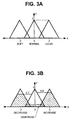
- the user enters his/her responses 11 by entering a number on a scale via, for example, a touch screen monitor. An example of how these responses could be interpreted are described next. If the stimuli sounds loud to him/her, then a high number ( 3) is entered on the membership graph for loudness scale shown in Fig. 2.
- the value of 3 on the x axis of said graph means that the sound level perceived by the user has a membership degree of 1 in the loud category and a membership degree of 0 in the soft and normal categories, as shown in the y axis of said graph.
- the membership degree numbers are the inputs to the fuzzy logic system 9.
- Fig. 2 a flow chart for purposes of enabling one of skill to understand and practice the invention, is shown of the fuzzy logic and its operation.
- the membership degrees in the objective input category termed speech-level in Fig 3 indicate that the level of the input signal to the hearing aid is very close in value to what a normal hearing user calls comfortable (membership degree 0.7). That same signal is characterized as “loud” by the hearing aid user as indicated by the subjective input termed “loudness” (membership degree 0.9, in loud category). This same signal is characterized as “low pitch” (membership degree 0.8) in the tonality scale and “almost unclear” (membership degree 0.5) in the clarity scale.
- Fig. 2 The implementation of the above examples of rules is illustrated in Fig. 2.
- the outcome of the implementation of the rules will be an increase, decrease or no change in the gain for the frequency/gain curve termed normal-target, corresponding to the target electroacoustic response of the hearing aid for normal level input sounds.
- the target curve is divided into low, mid, and high frequency sections for simplicity purposes. The gain of each of these sections can be increased, decreased, or remain unchanged, depending on the membership degree value assigned to it by the above inference rules.
- Rule #1 assigns the minimum of two membership degree values (that of the loud category in the loudness scale, and the comfortable category in the speech level scale) to the increase-high-frequency category of the normal-target-high-frequency scale.
- the resulting membership degree is 0.8. The same procedure is followed with the rest of the rules.
- the shaded area under each category gives a visual representation of the membership degree.
- the center of gravity of the shaded area is closer to 3 than to -3 in the x axis (close to 1).
- the centroid is a representative crisp value which indicates how many decibels of gain must be added to the high frequency target.
- Fig. 3 indicates a crisp value of 3dB should be subtracted from the mid and low frequency gain of the target curve.
- the satisfaction meter 8 can be based on the weighted accumulated changes of the target curves. Once a converging value is reached, this could be indication of having reached a point of diminishing returns in the fine tuning process.
Landscapes
- Engineering & Computer Science (AREA)
- Physics & Mathematics (AREA)
- Artificial Intelligence (AREA)
- Health & Medical Sciences (AREA)
- Software Systems (AREA)
- Evolutionary Computation (AREA)
- Acoustics & Sound (AREA)
- Signal Processing (AREA)
- Otolaryngology (AREA)
- Neurosurgery (AREA)
- Fuzzy Systems (AREA)
- Mathematical Physics (AREA)
- General Health & Medical Sciences (AREA)
- Automation & Control Theory (AREA)
- General Physics & Mathematics (AREA)
- Medical Informatics (AREA)
- Computer Vision & Pattern Recognition (AREA)
- Measurement Of The Respiration, Hearing Ability, Form, And Blood Characteristics Of Living Organisms (AREA)
- Peptides Or Proteins (AREA)
- Feedback Control In General (AREA)
- Medicines Containing Material From Animals Or Micro-Organisms (AREA)
- Medicines Containing Antibodies Or Antigens For Use As Internal Diagnostic Agents (AREA)
- Magnetic Resonance Imaging Apparatus (AREA)
- Manipulator (AREA)
Applications Claiming Priority (3)
| Application Number | Priority Date | Filing Date | Title |
|---|---|---|---|
| US6235497P | 1997-10-15 | 1997-10-15 | |
| US62354P | 1997-10-15 | ||
| PCT/US1998/021701 WO1999019779A1 (en) | 1997-10-15 | 1998-10-14 | A neurofuzzy based device for programmable hearing aids |
Publications (3)
| Publication Number | Publication Date |
|---|---|
| EP1023647A1 EP1023647A1 (en) | 2000-08-02 |
| EP1023647A4 EP1023647A4 (en) | 2000-12-06 |
| EP1023647B1 true EP1023647B1 (en) | 2005-04-13 |
Family
ID=22041920
Family Applications (1)
| Application Number | Title | Priority Date | Filing Date |
|---|---|---|---|
| EP98953507A Expired - Lifetime EP1023647B1 (en) | 1997-10-15 | 1998-10-14 | A neurofuzzy based device for programmable hearing aids |
Country Status (7)
| Country | Link |
|---|---|
| EP (1) | EP1023647B1 (enExample) |
| JP (1) | JP4384352B2 (enExample) |
| AT (1) | ATE293261T1 (enExample) |
| AU (1) | AU1086099A (enExample) |
| CA (1) | CA2305991A1 (enExample) |
| DE (1) | DE69829770T2 (enExample) |
| WO (1) | WO1999019779A1 (enExample) |
Cited By (1)
| Publication number | Priority date | Publication date | Assignee | Title |
|---|---|---|---|---|
| EP3808104A1 (en) * | 2018-06-15 | 2021-04-21 | Widex A/S | Method of fitting a hearing aid system and a hearing aid system |
Families Citing this family (16)
| Publication number | Priority date | Publication date | Assignee | Title |
|---|---|---|---|---|
| JP2001175637A (ja) * | 1999-12-15 | 2001-06-29 | Rion Co Ltd | システム最適化方法及びその装置 |
| DK1252799T3 (da) | 2000-01-20 | 2012-01-23 | Starkey Lab Inc | Fremgangsmåde og apparat til tilpasning af høreapparater |
| DE60109749T2 (de) * | 2000-01-21 | 2006-02-23 | Oticon A/S | Verfahren zur verbesserung des passens von hörgeräten sowie gerät zur implementierung des verfahrens |
| EP1453356B1 (de) | 2003-02-27 | 2012-10-31 | Siemens Audiologische Technik GmbH | Verfahren zum Einstellen eines Hörsystems und entsprechendes Hörsystem |
| WO2008031169A1 (en) * | 2006-09-14 | 2008-03-20 | Cochlear Limited | Medical implant configuration method |
| CA2687749A1 (en) * | 2007-06-13 | 2008-12-18 | Widex A/S | Method for user individualized fitting of a hearing aid |
| DE102007035174B4 (de) | 2007-07-27 | 2014-12-04 | Siemens Medical Instruments Pte. Ltd. | Hörvorrichtung gesteuert durch ein perzeptives Modell und entsprechendes Verfahren |
| CN101953176A (zh) * | 2008-02-20 | 2011-01-19 | 皇家飞利浦电子股份有限公司 | 音频设备及其操作方法 |
| EP2549397A1 (en) * | 2012-07-02 | 2013-01-23 | Oticon A/s | Method for customizing a hearing aid |
| US9131321B2 (en) * | 2013-05-28 | 2015-09-08 | Northwestern University | Hearing assistance device control |
| JP6625898B2 (ja) * | 2016-02-23 | 2019-12-25 | リオン株式会社 | 補聴器フィッティング装置、補聴器フィッティングプログラム、補聴器フィッティングサーバ、および補聴器フィッティング方法 |
| JP7272425B2 (ja) * | 2019-04-24 | 2023-05-12 | 日本電気株式会社 | フィッティング支援装置、フィッティング支援方法、及びプログラム |
| WO2021138603A1 (en) * | 2019-12-31 | 2021-07-08 | Starkey Laboratories, Inc. | Hearing assistance device model prediction |
| EP4393167A1 (en) * | 2021-08-25 | 2024-07-03 | Starkey Laboratories, Inc. | Hearing instrument fitting systems |
| CN117692855B (zh) * | 2023-12-07 | 2024-07-16 | 深圳子卿医疗器械有限公司 | 一种助听器语音质量评价方法及系统 |
| WO2025173233A1 (ja) * | 2024-02-16 | 2025-08-21 | Ntt株式会社 | 信号処理装置、方法及びプログラム |
Family Cites Families (3)
| Publication number | Priority date | Publication date | Assignee | Title |
|---|---|---|---|---|
| US4972487A (en) * | 1988-03-30 | 1990-11-20 | Diphon Development Ab | Auditory prosthesis with datalogging capability |
| DE59410167D1 (de) * | 1994-03-23 | 2002-09-19 | Siemens Audiologische Technik | Einrichtung zur Anpassung programmierbarer Hörgeräte |
| EP0712261A1 (de) * | 1994-11-10 | 1996-05-15 | Siemens Audiologische Technik GmbH | Programmierbares Hörgerät |
-
1998
- 1998-10-14 AT AT98953507T patent/ATE293261T1/de not_active IP Right Cessation
- 1998-10-14 EP EP98953507A patent/EP1023647B1/en not_active Expired - Lifetime
- 1998-10-14 AU AU10860/99A patent/AU1086099A/en not_active Abandoned
- 1998-10-14 WO PCT/US1998/021701 patent/WO1999019779A1/en not_active Ceased
- 1998-10-14 JP JP2000516266A patent/JP4384352B2/ja not_active Expired - Lifetime
- 1998-10-14 CA CA002305991A patent/CA2305991A1/en not_active Abandoned
- 1998-10-14 DE DE69829770T patent/DE69829770T2/de not_active Expired - Lifetime
Cited By (1)
| Publication number | Priority date | Publication date | Assignee | Title |
|---|---|---|---|---|
| EP3808104A1 (en) * | 2018-06-15 | 2021-04-21 | Widex A/S | Method of fitting a hearing aid system and a hearing aid system |
Also Published As
| Publication number | Publication date |
|---|---|
| EP1023647A4 (en) | 2000-12-06 |
| JP2001520412A (ja) | 2001-10-30 |
| DE69829770D1 (de) | 2005-05-19 |
| AU1086099A (en) | 1999-05-03 |
| DE69829770T2 (de) | 2005-09-01 |
| CA2305991A1 (en) | 1999-04-22 |
| EP1023647A1 (en) | 2000-08-02 |
| ATE293261T1 (de) | 2005-04-15 |
| JP4384352B2 (ja) | 2009-12-16 |
| WO1999019779A1 (en) | 1999-04-22 |
Similar Documents
| Publication | Publication Date | Title |
|---|---|---|
| US7187778B2 (en) | Neurofuzzy based device for programmable hearing aids | |
| EP1023647B1 (en) | A neurofuzzy based device for programmable hearing aids | |
| EP0341997B1 (en) | Auditory prosthesis fitting using vectors | |
| US8265765B2 (en) | Multimodal auditory fitting | |
| US5604812A (en) | Programmable hearing aid with automatic adaption to auditory conditions | |
| US6035050A (en) | Programmable hearing aid system and method for determining optimum parameter sets in a hearing aid | |
| US8194899B2 (en) | Method for improving the fitting of hearing aids and device for implementing the method | |
| US8532317B2 (en) | Programmable auditory prosthesis with trainable automatic adaptation to acoustic conditions | |
| US8301259B2 (en) | Using a genetic algorithm to fit a cochlear implant system to a patient | |
| US4953112A (en) | Method and apparatus for determining acoustic parameters of an auditory prosthesis using software model | |
| US20080056518A1 (en) | System for and Method of Optimizing an Individual's Hearing Aid | |
| Humes | An evaluation of several rationales for selecting hearing aid gain | |
| EP2752032A1 (en) | System and method for fitting of a hearing device | |
| EP1767058A1 (en) | Hearing device sound simulation system and method of using the system | |
| US7024000B1 (en) | Adjustment of a hearing aid using a phone | |
| US20210361193A1 (en) | Optimization tool for auditory devices | |
| WO1990009760A1 (en) | Apparatus and a method for fitting a hearing aid | |
| US8755533B2 (en) | Automatic performance optimization for perceptual devices | |
| EP3494711A1 (en) | Method for selecting and adjusting in a customised manner a hearing aid | |
| CN114339564A (zh) | 一种基于神经网络的用户自适应助听器自验配方法 | |
| Rennies et al. | User-interface concepts for sound personalization in headphones | |
| Vecchi et al. | Hearing-impaired sound perception: What can we learn from a biophysical model of the human auditory periphery | |
| CN116996823A (zh) | 包括以辅助参数为条件的信号处理网络的助听器 | |
| Hecox et al. | The impact of digital technology on the selection and fitting of hearing aids | |
| EP4661430A1 (en) | Vent-dependent fitting system steering |
Legal Events
| Date | Code | Title | Description |
|---|---|---|---|
| PUAI | Public reference made under article 153(3) epc to a published international application that has entered the european phase |
Free format text: ORIGINAL CODE: 0009012 |
|
| 17P | Request for examination filed |
Effective date: 20000502 |
|
| AK | Designated contracting states |
Kind code of ref document: A1 Designated state(s): AT BE CH DE DK ES FR GB IT LI NL SE |
|
| A4 | Supplementary search report drawn up and despatched |
Effective date: 20001023 |
|
| AK | Designated contracting states |
Kind code of ref document: A4 Designated state(s): AT BE CH DE DK ES FR GB IT LI NL SE |
|
| RIC1 | Information provided on ipc code assigned before grant |
Free format text: 7G 05B 13/02 A, 7H 04R 25/00 B |
|
| 17Q | First examination report despatched |
Effective date: 20030409 |
|
| GRAP | Despatch of communication of intention to grant a patent |
Free format text: ORIGINAL CODE: EPIDOSNIGR1 |
|
| GRAS | Grant fee paid |
Free format text: ORIGINAL CODE: EPIDOSNIGR3 |
|
| GRAA | (expected) grant |
Free format text: ORIGINAL CODE: 0009210 |
|
| AK | Designated contracting states |
Kind code of ref document: B1 Designated state(s): AT BE CH DE DK ES FR GB IT LI NL SE |
|
| PG25 | Lapsed in a contracting state [announced via postgrant information from national office to epo] |
Ref country code: NL Free format text: LAPSE BECAUSE OF FAILURE TO SUBMIT A TRANSLATION OF THE DESCRIPTION OR TO PAY THE FEE WITHIN THE PRESCRIBED TIME-LIMIT Effective date: 20050413 Ref country code: LI Free format text: LAPSE BECAUSE OF FAILURE TO SUBMIT A TRANSLATION OF THE DESCRIPTION OR TO PAY THE FEE WITHIN THE PRESCRIBED TIME-LIMIT Effective date: 20050413 Ref country code: IT Free format text: LAPSE BECAUSE OF FAILURE TO SUBMIT A TRANSLATION OF THE DESCRIPTION OR TO PAY THE FEE WITHIN THE PRESCRIBED TIME-LIMIT;WARNING: LAPSES OF ITALIAN PATENTS WITH EFFECTIVE DATE BEFORE 2007 MAY HAVE OCCURRED AT ANY TIME BEFORE 2007. THE CORRECT EFFECTIVE DATE MAY BE DIFFERENT FROM THE ONE RECORDED. Effective date: 20050413 Ref country code: ES Free format text: LAPSE BECAUSE OF FAILURE TO SUBMIT A TRANSLATION OF THE DESCRIPTION OR TO PAY THE FEE WITHIN THE PRESCRIBED TIME-LIMIT Effective date: 20050413 Ref country code: CH Free format text: LAPSE BECAUSE OF FAILURE TO SUBMIT A TRANSLATION OF THE DESCRIPTION OR TO PAY THE FEE WITHIN THE PRESCRIBED TIME-LIMIT Effective date: 20050413 Ref country code: BE Free format text: LAPSE BECAUSE OF FAILURE TO SUBMIT A TRANSLATION OF THE DESCRIPTION OR TO PAY THE FEE WITHIN THE PRESCRIBED TIME-LIMIT Effective date: 20050413 Ref country code: AT Free format text: LAPSE BECAUSE OF FAILURE TO SUBMIT A TRANSLATION OF THE DESCRIPTION OR TO PAY THE FEE WITHIN THE PRESCRIBED TIME-LIMIT Effective date: 20050413 |
|
| REG | Reference to a national code |
Ref country code: GB Ref legal event code: FG4D |
|
| REG | Reference to a national code |
Ref country code: CH Ref legal event code: EP |
|
| REF | Corresponds to: |
Ref document number: 69829770 Country of ref document: DE Date of ref document: 20050519 Kind code of ref document: P |
|
| PG25 | Lapsed in a contracting state [announced via postgrant information from national office to epo] |
Ref country code: SE Free format text: LAPSE BECAUSE OF FAILURE TO SUBMIT A TRANSLATION OF THE DESCRIPTION OR TO PAY THE FEE WITHIN THE PRESCRIBED TIME-LIMIT Effective date: 20050713 Ref country code: DK Free format text: LAPSE BECAUSE OF FAILURE TO SUBMIT A TRANSLATION OF THE DESCRIPTION OR TO PAY THE FEE WITHIN THE PRESCRIBED TIME-LIMIT Effective date: 20050713 |
|
| NLV1 | Nl: lapsed or annulled due to failure to fulfill the requirements of art. 29p and 29m of the patents act | ||
| REG | Reference to a national code |
Ref country code: CH Ref legal event code: PL |
|
| ET | Fr: translation filed | ||
| PLBE | No opposition filed within time limit |
Free format text: ORIGINAL CODE: 0009261 |
|
| STAA | Information on the status of an ep patent application or granted ep patent |
Free format text: STATUS: NO OPPOSITION FILED WITHIN TIME LIMIT |
|
| 26N | No opposition filed |
Effective date: 20060116 |
|
| PGFP | Annual fee paid to national office [announced via postgrant information from national office to epo] |
Ref country code: GB Payment date: 20141022 Year of fee payment: 17 Ref country code: DE Payment date: 20141024 Year of fee payment: 17 Ref country code: FR Payment date: 20141031 Year of fee payment: 17 |
|
| REG | Reference to a national code |
Ref country code: DE Ref legal event code: R119 Ref document number: 69829770 Country of ref document: DE |
|
| GBPC | Gb: european patent ceased through non-payment of renewal fee |
Effective date: 20151014 |
|
| PG25 | Lapsed in a contracting state [announced via postgrant information from national office to epo] |
Ref country code: GB Free format text: LAPSE BECAUSE OF NON-PAYMENT OF DUE FEES Effective date: 20151014 Ref country code: DE Free format text: LAPSE BECAUSE OF NON-PAYMENT OF DUE FEES Effective date: 20160503 |
|
| REG | Reference to a national code |
Ref country code: FR Ref legal event code: ST Effective date: 20160630 |
|
| PG25 | Lapsed in a contracting state [announced via postgrant information from national office to epo] |
Ref country code: FR Free format text: LAPSE BECAUSE OF NON-PAYMENT OF DUE FEES Effective date: 20151102 |