EP1021600B1 - A method for significantly enhancing the quality of scoured wool and machinery for achieving those enhancements - Google Patents
A method for significantly enhancing the quality of scoured wool and machinery for achieving those enhancements Download PDFInfo
- Publication number
- EP1021600B1 EP1021600B1 EP98946737A EP98946737A EP1021600B1 EP 1021600 B1 EP1021600 B1 EP 1021600B1 EP 98946737 A EP98946737 A EP 98946737A EP 98946737 A EP98946737 A EP 98946737A EP 1021600 B1 EP1021600 B1 EP 1021600B1
- Authority
- EP
- European Patent Office
- Prior art keywords
- fibre
- wool
- scouring
- bowl
- fibres
- Prior art date
- Legal status (The legal status is an assumption and is not a legal conclusion. Google has not performed a legal analysis and makes no representation as to the accuracy of the status listed.)
- Expired - Lifetime
Links
- 210000002268 wool Anatomy 0.000 title claims description 78
- 238000000034 method Methods 0.000 title claims description 61
- 230000002708 enhancing effect Effects 0.000 title 1
- 230000008569 process Effects 0.000 claims description 52
- 238000009991 scouring Methods 0.000 claims description 36
- XEEYBQQBJWHFJM-UHFFFAOYSA-N Iron Chemical compound [Fe] XEEYBQQBJWHFJM-UHFFFAOYSA-N 0.000 claims description 30
- 239000000835 fiber Substances 0.000 claims description 27
- 150000002978 peroxides Chemical class 0.000 claims description 26
- 238000012545 processing Methods 0.000 claims description 21
- 229910052742 iron Inorganic materials 0.000 claims description 15
- 239000003599 detergent Substances 0.000 claims description 12
- 238000001035 drying Methods 0.000 claims description 12
- 239000002253 acid Substances 0.000 claims description 11
- 238000004061 bleaching Methods 0.000 claims description 11
- 239000003638 chemical reducing agent Substances 0.000 claims description 11
- 230000008901 benefit Effects 0.000 claims description 10
- 239000000428 dust Substances 0.000 claims description 10
- 239000002270 dispersing agent Substances 0.000 claims description 9
- 238000004043 dyeing Methods 0.000 claims description 9
- 238000000605 extraction Methods 0.000 claims description 9
- 239000002689 soil Substances 0.000 claims description 9
- 238000006722 reduction reaction Methods 0.000 claims description 7
- 239000004519 grease Substances 0.000 claims description 6
- 239000000575 pesticide Substances 0.000 claims description 6
- 239000007844 bleaching agent Substances 0.000 claims description 5
- 238000010981 drying operation Methods 0.000 claims description 5
- 235000019388 lanolin Nutrition 0.000 claims description 4
- 238000006386 neutralization reaction Methods 0.000 claims description 4
- 150000003839 salts Chemical class 0.000 claims description 3
- 239000003352 sequestering agent Substances 0.000 claims description 3
- 239000003929 acidic solution Substances 0.000 claims description 2
- 230000006866 deterioration Effects 0.000 claims description 2
- 238000010348 incorporation Methods 0.000 claims description 2
- 238000009896 oxidative bleaching Methods 0.000 claims description 2
- 102000004169 proteins and genes Human genes 0.000 claims description 2
- 108090000623 proteins and genes Proteins 0.000 claims description 2
- 239000000126 substance Substances 0.000 description 10
- YMWUJEATGCHHMB-UHFFFAOYSA-N Dichloromethane Chemical compound ClCCl YMWUJEATGCHHMB-UHFFFAOYSA-N 0.000 description 6
- 230000006872 improvement Effects 0.000 description 6
- 239000000463 material Substances 0.000 description 5
- 238000005516 engineering process Methods 0.000 description 4
- 150000002632 lipids Chemical class 0.000 description 4
- 230000009467 reduction Effects 0.000 description 4
- 238000011282 treatment Methods 0.000 description 4
- MHAJPDPJQMAIIY-UHFFFAOYSA-N Hydrogen peroxide Chemical compound OO MHAJPDPJQMAIIY-UHFFFAOYSA-N 0.000 description 3
- 238000012993 chemical processing Methods 0.000 description 3
- 238000004140 cleaning Methods 0.000 description 3
- 238000011109 contamination Methods 0.000 description 3
- ORWQBKPSGDRPPA-UHFFFAOYSA-N 3-[2-[ethyl(methyl)amino]ethyl]-1h-indol-4-ol Chemical compound C1=CC(O)=C2C(CCN(C)CC)=CNC2=C1 ORWQBKPSGDRPPA-UHFFFAOYSA-N 0.000 description 2
- CURLTUGMZLYLDI-UHFFFAOYSA-N Carbon dioxide Chemical compound O=C=O CURLTUGMZLYLDI-UHFFFAOYSA-N 0.000 description 2
- KCXVZYZYPLLWCC-UHFFFAOYSA-N EDTA Chemical compound OC(=O)CN(CC(O)=O)CCN(CC(O)=O)CC(O)=O KCXVZYZYPLLWCC-UHFFFAOYSA-N 0.000 description 2
- 239000004411 aluminium Substances 0.000 description 2
- 229910052782 aluminium Inorganic materials 0.000 description 2
- XAGFODPZIPBFFR-UHFFFAOYSA-N aluminium Chemical compound [Al] XAGFODPZIPBFFR-UHFFFAOYSA-N 0.000 description 2
- 238000010924 continuous production Methods 0.000 description 2
- 229960001484 edetic acid Drugs 0.000 description 2
- 239000002245 particle Substances 0.000 description 2
- 238000004088 simulation Methods 0.000 description 2
- 238000010186 staining Methods 0.000 description 2
- 238000004383 yellowing Methods 0.000 description 2
- 239000005946 Cypermethrin Substances 0.000 description 1
- 239000005892 Deltamethrin Substances 0.000 description 1
- WGOWCPGHOCIHBW-UHFFFAOYSA-N Dichlofenthion Chemical compound CCOP(=S)(OCC)OC1=CC=C(Cl)C=C1Cl WGOWCPGHOCIHBW-UHFFFAOYSA-N 0.000 description 1
- CWYNVVGOOAEACU-UHFFFAOYSA-N Fe2+ Chemical compound [Fe+2] CWYNVVGOOAEACU-UHFFFAOYSA-N 0.000 description 1
- DWAQJAXMDSEUJJ-UHFFFAOYSA-M Sodium bisulfite Chemical compound [Na+].OS([O-])=O DWAQJAXMDSEUJJ-UHFFFAOYSA-M 0.000 description 1
- FSAVDKDHPDSCTO-WQLSENKSSA-N [(z)-2-chloro-1-(2,4-dichlorophenyl)ethenyl] diethyl phosphate Chemical compound CCOP(=O)(OCC)O\C(=C/Cl)C1=CC=C(Cl)C=C1Cl FSAVDKDHPDSCTO-WQLSENKSSA-N 0.000 description 1
- 238000010306 acid treatment Methods 0.000 description 1
- 230000002378 acidificating effect Effects 0.000 description 1
- 238000007792 addition Methods 0.000 description 1
- 238000004458 analytical method Methods 0.000 description 1
- 230000033228 biological regulation Effects 0.000 description 1
- 238000009835 boiling Methods 0.000 description 1
- 239000001569 carbon dioxide Substances 0.000 description 1
- 229910002092 carbon dioxide Inorganic materials 0.000 description 1
- 210000000170 cell membrane Anatomy 0.000 description 1
- 230000008859 change Effects 0.000 description 1
- 238000001311 chemical methods and process Methods 0.000 description 1
- 238000006243 chemical reaction Methods 0.000 description 1
- SBPBAQFWLVIOKP-UHFFFAOYSA-N chlorpyrifos Chemical compound CCOP(=S)(OCC)OC1=NC(Cl)=C(Cl)C=C1Cl SBPBAQFWLVIOKP-UHFFFAOYSA-N 0.000 description 1
- 239000003086 colorant Substances 0.000 description 1
- BXNANOICGRISHX-UHFFFAOYSA-N coumaphos Chemical compound CC1=C(Cl)C(=O)OC2=CC(OP(=S)(OCC)OCC)=CC=C21 BXNANOICGRISHX-UHFFFAOYSA-N 0.000 description 1
- ZXQYGBMAQZUVMI-UNOMPAQXSA-N cyhalothrin Chemical compound CC1(C)C(\C=C(/Cl)C(F)(F)F)C1C(=O)OC(C#N)C1=CC=CC(OC=2C=CC=CC=2)=C1 ZXQYGBMAQZUVMI-UNOMPAQXSA-N 0.000 description 1
- 229960005424 cypermethrin Drugs 0.000 description 1
- KAATUXNTWXVJKI-UHFFFAOYSA-N cypermethrin Chemical compound CC1(C)C(C=C(Cl)Cl)C1C(=O)OC(C#N)C1=CC=CC(OC=2C=CC=CC=2)=C1 KAATUXNTWXVJKI-UHFFFAOYSA-N 0.000 description 1
- 229960002483 decamethrin Drugs 0.000 description 1
- OWZREIFADZCYQD-NSHGMRRFSA-N deltamethrin Chemical compound CC1(C)[C@@H](C=C(Br)Br)[C@H]1C(=O)O[C@H](C#N)C1=CC=CC(OC=2C=CC=CC=2)=C1 OWZREIFADZCYQD-NSHGMRRFSA-N 0.000 description 1
- FHIVAFMUCKRCQO-UHFFFAOYSA-N diazinon Chemical compound CCOP(=S)(OCC)OC1=CC(C)=NC(C(C)C)=N1 FHIVAFMUCKRCQO-UHFFFAOYSA-N 0.000 description 1
- 239000002027 dichloromethane extract Substances 0.000 description 1
- 238000002845 discoloration Methods 0.000 description 1
- 238000011143 downstream manufacturing Methods 0.000 description 1
- 238000010410 dusting Methods 0.000 description 1
- 239000000975 dye Substances 0.000 description 1
- 239000013057 ectoparasiticide Substances 0.000 description 1
- 230000008030 elimination Effects 0.000 description 1
- 238000003379 elimination reaction Methods 0.000 description 1
- 239000000284 extract Substances 0.000 description 1
- 210000004209 hair Anatomy 0.000 description 1
- 231100000206 health hazard Toxicity 0.000 description 1
- 150000002506 iron compounds Chemical class 0.000 description 1
- 239000000314 lubricant Substances 0.000 description 1
- 230000014759 maintenance of location Effects 0.000 description 1
- 238000004519 manufacturing process Methods 0.000 description 1
- 238000005007 materials handling Methods 0.000 description 1
- 229910052751 metal Inorganic materials 0.000 description 1
- 239000002184 metal Substances 0.000 description 1
- 230000007935 neutral effect Effects 0.000 description 1
- 230000003472 neutralizing effect Effects 0.000 description 1
- 239000003960 organic solvent Substances 0.000 description 1
- 239000000447 pesticide residue Substances 0.000 description 1
- 238000011112 process operation Methods 0.000 description 1
- 230000002035 prolonged effect Effects 0.000 description 1
- BZNDWPRGXNILMS-VQHVLOKHSA-N propetamphos Chemical compound CCNP(=S)(OC)O\C(C)=C\C(=O)OC(C)C BZNDWPRGXNILMS-VQHVLOKHSA-N 0.000 description 1
- 230000035484 reaction time Effects 0.000 description 1
- 238000011084 recovery Methods 0.000 description 1
- 230000000717 retained effect Effects 0.000 description 1
- JVBXVOWTABLYPX-UHFFFAOYSA-L sodium dithionite Chemical compound [Na+].[Na+].[O-]S(=O)S([O-])=O JVBXVOWTABLYPX-UHFFFAOYSA-L 0.000 description 1
- 239000004289 sodium hydrogen sulphite Substances 0.000 description 1
- 235000010267 sodium hydrogen sulphite Nutrition 0.000 description 1
- 239000007787 solid Substances 0.000 description 1
- 239000000243 solution Substances 0.000 description 1
- 239000002904 solvent Substances 0.000 description 1
- 230000003019 stabilising effect Effects 0.000 description 1
- 238000003860 storage Methods 0.000 description 1
- 239000000758 substrate Substances 0.000 description 1
Images


Classifications
-
- D—TEXTILES; PAPER
- D01—NATURAL OR MAN-MADE THREADS OR FIBRES; SPINNING
- D01C—CHEMICAL OR BIOLOGICAL TREATMENT OF NATURAL FILAMENTARY OR FIBROUS MATERIAL TO OBTAIN FILAMENTS OR FIBRES FOR SPINNING; CARBONISING RAGS TO RECOVER ANIMAL FIBRES
- D01C3/00—Treatment of animal material, e.g. chemical scouring of wool
-
- D—TEXTILES; PAPER
- D01—NATURAL OR MAN-MADE THREADS OR FIBRES; SPINNING
- D01B—MECHANICAL TREATMENT OF NATURAL FIBROUS OR FILAMENTARY MATERIAL TO OBTAIN FIBRES OF FILAMENTS, e.g. FOR SPINNING
- D01B3/00—Mechanical removal of impurities from animal fibres
- D01B3/04—Machines or apparatus for washing or scouring loose wool fibres
- D01B3/10—Details of machines or apparatus
Definitions
- This invention relates to a new method of scouring and chemically processing wool or other like fibre in a modified scour in order to produce scoured fibres very much improved in respect of a number of important quality parameters. This process is for brevity and convenience referred to as "Superscouring”.
- Peroxide bleaching is a well-known adjunct to conventional wool scouring in New Zealand and elsewhere.
- the usual process involves passage of the wool through a hot bowl (invariably the final bowl in the train) containing from 1-10 g/l of hydrogen peroxide, with high pressure squeezing, and entry to a wool dryer where most of the bleaching occurs (although some may continue in the baled wool).
- this form of peroxide bleaching has a major disadvantage in that when the wool is dyed, peroxide residues present in the fibre initiate yellowing reactions which cause the substrate colour of the product being dyed often to be poorer than the original unbleached wool. This phenomenon is dubbed "colour reversion".
- FR 15 79174 A relates to a process for scouring wool using against solvents GB 2 047 293 A relates to a process for scouring greasy animal hair material using organic solvents.
- DE 2 756 979 A relates to a wool-scouring process using aqueous detergents.
- the invention therefore provides in a fibre scouring process of at least two parts, wherein in a first part fibres are subjected to process steps to remove woolgrease and dirt, the process steps incorporating a peroxide bleaching step carried out in a bowl or pad and drying, rewetting and chemical reduction, and wherein in a second part there is incorporated a step of subjecting the fibres to an acidic solution of a sequestering agent and a reducing agent to thereby remove absorbed iron, to bleach the fibre protein to thereby greatly improve the brightness (Y tristimulus value) of the fibres, remove peroxide residues from the fibres. stabilise the colour benefit from any previous oxidative bleaching step, and prevent subsequent colour deterioration during dyeing.
- the invention also provides:
- the scouring process can involve drying the wool at both an intermediate and final stage, in which the drying operations can be conveniently and economically earned out by combining them within one integrated drying module.
- the invention also provides:
- This invention allows these improved qualities to be achieved concurrently in a single pass through a substantially revised configuration of scouring machinery components.
- the applicant proposes an efficient and logistically acceptable plant configuration in which this process can be incorporated into a single.process pass.
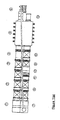
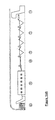
- FIG. 1(a to d) The plant configuration shown in Figures 1(a to d) incorporates a number of features, brief details of which are detailed in Table 1 below. Describing the numbered features of Figures 1(a to d). Number Feature Function 1 Greasy feed Combination of feed hoppers and weighbelt to present even wool mat to scour. 2 Scouring bowls Conventional wool scouring (mini)bowls containing detergent to remove woolgrease, suint, and dirt. 3 Rinsing bowl Additional wool cleaning. 4 Peroxide applicator Application of hydrogen peroxide solution to wool. 5 Twin channel dryer Intermediate drying of wool to develop peroxide bleach and assist subsequent soil removal. 6 Scoured wool cleaner Mechanical cleaner to remove larger particles of dirt from dry wool.
- Scoured feed Feed hopper to present even wool mat to second stage of scour.
- Polish scouring and dispersing 2 scouring bowls containing detergent and dispersant to remove fine residual dirt, and chemical reducing agent to destroy peroxide residues.
- Accumulator/hopper Storage hopper to allow adequate reaction time for iron removal.
- Neutralising bowl Returns wool to neutral pH.
- Hot rinse bowl or chemical application bowl Removes remaining chemicals, and applies additional chemical treatments if required.
- peroxide is applied by a pad applicator [4], dried onto the wool in the first dryer pass, and neutralised with reducing agent in the second bowl of the parallel train [8].
- peroxide can be applied in a conventional bowl which may be bowl 3-6 of the first wet process stage prior to intermediate drying.
- brightness enhancements of a further three Y units can be achieved with limited peroxide additions, and the yellowness (Y-Z) reduced down to a level below that of the original scoured wool, so that the wool is both much brighter and somewhat whiter than conventionally scoured wool.
- the peroxide bleached wool is initially of excellent colour, but on dyeing it becomes duller and quite yellow.
- the Superscoured wool in which the peroxide residues are neutralised (peroxide bleached and reduced) is much more colour stable when blank dyed, and remains substantially superior to the scoured-only material.
- Residual dirt is also undesirable in processing because it leads to contamination of equipment, especially cards, with sticky combinations of dirt, fibre debris, and processing lubricant. It is to be expected that the product from Superscouring will be preferred by spinners on process efficiency grounds, because of reduced frequency of card fettling (ie, cleaning).
- the process train in Figures 1(a to d) includes at an intermediate stage a scoured wool cleaner which is existing technology well known to be effective in removal of dust and short broken fibre. Subsequent additional wet processing of this cleaned fibre will result in the removal of yet more dust and fine debris, therefore giving a product which is more free of dust than normal scoured wool.
- Superscoured wool has had the absorbed ferrous iron removed by acid extraction, and the superficial oxidised iron removed by detergents and dispersants in the second phase of wet treatment.
- Superscoured wool therefore eliminates the potential dangers of iron-related processing problems for the spinner and carpet maker. Faulty carpet arising from minor iron compound variations in yarn, leading to stripes in the product, has been a major problem in industry, which is now able to be obviated by the use of Superscoured wool.
- Table 5 assumes all wet process operations are carried out in conventional bowls. However, it is possible with some simplification and space saving to replace chemical application stations with pad-store devices, taking the place of bowl 5 and bowls 8-9 in Table 5.
- 3 hot scouring bowls 1 warm rinsing bowl, 1 hot peroxide bleaching bowl, a dryer, a scoured wool cleaner, a hopper for relaying the wool mat, 2 second stage hot detergent/dispersant bowls, an acid extraction bowl, an alkaline neutralisation bowl, a hot rinse bowl, and a further dryer.
Landscapes
- Engineering & Computer Science (AREA)
- Textile Engineering (AREA)
- General Chemical & Material Sciences (AREA)
- Life Sciences & Earth Sciences (AREA)
- Chemical & Material Sciences (AREA)
- Mechanical Engineering (AREA)
- Animal Husbandry (AREA)
- Health & Medical Sciences (AREA)
- Chemical Kinetics & Catalysis (AREA)
- Molecular Biology (AREA)
- Wood Science & Technology (AREA)
- Zoology (AREA)
- Detergent Compositions (AREA)
- Chemical Or Physical Treatment Of Fibers (AREA)
- Treatment Of Fiber Materials (AREA)
Description
- major improvements in the brightness of scoured wool, as measured by its Y tristimulus value, measured on wool in the 'as-is' state as it comes from the scour. On good-quality New Zealand crossbred fleece wools these increases may be as high as 8-9 units in Y, compared to conventionally scoured wool.
- stability of the enhanced colour of the wool to subsequent dyeing, in contrast to conventional bleaching processes, Where much of the colour benefit is lost by a yellowing process occurring during dyeing.
- very large reductions (on a proportionate basis) of residual grease levels on the scoured wool, down to virtually negligible remaining levels of superficial woolgrease (as distinct from internal wool lipids), which in turn mean that the levels of residual lipophilic ectoparasiticides on the wool are sufficiently reduced to comply with pesticide content regulations.
- very substantially reduced contamination of the wool by finely divided residual soil particles, thereby producing not only a brighter wool but one which avoids downstream processing problems associated with residual dirt.
- a wool that is comparatively dust free compared to conventionally scoured wool.
- a wool that is substantially reduced in its iron content, both as to the iron associated with residual dirt, and the iron that is chemically absorbed and bound within the fibre.
| Describing the numbered features of Figures 1(a to d). | ||
| Number | Feature | Function |
| 1 | Greasy feed | Combination of feed hoppers and weighbelt to present even wool mat to scour. |
| 2 | Scouring bowls | Conventional wool scouring (mini)bowls containing detergent to remove woolgrease, suint, and dirt. |
| 3 | Rinsing bowl | Additional wool cleaning. |
| 4 | Peroxide applicator | Application of hydrogen peroxide solution to wool. |
| 5 | Twin channel dryer | Intermediate drying of wool to develop peroxide bleach and assist subsequent soil removal. |
| 6 | Scoured wool cleaner | Mechanical cleaner to remove larger particles of dirt from dry wool. |
| 7 | Scoured feed | Feed hopper to present even wool mat to second stage of scour. |
| 8 | Polish scouring and dispersing | 2 scouring bowls containing detergent and dispersant to remove fine residual dirt, and chemical reducing agent to destroy peroxide residues. |
| 9 | Acid applicator | Application of acidic iron-complexing chemicals to wool for iron removal. Optionally may contain reducing agent. |
| 10 | Accumulator/hopper | Storage hopper to allow adequate reaction time for iron removal. |
| 11 | Neutralising bowl | Returns wool to neutral pH. |
| 12 | Hot rinse bowl or chemical application bowl | Removes remaining chemicals, and applies additional chemical treatments if required. |
| COLOUR PROPERTIES OF NORMALLY SCOURED, PEROXIDE BLEACHED, AND SUPERSCOURED WOOL | |||
| Y | Z | Y-Z | |
| BEFORE BLANK DYEING | |||
| Scoured only | 63.5 | 60.3 | 3.2 |
| Peroxide bleached | 68.1 | 68.4 | -0.3 |
| Peroxide bleached + reduction | |||
| treatment in Superscouring | 69.5 | 68.5 | 1.0 |
| AFTER BLANK DYEING | |||
| Scoured only | 65.7 | 59.7 | 6.0 |
| Peroxide bleached | 63.6 | 57.4 | 6.2 |
| Peroxide bleached + reduction | |||
| treatment in Superscouring | 67.5 | 63.1 | 4.4 |
| PESTICIDE RESIDUE CONTENTS (µg/g) IN GREASY, NORMALLY SCOURED, AND SUPERSCOURED WOOL (FOLLOWING LIPID EXTRACTION WITH SUPERCRITICAL CARBON DIOXIDE) | |||
| SAMPLE | GREASY | NORMALLY SCOURED | SUPERSCOURED |
| Propetamphos | 8.19 | 0.20 | 0.01 |
| Diazinon | 6.50 | 0.09 | 0.01 |
| Dichlofenthion | 6.13 | 0.13 | 0.02 |
| Chloropyriphos | 12.07 | 0.08 | 0.01 |
| Chlorfenvinphos | 7.42 | 0.13 | 0.01 |
| Cyhalothrin | 6.83 | 0.05 | 0.01 |
| Coumaphos | 12.34 | 0.12 | 0.01 |
| Cypermethrin | 9.52 | 0.08 | 0.01 |
| Deltamethrin | 7.60 | 0.03 | 0.00 |
| Total | 76.60 | 0.91 | 0.09 |
Subsequent additional wet processing of this cleaned fibre will result in the removal of yet more dust and fine debris, therefore giving a product which is more free of dust than normal scoured wool.
| COLOUR CHANGES IN YARN DURING PROLONGED CHEMICAL SETTING | |||||
| 'As-is' colour | Base colour | ||||
| Y | Z | Y | Z | ||
| Normal scoured wool | Start of run | 58.3 | 56.8 | 60.9 | 59.7 |
| End of run | 56.2 | 54.7 | 59.6 | 58.5 | |
| Superscoured wool | Start of run | 63.0 | 63.3 | 65.1 | 65.8 |
| End of run | 62.4 | 62.7 | 65.1 | 65.6 |

Claims (11)
- A fibre scouring process of at least two parts, wherein in a first part fibres are subjected to process steps to remove woolgrease and dirt (1-3), the process steps incorporating a peroxide bleaching step (4) carried out in a bowl or pad, and drying (5) rewetting and chemical reduction, and wherein in a second part there is incorporated a step of subjecting the fibres to an acidic solution of a sequestering agent and a reducing agent to thereby remove absorbed iron (9-10), to bleach the fibre protein to thereby improve the brightness of the fibres, remove peroxide residues from the fibres, stabilise the colour benefit from any previous oxidative bleaching step, and prevent subsequent colour deterioration during dyeing.
- A fibre scouring process as claimed in claim 1 in which scoured clean fibres are dried and dusted, and then reimmersed in liquors containing detergents and dispersants (8), thereby effectivety removing extra amounts of dirt.
- A fibre scouring process as claimed in claim 1 or claim 2 involving two separate stages of wet processing to thereby reduce residual grease and residual pesticide levels and minimise dangers of market resistance associated with traces of animal-remedy pesticides.
- A fibre scouring process as claimed in any one of the preceding claims wherein the peroxide bleaching step is applied by a pad (4), dried onto the wool in a first dryer pass, and neutralised with reducing agent in a bowl (9-10) of a parallel scouring train.
- A fibre scouring process as claimed in any one of preceding claims 1 to 3 wherein the peroxide bleaching step is applied in a conventional bowl of a first wet process stage which is prior to intermediate drying (8).
- A fibre scouring process as claimed in any one of the preceding claims wherein the incorporation of extra scouring steps, in the first two bowls of the second stage of the process, enables low residual grease levels to be obtained.
- A fibre scouring process as claimed in claim 6 wherein detergents and dispersants are employed together in the first two bowls of the second bowl train (8) so there are only low levels of dissolved salts present, and in these bowls further effective residual soil removal from the fibre is achieved.
- A fibre scouring process as claimed in claim 6 wherein the process includes at an intermediate stage a scoured fibre cleaner (6) for effective removal of dust and short broken fibre.
- A fibre scouring process as claimed in claim 8 wherein subsequent additional wet processing of this cleaned fibre results in the removal of yet more dust and fine debris.
- A fibre scouring process as claimed in claim 1 wherein a pad (9) is used for acid application and wherein completion of an acid extraction step is carried out during a dwell time in a small accumulator (10) attached to a wet-feed hopper which feeds the subsequent neutralisation bowl (11).
- A fibre scouring process as claimed in claim 1 wherein a scouring plant layout includes bringing two wet processing sections together in parallel, and combining two drying operations within a single drying unit (5) so that after passing through a first section of the two wet processing sections, and through the dryer the first time, the fibres are cleaned in a scoured fibre cleaner (6) and conveyed pneumatically or by conveyor, to the feed hopper (7) of the second section of the wet processing sections.
Applications Claiming Priority (3)
| Application Number | Priority Date | Filing Date | Title |
|---|---|---|---|
| NZ32885597 | 1997-09-26 | ||
| NZ32885597 | 1997-09-26 | ||
| PCT/NZ1998/000144 WO1999016942A1 (en) | 1997-09-26 | 1998-09-25 | A method for significantly enhancing the quality of scoured wool and machinery for achieving those enhancements |
Publications (3)
| Publication Number | Publication Date |
|---|---|
| EP1021600A1 EP1021600A1 (en) | 2000-07-26 |
| EP1021600A4 EP1021600A4 (en) | 2000-12-20 |
| EP1021600B1 true EP1021600B1 (en) | 2005-03-02 |
Family
ID=19926461
Family Applications (1)
| Application Number | Title | Priority Date | Filing Date |
|---|---|---|---|
| EP98946737A Expired - Lifetime EP1021600B1 (en) | 1997-09-26 | 1998-09-25 | A method for significantly enhancing the quality of scoured wool and machinery for achieving those enhancements |
Country Status (8)
| Country | Link |
|---|---|
| US (1) | US6537326B1 (en) |
| EP (1) | EP1021600B1 (en) |
| JP (1) | JP2001518568A (en) |
| CN (1) | CN1265033C (en) |
| AU (1) | AU754431B2 (en) |
| DE (1) | DE69829195D1 (en) |
| TR (1) | TR200000866T2 (en) |
| WO (1) | WO1999016942A1 (en) |
Cited By (2)
| Publication number | Priority date | Publication date | Assignee | Title |
|---|---|---|---|---|
| RU2441946C1 (en) * | 2010-06-22 | 2012-02-10 | Государственное научное учреждение Ставропольский научно-исследовательский институт животноводства и кормопроизводства Россельхозакадемии | Device for registering and control of detergent solutions counter flow during machine washing of wool |
| CN110079870A (en) * | 2019-05-06 | 2019-08-02 | 西藏自治区农牧科学院畜牧兽医研究所 | Cleaning device is used in a kind of processing of villus |
Families Citing this family (4)
| Publication number | Priority date | Publication date | Assignee | Title |
|---|---|---|---|---|
| WO2005124011A1 (en) * | 2004-06-10 | 2005-12-29 | Keraplast Technologies, Ltd. | Keratin based hydrogel sheets prepared from fabric for biomedical and other applications and method of production |
| US20110252663A1 (en) * | 2010-04-19 | 2011-10-20 | Global Seed Dryer Solutions, LLC | Agricultural material dryer |
| CN102851936B (en) * | 2012-09-03 | 2014-04-16 | 上海嘉麟杰纺织品股份有限公司 | Low damage bleaching method for wool fabric, and pure white wool fabric |
| CN110468458B (en) * | 2019-09-12 | 2021-08-27 | 大连工业大学 | Tunnel type supercritical (subcritical) CO2Waterless wool washing device |
Family Cites Families (11)
| Publication number | Priority date | Publication date | Assignee | Title |
|---|---|---|---|---|
| US2481205A (en) * | 1946-04-19 | 1949-09-06 | Olin Mathieson | Simultaneously scouring and bleaching wool |
| BE638882A (en) * | 1962-10-18 | 1900-01-01 | ||
| AU2613367A (en) * | 1967-08-18 | 1970-02-05 | Raymond Arthur Couche | Improved wool scouring process |
| JPS4940008B1 (en) * | 1968-12-28 | 1974-10-30 | ||
| US3619116A (en) * | 1969-04-02 | 1971-11-09 | Thomas Burnley & Sons Ltd | Method for scouring wool |
| GB1433378A (en) * | 1972-08-18 | 1976-04-28 | Wool Res Organisation | Wool scouring |
| AU515802B2 (en) * | 1976-12-23 | 1981-04-30 | Commonwealth Scientific And Industrial Research Organization | Reuse of wool scouring liquors |
| DE3011585C2 (en) * | 1979-03-30 | 1983-09-08 | Asahi-Dow Ltd., Tokyo | Process for the recovery of washed animal hair |
| US4349347A (en) * | 1979-09-07 | 1982-09-14 | Wool Development International Limited | Wool scouring |
| KR960015653B1 (en) * | 1988-06-09 | 1996-11-20 | 울 테크 리미티드 | Refining method of animal hair such as wool using organic solvent |
| US5084066A (en) * | 1989-01-19 | 1992-01-28 | United States Of America, As Represented By The Secretary Of Agriculture | Sequential oxidative and reductive bleaching of pigmented and unpigmented fibers |
-
1998
- 1998-09-25 DE DE69829195T patent/DE69829195D1/en not_active Expired - Lifetime
- 1998-09-25 WO PCT/NZ1998/000144 patent/WO1999016942A1/en not_active Ceased
- 1998-09-25 JP JP2000513998A patent/JP2001518568A/en active Pending
- 1998-09-25 US US09/509,359 patent/US6537326B1/en not_active Expired - Fee Related
- 1998-09-25 CN CN98811199.3A patent/CN1265033C/en not_active Expired - Fee Related
- 1998-09-25 TR TR2000/00866T patent/TR200000866T2/en unknown
- 1998-09-25 EP EP98946737A patent/EP1021600B1/en not_active Expired - Lifetime
- 1998-09-25 AU AU93689/98A patent/AU754431B2/en not_active Ceased
Cited By (3)
| Publication number | Priority date | Publication date | Assignee | Title |
|---|---|---|---|---|
| RU2441946C1 (en) * | 2010-06-22 | 2012-02-10 | Государственное научное учреждение Ставропольский научно-исследовательский институт животноводства и кормопроизводства Россельхозакадемии | Device for registering and control of detergent solutions counter flow during machine washing of wool |
| CN110079870A (en) * | 2019-05-06 | 2019-08-02 | 西藏自治区农牧科学院畜牧兽医研究所 | Cleaning device is used in a kind of processing of villus |
| CN110079870B (en) * | 2019-05-06 | 2021-04-13 | 西藏自治区农牧科学院畜牧兽医研究所 | A cleaning device for fluff processing |
Also Published As
| Publication number | Publication date |
|---|---|
| EP1021600A1 (en) | 2000-07-26 |
| EP1021600A4 (en) | 2000-12-20 |
| CN1265033C (en) | 2006-07-19 |
| TR200000866T2 (en) | 2001-03-21 |
| AU9368998A (en) | 1999-04-23 |
| DE69829195D1 (en) | 2005-04-07 |
| CN1278875A (en) | 2001-01-03 |
| AU754431B2 (en) | 2002-11-14 |
| US6537326B1 (en) | 2003-03-25 |
| WO1999016942A1 (en) | 1999-04-08 |
| JP2001518568A (en) | 2001-10-16 |
Similar Documents
| Publication | Publication Date | Title |
|---|---|---|
| US6673120B2 (en) | Dry cleaning solvents containing DPTB and other surfactants | |
| US7481844B2 (en) | Jute degumming process | |
| AU2015264403B2 (en) | Bleaching and shive reduction process for non-wood fibers | |
| US4761161A (en) | Process for improving the dyeing of cellulosic materials with reactive or substantive dyes utilizing milk protein as a leveling agent | |
| AU754431B2 (en) | A method for significantly enhancing the quality of scoured wool and machinery for achieving those enhancements | |
| EP3428336A1 (en) | Method for treating textiles and washing machine | |
| EP1756350B1 (en) | Biodegradable ether dry cleaning solvent | |
| EP0281041B1 (en) | Method and device for washing and/or rinsing textile materials | |
| US20130117946A1 (en) | Compositions and methods to use them to remove stains from garments including water sensitive protein fibers, without incurring any damage to the fibers or dye/color loss, in wet and dry cleaning processes | |
| US3148018A (en) | Bleaching of wool | |
| Winch | Evaluation of Cleaning and Washing Processes for Cotton Fiber: Part II: Washing Processes and Equipment 1 | |
| DE69829052T2 (en) | Wash for washing machine | |
| JP3930475B2 (en) | Textile fiber degreasing agent, its manufacture and its use | |
| DE4026806A1 (en) | Cleaning carpet by impregnation with aq. soln. - contg. solid inorganic peroxide, activator for peroxide, and surfactant | |
| JPWO2003038183A1 (en) | Method for dyeing polyamide fiber-containing fabric | |
| RU2206650C1 (en) | Washing method | |
| PL332244A1 (en) | Peroxy bleaching compositions containing a peroxy bleaching agent and atmp suitable for prewashing operation | |
| US1677852A (en) | Textile lubricant and process | |
| JPS6366372A (en) | Method for washing fiber product | |
| JP4373978B2 (en) | Natural fiber product manufacturing method and natural fiber product | |
| JPS5922821B2 (en) | Combination bleaching method for fibers | |
| JP4528484B2 (en) | Colored wool and silk stain remover | |
| Sasser et al. | Washing of cotton | |
| US6632253B1 (en) | Fiber cleaning system and method | |
| SU47044A1 (en) | The method of preparing the labial fibers for cottonization or for short spraying |
Legal Events
| Date | Code | Title | Description |
|---|---|---|---|
| PUAI | Public reference made under article 153(3) epc to a published international application that has entered the european phase |
Free format text: ORIGINAL CODE: 0009012 |
|
| 17P | Request for examination filed |
Effective date: 20000420 |
|
| AK | Designated contracting states |
Kind code of ref document: A1 Designated state(s): BE DE DK FR GB IE IT NL |
|
| A4 | Supplementary search report drawn up and despatched |
Effective date: 20001103 |
|
| AK | Designated contracting states |
Kind code of ref document: A4 Designated state(s): BE DE DK FR GB IE IT NL |
|
| 17Q | First examination report despatched |
Effective date: 20021114 |
|
| RAP1 | Party data changed (applicant data changed or rights of an application transferred) |
Owner name: CANESIS NETWORK LIMITED |
|
| GRAP | Despatch of communication of intention to grant a patent |
Free format text: ORIGINAL CODE: EPIDOSNIGR1 |
|
| GRAS | Grant fee paid |
Free format text: ORIGINAL CODE: EPIDOSNIGR3 |
|
| GRAA | (expected) grant |
Free format text: ORIGINAL CODE: 0009210 |
|
| AK | Designated contracting states |
Kind code of ref document: B1 Designated state(s): BE DE DK FR GB IE IT NL |
|
| PG25 | Lapsed in a contracting state [announced via postgrant information from national office to epo] |
Ref country code: NL Free format text: LAPSE BECAUSE OF FAILURE TO SUBMIT A TRANSLATION OF THE DESCRIPTION OR TO PAY THE FEE WITHIN THE PRESCRIBED TIME-LIMIT Effective date: 20050302 Ref country code: IT Free format text: LAPSE BECAUSE OF FAILURE TO SUBMIT A TRANSLATION OF THE DESCRIPTION OR TO PAY THE FEE WITHIN THE PRESCRIBED TIME-LIMIT;WARNING: LAPSES OF ITALIAN PATENTS WITH EFFECTIVE DATE BEFORE 2007 MAY HAVE OCCURRED AT ANY TIME BEFORE 2007. THE CORRECT EFFECTIVE DATE MAY BE DIFFERENT FROM THE ONE RECORDED. Effective date: 20050302 Ref country code: FR Free format text: LAPSE BECAUSE OF NON-PAYMENT OF DUE FEES Effective date: 20050302 Ref country code: BE Free format text: LAPSE BECAUSE OF FAILURE TO SUBMIT A TRANSLATION OF THE DESCRIPTION OR TO PAY THE FEE WITHIN THE PRESCRIBED TIME-LIMIT Effective date: 20050302 |
|
| REG | Reference to a national code |
Ref country code: GB Ref legal event code: FG4D |
|
| REG | Reference to a national code |
Ref country code: IE Ref legal event code: FG4D |
|
| REF | Corresponds to: |
Ref document number: 69829195 Country of ref document: DE Date of ref document: 20050407 Kind code of ref document: P |
|
| PG25 | Lapsed in a contracting state [announced via postgrant information from national office to epo] |
Ref country code: DK Free format text: LAPSE BECAUSE OF FAILURE TO SUBMIT A TRANSLATION OF THE DESCRIPTION OR TO PAY THE FEE WITHIN THE PRESCRIBED TIME-LIMIT Effective date: 20050602 |
|
| PG25 | Lapsed in a contracting state [announced via postgrant information from national office to epo] |
Ref country code: DE Free format text: LAPSE BECAUSE OF FAILURE TO SUBMIT A TRANSLATION OF THE DESCRIPTION OR TO PAY THE FEE WITHIN THE PRESCRIBED TIME-LIMIT Effective date: 20050603 |
|
| NLV1 | Nl: lapsed or annulled due to failure to fulfill the requirements of art. 29p and 29m of the patents act | ||
| PG25 | Lapsed in a contracting state [announced via postgrant information from national office to epo] |
Ref country code: IE Free format text: LAPSE BECAUSE OF NON-PAYMENT OF DUE FEES Effective date: 20050926 |
|
| PLBE | No opposition filed within time limit |
Free format text: ORIGINAL CODE: 0009261 |
|
| STAA | Information on the status of an ep patent application or granted ep patent |
Free format text: STATUS: NO OPPOSITION FILED WITHIN TIME LIMIT |
|
| 26N | No opposition filed |
Effective date: 20051205 |
|
| EN | Fr: translation not filed | ||
| REG | Reference to a national code |
Ref country code: IE Ref legal event code: MM4A |
|
| REG | Reference to a national code |
Ref country code: GB Ref legal event code: 732E |
|
| PGFP | Annual fee paid to national office [announced via postgrant information from national office to epo] |
Ref country code: GB Payment date: 20071001 Year of fee payment: 10 |
|
| GBPC | Gb: european patent ceased through non-payment of renewal fee |
Effective date: 20080925 |
|
| PG25 | Lapsed in a contracting state [announced via postgrant information from national office to epo] |
Ref country code: GB Free format text: LAPSE BECAUSE OF NON-PAYMENT OF DUE FEES Effective date: 20080925 |