EP1017406B1 - Bovine excretion extracts having anticancer and anti-inflammatory activity and process for preparing the same - Google Patents
Bovine excretion extracts having anticancer and anti-inflammatory activity and process for preparing the same Download PDFInfo
- Publication number
- EP1017406B1 EP1017406B1 EP99925441A EP99925441A EP1017406B1 EP 1017406 B1 EP1017406 B1 EP 1017406B1 EP 99925441 A EP99925441 A EP 99925441A EP 99925441 A EP99925441 A EP 99925441A EP 1017406 B1 EP1017406 B1 EP 1017406B1
- Authority
- EP
- European Patent Office
- Prior art keywords
- extracts
- anticancer
- bovine
- bovine excretion
- excretion
- Prior art date
- Legal status (The legal status is an assumption and is not a legal conclusion. Google has not performed a legal analysis and makes no representation as to the accuracy of the status listed.)
- Expired - Lifetime
Links
- 239000000284 extract Substances 0.000 title claims abstract description 62
- 241000283690 Bos taurus Species 0.000 title claims abstract description 56
- 230000029142 excretion Effects 0.000 title claims abstract description 56
- 230000001093 anti-cancer Effects 0.000 title claims abstract description 18
- 230000003110 anti-inflammatory effect Effects 0.000 title claims abstract description 14
- 238000004519 manufacturing process Methods 0.000 title claims abstract description 7
- 239000002246 antineoplastic agent Substances 0.000 claims abstract description 23
- WEVYAHXRMPXWCK-UHFFFAOYSA-N Acetonitrile Chemical compound CC#N WEVYAHXRMPXWCK-UHFFFAOYSA-N 0.000 claims abstract description 18
- 239000002260 anti-inflammatory agent Substances 0.000 claims abstract description 13
- 229940121363 anti-inflammatory agent Drugs 0.000 claims abstract description 13
- LFQSCWFLJHTTHZ-UHFFFAOYSA-N Ethanol Chemical compound CCO LFQSCWFLJHTTHZ-UHFFFAOYSA-N 0.000 claims abstract description 10
- 239000000203 mixture Substances 0.000 claims abstract description 9
- XLYOFNOQVPJJNP-UHFFFAOYSA-N water Substances O XLYOFNOQVPJJNP-UHFFFAOYSA-N 0.000 claims abstract description 8
- 150000002576 ketones Chemical class 0.000 claims abstract description 7
- 238000000034 method Methods 0.000 claims abstract description 7
- 230000008569 process Effects 0.000 claims abstract description 7
- 239000002798 polar solvent Substances 0.000 claims abstract description 5
- XEKOWRVHYACXOJ-UHFFFAOYSA-N Ethyl acetate Chemical compound CCOC(C)=O XEKOWRVHYACXOJ-UHFFFAOYSA-N 0.000 claims description 15
- RTZKZFJDLAIYFH-UHFFFAOYSA-N Diethyl ether Chemical compound CCOCC RTZKZFJDLAIYFH-UHFFFAOYSA-N 0.000 claims description 10
- 229910052799 carbon Inorganic materials 0.000 claims description 10
- 125000004432 carbon atom Chemical group C* 0.000 claims description 10
- LRHPLDYGYMQRHN-UHFFFAOYSA-N N-Butanol Chemical class CCCCO LRHPLDYGYMQRHN-UHFFFAOYSA-N 0.000 claims description 6
- 239000003960 organic solvent Substances 0.000 claims description 6
- 239000004480 active ingredient Substances 0.000 claims description 5
- 125000000217 alkyl group Chemical group 0.000 claims description 5
- 239000002671 adjuvant Substances 0.000 abstract description 7
- OKKJLVBELUTLKV-UHFFFAOYSA-N Methanol Chemical compound OC OKKJLVBELUTLKV-UHFFFAOYSA-N 0.000 description 18
- 210000004027 cell Anatomy 0.000 description 16
- IQFYYKKMVGJFEH-XLPZGREQSA-N Thymidine Chemical compound O=C1NC(=O)C(C)=CN1[C@@H]1O[C@H](CO)[C@@H](O)C1 IQFYYKKMVGJFEH-XLPZGREQSA-N 0.000 description 12
- 208000010110 spontaneous platelet aggregation Diseases 0.000 description 12
- 206010018910 Haemolysis Diseases 0.000 description 11
- 230000008588 hemolysis Effects 0.000 description 11
- 230000005764 inhibitory process Effects 0.000 description 9
- MJVAVZPDRWSRRC-UHFFFAOYSA-N Menadione Chemical compound C1=CC=C2C(=O)C(C)=CC(=O)C2=C1 MJVAVZPDRWSRRC-UHFFFAOYSA-N 0.000 description 8
- 206010028980 Neoplasm Diseases 0.000 description 8
- 201000011510 cancer Diseases 0.000 description 8
- 210000003743 erythrocyte Anatomy 0.000 description 8
- 241001465754 Metazoa Species 0.000 description 7
- DWRXFEITVBNRMK-UHFFFAOYSA-N Beta-D-1-Arabinofuranosylthymine Natural products O=C1NC(=O)C(C)=CN1C1C(O)C(O)C(CO)O1 DWRXFEITVBNRMK-UHFFFAOYSA-N 0.000 description 6
- IQFYYKKMVGJFEH-UHFFFAOYSA-N beta-L-thymidine Natural products O=C1NC(=O)C(C)=CN1C1OC(CO)C(O)C1 IQFYYKKMVGJFEH-UHFFFAOYSA-N 0.000 description 6
- 239000000243 solution Substances 0.000 description 6
- 239000000126 substance Substances 0.000 description 6
- 229940104230 thymidine Drugs 0.000 description 6
- 230000003064 anti-oxidating effect Effects 0.000 description 5
- 239000004615 ingredient Substances 0.000 description 5
- 230000035407 negative regulation of cell proliferation Effects 0.000 description 5
- 238000012360 testing method Methods 0.000 description 5
- HEDRZPFGACZZDS-UHFFFAOYSA-N Chloroform Chemical compound ClC(Cl)Cl HEDRZPFGACZZDS-UHFFFAOYSA-N 0.000 description 4
- VEXZGXHMUGYJMC-UHFFFAOYSA-N Hydrochloric acid Chemical compound Cl VEXZGXHMUGYJMC-UHFFFAOYSA-N 0.000 description 4
- VYPSYNLAJGMNEJ-UHFFFAOYSA-N Silicium dioxide Chemical compound O=[Si]=O VYPSYNLAJGMNEJ-UHFFFAOYSA-N 0.000 description 4
- 239000002609 medium Substances 0.000 description 4
- 230000003389 potentiating effect Effects 0.000 description 4
- 230000035755 proliferation Effects 0.000 description 4
- 239000000741 silica gel Substances 0.000 description 4
- 229910002027 silica gel Inorganic materials 0.000 description 4
- 238000004809 thin layer chromatography Methods 0.000 description 4
- 235000012711 vitamin K3 Nutrition 0.000 description 4
- 239000011652 vitamin K3 Substances 0.000 description 4
- 229940041603 vitamin k 3 Drugs 0.000 description 4
- ZWEHNKRNPOVVGH-UHFFFAOYSA-N 2-Butanone Chemical compound CCC(C)=O ZWEHNKRNPOVVGH-UHFFFAOYSA-N 0.000 description 3
- 241000282817 Bovidae Species 0.000 description 3
- HEMHJVSKTPXQMS-UHFFFAOYSA-M Sodium hydroxide Chemical compound [OH-].[Na+] HEMHJVSKTPXQMS-UHFFFAOYSA-M 0.000 description 3
- 239000005557 antagonist Substances 0.000 description 3
- 231100000135 cytotoxicity Toxicity 0.000 description 3
- 230000003013 cytotoxicity Effects 0.000 description 3
- 210000004623 platelet-rich plasma Anatomy 0.000 description 3
- 230000002062 proliferating effect Effects 0.000 description 3
- KDCGOANMDULRCW-UHFFFAOYSA-N 7H-purine Chemical compound N1=CNC2=NC=NC2=C1 KDCGOANMDULRCW-UHFFFAOYSA-N 0.000 description 2
- CSCPPACGZOOCGX-UHFFFAOYSA-N Acetone Chemical compound CC(C)=O CSCPPACGZOOCGX-UHFFFAOYSA-N 0.000 description 2
- 239000006144 Dulbecco’s modified Eagle's medium Substances 0.000 description 2
- 101100063942 Neurospora crassa (strain ATCC 24698 / 74-OR23-1A / CBS 708.71 / DSM 1257 / FGSC 987) dot-1 gene Proteins 0.000 description 2
- 241000700159 Rattus Species 0.000 description 2
- LGJMUZUPVCAVPU-JFBKYFIKSA-N Sitostanol Natural products O[C@@H]1C[C@H]2[C@@](C)([C@@H]3[C@@H]([C@H]4[C@@](C)([C@@H]([C@@H](CC[C@H](C(C)C)CC)C)CC4)CC3)CC2)CC1 LGJMUZUPVCAVPU-JFBKYFIKSA-N 0.000 description 2
- CDBYLPFSWZWCQE-UHFFFAOYSA-L Sodium Carbonate Chemical compound [Na+].[Na+].[O-]C([O-])=O CDBYLPFSWZWCQE-UHFFFAOYSA-L 0.000 description 2
- 238000002835 absorbance Methods 0.000 description 2
- 239000002168 alkylating agent Substances 0.000 description 2
- 229940100198 alkylating agent Drugs 0.000 description 2
- LGJMUZUPVCAVPU-UHFFFAOYSA-N beta-Sitostanol Natural products C1CC2CC(O)CCC2(C)C2C1C1CCC(C(C)CCC(CC)C(C)C)C1(C)CC2 LGJMUZUPVCAVPU-UHFFFAOYSA-N 0.000 description 2
- 230000004663 cell proliferation Effects 0.000 description 2
- 230000001079 digestive effect Effects 0.000 description 2
- LOKCTEFSRHRXRJ-UHFFFAOYSA-I dipotassium trisodium dihydrogen phosphate hydrogen phosphate dichloride Chemical compound P(=O)(O)(O)[O-].[K+].P(=O)(O)([O-])[O-].[Na+].[Na+].[Cl-].[K+].[Cl-].[Na+] LOKCTEFSRHRXRJ-UHFFFAOYSA-I 0.000 description 2
- 229940079593 drug Drugs 0.000 description 2
- 239000003814 drug Substances 0.000 description 2
- 239000003937 drug carrier Substances 0.000 description 2
- 230000000694 effects Effects 0.000 description 2
- 239000000706 filtrate Substances 0.000 description 2
- 239000012530 fluid Substances 0.000 description 2
- 210000001035 gastrointestinal tract Anatomy 0.000 description 2
- 230000002401 inhibitory effect Effects 0.000 description 2
- NOESYZHRGYRDHS-UHFFFAOYSA-N insulin Chemical compound N1C(=O)C(NC(=O)C(CCC(N)=O)NC(=O)C(CCC(O)=O)NC(=O)C(C(C)C)NC(=O)C(NC(=O)CN)C(C)CC)CSSCC(C(NC(CO)C(=O)NC(CC(C)C)C(=O)NC(CC=2C=CC(O)=CC=2)C(=O)NC(CCC(N)=O)C(=O)NC(CC(C)C)C(=O)NC(CCC(O)=O)C(=O)NC(CC(N)=O)C(=O)NC(CC=2C=CC(O)=CC=2)C(=O)NC(CSSCC(NC(=O)C(C(C)C)NC(=O)C(CC(C)C)NC(=O)C(CC=2C=CC(O)=CC=2)NC(=O)C(CC(C)C)NC(=O)C(C)NC(=O)C(CCC(O)=O)NC(=O)C(C(C)C)NC(=O)C(CC(C)C)NC(=O)C(CC=2NC=NC=2)NC(=O)C(CO)NC(=O)CNC2=O)C(=O)NCC(=O)NC(CCC(O)=O)C(=O)NC(CCCNC(N)=N)C(=O)NCC(=O)NC(CC=3C=CC=CC=3)C(=O)NC(CC=3C=CC=CC=3)C(=O)NC(CC=3C=CC(O)=CC=3)C(=O)NC(C(C)O)C(=O)N3C(CCC3)C(=O)NC(CCCCN)C(=O)NC(C)C(O)=O)C(=O)NC(CC(N)=O)C(O)=O)=O)NC(=O)C(C(C)CC)NC(=O)C(CO)NC(=O)C(C(C)O)NC(=O)C1CSSCC2NC(=O)C(CC(C)C)NC(=O)C(NC(=O)C(CCC(N)=O)NC(=O)C(CC(N)=O)NC(=O)C(NC(=O)C(N)CC=1C=CC=CC=1)C(C)C)CC1=CN=CN1 NOESYZHRGYRDHS-UHFFFAOYSA-N 0.000 description 2
- 230000002503 metabolic effect Effects 0.000 description 2
- 244000005700 microbiome Species 0.000 description 2
- 239000002953 phosphate buffered saline Substances 0.000 description 2
- 239000000843 powder Substances 0.000 description 2
- 238000002360 preparation method Methods 0.000 description 2
- 238000012216 screening Methods 0.000 description 2
- LGJMUZUPVCAVPU-HRJGVYIJSA-N stigmastanol Chemical compound C([C@@H]1CC2)[C@@H](O)CC[C@]1(C)[C@@H]1[C@@H]2[C@@H]2CC[C@H]([C@H](C)CC[C@@H](CC)C(C)C)[C@@]2(C)CC1 LGJMUZUPVCAVPU-HRJGVYIJSA-N 0.000 description 2
- 231100000331 toxic Toxicity 0.000 description 2
- 230000002588 toxic effect Effects 0.000 description 2
- 102100025573 1-alkyl-2-acetylglycerophosphocholine esterase Human genes 0.000 description 1
- 108010024976 Asparaginase Proteins 0.000 description 1
- 241000894006 Bacteria Species 0.000 description 1
- 208000034656 Contusions Diseases 0.000 description 1
- CEAZRRDELHUEMR-URQXQFDESA-N Gentamicin Chemical compound O1[C@H](C(C)NC)CC[C@@H](N)[C@H]1O[C@H]1[C@H](O)[C@@H](O[C@@H]2[C@@H]([C@@H](NC)[C@@](C)(O)CO2)O)[C@H](N)C[C@@H]1N CEAZRRDELHUEMR-URQXQFDESA-N 0.000 description 1
- 229930182566 Gentamicin Natural products 0.000 description 1
- 102000004877 Insulin Human genes 0.000 description 1
- 108090001061 Insulin Proteins 0.000 description 1
- 108091005461 Nucleic proteins Proteins 0.000 description 1
- CZPWVGJYEJSRLH-UHFFFAOYSA-N Pyrimidine Chemical compound C1=CN=CN=C1 CZPWVGJYEJSRLH-UHFFFAOYSA-N 0.000 description 1
- 108090000190 Thrombin Proteins 0.000 description 1
- 230000002159 abnormal effect Effects 0.000 description 1
- 230000029936 alkylation Effects 0.000 description 1
- 238000005804 alkylation reaction Methods 0.000 description 1
- 239000002839 antibiotic anticancer agent Substances 0.000 description 1
- 239000011230 binding agent Substances 0.000 description 1
- 230000003115 biocidal effect Effects 0.000 description 1
- 210000004369 blood Anatomy 0.000 description 1
- 239000008280 blood Substances 0.000 description 1
- 208000034526 bruise Diseases 0.000 description 1
- 244000309466 calf Species 0.000 description 1
- 230000003915 cell function Effects 0.000 description 1
- 238000005119 centrifugation Methods 0.000 description 1
- 239000013043 chemical agent Substances 0.000 description 1
- 238000006243 chemical reaction Methods 0.000 description 1
- 239000003153 chemical reaction reagent Substances 0.000 description 1
- 239000003795 chemical substances by application Substances 0.000 description 1
- DQLATGHUWYMOKM-UHFFFAOYSA-L cisplatin Chemical compound N[Pt](N)(Cl)Cl DQLATGHUWYMOKM-UHFFFAOYSA-L 0.000 description 1
- 229960004316 cisplatin Drugs 0.000 description 1
- 239000003086 colorant Substances 0.000 description 1
- 150000001875 compounds Chemical class 0.000 description 1
- 231100000433 cytotoxic Toxicity 0.000 description 1
- 230000001472 cytotoxic effect Effects 0.000 description 1
- 231100000263 cytotoxicity test Toxicity 0.000 description 1
- 239000008367 deionised water Substances 0.000 description 1
- 229910021641 deionized water Inorganic materials 0.000 description 1
- 238000001514 detection method Methods 0.000 description 1
- 238000001784 detoxification Methods 0.000 description 1
- 102000038379 digestive enzymes Human genes 0.000 description 1
- 108091007734 digestive enzymes Proteins 0.000 description 1
- 201000010099 disease Diseases 0.000 description 1
- 208000037265 diseases, disorders, signs and symptoms Diseases 0.000 description 1
- -1 disintegrators Substances 0.000 description 1
- 239000002552 dosage form Substances 0.000 description 1
- 239000000796 flavoring agent Substances 0.000 description 1
- 235000013355 food flavoring agent Nutrition 0.000 description 1
- 239000007789 gas Substances 0.000 description 1
- 239000011521 glass Substances 0.000 description 1
- 239000007902 hard capsule Substances 0.000 description 1
- 238000010438 heat treatment Methods 0.000 description 1
- 206010073071 hepatocellular carcinoma Diseases 0.000 description 1
- 125000004435 hydrogen atom Chemical group [H]* 0.000 description 1
- 239000000677 immunologic agent Substances 0.000 description 1
- 229940124541 immunological agent Drugs 0.000 description 1
- 239000002584 immunological anticancer agent Substances 0.000 description 1
- 229940125396 insulin Drugs 0.000 description 1
- 239000000314 lubricant Substances 0.000 description 1
- 230000004060 metabolic process Effects 0.000 description 1
- 230000004048 modification Effects 0.000 description 1
- 238000012986 modification Methods 0.000 description 1
- 230000007524 negative regulation of DNA replication Effects 0.000 description 1
- 102000039446 nucleic acids Human genes 0.000 description 1
- 108020004707 nucleic acids Proteins 0.000 description 1
- 150000007523 nucleic acids Chemical class 0.000 description 1
- 239000000546 pharmaceutical excipient Substances 0.000 description 1
- 230000001766 physiological effect Effects 0.000 description 1
- 150000003058 platinum compounds Chemical class 0.000 description 1
- 239000003495 polar organic solvent Substances 0.000 description 1
- 239000013641 positive control Substances 0.000 description 1
- 239000002244 precipitate Substances 0.000 description 1
- 102000004169 proteins and genes Human genes 0.000 description 1
- 230000002285 radioactive effect Effects 0.000 description 1
- 230000008844 regulatory mechanism Effects 0.000 description 1
- 210000002966 serum Anatomy 0.000 description 1
- 229910000029 sodium carbonate Inorganic materials 0.000 description 1
- 239000007901 soft capsule Substances 0.000 description 1
- 239000002904 solvent Substances 0.000 description 1
- 239000003381 stabilizer Substances 0.000 description 1
- 239000000375 suspending agent Substances 0.000 description 1
- 239000000725 suspension Substances 0.000 description 1
- 239000003826 tablet Substances 0.000 description 1
- 229960004072 thrombin Drugs 0.000 description 1
- 210000001519 tissue Anatomy 0.000 description 1
- YNJBWRMUSHSURL-UHFFFAOYSA-N trichloroacetic acid Chemical compound OC(=O)C(Cl)(Cl)Cl YNJBWRMUSHSURL-UHFFFAOYSA-N 0.000 description 1
Images


Classifications
-
- A—HUMAN NECESSITIES
- A61—MEDICAL OR VETERINARY SCIENCE; HYGIENE
- A61K—PREPARATIONS FOR MEDICAL, DENTAL OR TOILETRY PURPOSES
- A61K35/00—Medicinal preparations containing materials or reaction products thereof with undetermined constitution
- A61K35/12—Materials from mammals; Compositions comprising non-specified tissues or cells; Compositions comprising non-embryonic stem cells; Genetically modified cells
- A61K35/24—Mucus; Mucous glands; Bursa; Synovial fluid; Arthral fluid; Excreta; Spinal fluid
-
- A—HUMAN NECESSITIES
- A61—MEDICAL OR VETERINARY SCIENCE; HYGIENE
- A61P—SPECIFIC THERAPEUTIC ACTIVITY OF CHEMICAL COMPOUNDS OR MEDICINAL PREPARATIONS
- A61P29/00—Non-central analgesic, antipyretic or antiinflammatory agents, e.g. antirheumatic agents; Non-steroidal antiinflammatory drugs [NSAID]
-
- A—HUMAN NECESSITIES
- A61—MEDICAL OR VETERINARY SCIENCE; HYGIENE
- A61P—SPECIFIC THERAPEUTIC ACTIVITY OF CHEMICAL COMPOUNDS OR MEDICINAL PREPARATIONS
- A61P35/00—Antineoplastic agents
Definitions
- the present invention relates to bovine excretion extracts and a process for preparing the same. More specifically, the present invention relates to bovine excretion extracts having not only anticancer activity by potent inhibition of cell proliferation and by anti-oxidation but also anti-inflammatory activity by potent inhibition of platelet aggregation, which are useful as an anticancer agent or adjuvant, or an anti-inflammatory agent, and the process for preparing the same.
- cancer is a generic name of malignant tumors. It means the state wherein part of cells begin abnormal proliferation and continue the proliferation to invade neighboring normal tissues and to break down cell functions. Cells abnormally proliferate because they get out of the control of their regulatory mechanisms because they are genetically mutated.
- Anticancer agents which have been developed hitherto for treating various cancers are broadly classified into chemical anticancer agents and immunological anticancer agents (modification substances of biological reactions).
- the chemical agents display their effect because proliferative potency of cancer cells is different from that of normal cells.
- the immunological agents expel cancer cells by reviving immunocompetence in an organism.
- Chemical anticancer agents are usually toxic to the cells and display their effect based on the principle that cancer cells have stronger proliferative potency than normal cells. That is, if chemical anticancer agents which suppress cell proliferation are administered to a living body, cancer cells having stronger proliferative potency will be influenced more severely than normal cells.
- Chemical anticancer agents which have been developed to the present time can be classified into five types: alkylating agents, metabolic antagonists, antibiotic anticancer agents, botanical anticancer agents, etc.
- Alkylating agents are medicines which display anticancer effect by alkylation of hydrogen atoms of nucleic acids or proteins.
- Metabolic antagonists are antagonists against purine or pyrimidine bases and display anticancer effect by inhibition of DNA replication.
- Antibiotic and botanical anticancer agents are derived from microorganisms and plants, respectively.
- Other examples of anticancer agents are L-asparaginase or cisplatin (platinum compound)
- animal excretion has been used for treating various diseases in a folk remedy. That is, human excretion has been traditionally used for treating a cut or a bruise, and bovine excretion has been used for detoxification or treating a burn. In addition, it has been known that wounded animals take bovine excretion. As above-described, although animal excretion has been traditionally used for medicines, scientific studies thereon have not been performed to the present time. Moreover, it has not been expected that animal excretion can be used as an anticancer agent or adjuvant, or an anti-inflammatory agent.
- bovine excretion extracts prepared by a process according to the present invention have anticancer activity by potent inhibition of cell proliferation and by anti-oxidation, and anti-inflammatory activity by potent inhibition of platelet aggregation, and finally, completed the present invention.
- An object of the present invention is to provide novel bovine excretion extracts having anticancer activity by inhibition of cell proliferation and by anti-oxidation, and anti-inflammatory activity by inhibition of platelet aggregation, which are useful as an anticancer agent or adjuvant, or an anti-inflammatory agent.
- Another object of the present invention is to provide a process for preparing the bovine excretion extracts.
- the present invention provides bovine excretion extracts having anticancer and anti-inflammatory activity prepared by a process comprising the step of extracting bovine excretion with a polar organic solvent selected from the group consisting of lower alcohol having 1 to 4 carbon atom(s), lower ketone of the formula: R 1 COR 2, wherein R 1 and R 2 independently of one another represent alkyl having 1 to 3 carbon atom(s), acetonitrile, water and mixtures thereof.
- the present bovine excretion extracts are prepared by re-extracting the extracts with a nonpolar organic solvent selected from the group consisting of water-saturated butanol, ethyl acetate and ethyl ether.
- the bovine excretion is preferably excrement of cattle or buffaloes.
- the present invention also provides an anticancer agent comprising the bovine excretion extracts as active ingredient.
- the anticancer agent is orally administered with a unit dose of 100 to 500 mg, about 3 times a day.
- the present invention also provides an anti-inflammatory agent comprising the bovine excretion extracts as active ingredient.
- the anti-inflammatory agent is orally administered with a unit dose of 100 to 500 mg, about 3 times a day.
- the present invention provides a process for preparing bovine excretion extracts having anticancer and anti-inflammatory activity comprising the step of extracting bovine excretion with a polar solvent selected from the group consisting of lower alcohol having 1 to 4 carbon atom(s), lower ketone of the formula: R 1 COR 2 , wherein R 1 and R 2 independently of one another represent alkyl having 1 to 3 carbon atom(s), acetonitrile, water and mixtures thereof.
- the process further comprises the step of re-extracting the extracts with a nonpolar organic solvent selected from the group consisting of water-saturated butanol, ethyl acetate and ethyl ether.
- bovine excretion means "excretion from animals of family Bovidae" .
- Family Bovidae includes all the animals belonging to family Bovidae in accordance with zoological taxonomy. In particular, cattle or buffaloes are preferable in the present invention.
- Bovine excretion extracts according to the present invention are prepared by collecting fresh bovine excretion and then extracting the excretion with a polar solvent such as lower alcohol, lower ketone, acetonitrile, water or mixtures thereof.
- a polar solvent such as lower alcohol, lower ketone, acetonitrile, water or mixtures thereof.
- the lower alcohol is one having 1 to 4 carbon atom(s) and particularly, methanol or ethanol.
- the lower ketone is one having the formula: R 1 COR 2 , wherein R 1 and R 2 independently of one another represent alkyl having 1 to 3 carbon atom(s), and particularly, acetone or methyl ethyl ketone.
- the bovine excretion extracts of the present invention may be prepared as above and more preferably, may be prepared by subsequently suspending the extracts in water followed by re-extracting the suspended extracts with a nonpolar organic solvent such as water-saturated butanol, ethyl acetate or ethyl ether.
- a nonpolar organic solvent such as water-saturated butanol, ethyl acetate or ethyl ether.
- ingredients derived from fodder which has been taken by cattle may be comprised in the bovine excretion extracts. These are ingredients as such which are comprised in fodder or modified ingredients thereof.
- the modified ingredients are produced by metabolism of original ingredients by the actions of digestive fluid, digestive enzymes or enteric bacteria in the gastrointestinal tract.
- the extracts may also comprise various digestive fluid secreted from the bovine digestive tract.
- the bovine excretion extracts of the present invention have anticancer activity by inhibition of cell proliferation and by anti-oxidation and an anti-inflammatory activity by inhibition of platelet aggregation and therefore, may be useful as an anticancer agent or adjuvant, or an anti-inflammatory agent. That is, an anticancer agent or adjuvant, or an anti-inflammatory agent may comprise the bovine excretion extracts of the present invention as active ingredient.
- the agent is preferably orally administered in the present invention.
- the extracts may be pharmaceutically manufactured into orally administrable dosage forms such as conventional tablets, hard or soft capsules, solution or suspension in combination with pharmaceutically acceptable carriers.
- the pharmaceutically acceptable carriers are binders, lubricants, disintegrators, excipients, solubilizers, stabilizers, suspending agents, colorants or flavoring agents.
- the anticancer or anti-inflammatory agent of the present invention may be preferably administered with a unit dose of 100 ⁇ 500 mg, three times a day. In the above case, effective anticancer or anti-inflammatory activity can be expected.
- Cytotoxicity of the bovine excretion extracts according to the present invention was tested by measuring degree of hemolysis of erythrocytes.
- the extracts prepared in example 1 were added and then, the mixture was cultivated at a temperature of 37°C for 30, 60 and 120 minutes, respectively. After centrifugation, 400 ⁇ l of medium was taken and then reagent for detection of hemolysis was added thereto. Then, absorbance was read at 540 nm to determine degree of hemolysis.
- Erythrocytes treated with menadione were measured on degree of hemolysis, for the purpose of comparison with the bovine excretion extracts prepared in example 1.
- Menadione is a known compound which induce hemolysis of erythrocytes.
- the result of measuring cytotoxicity by degree of hemolysis is shown in the following table 1. Cytotoxic effect of extracts of example 1 on erythrocytes time (min) 0 30 60 120 group treated with the extracts of example 1 0.0 2.3 ⁇ 0.2 2.1 ⁇ 0.5 2.6 ⁇ 1.9 control group 0.0 0.3 1.7 1.5 menadione-treated group 0.0 1.6 ⁇ 1.3 2.3 ⁇ 0.4 65.3 ⁇ 4.8
- Test example 2 Anticancer activity test by measuring thymidine uptake amount
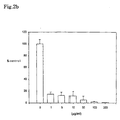
- Anticancer activity of the extracts prepared in examples I and 2 was tested by measuring thymidine uptake amount as described in the following. 13.8 g of DMEM (Dulbecco's Modified Eagle's Medium, Gibco) was dissolved in 1 l of deionized water and the solution was adjusted to a pH of 7.4 with sodium carbonate and hydrochloric acid solutions. Then, 10% of calf serum, 1 ⁇ 10 -7 M of insulin and 50 mg/l of gentamycin were added thereto and the whole was sterilized by millipore filter to prepare cultivation medium.
- DMEM Dulbecco's Modified Eagle's Medium, Gibco
- human hepatoma cells sk-Hep-1 obtained from Cancer Research Center of Seoul National University in the Republic of Korea were inoculated, the number of which was 1 ⁇ 10 6 per 25 cm 2 of T flask and then incubated for 48 hours under 5% of CO 2 gas at a temperature of 37°C.
- the cultivate was transferred to 24-well cultivation container and was successively cultured for one day and then, the bovine extracts prepared in examples 1 and 2 were respectively added thereto up to a concentration of 1 ⁇ 200 ⁇ g/ml. 12 hours after addition, 3 H-labelled thymidine was added up to a concentration of 1 ⁇ Ci/ml. Further, 12 hours after addition, medium was removed from each well and cells were fixed with methanol, washed with PBS (phosphate buffered saline), and then, washed twice with 10% of trichloroacetic acid to remove residual radioactive thymidine. The cells were dissolved with 1 M of sodium hydroxide and the solution was neutralized with 1 M of hydrochloric acid. The radioactivity incorporated into DNA was measured using scintillation counter (Pharmacia 1024).
- Figs 2a and 2b are graphs which show results of the bovine excretion extracts of examples 1 and 2, respectively.
- a concentration of sample is plotted on the axis of abscissa and a thymidine uptake amount is plotted on the axis of ordinates.
- the bovine excretion extracts of examples 1 and 2 significantly decrease a thymidine uptake amount at a concentration of more than 1 ⁇ g/ml, which suggests that they inhibit proliferation of cancer cells sk-Hep-1. Therefore, the bovine excretion extracts according to the present invention significantly inhibit proliferation of cancer cells and hence, are expected to be very useful as an anticancer agent or adjunctive.
- Test example 3 Anti-inflammatory activity test by measuring inhibition of platelet aggregation
- Anti-inflammatory activity of the extracts prepared in example 1 was tested by measuring inhibition of platelet aggregation as described in the following.
- Platelet rich plasma (PRP) were obtained from rat blood and the number of platelets was adjusted to 3 ⁇ 10 8 /ml 489 ⁇ l of PRP was each placed in a glass container for measuring platelet aggregation and was pre-incubated for 1 minute at 37°C.
- 2.5 ⁇ l of a solution of the extracts prepared in example 1 dissolved in methanol was added thereto and 3minutes after addition, 8 ⁇ l of thrombin solution was added.
- the inhibitory effect on platelet aggregation was measured using a platelet-aggregometer. The result is shown in table 2.
- Anti-inflammatory activity by inhibition of platelet aggregation Extracts of example 1 ( ⁇ g/ml) 1.25 2.5 5.0 Inhibition of platelet aggregation (%) 42.6 57.4 54.3
- the extracts of example 1 significantly inhibit platelet aggregation. Therefore, the extracts of the present invention are expected to be very useful as an anti-inflammatory agent.
- bovine excretion extracts of the present invention are expected to be very useful as an anticancer agent or adjuvant by inhibition of cell proliferation and by anti-oxidation or an anti-inflammatory agent by inhibition of platelet aggregation.
Landscapes
- Health & Medical Sciences (AREA)
- Life Sciences & Earth Sciences (AREA)
- Biomedical Technology (AREA)
- Engineering & Computer Science (AREA)
- Public Health (AREA)
- Chemical & Material Sciences (AREA)
- Medicinal Chemistry (AREA)
- Veterinary Medicine (AREA)
- Pharmacology & Pharmacy (AREA)
- Animal Behavior & Ethology (AREA)
- General Health & Medical Sciences (AREA)
- Developmental Biology & Embryology (AREA)
- Zoology (AREA)
- Epidemiology (AREA)
- Virology (AREA)
- Immunology (AREA)
- Cell Biology (AREA)
- Neurology (AREA)
- Orthopedic Medicine & Surgery (AREA)
- Biotechnology (AREA)
- General Chemical & Material Sciences (AREA)
- Chemical Kinetics & Catalysis (AREA)
- Nuclear Medicine, Radiotherapy & Molecular Imaging (AREA)
- Organic Chemistry (AREA)
- Rheumatology (AREA)
- Pain & Pain Management (AREA)
- Medicines Containing Plant Substances (AREA)
- Medicines Containing Material From Animals Or Micro-Organisms (AREA)
- Compounds Of Unknown Constitution (AREA)
- Medicines That Contain Protein Lipid Enzymes And Other Medicines (AREA)
- Pharmaceuticals Containing Other Organic And Inorganic Compounds (AREA)
Abstract
Description
| Cytotoxic effect of extracts of example 1 on erythrocytes | ||||
| time (min) | 0 | 30 | 60 | 120 |
| group treated with the extracts of example 1 | 0.0 | 2.3±0.2 | 2.1±0.5 | 2.6±1.9 |
| control group | 0.0 | 0.3 | 1.7 | 1.5 |
| menadione-treated group | 0.0 | 1.6±1.3 | 2.3±0.4 | 65.3±4.8 |
| Anti-inflammatory activity by inhibition of platelet aggregation | |||
| Extracts of example 1 (µg/mℓ) | 1.25 | 2.5 | 5.0 |
| Inhibition of platelet aggregation (%) | 42.6 | 57.4 | 54.3 |
Claims (9)
- Bovine excretion extracts having anticancer and anti-inflammatory activity prepared by a process comprising the step of extracting bovine excretion with a polar solvent selected from the group consisting of alcohol having 1 to 4 carbon atom(s), ketone of the formula: R1COR2, wherein R1 and R2 independently of one another represent alkyl having 1 to 3 carbon atom(s), acetonitrile, water and mixtures thereof.
- The bovine excretion extracts according to claim 1 prepared by the process further comprising the step of re-extracting said extracts with a nonpolar organic solvent selected from the group consisting of water-saturated butanol, ethyl acetate and ethyl ether.
- The bovine excretion extracts according to claim 1 wherein the bovine excretion is excrement of cattle or buffaloes.
- An anticancer agent comprising the bovine excretion extracts according to any one of claims 1 to 3 as active ingredient.
- The anticancer agent according to claim 4 which is to be orally administered with a unit dose of 100 to 500 mg, about 3 times a day.
- An anti-inflammatory agent comprising the bovine excretion extracts according to any one of claims 1 to 3 as active ingredient.
- The anti-inflammatory agent according to claim 6 which is to be orally administered with a unit dose of 100 to 500 mg, about 3 times a day.
- A process for preparing bovine excretion extracts having anticancer and anti-inflammatory activity comprising the step of extracting bovine excretion with a polar solvent selected from the group consisting of alcohol having 1 to 4 carbon atom(s), ketone of the formula: R1COR2, wherein R1 and R2 independently of one another represent alkyl having 1 to 3 carbon atom(s), acetonitrile, water and mixtures thereof.
- The process according to claim 8 further comprising the step of re-extracting said extracts with a nonpolar organic solvent selected from the group consisting of water-saturated butanol, ethyl acetate and ethyl ether.
Applications Claiming Priority (3)
| Application Number | Priority Date | Filing Date | Title |
|---|---|---|---|
| KR1019980029460A KR100286447B1 (en) | 1998-07-22 | 1998-07-22 | Milk powder extract having anticancer and anti-inflammatory effect and preparation method thereof |
| KR9829460 | 1998-07-22 | ||
| PCT/KR1999/000290 WO2000004911A1 (en) | 1998-07-22 | 1999-06-11 | Bovine excretion extracts having anticancer and anti-inflammatory activity and process for preparing the same |
Publications (2)
| Publication Number | Publication Date |
|---|---|
| EP1017406A1 EP1017406A1 (en) | 2000-07-12 |
| EP1017406B1 true EP1017406B1 (en) | 2002-09-11 |
Family
ID=19544840
Family Applications (1)
| Application Number | Title | Priority Date | Filing Date |
|---|---|---|---|
| EP99925441A Expired - Lifetime EP1017406B1 (en) | 1998-07-22 | 1999-06-11 | Bovine excretion extracts having anticancer and anti-inflammatory activity and process for preparing the same |
Country Status (9)
| Country | Link |
|---|---|
| US (1) | US6248367B1 (en) |
| EP (1) | EP1017406B1 (en) |
| JP (1) | JP2002521341A (en) |
| KR (1) | KR100286447B1 (en) |
| CN (1) | CN1273532A (en) |
| AT (1) | ATE223724T1 (en) |
| AU (1) | AU4171299A (en) |
| DE (1) | DE69902866T2 (en) |
| WO (1) | WO2000004911A1 (en) |
Families Citing this family (3)
| Publication number | Priority date | Publication date | Assignee | Title |
|---|---|---|---|---|
| US7723491B1 (en) | 2007-05-25 | 2010-05-25 | Clemson University | Methods of isolating specific compounds from supramammary lymph node tissue |
| WO2015124637A1 (en) * | 2014-02-18 | 2015-08-27 | Conaris Research Institute Ag | Methods and compositions for intestinal microenvironment transfer |
| CN106509445A (en) * | 2016-11-16 | 2017-03-22 | 广西山水牛农业有限责任公司 | Preparation method of pig feed containing cow dungs |
Family Cites Families (3)
| Publication number | Priority date | Publication date | Assignee | Title |
|---|---|---|---|---|
| JPS59205320A (en) * | 1983-05-10 | 1984-11-20 | Kaken Pharmaceut Co Ltd | Preventive and remedy for bovine lipomatosis |
| JPH06305970A (en) * | 1993-04-25 | 1994-11-01 | Nippon Suisan Kaisha Ltd | Carcinogenic promotion inhibitor |
| JPH0940657A (en) * | 1995-07-27 | 1997-02-10 | Taisho Pharmaceut Co Ltd | Process for producing taxol and taxane terpenoids |
-
1998
- 1998-07-22 KR KR1019980029460A patent/KR100286447B1/en not_active Expired - Lifetime
-
1999
- 1999-06-11 CN CN99801029A patent/CN1273532A/en active Pending
- 1999-06-11 AU AU41712/99A patent/AU4171299A/en not_active Abandoned
- 1999-06-11 DE DE69902866T patent/DE69902866T2/en not_active Expired - Lifetime
- 1999-06-11 WO PCT/KR1999/000290 patent/WO2000004911A1/en not_active Ceased
- 1999-06-11 AT AT99925441T patent/ATE223724T1/en not_active IP Right Cessation
- 1999-06-11 EP EP99925441A patent/EP1017406B1/en not_active Expired - Lifetime
- 1999-06-11 JP JP2000560904A patent/JP2002521341A/en active Pending
- 1999-07-07 US US09/348,898 patent/US6248367B1/en not_active Expired - Lifetime
Also Published As
| Publication number | Publication date |
|---|---|
| WO2000004911A1 (en) | 2000-02-03 |
| KR20000009196A (en) | 2000-02-15 |
| DE69902866T2 (en) | 2003-08-07 |
| ATE223724T1 (en) | 2002-09-15 |
| EP1017406A1 (en) | 2000-07-12 |
| AU4171299A (en) | 2000-02-14 |
| JP2002521341A (en) | 2002-07-16 |
| CN1273532A (en) | 2000-11-15 |
| DE69902866D1 (en) | 2002-10-17 |
| US6248367B1 (en) | 2001-06-19 |
| KR100286447B1 (en) | 2001-04-16 |
Similar Documents
| Publication | Publication Date | Title |
|---|---|---|
| Zhong et al. | Inhibitory effect of resveratrol on interleukin 6 release by stimulated peritoneal macrophages of mice | |
| JPH03170499A (en) | Drastatin 14 | |
| BRPI0017067B1 (en) | cell division inhibitor, dehydrogenase, method for producing a cell division inhibitor and compound | |
| Evans et al. | Acute bracken poisoning in homogastric and ruminant animals | |
| Xu et al. | Elemental diet‐induced bacterial translocation associated with systemic and intestinal immune suppression | |
| CN106943432B (en) | Exosome derived from umbilical cord mesenchymal stem cells and application of exosome in preparation of liver cancer treatment drug | |
| CN101765433A (en) | An anti-diabetic red bush extract | |
| US6361805B2 (en) | Method of preparation and composition of a water soluble extract of the plant species uncaria for enhancing immune, anti-inflammatory, anti-tumor and DNA repair processes of warm blooded animals | |
| KR20190003421A (en) | Composition for preventing, improving or treating of fibrosis | |
| US6248367B1 (en) | Bovine excretion extracts having anticancer and anti-inflammatory activity and process for preparing the same | |
| EP2120924B1 (en) | An anti-diabetic extract of honeybush | |
| KR101385191B1 (en) | Use of Cichorium intybus extracts for preventing, treating improving muscular atrophy | |
| Sakagami et al. | Partial purification of novel differentiation-inducing substance (s) from hot water extract of Japanese pine cone | |
| JP2000503686A (en) | Pharmaceutical composition for the treatment of hepatitis C, comprising a mixed extract of yellow bamboo skin and Ominaeushi plant | |
| Freinkel et al. | The synthesis of mesoinositol in germ-free rats and mice | |
| Owen et al. | Chromosome marker studies in the graft-versus-host reaction in the chick embryo | |
| KR100912735B1 (en) | Composition for the anti-inflammatory and analgesia comprising rutin-contained Sophora japonica extract | |
| CN111297849B (en) | Pharmaceutical composition for treating laryngeal cancer, preparation method and application thereof | |
| CN105030770A (en) | Application of berberine to preparing medicine for treating acute myeloid leukemia | |
| CN105997962B (en) | Application of coenzyme Q10 in the treatment of periodic paralysis | |
| AU635553B2 (en) | Extracts of the acanthospermum hispidum plant | |
| CN118526489B (en) | A kind of use of ethyl pheophorbide | |
| KR20010101065A (en) | Lak activity potentiator originating in shiitake mushroom hyphae extract and lak activity potentiating preparations containing the same | |
| CN118593504B (en) | New use of deuterated colestitinib or its salt in preparing PVNS drugs | |
| Sivagnanam et al. | Chemotherapeutic efficacy of Indigofera aspalathoides on 20‐methylcholanthrene‐induced fibrosarcoma in rats |
Legal Events
| Date | Code | Title | Description |
|---|---|---|---|
| PUAI | Public reference made under article 153(3) epc to a published international application that has entered the european phase |
Free format text: ORIGINAL CODE: 0009012 |
|
| 17P | Request for examination filed |
Effective date: 20000222 |
|
| AK | Designated contracting states |
Kind code of ref document: A1 Designated state(s): AT BE CH DE DK ES FI FR GB GR IE IT LI LU MC NL PT SE |
|
| GRAG | Despatch of communication of intention to grant |
Free format text: ORIGINAL CODE: EPIDOS AGRA |
|
| 17Q | First examination report despatched |
Effective date: 20010605 |
|
| GRAG | Despatch of communication of intention to grant |
Free format text: ORIGINAL CODE: EPIDOS AGRA |
|
| GRAH | Despatch of communication of intention to grant a patent |
Free format text: ORIGINAL CODE: EPIDOS IGRA |
|
| GRAH | Despatch of communication of intention to grant a patent |
Free format text: ORIGINAL CODE: EPIDOS IGRA |
|
| RAP1 | Party data changed (applicant data changed or rights of an application transferred) |
Owner name: GINSENG SCIENCE INC. |
|
| RIN1 | Information on inventor provided before grant (corrected) |
Inventor name: PARK, SUNG-WON, SHINNAEDAERIM APT. 505-601 Inventor name: CHUNG, JIN-HO Inventor name: LEE, SEUNG-KI, COLLEGE OF PHARMACY, SEOUL NATIONA Inventor name: PARK, JEONG-HILL Inventor name: PARK, MAN-KI, SHINWON APT. 310-1502, Inventor name: KIM, BOK-DEUK |
|
| GRAA | (expected) grant |
Free format text: ORIGINAL CODE: 0009210 |
|
| AK | Designated contracting states |
Kind code of ref document: B1 Designated state(s): AT BE CH DE DK ES FI FR GB GR IE IT LI LU MC NL PT SE |
|
| PG25 | Lapsed in a contracting state [announced via postgrant information from national office to epo] |
Ref country code: NL Free format text: LAPSE BECAUSE OF FAILURE TO SUBMIT A TRANSLATION OF THE DESCRIPTION OR TO PAY THE FEE WITHIN THE PRESCRIBED TIME-LIMIT Effective date: 20020911 Ref country code: LI Free format text: LAPSE BECAUSE OF FAILURE TO SUBMIT A TRANSLATION OF THE DESCRIPTION OR TO PAY THE FEE WITHIN THE PRESCRIBED TIME-LIMIT Effective date: 20020911 Ref country code: GR Free format text: LAPSE BECAUSE OF FAILURE TO SUBMIT A TRANSLATION OF THE DESCRIPTION OR TO PAY THE FEE WITHIN THE PRESCRIBED TIME-LIMIT Effective date: 20020911 Ref country code: FI Free format text: LAPSE BECAUSE OF FAILURE TO SUBMIT A TRANSLATION OF THE DESCRIPTION OR TO PAY THE FEE WITHIN THE PRESCRIBED TIME-LIMIT Effective date: 20020911 Ref country code: CH Free format text: LAPSE BECAUSE OF FAILURE TO SUBMIT A TRANSLATION OF THE DESCRIPTION OR TO PAY THE FEE WITHIN THE PRESCRIBED TIME-LIMIT Effective date: 20020911 Ref country code: BE Free format text: LAPSE BECAUSE OF FAILURE TO SUBMIT A TRANSLATION OF THE DESCRIPTION OR TO PAY THE FEE WITHIN THE PRESCRIBED TIME-LIMIT Effective date: 20020911 Ref country code: AT Free format text: LAPSE BECAUSE OF FAILURE TO SUBMIT A TRANSLATION OF THE DESCRIPTION OR TO PAY THE FEE WITHIN THE PRESCRIBED TIME-LIMIT Effective date: 20020911 |
|
| REF | Corresponds to: |
Ref document number: 223724 Country of ref document: AT Date of ref document: 20020915 Kind code of ref document: T |
|
| REG | Reference to a national code |
Ref country code: GB Ref legal event code: FG4D |
|
| REG | Reference to a national code |
Ref country code: CH Ref legal event code: EP |
|
| REG | Reference to a national code |
Ref country code: IE Ref legal event code: FG4D |
|
| REF | Corresponds to: |
Ref document number: 69902866 Country of ref document: DE Date of ref document: 20021017 |
|
| ET | Fr: translation filed | ||
| PG25 | Lapsed in a contracting state [announced via postgrant information from national office to epo] |
Ref country code: SE Free format text: LAPSE BECAUSE OF FAILURE TO SUBMIT A TRANSLATION OF THE DESCRIPTION OR TO PAY THE FEE WITHIN THE PRESCRIBED TIME-LIMIT Effective date: 20021211 Ref country code: DK Free format text: LAPSE BECAUSE OF FAILURE TO SUBMIT A TRANSLATION OF THE DESCRIPTION OR TO PAY THE FEE WITHIN THE PRESCRIBED TIME-LIMIT Effective date: 20021211 |
|
| PG25 | Lapsed in a contracting state [announced via postgrant information from national office to epo] |
Ref country code: PT Free format text: LAPSE BECAUSE OF FAILURE TO SUBMIT A TRANSLATION OF THE DESCRIPTION OR TO PAY THE FEE WITHIN THE PRESCRIBED TIME-LIMIT Effective date: 20021217 |
|
| NLV1 | Nl: lapsed or annulled due to failure to fulfill the requirements of art. 29p and 29m of the patents act | ||
| REG | Reference to a national code |
Ref country code: CH Ref legal event code: PL |
|
| PG25 | Lapsed in a contracting state [announced via postgrant information from national office to epo] |
Ref country code: ES Free format text: LAPSE BECAUSE OF FAILURE TO SUBMIT A TRANSLATION OF THE DESCRIPTION OR TO PAY THE FEE WITHIN THE PRESCRIBED TIME-LIMIT Effective date: 20030328 |
|
| PG25 | Lapsed in a contracting state [announced via postgrant information from national office to epo] |
Ref country code: LU Free format text: LAPSE BECAUSE OF NON-PAYMENT OF DUE FEES Effective date: 20030611 Ref country code: IE Free format text: LAPSE BECAUSE OF NON-PAYMENT OF DUE FEES Effective date: 20030611 |
|
| PG25 | Lapsed in a contracting state [announced via postgrant information from national office to epo] |
Ref country code: MC Free format text: LAPSE BECAUSE OF NON-PAYMENT OF DUE FEES Effective date: 20030630 |
|
| PLBE | No opposition filed within time limit |
Free format text: ORIGINAL CODE: 0009261 |
|
| STAA | Information on the status of an ep patent application or granted ep patent |
Free format text: STATUS: NO OPPOSITION FILED WITHIN TIME LIMIT |
|
| 26N | No opposition filed |
Effective date: 20030612 |
|
| REG | Reference to a national code |
Ref country code: IE Ref legal event code: MM4A |
|
| PGFP | Annual fee paid to national office [announced via postgrant information from national office to epo] |
Ref country code: FR Payment date: 20110630 Year of fee payment: 13 |
|
| PGFP | Annual fee paid to national office [announced via postgrant information from national office to epo] |
Ref country code: GB Payment date: 20110621 Year of fee payment: 13 |
|
| PGFP | Annual fee paid to national office [announced via postgrant information from national office to epo] |
Ref country code: DE Payment date: 20110603 Year of fee payment: 13 |
|
| PGFP | Annual fee paid to national office [announced via postgrant information from national office to epo] |
Ref country code: IT Payment date: 20110627 Year of fee payment: 13 |
|
| GBPC | Gb: european patent ceased through non-payment of renewal fee |
Effective date: 20120611 |
|
| PG25 | Lapsed in a contracting state [announced via postgrant information from national office to epo] |
Ref country code: IT Free format text: LAPSE BECAUSE OF NON-PAYMENT OF DUE FEES Effective date: 20120611 |
|
| REG | Reference to a national code |
Ref country code: FR Ref legal event code: ST Effective date: 20130228 |
|
| REG | Reference to a national code |
Ref country code: DE Ref legal event code: R119 Ref document number: 69902866 Country of ref document: DE Effective date: 20130101 |
|
| PG25 | Lapsed in a contracting state [announced via postgrant information from national office to epo] |
Ref country code: FR Free format text: LAPSE BECAUSE OF NON-PAYMENT OF DUE FEES Effective date: 20120702 Ref country code: GB Free format text: LAPSE BECAUSE OF NON-PAYMENT OF DUE FEES Effective date: 20120611 Ref country code: DE Free format text: LAPSE BECAUSE OF NON-PAYMENT OF DUE FEES Effective date: 20130101 |