EP1017247A2 - Multiport Endgerät mit einziger Leitung - Google Patents
Multiport Endgerät mit einziger Leitung Download PDFInfo
- Publication number
- EP1017247A2 EP1017247A2 EP99310122A EP99310122A EP1017247A2 EP 1017247 A2 EP1017247 A2 EP 1017247A2 EP 99310122 A EP99310122 A EP 99310122A EP 99310122 A EP99310122 A EP 99310122A EP 1017247 A2 EP1017247 A2 EP 1017247A2
- Authority
- EP
- European Patent Office
- Prior art keywords
- port
- ports
- subscriber terminal
- rate
- channels
- Prior art date
- Legal status (The legal status is an assumption and is not a legal conclusion. Google has not performed a legal analysis and makes no representation as to the accuracy of the status listed.)
- Withdrawn
Links
- 238000004891 communication Methods 0.000 claims abstract description 54
- 238000000034 method Methods 0.000 claims description 11
- 230000003213 activating effect Effects 0.000 claims description 6
- 238000001514 detection method Methods 0.000 claims 1
- 238000010586 diagram Methods 0.000 description 4
- 238000005516 engineering process Methods 0.000 description 3
- 230000003044 adaptive effect Effects 0.000 description 2
- 238000012986 modification Methods 0.000 description 2
- 230000004048 modification Effects 0.000 description 2
- 230000001413 cellular effect Effects 0.000 description 1
- 230000006835 compression Effects 0.000 description 1
- 238000007906 compression Methods 0.000 description 1
- 230000001419 dependent effect Effects 0.000 description 1
Images
Classifications
-
- H—ELECTRICITY
- H04—ELECTRIC COMMUNICATION TECHNIQUE
- H04Q—SELECTING
- H04Q11/00—Selecting arrangements for multiplex systems
- H04Q11/04—Selecting arrangements for multiplex systems for time-division multiplexing
-
- H—ELECTRICITY
- H04—ELECTRIC COMMUNICATION TECHNIQUE
- H04Q—SELECTING
- H04Q2213/00—Indexing scheme relating to selecting arrangements in general and for multiplex systems
- H04Q2213/13031—Pulse code modulation, PCM
-
- H—ELECTRICITY
- H04—ELECTRIC COMMUNICATION TECHNIQUE
- H04Q—SELECTING
- H04Q2213/00—Indexing scheme relating to selecting arrangements in general and for multiplex systems
- H04Q2213/1309—Apparatus individually associated with a subscriber line, line circuits
-
- H—ELECTRICITY
- H04—ELECTRIC COMMUNICATION TECHNIQUE
- H04Q—SELECTING
- H04Q2213/00—Indexing scheme relating to selecting arrangements in general and for multiplex systems
- H04Q2213/13093—Personal computer, PC
-
- H—ELECTRICITY
- H04—ELECTRIC COMMUNICATION TECHNIQUE
- H04Q—SELECTING
- H04Q2213/00—Indexing scheme relating to selecting arrangements in general and for multiplex systems
- H04Q2213/13098—Mobile subscriber
-
- H—ELECTRICITY
- H04—ELECTRIC COMMUNICATION TECHNIQUE
- H04Q—SELECTING
- H04Q2213/00—Indexing scheme relating to selecting arrangements in general and for multiplex systems
- H04Q2213/13174—Data transmission, file transfer
-
- H—ELECTRICITY
- H04—ELECTRIC COMMUNICATION TECHNIQUE
- H04Q—SELECTING
- H04Q2213/00—Indexing scheme relating to selecting arrangements in general and for multiplex systems
- H04Q2213/13199—Modem, modulation
-
- H—ELECTRICITY
- H04—ELECTRIC COMMUNICATION TECHNIQUE
- H04Q—SELECTING
- H04Q2213/00—Indexing scheme relating to selecting arrangements in general and for multiplex systems
- H04Q2213/13208—Inverse multiplexing, channel bonding, e.g. TSSI aspects
-
- H—ELECTRICITY
- H04—ELECTRIC COMMUNICATION TECHNIQUE
- H04Q—SELECTING
- H04Q2213/00—Indexing scheme relating to selecting arrangements in general and for multiplex systems
- H04Q2213/13292—Time division multiplexing, TDM
-
- H—ELECTRICITY
- H04—ELECTRIC COMMUNICATION TECHNIQUE
- H04Q—SELECTING
- H04Q2213/00—Indexing scheme relating to selecting arrangements in general and for multiplex systems
- H04Q2213/13298—Local loop systems, access network
Definitions
- the present invention relates to telephony and, more particularly, but not exclusively, to a subscriber terminal for bandwidth-limited telephony systems such as wireless local loop networks, that allows the selection of an optimal rate of communication across a single subscriber line.
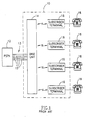
- FIG 1 is a greatly simplified diagram of a WLL network 10.
- a base unit 14 is connected to the PSTN 12 by a conventional wire line 13.
- Wire line 13 is drawn in Figure 1 as four horizontal lines 15 to indicate that PSTN 12 assigns a different subscriber line 15, via wire line 13, to each of the four subscriber terminals 16 that are shown in Figure 1.
- Base unit 14 functions analogously to a cellular network base station, to communicate by radio with a plurality of subscriber terminals 16.
- Each subscriber terminal supports, and is connected by wire to, one or more user communication devices 18 which are illustrated in Figure 1 as telephone sets.
- Telephone sets are most commonly used as communication devices 18; but any device that can be plugged directly into PSTN 12, for example, a fax machine or a modem, can be connected to a subscriber terminal 16.
- WLL 10 is transparent to the users: for all they know, devices 18 could be connected directly to PSTN 12.
- WLL network 10 The number of users that can be supported by WLL network 10 is limited by the available radio bandwidth. This bandwidth is a scarce resource that typically is allocated by government traditions of communications. Digital compression of voice for telephony is well-known in the art. The standard encoding used is PCM (Pulse Code Modulation), which requires 64Kbps for voice. Another will-known technique is ADPCM (Adaptive Differential Pulse Code Modulation), which further reduces the required bandwidth to 32Kbps, but limits the ability to carry voice band data at higher rates. See, for example, John Bellamy, Digital Telephony, second edition (Wiley, 1991), Chapter 3.
- PCM Pulse Code Modulation
- ADPCM Adaptive Differential Pulse Code Modulation
- a single user desires both voice communication and sporadic digital data exchange (e.g., Internet access). Assigning a 64Kbps channel to such a user is an inefficient allocation of scarce bandwidth, because most of the time, the user needs only 32Kbps.
- WLL services notably Siemens AG of Kunststoff, Germany and Alcatel Telecom of Antwerp, Belgium.
- subscriber terminal 16 detects, based on the presence or absence of modem tones at the port to which user device 18 is connected, whether voice or data communication is desired, and signals base station 14 to allocate either 32Kbps or 64Kbps for the communication session accordingly.
- Alcatel also provides a subscriber terminal 18 that includes an analog port for voice communications on one line and a digital port for packet mode data communications on a second line. To support the two lines of this subscriber terminal 18, two separate subscriber lines 15 must be allocated to the user in PSTN 12, and the second subscriber line 15 may only be used for packet mode data.
- a subscriber terminal for connecting a device of a user to a telecommunication network, including: (a) a plurality of analog ports; and (b) a mechanism for selecting a single one of the ports for connection to a single subscriber line of the telephony network.
- a method of allocating the at least one channel including the steps of: (a) providing to the user a subscriber terminal including: (i) a low speed port, and (ii) a high speed port; (b) establishing an operational connection between the device and only a first of the ports for an outgoing call; (c) activating only the first port; and (d) if the activated port is the low speed analog port, allocating one channel to the device.
- a communications system including: (a) a subscriber terminal including two ports; and (b) a base unit for allocating at least one of the channels to the subscriber terminal for a first communication session via one of the ports.
- a subscriber terminal in accordance with one embodiment of the present invention is provided with a set of two or more ports associated with each subscriber line 15 of PSTN 12 that is serviced by the subscriber terminal, each one of the two or more ports supporting communication on the associated single PSTN subscriber line 15 at a different rate.
- the user selects the communication rate, and hence the communication bandwidth, by plugging device 18 into the desired port and activating device 18 to establish an operational connection between device 18 and the desired port for an outgoing call. For example, if device 18 is a telephone, the user lifts the telephone receiver; or if device 18 is a computer connected to the port via a modem, the user activates the appropriate communications software.
- the subscriber terminal is provided with a mechanism for activating the desired port, i.e. , connecting only the desired port to the associated PSTN subscriber line 15.
- this mechanism may be considered as a switch that is set automatically to comply with the user's bandwidth requirement.
- the mechanism is adapted to identify to which of the ports, an active device 18 is plugged into, for example by sensing an off-hook condition at the port.
- a circuits-busy condition (“busy signal”) is indicated at the other ports to preclude interference from other devices 18 that are plugged into the other ports and are subsequently activated.
- the mechanism then coordinates the bandwidth associated with the selected port, with base unit 14 in the conventional manner.
- Base Unit 14 allocates one or more channels to the selected port. Once a certain number of channels has been selected, that number of channels is used for the entire duration of the communication session via the selected port. For example, if only one 32Kbps channel has been allocated to a port that supports voice-band data exchange at 64Kbps because at the time the communication session was established only one channel was available, then that one channel is used for the duration of the communication session even if a second channel becomes available during the course of the communication session.
- the simplest preferred embodiment of a subscriber terminal of the present invention has two analog ports a high speed port and a low speed port, for communication, alternately at two different rates and two different associated bandwidths, via only a single PSTN subscriber line 15.
- the low speed port supports voice communication at a rate of 32Kbps and the high speed port supports voice-band data communication at a rate of 64Kbps.
- the mechanism for connecting the desired port to the PSTN subscriber line 15 requests base unit 14 to allocate either a 32Kbps channel or a 64Kbps channel to subscriber terminal 16, depending on whether the low speed port or the high speed port is selected. If only a 32Kbps channel is available, base unit 14 allocates only that channel to subscriber terminal 16, no matter which port is selected.
- the low speed port supports both incoming calls and outgoing calls.
- the high speed port which is intended primarily for internet access, supports only outgoing calls. Incoming calls are directed by base unit 14 only to the low speed port.
- both ports support incoming calls, but only at a rate of 32Kbps, with one 32Kbps channel allocated to each port.
- An embodiment of the present invention is a subscriber terminal which enables efficient WLL bandwidth allocation in a simple manner than that known in the prior art.
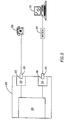
- FIG. 2 is a high level block diagram of a subscriber terminal 20 in accordance with an embodiment of the present invention, intended to facilitate communication with PSTN network 12 via base unit 14 using either a telephone set 28 at a rate of 32 Kbps or a personal computer 32 at a rate of 64Kbps.
- Subscriber terminal 20 includes a 32Kbps analog port 22 and a 64Kbps analog port 24. Both ports 22 and 24 are connected to circuitry 26 whose function is described below.
- Telephone set 28 is provided with a jack 30 that plugs into a socket 23 of port 22.
- Personal computer 32 is connected to a modem 34 that is provided with a jack 36 that plugs into a socket 25 of port 24.
- Circuitry 26 is based on a SLIC (Subscriber Line Interface Circuit) chip, such as the Lucent L7554 manufactured by Lucent Technologies of Murray Hill, NJ.
- SLIC Subscriber Line Interface Circuit
- Among the operational capabilities of an SLIC chip are the sensing of an on-hook condition at either of ports 22 and 24 and the generation of a circuits-busy signal at either of ports 22 and 24.
- circuitry 26 when telephone 28 is activated by the user for an outgoing call, circuitry 26 identifies the consequent off-hook condition at port 22 and generates a circuits-busy signal at port 24 to prevent communication by computer 32 and modem 34 via port 24. Circuitry 26 also signals base unit 14 to allocate two 32Kbps channels for the use of telephone 28.
- circuitry 26 When computer 32 and modem 34 are activated by the user for voice-band data communication, circuitry 26 identifies the consequent off-hook condition at port 24 and generates a circuit-busy signal at port 22 to prevent an attempt to use telephone 28 to communicate via port 32. Circuitry 26 also signals base unit 14 to allocate two 32Kbps channels for the use of computer 32 and modem 34. If only one 32Kbps channel is available to base unit 14, only one 32Kbps channel is allocated. Note that this single 32Kbps channel is used for the entire communication session, even if another 32Kbps channel becomes available during the communication session.
- port 24 is intended primarily for Internet access and so supports only outgoing calls.
- An incoming call from PSTN 12 is allocated a single 32Kbps channel by base unit 14 and is directed to port 22.
- base unit 14 always allocates two 32Kbps channels per subscriber terminal 20, and PSTN 12 supplies two subscriber lines 15 to base unit 14 per subscriber terminal 20.
- An incoming call from PSTN 12 is allocated to one of these two 32Kbps channels and is directed either to port 22 or to port 24, depending on which of the two subscriber lines 15 the incoming call is on.
- telephone 28 and computer 32 can receive simultaneous incoming calls.
- circuitry 26 identifies the consequent off-hook condition at port 22 and signals base unit 14 to allocate one of the two 32Kbps channels for the use of telephone 28 via one of the two subscriber lines 15 to PSTN 12, but circuitry 26 does not generate a circuits-busy signal, either at port 24 or on the other of the two subscriber lines 15 to PSTN 12, so that port 24 can be used to direct an incoming call, via the other 32Kbps channel, to computer 32, or, computer 32 can use port 24 to make an outgoing call via the available 32Kbps channel.
- circuitry 26 when computer 32 and modem 34 are activated by the user for voice-band data communication, circuitry 26 identifies the consequent off-hook condition at port 24 and signals base unit 14 to allocate both 32Kbps channels for the use of computer 32 and modem 34. Because no 32Kbps channels are available for the use of telephone 28, circuitry 26 also generates a circuits-busy signal at port 22 to prevent an attempt to use telephone 28 to communicate via port 22, and base unit 14 signals PSTN 12 that the subscriber line 15 associated with port 22 is off-hook so as not to pass a call.
Landscapes
- Engineering & Computer Science (AREA)
- Computer Networks & Wireless Communication (AREA)
- Telephone Function (AREA)
- Mobile Radio Communication Systems (AREA)
- Telephonic Communication Services (AREA)
Applications Claiming Priority (2)
| Application Number | Priority Date | Filing Date | Title |
|---|---|---|---|
| US22099998A | 1998-12-28 | 1998-12-28 | |
| US220999 | 1998-12-28 |
Publications (2)
| Publication Number | Publication Date |
|---|---|
| EP1017247A2 true EP1017247A2 (de) | 2000-07-05 |
| EP1017247A3 EP1017247A3 (de) | 2006-05-24 |
Family
ID=22825916
Family Applications (1)
| Application Number | Title | Priority Date | Filing Date |
|---|---|---|---|
| EP99310122A Withdrawn EP1017247A3 (de) | 1998-12-28 | 1999-12-15 | Multiport Endgerät mit einziger Leitung |
Country Status (7)
| Country | Link |
|---|---|
| EP (1) | EP1017247A3 (de) |
| AR (1) | AR022041A1 (de) |
| BR (1) | BR9905986A (de) |
| EA (1) | EA199901091A3 (de) |
| IL (1) | IL133505A0 (de) |
| PL (1) | PL337420A1 (de) |
| TR (1) | TR199903289A3 (de) |
Family Cites Families (2)
| Publication number | Priority date | Publication date | Assignee | Title |
|---|---|---|---|---|
| GB2301756B (en) * | 1995-06-02 | 2000-01-19 | Dsc Communications | Multi-channel digital data transmission in a wireless telecommunication system |
| DE19643776C1 (de) * | 1996-10-23 | 1998-08-27 | Siemens Ag | Verfahren zum Übertragen von Nutzdaten in einem hybriden Telekommunikationssystem, insbesondere einem "ISDN DECT-spezifischen RLL/WLL"-System |
-
1999
- 1999-12-14 IL IL13350599A patent/IL133505A0/xx not_active IP Right Cessation
- 1999-12-15 EP EP99310122A patent/EP1017247A3/de not_active Withdrawn
- 1999-12-23 PL PL99337420A patent/PL337420A1/xx unknown
- 1999-12-27 EA EA199901091A patent/EA199901091A3/ru unknown
- 1999-12-27 BR BR9905986-0A patent/BR9905986A/pt not_active Application Discontinuation
- 1999-12-28 AR ARP990106788A patent/AR022041A1/es unknown
- 1999-12-28 TR TR1999/03289A patent/TR199903289A3/tr unknown
Also Published As
| Publication number | Publication date |
|---|---|
| TR199903289A2 (xx) | 2000-08-21 |
| PL337420A1 (en) | 2000-07-03 |
| IL133505A0 (en) | 2001-04-30 |
| EA199901091A2 (ru) | 2000-08-28 |
| EA199901091A3 (ru) | 2000-10-30 |
| BR9905986A (pt) | 2000-08-15 |
| EP1017247A3 (de) | 2006-05-24 |
| TR199903289A3 (tr) | 2000-08-21 |
| AR022041A1 (es) | 2002-09-04 |
Similar Documents
| Publication | Publication Date | Title |
|---|---|---|
| US5954799A (en) | Access to telecommunications networks in a multi-service environment by mapping and exchanging control message between CPE adaptors and access server | |
| CA2256814C (en) | A multifunction interface facility connecting wideband multiple access subscriber loops with various networks | |
| US6047006A (en) | Method and apparatus for dynamically allocating bandwidth to independent data and audio devices | |
| EP0605086B1 (de) | Kleines schnurloses Telekommunikationssystem | |
| JPH1155753A (ja) | 他のシステムによりサービスを受けている無線電話へローカル・サービスを行うシステム及びその方法 | |
| EP1282975B1 (de) | System und verfahren zur bereitstellung von telefondiensten | |
| KR20000019059A (ko) | 무선 가입자망 시스템에서 데이터 전송방식에 따른 자원할당및 해제방법 | |
| EP0813347A2 (de) | Verfahren und Einrichtung zum Abfangen eines Anrufes in einem schnurlosen System | |
| US20040196868A1 (en) | Method and system for prioritizing a telephone call | |
| EP0385986A1 (de) | Verfahren zur verarbeitung von anrufen. | |
| EP1017247A2 (de) | Multiport Endgerät mit einziger Leitung | |
| JP3933694B2 (ja) | 通信確立のための装置と方法 | |
| WO1997037442A1 (en) | Method for providing a plurality of services in a communication system | |
| US6088438A (en) | Method of and apparatus for networking a plurality of private branch exchange systems using ISDN lines | |
| US6925090B2 (en) | High-speed digital transmission method allowing plurality of voice services by use of single subscriber line | |
| AU784442B2 (en) | Method for making communication in wireless local loop system | |
| US6407995B1 (en) | Independently switched voice and data calls using a single PSTN line connection | |
| CN1360451A (zh) | 移动通信系统中的视频呼叫接收业务方法 | |
| CN1234251C (zh) | 呼叫进行管理系统、装置和方法 | |
| CN1295751A (zh) | 用于处理呼入的主叫用户识别消息的多线路电话系统 | |
| US20040082325A1 (en) | Man-machine interface of wireless access fixed unit | |
| KR20030010208A (ko) | 음성 및 데이터 통합 시스템 및 처리 방법 | |
| KR20010059196A (ko) | 교환 시스템의 가입자 정합 장치 | |
| JPH1070762A (ja) | 無線電話通信システム | |
| KR19990075738A (ko) | 데이터서비스를 구현하기 위한 이동교환기와 연동기능장치간정합방법 |
Legal Events
| Date | Code | Title | Description |
|---|---|---|---|
| PUAI | Public reference made under article 153(3) epc to a published international application that has entered the european phase |
Free format text: ORIGINAL CODE: 0009012 |
|
| AK | Designated contracting states |
Kind code of ref document: A2 Designated state(s): AT BE CH CY DE DK ES FI FR GB GR IE IT LI LU MC NL PT SE |
|
| AX | Request for extension of the european patent |
Free format text: AL;LT;LV;MK;RO;SI |
|
| RAP1 | Party data changed (applicant data changed or rights of an application transferred) |
Owner name: ALVARION ISRAEL (2003) LTD. |
|
| PUAL | Search report despatched |
Free format text: ORIGINAL CODE: 0009013 |
|
| AK | Designated contracting states |
Kind code of ref document: A3 Designated state(s): AT BE CH CY DE DK ES FI FR GB GR IE IT LI LU MC NL PT SE |
|
| AX | Request for extension of the european patent |
Extension state: AL LT LV MK RO SI |
|
| 17P | Request for examination filed |
Effective date: 20061123 |
|
| AKX | Designation fees paid |
Designated state(s): AT BE CH CY DE DK ES FI FR GB GR IE IT LI LU MC NL PT SE |
|
| 17Q | First examination report despatched |
Effective date: 20070926 |
|
| STAA | Information on the status of an ep patent application or granted ep patent |
Free format text: STATUS: THE APPLICATION IS DEEMED TO BE WITHDRAWN |
|
| 18D | Application deemed to be withdrawn |
Effective date: 20080207 |