EP1017069A2 - Capacitor and dielectric ceramic powder based upon a barium borate and zinc silicate dual-component sintering flux - Google Patents
Capacitor and dielectric ceramic powder based upon a barium borate and zinc silicate dual-component sintering flux Download PDFInfo
- Publication number
- EP1017069A2 EP1017069A2 EP99310329A EP99310329A EP1017069A2 EP 1017069 A2 EP1017069 A2 EP 1017069A2 EP 99310329 A EP99310329 A EP 99310329A EP 99310329 A EP99310329 A EP 99310329A EP 1017069 A2 EP1017069 A2 EP 1017069A2
- Authority
- EP
- European Patent Office
- Prior art keywords
- weight percent
- powder
- dielectric ceramic
- dual
- flux
- Prior art date
- Legal status (The legal status is an assumption and is not a legal conclusion. Google has not performed a legal analysis and makes no representation as to the accuracy of the status listed.)
- Withdrawn
Links
Images





Classifications
-
- C—CHEMISTRY; METALLURGY
- C04—CEMENTS; CONCRETE; ARTIFICIAL STONE; CERAMICS; REFRACTORIES
- C04B—LIME, MAGNESIA; SLAG; CEMENTS; COMPOSITIONS THEREOF, e.g. MORTARS, CONCRETE OR LIKE BUILDING MATERIALS; ARTIFICIAL STONE; CERAMICS; REFRACTORIES; TREATMENT OF NATURAL STONE
- C04B35/00—Shaped ceramic products characterised by their composition; Ceramics compositions; Processing powders of inorganic compounds preparatory to the manufacturing of ceramic products
- C04B35/01—Shaped ceramic products characterised by their composition; Ceramics compositions; Processing powders of inorganic compounds preparatory to the manufacturing of ceramic products based on oxide ceramics
- C04B35/46—Shaped ceramic products characterised by their composition; Ceramics compositions; Processing powders of inorganic compounds preparatory to the manufacturing of ceramic products based on oxide ceramics based on titanium oxides or titanates
- C04B35/462—Shaped ceramic products characterised by their composition; Ceramics compositions; Processing powders of inorganic compounds preparatory to the manufacturing of ceramic products based on oxide ceramics based on titanium oxides or titanates based on titanates
- C04B35/465—Shaped ceramic products characterised by their composition; Ceramics compositions; Processing powders of inorganic compounds preparatory to the manufacturing of ceramic products based on oxide ceramics based on titanium oxides or titanates based on titanates based on alkaline earth metal titanates
- C04B35/468—Shaped ceramic products characterised by their composition; Ceramics compositions; Processing powders of inorganic compounds preparatory to the manufacturing of ceramic products based on oxide ceramics based on titanium oxides or titanates based on titanates based on alkaline earth metal titanates based on barium titanates
-
- H—ELECTRICITY
- H01—ELECTRIC ELEMENTS
- H01G—CAPACITORS; CAPACITORS, RECTIFIERS, DETECTORS, SWITCHING DEVICES, LIGHT-SENSITIVE OR TEMPERATURE-SENSITIVE DEVICES OF THE ELECTROLYTIC TYPE
- H01G4/00—Fixed capacitors; Processes of their manufacture
- H01G4/002—Details
- H01G4/018—Dielectrics
- H01G4/06—Solid dielectrics
- H01G4/08—Inorganic dielectrics
- H01G4/12—Ceramic dielectrics
- H01G4/1209—Ceramic dielectrics characterised by the ceramic dielectric material
- H01G4/1218—Ceramic dielectrics characterised by the ceramic dielectric material based on titanium oxides or titanates
-
- C—CHEMISTRY; METALLURGY
- C04—CEMENTS; CONCRETE; ARTIFICIAL STONE; CERAMICS; REFRACTORIES
- C04B—LIME, MAGNESIA; SLAG; CEMENTS; COMPOSITIONS THEREOF, e.g. MORTARS, CONCRETE OR LIKE BUILDING MATERIALS; ARTIFICIAL STONE; CERAMICS; REFRACTORIES; TREATMENT OF NATURAL STONE
- C04B35/00—Shaped ceramic products characterised by their composition; Ceramics compositions; Processing powders of inorganic compounds preparatory to the manufacturing of ceramic products
- C04B35/01—Shaped ceramic products characterised by their composition; Ceramics compositions; Processing powders of inorganic compounds preparatory to the manufacturing of ceramic products based on oxide ceramics
- C04B35/46—Shaped ceramic products characterised by their composition; Ceramics compositions; Processing powders of inorganic compounds preparatory to the manufacturing of ceramic products based on oxide ceramics based on titanium oxides or titanates
- C04B35/462—Shaped ceramic products characterised by their composition; Ceramics compositions; Processing powders of inorganic compounds preparatory to the manufacturing of ceramic products based on oxide ceramics based on titanium oxides or titanates based on titanates
-
- C—CHEMISTRY; METALLURGY
- C04—CEMENTS; CONCRETE; ARTIFICIAL STONE; CERAMICS; REFRACTORIES
- C04B—LIME, MAGNESIA; SLAG; CEMENTS; COMPOSITIONS THEREOF, e.g. MORTARS, CONCRETE OR LIKE BUILDING MATERIALS; ARTIFICIAL STONE; CERAMICS; REFRACTORIES; TREATMENT OF NATURAL STONE
- C04B35/00—Shaped ceramic products characterised by their composition; Ceramics compositions; Processing powders of inorganic compounds preparatory to the manufacturing of ceramic products
- C04B35/01—Shaped ceramic products characterised by their composition; Ceramics compositions; Processing powders of inorganic compounds preparatory to the manufacturing of ceramic products based on oxide ceramics
- C04B35/46—Shaped ceramic products characterised by their composition; Ceramics compositions; Processing powders of inorganic compounds preparatory to the manufacturing of ceramic products based on oxide ceramics based on titanium oxides or titanates
- C04B35/462—Shaped ceramic products characterised by their composition; Ceramics compositions; Processing powders of inorganic compounds preparatory to the manufacturing of ceramic products based on oxide ceramics based on titanium oxides or titanates based on titanates
- C04B35/465—Shaped ceramic products characterised by their composition; Ceramics compositions; Processing powders of inorganic compounds preparatory to the manufacturing of ceramic products based on oxide ceramics based on titanium oxides or titanates based on titanates based on alkaline earth metal titanates
-
- C—CHEMISTRY; METALLURGY
- C04—CEMENTS; CONCRETE; ARTIFICIAL STONE; CERAMICS; REFRACTORIES
- C04B—LIME, MAGNESIA; SLAG; CEMENTS; COMPOSITIONS THEREOF, e.g. MORTARS, CONCRETE OR LIKE BUILDING MATERIALS; ARTIFICIAL STONE; CERAMICS; REFRACTORIES; TREATMENT OF NATURAL STONE
- C04B35/00—Shaped ceramic products characterised by their composition; Ceramics compositions; Processing powders of inorganic compounds preparatory to the manufacturing of ceramic products
- C04B35/01—Shaped ceramic products characterised by their composition; Ceramics compositions; Processing powders of inorganic compounds preparatory to the manufacturing of ceramic products based on oxide ceramics
- C04B35/46—Shaped ceramic products characterised by their composition; Ceramics compositions; Processing powders of inorganic compounds preparatory to the manufacturing of ceramic products based on oxide ceramics based on titanium oxides or titanates
- C04B35/462—Shaped ceramic products characterised by their composition; Ceramics compositions; Processing powders of inorganic compounds preparatory to the manufacturing of ceramic products based on oxide ceramics based on titanium oxides or titanates based on titanates
- C04B35/465—Shaped ceramic products characterised by their composition; Ceramics compositions; Processing powders of inorganic compounds preparatory to the manufacturing of ceramic products based on oxide ceramics based on titanium oxides or titanates based on titanates based on alkaline earth metal titanates
- C04B35/468—Shaped ceramic products characterised by their composition; Ceramics compositions; Processing powders of inorganic compounds preparatory to the manufacturing of ceramic products based on oxide ceramics based on titanium oxides or titanates based on titanates based on alkaline earth metal titanates based on barium titanates
- C04B35/4682—Shaped ceramic products characterised by their composition; Ceramics compositions; Processing powders of inorganic compounds preparatory to the manufacturing of ceramic products based on oxide ceramics based on titanium oxides or titanates based on titanates based on alkaline earth metal titanates based on barium titanates based on BaTiO3 perovskite phase
-
- C—CHEMISTRY; METALLURGY
- C04—CEMENTS; CONCRETE; ARTIFICIAL STONE; CERAMICS; REFRACTORIES
- C04B—LIME, MAGNESIA; SLAG; CEMENTS; COMPOSITIONS THEREOF, e.g. MORTARS, CONCRETE OR LIKE BUILDING MATERIALS; ARTIFICIAL STONE; CERAMICS; REFRACTORIES; TREATMENT OF NATURAL STONE
- C04B35/00—Shaped ceramic products characterised by their composition; Ceramics compositions; Processing powders of inorganic compounds preparatory to the manufacturing of ceramic products
- C04B35/01—Shaped ceramic products characterised by their composition; Ceramics compositions; Processing powders of inorganic compounds preparatory to the manufacturing of ceramic products based on oxide ceramics
- C04B35/48—Shaped ceramic products characterised by their composition; Ceramics compositions; Processing powders of inorganic compounds preparatory to the manufacturing of ceramic products based on oxide ceramics based on zirconium or hafnium oxides, zirconates, zircon or hafnates
- C04B35/49—Shaped ceramic products characterised by their composition; Ceramics compositions; Processing powders of inorganic compounds preparatory to the manufacturing of ceramic products based on oxide ceramics based on zirconium or hafnium oxides, zirconates, zircon or hafnates containing also titanium oxides or titanates
-
- C—CHEMISTRY; METALLURGY
- C04—CEMENTS; CONCRETE; ARTIFICIAL STONE; CERAMICS; REFRACTORIES
- C04B—LIME, MAGNESIA; SLAG; CEMENTS; COMPOSITIONS THEREOF, e.g. MORTARS, CONCRETE OR LIKE BUILDING MATERIALS; ARTIFICIAL STONE; CERAMICS; REFRACTORIES; TREATMENT OF NATURAL STONE
- C04B35/00—Shaped ceramic products characterised by their composition; Ceramics compositions; Processing powders of inorganic compounds preparatory to the manufacturing of ceramic products
- C04B35/622—Forming processes; Processing powders of inorganic compounds preparatory to the manufacturing of ceramic products
- C04B35/626—Preparing or treating the powders individually or as batches ; preparing or treating macroscopic reinforcing agents for ceramic products, e.g. fibres; mechanical aspects section B
- C04B35/62605—Treating the starting powders individually or as mixtures
- C04B35/62685—Treating the starting powders individually or as mixtures characterised by the order of addition of constituents or additives
-
- H—ELECTRICITY
- H01—ELECTRIC ELEMENTS
- H01G—CAPACITORS; CAPACITORS, RECTIFIERS, DETECTORS, SWITCHING DEVICES, LIGHT-SENSITIVE OR TEMPERATURE-SENSITIVE DEVICES OF THE ELECTROLYTIC TYPE
- H01G4/00—Fixed capacitors; Processes of their manufacture
- H01G4/002—Details
- H01G4/018—Dielectrics
- H01G4/06—Solid dielectrics
- H01G4/08—Inorganic dielectrics
- H01G4/12—Ceramic dielectrics
-
- H—ELECTRICITY
- H01—ELECTRIC ELEMENTS
- H01G—CAPACITORS; CAPACITORS, RECTIFIERS, DETECTORS, SWITCHING DEVICES, LIGHT-SENSITIVE OR TEMPERATURE-SENSITIVE DEVICES OF THE ELECTROLYTIC TYPE
- H01G4/00—Fixed capacitors; Processes of their manufacture
- H01G4/002—Details
- H01G4/018—Dielectrics
- H01G4/06—Solid dielectrics
- H01G4/08—Inorganic dielectrics
- H01G4/12—Ceramic dielectrics
- H01G4/1209—Ceramic dielectrics characterised by the ceramic dielectric material
- H01G4/1218—Ceramic dielectrics characterised by the ceramic dielectric material based on titanium oxides or titanates
- H01G4/1227—Ceramic dielectrics characterised by the ceramic dielectric material based on titanium oxides or titanates based on alkaline earth titanates
-
- H—ELECTRICITY
- H01—ELECTRIC ELEMENTS
- H01G—CAPACITORS; CAPACITORS, RECTIFIERS, DETECTORS, SWITCHING DEVICES, LIGHT-SENSITIVE OR TEMPERATURE-SENSITIVE DEVICES OF THE ELECTROLYTIC TYPE
- H01G4/00—Fixed capacitors; Processes of their manufacture
- H01G4/002—Details
- H01G4/018—Dielectrics
- H01G4/06—Solid dielectrics
- H01G4/08—Inorganic dielectrics
- H01G4/12—Ceramic dielectrics
- H01G4/1209—Ceramic dielectrics characterised by the ceramic dielectric material
- H01G4/1236—Ceramic dielectrics characterised by the ceramic dielectric material based on zirconium oxides or zirconates
- H01G4/1245—Ceramic dielectrics characterised by the ceramic dielectric material based on zirconium oxides or zirconates containing also titanates
-
- C—CHEMISTRY; METALLURGY
- C04—CEMENTS; CONCRETE; ARTIFICIAL STONE; CERAMICS; REFRACTORIES
- C04B—LIME, MAGNESIA; SLAG; CEMENTS; COMPOSITIONS THEREOF, e.g. MORTARS, CONCRETE OR LIKE BUILDING MATERIALS; ARTIFICIAL STONE; CERAMICS; REFRACTORIES; TREATMENT OF NATURAL STONE
- C04B2235/00—Aspects relating to ceramic starting mixtures or sintered ceramic products
- C04B2235/02—Composition of constituents of the starting material or of secondary phases of the final product
- C04B2235/30—Constituents and secondary phases not being of a fibrous nature
- C04B2235/32—Metal oxides, mixed metal oxides, or oxide-forming salts thereof, e.g. carbonates, nitrates, (oxy)hydroxides, chlorides
- C04B2235/3201—Alkali metal oxides or oxide-forming salts thereof
- C04B2235/3203—Lithium oxide or oxide-forming salts thereof
-
- C—CHEMISTRY; METALLURGY
- C04—CEMENTS; CONCRETE; ARTIFICIAL STONE; CERAMICS; REFRACTORIES
- C04B—LIME, MAGNESIA; SLAG; CEMENTS; COMPOSITIONS THEREOF, e.g. MORTARS, CONCRETE OR LIKE BUILDING MATERIALS; ARTIFICIAL STONE; CERAMICS; REFRACTORIES; TREATMENT OF NATURAL STONE
- C04B2235/00—Aspects relating to ceramic starting mixtures or sintered ceramic products
- C04B2235/02—Composition of constituents of the starting material or of secondary phases of the final product
- C04B2235/30—Constituents and secondary phases not being of a fibrous nature
- C04B2235/32—Metal oxides, mixed metal oxides, or oxide-forming salts thereof, e.g. carbonates, nitrates, (oxy)hydroxides, chlorides
- C04B2235/3205—Alkaline earth oxides or oxide forming salts thereof, e.g. beryllium oxide
- C04B2235/3206—Magnesium oxides or oxide-forming salts thereof
-
- C—CHEMISTRY; METALLURGY
- C04—CEMENTS; CONCRETE; ARTIFICIAL STONE; CERAMICS; REFRACTORIES
- C04B—LIME, MAGNESIA; SLAG; CEMENTS; COMPOSITIONS THEREOF, e.g. MORTARS, CONCRETE OR LIKE BUILDING MATERIALS; ARTIFICIAL STONE; CERAMICS; REFRACTORIES; TREATMENT OF NATURAL STONE
- C04B2235/00—Aspects relating to ceramic starting mixtures or sintered ceramic products
- C04B2235/02—Composition of constituents of the starting material or of secondary phases of the final product
- C04B2235/30—Constituents and secondary phases not being of a fibrous nature
- C04B2235/32—Metal oxides, mixed metal oxides, or oxide-forming salts thereof, e.g. carbonates, nitrates, (oxy)hydroxides, chlorides
- C04B2235/3205—Alkaline earth oxides or oxide forming salts thereof, e.g. beryllium oxide
- C04B2235/3208—Calcium oxide or oxide-forming salts thereof, e.g. lime
-
- C—CHEMISTRY; METALLURGY
- C04—CEMENTS; CONCRETE; ARTIFICIAL STONE; CERAMICS; REFRACTORIES
- C04B—LIME, MAGNESIA; SLAG; CEMENTS; COMPOSITIONS THEREOF, e.g. MORTARS, CONCRETE OR LIKE BUILDING MATERIALS; ARTIFICIAL STONE; CERAMICS; REFRACTORIES; TREATMENT OF NATURAL STONE
- C04B2235/00—Aspects relating to ceramic starting mixtures or sintered ceramic products
- C04B2235/02—Composition of constituents of the starting material or of secondary phases of the final product
- C04B2235/30—Constituents and secondary phases not being of a fibrous nature
- C04B2235/32—Metal oxides, mixed metal oxides, or oxide-forming salts thereof, e.g. carbonates, nitrates, (oxy)hydroxides, chlorides
- C04B2235/3205—Alkaline earth oxides or oxide forming salts thereof, e.g. beryllium oxide
- C04B2235/3213—Strontium oxides or oxide-forming salts thereof
-
- C—CHEMISTRY; METALLURGY
- C04—CEMENTS; CONCRETE; ARTIFICIAL STONE; CERAMICS; REFRACTORIES
- C04B—LIME, MAGNESIA; SLAG; CEMENTS; COMPOSITIONS THEREOF, e.g. MORTARS, CONCRETE OR LIKE BUILDING MATERIALS; ARTIFICIAL STONE; CERAMICS; REFRACTORIES; TREATMENT OF NATURAL STONE
- C04B2235/00—Aspects relating to ceramic starting mixtures or sintered ceramic products
- C04B2235/02—Composition of constituents of the starting material or of secondary phases of the final product
- C04B2235/30—Constituents and secondary phases not being of a fibrous nature
- C04B2235/32—Metal oxides, mixed metal oxides, or oxide-forming salts thereof, e.g. carbonates, nitrates, (oxy)hydroxides, chlorides
- C04B2235/3205—Alkaline earth oxides or oxide forming salts thereof, e.g. beryllium oxide
- C04B2235/3215—Barium oxides or oxide-forming salts thereof
-
- C—CHEMISTRY; METALLURGY
- C04—CEMENTS; CONCRETE; ARTIFICIAL STONE; CERAMICS; REFRACTORIES
- C04B—LIME, MAGNESIA; SLAG; CEMENTS; COMPOSITIONS THEREOF, e.g. MORTARS, CONCRETE OR LIKE BUILDING MATERIALS; ARTIFICIAL STONE; CERAMICS; REFRACTORIES; TREATMENT OF NATURAL STONE
- C04B2235/00—Aspects relating to ceramic starting mixtures or sintered ceramic products
- C04B2235/02—Composition of constituents of the starting material or of secondary phases of the final product
- C04B2235/30—Constituents and secondary phases not being of a fibrous nature
- C04B2235/32—Metal oxides, mixed metal oxides, or oxide-forming salts thereof, e.g. carbonates, nitrates, (oxy)hydroxides, chlorides
- C04B2235/3224—Rare earth oxide or oxide forming salts thereof, e.g. scandium oxide
-
- C—CHEMISTRY; METALLURGY
- C04—CEMENTS; CONCRETE; ARTIFICIAL STONE; CERAMICS; REFRACTORIES
- C04B—LIME, MAGNESIA; SLAG; CEMENTS; COMPOSITIONS THEREOF, e.g. MORTARS, CONCRETE OR LIKE BUILDING MATERIALS; ARTIFICIAL STONE; CERAMICS; REFRACTORIES; TREATMENT OF NATURAL STONE
- C04B2235/00—Aspects relating to ceramic starting mixtures or sintered ceramic products
- C04B2235/02—Composition of constituents of the starting material or of secondary phases of the final product
- C04B2235/30—Constituents and secondary phases not being of a fibrous nature
- C04B2235/32—Metal oxides, mixed metal oxides, or oxide-forming salts thereof, e.g. carbonates, nitrates, (oxy)hydroxides, chlorides
- C04B2235/3224—Rare earth oxide or oxide forming salts thereof, e.g. scandium oxide
- C04B2235/3225—Yttrium oxide or oxide-forming salts thereof
-
- C—CHEMISTRY; METALLURGY
- C04—CEMENTS; CONCRETE; ARTIFICIAL STONE; CERAMICS; REFRACTORIES
- C04B—LIME, MAGNESIA; SLAG; CEMENTS; COMPOSITIONS THEREOF, e.g. MORTARS, CONCRETE OR LIKE BUILDING MATERIALS; ARTIFICIAL STONE; CERAMICS; REFRACTORIES; TREATMENT OF NATURAL STONE
- C04B2235/00—Aspects relating to ceramic starting mixtures or sintered ceramic products
- C04B2235/02—Composition of constituents of the starting material or of secondary phases of the final product
- C04B2235/30—Constituents and secondary phases not being of a fibrous nature
- C04B2235/32—Metal oxides, mixed metal oxides, or oxide-forming salts thereof, e.g. carbonates, nitrates, (oxy)hydroxides, chlorides
- C04B2235/3231—Refractory metal oxides, their mixed metal oxides, or oxide-forming salts thereof
- C04B2235/3232—Titanium oxides or titanates, e.g. rutile or anatase
- C04B2235/3234—Titanates, not containing zirconia
-
- C—CHEMISTRY; METALLURGY
- C04—CEMENTS; CONCRETE; ARTIFICIAL STONE; CERAMICS; REFRACTORIES
- C04B—LIME, MAGNESIA; SLAG; CEMENTS; COMPOSITIONS THEREOF, e.g. MORTARS, CONCRETE OR LIKE BUILDING MATERIALS; ARTIFICIAL STONE; CERAMICS; REFRACTORIES; TREATMENT OF NATURAL STONE
- C04B2235/00—Aspects relating to ceramic starting mixtures or sintered ceramic products
- C04B2235/02—Composition of constituents of the starting material or of secondary phases of the final product
- C04B2235/30—Constituents and secondary phases not being of a fibrous nature
- C04B2235/32—Metal oxides, mixed metal oxides, or oxide-forming salts thereof, e.g. carbonates, nitrates, (oxy)hydroxides, chlorides
- C04B2235/3231—Refractory metal oxides, their mixed metal oxides, or oxide-forming salts thereof
- C04B2235/3232—Titanium oxides or titanates, e.g. rutile or anatase
- C04B2235/3234—Titanates, not containing zirconia
- C04B2235/3236—Alkaline earth titanates
-
- C—CHEMISTRY; METALLURGY
- C04—CEMENTS; CONCRETE; ARTIFICIAL STONE; CERAMICS; REFRACTORIES
- C04B—LIME, MAGNESIA; SLAG; CEMENTS; COMPOSITIONS THEREOF, e.g. MORTARS, CONCRETE OR LIKE BUILDING MATERIALS; ARTIFICIAL STONE; CERAMICS; REFRACTORIES; TREATMENT OF NATURAL STONE
- C04B2235/00—Aspects relating to ceramic starting mixtures or sintered ceramic products
- C04B2235/02—Composition of constituents of the starting material or of secondary phases of the final product
- C04B2235/30—Constituents and secondary phases not being of a fibrous nature
- C04B2235/32—Metal oxides, mixed metal oxides, or oxide-forming salts thereof, e.g. carbonates, nitrates, (oxy)hydroxides, chlorides
- C04B2235/3231—Refractory metal oxides, their mixed metal oxides, or oxide-forming salts thereof
- C04B2235/3244—Zirconium oxides, zirconates, hafnium oxides, hafnates, or oxide-forming salts thereof
- C04B2235/3248—Zirconates or hafnates, e.g. zircon
-
- C—CHEMISTRY; METALLURGY
- C04—CEMENTS; CONCRETE; ARTIFICIAL STONE; CERAMICS; REFRACTORIES
- C04B—LIME, MAGNESIA; SLAG; CEMENTS; COMPOSITIONS THEREOF, e.g. MORTARS, CONCRETE OR LIKE BUILDING MATERIALS; ARTIFICIAL STONE; CERAMICS; REFRACTORIES; TREATMENT OF NATURAL STONE
- C04B2235/00—Aspects relating to ceramic starting mixtures or sintered ceramic products
- C04B2235/02—Composition of constituents of the starting material or of secondary phases of the final product
- C04B2235/30—Constituents and secondary phases not being of a fibrous nature
- C04B2235/32—Metal oxides, mixed metal oxides, or oxide-forming salts thereof, e.g. carbonates, nitrates, (oxy)hydroxides, chlorides
- C04B2235/3231—Refractory metal oxides, their mixed metal oxides, or oxide-forming salts thereof
- C04B2235/3251—Niobium oxides, niobates, tantalum oxides, tantalates, or oxide-forming salts thereof
-
- C—CHEMISTRY; METALLURGY
- C04—CEMENTS; CONCRETE; ARTIFICIAL STONE; CERAMICS; REFRACTORIES
- C04B—LIME, MAGNESIA; SLAG; CEMENTS; COMPOSITIONS THEREOF, e.g. MORTARS, CONCRETE OR LIKE BUILDING MATERIALS; ARTIFICIAL STONE; CERAMICS; REFRACTORIES; TREATMENT OF NATURAL STONE
- C04B2235/00—Aspects relating to ceramic starting mixtures or sintered ceramic products
- C04B2235/02—Composition of constituents of the starting material or of secondary phases of the final product
- C04B2235/30—Constituents and secondary phases not being of a fibrous nature
- C04B2235/32—Metal oxides, mixed metal oxides, or oxide-forming salts thereof, e.g. carbonates, nitrates, (oxy)hydroxides, chlorides
- C04B2235/3262—Manganese oxides, manganates, rhenium oxides or oxide-forming salts thereof, e.g. MnO
-
- C—CHEMISTRY; METALLURGY
- C04—CEMENTS; CONCRETE; ARTIFICIAL STONE; CERAMICS; REFRACTORIES
- C04B—LIME, MAGNESIA; SLAG; CEMENTS; COMPOSITIONS THEREOF, e.g. MORTARS, CONCRETE OR LIKE BUILDING MATERIALS; ARTIFICIAL STONE; CERAMICS; REFRACTORIES; TREATMENT OF NATURAL STONE
- C04B2235/00—Aspects relating to ceramic starting mixtures or sintered ceramic products
- C04B2235/02—Composition of constituents of the starting material or of secondary phases of the final product
- C04B2235/30—Constituents and secondary phases not being of a fibrous nature
- C04B2235/32—Metal oxides, mixed metal oxides, or oxide-forming salts thereof, e.g. carbonates, nitrates, (oxy)hydroxides, chlorides
- C04B2235/3284—Zinc oxides, zincates, cadmium oxides, cadmiates, mercury oxides, mercurates or oxide forming salts thereof
-
- C—CHEMISTRY; METALLURGY
- C04—CEMENTS; CONCRETE; ARTIFICIAL STONE; CERAMICS; REFRACTORIES
- C04B—LIME, MAGNESIA; SLAG; CEMENTS; COMPOSITIONS THEREOF, e.g. MORTARS, CONCRETE OR LIKE BUILDING MATERIALS; ARTIFICIAL STONE; CERAMICS; REFRACTORIES; TREATMENT OF NATURAL STONE
- C04B2235/00—Aspects relating to ceramic starting mixtures or sintered ceramic products
- C04B2235/02—Composition of constituents of the starting material or of secondary phases of the final product
- C04B2235/30—Constituents and secondary phases not being of a fibrous nature
- C04B2235/32—Metal oxides, mixed metal oxides, or oxide-forming salts thereof, e.g. carbonates, nitrates, (oxy)hydroxides, chlorides
- C04B2235/3298—Bismuth oxides, bismuthates or oxide forming salts thereof, e.g. zinc bismuthate
-
- C—CHEMISTRY; METALLURGY
- C04—CEMENTS; CONCRETE; ARTIFICIAL STONE; CERAMICS; REFRACTORIES
- C04B—LIME, MAGNESIA; SLAG; CEMENTS; COMPOSITIONS THEREOF, e.g. MORTARS, CONCRETE OR LIKE BUILDING MATERIALS; ARTIFICIAL STONE; CERAMICS; REFRACTORIES; TREATMENT OF NATURAL STONE
- C04B2235/00—Aspects relating to ceramic starting mixtures or sintered ceramic products
- C04B2235/02—Composition of constituents of the starting material or of secondary phases of the final product
- C04B2235/30—Constituents and secondary phases not being of a fibrous nature
- C04B2235/34—Non-metal oxides, non-metal mixed oxides, or salts thereof that form the non-metal oxides upon heating, e.g. carbonates, nitrates, (oxy)hydroxides, chlorides
- C04B2235/3409—Boron oxide, borates, boric acids, or oxide forming salts thereof, e.g. borax
-
- C—CHEMISTRY; METALLURGY
- C04—CEMENTS; CONCRETE; ARTIFICIAL STONE; CERAMICS; REFRACTORIES
- C04B—LIME, MAGNESIA; SLAG; CEMENTS; COMPOSITIONS THEREOF, e.g. MORTARS, CONCRETE OR LIKE BUILDING MATERIALS; ARTIFICIAL STONE; CERAMICS; REFRACTORIES; TREATMENT OF NATURAL STONE
- C04B2235/00—Aspects relating to ceramic starting mixtures or sintered ceramic products
- C04B2235/02—Composition of constituents of the starting material or of secondary phases of the final product
- C04B2235/30—Constituents and secondary phases not being of a fibrous nature
- C04B2235/34—Non-metal oxides, non-metal mixed oxides, or salts thereof that form the non-metal oxides upon heating, e.g. carbonates, nitrates, (oxy)hydroxides, chlorides
- C04B2235/3427—Silicates other than clay, e.g. water glass
-
- C—CHEMISTRY; METALLURGY
- C04—CEMENTS; CONCRETE; ARTIFICIAL STONE; CERAMICS; REFRACTORIES
- C04B—LIME, MAGNESIA; SLAG; CEMENTS; COMPOSITIONS THEREOF, e.g. MORTARS, CONCRETE OR LIKE BUILDING MATERIALS; ARTIFICIAL STONE; CERAMICS; REFRACTORIES; TREATMENT OF NATURAL STONE
- C04B2235/00—Aspects relating to ceramic starting mixtures or sintered ceramic products
- C04B2235/02—Composition of constituents of the starting material or of secondary phases of the final product
- C04B2235/30—Constituents and secondary phases not being of a fibrous nature
- C04B2235/36—Glass starting materials for making ceramics, e.g. silica glass
- C04B2235/365—Borosilicate glass
-
- C—CHEMISTRY; METALLURGY
- C04—CEMENTS; CONCRETE; ARTIFICIAL STONE; CERAMICS; REFRACTORIES
- C04B—LIME, MAGNESIA; SLAG; CEMENTS; COMPOSITIONS THEREOF, e.g. MORTARS, CONCRETE OR LIKE BUILDING MATERIALS; ARTIFICIAL STONE; CERAMICS; REFRACTORIES; TREATMENT OF NATURAL STONE
- C04B2235/00—Aspects relating to ceramic starting mixtures or sintered ceramic products
- C04B2235/02—Composition of constituents of the starting material or of secondary phases of the final product
- C04B2235/50—Constituents or additives of the starting mixture chosen for their shape or used because of their shape or their physical appearance
- C04B2235/54—Particle size related information
- C04B2235/5418—Particle size related information expressed by the size of the particles or aggregates thereof
- C04B2235/5436—Particle size related information expressed by the size of the particles or aggregates thereof micrometer sized, i.e. from 1 to 100 micron
-
- C—CHEMISTRY; METALLURGY
- C04—CEMENTS; CONCRETE; ARTIFICIAL STONE; CERAMICS; REFRACTORIES
- C04B—LIME, MAGNESIA; SLAG; CEMENTS; COMPOSITIONS THEREOF, e.g. MORTARS, CONCRETE OR LIKE BUILDING MATERIALS; ARTIFICIAL STONE; CERAMICS; REFRACTORIES; TREATMENT OF NATURAL STONE
- C04B2235/00—Aspects relating to ceramic starting mixtures or sintered ceramic products
- C04B2235/65—Aspects relating to heat treatments of ceramic bodies such as green ceramics or pre-sintered ceramics, e.g. burning, sintering or melting processes
- C04B2235/656—Aspects relating to heat treatments of ceramic bodies such as green ceramics or pre-sintered ceramics, e.g. burning, sintering or melting processes characterised by specific heating conditions during heat treatment
-
- C—CHEMISTRY; METALLURGY
- C04—CEMENTS; CONCRETE; ARTIFICIAL STONE; CERAMICS; REFRACTORIES
- C04B—LIME, MAGNESIA; SLAG; CEMENTS; COMPOSITIONS THEREOF, e.g. MORTARS, CONCRETE OR LIKE BUILDING MATERIALS; ARTIFICIAL STONE; CERAMICS; REFRACTORIES; TREATMENT OF NATURAL STONE
- C04B2235/00—Aspects relating to ceramic starting mixtures or sintered ceramic products
- C04B2235/70—Aspects relating to sintered or melt-casted ceramic products
- C04B2235/74—Physical characteristics
- C04B2235/76—Crystal structural characteristics, e.g. symmetry
- C04B2235/768—Perovskite structure ABO3
-
- C—CHEMISTRY; METALLURGY
- C04—CEMENTS; CONCRETE; ARTIFICIAL STONE; CERAMICS; REFRACTORIES
- C04B—LIME, MAGNESIA; SLAG; CEMENTS; COMPOSITIONS THEREOF, e.g. MORTARS, CONCRETE OR LIKE BUILDING MATERIALS; ARTIFICIAL STONE; CERAMICS; REFRACTORIES; TREATMENT OF NATURAL STONE
- C04B2235/00—Aspects relating to ceramic starting mixtures or sintered ceramic products
- C04B2235/70—Aspects relating to sintered or melt-casted ceramic products
- C04B2235/74—Physical characteristics
- C04B2235/77—Density
Definitions
- the present invention relates to temperature compensating capacitors, and dielectric compositions therefor, based upon a dual-component sintering flux of barium borate and zinc silicate to yield high quality factors and densities when sintered below 1,155 °C.
- Temperature compensating (TC) capacitors exhibit a linear change in the temperature coefficient of capacitance (TCC) over the temperature range of -55 °C and +125 °C.
- the different dielectrics employed have linear TCC slopes that vary between a negative slope of about 5,000 PPM/°C (parts per million/°C) to a positive slope of about 150 PPM/°C, as plotted in FIG.1.
- the most common dielectrics are the N4700, N3300, N2200, N1500, N750, N330, NPO (COG), P90, and P150. EIA-98 standard (Electronics Industries Association).
- Prior art discloses certain glass modifiers and formers that lower sintering temperature to below 1,250 °C.
- these modifiers/formers are based on heavy metal oxides, such as Bi 3 O 3 , PbO, and CdO. While heavy metal oxides are useful to reduce sintering to below 1,155 °C, they are volatile and tend to reduce a dielectric's Q. Further, PbO and CdO are environmental hazards and the industry's trend has been to avoid them. And, Bi 2 O 3 can be reactive with Ag/Pd electrodes.
- the present invention discloses a dual-component sintering flux based on zinc silicate and barium borate.
- This disclosed flux allows sintering of TC capacitors derived of positive and negative TCC dielectric materials at temperatures less than 1,155 °C.
- dielectric ceramic compositions based on the disclosed flux do not depend on glass modifiers of heavy metal oxides, such as Bi 2 O 3 , PbO, or CdO.
- TC capacitors and dielectric ceramic powders that have no glass modifers of heavy metal oxides, such as PbO, CdO, and Bi 2 O 3 .
- the present invention discloses TC capacitors and dielectric ceramic powders based on a sintering flux of zinc silicate and barium borate for derivable linear properties.
- the dielectric ceramic powders and TC capacitors can be fired at temperatures less than 1,155 °C, yet still achieve high densities and high Q factors. With the lower sintering temperatures, mixtures of dielectric ceramic powders can be used to derive linear and electrical properties without the adverse effect of solid solutions.
- the inexpensive 70%Ag/30%Pd electrodes can be used in the TC capacitors.
- the TCC slope can be further modified, depending on the amount and type of additive included.
- the functional range of partial substitution of calcium zirconate for barium titanate ranges from 20m% (mole percent) to 35m%.
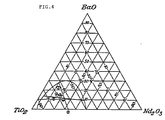
- the functional molar composition is xBaO.yTiO 2 .zRE 2 O 3 , with x ranging from 0m% to 30m%, y ranging from 45m% to 95m%, and z ranging from 5m% to 50m%.
- a dielectric ceramic powder for sintering or making a capacitor comprises from 91 weight percent to 99 weight percent of a dielectric ceramic composition, and from 1 weight percent to 9 weight percent of the dual-component flux (zinc silicate contributing from 0.5 weight percent to 4 weight percent, barium borate contributing from 0.5 weight percent to 5 weight percent).
- the dual-component flux zinc silicate contributing from 0.5 weight percent to 4 weight percent, barium borate contributing from 0.5 weight percent to 5 weight percent.
- One or more additives can also be included to adjust the TCC slope.
- zinc silicate has only one phase 2ZnO.SiO 2
- barium borate may exist in four phases, BaO.B 2 O 3 , 3BaO.1B 2 O 3 , BaO.2B 2 O 3 , and BaO.4B 2 O 3 .
- the BaO.B 2 O 3 and the 3BaO.B 2 O 3 phases are the preferred phases.
- B 2 O 3 and SiO 2 should be taken into account, wherein the functional weight percent of B 2 O 3 in the barium borate should range from 0.029w% to 2.75w% of the total weight of the dielectric composition, whereas the functional weight percent of SiO 2 in the zinc silicate should range from 0.08w% to 1.42w% of the total weight of the dielectric powder.
- the flux can be employed as a zinc-borasilicate glass or as separate components of zinc silicate and barium borate. In either embodiment, the precursor-flux composition can still be sintered at temperatures less than 1,155 °C with acceptable results.
- the sintering flux is also effective when added to a calcine of a dielectric ceramic composition (i.e. BaTiO 3 -CaZrO 3 or xBaO.yTiO 2 .zRe 2 O 3 ), whether as a glass or as zinc silicate and barium borate components.
- the sintering flux is effective when the dielectric ceramic powder is the calcine of a dielectric ceramic composition (i.e. BaTiO 3 -CaZrO 3 or xBaO.yTiO 2 .zRE 2 O 3 ) mildly calcined with the flux composition.
- the calcine of a first powder mixture of BaTiO 3 -CaZrO 3 , additive and flux, and the calcine of a second powder mixture of xBaO.yTiO 2 .zRE 2 O 3 , additive and flux, can be mixed in different amounts to derive TC capacitors and dielectrics of specific linear and electrical properties, depending on the mix and properties of the composition of the individual powder mixture calcine.
- the weight percentages of each of the first and second powder mixtures is plotted relative to a particular linear or electrical property, the resulting curve provides the weight percentages of each of the first and second powder mixtures needed to derive a dielectric or TC capacitor exhibiting the desired property.
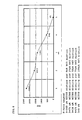
- FIG.6 An example is shown in FIG.6, where a first powder mixture derived to exhibit a TCC of N2200 and a K of 450 and a second powder derived to exhibit a TCC of NPO and a K of 65 were mixed in varying weight percentages and plotted relative to the TCC slope.
- FIG.1 is a two-dimensional graph demonstrating the linear relationship of TCC and temperature over the range of -55 °C and +125 °C of common linear dielectrics. It is noted that N type dielectrics have negative capacitance slopes and P type dielectrics have positive capacitance slopes.
- the NPO (COG) type dielectric has a zero or near zero slope.
- FIG.2 is a cross sectional view of a capacitor having one layer.
- the capacitor comprises a ceramic body 10, one electrode 11 composed of an alloy of 70% silver and 30% palladium buried within body 10, an external conductive terminal 12 by which external contact is made to electrode 11, and a second electrode 13 in contact with body 10 and in capacitive relationship with electrode 11.
- FIG.3 is a cross sectional view of a multilayered capacitor comprising a ceramic body 20, a group of electrodes 21 buried within body 20 and in capacitive relationship with another group of buried electrodes 22. External terminals 23 and 24 are connected to the group 21 and the group 22 electrodes respectively.
- Each electrode is composed of an alloy of 70% silver and 30% palladium.
- FIG.4 is a ternary diagram showing the operable molar values of BaO.TiO 2 with partial substitution by Nd 2 O 3 , as depicted within the semi-circled area.
- FIG.5 is a ternary diagram showing the operable weight percentages of a dielectric ceramic powder of dielectric ceramic composition, barium borate and zinc silicate.
- FIG.6 is a plot of a calcine of an N2200 dielectric ceramic powder and a calcine of a K65 dielectric ceramic powder mixed together in varying weight percentages relative to the TCC. This particular curve provides the weight percentages of the calcines needed to obtain a specific TCC slope.
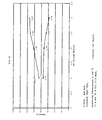
- FIG.7A, FIG.7B and FIG.7C are plots of B 2 O 3 and SiO 2 , to demonstrate the effective weight percent ranges of B 2 O 3 and SiO 2 .
- the new phase can be in the form of (Ba 1-m Ca m )(Ti 1-z Zr z )O 3 .
- the substitution of Ca for Ba, and Zr for Ti, in the pervoskite crystal lattice, will cause a shift in the ferro-electric to para-electric transition temperature of BaTiO 3 from +125 °C to well below -100 °C.
- This composition will exhibit a negative TCC slope.
- the titanate/zirconate TCC slope can be modified by varying the mole percent of calcium zirconate substituted for barium titanate.
- the TCC slope is further adjusted by adding bismuth titanate to adjust the linearity to an N2200 ⁇ 150 PPM/°C.
- Modifying the TCC slope may also be undertaken with strontium titanate, previously studied by R.J. Cava et al., Compensation of the temperature coefficient of the dielectric constant of barium strontium titanate, Appl. Phys. Lett. 67(25), December 18, 1995.
- Powders of BaCO 3 , CaCO 3 , TiO 2 , and ZrO 2 in proportions to derive the composition of (1-m)BaTiO 3 and (m)CaZrO 3 (m being either 30m% or 25m%) were milled with de-ionizer water for several hours, dried, granulated, and calcined at about 1,150 °C, to yield a high temperature phase powder.
- the powder was milled or pulverized to achieve an average particle size of less than 2 microns.
- Barium borate powder and zinc silicate powder were then added in different weight percentages, as shown in the examples.
- Monolayered sample discs were prepared from 50gm batches. The batches were combined with certain additives, as shown in the examples, a small amount of an organic binder, solvent and dispersant, milled for about 15 hours and dried. This process produced homogeneous mixtures, which were granulated and compressed into discs at about 15,000 PSI, and subsequently fired at 1,130 °C. The fired dimensions of the discs were about 1 cm in diameter and about 0.8 mm in thickness.
- the effect of the dual-component flux is realized via the 75/25 dielectric ceramic powder mixture.
- Table 1 when this mixture was sintered at 1,300 °C, without any flux or component thereof, as shown by sample 1, the fired disc was openly porous, and electrical and linear properties could not be measured. Adding 2w% Zn 2 SiO 4 and sintering at 1,250 °C, as shown by sample 2, the disc attained a density of 5.55 g/cm 3 and a %DF of 0.09. The TCC slope was very negative since only 25m% of barium titanate was substituted by calcium zirconate.
- Example 3 when sintered at 1,130 °C, was openly porous.
- the TCC slope is less negative than the 75/25 (more substitution of calcium zirconate), as shown by samples 7-10.
- Sample 7 had only the zinc silicate component of the flux (2w%). Sintering at 1,250 °C was necessary to attain a high density and a Q of 2,000.
- adding 1w% BaO.B 2 O 3 with sintering at only 1,130 °C achieved a Q of 10,000 and a high density of 5.47.
- Increasing the amount of BaO.B 2 O 3 as with the 75/25 mixture, showed a decrease in Q, most likely due to the 1:1 increase of BaO and B 2 O 3 , as demonstrated through FIG.7A, FIG.7B, and FIG.7C.
- Table 2 shows the results when the zinc silicate amount was varied, using the 75/25 mixture (with 0.1w% manganese carbonate for improving insulation resistance at high temperatures).
- samples 11-13 were openly porous when sintered at 1,130 °C.
- samples 14 and 15 yielded measurable properties, densities and Q factors.
- the results were poor, probably due to the zinc silicate approaching the limit of its operable amount, as seen through FIG.7A, FIG.7B, and FIG.7C.
- Samples 16-19 show the effect of 3BaO.B 2 O 3 , using the 75/25 mixture (with 0.1w% manganese carbonate for improving the insulation resistance at high temperatures).
- the weight percent of 3BaO.B 2 O 3 must be greater than that weight percent of BaO.B 2 O 3 to achieve a higher borate amount.
- the results bear this out, as shown by samples 16-19.
- Bi 2 Ti 2 O 7 is the positive TCC slope and low dielectric constant, as shown by sample 25.
- the 70/30 dielectric ceramic powder mixture was not specifically useful for an N2200 TCC in light of the too positive effect of the 30m% calcium zirconate and bismuth titanate on the TCC slope, as shown by samples 22-24.
- the 75/25 mixture when adjusted by only 5w% of bismuth titanate, yielded an N2200 ⁇ 150 PPM/°C, with a Q of 10,000 and a high density of 5.57 g/cm 3 , as shown by sample 29.
- the sintering temperature was only 1,130 °C.
- With 0.1w% MnCO 3 as shown by sample 21, with 4w% bismuth titanate, an N2200 dielectric was attained, with a Q of ⁇ 3,333.
- strontium titanate was used in light of its negatively sloped TCC. With only 2w% of the zinc silicate component, as shown by samples 32 and 33 of Table 4, it was necessary to sinter at 1,250 °C. While the Q factor ranged from 1,250 to 2,000, the TCC slope was by no means linear, indicative of the solid solution of the SrTiO 3 when sintered at 1,250 °C. Samples 40-45, comprising the 70/30 mixture, confirmed strontium titanate forming the solid solution since these samples demonstrated the increasing nonlinearity of the TCC with greater amounts of strontium titanate.
- the effectiveness of the zinc silicate and barium borate flux as a glass was also examined.
- the glass was tested using the 75/25 mixture, where a two-to-one weight ratio of zinc silicate to barium borate (BaO.B 2 O 3 phase) was prepared to make a zincborasilicate powder.
- This powder was ball milled for 24 hours in isopropyl alcohol to form a slurry, dried at 85 °C to a powder, granulated through a 20 mesh screen.
- the resulting powder was then calcined at 750 °C for 1 hour, re-milled in the isopropyl alcohol, dried and granulated.
- the glass sample (3w% zincborasilicate glass), when sintered at 1,130 °C, yielded an N2200 ⁇ 150 PPM/°C dielectric with a density of 5.48 g/cm 3 , a 436 K, and a 2,500 Q.
- the sample with the flux added as separate components of 2w% zinc silicate and 1w% BaO.B 2 O 3 and sintered at 1,130 °C yielded an N2200 ⁇ 150 PPM/°C dielectric with a density of 5.47g/cm 3 , a K of 433, and a Q factor exceeding 10,000.
- the flux as separate components is a preferred embodiment for the BaTiO 3 -CaZrO 3 mixture.
- Sample multilayered capacitors were prepared using the 75/25 mixture.
- the method used to prepare the dielectric ceramic composition was the same as that described above, except that the composition was 92 weight percent, the sintering flux was 3 weight percent (2w% Zn 2 SiO 4 , 1w% BaO.B 2 O 3 ), and the additive Bi 2 Ti 2 O 7 powder was 5w%.
- the mixture of powders were combined in an organic vehicle and binder medium.
- the organic vehicle was xylene and N-butanol in a 70/30 weight ratio respectively.
- the binder medium was a poly-vinyl butyryl.
- This slurry contained by weight 50% of solvent (the vehicle), 9% of binder, a few percent of organic dispersant and plasticizer, and the dielectric ceramic composition, flux and bismuth titanate. The slurry was milled for about 6 hours to assure the homogeneity of the powders.
- the fired capacitors yielded a density of 5.436g/cm 3 , a K of 465 and a %DF of 0.01 (meeting the EIA-198 standard).
- the TCC was N2200 ⁇ 150 PPM/°C (N2350 between -55 °C and +25 °C, and N2280 between +25 °C and +125 °C).
- the insulation resistance was, at 100V and +25 °C, greater than 10 11 Ohms and, at 100V and +125 °C, greater than 10 10 Ohms.
- the dielectric breakdown was greater than 50V/ ⁇ .
- This set of examples demonstrates barium titanate with substitution by neodymium oxide, to produce a dielectric ceramic composition of xBaO.yTiO 2 zNd 2 O 3 , with the objective to attain an NPO dielectric exhibiting a very high Q and density, and a K in the 65 range.
- Rare earth metal titanates exhibit NPO linear properties, though with relatively high dielectric constants.
- the BaO.TiO 2 Nd 2 O 3 dielectric ceramic composition was prepared from powders of titanium dioxide, barium carbonate, and neodymium hydroxides, hydrates, oxalates, carbonates or oxides.
- the powders were mixed in the proportions to derive mole percentage values of 15.4m% of BaO, 67.6m% of TiO 2 , and 17.0m% of Nd 2 O 3 .
- the mixture was wet ball milled for several hours to produce a slurry.
- the slurry was dried at around 150 °C and granulated. This powder was then calcined at about 1,250 °C and milled or pulverized to achieve an average particle size of less than 2 microns.
- Barium borate powder and zinc silicate powder were then added in different weight percentages, as shown in the examples.
- Monolayered sample discs were prepared from 50gm batches. The batches were a mixture of the dielectric ceramic composition and the sintering flux. There batches were combined with certain additives, as shown in the examples, with a small amount of an organic binder, solvent and dispersant, milled for about 15 hours and dried. This process produced homogeneous mixtures, which were granulated and compressed into discs at about 15,000 PSI, and subsequently fired at 1,100 °C. The fired dimensions were about 1 cm in diameter and about 0.8 mm in thickness.
- the BaO.TiO 2 .Nd 2 O 3 dielectric ceramic composition was evaluated with two barium borate phases, BaO.B 2 O 3 and 3BaO.B 2 O 3 , and varying w% of flux and components thereof.
- the plotted density results can be grouped in the following manner: (a) zinc silicate constant at 2.5w% while varying the barium borate, (b) barium borate constant at 2.5w% while varying the zinc silicate, and (c) zinc silicate constant at 1w% while varying the barium borate.
- samples 46-49 show the change in density relative to varying 3BaO.1B 2 O 3 w%
- samples 63-66 show the change in density relative to varying BaO.B 2 O 3 w%.
- FIG.7A for samples 63-66, the density increased as the amount of barium borate was increased.
- a greater amount of the 3BaO.1B 2 O 3 phase is needed for a more significant effect on the density.
- the change in density was not necessarily significant in light of the small amount of zinc silicate used. For comparison, consider samples 59-62 and FIG.7C.
- the lower limit of the w% of zinc silicate is shown by the plot of samples 50-58 and 67-70.
- 3BaO.1B 2 O 3 less than 0.5w% of zinc silicate results in open porosity.
- Increasing the zinc silicate w% results in the increase of density.
- the increase in density is also demonstrated by the BaO.B 2 O 3 phase. While this phase at 0w% zinc silicate (sample 67) exhibited a relatively good density, this effect is due to the large amount of B 2 O 3 contributed.
- samples 71-73 when the zinc silicate was increased to 3w%, lesser w% of barium borate could be used without effect on the density.
- the Q factors were very large, at least 10,000.
- an NPO (COG) dielectric was achieved with a Q exceeding 10,000 and a high density of 5.60 g/cm 3 .
- the NPO (COG) dielectric had a Q exceeding 10,000 and a density of 5.62 g/cm 3 .
- the TCC slopes in general, fell within the EIA-98 standard of ⁇ 30 PPM/°C -- depending on the barium borate/zinc silicate weight percentages.
- Table 5's samples were prepared only with 15.4m% BaO, 67.6m% TiO 2 , and 17.0m% Nd 2 O 3 , without adjustment by varying the mole percentages of the oxides. With adjustment of the mole percentages, it may have been possible to achieve more precise NPO (COG) characteristics and properties.
- COG NPO
- Table 6 shows the results when the additive barium zirconate was added to the 15.4BaO.67.6TiO 2 .17.0RE 2 O 3 composition used.
- Using the sintering flux composition of 2.5w% zinc silicate and 2.5w% 3BaO.1B 2 O 3 (see sample 54 of Table 5), increasing amounts of barium zirconate resulted in a decreased density and Q factor.
- Characteristic of barium zirconate is the positive effect on the TCC slope. Sample 75 exhibited more linear properties and a K of 62, within the COG standard.
- the effectiveness of the zinc silicate and barium borate flux as a glass was also examined.
- the glass was prepared via the method previously discussed above for the 75/25 barium titanate/calcium zirconate mixture.
- a 6.5w% glass sample with the 15.4BaO.67.6TiO 2 .17.0Nd 2 O 3 composition was sintered at 1,100 °C and yielded an NPO (COG) dielectric.
- the Q ⁇ 3,333.
- a 4.5w% glass sample had a Q factor that exceeded 10,000.
- Sample multilayered capacitors were prepared of the precursor composition via that method used to prepare the precursor composition as described above, except that the precursor composition was 95w% (15.4m%) BaO.(67.6m%)TiO 2 . (17.0m%)Nd 2 O 3 and 5w% sintering flux (with 3BaO.1B 2 O 3 contributing 2.5 weight percent and zinc silicate contributing 2.5 weight percent).
- the sample multilayered capacitors, as shown in FIG.2 were then prepared via the process described for the titanate/zirconate capacitors above, with and without bismuth titanate, and the capacitors were fired at 1,100 °C.
- Each sample capacitor had dimensions of 3.0 mm X 2.5 mm X 0.75 mm and 10 layers of 35 ⁇ thickness each.
- the fired capacitors yielded a density of 5.55 g/cm 3 , a K of 68, and Q exceeding 10,000 at 1 KHz and 1,000 at 1 MHz.
- the TCC was almost within the NPO (COG) standard of ⁇ 30 PPM/°C (N38 between -55 °C and +25 °C, and N27 between +25 °C and +125 °C).
- Capacitance at 1KHz was 865pf, and at 1MHz was 865pf.
- the fired capacitors yielded a density of 5.59 g/cm 3 , a K of 64, and Q exceeding 10,000 at 1 KHz and 1,000 at 1 MHz.
- the TCC was well within the NPO (COG) standard of ⁇ 30 PPM/°C (N26 between -55 °C and +25 °C, and N19 between +25 °C and +125 °C). Capacitance at 1KHz was 1027pf, and at 1MHz was 1028pf.
- MZCT magnesium zinc calcium titanate system
- the dual-component flux of barium borate and zinc silicate was effective when the dielectric ceramic powder was sintered over the range of 1,100 °C and 1,150 °C, notwithstanding sample 103 of Table 10.
- the capacitors when fired, yielded very high densities, a K of 23 or 24.
- the TCC's were well within the COG standard.
- the %DF's were low, especially as shown by samples 100, 101 and 105. These samples exhibited Q factors of at least 10,000.
- sample 99 prepared with 1.2 w% 3BaO.1B 2 O 3 and 1.0 w% Zn 2 SiO 4
- sample 103 yielded poor data, it was likely due to measurement difficulties.
- lithium carbonate When a small amount of lithium carbonate (0.3 w%) was tested to determine whether lithium carbonate may effect life expectancy, lithium carbonate's effectiveness was dramatic and unexpected. Those capacitors with Li 2 CO 3 passed the life expectancy tests, while still exhibiting excellent electrical and linear properties, as shown by sample 105 of Table 10 (respective to sample 96 of Table 9). Thereafter, Li 2 SiO 4 was tested for its effect on life expectancy. As with the Li 2 CO 3 , those capacitors with Li 2 SiO 4 passed the life expectancy test and achieved good electrical and linear properties, as shown by sample 106 of Table 10 (respective to sample 97 of Table 9). The lower Q factor of sample 106 (compared to sample 105) was likely due to the lower sintering temperature of 1,110 °C. Samples 105 and 106 were within the COG standard.
- the particular dielectric ceramic compositions were prepared as previously discussed above. As shown in Table 8, different weight percentages of each dielectric ceramic powder were added together and then sintered 1,130 °C. The N2200 and K65 mixtures, when sintered at 1,130 °C, yielded dielectrics of high densities and high Q factors. When graphed, as shown in FIG.6, the resulting curve can provide the specific weight percentages of N2200 and K65 needed to attain dielectrics of specific K and/or TCC values.
- This aspect of the present invention is appropriate for an embodiment of a kit comprising a first powder mixture of a (Ba m Ca 1-m Ti m Zr 1-m )O 3 , additive, and flux (derived to exhibit particular TCC and K properties) and a second powder mixture of xBaO.yTiO 2 .zNd 2 O 3 , additive, and flux (derived to exhibit particular TCC and K properties).
- a second powder mixture of xBaO.yTiO 2 .zNd 2 O 3 , additive, and flux (derived to exhibit particular TCC and K properties).
- each component of the each powder mixture can be adjusted to yield specific linear and electric properties.
- xBaO.yTiO 2 .zRE 2 O 3 includes not only the compound but also those compounds selected from the group consisting essentially of x moles baria, y moles titania, and z moles RE 2 O 3 , in the molar ratio previously disclosed.
Landscapes
- Engineering & Computer Science (AREA)
- Chemical & Material Sciences (AREA)
- Ceramic Engineering (AREA)
- Manufacturing & Machinery (AREA)
- Power Engineering (AREA)
- Materials Engineering (AREA)
- Organic Chemistry (AREA)
- Structural Engineering (AREA)
- Inorganic Chemistry (AREA)
- Microelectronics & Electronic Packaging (AREA)
- Composite Materials (AREA)
- Compositions Of Oxide Ceramics (AREA)
- Ceramic Capacitors (AREA)
- Inorganic Insulating Materials (AREA)
Abstract
Description


Claims (20)
- A dielectric ceramic powder comprising:wherein said first and said second powder mixtures together amount to at least 99 weight percent of said dielectric ceramic powder and the weight percent of each of said first and said second powder mixtures is from 0 to 100 weight percent,a) a first powder mixture comprised essentially ofa1) from 51 weight percent to 99 weight percent (Ba(1-m)CamTi(1-m)Zrm)O3, the molar fraction m ranging from 0.20 to 0.35,a2) a first additive selected from the group consisting of up to 30 weight percent strontium titanate, up to 10 weight percent bismuth titanate, and mixtures thereof,a3) a dual-component sintering flux comprised essentially of barium borate and zinc silicate, the barium borate making up from 0.5 weight percent to 5 weight percent and the zinc silicate making up from 0.5 weight percent to 4 weight percent, andb) a second powder mixture comprised essentially ofb1) a precursor powder selected from the group consisting essentially of from 82.5 weight percent to 99 weight percent of a powder of xBaO.yTiO2.zRE2O3, RE being a rare earth metal selected from the group consisting essentially of Nd, Sm, Ce, La, Pr, and mixtures thereof, and x ranging from 0 mole percent to 30 mole percent, y ranging from 45 mole percent to 95 mole percent, and z ranging from 5 mole percent to 50 mole percent,b2) a second additive selected from the group consisting essentially of up to 2.5 weight percent bismuth titanate, up to 6 weight percent barium zirconate, and mixtures thereof,b3) of said dual-component sintering flux, the barium borate making up from 0.5 weight percent to 5 weight percent and the zinc silicate making up from 0.5 weight percent to 4 weight percent,
so that by sintering said dielectric ceramic powder, there may be provided a low TCC dielectric ceramic body having selected electrical and linear properties by having chosen the relative amounts of each of said powder mixtures and having chosen the relative amounts of each of the environmentally friendly and TCC stabilizing dual-component pair of fluxes, barium borate and zinc silicate. - A dielectric ceramic powder of claim 1, wherein the weight percent of B2O3 in the barium borate of said dual-component flux in each mixture ranges from 0.029 weight percent to 2.75 weight percent, and the weight percent of SiO2 in the zinc silicate of said dual-component in each mixture ranges from 0.08 weight percent to 1.42 weight percent.
- A dielectric ceramic powder of claim 1, wherein the barium borate of said dual-component flux in each mixture is selected from the group consisting essentially of BaO.B2O3, 3BaO.1B2O3, BaO.2B2O3, BaO.4B2O3, and mixtures thereof.
- A dielectric ceramic powder of claim 1, wherein the weight percent of said first powder mixture is 100.
- A dielectric ceramic powder of claim 1, wherein the weight percent of said second mixture is 100.
- A dielectric ceramic powder of claim 1, wherein the rare earth metal is neodymium.
- A dielectric ceramic powder of claim 1,wherein said first powder mixture is the calcine of (Ba(1-m)CamTi(1-m)Zrm)O3, said first additive and said dual-component flux, with a grain size of 2 microns or less average particle size, andwherein said second powder mixture is the calcine of xBaO.yTiO2.zRE2O3, said second additive and said dual-component flux, with a grain size of 2 microns or less average particle size.
- A dielectric ceramic powder of claim 7, wherein the dielectric ceramic powder is a calcine of said first powder mixture and said second powder mixture, with a grain size of 2 microns or less average particle size.
- A dielectric ceramic powder of claim 1,wherein said first powder mixture is made up of said dual-component flux and the calcine of (Ba(1-m)CamTi(1-m)Zrm)O3 and said first additive, andwherein said second powder mixture is made up of said dual-component flux and the calcine of xBaO.yTiO2.zRE2O3 and said second additive.
- A dielectric ceramic powder of claim 1, wherein the sintering flux of each mixture is a borasilicate glass.
- A capacitor having a ceramic body with at least one electrode buried within said ceramic body, an external conductive terminal by which external contact is made to said at least one electrode, said capacitor being co-fired with said at least one electrode, said capacitor's un-fired ceramic body composed of a dielectric ceramic powder that comprises:wherein said first and said second powder mixtures together amount to at least 99 weight percent of said dielectric ceramic powder and the weight percent of each of said first and said second powder mixtures is from 0 to 100 weight percent,a) a first powder mixture comprised essentially ofa1) from 51 weight percent to 99 weight percent (Ba(1-m)CamTi(1-m)Zrm)O3, the molar fraction m ranging from 0.20 to 0.35,a2) a first additive selected from the group consisting of up to 30 weight percent strontium titanate, up to 10 weight percent bismuth titanate, and mixtures thereof,a3) a dual-component sintering flux comprised essentially of barium borate and zinc silicate, the barium borate making up from 0.5 weight percent to 5 weight percent and the zinc silicate making up from 0.5 weight percent to 4 weight percent, andb) a second powder mixture comprised essentially ofb1) a precursor powder selected from the group consisting essentially of from 82.5 weight percent to 99 weight percent of a powder of xBaO.yTiO2.zRE2O3, RE being a rare earth metal selected from the group consisting essentially of Nd, Sm, Ce, La, Pr, and mixtures thereof, and x ranging from 0 mole percent to 30 mole percent, y ranging from 45 mole percent to 95 mole percent, and z ranging from 5 mole percent to 50 mole percent,b2) a second additive selected from the group consisting essentially of up to 2.5 weight percent bismuth titanate, up to 6 weight percent barium zirconate, and mixtures thereof,b3) of said dual-component sintering flux, the barium borate making up from 0.5 weight percent to 5 weight percent and the zinc silicate making up from 0.5 weight percent to 4 weight percent,
so that by sintering said dielectric ceramic powder, there may be provided a low TCC dielectric ceramic body having selected electrical and linear properties by having chosen the relative amounts of each of said powder mixtures and having chosen the relative amounts of each of the environmentally friendly and TCC stabilizing dual-component pair of fluxes, barium borate and zinc silicate. - A capacitor of claim 11, wherein the weight percent of B2O3 in the barium borate of said dual-component flux in each mixture ranges from 0.029 weight percent to 2.75 weight percent, and the weight percent of SiO2 in the zinc silicate of said dual-component in each mixture ranges from 0.08 weight percent to 1.42 weight percent.
- A capacitor of claim 11, wherein the weight percent of said first powder mixture is 100.
- A capacitor of claim 11, wherein the weight percent of said second powder mixture is 100.
- A kit comprising a first dielectric ceramic powder and a second dielectric ceramic powder,wherein said first and said second powder mixtures together amount to at least 99 weight percent of said dielectric ceramic powder and the weight percent of each of said first and said second powder mixtures is from 0 to 100 weight percent,a) a first powder mixture comprised essentially ofa1) from 51 weight percent to 99 weight percent (Ba(1-m)CamTi(1-m)Zrm)O3, the molar fraction m ranging from 0.20 to 0.35,a2) a first additive selected from the group consisting of up to 30 weight percent strontium titanate, up to 10 weight percent bismuth titanate, and mixtures thereof,a3) a dual-component sintering flux comprised essentially of barium borate and zinc silicate, the barium borate making up from 0.5 weight percent to 5 weight percent and the zinc silicate making up from 0.5 weight percent to 4 weight percent, andb) a second powder mixture comprised essentially ofb1) a precursor powder selected from the group consisting essentially of from 82.5 weight percent to 99 weight percent of a powder of xBaO.yTiO2.zRE2O3, RE being a rare earth metal selected from the group consisting essentially of Nd, Sm, Ce, La, Pr, and mixtures thereof, and x ranging from 0 mole percent to 30 mole percent, y ranging from 45 mole percent to 95 mole percent, and z ranging from 5 mole percent to 50 mole percent,b2) a second additive selected from the group consisting essentially of up to 2.5 weight percent bismuth titanate, up to 6 weight percent barium zirconate, and mixtures thereof,b3) of said dual-component sintering flux, the barium borate making up from 0.5 weight percent to 5 weight percent and the zinc silicate making up from 0.5 weight percent to 4 weight percent,
so that by sintering said dielectric ceramic powder, there may be provided a low TCC dielectric ceramic body having selected electrical and linear properties by having chosen the relative amounts of each of said powder mixtures and having chosen the relative amounts of each of the environmentally friendly and TCC stabilizing dual-component pair of fluxes, barium borate and zinc silicate. - A kit of claim 15, wherein the weight percent of B2O3 in the barium borate of said dual-component flux in each powder ranges from 0.029 weight percent to 2.75 weight percent, and the weight percent of SiO2 in the zinc silicate of said dual-component in each powder ranges from 0.08 weight percent to 1.42 weight percent.
- A dielectric ceramic powder of claim 15,wherein said first powder mixture is the calcine of (Ba(1-m)CamTi(1-m)Zrm)O3, said first additive and said dual-component flux, with a grain size of 2 microns or less average particle size, andwherein said second powder mixture is the calcine of xBaO.yTiO2.zRE2O3, said second additive and said dual-component flux, with a grain size of 2 microns or less average particle size.
- A dielectric ceramic powder of claim 17, wherein the dielectric ceramic powder is a calcine of said first powder mixture and said second powder mixture, with a grain size of 2 microns or less average particle size.
- A dielectric ceramic powder of claim 15,wherein said first powder mixture is made up of said dual-component flux and the calcine of (Ba(1-m)CamTi(1-m)Zrm)O3 and said first additive, andwherein said second powder mixture is made up of said dual-component flux and the calcine of xBaO.yTiO2.zRE2O3 and said second additive.
- A dielectric ceramic powder of claim 15, wherein the sintering flux of each mixture is a borasilicate glass.
Applications Claiming Priority (2)
| Application Number | Priority Date | Filing Date | Title |
|---|---|---|---|
| US09/224,536 US6251816B1 (en) | 1998-12-31 | 1998-12-31 | Capacitor and dielectric ceramic powder based upon a barium borate and zinc silicate dual-component sintering flux |
| US224536 | 1998-12-31 |
Publications (2)
| Publication Number | Publication Date |
|---|---|
| EP1017069A2 true EP1017069A2 (en) | 2000-07-05 |
| EP1017069A3 EP1017069A3 (en) | 2006-04-05 |
Family
ID=22841105
Family Applications (1)
| Application Number | Title | Priority Date | Filing Date |
|---|---|---|---|
| EP99310329A Withdrawn EP1017069A3 (en) | 1998-12-31 | 1999-12-21 | Capacitor and dielectric ceramic powder therefor |
Country Status (5)
| Country | Link |
|---|---|
| US (1) | US6251816B1 (en) |
| EP (1) | EP1017069A3 (en) |
| JP (1) | JP3383623B2 (en) |
| KR (1) | KR100390021B1 (en) |
| TW (1) | TW577860B (en) |
Cited By (7)
| Publication number | Priority date | Publication date | Assignee | Title |
|---|---|---|---|---|
| EP1199290A1 (en) * | 2000-08-31 | 2002-04-24 | MRA Laboratories, Inc. | A magnesium zinc titanate powder with a barium boron lithium silicate flux and a multilayer ceramic cog capacitor made therefrom |
| DE102004038958A1 (en) * | 2004-08-05 | 2006-02-23 | Fraunhofer-Gesellschaft zur Förderung der angewandten Forschung e.V. | Heterogenic high dielectric ceramic material has a meta-stable matrix of co-sintered granulate particles of two or more dielectric ceramic compounds |
| EP1708212A3 (en) * | 2005-03-29 | 2006-12-06 | Samsung Electro-Mechanics Co., Ltd. | Method for manufacturing dielectric ceramic powder, and multilayer ceramic capacitor obtained by using the ceramic powder |
| WO2014117689A1 (en) | 2013-01-30 | 2014-08-07 | Shenzhen Byd Auto R & D Company Limited | Thermistor material and method of preparing the same |
| EP3182429A1 (en) | 2015-12-17 | 2017-06-21 | 3M Innovative Properties Company | Capacitor, capacitive voltage sensor and method for manufacturing a capacitor |
| EP3182428A1 (en) | 2015-12-17 | 2017-06-21 | 3M Innovative Properties Company | Capacitor, capacitive voltage sensor and method for manufacturing a capacitor |
| US11094463B2 (en) * | 2019-02-27 | 2021-08-17 | Aegis Technology Inc. | Method for manufacturing spherical ceramic-glass nanocomposite dielectrics for multilayer ceramic capacitor applications |
Families Citing this family (19)
| Publication number | Priority date | Publication date | Assignee | Title |
|---|---|---|---|---|
| US6514895B1 (en) * | 2000-06-15 | 2003-02-04 | Paratek Microwave, Inc. | Electronically tunable ceramic materials including tunable dielectric and metal silicate phases |
| US6727200B2 (en) | 2000-08-31 | 2004-04-27 | Mra Laboratories, Inc. | High dielectric constant very low fired X7R ceramic capacitor, and powder for making |
| KR100414832B1 (en) * | 2001-02-22 | 2004-01-13 | 삼성전기주식회사 | Preparation of the high quality Barium-Titanate based powder |
| JP2002289462A (en) * | 2001-03-27 | 2002-10-04 | Alps Electric Co Ltd | Method of manufacturing thin film capacitor, thin film capacitor for temperature compensation provided with the thin film capacitor, electronic device and electronic circuit |
| KR100466072B1 (en) * | 2002-05-24 | 2005-01-13 | 삼성전기주식회사 | Dielectric Composition For Multilayer Ceramic Condenser And Multilayer Ceramic Condenser Using The Same |
| US6960546B2 (en) * | 2002-09-27 | 2005-11-01 | Paratek Microwave, Inc. | Dielectric composite materials including an electronically tunable dielectric phase and a calcium and oxygen-containing compound phase |
| US6876536B2 (en) * | 2002-12-27 | 2005-04-05 | Tdk Corporation | Thin film capacitor and method for fabricating the same |
| WO2004077565A1 (en) * | 2003-02-27 | 2004-09-10 | Tdk Corporation | Thin-film capacitative element and electronic circuit or electronic equipment including the same |
| JP2004284941A (en) * | 2003-03-04 | 2004-10-14 | Ngk Insulators Ltd | Dielectric composition for low temperature firing, and electronic component |
| JP4907850B2 (en) * | 2003-06-11 | 2012-04-04 | 日本特殊陶業株式会社 | Low-temperature fired dielectric ceramic composition and manufacturing method thereof |
| US7378363B2 (en) * | 2005-05-20 | 2008-05-27 | Skyworks Solutions, Inc. | Dielectric ceramic composition having wide sintering temperature range and reduced exaggerated grain growth |
| JP4299827B2 (en) * | 2005-12-05 | 2009-07-22 | Tdk株式会社 | Dielectric ceramic composition, electronic component and multilayer ceramic capacitor |
| JP5294441B2 (en) * | 2006-03-30 | 2013-09-18 | 双信電機株式会社 | Electronic components |
| KR101532137B1 (en) * | 2013-07-23 | 2015-06-26 | 삼성전기주식회사 | Dielectric composition for low temperature sintering, multilayer ceramic electronic device including the same and method for fabricating the multilayer ceramic electronic device |
| US9255034B1 (en) | 2014-09-15 | 2016-02-09 | Hyundai Motor Company | Dielectric material for temperature compensation and method of preparing the same |
| US10950688B2 (en) | 2019-02-21 | 2021-03-16 | Kemet Electronics Corporation | Packages for power modules with integrated passives |
| CN111362678A (en) * | 2020-03-10 | 2020-07-03 | 烟台大学 | A kind of preparation method of low temperature sintering without shrinkage deformation microporous ceramic irrigation device |
| CN111302793B (en) * | 2020-03-23 | 2022-04-19 | 广东华荣功能材料有限公司 | Dielectric material of high-voltage-resistant ceramic capacitor |
| CN118063209B (en) * | 2022-11-11 | 2025-12-16 | 比亚迪股份有限公司 | Zirconium-based composite ceramic material, preparation method thereof and ceramic structural member |
Family Cites Families (11)
| Publication number | Priority date | Publication date | Assignee | Title |
|---|---|---|---|---|
| US3988498A (en) * | 1968-09-26 | 1976-10-26 | Sprague Electric Company | Low temperature fired electrical components and method of making same |
| US4533974A (en) | 1984-04-09 | 1985-08-06 | Sprague Electric Company | Low-firing high Q monolithic ceramic capacitor |
| US4898844A (en) * | 1986-07-14 | 1990-02-06 | Sprague Electric Company | Process for manufacturing a ceramic body having multiple barium-titanate phases |
| US4897249A (en) * | 1989-04-03 | 1990-01-30 | Sprague Electric Company | Barium borate preparation |
| US5089933A (en) * | 1989-12-04 | 1992-02-18 | Taiyo Yuden Co., Ltd. | Solid dielectric capacitor and method of manufacture |
| JPH0828128B2 (en) * | 1991-09-24 | 1996-03-21 | 太陽誘電株式会社 | Dielectric porcelain composition |
| US5264403A (en) | 1991-09-27 | 1993-11-23 | Ngk Insulators, Ltd. | Dielectric ceramic composition containing ZnO-B2 O3 -SiO2 glass |
| US5290740A (en) * | 1991-11-06 | 1994-03-01 | Ngk Insulators, Ltd. | Dielectric ceramic composition used for producing dielectric resonator or filter for microwave application |
| JP2761690B2 (en) * | 1992-02-04 | 1998-06-04 | 太陽誘電株式会社 | Porcelain capacitor and method of manufacturing the same |
| JP2736397B2 (en) * | 1992-02-04 | 1998-04-02 | 太陽誘電株式会社 | Porcelain capacitor and method of manufacturing the same |
| US5599757A (en) | 1995-10-26 | 1997-02-04 | Ferro Corporation | NPO dielectric ceramic compositions and capacitors made therefrom |
-
1998
- 1998-12-31 US US09/224,536 patent/US6251816B1/en not_active Expired - Fee Related
-
1999
- 1999-12-14 JP JP35476099A patent/JP3383623B2/en not_active Expired - Fee Related
- 1999-12-21 EP EP99310329A patent/EP1017069A3/en not_active Withdrawn
- 1999-12-28 KR KR10-1999-0063454A patent/KR100390021B1/en not_active Expired - Fee Related
- 1999-12-29 TW TW088123194A patent/TW577860B/en not_active IP Right Cessation
Cited By (10)
| Publication number | Priority date | Publication date | Assignee | Title |
|---|---|---|---|---|
| EP1199290A1 (en) * | 2000-08-31 | 2002-04-24 | MRA Laboratories, Inc. | A magnesium zinc titanate powder with a barium boron lithium silicate flux and a multilayer ceramic cog capacitor made therefrom |
| KR100437883B1 (en) * | 2000-08-31 | 2004-06-30 | 엠아르에이 라보레이토리스 | A magnesium zinc titanate powder with a barium boron lithium silicate flux and a multilayer ceramic cog capacitor made therefrom |
| DE102004038958A1 (en) * | 2004-08-05 | 2006-02-23 | Fraunhofer-Gesellschaft zur Förderung der angewandten Forschung e.V. | Heterogenic high dielectric ceramic material has a meta-stable matrix of co-sintered granulate particles of two or more dielectric ceramic compounds |
| EP1708212A3 (en) * | 2005-03-29 | 2006-12-06 | Samsung Electro-Mechanics Co., Ltd. | Method for manufacturing dielectric ceramic powder, and multilayer ceramic capacitor obtained by using the ceramic powder |
| US7791859B2 (en) | 2005-03-29 | 2010-09-07 | Samsung Electro-Mechanics Co., Ltd. | Method for manufacturing dielectric ceramic powder, and multilayer ceramic capacitor obtained by using the ceramic powder |
| WO2014117689A1 (en) | 2013-01-30 | 2014-08-07 | Shenzhen Byd Auto R & D Company Limited | Thermistor material and method of preparing the same |
| US9805847B2 (en) | 2013-01-30 | 2017-10-31 | Byd Company Limited | Thermistor material and method of preparing the same |
| EP3182429A1 (en) | 2015-12-17 | 2017-06-21 | 3M Innovative Properties Company | Capacitor, capacitive voltage sensor and method for manufacturing a capacitor |
| EP3182428A1 (en) | 2015-12-17 | 2017-06-21 | 3M Innovative Properties Company | Capacitor, capacitive voltage sensor and method for manufacturing a capacitor |
| US11094463B2 (en) * | 2019-02-27 | 2021-08-17 | Aegis Technology Inc. | Method for manufacturing spherical ceramic-glass nanocomposite dielectrics for multilayer ceramic capacitor applications |
Also Published As
| Publication number | Publication date |
|---|---|
| TW577860B (en) | 2004-03-01 |
| KR20000052606A (en) | 2000-08-25 |
| JP3383623B2 (en) | 2003-03-04 |
| US6251816B1 (en) | 2001-06-26 |
| JP2000203936A (en) | 2000-07-25 |
| KR100390021B1 (en) | 2003-07-04 |
| EP1017069A3 (en) | 2006-04-05 |
Similar Documents
| Publication | Publication Date | Title |
|---|---|---|
| US6251816B1 (en) | Capacitor and dielectric ceramic powder based upon a barium borate and zinc silicate dual-component sintering flux | |
| KR100278417B1 (en) | Dielectric ceramic, method for producing the same, laminated ceramic electronic element, and method for producing the same | |
| KR100414331B1 (en) | Nonreducing dielectric ceramic and monolithic ceramic capacitor using the same | |
| US6858554B2 (en) | Nonreducible dielectric ceramic composition | |
| US6303529B1 (en) | Dielectric ceramic, method for producing the same, laminated ceramic electronic element, and method for producing the same | |
| US7595975B2 (en) | Dielectric ceramic, ceramic electronic element, and multilayer ceramic capacitor | |
| JP4382598B2 (en) | Reduction-resistant dielectric ceramic composition and ultrathin multilayer ceramic capacitor | |
| KR100326950B1 (en) | Dielectric ceramic composition and laminated ceramic parts | |
| US6790801B2 (en) | Nonreducible dielectric ceramic composition | |
| JPH05152158A (en) | Ceramic capacitor | |
| US5672378A (en) | Method for making a BaTiO3 powder mixture the powder mixture and method for making a Y5V ceramic body therefrom | |
| US4818736A (en) | High dielectric constant type ceramic composition | |
| JPH10310469A (en) | Production of powdery starting material for dielectric ceramic and dielectric ceramic composition | |
| JP4652595B2 (en) | Dielectric porcelain with excellent temperature characteristics | |
| JP3350326B2 (en) | Multilayer capacitors | |
| JP2002226263A (en) | Dielectric porcelain and multilayer ceramic capacitors | |
| JPS61261263A (en) | Manufacture of dielectric ceramic | |
| KR100474249B1 (en) | Dielectric ceramic composition and manufacture method | |
| JP2872513B2 (en) | Dielectric porcelain and porcelain capacitor | |
| KR100395089B1 (en) | A dielectric compositions for Y5V type multilayer ceramic Chip Capacitors having the inner electrode of Ni | |
| JPH10259055A (en) | Dielectric ceramic composition and ceramic condenser | |
| KR20240076952A (en) | Ceramic compostion having high temperature stability | |
| JP4782539B2 (en) | Dielectric porcelain | |
| KR20240078013A (en) | Ceramic compostion having high temperature stability and ceramic capacitor including the same | |
| KR19990081475A (en) | Dielectric ceramic composition |
Legal Events
| Date | Code | Title | Description |
|---|---|---|---|
| PUAI | Public reference made under article 153(3) epc to a published international application that has entered the european phase |
Free format text: ORIGINAL CODE: 0009012 |
|
| AK | Designated contracting states |
Kind code of ref document: A2 Designated state(s): AT BE CH CY DE DK ES FI FR GB GR IE IT LI LU MC NL PT SE |
|
| AX | Request for extension of the european patent |
Free format text: AL;LT;LV;MK;RO;SI |
|
| 17P | Request for examination filed |
Effective date: 20000621 |
|
| PUAL | Search report despatched |
Free format text: ORIGINAL CODE: 0009013 |
|
| AK | Designated contracting states |
Kind code of ref document: A3 Designated state(s): AT BE CH CY DE DK ES FI FR GB GR IE IT LI LU MC NL PT SE |
|
| AX | Request for extension of the european patent |
Extension state: AL LT LV MK RO SI |
|
| RTI1 | Title (correction) |
Free format text: CAPACITOR AND DIELECTRIC CERAMIC POWDER THEREFOR |
|
| AKX | Designation fees paid |
Designated state(s): GB |
|
| REG | Reference to a national code |
Ref country code: DE Ref legal event code: 8566 |
|
| 17Q | First examination report despatched |
Effective date: 20070122 |
|
| GRAP | Despatch of communication of intention to grant a patent |
Free format text: ORIGINAL CODE: EPIDOSNIGR1 |
|
| STAA | Information on the status of an ep patent application or granted ep patent |
Free format text: STATUS: THE APPLICATION IS DEEMED TO BE WITHDRAWN |
|
| 18D | Application deemed to be withdrawn |
Effective date: 20090512 |