EP1008044B1 - Informationsverarbeitung - Google Patents
Informationsverarbeitung Download PDFInfo
- Publication number
- EP1008044B1 EP1008044B1 EP98900908A EP98900908A EP1008044B1 EP 1008044 B1 EP1008044 B1 EP 1008044B1 EP 98900908 A EP98900908 A EP 98900908A EP 98900908 A EP98900908 A EP 98900908A EP 1008044 B1 EP1008044 B1 EP 1008044B1
- Authority
- EP
- European Patent Office
- Prior art keywords
- data
- pool
- processing
- data pool
- data items
- Prior art date
- Legal status (The legal status is an assumption and is not a legal conclusion. Google has not performed a legal analysis and makes no representation as to the accuracy of the status listed.)
- Expired - Lifetime
Links
Images




Classifications
-
- G—PHYSICS
- G06—COMPUTING OR CALCULATING; COUNTING
- G06F—ELECTRIC DIGITAL DATA PROCESSING
- G06F9/00—Arrangements for program control, e.g. control units
- G06F9/06—Arrangements for program control, e.g. control units using stored programs, i.e. using an internal store of processing equipment to receive or retain programs
- G06F9/46—Multiprogramming arrangements
- G06F9/50—Allocation of resources, e.g. of the central processing unit [CPU]
- G06F9/5005—Allocation of resources, e.g. of the central processing unit [CPU] to service a request
- G06F9/5027—Allocation of resources, e.g. of the central processing unit [CPU] to service a request the resource being a machine, e.g. CPUs, Servers, Terminals
-
- G—PHYSICS
- G06—COMPUTING OR CALCULATING; COUNTING
- G06F—ELECTRIC DIGITAL DATA PROCESSING
- G06F15/00—Digital computers in general; Data processing equipment in general
- G06F15/76—Architectures of general purpose stored program computers
- G06F15/80—Architectures of general purpose stored program computers comprising an array of processing units with common control, e.g. single instruction multiple data processors
- G06F15/8007—Architectures of general purpose stored program computers comprising an array of processing units with common control, e.g. single instruction multiple data processors single instruction multiple data [SIMD] multiprocessors
Definitions
- the present invention relates to methods and systems for processing information.
- processing elements are typically connected in a fixed or relatively inflexible configuration with the various component parts being controlled by regular clock pulses to ensure that the information remains synchronised as it is passed from one component to another within the system.
- an information processing system comprising:
- said system controller is arranged such that said selective taking of at least one data item from a plurality of data items in said first data pool is on a random basis.
- systems of the present invention comprise a second data pool for containing input information and output information in the form of data items, said second data pool being adjacent to said first data pool and separated from it by a boundary; and further comprise a transfer means for importing data items of input information from said second data pool to said first data pool and for exporting data items of output information from said first data pool to said second data pool.
- the transfer means may be constituted by one or more of the processing elements.
- At least one of said processing elements constituting the transfer means is arranged to import data items of input information from said second data pool to said first data pool, such a processing element being referred to as an importing processing element; and at least one of said processing elements constituting the transfer means is arranged to export data items of output information from said first data pool to said second data pool, such a processing element being referred to as an exporting processing element.
- a said importing processing element may be a different processing element from a said exporting processing element.
- a single processing element may constitute both a said importing processing element and a said exporting processing element.
- a said importing processing element is arranged to select a data item of input information from said second data pool in accordance with a first predetermined criterion, to create a copy of said selected data item of input information and place said copy into said first data pool, and to destroy said selected data item of input information.
- a said exporting processing element may be arranged to select a data item of output information from said first data pool in accordance with a second predetermined criterion, to create a copy of said selected data item of output information and place said copy into said second data pool, and to destroy said selected data item of output information.
- each of the processing elements is arranged to distinguish between data items that it is allowed to operate upon and data items that it is not allowed to operate upon.
- At least one of said processing elements is arranged to perform a join operation on two or more selected data items.
- At least one of said processing elements is arranged to perform a break operation on a selected data item.
- said system controller is arranged such as to determine the rate at which at least one of the processing elements performs its selection from said first data pool.
- said predetermined function of the selecting and taking step randomises the selection of said at least one data item.
- the selecting and taking step includes a substep of distinguishing between data items that the processing element is allowed to operate upon and data items that it is not allowed to operate upon.
- said step of populating said first data pool with a plurality of data items comprises transferring data items which meet a first predetermined criterion relating to input information from a second data pool to said first data pool.
- the performing step comprises a join operation on two or more selected data items.
- the performing step may comprise a break operation on a selected data item.
- said predetermined function defines the rate of selection of said at least one data item.
- Systems of the present invention are highly parallel, with constituent processing elements operating asynchronously on the data.
- the behaviour of the information processing system can be controlled not only by the specific operations performed by the processing elements, but also by the dynamics which affect the rate at which particular processing elements operate.
- a unit of information is typically represented by multiple data items, or a "concentration" of data items, and this concentration can also be modified so as to affect the results of the processing carried out by the system.
- the transfer of data between processing elements is a result of each processing element's method of selecting appropriate data from the data pool rather than being determined by fixed data paths between the elements.
- System attributes including the dynamics, data item concentrations, and the processing elements' data selectivity can be varied smoothly to control the system behaviour and avoid the brittleness associated with the design of traditional architectures.
- an information processing system 10 comprising an external environment or data pool 12 surrounding an internal environment or data pool 14, and separated from it by a boundary 16.
- the internal environment 14 and the boundary 16 together are referred to as an "enclosure” or a “sac” and these terms are used interchangeably hereinafter.
- the external environment 12 contains a set of data items Dls, of which only data items DI1 to DI5 are shown. The data items are placed in the external environment 12 by a user in an initialisation process described later.
- Transfer mechanism 18 which selectively transfers data items between the external environment 12 and the internal environment 14. Transfer mechanism 18 is shown schematically as a discrete entity not connected to data item DI4 which is shown in Figure 1 being imported and data item DI8 which is which is shown in Figure 1 being exported, but in practice the transfer mechanism 18 will be intimately involved in the importing and exporting of the data items.
- the internal environment 14 contains a set of data items, of which only data items DI6 to DI11 are shown, and a set of processing elements PEs, of which only processing elements PE1, PE2 and PE3 are shown.
- the data items within the internal environment 14 are the result of the operation of the transfer mechanism 18 and the processing elements.
- Each processing element is associated with a source data pool, from which it draws one or more data items to operate on, and a target data pool into which it places the result of the operation.
- the source data pool for the processing elements is the internal data pool 14, which is also the target data pool.
- the operation of the processing elements is controlled by a system controller 20 which includes an iteration counter 22.
- the user of the system 10 will first obtain the input information to be processed (step 210), initialise the system (step 212), define the end condition for the processing (step 214), set the iteration counter 22 to zero (step 216) and then initiate processing by the system 10.
- the system 10 will then perform processing of the information by repeatedly carrying out the following actions, asynchronously and in parallel, with invocation of the actions being governed by the system controller 20 until the end condition is met (step 218).
- Transfer data items between the external environment 12 and the internal environment 14 under the control of the transfer mechanism 18 (step 220).
- Process the sac step 222, shown in detail in Figure 4) and increment the iteration counter 22 (step 224).
- the processed information is extracted from data items in the external data pool (step 226) and the processed information is output (step 228).
- the system 10 ceases processing iterations when the system controller 20 determines that the task specific end condition (set by the user in step 214) has been reached, in this specific embodiment, that a fixed number of processing iterations has been performed.
- different task specific end conditions are used to determine when the system 10 ceases processing.
- the system 10 can be configured to carry out many alternative tasks according to the specific instructions that the system controller 20 is set up to operate under, or given by the user, in the initialisation step 212, also called initialisation procedure.
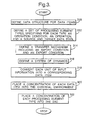
- the user defines a data structure for the data items (step 310), defines a set of processing element types (step 312), defines the operation of the transfer mechanism 18 (step 314, shown in detail in Figure 5), defines a system of dynamics, i.e. the operation of the system controller 20, (step 316), converts each unit of input information into a corresponding data item (step 318), places a concentration of each data item into the external environment (step 320), and places a concentration of each processing element type into the sac (step 322).
- Each processing element type is defined (step 312) by specifying an operation condition, an operation, and associated source and target data pools.
- the transfer mechanism 18 is defined (step 314) by specifying an import condition and an export condition.
- the system controller 20 in step 410, attempts to select, using the system of dynamics defined in step 316, a processing element together with at least one data item from the processing element's source data pool, i.e. the sac.
- the system controller 20 checks the operation condition of the selected processing element to determine if it should operate on the selected data item(s) (step 414).
- the processing element If the processing element should operate (step 416), then the processing element performs its operation on the selected data item(s), generating zero or more new data items as a result (step 418), and placing any such new data items into the processing element's target data pool, i.e. the sac (step 420), and destroying the originally selected data item(s) (step 422).
- the transfer mechanism 18 decides randomly whether to export or to import a data item (step 510).
- the transfer mechanism 18 sets the source data pool to be the external environment and the target data pool to be the internal environment (step 514), and sets the transfer condition to be the import condition (step 516).
- the transfer mechanism 18 sets the source data pool to be the internal environment and the target data pool to be the external environment (step 518), and sets the transfer condition to be the export condition (step 520).
- the transfer mechanism 18 selects a data item from the source data pool randomly (step 522). In a variant, this selection is under the predetermined control of the defined system of dynamics.
- the transfer mechanism 18 decreases the concentration of data item in the source data pool, and increases it by the same amount in the target data pool (step 526).
- the system 10 is to be used to sort a set of unique integer values into a monotonically increasing list of values.
- the initial data items comprise multiple (a concentration of) unit length lists of each integer value to be sorted
- the system output is one or more copies (a concentration) of the sorted list of integers.
- the transfer mechanism 18 is adapted to allow unit length lists to pass from the external environment 12 to the internal environment 14, and to allow lists of the desired (sorted) length to pass from the internal environment 14 to the external environment 12. Multiple copies (or concentrations) of two types of processing elements are sufficient to carry out the main processing tasks involved in assembling the sorted lists as described in more detail later.
- a data item comprises the combination of a task specific data structure defined during system initialisation (step 310) and an associated "concentration".
- concentration can be either a non-negative integer value indicating how many distinct instances of a data item are present, or a non-negative real value representing the quantity of the data item that exists in a data pool.
- concentration of a particular data item is represented by the number of instances of that data item present in a data pool.
- a processing element operates upon one or more data items which originate from its associated source data pool (the internal data pool in this specific embodiment) to produce zero or more new data items which are inserted into the associated target data pool (the internal data pool), (steps 418 and 420).
- Each processing element has an associated "concentration” (step 322) indicating how many instances of the processing element are present or the quantity of the processing element that exists.
- each processing element has an "operation condition" (defined in step 312) which determines whether or not it will operate on a given set of one or more data items, and an operation (also defined in step 312) which it performs on data items which satisfy the operation condition. The operation results in the destruction of the data items drawn from the source data pool (step 422) and the insertion of any new data items into the target data pool (step 420).
- the transfer mechanism 18 provides a means for selectively transferring data items across the boundary 16, and acts as a selective filter in each direction (import or export of data items). It is specified by two conditions, an import condition and an export condition (defined in step 314) , which a data item must satisfy in order for the transfer of the data item to be allowed between external and internal data pools in the appropriate direction. Transfer consists of an exchange of concentration of the data item across the boundary. When the concentration is represented by multiple discrete data item instances, these are effectively transferred by a copy and delete mechanism.
- the system controller 20 determines the order and rate of processing, i.e. the dynamics of the processing system, carried out by the processing elements. It determines which processing element is to be activated, i.e. commanded to perform its operation, and the selection of one or more data items from the internal data pool.
- the system 10 is configured to sort a set of unique integers into a sorted, monotonically increasing list.
- a data item's data structure is defined to be a list of integer values (data elements) and two types of processing element are defined which are called "join" and "break".
- the processing element's source and target data pools are set to be the sac's internal data pool.
- the transfer mechanism's import condition is that a data item should have unit length, i.e. one data element
- its export condition is that a data item has a length, i.e. the number of its data elements, equal to the number of input integer values, that is, it is a fully sorted list. Concentrations of data items and processing elements are specified, in this example, by non-negative integer values which define the number of discrete instances of data items and processing elements that are present.
- the system of dynamics programmed into the system controller 20 provides the mechanism by which the next processing element to operate is chosen together with the data item(s) it may operate upon.
- the system of dynamics in this specific example is determined by:
- the toroidal surface, notion of position, distances, and velocities associated with instances of data items are solely used to create a system of dynamics which the controller uses (as shown in Figure 6) to determine which processing element should operate next and which data item(s) it should operate upon. Positions are updated according to velocities autonomously and asynchronously with the operation of steps indicated in Figure 6.
- An alternative version of the controller as shown in Figure 7 uses only the concentration of data items and processing elements and therefore does not require the surface, positions or velocities described in the current example.
- the system controller 20 first records all processing elements as unvisited (step 610), and then proceeds to the decision - "Are there any unvisited processing elements" (step 612).
- the system controller 20 randomly selects an unvisited processing element (step 614), marks the selected processing element as visited (step 616), and proceeds to a decision - "Is there at least one data item in the processing element's source data pool within a predetermined distance of the processing element" (step 618).
- the system controller 20 selects one or more data items from those within the predetermined distance in accordance with its selection criterion (step 620), and records the selected processing element and data item(s) (step 622).
- step 618 the system controller 20 deselects the selected processing element (step 624) and the processing returns to step 612.
- a variant of the system 10 uses the system dynamics as shown in Figure 7.
- concentrations can be represented as non-negative real values and there is no need to use the toroidal surface, positions, distances or velocities of the earlier example.
- the system controller 20 is arranged to assign a selection probability to each processing element, this being defined as the concentration of the processing element divided by the sum of the concentrations over all the processing elements (step 710).
- the system controller 20 selects a processing element randomly according to the selection probabilities (step 712).
- the system controller 20 then assigns a selection probability to each data item in the processing element's source data pool, this being defined as the concentration of the data item divided by the sum of the concentrations over all the data items in the source data pool (step 714).
- the system controller 20 selects one or more data items according to the selection probabilities of the data items (the number selected is the number required for the processing element to operate upon) (step 716), and finally, the system controller 20 records the selected processing element and data item(s) (step 718).
- the input to the system 10 is the set of unique integers to be sorted.
- each of these is converted into a data item's unit length list containing the corresponding integer value.
- Multiple instances of each data item (equivalent to a concentration of the data item - integer value) are then placed into the external environment 12 prior to processing.
- the sac is initialised to contain multiple instances of processing elements (equivalent to a concentration) of both "join” and "break" types.
- the operation condition of a "join" processing element is that it operates on two data items, and that the higher end value of one of the data item's list is less than the lower end value of the other data item's list.
- the resulting operation appends the latter data item's list to the former data item's list to create a new data item containing the resulting list. This operation results in data items with increasing list lengths, but often with large gaps of "missing" integer values.
- the operation condition of the "break" processing element is that it operates on two data items, one with a unit length list and the other with a list containing at least two data elements, and that the following relationship exists between the two lists: the value of the unit length list element must (a) not exist in the longer list, and (b) be both greater than the lower end value of the longer list and less than the higher end value of that list.
- the operation which the processing element carries out is to break the longer list into two sections (sub-lists) creating two new data item entities, one for each sub-list.
- the system 10 When the system 10 is initialised and given a set of unique integer numbers as input information, it produces progressively longer sorted lists within the sac. Eventually a fully sorted list is produced provided that sufficient processing iterations have been allowed and the number of data items in the data pools is not restricted. The fully sorted list will be of the length required by the export condition of the transfer mechanism 18, and is therefore exported into the external data pool. The sorted list can then be extracted from the corresponding data item to form the output of the system.
- concentrations of data items and processing elements as the number of discrete instances in the system.
- concentrations could be represented as non-negative real values, indicating the quantity of data items and processing elements that are present.
- This allows alternative systems of dynamics to be used.
- One such alternative would be to use a system of dynamic equations to govern the concentrations of processing elements and data items.
- Such a dynamic system could for instance be based on known equations previously used to model enzyme kinetics of biochemical systems.
- the transfer mechanism 18 is in the form of individual respective transfer mechanisms constituted by additional operations which can be carried out by one or more of the processing elements.
- specific processing elements can act as importers or exporters of data items by setting their source and target data pools to be different and by assigning the processing element a "copy" operation.
- importer the processing element's source data pool is set to the external data pool whilst its target data pool is set to the internal data pool.
- the import condition is then defined by an appropriate part of the operation condition of the processing element. This part controls the processing element to copy the source data item into the target data pool, and to destroy the source data item as normal.
- An extension to the basic processing system is to allow the sac to contain one or more subsidiary sacs.
- a subsidiary sac's external environment is the enclosing sac's internal environment (i.e. the environment within the sac but external to the subsidiary sacs).
- a hierarchy of processing sacs can be described by the system, with subsidiary sacs performing parts of the whole information processing task.
- the external environment and transfer mechanism could be omitted and the initial data items introduced directly into the sac during initialisation, and as processing of the sac proceeds its constituent data items could be examined directly (by the processing elements, if they contain this function as part of their operation) for solutions to the processing task.
- processing systems of the present invention will be particularly useful within an evolutionary framework.
- a known technique such as Genetic Algorithms could be used to determine various attributes of the system including the processing elements' operation condition and operations performed.
- the processing system of the present invention is potentially more "evolvable" than existing systems and computer languages.
Landscapes
- Engineering & Computer Science (AREA)
- Theoretical Computer Science (AREA)
- Software Systems (AREA)
- Physics & Mathematics (AREA)
- General Engineering & Computer Science (AREA)
- General Physics & Mathematics (AREA)
- Computer Hardware Design (AREA)
- Computing Systems (AREA)
- Management, Administration, Business Operations System, And Electronic Commerce (AREA)
- Information Retrieval, Db Structures And Fs Structures Therefor (AREA)
- Photoreceptors In Electrophotography (AREA)
Claims (21)
- Informationsverarbeitungssystem mit
einem ersten Datenpool (14), der Informationen in Form von Datensätzen (DI6 - DI11) enthält,
mehreren in dem ersten Datenpool angeordneten Verarbeitungselementen (PE1, PE2, PE3) zur Verarbeitung von Datensätzen und
einer Systemsteuereinheit (20), die derart beschaffen ist, daß sie die Verarbeitungselemente so steuert, daß sie selektiv mindestens einen Datensatz aus den mehreren Datensätzen in dem ersten Datenpool entnehmen, wobei jedes der Verarbeitungselemente des Systems so beschaffen ist, daß es autonom und asynchron eine jeweilige Operation an dem von ihm ausgewählten mindestens einem Datensatz ausführt, einen resultierenden Datensatz erzeugt und den resultierenden Datensatz in dem ersten Datenpool plaziert. - System nach Anspruch 1, bei dem die Systemsteuereinheit so beschaffen ist, daß die selektive Entnahme mindestens eines Datensatzes aus mehreren Datensätzen in dem ersten Datenpool auf Zufallsbasis erfolgt.
- System nach Anspruch 1 oder 2 mit einem zweiten Datenpool (12) zur Aufnahme von Eingangsinformationen und Ausgangsinformationen in Form von Datensätzen, der neben dem ersten Datenpool angeordnet und durch eine Grenze (16) von ihm getrennt ist, und einer Übertragungseinrichtung (18) zum Importieren von Datensätzen von Eingangsinformationen aus dem zweiten Datenpool in den ersten Datenpool und zum Exportieren von Datensätzen von Ausgangsinformationen aus dem ersten Datenpool in den zweiten Datenpool.
- System nach Anspruch 3, bei dem die Übertragungseinrichtung durch eines oder mehrere der Verarbeitungselemente gebildet wird.
- System nach Anspruch 4, bei dem
mindestens eines der die Übertragungseinrichtung bildenden Verarbeitungselemente so beschaffen ist, daß es Datensätze von Eingangsinformationen aus dem zweiten Datenpool in den ersten Datenpool importiert, wobei ein derartiges Verarbeitungselement als importierendes Verarbeitungselement bezeichnet wird, und
zumindest eines der die Übertragungseinrichtung bildenden Verarbeitungselemente so beschaffen ist, daß es Datensätze von Ausgangsinformationen aus dem ersten Datenpool in den zweiten Datenpool exportiert, wobei ein derartiges Verarbeitungselement als exportierendes Verarbeitungselement bezeichnet wird. - System nach Anspruch 5, bei dem das importierende Verarbeitungselement ein anderes Verarbeitungselement als das exportierende Verarbeitungselement ist.
- System nach Anspruch 5, bei dem ein einziges Verarbeitungselement sowohl das importierende Verarbeitungselement als auch das exportierende Verarbeitungselement bildet.
- System nach einem der Ansprüche 5 bis 7, bei dem das importierende Verarbeitungselement so beschaffen ist, daß es entsprechend einem ersten vorgegebenen Kriterium einen Datensatz von Eingangsinformationen aus dem zweiten Datenpool auswählt, eine Kopie des ausgewählten Datensatzes von Eingangsinformationen erzeugt, die Kopie in dem ersten Datenpool plaziert und den ausgewählten Datensatz von Eingangsinformationen zerstört.
- System nach einem der Ansprüche 5 bis 8, bei dem das exportierende Verarbeitungselement so beschaffen ist, daß es entsprechend einem zweiten vorgegebenen Kriterium einen Datensatz von Ausgangsinformationen aus dem ersten Datenpool auswählt, eine Kopie des ausgewählten Datensatzes erzeugt, die Kopie in dem zweiten Datenpool plaziert und den ausgewählten Datensatz von Ausgangsinformationen zerstört.
- System nach einem der Ansprüche 1 bis 9, bei dem jedes der Verarbeitungselemente so beschaffen ist, daß es zwischen Datensätzen, an denen es Operationen ausführen darf, und Datensätzen unterscheidet, an denen es keine Operationen ausführen darf.
- System nach einem der Ansprüche 1 bis 10, bei dem mindestens eines der Verarbeitungselemente so beschaffen ist, daß es eine Verbindungsoperation an zwei oder mehreren der ausgewählten Datensätze ausführt.
- System nach einem- der Ansprüche 1 bis 11, bei dem mindestens eines der Verarbeitungselemente so beschaffen ist, daß es eine Trennungsoperation an einem ausgewählten Datensatz ausführt.
- System nach einem der Ansprüche 1 bis 12, bei dem die Systemsteuereinheit so beschaffen ist, daß sie die Geschwindigkeit bestimmt, mit der mindestens eines der Verarbeitungselemente seine Auswahl aus dem ersten Datenpool ausführt.
- Verfahren zur Informationsverarbeitung mit den Schritten:(i) Ausstattung eines ersten Datenpools (14) mit mehreren Datensätzen (DI6 - DI11) und mehreren Verarbeitungselementen (PE1, PE2, PE3) und für jedes der Verarbeitungselemente:(ii) Auswahl mindestens eines der gegenwärtig in dem ersten Datenpool befindlichen Datensätze entsprechend einer vorgegebenen Funktion und Entnahme des ausgewählten Datensatzes (der ausgewählten Datensätze) aus dem ersten Datenpool,(iii) autonome und asynchrone Ausführung einer jeweiligen Operation an dem ausgewählten Datensatz (den ausgewählten Datensätzen) und Erzeugung eines resultierenden Datensatzes durch das zugeordnete Verarbeitungselement und(iv) Plazieren des resultierenden Datensatzes in dem ersten Datenpool.
- Verfahren nach Anspruch 14, bei dem die vorgegebene Funktion des Auswahl- und Entnahmeschritts die Auswahl des mindestens einen Datensatzes nach dem Zufallsprinzip ausführt.
- Verfahren nach einem der Ansprüche 14 oder 15, bei dem der Auswahl- und Entnahmeschritt einen Unterschritt zur Unterscheidung zwischen Datensätzen, an denen das Verarbeitungselement Operationen ausführen darf, und Datensätzen umfaßt, an denen es keine Operationen vornehmen darf.
- Verfahren nach einem der Ansprüche 14 bis 16, bei dem der Schritt der Ausstattung des ersten Datenpools mit mehreren Datensätzen die Übertragung von Datensätzen, die ein Eingangsinformationen betreffendes erstes vorgegebenes Kriterium erfüllen, aus einem zweiten Datenpool (12) in den ersten Datenpool umfaßt.
- Verfahren nach Anspruch 17 mit dem Schritt der Übertragung von Datensätzen, die ein Ausgangsinformationen betreffendes zweites vorgegebenes Kriterium erfüllen, aus dem ersten Datenpool in den zweiten Datenpool.
- Verfahren nach einem der Ansprüche 14 bis 18, bei dem der Ausführungsschritt eine Operation zum Verbinden von zwei oder mehr ausgewählten Datensätzen umfaßt.
- Verfahren nach einem der Ansprüche 14 bis 18, bei dem der Ausführungsschritt eine Operation zur Trennung eines ausgewählten Datensatzes umfaßt.
- Verfahren nach einem der Ansprüche 14 bis 20, bei dem die vorgegebene Funktion die Häufigkeit der Auswahl des mindestens einen Datensatzes definiert.
Priority Applications (1)
| Application Number | Priority Date | Filing Date | Title |
|---|---|---|---|
| EP98900908A EP1008044B1 (de) | 1997-02-14 | 1998-01-16 | Informationsverarbeitung |
Applications Claiming Priority (4)
| Application Number | Priority Date | Filing Date | Title |
|---|---|---|---|
| EP97300989 | 1997-02-14 | ||
| EP97300989 | 1997-02-14 | ||
| EP98900908A EP1008044B1 (de) | 1997-02-14 | 1998-01-16 | Informationsverarbeitung |
| PCT/GB1998/000150 WO1998036354A1 (en) | 1997-02-14 | 1998-01-16 | Information processing |
Publications (2)
| Publication Number | Publication Date |
|---|---|
| EP1008044A1 EP1008044A1 (de) | 2000-06-14 |
| EP1008044B1 true EP1008044B1 (de) | 2002-10-30 |
Family
ID=8229219
Family Applications (1)
| Application Number | Title | Priority Date | Filing Date |
|---|---|---|---|
| EP98900908A Expired - Lifetime EP1008044B1 (de) | 1997-02-14 | 1998-01-16 | Informationsverarbeitung |
Country Status (7)
| Country | Link |
|---|---|
| US (1) | US6292821B1 (de) |
| EP (1) | EP1008044B1 (de) |
| CN (1) | CN1247610A (de) |
| AU (1) | AU725597B2 (de) |
| CA (1) | CA2280948A1 (de) |
| DE (1) | DE69809065T2 (de) |
| WO (1) | WO1998036354A1 (de) |
Families Citing this family (2)
| Publication number | Priority date | Publication date | Assignee | Title |
|---|---|---|---|---|
| CN102385677B (zh) * | 2010-09-01 | 2015-04-29 | 北京启明星辰信息技术股份有限公司 | 一种统一威胁管理系统及其数据处理方法 |
| CN108108120B (zh) * | 2016-11-25 | 2021-03-09 | 上海川源信息科技有限公司 | 数据储存系统及其数据储存方法 |
Family Cites Families (10)
| Publication number | Priority date | Publication date | Assignee | Title |
|---|---|---|---|---|
| US3623002A (en) * | 1970-01-06 | 1971-11-23 | Peripheral Business Equipment | Data-pooling circuits |
| US4201889A (en) * | 1978-03-17 | 1980-05-06 | International Telephone And Telegraph | Distributed control digital switching system |
| US4509119A (en) * | 1982-06-24 | 1985-04-02 | International Business Machines Corporation | Method for managing a buffer pool referenced by batch and interactive processes |
| US5253342A (en) * | 1989-01-18 | 1993-10-12 | International Business Machines Corporation | Intermachine communication services |
| US5093912A (en) * | 1989-06-26 | 1992-03-03 | International Business Machines Corporation | Dynamic resource pool expansion and contraction in multiprocessing environments |
| EP0664509A1 (de) * | 1994-01-20 | 1995-07-26 | International Business Machines Corporation | Verfahren und Anordnung für Kontrollübergabe von einem ersten Prozess zu einem zweiten Prozess |
| US5513181A (en) * | 1995-02-17 | 1996-04-30 | At&T Corp. | Multi-signal multi-coder transcoder |
| US5784698A (en) * | 1995-12-05 | 1998-07-21 | International Business Machines Corporation | Dynamic memory allocation that enalbes efficient use of buffer pool memory segments |
| US5983195A (en) * | 1997-06-06 | 1999-11-09 | Electronic Data Systems Corporation | Method and system for scheduling product orders in a manufacturing facility |
| US5893086A (en) * | 1997-07-11 | 1999-04-06 | International Business Machines Corporation | Parallel file system and method with extensible hashing |
-
1998
- 1998-01-16 AU AU56715/98A patent/AU725597B2/en not_active Ceased
- 1998-01-16 CN CN98802536.1A patent/CN1247610A/zh active Pending
- 1998-01-16 WO PCT/GB1998/000150 patent/WO1998036354A1/en not_active Ceased
- 1998-01-16 CA CA002280948A patent/CA2280948A1/en not_active Abandoned
- 1998-01-16 DE DE69809065T patent/DE69809065T2/de not_active Expired - Fee Related
- 1998-01-16 US US09/029,897 patent/US6292821B1/en not_active Expired - Fee Related
- 1998-01-16 EP EP98900908A patent/EP1008044B1/de not_active Expired - Lifetime
Also Published As
| Publication number | Publication date |
|---|---|
| AU5671598A (en) | 1998-09-08 |
| WO1998036354A1 (en) | 1998-08-20 |
| EP1008044A1 (de) | 2000-06-14 |
| DE69809065T2 (de) | 2003-06-12 |
| CN1247610A (zh) | 2000-03-15 |
| US6292821B1 (en) | 2001-09-18 |
| AU725597B2 (en) | 2000-10-12 |
| CA2280948A1 (en) | 1998-08-20 |
| DE69809065D1 (de) | 2002-12-05 |
Similar Documents
| Publication | Publication Date | Title |
|---|---|---|
| Baer | A survey of some theoretical aspects of multiprocessing | |
| Hayes et al. | Hypercube supercomputers | |
| Kung | The structure of parallel algorithms | |
| JP3921367B2 (ja) | データ処理装置および方法、コンピュータプログラム、情報記憶媒体、並列演算装置、データ処理システム | |
| JPH04267466A (ja) | 連想並列処理システム | |
| Chen et al. | Competitive neural network to solve scheduling problems | |
| Lusk et al. | Use of monitors in FORTRAN: a tutorial on the barrier, self-scheduling DO-loop, and askfor monitors | |
| US5907693A (en) | Autonomously cycling data processing architecture | |
| Miller et al. | Configurable computers: A new class of general purpose machines | |
| Morrison | Data stream linkage mechanism | |
| EP1008044B1 (de) | Informationsverarbeitung | |
| EP0223849B1 (de) | Superrechnersystemarchitektur | |
| Bernhard | Computers: Computing at the speed limit: Computers 1000 times faster than today's supercomputers would benefit vital scientific applications | |
| JP2521401B2 (ja) | 単一命令複数デ―タ/複数命令複数デ―タ・プロセッサ・アレイ用コントロ―ラ | |
| Ziavras | Efficient mapping algorithms for a class of hierarchical systems | |
| JP3223530B2 (ja) | データ転送命令生成処理方法 | |
| Muller et al. | Neural net simulation on parallel computers | |
| Lee et al. | Sequence control for integrated structural design models | |
| Koepke | The evolution of software design ideas | |
| Tanomaru et al. | An evolutionary method for automatic wire routing | |
| Huberman | Parallel computation | |
| Hyde | Introduction to the principles of parallel computation | |
| Roosta | Computer architecture | |
| Schäfer et al. | A design concept for verified concurrent controllers | |
| Dhodhi et al. | Data path synthesis for easy testability |
Legal Events
| Date | Code | Title | Description |
|---|---|---|---|
| PUAI | Public reference made under article 153(3) epc to a published international application that has entered the european phase |
Free format text: ORIGINAL CODE: 0009012 |
|
| 17P | Request for examination filed |
Effective date: 19990802 |
|
| AK | Designated contracting states |
Kind code of ref document: A1 Designated state(s): DE FR GB |
|
| GRAG | Despatch of communication of intention to grant |
Free format text: ORIGINAL CODE: EPIDOS AGRA |
|
| 17Q | First examination report despatched |
Effective date: 20011106 |
|
| GRAG | Despatch of communication of intention to grant |
Free format text: ORIGINAL CODE: EPIDOS AGRA |
|
| GRAH | Despatch of communication of intention to grant a patent |
Free format text: ORIGINAL CODE: EPIDOS IGRA |
|
| GRAH | Despatch of communication of intention to grant a patent |
Free format text: ORIGINAL CODE: EPIDOS IGRA |
|
| GRAA | (expected) grant |
Free format text: ORIGINAL CODE: 0009210 |
|
| AK | Designated contracting states |
Kind code of ref document: B1 Designated state(s): DE FR GB |
|
| REG | Reference to a national code |
Ref country code: GB Ref legal event code: FG4D |
|
| REF | Corresponds to: |
Ref document number: 69809065 Country of ref document: DE Date of ref document: 20021205 |
|
| ET | Fr: translation filed | ||
| PLBE | No opposition filed within time limit |
Free format text: ORIGINAL CODE: 0009261 |
|
| STAA | Information on the status of an ep patent application or granted ep patent |
Free format text: STATUS: NO OPPOSITION FILED WITHIN TIME LIMIT |
|
| 26N | No opposition filed |
Effective date: 20030731 |
|
| PGFP | Annual fee paid to national office [announced via postgrant information from national office to epo] |
Ref country code: GB Payment date: 20071218 Year of fee payment: 11 Ref country code: FR Payment date: 20071210 Year of fee payment: 11 |
|
| PGFP | Annual fee paid to national office [announced via postgrant information from national office to epo] |
Ref country code: DE Payment date: 20071213 Year of fee payment: 11 |
|
| GBPC | Gb: european patent ceased through non-payment of renewal fee |
Effective date: 20090116 |
|
| PG25 | Lapsed in a contracting state [announced via postgrant information from national office to epo] |
Ref country code: DE Free format text: LAPSE BECAUSE OF NON-PAYMENT OF DUE FEES Effective date: 20090801 |
|
| REG | Reference to a national code |
Ref country code: FR Ref legal event code: ST Effective date: 20091030 |
|
| PG25 | Lapsed in a contracting state [announced via postgrant information from national office to epo] |
Ref country code: GB Free format text: LAPSE BECAUSE OF NON-PAYMENT OF DUE FEES Effective date: 20090116 |
|
| PG25 | Lapsed in a contracting state [announced via postgrant information from national office to epo] |
Ref country code: FR Free format text: LAPSE BECAUSE OF NON-PAYMENT OF DUE FEES Effective date: 20090202 |