EP1005732B1 - A multi-channel automatic retransmission query (arq) method - Google Patents
A multi-channel automatic retransmission query (arq) method Download PDFInfo
- Publication number
- EP1005732B1 EP1005732B1 EP98935453A EP98935453A EP1005732B1 EP 1005732 B1 EP1005732 B1 EP 1005732B1 EP 98935453 A EP98935453 A EP 98935453A EP 98935453 A EP98935453 A EP 98935453A EP 1005732 B1 EP1005732 B1 EP 1005732B1
- Authority
- EP
- European Patent Office
- Prior art keywords
- data packets
- multiplexing
- source
- channels
- over
- Prior art date
- Legal status (The legal status is an assumption and is not a legal conclusion. Google has not performed a legal analysis and makes no representation as to the accuracy of the status listed.)
- Expired - Lifetime
Links
- 238000000034 method Methods 0.000 title claims abstract description 99
- 238000004891 communication Methods 0.000 claims abstract description 30
- 239000000872 buffer Substances 0.000 claims description 73
- 230000003139 buffering effect Effects 0.000 claims description 13
- 230000005540 biological transmission Effects 0.000 description 19
- 238000012546 transfer Methods 0.000 description 10
- 238000010586 diagram Methods 0.000 description 8
- 230000004044 response Effects 0.000 description 7
- 230000001186 cumulative effect Effects 0.000 description 6
- 238000012937 correction Methods 0.000 description 3
- 230000001934 delay Effects 0.000 description 3
- 230000008569 process Effects 0.000 description 2
- 230000007480 spreading Effects 0.000 description 2
- 238000013459 approach Methods 0.000 description 1
- 238000007796 conventional method Methods 0.000 description 1
- 230000007423 decrease Effects 0.000 description 1
- 230000003247 decreasing effect Effects 0.000 description 1
- 230000003111 delayed effect Effects 0.000 description 1
- 238000005516 engineering process Methods 0.000 description 1
- 230000003203 everyday effect Effects 0.000 description 1
- 238000005562 fading Methods 0.000 description 1
- 230000007246 mechanism Effects 0.000 description 1
- 238000001228 spectrum Methods 0.000 description 1
- 230000001360 synchronised effect Effects 0.000 description 1
Images





Classifications
-
- H—ELECTRICITY
- H04—ELECTRIC COMMUNICATION TECHNIQUE
- H04L—TRANSMISSION OF DIGITAL INFORMATION, e.g. TELEGRAPHIC COMMUNICATION
- H04L1/00—Arrangements for detecting or preventing errors in the information received
- H04L1/12—Arrangements for detecting or preventing errors in the information received by using return channel
- H04L1/16—Arrangements for detecting or preventing errors in the information received by using return channel in which the return channel carries supervisory signals, e.g. repetition request signals
- H04L1/18—Automatic repetition systems, e.g. Van Duuren systems
-
- H—ELECTRICITY
- H04—ELECTRIC COMMUNICATION TECHNIQUE
- H04L—TRANSMISSION OF DIGITAL INFORMATION, e.g. TELEGRAPHIC COMMUNICATION
- H04L1/00—Arrangements for detecting or preventing errors in the information received
- H04L1/12—Arrangements for detecting or preventing errors in the information received by using return channel
- H04L1/16—Arrangements for detecting or preventing errors in the information received by using return channel in which the return channel carries supervisory signals, e.g. repetition request signals
- H04L1/18—Automatic repetition systems, e.g. Van Duuren systems
- H04L1/1867—Arrangements specially adapted for the transmitter end
- H04L1/1887—Scheduling and prioritising arrangements
-
- H—ELECTRICITY
- H04—ELECTRIC COMMUNICATION TECHNIQUE
- H04L—TRANSMISSION OF DIGITAL INFORMATION, e.g. TELEGRAPHIC COMMUNICATION
- H04L1/00—Arrangements for detecting or preventing errors in the information received
- H04L1/12—Arrangements for detecting or preventing errors in the information received by using return channel
- H04L1/16—Arrangements for detecting or preventing errors in the information received by using return channel in which the return channel carries supervisory signals, e.g. repetition request signals
- H04L1/18—Automatic repetition systems, e.g. Van Duuren systems
- H04L1/1822—Automatic repetition systems, e.g. Van Duuren systems involving configuration of automatic repeat request [ARQ] with parallel processes
-
- H—ELECTRICITY
- H04—ELECTRIC COMMUNICATION TECHNIQUE
- H04L—TRANSMISSION OF DIGITAL INFORMATION, e.g. TELEGRAPHIC COMMUNICATION
- H04L25/00—Baseband systems
- H04L25/02—Details ; arrangements for supplying electrical power along data transmission lines
- H04L25/14—Channel dividing arrangements, i.e. in which a single bit stream is divided between several baseband channels and reassembled at the receiver
-
- H—ELECTRICITY
- H04—ELECTRIC COMMUNICATION TECHNIQUE
- H04L—TRANSMISSION OF DIGITAL INFORMATION, e.g. TELEGRAPHIC COMMUNICATION
- H04L1/00—Arrangements for detecting or preventing errors in the information received
- H04L1/12—Arrangements for detecting or preventing errors in the information received by using return channel
- H04L1/16—Arrangements for detecting or preventing errors in the information received by using return channel in which the return channel carries supervisory signals, e.g. repetition request signals
- H04L1/18—Automatic repetition systems, e.g. Van Duuren systems
- H04L1/1803—Stop-and-wait protocols
-
- H—ELECTRICITY
- H04—ELECTRIC COMMUNICATION TECHNIQUE
- H04L—TRANSMISSION OF DIGITAL INFORMATION, e.g. TELEGRAPHIC COMMUNICATION
- H04L1/00—Arrangements for detecting or preventing errors in the information received
- H04L2001/0092—Error control systems characterised by the topology of the transmission link
- H04L2001/0096—Channel splitting in point-to-point links
Definitions
- This invention relates to the field of data communications, more particularly, to improving data throughput in a data communication network.
- Some communication networks use packet-switched communication links in which the user information is packetized, and the packets are individually sent as data burst from a source to a destination.
- packet-switched networks the data throughput is expressed in terms of the number of data packets per unit of time. Since the links are not perfect, especially when wireless links are used, the error rate requirement is not easily met unless some type of error correction mechanism is introduced, for correcting errors while data is being communicated over the network.
- Error correction schemes can be divided into two classes: a forward-error-correction (FEC) method, and a retransmission method.
- FEC forward-error-correction
- retransmission method extra check bits are added to the data packets at the source so that the destination can check the data packets for errors. If the destination detects an error, it will automatically request for a retransmission of the data packet.
- ARQ Automatic Retransmit Query
- the data traffic over a switched packet network is carried out in data bursts. Communication errors often arrive in bursts as well. Therefore, it is more efficient to apply a ARQ method, which requires occasional retransmissions, than to apply FEC coding, which adds a constant overhead irrespective of whether there are communication errors or not. A slight amount of FEC coding is always advantageous to avoid retransmissions of data packets that have very few errors. Accordingly, the use of an ARQ method, preferably, with little FEC, is necessary in order to produce a low residual error rate in a high data throughput network.
- ARQ methods A number of ARQ methods is known.
- the ARQ methods may be divided into a numbered ARQ method and an unnumbered ARQ method.
- each data packet is assigned a packet number that allows the destination to specify which data packets have arrived successfully and which have arrived erroneously. In this way, the data packets do not have to arrive at the destination in the order of transmission from the source.
- the packet-switched networks transfer consecutive packets along different paths having different delays. Therefore, the data packets may arrive out of sequence.
- the packet numbers of the numbered ARQ method the data packets can be reordered at the destination in proper sequence.
- a well-known unnumbered ARQ method is a stop-and-wait ARQ method in which the source stops and waits until a transmitted data packet is acknowledged. For each data packet, a positive acknowledgement (ACK) must be received from the destination, before a subsequent data packet can be transmitted from the source. If a negative acknowledgement (NAK) is received from the destination, however, the source retransmits the same data packet again. If no acknowledgement is received, the source will automatically retransmit the same data packet after a time-out period.
- ACK positive acknowledgement
- NAK negative acknowledgement
- the delay between the data packet transmission and the arrival of the acknowledgement information is known as a round-trip delay.
- the round-trip delay determines the data throughput of the network. The longer the round-trip delay, the longer the source has to wait before it can transmit a new data packet or retransmit a NAKed data packet. Accordingly, the data throughput on the communication link is inversely proportional to the round-trip delay between the source and destination. Because during the wait periods, the source is idle and no transmission takes place, in order to maintain a high data throughput, the stop-and-wait ARQ methods are generally used in networks with short round-trip delays.
- FIG. 1 shows an exemplary timing diagram of a data packet transfer that uses a conventional stop-and-wait ARQ method.
- a sequence of five (5) data packets are transmitted from a source 12 to a destination 14.
- the data packet are shown by numbers 1 to 5 for illustration purpose only. In practice, however, no number is assigned to the data packets.
- the round trip delay between a packet and its response is shown by T d .
- the destination 14 transmits a NAK to the source. For example, an erroneously transmitted 3rd data packet, shown by number 3 in FIG. 1 , is retransmitted from the source 12 during the next transmission based on a NAK received from the destination 14.
- the stop-and-wait ARQ method makes efficient use of the communication resource by allowing for sharing of communication resources among users during idle times. Moreover, the data packets arrive at the destination 14 in the order of transmission from the source 12. Thus, under the stop-and-wait ARQ method, there is no need for numbering and reordering of the data packets, which significantly reduces communication overhead.
- the stop-and-wait ARQ method provides a high overall data throughput. Because of acknowledgment requirement, however, the data throughput per user may be low under the stop-and-wait ARQ method. Although attractive because of its simplicity and resource efficiency, the stop-and-wait ARQ method is less attractive in high-speed networks, especially when the round-trip delay increases.
- a well-known numbered ARQ method is go-back-N ARQ method in which each data packet is numbered.
- the source uses a rotating N-element buffer containing N data packets, for example, packets k to k+N. The N packets of the buffer are subsequently transmitted. When the source is back at frame k, the source determines whether the corresponding data packet has been acknowledged. If so, the source transmits frame k + N + 1 .
- the source transmits the entire buffer contents, including frames k to k+N again.
- the buffer length (or the repetition period of the retransmissions) spans over a longer time period than the longest round-trip delay.
- the go-back-N ARQ method provides a higher throughput per user since the source does not have to wait for an acknowledgement before it can transmit the next data packet.
- the go-back-N ARQ scheme is less efficient from a shared resource point of view, since a single data packet failure results in the retransmission of all data packets in the buffer.
- the destination stores all successfully received data packets, and acknowledges the highest packet number of the data packets received in sequence. This allows the destination to jump over a number of data packets in a rotating buffer if they correspond to data packets with a lower number than the highest packet number the destination indicates.
- data packets that have been successfully received once but failed during a retransmission do not have to be retransmitted again.
- the cumulative method does not prevent the retransmission of successfully received data packets.
- the buffer lengths in both of these methods depend on the round-trip delay. As in the stop-and-wait ARQ method, the data throughput decreases, when the round-trip delay increases, but only in an error prone environment. Under error free conditions, optimal throughput is obtained.
- the most efficient ARQ scheme both with respect to throughput per user and shared resource efficiency is a selective repeat ARQ method.
- the destination specifies in the acknowledgement exactly which data packet has to be retransmitted. In this way, only failed packets are retransmitted, and no packet transmission is delayed due to a retransmission.
- the packet numbers are used both for retransmission requests and for the ordering of out-of-sequence data packets.
- the data throughput is independent of the round-trip delay, and can reach the theoretical limit of what can be achieved with a retransmission method, that is a data throughput of 1-FER, where FER is Frame Error Rate or Packet Error Rate.
- the selective repeat ARQ method requires extensive storage capability and packet handling at both the source and the destination.
- Some communication networks transfer data packets in parallel. These networks subdivide the communication link into a number of subchannels for parallel transmission of data packets. In order to guarantee proper ordering of data packets arriving from various subchannels, most conventional networks employ the numbered ARQ method.
- One conventional network uses the unnumbered ARQ method for transfer of data packets in parallel.
- This network which is used by ARPANET and is described by D. Bertsekas and R. Gallager, "Data Networks,” 2nd Edition, Prentice Hall International, Inc., London, 1992 , applies independent stop-and-wait ARQ methods on eight (virtual) channels in parallel. The data packets are multiplexed over the channels according to availability to transmit a new data packet on the channels.
- Each data packet contains a virtual channel number identifying the channel on which the data packet is transmitted.
- the data packets can be transmitted out of order, because the stop-and-wait ARQ method on the separate channels are independent of each other. In other words, retransmissions on one channel will not affect the other channels, but will result in data packets arriving at the destination out of order.
- the present invention is exemplified in a communication network that uses a multi-channel automatic retransmission query (ARQ) for communicating data packets from a source to a destination over a communication link that is subdivided into a number of channels.
- ARQ automatic retransmission query
- the network sequentially multiplexes the data packets at the source over corresponding channels during multiplexing rounds.
- the invention then applies a stop-and wait ARQ method on each one of the channels and determines whether the destination has positively acknowledged a previously transmitted data packet. If not, the network retransmits only the data packets that are not positively acknowledged, after being transmitted during a previous multiplexing round.
- the network of the invention multiplexes the data packets during successive multiplexing rounds, when the data packets are sequentially transmitted on all of the channels.
- the network halts the multiplexing of new data packets at the source during a subsequent multiplexing round until the destination positively acknowledges successful reception of a data packet that was transmitted over a corresponding channel during the previous multiplexing round.
- the network only retransmits previously transmitted data packets that are not positively acknowledged.
- the source may retransmit the data packets if no acknowledgement is received from the destination after a predefined time-out period.
- the network sequentially de-multiplexes the data packets over the channels and halts the de-multiplexing of new data packets over all other channels, if a new data packet is not received over a channel.
- the network buffers the data packets before transmissions over corresponding channels.
- the network includes source FIFO buffers with predefined lengths for buffering the data packets over the channels in a FIFO manner.
- the source halts the transmission of the data packets, when the source FIFO buffer is full.
- the destination includes a destination FIFO buffer for sequentially buffering received data packets over the channels in a FIFO manner. Similar to the source FIFO buffer, the destination FIFO buffer has a predefined length. Under this arrangement, the de-multiplexing of the data packets is halted when the destination FIFO buffer is empty. The destination starts its de-multiplexing operation of the buffered data packets, after the new data packet is received.
- the source includes a multiplexer for multiplexing the data packets on the channels in a rotating manner and the destination includes a de-multiplexer for similarly de-multiplexing the data packets.
- the multiplexer halts the multiplexing of the data packets, when the transmissions of the data packets are halted and, the de-multiplexer halts the de-multiplexing of the data packets, when the reception of the data packets are halted.
- data packets are pseudo-randomly transmitted over a predetermined number of physical channels, such as radio frequency channels.
- the destination determines whether a received data packet is a new data packet or not. In response, the destination transmits a positive acknowledgment to the source if a data packet is successfully received over a communication channel, and it transmits a negative acknowledgment to the source if a data packet is not received successfully.
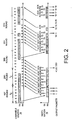
- a multi-channel ARQ method subdivides each round trip delay into a number of time slots. As shown, the roundtrip delay T d is divided into six time slots designated as ARQ Channels A-F. In a Time Division Multiplex (TDM) manner, each time slot is used as a virtual channel on a communication link assigned to a user. These channels are used for parallel transfer of data packets between a source 16 and a destination 18. At the source 16, the data packets are sequentially multiplexed over the ARQ Channels A-F and transmitted to the destination 18.
- the multi-channel ARQ method of the invention applies a stop-and-wait ARQ method on each one of the ARQ Channels A-F.
- the source 16 sequentially transmits data packets in multiplexing rounds, starting with the first ARQ Channel A and ending with the last ARQ Channel F. Therefore, at the end of each multiplexing round the data packets are sequentially multiplexed over all of the ARQ Channels A-F.
- the source waits to receive an acknowledgement from the destination 18 before transmitting a new data packet over the same ARQ Channel.
- the subsequent round if a data packet transmitted on a ARQ Channel during a previous round is negatively acknowledged, i.e.
- the source 16 halts multiplexing of the data packets and retransmits the NAKed data packet on its corresponding ARQ Channel, before transmitting any subsequent data packet on that ARQ Channel again.
- the source 16 continues to retransmit only NAKed data packets, if any, on other ARQ Channels until corresponding data packet(s) is (are) positively acknowledged.
- the received data packets are sequentially de-multiplexed. In order to maintain data packet ordering, the destination 18 halts the de-multiplexing of the received data packets, if it does not receive a new data packet on a particular ARQ Channel.
- a first data packet is transmitted on the ARQ Channel A.
- a second, third, and subsequent data packets are transmitted on ARQ Channels B-F, respectively.
- These data packets are shown by numbers 1-6, for illustration purpose only.
- the cumulative duration of the ARQ Channels i.e., the minimum repetition period of a round, is selected so that sufficient time is allowed for reception of positive acknowledgments (ACKs) or negative acknowledgments (NAKs) from the destination, before another data packet is transmitted during a second round.
- a subsequent data packet i.e., the 7th data packet (shown by number 7) is transmitted. This process continues on to the ARQ Channels B, C, and so on.
- the source halts to multiplex the data packets and only retransmits the NAKed data packets during the second round.
- FIG. 2 shows that a fourth data packet (shown by number 4) transmitted on ARQ Channel D to be NAKed.
- the source 16 Before transmitting a new data packet on ARQ Channel D during the second round, the source 16, which had continued on to transmit data packets on ARQ Channels E, F, etc., during the first round, retransmits the fourth data packet again on channel D during the second round. If the data packets transmitted on Channels E, F, A, B, C during the first round are all ACKed, as is the case in this example, the source 16 only retransmits the NAKed fourth data packet and stops transmission of new data packets on subsequent ARQ Channels during the second round, until an ACK is received for the fourth data packet.
- the previously ACKed data packets are not retransmitted unnecessarily. Instead, the source 16 remains idle until it reaches ARQ Channel D during a subsequent third round. If during the third round, an ACK is received in response to the retransmission of the fourth packet, then a new data packet, i.e., a 10th data packet, is transmitted on ARQ Channel D. Provided that previously transmitted data packets on the ARQ Channels have all been ACKed, new data packets are transmitted on subsequent ARQ Channels E through F.
- the destination 18 At the destination 18 the first through third data packets are received and demultiplexed successfully during the first round. However, because of the NAKed fourth data packet, the destination 18 halts the de-multiplexing operation to maintain order in the sequence of the received data packets. Once the fourth data packet is positively acknowledged, the destination 18 resumes the de-multiplexing of the 4th through 9th data packets, which were all received correctly. When it reaches the 10th NAKed data packet, it halts the de-multiplexing operation again until it can positively acknowledge this data packet. Once acknowledged, the destination resumes its de-multiplexing operation. The same process continues for the NAKed 12th data packet until all the received data are positively acknowledged.
- the multiplexer at the source and the de-multiplexer at the destination operate independently and are not synchronized.
- the multiplexer steps forward in response to ACKed packets, whereas the de-multiplexer steps forward in response to new arrived packets. Therefore, the duration of the multiplexing rounds may be different from each other.
- acknowledgement errors arise during data packet transfers.
- An acknowledgement error arises when a data packet has been successfully received at the destination 18, however, the associated ACK is not received successfully at the source 16.
- the source 16 retransmits the same packet again.
- the destination 18 must be able to distinguish between the retransmission of an old data packet and a new data packet.
- the present invention assigns a sequence number to each data packet.
- the sequence number may be a single bit which is toggled from one binary state to another for each new data packet.
- the destination 18 determines whether a new or an old data packet is received from the source 16. New data packets always have alternating sequence numbers. Otherwise, if the same sequence number is encountered for adjacent data packets, the destination 18 acknowledges the reception of the last data packet but ignores its content.
- FIG. 3 a simplified block diagram of the implementation of a multi-channel ARQ method according to FIG. 2 is shown.
- a data packetizer 20 packetizes input data according to a predefined protocol.
- a multiplexer 22 routes the data packets sequentially over the ARQ Channels A-F in a rotating manner.
- single-element buffers 24 store data packets provided by the multiplexer 22 for transmission on a corresponding ARQ Channel.
- the multiplexer 22 After placing a data packet in a buffer 24 of the last ARQ Channel of each round, i.e., ARQ Channel F, the multiplexer 22 places a subsequent data packet in the buffer of the first ARQ Channel, i.e., ARQ Channel A, during a subsequent round, provided that a previously transmitted data packet on the first ARQ Channel is positively acknowledged.
- the corresponding buffer 24 For each ARQ Channel, the corresponding buffer 24 indicates an empty condition each time an ACK is received based on a successful reception of a data packet at the destination 18. Otherwise, the corresponding buffer 24 indicates a full condition.
- each ARQ Channel For as long as a buffer 24 of a particular ARQ Channel indicates an empty condition, the multiplexer 22 continues to load a new data packet in that buffer and moves onto the next ARQ-channel. If a buffer 24 is not empty when the multiplexer 22 arrives at the buffer's corresponding ARQ Channel, it stops its multiplexing operation during that round. During the round, the source 16 only retransmits NAKed data packets on subsequent ARQ Channels. At that time, no new data packets are loaded into the buffers 24 until the non-empty buffer that stopped the multiplexing operation indicates an empty condition, which is resulted when a previously transmitted data packet is positively acknowledged.
- a de-multiplexer 26 operating in a rotating fashion sequentially reads the received data packets over the ARQ Channels A-F. Similar to the multiplexer 22 at the source 16, if the de-multiplexer 26 arrives at an ARQ Channel with no new received data packet, it stops its de-multiplexing operation until a successful data packet is received. Only after the arrival of a new data packet, the de-multiplexer 26 advances to demultiplex on the subsequent ARQ Channels.
- the operation of the multiplexer 22 and de-multiplexer 26 according to the invention which halt their respective multiplexing and de-multiplexing operation when ARQ Channel cannot accept or provide new data packets, assures proper ordering of the received data packets at the destination 18.
- the repetition period of the multiplexer 22 is selected to be longer than the round-trip delay, to avoid idle times at the source 16.
- the buffers 24 at the ARQ Channels A-F of the multi-channel ARQ method of the invention can be considered as the elements of a circular buffer that is used in a conventional cumulative go-back-N ARQ implementation, the present invention provides similar data per user throughput as that provided by the cumulative method, without the numbering or overhead thereof, while avoiding unnecessary retransmissions of successfully received data packets.
- multi-element source and destination buffers 28 and 29 are positioned at the transmission and reception path of the ARQ Channels A-F, respectively.
- the source and destination buffers 28 and 29 are first-in-first-out (FIFO) buffers.
- FIFO first-in-first-out
- Consecutive packets are distributed among the FIFO, i.e., packet k is placed in the first FIFO, packet k+1 in the second FIFO, etc. After the last FIFO, the multiplexer returns to the first FIFO. If a source FIFO buffer 28 is full, the multiplexer 22 stops multiplexing until a transmitted data packet at the end of the full source FIFO buffer is ACKed. Once ACKed, the multiplexer 22 inputs a subsequent data packet into the source FIFO buffer 28.
- the destination FIFO buffers 29 operate to allow for orderly reception of the data packets transmitted from the source FIFO buffers 28. Only new data packets are buffered in the destination FIFO buffers 29. This is true even when a data packet is successfully received, however, is retransmitted due to an a acknowledgement error. In this case, the reception is acknowledged, but the data packet is not stored in the destination FIFO.
- the de-multiplexer 26 advances its de-multiplexing operation for as long as a destination FIFO buffer 29 is not empty. When an empty FIFO buffer 20 is encountered, the de-multiplexer 26 stops its de-multiplexing operation on a corresponding ARQ Channel until the arrival of a new data packet over that ARQ Channel. The destination then continues its de-multiplexing of the buffered data packets at the destination FIFO buffers 29, after a new data packet is received.
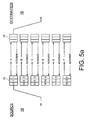
- FIGs. 5(a) and 5(b) show exemplary operations of the method of the invention under the embodiment of FIG. 4 .
- a system with 6 parallel ARQ channels and with 3-element source and destination buffers is shown. It is assumed that the source can load the source FIFOs at a much higher rate than the packets can be transferred over the channels A to F.
- FIG. 5(a) shows the begin conditions.
- the multiplexer 22 has distributed packets 1 to 18 over the source FIFOs in a manner as shown in FIG. 5(a) .
- the packets are transmitted independently over the six physical channels. This can occur sequentially when the channels form slots in a TDMA system, or simultaneously when the channels form carrier frequencies in a FDMA system or codes in a CDMA system.
- the FIFOs 28 shift their packets to the end, and new packets may be loaded by the multiplexer 22.
- FIG. 5(b) the situation is shown when packets 1 to 3, and packets 5-9 and 11-13 have been received successfully. However, since packet 4 has not been received correctly yet, only packets 1 to 3 have been de-multiplexed and carried on to the final destination. New packets 19 to 21 have been multiplexed and loaded into the source buffers 28 corresponding to channels A to C. However, packet 22 cannot be placed in the proper source buffer (the buffer corresponding to channel D) since this source buffer is full. This is because packet 4 has not been received successfully on channel D and therefore it has not been acknowledged yet.
- Both the multiplexer 22 and the de-multiplexer 26 have halted at channel D since the source FIFO buffer 28 is full and the destination buffer 29 is empty. Only when the fourth packet is received correctly can the de-multiplexer move forward, whereas only when the acknowledgement of this success has been received by the source can the multiplexer 22 move forward. The transmissions and retransmissions on other channels, however, can continue for as long as their corresponding source FIFO buffers 28 are not empty.
- a data throughput comparable to that of go-back-N algorithms may be obtained without applying numbering and extra packet overhead, except for handling acknowledgment errors based on the sequence numbers.
- sufficiently large FIFO buffers 28 and 29 can increase the data throughput to the theoretical limit, making the methods as efficient as the selective repeat ARQ method.
- each ARQ Channel in the multi-channel ARQ method of the invention should, on average, have an equal error behavior. If retransmissions occur much more frequently on one ARQ Channel than on another, the former ARQ Channel could limit the overall data throughput of the network. Under this situation, it is more advantageous to distribute the data packets over different physical channels, that is, an ARQ channel does not constantly use the same physical channel. If a single physical channel is bad, a single retransmission on a different channel may result in successful reception of a data packet. In contrast, when each data packet is bit-interleaved over multiple physical channels, each packet would be affected by the bad channel, and only a FEC method would help to overcome the transmission errors.
- the average data throughput performance should be the same in order to achieve an optimal overall data throughput performance.
- the communication link consists of discrete physical channels, for example, radio frequency (RF) links consisting of a predefined number of parallel Frequency-Division multiplex (FDM) channels.
- RF radio frequency
- FDM Frequency-Division multiplex
- the RF link may be deteriorated at one or more portions of the frequency spectrum, due to such factors as multi-path fading, or narrowband interference. Accordingly, not all the physical channels may have the same average quality.
- the ARQ Channels of the invention should be distributed over the physical FDM channels, for example, by applying well known spreading and despreading operations, such as frequency hopping.
- FIG. 6 one such network is shown where the ARQ channels are spread by a spreader 32 at the source 16 and de-spread by a de-spreader 34 at the destination 18.
- a synchronization block 36 synchronizes the spreading and de-spreading operations, to achieve an equal error performance on all physical channels.
- MUX/FIFO and DE-MUX/FIFO blocks 38 and 40 correspond to a multiplexer/demultiplexer 22 and 26 and FIFO buffers 28 and 29 shown in FIG. 4 .
- the available physical channels consist of six FDM channels.
- the network can use four ARQ Channels A-D in parallel.
- the source 16 and destination 18 pseudo-randomly assign one of the six physical channels to support one of the four ARQ Channels A-D.
- the six physical channels are different from each other; that is, they are orthogonal and no collisions between packets on different ARQ Channels would occur.
- the return channels carrying positive and negative acknowledgement are not shown.
- the present invention provides a high data throughput ARQ method that is unnumbered, thus, simple to implement and does not retransmit successfully received data packets unnecessarily. Due to multiplexing and de-multiplexing at the source and destination, respectively, the unnumbered ARQ method of the invention transmits the data packets in parallel, without requiring substantial packet ordering overhead. As described above, by increasing the size of FIFO buffers at the source and destination, the present invention can provide a data throughput approaching the theoretical limit, regardless of the round-trip delays.
Landscapes
- Engineering & Computer Science (AREA)
- Computer Networks & Wireless Communication (AREA)
- Signal Processing (AREA)
- Power Engineering (AREA)
- Detection And Prevention Of Errors In Transmission (AREA)
- Communication Control (AREA)
- Mobile Radio Communication Systems (AREA)
- Data Exchanges In Wide-Area Networks (AREA)
Applications Claiming Priority (3)
| Application Number | Priority Date | Filing Date | Title |
|---|---|---|---|
| US912834 | 1997-08-19 | ||
| US08/912,834 US6021124A (en) | 1997-08-19 | 1997-08-19 | Multi-channel automatic retransmission query (ARQ) method |
| PCT/SE1998/001415 WO1999009698A1 (en) | 1997-08-19 | 1998-07-24 | A multi-channel automatic retransmission query (arq) method |
Publications (2)
| Publication Number | Publication Date |
|---|---|
| EP1005732A1 EP1005732A1 (en) | 2000-06-07 |
| EP1005732B1 true EP1005732B1 (en) | 2011-08-31 |
Family
ID=25432531
Family Applications (1)
| Application Number | Title | Priority Date | Filing Date |
|---|---|---|---|
| EP98935453A Expired - Lifetime EP1005732B1 (en) | 1997-08-19 | 1998-07-24 | A multi-channel automatic retransmission query (arq) method |
Country Status (12)
| Country | Link |
|---|---|
| US (1) | US6021124A (enExample) |
| EP (1) | EP1005732B1 (enExample) |
| JP (1) | JP4146079B2 (enExample) |
| KR (1) | KR20010023029A (enExample) |
| CN (1) | CN1132365C (enExample) |
| AR (1) | AR016825A1 (enExample) |
| AU (1) | AU747369B2 (enExample) |
| BR (1) | BR9811240A (enExample) |
| CO (1) | CO4790192A1 (enExample) |
| EE (1) | EE200000108A (enExample) |
| MY (1) | MY116270A (enExample) |
| WO (1) | WO1999009698A1 (enExample) |
Families Citing this family (143)
| Publication number | Priority date | Publication date | Assignee | Title |
|---|---|---|---|---|
| SE504085C2 (sv) | 1995-02-01 | 1996-11-04 | Greg Benson | Sätt och system för att hantera dataobjekt i enlighet med förutbestämda villkor för användare |
| FI103540B1 (fi) * | 1997-04-28 | 1999-07-15 | Nokia Mobile Phones Ltd | Menetelmä pakettikytkentäisen datan siirtoon matkapuhelinjärjestelmässä |
| US6212165B1 (en) * | 1998-03-24 | 2001-04-03 | 3Com Corporation | Apparatus for and method of allocating a shared resource among multiple ports |
| EP0964544A1 (en) * | 1998-06-09 | 1999-12-15 | Mitsubishi Electric Information Technology Centre Europe B.V. | Method of controlling errors in a packets transmission link |
| US6553003B1 (en) * | 1998-06-13 | 2003-04-22 | Samsung Electronics, Co., Ltd. | Device and method processing a radio link protocol in a mobile communication system |
| FI106330B (fi) * | 1998-08-12 | 2001-01-15 | Nokia Networks Oy | Kulkuviiveen huomioon ottaminen datayhteydellä |
| US6590895B1 (en) * | 1998-10-15 | 2003-07-08 | Sun Microsystems, Inc. | Adaptive retransmission for error control in computer networks |
| US6967963B1 (en) * | 1998-12-01 | 2005-11-22 | 3Com Corporation | Telecommunication method for ensuring on-time delivery of packets containing time-sensitive data |
| DE19902436A1 (de) * | 1999-01-22 | 2000-07-27 | Nokia Networks Oy | Verfahren zum Konfigurieren bzw. Überwachen von Register aufweisenden Einrichtungen sowie Steuereinheit und ATM-Zelle |
| JP4015773B2 (ja) * | 1999-03-10 | 2007-11-28 | 松下電器産業株式会社 | 送受信装置 |
| US6335933B1 (en) * | 1999-05-21 | 2002-01-01 | Broadcom Homenetworking, Inc. | Limited automatic repeat request protocol for frame-based communication channels |
| KR100424654B1 (ko) * | 1999-08-02 | 2004-03-24 | 삼성전자주식회사 | 이동 통신시스템에서 라디오링크프로토콜에 따른 데이터 재전송 장치 및 방법 |
| US6463070B1 (en) * | 1999-08-27 | 2002-10-08 | Tachyon, Inc. | System and method for clock correlated data flow in a multi-processor communication system |
| FR2798810B1 (fr) * | 1999-09-16 | 2002-05-31 | Cit Alcatel | Procede et systeme de telecommunication en mode paquets dans lequel plusieurs communications sont transferables d'un chemin vers un autre |
| WO2001022747A1 (en) * | 1999-09-22 | 2001-03-29 | Motorola Inc. | Selecting channels for retransmission of data packets |
| US6629284B1 (en) * | 1999-10-28 | 2003-09-30 | Koninklijke Philips Electronics N.V. | System and method for supervised downloading of broadcast data |
| JP2001142845A (ja) * | 1999-11-17 | 2001-05-25 | Toshiba Corp | コンピュータシステムおよびデータ転送制御方法 |
| US7065068B2 (en) * | 1999-12-29 | 2006-06-20 | Motorola, Inc. | Multi channel stop and wait ARQ communication method and apparatus |
| US7068623B1 (en) * | 2000-01-10 | 2006-06-27 | Nortel Networks Limited | Communicating traffic over a wireless channel in a mobile communications system |
| US6748445B1 (en) * | 2000-02-01 | 2004-06-08 | Microsoft Corporation | System and method for exchanging data |
| US6996100B1 (en) * | 2000-02-03 | 2006-02-07 | Telefonaktiebolaget Lm Ericsson (Publ) | Method and system for medium access on a radio channel |
| FI112305B (fi) | 2000-02-14 | 2003-11-14 | Nokia Corp | Datapakettien numerointi pakettivälitteisessä tiedonsiirrossa |
| US6760781B1 (en) * | 2000-02-16 | 2004-07-06 | 3Com Corporation | Intelligent packet transmission engine |
| US6801512B1 (en) * | 2000-03-23 | 2004-10-05 | Motorola, Inc. | Method and apparatus for providing a distributed architecture digital wireless communication system |
| US7586949B1 (en) | 2000-04-03 | 2009-09-08 | Nortel Networks Limited | Interleaving data over frames communicated in a wireless channel |
| KR100703107B1 (ko) * | 2000-04-10 | 2007-04-05 | 유티스타콤코리아 유한회사 | 무선통신 시스템에서 데이터 자동 재전송 방법 |
| DE60035530T2 (de) * | 2000-05-17 | 2007-10-25 | Matsushita Electric Industrial Co., Ltd., Kadoma | Hybrides ARQ-System mit Daten- und Kontroll-Kanal für Datenpaket-Übertragung |
| KR20020003526A (ko) * | 2000-07-05 | 2002-01-12 | 윤종용 | 복합 재전송방식을 사용하는 이동 통신시스템의 데이터재전송 장치 및 방법 |
| US7453878B1 (en) * | 2000-07-21 | 2008-11-18 | Silicon Graphics, Inc. | System and method for ordering of data transferred over multiple channels |
| US6937592B1 (en) | 2000-09-01 | 2005-08-30 | Intel Corporation | Wireless communications system that supports multiple modes of operation |
| KR100695830B1 (ko) * | 2000-09-05 | 2007-03-19 | 유티스타콤코리아 유한회사 | 무선통신 시스템에서 데이터 반복 전송 방법 |
| FI20001975L (fi) * | 2000-09-07 | 2002-03-08 | Nokia Corp | Ohjaustietojen signalointimenetelmä |
| DE10050117A1 (de) * | 2000-10-11 | 2002-04-25 | Philips Corp Intellectual Pty | Drahtloses Netzwerk mit einem Datenaustausch nach der ARQ-Methode |
| US6567387B1 (en) | 2000-11-07 | 2003-05-20 | Intel Corporation | System and method for data transmission from multiple wireless base transceiver stations to a subscriber unit |
| US6999430B2 (en) * | 2000-11-30 | 2006-02-14 | Qualcomm Incorporated | Method and apparatus for transmitting data traffic on a wireless communication channel |
| US6751480B2 (en) * | 2000-12-01 | 2004-06-15 | Lucent Technologies Inc. | Method for simultaneously conveying information to multiple mobiles with multiple antennas |
| JP2002186014A (ja) * | 2000-12-12 | 2002-06-28 | Matsushita Electric Ind Co Ltd | 無線基地局装置及び通信端末装置 |
| FR2819661B1 (fr) * | 2001-01-15 | 2003-03-28 | Nortel Networks | Procede et dispositifs de transmission de donnees avec mecanisme d'acquittement |
| US7184401B2 (en) * | 2001-02-05 | 2007-02-27 | Interdigital Technology Corporation | Link-aware transmission control protocol |
| KR100691419B1 (ko) * | 2001-02-09 | 2007-03-09 | 삼성전자주식회사 | 무선 통신기기 및 그 통신방법 및 이를 적용한 무선통신시스템 |
| US7120134B2 (en) * | 2001-02-15 | 2006-10-10 | Qualcomm, Incorporated | Reverse link channel architecture for a wireless communication system |
| GB0104830D0 (en) * | 2001-02-27 | 2001-04-18 | Koninkl Philips Electronics Nv | Radio communication system |
| US7058085B2 (en) * | 2001-03-14 | 2006-06-06 | Nortel Networks Limited | Method and apparatus for transmitting data over a network within a specified time limit |
| US20020136287A1 (en) * | 2001-03-20 | 2002-09-26 | Heath Robert W. | Method, system and apparatus for displaying the quality of data transmissions in a wireless communication system |
| US9100457B2 (en) * | 2001-03-28 | 2015-08-04 | Qualcomm Incorporated | Method and apparatus for transmission framing in a wireless communication system |
| US8077679B2 (en) * | 2001-03-28 | 2011-12-13 | Qualcomm Incorporated | Method and apparatus for providing protocol options in a wireless communication system |
| CN101009709B (zh) * | 2001-03-28 | 2011-01-12 | 高通股份有限公司 | 无线通信系统中传输组帧的方法和装置 |
| US8121296B2 (en) * | 2001-03-28 | 2012-02-21 | Qualcomm Incorporated | Method and apparatus for security in a data processing system |
| DE10117695A1 (de) * | 2001-04-09 | 2002-10-10 | Siemens Ag | Verfahren zur paketorientierten Übertragung von Daten in einem Kommunikationssystem |
| US6625172B2 (en) | 2001-04-26 | 2003-09-23 | Joseph P. Odenwalder | Rescheduling scheduled transmissions |
| US7230941B2 (en) * | 2001-04-26 | 2007-06-12 | Qualcomm Incorporated | Preamble channel decoding |
| US6920598B2 (en) * | 2001-05-21 | 2005-07-19 | Lucent Technologies Inc. | System and method for error recovery using NAKs |
| DE10141008A1 (de) * | 2001-05-21 | 2002-11-28 | Siemens Ag | Vorrichtung und Verfahren zum Übersenden von Information |
| CN1134918C (zh) * | 2001-08-06 | 2004-01-14 | 华为技术有限公司 | 基于移动台能力的包数据调度方法 |
| US7185362B2 (en) * | 2001-08-20 | 2007-02-27 | Qualcomm, Incorporated | Method and apparatus for security in a data processing system |
| US20040120527A1 (en) * | 2001-08-20 | 2004-06-24 | Hawkes Philip Michael | Method and apparatus for security in a data processing system |
| US20030039226A1 (en) * | 2001-08-24 | 2003-02-27 | Kwak Joseph A. | Physical layer automatic repeat request (ARQ) |
| KR20070095993A (ko) * | 2001-08-24 | 2007-10-01 | 인터디지탈 테크날러지 코포레이션 | 물리 계층의 자동 재전송 요구를 구현하는 기지국 |
| TWI261984B (en) * | 2001-08-24 | 2006-09-11 | Interdigital Tech Corp | Implementing a physical layer automatic repeat request for a subscriber unit |
| AU2002332602B2 (en) * | 2001-08-24 | 2006-06-01 | Interdigital Technology Corporation | Method for physical layer automatic repeat request for a base station |
| US7149254B2 (en) * | 2001-09-06 | 2006-12-12 | Intel Corporation | Transmit signal preprocessing based on transmit antennae correlations for multiple antennae systems |
| US7697523B2 (en) * | 2001-10-03 | 2010-04-13 | Qualcomm Incorporated | Method and apparatus for data packet transport in a wireless communication system using an internet protocol |
| EP1434379A1 (en) * | 2001-10-04 | 2004-06-30 | Mitsubishi Denki Kabushiki Kaisha | COMMUNICATION METHOD, COMMUNICATION SYSTEM AND COMMUNICATION APPARATUS |
| US7352868B2 (en) * | 2001-10-09 | 2008-04-01 | Philip Hawkes | Method and apparatus for security in a data processing system |
| US20030067890A1 (en) * | 2001-10-10 | 2003-04-10 | Sandesh Goel | System and method for providing automatic re-transmission of wirelessly transmitted information |
| US7649829B2 (en) | 2001-10-12 | 2010-01-19 | Qualcomm Incorporated | Method and system for reduction of decoding complexity in a communication system |
| US7379434B2 (en) * | 2001-10-19 | 2008-05-27 | Koninklijke Philips Electronics N.V. | Radio communication system |
| US7336719B2 (en) * | 2001-11-28 | 2008-02-26 | Intel Corporation | System and method for transmit diversity base upon transmission channel delay spread |
| TW589815B (en) * | 2002-01-16 | 2004-06-01 | Winbond Electronics Corp | Control method for multi-channel data transmission |
| US7287206B2 (en) * | 2002-02-13 | 2007-10-23 | Interdigital Technology Corporation | Transport block set transmission using hybrid automatic repeat request |
| US7012978B2 (en) * | 2002-03-26 | 2006-03-14 | Intel Corporation | Robust multiple chain receiver |
| AU2002252926A1 (en) * | 2002-03-27 | 2003-10-08 | Linkair Communications, Inc. | An automatic repeat request arq error control method for different channels and the device thereof |
| CN1555631A (zh) * | 2002-03-29 | 2004-12-15 | 连宇通信有限公司 | 一种不同信道自动重发请求arq差错控制方法及装置 |
| AU2002254853A1 (en) * | 2002-04-16 | 2003-10-27 | Linkair Communications, Inc. | A n-channel arq error control method and apparatus suitable for high-speed wireless packet data service |
| KR100876765B1 (ko) * | 2002-05-10 | 2009-01-07 | 삼성전자주식회사 | 이동 통신 시스템에서 데이터 재전송 장치 및 방법 |
| US20030235252A1 (en) * | 2002-06-19 | 2003-12-25 | Jose Tellado | Method and system of biasing a timing phase estimate of data segments of a received signal |
| US6876727B2 (en) * | 2002-07-24 | 2005-04-05 | Sbc Properties, Lp | Voice over IP method for developing interactive voice response system |
| ATE349829T1 (de) * | 2002-08-13 | 2007-01-15 | Matsushita Electric Industrial Co Ltd | Hybrides automatisches wiederholungsaufforderungsprotokoll |
| DE60209067T2 (de) * | 2002-09-13 | 2006-11-02 | Winbond Electronics Corp. | Verfahren zur parallelen Übertragung von Datenrahmen mittels unabhängiger stop & wait Protokolle für jeden Kanal, was die empfangseitige Neuordnung der Datenrahmen erlaubt |
| US7042857B2 (en) * | 2002-10-29 | 2006-05-09 | Qualcom, Incorporated | Uplink pilot and signaling transmission in wireless communication systems |
| US7505486B2 (en) * | 2002-11-19 | 2009-03-17 | Hewlett-Packard Development Company, L.P. | Degradable network data path transmission scheme |
| US7599655B2 (en) * | 2003-01-02 | 2009-10-06 | Qualcomm Incorporated | Method and apparatus for broadcast services in a communication system |
| US7586874B2 (en) * | 2003-01-06 | 2009-09-08 | Interdigital Technology Corporation | Wireless communication method and apparatus for providing multimedia broadcast services |
| US7181666B2 (en) * | 2003-04-29 | 2007-02-20 | Qualcomm, Incorporated | Method, apparatus, and system for user-multiplexing in multiple access systems with retransmission |
| US7177297B2 (en) * | 2003-05-12 | 2007-02-13 | Qualcomm Incorporated | Fast frequency hopping with a code division multiplexed pilot in an OFDMA system |
| EP1489773A1 (en) * | 2003-06-16 | 2004-12-22 | Mitsubishi Electric Information Technology Centre Europe B.V. | Time scheduling with stop-and-wait ARQ process |
| JP4126059B2 (ja) | 2003-06-18 | 2008-07-30 | 日本電信電話株式会社 | 無線パケット通信方法および無線パケット通信装置 |
| JP4126058B2 (ja) * | 2003-06-18 | 2008-07-30 | 日本電信電話株式会社 | 無線パケット通信方法および無線パケット通信装置 |
| US7623836B1 (en) | 2003-06-19 | 2009-11-24 | Intel Corporation | Antenna selection for multicarrier communications |
| US8098818B2 (en) * | 2003-07-07 | 2012-01-17 | Qualcomm Incorporated | Secure registration for a multicast-broadcast-multimedia system (MBMS) |
| US20050224596A1 (en) * | 2003-07-08 | 2005-10-13 | Panopoulos Peter J | Machine that is an automatic pesticide, insecticide, repellant, poison, air freshener, disinfectant or other type of spray delivery system |
| US8718279B2 (en) * | 2003-07-08 | 2014-05-06 | Qualcomm Incorporated | Apparatus and method for a secure broadcast system |
| US20050047366A1 (en) * | 2003-08-25 | 2005-03-03 | Motorola, Inc. | Random access communication opportunity method |
| US8724803B2 (en) * | 2003-09-02 | 2014-05-13 | Qualcomm Incorporated | Method and apparatus for providing authenticated challenges for broadcast-multicast communications in a communication system |
| JP3723980B2 (ja) * | 2003-12-22 | 2005-12-07 | 横河電機株式会社 | 通信制御システム |
| US8611283B2 (en) * | 2004-01-28 | 2013-12-17 | Qualcomm Incorporated | Method and apparatus of using a single channel to provide acknowledgement and assignment messages |
| KR101042813B1 (ko) * | 2004-02-17 | 2011-06-20 | 삼성전자주식회사 | 시분할 듀플렉싱 이동 통신 시스템에서 상향 방향 전송증대를 위한 데이터 수신 여부 정보를 전송하는 방법 |
| EP1569377B1 (en) * | 2004-02-27 | 2006-08-23 | Mitsubishi Denki Kabushiki Kaisha | Method and device for joint dynamic sliding window management of multiple ARQ data links |
| KR100989314B1 (ko) * | 2004-04-09 | 2010-10-25 | 삼성전자주식회사 | 디스플레이장치 |
| US8351400B2 (en) * | 2004-05-05 | 2013-01-08 | Qualcomm Incorporated | Method and apparatus for overhead reduction in an enhanced uplink in a wireless communication system |
| US8891349B2 (en) | 2004-07-23 | 2014-11-18 | Qualcomm Incorporated | Method of optimizing portions of a frame |
| US7643503B2 (en) * | 2004-07-30 | 2010-01-05 | Sony Corporation | System and method for dynamically determining retransmit buffer time |
| GB2417400B (en) * | 2004-08-18 | 2008-12-03 | Wecomm Ltd | Network data transmission |
| EP1628429A3 (en) * | 2004-08-19 | 2011-06-01 | Infineon Technologies AG | Method for transmitting information with an acknowledgement scheme and respective communication system |
| US20060039282A1 (en) * | 2004-08-23 | 2006-02-23 | Lucent Technologies, Inc. | Outer loop power control for high speed data transmissions |
| US7498443B2 (en) * | 2004-09-17 | 2009-03-03 | Albany Molecular Research, Inc. | Process for production of carebastine |
| US7602720B2 (en) * | 2004-10-22 | 2009-10-13 | Cisco Technology, Inc. | Active queue management methods and devices |
| US7801125B2 (en) | 2004-10-22 | 2010-09-21 | Cisco Technology, Inc. | Forwarding table reduction and multipath network forwarding |
| US7830793B2 (en) * | 2004-10-22 | 2010-11-09 | Cisco Technology, Inc. | Network device architecture for consolidating input/output and reducing latency |
| US7564869B2 (en) | 2004-10-22 | 2009-07-21 | Cisco Technology, Inc. | Fibre channel over ethernet |
| US8238347B2 (en) | 2004-10-22 | 2012-08-07 | Cisco Technology, Inc. | Fibre channel over ethernet |
| US7969971B2 (en) * | 2004-10-22 | 2011-06-28 | Cisco Technology, Inc. | Ethernet extension for the data center |
| US7839940B2 (en) * | 2004-11-22 | 2010-11-23 | Nokia Corporation | Ordered retransmissions for ARQ in multicarrier systems |
| US7453849B2 (en) * | 2004-12-22 | 2008-11-18 | Qualcomm Incorporated | Method of implicit deassignment of resources |
| US8661322B2 (en) * | 2004-12-22 | 2014-02-25 | Qualcomm Incorporated | Apparatus and method for selective response to incremental redundancy transmissions |
| US8831115B2 (en) * | 2004-12-22 | 2014-09-09 | Qualcomm Incorporated | MC-CDMA multiplexing in an orthogonal uplink |
| US8238923B2 (en) * | 2004-12-22 | 2012-08-07 | Qualcomm Incorporated | Method of using shared resources in a communication system |
| US9014192B2 (en) * | 2005-03-21 | 2015-04-21 | Qualcomm Incorporated | Method and apparatus for improving data transmission reliability in a wireless communications system |
| US7864715B2 (en) * | 2005-03-28 | 2011-01-04 | Kyocera Corporation | Data communication method, communication server system, and communication terminal |
| US8693383B2 (en) * | 2005-03-29 | 2014-04-08 | Qualcomm Incorporated | Method and apparatus for high rate data transmission in wireless communication |
| ES2903025T3 (es) * | 2005-05-23 | 2022-03-30 | Optis Wireless Technology Llc | Protocolo de solicitud de repetición automática (ARQ) que tiene múltiples mecanismos de retroalimentación complementarios |
| US7961621B2 (en) * | 2005-10-11 | 2011-06-14 | Cisco Technology, Inc. | Methods and devices for backward congestion notification |
| US8995466B2 (en) * | 2005-12-22 | 2015-03-31 | Qualcomm Incorporated | Communications methods and apparatus for using a single logical link with multiple physical layer connections |
| US8432794B2 (en) | 2005-12-29 | 2013-04-30 | Interdigital Technology Corporation | Method and apparatus for selecting multiple transport formats and transmitting multiple transport blocks simultaneously with multiple H-ARQ processes |
| TWI427958B (zh) * | 2005-12-29 | 2014-02-21 | Interdigital Tech Corp | 以多h-arq方法同時選取多傳輸格式及傳送多傳輸塊組方法及裝置 |
| TWI455514B (zh) | 2006-02-03 | 2014-10-01 | Interdigital Tech Corp | 每時間間隔支援多數混合自動重複請求程序方法及設備 |
| EP1936853B1 (en) * | 2006-12-20 | 2018-11-21 | Panasonic Intellectual Property Corporation of America | Avoidance of feedback collision in mobile communications |
| US8259720B2 (en) * | 2007-02-02 | 2012-09-04 | Cisco Technology, Inc. | Triple-tier anycast addressing |
| US8149710B2 (en) | 2007-07-05 | 2012-04-03 | Cisco Technology, Inc. | Flexible and hierarchical dynamic buffer allocation |
| JP2009044581A (ja) | 2007-08-10 | 2009-02-26 | Fujitsu Ltd | 通信装置、送信方法、受信方法 |
| US8121038B2 (en) * | 2007-08-21 | 2012-02-21 | Cisco Technology, Inc. | Backward congestion notification |
| JP4587053B2 (ja) * | 2007-08-28 | 2010-11-24 | 日本電気株式会社 | 通信装置、通信システム、パケット欠落検出方法、およびパケット欠落検出プログラム |
| US8351464B2 (en) * | 2007-10-02 | 2013-01-08 | Infineon Technologies Ag | Retransmission in data communication systems |
| US8116271B2 (en) * | 2008-02-07 | 2012-02-14 | Samsung Electronics Co., Ltd. | Methods and apparatus to allocate acknowledgement channels |
| WO2010016669A2 (en) * | 2008-08-04 | 2010-02-11 | Samsung Electronics Co., Ltd. | Signal transmission method and apparatus for user equipment in mobile communication system |
| KR101515042B1 (ko) * | 2008-08-04 | 2015-04-24 | 삼성전자주식회사 | 역방향 전송 자원 할당 메시지를 처리하는 방법 및 장치 |
| US8942208B2 (en) * | 2009-06-22 | 2015-01-27 | Qualcomm Incorporated | Wireless communication having reduced feedback delay |
| US8645785B2 (en) * | 2011-03-14 | 2014-02-04 | Freescale Semiconductor, Inc. | Method of re-ordering received data blocks in hybrid automatic repeat request telecommunication system |
| DE102011015966B4 (de) | 2011-04-04 | 2017-07-06 | Wago Verwaltungsgesellschaft Mbh | Automatisierungssystem |
| WO2013027247A1 (ja) * | 2011-08-25 | 2013-02-28 | 富士通株式会社 | 情報処理装置及び情報処理装置の制御方法 |
| US9600191B2 (en) * | 2014-06-02 | 2017-03-21 | Micron Technology, Inc. | Systems and methods for reordering packet transmissions in a scalable memory system protocol |
| US10554761B2 (en) * | 2015-12-12 | 2020-02-04 | At&T Intellectual Property I, Lp | Methods and apparatus to improve transmission of a field data set to a network access point via parallel communication sessions |
| WO2020226680A1 (en) * | 2019-05-03 | 2020-11-12 | Huawei Technologies Co. Ltd. | Adaptive reordering in multiband communication systems |
Family Cites Families (4)
| Publication number | Priority date | Publication date | Assignee | Title |
|---|---|---|---|---|
| CA1266318A (en) * | 1985-10-07 | 1990-02-27 | Hiroshi Suzuki | High-speed packet-switched communications system with end-to-end flow control and retransmission |
| US4970714A (en) * | 1989-01-05 | 1990-11-13 | International Business Machines Corp. | Adaptive data link protocol |
| US5453981A (en) * | 1990-10-16 | 1995-09-26 | Kabushiki Kaisha Toshiba | Method of controlling communication network incorporating virtual channels exchange nodes and virtual paths exchange nodes |
| JP2576780B2 (ja) * | 1993-12-17 | 1997-01-29 | 日本電気株式会社 | プロトコル終端方式 |
-
1997
- 1997-08-19 US US08/912,834 patent/US6021124A/en not_active Expired - Lifetime
-
1998
- 1998-07-24 JP JP2000510243A patent/JP4146079B2/ja not_active Expired - Lifetime
- 1998-07-24 AU AU84699/98A patent/AU747369B2/en not_active Ceased
- 1998-07-24 CN CN988100991A patent/CN1132365C/zh not_active Expired - Fee Related
- 1998-07-24 KR KR1020007001639A patent/KR20010023029A/ko not_active Ceased
- 1998-07-24 BR BR9811240-6A patent/BR9811240A/pt not_active IP Right Cessation
- 1998-07-24 WO PCT/SE1998/001415 patent/WO1999009698A1/en not_active Ceased
- 1998-07-24 EE EEP200000108A patent/EE200000108A/xx unknown
- 1998-07-24 EP EP98935453A patent/EP1005732B1/en not_active Expired - Lifetime
- 1998-08-06 CO CO98045236A patent/CO4790192A1/es unknown
- 1998-08-18 MY MYPI98003759A patent/MY116270A/en unknown
- 1998-08-18 AR ARP980104070A patent/AR016825A1/es active IP Right Grant
Also Published As
| Publication number | Publication date |
|---|---|
| HK1031962A1 (en) | 2001-06-29 |
| MY116270A (en) | 2003-12-31 |
| EE200000108A (et) | 2000-12-15 |
| AU8469998A (en) | 1999-03-08 |
| JP2001516177A (ja) | 2001-09-25 |
| BR9811240A (pt) | 2000-08-15 |
| US6021124A (en) | 2000-02-01 |
| AU747369B2 (en) | 2002-05-16 |
| CN1132365C (zh) | 2003-12-24 |
| WO1999009698A1 (en) | 1999-02-25 |
| CO4790192A1 (es) | 1999-05-31 |
| KR20010023029A (ko) | 2001-03-26 |
| EP1005732A1 (en) | 2000-06-07 |
| AR016825A1 (es) | 2001-08-01 |
| JP4146079B2 (ja) | 2008-09-03 |
| CN1275279A (zh) | 2000-11-29 |
Similar Documents
| Publication | Publication Date | Title |
|---|---|---|
| EP1005732B1 (en) | A multi-channel automatic retransmission query (arq) method | |
| US5477550A (en) | Method for communicating data using a modified SR-ARQ protocol | |
| KR101265637B1 (ko) | 복수 개의 harq 프로세스 채널을 순차적으로 사용하여데이터를 송신하는 방법 | |
| EP1020048B1 (en) | Method and apparatus for conveying data packets in a packet data communication system | |
| US7054316B2 (en) | Method and system for interlayer control between re-sequencing and retransmission entities | |
| KR200331231Y1 (ko) | 무선 링크 제어 재전송을 지원하기 위해 프로토콜 데이터단위의 재전송의 순위 지정을 하는 노드 b | |
| US8248973B2 (en) | Method for operation of synchronous HARQ in a wireless communication system | |
| US7065068B2 (en) | Multi channel stop and wait ARQ communication method and apparatus | |
| CN104104479B (zh) | 经由无线网络和无线装置发送/接收数据的方法和设备 | |
| US20040221218A1 (en) | Method, apparatus, and system for user-multiplexing in multiple access systems with retransmission | |
| KR20030060055A (ko) | 고속 무선 통신 시스템에 대한 타이머 기반의 스톨 방지메커니즘 | |
| WO2006093979A2 (en) | Method of repeating data transmission between network devices | |
| KR100516554B1 (ko) | 고속 순방향 패킷 접속 통신 시스템에서 프로토콜 데이터유닛 처리 방법 | |
| Tachikawa et al. | ARQ protocols for bi-directional data transmission | |
| KR101087112B1 (ko) | 자동 재전송 요구 방식에 적용되는 자원 할당 방법 | |
| US20020099838A1 (en) | Method for allocating receive buffers to accommodate retransmission scheme in wireless computer networks | |
| HK1031962B (en) | A multi-channel automatic retransmission query (arq) method | |
| KR100708190B1 (ko) | 무선 네트워크를 통하여 데이터를 효율적으로 송/수신하는방법 및 그 방법을 이용한 무선 디바이스 | |
| KR20070101889A (ko) | 이동 통신 시스템에서 효율적인 기지국 스케줄링 방법 및장치 | |
| CiilIRe | Analysis of throughput efficiency and delay in ARQ systems | |
| KR20020043794A (ko) | 선택적 반복 자동 재송 요구(arq)를 이용한 패킷전송 방법 |
Legal Events
| Date | Code | Title | Description |
|---|---|---|---|
| PUAI | Public reference made under article 153(3) epc to a published international application that has entered the european phase |
Free format text: ORIGINAL CODE: 0009012 |
|
| 17P | Request for examination filed |
Effective date: 20000126 |
|
| AK | Designated contracting states |
Kind code of ref document: A1 Designated state(s): ES GB IT SE |
|
| RAP1 | Party data changed (applicant data changed or rights of an application transferred) |
Owner name: TELEFONAKTIEBOLAGET LM ERICSSON (PUBL) |
|
| 17Q | First examination report despatched |
Effective date: 20071213 |
|
| GRAP | Despatch of communication of intention to grant a patent |
Free format text: ORIGINAL CODE: EPIDOSNIGR1 |
|
| GRAS | Grant fee paid |
Free format text: ORIGINAL CODE: EPIDOSNIGR3 |
|
| GRAA | (expected) grant |
Free format text: ORIGINAL CODE: 0009210 |
|
| AK | Designated contracting states |
Kind code of ref document: B1 Designated state(s): ES GB IT SE |
|
| REG | Reference to a national code |
Ref country code: GB Ref legal event code: FG4D |
|
| PG25 | Lapsed in a contracting state [announced via postgrant information from national office to epo] |
Ref country code: SE Free format text: LAPSE BECAUSE OF FAILURE TO SUBMIT A TRANSLATION OF THE DESCRIPTION OR TO PAY THE FEE WITHIN THE PRESCRIBED TIME-LIMIT Effective date: 20110831 |
|
| PG25 | Lapsed in a contracting state [announced via postgrant information from national office to epo] |
Ref country code: IT Free format text: LAPSE BECAUSE OF FAILURE TO SUBMIT A TRANSLATION OF THE DESCRIPTION OR TO PAY THE FEE WITHIN THE PRESCRIBED TIME-LIMIT Effective date: 20110831 |
|
| PLBE | No opposition filed within time limit |
Free format text: ORIGINAL CODE: 0009261 |
|
| STAA | Information on the status of an ep patent application or granted ep patent |
Free format text: STATUS: NO OPPOSITION FILED WITHIN TIME LIMIT |
|
| 26N | No opposition filed |
Effective date: 20120601 |
|
| PG25 | Lapsed in a contracting state [announced via postgrant information from national office to epo] |
Ref country code: ES Free format text: LAPSE BECAUSE OF FAILURE TO SUBMIT A TRANSLATION OF THE DESCRIPTION OR TO PAY THE FEE WITHIN THE PRESCRIBED TIME-LIMIT Effective date: 20111211 |
|
| PGFP | Annual fee paid to national office [announced via postgrant information from national office to epo] |
Ref country code: GB Payment date: 20130729 Year of fee payment: 16 |
|
| GBPC | Gb: european patent ceased through non-payment of renewal fee |
Effective date: 20140724 |
|
| PG25 | Lapsed in a contracting state [announced via postgrant information from national office to epo] |
Ref country code: GB Free format text: LAPSE BECAUSE OF NON-PAYMENT OF DUE FEES Effective date: 20140724 |