EP1002806A1 - Production process for hydrophilic polymer - Google Patents
Production process for hydrophilic polymer Download PDFInfo
- Publication number
- EP1002806A1 EP1002806A1 EP99122561A EP99122561A EP1002806A1 EP 1002806 A1 EP1002806 A1 EP 1002806A1 EP 99122561 A EP99122561 A EP 99122561A EP 99122561 A EP99122561 A EP 99122561A EP 1002806 A1 EP1002806 A1 EP 1002806A1
- Authority
- EP
- European Patent Office
- Prior art keywords
- hydrogel polymer
- weight
- water content
- water
- polymer
- Prior art date
- Legal status (The legal status is an assumption and is not a legal conclusion. Google has not performed a legal analysis and makes no representation as to the accuracy of the status listed.)
- Granted
Links
- 238000004519 manufacturing process Methods 0.000 title claims abstract description 48
- 229920001477 hydrophilic polymer Polymers 0.000 title claims abstract description 17
- 239000000017 hydrogel Substances 0.000 claims abstract description 160
- 229920000642 polymer Polymers 0.000 claims abstract description 133
- XLYOFNOQVPJJNP-UHFFFAOYSA-N water Substances O XLYOFNOQVPJJNP-UHFFFAOYSA-N 0.000 claims abstract description 129
- 238000001035 drying Methods 0.000 claims abstract description 95
- 239000000178 monomer Substances 0.000 claims abstract description 83
- 239000000463 material Substances 0.000 claims abstract description 55
- 238000006116 polymerization reaction Methods 0.000 claims abstract description 24
- 230000008859 change Effects 0.000 claims abstract description 20
- 238000010521 absorption reaction Methods 0.000 claims description 38
- 239000002250 absorbent Substances 0.000 claims description 18
- 239000011347 resin Substances 0.000 claims description 18
- 229920005989 resin Polymers 0.000 claims description 18
- 239000007864 aqueous solution Substances 0.000 claims description 10
- 238000010528 free radical solution polymerization reaction Methods 0.000 claims description 9
- JRKICGRDRMAZLK-UHFFFAOYSA-L persulfate group Chemical class S(=O)(=O)([O-])OOS(=O)(=O)[O-] JRKICGRDRMAZLK-UHFFFAOYSA-L 0.000 claims description 3
- 229910052799 carbon Inorganic materials 0.000 abstract description 3
- 239000000047 product Substances 0.000 description 62
- 239000000243 solution Substances 0.000 description 50
- 230000000052 comparative effect Effects 0.000 description 30
- 238000005259 measurement Methods 0.000 description 26
- 239000000843 powder Substances 0.000 description 26
- 238000000034 method Methods 0.000 description 25
- 239000002245 particle Substances 0.000 description 20
- 230000008569 process Effects 0.000 description 20
- 239000003505 polymerization initiator Substances 0.000 description 17
- IJGRMHOSHXDMSA-UHFFFAOYSA-N Atomic nitrogen Chemical compound N#N IJGRMHOSHXDMSA-UHFFFAOYSA-N 0.000 description 15
- LXEKPEMOWBOYRF-UHFFFAOYSA-N [2-[(1-azaniumyl-1-imino-2-methylpropan-2-yl)diazenyl]-2-methylpropanimidoyl]azanium;dichloride Chemical compound Cl.Cl.NC(=N)C(C)(C)N=NC(C)(C)C(N)=N LXEKPEMOWBOYRF-UHFFFAOYSA-N 0.000 description 12
- 150000001875 compounds Chemical class 0.000 description 12
- 239000000499 gel Substances 0.000 description 11
- 239000007787 solid Substances 0.000 description 11
- 239000002202 Polyethylene glycol Substances 0.000 description 10
- 229920001223 polyethylene glycol Polymers 0.000 description 10
- 235000013372 meat Nutrition 0.000 description 9
- 230000032683 aging Effects 0.000 description 8
- 239000003431 cross linking reagent Substances 0.000 description 8
- 125000004386 diacrylate group Chemical group 0.000 description 8
- 230000008961 swelling Effects 0.000 description 8
- LCPVQAHEFVXVKT-UHFFFAOYSA-N 2-(2,4-difluorophenoxy)pyridin-3-amine Chemical compound NC1=CC=CN=C1OC1=CC=C(F)C=C1F LCPVQAHEFVXVKT-UHFFFAOYSA-N 0.000 description 7
- SMZOUWXMTYCWNB-UHFFFAOYSA-N 2-(2-methoxy-5-methylphenyl)ethanamine Chemical compound COC1=CC=C(C)C=C1CCN SMZOUWXMTYCWNB-UHFFFAOYSA-N 0.000 description 7
- NIXOWILDQLNWCW-UHFFFAOYSA-N 2-Propenoic acid Natural products OC(=O)C=C NIXOWILDQLNWCW-UHFFFAOYSA-N 0.000 description 7
- MHAJPDPJQMAIIY-UHFFFAOYSA-N Hydrogen peroxide Chemical compound OO MHAJPDPJQMAIIY-UHFFFAOYSA-N 0.000 description 7
- 238000006243 chemical reaction Methods 0.000 description 7
- 230000000694 effects Effects 0.000 description 7
- 229910052757 nitrogen Inorganic materials 0.000 description 7
- CHQMHPLRPQMAMX-UHFFFAOYSA-L sodium persulfate Substances [Na+].[Na+].[O-]S(=O)(=O)OOS([O-])(=O)=O CHQMHPLRPQMAMX-UHFFFAOYSA-L 0.000 description 7
- 229920003169 water-soluble polymer Polymers 0.000 description 7
- PQUXFUBNSYCQAL-UHFFFAOYSA-N 1-(2,3-difluorophenyl)ethanone Chemical compound CC(=O)C1=CC=CC(F)=C1F PQUXFUBNSYCQAL-UHFFFAOYSA-N 0.000 description 6
- -1 2-hydroxypropyl Chemical group 0.000 description 6
- RTZKZFJDLAIYFH-UHFFFAOYSA-N Diethyl ether Chemical compound CCOCC RTZKZFJDLAIYFH-UHFFFAOYSA-N 0.000 description 6
- PEDCQBHIVMGVHV-UHFFFAOYSA-N Glycerine Chemical compound OCC(O)CO PEDCQBHIVMGVHV-UHFFFAOYSA-N 0.000 description 6
- DNIAPMSPPWPWGF-UHFFFAOYSA-N Propylene glycol Chemical compound CC(O)CO DNIAPMSPPWPWGF-UHFFFAOYSA-N 0.000 description 6
- 229940047670 sodium acrylate Drugs 0.000 description 6
- PPASLZSBLFJQEF-RXSVEWSESA-M sodium-L-ascorbate Chemical compound [Na+].OC[C@H](O)[C@H]1OC(=O)C(O)=C1[O-] PPASLZSBLFJQEF-RXSVEWSESA-M 0.000 description 6
- 235000019187 sodium-L-ascorbate Nutrition 0.000 description 6
- 239000011755 sodium-L-ascorbate Substances 0.000 description 6
- 210000002700 urine Anatomy 0.000 description 6
- NIXOWILDQLNWCW-UHFFFAOYSA-M Acrylate Chemical compound [O-]C(=O)C=C NIXOWILDQLNWCW-UHFFFAOYSA-M 0.000 description 5
- 229940048053 acrylate Drugs 0.000 description 5
- 229910052782 aluminium Inorganic materials 0.000 description 5
- XAGFODPZIPBFFR-UHFFFAOYSA-N aluminium Chemical compound [Al] XAGFODPZIPBFFR-UHFFFAOYSA-N 0.000 description 5
- 239000011888 foil Substances 0.000 description 5
- 239000007789 gas Substances 0.000 description 5
- 238000007654 immersion Methods 0.000 description 5
- 238000010298 pulverizing process Methods 0.000 description 5
- QGZKDVFQNNGYKY-UHFFFAOYSA-N Ammonia Chemical compound N QGZKDVFQNNGYKY-UHFFFAOYSA-N 0.000 description 4
- LSNNMFCWUKXFEE-UHFFFAOYSA-N Sulfurous acid Chemical compound OS(O)=O LSNNMFCWUKXFEE-UHFFFAOYSA-N 0.000 description 4
- 239000002253 acid Substances 0.000 description 4
- 230000006866 deterioration Effects 0.000 description 4
- 239000011369 resultant mixture Substances 0.000 description 4
- 238000004448 titration Methods 0.000 description 4
- LYCAIKOWRPUZTN-UHFFFAOYSA-N Ethylene glycol Chemical compound OCCO LYCAIKOWRPUZTN-UHFFFAOYSA-N 0.000 description 3
- HEMHJVSKTPXQMS-UHFFFAOYSA-M Sodium hydroxide Chemical compound [OH-].[Na+] HEMHJVSKTPXQMS-UHFFFAOYSA-M 0.000 description 3
- 150000007513 acids Chemical class 0.000 description 3
- 239000000654 additive Substances 0.000 description 3
- 150000003863 ammonium salts Chemical class 0.000 description 3
- 238000004132 cross linking Methods 0.000 description 3
- 239000008367 deionised water Substances 0.000 description 3
- 229910021641 deionized water Inorganic materials 0.000 description 3
- MTHSVFCYNBDYFN-UHFFFAOYSA-N diethylene glycol Chemical compound OCCOCCO MTHSVFCYNBDYFN-UHFFFAOYSA-N 0.000 description 3
- 239000000706 filtrate Substances 0.000 description 3
- 238000010438 heat treatment Methods 0.000 description 3
- 238000007602 hot air drying Methods 0.000 description 3
- 229910052751 metal Inorganic materials 0.000 description 3
- 239000002184 metal Substances 0.000 description 3
- 150000003839 salts Chemical class 0.000 description 3
- PUPZLCDOIYMWBV-UHFFFAOYSA-N (+/-)-1,3-Butanediol Chemical compound CC(O)CCO PUPZLCDOIYMWBV-UHFFFAOYSA-N 0.000 description 2
- UWFRVQVNYNPBEF-UHFFFAOYSA-N 1-(2,4-dimethylphenyl)propan-1-one Chemical compound CCC(=O)C1=CC=C(C)C=C1C UWFRVQVNYNPBEF-UHFFFAOYSA-N 0.000 description 2
- LEJBBGNFPAFPKQ-UHFFFAOYSA-N 2-(2-prop-2-enoyloxyethoxy)ethyl prop-2-enoate Chemical compound C=CC(=O)OCCOCCOC(=O)C=C LEJBBGNFPAFPKQ-UHFFFAOYSA-N 0.000 description 2
- XFCMNSHQOZQILR-UHFFFAOYSA-N 2-[2-(2-methylprop-2-enoyloxy)ethoxy]ethyl 2-methylprop-2-enoate Chemical compound CC(=C)C(=O)OCCOCCOC(=O)C(C)=C XFCMNSHQOZQILR-UHFFFAOYSA-N 0.000 description 2
- INQDDHNZXOAFFD-UHFFFAOYSA-N 2-[2-(2-prop-2-enoyloxyethoxy)ethoxy]ethyl prop-2-enoate Chemical compound C=CC(=O)OCCOCCOCCOC(=O)C=C INQDDHNZXOAFFD-UHFFFAOYSA-N 0.000 description 2
- KUDUQBURMYMBIJ-UHFFFAOYSA-N 2-prop-2-enoyloxyethyl prop-2-enoate Chemical compound C=CC(=O)OCCOC(=O)C=C KUDUQBURMYMBIJ-UHFFFAOYSA-N 0.000 description 2
- CIWBSHSKHKDKBQ-JLAZNSOCSA-N Ascorbic acid Chemical compound OC[C@H](O)[C@H]1OC(=O)C(O)=C1O CIWBSHSKHKDKBQ-JLAZNSOCSA-N 0.000 description 2
- CURLTUGMZLYLDI-UHFFFAOYSA-N Carbon dioxide Chemical compound O=C=O CURLTUGMZLYLDI-UHFFFAOYSA-N 0.000 description 2
- VZCYOOQTPOCHFL-OWOJBTEDSA-N Fumaric acid Chemical compound OC(=O)\C=C\C(O)=O VZCYOOQTPOCHFL-OWOJBTEDSA-N 0.000 description 2
- XEEYBQQBJWHFJM-UHFFFAOYSA-N Iron Chemical compound [Fe] XEEYBQQBJWHFJM-UHFFFAOYSA-N 0.000 description 2
- 239000004372 Polyvinyl alcohol Substances 0.000 description 2
- WCUXLLCKKVVCTQ-UHFFFAOYSA-M Potassium chloride Chemical compound [Cl-].[K+] WCUXLLCKKVVCTQ-UHFFFAOYSA-M 0.000 description 2
- FAPWRFPIFSIZLT-UHFFFAOYSA-M Sodium chloride Chemical compound [Na+].[Cl-] FAPWRFPIFSIZLT-UHFFFAOYSA-M 0.000 description 2
- HCHKCACWOHOZIP-UHFFFAOYSA-N Zinc Chemical compound [Zn] HCHKCACWOHOZIP-UHFFFAOYSA-N 0.000 description 2
- 239000006096 absorbing agent Substances 0.000 description 2
- 238000013019 agitation Methods 0.000 description 2
- 150000001412 amines Chemical class 0.000 description 2
- 229910021529 ammonia Inorganic materials 0.000 description 2
- ROOXNKNUYICQNP-UHFFFAOYSA-N ammonium persulfate Chemical compound [NH4+].[NH4+].[O-]S(=O)(=O)OOS([O-])(=O)=O ROOXNKNUYICQNP-UHFFFAOYSA-N 0.000 description 2
- 238000009412 basement excavation Methods 0.000 description 2
- WERYXYBDKMZEQL-UHFFFAOYSA-N butane-1,4-diol Chemical compound OCCCCO WERYXYBDKMZEQL-UHFFFAOYSA-N 0.000 description 2
- 239000003054 catalyst Substances 0.000 description 2
- 239000003638 chemical reducing agent Substances 0.000 description 2
- 239000003795 chemical substances by application Substances 0.000 description 2
- 229920001577 copolymer Polymers 0.000 description 2
- 230000007423 decrease Effects 0.000 description 2
- 150000002148 esters Chemical class 0.000 description 2
- STVZJERGLQHEKB-UHFFFAOYSA-N ethylene glycol dimethacrylate Substances CC(=C)C(=O)OCCOC(=O)C(C)=C STVZJERGLQHEKB-UHFFFAOYSA-N 0.000 description 2
- 239000008394 flocculating agent Substances 0.000 description 2
- 235000013373 food additive Nutrition 0.000 description 2
- 239000002778 food additive Substances 0.000 description 2
- 238000009415 formwork Methods 0.000 description 2
- 239000003999 initiator Substances 0.000 description 2
- KFZMGEQAYNKOFK-UHFFFAOYSA-N isopropyl alcohol Natural products CC(C)O KFZMGEQAYNKOFK-UHFFFAOYSA-N 0.000 description 2
- 239000003208 petroleum Substances 0.000 description 2
- 229920000058 polyacrylate Polymers 0.000 description 2
- 229920000768 polyamine Chemical class 0.000 description 2
- 229920000223 polyglycerol Polymers 0.000 description 2
- 229920001451 polypropylene glycol Polymers 0.000 description 2
- 229920002451 polyvinyl alcohol Polymers 0.000 description 2
- 230000009467 reduction Effects 0.000 description 2
- 150000005846 sugar alcohols Polymers 0.000 description 2
- VZCYOOQTPOCHFL-UHFFFAOYSA-N trans-butenedioic acid Natural products OC(=O)C=CC(O)=O VZCYOOQTPOCHFL-UHFFFAOYSA-N 0.000 description 2
- DNIAPMSPPWPWGF-VKHMYHEASA-N (+)-propylene glycol Chemical compound C[C@H](O)CO DNIAPMSPPWPWGF-VKHMYHEASA-N 0.000 description 1
- WYTZZXDRDKSJID-UHFFFAOYSA-N (3-aminopropyl)triethoxysilane Chemical compound CCO[Si](OCC)(OCC)CCCN WYTZZXDRDKSJID-UHFFFAOYSA-N 0.000 description 1
- ORTVZLZNOYNASJ-UPHRSURJSA-N (z)-but-2-ene-1,4-diol Chemical compound OC\C=C/CO ORTVZLZNOYNASJ-UPHRSURJSA-N 0.000 description 1
- ZZXUZKXVROWEIF-UHFFFAOYSA-N 1,2-butylene carbonate Chemical compound CCC1COC(=O)O1 ZZXUZKXVROWEIF-UHFFFAOYSA-N 0.000 description 1
- KOMNUTZXSVSERR-UHFFFAOYSA-N 1,3,5-tris(prop-2-enyl)-1,3,5-triazinane-2,4,6-trione Chemical compound C=CCN1C(=O)N(CC=C)C(=O)N(CC=C)C1=O KOMNUTZXSVSERR-UHFFFAOYSA-N 0.000 description 1
- YPFDHNVEDLHUCE-UHFFFAOYSA-N 1,3-propanediol Substances OCCCO YPFDHNVEDLHUCE-UHFFFAOYSA-N 0.000 description 1
- VILCJCGEZXAXTO-UHFFFAOYSA-N 2,2,2-tetramine Chemical compound NCCNCCNCCN VILCJCGEZXAXTO-UHFFFAOYSA-N 0.000 description 1
- JCTXKRPTIMZBJT-UHFFFAOYSA-N 2,2,4-trimethylpentane-1,3-diol Chemical compound CC(C)C(O)C(C)(C)CO JCTXKRPTIMZBJT-UHFFFAOYSA-N 0.000 description 1
- 229920000536 2-Acrylamido-2-methylpropane sulfonic acid Polymers 0.000 description 1
- XNWFRZJHXBZDAG-UHFFFAOYSA-N 2-METHOXYETHANOL Chemical compound COCCO XNWFRZJHXBZDAG-UHFFFAOYSA-N 0.000 description 1
- XHZPRMZZQOIPDS-UHFFFAOYSA-N 2-Methyl-2-[(1-oxo-2-propenyl)amino]-1-propanesulfonic acid Chemical compound OS(=O)(=O)CC(C)(C)NC(=O)C=C XHZPRMZZQOIPDS-UHFFFAOYSA-N 0.000 description 1
- HDPLHDGYGLENEI-UHFFFAOYSA-N 2-[1-(oxiran-2-ylmethoxy)propan-2-yloxymethyl]oxirane Chemical compound C1OC1COC(C)COCC1CO1 HDPLHDGYGLENEI-UHFFFAOYSA-N 0.000 description 1
- KFNAHVKJFHDCSK-UHFFFAOYSA-N 2-[2-(4,5-dihydro-1,3-oxazol-2-yl)ethyl]-4,5-dihydro-1,3-oxazole Chemical compound N=1CCOC=1CCC1=NCCO1 KFNAHVKJFHDCSK-UHFFFAOYSA-N 0.000 description 1
- AOBIOSPNXBMOAT-UHFFFAOYSA-N 2-[2-(oxiran-2-ylmethoxy)ethoxymethyl]oxirane Chemical compound C1OC1COCCOCC1CO1 AOBIOSPNXBMOAT-UHFFFAOYSA-N 0.000 description 1
- HWSSEYVMGDIFMH-UHFFFAOYSA-N 2-[2-[2-(2-methylprop-2-enoyloxy)ethoxy]ethoxy]ethyl 2-methylprop-2-enoate Chemical compound CC(=C)C(=O)OCCOCCOCCOC(=O)C(C)=C HWSSEYVMGDIFMH-UHFFFAOYSA-N 0.000 description 1
- 125000000954 2-hydroxyethyl group Chemical group [H]C([*])([H])C([H])([H])O[H] 0.000 description 1
- PUEFXLJYTSRTGI-UHFFFAOYSA-N 4,4-dimethyl-1,3-dioxolan-2-one Chemical compound CC1(C)COC(=O)O1 PUEFXLJYTSRTGI-UHFFFAOYSA-N 0.000 description 1
- LWLOKSXSAUHTJO-UHFFFAOYSA-N 4,5-dimethyl-1,3-dioxolan-2-one Chemical compound CC1OC(=O)OC1C LWLOKSXSAUHTJO-UHFFFAOYSA-N 0.000 description 1
- UHIIHYFGCONAHB-UHFFFAOYSA-N 4,6-dimethyl-1,3-dioxan-2-one Chemical compound CC1CC(C)OC(=O)O1 UHIIHYFGCONAHB-UHFFFAOYSA-N 0.000 description 1
- JFMGYULNQJPJCY-UHFFFAOYSA-N 4-(hydroxymethyl)-1,3-dioxolan-2-one Chemical compound OCC1COC(=O)O1 JFMGYULNQJPJCY-UHFFFAOYSA-N 0.000 description 1
- DBCAQXHNJOFNGC-UHFFFAOYSA-N 4-bromo-1,1,1-trifluorobutane Chemical compound FC(F)(F)CCCBr DBCAQXHNJOFNGC-UHFFFAOYSA-N 0.000 description 1
- OVDQEUFSGODEBT-UHFFFAOYSA-N 4-methyl-1,3-dioxan-2-one Chemical compound CC1CCOC(=O)O1 OVDQEUFSGODEBT-UHFFFAOYSA-N 0.000 description 1
- HRPVXLWXLXDGHG-UHFFFAOYSA-N Acrylamide Chemical compound NC(=O)C=C HRPVXLWXLXDGHG-UHFFFAOYSA-N 0.000 description 1
- NLHHRLWOUZZQLW-UHFFFAOYSA-N Acrylonitrile Chemical compound C=CC#N NLHHRLWOUZZQLW-UHFFFAOYSA-N 0.000 description 1
- OYPRJOBELJOOCE-UHFFFAOYSA-N Calcium Chemical compound [Ca] OYPRJOBELJOOCE-UHFFFAOYSA-N 0.000 description 1
- 229920001661 Chitosan Polymers 0.000 description 1
- FBPFZTCFMRRESA-FSIIMWSLSA-N D-Glucitol Natural products OC[C@H](O)[C@H](O)[C@@H](O)[C@H](O)CO FBPFZTCFMRRESA-FSIIMWSLSA-N 0.000 description 1
- FBPFZTCFMRRESA-JGWLITMVSA-N D-glucitol Chemical compound OC[C@H](O)[C@@H](O)[C@H](O)[C@H](O)CO FBPFZTCFMRRESA-JGWLITMVSA-N 0.000 description 1
- RPNUMPOLZDHAAY-UHFFFAOYSA-N Diethylenetriamine Chemical compound NCCNCCN RPNUMPOLZDHAAY-UHFFFAOYSA-N 0.000 description 1
- BRLQWZUYTZBJKN-UHFFFAOYSA-N Epichlorohydrin Chemical compound ClCC1CO1 BRLQWZUYTZBJKN-UHFFFAOYSA-N 0.000 description 1
- KMTRUDSVKNLOMY-UHFFFAOYSA-N Ethylene carbonate Chemical compound O=C1OCCO1 KMTRUDSVKNLOMY-UHFFFAOYSA-N 0.000 description 1
- PIICEJLVQHRZGT-UHFFFAOYSA-N Ethylenediamine Chemical compound NCCN PIICEJLVQHRZGT-UHFFFAOYSA-N 0.000 description 1
- CWYNVVGOOAEACU-UHFFFAOYSA-N Fe2+ Chemical class [Fe+2] CWYNVVGOOAEACU-UHFFFAOYSA-N 0.000 description 1
- CTKINSOISVBQLD-UHFFFAOYSA-N Glycidol Chemical class OCC1CO1 CTKINSOISVBQLD-UHFFFAOYSA-N 0.000 description 1
- 239000005057 Hexamethylene diisocyanate Substances 0.000 description 1
- 239000002211 L-ascorbic acid Substances 0.000 description 1
- 235000000069 L-ascorbic acid Nutrition 0.000 description 1
- FYYHWMGAXLPEAU-UHFFFAOYSA-N Magnesium Chemical compound [Mg] FYYHWMGAXLPEAU-UHFFFAOYSA-N 0.000 description 1
- CERQOIWHTDAKMF-UHFFFAOYSA-N Methacrylic acid Chemical compound CC(=C)C(O)=O CERQOIWHTDAKMF-UHFFFAOYSA-N 0.000 description 1
- 239000011837 N,N-methylenebisacrylamide Substances 0.000 description 1
- ALQSHHUCVQOPAS-UHFFFAOYSA-N Pentane-1,5-diol Chemical compound OCCCCCO ALQSHHUCVQOPAS-UHFFFAOYSA-N 0.000 description 1
- 229920002873 Polyethylenimine Polymers 0.000 description 1
- ZLMJMSJWJFRBEC-UHFFFAOYSA-N Potassium Chemical compound [K] ZLMJMSJWJFRBEC-UHFFFAOYSA-N 0.000 description 1
- OFOBLEOULBTSOW-UHFFFAOYSA-N Propanedioic acid Natural products OC(=O)CC(O)=O OFOBLEOULBTSOW-UHFFFAOYSA-N 0.000 description 1
- 239000006087 Silane Coupling Agent Substances 0.000 description 1
- PMZURENOXWZQFD-UHFFFAOYSA-L Sodium Sulfate Chemical compound [Na+].[Na+].[O-]S([O-])(=O)=O PMZURENOXWZQFD-UHFFFAOYSA-L 0.000 description 1
- DWAQJAXMDSEUJJ-UHFFFAOYSA-M Sodium bisulfite Chemical compound [Na+].OS([O-])=O DWAQJAXMDSEUJJ-UHFFFAOYSA-M 0.000 description 1
- QAOWNCQODCNURD-UHFFFAOYSA-L Sulfate Chemical compound [O-]S([O-])(=O)=O QAOWNCQODCNURD-UHFFFAOYSA-L 0.000 description 1
- UWHCKJMYHZGTIT-UHFFFAOYSA-N Tetraethylene glycol, Natural products OCCOCCOCCOCCO UWHCKJMYHZGTIT-UHFFFAOYSA-N 0.000 description 1
- GSEJCLTVZPLZKY-UHFFFAOYSA-N Triethanolamine Chemical compound OCCN(CCO)CCO GSEJCLTVZPLZKY-UHFFFAOYSA-N 0.000 description 1
- ZJCCRDAZUWHFQH-UHFFFAOYSA-N Trimethylolpropane Chemical compound CCC(CO)(CO)CO ZJCCRDAZUWHFQH-UHFFFAOYSA-N 0.000 description 1
- DAKWPKUUDNSNPN-UHFFFAOYSA-N Trimethylolpropane triacrylate Chemical compound C=CC(=O)OCC(CC)(COC(=O)C=C)COC(=O)C=C DAKWPKUUDNSNPN-UHFFFAOYSA-N 0.000 description 1
- OKKRPWIIYQTPQF-UHFFFAOYSA-N Trimethylolpropane trimethacrylate Chemical compound CC(=C)C(=O)OCC(CC)(COC(=O)C(C)=C)COC(=O)C(C)=C OKKRPWIIYQTPQF-UHFFFAOYSA-N 0.000 description 1
- XTXRWKRVRITETP-UHFFFAOYSA-N Vinyl acetate Chemical compound CC(=O)OC=C XTXRWKRVRITETP-UHFFFAOYSA-N 0.000 description 1
- QCWXUUIWCKQGHC-UHFFFAOYSA-N Zirconium Chemical compound [Zr] QCWXUUIWCKQGHC-UHFFFAOYSA-N 0.000 description 1
- GQPVFBDWIUVLHG-UHFFFAOYSA-N [2,2-bis(hydroxymethyl)-3-(2-methylprop-2-enoyloxy)propyl] 2-methylprop-2-enoate Chemical compound CC(=C)C(=O)OCC(CO)(CO)COC(=O)C(C)=C GQPVFBDWIUVLHG-UHFFFAOYSA-N 0.000 description 1
- CQHKDHVZYZUZMJ-UHFFFAOYSA-N [2,2-bis(hydroxymethyl)-3-prop-2-enoyloxypropyl] prop-2-enoate Chemical compound C=CC(=O)OCC(CO)(CO)COC(=O)C=C CQHKDHVZYZUZMJ-UHFFFAOYSA-N 0.000 description 1
- JUDXBRVLWDGRBC-UHFFFAOYSA-N [2-(hydroxymethyl)-3-(2-methylprop-2-enoyloxy)-2-(2-methylprop-2-enoyloxymethyl)propyl] 2-methylprop-2-enoate Chemical compound CC(=C)C(=O)OCC(CO)(COC(=O)C(C)=C)COC(=O)C(C)=C JUDXBRVLWDGRBC-UHFFFAOYSA-N 0.000 description 1
- HVVWZTWDBSEWIH-UHFFFAOYSA-N [2-(hydroxymethyl)-3-prop-2-enoyloxy-2-(prop-2-enoyloxymethyl)propyl] prop-2-enoate Chemical compound C=CC(=O)OCC(CO)(COC(=O)C=C)COC(=O)C=C HVVWZTWDBSEWIH-UHFFFAOYSA-N 0.000 description 1
- XDODWINGEHBYRT-UHFFFAOYSA-N [2-(hydroxymethyl)cyclohexyl]methanol Chemical compound OCC1CCCCC1CO XDODWINGEHBYRT-UHFFFAOYSA-N 0.000 description 1
- 230000002378 acidificating effect Effects 0.000 description 1
- 238000007259 addition reaction Methods 0.000 description 1
- 239000003570 air Substances 0.000 description 1
- LFVGISIMTYGQHF-UHFFFAOYSA-N ammonium dihydrogen phosphate Chemical compound [NH4+].OP(O)([O-])=O LFVGISIMTYGQHF-UHFFFAOYSA-N 0.000 description 1
- 229910000387 ammonium dihydrogen phosphate Inorganic materials 0.000 description 1
- 229910001870 ammonium persulfate Inorganic materials 0.000 description 1
- 229960005070 ascorbic acid Drugs 0.000 description 1
- 230000015572 biosynthetic process Effects 0.000 description 1
- 229920001400 block copolymer Polymers 0.000 description 1
- 125000000484 butyl group Chemical group [H]C([*])([H])C([H])([H])C([H])([H])C([H])([H])[H] 0.000 description 1
- 229960005069 calcium Drugs 0.000 description 1
- 239000011575 calcium Substances 0.000 description 1
- 229910052791 calcium Inorganic materials 0.000 description 1
- LLSDKQJKOVVTOJ-UHFFFAOYSA-L calcium chloride dihydrate Chemical compound O.O.[Cl-].[Cl-].[Ca+2] LLSDKQJKOVVTOJ-UHFFFAOYSA-L 0.000 description 1
- 229940052299 calcium chloride dihydrate Drugs 0.000 description 1
- 239000001569 carbon dioxide Substances 0.000 description 1
- 229910002092 carbon dioxide Inorganic materials 0.000 description 1
- 238000005266 casting Methods 0.000 description 1
- 150000001805 chlorine compounds Chemical class 0.000 description 1
- 238000004587 chromatography analysis Methods 0.000 description 1
- 238000007796 conventional method Methods 0.000 description 1
- 238000000354 decomposition reaction Methods 0.000 description 1
- 238000007872 degassing Methods 0.000 description 1
- 230000002542 deteriorative effect Effects 0.000 description 1
- MNNHAPBLZZVQHP-UHFFFAOYSA-N diammonium hydrogen phosphate Chemical compound [NH4+].[NH4+].OP([O-])([O-])=O MNNHAPBLZZVQHP-UHFFFAOYSA-N 0.000 description 1
- 229910000388 diammonium phosphate Inorganic materials 0.000 description 1
- 235000019838 diammonium phosphate Nutrition 0.000 description 1
- ZBCBWPMODOFKDW-UHFFFAOYSA-N diethanolamine Chemical compound OCCNCCO ZBCBWPMODOFKDW-UHFFFAOYSA-N 0.000 description 1
- GPLRAVKSCUXZTP-UHFFFAOYSA-N diglycerol Chemical compound OCC(O)COCC(O)CO GPLRAVKSCUXZTP-UHFFFAOYSA-N 0.000 description 1
- 229910001873 dinitrogen Inorganic materials 0.000 description 1
- SZXQTJUDPRGNJN-UHFFFAOYSA-N dipropylene glycol Chemical compound OCCCOCCCO SZXQTJUDPRGNJN-UHFFFAOYSA-N 0.000 description 1
- 238000009826 distribution Methods 0.000 description 1
- 239000003651 drinking water Substances 0.000 description 1
- 235000020188 drinking water Nutrition 0.000 description 1
- GKIPXFAANLTWBM-UHFFFAOYSA-N epibromohydrin Chemical compound BrCC1CO1 GKIPXFAANLTWBM-UHFFFAOYSA-N 0.000 description 1
- UIWXSTHGICQLQT-UHFFFAOYSA-N ethenyl propanoate Chemical compound CCC(=O)OC=C UIWXSTHGICQLQT-UHFFFAOYSA-N 0.000 description 1
- 125000001495 ethyl group Chemical group [H]C([H])([H])C([H])([H])* 0.000 description 1
- 238000011049 filling Methods 0.000 description 1
- 239000001530 fumaric acid Substances 0.000 description 1
- 125000000524 functional group Chemical group 0.000 description 1
- 229920000578 graft copolymer Polymers 0.000 description 1
- 239000001307 helium Substances 0.000 description 1
- 229910052734 helium Inorganic materials 0.000 description 1
- SWQJXJOGLNCZEY-UHFFFAOYSA-N helium atom Chemical compound [He] SWQJXJOGLNCZEY-UHFFFAOYSA-N 0.000 description 1
- RRAMGCGOFNQTLD-UHFFFAOYSA-N hexamethylene diisocyanate Chemical compound O=C=NCCCCCCN=C=O RRAMGCGOFNQTLD-UHFFFAOYSA-N 0.000 description 1
- XXMIOPMDWAUFGU-UHFFFAOYSA-N hexane-1,6-diol Chemical compound OCCCCCCO XXMIOPMDWAUFGU-UHFFFAOYSA-N 0.000 description 1
- 238000003898 horticulture Methods 0.000 description 1
- 150000004679 hydroxides Chemical class 0.000 description 1
- 239000011261 inert gas Substances 0.000 description 1
- 238000007603 infrared drying Methods 0.000 description 1
- 229910052742 iron Inorganic materials 0.000 description 1
- 125000001449 isopropyl group Chemical group [H]C([H])([H])C([H])(*)C([H])([H])[H] 0.000 description 1
- 239000007788 liquid Substances 0.000 description 1
- 239000011777 magnesium Substances 0.000 description 1
- 229910052749 magnesium Inorganic materials 0.000 description 1
- 229940050906 magnesium chloride hexahydrate Drugs 0.000 description 1
- DHRRIBDTHFBPNG-UHFFFAOYSA-L magnesium dichloride hexahydrate Chemical compound O.O.O.O.O.O.[Mg+2].[Cl-].[Cl-] DHRRIBDTHFBPNG-UHFFFAOYSA-L 0.000 description 1
- 229940091250 magnesium supplement Drugs 0.000 description 1
- VZCYOOQTPOCHFL-UPHRSURJSA-N maleic acid Chemical compound OC(=O)\C=C/C(O)=O VZCYOOQTPOCHFL-UPHRSURJSA-N 0.000 description 1
- 239000011976 maleic acid Substances 0.000 description 1
- 125000002496 methyl group Chemical group [H]C([H])([H])* 0.000 description 1
- 235000019837 monoammonium phosphate Nutrition 0.000 description 1
- LSHROXHEILXKHM-UHFFFAOYSA-N n'-[2-[2-[2-(2-aminoethylamino)ethylamino]ethylamino]ethyl]ethane-1,2-diamine Chemical compound NCCNCCNCCNCCNCCN LSHROXHEILXKHM-UHFFFAOYSA-N 0.000 description 1
- ZIUHHBKFKCYYJD-UHFFFAOYSA-N n,n'-methylenebisacrylamide Chemical compound C=CC(=O)NCNC(=O)C=C ZIUHHBKFKCYYJD-UHFFFAOYSA-N 0.000 description 1
- WXZMFSXDPGVJKK-UHFFFAOYSA-N pentaerythritol Chemical compound OCC(CO)(CO)CO WXZMFSXDPGVJKK-UHFFFAOYSA-N 0.000 description 1
- 229920000765 poly(2-oxazolines) Polymers 0.000 description 1
- 229920001495 poly(sodium acrylate) polymer Polymers 0.000 description 1
- 229920002401 polyacrylamide Polymers 0.000 description 1
- 239000005056 polyisocyanate Substances 0.000 description 1
- 229920001228 polyisocyanate Polymers 0.000 description 1
- 230000000379 polymerizing effect Effects 0.000 description 1
- 229920000166 polytrimethylene carbonate Polymers 0.000 description 1
- 239000011591 potassium Substances 0.000 description 1
- 229910052700 potassium Inorganic materials 0.000 description 1
- 239000001103 potassium chloride Substances 0.000 description 1
- 235000011164 potassium chloride Nutrition 0.000 description 1
- USHAGKDGDHPEEY-UHFFFAOYSA-L potassium persulfate Chemical compound [K+].[K+].[O-]S(=O)(=O)OOS([O-])(=O)=O USHAGKDGDHPEEY-UHFFFAOYSA-L 0.000 description 1
- RUOJZAUFBMNUDX-UHFFFAOYSA-N propylene carbonate Chemical compound CC1COC(=O)O1 RUOJZAUFBMNUDX-UHFFFAOYSA-N 0.000 description 1
- 238000000197 pyrolysis Methods 0.000 description 1
- 239000012966 redox initiator Substances 0.000 description 1
- 239000011780 sodium chloride Substances 0.000 description 1
- 229940079827 sodium hydrogen sulfite Drugs 0.000 description 1
- 235000010267 sodium hydrogen sulphite Nutrition 0.000 description 1
- NNMHYFLPFNGQFZ-UHFFFAOYSA-M sodium polyacrylate Chemical compound [Na+].[O-]C(=O)C=C NNMHYFLPFNGQFZ-UHFFFAOYSA-M 0.000 description 1
- 229910052938 sodium sulfate Inorganic materials 0.000 description 1
- 235000011152 sodium sulphate Nutrition 0.000 description 1
- 239000000600 sorbitol Substances 0.000 description 1
- 239000007921 spray Substances 0.000 description 1
- 238000003756 stirring Methods 0.000 description 1
- 239000000126 substance Substances 0.000 description 1
- 150000003460 sulfonic acids Chemical class 0.000 description 1
- FAGUFWYHJQFNRV-UHFFFAOYSA-N tetraethylenepentamine Chemical compound NCCNCCNCCNCCN FAGUFWYHJQFNRV-UHFFFAOYSA-N 0.000 description 1
- 229950003937 tolonium Drugs 0.000 description 1
- HNONEKILPDHFOL-UHFFFAOYSA-M tolonium chloride Chemical compound [Cl-].C1=C(C)C(N)=CC2=[S+]C3=CC(N(C)C)=CC=C3N=C21 HNONEKILPDHFOL-UHFFFAOYSA-M 0.000 description 1
- DVKJHBMWWAPEIU-UHFFFAOYSA-N toluene 2,4-diisocyanate Chemical compound CC1=CC=C(N=C=O)C=C1N=C=O DVKJHBMWWAPEIU-UHFFFAOYSA-N 0.000 description 1
- 230000001988 toxicity Effects 0.000 description 1
- 231100000419 toxicity Toxicity 0.000 description 1
- ZIBGPFATKBEMQZ-UHFFFAOYSA-N triethylene glycol Chemical compound OCCOCCOCCO ZIBGPFATKBEMQZ-UHFFFAOYSA-N 0.000 description 1
- BPSIOYPQMFLKFR-UHFFFAOYSA-N trimethoxy-[3-(oxiran-2-ylmethoxy)propyl]silane Chemical compound CO[Si](OC)(OC)CCCOCC1CO1 BPSIOYPQMFLKFR-UHFFFAOYSA-N 0.000 description 1
- YFHICDDUDORKJB-UHFFFAOYSA-N trimethylene carbonate Chemical compound O=C1OCCCO1 YFHICDDUDORKJB-UHFFFAOYSA-N 0.000 description 1
- 229920002554 vinyl polymer Polymers 0.000 description 1
- 229910052725 zinc Inorganic materials 0.000 description 1
- 239000011701 zinc Substances 0.000 description 1
- 229910052726 zirconium Inorganic materials 0.000 description 1
Images
Classifications
-
- C—CHEMISTRY; METALLURGY
- C08—ORGANIC MACROMOLECULAR COMPOUNDS; THEIR PREPARATION OR CHEMICAL WORKING-UP; COMPOSITIONS BASED THEREON
- C08F—MACROMOLECULAR COMPOUNDS OBTAINED BY REACTIONS ONLY INVOLVING CARBON-TO-CARBON UNSATURATED BONDS
- C08F6/00—Post-polymerisation treatments
- C08F6/02—Neutralisation of the polymerisation mass, e.g. killing the catalyst also removal of catalyst residues
-
- C—CHEMISTRY; METALLURGY
- C08—ORGANIC MACROMOLECULAR COMPOUNDS; THEIR PREPARATION OR CHEMICAL WORKING-UP; COMPOSITIONS BASED THEREON
- C08F—MACROMOLECULAR COMPOUNDS OBTAINED BY REACTIONS ONLY INVOLVING CARBON-TO-CARBON UNSATURATED BONDS
- C08F6/00—Post-polymerisation treatments
- C08F6/001—Removal of residual monomers by physical means
-
- C—CHEMISTRY; METALLURGY
- C08—ORGANIC MACROMOLECULAR COMPOUNDS; THEIR PREPARATION OR CHEMICAL WORKING-UP; COMPOSITIONS BASED THEREON
- C08F—MACROMOLECULAR COMPOUNDS OBTAINED BY REACTIONS ONLY INVOLVING CARBON-TO-CARBON UNSATURATED BONDS
- C08F6/00—Post-polymerisation treatments
- C08F6/008—Treatment of solid polymer wetted by water or organic solvents, e.g. coagulum, filter cakes
Definitions
- the present invention relates to a production process for a hydrophilic polymer such as a water-soluble or water-swellable polymer, and, in more detail, to a process for producing a hydrophilic polymer having a low residual monomer content while retaining the properties of a hydrogel polymer resultant from polymerization.
- a hydrophilic polymer such as a water-soluble or water-swellable polymer
- Hydrophilic polymers are represented by water-soluble polymers and water-swellable polymers.
- the water-soluble polymer include: sodium polyacrylate; partially hydrolyzed products of polyacrylamide; and polyvinyl alcohol. These water-soluble polymers are, for example, used for: flocculants for water treatment; mud additives for petroleum excavation; and food additives.
- the water-swellable polymer include: crosslinked polyacrylate salts; saponified products of acrylic acid ester-vinyl acetate copolymers; modified products of crosslinked polyvinyl alcohol; crosslinked products of partially neutralized polyacrylate salts; crosslinked products of isobutylene-maleic anhydride copolymers; and starch-acrylic acid grafted polymers.
- processes to reduce the residual monomer content in the polymer generally, for example, there are the following proposed processes: a process in which ammonia or an amine (JP-B-33-002646 and JP-A-50-040689) or a sulfite or hydrogensulfite salt (USP 2,960,486 and JP-A-55-135110) is added to cause addition reactions of these compounds to the residual monomer, thereby reducing the residual monomer content; and a process in which a low or high temperature decomposition type polymerization initiator (JP-B-50-044280, JP-A-59-133205, and JP-A-53-141388) or a combination of a redox catalyst and an azo initiator (JP-A-50-096689 and JP-B-47-026430) is further used to polymerize the residual monomer, thereby reducing the residual monomer content.
- a low or high temperature decomposition type polymerization initiator JP-B-50-044280, J
- ammonia, the amine, or the sulfite or hydrogensulfite salt may be effective in the reduction of the residual monomer content, but, in the case where the amount of these compounds as added is small, there is no effect, and further, there are problems of toxicity of these additives themselves.
- the process, involving the further use of the catalyst merely has insufficient effects.
- a hydrogel polymer is obtained by aqueous solution polymerization of a hydrophilic monomer and then dried to produce a hydrophilic polymer
- a process to reduce the residual monomer content comprising the step of drying the hydrogel polymer in which the hydrogel polymer is dried in the temperature range of 80 ⁇ 250 °C while being caused to contact water-vapor-mixed air having a dew point of 50 ⁇ 100 °C (JP-A-01-026604).
- This process might need too large a drying oven.
- the microwave irradiation in the drying step involves local heating of materials to change the properties of the hydrogel polymer, and further, has many problems to overcome in the future in respect to the safety of the microwave itself, the restriction of materials in the vicinity of the microwave irradiation, and high cost of devices, therefore, is not practical in the current state.
- an object of the present invention is to provide a production process to obtain a hydrophilic polymer, having a low residual monomer content, with good productivity while keeping the properties of a hydrogel polymer resultant from polymerization.
- the hydrogel polymer to be dried in the present invention is a water-soluble or water-swellable hydrogel as obtained by aqueous solution polymerization of a hydrophilic monomer, and contains the unreacted residue of the monomer. If necessary, this hydrogel polymer may be a particulate hydrogel polymer as divided into small pieces to ensure a surface area needed for drying.
- hydrogel polymer examples include:
- hydrophilic monomer examples include: (meth)acrylic acid, or alkaline metal or ammonium salts thereof; (meth)acrylamide; (meth)acrylonitrile; unsaturated dibasic acids such as maleic acid and fumaric acid, or half esters of these unsaturated dibasic acids, or alkaline metal or ammonium salts of these dibasic acids or half esters; unsaturated sulfonic acids such as 2-acrylamido-2-methylpropanesulfonic acid and 2-(meth)acryloylethanesulfonic acid, or alkaline metal or ammonium salts thereof; and 2-hydroxyethyl (meth)acrylate and 2-hydroxypropyl (meth)acrylate.
- hydrophilic monomers such as methyl (meth)acrylate, ethyl (meth)acrylate, butyl (meth)acrylate, vinyl acetate, and vinyl propionate, may be used in such an amount as not to extremely damage the hydrophilicity of the resultant hydrogel polymer.
- a crosslinking agent may be jointly used with the above hydrophilic monomer.
- crosslinking agent examples include ethylene glycol diacrylate, ethylene glycol dimethacrylate, diethylene glycol diacrylate, diethylene glycol dimethacrylate, triethylene glycol diacrylate, triethylene glycol dimethacrylate, polyethylene glycol diacrylate, polyethylene glycol dimethacrylate, trimethylolpropane triacrylate, trimethylolpropane trimethacrylate, pentaerythritol triacrylate, pentaerythritol trimethacrylate, N,N-methylenebisacrylamide, triallyl isocyanurate, pentaerythritol diacrylate, and pentaerythritol dimethacrylate.
- the polymerization for obtaining the hydrogel polymer is the aqueous solution polymerization of the hydrophilic monomer, and is generally achieved by dissolving a hydrophilic monomer component, a polymerization initiator, and a crosslinking agent (as used if necessary) into water, and then degassing the resultant aqueous hydrophilic monomer solution with an inert gas such as nitrogen gas, and then carrying out a polymerization process of which examples include: as is disclosed in JP-B-48-042466, a casting polymerization process in which the aqueous monomer solution is placed into a formwork to polymerize the solution; as is disclosed in JP-A-58-049714, a process in which the polymerization is carried out on a belt conveyer; and, as is disclosed in JP-A-57-034101, a process in which the polymerization is carried out in a device such as a kneader that contains agitation vanes which can divide the resultant hydrogel poly
- the polymerization initiator is usable without especial limitation, and examples thereof include ammonium persulfate, potassium persulfate, sodium persulfate, hydrogen peroxide, and 2,2'-azobis(2-amidinopropane) dihydrochloride.
- redox initiators which are combinations of the above initiators with reducing agents such as sodium hydrogensulfite, L-ascorbic acid, and ferrous salts, are also usable.
- the persulfate salts have so high pyrolysis temperature as to easily remain even in the hydrogel polymer resultant from the polymerization, therefore, if they are reacted with residual monomers, the residual monomer content can be reduced.
- the water content of the hydrogel polymer is preferably in the range of 80 ⁇ 60 weight %.
- the water content of the hydrogel polymer can be adjusted with the concentration of the aqueous hydrophilic monomer solution.
- the amount of the polymerization initiator, as used relative to the monomer, is in the range of usually 0.0001 ⁇ 3 weight %, preferably 0.0002 ⁇ 2 weight %, for the water-soluble polymer, and in the range of usually 0.01 ⁇ 2 weight %, preferably 0.05 ⁇ 1 weight %, for the water-swellable polymer.
- the hydrogel polymer as obtained by polymerization might be an already disintegrated one, but, in many cases, the hydrogel polymer needs to be small divided so as to be easy to dry.
- effective methods for the small division include disintegration with a device such as a meat chopper, an extruder, or a kneader.
- the residual monomer content of the hydrogel polymer is usually not lower than 1,000 ppm, but the drying process according to the present invention involves the use of a hydrogel polymer having a residual monomer content of usually not lower than 10,000 ppm, preferably not lower than 20,000 ppm, more preferably not lower than 30,000 ppm, most preferably not lower than 40,000 ppm.
- An attempt to reduce the residual monomer content only by polymerization would result in so long a polymerization time as to deteriorate the productivity.
- an attempt to reduce the residual monomer content using a large amount of polymerization initiator would result in the deterioration of the properties, such as decrease of the absorption capacity under no load or increase of the extractable content, of the resultant water-absorbent resin.
- the present invention is achieved by a drying process for a hydrogel polymer which comprises the steps of: drying the hydrogel polymer under normal pressure at a material temperature of not higher than 90 °C until the water content of the hydrogel polymer reduces to 15 ⁇ 40 weight % (partial drying step); and then heat-aging the hydrogel polymer by keeping the hydrogel polymer for not shorter than 10 minutes either in a state where the change of the water content of the hydrogel polymer is within 5 weight % and where the material temperature is in the range of 70 ⁇ 120 °C or in a state where the water content of the hydrogel polymer is in the range of 15 ⁇ 40 weight % and where the material temperature is in the range of 70 ⁇ 120 °C (heat-aging step); and then finish-drying the hydrogel polymer until the water content of the hydrogel polymer reduces to a desired value (finish-drying step).
- the partial drying step is carried out under normal pressure, when the material temperature is not higher than 90 °C, preferably not higher than 80 °C.
- the case where the material temperature is higher than 90 °C has the disadvantage of increasing the residual monomer content or deteriorating the hydrogel.
- the drying under vacuum involves the device cost up of the drying oven and needs a long drying time, therefore, is not practical.
- the partial drying step is carried out until the water content of the hydrogel polymer reduces to 15 ⁇ 40 weight %, preferably to 20 ⁇ 35 weight %.
- the effect to reduce the residual monomer content in the subsequent heat-aging step is insufficient, and further, the hydrogel polymer is greatly deteriorated and the extractable content increases.
- the effect to reduce the residual monomer content is poor.
- the heat-aging step which is to keep the hydrogel polymer for not shorter than 10 minutes either in a state where the change of the water content of the hydrogel polymer is within 5 weight % and where the material temperature is in the range of 70 ⁇ 120 °C or in a state where the water content of the hydrogel polymer is in the range of 15 ⁇ 40 weight % and where the material temperature is in the range of 70 ⁇ 120 °C, can be realized, for example, by heating the hydrogel polymer in an airtight vessel to suppress the drying, or by lessening the wind amount in the case of hot-air drying, or by filling the drying oven with water vapor.
- the material temperature is in the range of 70 ⁇ 120 °C, preferably 80 ⁇ 100 °C.
- the material temperature exceeds 120 °C would result in the great deterioration of the polymer and in the increase of the water-soluble polymer content.
- the aging period of time is not shorter than 10 minutes, preferably not shorter than 20 minutes. In the case where the aging period of time is shorter than 10 minutes, the effect to reduce the residual monomer content is insufficient.
- the water content is kept in the range of 15 ⁇ 40 weight %, preferably 20 ⁇ 35 weight %, or the change of the water content is kept within 5 weight %, preferably within 4 weight %. The case, where the water content exceeds 40 weight % or reduces below 15 weight %, or where the change of the water content exceeds 5 weight %, would result in the increase of the residual monomer content and in the great deterioration of the hydrogel polymer.
- the material which has been subjected to the heat-aging step can be finish-dried until the water content reduces to a desired value, when the drying temperature is preferably in the range of 80 ⁇ 250 °C, more preferably 80 ⁇ 170 °C for preventing the deterioration of the hydrogel polymer.
- the drying temperature is either the temperature of the gas, as used, or the temperature of the material to be dried.
- the desired water content can fitly be set according to the object, but is usually in the range of 0 ⁇ 10 weight %, preferably 3 ⁇ 7 weight %.
- the form of the drying oven is not especially limited, but examples thereof include conductive heat-transfer drying ovens, radiative heat-transfer drying ovens, and hot-air heat-transfer drying ovens.
- the hot-air heat-transfer drying oven (hereinafter referred to as "hot-air drying oven") is particularly preferable for the steps as particularly aimed at drying, such as the partial drying step, the finish-drying step, and later steps.
- the hot-air drying oven include devices of the following types: through-flow band type, through-flow rotary type, through-flow tower type, parallel-flow band type, through-flow tunnel type, through-flow channel stirring type, fluidized-bed type, gas current type, and spray type.
- Examples of the radiative heat-transfer type device include infrared and far-infrared drying ovens.
- examples of the conductive heat-transfer type device include paddle dryers and drum dryers.
- the gas as used for drying is not especially limited, but examples thereof include air, nitrogen, carbon dioxide, helium, and water vapor.
- the hydrogel polymer is dried to obtain the aimed hydrophilic polymer. After being dried, the hydrogel polymer is pulverized, and then classified (if necessary), and then, preferably in the case of the water-swellable polymer, subjected to a surface-crosslinking treatment by a conventional method.
- the surface-crosslinking treatment is, for example, carried out as follows: particles of the water-swellable polymer are mixed with a surface-crosslinking agent which is reactable with functional groups (e.g. acidic groups) of surfaces of the water-swellable polymer particles; and then, if necessary according to the type of the surface-crosslinking agent, the resultant mixture is heated; thus crosslinking the surface neighborhood.
- the amount of the surface-crosslinking agent, as used, is preferably in the range of 0.01 ⁇ 10 weight parts, more preferably 0.5 ⁇ 5 weight parts, per 100 weight parts of the water-swellable polymer.
- the surface-crosslinking agent examples include: polyhydric alcohol compounds such as ethylene glycol, diethylene glycol, propylene glycol, triethylene glycol, tetraethylene glycol, polyethylene glycol, 1,3-propanediol, dipropylene glycol, 2,2,4-trimethyl-1,3-pentanediol, polypropylene glycol, glycerol, polyglycerol, 2-butene-1,4-diol, 1,3-butanediol, 1,4-butanediol, 1,5-pentanediol, 1,6-hexanediol, 1,2-cyclohexanedimethanol, 1,2-cyclohexanol, trimethylolpropane, diethanolamine, triethanolamine, polyoxypropylene, oxyethylene-oxypropylene block copolymer, pentaerythritol and sorbitol; polyepoxy compounds such as ethylene glycol diglycidy
- the process according to the present invention can produce a hydrophilic polymer, having a low residual monomer content, with good productivity while keeping the properties of a hydrogel polymer resultant from polymerization, that is to say, preventing the polymer from being deteriorated due to drying.
- the drying step can keep the absorption capacity change ratio not higher than 10 under no load and the extractable content change ratio not higher than 100, and further, can reduce the residual monomer content to not higher than 300 ppm.
- the hydrophilic polymer as produced by the process according to the present invention, has little bad influence upon human bodies or environment, and is favorably used, for example, for the following purposes: flocculants for water treatment; mud additives for petroleum excavation; food additives; absorbing agents for sanitary materials; water-holding agents; and food-freshness-retaining films.
- the water content, the solid content, the absorption capacity under no load, the extractable content, the residual monomer content, the absorption capacity under a load, and the swollen-gel pressure were measured by the following methods.
- W1 (g) (about 0.2 g as 100 % solid content) of either a particulate hydrogel polymer, as converted into small particles of not greater than 1 mm, or a powder, as classified into 300 ⁇ 500 ⁇ m by pulverization, (both of which had a solid content of A (weight %)) was placed into a nonwoven-fabric-made bag (60 mm ⁇ 60 mm) and then immersed into a 0.9 weight % aqueous sodium chloride solution. Sixteen hours later, the bag was drawn up and then drained at 250 G for 3 minutes with a centrifuge, and the resultant weight W2 (g) of the bag was then measured.
- W3 (g) (about 0.5 g as 100 % solid content) of either a particulate hydrogel polymer, as converted into small particles of not greater than 1 mm, or a powder, as classified into 300 ⁇ 500 ⁇ m by pulverization, (both of which had a solid content of A (weight %)) was dispersed into 1,000 g of deionized water, and then stirred for 16 hours.
- the resultant mixture was filtered with filter paper, and 50 g of the resultant filtrate was placed into a beaker of 100 ml.
- Extractable content (weight %) (C - B) ⁇ 0.005 ⁇ D/W3 ⁇ (100/A)
- the surface-crosslinked water-absorbent resin was allowed to absorb artificial urine under a load of 0.7 psi for 1 hour, and the resultant amount of the absorption was divided by the weight of the water-absorbent resin to determine the absorption capacity under the load, wherein the artificial urine was an aqueous solution containing sodium sulfate of 0.2 weight %, potassium chloride of 0.2 weight %, magnesium chloride hexahydrate of 0.05 weight %, calcium chloride dihydrate of 0.025 weight %, ammonium dihydrogenphosphate of 0.035 weight %, and diammonium hydrogenphosphate of 0.015 weight % in concentration respectively.
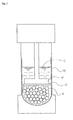
- the measurement was made with a measurement device having a structure of Fig. 1 (Accuforce Cadet Force Gage (digital force gage), made by The Crown Tool and Supply Company) in the following way.
- An amount of 0.358 g of water-absorbent resin a as classified into 300 ⁇ 600 ⁇ m, was placed into a cell b for FISHER ELECTRO-PHOTOMETER, and 10 g of artificial urine c having an adjusted temperature of 25 °C was also placed into the above cell b .
- a polyethylene-made lid d was floated in the cell, and a disk e was piled up on the lid d .
- aqueous monomer solution comprising 204 g of acrylic acid, 496 g of sodium acrylate, 1.6 g of polyethylene glycol diacrylate, and 1,286 g of water, was placed into a stainless vat of 220 mm ⁇ 300 mm, and then air in the reaction system was displaced with nitrogen while the temperature of the solution was kept at 20 °C.
- the stainless vat was cooled for 20 minutes by immersion into a water bath of 20 °C, and then aging was made with warm water of 60 °C for 10 minutes.
- the resultant polymer gel was divided with a meat chopper (made by Hiraga Seisakusho Co., Ltd.), thus obtaining a particulate hydrogel of about 3 mm in average particle diameter and of 65 weight % in water content.
- aqueous monomer solution comprising 204 g of acrylic acid, 496 g of sodium acrylate, 1.6 g of polyethylene glycol diacrylate, and 1,286 g of water, was placed into a stainless vat of 220 mm ⁇ 300 mm, and then air in the reaction system was displaced with nitrogen while the temperature of the solution was kept at 20 °C.
- aqueous monomer solution was stirred with a magnetic stirrer, thereto 3 g of 5 weight % aqueous V-50 solution, 3 g of 5 weight % aqueous sodium persulfate solution, 3 g of 0.5 weight % aqueous sodium L-ascorbate solution, and 3.5 g of 0.35 weight % aqueous hydrogen peroxide solution were added as polymerization initiators. About 1 minute later than the addition of the polymerization initiators, a polymerization reaction started. The stainless vat was cooled for 20 minutes by immersion into a water bath of 20 °C, and then aging was made with warm water of 60 °C for 40 minutes. The resultant polymer gel was divided with a meat chopper (made by Hiraga Seisakusho Co., Ltd.), thus obtaining a particulate hydrogel of about 3 mm in average particle diameter and of 65 weight % in water content.
- a meat chopper made by Hiraga Seisakusho Co., Ltd.
- aqueous monomer solution comprising 204 g of acrylic acid, 496 g of sodium acrylate, 1.6 g of polyethylene glycol diacrylate, and 1,286 g of water, was placed into a stainless vat of 220 mm ⁇ 300 mm, and then air in the reaction system was displaced with nitrogen while the temperature of the solution was kept at 20 °C.
- aqueous monomer solution was stirred with a magnetic stirrer, thereto 3 g of 5 weight % aqueous V-50 solution, 6 g of 5 weight % aqueous sodium persulfate solution, 3 g of 0.5 weight % aqueous sodium L-ascorbate solution, and 3.5 g of 0.35 weight % aqueous hydrogen peroxide solution were added as polymerization initiators. About 1 minute later than the addition of the polymerization initiators, a polymerization reaction started. The stainless vat was cooled for 20 minutes by immersion into a water bath of 20 °C, and then aging was made with warm water of 60 °C for 30 minutes. The resultant polymer gel was divided with a meat chopper (made by Hiraga Seisakusho Co., Ltd.), thus obtaining a particulate hydrogel of about 3 mm in average particle diameter and of 65 weight % in water content.
- a meat chopper made by Hiraga Seisakusho Co., Ltd.
- aqueous monomer solution comprising 204 g of acrylic acid, 496 g of sodium acrylate, 1.6 g of polyethylene glycol diacrylate, and 1,286 g of water, was placed into a stainless vat of 220 mm ⁇ 300 mm, and then air in the reaction system was displaced with nitrogen while the temperature of the solution was kept at 20 °C.
- aqueous monomer solution was stirred with a magnetic stirrer, thereto 3 g of 5 weight % aqueous V-50 solution, 9 g of 5 weight % aqueous sodium persulfate solution, 3 g of 0.5 weight % aqueous sodium L-ascorbate solution, and 3.5 g of 0.35 weight % aqueous hydrogen peroxide solution were added as polymerization initiators. About 1 minute later than the addition of the polymerization initiators, a polymerization reaction started. The stainless vat was cooled for 20 minutes by immersion into a water bath of 20 °C, and then aging was made with warm water of 60 °C for 30 minutes. The resultant polymer gel was divided with a meat chopper (made by Hiraga Seisakusho Co., Ltd.), thus obtaining a particulate hydrogel of about 3 mm in average particle diameter and of 65 weight % in water content.
- a meat chopper made by Hiraga Seisakusho Co., Ltd.
- a cap was attached to a jacketed stainless twin-arm type kneader of 10 liters in capacity and of 240 mm in depth having an opening portion of 220 mm ⁇ 260 mm and two sigmoidal vanes of 120 mm in rotational diameter. Then, an aqueous monomer solution, comprising 408 g of acrylic acid, 992 g of sodium acrylate, 3.2 g of polyethylene glycol diacrylate, and 2,572 g of water, was placed into the kneader, and then air in the reaction system was displaced with nitrogen while the liquid temperature of the aqueous monomer solution was kept at 25 °C by circulating warm water of 25 °C through the jacket.
- aqueous monomer solution was stirred at 40 rpm with the two sigmoidal vanes, thereto 6 g of 5 weight % aqueous V-50 solution, 6 g of 5 weight % aqueous sodium persulfate solution, 6 g of 0.5 weight % aqueous sodium L-ascorbate solution, and 7 g of 0.35 weight % aqueous hydrogen peroxide solution were added as polymerization initiators. After the addition of the polymerization initiators, a polymerization reaction started in about 1 minute, and the temperature in the reaction system reached its peak in 15 minutes, when the temperature was 63 °C.
- the temperature of the warm water in the jacket was raised to 60 °C to carry out aging for 10 minutes.
- the resultant polymer gel was divided with a meat chopper (made by Hiraga Seisakusho Co., Ltd.), thus obtaining a particulate hydrogel of about 3 mm in average particle diameter and of 65 weight % in water content.
- a particulate hydrogel was obtained in the same way as of Production Example 1 except that the amount of polyethylene glycol diacrylate, as used, was changed to 0.8 g.
- aqueous monomer solution comprising 184 g of acrylic acid, 1,611 g of 37 weight % aqueous sodium acrylate solution, 4.3 g of polyethylene glycol diacrylate, and 194 g of water, was placed into a stainless vat of 220 mm ⁇ 300 mm, and then air in the reaction system was displaced with nitrogen while the temperature of the solution was kept at 18 °C. Next, while the aqueous monomer solution was stirred with a magnetic stirrer, thereto 5.3 g of 20 weight % aqueous sodium persulfate solution and 1.6 g of 5 weight % aqueous sodium L-ascorbate solution were added as polymerization initiators.
- An amount of 1 kg of the particulate hydrogel as obtained in Production Example 1 was statically dried for 20 minutes at a wind speed of 1 m/sec and a temperature of 80 °C with a through-flow batch type drying oven (71-S6, made by Satake Kagaku Kikai Kogyo Co., Ltd.) (partial drying step).
- a thermometer was stuck into the central portion of the resultant lumpish aggregate to measure the material temperature, which was 70 °C.
- the water content was 25 weight %.
- the resultant aggregated semidry product was placed into a stainless beaker, and this vessel was airtightened by wrapping the entirety thereof with aluminum foil, and then heated at 100 °C for 1 hour (heat-aging step).
- the semidry product After being heated, the semidry product had a material temperature of 95 °C and a water content of 23 weight %. Thereafter, the lumpish aggregate was spread onto a wire gauze again, and then finish-dried at 150 °C for 30 minutes with the through-flow batch type drying oven (finish-drying step), thus obtaining a dried product having a water content of 7 weight %. This product was pulverized, and then classified. Measurement was made about the absorption capacity under no load, the extractable content, and the residual monomer content of the resultant powder of 500 ⁇ 300 ⁇ m.
- the material temperature and the water content were 70 °C and 25 weight % respectively after the partial drying step; and the material temperature and the water content were 95 °C and 23 weight % respectively after the heat-aging step; and the water content was 7 weight % after the finish-drying step.
- the material temperature and the water content were 73 °C and 24 weight % respectively after the partial drying step; and the material temperature and the water content were 96 °C and 22 weight % respectively after the heat-aging step; and the water content was 6 weight % after the finish-drying step.
- the material temperature and the water content were 72 °C and 25 weight % respectively after the partial drying step; and the material temperature and the water content were 96 °C and 24 weight % respectively after the heat-aging step; and the water content was 7 weight % after the finish-drying step.
- the material temperature and the water content were 72 °C and 25 weight % respectively after the partial drying step; and the material temperature and the water content were 95 °C and 25 weight % respectively after the heat-aging step; and the water content was 6 weight % after the finish-drying step.
- the material temperature and the water content were 71 °C and 24 weight % respectively after the partial drying step; and the material temperature and the water content were 96 °C and 23 weight % respectively after the heat-aging step; and the water content was 7 weight % after the finish-drying step.
- the material temperature and the water content were 70 °C and 25 weight % respectively after the partial drying step; and the material temperature and the water content were 97 °C and 24 weight % respectively after the heat-aging step; and the water content was 7 weight % after the finish-drying step.
- the aggregated semidry product, resultant from the partial drying step in Example 1, was placed into a stainless autoclave, which was then airtightened and then heated at 120 °C for 12 minutes. After being heated, the semidry product had a material temperature of 118 °C and a water content of 23 weight %. Thereafter, the lumpish aggregate was spread onto a wire gauze again, and then finish-dried at 150 °C for 30 minutes with the through-flow batch type drying oven, thus obtaining a dried product having a water content of 7 weight %. This product was pulverized, and then classified. Measurement was made about the absorption capacity under no load, the extractable content, and the residual monomer content of the resultant powder of 500 ⁇ 300 ⁇ m.
- An amount of 1 kg of the particulate hydrogel as obtained in Production Example 1 was statically dried for 15 minutes at a wind speed of 1 m/sec and a temperature of 80 °C with a through-flow batch type drying oven (71-S6, made by Satake Kagaku Kikai Kogyo Co., Ltd.). A thermometer was stuck into the central portion of the resultant lumpish aggregate to measure the material temperature, which was 40 °C. In addition, the water content was 50 weight %. Next, the resultant aggregated semidry product was placed into a stainless beaker, and this vessel was airtightened by wrapping the entirety thereof with aluminum foil, and then heated at 100 °C for 1 hour.
- a through-flow batch type drying oven 71-S6, made by Satake Kagaku Kikai Kogyo Co., Ltd.
- the semidry product After being heated, the semidry product had a material temperature of 90 °C and a water content of 45 weight %. Thereafter, the lumpish aggregate was spread onto a wire gauze again, and then finish-dried at 150 °C for 30 minutes with the through-flow batch type drying oven, thus obtaining a dried product having a water content of 7 weight %. This product was pulverized, and then classified. Measurement was made about the absorption capacity under no load, the extractable content, and the residual monomer content of the resultant powder of 500 ⁇ 300 ⁇ m.
- An amount of 1 kg of the particulate hydrogel as obtained in Production Example 1 was statically dried for 30 minutes at a wind speed of 1 m/sec and a temperature of 80 °C with a through-flow batch type drying oven (71-S6, made by Satake Kagaku Kikai Kogyo Co., Ltd.). A thermometer was stuck into the central portion of the resultant lumpish aggregate to measure the material temperature, which was 80 °C. In addition, the water content was 10 weight %. Next, the resultant aggregated semidry product was placed into a stainless beaker, and this vessel was airtightened by wrapping the entirety thereof with aluminum foil, and then heated at 100 °C for 1 hour.
- a through-flow batch type drying oven 71-S6, made by Satake Kagaku Kikai Kogyo Co., Ltd.
- the semidry product After being heated, the semidry product had a material temperature of 98 °C and a water content of 9 weight %. Thereafter, the lumpish aggregate was spread onto a wire gauze again, and then finish-dried at 150 °C for 30 minutes with the through-flow batch type drying oven, thus obtaining a dried product having a water content of 6 weight %. This product was pulverized, and then classified. Measurement was made about the absorption capacity under no load, the extractable content, and the residual monomer content of the resultant powder of 500 ⁇ 300 ⁇ m.
- An amount of 1 kg of the particulate hydrogel as obtained in Production Example 1 was statically dried for 10 minutes at a wind speed of 1 m/sec and a temperature of 180 °C with a through-flow batch type drying oven (71-S6, made by Satake Kagaku Kikai Kogyo Co., Ltd.). A thermometer was stuck into the central portion of the resultant lumpish aggregate to measure the material temperature, which was 95 °C. In addition, the water content was 25 weight %. Next, the resultant aggregated semidry product was placed into a stainless beaker, and this vessel was airtightened by wrapping the entirety thereof with aluminum foil, and then heated at 100 °C for 1 hour.
- a through-flow batch type drying oven 71-S6, made by Satake Kagaku Kikai Kogyo Co., Ltd.
- the semidry product After being heated, the semidry product had a material temperature of 98 °C and a water content of 23 weight %. Thereafter, the lumpish aggregate was spread onto a wire gauze again, and then finish-dried at 150 °C for 30 minutes with the through-flow batch type drying oven, thus obtaining a dried product having a water content of 7 weight %. This product was pulverized, and then classified. Measurement was made about the absorption capacity under no load, the extractable content, and the residual monomer content of the resultant powder of 500 ⁇ 300 ⁇ m.
- An amount of 1 kg of the particulate hydrogel as obtained in Production Example 1 was statically dried for 20 minutes at a wind speed of 1 m/sec and a temperature of 80 °C with a through-flow batch type drying oven (71-S6, made by Satake Kagaku Kikai Kogyo Co., Ltd.). A thermometer was stuck into the central portion of the resultant lumpish aggregate to measure the material temperature, which was 70 °C. In addition, the water content was 25 weight %. Next, the resultant aggregated semidry product was placed into a stainless autoclave, and then heated at 140 °C for 8 minutes. After being heated, the semidry product had a material temperature of 125 °C and a water content of 22 weight %.
- the lumpish aggregate was spread onto a wire gauze again, and then finish-dried at 150 °C for 30 minutes with the through-flow batch type drying oven, thus obtaining a dried product having a water content of 6 weight %.
- This product was pulverized, and then classified. Measurement was made about the absorption capacity under no load, the extractable content, and the residual monomer content of the resultant powder of 500 ⁇ 300 ⁇ m.
- An amount of 1 kg of the particulate hydrogel as obtained in Production Example 1 was statically dried for 40 minutes at a wind speed of 1 m/sec and a temperature of 170 °C with a through-flow batch type drying oven (71-S6, made by Satake Kagaku Kikai Kogyo Co., Ltd.), thus obtaining a dried product having a water content of 6 weight %.
- This product was pulverized, and then classified. Measurement was made about the absorption capacity under no load, the extractable content, and the residual monomer content of the resultant powder of 500 ⁇ 300 ⁇ m.
- a dried product having a water content of 6 weight % was obtained in the same way as of Comparative Example 5 except that the particulate hydrogel was changed to the particulate hydrogel resultant from Production Example 2. This product was pulverized, and then classified. Measurement was made about the properties of the resultant powder of 500 ⁇ 300 ⁇ m.
- a dried product having a water content of 6 weight % was obtained in the same way as of Comparative Example 5 except that the particulate hydrogel was changed to the particulate hydrogel resultant from Production Example 3. This product was pulverized, and then classified. Measurement was made about the properties of the resultant powder of 500 ⁇ 300 ⁇ m.
- a dried product having a water content of 7 weight % was obtained in the same way as of Comparative Example 5 except that the particulate hydrogel was changed to the particulate hydrogel resultant from Production Example 4. This product was pulverized, and then classified. Measurement was made about the properties of the resultant powder of 500 ⁇ 300 ⁇ m.
- a dried product having a water content of 6 weight % was obtained in the same way as of Comparative Example 5 except that the particulate hydrogel was changed to the particulate hydrogel resultant from Production Example 5. This product was pulverized, and then classified. Measurement was made about the properties of the resultant powder of 500 ⁇ 300 ⁇ m.
- a dried product having a water content of 6 weight % was obtained in the same way as of Comparative Example 5 except that the particulate hydrogel was changed to the particulate hydrogel resultant from Production Example 6. This product was pulverized, and then classified. Measurement was made about the properties of the resultant powder of 500 ⁇ 300 ⁇ m.
- a dried product having a water content of 6 weight % was obtained in the same way as of Comparative Example 5 except that the particulate hydrogel was changed to the particulate hydrogel resultant from Production Example 7. This product was pulverized, and then classified. Measurement was made about the properties of the resultant powder of 500 ⁇ 300 ⁇ m.
- An amount of 1 kg of the particulate hydrogel as obtained in Production Example 1 was statically dried for 15 minutes at a wind speed of 1 m/sec and a temperature of 80 °C with a through-flow batch type drying oven (71-S6, made by Satake Kagaku Kikai Kogyo Co., Ltd.). A thermometer was stuck into the central portion of the resultant lumpish aggregate to measure the material temperature, which was 40 °C. In addition, the water content was 50 weight %. Next, the resultant aggregated semidry product was treated with a microwave oven at 500 w for 3 minutes. After being heated, the semidry product had a material temperature of 95 °C and a water content of 27 weight %.
- the lumpish aggregate was spread onto a wire gauze again, and then finish-dried at 150 °C for 30 minutes with the through-flow batch type drying oven, thus obtaining a dried product having a water content of 6 weight %.
- This product was pulverized, and then classified. Measurement was made about the absorption capacity under no load, the extractable content and the residual monomer content of the resultant powder of 500 ⁇ 300 ⁇ m.
- An amount of 1 kg of the particulate hydrogel as obtained in Production Example 1 was statically dried for 20 minutes at a wind speed of 1 m/sec and a temperature of 80 °C with a through-flow batch type drying oven (71-S6, made by Satake Kagaku Kikai Kogyo Co., Ltd.). A thermometer was stuck into the central portion of the resultant lumpish aggregate to measure the material temperature, which was 70 °C. In addition, the water content was 25 weight %. Next, the resultant aggregated semidry product was treated with a microwave oven at 500 w for 3 minutes. After being heated, the semidry product had a material temperature of 98 °C and a water content of 15 weight %.
- the lumpish aggregate was spread onto a wire gauze again, and then finish-dried at 150 °C for 30 minutes with the through-flow batch type drying oven, thus obtaining a dried product having a water content of 6 weight %.
- This product was pulverized, and then classified. Measurement was made about the absorption capacity under no load, the extractable content, and the residual monomer content of the resultant powder of 500 ⁇ 300 ⁇ m.
- the drying process was carried out in the same way as of Comparative Example 13 except that the aggregated semidry product was treated with a microwave oven at 1,500 w for 9 minutes.
- the resultant dried product was pulverized, and then classified. Measurement was made about the absorption capacity under no load, the extractable content, and the residual monomer content of the resultant powder of 500 ⁇ 300 ⁇ m.
- the material temperature was 98 °C, and the water content was 5 weight %.
- the dried product resultant from the finish-drying step had a water content of 4 weight %.
- the semidry product as got out of the microwave oven had a partially scorched surface and gave out a foul smell.
- An amount of 1 kg of the particulate hydrogel as obtained in Production Example 1 was dried until the water content reduced to 20 weight % by causing a hot wind, comprising a mixed gas of water vapor and air and having a temperature of 120 °C and a dew point of 80 °C, to blow the hydrogel at a wind speed of 1 m/sec with a through-flow batch type drying oven (71-S6, made by Satake Kagaku Kikai Kogyo Co., Ltd.).
- a hot wind comprising a mixed gas of water vapor and air and having a temperature of 120 °C and a dew point of 80 °C
- the hydrogel was further dried until the water content reduced to 6 weight % with an unhumidified hot wind having a temperature of 180 °C, a dew point of 5 °C, and a wind speed of 1.0 m/sec, and then the dried hydrogel was pulverized and then classified. Measurement was made about the absorption capacity under no load, the extractable content, and the residual monomer content of the resultant powder of 500 ⁇ 300 ⁇ m.
- An amount of 1 kg of the particulate hydrogel as obtained in Production Example 1 was dried by causing a hot wind, comprising a mixed gas of water vapor and air and having a temperature of 130 °C and a dew point of 80 °C, to blow the hydrogel for 15 minutes at a wind speed of 1 m/sec with a through-flow batch type drying oven (71-S6, made by Satake Kagaku Kikai Kogyo Co., Ltd.).
- a hot wind comprising a mixed gas of water vapor and air and having a temperature of 130 °C and a dew point of 80 °C
- the hydrogel was further dried until the water content reduced to 6 weight % by causing an unhumidified hot wind, having a temperature of 160 °C, a dew point of 5 °C, and a wind speed of 1.0 m/sec, to blow the hydrogel for 50 minutes, and then the dried hydrogel was pulverized and then classified. Measurement was made about the absorption capacity under no load, the extractable content, and the residual monomer content of the resultant powder of 500 ⁇ 300 ⁇ m. Absorption capacity under no load (g/g) Extractable content (%) Residual monomer content (ppm) Water-absorbent resin used Absorption capacity change ratio under no load (%) Extractable content change ratio (%) Prod.
- an unhumidified hot wind having a temperature of 160 °C, a dew point of 5 °C, and a wind speed of 1.0 m/sec
- the dried product. resultant from Example 6, was pulverized with a roll mill and then classified to obtain particles which passed through a sieve of 850 ⁇ m and remained on a sieve of 150 ⁇ m.
- a surface-treated water-absorbent resin was obtained in the same way as of Example 9 except that the dried product was changed to the dried product resultant from Comparative Example 10.
- This water-absorbent resin had an absorption capacity of 50 (g/g) under no load and an absorption capacity of 30 (g/g) under the load.
- Example 9 As is evident from the results of Example 9 and Comparative Example 17, the water-absorbent resin is dried without being deteriorated in the present invention, therefore the resultant dried water-absorbent resin exhibits excellent absorbency under the load.
- the water-absorbent resin is dried without being deteriorated in the present invention, therefore the resultant dried water-absorbent resin exhibits high swelling pressure.
- the water-absorbent resin is dried without being deteriorated in the present invention, therefore the resultant dried water-absorbent resin exhibits high swelling pressure.
Landscapes
- Chemical & Material Sciences (AREA)
- Health & Medical Sciences (AREA)
- Chemical Kinetics & Catalysis (AREA)
- Medicinal Chemistry (AREA)
- Polymers & Plastics (AREA)
- Organic Chemistry (AREA)
- Addition Polymer Or Copolymer, Post-Treatments, Or Chemical Modifications (AREA)
- Processes Of Treating Macromolecular Substances (AREA)
Abstract
Description
| Absorption capacity under no load (g/g) | Extractable content (%) | Residual monomer content (ppm) | Water-absorbent resin used | Absorption capacity change ratio under no load (%) | Extractable content change ratio (%) | |
| Prod. Ex. 1 | 37.3 | 2.7 | 42,000 | ----- | ----- | ----- |
| Prod. Ex. 2 | 38.5 | 3.1 | 33,000 | ----- | ----- | ----- |
| Prod. Ex. 3 | 39.0 | 3.4 | 21,000 | ----- | ----- | ----- |
| Prod. Ex. 4 | 40.0 | 4.3 | 13,000 | ----- | ----- | ----- |
| Prod. Ex. 5 | 37.5 | 2.5 | 47,000 | ----- | ----- | ----- |
| Prod. Ex. 6 | 44.6 | 3.3 | 43,000 | ----- | ----- | ----- |
| Prod. Ex. 7 | 27.0 | 2.0 | 10,000 | ----- | ----- | ----- |
| Ex. 1 | 38.2 | 3.4 | 130 | Prod. Ex. 1 | 0 | 26 |
| Ex. 2 | 39.7 | 4.1 | 170 | Prod. Ex. 2 | 3 | 32 |
| Ex. 3 | 41.5 | 4.9 | 80 | Prod. Ex. 3 | 7 | 44 |
| Ex. 4 | 42.7 | 6.3 | 95 | Prod. Ex. 4 | 7 | 47 |
| Ex. 5 | 39.0 | 4.7 | 90 | Prod. Ex. 5 | 4 | 88 |
| Ex. 6 | 46.6 | 5.0 | 100 | Prod. Ex. 6 | 4 | 52 |
| Ex. 7 | 27.8 | 2.3 | 50 | Prod. Ex. 7 | 3 | 30 |
| Ex. 8 | 38.0 | 3.2 | 290 | Prod. Ex. 1 | 2 | 60 |
| Comp. Ex. 1 | 43.4 | 4.6 | 15,000 | Prod. Ex. 1 | 16 | 70 |
| Comp. Ex. 2 | 39.8 | 4.8 | 960 | Prod. Ex. 1 | 7 | 78 |
| Comp. Ex. 3 | 42.0 | 6.8 | 840 | Prod. Ex. 1 | 13 | 152 |
| Comp. Ex. 4 | 41.8 | 6.2 | 202 | Prod. Ex. 1 | 12 | 130 |
| Comp. Ex. 5 | 51.5 | 14.0 | 750 | Prod. Ex. 1 | 38 | 419 |
| Comp. Ex. 6 | 51.5 | 15.0 | 580 | Prod. Ex. 2 | 34 | 384 |
| Comp. Ex. 7 | 53.0 | 16.0 | 520 | Prod. Ex. 3 | 36 | 371 |
| Comp. Ex. 8 | 52.0 | 17.0 | 450 | Prod. Ex. 4 | 30 | 342 |
| Comp. Ex. 9 | 52.5 | 13.2 | 1,100 | Prod. Ex. 5 | 40 | 428 |
| Comp. Ex. 10 | 65.1 | 30.0 | 700 | Prod. Ex. 6 | 46 | 809 |
| Comp. Ex. 11 | 33.8 | 8.2 | 390 | Prod. Ex. 7 | 25 | 210 |
| Comp. Ex. 12 | 41.4 | 4.5 | 3,700 | Prod. Ex. 1 | 11 | 67 |
| Comp. Ex. 13 | 36.6 | 3.6 | 3,400 | Prod. Ex. 1 | 3 | 33 |
| Comp. Ex. 14 | 48.0 | 18.0 | 300 | Prod. Ex. 1 | 29 | 567 |
| Comp. Ex. 15 | 48.5 | 13.0 | 280 | Prod. Ex. 1 | 30 | 381 |
| Comp. Ex. 16 | 44.1 | 7.1 | 280 | Prod. Ex. 1 | 18 | 163 |
| Prod. Ex.: Production Example Ex.: Example Comp. Ex.: Comparative Example |
Claims (6)
- A production process for a hydrophilic polymer, comprising the steps of: obtaining a hydrogel polymer by aqueous solution polymerization of a hydrophilic monomer; and then drying the hydrogel polymer;with the production process being characterized in that the drying step includes the steps of:partially drying the hydrogel polymer under normal pressure at a material temperature of not higher than 90 °C until the water content of the hydrogel polymer reduces to 15∼40 weight %; and thenheat-aging the hydrogel polymer by keeping the hydrogel polymer for not shorter than 10 minutes in a state where the change of the water content of the hydrogel polymer is within 5 weight % and where the material temperature is in the range of 70∼120 °C; and thenfinish-drying the hydrogel polymer until the water content of the hydrogel polymer reduces to a desired value.
- A production process for a hydrophilic polymer, comprising the steps of: obtaining a hydrogel polymer by aqueous solution polymerization of a hydrophilic monomer; and then drying the hydrogel polymer;with the production process being characterized in that the drying step includes the steps of:partially drying the hydrogel polymer under normal pressure at a material temperature of not higher than 90 °C until the water content of the hydrogel polymer reduces to 15∼40 weight %; and thenheat-aging the hydrogel polymer by keeping the hydrogel polymer for not shorter than 10 minutes in a state where the water content of the hydrogel polymer is in the range of 15∼40 weight % and where the material temperature is in the range of 70∼120 °C; and thenfinish-drying the hydrogel polymer until the water content of the hydrogel polymer reduces to a desired value.
- A production process according to claim 1 or 2, wherein the water content of the hydrogel polymer as obtained by the polymerization is in the range of 80∼60 weight %.
- A production process according to claim 1 or 2, wherein the aqueous solution polymerization of the hydrophilic monomer involves the use of a persulfate salt.
- A production process according to claim 1 or 2, wherein the hydrogel polymer as obtained by the polymerization has a residual monomer content of not lower than 10,000 ppm.
- A production process for a water-absorbent resin, comprising the steps of: obtaining a hydrogel polymer by aqueous solution polymerization of a hydrophilic monomer; and then drying the hydrogel polymer;with the production process being characterized in that the drying step involves an absorption capacity change ratio of not higher than 10 under no load and an extractable content change ratio of not higher than 100, and gives the water-absorbent resin with a residual monomer content of not higher than 300 ppm.
Applications Claiming Priority (2)
| Application Number | Priority Date | Filing Date | Title |
|---|---|---|---|
| JP32823698 | 1998-11-18 | ||
| JP32823698 | 1998-11-18 |
Publications (2)
| Publication Number | Publication Date |
|---|---|
| EP1002806A1 true EP1002806A1 (en) | 2000-05-24 |
| EP1002806B1 EP1002806B1 (en) | 2005-03-16 |
Family
ID=34362519
Family Applications (1)
| Application Number | Title | Priority Date | Filing Date |
|---|---|---|---|
| EP99122561A Expired - Lifetime EP1002806B1 (en) | 1998-11-18 | 1999-11-12 | Production process for hydrophilic polymer |
Country Status (3)
| Country | Link |
|---|---|
| US (1) | US6207796B1 (en) |
| EP (1) | EP1002806B1 (en) |
| DE (1) | DE69924208T2 (en) |
Cited By (7)
| Publication number | Priority date | Publication date | Assignee | Title |
|---|---|---|---|---|
| US6576713B2 (en) | 2000-02-29 | 2003-06-10 | Nippon Shokubai Co., Ltd. | Water-absorbent resin powder and production process therefor |
| EP1367081A1 (en) * | 2002-05-30 | 2003-12-03 | Nippon Shokubai Co., Ltd. | Production process for particulate water-absorbent resin |
| WO2008034786A1 (en) | 2006-09-19 | 2008-03-27 | Basf Se | Process for preparing color-stable water-absorbing polymer particles with a low degree of neutralization |
| US8592516B2 (en) | 2005-03-24 | 2013-11-26 | Basf Aktiengesellschaft | Method for the production of water absorbing polymers |
| WO2020145384A1 (en) | 2019-01-11 | 2020-07-16 | 株式会社日本触媒 | Water absorbent having water-absorbent resin as main component, and method for producing same |
| EP3753976A4 (en) * | 2018-11-13 | 2021-11-03 | Lg Chem, Ltd. | SUPERABSORBENT POLYMER PREPARATION PROCESS |
| WO2023046583A1 (en) | 2021-09-27 | 2023-03-30 | Basf Se | Process for producing superabsorbent particles |
Families Citing this family (24)
| Publication number | Priority date | Publication date | Assignee | Title |
|---|---|---|---|---|
| DE10041395A1 (en) * | 2000-08-23 | 2002-03-07 | Stockhausen Chem Fab Gmbh | Polymer dispersions for fire prevention and fire fighting with improved environmental compatibility |
| WO2002066543A1 (en) * | 2001-02-16 | 2002-08-29 | Genzyme Corporation | Method of drying a material having a cohesive phase |
| DE10118020A1 (en) | 2001-04-10 | 2002-10-17 | Stockhausen Chem Fab Gmbh | Use of water-swellable polymers based on unsaturated sulfonic acid monomers as additives for increasing the viscosity of saline water used to prevent or fight fires |
| TW200712114A (en) * | 2005-09-30 | 2007-04-01 | Nippon Catalytic Chem Ind | Method for manufacturing particulate water-absorbing agent and particulate water-absorbing agent |
| WO2008095901A1 (en) | 2007-02-06 | 2008-08-14 | Basf Se | Method for producing water-absorbent polymer particles by the polymerisation of droplets of a monomer solution |
| SA08290542B1 (en) * | 2007-08-28 | 2012-11-14 | نيبون شوكوباي كو. ، ليمتد | Method for Producing Water Absorbent Resin |
| US8586787B2 (en) | 2009-05-15 | 2013-11-19 | Nippon Shokubai Co., Ltd. | Process for producing (meth)acrylic acid |
| US8637701B2 (en) | 2009-05-15 | 2014-01-28 | Nippon Shokubai Co., Ltd. | Method for producing (meth) acrylic acid |
| SG175379A1 (en) | 2009-05-15 | 2011-12-29 | Nippon Catalytic Chem Ind | Process for producing (meth)acrylic acid and crystallization system |
| EP2471848B2 (en) | 2009-08-28 | 2017-11-29 | Nippon Shokubai Co., Ltd. | Process for production of water-absorbable resin |
| TWI483996B (en) * | 2009-12-08 | 2015-05-11 | Novartis Ag | A silicone hydrogel lens with a covalently attached coating |
| JP5587348B2 (en) | 2010-01-20 | 2014-09-10 | 株式会社日本触媒 | Method for producing water absorbent resin |
| JP5514841B2 (en) | 2010-01-20 | 2014-06-04 | 株式会社日本触媒 | Method for producing water absorbent resin |
| US9976001B2 (en) | 2010-02-10 | 2018-05-22 | Nippon Shokubai Co., Ltd. | Process for producing water-absorbing resin powder |
| CN102791774B (en) | 2010-03-08 | 2016-06-29 | 株式会社日本触媒 | The drying means of graininess aqueous gel shape cross linked polymer |
| WO2011111857A1 (en) | 2010-03-12 | 2011-09-15 | 株式会社日本触媒 | Method for manufacturing a water-absorbing resin |
| EP2565219B1 (en) | 2010-04-27 | 2018-06-27 | Nippon Shokubai Co., Ltd. | Method for producing polyacrylic acid (salt)-based water absorbent resin powder |
| KR102159909B1 (en) * | 2010-07-30 | 2020-09-25 | 알콘 인코포레이티드 | Silicone hydrogel lenses with water-rich surfaces |
| US10338408B2 (en) | 2012-12-17 | 2019-07-02 | Novartis Ag | Method for making improved UV-absorbing ophthalmic lenses |
| CN105829081B (en) | 2013-12-17 | 2017-12-19 | 诺华股份有限公司 | Silicone hydrogel lenses with cross-linked hydrophilic coating |
| US11002884B2 (en) | 2014-08-26 | 2021-05-11 | Alcon Inc. | Method for applying stable coating on silicone hydrogel contact lenses |
| DE102015202692A1 (en) * | 2015-02-13 | 2016-08-18 | Universität Rostock | Process for the preparation of a crosslinked polymer of a vinylimidazolium compound |
| MY184638A (en) | 2015-12-15 | 2021-04-13 | Alcon Inc | Method for applying stable coating on silicone hydrogel contact lenses |
| MY201826A (en) | 2017-12-13 | 2024-03-19 | Alcon Inc | Method for producing mps-compatible water gradient contact lenses |
Citations (3)
| Publication number | Priority date | Publication date | Assignee | Title |
|---|---|---|---|---|
| EP0412363A2 (en) * | 1989-08-08 | 1991-02-13 | BASF Aktiengesellschaft | Process for improving the water absorption capacity of crosslinked, water swellable polymers |
| EP0514775A1 (en) * | 1991-05-20 | 1992-11-25 | The Dow Chemical Company | Process for producing a superabsorbent polymer |
| EP0605215A1 (en) * | 1992-12-25 | 1994-07-06 | Nippon Shokubai Co., Ltd. | Absorbent and method for production of absorbent resin |
Family Cites Families (3)
| Publication number | Priority date | Publication date | Assignee | Title |
|---|---|---|---|---|
| JPS6426606A (en) | 1987-03-30 | 1989-01-27 | Japan Synthetic Rubber Co Ltd | Production of acid-modified hexene-1 polymer |
| ES2026653T3 (en) | 1987-04-30 | 1992-05-01 | Nippon Shokubai Kagaku Kogyo Co., Ltd | METHOD FOR THE PRODUCTION OF A HYDROPHILIC POLYMER. |
| JPH05310806A (en) | 1992-05-08 | 1993-11-22 | Nippon Shokubai Co Ltd | Production of hydrophilic polymer |
-
1999
- 1999-11-09 US US09/436,345 patent/US6207796B1/en not_active Expired - Lifetime
- 1999-11-12 DE DE69924208T patent/DE69924208T2/en not_active Expired - Lifetime
- 1999-11-12 EP EP99122561A patent/EP1002806B1/en not_active Expired - Lifetime
Patent Citations (3)
| Publication number | Priority date | Publication date | Assignee | Title |
|---|---|---|---|---|
| EP0412363A2 (en) * | 1989-08-08 | 1991-02-13 | BASF Aktiengesellschaft | Process for improving the water absorption capacity of crosslinked, water swellable polymers |
| EP0514775A1 (en) * | 1991-05-20 | 1992-11-25 | The Dow Chemical Company | Process for producing a superabsorbent polymer |
| EP0605215A1 (en) * | 1992-12-25 | 1994-07-06 | Nippon Shokubai Co., Ltd. | Absorbent and method for production of absorbent resin |
Cited By (10)
| Publication number | Priority date | Publication date | Assignee | Title |
|---|---|---|---|---|
| US6576713B2 (en) | 2000-02-29 | 2003-06-10 | Nippon Shokubai Co., Ltd. | Water-absorbent resin powder and production process therefor |
| EP1367081A1 (en) * | 2002-05-30 | 2003-12-03 | Nippon Shokubai Co., Ltd. | Production process for particulate water-absorbent resin |
| US6875511B2 (en) | 2002-05-30 | 2005-04-05 | Nippon Shokubai Co., Ltd. | Production process for particulate water-absorbent resin |
| US8592516B2 (en) | 2005-03-24 | 2013-11-26 | Basf Aktiengesellschaft | Method for the production of water absorbing polymers |
| WO2008034786A1 (en) | 2006-09-19 | 2008-03-27 | Basf Se | Process for preparing color-stable water-absorbing polymer particles with a low degree of neutralization |
| US7960490B2 (en) | 2006-09-19 | 2011-06-14 | Basf Se | Process for preparing color-stable water-absorbing polymer particles with a low degree of neutralization |
| EP3753976A4 (en) * | 2018-11-13 | 2021-11-03 | Lg Chem, Ltd. | SUPERABSORBENT POLYMER PREPARATION PROCESS |
| WO2020145384A1 (en) | 2019-01-11 | 2020-07-16 | 株式会社日本触媒 | Water absorbent having water-absorbent resin as main component, and method for producing same |
| US12053756B2 (en) | 2019-01-11 | 2024-08-06 | Nippon Shokubai Co., Ltd. | Water absorbent agent having water-absorbent resin as main component and comprising a sulfur-containing reducing agent |
| WO2023046583A1 (en) | 2021-09-27 | 2023-03-30 | Basf Se | Process for producing superabsorbent particles |
Also Published As
| Publication number | Publication date |
|---|---|
| DE69924208D1 (en) | 2005-04-21 |
| EP1002806B1 (en) | 2005-03-16 |
| US6207796B1 (en) | 2001-03-27 |
| DE69924208T2 (en) | 2006-03-23 |
Similar Documents
| Publication | Publication Date | Title |
|---|---|---|
| EP1002806B1 (en) | Production process for hydrophilic polymer | |
| US6265488B1 (en) | Production process for water-absorbing agent | |
| US6297319B1 (en) | Water-absorbing agent and production process therefor | |
| EP0878488B2 (en) | Method for production of hydrophilic resin | |
| US7879923B2 (en) | Method for surface-treatment of water absorbent resin | |
| EP1302485B1 (en) | Process for production of water-absorbent resin | |
| JP4162746B2 (en) | Water-absorbing agent composition and absorbent article using the same | |
| EP1191051A2 (en) | Water-absorbent polymer particles and production process therefor | |
| EP1824910A2 (en) | Method for production of modified water absorbent resin | |
| JPH11279287A (en) | Water-absorption agent composition and its production | |
| WO2006094907A1 (en) | Hydrolytically stable postcrosslinked superabsorbents | |
| JPH06122707A (en) | Production of water-absorbent resin | |
| JPH06122708A (en) | Production of water-absorbent resin | |
| JP4326612B2 (en) | Method for producing particulate water-absorbing resin | |
| JPH10265582A (en) | Water absorbing agent and method for producing the same | |
| JP2000038407A (en) | Production of water-absorbing resin | |
| JP2016113465A (en) | Polyacrylic acid (acrylate)-based water-absorbing resin, and production method thereof | |
| JP3822812B2 (en) | Water absorbing agent and method for producing the same | |
| JP4323647B2 (en) | Method for producing hydrophilic polymer | |
| JP2944447B2 (en) | Water absorbing agent and method for producing the same | |
| EP0940149A1 (en) | "Water-absorbing agent and production process therefor" | |
| JP4242467B2 (en) | Method for producing water absorbent resin | |
| JP4198265B2 (en) | Method for producing water absorbent resin | |
| JP4198266B2 (en) | Method for producing water absorbent resin | |
| JPH11279288A (en) | Production of water-absorption agent |
Legal Events
| Date | Code | Title | Description |
|---|---|---|---|
| PUAI | Public reference made under article 153(3) epc to a published international application that has entered the european phase |
Free format text: ORIGINAL CODE: 0009012 |
|
| AK | Designated contracting states |
Kind code of ref document: A1 Designated state(s): BE DE FR GB |
|
| AX | Request for extension of the european patent |
Free format text: AL;LT;LV;MK;RO;SI |
|
| 17P | Request for examination filed |
Effective date: 20001027 |
|
| AKX | Designation fees paid |
Free format text: BE DE FR GB |
|
| 17Q | First examination report despatched |
Effective date: 20031128 |
|
| GRAP | Despatch of communication of intention to grant a patent |
Free format text: ORIGINAL CODE: EPIDOSNIGR1 |
|
| GRAS | Grant fee paid |
Free format text: ORIGINAL CODE: EPIDOSNIGR3 |
|
| GRAA | (expected) grant |
Free format text: ORIGINAL CODE: 0009210 |
|
| AK | Designated contracting states |
Kind code of ref document: B1 Designated state(s): BE DE FR GB |
|
| REG | Reference to a national code |
Ref country code: GB Ref legal event code: FG4D |
|
| REF | Corresponds to: |
Ref document number: 69924208 Country of ref document: DE Date of ref document: 20050421 Kind code of ref document: P |
|
| PLBI | Opposition filed |
Free format text: ORIGINAL CODE: 0009260 |
|
| PLAX | Notice of opposition and request to file observation + time limit sent |
Free format text: ORIGINAL CODE: EPIDOSNOBS2 |
|
| 26 | Opposition filed |
Opponent name: BASF AKTIENGESELLSCHAFT PATENTE, MARKEN UND LIZENZ Effective date: 20051216 |
|
| ET | Fr: translation filed | ||
| PLBB | Reply of patent proprietor to notice(s) of opposition received |
Free format text: ORIGINAL CODE: EPIDOSNOBS3 |
|
| PLAB | Opposition data, opponent's data or that of the opponent's representative modified |
Free format text: ORIGINAL CODE: 0009299OPPO |
|
| APBM | Appeal reference recorded |
Free format text: ORIGINAL CODE: EPIDOSNREFNO |
|
| APBP | Date of receipt of notice of appeal recorded |
Free format text: ORIGINAL CODE: EPIDOSNNOA2O |
|
| APAH | Appeal reference modified |
Free format text: ORIGINAL CODE: EPIDOSCREFNO |
|
| APBM | Appeal reference recorded |
Free format text: ORIGINAL CODE: EPIDOSNREFNO |
|
| APBP | Date of receipt of notice of appeal recorded |
Free format text: ORIGINAL CODE: EPIDOSNNOA2O |
|
| APBQ | Date of receipt of statement of grounds of appeal recorded |
Free format text: ORIGINAL CODE: EPIDOSNNOA3O |
|
| PGFP | Annual fee paid to national office [announced via postgrant information from national office to epo] |
Ref country code: GB Payment date: 20091111 Year of fee payment: 11 Ref country code: FR Payment date: 20091123 Year of fee payment: 11 |
|
| GBPC | Gb: european patent ceased through non-payment of renewal fee |
Effective date: 20101112 |
|
| REG | Reference to a national code |
Ref country code: FR Ref legal event code: ST Effective date: 20110801 |
|
| PG25 | Lapsed in a contracting state [announced via postgrant information from national office to epo] |
Ref country code: FR Free format text: LAPSE BECAUSE OF NON-PAYMENT OF DUE FEES Effective date: 20101130 |
|
| PG25 | Lapsed in a contracting state [announced via postgrant information from national office to epo] |
Ref country code: GB Free format text: LAPSE BECAUSE OF NON-PAYMENT OF DUE FEES Effective date: 20101112 |
|
| PLAB | Opposition data, opponent's data or that of the opponent's representative modified |
Free format text: ORIGINAL CODE: 0009299OPPO |
|
| PLAB | Opposition data, opponent's data or that of the opponent's representative modified |
Free format text: ORIGINAL CODE: 0009299OPPO |
|
| REG | Reference to a national code |
Ref country code: DE Ref legal event code: R100 Ref document number: 69924208 Country of ref document: DE |
|
| R26 | Opposition filed (corrected) |
Opponent name: BASF AKTIENGESELLSCHAFT Effective date: 20051216 |
|
| APBU | Appeal procedure closed |
Free format text: ORIGINAL CODE: EPIDOSNNOA9O |
|
| R26 | Opposition filed (corrected) |
Opponent name: BASF AKTIENGESELLSCHAFT Effective date: 20051216 |
|
| APAN | Information on closure of appeal procedure modified |
Free format text: ORIGINAL CODE: EPIDOSCNOA9O |
|
| PLCK | Communication despatched that opposition was rejected |
Free format text: ORIGINAL CODE: EPIDOSNREJ1 |
|
| PLBN | Opposition rejected |
Free format text: ORIGINAL CODE: 0009273 |
|
| STAA | Information on the status of an ep patent application or granted ep patent |
Free format text: STATUS: OPPOSITION REJECTED |
|
| 27O | Opposition rejected |
Effective date: 20130904 |
|
| REG | Reference to a national code |
Ref country code: DE Ref legal event code: R100 Ref document number: 69924208 Country of ref document: DE Effective date: 20130904 |
|
| PGFP | Annual fee paid to national office [announced via postgrant information from national office to epo] |
Ref country code: DE Payment date: 20181030 Year of fee payment: 20 |
|
| PGFP | Annual fee paid to national office [announced via postgrant information from national office to epo] |
Ref country code: BE Payment date: 20181015 Year of fee payment: 20 |
|
| REG | Reference to a national code |
Ref country code: DE Ref legal event code: R071 Ref document number: 69924208 Country of ref document: DE |
|
| REG | Reference to a national code |
Ref country code: BE Ref legal event code: MK Effective date: 20191112 |