EP0983252B2 - Verfahren und reaktor zur herstellung von ethylenoxid - Google Patents
Verfahren und reaktor zur herstellung von ethylenoxid Download PDFInfo
- Publication number
- EP0983252B2 EP0983252B2 EP98925547.6A EP98925547A EP0983252B2 EP 0983252 B2 EP0983252 B2 EP 0983252B2 EP 98925547 A EP98925547 A EP 98925547A EP 0983252 B2 EP0983252 B2 EP 0983252B2
- Authority
- EP
- European Patent Office
- Prior art keywords
- metal plates
- reactor
- ethylene oxide
- plate packets
- reaction
- Prior art date
- Legal status (The legal status is an assumption and is not a legal conclusion. Google has not performed a legal analysis and makes no representation as to the accuracy of the status listed.)
- Expired - Lifetime
Links
- 238000000034 method Methods 0.000 title claims description 24
- IAYPIBMASNFSPL-UHFFFAOYSA-N Ethylene oxide Chemical compound C1CO1 IAYPIBMASNFSPL-UHFFFAOYSA-N 0.000 title claims description 14
- 238000006243 chemical reaction Methods 0.000 claims description 23
- 239000007789 gas Substances 0.000 claims description 21
- 239000002184 metal Substances 0.000 claims description 19
- 239000003054 catalyst Substances 0.000 claims description 16
- VGGSQFUCUMXWEO-UHFFFAOYSA-N Ethene Chemical compound C=C VGGSQFUCUMXWEO-UHFFFAOYSA-N 0.000 claims description 14
- 239000005977 Ethylene Substances 0.000 claims description 11
- VNWKTOKETHGBQD-UHFFFAOYSA-N methane Chemical compound C VNWKTOKETHGBQD-UHFFFAOYSA-N 0.000 claims description 11
- IJGRMHOSHXDMSA-UHFFFAOYSA-N Atomic nitrogen Chemical compound N#N IJGRMHOSHXDMSA-UHFFFAOYSA-N 0.000 claims description 9
- 238000001816 cooling Methods 0.000 claims description 9
- XLYOFNOQVPJJNP-UHFFFAOYSA-N water Substances O XLYOFNOQVPJJNP-UHFFFAOYSA-N 0.000 claims description 9
- 239000001301 oxygen Substances 0.000 claims description 7
- 229910052760 oxygen Inorganic materials 0.000 claims description 7
- 239000002245 particle Substances 0.000 claims description 7
- QVGXLLKOCUKJST-UHFFFAOYSA-N atomic oxygen Chemical compound [O] QVGXLLKOCUKJST-UHFFFAOYSA-N 0.000 claims description 6
- 238000006555 catalytic reaction Methods 0.000 claims description 6
- 238000004519 manufacturing process Methods 0.000 claims description 5
- 229910052757 nitrogen Inorganic materials 0.000 claims description 5
- 238000000926 separation method Methods 0.000 claims description 5
- 239000002826 coolant Substances 0.000 claims description 4
- 150000001412 amines Chemical class 0.000 claims description 3
- 239000012530 fluid Substances 0.000 claims description 2
- 238000005406 washing Methods 0.000 claims 2
- 238000005192 partition Methods 0.000 description 5
- 238000010276 construction Methods 0.000 description 3
- 238000013021 overheating Methods 0.000 description 3
- 238000007086 side reaction Methods 0.000 description 3
- 238000002485 combustion reaction Methods 0.000 description 2
- JEIPFZHSYJVQDO-UHFFFAOYSA-N iron(III) oxide Inorganic materials O=[Fe]O[Fe]=O JEIPFZHSYJVQDO-UHFFFAOYSA-N 0.000 description 2
- 230000007257 malfunction Effects 0.000 description 2
- 238000005201 scrubbing Methods 0.000 description 2
- 239000004215 Carbon black (E152) Substances 0.000 description 1
- 229910000975 Carbon steel Inorganic materials 0.000 description 1
- MYMOFIZGZYHOMD-UHFFFAOYSA-N Dioxygen Chemical compound O=O MYMOFIZGZYHOMD-UHFFFAOYSA-N 0.000 description 1
- 229910000831 Steel Inorganic materials 0.000 description 1
- 206010053615 Thermal burn Diseases 0.000 description 1
- 238000009835 boiling Methods 0.000 description 1
- 239000006227 byproduct Substances 0.000 description 1
- 239000010962 carbon steel Substances 0.000 description 1
- 239000000470 constituent Substances 0.000 description 1
- 230000001419 dependent effect Effects 0.000 description 1
- 230000000694 effects Effects 0.000 description 1
- 230000002349 favourable effect Effects 0.000 description 1
- 229930195733 hydrocarbon Natural products 0.000 description 1
- 150000002430 hydrocarbons Chemical class 0.000 description 1
- 230000003993 interaction Effects 0.000 description 1
- -1 nitrogen contaminated oxygen Chemical class 0.000 description 1
- 239000002574 poison Substances 0.000 description 1
- 231100000614 poison Toxicity 0.000 description 1
- 238000004886 process control Methods 0.000 description 1
- 239000000047 product Substances 0.000 description 1
- 238000000746 purification Methods 0.000 description 1
- 239000010935 stainless steel Substances 0.000 description 1
- 229910001220 stainless steel Inorganic materials 0.000 description 1
- 239000010959 steel Substances 0.000 description 1
- 230000008646 thermal stress Effects 0.000 description 1
Images
Classifications
-
- B—PERFORMING OPERATIONS; TRANSPORTING
- B01—PHYSICAL OR CHEMICAL PROCESSES OR APPARATUS IN GENERAL
- B01J—CHEMICAL OR PHYSICAL PROCESSES, e.g. CATALYSIS OR COLLOID CHEMISTRY; THEIR RELEVANT APPARATUS
- B01J8/00—Chemical or physical processes in general, conducted in the presence of fluids and solid particles; Apparatus for such processes
- B01J8/02—Chemical or physical processes in general, conducted in the presence of fluids and solid particles; Apparatus for such processes with stationary particles, e.g. in fixed beds
- B01J8/0285—Heating or cooling the reactor
-
- B—PERFORMING OPERATIONS; TRANSPORTING
- B01—PHYSICAL OR CHEMICAL PROCESSES OR APPARATUS IN GENERAL
- B01J—CHEMICAL OR PHYSICAL PROCESSES, e.g. CATALYSIS OR COLLOID CHEMISTRY; THEIR RELEVANT APPARATUS
- B01J19/00—Chemical, physical or physico-chemical processes in general; Their relevant apparatus
- B01J19/24—Stationary reactors without moving elements inside
- B01J19/248—Reactors comprising multiple separated flow channels
- B01J19/249—Plate-type reactors
-
- C—CHEMISTRY; METALLURGY
- C07—ORGANIC CHEMISTRY
- C07D—HETEROCYCLIC COMPOUNDS
- C07D301/00—Preparation of oxiranes
- C07D301/02—Synthesis of the oxirane ring
- C07D301/03—Synthesis of the oxirane ring by oxidation of unsaturated compounds, or of mixtures of unsaturated and saturated compounds
- C07D301/04—Synthesis of the oxirane ring by oxidation of unsaturated compounds, or of mixtures of unsaturated and saturated compounds with air or molecular oxygen
- C07D301/08—Synthesis of the oxirane ring by oxidation of unsaturated compounds, or of mixtures of unsaturated and saturated compounds with air or molecular oxygen in the gaseous phase
-
- B—PERFORMING OPERATIONS; TRANSPORTING
- B01—PHYSICAL OR CHEMICAL PROCESSES OR APPARATUS IN GENERAL
- B01J—CHEMICAL OR PHYSICAL PROCESSES, e.g. CATALYSIS OR COLLOID CHEMISTRY; THEIR RELEVANT APPARATUS
- B01J2208/00—Processes carried out in the presence of solid particles; Reactors therefor
- B01J2208/00008—Controlling the process
- B01J2208/00017—Controlling the temperature
- B01J2208/00106—Controlling the temperature by indirect heat exchange
- B01J2208/00115—Controlling the temperature by indirect heat exchange with heat exchange elements inside the bed of solid particles
- B01J2208/0015—Plates; Cylinders
-
- B—PERFORMING OPERATIONS; TRANSPORTING
- B01—PHYSICAL OR CHEMICAL PROCESSES OR APPARATUS IN GENERAL
- B01J—CHEMICAL OR PHYSICAL PROCESSES, e.g. CATALYSIS OR COLLOID CHEMISTRY; THEIR RELEVANT APPARATUS
- B01J2208/00—Processes carried out in the presence of solid particles; Reactors therefor
- B01J2208/00008—Controlling the process
- B01J2208/00017—Controlling the temperature
- B01J2208/00106—Controlling the temperature by indirect heat exchange
- B01J2208/00265—Part of all of the reactants being heated or cooled outside the reactor while recycling
- B01J2208/00274—Part of all of the reactants being heated or cooled outside the reactor while recycling involving reactant vapours
-
- B—PERFORMING OPERATIONS; TRANSPORTING
- B01—PHYSICAL OR CHEMICAL PROCESSES OR APPARATUS IN GENERAL
- B01J—CHEMICAL OR PHYSICAL PROCESSES, e.g. CATALYSIS OR COLLOID CHEMISTRY; THEIR RELEVANT APPARATUS
- B01J2219/00—Chemical, physical or physico-chemical processes in general; Their relevant apparatus
- B01J2219/00002—Chemical plants
- B01J2219/00018—Construction aspects
- B01J2219/0002—Plants assembled from modules joined together
-
- B—PERFORMING OPERATIONS; TRANSPORTING
- B01—PHYSICAL OR CHEMICAL PROCESSES OR APPARATUS IN GENERAL
- B01J—CHEMICAL OR PHYSICAL PROCESSES, e.g. CATALYSIS OR COLLOID CHEMISTRY; THEIR RELEVANT APPARATUS
- B01J2219/00—Chemical, physical or physico-chemical processes in general; Their relevant apparatus
- B01J2219/24—Stationary reactors without moving elements inside
- B01J2219/2401—Reactors comprising multiple separate flow channels
- B01J2219/245—Plate-type reactors
- B01J2219/2451—Geometry of the reactor
- B01J2219/2453—Plates arranged in parallel
-
- B—PERFORMING OPERATIONS; TRANSPORTING
- B01—PHYSICAL OR CHEMICAL PROCESSES OR APPARATUS IN GENERAL
- B01J—CHEMICAL OR PHYSICAL PROCESSES, e.g. CATALYSIS OR COLLOID CHEMISTRY; THEIR RELEVANT APPARATUS
- B01J2219/00—Chemical, physical or physico-chemical processes in general; Their relevant apparatus
- B01J2219/24—Stationary reactors without moving elements inside
- B01J2219/2401—Reactors comprising multiple separate flow channels
- B01J2219/245—Plate-type reactors
- B01J2219/2451—Geometry of the reactor
- B01J2219/2454—Plates arranged concentrically
-
- B—PERFORMING OPERATIONS; TRANSPORTING
- B01—PHYSICAL OR CHEMICAL PROCESSES OR APPARATUS IN GENERAL
- B01J—CHEMICAL OR PHYSICAL PROCESSES, e.g. CATALYSIS OR COLLOID CHEMISTRY; THEIR RELEVANT APPARATUS
- B01J2219/00—Chemical, physical or physico-chemical processes in general; Their relevant apparatus
- B01J2219/24—Stationary reactors without moving elements inside
- B01J2219/2401—Reactors comprising multiple separate flow channels
- B01J2219/245—Plate-type reactors
- B01J2219/2461—Heat exchange aspects
- B01J2219/2462—Heat exchange aspects the reactants being in indirect heat exchange with a non reacting heat exchange medium
-
- B—PERFORMING OPERATIONS; TRANSPORTING
- B01—PHYSICAL OR CHEMICAL PROCESSES OR APPARATUS IN GENERAL
- B01J—CHEMICAL OR PHYSICAL PROCESSES, e.g. CATALYSIS OR COLLOID CHEMISTRY; THEIR RELEVANT APPARATUS
- B01J2219/00—Chemical, physical or physico-chemical processes in general; Their relevant apparatus
- B01J2219/24—Stationary reactors without moving elements inside
- B01J2219/2401—Reactors comprising multiple separate flow channels
- B01J2219/245—Plate-type reactors
- B01J2219/2476—Construction materials
- B01J2219/2483—Construction materials of the plates
- B01J2219/2485—Metals or alloys
-
- B—PERFORMING OPERATIONS; TRANSPORTING
- B01—PHYSICAL OR CHEMICAL PROCESSES OR APPARATUS IN GENERAL
- B01J—CHEMICAL OR PHYSICAL PROCESSES, e.g. CATALYSIS OR COLLOID CHEMISTRY; THEIR RELEVANT APPARATUS
- B01J2219/00—Chemical, physical or physico-chemical processes in general; Their relevant apparatus
- B01J2219/24—Stationary reactors without moving elements inside
- B01J2219/2401—Reactors comprising multiple separate flow channels
- B01J2219/245—Plate-type reactors
- B01J2219/2476—Construction materials
- B01J2219/2483—Construction materials of the plates
- B01J2219/2485—Metals or alloys
- B01J2219/2486—Steel
Definitions
- the invention relates to a process for the production of ethylene oxide from a gaseous feed - in a cooled exothermic catalytic reaction of ethylene and oxygen from this feed gas in parallel reaction zones, also a reactor for this process with catalyst particles between cooled partitions in at least one reactor vessel.
- the object of the invention is therefore a simple process control in the reactor and a simpler construction of the reactor associated with safe operation in case of disturbances and avoiding the disadvantages mentioned.
- Characteristic of the invention is, inter alia, that in the process, the reaction zones are formed by cooled partitions and the cooling is accomplished by a flowing fluid within the partition walls and that the reactor, the cooled partitions are formed by means of metal plates and cavities for cooling in the metal plates are arranged in the form of channels for receiving and for passing a cooling medium.
- the realized by the cooled partitions separate reaction zones provide a safe method even in the mentioned malfunction, since overheating of adjacent reaction zones is excluded.
- the metal plates are commercially available as coolable or heatable panels and provide cost effective solutions for the reactor internals.
- the gaseous use contains not only the constituents ethylene and oxygen but also nitrogen and / or methane. It can also be used with nitrogen contaminated oxygen or air.
- methane in use methane burns at too high operating temperatures. This reaction is less exothermic compared to the combustion of ethylene so that local overheating is reduced.
- the valuable ethylene remains and can be returned to the process.
- the exit gas from the reaction zones with the ethylene oxide formed is subjected to a separation of the ethylene oxide, preferably by a water wash, and thus obtained as a product.
- a remaining after the separation of the ethylene oxide residual gas can be a CO 2 separation, preferably an amine scrubbing, fed and are largely reused in the catalytic reaction. This leads to a good utilization of the valuable ethylene.
- a plurality of metal plates are joined together at a distance from one another to form a metal plate package, thus forming a free space into which the catalyst particles are poured.
- Tube bottoms omitted and the reaction spaces between the plates are similar to fill as a fixed bed without cooling. This is a significant improvement over a prior art reactor.
- the metal plate packages are formed from flat, preferably parallel plates. Such plates, including plate packs, are commercially available at low cost.
- a plurality of metal plate packages are arranged side by side in the reactor vessel so that they form a module of plate packs, in which the plate packs are flowed through in parallel by the feed gas.
- the reactor can thus be optimally adapted to the available space and the permissible pressure drop in the reactor.
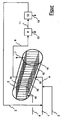
- the figure shows schematically an embodiment of the method with a reactor having a module.
- Ethylene 1 and recycle gas 2 from a rear part of the plant is mixed with oxygen 3 to form a feed 4 and fed to a reactor 5, which is cooled with boiler feed water 6, so that steam 7 is obtained.
- ethylene oxide 10 is separated in a water wash and the residual gas reactor 5 is separated in a water scrubbing 9 ethylene oxide 10 and the residual gas 11 with the by-product CO 2 generated in the reactor 5 of an amine wash 12, in which the CO 2 13 is separated.
- the particular of the CO 2 purified residual gas is used as Recyclegas 2 wholly or partially in use 4 of the reactor again.
- the figure also shows schematically the reactor 5 as a horizontal container 14, in which a module 15 is arranged from plate packs 16. It is indicated that the packets 16 consist of cooled parallel plates whose edges are shown in the figure as a line. In their construction, the cooled panels may resemble the radiators for residential and office space. The catalyst beds between the plates are not shown in the figure.
Landscapes
- Chemical & Material Sciences (AREA)
- Organic Chemistry (AREA)
- Chemical Kinetics & Catalysis (AREA)
- Organic Low-Molecular-Weight Compounds And Preparation Thereof (AREA)
- Epoxy Compounds (AREA)
- Physical Or Chemical Processes And Apparatus (AREA)
Description
- Die Erfindung betrifft ein Verfahren zur Herstellung von Ethylenoxid aus einem gasförmigen Einsatz - in einer gekühlten exothermen katalytischen Reaktion von Ethylen und Sauerstoff aus diesem Einsatzgas in parallel durchströmten Reaktionszonen, außerdem einen Reaktor für dieses Verfahren mit Katalysatorpartikeln zwischen gekühlten Trennwänden in mindestens einem Reaktorbehälter.
- Aus der Zeitschrift Hydrocarbon Processing, March 1997, Seite 134 ist ein solches Verfahren bekannt. Es wird in Zusammenhang mit einem Röhrenreaktor mit Katalysatorpartikeln in den Rohren verwendet. Die Rohre werden auf der Mantelseite des Reaktors mit siedendem Wasser gekühlt.
- Die Aufteilung des Verfahrensstromes und der Katalysatorpartikel auf mehrere Rohre stellt sicher, daß im Falle einer Betriebsstörung eine sich selbst beschleunigende Reaktion hervorgerufen durch örtliche Überhitzung sich auf ein Reaktionsrohr beschränkt und nicht den ganzen Reaktor erfaßt. Diese Verfahrensführung und Reaktorkonstruktion hat jedoch auch mehrere Nachteile.
- Der Reaktormantel muß auf den Kühlmitteldruck ausgelegt sein, in der Praxis ca. 70 bar. Dadurch ist der Mantel sehr dick und damit teuer, schwer zu transportieren und Baustellenmontage ist ausgeschlossen.
- Die Rohrböden sind bei großem Durchmesser sehr dick und damit teuer und durch Wärmespannungen gefährdet.
- Die vielen Reaktionsrohre sind nur mit großem Aufwand in die dicken Rohrböden einzuschweißen.
- Die vielen Reaktionsrohre sind nur mit großem Aufwand zu befüllen. Insbesondere ist auf gleichen Druckverlust in den vielen verschiedenen Rohren zu achten, damit nicht ein wegen hohem Druckabfall zu wenig beaufschlagtes Reaktionsrohr überhitzt wird.
- Wegen des hohen Gewichts wird für den Reaktor C-Stahl verwendet, obwohl Rost damit unvermeidlich ist. Rost wirkt aber als ein Katalysatorgift. Bei Katalysatorentleerung muß deshalb der Reaktor sandgestrahlt werden, was bei der großen Zahl von Reaktionsrohren ein erheblicher zeitlicher und finanzieller Aufwand ist.
- Nur stehende Reaktoren sind realisierbar.
- Die Kühlflache pro Katalysatorvolumen ist nur in engen Grenzen wählbar.
- Aufgabe der Erfindung ist daher eine einfache Verfahrensführung im Reaktor und eine einfachere Konstruktion des Reaktors verbunden mit sicherem Betrieb bei Störungen und Vermeidung der genannten Nachteile.
- Diese Aufgabe wird erfindungsgemäß gelöst von einem Verfahren mit den Merkmalen des Anspruchs 1 und einem Reaktor mit den Merkmalen des Anspruchs 6. Ausführungen der Erfindung sind Gegenstand von Unteransprüchen.
- Kennzeichnend an der Erfindung ist unter anderem, daß beim Verfahren die Reaktionszonen durch gekühlte Trennwände gebildet werden und die Kühlung durch ein innerhalb der Trennwände strömendes Fluid bewerkstelligt wird und daß beim Reaktor die gekühlten Trennwände mit Hilfe von Metallplatten gebildet werden und zur Kühlung in den Metallplatten Hohlräume in Form von Kanälen zur Aufnahme und zum Durchleiten eines Kühlmediums angeordnet sind.
- Die durch die gekühlten Trennwände verwirklichten separaten Reaktionszonen ergeben ein sicheres Verfahren auch bei den genannten Betriebsstörungen, da Überhitzung benachbarter Reaktionszonen ausgeschlossen ist. Die Metallplatten sind als kühlbare oder heizbare Panele im Handel erhältlich und ermöglichen kostengünstige Lösungen für die Reaktoreinbauten.
- In einer vorteilhaften Ausführung des Verfahrens enthält der gasförmige Einsatz neben den Bestandteilen Ethylen und Sauerstoff auch Stickstoff und/oder Methan. Es kann damit auch mit Stickstoff verunreinigter Sauerstoff oder Luft eingesetzt werden. Mit Methan im Einsatz verbrennt bei zu hohen Betriebstemperaturen vermehrt Methan. Diese Reaktion ist weniger exotherm verglichen mit der Verbrennung von Ethylen, so daß die örtliche Überhitzung verringert wird. Außerdem bleibt der Wertstoff Ethylen erhalten und kann dem Prozeß wieder zugeführt werden.
- Vorteilhafterweise wird das Austrittsgas aus den Reaktionszonen mit dem gebildeten Ethylenoxid einer Abtrennung des Ethylenoxid, vorzugsweise durch eine Wasserwäsche, unterzogen und so als Produkt gewonnen.
- Ein nach der Abtrennung des Ethylenoxids verbleibendes Restgas kann einer CO2-Abtrennung, vorzugsweise einer Aminwäsche, zugeführt werden und das weitgehend in der katalytischen Reaktion wiederverwendet werden. Dies führt zu einer guten Ausnutzung des Wertstoffes Ethylen.
- Vorzugsweise wird bei der katalytischen Reaktion im erfindungsgemäßen Verfahren eine Raumgeschwindigkeit zwischen 5 000 und 50 000 h-1, bevorzugt zwischen 7 000 und 15 000 h-1 verwendet. Sie kann wegen des niedrigeren Druckabfalls im Reaktor höher gewählt werden als beim Stand der Technik mit meist unter 5 000 h-1. Damit werden drei Vorteile erzielt:
- 1. Die hohen Raumgeschwindigkeiten führen zu besserer Selektivität des Katalysators und ermöglichen damit einen besseren Ausnutzungsgrad des eingesetzten Ethylen, d.h. die Wirtschaftlichkeit des Verfahrens steigt.
- 2. Bessere Selektivität bedeutet, daß die unerwünschte Nebenreaktion der vollständigen Verbrennung des Ethylen zu CO2 und Wasser besser unterdrückt wird. Diese Nebenreaktion ist sehr stark exotherm, d.h. gibt viel Wärme ab. Wo diese Reaktion auftritt steigt folglich die Temperatur. Bei steigender Temperatur wird die Selektivität des Katalysators schlechter, so daß die unerwünschte Nebenreaktion noch verstärkt wird. Das kann soweit gehen, daß Katalysator und/oder Reaktor irreversibel geschädigt werden. Das erfindungsgemäße Verfahren verbessert die Selektivität und erhöht damit die Sicherheit der Produktion von Ethylenoxid.
- 3. Das Katalysatorvolumen, das für den Umsatz einer bestimmten Menge Rohgas erforderlich ist, wird kleiner. Damit kann der gesamte Reaktor kleiner und folglich billiger werden. Da im Reaktor dann auch weniger von dem reaktionsfähigen Gas enthalten ist, wird auch durch diesen Effekt die Sicherheit weiter erhöht.
- Bei dem erfindungsgemäßen Reaktor werden mehrere Metallplatten, vorzugsweise senkrecht, mit Abstand voneinander zu einem Metallplattenpaket zusammengefügt und bilden so einen Freiraum, in den die Katalysatorpartikel geschüttet werden. Rohrböden entfallen und die Reaktionsräume zwischen den Platten sind ähnlich zu befüllen wie ein Festbett ohne Kühlung. Dies ist eine wesentliche Verbesserung gegenüber einem Reaktor nach dem Stand der Technik.
- Die Metallplattenpakete werden aus ebenen, vorzugsweise parallel angeordneten Platten gebildet. Solche Platten, auch Plattenpakete, sind kostengünstig im Handel erhältlich.
- Bei dem erfindungsgemäßen Reaktor werden mehrere Metallplattenpakete so nebeneinander im Reaktorbehälter angeordnet, daß sie ein Modul aus Plattenpaketen bilden, in dem die Plattenpakete parallel vom Einsatzgas durchströmt werden. Dies ist, insbesondere in liegenden Behältern, leicht zu verwirklichen, ohne an Baugrenzen zu stoßen, und es werden im Verfahren niedrige Druckabfälle ermöglicht.
- Es werden mehrere Module im gleichen Reaktorbehälter, vorzugsweise übereinander, angeordnet und nacheinander vom Einsatzgas durchströmt. Zusammen mit der Wahlmöglichkeit zwischen stehenden und liegenden Reaktorbehältern kann der Reaktor so dem verfügbaren Platz und dem zulässigen Druckabfall im Reaktor optimal angepaßt werden.
- Weitere Vorteile des erfindungsgemäßen Verfahrens ergeben sich aus dem Zusammenwirken der Merkmale der Erfindung mit denen ihrer günstigen Ausführungsformen:
- Der Reaktormantel muß nur den Gasdruck aushalten, nicht den höheren Druck des Dampfs, der bei der Kühlung erzeugt wird.
- Der Reaktor ist wesentlich leichter als ein Reaktor nach dem Stand der Technik und kann aus Edelstahl gebaut werden, so daß die Probleme von C-Stahl entfallen.
- Die Kühlflache pro Katalysatorvolumen ist in sehr weiten Grenzen frei wählbar.
- Weil die erfindungsgemäßen Reaktoren bei gleicher Leistung wesentlich leichter sind, werden Transport, Montage und Fundamente billiger als bei Reaktoren nach dem Stand der Technik.
- Baubarkeitsgrenzen und Sicherheitsbedenken begrenzen die an einem Standort installierbare Produktionskapazität nicht.
- Die Erfindung wird anhand einer Ausführungsform mit einer Figur näher erläutert.
- Die Figur zeigt schematisch eine Ausführung des Verfahrens mit einem Reaktor, der ein Modul aufweist.
- Ethylen 1 und Recyclegas 2 aus einem hinteren Anlagenteil wird mit Sauerstoff 3 zu einem Einsatz 4 vermischt und einem Reaktor 5 zugeführt, der mit Kesselspeisewasser 6 gekühlt wird, so daß dabei Dampf 7 anfällt. Vom Austrittsgas 8 aus dem Reaktor 5 wird in einer Wasserwäsche 9 Ethylenoxid 10 abgetrennt und das Restgas Reaktor 5 wird in einer Wasserwäsche 9 Ethylenoxid 10 abgetrennt und das Restgas 11 mit dem im Reaktor 5 erzeugten Nebenprodukt CO2 einer Aminwäsche 12 zugeführt, in der das CO2 13 abgetrennt wird. Nach weiteren Reinigungsschritten, die in der Figur nicht dargestellt sind, wird das insbesondere vom CO2 gereinigte Restgas als Recyclegas 2 ganz oder teilweise im Einsatz 4 des Reaktors wieder verwendet.
- Die Figur zeigt außerdem schematisch den Reaktor 5 als liegenden Behälter 14, in dem ein Modul 15 aus Plattenpaketen 16 angeordnet ist. Angedeutet ist, daß die Pakete 16 aus gekühlten parallelen Platten bestehen, deren Kanten in der Figur als Linie dargestellt sind. In ihrem Aufbau können die gekühlten Platten den Heizkörpern für Wohn- und Büroräume ähneln. Die Katalysatorschüttungen zwischen den Platten sind in der Figur nicht dargestellt.
- Ein typischer Einsatz für das erfindungsgemäße Verfahren mit dem erfindungsgemäßen Reaktor enthält ungefähr
- 30 % Ethylen,
- 60% Methan,
- 5 % Sauerstoff und
- 5 % Stickstoff und Wasserdampf.
Claims (6)
- Verfahren zur Herstellung von Ethylenoxid aus einem gasförmigen Einsatz - in einer gekühlten, exothermen, katalytischen Reaktion von Ethylen und Sauerstoff aus diesen Einsatzgasen in parallel durchströmten Reaktionszonen, dadurch gekennzeichnet, dass die Reaktionszonen von gekühlten Trennwänden begrenzt werden und die Kühlung durch ein innerhalb der Trennwände strömendes Fluid bewerkstelligt wird, wobei
die gekühlten Trennwände mit Hilfe von Metallplatten gebildet werden und zur Kühlung in den Metallplatten Hohlräume in Form von Kanälen zur Aufnahme und zum Durchleiten eines Kühlmediums angewandt sind, wobei jeweils mehrere Metallplatten senkrecht, mit Abstand voneinander zu einem Metallplattenpaket zusammengefügt werden und so einen Freiraum bilden, in den die Katalysatorpartikel geschüttet werden und die Metallplattenpakete aus ebenen, parallel angeordneten Platten gebildet werden und mehrere Metallplattenpakete so nebeneinander im Reaktorbehälter angeordnet werden, dass sie ein Modul aus Plattenpaketen bilden, in dem die Plattenpakete parallel vom Einsatzgas durchströmt werden, wobei mehrere Module im gleichen Reaktorbehälter vorhanden sind, die vorzugsweise übereinander angeordnet sind, und nacheinander vom Einsatzgas durchströmt werden. - Verfahren nach Anspruch 1, dadurch gekennzeichnet, dass der gasförmige Einsatz neben den Bestandteilen Ethylen und Sauerstoff auch Stickstoff und/oder Methan enthält.
- Verfahren nach Anspruch 1 oder 2, dadurch gekennzeichnet, dass das Austrittsgas aus den Reaktionszonen mit dem gebildeten Ethylenoxid einer Abtrennung des Ethylenoxids, vorzugsweise durch eine Wasserwäsche, unterzogen wird.
- Verfahren nach einem der Ansprüche 1 bis 3, dadurch gekennzeichnet, dass ein nach der Abtrennung des Ethylenoxids verbleibendes Restgas einer CO2-Abtrennung, vorzugsweise einer Aminwäsche, zugeführt wird und dass das weitgehend von CO2 befreite Restgas mindestens teilweise rezykliert, dem Einsatz zugemischt und in der katalytischen Reaktion wiederverwendet wird.
- Verfahren nach einem der Ansprüche 1 bis 4, dadurch gekennzeichnet, dass bei der katalytischen Reaktion eine Raumgeschwindigkeit zwischen 5000 und 50000 h-1, bevorzugt zwischen 7000 und 15000 h-1 verwendet wird.
- Reaktor zur Herstellung von Ethylenoxid nach einem der Verfahren 1 bis 5 mit Katalysatorpartikeln zwischen gekühlten Trennwänden in mindestens einem Reaktorbehälter, dadurch gekennzeichnet, dass die gekühlten Trennwände mit Hilfe von Metallplatten gebildet werden und zur Kühlung in den Metallplatten Hohlräume in Form von Kanälen zur Aufnahme und zum Durchleiten eines Kühlmediums angewandt sind, wobei jeweils mehrere Metallplatten senkrecht, mit Abstand voneinander zu einem Metallplattenpaket zusammengefügt werden und so einen Freiraum bilden, in den die Katalysatorpartikel geschüttet werden und die Metallplattenpakete aus ebenen, parallel angeordneten Platten gebildet werden und mehrere Metallplattenpakete so nebeneinander im Reaktorbehälter angeordnet werden, dass sie ein Modul aus Plattenpaketen bilden, in dem die Plattenpakete parallel vom Einsatzgas durchströmt werden, wobei mehrere Module im gleichen Reaktorbehälter vorhanden sind, die vorzugsweise übereinander angeordnet sind, und nacheinander vom Einsatzgas durchströmt werden.
Applications Claiming Priority (3)
| Application Number | Priority Date | Filing Date | Title |
|---|---|---|---|
| DE19719375 | 1997-05-07 | ||
| DE19719375A DE19719375A1 (de) | 1997-05-07 | 1997-05-07 | Verfahren und Reaktor zur Herstellung von Ethylenoxid |
| PCT/EP1998/002673 WO1998050375A1 (de) | 1997-05-07 | 1998-05-06 | Verfahren und reaktor zur herstellung von ethylenoxid |
Publications (3)
| Publication Number | Publication Date |
|---|---|
| EP0983252A1 EP0983252A1 (de) | 2000-03-08 |
| EP0983252B1 EP0983252B1 (de) | 2007-10-17 |
| EP0983252B2 true EP0983252B2 (de) | 2015-06-17 |
Family
ID=7828943
Family Applications (1)
| Application Number | Title | Priority Date | Filing Date |
|---|---|---|---|
| EP98925547.6A Expired - Lifetime EP0983252B2 (de) | 1997-05-07 | 1998-05-06 | Verfahren und reaktor zur herstellung von ethylenoxid |
Country Status (7)
| Country | Link |
|---|---|
| US (1) | US6172244B1 (de) |
| EP (1) | EP0983252B2 (de) |
| JP (1) | JP2001527549A (de) |
| AU (1) | AU7762398A (de) |
| DE (2) | DE19719375A1 (de) |
| ES (1) | ES2292203T5 (de) |
| WO (1) | WO1998050375A1 (de) |
Families Citing this family (6)
| Publication number | Priority date | Publication date | Assignee | Title |
|---|---|---|---|---|
| US6616909B1 (en) * | 1998-07-27 | 2003-09-09 | Battelle Memorial Institute | Method and apparatus for obtaining enhanced production rate of thermal chemical reactions |
| DE19952964A1 (de) | 1999-11-03 | 2001-05-10 | Basf Ag | Verfahren zur katalytischen Gasphasenoxidation zu (Meth)Acrolein und/oder (Meth)Acrylsäure |
| DE10000584A1 (de) | 2000-01-10 | 2001-07-12 | Basf Ag | Verfahren zur katalytischen Gasphasenoxidation zu Maleinsäureanhydrid |
| JP4910503B2 (ja) * | 2005-08-25 | 2012-04-04 | 住友化学株式会社 | プロピレンオキサイドの製造方法 |
| DE102008025835A1 (de) | 2008-05-29 | 2009-12-03 | Bayer Technology Services Gmbh | Verfahren zur Herstellung von Ethylenoxid |
| EP3067109B1 (de) | 2015-03-12 | 2018-12-05 | Prosernat | Verfahren zur entfernung von schwefelverbindungen aus einem gas durch hydrierung und direkte oxidationsschritte |
Citations (1)
| Publication number | Priority date | Publication date | Assignee | Title |
|---|---|---|---|---|
| GB1116345A (en) † | 1964-06-16 | 1968-06-06 | Marston Excelsior Ltd | Improvements in or relating to chemical catalytic reactors and like process vessels in which fluids are contacted with solid materials |
Family Cites Families (10)
| Publication number | Priority date | Publication date | Assignee | Title |
|---|---|---|---|---|
| EP0082609B1 (de) * | 1981-12-14 | 1987-01-14 | Imperial Chemical Industries Plc | Chemischer Reaktor und Verfahren |
| EP0081948B1 (de) * | 1981-12-14 | 1987-05-13 | Imperial Chemical Industries Plc | Reaktor |
| GB2161596A (en) * | 1983-06-13 | 1986-01-15 | Humphreys & Glasgow Ltd | Reactor for exothermic gas reactions |
| IN161263B (de) * | 1983-06-30 | 1987-10-31 | Halcon Sd Group Inc | |
| DE3339570A1 (de) * | 1983-11-02 | 1985-05-09 | Linde Ag, 6200 Wiesbaden | Verfahren und vorrichtung zur durchfuehrung chemischer oder biochemischer reaktionen |
| GB8810006D0 (en) * | 1988-04-27 | 1988-06-02 | Shell Int Research | Process for preparation of ethylene oxide |
| US5270127A (en) | 1991-08-09 | 1993-12-14 | Ishikawajima-Harima Heavy Industries Co., Ltd. | Plate shift converter |
| JP2778878B2 (ja) | 1991-09-12 | 1998-07-23 | 株式会社日本触媒 | エチレンオキシドの製造方法 |
| DE4131446A1 (de) | 1991-09-21 | 1993-06-09 | Basf Ag, 6700 Ludwigshafen, De | Reaktor und verfahren zur durchfuehrung heterogenkatalytischer gasphasenreaktionen |
| JPH0748305A (ja) * | 1993-07-30 | 1995-02-21 | Lion Corp | アルキレンオキサイド付加物の製造方法 |
-
1997
- 1997-05-07 DE DE19719375A patent/DE19719375A1/de not_active Withdrawn
-
1998
- 1998-05-06 AU AU77623/98A patent/AU7762398A/en not_active Abandoned
- 1998-05-06 JP JP54773898A patent/JP2001527549A/ja active Pending
- 1998-05-06 ES ES98925547.6T patent/ES2292203T5/es not_active Expired - Lifetime
- 1998-05-06 US US09/423,247 patent/US6172244B1/en not_active Expired - Fee Related
- 1998-05-06 DE DE59814108T patent/DE59814108D1/de not_active Expired - Lifetime
- 1998-05-06 WO PCT/EP1998/002673 patent/WO1998050375A1/de not_active Ceased
- 1998-05-06 EP EP98925547.6A patent/EP0983252B2/de not_active Expired - Lifetime
Patent Citations (1)
| Publication number | Priority date | Publication date | Assignee | Title |
|---|---|---|---|---|
| GB1116345A (en) † | 1964-06-16 | 1968-06-06 | Marston Excelsior Ltd | Improvements in or relating to chemical catalytic reactors and like process vessels in which fluids are contacted with solid materials |
Also Published As
| Publication number | Publication date |
|---|---|
| US6172244B1 (en) | 2001-01-09 |
| EP0983252A1 (de) | 2000-03-08 |
| JP2001527549A (ja) | 2001-12-25 |
| EP0983252B1 (de) | 2007-10-17 |
| ES2292203T5 (es) | 2015-09-01 |
| WO1998050375A1 (de) | 1998-11-12 |
| DE59814108D1 (de) | 2007-11-29 |
| DE19719375A1 (de) | 1998-11-12 |
| ES2292203T3 (es) | 2008-03-01 |
| AU7762398A (en) | 1998-11-27 |
Similar Documents
| Publication | Publication Date | Title |
|---|---|---|
| DE69413691T2 (de) | Verfahren und vorrichtung zur regulierung der temperaturen von reaktionen | |
| EP1180395B1 (de) | Reaktor zur Durchführung einer stark wärmegetönten katalytischen Reaktion | |
| EP3296255A1 (de) | Reformerrohr mit strukturiertem katalysator und verbessertem wärmehaushalt | |
| EP1232004A1 (de) | Verfahren zur katalytischen gasphasenoxidation zu (meth)acrolein und/oder (meth)acrylsäure | |
| EP0534195B1 (de) | Reaktor und Verfahren zur Durchführung heterogenkatalytischer Gasphasenreaktionen | |
| EP1185494B1 (de) | Verfahren zur katalytischen gasphasenoxidation zu maleinsäureanhydrid | |
| EP2678100B1 (de) | Rohrbündelreaktor mit einer strukturierten packung und einer halterung | |
| EP4155259A1 (de) | Verfahren zum herstellen von synthesegas mit reduziertem dampfexport | |
| DE19851109B4 (de) | Reaktor zur Durchführung katalytischer Reaktionen mit starker Wärmetönung | |
| EP0983252B1 (de) | Verfahren und reaktor zur herstellung von ethylenoxid | |
| DE3248502A1 (de) | Verfahren zur temperierung einer in einem rohrreaktor in form eines festbettes angeordneten schuettung und eine anordnung zur durchfuehrung des verfahrens | |
| DE3442053A1 (de) | Waermeabgebender doppelrohr-reaktor | |
| EP1123256B1 (de) | Verfahren zur durchführung von gas-flüssig-reaktionen und durchflussreaktor hierfür | |
| EP1234612A2 (de) | Reaktor zur Durchführung von katalysierten Reaktionen | |
| EP1621250B1 (de) | Reaktor zur Durchführung von Reaktionen mit starker Wärmetönung und Druckaufkommen | |
| EP0711595B1 (de) | Reaktor zur Durchführung heterogenkatalysierter Gasphasenreaktionen | |
| DE19804806A1 (de) | Verfahren und Reaktor zur Hydrierung von Acetylen | |
| DE3941407A1 (de) | Rohrreaktor | |
| EP1663478B1 (de) | Verfahren zur herstellung von (meth)acrolein und/oder (meth)acryls ure durch heterogen katalysierte partialoxidation von c3- und/oder c4-vorläuferverbindungen in einem reaktor mit thermoblechplattenmodulen | |
| AT412871B (de) | Verfahren und vorrichtung zur herstellung von formaldehyd | |
| DE973726C (de) | Verfahren und Vorrichtung zur Kohlenoxydhydrierung ueber ruhendem Katalysator unter Anwendung hoher linearer Gasgeschwindigkeiten | |
| DE844737C (de) | Vorrichtung zur Durchfuehrung exotherm verlaufender katalytischer Reaktionen | |
| AT273174B (de) | Vorrichtung zur Durchführung exothermer katalytischer Gasreaktionen, insbesondere der Ammoniaksynthese | |
| AT216533B (de) | Verfahren zur Gasführung in katalytischen Hochdrucksyntheseanlagen | |
| DE1667221C (de) | Hochdruckreaktor fur katalytische Gasreaktionen |
Legal Events
| Date | Code | Title | Description |
|---|---|---|---|
| PUAI | Public reference made under article 153(3) epc to a published international application that has entered the european phase |
Free format text: ORIGINAL CODE: 0009012 |
|
| 17P | Request for examination filed |
Effective date: 19991123 |
|
| AK | Designated contracting states |
Kind code of ref document: A1 Designated state(s): BE DE ES FR GB IT NL PT |
|
| RAP1 | Party data changed (applicant data changed or rights of an application transferred) |
Owner name: HEISEL, MICHAEL DR. |
|
| RIN1 | Information on inventor provided before grant (corrected) |
Inventor name: HEISEL, MICHAEL DR. |
|
| GRAP | Despatch of communication of intention to grant a patent |
Free format text: ORIGINAL CODE: EPIDOSNIGR1 |
|
| GRAS | Grant fee paid |
Free format text: ORIGINAL CODE: EPIDOSNIGR3 |
|
| GRAJ | Information related to disapproval of communication of intention to grant by the applicant or resumption of examination proceedings by the epo deleted |
Free format text: ORIGINAL CODE: EPIDOSDIGR1 |
|
| GRAS | Grant fee paid |
Free format text: ORIGINAL CODE: EPIDOSNIGR3 |
|
| 17Q | First examination report despatched |
Effective date: 20070114 |
|
| GRAP | Despatch of communication of intention to grant a patent |
Free format text: ORIGINAL CODE: EPIDOSNIGR1 |
|
| GRAS | Grant fee paid |
Free format text: ORIGINAL CODE: EPIDOSNIGR3 |
|
| GRAA | (expected) grant |
Free format text: ORIGINAL CODE: 0009210 |
|
| AK | Designated contracting states |
Kind code of ref document: B1 Designated state(s): BE DE ES FR GB IT NL PT |
|
| REG | Reference to a national code |
Ref country code: GB Ref legal event code: FG4D Free format text: NOT ENGLISH |
|
| REF | Corresponds to: |
Ref document number: 59814108 Country of ref document: DE Date of ref document: 20071129 Kind code of ref document: P |
|
| ET | Fr: translation filed | ||
| GBT | Gb: translation of ep patent filed (gb section 77(6)(a)/1977) |
Effective date: 20071210 |
|
| REG | Reference to a national code |
Ref country code: ES Ref legal event code: FG2A Ref document number: 2292203 Country of ref document: ES Kind code of ref document: T3 |
|
| PG25 | Lapsed in a contracting state [announced via postgrant information from national office to epo] |
Ref country code: PT Free format text: LAPSE BECAUSE OF FAILURE TO SUBMIT A TRANSLATION OF THE DESCRIPTION OR TO PAY THE FEE WITHIN THE PRESCRIBED TIME-LIMIT Effective date: 20080317 |
|
| PLBI | Opposition filed |
Free format text: ORIGINAL CODE: 0009260 |
|
| PLAX | Notice of opposition and request to file observation + time limit sent |
Free format text: ORIGINAL CODE: EPIDOSNOBS2 |
|
| 26 | Opposition filed |
Opponent name: METHANOL CASALE S.A. Effective date: 20080716 |
|
| NLR1 | Nl: opposition has been filed with the epo |
Opponent name: METHANOL CASALE S.A. |
|
| PLAF | Information modified related to communication of a notice of opposition and request to file observations + time limit |
Free format text: ORIGINAL CODE: EPIDOSCOBS2 |
|
| PLBB | Reply of patent proprietor to notice(s) of opposition received |
Free format text: ORIGINAL CODE: EPIDOSNOBS3 |
|
| APBM | Appeal reference recorded |
Free format text: ORIGINAL CODE: EPIDOSNREFNO |
|
| APBP | Date of receipt of notice of appeal recorded |
Free format text: ORIGINAL CODE: EPIDOSNNOA2O |
|
| APAH | Appeal reference modified |
Free format text: ORIGINAL CODE: EPIDOSCREFNO |
|
| APBQ | Date of receipt of statement of grounds of appeal recorded |
Free format text: ORIGINAL CODE: EPIDOSNNOA3O |
|
| PGFP | Annual fee paid to national office [announced via postgrant information from national office to epo] |
Ref country code: NL Payment date: 20110524 Year of fee payment: 14 Ref country code: BE Payment date: 20110525 Year of fee payment: 14 |
|
| BERE | Be: lapsed |
Owner name: HEISEL, MICHAEL DR. Effective date: 20120531 |
|
| REG | Reference to a national code |
Ref country code: NL Ref legal event code: V1 Effective date: 20121201 |
|
| PG25 | Lapsed in a contracting state [announced via postgrant information from national office to epo] |
Ref country code: BE Free format text: LAPSE BECAUSE OF NON-PAYMENT OF DUE FEES Effective date: 20120531 |
|
| PG25 | Lapsed in a contracting state [announced via postgrant information from national office to epo] |
Ref country code: NL Free format text: LAPSE BECAUSE OF NON-PAYMENT OF DUE FEES Effective date: 20121201 |
|
| APBU | Appeal procedure closed |
Free format text: ORIGINAL CODE: EPIDOSNNOA9O |
|
| PLAY | Examination report in opposition despatched + time limit |
Free format text: ORIGINAL CODE: EPIDOSNORE2 |
|
| PLBC | Reply to examination report in opposition received |
Free format text: ORIGINAL CODE: EPIDOSNORE3 |
|
| PLAY | Examination report in opposition despatched + time limit |
Free format text: ORIGINAL CODE: EPIDOSNORE2 |
|
| REG | Reference to a national code |
Ref country code: DE Ref legal event code: R082 Ref document number: 59814108 Country of ref document: DE Representative=s name: LEDERER & KELLER PATENTANWAELTE PARTNERSCHAFT , DE |
|
| REG | Reference to a national code |
Ref country code: DE Ref legal event code: R082 Ref document number: 59814108 Country of ref document: DE Representative=s name: LEDERER & KELLER PATENTANWAELTE PARTNERSCHAFT , DE Effective date: 20141118 Ref country code: DE Ref legal event code: R081 Ref document number: 59814108 Country of ref document: DE Owner name: PROSERNAT, FR Free format text: FORMER OWNER: HEISEL, MICHAEL, DR., 82049 PULLACH, DE Effective date: 20141118 Ref country code: DE Ref legal event code: R081 Ref document number: 59814108 Country of ref document: DE Owner name: ITS REAKTORTECHNIK GMBH, DE Free format text: FORMER OWNER: HEISEL, MICHAEL, DR., 82049 PULLACH, DE Effective date: 20141118 |
|
| REG | Reference to a national code |
Ref country code: DE Ref legal event code: R082 Ref document number: 59814108 Country of ref document: DE Representative=s name: LEDERER & KELLER PATENTANWAELTE PARTNERSCHAFT , DE |
|
| REG | Reference to a national code |
Ref country code: DE Ref legal event code: R082 Ref document number: 59814108 Country of ref document: DE Representative=s name: LEDERER & KELLER PATENTANWAELTE PARTNERSCHAFT , DE Effective date: 20150204 Ref country code: DE Ref legal event code: R081 Ref document number: 59814108 Country of ref document: DE Owner name: PROSERNAT, FR Free format text: FORMER OWNER: ITS REAKTORTECHNIK GMBH, 82049 PULLACH, DE Effective date: 20150204 |
|
| RAP2 | Party data changed (patent owner data changed or rights of a patent transferred) |
Owner name: PROSERNAT |
|
| RIN2 | Information on inventor provided after grant (corrected) |
Inventor name: HEISEL MICHAEL |
|
| APBW | Interlocutory revision of appeal recorded |
Free format text: ORIGINAL CODE: EPIDOSNIRAPO |
|
| REG | Reference to a national code |
Ref country code: GB Ref legal event code: 732E Free format text: REGISTERED BETWEEN 20150305 AND 20150311 |
|
| REG | Reference to a national code |
Ref country code: FR Ref legal event code: TP Owner name: PROSERNAT, FR Effective date: 20150318 |
|
| PUAH | Patent maintained in amended form |
Free format text: ORIGINAL CODE: 0009272 |
|
| STAA | Information on the status of an ep patent application or granted ep patent |
Free format text: STATUS: PATENT MAINTAINED AS AMENDED |
|
| REG | Reference to a national code |
Ref country code: FR Ref legal event code: PLFP Year of fee payment: 18 |
|
| 27A | Patent maintained in amended form |
Effective date: 20150617 |
|
| AK | Designated contracting states |
Kind code of ref document: B2 Designated state(s): BE DE ES FR GB IT NL PT |
|
| REG | Reference to a national code |
Ref country code: DE Ref legal event code: R102 Ref document number: 59814108 Country of ref document: DE |
|
| PGFP | Annual fee paid to national office [announced via postgrant information from national office to epo] |
Ref country code: ES Payment date: 20150520 Year of fee payment: 18 Ref country code: GB Payment date: 20150521 Year of fee payment: 18 Ref country code: DE Payment date: 20150521 Year of fee payment: 18 |
|
| PGFP | Annual fee paid to national office [announced via postgrant information from national office to epo] |
Ref country code: IT Payment date: 20150519 Year of fee payment: 18 Ref country code: FR Payment date: 20150519 Year of fee payment: 18 |
|
| REG | Reference to a national code |
Ref country code: ES Ref legal event code: DC2A Ref document number: 2292203 Country of ref document: ES Kind code of ref document: T5 Effective date: 20150901 |
|
| REG | Reference to a national code |
Ref country code: DE Ref legal event code: R119 Ref document number: 59814108 Country of ref document: DE |
|
| GBPC | Gb: european patent ceased through non-payment of renewal fee |
Effective date: 20160506 |
|
| PG25 | Lapsed in a contracting state [announced via postgrant information from national office to epo] |
Ref country code: IT Free format text: LAPSE BECAUSE OF NON-PAYMENT OF DUE FEES Effective date: 20160506 |
|
| REG | Reference to a national code |
Ref country code: FR Ref legal event code: ST Effective date: 20170131 |
|
| PG25 | Lapsed in a contracting state [announced via postgrant information from national office to epo] |
Ref country code: FR Free format text: LAPSE BECAUSE OF NON-PAYMENT OF DUE FEES Effective date: 20160531 Ref country code: DE Free format text: LAPSE BECAUSE OF NON-PAYMENT OF DUE FEES Effective date: 20161201 |
|
| PG25 | Lapsed in a contracting state [announced via postgrant information from national office to epo] |
Ref country code: GB Free format text: LAPSE BECAUSE OF NON-PAYMENT OF DUE FEES Effective date: 20160506 |
|
| PG25 | Lapsed in a contracting state [announced via postgrant information from national office to epo] |
Ref country code: ES Free format text: LAPSE BECAUSE OF NON-PAYMENT OF DUE FEES Effective date: 20160507 |
|
| REG | Reference to a national code |
Ref country code: ES Ref legal event code: FD2A Effective date: 20180627 |