EP0982012B1 - Mammary prosthese for wearing in a brassiere or in such a thing - Google Patents
Mammary prosthese for wearing in a brassiere or in such a thing Download PDFInfo
- Publication number
- EP0982012B1 EP0982012B1 EP99112603A EP99112603A EP0982012B1 EP 0982012 B1 EP0982012 B1 EP 0982012B1 EP 99112603 A EP99112603 A EP 99112603A EP 99112603 A EP99112603 A EP 99112603A EP 0982012 B1 EP0982012 B1 EP 0982012B1
- Authority
- EP
- European Patent Office
- Prior art keywords
- prosthesis
- groove
- wearer
- breast
- walls
- Prior art date
- Legal status (The legal status is an assumption and is not a legal conclusion. Google has not performed a legal analysis and makes no representation as to the accuracy of the status listed.)
- Expired - Lifetime
Links
- 210000000481 breast Anatomy 0.000 claims description 33
- 229920002379 silicone rubber Polymers 0.000 claims description 13
- 239000004945 silicone rubber Substances 0.000 claims description 13
- 238000007665 sagging Methods 0.000 claims description 10
- 230000005484 gravity Effects 0.000 claims description 9
- 239000000463 material Substances 0.000 claims description 4
- 239000002985 plastic film Substances 0.000 claims description 4
- 230000035515 penetration Effects 0.000 claims description 3
- 229920006255 plastic film Polymers 0.000 claims description 3
- 238000005452 bending Methods 0.000 description 6
- 230000000694 effects Effects 0.000 description 6
- 150000001875 compounds Chemical class 0.000 description 4
- 210000002445 nipple Anatomy 0.000 description 4
- 238000013461 design Methods 0.000 description 3
- 239000004744 fabric Substances 0.000 description 3
- 210000001519 tissue Anatomy 0.000 description 3
- 238000009423 ventilation Methods 0.000 description 3
- BASFCYQUMIYNBI-UHFFFAOYSA-N platinum Chemical compound [Pt] BASFCYQUMIYNBI-UHFFFAOYSA-N 0.000 description 2
- 229920001296 polysiloxane Polymers 0.000 description 2
- 229910001369 Brass Inorganic materials 0.000 description 1
- -1 Polydimethylsiloxanes Polymers 0.000 description 1
- 230000006978 adaptation Effects 0.000 description 1
- 238000013006 addition curing Methods 0.000 description 1
- 230000002238 attenuated effect Effects 0.000 description 1
- 239000010951 brass Substances 0.000 description 1
- 239000003054 catalyst Substances 0.000 description 1
- 210000000038 chest Anatomy 0.000 description 1
- 230000003750 conditioning effect Effects 0.000 description 1
- 238000011161 development Methods 0.000 description 1
- 235000013870 dimethyl polysiloxane Nutrition 0.000 description 1
- 238000002474 experimental method Methods 0.000 description 1
- 238000005259 measurement Methods 0.000 description 1
- 229910052697 platinum Inorganic materials 0.000 description 1
- 229920000435 poly(dimethylsiloxane) Polymers 0.000 description 1
- 229920006264 polyurethane film Polymers 0.000 description 1
- 238000005086 pumping Methods 0.000 description 1
- 238000005096 rolling process Methods 0.000 description 1
- 210000004872 soft tissue Anatomy 0.000 description 1
- 238000012360 testing method Methods 0.000 description 1
- 238000012549 training Methods 0.000 description 1
- 229920002554 vinyl polymer Polymers 0.000 description 1
Images

Classifications
-
- A—HUMAN NECESSITIES
- A61—MEDICAL OR VETERINARY SCIENCE; HYGIENE
- A61F—FILTERS IMPLANTABLE INTO BLOOD VESSELS; PROSTHESES; DEVICES PROVIDING PATENCY TO, OR PREVENTING COLLAPSING OF, TUBULAR STRUCTURES OF THE BODY, e.g. STENTS; ORTHOPAEDIC, NURSING OR CONTRACEPTIVE DEVICES; FOMENTATION; TREATMENT OR PROTECTION OF EYES OR EARS; BANDAGES, DRESSINGS OR ABSORBENT PADS; FIRST-AID KITS
- A61F2/00—Filters implantable into blood vessels; Prostheses, i.e. artificial substitutes or replacements for parts of the body; Appliances for connecting them with the body; Devices providing patency to, or preventing collapsing of, tubular structures of the body, e.g. stents
- A61F2/50—Prostheses not implantable in the body
- A61F2/52—Mammary prostheses
-
- A—HUMAN NECESSITIES
- A61—MEDICAL OR VETERINARY SCIENCE; HYGIENE
- A61F—FILTERS IMPLANTABLE INTO BLOOD VESSELS; PROSTHESES; DEVICES PROVIDING PATENCY TO, OR PREVENTING COLLAPSING OF, TUBULAR STRUCTURES OF THE BODY, e.g. STENTS; ORTHOPAEDIC, NURSING OR CONTRACEPTIVE DEVICES; FOMENTATION; TREATMENT OR PROTECTION OF EYES OR EARS; BANDAGES, DRESSINGS OR ABSORBENT PADS; FIRST-AID KITS
- A61F2/00—Filters implantable into blood vessels; Prostheses, i.e. artificial substitutes or replacements for parts of the body; Appliances for connecting them with the body; Devices providing patency to, or preventing collapsing of, tubular structures of the body, e.g. stents
- A61F2/02—Prostheses implantable into the body
- A61F2/30—Joints
- A61F2002/30001—Additional features of subject-matter classified in A61F2/28, A61F2/30 and subgroups thereof
- A61F2002/30108—Shapes
- A61F2002/3011—Cross-sections or two-dimensional shapes
- A61F2002/30112—Rounded shapes, e.g. with rounded corners
-
- A—HUMAN NECESSITIES
- A61—MEDICAL OR VETERINARY SCIENCE; HYGIENE
- A61F—FILTERS IMPLANTABLE INTO BLOOD VESSELS; PROSTHESES; DEVICES PROVIDING PATENCY TO, OR PREVENTING COLLAPSING OF, TUBULAR STRUCTURES OF THE BODY, e.g. STENTS; ORTHOPAEDIC, NURSING OR CONTRACEPTIVE DEVICES; FOMENTATION; TREATMENT OR PROTECTION OF EYES OR EARS; BANDAGES, DRESSINGS OR ABSORBENT PADS; FIRST-AID KITS
- A61F2/00—Filters implantable into blood vessels; Prostheses, i.e. artificial substitutes or replacements for parts of the body; Appliances for connecting them with the body; Devices providing patency to, or preventing collapsing of, tubular structures of the body, e.g. stents
- A61F2/02—Prostheses implantable into the body
- A61F2/30—Joints
- A61F2002/30001—Additional features of subject-matter classified in A61F2/28, A61F2/30 and subgroups thereof
- A61F2002/30108—Shapes
- A61F2002/3011—Cross-sections or two-dimensional shapes
- A61F2002/30138—Convex polygonal shapes
- A61F2002/30156—Convex polygonal shapes triangular
-
- A—HUMAN NECESSITIES
- A61—MEDICAL OR VETERINARY SCIENCE; HYGIENE
- A61F—FILTERS IMPLANTABLE INTO BLOOD VESSELS; PROSTHESES; DEVICES PROVIDING PATENCY TO, OR PREVENTING COLLAPSING OF, TUBULAR STRUCTURES OF THE BODY, e.g. STENTS; ORTHOPAEDIC, NURSING OR CONTRACEPTIVE DEVICES; FOMENTATION; TREATMENT OR PROTECTION OF EYES OR EARS; BANDAGES, DRESSINGS OR ABSORBENT PADS; FIRST-AID KITS
- A61F2/00—Filters implantable into blood vessels; Prostheses, i.e. artificial substitutes or replacements for parts of the body; Appliances for connecting them with the body; Devices providing patency to, or preventing collapsing of, tubular structures of the body, e.g. stents
- A61F2/02—Prostheses implantable into the body
- A61F2/30—Joints
- A61F2002/30001—Additional features of subject-matter classified in A61F2/28, A61F2/30 and subgroups thereof
- A61F2002/30316—The prosthesis having different structural features at different locations within the same prosthesis; Connections between prosthetic parts; Special structural features of bone or joint prostheses not otherwise provided for
- A61F2002/30329—Connections or couplings between prosthetic parts, e.g. between modular parts; Connecting elements
- A61F2002/30451—Connections or couplings between prosthetic parts, e.g. between modular parts; Connecting elements soldered or brazed or welded
-
- A—HUMAN NECESSITIES
- A61—MEDICAL OR VETERINARY SCIENCE; HYGIENE
- A61F—FILTERS IMPLANTABLE INTO BLOOD VESSELS; PROSTHESES; DEVICES PROVIDING PATENCY TO, OR PREVENTING COLLAPSING OF, TUBULAR STRUCTURES OF THE BODY, e.g. STENTS; ORTHOPAEDIC, NURSING OR CONTRACEPTIVE DEVICES; FOMENTATION; TREATMENT OR PROTECTION OF EYES OR EARS; BANDAGES, DRESSINGS OR ABSORBENT PADS; FIRST-AID KITS
- A61F2/00—Filters implantable into blood vessels; Prostheses, i.e. artificial substitutes or replacements for parts of the body; Appliances for connecting them with the body; Devices providing patency to, or preventing collapsing of, tubular structures of the body, e.g. stents
- A61F2/50—Prostheses not implantable in the body
- A61F2002/5007—Prostheses not implantable in the body having elastic means different from springs, e.g. including an elastomeric insert
-
- A—HUMAN NECESSITIES
- A61—MEDICAL OR VETERINARY SCIENCE; HYGIENE
- A61F—FILTERS IMPLANTABLE INTO BLOOD VESSELS; PROSTHESES; DEVICES PROVIDING PATENCY TO, OR PREVENTING COLLAPSING OF, TUBULAR STRUCTURES OF THE BODY, e.g. STENTS; ORTHOPAEDIC, NURSING OR CONTRACEPTIVE DEVICES; FOMENTATION; TREATMENT OR PROTECTION OF EYES OR EARS; BANDAGES, DRESSINGS OR ABSORBENT PADS; FIRST-AID KITS
- A61F2/00—Filters implantable into blood vessels; Prostheses, i.e. artificial substitutes or replacements for parts of the body; Appliances for connecting them with the body; Devices providing patency to, or preventing collapsing of, tubular structures of the body, e.g. stents
- A61F2/50—Prostheses not implantable in the body
- A61F2/52—Mammary prostheses
- A61F2002/526—Nipples
-
- A—HUMAN NECESSITIES
- A61—MEDICAL OR VETERINARY SCIENCE; HYGIENE
- A61F—FILTERS IMPLANTABLE INTO BLOOD VESSELS; PROSTHESES; DEVICES PROVIDING PATENCY TO, OR PREVENTING COLLAPSING OF, TUBULAR STRUCTURES OF THE BODY, e.g. STENTS; ORTHOPAEDIC, NURSING OR CONTRACEPTIVE DEVICES; FOMENTATION; TREATMENT OR PROTECTION OF EYES OR EARS; BANDAGES, DRESSINGS OR ABSORBENT PADS; FIRST-AID KITS
- A61F2220/00—Fixations or connections for prostheses classified in groups A61F2/00 - A61F2/26 or A61F2/82 or A61F9/00 or A61F11/00 or subgroups thereof
- A61F2220/0025—Connections or couplings between prosthetic parts, e.g. between modular parts; Connecting elements
- A61F2220/0058—Connections or couplings between prosthetic parts, e.g. between modular parts; Connecting elements soldered or brazed or welded
-
- A—HUMAN NECESSITIES
- A61—MEDICAL OR VETERINARY SCIENCE; HYGIENE
- A61F—FILTERS IMPLANTABLE INTO BLOOD VESSELS; PROSTHESES; DEVICES PROVIDING PATENCY TO, OR PREVENTING COLLAPSING OF, TUBULAR STRUCTURES OF THE BODY, e.g. STENTS; ORTHOPAEDIC, NURSING OR CONTRACEPTIVE DEVICES; FOMENTATION; TREATMENT OR PROTECTION OF EYES OR EARS; BANDAGES, DRESSINGS OR ABSORBENT PADS; FIRST-AID KITS
- A61F2230/00—Geometry of prostheses classified in groups A61F2/00 - A61F2/26 or A61F2/82 or A61F9/00 or A61F11/00 or subgroups thereof
- A61F2230/0002—Two-dimensional shapes, e.g. cross-sections
- A61F2230/0004—Rounded shapes, e.g. with rounded corners
-
- A—HUMAN NECESSITIES
- A61—MEDICAL OR VETERINARY SCIENCE; HYGIENE
- A61F—FILTERS IMPLANTABLE INTO BLOOD VESSELS; PROSTHESES; DEVICES PROVIDING PATENCY TO, OR PREVENTING COLLAPSING OF, TUBULAR STRUCTURES OF THE BODY, e.g. STENTS; ORTHOPAEDIC, NURSING OR CONTRACEPTIVE DEVICES; FOMENTATION; TREATMENT OR PROTECTION OF EYES OR EARS; BANDAGES, DRESSINGS OR ABSORBENT PADS; FIRST-AID KITS
- A61F2230/00—Geometry of prostheses classified in groups A61F2/00 - A61F2/26 or A61F2/82 or A61F9/00 or A61F11/00 or subgroups thereof
- A61F2230/0002—Two-dimensional shapes, e.g. cross-sections
- A61F2230/0017—Angular shapes
- A61F2230/0023—Angular shapes triangular
Definitions
- the invention relates to a breast prosthesis for wearing in one Brassiere or the like, with a prosthesis body, the a face having the shape of a natural breast, a deepened back and a back closed line following prosthesis margin, on which the Front and back of the denture body respectively
- the prosthesis body is a soft-elastic silicone rubber compound which is in a bag of two longitudinally the denture edge tightly interconnected, elastic stretchable plastic films is trapped cavity-free.
- Such a breast prosthesis has been e.g. in the European Patent Application Publication No. 0 657 148 A1 shown and described.
- this breast prosthesis are in the rear depression of the prosthesis body one or several stiffening ribs provided in the upright posture the prosthesis wearer vertically and parallel to the body longitudinal axis run the carrier and have the function, the Prosthesis body to prevent, in upright posture of Prosthesis wearer collapse under the action of gravity.
- the stiffening ribs the Provide dimensional stability of the prosthesis when the wearer is in an upright position.
- the stiffening ribs The well-known breast prosthesis also have a shape-retaining effect on the prosthesis body in the lying position of the prosthesis wearer because they prevent the prosthetic body under the effect of gravity in lying position of the prosthesis wearer horizontal stretches.
- Some prosthesis wearers find it unnatural when the prosthesis is the same Form in lying as in the state has. More specifically, fault these prosthesis wearers that this prosthesis is not appropriate
- the object of the invention is corresponding to the characterizing Part of claim 1 solved by the recess at least one transverse to the body longitudinal axis of the wearer Notch that faces from opposite walls an upper and a lower part of the prosthetic body and a middle, the upper part with the lower part flexible connecting section is limited to the upper part in upright posture the wearer is allowed by the effect gravity is controlled relative to the lower part sagging, with the controlled sagging of the upper part causes an elastic bending deformation of the central portion and by conditioning at least a part of the opposite ones Walls of the notch is limited.
- the prosthesis according to the invention assumes in a lying position Prosthesis wearer a relatively elongated flat shape. If the wearer straightens, the upper part of the prosthesis body sags under the action of gravity as far as down to at least part of the opposite walls the notch on top of each other. The by sagging the top Part of the prosthesis body caused bending deformation of the middle Section of the prosthetic body as well as the pressure of the abutting Walls of the notch cause an increased bulge the front in the lower to middle area of the Prosthetic body. The prosthesis then has a shape that matches the shape a natural breast of very soft breast tissue.
- This form becomes the cup of the brassiere very well filled, allowing for optimal adaptation of the prosthesis to the shape of the receiving basket of a given Brass is achieved.
- the flexible connection between the upper and lower part of the prosthesis body also leads to an excellent vibration behavior of the prosthesis, the again the vibration behavior of a natural breast corresponds to very soft tissue.
- the alternating stretches and collapse of the prosthesis does not mediate while running only a natural vibration behavior, but it promotes also the ventilation of the back of the prosthesis, because the alternating clash of opposing ones Walls of notch and widening of notch causes one alternately sucking and pumping air between the back the prosthesis and the wearer's body.
- the prosthesis stretches in horizontal direction parallel to the body longitudinal axis of the Carrier, this extension by the weight of the Prosthesis now acting perpendicular to the wearer's body and that generated by the deformation of the central portion Restoring force is effected.
- a consequence of this extension of the Prosthesis in the lying position of the wearer is the flattening the prosthesis, so that now in the lying position of the wearer the shape of the prosthesis to the shape of a natural breast, the made of very soft breast tissue, is adapted.
- the middle one, flexible section that covers the upper part of the denture body connects to the lower part of the prosthesis body, can be compared to a movie hinge that is an up and down Collapse of the notch allows when the wearer between Lying and upright posture changes or quickly moves.
- the prosthesis according to the invention is further distinguished by a low weight, so that the prosthesis extremely is comfortable to wear.
- the notch in place a rectilinear course in the undeformed state an arcuate Course, the opposite walls the notch forces itself in sagging the upper part in Longitudinally of the notch progressively put together.
- the sagging of the upper part of the prosthetic body more attenuated than with a denture in which the notch has a straight course. Comparing the middle section of the prosthesis body with a hinge, that's how it works Hinge self-locking due to the curved course of the notch.
- the shape-changing capacity of the prosthesis can by a deviating from the line design of the notch strong influenced and thus to the individual needs of a Prosthesis wearer to be adapted.
- the length of the notch also influences the shape changing ability the prosthesis. As a particularly advantageous proved when the notch, seen in the longitudinal direction, in the Distance before the edge of the prosthesis ends. With such a length the notch prevents the lateral foothills of the Denture too much bend when the prosthesis in the bagged State is.
- the shape-changing capacity of the prosthesis can further be characterized by Number of transverse notches to be controlled.
- the depression can be more than one transverse to the body's longitudinal axis have extending notch, based on the body longitudinal axis the wearer, spaced above each other are.
- the silicone rubber composition on a Softness with a penetration set between 150 to 230 becomes.
- the silicone rubber composition is made two addition-crosslinked components whose viscosity is in the range is between 500 and 2500 mPa.s.
- the back of the prosthesis body can through a fabric part be covered, which is attached to the edge of the prosthesis.
- This Fabric part reduces the friction between the prosthesis and the Body of the wearer, thereby accelerating the Absackund Stretching movement of the prosthesis is achieved.
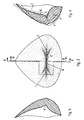
- the breast prosthesis According to a first embodiment, a prosthesis body 1, which has a front 2, a back 3 and a one closed line following prosthesis edge 4, on which the Front 2 and the back 3 each end.
- the front 2 of the prosthetic body 1 has a shape corresponding to the shape corresponds to a natural breast.
- the shape of the prosthesis between a stretched Shape and a collapsed shape depending on the Change position of prosthesis wearer (lying or upright).
- the prosthesis is worn in the basket of a brassiere. she Also suitable for wearing in the top of a swimsuit or a bikini.
- the dashed lines shown in Fig. 2, stretched Form takes the prosthesis when the wearer is lying.
- Fig. 2 In the the wearer's upright position collapses the prosthesis, as shown in phantom in Fig. 2. Both in the stretched Form as well as in collapsed form corresponds the shape of the front 2 of the form of a natural Chest.
- the cross-sectional representation of the prosthesis in Fig. 2 shows the prosthesis in the undeformed state.
- the back 3 of the prosthesis is provided with a recess 5, the invention according to a transverse to the longitudinal axis of the body Carrier extending notch 6 has.
- the body longitudinal axis of the Carrier runs parallel to the drawn in Fig. 1 Section II-II.
- a nipple 14 formed simulating knob.
- the prosthesis body 1 is composed of a soft-elastic silicone rubber compound 7 and a bag of two along the denture edge 4 tightly welded together, elastically stretchable plastic sheets 8, 9 together, wherein the silicone rubber composition 7 is enclosed in the bag cavity-free.
- the two plastic films 8, 9 are polyurethane films.
- the notch 6 is bounded by the opposing walls of an upper prosthetic body part 10 and a lower prosthetic body part 11 and a central portion 12 which flexibly connects the upper part 10 and the lower part 11 of the prosthesis body 1.
- the denture changes its shape from the dashed lines in Fig. 2, stretched shape in the in Fig. 2 dash-dotted lines, collapsed shape. More precisely, it sinks when changing from the lying position in the upright posture of the upper part 10 under the effect of gravity in the cup of the brassiere down, wherein the sagging of the upper part 10 is an elastic bending deformation of the central portion 12 causes.
- the bagging movement of the upper part 10 is stopped when the opposite Walls of the notch 6 meet so that the Notch 6 in the longitudinal direction and largely in the depth direction closed is.
- the back 3 of the prosthesis shows, the notch is represented by a plurality of points.
- the prosthesis changes its shape in the way that it does stretches, as shown in Fig. 2.
- Under the influence gravity, which now turns 90 ° on the prosthesis is the upper part 10 of the prosthesis body again after moved above, wherein the notch 6 assumes a shape as in Fig. 2 is shown by dashed lines.
- Stretching the prosthesis is due to the provision of the elastically deformed middle Section 12 supported.
- the front side 2 flattens off again and goes the vault the front 2 back in the middle and lower area.
- the movement of the Prosthesis from the stretched to the collapsed form (and back again) can also be described as a rolling movement around the point S. become.
- the notch 6 ends in the illustrated first embodiment at a distance in front of the prosthesis edge 4, as can be seen in FIG is.
- the alternating stretching and collapse of the prosthesis promotes the ventilation of the back of the prosthesis, because by the alternating opening and closing of the notch 6 Air is sucked in or pumped out. A good ventilation The prosthesis prevents unpleasant perspiration on the skin under the prosthesis.
- the inventive Prosthesis a symmetrical prosthesis, that is, they can be used on both sides.
- the innovative training of Prosthesis is also transferable to an asymmetric prosthesis, which can be worn either right or left.
- On the back of a fabric part can be attached, which the friction between the prosthetic body and the skin of the prosthesis wearer reduced.
- the adaptability of the prosthesis to the shape of the natural breast when lying down and upright Attitude of the wearer is thereby increased.
- the silicone rubber composition of the prosthesis according to the invention has a very soft, lazy character. He is achieved by that as silicone rubber composition, an addition-curing two-component silicone system from ⁇ , ⁇ -dimethylpolydimethylsiloxanes, ⁇ , ⁇ -divinylpolydimethylsiloxanes having a Si-vinyl content between 0.01 mmol / g and 0.2 mmol / g, SiH-functional Polydimethylsiloxanes having an SiH content of 2 mmol / g to 5 mmol / g and platinum complex compounds used as catalysts becomes.
- the viscosity of the two components is in between 500 to 2500 mPa.s.
- the softness of the two-component silicone system is adjusted so that the penetration between 150 to 230.1 / 10 mm, whereby the measurement according to DIN 51580 with a mass of the test cone of 14.9 g and that of Taper rod of 10 g.
- the elastic bending formability of the prosthesis in the area of Notch 6 is characterized by the very soft character of the silicone rubber compound supported.
- the second embodiment is the first embodiment very similar as far as the composition of the prosthesis and the shape of the front of the prosthesis in undeformed Condition concerns.
- FIG. 3 in conjunction with FIGS. 4 and 5 is, has the notch 6 ', in the longitudinal direction of the notch 6' seen, a middle area M and two side areas L, between which the middle area M is located.
- the middle area M of the notch 6 ' are the opposite ones Walls relatively steep, so that in the middle region M, the notch 6 'is relatively narrow.
- the opposite walls are flatter than in the Middle region M formed so that the notch 6 'wider there than in the middle region M, but essentially the same depth as in the middle area M has.
- the effect of gravity come together only in the middle Area M of the notch 6 'opposite walls to Plant, whereas the walls of the notch 6 'in the lateral Areas L come closer but do not touch .. the upper part 10 'of the prosthesis presses in collapsed state to a reduced area compared to the first embodiment, through the lower wall of the notch 6 'in the middle Area M is formed. This will in the lower part 11 ' The prosthesis material more down and after pushed forward, so that on the front 2 'a results in stronger bulge in the middle of the prosthesis.
- the softness of the silicone rubber composition also provides that Bagging and Aufricht the prosthesis influencing Parameter dar. Through experiments with different notch shapes and different degrees of softness of the silicone rubber composition This makes it easy to get one optimal for every prosthesis wearer adapted prosthesis are found, the highest standards Naturalness in lying as well as in the state of the wearer and under dynamic load is enough.
Landscapes
- Health & Medical Sciences (AREA)
- Cardiology (AREA)
- Oral & Maxillofacial Surgery (AREA)
- Transplantation (AREA)
- Engineering & Computer Science (AREA)
- Biomedical Technology (AREA)
- Heart & Thoracic Surgery (AREA)
- Vascular Medicine (AREA)
- Life Sciences & Earth Sciences (AREA)
- Animal Behavior & Ethology (AREA)
- General Health & Medical Sciences (AREA)
- Public Health (AREA)
- Veterinary Medicine (AREA)
- Prostheses (AREA)
- Corsets Or Brassieres (AREA)
Description
Die Erfindung betrifft eine Brustprothese zum Tragen in einem Büstenhalter oder dergleichen, mit einem Prothesenkörper, der eine die Form einer natürlichen Brust aufweisende Vorderseite, eine mit einer Vertiefung versehene Rückseite und einen einer geschlossenen Linie folgenden Prothesenrand hat, an dem die Vorderseite und die Rückseite des Prothesenkörpers jeweils enden, wobei der Prothesenkörper eine weich-elastische Silikonkautschukmasse aufweist, die in einen Beutel aus zwei längs des Prothesenrandes dicht miteinander verbundenen, elastisch dehnbaren Kunststoffolien hohlraumfrei eingeschlossen ist.The invention relates to a breast prosthesis for wearing in one Brassiere or the like, with a prosthesis body, the a face having the shape of a natural breast, a deepened back and a back closed line following prosthesis margin, on which the Front and back of the denture body respectively The prosthesis body is a soft-elastic silicone rubber compound which is in a bag of two longitudinally the denture edge tightly interconnected, elastic stretchable plastic films is trapped cavity-free.
Eine solche Brustprothese wurde z.B. in der europäischen Patentanmeldung mit der Veröffentlichungsnummer 0 657 148 A1 dargestellt und beschrieben. Bei dieser Brustprothese sind in der rückwärtigen Vertiefung des Prothesenkörpers eine oder mehrere Versteifungsrippen vorgesehen, die bei aufrechter Haltung der Prothesenträgerin vertikal und parallel zur Körperlängsachse der Trägerin verlaufen und die Funktion haben, den Prothesenkörper daran zu hindern, bei aufrechter Haltung der Prothesenträgerin unter der Wirkung der Schwerkraft zusammenzusacken. Anders ausgedrückt, sollen die Versteifungsrippen die Formstabilität der Prothese gewährleisten, wenn sich die Trägerin in aufrechter Haltung befindet. Die Versteifungsrippen der bekannten Brustprothese wirken sich aber auch formerhaltend auf den Prothesenkörper in der Liegestellung der Prothesenträgerin aus, denn sie verhindern, daß sich der Prothesenkörper unter der Wirkung der Schwerkraft in Liegestellung der Prothesenträgerin horizontal streckt. Manche Prothesenträgerinnen empfinden es als unnatürlich, wenn die Prothese die gleiche Form im Liegen wie im Stand hat. Genauer ausgedrückt, bemängeln diese Prothesenträgerinnen, daß diese Prothese nicht entsprechend den natürlichen Verhältnissen im Liegen etwas flacher als bei aufrechter Haltung ist. Besonders wenn mit der Prothese sehr weiches Brustgewebe ersetzt werden soll, wie es bei älteren Patientinnen oft der Fall ist, wird als'Nachteil gesehen, daß die Prothese im Liegen unnatürlich steil vom Körper der Trägerin wegragt.Such a breast prosthesis has been e.g. in the European Patent Application Publication No. 0 657 148 A1 shown and described. In this breast prosthesis are in the rear depression of the prosthesis body one or several stiffening ribs provided in the upright posture the prosthesis wearer vertically and parallel to the body longitudinal axis run the carrier and have the function, the Prosthesis body to prevent, in upright posture of Prosthesis wearer collapse under the action of gravity. In other words, should the stiffening ribs the Provide dimensional stability of the prosthesis when the wearer is in an upright position. The stiffening ribs The well-known breast prosthesis also have a shape-retaining effect on the prosthesis body in the lying position of the prosthesis wearer because they prevent the prosthetic body under the effect of gravity in lying position of the prosthesis wearer horizontal stretches. Some prosthesis wearers find it unnatural when the prosthesis is the same Form in lying as in the state has. More specifically, fault these prosthesis wearers that this prosthesis is not appropriate The natural conditions in lying a bit flatter than is upright posture. Especially if with the prosthesis very soft breast tissue should be replaced, as it is in older ones Patients are often the case, is seen as' disadvantage that the prosthesis lying down unnaturally steeply from the body of the Carrier juts out.
Es ist daher die Aufgabe der Erfindung, eine Brustprothese, wie sie im Oberbegriff des Patentanspruches 1 definiert ist, derart weiterzubilden, daß sie ihre Form beim Wechsel zwischen liegender und aufrechter Haltung der Trägerin ändert, so daß die Form der Brustprothese auch in liegender Haltung der Trägerin der Form einer natürlichen Brust entspricht.It is therefore the object of the invention to provide a breast prosthesis such as it is defined in the preamble of claim 1, such to develop their form when changing between lying and upright posture of the wearer changes, so that the shape the breast prosthesis also in a lying position of the wearer of Form of a natural breast corresponds.
Die Aufgabe der Erfindung wird entsprechend dem kennzeichnenden Teil des Patentanspruches 1 dadurch gelöst, daß die Vertiefung mindestens eine quer zur Körperlängsachse der Trägerin verlaufende Kerbe aufweist, die von sich gegenüberliegenden Wänden eines oberen und eines unteren Teils des Prothesenkörpers und einem mittleren, den oberen Teil mit dem unteren Teil flexibel verbindenden Abschnitt begrenzt wird, der es dem oberen Teil bei aufrechter Haltung der Trägerin gestattet, durch die Wirkung der Schwerkraft relativ zu dem unteren Teil kontrolliert abzusacken, wobei das kontrollierte Absacken des oberen Teils eine elastische Biegeverformung des mittleren Abschnitts bewirkt und durch Anlage zumindest eines Teiles der sich gegenüberliegenden Wände der Kerbe begrenzt wird.The object of the invention is corresponding to the characterizing Part of claim 1 solved by the recess at least one transverse to the body longitudinal axis of the wearer Notch that faces from opposite walls an upper and a lower part of the prosthetic body and a middle, the upper part with the lower part flexible connecting section is limited to the upper part in upright posture the wearer is allowed by the effect gravity is controlled relative to the lower part sagging, with the controlled sagging of the upper part causes an elastic bending deformation of the central portion and by conditioning at least a part of the opposite ones Walls of the notch is limited.
Die erfindungsgemäße Prothese nimmt in liegender Haltung der Prothesenträgerin eine relativ gestreckte flache Form ein. Richtet sich die Trägerin auf, sackt der obere Teil des Prothesenkörpers unter der Wirkung der Schwerkraft soweit nach unten, bis zumindest ein Teil der sich gegenüberliegenden Wände der Kerbe aufeinandersitzen. Die durch Absacken des oberen Teils des Prothesenkörpers bedingte Biegeverformung des mittleren Abschnitts des Prothesenkörpers sowie der Druck der aufeinandersitzenden Wände der Kerbe bewirken eine verstärkte Auswölbung der Vorderseite im unteren bis mittleren Bereich des Prothesenkörpers. Die Prothese hat dann eine Form, die der Form einer natürlichen Brust aus sehr weichem Brustgewebe entspricht. Mit dieser Form wird das Körbchen des Büstenhalters sehr gut ausgefüllt, so daß eine optimale Anpassung der Prothese an die Form des sie aufnehmenden Körbchens eines gegebenen Büstenhalters erzielt wird. Die flexible Verbindung zwischen dem oberen und unteren Teil des Prothesenkörpers führt auch zu einem ausgezeichneten Schwingungsverhalten der Prothese, das wiederum dem Schwingungsverhalten einer natürlichen Brust aus sehr weichem Gewebe entspricht. Das sich abwechselnde Strecken und Zusammensacken der Prothese vermittelt beim Laufen nicht nur ein natürliches Schwingungsverhalten, sondern es fördert auch die Be- und Entlüftung der Rückseite der Prothese, denn das sich abwechselnde Aufeinandertreffen der sich gegenüberliegenden Wände der Kerbe und Aufweiten der Kerbe bewirkt ein abwechselndes Saugen und Pumpen von Luft zwischen der Rückseite der Prothese und dem Körper der Trägerin. Befindet sich die Trägerin in liegender Stellung, streckt sich die Prothese in horizontaler Richtung parallel zu der Körperlängsachse der Trägerin, wobei diese Streckung durch das Eigengewicht der Prothese, das nun senkrecht auf den Körper der Trägerin wirkt, und die durch die Verformung des mittleren Abschnitts erzeugte Rückstellkraft bewirkt wird. Eine Folge dieser Streckung der Prothese in der Liegestellung der Trägerin ist die Abflachung der Prothese, so daß nun auch in der Liegestellung der Trägerin die Form der Prothese an die Form einer natürlichen Brust, die aus sehr weichem Brustgewebe besteht, angepaßt ist. Der mittlere, flexible Abschnitt, der den oberen Teil des Prothesenkörpers mit dem unteren Teil des Prothesenkörpers verbindet, kann mit einem Filmscharnier verglichen werden, das ein Aufund Zuklappen der Kerbe gestattet, wenn die Trägerin zwischen Liegestellung und aufrechter Haltung wechselt oder sich rasch fortbewegt. Die erfindungsgemäße Prothese zeichnet sich weiterhin durch ein geringes Gewicht aus, so daß die Prothese äußerst angenehm zu tragen ist.The prosthesis according to the invention assumes in a lying position Prosthesis wearer a relatively elongated flat shape. If the wearer straightens, the upper part of the prosthesis body sags under the action of gravity as far as down to at least part of the opposite walls the notch on top of each other. The by sagging the top Part of the prosthesis body caused bending deformation of the middle Section of the prosthetic body as well as the pressure of the abutting Walls of the notch cause an increased bulge the front in the lower to middle area of the Prosthetic body. The prosthesis then has a shape that matches the shape a natural breast of very soft breast tissue. This form becomes the cup of the brassiere very well filled, allowing for optimal adaptation of the prosthesis to the shape of the receiving basket of a given Brass is achieved. The flexible connection between the upper and lower part of the prosthesis body also leads to an excellent vibration behavior of the prosthesis, the again the vibration behavior of a natural breast corresponds to very soft tissue. The alternating stretches and collapse of the prosthesis does not mediate while running only a natural vibration behavior, but it promotes also the ventilation of the back of the prosthesis, because the alternating clash of opposing ones Walls of notch and widening of notch causes one alternately sucking and pumping air between the back the prosthesis and the wearer's body. Is the Caregiver in a lying position, the prosthesis stretches in horizontal direction parallel to the body longitudinal axis of the Carrier, this extension by the weight of the Prosthesis now acting perpendicular to the wearer's body and that generated by the deformation of the central portion Restoring force is effected. A consequence of this extension of the Prosthesis in the lying position of the wearer is the flattening the prosthesis, so that now in the lying position of the wearer the shape of the prosthesis to the shape of a natural breast, the made of very soft breast tissue, is adapted. The middle one, flexible section that covers the upper part of the denture body connects to the lower part of the prosthesis body, can be compared to a movie hinge that is an up and down Collapse of the notch allows when the wearer between Lying and upright posture changes or quickly moves. The prosthesis according to the invention is further distinguished by a low weight, so that the prosthesis extremely is comfortable to wear.
Nach einer Weiterbildung der Erfindung kann die Kerbe an Stelle eines geradlinigen Verlaufes im unverformten Zustand einen bogenförmigen Verlauf haben, der die sich gegenüberliegenden Wände der Kerbe zwingt, sich beim Absacken des oberen Teils in Längsrichtung der Kerbe fortschreitend aneinanderzulegen. Dadurch wird das Absacken des oberen Teils des Prothesenkörpers stärker gedämpft als bei einer Prothese, bei der die Kerbe einen geraden Verlauf hat. Vergleicht man den mittleren Abschnitt des Prothesenkörpers mit einem Scharnier, so wirkt das Scharnier durch den bogenförmigen Verlauf der Kerbe selbsthemmend. Das Formveränderungsvermögen der Prothese kann durch eine von der Geraden abweichenden Gestaltung der Kerbe stark beeinflußt und somit an die individuellen Bedürfnisse einer Prothesenträgerin angepaßt werden.According to a development of the invention, the notch in place a rectilinear course in the undeformed state an arcuate Course, the opposite walls the notch forces itself in sagging the upper part in Longitudinally of the notch progressively put together. Thereby is the sagging of the upper part of the prosthetic body more attenuated than with a denture in which the notch has a straight course. Comparing the middle section of the prosthesis body with a hinge, that's how it works Hinge self-locking due to the curved course of the notch. The shape-changing capacity of the prosthesis can by a deviating from the line design of the notch strong influenced and thus to the individual needs of a Prosthesis wearer to be adapted.
Auch die Länge der Kerbe hat einen Einfluß auf das Formveränderungsvermögen der Prothese. Als besonders vorteilhaft hat sich erwiesen, wenn die Kerbe, in Längsrichtung gesehen, im Abstand vor dem Prothesenrand endet. Bei einer derartigen Länge der Kerbe wird verhindert, daß die seitlichen Ausläufer der Prothese zu sehr abknicken, wenn sich die Prothese im abgesackten Zustand befindet. The length of the notch also influences the shape changing ability the prosthesis. As a particularly advantageous proved when the notch, seen in the longitudinal direction, in the Distance before the edge of the prosthesis ends. With such a length the notch prevents the lateral foothills of the Denture too much bend when the prosthesis in the bagged State is.
Das Formveränderungsvermögen der Prothese kann ferner durch die Zahl der querverlaufenden Kerben gesteuert werden. Beispielsweise kann die Vertiefung mehr als eine quer zur Körperlängsachse verlaufende Kerbe aufweisen, die bezogen auf die Körperlängsachse der Trägerin, im Abstand übereinander angeordnet sind. Bei einer derartigen Prothese ergeben sich dann mehrere in Reihe geschaltete Scharniere, die alle eine elastische Biegeverformung des Prothesenkörpers durch Schwerkrafteinwirkung im Liegen und in aufrechter Haltung der Trägerin zulassen. Die Gesamtbiegeverformung wird in einem solchen Fall auf mehr als ein Scharnier verteilt.The shape-changing capacity of the prosthesis can further be characterized by Number of transverse notches to be controlled. For example The depression can be more than one transverse to the body's longitudinal axis have extending notch, based on the body longitudinal axis the wearer, spaced above each other are. With such a prosthesis then arise several hinges connected in series, all of which have elastic bending deformation of the prosthesis body by gravity while lying and in upright posture allow the wearer. The Total bending deformation in such a case will be more than distributed a hinge.
Das Anpassungsvermögen der Prothese an die Form der natürlichen Brust beim Liegen und in aufrechter Haltung der Trägerin wird dadurch noch verbessert, daß die Silikonkautschukmasse auf eine Weichheit mit einer Penetration zwischen 150 bis 230 eingestellt wird. Vorzugsweise besteht die Silikonkautschukmasse aus zwei additionsvernetzten Komponenten, deren Viskosität im Bereich zwischen 500 und 2500 mPa.s liegt.The adaptability of the prosthesis to the shape of the natural Breast while lying and in upright posture of the wearer becomes thereby further improved that the silicone rubber composition on a Softness with a penetration set between 150 to 230 becomes. Preferably, the silicone rubber composition is made two addition-crosslinked components whose viscosity is in the range is between 500 and 2500 mPa.s.
Die Rückseite des Prothesenkörpers kann durch ein Stoffteil abgedeckt sein, das am Prothesenrand befestigt ist. Dieses Stoffteil verringert die Reibung zwischen der Prothese und dem Körper der Trägerin, wodurch eine Beschleunigung der Absackund Streckbewegung der Prothese erzielbar ist.The back of the prosthesis body can through a fabric part be covered, which is attached to the edge of the prosthesis. This Fabric part reduces the friction between the prosthesis and the Body of the wearer, thereby accelerating the Absackund Stretching movement of the prosthesis is achieved.
Zwei Ausführungsbeispiele der Erfindung sind in den Zeichnungen dargestellt und werden im folgenden näher beschrieben. Es zeigt
- Fig. 1
- eine Draufsicht auf die Rückseite einer Brustprothese gemäß einem ersten Ausführungsbeispiel im unverformten Zustand der Prothese;
- Fig. 2
- einen Querschnitt der in Fig. 1 gezeigten Brustprothese entlang der Linie II-II in Fig. 1 mit Blick in Richtung der Pfeile, wobei zusätzlich die Kontur der Prothese jeweils in Liegestellung und bei aufrechter Haltung der Prothesenträgerin angedeutet ist;
- Fig. 3
- eine Draufsicht auf die Rückseite einer Brustprothese gemäß einem zweiten Ausführungsbeispiel der Erfindung im unverformten Zustand der Prothese;
- Fig. 4
- einen Querschnitt der in Fig. 3 gezeigten Brustprothese entlang der Linie IV-IV in Fig. 3 mit Blick in Richtung der Pfeile, wobei zusätzlich die Kontur der Prothese jeweils in Liegestellung und bei aufrechter Haltung der Prothesenträgerin angedeutet ist; und
- Fig. 5
- einen Querschnitt der in Fig. 3 gezeigten Brustprothese entlang der Linie V-V in Fig. 3 mit Blick in Richtung der Pfeile, wobei die Prothese im unverformten Zustand ist.
- Fig. 1
- a plan view of the back of a breast prosthesis according to a first embodiment in the undeformed state of the prosthesis;
- Fig. 2
- a cross-section of the breast prosthesis shown in Figure 1 along the line II-II in Figure 1 with a view in the direction of the arrows, wherein additionally the contour of the prosthesis is respectively indicated in lying position and upright posture of the prosthesis wearer.
- Fig. 3
- a plan view of the back of a breast prosthesis according to a second embodiment of the invention in the undeformed state of the prosthesis;
- Fig. 4
- a cross-section of the breast prosthesis shown in Figure 3 along the line IV-IV in Figure 3 looking in the direction of the arrows, wherein additionally the contour of the prosthesis is respectively indicated in lying position and upright posture of the prosthesis wearer. and
- Fig. 5
- a cross-section of the breast prosthesis shown in Fig. 3 along the line VV in Fig. 3 viewed in the direction of the arrows, wherein the prosthesis is in the undeformed state.
Wie in den Figuren 1 und 2 gezeigt, weist die Brustprothese gemäß einem ersten Ausführungsbeispiel einen Prothesenkörper 1 auf, der eine Vorderseite 2, eine Rückseite 3 und einen einer geschlossenen Linie folgenden Prothesenrand 4 hat, an dem die Vorderseite 2 und die Rückseite 3 jeweils enden. Die Vorderseite 2 des Prothesenkörpers 1 hat eine Form, die der Form einer natürlichen Brust entspricht. Wie unten näher erläutert ist, kann sich die Form der Prothese zwischen einer gestreckten Form und einer zusammengesackten Form in Abhängigkeit von der Haltung der Prothesenträgerin (liegend oder aufrecht) ändern. Die Prothese wird im Körbchen eines Büstenhalters getragen. Sie eignet sich auch zum Tragen im Oberteil eines Badeanzugs oder eines Bikinis. Die in Fig. 2 gestrichelt gezeigte, gestreckte Form nimmt die Prothese ein, wenn die Trägerin liegt. In der aufrechten Haltung der Trägerin sackt die Prothese zusammen, wie in Fig. 2 strichpunktiert gezeigt ist. Sowohl in der gestreckten Form wie auch in der zusammengesackten Form entspricht die Form der Vorderseite 2 der Form einer natürlichen Brust. Die Querschnittsdarstellung der Prothese in Fig. 2 zeigt die Prothese im unverformten Zustand.As shown in Figures 1 and 2, the breast prosthesis According to a first embodiment, a prosthesis body 1, which has a front 2, a back 3 and a one closed line following prosthesis edge 4, on which the Front 2 and the back 3 each end. The front 2 of the prosthetic body 1 has a shape corresponding to the shape corresponds to a natural breast. As explained in more detail below is, the shape of the prosthesis between a stretched Shape and a collapsed shape depending on the Change position of prosthesis wearer (lying or upright). The prosthesis is worn in the basket of a brassiere. she Also suitable for wearing in the top of a swimsuit or a bikini. The dashed lines shown in Fig. 2, stretched Form takes the prosthesis when the wearer is lying. In the the wearer's upright position collapses the prosthesis, as shown in phantom in Fig. 2. Both in the stretched Form as well as in collapsed form corresponds the shape of the front 2 of the form of a natural Chest. The cross-sectional representation of the prosthesis in Fig. 2 shows the prosthesis in the undeformed state.
Die Rückseite 3 der Prothese ist mit einer Vertiefung 5 versehen, die erfindungsgemäß eine quer zur Körperlängsachse der Trägerin verlaufende Kerbe 6 aufweist. Die Körperlängsachse der Trägerin verläuft parallel zu der in der Fig. 1 gezeichneten Schnittlinie II-II.The back 3 of the prosthesis is provided with a recess 5, the invention according to a transverse to the longitudinal axis of the body Carrier extending notch 6 has. The body longitudinal axis of the Carrier runs parallel to the drawn in Fig. 1 Section II-II.
An der Vorderseite 2 der Prothese ist eine, eine Brustwarze 14
simulierende Noppe ausgebildet.On the front side 2 of the prosthesis is one, a
Der Prothesenkörper 1 setzt sich aus einer weich-elastischen
Silikonkautschukmasse 7 und einem Beutel aus zwei längs des
Prothesenrandes 4 dicht miteinander verschweißten, elastisch
dehnbaren Kunststoffolien 8, 9 zusammen, wobei die Silikonkautschukmasse
7 in den Beutel hohlraumfrei eingeschlossen ist.
Vorzugsweise sind die beiden Kunststoffolien 8, 9 Polyurethanfolien.
Die Kerbe 6 wird von den sich gegenüberliegenden Wänden eines
oberen Prothesenkörperteiles 10 und eines unteren Prothesenkörperteiles
11 sowie einem mittleren Abschnitt 12 begrenzt, der
den oberen Teil 10 und den unteren Teil 11 des Prothesenkörpers
1 flexibel miteinander verbindet.The prosthesis body 1 is composed of a soft-elastic silicone rubber compound 7 and a bag of two along the denture edge 4 tightly welded together, elastically
The notch 6 is bounded by the opposing walls of an upper prosthetic body part 10 and a lower prosthetic body part 11 and a
Wechselt die Trägerin ihre Position von der Liegestellung in
eine aufrechte Haltung, ändert die Prothese ihre Form von der
in Fig. 2 gestrichelt dargestellten, gestreckten Form in die
in Fig. 2 strichpunktiert dargestellte, zusammengesackte Form.
Genauer ausgedrückt, sackt beim Wechsel von der Liegestellung
in die aufrechte Haltung der obere Teil 10 unter der Wirkung
der Schwerkraft im Körbchen des Büstenhalters nach unten ab,
wobei das Absacken des oberen Teils 10 eine elastische Biegeverformung
des mittleren Abschnitts 12 bewirkt. Die Absackbewegung
des oberen Teils 10 wird gestoppt, wenn die sich gegenüberliegenden
Wände der Kerbe 6 aufeinandertreffen, so daß die
Kerbe 6 in Längsrichtung und weitgehend in der Tiefenrichtung
geschlossen ist. In Fig. 1, die die Rückseite 3 der Prothese
zeigt, ist die Kerbe durch eine Vielzahl an Punkten dargestellt.If the wearer changes her position from the lying position to
an upright posture, the denture changes its shape from the
dashed lines in Fig. 2, stretched shape in the
in Fig. 2 dash-dotted lines, collapsed shape.
More precisely, it sinks when changing from the lying position
in the upright posture of the upper part 10 under the effect
of gravity in the cup of the brassiere down,
wherein the sagging of the upper part 10 is an elastic bending deformation
of the
Wie in Fig. 2 zu sehen ist, hat das Absacken des oberen Teiles
10 des Prothesenkörpers 1 zur Folge, daß der die Brustwarze 14
einschließende mittlere Bereich und der unterhalb der Brustwarze
14 liegende Bereich der Vorderseite 2 des Prothesenkörpers
im Vergleich zu der gestrichelt dargestellten, gestreckten Form
eine starke Auswölbung erfährt, die mit einer Verschiebung der
Brustwarze 14 nach vorne und nach unten einhergeht, wobei der
Prothesenrand 4 im unteren Bereich durch den Rand des Körbchens
des Büstenhalters am Körper der Trägerin beim Punkt S fixiert
wird. Der mittlere Bereich der Vorderseite 2 des Prothesenkörpers
ist in der abgesackten Stellung weiter vom Körper der Trägerin
entfernt als in der gestreckten Stellung der Prothese.
Der Prothesenrand im oberen Bereich der Vorderseite 2 des
Prothesenkörpers 1 liegt im zusammengesackten Zustand der
Prothese tiefer als bei der gestreckten Stellung der Prothese.As can be seen in Fig. 2, the sagging of the upper part
10 of the prosthesis body 1 with the result that the nipple 14th
enclosing middle area and below the
Wechselt die Trägerin von der aufrechten Haltung in eine Liegestellung,
ändert die Prothese ihre Form in der Weise, daß sie
sich streckt, wie in Fig. 2 dargestellt ist. Unter dem Einfluß
der Schwerkraft, die nun um 90° gedreht an der Prothese angreift,
wird der obere Teil 10 des Prothesenkörpers wieder nach
oben bewegt, wobei die Kerbe 6 eine Form annimmt, wie sie in
Fig. 2 strichliniert gezeigt ist. Das Strecken der Prothese
wird durch die Rückstellung des elastisch verformten mittleren
Abschnitts 12 unterstützt. Als Folge der Streckung der Prothese
flacht sich die Vorderseite 2 wieder ab und geht die Wölbung
der Vorderseite 2 im mittleren und unteren Bereich zurück. Der
tiefste Punkt der Prothese liegt in der gestreckten Stellung
im untersten Bereich des Prothesenrandes 4. Die Bewegung der
Prothese von der gestreckten in die zusammengesackte Form (und
wieder zurück) kann auch als Rollbewegung um den Punkt S beschrieben
werden. If the wearer changes from the upright position to a lying position,
the prosthesis changes its shape in the way that it does
stretches, as shown in Fig. 2. Under the influence
gravity, which now turns 90 ° on the prosthesis,
is the upper part 10 of the prosthesis body again after
moved above, wherein the notch 6 assumes a shape as in
Fig. 2 is shown by dashed lines. Stretching the prosthesis
is due to the provision of the elastically deformed
Die Kerbe 6 endet im dargestellten ersten Ausführungsbeispiel im Abstand vor dem Prothesenrand 4, wie in Fig. 1 erkennbar ist.The notch 6 ends in the illustrated first embodiment at a distance in front of the prosthesis edge 4, as can be seen in FIG is.
Befindet sich die Trägerin in einer aufrechten Haltung und wird die Prothese einer dynamischen Belastung, beispielsweise beim Laufen, ausgesetzt, ändert die Prothese ihre Form abwechselnd zwischen den in Fig. 2 dargestellten strichlinierten und strichpunktierten Formen. Diese Formänderung unter dynamischer Belastung entspricht weitgehend dem Schwingungsverhalten einer natürlichen Brust bei dynamischer Belastung.Is the wearer in an upright posture and will the prosthesis of a dynamic load, for example during Running, exposed, the prosthesis changes its shape alternately between the dashed and shown in Fig. 2 dot-dashed forms. This shape change under dynamic Load corresponds largely to the vibration behavior of a natural breast with dynamic load.
Das abwechselnde Strecken und Zusammensacken der Prothese fördert die Be- und Entlüftung der Rückseite der Prothese, denn durch das sich abwechselnde Öffnen und Schließen der Kerbe 6 wird Luft eingesaugt oder ausgepumpt. Eine gute Be- und Entlüftung der Prothese verhindert eine unangenehme Schweißbildung auf der Haut unter der Prothese.The alternating stretching and collapse of the prosthesis promotes the ventilation of the back of the prosthesis, because by the alternating opening and closing of the notch 6 Air is sucked in or pumped out. A good ventilation The prosthesis prevents unpleasant perspiration on the skin under the prosthesis.
Im dargestellten Beispiel gemäß Figuren 1 und 2 ist die erfindungsgemäße Prothese eine symmetrische Prothese, d.h., sie kann beidseitig verwendet werden. Die erfinderische Ausbildung der Prothese ist aber auch auf eine asymmetrische Prothese übertragbar, die entweder rechts oder links getragen werden kann. Auf der Rückseite kann ein Stoffteil angebracht werden, welches die Reibung zwischen dem Prothesenkörper und der Haut der Prothesenträgerin verringert. Die Anpassungsfähigkeit der Prothese an die Form der natürlichen Brust beim Liegen und in aufrechter Haltung der Trägerin wird dadurch erhöht.In the example shown in Figures 1 and 2, the inventive Prosthesis a symmetrical prosthesis, that is, they can be used on both sides. The innovative training of Prosthesis is also transferable to an asymmetric prosthesis, which can be worn either right or left. On the back of a fabric part can be attached, which the friction between the prosthetic body and the skin of the prosthesis wearer reduced. The adaptability of the prosthesis to the shape of the natural breast when lying down and upright Attitude of the wearer is thereby increased.
Die Silikonkautschukmasse der erfindungsgemäßen Prothese hat einen sehr weichen, trägen Charakter. Er wird dadurch erreicht, daß als Silikonkautschukmasse ein additionsvernetzendes Zweikomponenten-Silikonsystem aus α, ω-Dimethylpolydimethylsiloxanen, α, ω-Divinylpolydimethylsiloxanen mit einem Si-Vinyl-Gehalt zwischen 0,01 mmol/g und 0,2 mmol/g, SiH-funktionellen Polydimethylsiloxanen mit einem SiH-Gehalt von 2 mmol/g bis 5 mmol/g und Platinkomplexverbindungen als Katalysatoren verwendet wird. Die Viskosität der beiden Komponenten liegt zwischen 500 bis 2500 mPa.s. Die Weichheit des Zweikomponenten-Silikonsystems wird derart eingestellt, daß die Penetration zwischen 150 bis 230.1/10 mm liegt, wobei die Messung nach DIN 51580 mit einer Masse des Prüfkonus von 14,9 g und der der Konusführungsstange von 10 g erfolgt.The silicone rubber composition of the prosthesis according to the invention has a very soft, lazy character. He is achieved by that as silicone rubber composition, an addition-curing two-component silicone system from α, ω-dimethylpolydimethylsiloxanes, α, ω-divinylpolydimethylsiloxanes having a Si-vinyl content between 0.01 mmol / g and 0.2 mmol / g, SiH-functional Polydimethylsiloxanes having an SiH content of 2 mmol / g to 5 mmol / g and platinum complex compounds used as catalysts becomes. The viscosity of the two components is in between 500 to 2500 mPa.s. The softness of the two-component silicone system is adjusted so that the penetration between 150 to 230.1 / 10 mm, whereby the measurement according to DIN 51580 with a mass of the test cone of 14.9 g and that of Taper rod of 10 g.
Die elastische Biegeformbarkeit der Prothese im Bereich der Kerbe 6 wird durch den sehr weichen Charakter der Silikonkautschukmasse unterstützt.The elastic bending formability of the prosthesis in the area of Notch 6 is characterized by the very soft character of the silicone rubber compound supported.
Das zweite Ausführungsbeispiel ist dem ersten Ausführungsbeispiel sehr ähnlich soweit es die Zusammensetzung der Prothese und die Form der Vorderseite der Prothese im unverformten Zustand betrifft. Der einzige Unterschied zwischen den beiden Ausführungsbeispielen liegt in der Form der Kerbe, die beim zweiten Ausführungsbeispiel dazu führt, daß der untere Bereich der Vorderseite der Prothese im zusammengesackten Zustand noch stärker ausgewölbt ist, wobei diese Auswölbung sich stärker auf das Zentrum der Prothesenvorderseite konzentriert und infolgedessen eine ausgeprägte Konusform der Vorderseite der Brustprothese vermittelt.The second embodiment is the first embodiment very similar as far as the composition of the prosthesis and the shape of the front of the prosthesis in undeformed Condition concerns. The only difference between the two Embodiments lies in the shape of the notch, the at second embodiment results in that the lower portion the front of the prosthesis in the collapsed state yet is more bulged, with this bulge is more pronounced the center of the front of the denture concentrated and consequently a pronounced conical shape of the front of the breast prosthesis taught.
Aufgrund der weitgehenden Übereinstimmung der beiden Ausführungsbeispiele beschränkt sich die folgende Beschreibung daher auf eine Erläuterung der Form der Kerbe und deren Auswirkungen auf die Form der Vorderseite der Prothese. Es werden die gleichen Bezugszeichen wie beim ersten Ausführungsbeispiel verwendet, wobei lediglich ein Strich hinter der jeweiligen Bezugsziffer hinzugefügt ist. Außerdem werden nur diejenigen Teile bezeichnet, auf die zum besseren Verständnis des Unterschieds zwischen den beiden Ausführungsbeispielen Bezug genommen werden muß.Due to the broad agreement of the two embodiments limited the following description Therefore, an explanation of the shape of the notch and its effects on the shape of the front of the prosthesis. It will the same reference numerals as in the first embodiment used, with only one line behind the respective Reference number is added. Besides, only those will be Parts referred to, for a better understanding of the difference between the two embodiments must become.
Wie aus der Fig. 3 in Verbindung mit den Figuren 4 und 5 erkennbar ist, hat die Kerbe 6', in Längsrichtung der Kerbe 6' gesehen, einen mittleren Bereich M und zwei seitliche Bereiche L, zwischen denen sich die der mittlere Bereich M befindet. Im mittleren Bereich M der Kerbe 6' sind die sich gegenüberliegenden Wände relativ steil, so daß im mittleren Bereich M die Kerbe 6' relativ eng ist. In den beiden seitlichen Bereichen L der Kerbe 6' sind die sich gegenüberliegenden Wände flacher als im mittleren Bereich M ausgebildet, so daß die Kerbe 6' dort breiter als im mittleren Bereich M ist, aber dennoch im wesentlichen die gleiche Tiefe wie im mittleren Bereich M hat. Außerdem ist im mittleren Bereich M der Kerbe 6' die untere Wand länger leicht gekrümmt nach hinten geführt, bevor sie eine deutliche Richtungsänderung nach unten macht. Im Vergleich dazu macht die obere Wand eine deutliche Richtungsänderung nach oben an einer Stelle, die nicht weit von der tiefsten Stelle der Kerbe 6' entfernt ist. Infolgedessen ist der unterhalb der Kerbe 6' liegende Bereich der Rückseite 3' stärker wulstförmig ausgeprägt als der oberhalb der Kerbe 6' liegende, obere Bereich der Rückseite 3'.As can be seen from FIG. 3 in conjunction with FIGS. 4 and 5 is, has the notch 6 ', in the longitudinal direction of the notch 6' seen, a middle area M and two side areas L, between which the middle area M is located. in the middle area M of the notch 6 'are the opposite ones Walls relatively steep, so that in the middle region M, the notch 6 'is relatively narrow. In the two lateral areas L of Notch 6 ', the opposite walls are flatter than in the Middle region M formed so that the notch 6 'wider there than in the middle region M, but essentially the same depth as in the middle area M has. Furthermore is in the middle region M of the notch 6 'the lower wall longer slightly curved, led backwards, before giving a clear Change of direction makes down. In comparison, the upper wall a clear change of direction upwards at one Spot not far from the lowest point of the notch 6 ' is removed. As a result, the below the notch 6 'lying Area of the back 3 'more pronounced bulge-shaped as the above the notch 6 'lying, upper portion of the back 3 '.
Sackt die Prothese gemäß dem zweiten Ausführungsbeispiel unter der Wirkung der Schwerkraft zusammen, kommen nur die im mittleren Bereich M der Kerbe 6' sich gegenüberliegenden Wände zur Anlage, wogegen sich die Wände der Kerbe 6' in den seitlichen Bereichen L näher kommen aber nicht berühren.. Der obere Teil 10' der Prothese drückt im zusammengesackten Zustand auf eine im Vergleich zum ersten Ausführungsbeispiel verminderte Fläche, die durch die untere Wand der Kerbe 6' in deren mittlerem Bereich M gebildet wird. Dadurch wird das im unteren Teil 11' der Prothese befindliche Material stärker nach unten und nach vorne geschoben, so daß sich auf der Vorderseite 2' eine stärkere Auswölbung in der Mitte der Prothese ergibt.Sinks the prosthesis according to the second embodiment the effect of gravity come together only in the middle Area M of the notch 6 'opposite walls to Plant, whereas the walls of the notch 6 'in the lateral Areas L come closer but do not touch .. the upper part 10 'of the prosthesis presses in collapsed state to a reduced area compared to the first embodiment, through the lower wall of the notch 6 'in the middle Area M is formed. This will in the lower part 11 ' The prosthesis material more down and after pushed forward, so that on the front 2 'a results in stronger bulge in the middle of the prosthesis.
Aufgrund der steileren Ausführung kommen im mittleren Bereich M der Kerbe 6' die sich gegenüberliegende Wände früher zur Anlage als beim ersten Ausführungsbeispiel. Dies bedeutet, daß das Abbremsen der Absackbewegung mit der daraus resultierenden Verformung der Vorderseite 2' im mittleren und unteren Bereich früher einsetzt als beim ersten Ausführungsbeispiel. Das Strecken der Prothese als Folge eines Wechsels der Trägerin von der aufrechten Haltung in die Liegestellung geht wie beim ersten Ausführungsbeispiel vonstatten.Due to the steeper design come in the middle range M the notch 6 'the opposite walls earlier to Plant as in the first embodiment. This means that slowing down the bagging movement with the resulting Deformation of the front side 2 'in the middle and lower area used earlier than in the first embodiment. The Stretching the prosthesis as a result of a change of the wearer of the upright posture goes into the lying position as with the first embodiment.
Anhand der beiden Ausführungsbeispiele wird deutlich, daß die Absackbewegung der Prothese durch unterschiedliche Art der Gestaltung der Kerbe verschieden gesteuert werden kann. Je nach Wahl der Form der Kerbe ergibt sich auch eine unterschiedliche Auswölbung des unteren und mittleren Bereichs der Vorderseite 2' der Prothese.On the basis of the two embodiments, it is clear that the Bagging movement of the prosthesis by different kind of Design of the notch can be controlled differently. Depending on Choice of the shape of the notch also results in a different one Bulge of the lower and middle area of the front 2 'of the prosthesis.
Auch die Weichheit der Silikonkautschukmasse stellt einen das Absack- und Aufrichtverhalten der Prothese beeinflussenden Parameter dar. Durch Versuche mit verschiedenen Kerbenformen und unterschiedlichen Weichheitsgraden der Silikonkautschukmasse kann somit leicht eine für jede Prothesenträgerin optimal angepaßte Prothese gefunden werden, die höchsten Ansprüchen an Natürlichkeit im Liegen wie im Stand der Trägerin und unter dynamischer Belastung genügt.The softness of the silicone rubber composition also provides that Bagging and Aufrichtverhalten the prosthesis influencing Parameter dar. Through experiments with different notch shapes and different degrees of softness of the silicone rubber composition This makes it easy to get one optimal for every prosthesis wearer adapted prosthesis are found, the highest standards Naturalness in lying as well as in the state of the wearer and under dynamic load is enough.
Claims (7)
- A breast prosthesis for wearing in a brassiere or the like, comprising a prosthesis body (1) having a front (2; 2') having the shape of a natural breast, a back (3, 3') provided with a recess (5), and a prosthesis edge (4) which follows a closed line and at which the front (2; 2') and the back (3; 3') respectively end, the prosthesis body (1) comprising a soft-elastic silicone rubber material which is enclosed so as to be free from cavities in a bag consisting of elastically extensible plastic films (8, 9) sealingly interconnected along the prosthesis edge (4), characterised in that the recess (5) has at least one groove (6; 6') extending transversely of the longitudinal axis of the wearer's body and which is bounded by oppositely situated walls of a top part (10; 10') and a bottom part (11; 11') of the prosthesis body (1) and a middle section (12) flexibly connecting the top and bottom parts (10, 11; 10', 11'), which section (12) allows the top part (10; 10') to sag in relation to the bottom part (11; 11') under the action of gravity when the wearer is in the upright position, the sagging of the top part (10; 10') resulting in an elastic flexural deformation of the middle section (12) and being limited by at least a part of the oppositely situated walls of the groove (6; 6') coming into contact, and in that when the wearer's position changes from the upright position to a reclining position the top part (10; 10') of the prosthesis body (1) moves upwards relatively to the bottom part (11; 11'), the walls of the groove (6; 6') moving away from one another and the front (2; 2') of the prosthesis body (1) becoming flatter.
- A breast prosthesis according to claim 1, characterised in that the groove (6) has at least in the undeformed state an arcuate configuration which forces the oppositely situated walls of the groove (6) to progressively come into contact in the longitudinal direction of the groove (6) during the sagging of the top part (10).
- A breast prosthesis according to any one of the preceding claims, characterised in that the groove (6) as considered in the longitudinal direction terminates at a distance in front of the prosthesis edge (4).
- A breast prosthesis according to any one of the preceding claims, characterised in that the recess (3) has more than one groove (6) extending transversely of the longitudinal axis of the wearer's body, said grooves being disposed one above the other in spaced relationship with respect to the longitudinal axis of the wearer's body.
- A breast prosthesis according to claim 1, characterised in that the groove (6') has steeper walls in a middle zone (M) than in two lateral zones (L) and only the walls in the middle zone (M) of the groove (6') come into contact with one another to limit the sagging movement.
- A breast prosthesis according to any one of the preceding claims, characterised in that the silicone rubber material is adjusted to a softness having a penetration of between 150 and 230.
- A breast prosthesis according to any one of the preceding claims, characterised in that the silicone rubber material consists of two addition crosslinked components, the viscosity of which is in the range between 500 and 2500 mPa.s.
Applications Claiming Priority (2)
| Application Number | Priority Date | Filing Date | Title |
|---|---|---|---|
| DE19838428A DE19838428B4 (en) | 1998-08-24 | 1998-08-24 | Breast prosthesis to wear in a bra |
| DE19838428 | 1998-08-24 |
Publications (3)
| Publication Number | Publication Date |
|---|---|
| EP0982012A2 EP0982012A2 (en) | 2000-03-01 |
| EP0982012A3 EP0982012A3 (en) | 2000-03-22 |
| EP0982012B1 true EP0982012B1 (en) | 2003-01-15 |
Family
ID=7878547
Family Applications (1)
| Application Number | Title | Priority Date | Filing Date |
|---|---|---|---|
| EP99112603A Expired - Lifetime EP0982012B1 (en) | 1998-08-24 | 1999-07-01 | Mammary prosthese for wearing in a brassiere or in such a thing |
Country Status (3)
| Country | Link |
|---|---|
| US (1) | US6136028A (en) |
| EP (1) | EP0982012B1 (en) |
| DE (2) | DE19838428B4 (en) |
Families Citing this family (10)
| Publication number | Priority date | Publication date | Assignee | Title |
|---|---|---|---|---|
| DE10059013B4 (en) * | 2000-11-28 | 2004-11-11 | F+E Gesellschaft für Bekleidungsinnovation mbH & Co. KG | Symmetrical breast prosthesis |
| US6565604B2 (en) * | 2000-12-05 | 2003-05-20 | F & E Gesellschaft Fur Bekleidungs-Innovation Gmbh & Co. Kg | Symmetrical breast prosthesis |
| DE102010033356A1 (en) | 2010-07-26 | 2012-01-26 | Absolutely Special-Trade Gmbh | Breast epithesis, breast orthosis or breast prosthesis for use by breast cancer affected woman, has artificial nipple that swells, bends and falls down, and stimulation unit with electrodes for creating feeling of movements on skin |
| WO2012113552A1 (en) | 2011-02-23 | 2012-08-30 | Edelweiss Basics Gmbh & Co. Kg | Textile fabric for items of clothing and/or orthopaedic articles, and artificial breast tissue part comprising such a fabric |
| DE102011012111A1 (en) | 2011-02-23 | 2012-08-23 | F+E Gesellschaft für Bekleidungsinnovation mbH & Co. KG | Artificial breast fabric part for use as breast prosthesis or breast tissue balancing part for support in bra-cup of garment for women, comprises body, which has soft elastic core and two elastic plastic films forming seam |
| DE102011079147A1 (en) | 2011-07-14 | 2013-01-17 | Edelweiss Basics Gmbh & Co. Kg | Artificial breast tissue part i.e. breast prosthesis, for supporting in pad of bra for women with partially or completely ablated breast, has fabric layer comprising holes to create air exchange between depressions and environment of part |
| DE202016104677U1 (en) | 2016-08-25 | 2016-09-07 | Edelweiss Basics Gmbh & Co. Kg | Breast prosthesis with padding |
| US11413134B1 (en) * | 2016-09-28 | 2022-08-16 | Nipple Implant System, LLC | Nipple implant system |
| EP3549554A1 (en) | 2018-04-04 | 2019-10-09 | Edelweiss Basics GmbH & Co. Kg | Concave artificial breast |
| CN113317913B (en) * | 2021-07-01 | 2025-02-18 | 上海交通大学医学院附属第九人民医院 | A breast prosthesis with touch feedback and heating function |
Family Cites Families (20)
| Publication number | Priority date | Publication date | Assignee | Title |
|---|---|---|---|---|
| US2345649A (en) * | 1939-12-04 | 1944-04-04 | Zimmerman | Brassiere |
| US2543499A (en) * | 1947-04-10 | 1951-02-27 | Walter O Kausch | Artificial breast |
| US3285247A (en) * | 1964-12-11 | 1966-11-15 | Morin Henry | Brassiere |
| US3860969A (en) * | 1970-06-26 | 1975-01-21 | Henri G Arion | Retromammary prosthesis |
| US3681787A (en) * | 1971-03-26 | 1972-08-08 | Moxness Products Inc | Implantable breast prosthesis filled with gels of different densities |
| US3706104A (en) * | 1971-10-13 | 1972-12-19 | Leone S Dehlin | Artificial breast replacement |
| US3845507A (en) * | 1972-12-14 | 1974-11-05 | Batcheller G Co Inc | Brassiere worn breast prosthesis |
| US3911503A (en) * | 1974-01-21 | 1975-10-14 | George Hankin | Breast prosthesis |
| US4172298A (en) * | 1976-06-16 | 1979-10-30 | Cornelius Rechenberg | Breast prosthesis |
| DE3440960C2 (en) * | 1984-10-13 | 1987-01-08 | S + G Implants GmbH, 2400 Lübeck | Breast prosthesis |
| US4828559A (en) * | 1987-12-21 | 1989-05-09 | Bert Greenberg | Breast form |
| DE8902304U1 (en) * | 1989-02-27 | 1989-04-06 | Anita Spezialmiederfabrik Dr. Helbig Ges.M.B.H. & Co. Kg, Kufstein | Breast prosthesis |
| DK177289D0 (en) * | 1989-04-13 | 1989-04-13 | Coloplast As | bREAST PROSTHESIS |
| US5066302A (en) * | 1990-04-25 | 1991-11-19 | Rice Jean E | Breast prosthesis |
| DE9318842U1 (en) * | 1993-12-08 | 1994-02-03 | Dr. Helbig GmbH & Co Orthopädische Produkte KG, 83098 Brannenburg | Breast prosthesis for wearing in the top of a swimwear item |
| DE4413076A1 (en) * | 1994-04-15 | 1995-10-19 | Amoena Med Orthopaedie Tech | Process for the manufacture of breast prostheses |
| US5693164A (en) * | 1996-02-07 | 1997-12-02 | Bragel International, Inc. | Method of making breast enhancers |
| US5895423A (en) * | 1996-02-23 | 1999-04-20 | Coloplast Corporation | Attachable two-chamber breast prosthesis |
| US5697974A (en) * | 1996-08-15 | 1997-12-16 | Wang; Sui-Mu | Inflatable prosthesis insertable in adjustable brassiere |
| FR2757043B1 (en) * | 1996-12-18 | 1999-02-26 | Eurosilicone Lab | BREAST PROSTHESIS |
-
1998
- 1998-08-24 DE DE19838428A patent/DE19838428B4/en not_active Expired - Lifetime
- 1998-11-17 US US09/193,133 patent/US6136028A/en not_active Expired - Lifetime
-
1999
- 1999-07-01 EP EP99112603A patent/EP0982012B1/en not_active Expired - Lifetime
- 1999-07-01 DE DE59904027T patent/DE59904027D1/en not_active Expired - Lifetime
Also Published As
| Publication number | Publication date |
|---|---|
| DE19838428B4 (en) | 2005-09-15 |
| US6136028A (en) | 2000-10-24 |
| DE19838428A1 (en) | 2000-03-09 |
| EP0982012A2 (en) | 2000-03-01 |
| DE59904027D1 (en) | 2003-02-20 |
| EP0982012A3 (en) | 2000-03-22 |
Similar Documents
| Publication | Publication Date | Title |
|---|---|---|
| DE60202492T2 (en) | Heel cap for shoes | |
| EP3238667B1 (en) | Liner for coating over a limb stump | |
| DE68908825T2 (en) | Flexible bag with a handle. | |
| EP0982012B1 (en) | Mammary prosthese for wearing in a brassiere or in such a thing | |
| AT6721U1 (en) | MAMMAL | |
| EP0125400A1 (en) | Breast prosthesis | |
| DE2061711A1 (en) | Bra frame | |
| WO2001021019A1 (en) | Method for producing undergarment by using glued joints | |
| DE2017795A1 (en) | Waist band for the waistband of items of clothing, such as pants, skirts or the like | |
| EP0384951A1 (en) | Mammary prosthesis | |
| EP4674307A2 (en) | Sole with horizontal and vertical damping | |
| DE29824459U1 (en) | Breast prosthesis for wearing in a bra or the like. | |
| WO1987004917A1 (en) | Endoprosthesis for the articular disk of the human temporo-mandibular joint | |
| DE3423301A1 (en) | Clothes hanger made of plastic | |
| EP1053692B1 (en) | Brassiere reinforcing wire | |
| DE1142806B (en) | Hip belt | |
| DE19614877A1 (en) | Knitted fabric as part of bandages or other orthopedic aids | |
| EP1232732B1 (en) | Symmetric breast prosthesis | |
| DE69410272T2 (en) | Swimming cap | |
| DE19743684C1 (en) | Garment y | |
| DE202004007323U1 (en) | Corsetry, especially bras, for women who have had breast surgery | |
| DE3737546C1 (en) | Abduction diapers with lateral cushioning wedges | |
| DE102024102183A1 (en) | Orthopedic and ergonomic seat cushion suitable for people with hemorrhoids, sitting and coccyx problems | |
| DE102016107774A1 (en) | Women's clothing | |
| DE20023137U1 (en) | A symmetrical heart-shaped breast prosthesis having two identical notches arranged symmetrically relative to a plane of symmetry, useful for wearing in either cup of a brassiere or corselet |
Legal Events
| Date | Code | Title | Description |
|---|---|---|---|
| PUAI | Public reference made under article 153(3) epc to a published international application that has entered the european phase |
Free format text: ORIGINAL CODE: 0009012 |
|
| PUAL | Search report despatched |
Free format text: ORIGINAL CODE: 0009013 |
|
| AK | Designated contracting states |
Kind code of ref document: A2 Designated state(s): DE FR GB IT |
|
| AX | Request for extension of the european patent |
Free format text: AL;LT;LV;MK;RO;SI |
|
| AK | Designated contracting states |
Kind code of ref document: A3 Designated state(s): AT BE CH CY DE DK ES FI FR GB GR IE IT LI LU MC NL PT SE |
|
| AX | Request for extension of the european patent |
Free format text: AL;LT;LV;MK;RO;SI |
|
| 17P | Request for examination filed |
Effective date: 20000524 |
|
| AKX | Designation fees paid |
Free format text: DE FR GB IT |
|
| GRAH | Despatch of communication of intention to grant a patent |
Free format text: ORIGINAL CODE: EPIDOS IGRA |
|
| GRAH | Despatch of communication of intention to grant a patent |
Free format text: ORIGINAL CODE: EPIDOS IGRA |
|
| GRAA | (expected) grant |
Free format text: ORIGINAL CODE: 0009210 |
|
| AK | Designated contracting states |
Kind code of ref document: B1 Designated state(s): DE FR GB IT |
|
| REG | Reference to a national code |
Ref country code: GB Ref legal event code: FG4D Free format text: NOT ENGLISH |
|
| REF | Corresponds to: |
Ref document number: 59904027 Country of ref document: DE Date of ref document: 20030220 Kind code of ref document: P |
|
| GBT | Gb: translation of ep patent filed (gb section 77(6)(a)/1977) |
Effective date: 20030217 |
|
| ET | Fr: translation filed | ||
| PLBE | No opposition filed within time limit |
Free format text: ORIGINAL CODE: 0009261 |
|
| STAA | Information on the status of an ep patent application or granted ep patent |
Free format text: STATUS: NO OPPOSITION FILED WITHIN TIME LIMIT |
|
| 26N | No opposition filed |
Effective date: 20031016 |
|
| REG | Reference to a national code |
Ref country code: DE Ref legal event code: R082 Ref document number: 59904027 Country of ref document: DE Representative=s name: KADOR & PARTNER PARTG MBB, DE Effective date: 20120802 Ref country code: DE Ref legal event code: R082 Ref document number: 59904027 Country of ref document: DE Representative=s name: ANDRAE FLACH HAUG, DE Effective date: 20120802 Ref country code: DE Ref legal event code: R081 Ref document number: 59904027 Country of ref document: DE Owner name: EDELWEISS BASICS GMBH CO. KG, DE Free format text: FORMER OWNER: F+E GESELLSCHAFT FUER BEKLEIDUNGSINNOVATION MBH CO. KG, 83098 BRANNENBURG, DE Effective date: 20120802 Ref country code: DE Ref legal event code: R082 Ref document number: 59904027 Country of ref document: DE Representative=s name: KADOR & PARTNER, DE Effective date: 20120802 Ref country code: DE Ref legal event code: R082 Ref document number: 59904027 Country of ref document: DE Representative=s name: KADOR & PARTNER PART MBB PATENTANWAELTE, DE Effective date: 20120802 Ref country code: DE Ref legal event code: R081 Ref document number: 59904027 Country of ref document: DE Owner name: EDELWEISS BASICS GMBH & CO. KG, DE Free format text: FORMER OWNER: F+E GESELLSCHAFT FUER BEKLEIDUNGSINNOVATION MBH & CO. KG, 83098 BRANNENBURG, DE Effective date: 20120802 |
|
| REG | Reference to a national code |
Ref country code: DE Ref legal event code: R082 Ref document number: 59904027 Country of ref document: DE Representative=s name: KADOR & PARTNER, DE Ref country code: DE Ref legal event code: R082 Ref document number: 59904027 Country of ref document: DE Representative=s name: KADOR & PARTNER PART MBB PATENTANWAELTE, DE Ref country code: DE Ref legal event code: R082 Ref document number: 59904027 Country of ref document: DE Representative=s name: KADOR & PARTNER PARTG MBB, DE Ref country code: DE Ref legal event code: R082 Ref document number: 59904027 Country of ref document: DE |
|
| REG | Reference to a national code |
Ref country code: FR Ref legal event code: PLFP Year of fee payment: 18 |
|
| REG | Reference to a national code |
Ref country code: FR Ref legal event code: PLFP Year of fee payment: 19 |
|
| REG | Reference to a national code |
Ref country code: FR Ref legal event code: PLFP Year of fee payment: 20 |
|
| PGFP | Annual fee paid to national office [announced via postgrant information from national office to epo] |
Ref country code: IT Payment date: 20180720 Year of fee payment: 20 Ref country code: FR Payment date: 20180723 Year of fee payment: 20 Ref country code: DE Payment date: 20180823 Year of fee payment: 20 |
|
| PGFP | Annual fee paid to national office [announced via postgrant information from national office to epo] |
Ref country code: GB Payment date: 20180725 Year of fee payment: 20 |
|
| REG | Reference to a national code |
Ref country code: DE Ref legal event code: R071 Ref document number: 59904027 Country of ref document: DE |
|
| REG | Reference to a national code |
Ref country code: GB Ref legal event code: PE20 Expiry date: 20190630 |
|
| PG25 | Lapsed in a contracting state [announced via postgrant information from national office to epo] |
Ref country code: GB Free format text: LAPSE BECAUSE OF EXPIRATION OF PROTECTION Effective date: 20190630 |