EP0981658B1 - Polyester yarn - Google Patents
Polyester yarn Download PDFInfo
- Publication number
- EP0981658B1 EP0981658B1 EP98920190A EP98920190A EP0981658B1 EP 0981658 B1 EP0981658 B1 EP 0981658B1 EP 98920190 A EP98920190 A EP 98920190A EP 98920190 A EP98920190 A EP 98920190A EP 0981658 B1 EP0981658 B1 EP 0981658B1
- Authority
- EP
- European Patent Office
- Prior art keywords
- cross
- fibers
- section
- polyester
- fiber
- Prior art date
- Legal status (The legal status is an assumption and is not a legal conclusion. Google has not performed a legal analysis and makes no representation as to the accuracy of the status listed.)
- Expired - Lifetime
Links
- 229920000728 polyester Polymers 0.000 title claims description 59
- 239000000835 fiber Substances 0.000 claims description 128
- 238000007383 open-end spinning Methods 0.000 claims description 28
- 238000000034 method Methods 0.000 claims description 19
- 229920000742 Cotton Polymers 0.000 claims description 9
- 239000000975 dye Substances 0.000 description 37
- 229920000642 polymer Polymers 0.000 description 20
- 239000004744 fabric Substances 0.000 description 17
- 238000009987 spinning Methods 0.000 description 15
- 235000017060 Arachis glabrata Nutrition 0.000 description 10
- 241001553178 Arachis glabrata Species 0.000 description 10
- 235000010777 Arachis hypogaea Nutrition 0.000 description 10
- 235000018262 Arachis monticola Nutrition 0.000 description 10
- 235000020232 peanut Nutrition 0.000 description 10
- 239000004753 textile Substances 0.000 description 8
- 239000000203 mixture Substances 0.000 description 7
- -1 polyethylene terephthalate Polymers 0.000 description 6
- 229920003171 Poly (ethylene oxide) Polymers 0.000 description 5
- 230000002093 peripheral effect Effects 0.000 description 4
- OKKJLVBELUTLKV-UHFFFAOYSA-N Methanol Chemical compound OC OKKJLVBELUTLKV-UHFFFAOYSA-N 0.000 description 3
- 239000004677 Nylon Substances 0.000 description 3
- 230000015572 biosynthetic process Effects 0.000 description 3
- 229920006240 drawn fiber Polymers 0.000 description 3
- 238000002074 melt spinning Methods 0.000 description 3
- 239000004745 nonwoven fabric Substances 0.000 description 3
- 229920001778 nylon Polymers 0.000 description 3
- 229920000139 polyethylene terephthalate Polymers 0.000 description 3
- 239000005020 polyethylene terephthalate Substances 0.000 description 3
- WSQZNZLOZXSBHA-UHFFFAOYSA-N 3,8-dioxabicyclo[8.2.2]tetradeca-1(12),10,13-triene-2,9-dione Chemical compound O=C1OCCCCOC(=O)C2=CC=C1C=C2 WSQZNZLOZXSBHA-UHFFFAOYSA-N 0.000 description 2
- GWEVSGVZZGPLCZ-UHFFFAOYSA-N Titan oxide Chemical compound O=[Ti]=O GWEVSGVZZGPLCZ-UHFFFAOYSA-N 0.000 description 2
- 238000010042 air jet spinning Methods 0.000 description 2
- 238000004043 dyeing Methods 0.000 description 2
- 238000001125 extrusion Methods 0.000 description 2
- 238000005461 lubrication Methods 0.000 description 2
- 238000004519 manufacturing process Methods 0.000 description 2
- 239000003921 oil Substances 0.000 description 2
- 238000010791 quenching Methods 0.000 description 2
- 230000000171 quenching effect Effects 0.000 description 2
- 230000009467 reduction Effects 0.000 description 2
- 238000007378 ring spinning Methods 0.000 description 2
- JHJLBTNAGRQEKS-UHFFFAOYSA-M sodium bromide Chemical compound [Na+].[Br-] JHJLBTNAGRQEKS-UHFFFAOYSA-M 0.000 description 2
- 229920002994 synthetic fiber Polymers 0.000 description 2
- 239000012209 synthetic fiber Substances 0.000 description 2
- NMYFVWYGKGVPIW-UHFFFAOYSA-N 3,7-dioxabicyclo[7.2.2]trideca-1(11),9,12-triene-2,8-dione Chemical compound O=C1OCCCOC(=O)C2=CC=C1C=C2 NMYFVWYGKGVPIW-UHFFFAOYSA-N 0.000 description 1
- LLLVZDVNHNWSDS-UHFFFAOYSA-N 4-methylidene-3,5-dioxabicyclo[5.2.2]undeca-1(9),7,10-triene-2,6-dione Chemical compound C1(C2=CC=C(C(=O)OC(=C)O1)C=C2)=O LLLVZDVNHNWSDS-UHFFFAOYSA-N 0.000 description 1
- 229920001634 Copolyester Polymers 0.000 description 1
- 241000282414 Homo sapiens Species 0.000 description 1
- 229920002292 Nylon 6 Polymers 0.000 description 1
- 241000237503 Pectinidae Species 0.000 description 1
- 239000004952 Polyamide Substances 0.000 description 1
- 239000002202 Polyethylene glycol Substances 0.000 description 1
- 238000000137 annealing Methods 0.000 description 1
- 238000009960 carding Methods 0.000 description 1
- 238000004040 coloring Methods 0.000 description 1
- 230000000052 comparative effect Effects 0.000 description 1
- 239000000470 constituent Substances 0.000 description 1
- 238000010924 continuous production Methods 0.000 description 1
- 238000002788 crimping Methods 0.000 description 1
- 230000003247 decreasing effect Effects 0.000 description 1
- 238000002845 discoloration Methods 0.000 description 1
- 230000000694 effects Effects 0.000 description 1
- 238000010828 elution Methods 0.000 description 1
- 238000005516 engineering process Methods 0.000 description 1
- 238000007373 indentation Methods 0.000 description 1
- 239000000155 melt Substances 0.000 description 1
- 238000000386 microscopy Methods 0.000 description 1
- 238000002156 mixing Methods 0.000 description 1
- 239000003607 modifier Substances 0.000 description 1
- 230000003287 optical effect Effects 0.000 description 1
- 229920002647 polyamide Polymers 0.000 description 1
- 229920001223 polyethylene glycol Polymers 0.000 description 1
- 239000000843 powder Substances 0.000 description 1
- XOFYZVNMUHMLCC-ZPOLXVRWSA-N prednisone Chemical compound O=C1C=C[C@]2(C)[C@H]3C(=O)C[C@](C)([C@@](CC4)(O)C(=O)CO)[C@@H]4[C@@H]3CCC2=C1 XOFYZVNMUHMLCC-ZPOLXVRWSA-N 0.000 description 1
- 238000002360 preparation method Methods 0.000 description 1
- 230000003014 reinforcing effect Effects 0.000 description 1
- 235000020637 scallop Nutrition 0.000 description 1
- 239000002904 solvent Substances 0.000 description 1
- 239000004408 titanium dioxide Substances 0.000 description 1
- 125000005591 trimellitate group Chemical group 0.000 description 1
- 230000000007 visual effect Effects 0.000 description 1
- 238000004804 winding Methods 0.000 description 1
- 239000002759 woven fabric Substances 0.000 description 1
Images


Classifications
-
- D—TEXTILES; PAPER
- D01—NATURAL OR MAN-MADE THREADS OR FIBRES; SPINNING
- D01D—MECHANICAL METHODS OR APPARATUS IN THE MANUFACTURE OF ARTIFICIAL FILAMENTS, THREADS, FIBRES, BRISTLES OR RIBBONS
- D01D5/00—Formation of filaments, threads, or the like
- D01D5/253—Formation of filaments, threads, or the like with a non-circular cross section; Spinnerette packs therefor
-
- D—TEXTILES; PAPER
- D01—NATURAL OR MAN-MADE THREADS OR FIBRES; SPINNING
- D01F—CHEMICAL FEATURES IN THE MANUFACTURE OF ARTIFICIAL FILAMENTS, THREADS, FIBRES, BRISTLES OR RIBBONS; APPARATUS SPECIALLY ADAPTED FOR THE MANUFACTURE OF CARBON FILAMENTS
- D01F6/00—Monocomponent artificial filaments or the like of synthetic polymers; Manufacture thereof
- D01F6/58—Monocomponent artificial filaments or the like of synthetic polymers; Manufacture thereof from homopolycondensation products
- D01F6/62—Monocomponent artificial filaments or the like of synthetic polymers; Manufacture thereof from homopolycondensation products from polyesters
-
- Y—GENERAL TAGGING OF NEW TECHNOLOGICAL DEVELOPMENTS; GENERAL TAGGING OF CROSS-SECTIONAL TECHNOLOGIES SPANNING OVER SEVERAL SECTIONS OF THE IPC; TECHNICAL SUBJECTS COVERED BY FORMER USPC CROSS-REFERENCE ART COLLECTIONS [XRACs] AND DIGESTS
- Y10—TECHNICAL SUBJECTS COVERED BY FORMER USPC
- Y10T—TECHNICAL SUBJECTS COVERED BY FORMER US CLASSIFICATION
- Y10T428/00—Stock material or miscellaneous articles
- Y10T428/29—Coated or structually defined flake, particle, cell, strand, strand portion, rod, filament, macroscopic fiber or mass thereof
-
- Y—GENERAL TAGGING OF NEW TECHNOLOGICAL DEVELOPMENTS; GENERAL TAGGING OF CROSS-SECTIONAL TECHNOLOGIES SPANNING OVER SEVERAL SECTIONS OF THE IPC; TECHNICAL SUBJECTS COVERED BY FORMER USPC CROSS-REFERENCE ART COLLECTIONS [XRACs] AND DIGESTS
- Y10—TECHNICAL SUBJECTS COVERED BY FORMER USPC
- Y10T—TECHNICAL SUBJECTS COVERED BY FORMER US CLASSIFICATION
- Y10T428/00—Stock material or miscellaneous articles
- Y10T428/29—Coated or structually defined flake, particle, cell, strand, strand portion, rod, filament, macroscopic fiber or mass thereof
- Y10T428/2913—Rod, strand, filament or fiber
-
- Y—GENERAL TAGGING OF NEW TECHNOLOGICAL DEVELOPMENTS; GENERAL TAGGING OF CROSS-SECTIONAL TECHNOLOGIES SPANNING OVER SEVERAL SECTIONS OF THE IPC; TECHNICAL SUBJECTS COVERED BY FORMER USPC CROSS-REFERENCE ART COLLECTIONS [XRACs] AND DIGESTS
- Y10—TECHNICAL SUBJECTS COVERED BY FORMER USPC
- Y10T—TECHNICAL SUBJECTS COVERED BY FORMER US CLASSIFICATION
- Y10T428/00—Stock material or miscellaneous articles
- Y10T428/29—Coated or structually defined flake, particle, cell, strand, strand portion, rod, filament, macroscopic fiber or mass thereof
- Y10T428/2913—Rod, strand, filament or fiber
- Y10T428/2933—Coated or with bond, impregnation or core
- Y10T428/2964—Artificial fiber or filament
- Y10T428/2967—Synthetic resin or polymer
- Y10T428/2969—Polyamide, polyimide or polyester
-
- Y—GENERAL TAGGING OF NEW TECHNOLOGICAL DEVELOPMENTS; GENERAL TAGGING OF CROSS-SECTIONAL TECHNOLOGIES SPANNING OVER SEVERAL SECTIONS OF THE IPC; TECHNICAL SUBJECTS COVERED BY FORMER USPC CROSS-REFERENCE ART COLLECTIONS [XRACs] AND DIGESTS
- Y10—TECHNICAL SUBJECTS COVERED BY FORMER USPC
- Y10T—TECHNICAL SUBJECTS COVERED BY FORMER US CLASSIFICATION
- Y10T428/00—Stock material or miscellaneous articles
- Y10T428/29—Coated or structually defined flake, particle, cell, strand, strand portion, rod, filament, macroscopic fiber or mass thereof
- Y10T428/2913—Rod, strand, filament or fiber
- Y10T428/2973—Particular cross section
-
- Y—GENERAL TAGGING OF NEW TECHNOLOGICAL DEVELOPMENTS; GENERAL TAGGING OF CROSS-SECTIONAL TECHNOLOGIES SPANNING OVER SEVERAL SECTIONS OF THE IPC; TECHNICAL SUBJECTS COVERED BY FORMER USPC CROSS-REFERENCE ART COLLECTIONS [XRACs] AND DIGESTS
- Y10—TECHNICAL SUBJECTS COVERED BY FORMER USPC
- Y10T—TECHNICAL SUBJECTS COVERED BY FORMER US CLASSIFICATION
- Y10T428/00—Stock material or miscellaneous articles
- Y10T428/29—Coated or structually defined flake, particle, cell, strand, strand portion, rod, filament, macroscopic fiber or mass thereof
- Y10T428/2913—Rod, strand, filament or fiber
- Y10T428/298—Physical dimension
Definitions
- This invention relates to improvement in polyester yarn, and is more particularly concerned with providing new yarns of polyester fibers that may be continuous or cut and that have an improved cross-section in that the periphery of the new cross-section is a simple oval contour that provides advantages in improved dye yield, and also in aesthetics, and in open-end spinning of such cut fibers, and that may be in the form of spun yarns prepared from spinning such new fibers, and in downstream products of such fibers and yarns, and in processes for obtaining such fibers, yarns and downstream products.
- polyester staple fibers are first formed by extrusion into continuous polyester filaments, which are processed in the form of a tow of continuous polyester filaments, before the filamentary tow is converted into staple, which is then spun into spun textile yarn, often from blends of polyester fiber with other fibers, mostly cotton fibers or other natural and/or synthetic fibers.
- Virtually all polyester staple fibers used to make commercial yarns for the apparel market have been of round cross-section for practical and economic reasons.
- the cross-sectional shape is established by the fiber producer primarily during melt-spinning and is then essentially fixed during drawing and annealing steps used to strengthen the fiber and to stabilize the fine structure of the polyester.
- the cross-section of staple fiber generally remains essentially unchanged during subsequent mill processing steps used to form the yarns, fabrics and garments.
- Increasing the complexity of the cross-sectional shape i.e., making and using any cross-section other than round
- fiber and “filament” are used generically herein to include both continuous filaments and staple fiber (cut fiber) unless continuous filaments or staple fiber (cut fiber) are specifically mentioned.
- Round fibers have also been highly desirable for their economic dyeability and coloring characteristics. Of all potential cross-sections, round fibers possess minimum surface area to color and, therefore, require less dyestuff for coloration, in contrast to any non-round cross section which must necessarily have increased surface area, so would be expected to dye with lower yield and, therefore, generally require a higher level of costly dyestuffs to achieve the same coloration as a round cross-section.
- polyester fibers with non-round cross-sections have found little to no use in high volume commodity blends applications, especially in polyester/cotton for the commodity apparel market.
- the few examples of non-round fibers in the apparel market have been limited to specialty fibers that have provided marketable visual and/or performance fabric and garment attributes that have commanded point of sales premiums to off-set the necessary added producer and textile mill costs.
- a polyester yarn for woven fabric comprising fibers of simple oval cross-section having an aspect ratio of 1,4 to 3,7 is known from JP-A-62 057 913.
- This invention in contrast, provides a commodity polyester fiber of non-round cross-section that provides, surprisingly, yarns and fabrics that have shown dye yields equivalent or near equivalent to round fibers, as well as other advantages, including improved open-end spinning performance over round fibers, as will be explained hereinafter.
- the present invention provides improved yarn comprising polyester fiber of simple oval cross-section of aspect ratio about 1.85:1 to about 3.5:1.
- "Simple" oval cross-section is discussed and distinguished from a more complex oval cross-sectional shape hereinafter.
- the aspect ratio is at least about 2.0:1, especially about 2.1-2.5:1.
- yarns and fabrics of such polyester fibers can be dyed with little or no loss in coloration (i.e., dye yield) using the same weight percent of dyestuff as the commodity round fibers.
- fibers with other oval cross-sections have dyed significantly lighter than round fibers when the same amount of dyestuff has been provided for such fibers, as will be discussed hereinafter.
- a process of open-end spinning polyester staple fiber alone, or mixed with cotton said polyester fiber having a simple oval cross-section of aspect ratio about 1.85:1, and preferably at least about 2.0:1, to about 3.5:1, and especially about 2.1-2.5:1, and open-end spun yarns of polyester staple fiber having a simple oval cross-section of aspect ratio from about 1.85:1, and preferably at least about 2.0:1, to about 3.5:1, and especially about 2.1:2.5:1, either alone or mixed with cotton.
- Spinning staple fibers which are discontinuous
- spun yarns to distinguish them from continuous filament yarns
- ring spinning More recently, however, ring spinning is being mostly replaced by other methods, primarily “open-end spinning”, sometimes referred to as “rotor spinning”, and by air jet spinning.
- Open-end spinning is sometimes referred to as OES herein.
- OES provides a different softer yarn structure than that obtained by air jet spinning.
- the consequently softer aesthetics of OES yarns are preferred for many end-uses, air-jet yarns having harsher aesthetics because of their different formation and their resulting different yarn structure.
- the pilling performances of the yarn structures also differ.
- polyester polymer used for textile fibers has been ethylene terephthalate polymer of 14 to 24 relative viscosity (LRV).
- the polymer may be modified, e.g., with polyethylene oxide (PEO) of molecular weight about 200-2000, in amount about 1 to 5 % by weight, to enhance fiber dye rates.
- Polymer preparation may also include the use of a trifunctional or tetrafunctional chain brancher in amount up to about 0.5 mole %, especially up to about 0.35 mole %, to enhance melt-viscosity as necessary to achieve the desired cross-section shape definition.
- trimethylene terephthalate polymer sometimes referred to as 3G-T to differentiate from 2G-T for polyethylene terephthalate
- 4G-T tetramethylene terephthalate
- the polymer preferably includes a delusterant and/or optical brighteners to screen the normal discolorations associated with polymer manufacture, especially when polymer modifiers are employed, e.g., about 0.1 to about 0.4% by weight of titanium dioxide.
- Polyethylene terephthalate containing polyethylene glycol has already been disclosed in the art, e.g., by Snyder in U.S. Patent 2,744,087 and by De Martino in U.S. Patent No. 4,666,454.
- Vail U.S. Patent No. 3,816,486, and Hancock et al. U.S. Patent No. 4,704,329 have disclosed examples of processing techniques for preparing drawn annealed fibers and various polymers, and of polymer compositions that may be produced and used according to this invention.
- Use of copolyester compositions may require adjustment of viscosity appropriately, as described in the art.
- Fibers have generally been of 0.9 to 1.5 dpf (1 to 1.7 dtex) and have generally been cut to staple lengths of 32-38 mm to be suitable for open-end and other types of spinning, but may be from 1 inch (25mm) to 2 inches (50mm) and are preferably at least 1.25 inches (30mm) and preferably up to 40mm cut length.
- Several people in the trade have shown interest recently in the potential for lower dpf fibers, as indicated, e.g., by Collins et al. in U.S. Patents Nos. 5,250,245 and 5,288,553 and also Anderson et al in U.S. Patents Nos.
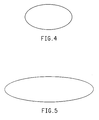
- an essential feature is the cross-sectional peripheral shape of the polyester fibers which should be a simple oval of aspect ratio from about 1.85:1 (as shown in Figure 4), preferably at least about 2.0:1, to about 3.5:1 (as shown in Figure 5).
- simple oval herein to distinguish from more complex cross-sections such as, for example, those with deep grooves or indentations or scallops as are disclosed by Gorrafa in U.S. Patent No. 3,914,488, Franklin in U.S. Patent No. 4,634,625, Clark et al in U.S. Patent No. 4,707,407, by Aneja in U.S. Patents Nos.
- the dye yield of fabrics of polyester staple fiber of scalloped-oval cross-section such as was disclosed, for example, by Gorrafa has been compared with that for polyester staple fiber of simple oval cross-section within the range according to the invention and the results are included in Example 1 hereinafter, the Gorrafa cross-section being referred to as "4gSO" in Table 1 (for 4 groove scalloped-oval) and its dye yield being 6 shades light, as compared to less than 1 and only 2 shades light for the staple fibers of the invention.
- scalloped-oval cross-sections are not desirable according to the invention, and a smooth oval cross-section is preferred, as will be understood, minor variations from a smooth oval periphery may not significantly increase the dye required and are likely to provide improved OES capability over round fibers.
- polyester staple fiber of simple oval cross-section As compared in several of the Examples hereinafter vs. polyester staple fiber of simple oval cross-section according to the invention were polyester staple fiber of "Peanut" cross-section, this term for a filament cross-section having been used, for example, in Japanese Patent Application Publication (Kokai), No.: Heisei 4-370,209 (Tanaka Kikinzoku KKK), published December 22, 1992, and being self-explanatory and indicating a peripheral cross-section that has a significant neck halfway along the major axis, instead of having its maximum width at where the minor axis of a simple oval would be located, so a peanut cross-section is not a simple oval cross-section.
- Japanese Patent Application Publication Kokai Hei 4-119118 described a polyester fiber with "oval and deformed cross-section" that was not a simple oval; it mostly described use as filament yarns, adding that its fiber could be "of filament or flocculent type”; it referred to several earlier Japanese published applications with various cross-sections that did not, apparently, disclose polyester fibers having a simple oval cross-section.
- Henning, GB 2 221 186 A disclosed high strength nylon monofilaments of high denier from high viscosity polyamide, desirably of ob-round cross-section, i.e., a generally flat, ribbon-like cross-section with rounded corners (top of page 6).
- Other disclosures of nylon filaments are Cornelis U.S. Patent 4,012,557, disclosing treating nylon-6 in powder form with aqueous KBr or NaBr and extruding it to form a filament of oval cross-section (e.g., col 4, lines 8, et seq), the dimensions of the resulting filament not being disclosed by Cornelis, and Jennings in U.S. Patents 4,702,875 and 4,801,503, disclosing and illustrating (Fig 2) high tenacity nylon filaments having a ribbon cross-section of length to width ratio greater than 3.
- Aspect ratio is the ratio of the major axis to the minor axis of the peripheral cross-section of the polyester staple fiber.
- low aspect ratios of 1.5:1 and 1.7:1 for Comparisons D and E would not provide as much advantage as we have obtained by use of staple fiber having cross-sections with higher aspect ratios of about 1.85:1 or more, because Comparisons D and E dyed significantly lighter in shade and so would require significantly more dyestuff; this is also referred to later herein, in relation to Figure 1.
- sample filaments of different oval cross-sections were melt-spun from the same polymer recipe and polymer viscosity through different capillaries to give the desired cross-sectional shapes for comparison in dye yield and open-end spinning. Also for comparison, to serve as a control, i.e., to show the state of the current commercial art, round filaments were dyed and spun in the same manner as the test items.
- the polymer melt-spun into filaments in each Example was poly(ethylene terephthalate) polymerized with the addition of 0.12 mole % of trimellitate chain-brancher (added as trihydroxyethyl trimellitate). As indicated, the polymer in Example 4 also contained a significant amount of PEO.
- the relative viscosities of the polymers were measured essentially as described by Hancock et al. U.S. Patent 4,704,329, col. 9 lines 6-11, but on a solution obtained by dissolving 0.40 grams of fiber in 5.0 ml. of solvent.
- the round filaments spun to provide controls were of course spun through circular orifices.
- the simple oval comparison filaments D & E in Table I were spun through orifices shaped like slots, of lengths, respectively, 15 mil (0.38mm) and 16 mil (0.4mm), with rounded bulges outwards in the middle of each longer side of the slots, of maximum width, respectively, 7 mil (0.18mm) and 5 mil (0.15mm), the slot for D being otherwise shaped like a rectangle with squared corners at each end, while the slot for E had radiused ends.
- the simple oval filaments spun to provide staple fiber yarns according to the invention were all spun through slots with parallel longer sides of overall lengths, respectively, 16 mil (0.4mm), 15 mil (0.38mm) and 28 mil (0.71mm), and widths, respectively, 3.5 mil (0.089mm), 3 mil 0.076mm) and 4.3 mil (0.109mm), the first and third of such slots having radiused ends, while the second was a rectangularly-shaped orifice
- these slots produced filaments of simple oval cross-section because the freshly-extruded melt bulged immediately under the orifices, the viscosity of the polymer, the quenching and the wind-up speed being important factors and empirical experimentation generally being desirable to obtain the particular non-round cross-sectional configuration desired, as is understood by those skilled in this art.
- Oval filaments may be made from orifices of other shapes, as is also well understood, e.g., from orifices that are themselves of oval shape, or with bulges, if desired.
- the ability to make polyester filaments of various smooth non-round cross-sections was previously known and is not part of the present invention, which is directed to the surprising advantages that we have found in using polyester fiber of simple oval peripheral cross-section having aspect ratios as claimed.
- the resulting filaments were then drawn, annealed, crimped and lubricated as described to give dpf, tensile and crimp properties as near alike as possible.
- Aspect ratio with regards to this disclosure is defined as the ratio of the maximum length to maximum width of the periphery of the filament cross-section, the length being the longest axis, and the length and width axes being perpendicular, normally but not necessarily taken through the centers of the samples. Aspect ratios were obtained by measuring the lengths and widths of multiple samples of drawn fibers, using cross-section images of each particular sample, according to the following procedure.
- a fiber specimen is mounted in a Hardy microtome (Hardy, U.S. Department of Agriculture circa 378, 1933) and divided into thin sections according to methods essentially as disclosed in "Fiber Microscopy Its Technique and Applications", by J. L. Sloves (van Nostrand Co., Inc., New York 1958, No. 180-182).
- Thin sections are then mounted on a super FIBERQUANT video microscope system stage (Vashaw Scientific Co., 3597 Parkway Lane, Suite 100, Norcross, Georgia 30092) and displayed on the Super FIBERQUANT CRT under magnifications as needed.
- the image of an individual thin section of one fiber is selected and critical fiber dimensions measured. The ratios are then calculated. This process is repeated for each filament in the field of view to generate a statistically significant sample set, and the averages are given herein.
- Tensile properties were measured using either a Model 1122 or 1123 Instron on fibers using a 0.5 inch (13mm) gauge length.
- Finish levels are given as FOT % (Finish on Tow) and were obtained on polyester fiber cut from the tow, using the well known tube elution method that gravimetrically determines the weight percent of finish oils after extracting the oils from the fiber with methanol, as a percentage of the weight of the fiber.
- CPI crimps per inch
- Open-end spinning (OES) trials were carried out on Schlafhorst SE-9 or SE-8 spinning frames using 100% or 50/50 cotton blend sliver prepared as described in the Examples. Spinning frame setup and conditions (including room temperature - humidity conditions) were held constant during each Example except for any adjustment of rotor speed per test design. For each Example, items were assayed one by one over a common set of 24 machine positions (rotors) for periods of 5 to 10 hours. Ends down (yarn formation failures in the spinning box) were tracked by the SE-8 or SE-9 instrumentation and the failure data normalized to express failures in terms of 1000 rotor hours for each item.
- each item was spun into 100% 20/1 cc (295 dtex) open-end yarns on a Schlafhorst SE-8.
- the resulting yarns were knitted into fabrics and then dyed in separate baths using 2% Terasil Blue GLF dyestuff per gram of fabric and a dye bath rate of rise of 3°F (2°C) per minute from room temperature up to 260°F (127°C) with a 30 minute hold at 260°F, a typical procedure used commercially for the dyeing of polyester.
- the dyed fabrics were then dried and instrumentally compared on a Color Mate HDS Color Analyzer using D65 standard daylight illuminant.
- the instrument provides a Delta E value that quantifies any difference from the color of the round fiber standard.
- a Delta E value greater than 0.7 units from standard is estimated as a dye shade difference of 1, so, for convenience, the number of shade differences are shown in the Tables as well as the Delta E values.
- Polyester filament samples having different oval-shaped cross-sections were melt-spun from polymer of 19 LRV through spinnerets fitted with capillaries designed to give different specific cross-section shapes in the fully-drawn fibers. Filaments were collected at 1800 yards per minute (1650 mpm) on bobbins using a commercial winding device.
- Bobbin lots of 2.5 and 3.2 aspect ratio simple oval cross-section according to the invention were prepared in this manner as well as the following comparisons that are not according to the invention, namely simple oval cross-sections of lower aspect ratio 1.5 and 1.7, more complex peanut-shaped and a 4 groove (4gSO) scalloped-oval cross-section, and a round cross-section as a control.
- Each bobbin lot was combined into a tow (from a creel) which was drawn, steam-annealed, crimped and dried to give a denier per filament of 1.2 (1.3 dtex) and similar tensile and crimp properties as given in Table 1.
- the same standard commercial lubrication useful for open-end spinning was applied to all the items during the drawing and crimping operation.
- the tensile and crimp properties and finish (FOT) in Table 1 are for the raw fibers.
- Each test lot was cut to standard 1.25 inch (32mm) fiber length and carded as 100% polyester. Some was spun into 100% polyester yarns and compared for Dye Yield as described hereinbefore, while other portions were draw frame blended with 70 grain (4.5 gm) carded cotton to give a 50/50 polyester cotton blend sliver of 68 grain (4.4 gm) weight, followed by finisher drawing to complete the draw blending operation and reduce the sliver weight to 60 grains (3.9 gm), which slivers were competitively spun into 28/1 cc (210 dtex) yarns on common rotors of a Schlafhorst SE-9 against the round control and the results are shown in Table 1, from which it can be seen that all the oval shapes tested gave significant reductions in ends down, i.e., significant improvements in OES process capability over the round commercial control.
- the dye advantage for simple oval cross-sections according to the invention is easily seen from Table 1, in contrast to oval cross-sections having Aspect Ratios of 1.5 and 1.7, which incurred substantial dye yield losses of 3 and 7 shades. Likewise, 4.5 and 6 shades of dye yield loss were incurred with the more complex cross-sections such as the peanut and the 4g scalloped-oval cross-section, although the peanut cross-section had an aspect ratio within the range of 2 to 3.5.
- polyester fibers according to the invention having simple oval cross-sections with high enough aspect ratios did not show much dye yield loss as compared with the same commercial standard, and in contrast to the other cross-sections tested, which showed significant dye yield losses, and did show significant improvements in OES process capability (at most about half the number of ends down as tested and compared with the round standard).
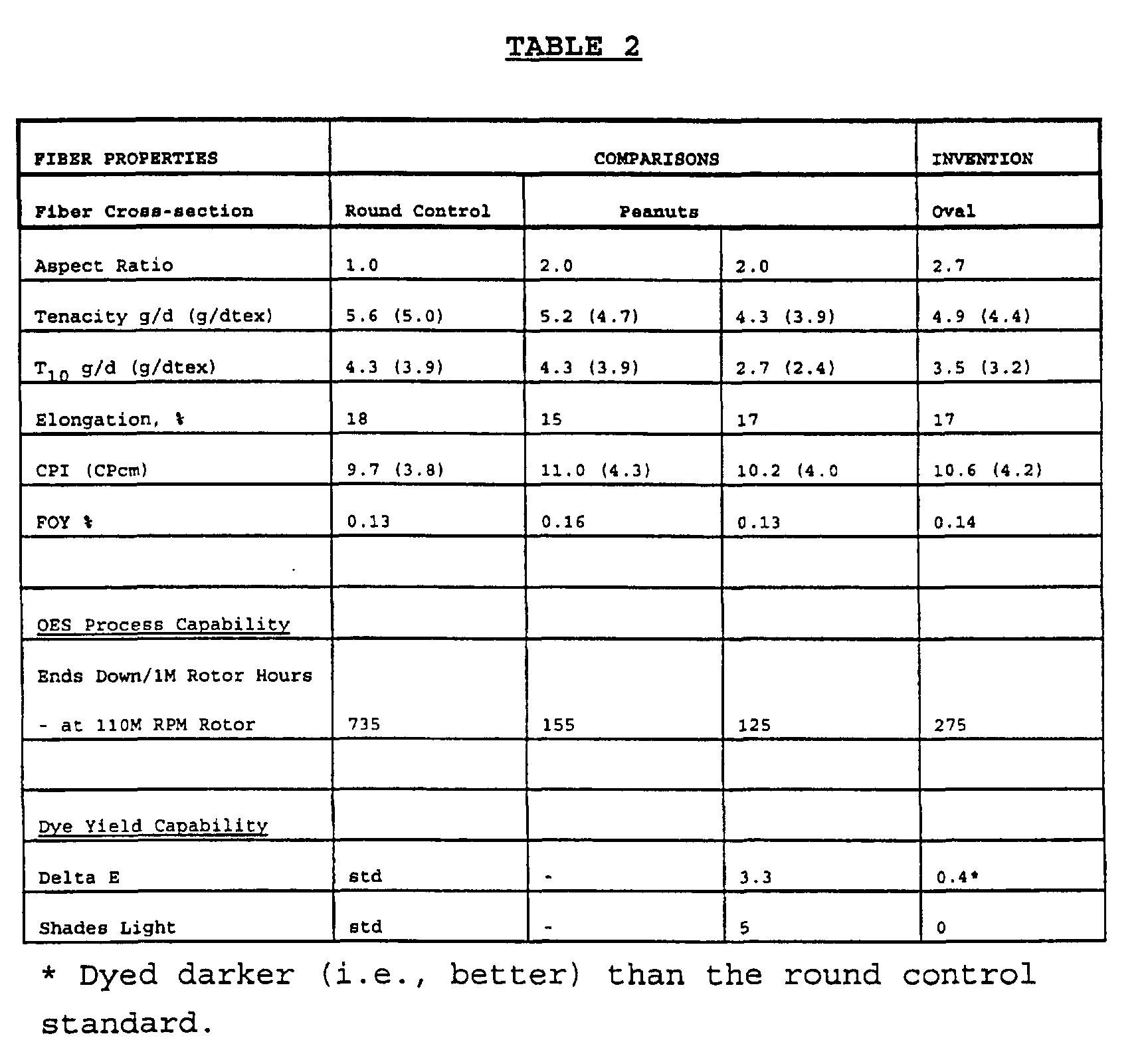
- Example 2 Another set of filaments having different cross-sections were prepared essentially as described in Example 1. These bobbin lots had fibers having a normal round cross-section as a control, a simple oval of 2.7 aspect ratio according to the invention, and two peanut cross-sections, each of aspect ratio 2.0 as comparisons. Their properties are listed in Table 2.
- Sample filaments having round cross-section (as a control again) and simple oval cross-section according to the invention were produced from polymer of about 20.3 LRV and about 2.3% by weight of PEO, poly(ethylene oxide) of 600 MW, but in other respects essentially as described in Example 1, and were processed and spun into yarns at a rotor speed of 107,000 RPM and compared also essentially as described in Example 1.
- Relevant parameters and results are summarized in Table 4, from which it can be seen that the fibers of simple oval cross-section according to the invention were processed into spun yarn much better (only a quarter of the failures encountered with the round control) without much loss in dye yield.
- the Dye Yields (Delta E values) for various fiber cross-sections that we have tested and measured have been plotted vs.
- a round cross-section standard has an Aspect Ratio of 1.0:1 and a ⁇ E of 0.0.
- ⁇ E and aspect ratio were very surprising. It was especially surprising to find that the ⁇ E for aspect ratios of about 1.85:1 and more were so significantly less than for oval cross-sections of lower aspect ratio, such as 1.5:1, and that such polyester staple fibers gave significant advantages in open-end spinning over conventional polyester staple fiber of round cross-section, but dyed so much more efficiently than polyester staple fiber having other oval cross-sections, especially those of lower aspect ratio.
- the complex oval cross-sections are shown in Figure 1 as "x" points, for the (4 groove) scalloped-oval cross-section and the peanut cross-sections used as Comparisons in the foregoing Examples.
- the ⁇ E dye yield is about 1.0 or less when the aspect ratio is about 1.85:1 or more, i.e., use of simple oval cross-sections having such aspect ratios, surprisingly, have given shade differences of about 1.5 or less as compared with conventional round cross-sections, together with improved open-end spinning capability.
- the slope of the curve is relatively steep below about 2.0:1, and especially below about 1.9:1 aspect ratio, the dye yield becomes more sensitive to aspect ratio changes, so tnat dye yield management becomes more difficult. This is one reason why we prefer to operate outside such a potential problem area, i.e., at least about 2.0:1, and especially at about 2.1:1 aspect ratio or somewhat more.
- proper care e.g., of spinneret design and careful polymer viscosity management, we believe that somebody could operate using lower aspect ratios, such as 1.85-1.95, and get acceptable dye yields.
Landscapes
- Engineering & Computer Science (AREA)
- Textile Engineering (AREA)
- Mechanical Engineering (AREA)
- Chemical & Material Sciences (AREA)
- Chemical Kinetics & Catalysis (AREA)
- General Chemical & Material Sciences (AREA)
- Artificial Filaments (AREA)
- Yarns And Mechanical Finishing Of Yarns Or Ropes (AREA)
- Spinning Methods And Devices For Manufacturing Artificial Fibers (AREA)
- Prostheses (AREA)
Description



Claims (8)
- Yarn comprising polyester fiber of simple oval cross-section characterised by a cross-section having an aspect ratio of about 1.85:1 to about 3.5:1.
- Yarn according to Claim 1, wherein said aspect ratio is at least about 2.0:1.
- Yarn according to Claim 2, wherein said aspect ratio is about 2.1-2.5:1.
- Yarn according to any of Claims 1 to 3, wherein the polyester fiber is polyester staple fiber.
- Yarn according to Claim 4, wherein the yarn is open-end spun yarn.
- A process of open-end spinning polyester staple fiber alone, or mixed with cotton, characterised by said polyester staple fiber having a simple oval cross-section of aspect ratio about 1.85:1 to about 3.5:1.
- A process according to Claim 6, wherein said aspect ratio is at least about 2.0:1.
- A process according to Claim 7, wherein said aspect ratio is about 2.1-2.5:1.
Applications Claiming Priority (3)
| Application Number | Priority Date | Filing Date | Title |
|---|---|---|---|
| US850457 | 1986-04-10 | ||
| US08/850,457 US6010789A (en) | 1997-05-05 | 1997-05-05 | Polyester staple fiber |
| PCT/US1998/009043 WO1998050608A1 (en) | 1997-05-05 | 1998-05-04 | Polyester yarn |
Publications (2)
| Publication Number | Publication Date |
|---|---|
| EP0981658A1 EP0981658A1 (en) | 2000-03-01 |
| EP0981658B1 true EP0981658B1 (en) | 2001-12-19 |
Family
ID=25308158
Family Applications (1)
| Application Number | Title | Priority Date | Filing Date |
|---|---|---|---|
| EP98920190A Expired - Lifetime EP0981658B1 (en) | 1997-05-05 | 1998-05-04 | Polyester yarn |
Country Status (14)
| Country | Link |
|---|---|
| US (2) | US6010789A (en) |
| EP (1) | EP0981658B1 (en) |
| JP (1) | JP2001524174A (en) |
| KR (1) | KR20010012226A (en) |
| CN (1) | CN1102967C (en) |
| AR (1) | AR012663A1 (en) |
| BR (1) | BR9815522A (en) |
| CA (1) | CA2286016A1 (en) |
| DE (1) | DE69803057T2 (en) |
| ES (1) | ES2166160T3 (en) |
| ID (1) | ID22777A (en) |
| TR (1) | TR199902713T2 (en) |
| TW (1) | TW593811B (en) |
| WO (1) | WO1998050608A1 (en) |
Cited By (1)
| Publication number | Priority date | Publication date | Assignee | Title |
|---|---|---|---|---|
| US11359309B2 (en) | 2018-12-21 | 2022-06-14 | Target Brands, Inc. | Ring spun yarn and method |
Families Citing this family (22)
| Publication number | Priority date | Publication date | Assignee | Title |
|---|---|---|---|---|
| TWI230213B (en) * | 2000-08-17 | 2005-04-01 | Toray Industries | Base fabric for non-coated air bags, and fibers for air bags |
| US6666234B2 (en) * | 2000-12-26 | 2003-12-23 | Blair Mills L.P. | Institutional towel |
| US6602911B2 (en) * | 2001-11-05 | 2003-08-05 | Cypress Bioscience, Inc. | Methods of treating fibromyalgia |
| DE10214479A1 (en) * | 2002-03-30 | 2003-10-09 | Neumag Gmbh & Co Kg | Staple fibers are chopped from a fixed and crimped tow, produced from a number of melt spun filament cables in rolls with a high packing density stored in a creel |
| WO2005108661A2 (en) * | 2004-04-15 | 2005-11-17 | Invista Technologies S.A.R.L. | High tenacity polyester yarns |
| ES2244334B1 (en) * | 2004-05-19 | 2006-09-01 | Relats, S.A. | PROTECTION TUBE |
| US8513146B2 (en) * | 2005-09-29 | 2013-08-20 | Invista North America S.ár.l. | Scalloped oval bicomponent fibers with good wicking, and high uniformity spun yarns comprising such fibers |
| KR100663056B1 (en) * | 2006-02-20 | 2007-01-02 | 도레이새한 주식회사 | Polyester fiber with excellent shielding and manufacturing method thereof |
| JP2010520384A (en) * | 2007-03-05 | 2010-06-10 | コーロン インダストリーズ,インコーポレイテッド | Polyester yarn and woven fabric containing the same |
| KR101228125B1 (en) * | 2007-03-05 | 2013-01-31 | 코오롱인더스트리 주식회사 | Polyester fiber, and fabric comprising the same |
| CN101864604A (en) * | 2009-04-15 | 2010-10-20 | 东丽纤维研究所(中国)有限公司 | Double-component fiber and production method thereof |
| USD640065S1 (en) * | 2009-12-23 | 2011-06-21 | Oliver Wang | Wicker yarn |
| USD640061S1 (en) | 2009-12-23 | 2011-06-21 | Oliver Wang | Wicker yarn |
| US8641944B2 (en) * | 2009-12-23 | 2014-02-04 | Oliver Wang | Synthetic yarn |
| US20110151256A1 (en) * | 2009-12-23 | 2011-06-23 | Oliver Wang | Synthetic yarn |
| CN102031594B (en) * | 2010-12-30 | 2013-04-10 | 中国石油化工股份有限公司 | Production method of polyester staple fiber for jet vortex spinning process |
| ITMO20110239A1 (en) * | 2011-09-20 | 2013-03-21 | Max Mara S R L Societa Uniperson Ale | FABRIC, GARMENT AND METHOD FOR THE PRODUCTION OF A FABRIC |
| US20130101781A1 (en) * | 2011-10-24 | 2013-04-25 | Bestkey Textiles Limited | Woven and knitted fabrics with improved properties and core spun yarns for producing the same |
| IL218082A0 (en) * | 2012-02-13 | 2012-03-29 | Nilit Ltd | Cooling polyamide yarn |
| CN102787379A (en) * | 2012-08-27 | 2012-11-21 | 张家港锦亿化纤有限公司 | Preparation method of color-concentrated type composite polyester drawn textured yarn |
| CN106283236B (en) * | 2016-08-30 | 2018-05-18 | 桐昆集团浙江恒通化纤有限公司 | A kind of preparation processing method of two-sided hair ease Down Fiber |
| US11202508B2 (en) | 2017-08-28 | 2021-12-21 | Agio International Co., Ltd | Q-shaped wicker furniture |
Family Cites Families (32)
| Publication number | Priority date | Publication date | Assignee | Title |
|---|---|---|---|---|
| US2744087A (en) | 1951-12-11 | 1956-05-01 | Du Pont | Polyester from terephthalic acid, ethylene glycol and polyethylene glycol |
| NL285942A (en) * | 1961-11-30 | |||
| US3816486A (en) | 1969-11-26 | 1974-06-11 | Du Pont | Two stage drawn and relaxed staple fiber |
| FR2187945B1 (en) | 1972-06-02 | 1976-10-29 | Cornelis Jean Philippe | |
| US3914488A (en) | 1973-09-24 | 1975-10-21 | Du Pont | Polyester filaments for fur-like fabrics |
| DE3011118A1 (en) | 1978-06-03 | 1981-10-01 | Akzo Gmbh, 5600 Wuppertal | Polyester micro-filaments with multiple longitudinal cavities - giving precision micro:filters and light, high-absorptive felts |
| DE2824500A1 (en) | 1978-06-03 | 1979-12-13 | Akzo Gmbh | MOLECULAR-ORIENTED DRAWABLE FILAMENTS OR FIBERS MADE OF POLYESTER, THE PROCESS FOR THEIR MANUFACTURING AND THEIR USE |
| JPS5831276A (en) * | 1981-08-19 | 1983-02-23 | 松下冷機株式会社 | Heat-insulating box body |
| US4410579A (en) | 1982-09-24 | 1983-10-18 | E. I. Du Pont De Nemours And Company | Nonwoven fabric of ribbon-shaped polyester fibers |
| US4704329A (en) | 1984-03-16 | 1987-11-03 | E. I. Du Pont De Nemours And Company | Annealed polyester filaments and a process for making them |
| US4634625A (en) | 1984-10-25 | 1987-01-06 | E. I. Du Pont De Nemours And Company | New fabrics, yarns and process |
| US4707407A (en) | 1985-04-09 | 1987-11-17 | E. I. Du Pont De Nemours And Company | Synthetic water-dispersible fiber |
| US4801503A (en) | 1985-06-14 | 1989-01-31 | E. I. Du Pont De Nemours And Company | High tenacity polyhexamethylene adipamide yarn having ribbon cross-section filaments |
| US4702875A (en) | 1985-06-14 | 1987-10-27 | E. I. Du Pont De Nemours And Company | Process for producing high tenacity polyhexamethylene adipamide yarn having ribbon cross-section |
| JPS6257913A (en) * | 1985-09-06 | 1987-03-13 | Asahi Chem Ind Co Ltd | Polyester yarn for woven fabric |
| US4666454A (en) | 1985-09-09 | 1987-05-19 | Celanese Corporation | Production of a fabric containing polyethylene terephthalate fibers having a reduced tendency to pill |
| JPS62170543A (en) * | 1986-01-21 | 1987-07-27 | 旭化成株式会社 | False twisted processed yarn for stockings |
| US4729214A (en) | 1987-01-20 | 1988-03-08 | E. I. Du Pont De Nemours And Company | Combined carpet yarns by open end rotor spinning |
| US4845946A (en) * | 1988-02-24 | 1989-07-11 | W. Schlafhorst & Co. | Method of producing mottled rotor spun yarn |
| BR8903439A (en) | 1988-07-15 | 1990-03-06 | Du Pont | MONOFILAMENT PREPARED FROM LINEAR POLYAMIDE POLYMER |
| AU618821B2 (en) * | 1988-12-22 | 1992-01-09 | E.I. Du Pont De Nemours And Company | High tenacity, oblong cross-section monofilaments |
| JPH0434033A (en) * | 1990-05-31 | 1992-02-05 | Asahi Chem Ind Co Ltd | Acryl open-end spun yarn |
| US5223187A (en) | 1990-06-14 | 1993-06-29 | E. I. Du Pont De Nemours And Company | Process of making polyester monofilaments for reinforcing tires |
| JPH04119118A (en) | 1990-09-05 | 1992-04-20 | Toray Ind Inc | Elliptical modified cross section polyester fiber |
| JPH04370209A (en) | 1991-06-20 | 1992-12-22 | Tanaka Kikinzoku Kogyo Kk | Production of spinneret for spinning of modified fiber |
| US5219582A (en) | 1991-12-06 | 1993-06-15 | E. I. Du Pont De Nemours And Company | Apparatus for quenching melt spun filaments |
| US5219506A (en) | 1991-12-06 | 1993-06-15 | E. I. Du Pont De Nemours And Company | Preparing fine denier staple fibers |
| DE4209970A1 (en) * | 1992-03-27 | 1993-09-30 | Hoechst Ag | Structured knitted pile fabric - has selected thicknesses of filament yarns for piles and ground fabric for seating upholstery |
| JP3284735B2 (en) * | 1994-03-10 | 2002-05-20 | 東レ株式会社 | Base fabric for airbag |
| US5591523A (en) | 1995-06-30 | 1997-01-07 | E. I. Du Pont De Nemours And Company | Polyester tow |
| US5626961A (en) | 1995-06-30 | 1997-05-06 | E. I. Du Pont De Nemours And Company | Polyester filaments and tows |
| US5817740A (en) * | 1997-02-12 | 1998-10-06 | E. I. Du Pont De Nemours And Company | Low pill polyester |
-
1997
- 1997-05-05 US US08/850,457 patent/US6010789A/en not_active Expired - Fee Related
-
1998
- 1998-05-04 JP JP54833098A patent/JP2001524174A/en not_active Withdrawn
- 1998-05-04 KR KR1019997010175A patent/KR20010012226A/en not_active Abandoned
- 1998-05-04 DE DE69803057T patent/DE69803057T2/en not_active Expired - Lifetime
- 1998-05-04 WO PCT/US1998/009043 patent/WO1998050608A1/en not_active Ceased
- 1998-05-04 US US09/101,566 patent/US6413631B1/en not_active Expired - Fee Related
- 1998-05-04 BR BR9815522-9A patent/BR9815522A/en not_active Application Discontinuation
- 1998-05-04 CA CA002286016A patent/CA2286016A1/en not_active Abandoned
- 1998-05-04 CN CN98804714A patent/CN1102967C/en not_active Expired - Fee Related
- 1998-05-04 ES ES98920190T patent/ES2166160T3/en not_active Expired - Lifetime
- 1998-05-04 EP EP98920190A patent/EP0981658B1/en not_active Expired - Lifetime
- 1998-05-04 TR TR1999/02713T patent/TR199902713T2/en unknown
- 1998-05-04 ID IDW991318A patent/ID22777A/en unknown
- 1998-05-05 AR ARP980102095A patent/AR012663A1/en active IP Right Grant
- 1998-05-20 TW TW087106931A patent/TW593811B/en not_active IP Right Cessation
Cited By (2)
| Publication number | Priority date | Publication date | Assignee | Title |
|---|---|---|---|---|
| US11359309B2 (en) | 2018-12-21 | 2022-06-14 | Target Brands, Inc. | Ring spun yarn and method |
| US11767618B2 (en) | 2018-12-21 | 2023-09-26 | Target Brands, Inc. | Ring spun yarn and method |
Also Published As
| Publication number | Publication date |
|---|---|
| TR199902713T2 (en) | 2000-05-22 |
| CA2286016A1 (en) | 1998-11-12 |
| DE69803057T2 (en) | 2002-07-18 |
| DE69803057D1 (en) | 2002-01-31 |
| BR9815522A (en) | 2001-11-06 |
| JP2001524174A (en) | 2001-11-27 |
| US6413631B1 (en) | 2002-07-02 |
| US6010789A (en) | 2000-01-04 |
| WO1998050608A1 (en) | 1998-11-12 |
| CN1102967C (en) | 2003-03-12 |
| EP0981658A1 (en) | 2000-03-01 |
| KR20010012226A (en) | 2001-02-15 |
| CN1254388A (en) | 2000-05-24 |
| ID22777A (en) | 1999-12-09 |
| TW593811B (en) | 2004-06-21 |
| AR012663A1 (en) | 2000-11-08 |
| ES2166160T3 (en) | 2002-04-01 |
Similar Documents
| Publication | Publication Date | Title |
|---|---|---|
| US6413631B1 (en) | Process of open-end spinning of polyester staple fiber | |
| US5626961A (en) | Polyester filaments and tows | |
| EP0951592B1 (en) | Improvements in filament cross sections | |
| US5591523A (en) | Polyester tow | |
| EP0848766B1 (en) | Polyester tows | |
| CA2511114A1 (en) | Staple fibers and processes for making same | |
| WO1997002374A9 (en) | New polyester tows | |
| CA2106421C (en) | Mixed cross-section carpet yarn | |
| US5486417A (en) | Mixed cross-section carpet yarn | |
| CA1048765A (en) | Mixed cross-section staple filament mixtures and yarn therefrom | |
| US4933427A (en) | New heather yarns having pleasing aesthetics | |
| WO1999055941A2 (en) | Method of producing high quality dark dyeing polyester and resulting yarns and fabrics | |
| EP0601372B1 (en) | Mixed cross-section carpet yarn | |
| US6546711B2 (en) | Sewing yarn and process for the manufacture of a sewing yarn | |
| EP0070703B1 (en) | Polyester conjugate crimped yarns, process for preparation thereof, and polyester stretch fabrics | |
| JPH0651925B2 (en) | Fiber with special cross-sectional shape | |
| JP2002088585A (en) | Polyester composite short fiber and method for producing the same | |
| JPH08246245A (en) | Core-sheath composite staple fiber for non-woven fabric | |
| EP1068378A1 (en) | Drawing of polyester filaments |
Legal Events
| Date | Code | Title | Description |
|---|---|---|---|
| PUAI | Public reference made under article 153(3) epc to a published international application that has entered the european phase |
Free format text: ORIGINAL CODE: 0009012 |
|
| 17P | Request for examination filed |
Effective date: 19991011 |
|
| AK | Designated contracting states |
Kind code of ref document: A1 Designated state(s): DE ES FR GB IT |
|
| GRAG | Despatch of communication of intention to grant |
Free format text: ORIGINAL CODE: EPIDOS AGRA |
|
| 17Q | First examination report despatched |
Effective date: 20001228 |
|
| GRAG | Despatch of communication of intention to grant |
Free format text: ORIGINAL CODE: EPIDOS AGRA |
|
| GRAH | Despatch of communication of intention to grant a patent |
Free format text: ORIGINAL CODE: EPIDOS IGRA |
|
| GRAH | Despatch of communication of intention to grant a patent |
Free format text: ORIGINAL CODE: EPIDOS IGRA |
|
| GRAA | (expected) grant |
Free format text: ORIGINAL CODE: 0009210 |
|
| AK | Designated contracting states |
Kind code of ref document: B1 Designated state(s): DE ES FR GB IT |
|
| REG | Reference to a national code |
Ref country code: GB Ref legal event code: IF02 |
|
| REF | Corresponds to: |
Ref document number: 69803057 Country of ref document: DE Date of ref document: 20020131 |
|
| REG | Reference to a national code |
Ref country code: ES Ref legal event code: FG2A Ref document number: 2166160 Country of ref document: ES Kind code of ref document: T3 |
|
| PLBE | No opposition filed within time limit |
Free format text: ORIGINAL CODE: 0009261 |
|
| STAA | Information on the status of an ep patent application or granted ep patent |
Free format text: STATUS: NO OPPOSITION FILED WITHIN TIME LIMIT |
|
| 26N | No opposition filed | ||
| REG | Reference to a national code |
Ref country code: FR Ref legal event code: TP |
|
| REG | Reference to a national code |
Ref country code: GB Ref legal event code: 732E |
|
| PGFP | Annual fee paid to national office [announced via postgrant information from national office to epo] |
Ref country code: DE Payment date: 20130506 Year of fee payment: 16 Ref country code: GB Payment date: 20130508 Year of fee payment: 16 |
|
| PGFP | Annual fee paid to national office [announced via postgrant information from national office to epo] |
Ref country code: IT Payment date: 20130513 Year of fee payment: 16 |
|
| REG | Reference to a national code |
Ref country code: FR Ref legal event code: TP Owner name: INVISTA TECHNOLOGIES S.A R.L., CH Effective date: 20140102 |
|
| REG | Reference to a national code |
Ref country code: ES Ref legal event code: PC2A Owner name: INVISTA TECHNOLOGIES S.A.R.L. Effective date: 20140129 |
|
| REG | Reference to a national code |
Ref country code: DE Ref legal event code: R082 Ref document number: 69803057 Country of ref document: DE Representative=s name: PATENTANWAELTE ZELLENTIN & PARTNER GBR, DE |
|
| REG | Reference to a national code |
Ref country code: DE Ref legal event code: R082 Ref document number: 69803057 Country of ref document: DE Representative=s name: PATENTANWAELTE ZELLENTIN & PARTNER GBR, DE Effective date: 20140604 Ref country code: DE Ref legal event code: R081 Ref document number: 69803057 Country of ref document: DE Owner name: INVISTA TECHNOLOGIES S.A.R.L., CH Free format text: FORMER OWNER: ADVANSA BV, HOOFDDORP, NL Effective date: 20140604 |
|
| REG | Reference to a national code |
Ref country code: GB Ref legal event code: 732E Free format text: REGISTERED BETWEEN 20140626 AND 20140702 |
|
| REG | Reference to a national code |
Ref country code: DE Ref legal event code: R119 Ref document number: 69803057 Country of ref document: DE |
|
| GBPC | Gb: european patent ceased through non-payment of renewal fee |
Effective date: 20140504 |
|
| REG | Reference to a national code |
Ref country code: DE Ref legal event code: R119 Ref document number: 69803057 Country of ref document: DE Effective date: 20141202 |
|
| PG25 | Lapsed in a contracting state [announced via postgrant information from national office to epo] |
Ref country code: DE Free format text: LAPSE BECAUSE OF NON-PAYMENT OF DUE FEES Effective date: 20141202 Ref country code: IT Free format text: LAPSE BECAUSE OF NON-PAYMENT OF DUE FEES Effective date: 20140504 |
|
| PG25 | Lapsed in a contracting state [announced via postgrant information from national office to epo] |
Ref country code: GB Free format text: LAPSE BECAUSE OF NON-PAYMENT OF DUE FEES Effective date: 20140504 |
|
| REG | Reference to a national code |
Ref country code: FR Ref legal event code: PLFP Year of fee payment: 19 |
|
| REG | Reference to a national code |
Ref country code: FR Ref legal event code: PLFP Year of fee payment: 20 |
|
| PGFP | Annual fee paid to national office [announced via postgrant information from national office to epo] |
Ref country code: FR Payment date: 20170413 Year of fee payment: 20 |
|
| PGFP | Annual fee paid to national office [announced via postgrant information from national office to epo] |
Ref country code: ES Payment date: 20170602 Year of fee payment: 20 |
|
| REG | Reference to a national code |
Ref country code: ES Ref legal event code: FD2A Effective date: 20200902 |
|
| PG25 | Lapsed in a contracting state [announced via postgrant information from national office to epo] |
Ref country code: ES Free format text: LAPSE BECAUSE OF EXPIRATION OF PROTECTION Effective date: 20180505 |