EP0981506B1 - Beton autonivelant et procede de fabrication d'une piece de construction - Google Patents
Beton autonivelant et procede de fabrication d'une piece de construction Download PDFInfo
- Publication number
- EP0981506B1 EP0981506B1 EP98924417A EP98924417A EP0981506B1 EP 0981506 B1 EP0981506 B1 EP 0981506B1 EP 98924417 A EP98924417 A EP 98924417A EP 98924417 A EP98924417 A EP 98924417A EP 0981506 B1 EP0981506 B1 EP 0981506B1
- Authority
- EP
- European Patent Office
- Prior art keywords
- self
- superplasticizer
- concrete according
- levelling
- levelling concrete
- Prior art date
- Legal status (The legal status is an assumption and is not a legal conclusion. Google has not performed a legal analysis and makes no representation as to the accuracy of the status listed.)
- Expired - Lifetime
Links
- 239000004567 concrete Substances 0.000 title claims abstract description 123
- 238000000034 method Methods 0.000 title claims abstract description 27
- 239000008030 superplasticizer Substances 0.000 claims abstract description 64
- 150000001875 compounds Chemical class 0.000 claims abstract description 29
- 150000003839 salts Chemical class 0.000 claims abstract description 12
- 239000002245 particle Substances 0.000 claims abstract description 6
- 239000007787 solid Substances 0.000 claims abstract description 5
- 238000007654 immersion Methods 0.000 claims abstract 5
- 239000004568 cement Substances 0.000 claims description 36
- 239000000203 mixture Substances 0.000 claims description 35
- VGGSQFUCUMXWEO-UHFFFAOYSA-N Ethene Chemical compound C=C VGGSQFUCUMXWEO-UHFFFAOYSA-N 0.000 claims description 23
- 239000003795 chemical substances by application Substances 0.000 claims description 22
- 125000004432 carbon atom Chemical group C* 0.000 claims description 17
- 239000005977 Ethylene Substances 0.000 claims description 15
- XLYOFNOQVPJJNP-UHFFFAOYSA-N water Substances O XLYOFNOQVPJJNP-UHFFFAOYSA-N 0.000 claims description 15
- 229910018828 PO3H2 Inorganic materials 0.000 claims description 12
- 150000001412 amines Chemical class 0.000 claims description 12
- 239000002518 antifoaming agent Substances 0.000 claims description 12
- QQONPFPTGQHPMA-UHFFFAOYSA-N propylene Natural products CC=C QQONPFPTGQHPMA-UHFFFAOYSA-N 0.000 claims description 12
- HGCIXCUEYOPUTN-UHFFFAOYSA-N cyclohexene Chemical compound C1CCC=CC1 HGCIXCUEYOPUTN-UHFFFAOYSA-N 0.000 claims description 10
- 125000005842 heteroatom Chemical group 0.000 claims description 10
- 150000002430 hydrocarbons Chemical group 0.000 claims description 10
- 239000002562 thickening agent Substances 0.000 claims description 10
- 238000002347 injection Methods 0.000 claims description 9
- 239000007924 injection Substances 0.000 claims description 9
- 150000002894 organic compounds Chemical class 0.000 claims description 8
- -1 ethylene, propylene, butylene Chemical group 0.000 claims description 7
- 229910052500 inorganic mineral Inorganic materials 0.000 claims description 7
- 239000011707 mineral Substances 0.000 claims description 7
- 125000004805 propylene group Chemical group [H]C([H])([H])C([H])([*:1])C([H])([H])[*:2] 0.000 claims description 7
- 229920006395 saturated elastomer Polymers 0.000 claims description 7
- 239000002253 acid Substances 0.000 claims description 6
- 125000004435 hydrogen atom Chemical group [H]* 0.000 claims description 6
- 239000000178 monomer Substances 0.000 claims description 6
- 125000006353 oxyethylene group Chemical group 0.000 claims description 6
- 229920000570 polyether Polymers 0.000 claims description 6
- 235000019355 sepiolite Nutrition 0.000 claims description 6
- LIKMAJRDDDTEIG-UHFFFAOYSA-N 1-hexene Chemical compound CCCCC=C LIKMAJRDDDTEIG-UHFFFAOYSA-N 0.000 claims description 5
- IJGRMHOSHXDMSA-UHFFFAOYSA-N Atomic nitrogen Chemical compound N#N IJGRMHOSHXDMSA-UHFFFAOYSA-N 0.000 claims description 5
- 239000004721 Polyphenylene oxide Substances 0.000 claims description 5
- 239000004113 Sepiolite Substances 0.000 claims description 5
- PPBRXRYQALVLMV-UHFFFAOYSA-N Styrene Chemical compound C=CC1=CC=CC=C1 PPBRXRYQALVLMV-UHFFFAOYSA-N 0.000 claims description 5
- 125000002947 alkylene group Chemical group 0.000 claims description 5
- 239000011230 binding agent Substances 0.000 claims description 5
- 239000000284 extract Substances 0.000 claims description 5
- 229910052624 sepiolite Inorganic materials 0.000 claims description 5
- 125000001570 methylene group Chemical group [H]C([H])([*:1])[*:2] 0.000 claims description 4
- 125000005702 oxyalkylene group Chemical group 0.000 claims description 4
- OYPRJOBELJOOCE-UHFFFAOYSA-N Calcium Chemical compound [Ca] OYPRJOBELJOOCE-UHFFFAOYSA-N 0.000 claims description 3
- DGAQECJNVWCQMB-PUAWFVPOSA-M Ilexoside XXIX Chemical compound C[C@@H]1CC[C@@]2(CC[C@@]3(C(=CC[C@H]4[C@]3(CC[C@@H]5[C@@]4(CC[C@@H](C5(C)C)OS(=O)(=O)[O-])C)C)[C@@H]2[C@]1(C)O)C)C(=O)O[C@H]6[C@@H]([C@H]([C@@H]([C@H](O6)CO)O)O)O.[Na+] DGAQECJNVWCQMB-PUAWFVPOSA-M 0.000 claims description 3
- NINIDFKCEFEMDL-UHFFFAOYSA-N Sulfur Chemical compound [S] NINIDFKCEFEMDL-UHFFFAOYSA-N 0.000 claims description 3
- 125000001118 alkylidene group Chemical group 0.000 claims description 3
- 229910052791 calcium Inorganic materials 0.000 claims description 3
- 239000011575 calcium Substances 0.000 claims description 3
- 239000001913 cellulose Substances 0.000 claims description 3
- 229920002678 cellulose Polymers 0.000 claims description 3
- ZBCBWPMODOFKDW-UHFFFAOYSA-N diethanolamine Chemical class OCCNCCO ZBCBWPMODOFKDW-UHFFFAOYSA-N 0.000 claims description 3
- 239000012530 fluid Substances 0.000 claims description 3
- 150000004676 glycans Chemical class 0.000 claims description 3
- 229920001282 polysaccharide Polymers 0.000 claims description 3
- 239000005017 polysaccharide Substances 0.000 claims description 3
- 229910052708 sodium Inorganic materials 0.000 claims description 3
- 239000011734 sodium Substances 0.000 claims description 3
- 229920001285 xanthan gum Polymers 0.000 claims description 3
- KWKAKUADMBZCLK-UHFFFAOYSA-N 1-octene Chemical group CCCCCCC=C KWKAKUADMBZCLK-UHFFFAOYSA-N 0.000 claims description 2
- BKOOMYPCSUNDGP-UHFFFAOYSA-N 2-methylbut-2-ene Chemical group CC=C(C)C BKOOMYPCSUNDGP-UHFFFAOYSA-N 0.000 claims description 2
- JLBJTVDPSNHSKJ-UHFFFAOYSA-N 4-Methylstyrene Chemical compound CC1=CC=C(C=C)C=C1 JLBJTVDPSNHSKJ-UHFFFAOYSA-N 0.000 claims description 2
- 125000002877 alkyl aryl group Chemical group 0.000 claims description 2
- 125000000217 alkyl group Chemical group 0.000 claims description 2
- 239000012736 aqueous medium Substances 0.000 claims description 2
- 125000000732 arylene group Chemical group 0.000 claims description 2
- 239000002956 ash Substances 0.000 claims description 2
- QVGXLLKOCUKJST-UHFFFAOYSA-N atomic oxygen Chemical compound [O] QVGXLLKOCUKJST-UHFFFAOYSA-N 0.000 claims description 2
- 239000000945 filler Substances 0.000 claims description 2
- 238000009499 grossing Methods 0.000 claims description 2
- 239000004530 micro-emulsion Substances 0.000 claims description 2
- 229910052757 nitrogen Inorganic materials 0.000 claims description 2
- 239000007764 o/w emulsion Substances 0.000 claims description 2
- 229910052760 oxygen Inorganic materials 0.000 claims description 2
- 239000001301 oxygen Substances 0.000 claims description 2
- 239000002893 slag Substances 0.000 claims description 2
- 239000003381 stabilizer Substances 0.000 claims description 2
- 239000003760 tallow Substances 0.000 claims description 2
- 125000000391 vinyl group Chemical group [H]C([*])=C([H])[H] 0.000 claims description 2
- 229920002554 vinyl polymer Polymers 0.000 claims description 2
- 239000000230 xanthan gum Substances 0.000 claims description 2
- 229940082509 xanthan gum Drugs 0.000 claims description 2
- 235000010493 xanthan gum Nutrition 0.000 claims description 2
- 239000013589 supplement Substances 0.000 claims 3
- 229930195734 saturated hydrocarbon Natural products 0.000 claims 2
- 229930195735 unsaturated hydrocarbon Natural products 0.000 claims 2
- 235000002918 Fraxinus excelsior Nutrition 0.000 claims 1
- 239000005864 Sulphur Substances 0.000 claims 1
- 239000000654 additive Substances 0.000 claims 1
- 230000003254 anti-foaming effect Effects 0.000 claims 1
- 235000019864 coconut oil Nutrition 0.000 claims 1
- 239000003240 coconut oil Substances 0.000 claims 1
- 239000008187 granular material Substances 0.000 claims 1
- 125000002924 primary amino group Chemical group [H]N([H])* 0.000 claims 1
- 125000000467 secondary amino group Chemical group [H]N([*:1])[*:2] 0.000 claims 1
- 125000001302 tertiary amino group Chemical group 0.000 claims 1
- 238000005086 pumping Methods 0.000 abstract description 3
- 238000009415 formwork Methods 0.000 description 11
- 238000012360 testing method Methods 0.000 description 11
- 125000004429 atom Chemical group 0.000 description 9
- 239000010881 fly ash Substances 0.000 description 9
- 238000004519 manufacturing process Methods 0.000 description 9
- 230000007480 spreading Effects 0.000 description 9
- 238000003892 spreading Methods 0.000 description 9
- 241000196324 Embryophyta Species 0.000 description 8
- 238000010276 construction Methods 0.000 description 8
- 230000008569 process Effects 0.000 description 6
- 238000000518 rheometry Methods 0.000 description 5
- 238000012423 maintenance Methods 0.000 description 4
- 239000004576 sand Substances 0.000 description 4
- 239000000047 product Substances 0.000 description 3
- 229920002310 Welan gum Polymers 0.000 description 2
- 239000002671 adjuvant Substances 0.000 description 2
- 239000002585 base Substances 0.000 description 2
- 230000015572 biosynthetic process Effects 0.000 description 2
- 230000000740 bleeding effect Effects 0.000 description 2
- 244000309464 bull Species 0.000 description 2
- 230000000295 complement effect Effects 0.000 description 2
- YLGXILFCIXHCMC-JHGZEJCSSA-N methyl cellulose Chemical compound COC1C(OC)C(OC)C(COC)O[C@H]1O[C@H]1C(OC)C(OC)C(OC)OC1COC YLGXILFCIXHCMC-JHGZEJCSSA-N 0.000 description 2
- 238000002156 mixing Methods 0.000 description 2
- 230000002787 reinforcement Effects 0.000 description 2
- 238000005204 segregation Methods 0.000 description 2
- WECIKJKLCDCIMY-UHFFFAOYSA-N 2-chloro-n-(2-cyanoethyl)acetamide Chemical compound ClCC(=O)NCCC#N WECIKJKLCDCIMY-UHFFFAOYSA-N 0.000 description 1
- 241000195940 Bryophyta Species 0.000 description 1
- 235000013162 Cocos nucifera Nutrition 0.000 description 1
- 244000060011 Cocos nucifera Species 0.000 description 1
- 235000019738 Limestone Nutrition 0.000 description 1
- 241000209504 Poaceae Species 0.000 description 1
- 229920002472 Starch Polymers 0.000 description 1
- 229910000831 Steel Inorganic materials 0.000 description 1
- 229910052783 alkali metal Inorganic materials 0.000 description 1
- 150000001340 alkali metals Chemical class 0.000 description 1
- 229910052784 alkaline earth metal Inorganic materials 0.000 description 1
- 150000001342 alkaline earth metals Chemical class 0.000 description 1
- 239000008346 aqueous phase Substances 0.000 description 1
- 239000007900 aqueous suspension Substances 0.000 description 1
- 230000005587 bubbling Effects 0.000 description 1
- 210000004534 cecum Anatomy 0.000 description 1
- 239000011248 coating agent Substances 0.000 description 1
- 238000000576 coating method Methods 0.000 description 1
- 230000007547 defect Effects 0.000 description 1
- 230000001419 dependent effect Effects 0.000 description 1
- 230000000694 effects Effects 0.000 description 1
- 239000000839 emulsion Substances 0.000 description 1
- 229940082150 encore Drugs 0.000 description 1
- 238000005516 engineering process Methods 0.000 description 1
- 238000011049 filling Methods 0.000 description 1
- 239000012467 final product Substances 0.000 description 1
- 239000006260 foam Substances 0.000 description 1
- 238000009472 formulation Methods 0.000 description 1
- 230000005484 gravity Effects 0.000 description 1
- 238000003780 insertion Methods 0.000 description 1
- 230000037431 insertion Effects 0.000 description 1
- 238000009434 installation Methods 0.000 description 1
- 239000006028 limestone Substances 0.000 description 1
- 239000007788 liquid Substances 0.000 description 1
- 238000011068 loading method Methods 0.000 description 1
- 239000000463 material Substances 0.000 description 1
- 238000012986 modification Methods 0.000 description 1
- 230000004048 modification Effects 0.000 description 1
- 235000011929 mousse Nutrition 0.000 description 1
- 239000003921 oil Substances 0.000 description 1
- 238000002360 preparation method Methods 0.000 description 1
- 150000003141 primary amines Chemical class 0.000 description 1
- 238000003908 quality control method Methods 0.000 description 1
- 125000001453 quaternary ammonium group Chemical group 0.000 description 1
- 239000011395 ready-mix concrete Substances 0.000 description 1
- 150000003335 secondary amines Chemical class 0.000 description 1
- 239000007921 spray Substances 0.000 description 1
- 238000005507 spraying Methods 0.000 description 1
- 235000019698 starch Nutrition 0.000 description 1
- 239000010959 steel Substances 0.000 description 1
- 239000000126 substance Substances 0.000 description 1
- 229910052717 sulfur Inorganic materials 0.000 description 1
- 239000011593 sulfur Substances 0.000 description 1
- 238000003786 synthesis reaction Methods 0.000 description 1
- 150000003512 tertiary amines Chemical group 0.000 description 1
- 239000010409 thin film Substances 0.000 description 1
- 238000012549 training Methods 0.000 description 1
- STCOOQWBFONSKY-UHFFFAOYSA-N tributyl phosphate Chemical compound CCCCOP(=O)(OCCCC)OCCCC STCOOQWBFONSKY-UHFFFAOYSA-N 0.000 description 1
- 229940093635 tributyl phosphate Drugs 0.000 description 1
- 235000013311 vegetables Nutrition 0.000 description 1
Images
Classifications
-
- C—CHEMISTRY; METALLURGY
- C04—CEMENTS; CONCRETE; ARTIFICIAL STONE; CERAMICS; REFRACTORIES
- C04B—LIME, MAGNESIA; SLAG; CEMENTS; COMPOSITIONS THEREOF, e.g. MORTARS, CONCRETE OR LIKE BUILDING MATERIALS; ARTIFICIAL STONE; CERAMICS; REFRACTORIES; TREATMENT OF NATURAL STONE
- C04B24/00—Use of organic materials as active ingredients for mortars, concrete or artificial stone, e.g. plasticisers
- C04B24/003—Phosphorus-containing compounds
-
- C—CHEMISTRY; METALLURGY
- C04—CEMENTS; CONCRETE; ARTIFICIAL STONE; CERAMICS; REFRACTORIES
- C04B—LIME, MAGNESIA; SLAG; CEMENTS; COMPOSITIONS THEREOF, e.g. MORTARS, CONCRETE OR LIKE BUILDING MATERIALS; ARTIFICIAL STONE; CERAMICS; REFRACTORIES; TREATMENT OF NATURAL STONE
- C04B24/00—Use of organic materials as active ingredients for mortars, concrete or artificial stone, e.g. plasticisers
- C04B24/24—Macromolecular compounds
- C04B24/28—Macromolecular compounds obtained otherwise than by reactions only involving carbon-to-carbon unsaturated bonds
- C04B24/32—Polyethers, e.g. alkylphenol polyglycolether
-
- C—CHEMISTRY; METALLURGY
- C04—CEMENTS; CONCRETE; ARTIFICIAL STONE; CERAMICS; REFRACTORIES
- C04B—LIME, MAGNESIA; SLAG; CEMENTS; COMPOSITIONS THEREOF, e.g. MORTARS, CONCRETE OR LIKE BUILDING MATERIALS; ARTIFICIAL STONE; CERAMICS; REFRACTORIES; TREATMENT OF NATURAL STONE
- C04B28/00—Compositions of mortars, concrete or artificial stone, containing inorganic binders or the reaction product of an inorganic and an organic binder, e.g. polycarboxylate cements
- C04B28/02—Compositions of mortars, concrete or artificial stone, containing inorganic binders or the reaction product of an inorganic and an organic binder, e.g. polycarboxylate cements containing hydraulic cements other than calcium sulfates
-
- E—FIXED CONSTRUCTIONS
- E04—BUILDING
- E04F—FINISHING WORK ON BUILDINGS, e.g. STAIRS, FLOORS
- E04F15/00—Flooring
- E04F15/12—Flooring or floor layers made of masses in situ, e.g. seamless magnesite floors, terrazzo gypsum floors
-
- E—FIXED CONSTRUCTIONS
- E04—BUILDING
- E04G—SCAFFOLDING; FORMS; SHUTTERING; BUILDING IMPLEMENTS OR AIDS, OR THEIR USE; HANDLING BUILDING MATERIALS ON THE SITE; REPAIRING, BREAKING-UP OR OTHER WORK ON EXISTING BUILDINGS
- E04G21/00—Preparing, conveying, or working-up building materials or building elements in situ; Other devices or measures for constructional work
- E04G21/02—Conveying or working-up concrete or similar masses able to be heaped or cast
- E04G21/04—Devices for both conveying and distributing
-
- E—FIXED CONSTRUCTIONS
- E04—BUILDING
- E04G—SCAFFOLDING; FORMS; SHUTTERING; BUILDING IMPLEMENTS OR AIDS, OR THEIR USE; HANDLING BUILDING MATERIALS ON THE SITE; REPAIRING, BREAKING-UP OR OTHER WORK ON EXISTING BUILDINGS
- E04G21/00—Preparing, conveying, or working-up building materials or building elements in situ; Other devices or measures for constructional work
- E04G21/02—Conveying or working-up concrete or similar masses able to be heaped or cast
- E04G21/04—Devices for both conveying and distributing
- E04G21/0418—Devices for both conveying and distributing with distribution hose
- E04G21/0472—Details of connection of the hose to the formwork, e.g. inlets
-
- C—CHEMISTRY; METALLURGY
- C04—CEMENTS; CONCRETE; ARTIFICIAL STONE; CERAMICS; REFRACTORIES
- C04B—LIME, MAGNESIA; SLAG; CEMENTS; COMPOSITIONS THEREOF, e.g. MORTARS, CONCRETE OR LIKE BUILDING MATERIALS; ARTIFICIAL STONE; CERAMICS; REFRACTORIES; TREATMENT OF NATURAL STONE
- C04B2111/00—Mortars, concrete or artificial stone or mixtures to prepare them, characterised by specific function, property or use
- C04B2111/00034—Physico-chemical characteristics of the mixtures
- C04B2111/00146—Sprayable or pumpable mixtures
-
- C—CHEMISTRY; METALLURGY
- C04—CEMENTS; CONCRETE; ARTIFICIAL STONE; CERAMICS; REFRACTORIES
- C04B—LIME, MAGNESIA; SLAG; CEMENTS; COMPOSITIONS THEREOF, e.g. MORTARS, CONCRETE OR LIKE BUILDING MATERIALS; ARTIFICIAL STONE; CERAMICS; REFRACTORIES; TREATMENT OF NATURAL STONE
- C04B2111/00—Mortars, concrete or artificial stone or mixtures to prepare them, characterised by specific function, property or use
- C04B2111/60—Flooring materials
- C04B2111/62—Self-levelling compositions
Definitions
- the present invention relates to a concrete self-leveling that can completely dispense with vibration and surface leveling, and a method of manufacture of a construction part from such concrete, the manufactured parts can be vertical as well than horizontal.
- Self-leveling concretes are very fluid concretes, which fall into place and tighten under the sole effect of the gravity. without the need to implement vibrations. Self-leveling concrete also has the property to lead after hardening to a final product homogeneous, not having undergone segregation.
- S. NAGATAKI “Concrete Technology in Japan ”(Chapter 3), published in Concrete Under Severe Conditions: Environment and Loading (Volume 1), edited by K. SAKAI, N. BANTHIA and O. E. GJORV, 1995.
- the present invention relates to a self-leveling concrete. allowing to obtain a higher quality of facing, avoiding macrobubbling and not requiring subsequent leveling.
- the invention also relates to such a self-leveling concrete which offers good rheology maintenance, can be inexpensive, allows the use of any cement among a great diversity cements and can be manufactured in a ready-mix concrete plant employment thanks to a rheology maintenance of a few hours.
- the invention also relates to a method of manufacture of a construction part from concrete self-leveling, which is flexible to implement, does not require not using a crane, freeing up time for increase site productivity and be particularly suitable for self-leveling concrete with the qualities previous.
- the salts of the compounds (I) can be stoichiometric or not, mixed or not, and are made up with alkali metals, alkaline earth metals, amines or quaternary ammoniums.
- the compounds (I) are in a form which can vary from the liquid form to the solid form, passing through the waxy form.
- the complement to the cement to constitute the binder is advantageously made up of ground blast furnace slag, fly ash. to filler, limestone or siliceous, or others pozzolanic elements.
- the category of self-leveling concrete superplasticizers according to the invention is known in itself in a way general as a thinner for aqueous suspensions of mineral particles and hydraulic binder pastes, and is disclosed in document FR-A-2,696,736.
- a process for the preparation of such a fluidizer is described in the document FR-A-2,689,895.
- this fluidizer as superplasticizer in self-leveling concrete according to the invention is new.
- the self-leveling concrete of the invention can allow also a vibration-free installation, a virtual absence penetrant testing, rapid implementation, good pumping capacity and very good leveling character horizontal without vibration.
- Concrete can be prepared in a conventional concrete plant without modification of this concrete plant, and be delivered ready for use by trucks mixers on site. If necessary, the fluidity of the concrete is adjusted by an additional addition of the superplasticizer on site. Thus, the dosages of each component of the concrete can be regular.
- the fluidity of concrete eliminates operations traditional spreading and leveling with a ruler or equivalent, as well as the float operation for horizontal concreting, provided that the normal conditions of implementation are met by the skilled person.
- maintaining this fluidity for a reasonable period of time, on the order of 2 to 4 hours, and the good kinetics of setting and hardening of concrete allow people to access the workpiece from the day after placing the concrete.
- this concrete can make it possible to obtain a slump value greater than 70 cm after fluidification on site, and especially preferably between 73 cm and 77 cm.
- a average resistance at least 28 days equal to around thirty Mpa can also be obtained.
- the self-leveling concrete of the invention may comprise one or more viscosifying agents chosen for example from ultra-fine silicas or organic compounds such as high molecular weight polysaccharides such as starches, Xanthan gum , Welan gum or cellulose derivatives, at a rate of approximately 0 to 1 kg / m 3 (dry extract) of the composition.
- viscosifying agents chosen for example from ultra-fine silicas or organic compounds such as high molecular weight polysaccharides such as starches, Xanthan gum , Welan gum or cellulose derivatives, at a rate of approximately 0 to 1 kg / m 3 (dry extract) of the composition.
- one of the advantages of the concrete according to the invention is to avoid the use of often expensive viscous agents and difficult to use.
- the amount of the superplasticizer (I) comprising at least one amino-di group (alkylenephosphonic) and at least one chain polyoxyalkylated, in the self-leveling composition is between 0.2 and 2% by dry weight, based on weight cement, preferably between 0.3 and 0.8% by dry weight.
- PCP superplasticizers
- the weight ratio of the superplasticizer (I) on the superplasticizer (PCP) from 0.1 to 10.
- the combination of superplasticizers (I) and (PCP) allows to prepare self-leveling concretes for fluidity desired with reduced water contents. Furthermore, in varying the proportion of the superplasticizer (I) relative with the superplasticizer (PCP), we can modulate the maintenance of fluidity over time of concrete compositions self-leveling cement.
- the superplasticizer (PCP) provided in the self-leveling concrete according to the invention contains chains polyethers of different lengths.
- the superplasticizer (PCP) provided in self-leveling concrete according to the invention is such that the polyether chains contain, in average, at least 50% of oxyethylene units (percentage expressed on the total of the oxyalkylene units of the PCP superplasticizer).
- the other grounds oxyalkylenes are oxypropylene units.
- the self-leveling concrete according to the invention comprises at least one defoaming agent.
- the chemical nature of the defoaming agent is not critical. Of preferably, we choose tributylphosphate.
- the amount antifoaming agent is generally between 0.01 and 0.3% by weight, based on the weight of cement.
- the self-leveling concrete according to the invention comprises at least one thickening agent.
- thickening agent that can be used in concrete self-leveling object of the present invention, one can cite mineral compounds such as sepiolite or ultrafine silicas, or organic compounds, such as derivatives of cellulose or weight polysaccharides high molecular, such as xanthan gums, or mixtures of two or more of the thickening agents cited above.
- the amount of thickening agent can be understood between 0.005% and 0.05% by dry weight based on the weight of cement.
- the organic compound (O) is preferably chosen among the oleic amine, the copra amine, the tallow amine and derivatives of these amines, in particular derivatives of these amines with an oxyethylene motif or a chain containing maximum of 8 oxyethylene units.
- the invention also relates to a method of manufacture of a vertical construction part by injection of a self-leveling concrete according to the invention in a formwork.
- concrete is pumped under fluid form by means of at least one dip tube having a injection end at a lower level of the formwork.
- This process particularly well suited to concrete self-leveling according to the invention, allows filling homogeneous formwork and free of devices bulky and requiring tedious handling.
- the dip tube has a diameter between 35 mm and 65 mm inclusive, and advantageously equal to 50 mm.
- the dip tube is introduced into the formwork by an upper opening of the formwork.
- the dip tube passes through the formwork at bottom of the formwork. This makes the work of the workers easier, which have direct access to the insertion holes of the tube, especially for very reinforced sails or very thin posts.
- the invention also relates to a manufacturing process of a horizontal building part by injection of a self-leveling concrete according to the invention in a flat formwork or on a floor.
- a manufacturing process of a horizontal building part by injection of a self-leveling concrete according to the invention in a flat formwork or on a floor.
- we press regularly a smoothing bar on the concrete surface so ensure good flatness of the part.
- Self-leveling concrete according to the invention can be poured in several ways, the mode of implementation being advantageously adapted to the manufacturing part to be produced.
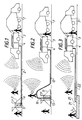
- concrete is poured, for example from a mobile concrete mixer 7, into a hopper 3 of 8 m 3 capacity and is injected with a pump 4 into the tank 1 through the dip tube 2, as shown in Figure 1.
- Tube 2 is a flexible hose with an inside diameter of 50 mm and a length of 60 m.
- the concrete is injected into a sheet 11 at by means of a dip tube 12, which is introduced into the form 11 by an upper opening 16 of the panel 11 and which has one end 15 which descends to the bottom of the panel 11.
- a dip tube 12 which is introduced into the form 11 by an upper opening 16 of the panel 11 and which has one end 15 which descends to the bottom of the panel 11.
- the tube 12 is a flexible hose having a horizontal part of 50 m, a vertical part of 15 m, and an internal diameter of 65 mm.
- the tube 12 is a rigid tube, having as for example an internal diameter of 65 mm.
- the tube 12 is a rigid pipe, possibly ovalized to make its easier introduction into dense reinforcement.
- the concrete is injected into a formwork horizontal 21 or directly in a reinforcement on the ground.
- We performs this injection by means of a horizontal tube 22 opening just above the formwork 21 at one end 25.
- This third embodiment is particularly suitable for the manufacture of slabs or rafts.
- the superplasticizer used is the compound of formula (II).
- Figure 1 For pouring concrete, we use for example the first mode of implementation (Figure 1) which is used under the following conditions.
- the sheet 1 having a volume of 2.5 m 3
- the concrete is injected by means of the tube 2 which consists of a flexible pipe 60 m long and having an inside diameter of 50 mm.
- Pump 4 has a flow rate of 5 m 3 / h and applies a pressure of 5 bars.
- the superplasticizer is a compound of formula (II).
- Example 2 The procedure is similar to Example 1, but with a pump flow of between 15 m 3 / h and 25 m 3 / h. During implementation, a spray release agent is added. Demoulding is carried out during a formwork removal period of the order of about fifteen hours.
- the measured spread is then of the order of 75 cm during the spreading test.
- the superplasticizer used is the compound of formula (II).
- a first embodiment 0.9% by weight of cement is introduced in the first step into the mixing plant, in the mixing water.
- an abrams cone sag test gives the following values: 25 cm sag and 62 cm spread.
- superplasticizer representing 0.3% by weight of the cement is added and the composition obtained is mixed by the rotation of a mixer of a truck mixer. The mixer is thus rotated for approximately 1 min / m 3 , in order to homogenize the mixture well.
- a release agent in the form of a emulsion in aqueous phase, for example of the type marketed under the name Aquadem.
- a pump giving a flow is used continuous injection.
- a pump can be for example constituted by a rotor pump comprising a hose having about 100 cm in diameter.
- Concrete obtained after hardening has a good quality siding, both with regard to macrobubble as microbubble or the formation of rootlets.
- the superplasticizer used is the compound of formula (II).
- the superplasticizer is introduced in two stages, incorporating into the mixture 0.8% by weight of the cement at the plant, and 0.4% by weight of the cement on arrival at the site. Before adding the superplasticizer on site, we obtain a spreading test of the values of 23 cm of slump and 50 cm spread. After adding the superplasticizer, obtains during a slump test, 72 cm of spreading and a spreading time at 60 cm of approximately 1 s.
- the transport time of the self-leveling concrete reaches a hour, without affecting the rheology of concrete.
- the hardened concrete obtained has a facing of good quality. by presenting in particular no macrobubing.
- the superplasticizer is the compound of formula (II).
- the superplasticizer is the compound of formula (II).
- the superplasticizer is introduced into the mixture in two stages, incorporating 0.8% by weight of the cement into the plant and 0.4% by weight of cement on site.
- the essay subsidence upon arrival on site before adding superplasticizer gives values of 23 cm sag and 51 cm spread. We also measure 4.6% air occluded in concrete. After adding the superplasticizer, a trial sag gives 74 cm spread and duration spreading at 60 cm equal to 1 s. Air occluded after adding superplasticizer represents 4.4% of concrete.
- the added release agent is a product of entirely vegetable origin (oil), for example of the type sold under the name Bio 2, which is sprayed.
- the superplasticizer is the compound of formula (II).
- the transport time of the self-leveling concrete is approximately 3 hours. following which a good maintenance of rheology.
- the pump used is preferably a pump giving a continuous injection flow.
- the facing obtained after hardening of the concrete has eight bubbles larger than 2 mm, the most large bubble measuring 5 mm. The properties obtained are therefore completely satisfactory.
- Example 7 the construction part produced and the implementation are similar to those of Example 7.
- the formula for self-leveling concrete differs from that of Example 7 by the amount of superplasticizer, equal to 5.4 kg / m 3 , and by the presence of a viscous agent consisting of Welan gum at a rate of 0.05 kg / m 3 .
- the facing obtained after hardening of the concrete is excellent quality. Indeed, the larger size of bubbles present on this facing is 2 mm.
- the superplasticizer used is the compound of formula (II).
- the aspect of the facing is excellent. No bleeding is not found.
Landscapes
- Engineering & Computer Science (AREA)
- Chemical & Material Sciences (AREA)
- Architecture (AREA)
- Ceramic Engineering (AREA)
- Structural Engineering (AREA)
- Civil Engineering (AREA)
- Organic Chemistry (AREA)
- Materials Engineering (AREA)
- Chemical Kinetics & Catalysis (AREA)
- Mechanical Engineering (AREA)
- Inorganic Chemistry (AREA)
- Curing Cements, Concrete, And Artificial Stone (AREA)
- On-Site Construction Work That Accompanies The Preparation And Application Of Concrete (AREA)
- Devices For Post-Treatments, Processing, Supply, Discharge, And Other Processes (AREA)
Description
- 350 à 600 kg/m3 environ de liant, dont 200 à 500 kg/m3 de ciment,
- 170 à 250kg/m3 environ d'eau,
- 0,5 à 4 kg/m3 environ d'agents et adjuvants divers (extraits secs), comprenant au moins un superplastifiant.
- le complément au mètre cube, en poids, de granulats et particules solides de granulométrie inférieure ou égale à 12 mm, préférentiellement inférieure ou égale à 8 mm.

- R est un atome d'hydrogène ou un groupe hydrocarboné monovalent, saturé ou non, comportant de 1 à 18 atomes de carbone et éventuellement un ou plusieurs hétéroatomes: R étant de préférence un atome d'hydrogène ou un groupe hydrocarboné monovalent, saturé ou non. comportant de 1 à 4 atomes de carbone, 50% à 100% des R1 sont l'éthylène, 0 à 50% des éventuels autres R1 sont semblables ou différents entre eux et représentent un alkylène comme l'éthylène, le propylène, le butylène, l'amylène, l'octylène ou le cyclohexène, ou un arylène comme le styrène ou le méthylstyrène; les Ri renfermant éventuellement un ou plusieurs hétéroatomes,
- Q est un groupe hydrocarboné comportant de 2 à 18 atomes de carbone et éventuellement un ou plusieurs hétéroatomes,
- A est un groupe alkylidène comportant de 1 à 3 atomes de carbone, A représentant de préférence le groupe méthylène,
- les Rj sont semblables ou différents entre eux et
peuvent être choisis parmi:
- le groupe A-PO3H2, A ayant la signification précitée,
- et le groupe
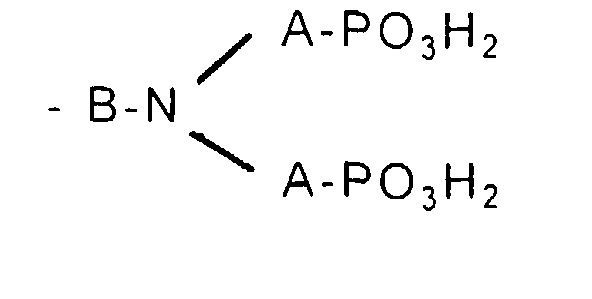
- B désignant un groupement alkylène comportant de 2 à 8 atomes de carbone, B représentant de préférence l'éthylène ou le propylène, A ayant la signification précitée,
- « n » est un nombre compris entre 20 et 250,
- « r » est le nombre des groupes (R-O(Ri-O)n portés par l'ensemble des Rj,
- « q » est le nombre des groupes [R-O(R1-O)n] portés par Q,
- la somme « r+q » est au plus égale à 3,
- « y » est un nombre entier égal à 1 ou 2,
- Q, N et les Rj peuvent former ensemble un ou plusieurs cycles, ce ou ces cycles pouvant en outre contenir un ou plusieurs autres hétéro-atomes.
- R est un atome d'hydrogène,
- R est un groupe hydrocarboné monovalent, saturé ou non, comportant de 1 à 4 atomes de carbone,
- les groupes Ri sont choisis parmi l'éthylène et le propylène,
- Ri est majoritairement l'éthylène, le nombre de motifs d'éthylène correspondant à Ri étant suffisant pour conserver le caractère hydrosoluble ou hydrodispersable du composé (I),
- Q est un groupe hydrocarboné comportant de 2 à 12, et préférentiellement de 2 à 6 atomes de carbone, et représente préférentiellement l'éthylène et/ou le propylène, ceux-ci étant avantageusement présents à raison de 95% en moles, le complément étant constitué d'autres monomères, tels le cyclohexène ou le n-hexène.
- le groupe alkylidène A comporte de 1 à 3 atomes de carbone,
- A est le groupe méthylène,
- le groupe Rj est le groupe -CH2-PO3H2, éventuellement salifié, ou le groupe -C2H4N (CH2-PO3H2)2, éventuellement salifié, ou le groupe - C3H6N(CH2PO3H2)2 éventuellement salifié,
- les sels du composé (I) sont des sels de sodium, de calcium ou de diéthanolamine,
- «n » est compris entre 20 et 250, de préférence entre 30 et 150 et encore mieux entre 50 et 100,
- la somme « r +q » est inférieure à 3 et préférentiellement égale à 1,
- «y » est égal à 1.

- de l'eau.
- au moins un agent antimousse non hydrosoluble ou faiblement hydrosoluble;
- au moins un superplastifiant (I) répondant à la formule (I) et, éventuellement, un autre superplastifiant (PCP), hydrosoluble ou hydrodispersable.
- au moins un composé organique (O) contenant:
- au moins une fonction amine primaire, secondaire ou tertiaire, éventuellement partiellement ou totalement neutralisée par un acide de Brönsted, organique ou minéral; et
- au moins une chaíne alkyle ou alkyl-aryle, linéaire ou ramifiée, saturée ou insaturée, comprenant au moins 8 atomes de carbone, et éventuellement des hétéroatomes, choisis parmi l'oxygène, le soufre ou l'azote;
- au moins un stabilisant minéral quand le pH dudit prémélange est supérieur à 7, tel que des argiles et les sépiolites;
- éventuellement, un acide ou une base pour ajuster le pH dudit mélange.
- par « agent antimousse » non hydrosoluble ou faiblement hydrosoluble », on entend un agent antimousse faiblement ou non soluble dans les milieux aqueux à température ambiante (environ 20°C) et à la pression atmosphérique;
- par « mélange uniforme », on entend un mélange qui, laissé au repos, peut aller d'un mélange limpide (comme une microémulsion) à un mélange trouble (comme une émulsion huile dans eau). Parfois, une fine pellicule, généralement de la mousse, pourra être présente à la surface du mélange uniforme.
- ciment CEM I: 270 kg/m3,
- eau: 218 l/m3
- cendres volantes: 210 kg/m3,
- granulats et particules volantes solides de granulométrie inférieure à 8 mm:1465 kg/m3,
- superplastifiant: 3,3 kg/m3, soit 0,99 kg/m3 en extrait sec,
- agent entraíneur d'air: 0,27 kg/m3.
- ciment CEM I: 270 kg/m3,
- eau: 230 l/m3,
- cendres: 210 kg/m3,
- granulats 0/1: 365 kg/m3,
- granulats 0/5: 365 kg/m3,
- granulats 3/8: 735 kg/m3,
- superplastifiant: 2,34 kg/m3, soit 0,7 kg/m3 en extrait sec,
- agent entraíneur d'air: 0,27 kg/m3.
- ciment CEM I: 270 kg/m3,
- eau: 226 kg/m3
- cendres volantes: 210 kg/m3,
- sablon: 245 kg/m3,
- granulats 0/5: 500 kg/m3,
- granulats 3/8: 740 kg/m3,
- superplastifiant: 1,2% en poids du ciment.
- ciment CEM I: 245 kg/m3,
- eau: 219 kg/m3
- cendres volantes: 230 kg/m3,
- sablon: 228 kg/m3,
- granulats 0/5: 500 kg/m3,
- granulats 3/8: 740 kg/m3,
- superplastifiant: 1,2% en poids du ciment.
- ciment CEM I: 270 kg/m3,
- eau: 218 kg/m3,
- cendres volantes: 210 kg/m3,
- sablon GSI: 245 kg/m3,
- granulats 0/5: 500 kg/m3,
- granulats 3/8: 740 kg/m3,
- superplastifiant: 1,3% en poids du ciment.
- ciment CEM I: 270 kg/m3,
- eau: 230 kg/m3,
- cendres volantes: 210 kg/m3,
- sablon: 365 kg/m3,
- granulats 0/5: 365 kg/m3,
- granulats 3/8: 735 kg/m3,
- superplastifiant: 1,2% en poids du ciment,
- agent entraíneur d'air: 0,1% en poids du ciment.
- ciment CEM I: 270 kg/m3,
- eau: 216 kg/m3,
- cendres volantes: 210 kg/m3,
- granulats 0/1: 366 kg/m3
- granulats 0/5: 366 kg/m3,
- granulats 5/12: 807 kg/m3,
- superplastifiant: 4,05 kg/m3,
- agent entraíneur d'air 0,27 kg/m3.
- Ciment CEMI 300 kg/m3
- Eau 225 kg/m3
- Cendres volantes 190 kg/m3
- Granulats 0/1 180 kg/m3
- Granulats 0/5 600 kg/m3
- Granulats 3/8 725 kg/m3
- Superplastifiant 4,6 kg/m3
- Superplastifiant II 14%
- Tributilphosphate 2,25%
- Amine grasse oxyéthylénée NORAMOX 022 de CECA 2,25%
- Sepiolite 1,2%
- PCP 18792 de BOZETTO 50% (à 30% en sec)
- Diéthanolamine 5,6% (à 30% en sec)
- Epaississant « Tylose 60 000 YP4 de HOECHST 2,25%
- Eau 28,62%
Claims (31)
- Béton autonivelant de composition contenant, en poids , par mètre cube de béton:caractérisé en ce que le superplastifiant est un composé (I) ou sel du composé (I), ledit composé (I) répondant à la formule350 à 600 kg/m3 environ de liant, dont 200 à 500 kg/m3 de ciment,170 à 250 kg/m3 environ d'eau,0,5 à 4 kg/m3 environ (extraits secs) d'agents et adjuvants divers, comprenant au moins un superplastifiant,le complément au mètre cube, en poids, de granulats et particules solides de granulométrie inférieure ou égale à 12 mm, préférentiellement inférieure ou égale à 8 mm,dans laquelle:
 R est un atome d'hydrogène ou un groupe hydrocarboné monovalent, saturé ou non, comportant de 1 à 18 atomes de carbone et éventuellement un ou plusieurs hétéroatomes; R étant de préférence un atome d'hydrogène ou un groupe hydrocarboné monovalent, saturé ou non. comportant de 1 à 4 atomes de carbone, 50% à 100% des Ri sont l'éthylène, 0 à 50% des éventuels autres Ri sont semblables ou différents entre eux et représentent un alkylène comme l'éthylène, le propylène, le butylène, l'amylène, l'octylène ou le cyclohexène, ou un arylène comme le styrène ou le méthylstyrène; les Ri renfermant éventuellement un ou plusieurs hétéroatomes,Q est un groupe hydrocarboné comportant de 2 à 18 atomes de carbone et éventuellement un ou plusieurs hétéroatomes,A est un groupe alkylidène comportant de 1 à 3 atomes de carbone, A représentant de préférence le groupe méthylène,les Rj sont semblables ou différents entre eux et peuvent être choisis parmi:le groupe A-PO3H2, A ayant la signification précitée,et le groupe
 B désignant un groupement alkylène comportant de 2 à 8 atomes de carbone, B représentant de préférence l'éthylène ou le propylène, A ayant la signification précitée,« n » est un nombre compris entre 20 et 250,« r » est le nombre des groupes [R-O(Ri-O)n] portés par l'ensemble des Rj,« q » est le nombre des groupes [R-O(Ri-O)n] portés par Q,la somme « r+q » est au plus égale à 3,« y » est un nombre entier égal à 1 ou 2,Q, N et les Rj peuvent former ensemble un ou plusieurs cycles, ce ou ces cycles pouvant en outre contenir un ou plusieurs autres hétéro-atomes.
 - Béton autonivelant selon la revendication 1, caractérisé en ce que R est un atome d'hydrogène.
- Béton autonivelant selon la revendication 1, caractérisé en ce que R est un groupe hydrocarboné monovalent, saturé ou non, comportant de 1 à 4 atomes de carbone.
- Béton autonivelant selon l'une des revendications 1 à 3, caractérisé en ce que Ri est majoritairement l'éthylène, le nombre de motifs d'éthylène correspondant à Ri étant suffisant pour conserver le caractère hydrosoluble ou hydrodispersable des composés (I).
- Béton autonivelant selon l'une quelconque des revendications 1 à 4, caractérisé en ce que Q est un groupe hydrocarboné comportant de 2 à 12, et préférentiellement de 2 à 6 atomes de carbone, et représente avantageusement l'éthylène et/ou le propylène, ceux-ci étant avantageusement présents à raison de 95% en moles, le complément étant constitué d'autres monomères, tels le cyclohexène ou le n-hexène.
- Béton autonivelant selon l'une quelconque des revendications 1 à 5, caractérisé en ce que A est le groupe méthylène.
- Béton autonivelant selon l'une quelconque des revendications 1 à 6, caractérisé en ce que le groupe Rj est le groupe -CH2-PO3H2, éventuellement salifié, ou le groupe-C2H4N(CH2-PO3H2)2, éventuellement salifié, ou le groupe-C3H6N(CH2-PO3H2)2 éventuellement salifié.
- Béton autonivelant selon l'une quelconque des revendications 1 à 7, caractérisé en ce que les sels sont des sels de sodium, de calcium ou de diéthanolamine.
- Béton autonivelant selon l'une quelconque des revendications 1 à 8, caractérisé en ce que « n » est compris entre 20 et 250, de préférence entre 30 et 150 et encore mieux entre 50 et 100.
- Béton autonivelant selon l'une quelconque des revendications 1 à 9, caractérisé en ce que la somme « r+q » est inférieure à 3, et préférentiellement égale à 1.
- Béton autonivelant selon l'une quelconque des revendications 1 à 10, caractérisé en ce qu'au moins 50% des R1 sont l'éthylène et les éventuelles autres R1 sont le propylène.
- Béton autonivelant selon l'une quelconque des revendications 1 à 11, caractérisé en ce que dans le composé (I) diphosphoné, Ri est l'éthylène, Rj est -CH2-PO3H2, « n » est compris entre 30 et 150 (bornes incluses), de préférence entre 50 et 100 (bornes incluses), la somme « r+q » est égale à 1 et « y » est égal à 1.
- Béton autonivelant selon l'une quelconque des revendications 1 à 12, caractérisé en ce que le superplastifiant est le composé de formule (II)ou ses sels.

- Béton autonivelant selon l'une quelconque des revendications 1 à 13, caractérisé en ce que la quantité du superplastifiant (I) comportant au moins un groupement amino-di (alkylènephosphonique) et au moins une chaíne polyoxyalkylée, dans la composition autonivelante, est comprise entre 0.2 et 2% en poids en sec, rapporté au poids de ciment, de préférence entre 0,3 et 0,8% en poids en sec.
- Béton autonivelant selon l'une quelconque des revendications 1 à 14, caractérisé en ce qu'il comprend, en plus du superplastifiant répondant à la formule (I), au moins un superplastifiant (PCP), hydrosoluble ou hydrodispersable, de type acide polycarboxylique et renfermant des chaínes polyéthers.
- Béton autonivelant selon la revendication 15, caractérisé en ce que les superplastifiants additionnels PCP sont à base de monomères vinyliques carboxyliques et éventuellement de monomères sulfonés.
- Béton autonivelant selon l'une des revendications 15 ou 16. caractérisé en ce que le superplastifiant additionnel PCP renferme des chaínes polyéthers de différentes longueurs, et en particulier est tel que les chaínes polyéthers renferment, en moyenne, au moins 50% d'unités oxyéthylènes (pourcentage exprimé sur le total des motifs oxyalkylènes du superplastifiant PCP), les autres motifs oxyalkylènes étant de préférence des motifs oxypropylènes.
- Béton autonivelant selon l'une quelconque des revendications 1 à 17, caractérisé en ce que le rapport en poids du superplastifiant (I) sur le superplastifiant (PCP) va de 0,1 à 10.
- Béton autonivelant selon l'une quelconque des revendications 1 à 18, caractérisé en ce qu'il comprend au moins un agent antimousse, en proportion en général comprise entre 0,01 et 0,3% en poids, rapporté au poids de ciment.
- Béton autonivelant selon l'une quelconque des revendications 1 à 19, caractérisé en ce qu'il comprend au moins un agent épaississant, par exemple des composés minéraux tels que la sépiolite ou des silices ultrafines, ou des composés organiques, tels que des dérivés de la cellulose ou des polysaccharides de poids moléculaire élevé, comme des gommes de xanthane, ou des mélanges de deux ou plusieurs des agents épaississants précités, la quantité d'agent épaississant étant en général comprise entre 0,005% et 0,05% en poids en sec rapporté au poids de ciment.
- Béton autonivelant selon l'une quelconque des revendications 1 à 20, caractérisé en ce que le complément au ciment pour constituer le liant est constitué de laitier de haut-fourneau moulu, de cendres volantes, de filler, calcaire ou siliceux, ou d'autres éléments pouzzolaniques.
- Procédé de fabrication d'une pièce de construction verticale par injection d'un béton autonivelant selon l'une quelconque des revendications 1 à 21 dans un coffrage (1, 11), procédé dans lequel on effectue un pompage dudit béton sous forme fluide au moyen d'au moins un tube plongeur (2, 12) ayant une extrémité d'injection (5, 15) à un niveau inférieur dudit coffrage (1, 11).
- Procédé de fabrication selon la revendication 22, caractérisé en ce que ledit tube plongeur (2, 12) a un diamètre compris entre 45 mm et 65 mm, avantageusement égal à 50 mm.
- Procédé de fabrication selon l'une des revendications 22 ou 23, caractérisé en ce qu'on introduit le tube plongeur (2, 12) dans le coffrage (11) par une ouverture supérieure (16) du coffrage (11).
- Procédé de fabrication d'une pièce de construction selon l'une des revendications 22 ou 23, caractérisé en ce que ledit tube plongeur (2) traverse ledit coffrage (1) au niveau inférieur du coffrage (1).
- Procédé de fabrication d'une pièce de construction horizontale par injection d'un béton autonivelant selon l'une quelconque des revendications 1 à 21 dans un coffrage plan (21) ou sur un sol, procédé dans lequel, après injection, on presse régulièrement une barre de lissage à la surface du béton afin d'assurer une bonne planéité de la pièce.
- Procédé de préparation d'une composition de béton autonivelant selon l'une quelconque des revendications 1 à 21, caractérisé en ce qu'on réalise un prémélange contenant le superplastifiant et les agents antimousse et/ou épaississant, si ceux-ci sont présents.
- Procédé selon la revendication 27, caractérisé en ce que le prémélange renferme:de l'eau,au moins un agent antimousse non hydrosoluble ou faiblement hydrosoluble;au moins un superplastifiant (I) répondant à la formule (I) et, éventuellement, un autre superplastifiant (PCP). hydrosoluble ou hydrodispersable.au moins un composé organique (O) contenant:au moins une fonction amine primaire. secondaire ou tertiaire, éventuellement partiellement ou totalement neutralisée par un acide de Brönsted, organique ou minéral; etau moins une chaíne alkyle ou alkyl-aryle. linéaire ou ramifiée, saturée ou insaturée, comprenant au moins 8 atomes de carbone, et éventuellement des hétéroatomes, choisi parmi l'oxygène, le soufre ou l'azote;au moins un stabilisant minéral quand le pH dudit prémélange est supérieur à 7, tel que des argiles et les sépiolites;éventuellement, un acide ou une base pour ajuster le pH dudit mélange.
- Procédé selon la revendication 28, caractérisé en ce que l'agent antimousse est un antimousse faiblement ou non soluble dans les milieux aqueux à température ambiante (environ 20°C) et à la pression atmosphérique.
- Procédé selon l'une des revendications 28 ou 29, caractérisé en ce que le composé organique (O) est choisi parmi l'amine oléique, l'amine de coprah, l'amine de suif et les dérivés de ces amines, en particulier les dérivés de ces amines. avec un motif d'oxéthylène ou une chaíne contenant au maximum 8 motifs d'oxyéthylènes.
- Procédé selon l'une quelconque des revendications 27 à 30, caractérisé en ce qu'on réalise un mélange uniforme, à savoir un mélange qui, laissé au repos, peut aller d'un mélange limpide (comme une microémulsion) à un mélange trouble (comme une émulsion huile dans eau).
Applications Claiming Priority (5)
| Application Number | Priority Date | Filing Date | Title |
|---|---|---|---|
| FR9705781 | 1997-05-12 | ||
| FR9705781A FR2763063B1 (fr) | 1997-05-12 | 1997-05-12 | Beton auto-nivelant et procede de fabrication d'une piece de construction |
| FR9710094 | 1997-08-06 | ||
| FR9710094A FR2763064B1 (fr) | 1997-05-12 | 1997-08-06 | Beton auto-nivelant et procede de fabrication d'une piece de construction |
| PCT/FR1998/000939 WO1998051638A1 (fr) | 1997-05-12 | 1998-05-11 | Beton autonivelant et procede de fabrication d'une piece de construction |
Publications (2)
| Publication Number | Publication Date |
|---|---|
| EP0981506A1 EP0981506A1 (fr) | 2000-03-01 |
| EP0981506B1 true EP0981506B1 (fr) | 2001-04-04 |
Family
ID=26233526
Family Applications (1)
| Application Number | Title | Priority Date | Filing Date |
|---|---|---|---|
| EP98924417A Expired - Lifetime EP0981506B1 (fr) | 1997-05-12 | 1998-05-11 | Beton autonivelant et procede de fabrication d'une piece de construction |
Country Status (11)
| Country | Link |
|---|---|
| US (1) | US6616755B1 (fr) |
| EP (1) | EP0981506B1 (fr) |
| AT (1) | ATE200274T1 (fr) |
| AU (1) | AU7662498A (fr) |
| CA (1) | CA2289587A1 (fr) |
| DE (1) | DE69800668T2 (fr) |
| DK (1) | DK0981506T3 (fr) |
| ES (1) | ES2155719T3 (fr) |
| FR (1) | FR2763064B1 (fr) |
| PT (1) | PT981506E (fr) |
| WO (1) | WO1998051638A1 (fr) |
Families Citing this family (10)
| Publication number | Priority date | Publication date | Assignee | Title |
|---|---|---|---|---|
| US6551929B1 (en) | 2000-06-28 | 2003-04-22 | Applied Materials, Inc. | Bifurcated deposition process for depositing refractory metal layers employing atomic layer deposition and chemical vapor deposition techniques |
| ITPN20020033A1 (it) * | 2002-05-20 | 2003-11-20 | Mirella Zampieri | Conglomerato cementizio autolivellante per il riempimento e la sigillatura di scavi di canalette, trincee, fognature e simili e per opere di |
| WO2004076377A1 (fr) * | 2003-02-25 | 2004-09-10 | Kao Corporation | Dispersant pour composition hydraulique |
| ITMI20040162A1 (it) * | 2004-02-02 | 2004-05-02 | Bozzetto Giovanni Spa | Uso di polliaaminometilenfosfonati quali agenti disperdenti |
| DE102004015422A1 (de) * | 2004-03-26 | 2005-10-13 | Putzmeister Ag | Anlage und Verfahren zur Herstellung von Betonfertigteilen |
| US7833339B2 (en) | 2006-04-18 | 2010-11-16 | Franklin Industrial Minerals | Mineral filler composition |
| SE0502666L (sv) * | 2005-12-06 | 2007-06-05 | Skanska Sverige Ab | Golvbetonganordning |
| DE102011000998B4 (de) * | 2011-03-01 | 2016-10-13 | Ralf Waiblinger | Verwendung eines Additivs für einen Estrich und Estrichzusammensetzung |
| US8759423B2 (en) | 2012-04-20 | 2014-06-24 | W. R. Grace & Co.-Conn. | Stabilized defoamers for cementitious compositions |
| FR3022240A1 (fr) | 2014-06-13 | 2015-12-18 | Lafarge Sa | Beton revetu d'une couche mince photovoltaique, son procede de fabrication et element de construction comprenant un tel beton |
Family Cites Families (8)
| Publication number | Priority date | Publication date | Assignee | Title |
|---|---|---|---|---|
| FR2696736B1 (fr) * | 1992-10-12 | 1994-12-30 | Chryso | Fluidifiants pour suspensions aqueuses de particules minérales et pâtes de liant hydraulique. |
| IT1263969B (it) | 1993-02-25 | 1996-09-05 | Mario Collepardi | Addittivi superfluidificanti ad elevata conservazione della lavorabilita' |
| FR2704853B1 (fr) * | 1993-05-07 | 1995-07-28 | Dijon Beton | Béton à propriété autolissante et autonivelante. |
| JPH07215750A (ja) * | 1994-02-04 | 1995-08-15 | Nitto Chem Ind Co Ltd | 自己平滑性セメントモルタル組成物の施工方法 |
| US5403394A (en) * | 1994-02-24 | 1995-04-04 | Burgand; Yves | Self-leveling floor coating material |
| FR2722526B1 (fr) | 1994-07-12 | 1996-10-04 | Meridionale De Travaux | Procede et dispositif pour la realisation sur chantier d'un ouvrage en beton, vertical ou oblique, par durcissement in-situ d'un melange a base de ciment |
| DE29518306U1 (de) * | 1995-11-21 | 1996-07-18 | Bilke, Thomas, 06528 Martinsrieth | Selbstnivellierender Zementfließestrich |
| US5614017A (en) | 1996-03-26 | 1997-03-25 | Arco Chemical Technology, L.P. | Cement additives |
-
1997
- 1997-08-06 FR FR9710094A patent/FR2763064B1/fr not_active Expired - Fee Related
-
1998
- 1998-05-11 DK DK98924417T patent/DK0981506T3/da active
- 1998-05-11 EP EP98924417A patent/EP0981506B1/fr not_active Expired - Lifetime
- 1998-05-11 AT AT98924417T patent/ATE200274T1/de not_active IP Right Cessation
- 1998-05-11 PT PT98924417T patent/PT981506E/pt unknown
- 1998-05-11 AU AU76624/98A patent/AU7662498A/en not_active Abandoned
- 1998-05-11 WO PCT/FR1998/000939 patent/WO1998051638A1/fr not_active Ceased
- 1998-05-11 ES ES98924417T patent/ES2155719T3/es not_active Expired - Lifetime
- 1998-05-11 DE DE69800668T patent/DE69800668T2/de not_active Expired - Fee Related
- 1998-05-11 US US09/423,314 patent/US6616755B1/en not_active Expired - Fee Related
- 1998-05-11 CA CA002289587A patent/CA2289587A1/fr not_active Abandoned
Also Published As
| Publication number | Publication date |
|---|---|
| DE69800668T2 (de) | 2001-09-27 |
| DK0981506T3 (da) | 2001-05-21 |
| FR2763064B1 (fr) | 1999-07-30 |
| ES2155719T3 (es) | 2001-05-16 |
| US6616755B1 (en) | 2003-09-09 |
| FR2763064A1 (fr) | 1998-11-13 |
| ATE200274T1 (de) | 2001-04-15 |
| PT981506E (pt) | 2001-07-31 |
| CA2289587A1 (fr) | 1998-11-19 |
| EP0981506A1 (fr) | 2000-03-01 |
| WO1998051638A1 (fr) | 1998-11-19 |
| DE69800668D1 (de) | 2001-05-10 |
| AU7662498A (en) | 1998-12-08 |
Similar Documents
| Publication | Publication Date | Title |
|---|---|---|
| EP1102816B1 (fr) | Emulsions de bitume, procede pour leur obtention, et compositions les contenant | |
| CA2290643C (fr) | Composition autonivelante a base de ciment | |
| EP2655448B1 (fr) | Polymère comportant une fonction hydrolysable utilisable comme fluidifiant | |
| WO2001098229A1 (fr) | Liant rapide pour beton autocompactant, utilisation et applications d'un tel liant | |
| EP1197480A1 (fr) | Composition cimentaire, son utilisation pour la réalisation de chape liquide autonivelante et chape ainsi obtenue | |
| CA2289587A1 (fr) | Beton autonivelant et procede de fabrication d'une piece de construction | |
| WO2011131904A1 (fr) | Liant hydraulique rapide pour pieces et ouvrages en beton | |
| WO2014096701A1 (fr) | Composition de béton ou mortier allégé comprenant une mousse aqueuse | |
| WO2012017169A1 (fr) | Composition pulverulente de mortier a adherence amelioree | |
| WO2006131659A2 (fr) | Compositions de liant rapide pour pieces et ouvrages en beton contenant un sel de calcium | |
| FR2726264A1 (fr) | Agent de cure pour une composition a base de ciment | |
| FR2961807A1 (fr) | Procede de transport d'une composition hydraulique | |
| JP4549667B2 (ja) | レオロジー改質剤 | |
| FR2763063A1 (fr) | Beton auto-nivelant et procede de fabrication d'une piece de construction | |
| EP0912462B1 (fr) | Adjuvant pour suspensions aqueuses de particules minerales et melanges a base de liant hydraulique | |
| EP3392224A1 (fr) | Utilisation d'un agent entraineur d air pour diminuer le temps de sechage d'une chape a base de sulfate de calcium | |
| JP2004300008A (ja) | 吹付け用急硬剤、急硬性セメントコンクリート、及びそれを用いた吹付け工法 | |
| EP3066060A1 (fr) | Composition fluidifiante sous forme de poudre et son procédé de préparation | |
| JP2007099561A (ja) | レオロジー改質剤 | |
| JP2024115077A (ja) | 水硬性組成物用表面美観向上剤 | |
| WO2024172052A1 (fr) | Améliorant d'aspect esthétique de surface pour compositions hydrauliques | |
| JP7775019B2 (ja) | 水硬性組成物の移送方法 | |
| JP7712844B2 (ja) | 硬化体の強度制御方法 | |
| EP2646211B1 (fr) | Composition de demoulage | |
| US20240101479A1 (en) | Method of making a sprayable setting type compound |
Legal Events
| Date | Code | Title | Description |
|---|---|---|---|
| PUAI | Public reference made under article 153(3) epc to a published international application that has entered the european phase |
Free format text: ORIGINAL CODE: 0009012 |
|
| 17P | Request for examination filed |
Effective date: 19991213 |
|
| AK | Designated contracting states |
Kind code of ref document: A1 Designated state(s): AT BE CH DE DK ES FR GB IT LI LU NL PT |
|
| GRAG | Despatch of communication of intention to grant |
Free format text: ORIGINAL CODE: EPIDOS AGRA |
|
| 17Q | First examination report despatched |
Effective date: 20000822 |
|
| GRAG | Despatch of communication of intention to grant |
Free format text: ORIGINAL CODE: EPIDOS AGRA |
|
| GRAH | Despatch of communication of intention to grant a patent |
Free format text: ORIGINAL CODE: EPIDOS IGRA |
|
| RAP1 | Party data changed (applicant data changed or rights of an application transferred) |
Owner name: LAFARGE |
|
| GRAH | Despatch of communication of intention to grant a patent |
Free format text: ORIGINAL CODE: EPIDOS IGRA |
|
| GRAA | (expected) grant |
Free format text: ORIGINAL CODE: 0009210 |
|
| AK | Designated contracting states |
Kind code of ref document: B1 Designated state(s): AT BE CH DE DK ES FR GB IT LI LU NL PT |
|
| REF | Corresponds to: |
Ref document number: 200274 Country of ref document: AT Date of ref document: 20010415 Kind code of ref document: T |
|
| ITF | It: translation for a ep patent filed | ||
| REG | Reference to a national code |
Ref country code: CH Ref legal event code: NV Representative=s name: KIRKER & CIE SA Ref country code: CH Ref legal event code: EP |
|
| REF | Corresponds to: |
Ref document number: 69800668 Country of ref document: DE Date of ref document: 20010510 |
|
| REG | Reference to a national code |
Ref country code: ES Ref legal event code: FG2A Ref document number: 2155719 Country of ref document: ES Kind code of ref document: T3 |
|
| REG | Reference to a national code |
Ref country code: DK Ref legal event code: T3 |
|
| GBT | Gb: translation of ep patent filed (gb section 77(6)(a)/1977) |
Effective date: 20010511 |
|
| REG | Reference to a national code |
Ref country code: PT Ref legal event code: SC4A Free format text: AVAILABILITY OF NATIONAL TRANSLATION Effective date: 20010426 |
|
| REG | Reference to a national code |
Ref country code: GB Ref legal event code: IF02 |
|
| PLBE | No opposition filed within time limit |
Free format text: ORIGINAL CODE: 0009261 |
|
| STAA | Information on the status of an ep patent application or granted ep patent |
Free format text: STATUS: NO OPPOSITION FILED WITHIN TIME LIMIT |
|
| 26N | No opposition filed | ||
| PGFP | Annual fee paid to national office [announced via postgrant information from national office to epo] |
Ref country code: NL Payment date: 20060428 Year of fee payment: 9 |
|
| PGFP | Annual fee paid to national office [announced via postgrant information from national office to epo] |
Ref country code: PT Payment date: 20060504 Year of fee payment: 9 |
|
| PGFP | Annual fee paid to national office [announced via postgrant information from national office to epo] |
Ref country code: AT Payment date: 20060510 Year of fee payment: 9 |
|
| PGFP | Annual fee paid to national office [announced via postgrant information from national office to epo] |
Ref country code: LU Payment date: 20060511 Year of fee payment: 9 |
|
| PGFP | Annual fee paid to national office [announced via postgrant information from national office to epo] |
Ref country code: DK Payment date: 20060526 Year of fee payment: 9 |
|
| PGFP | Annual fee paid to national office [announced via postgrant information from national office to epo] |
Ref country code: BE Payment date: 20060530 Year of fee payment: 9 |
|
| PGFP | Annual fee paid to national office [announced via postgrant information from national office to epo] |
Ref country code: IT Payment date: 20060531 Year of fee payment: 9 |
|
| PGFP | Annual fee paid to national office [announced via postgrant information from national office to epo] |
Ref country code: DE Payment date: 20060728 Year of fee payment: 9 |
|
| PGFP | Annual fee paid to national office [announced via postgrant information from national office to epo] |
Ref country code: CH Payment date: 20060810 Year of fee payment: 9 |
|
| REG | Reference to a national code |
Ref country code: PT Ref legal event code: MM4A Free format text: LAPSE DUE TO NON-PAYMENT OF FEES Effective date: 20071112 |
|
| BERE | Be: lapsed |
Owner name: *LAFARGE Effective date: 20070531 |
|
| REG | Reference to a national code |
Ref country code: CH Ref legal event code: PL |
|
| REG | Reference to a national code |
Ref country code: DK Ref legal event code: EBP |
|
| PG25 | Lapsed in a contracting state [announced via postgrant information from national office to epo] |
Ref country code: PT Free format text: LAPSE BECAUSE OF NON-PAYMENT OF DUE FEES Effective date: 20071112 Ref country code: NL Free format text: LAPSE BECAUSE OF NON-PAYMENT OF DUE FEES Effective date: 20071201 |
|
| NLV4 | Nl: lapsed or anulled due to non-payment of the annual fee |
Effective date: 20071201 |
|
| PG25 | Lapsed in a contracting state [announced via postgrant information from national office to epo] |
Ref country code: AT Free format text: LAPSE BECAUSE OF NON-PAYMENT OF DUE FEES Effective date: 20070511 Ref country code: CH Free format text: LAPSE BECAUSE OF NON-PAYMENT OF DUE FEES Effective date: 20070531 Ref country code: LI Free format text: LAPSE BECAUSE OF NON-PAYMENT OF DUE FEES Effective date: 20070531 |
|
| PG25 | Lapsed in a contracting state [announced via postgrant information from national office to epo] |
Ref country code: BE Free format text: LAPSE BECAUSE OF NON-PAYMENT OF DUE FEES Effective date: 20070531 |
|
| PG25 | Lapsed in a contracting state [announced via postgrant information from national office to epo] |
Ref country code: DK Free format text: LAPSE BECAUSE OF NON-PAYMENT OF DUE FEES Effective date: 20070531 Ref country code: DE Free format text: LAPSE BECAUSE OF NON-PAYMENT OF DUE FEES Effective date: 20071201 |
|
| PGFP | Annual fee paid to national office [announced via postgrant information from national office to epo] |
Ref country code: ES Payment date: 20080508 Year of fee payment: 11 |
|
| PG25 | Lapsed in a contracting state [announced via postgrant information from national office to epo] |
Ref country code: LU Free format text: LAPSE BECAUSE OF NON-PAYMENT OF DUE FEES Effective date: 20070511 |
|
| PG25 | Lapsed in a contracting state [announced via postgrant information from national office to epo] |
Ref country code: IT Free format text: LAPSE BECAUSE OF NON-PAYMENT OF DUE FEES Effective date: 20070511 |
|
| REG | Reference to a national code |
Ref country code: ES Ref legal event code: FD2A Effective date: 20090512 |
|
| PGFP | Annual fee paid to national office [announced via postgrant information from national office to epo] |
Ref country code: FR Payment date: 20100614 Year of fee payment: 13 |
|
| PG25 | Lapsed in a contracting state [announced via postgrant information from national office to epo] |
Ref country code: ES Free format text: LAPSE BECAUSE OF NON-PAYMENT OF DUE FEES Effective date: 20090512 |
|
| REG | Reference to a national code |
Ref country code: FR Ref legal event code: ST Effective date: 20120131 |
|
| PG25 | Lapsed in a contracting state [announced via postgrant information from national office to epo] |
Ref country code: FR Free format text: LAPSE BECAUSE OF NON-PAYMENT OF DUE FEES Effective date: 20110531 |
|
| PGFP | Annual fee paid to national office [announced via postgrant information from national office to epo] |
Ref country code: GB Payment date: 20160518 Year of fee payment: 19 |
|
| GBPC | Gb: european patent ceased through non-payment of renewal fee |
Effective date: 20170511 |
|
| PG25 | Lapsed in a contracting state [announced via postgrant information from national office to epo] |
Ref country code: GB Free format text: LAPSE BECAUSE OF NON-PAYMENT OF DUE FEES Effective date: 20170511 |