EP0979501B1 - Verbesserter kapodaster - Google Patents
Verbesserter kapodaster Download PDFInfo
- Publication number
- EP0979501B1 EP0979501B1 EP98918847A EP98918847A EP0979501B1 EP 0979501 B1 EP0979501 B1 EP 0979501B1 EP 98918847 A EP98918847 A EP 98918847A EP 98918847 A EP98918847 A EP 98918847A EP 0979501 B1 EP0979501 B1 EP 0979501B1
- Authority
- EP
- European Patent Office
- Prior art keywords
- capo
- jaw member
- lever member
- neck
- screw
- Prior art date
- Legal status (The legal status is an assumption and is not a legal conclusion. Google has not performed a legal analysis and makes no representation as to the accuracy of the status listed.)
- Expired - Lifetime
Links
- 239000012858 resilient material Substances 0.000 claims description 9
- 239000007779 soft material Substances 0.000 claims 1
- 230000009471 action Effects 0.000 abstract description 10
- 210000003739 neck Anatomy 0.000 description 37
- 230000033001 locomotion Effects 0.000 description 7
- 230000008901 benefit Effects 0.000 description 4
- 230000000694 effects Effects 0.000 description 3
- 230000004048 modification Effects 0.000 description 3
- 238000012986 modification Methods 0.000 description 3
- 230000009286 beneficial effect Effects 0.000 description 2
- 230000006835 compression Effects 0.000 description 2
- 238000007906 compression Methods 0.000 description 2
- 239000002184 metal Substances 0.000 description 2
- 241000538562 Banjos Species 0.000 description 1
- 230000004075 alteration Effects 0.000 description 1
- 238000005452 bending Methods 0.000 description 1
- 230000015572 biosynthetic process Effects 0.000 description 1
- 230000003247 decreasing effect Effects 0.000 description 1
- 230000000881 depressing effect Effects 0.000 description 1
- 230000000994 depressogenic effect Effects 0.000 description 1
- 238000006073 displacement reaction Methods 0.000 description 1
- 238000005755 formation reaction Methods 0.000 description 1
- 230000003993 interaction Effects 0.000 description 1
- 238000004519 manufacturing process Methods 0.000 description 1
- 239000000463 material Substances 0.000 description 1
- 230000007246 mechanism Effects 0.000 description 1
- 230000002035 prolonged effect Effects 0.000 description 1
- 230000003578 releasing effect Effects 0.000 description 1
Images


Classifications
-
- G—PHYSICS
- G10—MUSICAL INSTRUMENTS; ACOUSTICS
- G10D—STRINGED MUSICAL INSTRUMENTS; WIND MUSICAL INSTRUMENTS; ACCORDIONS OR CONCERTINAS; PERCUSSION MUSICAL INSTRUMENTS; AEOLIAN HARPS; SINGING-FLAME MUSICAL INSTRUMENTS; MUSICAL INSTRUMENTS NOT OTHERWISE PROVIDED FOR
- G10D3/00—Details of, or accessories for, stringed musical instruments, e.g. slide-bars
- G10D3/053—Capos, i.e. capo tastos
Definitions
- the invention relates to a capo for raising the pitch of a stringed musical instrument having a neck and a fingerboard, with the strings disposed across the fingerboard.
- a capodastro or capo as it is commonly known, is a device that is attached to the neck of a stringed instrument to shorten the effective length of the strings by depressing them against the fingerboard, thereby raising their pitch.
- chord formations can be used to play in a variety of different keys.
- U.S. Patent 4,250,790 describes an adjustable, positive locking capo comprising a frame having a top arm that bears against the strings and a side arm extending laterally of the instrument neck. Pivotally attached to the side arm are a jaw member extending under the back of the instrument neck and a lever member located below the jaw member. An adjusting screw extends through the lever member to bear against the lower surface of the jaw member when the lever member is pivoted toward the jaw member. As the lever member is pivoted toward the jaw member, the tip of the adjusting screw encounters a zone of interference with the lower surface of the jaw member.
- the screw passes through the zone of interference, effecting a positive locking action, whereby the upper surface of the jaw member engages the back of the instrument neck and the top arm depresses the strings against the fingerboard on the top of the neck.
- the adjusting screw may be advanced or backed off to vary the extent to which the jaw member closes, thereby allowing the capo to accommodate varying sizes of instrument neck, and allowing the user to regulate the pressure exerted by the capo on the instrument strings.
- friction between the tip of the adjusting screw and the lower surface of the jaw member led to the development of considerable wear on these parts, often leading to loss of alignment, and would sometimes contribute to difficulty in closing the capo.
- the disposition of the adjusting screw relative to the jaw member led to differential "dropoff" across the operating range of the capo.
- the object of the present invention is to provide an improved capo that has a smoother locking and releasing action, that prolongs the useful life of the capo by reducing wear due to friction and maintaining alignment between the jaw member and lever member, and that optimizes the "dropoff" phenomenon that is characteristic of this type of capo.
- capo of the prior art In the use of the capo of the prior art, it was also found that considerable resistance is encountered as the tip of the adjusting screw passes through its zone of interference with the lower surface of the jaw member, which can result in excessive wear on the capo, as well as posing an inconvenience to the user in attaching the capo to and/or removing the capo from the neck of the instrument. In addition, the capo of the prior art is prone to variabilities in dropoff (a phenomenon to be described below) at the extremities of its range.
- the present invention comprises an improved capo for a stringed instrument such as a guitar or banjo, said instrument having a neck with upper and lower surfaces.
- the upper surface of the neck comprises a fingerboard which also may contain raised frets attached to the neck and disposed perpendicular to the longitudinal axis of the neck.
- the improved capo of the invention is defined in claim 1.
- the top arm extends over the strings and presses the strings against the fingerboard when the capo is in its closed position.
- the side arm may be integrally connected to the top arm and extends laterally of the neck of the instrument.
- the lower surface of the jaw member may be contoured so as to form a sliding pair with a follower surface of a flexible member, as described below.
- the preferably contoured lower surface of the jaw member and the follower surface form a sliding pair, thereby maintaining a parallel alignment between the lever member and the jaw member as the capo is closed into its locked position.
- the improved capo of the invention can be attached and removed smoothly and easily and is adjustable to accommodate instrument necks of varying sizes.
- the improvements of this invention result is less lateral displacement of the lever member and the jaw member with respect to each other, leading to a longer useable lifetime for the capo.
- prior capos of this type exhibited variabilities in the degree of a phenomenon called "dropoff," at the extreme high and low ends of their adjustable range.
- the improved design of the present invention minimizes variability in the beneficial dropoff phenomenon, providing optimal dropoff regardless of the thickness of the instrument neck.
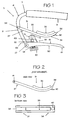
- Figure 1 shows a side elevation of the capo of the invention.
- Figure 2 shows a side elevation of the jaw member.
- Figure 3 shows a bottom view of the jaw member.
- Figure 4 shows a bottom view of the lever member, with the adjustable stop.
- Figure 5 shows a bottom view of the lever member, with the adjustable stop omitted.
- Figure 6 shows a side view of the lever member, including the adjustable stop but with the flexible member omitted.
- Figure 7 shows a top view of the lever member, with the adjustable stop and the flexible member omitted.
- Figure 8 shows a top view of the flexible member.
- Figure 9 shows a cutaway side view of the flexible member attached to the lever member, with the adjustable stop omitted.
- Figure 10 shows the capo of the invention attached to the neck of a stringed instrument.
- the main elements of the improved capo 5 of the invention are a frame 6 , a jaw member 31 , a lever member 50 , a flexible member 70 ending in a follower surface 72 , and an adjustable stop 52 .
- the frame 6 comprises a top arm 7 and a side arm 8 .
- the top arm 7 extends over the fingerboard 21 of the instrument and contains a pad 9 on its lower surface which contacts the strings 22 when the capo is in its closed position.
- the side arm 8 is attached to the top arm 7 and extends distally downward from the top arm 7 lateral to the neck 20 of the instrument.
- a jaw member 31 is pivotally attached to the side arm 8 at a position on the side arm between the free end and the end that is connected to the top arm, such that the distal portion 36 of the jaw member 31 is able to contact the back of the neck 20 .
- the jaw member 31 is connected to the side arm 8 by having a slot 38 in the proximal end 37 of the jaw member which receives the side arm.
- a roll pin 39 is inserted through bores 41 in the lugs formed in the proximal end 37 of the jaw member 31 and a bore through side arm 8 to provide a pivotal connection.
- the jaw member is curved to generally match the curvature of the back of the neck 20 of the instrument.
- a pad of soft, non-marking material 32 may be attached to the upper surface 33 of the jaw member 31 to prevent damage to the back of the neck 20 when the capo is in the closed position.
- the lower surface 34 of the jaw member 31 is configured so as to guide the motion of a follower member. More preferably, the lower surface 34 of the jaw member 31 contains a channel 35 , more easily viewed in Figure 3, to engage a follower member to be described below.
- a small bumper 40 of resilient material may be present on the lower surface 34 of the distal end 36 of the jaw member 31 , where it contacts the upper surface 51 of the lever member 50 when the capo is in the closed position. This will prevent any vibration or buzzing which might result from metal-to-metal contact when the capo is in the closed position, and avoid unnecessary noise during closing of the capo.
- a lever member 50 is pivotally attached to the side arm 8 of the frame at a location below (i.e. , in the direction away from the back of the neck) the point of attachment of the jaw member 31 . This connection is made in a similar fashion to that between the jaw member 31 and the side arm 8 .
- the proximal end 55 of the lever member 50 forms a slot 56 which receives the side arm 8 .
- a roll pin 57 is inserted through bores 58 in the lugs formed in the proximal end 55 of the lever member 50 and a bore through side arm 8 to provide a pivotal connection.
- the lever member 50 additionally contains a threaded bore 59 , located between the proximal end 55 and the center of the lever member 50 .
- the threaded bore 59 receives an adjustable stop 52 , to be described below.
- a small bumper made of resilient material may be present on the upper surface 51 of the distal end 61 of the lever member 50 , where it contacts the lower surface 34 of the jaw member 31 when the capo is in the closed position. This will prevent any vibration or buzzing which might result from metal-to-metal contact when the capo is in the closed position, and avoid unnecessary noise during closing of the capo.
- a flexible member 70 is mounted on the upper surface 51 of the lever member 50 in such a way that one end of the flexible member is attached close to the distal end 61 of the upper surface 51 of the lever member 50 (as seen most clearly in Figure 9 ). Attachment is by means of a rivet 74 or equivalent fastener.
- the end of the flexible member not attached to the lever member (hereby defined as the distal end 73 of the flexible member) comprises a follower surface 71 which will interact with the lower surface of the jaw member as the capo is closed.
- the follower surface 71 may be configured to match a particular configuration on the lower surface 34 of the jaw member, so that the follower surface 71 is guided in a path along the lower surface 34 of the jaw member.
- the lower surface 34 of the jaw member will have a channel 35 , in which the follower surface 71 will ride as the capo is opened and closed.
- the follower surface 71 will comprise a cylindrical roller 72 mounted in a roller housing 75 on the distal end 73 of the flexible member. The dimensions of the roller 72 will be such that the roller fits inside the channel 35 on the lower surface 34 of the jaw member 31 .
- the improved capo of the invention is adjustable, allowing it to be used with a variety of neck sizes, and permitting regulation of tension by the user.
- the capo is adjusted by means of an adjustable stop 52 passing through the proximal end 55 of the lever member 50 .
- the upper end 63 of the adjustable stop bears against the lower surface of the distal end 73 of the flexible member 70 .
- the adjustable stop 52 is a threaded screw or bolt, having a head 53 and a threaded shaft 62 passing through a threaded bore 59 in the lever member.
- the threaded screw or bolt will preferably possess, on its lower end, a knurled head 53 by which the screw or bolt may be easily adjusted by the user.
- a spring 54 is disposed about the threaded shaft 62 of the screw or bolt between the head 53 and the lower surface of the lever member 50 . This serves to prevent axial movement of the screw or bolt when the capo is disengaged, thereby maintaining the set position of the shaft 62 within the bore 59 and, hence, the level of tension selected by the user.
- the improved capo of the invention is brought adjacent to the fingerboard 21 of the instrument so that the top arm 7 is in contact with the strings 22 from above, the side arm 8 extends laterally of the neck 20 and downward, and the jaw member 31 lies underneath but not touching the back of the neck 20. In this position, the jaw member 31 and the lever member 50 are able to pivot freely.
- the lever member 50 is moved toward the jaw member 31 , thereby causing the cylindrical roller 72 at the distal end 73 of the flexible member 70 to contact the lower surface 34 of the jaw member 31 .
- a positive locking action is involved in the closing of the capo, because the follower surface 71 passes through a central zone of interference in its transit along the lower surface 34 of the jaw member 31 .
- the follower surface 71 is able to pass through this zone and continue along the lower surface 34 of the jaw member 31 , because of the flexibility of the flexible member 70 on which it is mounted and because the pad 9 attached to the top arm 7 and the pad 32 attached to the upper surface 33 of the jaw member 31 both can be slightly resilient.
- the pads 9 and 32 are able to distort slightly as the jaw member 31 undergoes a condition of maximum compression which occurs at the zone of interfefence, then relaxes slightly as the capo is moved into the fully closed position.
- the adjustable stop 52 is advanced or withdrawn, while the capo is disengaged, so that when the capo is locked, the top arm 7 exerts sufficient pressure on the strings 22 to prevent them from buzzing on the frets, but not so much pressure as to damage the neck 20 of the instrument or bend the strings across the fret to such an extent that the strings become sharp.
- a capo is used to raise the pitch of the strings in precise increments, which are defined by the difference in pitch between notes produced by strings fretted at adjacent frets.
- adjustable stop 52 will permit the use of the capo with different-sized necks.
- the capo When in the closed position and attached to the neck 20 of an instrument, the capo can be opened by moving the distal end 61 of the lever member 50 downward and away from the jaw member 31 .
- the distal end 61 of the lever member 50 extends beyond the distal end 36 of the jaw member 31 , to make opening the capo more convenient.
- the improved capo of the invention provides several advantages over capos of the prior art.
- a roller 72 mounted in a housing 75 located on the distal end 73 of the flexible member 70 follows a channel 35 on the lower surface 34 of the jaw member 31 .
- a smooth opening and closing action is obtained which reduces wear, makes it easy for the user to attach and remove the capo, and minimizes the chance of damage to the instrument or the capo.
- this interaction is often highly frictional, contributing to increased wear and making opening and closing of the capo more difficult.
- roller-channel combination of the present invention maintains a parallel alignment between the lever member 50 and the jaw member 31 as the capo is used over time.
- an initially parallel alignment of the lever member and jaw member is often lost over time, leading to poorer performance.
- a further advantage of the improved capo of the present invention is that it minimizes the variability of "dropoff" across the useable range of the capo.
- Dropoff describes a particular effect in the closing action of the improved capo of the invention and certain capos of the prior art, e.g., U.S. Patent 4,250,790; referring to the difference in the amount of pressure applied to the strings and fingerboard at two different positions in the closing action of the capo.
- an adjusting screw is threaded through a lever member, and the tip of this adjusting screw contacts the lower surface of a jaw member during the closing action of the capo and when the capo is in the closed position.
- this adjusting screw In adjusting this prior art capo to fit necks of different sizes, this adjusting screw is tightened or loosened. In the act of being tightened or loosened, the adjusting screw travels through the lever member in a straight line perpendicular to the longitudinal axis of the lever member. As the capo is closed, the tip of the adjusting screw, in its transit along the lower surface of the jaw member, passes through a center point of maximum resistance. This is also the point at which maximum pressure is exerted on the strings by the capo. As the tip of the adjusting screw continues past the center point during the closing action, less resistance is encountered, and the jaw member incrementally falls away from the back of the neck or "drops off.” Consequently, maximum pressure is not exerted at the closed position of the capo.
- dropoff can have certain advantageous effects in preventing the user from inadvertently over-tightening the capo, thereby driving the strings out of tune.
- dropoff is variable along the range of adjustment of the capo. This results from the fact that, as the adjusting screw is tightened, the final point of contact between the tip of the adjusting screw and the lower surface of the jaw member (at the closed position of the capo) moves further from the center point of maximum resistance, thereby increasing the degree of dropoff.
- dropoff is maximized at the narrowest end of the capo's range where the adjusting screw is furthest advanced ( i .
- the design of the improved capo of the present invention results in decreased variability in the degree of dropoff across the full range of the capo. This is accomplished by the inclusion of a flexible member 70 , which is attached to the upper surface 51 of the lever member 50 and whose distal end 73 contacts the lower surface 34 of the jaw member 31 as the capo is closed and locked.
- the flexible member 70 is adjusted by advancing or retracting an adjustable stop 52 whose upper end 63 bears against the lower surface of the flexible member 70.
- an adjustable stop 52 whose upper end 63 bears against the lower surface of the flexible member 70.
- the tip of the adjusting screw travels in a straight line as the screw is tightened, the follower surface 71 of the flexible member 70 travels in an arc as the adjustable stop 52 is advanced. Consequently, the follower surface 71 of the flexible member 70 will be closer to the center point, when the capo is closed, at all stages of adjustment ( i . e ., at all degrees of advancement or retraction of the adjustable stop 52 ), maintaining an optimum degree of dropoff along the entire range of the capo.
Landscapes
- Physics & Mathematics (AREA)
- Engineering & Computer Science (AREA)
- Acoustics & Sound (AREA)
- Multimedia (AREA)
- Stringed Musical Instruments (AREA)
- Catching Or Destruction (AREA)
- Piezo-Electric Or Mechanical Vibrators, Or Delay Or Filter Circuits (AREA)
- Pens And Brushes (AREA)
- Closures For Containers (AREA)
Claims (18)
- Kapodaster (5) für ein Saiteninstrument, das eine Mehrzahl von Saiten (22) und einen Hals (20) aufweist, wobei der Hals ein Griffbrett (21) und einen Rücken umfasst, welches Kapodaster umfasst:einen Rahmen (6), der einen oberen Arm (7), der sich quer über das Griffbrett oberhalb der Saiten erstreckt, und einen Seitenarm (8) umfasst, der sich im Wesentlichen seitlich zu dem Hals erstreckt;ein Klemmbackenelement (31), das sich unterhalb des Rückens erstreckt, wobei das Klemmbackenelement ein proximales (37) und ein distales (36) Ende aufweist, wobei dessen proximales Ende schwenkbar an dem Seitenarm angebracht ist, wobei das Klemmbackenelement auch eine Oberseite und eine Unterseite aufweist, wobei die Oberseite in Berührung mit dem Rücken bringbar ist;ein Hebelelement (50) mit einem proximalen und einem distalen (61) Ende, wobei dessen proximales Ende an dem Seitenarm schwenkbar an einer Stelle unterhalb des Ortes der Befestigung des Klemmbackenelements an dem Seitenarm angebracht ist, wobei das Hebelelement eine Oberseite (51) und eine Unterseite aufweist, wobei an der Oberseite des Hebelelements ein flexibles Element (70) mit einer Oberseite und einer Unterseite angebracht ist, wobei auch das flexible Element ein proximales und ein distales Ende aufweist, wobei das distale Ende (73) des flexiblen Elements die Oberseite des flexiblen Elements als Eingriffsfläche (71) umfasst, welche in der Lage ist, die Unterseite (34) des Klemmbackenelements zu berühren; undeinen einstellbaren Anschlag (52), der sich durch das Hebelelement hindurch erstreckt, wobei der einstellbare Anschlag ein erstes Ende und ein zweites Ende aufweist, wobei sich dessen zweites Ende (63) an der Unterseite des flexiblen Elements abstützt.
- Kapodaster nach Anspruch 1, wobei die Eingriffsfläche ein Profil aufweist.
- Kapodaster nach Anspruch 1, wobei die Unterseite (34) des Klemmbackenelements eine Profiloberfläche aufweist.
- Kapodaster nach Anspruch 1, wobei die Unterseite (34) des Klemmbackenelements eine Profiloberfläche besitzt und die obere Eingriffsfläche (71) ein Profil aufweist.
- Kapodaster nach Anspruch 4, wobei das Profil der oberen Eingriffsfläche an die Profiloberfläche des Klemmbackenelements angepasst ist.
- Kapodaster nach Anspruch 5, wobei die Unterseite des Klemmbackenelements einen Kanal (35) umfasst.
- Kapodaster nach Anspruch 1 oder Anspruch 6, wobei die obere Eingriffsfläche eine Rolle (72) umfasst, die in ein Rollengehäuse (75) eingebaut ist.
- Kapodaster nach Anspruch 1, wobei das Hebelelement eine Gewindebohrung (59) umfasst und wobei der einstellbare Anschlag eine Verstellschraube ist, die sich durch das Hebelelement hindurch erstreckt und eine Gewindestange (62) aufweist, die in der Gewindebohrung aufgenommen ist.
- Kapodaster nach Anspruch 8, wobei das erste Ende der Schraube einen Kopf (53) zum Greifen und Verdrehen der Schraube aufweist, um die Schraube innerhalb der Bohrung vorzustellen oder zurückzustellen.
- Kapodaster nach Anspruch 9, weiterhin umfassend eine Schraubenfeder (54), die um die Gewindestange herum zwischen dem Kopf der Schraube und der Unterseite des Hebelelements vorgesehen ist.
- Kapodaster nach Anspruch 1, wobei das flexible Element (70) eine Blattfeder ist.
- Kapodaster nach Anspruch 1, wobei der obere Arm (7) ein nachgiebiges Material umfasst, welches die Saiten (22) berührt.
- Kapodaster nach Anspruch 1, wobei das Klemmbackenelement außerdem auf seiner Oberseite ein weiches Material (32) umfasst, das den Rücken des Halses berühren kann, ohne den Rücken zu beschädigen.
- Kapodaster nach Anspruch 1, wobei das Klemmbackenelement abwärts relativ zu dem oberen Arm geneigt ist und gekrümmt ist, um ein Anschmiegen an den Rücken des Halses zu erleichtern, wenn der Kapodaster um den Hals geschlossen ist.
- Kapodaster nach Anspruch 14, wobei das distale Ende (61) des Hebelelements sich über das distale Ende (36) des Klemmbackenelements hinaus erstreckt, wenn der Kapodaster um den Hals geschlossen ist.
- Kapodaster nach Anspruch 1, wobei ein Stück (40) aus einem nachgiebigen Material auf dem distalen Ende der Unterseite des Klemmbackenelements vorhanden ist, wobei das Stück aus dem nachgiebigen Material in der Lage ist, die Oberseite des Hebelelements zu berühren.
- Kapodaster nach Anspruch 1, wobei ein Stück aus einem nachgiebigen Material auf dem distalen Ende (61) der Oberseite (51) des Hebelelements vorhanden ist, wobei das Stück aus dem nachgiebigen Material in der Lage ist, die Unterseite des Klemmbackenelements zu berühren.
- Kapodaster nach Anspruch 1, wobei
der Rahmen (6) ein nachgiebiges Kissen (9) auf seiner Unterseite aufweist;
das Klemmbackenelement (31) relativ zu dem oberen Arm (7) abwärts geneigt ist und gekrümmt ist, um ein Anschmiegen an den Rücken des Halses (20) zu erleichtern, wobei die Oberseite (33) des Klemmbackenelements ein weiches Kissen (32) zum Berühren des Rückens aufweist und die Unterseite des Klemmbackenelements einen Kanal (35) und optional ein Stück (40) aus einem nachgiebigen Material auf dessen distalem Ende aufweist;
das distale Ende (61) des Hebelelements (50) sich über das distale Ende (36) des Klemmbackenelements (31) hinaus erstreckt, wenn der Kapodaster um den Hals geschlossen ist, und wobei das Hebelelement (50) eine Gewindebohrung (59) und optional ein Stück aus einem nachgiebigen Material auf der Oberseite seines distalen Endes aufweist;
die Eingriffsfläche durch eine zylindrische Rolle (72), die in einem Rollengehäuse (75) vorgesehen ist und an der Oberseite des flexiblen Elements (70) angebracht ist, festgelegt ist, so dass die Rolle sich im Eingriff mit dem Kanal auf der Unterseite des Klemmbackenelements bewegen lässt;
und wobei der Kapodaster außerdem umfasst:eine Einstellschraube, die sich durch das Hebelelement hindurch erstreckt und eine Gewindestange (62) aufweist, die in der Gewindebohrung (59) des Hebelelements aufgenommen ist, wobei ein Ende der Schraube einen Kopf (53) zum Greifen und Drehen der Schraube umfasst, um die Schraube innerhalb der Bohrung vorzustellen oder zurückzustellen, und wobei das andere Ende (63) der Schraube an der Unterseite des flexiblen Elements (70) abgestützt ist, undeine Schraubenfeder (54), die zwischen dem Kopf der Schraube und der Unterseite des Hebelelements um die Gewindestange herum vorgesehen ist, um die Stellung der Schraube innerhalb der Bohrung aufrechtzuerhalten.
Applications Claiming Priority (3)
| Application Number | Priority Date | Filing Date | Title |
|---|---|---|---|
| US08/845,811 US5792969A (en) | 1997-04-29 | 1997-04-29 | Capo |
| US845811 | 1997-04-29 | ||
| PCT/US1998/008599 WO1998049669A1 (en) | 1997-04-29 | 1998-04-29 | Improved capo |
Publications (3)
| Publication Number | Publication Date |
|---|---|
| EP0979501A1 EP0979501A1 (de) | 2000-02-16 |
| EP0979501A4 EP0979501A4 (de) | 2001-08-22 |
| EP0979501B1 true EP0979501B1 (de) | 2005-09-21 |
Family
ID=25296139
Family Applications (1)
| Application Number | Title | Priority Date | Filing Date |
|---|---|---|---|
| EP98918847A Expired - Lifetime EP0979501B1 (de) | 1997-04-29 | 1998-04-29 | Verbesserter kapodaster |
Country Status (10)
| Country | Link |
|---|---|
| US (1) | US5792969A (de) |
| EP (1) | EP0979501B1 (de) |
| JP (1) | JP2001526799A (de) |
| AT (1) | ATE305162T1 (de) |
| AU (1) | AU748422B2 (de) |
| CA (1) | CA2288251C (de) |
| DE (1) | DE69831663T2 (de) |
| DK (1) | DK0979501T3 (de) |
| ES (1) | ES2249826T3 (de) |
| WO (1) | WO1998049669A1 (de) |
Cited By (2)
| Publication number | Priority date | Publication date | Assignee | Title |
|---|---|---|---|---|
| DE102006059821B3 (de) * | 2006-12-11 | 2007-09-13 | Wittner Gmbh & Co.Kg | Kapodaster |
| US7956263B1 (en) | 2009-01-16 | 2011-06-07 | Michael D. Volk, Jr. | Capo systems |
Families Citing this family (23)
| Publication number | Priority date | Publication date | Assignee | Title |
|---|---|---|---|---|
| US6008441A (en) * | 1998-03-09 | 1999-12-28 | Steinberger; Richard Ned | Capo |
| GB2361089B (en) * | 2000-04-06 | 2004-04-07 | Nicholas John Campling | Capo |
| US6459025B1 (en) | 2001-05-04 | 2002-10-01 | J. D'addario & Co., Inc. | Capo |
| CN100347740C (zh) * | 2001-09-29 | 2007-11-07 | G7有限公司 | 弦枕 |
| US6528711B1 (en) | 2001-10-05 | 2003-03-04 | Bryan R. Paige | Capo |
| US6835880B1 (en) | 2003-06-26 | 2004-12-28 | Dunlop Manufacturing, Inc. | Guitar fretboard capo |
| USD521048S1 (en) * | 2004-10-07 | 2006-05-16 | J. D'addario & Company, Inc. | Capo |
| US20070143929A1 (en) * | 2005-12-22 | 2007-06-28 | Selin Steven J | Combination Capo-Container Opener Device |
| GB0700849D0 (en) * | 2007-01-17 | 2007-02-21 | G7Th Ltd | Spring capo |
| USD573629S1 (en) * | 2007-02-01 | 2008-07-22 | Richard Ned Steinberger | Capo |
| US20100224049A1 (en) * | 2008-01-16 | 2010-09-09 | John Tran | Guitar Capo With Rotatable Member |
| GB2466294B (en) * | 2008-12-19 | 2013-07-03 | C7Th Ltd | An improved adjustable lever arm capo |
| US8779260B2 (en) * | 2010-07-13 | 2014-07-15 | Antonio Acosta | Movable capo device |
| USD728672S1 (en) | 2010-12-23 | 2015-05-05 | C7Th Limited | Capo |
| US9190033B2 (en) | 2013-11-11 | 2015-11-17 | Thalia Capos LLC | Capo |
| USD768233S1 (en) * | 2014-01-21 | 2016-10-04 | C7Th Limited | Capo |
| CN104105028B (zh) * | 2014-07-25 | 2018-05-04 | 深圳市伊诺乐器有限公司 | 拾音夹座及拾音器件组件 |
| USD776191S1 (en) * | 2015-10-23 | 2017-01-10 | Fengmao Shao | Capo |
| USD801426S1 (en) * | 2015-12-02 | 2017-10-31 | C7Th Limited | Capo |
| USD793471S1 (en) * | 2016-05-31 | 2017-08-01 | Kyser Musical Products, Inc. | Capotasto and tuner assembly |
| CN107240386B (zh) * | 2017-01-14 | 2021-02-19 | 梁坚 | 一种弹簧隐藏一体式变调夹 |
| JP6795823B2 (ja) * | 2017-03-16 | 2020-12-02 | 後藤ガット有限会社 | カポタスト |
| JP6750829B2 (ja) | 2017-11-27 | 2020-09-02 | 後藤ガット有限会社 | カポタスト |
Family Cites Families (2)
| Publication number | Priority date | Publication date | Assignee | Title |
|---|---|---|---|---|
| US4149443A (en) * | 1977-03-07 | 1979-04-17 | Bringe John E | Stringed instrument capo |
| US4250790A (en) * | 1979-10-22 | 1981-02-17 | Richard Shubb | Capo |
-
1997
- 1997-04-29 US US08/845,811 patent/US5792969A/en not_active Expired - Lifetime
-
1998
- 1998-04-29 AU AU71692/98A patent/AU748422B2/en not_active Expired
- 1998-04-29 AT AT98918847T patent/ATE305162T1/de not_active IP Right Cessation
- 1998-04-29 DK DK98918847T patent/DK0979501T3/da active
- 1998-04-29 ES ES98918847T patent/ES2249826T3/es not_active Expired - Lifetime
- 1998-04-29 DE DE69831663T patent/DE69831663T2/de not_active Expired - Lifetime
- 1998-04-29 CA CA002288251A patent/CA2288251C/en not_active Expired - Lifetime
- 1998-04-29 WO PCT/US1998/008599 patent/WO1998049669A1/en not_active Ceased
- 1998-04-29 EP EP98918847A patent/EP0979501B1/de not_active Expired - Lifetime
- 1998-04-29 JP JP54731798A patent/JP2001526799A/ja not_active Ceased
Cited By (2)
| Publication number | Priority date | Publication date | Assignee | Title |
|---|---|---|---|---|
| DE102006059821B3 (de) * | 2006-12-11 | 2007-09-13 | Wittner Gmbh & Co.Kg | Kapodaster |
| US7956263B1 (en) | 2009-01-16 | 2011-06-07 | Michael D. Volk, Jr. | Capo systems |
Also Published As
| Publication number | Publication date |
|---|---|
| ATE305162T1 (de) | 2005-10-15 |
| US5792969A (en) | 1998-08-11 |
| CA2288251C (en) | 2006-01-24 |
| WO1998049669A1 (en) | 1998-11-05 |
| AU748422B2 (en) | 2002-06-06 |
| EP0979501A4 (de) | 2001-08-22 |
| AU7169298A (en) | 1998-11-24 |
| DE69831663D1 (de) | 2005-10-27 |
| DK0979501T3 (da) | 2006-01-16 |
| ES2249826T3 (es) | 2006-04-01 |
| DE69831663T2 (de) | 2006-03-16 |
| CA2288251A1 (en) | 1998-11-05 |
| EP0979501A1 (de) | 2000-02-16 |
| JP2001526799A (ja) | 2001-12-18 |
Similar Documents
| Publication | Publication Date | Title |
|---|---|---|
| EP0979501B1 (de) | Verbesserter kapodaster | |
| US4250790A (en) | Capo | |
| US5623110A (en) | Quick-setting, variable, chord-forming, partial capo | |
| US8093476B2 (en) | Capo tasto | |
| US6008441A (en) | Capo | |
| US8779262B1 (en) | Capo | |
| US8940986B1 (en) | Tremolo and bridge device for stringed instruments | |
| US6459025B1 (en) | Capo | |
| US9035161B2 (en) | Capo | |
| US9196232B2 (en) | Self-compensating tunable bridge for string musical instrument | |
| US4412472A (en) | Musical instrument capotasto | |
| US20120036978A1 (en) | Capo | |
| US20220238085A1 (en) | Capo | |
| US20070175312A1 (en) | Capo applicable to dobro and slide guitars, and other raised-string instruments | |
| JP6795823B2 (ja) | カポタスト | |
| US9953622B2 (en) | Capo | |
| CN217133990U (zh) | 变调夹 | |
| US11398209B2 (en) | Clamping mechanism for guitar capo | |
| US2740312A (en) | Bow for playing stringed instruments | |
| US5918297A (en) | Bow for string instrument and improved string instrument | |
| CN107680566A (zh) | 一种用于弦乐器的滑臂式变调夹 | |
| CN214587986U (zh) | 一种便于调节夹持范围的吉他变调夹 | |
| AU6575080A (en) | Capo | |
| SU1755320A1 (ru) | Струнный музыкальный инструмент | |
| JPS6336375Y2 (de) |
Legal Events
| Date | Code | Title | Description |
|---|---|---|---|
| PUAI | Public reference made under article 153(3) epc to a published international application that has entered the european phase |
Free format text: ORIGINAL CODE: 0009012 |
|
| 17P | Request for examination filed |
Effective date: 19991112 |
|
| AK | Designated contracting states |
Kind code of ref document: A1 Designated state(s): AT BE CH CY DE DK ES FI FR GB GR IE IT LI LU MC NL PT SE |
|
| A4 | Supplementary search report drawn up and despatched |
Effective date: 20010710 |
|
| AK | Designated contracting states |
Kind code of ref document: A4 Designated state(s): AT BE CH CY DE DK ES FI FR GB GR IE IT LI LU MC NL PT SE |
|
| 17Q | First examination report despatched |
Effective date: 20040720 |
|
| GRAP | Despatch of communication of intention to grant a patent |
Free format text: ORIGINAL CODE: EPIDOSNIGR1 |
|
| GRAS | Grant fee paid |
Free format text: ORIGINAL CODE: EPIDOSNIGR3 |
|
| RAP1 | Party data changed (applicant data changed or rights of an application transferred) |
Owner name: COONTZ, DAVID Owner name: SHUBB, RICHARD |
|
| RIN1 | Information on inventor provided before grant (corrected) |
Inventor name: COONTZ, DAVID Inventor name: SHUBB, RICHARD |
|
| GRAA | (expected) grant |
Free format text: ORIGINAL CODE: 0009210 |
|
| AK | Designated contracting states |
Kind code of ref document: B1 Designated state(s): AT BE CH CY DE DK ES FI FR GB GR IE IT LI LU MC NL PT SE |
|
| REG | Reference to a national code |
Ref country code: GB Ref legal event code: FG4D |
|
| REG | Reference to a national code |
Ref country code: CH Ref legal event code: EP |
|
| REG | Reference to a national code |
Ref country code: IE Ref legal event code: FG4D |
|
| REG | Reference to a national code |
Ref country code: SE Ref legal event code: TRGR |
|
| REF | Corresponds to: |
Ref document number: 69831663 Country of ref document: DE Date of ref document: 20051027 Kind code of ref document: P |
|
| REG | Reference to a national code |
Ref country code: GR Ref legal event code: EP Ref document number: 20050403193 Country of ref document: GR |
|
| REG | Reference to a national code |
Ref country code: CH Ref legal event code: NV Representative=s name: R. A. EGLI & CO. PATENTANWAELTE |
|
| REG | Reference to a national code |
Ref country code: DK Ref legal event code: T3 |
|
| PGFP | Annual fee paid to national office [announced via postgrant information from national office to epo] |
Ref country code: AT Payment date: 20060314 Year of fee payment: 9 |
|
| PGFP | Annual fee paid to national office [announced via postgrant information from national office to epo] |
Ref country code: NL Payment date: 20060324 Year of fee payment: 9 |
|
| PGFP | Annual fee paid to national office [announced via postgrant information from national office to epo] |
Ref country code: PT Payment date: 20060328 Year of fee payment: 9 Ref country code: LU Payment date: 20060328 Year of fee payment: 9 |
|
| REG | Reference to a national code |
Ref country code: ES Ref legal event code: FG2A Ref document number: 2249826 Country of ref document: ES Kind code of ref document: T3 |
|
| PGFP | Annual fee paid to national office [announced via postgrant information from national office to epo] |
Ref country code: MC Payment date: 20060403 Year of fee payment: 9 |
|
| PGFP | Annual fee paid to national office [announced via postgrant information from national office to epo] |
Ref country code: GR Payment date: 20060406 Year of fee payment: 9 |
|
| PGFP | Annual fee paid to national office [announced via postgrant information from national office to epo] |
Ref country code: IE Payment date: 20060420 Year of fee payment: 9 |
|
| PGFP | Annual fee paid to national office [announced via postgrant information from national office to epo] |
Ref country code: FI Payment date: 20060421 Year of fee payment: 9 |
|
| PGFP | Annual fee paid to national office [announced via postgrant information from national office to epo] |
Ref country code: BE Payment date: 20060425 Year of fee payment: 9 |
|
| PGFP | Annual fee paid to national office [announced via postgrant information from national office to epo] |
Ref country code: IT Payment date: 20060430 Year of fee payment: 9 |
|
| ET | Fr: translation filed | ||
| PGFP | Annual fee paid to national office [announced via postgrant information from national office to epo] |
Ref country code: CH Payment date: 20060608 Year of fee payment: 9 |
|
| PLBE | No opposition filed within time limit |
Free format text: ORIGINAL CODE: 0009261 |
|
| STAA | Information on the status of an ep patent application or granted ep patent |
Free format text: STATUS: NO OPPOSITION FILED WITHIN TIME LIMIT |
|
| 26N | No opposition filed |
Effective date: 20060622 |
|
| REG | Reference to a national code |
Ref country code: PT Ref legal event code: MM4A Free format text: LAPSE DUE TO NON-PAYMENT OF FEES Effective date: 20071029 |
|
| REG | Reference to a national code |
Ref country code: DK Ref legal event code: EBP |
|
| REG | Reference to a national code |
Ref country code: CH Ref legal event code: PL |
|
| BERE | Be: lapsed |
Owner name: *COONTZ DAVID Effective date: 20070430 Owner name: *SHUBB RICHARD Effective date: 20070430 |
|
| NLV4 | Nl: lapsed or anulled due to non-payment of the annual fee |
Effective date: 20071101 |
|
| PG25 | Lapsed in a contracting state [announced via postgrant information from national office to epo] |
Ref country code: PT Free format text: LAPSE BECAUSE OF NON-PAYMENT OF DUE FEES Effective date: 20071029 Ref country code: NL Free format text: LAPSE BECAUSE OF NON-PAYMENT OF DUE FEES Effective date: 20071101 Ref country code: FI Free format text: LAPSE BECAUSE OF NON-PAYMENT OF DUE FEES Effective date: 20070429 |
|
| REG | Reference to a national code |
Ref country code: IE Ref legal event code: MM4A |
|
| PG25 | Lapsed in a contracting state [announced via postgrant information from national office to epo] |
Ref country code: AT Free format text: LAPSE BECAUSE OF NON-PAYMENT OF DUE FEES Effective date: 20070429 Ref country code: LI Free format text: LAPSE BECAUSE OF NON-PAYMENT OF DUE FEES Effective date: 20070430 Ref country code: CH Free format text: LAPSE BECAUSE OF NON-PAYMENT OF DUE FEES Effective date: 20070430 |
|
| PG25 | Lapsed in a contracting state [announced via postgrant information from national office to epo] |
Ref country code: BE Free format text: LAPSE BECAUSE OF NON-PAYMENT OF DUE FEES Effective date: 20070430 |
|
| PG25 | Lapsed in a contracting state [announced via postgrant information from national office to epo] |
Ref country code: DK Free format text: LAPSE BECAUSE OF NON-PAYMENT OF DUE FEES Effective date: 20070430 |
|
| PG25 | Lapsed in a contracting state [announced via postgrant information from national office to epo] |
Ref country code: IE Free format text: LAPSE BECAUSE OF NON-PAYMENT OF DUE FEES Effective date: 20070430 |
|
| PG25 | Lapsed in a contracting state [announced via postgrant information from national office to epo] |
Ref country code: CY Free format text: LAPSE BECAUSE OF NON-PAYMENT OF DUE FEES Effective date: 20060429 |
|
| PG25 | Lapsed in a contracting state [announced via postgrant information from national office to epo] |
Ref country code: GR Free format text: LAPSE BECAUSE OF NON-PAYMENT OF DUE FEES Effective date: 20071102 |
|
| PG25 | Lapsed in a contracting state [announced via postgrant information from national office to epo] |
Ref country code: MC Free format text: LAPSE BECAUSE OF NON-PAYMENT OF DUE FEES Effective date: 20070430 |
|
| PG25 | Lapsed in a contracting state [announced via postgrant information from national office to epo] |
Ref country code: LU Free format text: LAPSE BECAUSE OF NON-PAYMENT OF DUE FEES Effective date: 20070429 |
|
| PGFP | Annual fee paid to national office [announced via postgrant information from national office to epo] |
Ref country code: SE Payment date: 20090407 Year of fee payment: 12 |
|
| PG25 | Lapsed in a contracting state [announced via postgrant information from national office to epo] |
Ref country code: IT Free format text: LAPSE BECAUSE OF NON-PAYMENT OF DUE FEES Effective date: 20070429 |
|
| EUG | Se: european patent has lapsed | ||
| PG25 | Lapsed in a contracting state [announced via postgrant information from national office to epo] |
Ref country code: SE Free format text: LAPSE BECAUSE OF NON-PAYMENT OF DUE FEES Effective date: 20100430 |
|
| REG | Reference to a national code |
Ref country code: FR Ref legal event code: PLFP Year of fee payment: 19 |
|
| REG | Reference to a national code |
Ref country code: FR Ref legal event code: PLFP Year of fee payment: 20 |
|
| PGFP | Annual fee paid to national office [announced via postgrant information from national office to epo] |
Ref country code: FR Payment date: 20170313 Year of fee payment: 20 |
|
| PGFP | Annual fee paid to national office [announced via postgrant information from national office to epo] |
Ref country code: ES Payment date: 20170317 Year of fee payment: 20 |
|
| PGFP | Annual fee paid to national office [announced via postgrant information from national office to epo] |
Ref country code: DE Payment date: 20170426 Year of fee payment: 20 Ref country code: GB Payment date: 20170426 Year of fee payment: 20 |
|
| REG | Reference to a national code |
Ref country code: DE Ref legal event code: R071 Ref document number: 69831663 Country of ref document: DE |
|
| REG | Reference to a national code |
Ref country code: GB Ref legal event code: PE20 Expiry date: 20180428 |
|
| PG25 | Lapsed in a contracting state [announced via postgrant information from national office to epo] |
Ref country code: GB Free format text: LAPSE BECAUSE OF EXPIRATION OF PROTECTION Effective date: 20180428 |
|
| REG | Reference to a national code |
Ref country code: ES Ref legal event code: FD2A Effective date: 20220127 |
|
| PG25 | Lapsed in a contracting state [announced via postgrant information from national office to epo] |
Ref country code: ES Free format text: LAPSE BECAUSE OF EXPIRATION OF PROTECTION Effective date: 20180430 |