EP0975813B1 - Process for producing liquid pig iron or liquid metallurgical preparations - Google Patents
Process for producing liquid pig iron or liquid metallurgical preparations Download PDFInfo
- Publication number
- EP0975813B1 EP0975813B1 EP98922677A EP98922677A EP0975813B1 EP 0975813 B1 EP0975813 B1 EP 0975813B1 EP 98922677 A EP98922677 A EP 98922677A EP 98922677 A EP98922677 A EP 98922677A EP 0975813 B1 EP0975813 B1 EP 0975813B1
- Authority
- EP
- European Patent Office
- Prior art keywords
- reduction
- sludges
- scrubber
- gas
- zone
- Prior art date
- Legal status (The legal status is an assumption and is not a legal conclusion. Google has not performed a legal analysis and makes no representation as to the accuracy of the status listed.)
- Expired - Lifetime
Links
- 238000000034 method Methods 0.000 title claims description 36
- 229910000805 Pig iron Inorganic materials 0.000 title claims description 8
- 239000007788 liquid Substances 0.000 title description 3
- 238000002360 preparation method Methods 0.000 title 1
- 239000007789 gas Substances 0.000 claims description 73
- XEEYBQQBJWHFJM-UHFFFAOYSA-N Iron Chemical compound [Fe] XEEYBQQBJWHFJM-UHFFFAOYSA-N 0.000 claims description 48
- 239000010802 sludge Substances 0.000 claims description 40
- 229910052742 iron Inorganic materials 0.000 claims description 22
- OKTJSMMVPCPJKN-UHFFFAOYSA-N Carbon Chemical compound [C] OKTJSMMVPCPJKN-UHFFFAOYSA-N 0.000 claims description 11
- 229910052799 carbon Inorganic materials 0.000 claims description 11
- 239000008187 granular material Substances 0.000 claims description 11
- 239000008188 pellet Substances 0.000 claims description 10
- 239000002184 metal Substances 0.000 claims description 7
- 229910052751 metal Inorganic materials 0.000 claims description 7
- 238000002156 mixing Methods 0.000 claims description 7
- 239000000126 substance Substances 0.000 claims description 7
- QVGXLLKOCUKJST-UHFFFAOYSA-N atomic oxygen Chemical compound [O] QVGXLLKOCUKJST-UHFFFAOYSA-N 0.000 claims description 6
- 239000000969 carrier Substances 0.000 claims description 6
- 229910052760 oxygen Inorganic materials 0.000 claims description 6
- 239000001301 oxygen Substances 0.000 claims description 6
- 239000002817 coal dust Substances 0.000 claims description 5
- 238000001035 drying Methods 0.000 claims description 5
- 239000000428 dust Substances 0.000 claims description 5
- 230000008030 elimination Effects 0.000 claims description 5
- 238000003379 elimination reaction Methods 0.000 claims description 5
- 229910000831 Steel Inorganic materials 0.000 claims description 4
- 239000010959 steel Substances 0.000 claims description 4
- 238000004519 manufacturing process Methods 0.000 claims description 3
- 239000002893 slag Substances 0.000 claims description 3
- 238000010924 continuous production Methods 0.000 claims description 2
- 238000005201 scrubbing Methods 0.000 claims 8
- 235000008733 Citrus aurantifolia Nutrition 0.000 claims 2
- 235000011941 Tilia x europaea Nutrition 0.000 claims 2
- 230000004907 flux Effects 0.000 claims 2
- 239000004571 lime Substances 0.000 claims 2
- 238000007599 discharging Methods 0.000 claims 1
- 238000006722 reduction reaction Methods 0.000 description 73
- 238000002844 melting Methods 0.000 description 22
- 230000008018 melting Effects 0.000 description 22
- 238000002309 gasification Methods 0.000 description 21
- ODINCKMPIJJUCX-UHFFFAOYSA-N Calcium oxide Chemical compound [Ca]=O ODINCKMPIJJUCX-UHFFFAOYSA-N 0.000 description 14
- UQSXHKLRYXJYBZ-UHFFFAOYSA-N iron oxide Inorganic materials [Fe]=O UQSXHKLRYXJYBZ-UHFFFAOYSA-N 0.000 description 11
- 238000005406 washing Methods 0.000 description 11
- 239000000292 calcium oxide Substances 0.000 description 7
- 235000012255 calcium oxide Nutrition 0.000 description 7
- 235000013980 iron oxide Nutrition 0.000 description 6
- 239000000047 product Substances 0.000 description 5
- 238000005054 agglomeration Methods 0.000 description 4
- 230000002776 aggregation Effects 0.000 description 4
- AXCZMVOFGPJBDE-UHFFFAOYSA-L calcium dihydroxide Chemical compound [OH-].[OH-].[Ca+2] AXCZMVOFGPJBDE-UHFFFAOYSA-L 0.000 description 4
- 239000000203 mixture Substances 0.000 description 4
- 238000003723 Smelting Methods 0.000 description 3
- 238000006243 chemical reaction Methods 0.000 description 3
- 238000004140 cleaning Methods 0.000 description 3
- 238000005469 granulation Methods 0.000 description 3
- 230000003179 granulation Effects 0.000 description 3
- 238000010438 heat treatment Methods 0.000 description 3
- 239000002562 thickening agent Substances 0.000 description 3
- 238000010744 Boudouard reaction Methods 0.000 description 2
- VYPSYNLAJGMNEJ-UHFFFAOYSA-N Silicium dioxide Chemical compound O=[Si]=O VYPSYNLAJGMNEJ-UHFFFAOYSA-N 0.000 description 2
- 230000015572 biosynthetic process Effects 0.000 description 2
- 239000000920 calcium hydroxide Substances 0.000 description 2
- 229910001861 calcium hydroxide Inorganic materials 0.000 description 2
- 238000001816 cooling Methods 0.000 description 2
- VBMVTYDPPZVILR-UHFFFAOYSA-N iron(2+);oxygen(2-) Chemical class [O-2].[Fe+2] VBMVTYDPPZVILR-UHFFFAOYSA-N 0.000 description 2
- 239000002245 particle Substances 0.000 description 2
- 239000007787 solid Substances 0.000 description 2
- 239000007858 starting material Substances 0.000 description 2
- XLYOFNOQVPJJNP-UHFFFAOYSA-N water Chemical compound O XLYOFNOQVPJJNP-UHFFFAOYSA-N 0.000 description 2
- 229910018072 Al 2 O 3 Inorganic materials 0.000 description 1
- 229910004298 SiO 2 Inorganic materials 0.000 description 1
- 238000005299 abrasion Methods 0.000 description 1
- 230000002411 adverse Effects 0.000 description 1
- PNEYBMLMFCGWSK-UHFFFAOYSA-N aluminium oxide Inorganic materials [O-2].[O-2].[O-2].[Al+3].[Al+3] PNEYBMLMFCGWSK-UHFFFAOYSA-N 0.000 description 1
- 239000011230 binding agent Substances 0.000 description 1
- 239000003575 carbonaceous material Substances 0.000 description 1
- 239000003638 chemical reducing agent Substances 0.000 description 1
- 239000010883 coal ash Substances 0.000 description 1
- 229910052681 coesite Inorganic materials 0.000 description 1
- 229910052593 corundum Inorganic materials 0.000 description 1
- 229910052906 cristobalite Inorganic materials 0.000 description 1
- 238000005265 energy consumption Methods 0.000 description 1
- 239000013067 intermediate product Substances 0.000 description 1
- YOBAEOGBNPPUQV-UHFFFAOYSA-N iron;trihydrate Chemical compound O.O.O.[Fe].[Fe] YOBAEOGBNPPUQV-UHFFFAOYSA-N 0.000 description 1
- 239000000463 material Substances 0.000 description 1
- 239000010814 metallic waste Substances 0.000 description 1
- 238000013021 overheating Methods 0.000 description 1
- 238000005453 pelletization Methods 0.000 description 1
- JTJMJGYZQZDUJJ-UHFFFAOYSA-N phencyclidine Chemical class C1CCCCN1C1(C=2C=CC=CC=2)CCCCC1 JTJMJGYZQZDUJJ-UHFFFAOYSA-N 0.000 description 1
- 239000002243 precursor Substances 0.000 description 1
- 238000004064 recycling Methods 0.000 description 1
- 238000010079 rubber tapping Methods 0.000 description 1
- 239000000377 silicon dioxide Substances 0.000 description 1
- 229910052682 stishovite Inorganic materials 0.000 description 1
- 239000013589 supplement Substances 0.000 description 1
- 229910052905 tridymite Inorganic materials 0.000 description 1
- 238000004148 unit process Methods 0.000 description 1
- 239000002699 waste material Substances 0.000 description 1
- 229910001845 yogo sapphire Inorganic materials 0.000 description 1
Images
Classifications
-
- C—CHEMISTRY; METALLURGY
- C21—METALLURGY OF IRON
- C21B—MANUFACTURE OF IRON OR STEEL
- C21B13/00—Making spongy iron or liquid steel, by direct processes
- C21B13/0006—Making spongy iron or liquid steel, by direct processes obtaining iron or steel in a molten state
- C21B13/0013—Making spongy iron or liquid steel, by direct processes obtaining iron or steel in a molten state introduction of iron oxide into a bath of molten iron containing a carbon reductant
- C21B13/002—Reduction of iron ores by passing through a heated column of carbon
-
- C—CHEMISTRY; METALLURGY
- C21—METALLURGY OF IRON
- C21B—MANUFACTURE OF IRON OR STEEL
- C21B13/00—Making spongy iron or liquid steel, by direct processes
- C21B13/14—Multi-stage processes processes carried out in different vessels or furnaces
-
- C—CHEMISTRY; METALLURGY
- C21—METALLURGY OF IRON
- C21B—MANUFACTURE OF IRON OR STEEL
- C21B2100/00—Handling of exhaust gases produced during the manufacture of iron or steel
- C21B2100/20—Increasing the gas reduction potential of recycled exhaust gases
- C21B2100/22—Increasing the gas reduction potential of recycled exhaust gases by reforming
-
- C—CHEMISTRY; METALLURGY
- C21—METALLURGY OF IRON
- C21B—MANUFACTURE OF IRON OR STEEL
- C21B2100/00—Handling of exhaust gases produced during the manufacture of iron or steel
- C21B2100/20—Increasing the gas reduction potential of recycled exhaust gases
- C21B2100/28—Increasing the gas reduction potential of recycled exhaust gases by separation
- C21B2100/282—Increasing the gas reduction potential of recycled exhaust gases by separation of carbon dioxide
-
- C—CHEMISTRY; METALLURGY
- C21—METALLURGY OF IRON
- C21B—MANUFACTURE OF IRON OR STEEL
- C21B2100/00—Handling of exhaust gases produced during the manufacture of iron or steel
- C21B2100/40—Gas purification of exhaust gases to be recirculated or used in other metallurgical processes
- C21B2100/44—Removing particles, e.g. by scrubbing, dedusting
-
- Y—GENERAL TAGGING OF NEW TECHNOLOGICAL DEVELOPMENTS; GENERAL TAGGING OF CROSS-SECTIONAL TECHNOLOGIES SPANNING OVER SEVERAL SECTIONS OF THE IPC; TECHNICAL SUBJECTS COVERED BY FORMER USPC CROSS-REFERENCE ART COLLECTIONS [XRACs] AND DIGESTS
- Y02—TECHNOLOGIES OR APPLICATIONS FOR MITIGATION OR ADAPTATION AGAINST CLIMATE CHANGE
- Y02P—CLIMATE CHANGE MITIGATION TECHNOLOGIES IN THE PRODUCTION OR PROCESSING OF GOODS
- Y02P10/00—Technologies related to metal processing
- Y02P10/10—Reduction of greenhouse gas [GHG] emissions
- Y02P10/122—Reduction of greenhouse gas [GHG] emissions by capturing or storing CO2
-
- Y—GENERAL TAGGING OF NEW TECHNOLOGICAL DEVELOPMENTS; GENERAL TAGGING OF CROSS-SECTIONAL TECHNOLOGIES SPANNING OVER SEVERAL SECTIONS OF THE IPC; TECHNICAL SUBJECTS COVERED BY FORMER USPC CROSS-REFERENCE ART COLLECTIONS [XRACs] AND DIGESTS
- Y02—TECHNOLOGIES OR APPLICATIONS FOR MITIGATION OR ADAPTATION AGAINST CLIMATE CHANGE
- Y02P—CLIMATE CHANGE MITIGATION TECHNOLOGIES IN THE PRODUCTION OR PROCESSING OF GOODS
- Y02P10/00—Technologies related to metal processing
- Y02P10/10—Reduction of greenhouse gas [GHG] emissions
- Y02P10/134—Reduction of greenhouse gas [GHG] emissions by avoiding CO2, e.g. using hydrogen
-
- Y—GENERAL TAGGING OF NEW TECHNOLOGICAL DEVELOPMENTS; GENERAL TAGGING OF CROSS-SECTIONAL TECHNOLOGIES SPANNING OVER SEVERAL SECTIONS OF THE IPC; TECHNICAL SUBJECTS COVERED BY FORMER USPC CROSS-REFERENCE ART COLLECTIONS [XRACs] AND DIGESTS
- Y02—TECHNOLOGIES OR APPLICATIONS FOR MITIGATION OR ADAPTATION AGAINST CLIMATE CHANGE
- Y02P—CLIMATE CHANGE MITIGATION TECHNOLOGIES IN THE PRODUCTION OR PROCESSING OF GOODS
- Y02P10/00—Technologies related to metal processing
- Y02P10/20—Recycling
-
- Y—GENERAL TAGGING OF NEW TECHNOLOGICAL DEVELOPMENTS; GENERAL TAGGING OF CROSS-SECTIONAL TECHNOLOGIES SPANNING OVER SEVERAL SECTIONS OF THE IPC; TECHNICAL SUBJECTS COVERED BY FORMER USPC CROSS-REFERENCE ART COLLECTIONS [XRACs] AND DIGESTS
- Y10—TECHNICAL SUBJECTS COVERED BY FORMER USPC
- Y10S—TECHNICAL SUBJECTS COVERED BY FORMER USPC CROSS-REFERENCE ART COLLECTIONS [XRACs] AND DIGESTS
- Y10S75/00—Specialized metallurgical processes, compositions for use therein, consolidated metal powder compositions, and loose metal particulate mixtures
- Y10S75/961—Treating flue dust to obtain metal other than by consolidation
Definitions
- the invention relates to a process for the production of molten pig iron or liquid steel precursors from starting materials formed from iron ore, preferably in bar and / or pellet form, and optionally aggregates, the starting materials being reduced directly to sponge iron in a reduction zone and the sponge iron being charged into a melting gasification zone and there it is melted with the supply of carbon carriers and oxygen-containing gas, a CO and H 2 -containing reducing gas being generated, withdrawn from the meltdown gasification zone and introduced into the reduction zone, where it is reacted and removed as top gas, and the top gas is subjected to a wash and the sludges separated in the process are at least partially agglomerated, and a plant for carrying out the process.
- a method of this type is known for example from AT-B - 376 241.
- Solid particles from the reducing gas and from the exiting from the reduction zone Top gas separated in cyclones and mixed with binders such as iron oxide dust, hot briquetted and fed to the meltdown gasification zone.
- binders such as iron oxide dust, hot briquetted and fed to the meltdown gasification zone.
- this solution is in view on the investment and operating costs.
- due to the introduction of Iron oxides are done in the smelting gasification zone to reduce the Reduce iron oxide, creating the meltdown gasification zone for the meltdown process required energy is withdrawn.
- the invention has for its object a method of the type described to develop further in such a way that it is possible in a simple and efficient manner to implement the resulting sludge completely and with the least possible energy consumption in to recirculate the process, with the introduction of the sludge into the Meltdown gasification zone associated disadvantages, i.e. one in the Melting gasification zone to perform increased reduction work as well as heat losses heating of the goods brought in should be avoided.
- This object is achieved in that the agglomerate (at least a subset of the sludges resulting from the washing of the top gas of the reduction zone was formed) in the reduction zone, preferably exclusively in the reduction zone, is recirculated.
- At least a subset of the Melting gasification zone emerging reducing gas also washed, the thereby resulting sludges are at least partially agglomerated and the so formed Agglomerate recirculated into the reduction zone.
- the cleaned top gas from the reduction zone is subjected to a CO 2 elimination after washing and is fed as at least largely CO 2 -free reducing gas to at least one further reduction zone for the direct reduction of metal ore, in particular iron ore or pellets, after reaction with the metal ore in the withdrawn another reduction zone as export gas and cleaned in a scrubber, and the sludges obtained when washing the export gas from the further reduction zone are at least partially agglomerated, and the agglomerate thus formed is recirculated into the first reduction zone.
- the sludge to be agglomerated The inventive method first dewatered to a residual moisture content.
- oxidic dusts possibly coal dust and quicklime added.
- the method according to the invention become oxidic dusts from the foundry dedusting of a metallurgical plant, in particular from a plant for carrying out the method or from the dedusting plant Electric furnace of the melting gasification zone and / or further reduction zone downstream steelworks used.
- the agglomerates or granules are expediently recirculated into the Reduction zone dried.
- a plant for the production of molten pig iron or molten steel intermediate products of iron ore, preferably in piece and / or pellet form, and, if necessary, aggregates formed feedstocks, with a reduction reactor for iron ore, a Melting gasifier, one connecting the melting gasifier with the reduction reactor Supply line for a reducing gas formed in the melter, the one Reduction reactor with the melter connecting feed line for the in Reduction reactor formed reduction product, with one from the reduction reactor outgoing, with a scrubber top gas discharge, with in the melter gasifier opening supply lines for carbon carriers and oxygen-containing gases and one racking for pig iron and slag provided on the smelting gasifier and with one the scrubber to a device for agglomerating at least a part of the in Sludge discharge resulting from sludge is characterized by that the device for agglomerating the sludge line with the Reduction reactor is connected.
- the outlet into the reduction reactor Reduction gas supply line a second scrubber for at least a portion of the Reducing gas is provided, from which a sludge discharge to a device for Agglomeration of at least a part of the sludge produced in the second scrubber leads which device is connected by line to the reduction reactor.
- the sludge discharge associated with the second scrubber is also advantageous in terms of line the sludge discharge associated with the first scrubber.
- a further reduction reactor for receiving metal ore, in particular further iron ore or pellets, with a reduction gas feed line, with an export gas discharge line provided with a third scrubber and with a discharge device for the reduction product formed in this reduction reactor is provided, the top gas Discharge of the first reduction reactor opens into a CO 2 elimination system, from which the reducing gas feed line of the further reduction reactor starts and opens into the further reduction reactor, and wherein a sludge discharge from the third scrubber leads to a device for agglomerating at least a portion of those in the third scrubber Sludge leads which device is connected by line to the first reduction reactor.
- the one assigned to the first, second and / or third scrubber preferably leads Sludge discharge before the sludge agglomerating unit into one Sludge dewatering device, which is expediently designed as a decanter centrifuge.
- the device for agglomerating the sludge is expedient as a two-stage mixing and pelletizer and formed according to a preferred embodiment a drying device is connected to the first reduction reactor in terms of line.
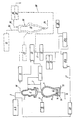
- a reduction reactor designed as a shaft furnace 1, i.e. in its fixed bed reduction zone 2, are 3-piece iron oxide containing from above via a feed line Feedstocks 4, such as ore, optionally together with unfired aggregates 5, are charged.
- the shaft furnace 1 is connected to a melter gasifier 6 in which Carbon carriers and oxygen-containing gas, a reducing gas is generated, which over a feed line 7 is fed to the shaft furnace 1 and this in counterflow to the Flow materials 4.
- a gas cleaning and Gas cooling device 8 which is designed as a scrubber, provided by the at least a partial stream of the reducing gas is passed through for the purpose of temperature adjustment.
- the melter gasifier 6 has a feed line 9 for solid, lumpy carbon carriers 10 and Supply lines 11 for oxygen-containing gases. In the melter gasifier 6 collects below the melting gasification zone 12 molten pig iron 13 and molten slag 14, which is tapped separately, each with its own tapping 15, 16 become.
- the resulting in the washer 19 sludge together with the sludge in the Scrubbers 8 are produced when washing the reduction gas fed to the shaft furnace 1, fed to a thickener 20.
- the thickened sludge from the thickener 20 a conveying line 21 of a sludge drying device 22, e.g. a decanter centrifuge, fed.
- the dewatered sludges are treated with dry oxidic dusts 23, such as ore abrasion and Foundry dust. and coal dust 24 mixed.
- This mixture of sludges and Dusts are then fed to a mixing and granulating device 25a, 25b, in which to further reduce the residual moisture in the dewatered sludge of quicklime 26 is added.
- the mixing and granulating device 25a, 25b granulates the Mixture of sludges, dusts 23, 24 and quicklime 26 to form a granulate two-stage.
- the Process steps mixing and granulation in separate reactors which have different sizes, are equipped with separate drives and on the Tasks mixing on the one hand and granulating on the other hand coordinated mixing and Have pelletizing tools.
- the granules are fed to a drying device 28 via a conveyor line 27 and then via the feed line 3 for the lumpy feedstocks containing iron oxide 4 and Supplements 5 introduced in the shaft furnace 1.
- the granules are dried preferably continuously in a third aggregate after granulation.
- This The unit can be designed with a heatable double jacket.
- the top gas cleaned in the scrubber 19 is subjected to CO 2 elimination, for example in a CO 2 scrubber 29 or a reformer, and is then a reducing gas Another reduction reactor 30 for receiving metal ore - in the illustrated embodiment for receiving iron ore or pellets 31 - available. If necessary, this reducing gas is subjected to heating before it is introduced into the further reduction reactor, but this is not shown in the exemplary embodiment.
- the further reduction reactor 30 is also designed as a shaft furnace and works like the first shaft furnace 1 in the counterflow principle.
- Iron ore in piece and / or pellet form also in a fixed bed reduction zone 32 Directly reduced sponge iron.
- the ore feed line is 33 and the sponge iron discharge device designated with 34.
- the export gas drawn off from the second reduction reactor 30 via the line 35 becomes also subjected to cleaning and cooling in an export gas scrubber 36 to remove it from To clean dust particles and lower the water vapor content, whereupon one can be used for further use.
- the sludges produced in the export gas scrubber 36 are thickened in a thickener 37 and fed via a line 38 to the delivery line 21.
- the invention is not limited to that shown in the drawing Embodiment, but also includes other embodiments.
- the sludge deposited in the washers 8, 19 and 36 can be separated separately separate delivery lines of the reduction zone 2 are supplied, if necessary after dewatering in separate sludge dewatering facilities or after agglomeration in separate agglomeration facilities. This way the chemical in their Composition, if necessary, different sludges before introduction into the Reduction zone 2 are treated specifically.
Landscapes
- Engineering & Computer Science (AREA)
- Chemical & Material Sciences (AREA)
- Manufacturing & Machinery (AREA)
- Materials Engineering (AREA)
- Metallurgy (AREA)
- Organic Chemistry (AREA)
- Manufacture And Refinement Of Metals (AREA)
- Manufacture Of Iron (AREA)
Description
Die Erfindung betrifft ein Verfahren zur Herstellung von flüssigem Roheisen oder flüssigen Stahlvorprodukten aus von Eisenerz, vorzugsweise in Stück- und/oder Pelletform, und gegebenenfalls Zuschlägen gebildeten Einsatzstoffen, wobei die Einsatzstoffe in einer Reduktionszone zu Eisenschwamm direkt reduziert werden, der Eisenschwamm in eine Einschmelzvergasungszone chargiert und dort unter Zufuhr von Kohlenstoffträgern und sauerstoffhältigem Gas erschmolzen wird, wobei ein CO- und H2-hältiges Reduktionsgas erzeugt, aus der Einschmelzvergasungszone abgezogen und in die Reduktionszone eingeleitet, dort umgesetzt und als Topgas abgezogen wird, und wobei das Topgas einer Wäsche unterzogen wird und die dabei abgeschiedenen Schlämme zumindest teilweise agglomeriert werden, sowie eine Anlage zur Durchführung des Verfahrens.The invention relates to a process for the production of molten pig iron or liquid steel precursors from starting materials formed from iron ore, preferably in bar and / or pellet form, and optionally aggregates, the starting materials being reduced directly to sponge iron in a reduction zone and the sponge iron being charged into a melting gasification zone and there it is melted with the supply of carbon carriers and oxygen-containing gas, a CO and H 2 -containing reducing gas being generated, withdrawn from the meltdown gasification zone and introduced into the reduction zone, where it is reacted and removed as top gas, and the top gas is subjected to a wash and the sludges separated in the process are at least partially agglomerated, and a plant for carrying out the process.
Ein Verfahren dieser Art ist beispielsweise aus der AT-B - 376 241 bekannt. Hierbei werden Feststoffpartikel aus dem Reduktionsgas sowie aus dem aus der Reduktionszone austretenden Topgas in Zyklonen abgeschieden und mit Bindemittel, wie Eisenoxidstaub, versetzt, heiß brikettiert und der Einschmelzvergasungszone zugeführt. Diese Lösung ist jedoch im Hinblick auf die Investitions- und Betriebskosten aufwendig. Weiters muß infolge des Einbringens von Eisenoxiden in die Einschmelzvergasungszone Reduktionsarbeit geleistet werden, um das Eisenoxid zu reduzieren, wodurch der Einschmelzvergasungszone für den Einschmelzvorgang benötigte Energie entzogen wird.A method of this type is known for example from AT-B - 376 241. Here are Solid particles from the reducing gas and from the exiting from the reduction zone Top gas separated in cyclones and mixed with binders such as iron oxide dust, hot briquetted and fed to the meltdown gasification zone. However, this solution is in view on the investment and operating costs. Furthermore, due to the introduction of Iron oxides are done in the smelting gasification zone to reduce the Reduce iron oxide, creating the meltdown gasification zone for the meltdown process required energy is withdrawn.
Aus der AT-B - 400 725 ist bekannt, Schlämme, die beim Waschen des aus der Einschmelzvergasungszone austretenden Reduktionsgases sowie des aus der Reduktionszone austretenden Topgases gebildet werden, zu entwässern und zu granulieren und schließlich wieder in Form von Granulaten in die Einschmelzvergasungszone einzusetzen. Hierbei ist ebenfalls in der Einschmelzvergasungszone Reduktionsarbeit zu leisten, wodurch bei sehr großen Granulatmengen der Einschmelzvergasungszone zu hohe Energiemengen entzogen werden, was zu einer Minderung der Reduktanten und damit zu Störungen im Prozeß führen kann.From AT-B - 400 725 it is known that sludge is obtained from the washing of the Melting gasification zone emerging reducing gas and that from the reduction zone escaping top gas are formed, dewatered and granulated and finally again in the form of granules in the melting gasification zone. Here is to also perform reduction work in the smelting gasification zone, which means very large amounts of granules from the melt-down gasification zone have withdrawn too much energy become, which lead to a reduction in the reductants and thus to disturbances in the process can.
Aus der DE-A - 41 23 626 ist bekannt, Hüttenreststoffe zu agglomerieren und die Agglomerate in den oberen Möllerbereich eines Schmelzaggregates einzubringen, wobei eine Vorwärmung und Trocknung der Agglomerate in diesem Möllerbereich des Schmelzaggregates erfolgt. Der Möller durchsetzt das Schmelzaggregat nach dem Gegenstromprinzip, bis er in den unteren Bereich des Schmelzaggregates gelangt, wo er geschmolzen wird. Dieses bekannte Verfahren ist insofern energieaufwendig, als auch metallische Abfall- oder Reststoffe im Schmelzaggregat getrocknet und gesintert werden und das Schmelzaggregat durchwandern müssen, wodurch der im Schmelzaggregat stattfindende Prozeß negativ beeinflußt wird.From DE-A - 41 23 626 it is known to agglomerate metallurgical residues and the Introduce agglomerates in the upper Möller range of a melting unit, one Preheating and drying of the agglomerates in this area of the Möller Melting unit takes place. The Möller passes through the melting unit after the Counterflow principle until it reaches the lower area of the melting unit, where it is melted. This known method is energy intensive as well metallic waste or residues are dried and sintered in the melting unit and must migrate through the melting unit, whereby the one taking place in the melting unit Process is adversely affected.
Weiters ist aus der EP-A - 0 623 684 ein Verfahren bekannt, bei welchem Abfall- und Reststoffe mit Kohlestaub und Eisen in metallischer und oxidischer Form nach ihrer chemischen Zusammensetzung in drei Gruppen getrennt gesammelt werden, u.zw. soll die erste Gruppe hauptsächlich Eisen in oxidischer Form, die zweite Gruppe hauptsächlich Eisen in metallischer Form und die dritte Gruppe hauptsächlich kohlenstoffhältige Stoffe enthalten. Die Verwertung erfolgt, indem die Stoffe der ersten Gruppe in die Reduktionszone und die der zweiten und dritten Gruppe zugehörenden Stoffe direkt in die Einschmelzvergasungszone eingesetzt werden. Die bei diesem Verfahren aus dem Topgas der Reduktionszone abgeschiedenen Stäube werden nur in die Einschmelzvergasungszone rezirkuliert. Hieraus resultiert eine Beeinflussung des Einschmelz-Vergasungsvorganges, da der Einschmelzvergasungszone zum Erwärmen und Aufschmelzen der Reststoffe Energie entzogen wird.Furthermore, from EP-A-0 623 684 a method is known in which waste and Residues with coal dust and iron in metallic and oxidic form according to their chemical composition can be collected separately in three groups, etc. should the first group mainly iron in oxidic form, the second group mainly iron in metallic form and the third group mainly contain carbonaceous substances. The recycling takes place by the substances of the first group in the reduction zone and the substances belonging to the second and third groups directly into the meltdown gasification zone be used. The process from the top gas of the reduction zone separated dusts are only recirculated to the meltdown gasification zone. Out of this results in influencing the meltdown gasification process, since the Melting gasification zone for heating and melting the residual energy is withdrawn.
Die Erfindung stellt sich die Aufgabe, ein Verfahren der eingangs beschriebenen Art dahingehend weiterzuentwickeln, daß es in einfacher und effizienter Weise möglich ist, die hierbei anfallenden Schlämme vollständig und unter geringstmöglichem Energieaufwand in das Verfahren zu rezirkulieren, wobei die mit dem Einbringen der Schlämme in die Einschmelzvergasungszone verbundenen Nachteile, d.h. eine in der Einschmelzvergasungszone zu leistende erhöhte Reduktionsarbeit sowie Wärmeverluste aus der Erwärmung des eingebrachten Gutes, vermieden werden sollen.The invention has for its object a method of the type described to develop further in such a way that it is possible in a simple and efficient manner to implement the resulting sludge completely and with the least possible energy consumption in to recirculate the process, with the introduction of the sludge into the Meltdown gasification zone associated disadvantages, i.e. one in the Melting gasification zone to perform increased reduction work as well as heat losses heating of the goods brought in should be avoided.
Diese Aufgabe wird erfindungsgemäß dadurch gelöst, daß das Agglomerat (das aus zumindest einer Teilmenge der beim Waschen des Topgases der Reduktionszone anfallenden Schlämme gebildet wurde) in die Reduktionszone, vorzugsweise ausschließlich in die Reduktionszone, rezirkuliert wird.This object is achieved in that the agglomerate (at least a subset of the sludges resulting from the washing of the top gas of the reduction zone was formed) in the reduction zone, preferably exclusively in the reduction zone, is recirculated.
Gemäß einer bevorzugten Ausführungsform wird zumindest eine Teilmenge des aus der Einschmelzvergasungszone austretenden Reduktionsgases ebenfalls gewaschen, die dabei anfallenden Schlämme werden zumindest teilweise agglomeriert und das so gebildete Agglomerat in die Reduktionszone rezirkuliert.According to a preferred embodiment, at least a subset of the Melting gasification zone emerging reducing gas also washed, the thereby resulting sludges are at least partially agglomerated and the so formed Agglomerate recirculated into the reduction zone.
Vorteilhaft werden die beim Waschen des Reduktionsgases aus der Einschmelzvergasungszone anfallenden, zu agglomerierenden Schlämme gemeinsam mit den beim Waschen des Topgases aus der Reduktionszone anfallenden, zu agglomerierenden Schlämmen weiterbehandelt. Dadurch können Investitionskosten minimiert werden.When washing the reducing gas from the Melting gasification zone resulting sludge to be agglomerated together with the when washing the top gas from the reduction zone, to be agglomerated Sludges treated. As a result, investment costs can be minimized.
Gegebenenfalls wird das gereinigte Topgas aus der Reduktionszone nach dem Waschen einer CO2-Eliminierung unterzogen und als zumindest weitgehend CO2-freies Reduktionsgas mindestens einer weiteren Reduktionszone zur Direktreduktion von Metallerz, insbesondere von Eisenerz oder Pellets, zugeführt, nach Umsetzung mit dem Metallerz in der weiteren Reduktionszone als Exportgas abgezogen und in einem Wäscher gereinigt, und die beim Waschen des Exportgases aus der weiteren Reduktionszone anfallenden Schlämme werden zumindest teilweise agglomeriert, und das so gebildete Agglomerat wird in die erste Reduktionszone rezirkuliert. Somit können auch die beim Waschen des Exportgases der weiteren Reduktionszone anfallenden Schlämme effizient wiederverwertet werden.If necessary, the cleaned top gas from the reduction zone is subjected to a CO 2 elimination after washing and is fed as at least largely CO 2 -free reducing gas to at least one further reduction zone for the direct reduction of metal ore, in particular iron ore or pellets, after reaction with the metal ore in the withdrawn another reduction zone as export gas and cleaned in a scrubber, and the sludges obtained when washing the export gas from the further reduction zone are at least partially agglomerated, and the agglomerate thus formed is recirculated into the first reduction zone. This means that the sludge that accumulates when the export gas from the further reduction zone is washed can be efficiently recycled.
Vorteilhaft werden dabei die beim Waschen des Exportgases aus der weiteren Reduktionszone anfallenden, zu agglomerierenden Schlämme gemeinsam mit den beim Waschen des Topgases aus der ersten Reduktionszone anfallenden und/oder gemeinsam mit den beim Waschen des Reduktionsgases aus der Einschmelzvergasungszone anfallenden, zu agglomerierenden Schlämmen weiterbehandelt.This is advantageous when washing the export gas from the further reduction zone accumulating sludge to be agglomerated together with that when washing the Top gases from the first reduction zone and / or together with those at the Washing the reducing gas from the meltdown gasification zone agglomerating sludges treated.
Die zu agglomerierenden Schlämme werden gemäß einer bevorzugten Ausführungsform des erfindungsgemäßen Verfahrens zunächst auf einen Restfeuchtegehalt entwässert. Vorteilhaft werden den Schlämmen zum Agglomerieren, vorzugsweise in einem zweistufigen kontinuierlichen Verfahren, oxidische Stäube, gegebenenfalls Kohlestaub und Branntkalk zugesetzt.According to a preferred embodiment of the sludge to be agglomerated The inventive method first dewatered to a residual moisture content. Advantageous the sludges for agglomeration, preferably in a two-stage continuous process, oxidic dusts, possibly coal dust and quicklime added.
Die so gebildeten Granulate bestehen aus folgenden Hauptkomponenten (zu etwa gleichen Teilen):
- Eisen und Eisenoxide
- Kalziumhydroxid
- Kohlenstoff
- Kohlenaschebestandteile wie Al2O3, SiO2, etc.
- Iron and iron oxides
- Calcium hydroxide
- carbon
- Coal ash components such as Al 2 O 3 , SiO 2 , etc.
Es ist bekannt, daß bei der Reduktion von Fe2O3 und FeO mit CO in einer Reduktionszone Wärme erzeugt wird, und es hat sich gezeigt, daß es in der Reduktionszone durch einen hierdurch bedingten Anstieg der Temperatur zu einer Überhitzung kommen kann. Als Folge tritt ein Zusammenbacken der Reduktionsprodukte - bekannt als Clusterbildung - und damit eine Störung des Reduktionsbetriebes ein. It is known that the reduction of Fe 2 O 3 and FeO with CO generates heat in a reduction zone, and it has been shown that an increase in the temperature caused by this can lead to overheating in the reduction zone. As a result, the reduction products - known as cluster formation - cake together and thus interfere with the reduction operation.
Durch die erfindungsgemäße Vorgangsweise kann dies vermieden werden, da bei der Einsetzung der obigen Granulate in die Reduktionszone in dieser folgende vorteilhafte Prozesse ablaufen:
- Durch den Gehalt an Kohlenstoff in den Granulaten wird die Boudouard-Reaktion, C + CO2 → 2 CO, welche wärmeverbrauchend abläuft, gefördert.
- Der Gehalt an Kalziumhydroxid, welches aus zugesetztem CaO gebildet wird, löst eine weitere wärmeverbrauchende Reaktion aus (Rückbildung von CaO).
- The carbon content in the granules promotes the Boudouard reaction, C + CO 2 → 2 CO, which takes up heat.
- The calcium hydroxide content, which is formed from added CaO, triggers a further heat-consuming reaction (regression of CaO).
Beide wärmeverbrauchenden Reaktionen ermöglichen eine gezielte Begrenzung der Temperatur in der Reduktionszone während der Reduktion des Erzes. Als Folge wird ein Zusammenbacken der Reduktionsprodukte (Clusterbildung) verhindert, weiters wird die Topgasmenge und -qualität erhöht.Both heat-consuming reactions allow a targeted limitation of the Temperature in the reduction zone during the reduction of the ore. As a result, a Caking of the reduction products (cluster formation) prevented, furthermore the Top gas volume and quality increased.
Aus der DE-A - 41 23 626 ist bekannt, Filterstäube aus dem Abgas des Schmelzaggregates in das Schmelzaggregat zu rezirkulieren. Diese Filterstäube enthalten jedoch nicht die oben angeführten Komponenten, d.h. die obigen vorteilhaften Prozesse im Schmelzaggregat können nicht stattfinden.From DE-A - 41 23 626 it is known to filter dust from the exhaust gas of the melting unit in to recirculate the melting unit. However, these filter dusts do not contain the above listed components, i.e. the above advantageous processes in the melting unit cannot take place.
Gemäß einer weiteren bevorzugten Ausführungsform des erfindungsgemäßen Verfahrens werden oxidische Stäube aus der Gießhallenentstaubung eines Hüttenwerkes, insbesondere aus einer Anlage zur Durchführung des Verfahrens bzw. aus der Entstaubungsanlage eines Elektroofens eines der Einschmelzvergasungszone und/oder weiteren Reduktionszone nachgeschalteten Stahlwerks, eingesetzt.According to a further preferred embodiment of the method according to the invention become oxidic dusts from the foundry dedusting of a metallurgical plant, in particular from a plant for carrying out the method or from the dedusting plant Electric furnace of the melting gasification zone and / or further reduction zone downstream steelworks used.
Die Agglomerate bzw. Granulate werden zweckmäßig vor dem Rezirkulieren in die Reduktionszone getrocknet.The agglomerates or granules are expediently recirculated into the Reduction zone dried.
Eine Anlage zur Herstellung von flüssigem Roheisen oder flüssigen Stahlvorprodukten aus von Eisenerz, vorzugsweise in Stück- und/oder Pelletform, und gegebenenfalls Zuschlägen gebildeten Einsatzstoffen, mit einem Reduktionsreaktor für Eisenerz, einem Einschmelzvergaser, einer den Einschmelzvergaser mit dem Reduktionsreaktor verbindenden Zuleitung für ein im Einschmelzvergaser gebildetes Reduktionsgas, einer den Reduktionsreaktor mit dem Einschmelzvergaser verbindenden Förderleitung für das im Reduktionsreaktor gebildete Reduktionsprodukt, mit einer vom Reduktionsreaktor ausgehenden, mit einem Wäscher versehenen Topgas-Ableitung, mit in den Einschmelzvergaser mündenden Zuleitungen für Kohlenstoffträger und sauerstoffhältige Gase und einem am Einschmelzvergaser vorgesehenen Abstich für Roheisen und Schlacke und mit einer aus dem Wäscher zu einer Einrichtung zum Agglomerieren von zumindest einem Teil der im Wäscher anfallenden Schlämme führenden Schlammableitung ist dadurch gekennzeichnet, daß die Einrichtung zum Agglomerieren der Schlämme leitungsmäßig mit dem Reduktionsreaktor verbunden ist.A plant for the production of molten pig iron or molten steel intermediate products of iron ore, preferably in piece and / or pellet form, and, if necessary, aggregates formed feedstocks, with a reduction reactor for iron ore, a Melting gasifier, one connecting the melting gasifier with the reduction reactor Supply line for a reducing gas formed in the melter, the one Reduction reactor with the melter connecting feed line for the in Reduction reactor formed reduction product, with one from the reduction reactor outgoing, with a scrubber top gas discharge, with in the melter gasifier opening supply lines for carbon carriers and oxygen-containing gases and one racking for pig iron and slag provided on the smelting gasifier and with one the scrubber to a device for agglomerating at least a part of the in Sludge discharge resulting from sludge is characterized by that the device for agglomerating the sludge line with the Reduction reactor is connected.
Gemäß einer bevorzugten Ausführungsform ist in der in den Reduktionsreaktor mündenden Reduktionsgas-Zuleitung ein zweiter Wäscher für zumindest eine Teilmenge des Reduktionsgases vorgesehen, von dem eine Schlammableitung zu einer Einrichtung zum Agglomerieren von zumindest einem Teil der im zweiten Wäscher anfallenden Schlämme führt, welche Einrichtung leitungsmäßig mit dem Reduktionsreaktor verbunden ist.According to a preferred embodiment, the outlet into the reduction reactor Reduction gas supply line a second scrubber for at least a portion of the Reducing gas is provided, from which a sludge discharge to a device for Agglomeration of at least a part of the sludge produced in the second scrubber leads which device is connected by line to the reduction reactor.
Vorteilhaft ist die dem zweiten Wäscher zugeordnete Schlammableitung leitungsmäßig mit der dem ersten Wäscher zugeordneten Schlammableitung verbunden.The sludge discharge associated with the second scrubber is also advantageous in terms of line the sludge discharge associated with the first scrubber.
Gegebenenfalls ist ein weiterer Reduktionsreaktor zur Aufnahme von Metallerz, insbesondere von weiterem Eisenerz oder Pellets, mit einer Reduktionsgas-Zuleitung, mit einer mit einem dritten Wäscher versehenen Exportgas-Ableitung und mit einer Austragsvorrichtung für das in diesem Reduktionsreaktor gebildete Reduktionsprodukt vorgesehen, wobei die Topgas-Ableitung des ersten Reduktionsreaktors in eine CO2-Eliminierungsanlage mündet, von der die Reduktionsgas-Zuleitung des weiteren Reduktionsreaktors ausgeht und in den weiteren Reduktionsreaktor mündet und wobei eine Schlammableitung aus dem dritten Wäscher zu einer Einrichtung zum Agglomerieren von zumindest einem Teil der im dritten Wäscher anfallenden Schlämme führt, welche Einrichtung leitungsmäßig mit dem ersten Reduktionsreaktor verbunden ist.If appropriate, a further reduction reactor for receiving metal ore, in particular further iron ore or pellets, with a reduction gas feed line, with an export gas discharge line provided with a third scrubber and with a discharge device for the reduction product formed in this reduction reactor is provided, the top gas Discharge of the first reduction reactor opens into a CO 2 elimination system, from which the reducing gas feed line of the further reduction reactor starts and opens into the further reduction reactor, and wherein a sludge discharge from the third scrubber leads to a device for agglomerating at least a portion of those in the third scrubber Sludge leads which device is connected by line to the first reduction reactor.
Gemäß einer bevorzugten Ausführungsform ist die dem dritten Wäscher zugeordnete Schlammableitung leitungsmäßig mit der dem ersten und/oder zweiten Wäscher zugeordneten Schlammableitung verbunden.According to a preferred embodiment, the one assigned to the third washer Sludge discharge line with that assigned to the first and / or second scrubber Sludge drainage connected.
Vorzugsweise führt die dem ersten, zweiten und/oder dritten Wäscher zugeordnete Schlammableitung vor der Einrichtung zum Agglomerieren der Schlämme zu einer Schlammentwässerungseinrichtung, die zweckmäßig als Dekanterzentrifuge ausgebildet ist.The one assigned to the first, second and / or third scrubber preferably leads Sludge discharge before the sludge agglomerating unit into one Sludge dewatering device, which is expediently designed as a decanter centrifuge.
Die Einrichtung zum Agglomerieren der Schlämme ist zweckmäßig als zweistufige Misch- und Granuliereinrichtung ausgebildet und gemäß einer bevorzugten Ausführungsform über eine Trocknungseinrichtung mit dem ersten Reduktionsreaktor leitungsmäßig verbunden. The device for agglomerating the sludge is expedient as a two-stage mixing and pelletizer and formed according to a preferred embodiment a drying device is connected to the first reduction reactor in terms of line.
Die Erfindung ist nachfolgend anhand eines in der Zeichnung dargestellten Ausführungsbeispiels näher erläutert, wobei die Zeichnung in schematischer Darstellung eine bevorzugte Ausführungsform der Anlage zur Durchführung des erfindungsgemäßen Verfahrens veranschaulicht.The invention is described below with reference to one in the drawing Embodiment explained in more detail, the drawing in a schematic representation preferred embodiment of the plant for carrying out the invention Process illustrated.
In einen als Schachtofen 1 ausgebildeten Reduktionsreaktor, d.h. in dessen Festbett-Reduktionszone
2, werden von oben über eine Zuleitung 3 stückige eisenoxidhältige
Einsatzstoffe 4, wie Erz, gegebenenfalls zusammen mit ungebrannten Zuschlägen 5, chargiert.
Der Schachtofen 1 steht mit einem Einschmelzvergaser 6 in Verbindung, in dem aus
Kohlenstoffträgern und sauerstoffhältigem Gas ein Reduktionsgas erzeugt wird, welches über
eine Zuleitung 7 dem Schachtofen 1 zugeführt wird und diesen im Gegenstrom zu den
Einsatzstoffen 4 durchströmt. In der Zuleitung 7 ist eine Gasreinigungs- und
Gaskühlungseinrichtung 8, die als Wäscher ausgebildet ist, vorgesehen, durch die zumindest
ein Teilstrom des Reduktionsgases zwecks Temperatureinstellung hindurchgeleitet wird.In a reduction reactor designed as a shaft furnace 1, i.e. in its fixed
Der Einschmelzvergaser 6 weist eine Zuleitung 9 für feste, stückige Kohlenstoffträger 10 und
Zuleitungen 11 für sauerstoffhältige Gase auf. Im Einschmelzvergaser 6 sammelt sich
unterhalb der Einschmelzvergasungszone 12 schmelzflüssiges Roheisen 13 und
schmelzflüssige Schlacke 14, die über je einen eigenen Abstich 15, 16 getrennt abgestochen
werden.The melter gasifier 6 has a feed line 9 for solid,
Die im Schachtofen 1 in der Reduktionszone 2 zu Eisenschwamm teil- und/oder
fertigreduzierten stückigen Einsatzstoffe werden dem Einschmelzvergaser 6 über eine oder
mehrere Förderleitungen 17 zugeführt, beispielsweise mittels Austragsschnecken. An den
oberen Teil des Schachtofens 1 schließt eine Ableitung 18 für das in der Reduktionszone 2
entstehende Topgas an. Dieses Topgas wird zwecks Befreiung von Staub und Wasserdampf
einer Gasreinigungseinrichtung 19, die ebenfalls als Wäscher ausgebildet ist, zugeleitet.Partially and / or in the shaft furnace 1 in the
Die im Wäscher 19 anfallenden Schlämme werden gemeinsam mit den Schlämmen, die im
Wäscher 8 beim Waschen des dem Schachtofen 1 zugeleiteten Reduktionsgases anfallen,
einem Eindicker 20 zugeleitet. Vom Eindicker 20 werden die eingedickten Schlämme über
eine Förderleitung 21 einer Schlammtrocknungseinrichtung 22, z.B. einer Dekanterzentrifuge,
zugeführt.The resulting in the
Die entwässerten Schlämme werden mit trockenen oxidischen Stäuben 23, wie Erzabrieb und
Gießhallenstäuben. und Kohlestaub 24 vermischt. Dieses Gemisch aus Schlämmen und
Stäuben wird anschließend einer Misch- und Granuliereinrichtung 25a, 25b zugeführt, in der
zur weiteren Herabsetzung der Restfeuchte den entwässerten Schlämmen gebrannter Kalk 26
zugefügt wird. In der Misch- und Granuliereinrichtung 25a, 25b erfolgt eine Granulierung des
Gemischs aus Schlämmen, Stäuben 23, 24 und gebranntem Kalk 26 zu einem Granulat
zweistufig. Beim zweistufigen kontinuierlichen Granulationsverfahren erfolgen die
Verfahrensschritte Mischen und Granulation in voneinander getrennten Reaktoren, welche
unterschiedliche Größen haben, mit separaten Antrieben ausgerüstet sind und auf die
Aufgaben Mischen einserseits und Granulieren andererseits abgestimmte Misch- und
Granulierwerkzeuge aufweisen.The dewatered sludges are treated with dry
Das Granulat wird über eine Förderleitung 27 einer Trocknungseinrichtung 28 zugeführt und
anschließend über die Zuleitung 3 für die stückigen eisenoxidhaltigen Einsatzstoffe 4 und die
Zuschläge 5 in den Schachtofen 1 eingebracht. Die Trocknung der Granulate erfolgt
vorzugsweise kontinuierelich in einem dritten Aggregat nach der Granulation. Dieses
Aggregat kann mit einem beheizbaren Doppelmantel ausgeführt sein.The granules are fed to a
Gemäß einer weiteren bevorzugten Ausführungsform des Verfahrens (die in der Zeichnung
mit strichlierten Linien veranschaulicht ist) wird das im Wäscher 19 gereinigte Topgas einer
CO2-Eliminierung, beispielsweise in einem CO2-Wäscher 29 oder einem Reformer,
unterworfen und steht sodann als Reduktionsgas einem weiteren Reduktionsreaktor 30 zur
Aufnahme von Metallerz - beim dargestellten Ausführungsbeispiel zur Aufnahme von
Eisenerz oder Pellets 31 - zur Verfügung. Gegebenenfalls wird vor Einleitung dieses
Reduktionsgases in den weiteren Reduktionsreaktor dieses einer Aufheizung unterzogen, was
im Ausführungsbeispiel jedoch nicht näher dargestellt ist.According to a further preferred embodiment of the method (which is illustrated in the drawing with dashed lines), the top gas cleaned in the
Der weitere Reduktionsreaktor 30 ist ebenfalls als Schachtofen ausgebildet und arbeitet wie
der erste Schachtofen 1 im Gegenstromprinzip. In diesem zweiten Schachtofen 30 wird
Eisenerz in Stück- und/oder Pelletform ebenfalls in einer Festbett-Reduktionszone 32 zu
Eisenschwamm direktreduziert. Die Erzzuleitung ist mit 33 und die Eisenschwamm-Austragsvorrichtung
mit 34 bezeichnet.The
Das aus dem zweiten Reduktionsreaktor 30 über die Leitung 35 abgezogene Exportgas wird
ebenfalls einer Reinigung und Kühlung in einem Exportgaswäscher 36 unterzogen, um es von
Staubpartikeln zu säubern und den Wasserdampfgehalt zu erniedrigen, worauf es einer
weiteren Verwendung zugeführt werden kann. The export gas drawn off from the
Die im Exportgaswäscher 36 anfallenden Schlämme werden in einem Eindicker 37 eingedickt
und über eine Leitung 38 der Förderleitung 21 zugeführt.The sludges produced in the
Auf diese Weise gelingt es, sämtliche Schlämme, die beim Waschen sowohl des Topgases aus
der Reduktionszone 2 als auch des Reduktionsgases aus der Einschmelzvergasungszone 12
und gegebenenfalls des Exportgases aus der weiteren Reduktionszone 32 anfallen,
nutzbringend in der Weise zu verwerten, daß die aus den Schlämmen gebildeten Agglomerate
der Reduktionszone 2 zugeführt werden und den in der Reduktionszone 2 ablaufenden Prozeß
vorteilhaft beeinflussen. Durch den in den Agglomeraten stets vorhandenen Kohlenstoff wird
nämlich in der Reduktionszone 2 der Ablauf der wärmeverbrauchenden Boudouard-Reaktion,
C + CO2 → 2 CO, gefördert, wodurch es gelingt, die Temperatur in der Reduktionszone 2
gezielt zu begrenzen und ein Zusammenbacken der Reduktionsprodukte zu verhindern.In this way, it is possible to utilize all the sludges which are produced when washing both the top gas from the
Die Erfindung beschränkt sich nicht auf das in der Zeichnung dargestellte
Ausführungsbeispiel, sondern umfaßt auch weitere Ausführungsformen. Beispielsweise
können die in den Wäschern 8, 19 und 36 abgeschiedenen Schlämme jeweils getrennt über
separate Förderleitungen der Reduktionszone 2 zugeführt werden, und zwar gegebenenfalls
nach Entwässern in separaten Schlammentwässerungseinrichtungen bzw. nach Agglomerieren
in separaten Agglomerierungseinrichtungen. Auf diese Weise können die in ihrer chemischen
Zusammensetzung gegebenenfalls unterschiedlichen Schlämme vor dem Einbringen in die
Reduktionszone 2 gezielt behandelt werden.The invention is not limited to that shown in the drawing
Embodiment, but also includes other embodiments. For example
the sludge deposited in the
Claims (20)
- Method of producing molten pig iron (13) or molten primary steel products from charging substances formed of iron ore (4), preferably in the shape of lumps and/or pellets, and optionally of fluxes (5), wherein the charging substances are directly reduced to sponge iron in a reduction zone (2), the sponge iron is charged into a melt-down gasifying zone (12) and, there, is melted under the supply of carbon carriers (10) and an oxygen-containing gas, wherein a CO- and H2-containing reducing gas is generated, is withdrawn from the melt-down gasifying zone (12) and introduced into the reduction zone (2), is reacted there and is withdrawn as a top gas, and wherein the top gas is subjected to scrubbing and the sludges thus separated are at least partially agglomerated, characterized in that the agglomerate thus formed is recirculated into the reduction zone (2), preferably only into the reduction zone (2).
- Method according to Claim 1, characterized in that at least a partial amount of the reducing gas that exits the melt-down gasifying zone (12) is scrubbed, the sludges thus obtained are at least partially agglomerated and the agglomerate thus formed is recirculated into the reduction zone (2).
- Method according to Claim 2, characterized in that the sludges that are obtained in the scrubbing of the reducing gas from the melt-down gasifying zone (2) and that have to be agglomerated are subjected to further treatment together with the sludges obtained in the scrubbing of the top gas from the reduction zone (2) that have to be agglomerated.
- Method according to one of Claims 1 to 3, characterized in that, after scrubbing, the purified top gas from the reduction zone (2) is subjected to CO2 elimination and as an at least largely CO2-free reducing gas is conducted to at least one further reduction zone (32) serving for the direct reduction of metal ore, particularly of iron ore or pellets (31), after reacting with the metal ore in the further reduction zone (32) is withdrawn as an export gas and purified in a scrubber (36) and that the sludges obtained in the scrubbing of the export gas from the further reduction zone (32) are at least partially agglomerated and the agglomerate thus formed is recirculated into the first reduction zone (2).
- Method according to Claim 4, characterized in that the sludges that arise in the scrubbing of the export gas from the further reduction zone (32) and that have to be agglomerated are subjected to further treatment together with the sludges that arise in the scrubbing of the top gas from the first reduction zone (2) and/or together with the sludges that arise in the scrubbing of the reducing gas from the melt-down gasifying zone (12) and that have to be agglomerated.
- Method according to one of Claims 1 to 5, characterized in that the sludges that have to be agglomerated are first of all dewatered to a residual moisture content.
- Method according to one of Claims 1 to 6, characterized in that oxidic dusts (23), optionally coal dust (24) and calcined lime (26), are added to the sludges that have to be agglomerated.
- Method according to one of Claims 1 to 7, characterized in that the sludges that have to be agglomerated are mixed with oxidic dusts (23), optionally coal dust (24), and calcined lime (26) in a two-step continuous process and subsequently are granulated.
- Method according to Claim 7 or 8, characterized in that oxidic dusts from the pouring-bay dust collection of a metallurgical plant are utilized.
- Method according to Claim 7 or 8, characterized in that oxidic dusts from a plant for carrying out the method according to one of claims 1 to 8 or from the dedusting plant of an electric furnace of a steelworks connected downstream of the melt-down gasifying zone (12) and/or the further reduction zone (32).
- Method according to one of Claims 1 to 10, characterized in that the agglomerates or granules, respectively, are dried prior to recirculation into the reduction zone (2).
- Plant for the production of molten pig iron (13) or molten primary steel products from charging substances formed of iron ore (4), preferably in the shape of lumps and/or pellets, and optionally of fluxes (5), which plant comprises a reduction reactor (1) for iron ore, a melter gasifier (6), a feed duct (7) for a reducing gas generated in the melter gasifier (6), which feed duct connects the melter gasifier (6) with the reduction reactor (1), a conveying duct (17) for the reduction product generated in the reduction reactor (1), which conveying duct connects the reduction reactor (1) with the melter gasifier (6), a top gas discharge duct (18) departing from the reduction reactor (1) and equipped with a scrubber (19), feed ducts (9,11) for carbon carriers (10) and oxygen-containing gases that open into the melter gasifier (6) and a tap (15,16) for pig iron (13) and slag (14) that is provided at the melter gasifier (6) and a sludge discharge duct (21) that from the scrubber (19) leads to a means (25a, 25b) for agglomerating at least a portion of the sludges arising in the scrubber (19), characterized in that the means (25a, 25b) for agglomerating the sludges is flow-connected with the reduction reactor (1).
- Plant according to Claim 12, characterized in that in the reducing-gas feed duct (7) which runs into the reduction reactor (1) there is provided a second scrubber (8) for at least a partial amount of the reducing gas, from which scrubber a sludge discharge duct leads to a means for agglomerating (25a, 25b) at least a portion of the sludges which arise in the second scrubber (8), said means (25a, 25b) being flow-connected with the reduction reactor (1).
- Plant according to Claim 13, characterized in that the sludge discharge duct associated with the second scrubber (8) is flow-connected with the sludge discharge duct (21) associated with the first scrubber (19) .
- Plant according to one of Claims 12 to 14, characterized in that at least one further reduction reactor (30) is provided for receiving metal ore, in particular further iron ore or pellets (31), which reactor comprises a reducing-gas feed duct, an export-gas discharge duct (35) equipped with a third scrubber (36), and a discharging device (34) for the reduction product formed in this reduction reactor (30), wherein the top-gas discharge duct (18) of the first reduction reactor runs into a CO2 elimination plant (29) from which the reducing-gas feed duct of the further reduction reactor (30) departs and runs into the further reduction reactor (30), and wherein a sludge discharge duct (38) from the third scrubber (36) leads to a means (25a, 25b) for agglomerating at least a portion of the sludges arising in the third scrubber (36), which means (25a, 25b) is flow-connected with the first reduction reactor (1).
- Plant according to Claim 15, characterized in that the sludge discharge duct (38) associated with the third scrubber (36) is flow-connected with the sludge discharge duct (21) associated with the first and/or second scrubber (19, 8).
- Plant according to one of Claims 12 to 16, characterized in that the sludge discharge duct(s) (21, 38) associated with the first, second and/or third scrubber lead(s) to (a) sludge dewatering means (22) prior to reaching the means (25a, 25b) for agglomerating the sludges.
- Plant according to Claim 17, characterized in that the sludge dewatering means (22) is (are) constructed as (a) decanter centrifuge(s).
- Plant according to one of Claims 12 to 18, characterized in that the means (25a, 25b) for agglomerating the sludges is (are) constructed as (a) two-step mixing and granulating means.
- Plant according to one of Claims 12 to 19, characterized in that the means (25a, 25b) for agglomerating the sludges (is) are flow-connected with the first reduction reactor (1) via (a) drying means (28) .
Applications Claiming Priority (3)
| Application Number | Priority Date | Filing Date | Title |
|---|---|---|---|
| AT97659A AT404598B (en) | 1997-04-16 | 1997-04-16 | METHOD AND INSTALLATION FOR THE PRODUCTION OF LIQUID PIG IRON OR LIQUID STEEL PRE-PRODUCTS |
| AT65997 | 1997-04-16 | ||
| PCT/EP1998/002086 WO1998046800A1 (en) | 1997-04-16 | 1998-04-09 | Process for producing liquid pig iron or liquid metallurgical preparations |
Publications (2)
| Publication Number | Publication Date |
|---|---|
| EP0975813A1 EP0975813A1 (en) | 2000-02-02 |
| EP0975813B1 true EP0975813B1 (en) | 2001-10-17 |
Family
ID=3496442
Family Applications (1)
| Application Number | Title | Priority Date | Filing Date |
|---|---|---|---|
| EP98922677A Expired - Lifetime EP0975813B1 (en) | 1997-04-16 | 1998-04-09 | Process for producing liquid pig iron or liquid metallurgical preparations |
Country Status (14)
| Country | Link |
|---|---|
| US (1) | US6293991B1 (en) |
| EP (1) | EP0975813B1 (en) |
| JP (1) | JP2001521580A (en) |
| KR (1) | KR20010006490A (en) |
| CN (1) | CN1075116C (en) |
| AT (1) | AT404598B (en) |
| AU (1) | AU732983B2 (en) |
| BR (1) | BR9808903A (en) |
| CA (1) | CA2288654A1 (en) |
| DE (1) | DE59801784D1 (en) |
| PL (1) | PL336417A1 (en) |
| TW (1) | TW393514B (en) |
| WO (1) | WO1998046800A1 (en) |
| ZA (1) | ZA983154B (en) |
Families Citing this family (2)
| Publication number | Priority date | Publication date | Assignee | Title |
|---|---|---|---|---|
| KR101321930B1 (en) * | 2012-06-07 | 2013-10-28 | 주식회사 포스코 | Manufacturing apparatus for reduced iron and manufacturing method thereof using the same |
| EP3239306A1 (en) * | 2016-04-27 | 2017-11-01 | Primetals Technologies Austria GmbH | Method and device for the preparation of molten pig iron |
Family Cites Families (7)
| Publication number | Priority date | Publication date | Assignee | Title |
|---|---|---|---|---|
| DE2852964A1 (en) * | 1978-12-07 | 1980-06-26 | Krupp Polysius Ag | METHOD AND SYSTEM FOR REDUCING ORES |
| AT376241B (en) | 1983-01-03 | 1984-10-25 | Voest Alpine Ag | METHOD FOR MELTING AT LEAST PARTLY REDUCED IRON ORE |
| DE69112385T2 (en) * | 1990-02-13 | 1996-02-22 | Illawarra Tech Corp Ltd | JOINT TREATMENT OF WASTEWATER AND WASTE OF STEELWORKS. |
| DE4123626A1 (en) | 1991-07-17 | 1993-01-21 | Intercept Ag | Reconditioning metallurgical residues with reduced installation costs - involves agglomeration or pelleting of residues, supplying to counted-flow melting unit with dust filter, heating and drying, etc. |
| AT403055B (en) * | 1993-05-07 | 1997-11-25 | Voest Alpine Ind Anlagen | METHOD FOR RECYCLING IRONIC WASTE OR RESIDUES |
| AT400725B (en) | 1994-04-11 | 1996-03-25 | Voest Alpine Ind Anlagen | METHOD FOR PRODUCING A MELTING IRON |
| AT405294B (en) * | 1995-04-24 | 1999-06-25 | Voest Alpine Ind Anlagen | METHOD FOR RECYCLING FERROUS CABINET RESIDUES AND PLANT FOR IMPLEMENTING THE METHOD |
-
1997
- 1997-04-16 AT AT97659A patent/AT404598B/en not_active IP Right Cessation
-
1998
- 1998-04-09 PL PL98336417A patent/PL336417A1/en unknown
- 1998-04-09 EP EP98922677A patent/EP0975813B1/en not_active Expired - Lifetime
- 1998-04-09 CA CA 2288654 patent/CA2288654A1/en not_active Abandoned
- 1998-04-09 WO PCT/EP1998/002086 patent/WO1998046800A1/en not_active Ceased
- 1998-04-09 KR KR1019997009580A patent/KR20010006490A/en not_active Abandoned
- 1998-04-09 CN CN98804191A patent/CN1075116C/en not_active Expired - Fee Related
- 1998-04-09 AU AU75235/98A patent/AU732983B2/en not_active Ceased
- 1998-04-09 JP JP54346598A patent/JP2001521580A/en active Pending
- 1998-04-09 US US09/402,337 patent/US6293991B1/en not_active Expired - Fee Related
- 1998-04-09 BR BR9808903A patent/BR9808903A/en not_active IP Right Cessation
- 1998-04-09 DE DE59801784T patent/DE59801784D1/en not_active Expired - Fee Related
- 1998-04-15 ZA ZA983154A patent/ZA983154B/en unknown
- 1998-04-20 TW TW87105985A patent/TW393514B/en not_active IP Right Cessation
Also Published As
| Publication number | Publication date |
|---|---|
| TW393514B (en) | 2000-06-11 |
| CN1252841A (en) | 2000-05-10 |
| AU7523598A (en) | 1998-11-11 |
| KR20010006490A (en) | 2001-01-26 |
| US6293991B1 (en) | 2001-09-25 |
| AT404598B (en) | 1998-12-28 |
| WO1998046800A1 (en) | 1998-10-22 |
| CN1075116C (en) | 2001-11-21 |
| ZA983154B (en) | 1998-10-22 |
| JP2001521580A (en) | 2001-11-06 |
| PL336417A1 (en) | 2000-06-19 |
| DE59801784D1 (en) | 2001-11-22 |
| AU732983B2 (en) | 2001-05-03 |
| ATA65997A (en) | 1998-05-15 |
| CA2288654A1 (en) | 1998-10-22 |
| BR9808903A (en) | 2000-08-01 |
| EP0975813A1 (en) | 2000-02-02 |
Similar Documents
| Publication | Publication Date | Title |
|---|---|---|
| AT404735B (en) | METHOD AND INSTALLATION FOR THE PRODUCTION OF LIQUID PIPE IRON OR LIQUID STEEL PRE-PRODUCTS | |
| DE2401909C3 (en) | Process for the production of steel | |
| AT403055B (en) | METHOD FOR RECYCLING IRONIC WASTE OR RESIDUES | |
| EP0657549A1 (en) | Process for producing an iron melt | |
| EP0670910B1 (en) | Process and device for producing pig iron from iron ore or for thermally and/or chemically treating an easily decomposable material | |
| EP0143102B1 (en) | Method and apparatus for the production of liquid pig iron or steel | |
| EP2281071A1 (en) | Process and device for producing pig iron or liquid steel precursors | |
| AT405186B (en) | INSTALLATION AND METHOD FOR THE PRODUCTION OF RAW IRON AND / OR IRON SPONGE | |
| AT406380B (en) | METHOD FOR PRODUCING LIQUID GUT IRON OR LIQUID STEEL PRE-PRODUCTS AND SYSTEM FOR IMPLEMENTING THE METHOD | |
| AT405054B (en) | METHOD AND PLANT FOR PRODUCING AN IRON MEL WITH THE USE OF IRON-CONTAINING RESIDUAL MATERIALS | |
| AT406272B (en) | METHOD FOR PRODUCING DIRECTLY REDUCED IRON, LIQUID PIPE IRON AND STEEL, AND SYSTEM FOR IMPLEMENTING THE METHOD | |
| AT400725B (en) | METHOD FOR PRODUCING A MELTING IRON | |
| EP0809713B1 (en) | Process for producing liquid raw iron or liquid steel base products and sponge iron and plant for implementing it | |
| EP0766750B1 (en) | Process and plant for recycling iron-containing residues from the steel and iron industry | |
| AT405524B (en) | METHOD FOR PRODUCING LIQUID PIPE IRON OR LIQUID STEEL PRE-PRODUCTS AND METAL SPONGE | |
| AT404598B (en) | METHOD AND INSTALLATION FOR THE PRODUCTION OF LIQUID PIG IRON OR LIQUID STEEL PRE-PRODUCTS | |
| EP0467874A1 (en) | Method for reprocessing steel mill dust and installation using this method | |
| DE4240194C1 (en) | Producing pig-iron, esp. sponge iron from fine ore - with initial division of the ore into fine and coarse fractions and use of mechanical means to break up clusters forming in fluid-bed reactors | |
| AT407162B (en) | METHOD FOR PRODUCING LIQUID PIG IRON |
Legal Events
| Date | Code | Title | Description |
|---|---|---|---|
| PUAI | Public reference made under article 153(3) epc to a published international application that has entered the european phase |
Free format text: ORIGINAL CODE: 0009012 |
|
| 17P | Request for examination filed |
Effective date: 19990909 |
|
| AK | Designated contracting states |
Kind code of ref document: A1 Designated state(s): DE GB IT LU |
|
| GRAG | Despatch of communication of intention to grant |
Free format text: ORIGINAL CODE: EPIDOS AGRA |
|
| 17Q | First examination report despatched |
Effective date: 20010123 |
|
| GRAG | Despatch of communication of intention to grant |
Free format text: ORIGINAL CODE: EPIDOS AGRA |
|
| GRAH | Despatch of communication of intention to grant a patent |
Free format text: ORIGINAL CODE: EPIDOS IGRA |
|
| GRAH | Despatch of communication of intention to grant a patent |
Free format text: ORIGINAL CODE: EPIDOS IGRA |
|
| GRAA | (expected) grant |
Free format text: ORIGINAL CODE: 0009210 |
|
| RIN1 | Information on inventor provided before grant (corrected) |
Inventor name: SCHREY, GUENTER Inventor name: GRUENBACHER, HERBERT |
|
| AK | Designated contracting states |
Kind code of ref document: B1 Designated state(s): DE GB IT LU |
|
| PG25 | Lapsed in a contracting state [announced via postgrant information from national office to epo] |
Ref country code: IT Free format text: LAPSE BECAUSE OF FAILURE TO SUBMIT A TRANSLATION OF THE DESCRIPTION OR TO PAY THE FEE WITHIN THE PRE;WARNING: LAPSES OF ITALIAN PATENTS WITH EFFECTIVE DATE BEFORE 2007 MAY HAVE OCCURRED AT ANY TIME BEFORE 2007. THE CORRECT EFFECTIVE DATE MAY BE DIFFERENT FROM THE ONE RECORDED.SCRIBED TIME-LIMIT Effective date: 20011017 Ref country code: GB Free format text: LAPSE BECAUSE OF FAILURE TO SUBMIT A TRANSLATION OF THE DESCRIPTION OR TO PAY THE FEE WITHIN THE PRESCRIBED TIME-LIMIT Effective date: 20011017 |
|
| REF | Corresponds to: |
Ref document number: 59801784 Country of ref document: DE Date of ref document: 20011122 |
|
| PGFP | Annual fee paid to national office [announced via postgrant information from national office to epo] |
Ref country code: LU Payment date: 20020404 Year of fee payment: 5 |
|
| GBV | Gb: ep patent (uk) treated as always having been void in accordance with gb section 77(7)/1977 [no translation filed] |
Effective date: 20011017 |
|
| PGFP | Annual fee paid to national office [announced via postgrant information from national office to epo] |
Ref country code: DE Payment date: 20020418 Year of fee payment: 5 |
|
| PLBE | No opposition filed within time limit |
Free format text: ORIGINAL CODE: 0009261 |
|
| STAA | Information on the status of an ep patent application or granted ep patent |
Free format text: STATUS: NO OPPOSITION FILED WITHIN TIME LIMIT |
|
| 26N | No opposition filed | ||
| PG25 | Lapsed in a contracting state [announced via postgrant information from national office to epo] |
Ref country code: LU Free format text: LAPSE BECAUSE OF NON-PAYMENT OF DUE FEES Effective date: 20030409 |
|
| PG25 | Lapsed in a contracting state [announced via postgrant information from national office to epo] |
Ref country code: DE Free format text: LAPSE BECAUSE OF NON-PAYMENT OF DUE FEES Effective date: 20031101 |