EP0969341A2 - Verfahren und Gerät zur Analyse eines dynamischen Systems - Google Patents
Verfahren und Gerät zur Analyse eines dynamischen Systems Download PDFInfo
- Publication number
- EP0969341A2 EP0969341A2 EP99305195A EP99305195A EP0969341A2 EP 0969341 A2 EP0969341 A2 EP 0969341A2 EP 99305195 A EP99305195 A EP 99305195A EP 99305195 A EP99305195 A EP 99305195A EP 0969341 A2 EP0969341 A2 EP 0969341A2
- Authority
- EP
- European Patent Office
- Prior art keywords
- signal
- parameters
- disturbance
- response
- signals
- Prior art date
- Legal status (The legal status is an assumption and is not a legal conclusion. Google has not performed a legal analysis and makes no representation as to the accuracy of the status listed.)
- Withdrawn
Links
Images





Classifications
-
- G—PHYSICS
- G05—CONTROLLING; REGULATING
- G05B—CONTROL OR REGULATING SYSTEMS IN GENERAL; FUNCTIONAL ELEMENTS OF SUCH SYSTEMS; MONITORING OR TESTING ARRANGEMENTS FOR SUCH SYSTEMS OR ELEMENTS
- G05B5/00—Anti-hunting arrangements
- G05B5/01—Anti-hunting arrangements electric
-
- G—PHYSICS
- G05—CONTROLLING; REGULATING
- G05B—CONTROL OR REGULATING SYSTEMS IN GENERAL; FUNCTIONAL ELEMENTS OF SUCH SYSTEMS; MONITORING OR TESTING ARRANGEMENTS FOR SUCH SYSTEMS OR ELEMENTS
- G05B23/00—Testing or monitoring of control systems or parts thereof
- G05B23/02—Electric testing or monitoring
- G05B23/0205—Electric testing or monitoring by means of a monitoring system capable of detecting and responding to faults
- G05B23/0218—Electric testing or monitoring by means of a monitoring system capable of detecting and responding to faults characterised by the fault detection method dealing with either existing or incipient faults
- G05B23/0256—Electric testing or monitoring by means of a monitoring system capable of detecting and responding to faults characterised by the fault detection method dealing with either existing or incipient faults injecting test signals and analyzing monitored process response, e.g. injecting the test signal while interrupting the normal operation of the monitored system; superimposing the test signal onto a control signal during normal operation of the monitored system
Definitions
- This invention relates to the monitoring, testing and control of dynamical systems.
- At least one property of the system varies with time in response to external disturbances.
- Examples include acoustical systems where the fluid pressure or velocity varies, mechanical systems where stresses or displacement varies, electrical system where the voltage or current varies and optical systems where the intensity of light varies.
- the analysis of dynamical systems is important in a great many areas, including monitoring, testing and control. There are usually two primary objectives (1) characterization of the dynamic disturbance of the system and (2) characterization of a dynamic response model which predicts how the system will respond to external disturbances. For example, in a control system, the disturbance must be characterized to determine if control action is required and the dynamic response model must be known in order to determine the appropriate control signal to apply.
- Disturbances can be classified as being either broadband or narrowband.
- An example ofbroadband noise is wind noise heard in an automobile cabin.
- Examples of narrowband noise include the hum produced by a power transformer or the repetitive vibration of a rotating machine.
- Stationary, broadband signals such as that which results from a recording ofthe noise from an air-conditioning vent, are usually characterized mathematically by a power spectrum, such as obtained by a third-octave spectral analysis, while transient broadband signals, such as impacts, may be characterized by time-frequency analysis, such as the short-term Fourier transform and the spectrogram or a wavelet transform.
- This invention relates to the analysis of transient, broadband and narrowband disturbances.
- Narrowband disturbances are so called because the majority of the power in the disturbance is concentrated in narrow frequency bands.
- the position of the frequency bands is determined by the external source of the disturbance and can therefore change when the source changes.
- Narrowband disturbances are often characterized by order analysis. In order analysis, the power of the disturbance in each ofthe narrow frequency bands is estimated, this contrasts to Fourier analysis in which the frequency bands are fixed and are not related to the source.
- Order analysis is used in many areas, for example: noise and vibration analysis, condition based monitoring of rotating machines, active noise and vibration control, higher harmonic control, machinery balancing and alignment. Order analysis systems typically use a synchronization signal.
- Tracking filters have a major disadvantage in that there is a fundamental trade-offbetween the bandwidth of the filter (which should be narrow to reject noise and nearby tonal components) and the ability to track changing signals (which requires a broader filter to reduce delay).
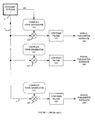
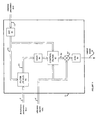
- a sensor 2 is used to sense the disturbance of a dynamic system 1 and produce a signal 3 .
- a synchronizing signal 100 is indicative of the frequency or phase of the system.
- the synchronizing signal is passed to tone generators 101, 101', 101" which each generate complex (in-phase and quadrature) signals at one of the harmonics of the fundamental frequency of the disturbance.
- the signal 3 is multiplied at 102, 102', 102" by each of the complex signals and passed through low pass filters 103, 103', 103" (which may be integrators) to produce estimates of the complex amplitudes at each harmonic frequency, as indicated 104, 104', 104" .
- These estimated signals provide an indication of the amplitude of the disturbance at the harmonic frequency. This process is known as heterodyning. Synchronous sampling techniques are better at separating the harmonic components, but require more expensive electronic hardware to perform the synchronous sampling and cannot be used simultaneously for broadband analysis.
- the use of tracking filters in a system for active control is described in US 5,469,087 (Eatwell).
- the measurement of disturbances experienced by rotating or reciprocating machinery often requires the use of multiple sensors.
- the data from these sensors is transmitted to a computer system for processing and analysis.
- the combination of multiple sensors and moderate frequency bandwidths will results in high data transfer rates. Considerable benefit would result if the data could be compressed before transmission or storage.
- System identification is the process of building a mathematical model of a dynamical system based on measurements ofresponse ofthe system to known disturbances. This is usually done by applying the known disturbances to a mathematical model and then adjusting the parameters of the model until the output of the model is as close as possible to the measured output from the real system.
- This model is referred to as the system model or the dynamic response model.
- System identification is a central part of modal analysis and control systems.
- modal analysis the dynamic response model of the system is parametrized by the frequency, damping and shape of a number of resonant modes.
- modal analysis In order to conduct a modal analysis of a system it is usually necessary to cease the operation of the system. This means that modal analysis cannot be part of an on-line condition monitoring system.
- System identification is also a central part of an adaptive control system, such as used for active noise and vibration control.
- a mathematical model of the physical system is assumed to be known from prior measurements or from numerical or analytical modelling. Once this information is known, the state of the system (usually current and prior conditions) can be estimated using known techniques. For example, if the statistics of the disturbance are known, an optimal 'observer' may be used to estimate the current system state.
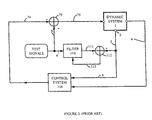
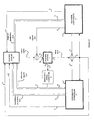
- Test signal 4 is added at 75 to the output 74 of control system 114 to produce an actuator drive signal 76 .
- the actuator 77 excites the dynamic system 1 .
- the response of the dynamic system is measured by sensor 2 to produce sensor signal 3 .
- the component of the sensor signal that is due to the test signal is estimated by passing the test signal 4 through adaptive filter 110 to produce an estimated response signal 111. This is subtracted from the sensor signal at 112 to give error signal 113 , which is in turn used to adapt the coefficients ofthe filter 110 .
- the control system 114 is responsive to the sensor signal 3 and, optionally, a reference signal 4 .
- the estimation of the dynamic response is achieved by adding a low level test signal to the controller output and correlating this with the response at the system inputs.
- the level of the test signal must be kept low so that the control is not adversely affected, and secondly, as a consequence, the convergence rate of the estimation must be slow in order to decorrelate the test signal and the residual disturbance. This is a particular problem especially at start up when the disturbance may be large.
- condition monitoring In on-line condition monitoring, the sound or vibration of a machine is monitored to determine if the machine is operating normally. Such a monitoring system infers information about the machine from the disturbance signals alone. In many machine failures the dynamic response of the system will also change prior to failure, so the monitoring could be improved significantly if the dynamic response could be measured.
- condition-based maintenance is to avoid stopping the machine unnecessarily for checks, so it is usually not possible to stop the machine to perform a modal analysis or other system response measurement.
- an object of the current invention is to provide a method and apparatus for simultaneous characterization of the disturbance and the dynamic response model of a dynamical system.
- a further object is to provide a method and apparatus for simultaneous characterization of narrowband and broadband components of the disturbance of a dynamical system.
- a still further object ofthe invention is to provide a method and apparatus for estimating the disturbance parameters of a dynamical system and using them to provide a compressed representation of the disturbance.
- a still further object of the invention is to provide a method and apparatus for controlling a dynamical system in which the control system simultaneously characterizes the disturbance and the dynamic response model of a dynamical system.
- the current invention is a method and apparatus for simultaneously characterizing the disturbance of a dynamical system and the dynamic response model of the system.
- the disturbance is characterized as a weighted sum of reference signals rather than the disturbance signals themselves.
- the weights in this sum are referred to as disturbance parameters.
- the dynamic response model is characterized by a set of response parameters which model the relationship between a set of test signals and the response to these test signals.
- the disturbance parameters and the response parameters characterize the state of the dynamical system (sometimes also called the hyperstate ).
- the disturbance parameters and the response parameters are jointly estimated to provide a characterization of the dynamical system. This estimation is achieved by obtaining reference and test signals related to the disturbances, sensing the system at one or more locations to obtain sensed signals, synthesizing an estimate of the sensed signal from the reference signals, the test signals, the disturbance parameters and the response parameters, and jointly adjusting the disturbance parameters and the response parameters according to the difference between the synthesized signal and the sensed signal.
- the principal outputs generated are: (1) the synthesized signal and its components (2) the disturbance and signal parameters (3) the difference signal between the synthesized signal and the sensed signal (the sensed signal may also be considered as an output, since the difference signal can be simply calculated from the sensed signal and the synthesized signal).
- the difference signal contains important information concerning the mis-adjustment of the parameters and unmodelled disturbance and will be described in more detail later.
- the disturbance parameters and response parameters are estimated independently, whereas in the current system the parameters are estimated jointly.
- Figure 1 is a diagrammatic view of a tonal signal analysis system of the prior art.
- Figure 2 is a diagrammatic view of a prior art control system with on-line system identification.
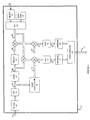
- Figure 3 is a diagrammatic view of a dynamic system analyzer of the current invention
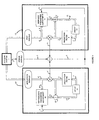
- Figure 4 is a diagrammatic view of a dynamic system analyzer of the current invention showing disturbance synthesizer and response synthesizer
- Figure 5 is a diagrammatic view of a time-domain parameter adjustment means of the current invention.
- Figure 6 is a diagrammatic view of a frequency-domain parameter adjustment means of the current invention.
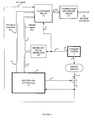
- Figure 7 is a diagrammatic view of a machinery monitoring system incorporating a dynamic system analyzer of the current invention
- Figure 8 is a diagrammatic view of an active control system for tonal noise incorporating a dynamic system analyzer of the current invention
- Figure 9 is a diagrammatic view of a frequency-domain adaptive controller
- Figure 10 is a diagrammatic view of an active control system for broadband or narrowband noise incorporating a dynamic system analyzer of the current invention.
- Figure 11 is a diagrammatic view of a time-domain adaptive controller.
- Figure 12 is a diagrammatic view of a dynamic system analyzer combined with means for producing and transmitting a compressed characterization of the state of the dynamic system.
- a system of the current invention is shown in figure 3. It comprises a dynamic system analyzer 15" for analyzing a dynamical system 1 .
- Sensor 2 senses the disturbance of the system and produce sensor signal 3 .
- Reference and/or test signals 4" and predicted parameters 5" are combined to produce synthesized signal 6" .
- the reference signals are time-related to the disturbance and are generated either from additional disturbance sensors or from signal generators.
- the test signals are known signals that are use to produce disturbances in the system.
- the predicted parameters 5" are obtained by passing previous estimates of the parameters 7" through a prediction filter 8" .
- An error signal 9 is calculated as the difference between the synthesized signals 6" and the sensor signals 3 .
- the error signal 9 and the reference signals 4" are used in parameter adjuster 10" to generate a correction 11" to the predicted parameters 5" .
- the correction and the predicted parameters are combined at 12" to generate a new estimate ofthe parameters 13" .
- the new parameters are delayed at 14" to produce the previous parameters 7".
- the principal outputs generated are the synthesized signal 6" , the estimated parameters 13" or the predicted parameters 5", and the error signal 9 .
- Figure 3 shows a general system analyzer for estimating a complete parameter set.
- the system may be more easily described if the reference signals and test signals are separated into two groups.
- the first group of signals are test signals, usually generated by the analyzer, which are used to generate disturbances in the dynamical system.
- the second group of signals are reference signals which are time-related to unknown disturbances in the dynamical system and are usually derived from sensor signals.
- ⁇ ( n ), 9 is the total unmodelled component of the signal.
- the response synthesizer is shown as 15 in figure 4.
- r (n) is denoted by 4 in figure 4.
- ⁇ 0 ( n ) is the component of the disturbance which is not predicted by the model.
- test signals are used to drive actuators which cause a disturbance to the dynamical system.
- an electromagnetic actuator may be used to excite a mechanical system or a loudspeaker used to excite an acoustical system.
- the response to the controlled disturbances can thus be written as a weighted sum of the signals r j ( n ) with weights given by the response parameters a j ( n ) .
- the response at sensor m to the controlled disturbances can be modelled as where c ml / k ( n ) and d p ( n ) are time varying parameters which characterize the system response.
- the response synthesizer is shown as 15 in figure 4.
- the actual values ofthe response parameters are unknown, so, at time sample n, the synthesized response r and ( n ) 6 is obtained from a prediction ofthe parameters â ( n
- n - 1) 5 and the test signals r (n) 4 as r ( n ) â( n
- n - 1) is the prediction of a ( n ) at time sample n using information available at time sample n - .1
- n ) will also be written simply as â ( n ) .
- the disturbance synthesizer is shown as 15' in figure 4. It is assumed that at least some component of the unknown disturbance, which corresponds to one component of sensor signal 3 , can be modelled as a weighted sum of reference signals. For example, these reference signals may be produced by sensors responsive to the disturbance at other locations. When a component of the disturbance is cyclic in nature, the reference signals may be sine and cosine signals at frequencies which are multiples of the fundamental frequency of the cyclic disturbance or combinations thereof. We denote the k th reference signal at sample n by x k ( n ).
- the unknown disturbance can be written as where b (n) is a vector of unknown disturbance parameters, b k ( n ), and ⁇ 1 ( n ) is the component of the disturbance which is unrelated to the reference signals.
- x ( n ) ⁇ x 0 ( n ), x 1 ( n ) ,...x K -1 ( n ) ⁇ T is the vector of reference signals, which is denoted by 4' in figure 4.
- ⁇ n may be determined from a sensor, such as a tachometer or accelerometer, or may be estimated by integrating the fundamental frequency of the disturbance.
- additional reference signals may be used for the additional disturbances.
- the vector of reference signals contains current an previous samples of the sensor signal.
- both types of reference signals are used.
- the disturbance synthesizer is shown as 15' in figure 4.
- the actual values of the disturbance parameters are unknown, so, at time sample n, the synthesized disturbance û( n ) 6' is obtained from a prediction of the parameter vector b and ( n
- n - 1) 5' and the reference signals x( n ) 4 ' according to û ( n ) b ( n
- the synthesized disturbance û ( n ) is obtained from the previous parameters b and ( n - 1
- n - 1) and the reference signals x( n ) as û ( n ) b ( n - 1
- the parameters are usually assumed to be slowly varying compared to the signals, they may be thought of as being generated by passing random parameters through a low pass filter. Examples of these models are and where ⁇ k,p and ⁇ k,p are the coefficients of a prediction filter.
- the current parameter may be predicted from the P - 1 previous values with an error of v ( n ).
- the prediction filter is typically a smoothing filter or low-pass filter.
- the coefficients ofthe filters themselves may depend upon other physical parameters such as the operating condition of the machine being monitored (speed, acceleration temperature etc.).
- F a and F b are matrices.
- the predicted parameters 5 and 5' are calculated from previous estimates of the parameters 7 and 7' as and respectively. This computation is performed by prediction filters 8 and 8' .
- the prediction are simply given by the previous estimates, i.e. â( n
- n - 1) â( n - 1) or b ( n
- n - 1) b ( n - 1).
- the parameters will usually vary more slowly than the signals themselves. This characteristic of the parameters can be included in the model so as to improve the accuracy and robustness ofthe final analysis.
- the future values of the parameters may be predicted from past values using a prediction filter 8" .
- the prediction filter 8" can be written in a standard state space form as where v (n) is a noise signal and A is a matrix which contains the filter parameters.
- A has the form where F (p) are sub-matrices of filter coefficients given by
- Equation for the sensor signal can be rewritten as
- the equations 38 and 35 are in a standard state space form and may be solved recursively by well known methods, such as the well known Kalman filter (see for example, 'Adaptive Filter Theory', Simon Haykin, pp244-266, Prentice Hall, 1991).
- Kalman filter see for example, 'Adaptive Filter Theory', Simon Haykin, pp244-266, Prentice Hall, 1991.
- the stochastic signals v ( n ) and ⁇ ( n ) are not known. Instead, the variances of the signals must be treated as parameters.
- an estimate of the unknown disturbance signal is synthesized by forming a sum of products of the reference signals with the predicted disturbance parameters.
- the synthesized disturbance signal is where ⁇ denotes an estimated value.
- the estimate f and ( n ) 13" of the current parameters is obtained by adding an adjustment 11" to the predicted parameter vector f( n
- the adjustment 11 " is given by k ( n ) e ( n ), where k ( n ) is a gain vector and e (n) is error signal ( 9 in figure 3).
- the gain vector may be a function of the signal vector ⁇ , 4", the state transition matrix A and estimates of the statistics of the signals ⁇ and v.
- the matrix k ( n ) ⁇ T ( n ) is not diagonal, so it is clear that the parameters are not updated independently of one another
- This embodiment of the adjustment means 10 " is depicted in figure 5.
- the signal vector ⁇ (n) 4" is multiplied by the error signal e (n) 9 at 30 .
- the result 31 is scaled by gain G (n) at 32 to given the adjustment G (n) ⁇ (n) e(n) 11" .
- the gain G (n) 33 is calculated from the signal vector 4" at 34 .
- n - 1) T r( n ) â( n ) â ( n
- n - 1) + k a ( n ) e ( n ) b ( n ) b ( n
- k a ( n ) is the vector obtained from the first J elements of k ( n ) and k b ( n ) is the vector obtained from the remaining K elements.
- each order component is estimated independent of the other by passing it through a narrowband filter or by calculating a Fourier transform. This reduces the ability of the system to track rapidly changing parameters.
- the current invention allows for the tracking of rapid changes in the disturbance parameters.
- the disturbance is substantially eliminated from the signal used to update the response parameters, hence the parameters may be updated much more quickly and more accurately.
- whitening filters may be used on the error signal and the reference or test signals so as to improve convergence speeds.
- the short term correlation between the reference signals x and the test signals r may be neglected.
- the gain vector k a ( n ) is then independent of r and the gain vector k b ( n ) is then independent of x .
- This particular embodiment is shown in figure 4.
- the response parameter adjustment means 10 depends upon the test signals 4 and the error signal 9 , but not on the reference signals 4' .
- the disturbance parameter adjustment means 10' depends upon the reference signals 4' and the error signal 9 but not on the test signals 4 .
- one embodiment of the invention uses a frequency domain update of the parameter vector, as depicted in figure 6.
- the blocks r L and e L are Fourier transformed at 43 and 44 respectively to give complex transforms R L 45 and EL 46 .
- the complex vector R L is then conjugated at 47 to give R * / L 48 and then delayed at 49 to give delayed transform R * / L -1 50.
- the inverse transforms da 0 55 and da 1 56 are then calculated by passing dA 0 and dA 1 through inverse Fourier transformers 57 and 58.
- the time domain updates are given by windowing da 0 and da 1 at 59 and 60 so as to retain only the first M /2 values and then concatenating at 61 according to to form the desired adjustment 11 to the j th element of the parameter vector, c j .
- This frequency domain update has rapid convergence properties.
- Other updates algorithms may be used, such as those described in 'Frequency Domain and Multirate Adaptive Filtering', IEEE Signal Processing Magazine, Vol. 9 No. 1, January 1992, by John J. Shynk.
- the reference signals may be taken to be sine and cosine signals at frequencies which are multiples of the fundamental frequency of each disturbance source.
- ⁇ m ( n ) may be determined from a reference sensor or a reference signal, or it may be estimated from the sensor signal.
- the synthesized disturbance signal is given by
- the disturbance parameter b 2 k ( n ) corresponds to the real part of the k th harmonic component ofthe disturbance while the disturbance parameter b 2 k +1 ( n ) corresponds to the imaginary part of the k th harmonic component of the disturbance.
- the reference signals 4' are linear combinations of sine and cosine signals.
- a sensor 90 such as a tachometer or shaft encoder, provides a synchronizing signal 91 which is used by cosine/sine generator 92 to generate sine and cosine signals synchronized to the dynamic system or machine 1 .
- the reference signals 4' which are preferably digital signals, are generated by passing the sine and cosine signals through an optional weighting network or matrix 93 to produce linear combinations of the sine and cosine signals.
- the first linear combination may represent the combination of tones corresponding to the normal operation of a machine, while other combinations are orthogonal to the first combination.
- the relative level of the parameter associated with the first combination to the other parameters then provides a measure of the deviation of the machine from normal operation and may be used as an indicator that maintenance is required.
- the singular vectors corresponding to the largest singular values are used to describe the normal operating condition, the remainder are used to describe deviations from the normal condition.
- the disturbance parameters 13' indicate the departure of the machine from normal operating conditions and are passed to the machinery monitoring system 94.
- the predicted disturbance parameters 5' may be used instead of the estimated parameters 13' .
- the error signal e ( n ) 9 is a measure of the part of the disturbance that is not tonal.
- the level of the error signal is an important indicator of the condition of the machine, and so it is passed to the machinery monitoring system 94 .
- the machinery monitoring system may use the synthesized disturbance signal 6' .
- This is the part of the disturbance signal that is purely tonal in nature - i.e. uncorrelated noise has been removed.
- the disturbance signal is therefore an enhanced version of the sensor signal and may be used for further analysis.
- the response parameters 13 are also estimated and passed to the machinery monitoring system 94 . This allows changes in the structural or acoustic response of the system to be monitored.
- the predicted response parameters 5 may be used instead of the estimated parameters 13.
- the tonal noise control system of the current invention utilizes the tonal noise analyzer described above.
- the response parameters c ml / 0 ( n ), c ml / 1 ( n ),... c ml / K -1 ( n ) represent the impulse response from the l th test signal to the m th sensor
- the Fourier transform of the impulse response is the transfer function C ml ( ⁇ , n ) at frequency ⁇ / KT s , where K is the length of the transform and T s is the sample period.
- the aim is often to reduce the tonal component of the disturbance by adding additional controlled disturbances to the dynamic system.
- C ⁇ ( ⁇ k , n ) is a pseudo inverse of C ( ⁇ k , n ) and ⁇ is positive step size.
- a tonal control system of the current invention is shown in figure 8.
- a sensor 70 which may be tachometer or accelerometer for example, provides a signal 71 related to the frequency or phase (timing) of the dynamic system. If more than one cyclic disturbance is present, additional sensors will be used.
- Signal 71 is used in reference signal generator 72 to produce cosine and sine reference signals 4' .
- Control system 73 is responsive to the predicted disturbance parameters 5', the reference signals 4' and the response parameters 13.
- the estimated disturbance parameters 13' may be used instead of 5' , or the predicted response parameters 5 used instead of the estimated parameters 13.
- the control system produces control signals 74 which are combined with the test signals 4.
- the resulting combined signals 75 are used to drive actuators 76 which produce a controlled disturbance in the dynamical system.
- the preferred embodiment of the control system 73 is shown in figure 9 .
- the response parameters 13 are passed through Fourier transformer 80 to produce the complex transfer function matrix C ( ⁇ , n ) 81 .
- the predicted disturbance parameters B k ( n ) 5' are multiplied at 82 by a matrix which is dependent upon C ( ⁇ , n ) to produce filtered parameters 83.
- This matrix should compensate for the phase modification of the signals by the actuators, the sensors and the dynamic system. Examples of such matrices include C * ( ⁇ , n ) and C ⁇ ( ⁇ , n ) .
- the filtered parameters are then multiplied by gain 84 and passed through control filter 85 to produce the control parameters Y k (n) 86.
- the control parameters are multiplied at 87 by the reference signals 4' and summed at 88 to produce the control signals 74 .
- control filter 85 examples include simple integrators as in equation 76.
- the control filter may depend upon the transfer function matrix as in equation 75.
- the output 74 from control system 79 (see figure 11 for details) is given by where h k ( n ) is the k th coefficient of the control filter at time sample n.
- the adjustment of the coefficients h k ( n ) uses the response parameters a sen / k (n) , 13 (or the predicted parameters 5 ) the synthesized disturbance signal û (n) 6' , the synthesized response signal r and ( n ) 6 and the unmodelled component of the signal ⁇ ( n ) 9 .
- the reference sensor is responsive to the effects of the control signal 71.
- the reference signal generator 72 is responsive to the control signal 76 and the response parameters a ref / k ( n ) .
- ⁇ is a positive constant and ⁇ , which is also positive, may depend upon the reference signals and the response parameters.
- a sen / k ( n ),..., is the k th coefficient of the impulse response to the (residual) sensor.
- the control system produces control signals 74 which are combined with the test signals 4 .
- the resulting combined signal 75 is used to drive actuators 76 which produce a controlled disturbance in the dynamic system.
- Figure 11 shows one embodiment of control system 79.
- h k ( n + 1) h k ( n ) - ⁇ g ( n - k ) s ( n )
- This algorithm is a modification to the well known filtered-x LMS algorithm (ref. Widrow).
- the update is proportional to the sensor signal s (n) .
- the update is proportional to the synthesized disturbance signal û ( n ) and an estimate e ( n ) of the unmodelled component of the signal.
- the sensor signal contains components that are uncorrelated with the reference signals. These components cannot be controlled, but their presence will degrade the reduction of the controllable components.
- the synthesized error signal however is correlated with the reference signal and so an improved reduction of the controllable components will be achieved.
- the additional term multiplied by ⁇ may be included to prevent amplification of uncorrelated noise in the reference signals.
- the constant ⁇ is chosen to reflect the importance of amplification relative to reduction of the controllable part.
- the modified algorithm will be referred to as a synthetic error filtered-x LMS algorithm.
- a diagrammatic view of the controller is shown in figure 11.
- the synthesized disturbance signal û ( n ) 6' and the unmodelled component e (n) 9 are combined at 89 to produce the signal s ( n ) 120.
- This signal is filtered at 121 by the filter with coefficients f k ( n ) .
- the result is signal f (n) 122.
- the reference signals 4' are passed through filter 123 with coefficients g k ( n ) and then multiplied by the filtered error signal at 124 to produce the input 125 to the control filter 85.
- the outputs from the control filter are the controller parameters (coefficients) 86.
- Examples of the control filter 85 include a simple integrator as given by equation 81 .
- the reference signals 4' are multiplied by the controller parameters 86 at 87 and summed at 88 to produce the controller output signal 71.
- the frequency domain update described above can be used.
- the filtering of the reference signal and the error signal can also be performed in the frequency domain. This approach yields rapid convergence of the filter coefficients and is computationally efficient.
- noise control is required to facilitate communication between a person in a noisy environment and other people.
- the sensor may be a microphone which can be used to provide a communication signal.
- the first filter is used for noise reduction
- the second filter is used to remove residual noise from the signal from microphone 36.
- the error signal 9 contains the component of the signal that is not correlated with the reference signal, and can therefore be used as a communication signal. No additional noise filtering is required.
- the disturbance synthesizer shows how the signal can be synthesized from the disturbance parameters and the reference signal.
- the disturbance parameters are often very slowly varying in comparison to the sensor signals. That is, they have a much lower frequency bandwidth and can be subsampled without losing significant information.
- the frequency of the disturbance may be transmitted.
- the error signal(s) can also be transmitted. Even though the error signals have a bandwidth as high as the original signals, the dynamic range is much smaller. Consequently, the error signals can be represented by fewer bits then the sensed signals and compression is still achieved.
- Compression is also useful if the signals are to be stored for later analysis or processing.
- the analysis system is used to pre-process the signals in the locality of the machine.
- the parameters and signals related to the reference signals are then used to form a compressed data signal which is then transmitted over a wired or wireless link to a remote site for further analysis and processing, or is stored for future analysis.
- the compression means 131 is responsive to the estimated disturbance parameters 13' (or predicted parameters 5' ).
- the compression means 131 may also be responsive to the reference signals 4' (in the case of broadband disturbance) which are generated by reference signals generator 130, or measured signal 71 (which may be a frequency or timing signal in the case of a tonal disturbance).
- the compression means 131 produces a compressed data signal 132 which is passed to transmission or storage means 133.
- the transmission means may be, for example, a wireless link or a computer network link or a data bus.
- the storage means may, for example, be a magnetic or optical disc.
- the compression means 131 may also be responsive to the error signal 9 .
- the preferred embodiments of the invention provide a method and apparatus for simultaneous characterization of the disturbance and the system response model of a dynamical system.
- This simultaneous characterization provides improvements in both the accuracy and speed of the characterization over previous systems which use independent characterization techniques.
- the current invention uses adaptive signal synthesis.
- the synthesis error signal ( 9 in figure 3 and 4) provides additional information which is not available in prior system which use filtering techniques.
- this error signal relates to the broadband component of the signal.
- stationary broadband signals are synthesized, this error corresponds to transient components in the signal.
- the current invention also allows both broadband and tonal signals to be synthesized simultaneously by using appropriate reference signals. This feature is not available in the prior art.
Landscapes
- Physics & Mathematics (AREA)
- General Physics & Mathematics (AREA)
- Engineering & Computer Science (AREA)
- Automation & Control Theory (AREA)
- Feedback Control In General (AREA)
- Monitoring And Testing Of Transmission In General (AREA)
Applications Claiming Priority (2)
| Application Number | Priority Date | Filing Date | Title |
|---|---|---|---|
| US09/108,253 US6208949B1 (en) | 1998-07-01 | 1998-07-01 | Method and apparatus for dynamical system analysis |
| US108253 | 1998-07-01 |
Publications (2)
| Publication Number | Publication Date |
|---|---|
| EP0969341A2 true EP0969341A2 (de) | 2000-01-05 |
| EP0969341A3 EP0969341A3 (de) | 2000-05-17 |
Family
ID=22321119
Family Applications (1)
| Application Number | Title | Priority Date | Filing Date |
|---|---|---|---|
| EP99305195A Withdrawn EP0969341A3 (de) | 1998-07-01 | 1999-07-01 | Verfahren und Gerät zur Analyse eines dynamischen Systems |
Country Status (2)
| Country | Link |
|---|---|
| US (1) | US6208949B1 (de) |
| EP (1) | EP0969341A3 (de) |
Cited By (11)
| Publication number | Priority date | Publication date | Assignee | Title |
|---|---|---|---|---|
| WO2002027418A3 (en) * | 2000-09-25 | 2003-01-16 | Motorwiz Inc | Model-based machine diagnostics and prognostics using theory of noise and communications |
| RU2451319C1 (ru) * | 2011-07-15 | 2012-05-20 | Государственное образовательное учреждение высшего профессионального образования "Тихоокеанский государственный университет" | Способ поиска неисправного блока в динамической системе |
| RU2506623C1 (ru) * | 2012-10-08 | 2014-02-10 | Федеральное государственное бюджетное образовательное учреждение высшего профессионального образования "Тихоокеанский государственный университет" | Способ поиска неисправного блока в дискретной динамической системе |
| RU2506622C1 (ru) * | 2012-10-08 | 2014-02-10 | Федеральное государственное бюджетное образовательное учреждение высшего профессионального образования "Тихоокеанский государственный университет" | Способ поиска неисправных блоков в дискретной динамической системе |
| RU2613402C1 (ru) * | 2016-04-12 | 2017-03-16 | Федеральное государственное бюджетное образовательное учреждение высшего образования "Тихоокеанский государственный университет" | Способ поиска топологического дефекта в непрерывной динамической системе на основе функции чувствительности |
| RU2613630C1 (ru) * | 2016-03-09 | 2017-03-21 | Федеральное государственное бюджетное образовательное учреждение высшего образования "Тихоокеанский государственный университет" | Способ поиска неисправного блока в непрерывной динамической системе на основе введения пробных отклонений |
| RU2616512C1 (ru) * | 2016-04-20 | 2017-04-17 | Федеральное государственное бюджетное образовательное учреждение высшего образования "Тихоокеанский государственный университет" | Способ поиска топологического дефекта в непрерывной динамической системе на основе введения пробных отклонений |
| RU2616501C1 (ru) * | 2016-06-22 | 2017-04-17 | Федеральное государственное бюджетное образовательное учреждение высшего образования "Тихоокеанский государственный университет" | Способ поиска топологического дефекта в непрерывной динамической системе на основе введения пробных отклонений |
| RU2616499C1 (ru) * | 2016-06-22 | 2017-04-17 | Федеральное государственное бюджетное образовательное учреждение высшего образования "Тихоокеанский государственный университет" | Способ поиска топологического дефекта в дискретной динамической системе на основе введения пробных отклонений |
| RU2662380C1 (ru) * | 2017-04-05 | 2018-07-25 | Федеральное государственное бюджетное образовательное учреждение высшего образования "Тихоокеанский государственный университет" | Способ поиска неисправного блока в непрерывной динамической системе на основе смены позиции входного сигнала |
| RU2711000C1 (ru) * | 2019-05-27 | 2020-01-14 | Федеральное государственное бюджетное образовательное учреждение высшего образования "Тихоокеанский государственный университет" | Способ поиска неисправного блока в непрерывной динамической системе на основе введения пробных отклонений и анализа знаков передач |
Families Citing this family (17)
| Publication number | Priority date | Publication date | Assignee | Title |
|---|---|---|---|---|
| US7024335B1 (en) * | 1998-04-15 | 2006-04-04 | The Texas A&M University System | Condition assessment and life expectancy prediction for devices |
| US6304832B1 (en) * | 1999-03-16 | 2001-10-16 | Mitutoyo Corporation | Symmetric sampling |
| US6459939B1 (en) * | 1999-06-29 | 2002-10-01 | Alan J. Hugo | Performance assessment of model predictive controllers |
| AU1131201A (en) * | 1999-11-03 | 2001-05-14 | Palle Andersen | Method for vibration analysis |
| US6415206B1 (en) * | 2000-02-24 | 2002-07-02 | Simmonds Precision Products, Inc. | Method for determining a minimal set of rotor blade adjustments |
| US6684114B1 (en) * | 2000-03-03 | 2004-01-27 | Tokyo Electron Limited | Efficient adaptive feedforward periodic disturbance compensation |
| DE10106505A1 (de) * | 2001-02-13 | 2002-08-29 | Bosch Gmbh Robert | Verfahren und Vorrichtung zur Zustandserfassung von technischen Systemen wie Energiespeicher |
| US20030079937A1 (en) * | 2001-10-30 | 2003-05-01 | Siemens Vdo Automotive, Inc. | Active noise cancellation using frequency response control |
| US7450725B2 (en) * | 2001-12-17 | 2008-11-11 | Mahle International Gmbh | Digital filter modeling for active noise cancellation |
| AU2004277166A1 (en) * | 2003-09-22 | 2005-04-07 | Kim Hyeung-Yun | Sensors and systems for structural health monitoring |
| US7512463B1 (en) | 2005-02-16 | 2009-03-31 | Simmonds Precision Products, Inc. | Reducing vibration using QR decomposition and unconstrained optimization for a multi-rotor aircraft |
| US8010235B2 (en) * | 2005-05-31 | 2011-08-30 | The Boeing Company | Approaching and compensating for machine kinematic singularities |
| US7317994B2 (en) * | 2005-08-10 | 2008-01-08 | General Electric Company | Method and apparatus for signal signature analysis for event detection in rotating machinery |
| US7573149B2 (en) * | 2007-12-06 | 2009-08-11 | General Electric Company | System and method for controlling a wind power plant |
| US8593273B2 (en) | 2011-02-07 | 2013-11-26 | Infineon Technologies Ag | Systems and methods for localization of tire pressure monitoring system wheel modules |
| US8565967B2 (en) * | 2011-12-21 | 2013-10-22 | Infineon Technologies Ag | Acceleration detection and angular position determination systems and methods in tire pressure monitoring systems |
| CN110057317B (zh) * | 2018-11-16 | 2020-10-30 | 中山大学 | 一种基于奇异值分解和查找表构造的投影噪声消除方法 |
Family Cites Families (13)
| Publication number | Priority date | Publication date | Assignee | Title |
|---|---|---|---|---|
| US4714988A (en) * | 1982-03-26 | 1987-12-22 | Kabushiki Kaisha Toshiba | Feedforward feedback control having predictive disturbance compensation |
| US4677676A (en) | 1986-02-11 | 1987-06-30 | Nelson Industries, Inc. | Active attenuation system with on-line modeling of speaker, error path and feedback pack |
| US4893480A (en) * | 1987-03-13 | 1990-01-16 | Nippondenso Co., Ltd. | Refrigeration cycle control apparatus |
| ATE65128T1 (de) * | 1987-05-21 | 1991-07-15 | Schenck Ag Carl | Verfahren zur regelung einer differentialdosierwaage, insbesondere fuer schuettgueter, und differential-dosierwaage zur durchfuehrung des verfahrens. |
| WO1989002617A1 (fr) * | 1987-09-11 | 1989-03-23 | Kabushiki Kaisha Yaskawa Denki Seisakusho | Systeme de commande qui suit au mieux une valeur de point de consigne periodique |
| US5033082A (en) | 1989-07-31 | 1991-07-16 | Nelson Industries, Inc. | Communication system with active noise cancellation |
| SE468691B (sv) * | 1991-06-26 | 1993-03-01 | Asea Brown Boveri | Metod foer att skapa en logisk beskrivning av en signal genom identifiering av dennas tillstaand samt en aendring av tillstaandet |
| US5469087A (en) | 1992-06-25 | 1995-11-21 | Noise Cancellation Technologies, Inc. | Control system using harmonic filters |
| US5740033A (en) * | 1992-10-13 | 1998-04-14 | The Dow Chemical Company | Model predictive controller |
| US5568377A (en) * | 1992-10-29 | 1996-10-22 | Johnson Service Company | Fast automatic tuning of a feedback controller |
| JP3196390B2 (ja) * | 1992-12-25 | 2001-08-06 | 富士電機株式会社 | パラメータ同定器 |
| US5553153A (en) | 1993-02-10 | 1996-09-03 | Noise Cancellation Technologies, Inc. | Method and system for on-line system identification |
| US5943637A (en) * | 1995-12-27 | 1999-08-24 | Kabushiki Kaisha Toshiba | Noise analyzing apparatus for analyzing noise of autonomous system by simulation |
-
1998
- 1998-07-01 US US09/108,253 patent/US6208949B1/en not_active Expired - Fee Related
-
1999
- 1999-07-01 EP EP99305195A patent/EP0969341A3/de not_active Withdrawn
Cited By (11)
| Publication number | Priority date | Publication date | Assignee | Title |
|---|---|---|---|---|
| WO2002027418A3 (en) * | 2000-09-25 | 2003-01-16 | Motorwiz Inc | Model-based machine diagnostics and prognostics using theory of noise and communications |
| RU2451319C1 (ru) * | 2011-07-15 | 2012-05-20 | Государственное образовательное учреждение высшего профессионального образования "Тихоокеанский государственный университет" | Способ поиска неисправного блока в динамической системе |
| RU2506623C1 (ru) * | 2012-10-08 | 2014-02-10 | Федеральное государственное бюджетное образовательное учреждение высшего профессионального образования "Тихоокеанский государственный университет" | Способ поиска неисправного блока в дискретной динамической системе |
| RU2506622C1 (ru) * | 2012-10-08 | 2014-02-10 | Федеральное государственное бюджетное образовательное учреждение высшего профессионального образования "Тихоокеанский государственный университет" | Способ поиска неисправных блоков в дискретной динамической системе |
| RU2613630C1 (ru) * | 2016-03-09 | 2017-03-21 | Федеральное государственное бюджетное образовательное учреждение высшего образования "Тихоокеанский государственный университет" | Способ поиска неисправного блока в непрерывной динамической системе на основе введения пробных отклонений |
| RU2613402C1 (ru) * | 2016-04-12 | 2017-03-16 | Федеральное государственное бюджетное образовательное учреждение высшего образования "Тихоокеанский государственный университет" | Способ поиска топологического дефекта в непрерывной динамической системе на основе функции чувствительности |
| RU2616512C1 (ru) * | 2016-04-20 | 2017-04-17 | Федеральное государственное бюджетное образовательное учреждение высшего образования "Тихоокеанский государственный университет" | Способ поиска топологического дефекта в непрерывной динамической системе на основе введения пробных отклонений |
| RU2616501C1 (ru) * | 2016-06-22 | 2017-04-17 | Федеральное государственное бюджетное образовательное учреждение высшего образования "Тихоокеанский государственный университет" | Способ поиска топологического дефекта в непрерывной динамической системе на основе введения пробных отклонений |
| RU2616499C1 (ru) * | 2016-06-22 | 2017-04-17 | Федеральное государственное бюджетное образовательное учреждение высшего образования "Тихоокеанский государственный университет" | Способ поиска топологического дефекта в дискретной динамической системе на основе введения пробных отклонений |
| RU2662380C1 (ru) * | 2017-04-05 | 2018-07-25 | Федеральное государственное бюджетное образовательное учреждение высшего образования "Тихоокеанский государственный университет" | Способ поиска неисправного блока в непрерывной динамической системе на основе смены позиции входного сигнала |
| RU2711000C1 (ru) * | 2019-05-27 | 2020-01-14 | Федеральное государственное бюджетное образовательное учреждение высшего образования "Тихоокеанский государственный университет" | Способ поиска неисправного блока в непрерывной динамической системе на основе введения пробных отклонений и анализа знаков передач |
Also Published As
| Publication number | Publication date |
|---|---|
| US6208949B1 (en) | 2001-03-27 |
| EP0969341A3 (de) | 2000-05-17 |
Similar Documents
| Publication | Publication Date | Title |
|---|---|---|
| US6208949B1 (en) | Method and apparatus for dynamical system analysis | |
| EP0695452B1 (de) | Adaptives steuerungssystem im frequenzbereich | |
| US6856920B2 (en) | Adaptation performance improvements for active control of sound or vibration | |
| JP3305719B2 (ja) | オンライン・システム識別の方法及び装置 | |
| CA2220275C (en) | High fidelity vibration source seismic method | |
| EP1003154B1 (de) | Identifikation einer akustischer Anordnung mittels akustischer Maskierung | |
| US5691893A (en) | Adaptive control system | |
| US5621656A (en) | Adaptive resonator vibration control system | |
| WO1997018489A1 (en) | High fidelity vibratory source seismic method using a plurality of vibrator sources | |
| US5812682A (en) | Active vibration control system with multiple inputs | |
| CA2297891A1 (en) | Signal processing system | |
| EP0654901B1 (de) | Schnelles Konvergenzsystem eines adaptiven Filters zur Erzeugung eines zeitabhängigen Signals zur Kompensation eines primären Signals | |
| Munn et al. | Virtual error sensing for active noise control in a one-dimensional waveguide: Performance prediction versus measurement (L) | |
| JPH11327658A (ja) | アクティブ制振系における移相適合制振方法 | |
| JP3646809B2 (ja) | 時間領域適応制御システム | |
| JP3579898B2 (ja) | 車両の振動制御装置および振動制御方法 | |
| Steffensen et al. | Accurate frequency response function estimation using noise measurements in experimental modal analysis | |
| JP3220418B2 (ja) | 信号制御システムおよび信号制御方法 | |
| Rauf et al. | New nonlinear adaptive filters with applications to chaos | |
| WO1992008224A1 (en) | Active vibration control system with multiple inputs | |
| Vanlanduit et al. | Elimination of background disturbances from measurement spectra | |
| KR970004265B1 (ko) | 반복현상 소거장치 | |
| Van der Auweraer et al. | Time dependent correlation analysis of truck pass-by-noise signals | |
| EP0636287B1 (de) | Verbesserte vibriationsunterdrückungsschaltung mit adaptivem resonator | |
| JP3204448B2 (ja) | 信号制御システムおよび相関情報付加システム |
Legal Events
| Date | Code | Title | Description |
|---|---|---|---|
| PUAI | Public reference made under article 153(3) epc to a published international application that has entered the european phase |
Free format text: ORIGINAL CODE: 0009012 |
|
| AK | Designated contracting states |
Kind code of ref document: A2 Designated state(s): AT BE CH CY DE DK ES FI FR GB GR IE IT LI LU MC NL PT SE |
|
| AX | Request for extension of the european patent |
Free format text: AL;LT;LV;MK;RO;SI |
|
| PUAL | Search report despatched |
Free format text: ORIGINAL CODE: 0009013 |
|
| AK | Designated contracting states |
Kind code of ref document: A3 Designated state(s): AT BE CH CY DE DK ES FI FR GB GR IE IT LI LU MC NL PT SE |
|
| AX | Request for extension of the european patent |
Free format text: AL;LT;LV;MK;RO;SI |
|
| RIC1 | Information provided on ipc code assigned before grant |
Free format text: 7G 05B 23/02 A, 7G 05B 5/01 B, 7G 05B 13/04 B |
|
| 17P | Request for examination filed |
Effective date: 20001023 |
|
| AKX | Designation fees paid |
Free format text: AT BE CH CY DE DK ES FI FR GB GR IE IT LI LU MC NL PT SE |
|
| STAA | Information on the status of an ep patent application or granted ep patent |
Free format text: STATUS: THE APPLICATION IS DEEMED TO BE WITHDRAWN |
|
| 18D | Application deemed to be withdrawn |
Effective date: 20040203 |