EP0967867B1 - Hydroximsäurehalogenide, verfahren zu ihrer herstellung und ihre verwendung - Google Patents
Hydroximsäurehalogenide, verfahren zu ihrer herstellung und ihre verwendung Download PDFInfo
- Publication number
- EP0967867B1 EP0967867B1 EP98905421A EP98905421A EP0967867B1 EP 0967867 B1 EP0967867 B1 EP 0967867B1 EP 98905421 A EP98905421 A EP 98905421A EP 98905421 A EP98905421 A EP 98905421A EP 0967867 B1 EP0967867 B1 EP 0967867B1
- Authority
- EP
- European Patent Office
- Prior art keywords
- compounds
- group
- och
- general formula
- compound corresponds
- Prior art date
- Legal status (The legal status is an assumption and is not a legal conclusion. Google has not performed a legal analysis and makes no representation as to the accuracy of the status listed.)
- Expired - Lifetime
Links
- 0 C**C(C(*)*1=CCCC=C1COCN=C(C*)N)=O Chemical compound C**C(C(*)*1=CCCC=C1COCN=C(C*)N)=O 0.000 description 9
Classifications
-
- A—HUMAN NECESSITIES
- A01—AGRICULTURE; FORESTRY; ANIMAL HUSBANDRY; HUNTING; TRAPPING; FISHING
- A01N—PRESERVATION OF BODIES OF HUMANS OR ANIMALS OR PLANTS OR PARTS THEREOF; BIOCIDES, e.g. AS DISINFECTANTS, AS PESTICIDES OR AS HERBICIDES; PEST REPELLANTS OR ATTRACTANTS; PLANT GROWTH REGULATORS
- A01N33/00—Biocides, pest repellants or attractants, or plant growth regulators containing organic nitrogen compounds
- A01N33/16—Biocides, pest repellants or attractants, or plant growth regulators containing organic nitrogen compounds containing nitrogen-to-oxygen bonds
- A01N33/24—Biocides, pest repellants or attractants, or plant growth regulators containing organic nitrogen compounds containing nitrogen-to-oxygen bonds only one oxygen atom attached to the nitrogen atom
-
- C—CHEMISTRY; METALLURGY
- C07—ORGANIC CHEMISTRY
- C07C—ACYCLIC OR CARBOCYCLIC COMPOUNDS
- C07C259/00—Compounds containing carboxyl groups, an oxygen atom of a carboxyl group being replaced by a nitrogen atom, this nitrogen atom being further bound to an oxygen atom and not being part of nitro or nitroso groups
- C07C259/02—Compounds containing carboxyl groups, an oxygen atom of a carboxyl group being replaced by a nitrogen atom, this nitrogen atom being further bound to an oxygen atom and not being part of nitro or nitroso groups with replacement of the other oxygen atom of the carboxyl group by halogen atoms
Definitions
- the invention also relates to processes for producing the Compounds I, compositions containing them and their use for controlling animal pests and harmful fungi.
- Phenylacetic acid derivatives are effective in the literature against Animal pests and harmful fungi are known, their general Structure includes the structure of the present compounds (WO-A 95 / 21,153; WO-A 95 / 21,154). In addition, in WO-A 95 / 18,789 Compounds of similar structures with action against animal pests and harmful fungi described.
- the present invention was associated with compounds improved effectiveness properties as a task.
- the present compounds I differ from the compounds known from WO-A 95 / 21,153 and WO-A 95 / 21,154 by the particular combination of the groups R 1 to R 3 .
- compounds of the known structural type show an improved action when a halogen atom is bonded in the position of the R 1 radical and a sterically demanding group which increases the lipophilicity of the compound and the position of the compound in the R 2 position R 3 is not taken up by hydrogen.
- the compounds I can generally according to the in the beginning method described can be obtained.
- the compounds I are obtained particularly advantageously by first converting a carboxylic acid ester IIa with hydroxylamine to the corresponding hydroxamic acid IIc, then reacting IIc with a benzyl compound IIIa to give the corresponding hydroxamic acid IV and converting IV to I using a halogenating agent [HAL] .
- R x in formula IIa represents the rest of a usual leaving group.
- customary leaving groups are to be understood in particular as the following groups: C 1 -C 4 -alkyl (especially methyl or ethyl) or phenyl.
- L in formula IIIa stands for a nucleofugic leaving group. in the The following are particularly important for this implementation understand: halogen or alkyl or aryl sulfonate, especially Chlorine, bromine, iodine, mesylate, tosylate and triflate.
- the carboxylic ester IIa is reacted with hydroxylamine usually at temperatures from -20 ° C to 50 ° C, preferably 0 ° C to 20 ° C, in an inert organic solvent, preferred in the presence of a base (cf. Lit. Houben-Weyl, 4th edition, Vol. ES, p. 1141 ff.).
- Suitable solvents are aliphatic hydrocarbons such as Pentane, hexane, cyclohexane and petroleum ether, aromatic hydrocarbons such as toluene, o-, m- and p-xylene, halogenated hydrocarbons such as methylene chloride, chloroform and chlorobenzene, Ethers such as diethyl ether, diisopropyl ether, tert-butyl methyl ether, Dioxane, anisole and tetrahydrofuran, nitriles such as acetonitrile and propionitrile, alcohols such as methanol, ethanol, n-propanol, Isopropanol, n-butanol and tert-butanol, as well as dimethyl sulfoxide, Dimethylformamide and dimethylacetamide, particularly preferred Alcohols such as methanol and ethanol. Mixtures can also be used of the solvents mentioned can be used.
- inorganic compounds such as alkali metal and alkaline earth metal hydroxides such as lithium hydroxide, sodium hydroxide, Potassium hydroxide and calcium hydroxide, alkali metal and Alkaline earth metal oxides such as lithium oxide, sodium oxide, calcium oxide and magnesium oxide, alkali metal and alkaline earth metal carbonates such as lithium carbonate and calcium carbonate, and alkali metal and Alkaline earth metal alcoholates such as sodium methoxide, sodium ethoxide, Potassium ethanolate, potassium tert-butoxide and dimethoxy magnesium, also organic bases, e.g.
- alkali metal and alkaline earth metal hydroxides such as lithium hydroxide, sodium hydroxide, Potassium hydroxide and calcium hydroxide
- alkali metal and Alkaline earth metal oxides such as lithium oxide, sodium oxide, calcium oxide and magnesium oxide
- alkali metal and alkaline earth metal carbonates such as lithium carbonate and calcium carbonate
- alkali metal and Alkaline earth metal alcoholates such as
- tertiary amines such as Trimethylamine, triethylamine, tri-isopropylethylamine and N-methylpiperidine, Pyridine, substituted pyridines such as collidine, lutidine and 4-dimethylaminopyridine and bicyclic amines.
- Alkali metal hydroxides such as sodium and potassium hydroxide, as well as alkali metal alcoholates such as sodium methoxide and sodium ethanolate.
- the bases are generally used in equimolar amounts or in excess.
- the starting materials are generally in equimolar amounts with one another implemented. It may be beneficial for yield to hydroxylamine in an excess based on IIa.
- the reaction of the hydroxamic acid IIc with the benzyl compound IIIa usually takes place at temperatures from 0 ° C to 130 ° C, preferably 10 ° C to 60 ° C, in an inert organic solvent in the presence of a base [cf. Lit. Liebigs Ann. Chem. 1992, 997 ff .; Synth. Commun. 19, 339 ff. (1989)].
- Suitable solvents are aliphatic hydrocarbons such as Pentane, hexane, cyclohexane and petroleum ether, aromatic hydrocarbons such as toluene, o-, m- and p-xylene, halogenated hydrocarbons such as methylene chloride, chloroform and chlorobenzene, Ethers such as diethyl ether, diisopropyl ether, tert-butyl methyl ether, Dioxane, anisole and tetrahydrofuran, nitriles such as acetonitrile and propionitrile, ketones such as acetone, methyl ethyl ketone, diethyl ketone and tert-butyl methyl ketone, alcohols such as methanol, Ethanol, n-propanol, isopropanol, n-butanol and tert-butanol as well as dimethyl sulfoxide,
- inorganic compounds such as alkali metal and alkaline earth metal hydroxides such as lithium hydroxide, sodium hydroxide, Potassium hydroxide and calcium hydroxide, alkali metal and Alkaline earth metal oxides such as lithium oxide, sodium oxide, calcium oxide and magnesium oxide, alkali metal and alkaline earth metal hydrides such as lithium hydride, sodium hydride, potassium hydride and calcium hydride, Alkali metal amides such as lithium amide, sodium amide and potassium amide, Alkali metal and alkaline earth metal carbonates such as lithium carbonate, Potassium carbonate and calcium carbonate as well as alkali metal hydrogen carbonates such as sodium hydrogen carbonate, organometallic Compounds, especially alkali metal alkyls such as methyl lithium, Butyllithium and phenyllithium, alkyl magnesium halides such as methyl magnesium chloride as well as alkali metal and alkaline earth metal alcoholates such as sodium methoxide, sodium ethanolate, potassium ethanolate,
- tertiary amines such as trimethylamine, triethylamine, Tri-isopropylethylamine and N-methylpiperidine, pyridine, substituted pyridines such as collidine, lutidine and 4-dimethylaminopyridine as well as bicyclic amines.
- Particularly preferred are sodium methoxide, potassium carbonate and sodium hydride.
- the bases are generally equimolar, in excess or, if appropriate used as a solvent.
- the starting materials are generally in equimolar amounts with one another implemented. It may be advantageous for the yield to IIc in to use an excess based on IIIa.
- This halogenation of the hydroxamic acid IV usually takes place at temperatures from -20 ° C to 100 ° C, preferably -10 ° C up to 80 ° C, in an inert organic solvent [cf. Lit. Houben-Weyl, 4th edition vol. E5, p. 631 ff .; J. Org. Chem. 36, 233 (1971); Synthesis 9, 750 ff. (1991); Tetrahedron 52 (1), 233 ff. (1996)].
- Suitable halogenating agents in this reaction are the customary inorganic and organic halogenating agents, for example thionyl chloride, oxalyl chloride, phosphorus tribromide, phosphorus trichloride, phosphorus pentachloride, phosphorus oxychloride, phosphorus triiodide, triphenylphosphine / CCl 4 , triphenylphosphine / CBr 4 , triphenylphosphine / iodine chloride or preferably triphenylphosphine / iodine chloride, preferably triphenylphosphine / iodine chloride, reagents.
- thionyl chloride oxalyl chloride
- phosphorus tribromide phosphorus trichloride
- phosphorus pentachloride phosphorus oxychloride
- phosphorus triiodide triphenylphosphine
- Suitable solvents are aliphatic hydrocarbons such as Pentane, hexane, cyclohexane and petroleum ether, aromatic hydrocarbons such as toluene, o-, m- and p-xylene, halogenated hydrocarbons such as methylene chloride, chloroform and chlorobenzene, Ethers such as diethyl ether, diisopropyl ether, tert-butyl methyl ether, Dioxane, anisole and tetrahydrofuran, nitriles such as acetonitrile and propionitrile, ketones such as acetone, methyl ethyl ketone, diethyl ketone and tert-butyl methyl ketone and dimethyl sulfoxide, Dimethylformamide and dimethylacetamide, particularly preferably acetonitrile, Toluene and tetrahydrofuran. Mixtures can also be used of the solvents mentioned
- the halogenating agents are generally at least in equimolar amounts used. It can be beneficial for the yield be based on them in an excess of up to 10 mol 1 mol IV, preferably up to 5 mol, in particular up to 3 mol, use.
- the compounds IV can also be obtained by reacting a carboxylic acid IIb with a benzylhydroxylamine IIIb.
- This reaction usually takes place at temperatures of -10 ° C to 120 ° C, preferably 0 ° C to 50 ° C, in an inert organic Solvent in the presence of an activation reagent [cf. Lit. Houben-Weyl, 4th edition vol. E5 p. 1141 ff .; J. Antibiot. 39, 1382 (1986)].
- Suitable solvents are aliphatic hydrocarbons such as Pentane, hexane, cyclohexane and petroleum ether, aromatic hydrocarbons such as toluene, o-, m- and p-xylene, halogenated hydrocarbons such as methylene chloride, chloroform and chlorobenzene, Ethers such as diethyl ether, diisopropyl ether, tert-butyl methyl ether, Dioxane, anisole and tetrahydrofuran, nitriles such as acetonitrile and propionitrile, ketones such as acetone, methyl ethyl ketone, diethyl ketone and tert-butyl methyl ketone and dimethyl sulfoxide, Dimethylformamide and dimethylacetamide, particularly preferably tetrahydrofuran and methylene chloride. Mixtures of mentioned solvents are used.
- Suitable activating reagents are acid halide formers such as phosgene, phosphorus tribromide, phosphorus trichloride, phosphorus pentachloride, phosphorus oxychloride, thionyl chloride or oxalyl chloride; Anhydride formers such as ethyl chloroformate or methanesulfonyl chloride; Carbodiimides such as N, N'-dicyclohexylcarbodiimide or other customary agents such as N, N'-carbonyldiimidazole or triphenylphosphine in CCl 4 . Thionyl chloride, oxalyl chloride and N, N'-carbonyldiimidazole are particularly preferred.
- the activation reagents generally become equimolar or used in excess.
- the starting materials are generally in equimolar amounts with one another implemented. It can be advantageous for the yield, IIb in to use an excess based on IIIb.
- the carboxylic acids IIb required for this reaction are from Literature known [J. Pharm. Sci. 57, 688 ff. (1968); DE-A 22 23 375; DE-A 22 65 234] or can according to the literature cited getting produced.
- the compounds IV are also obtained by reacting a carboxylic ester of the formal IIa with the benzylhydroxylamine IIIb under the conditions described above for the conversion of IIa to IIc.
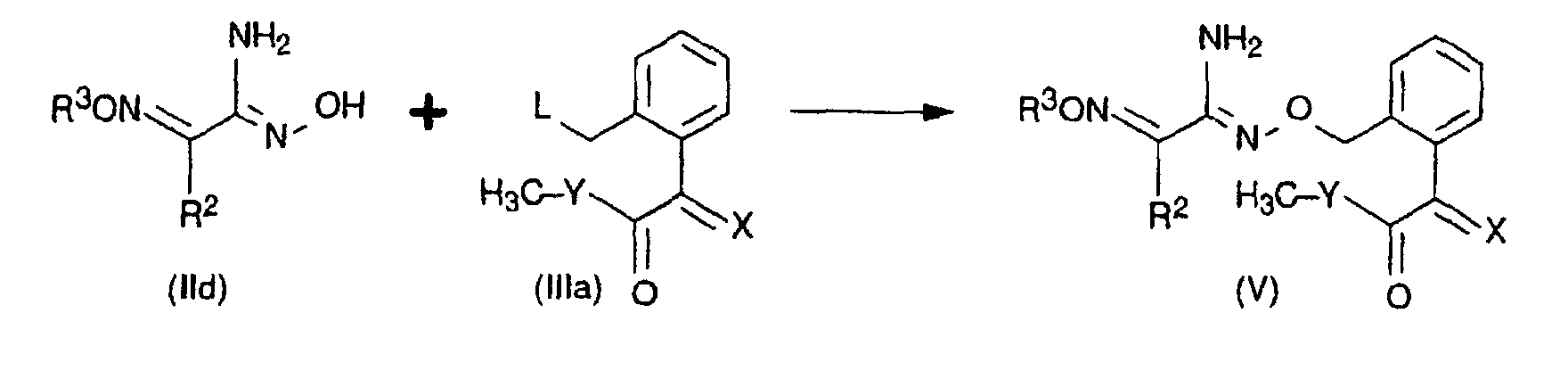
- the compounds I are advantageously obtained by converting an amidoxime IId with a benzyl compound IIIa into the corresponding compound of the formula v and exchanging the amino group of V for halogen by diazotization.
- the reaction of the amidoxime IId with the benzyl compound IIIa usually takes place at temperatures from 0 ° C to 130 ° C, preferably 10 ° C to 60 ° C, in an inert organic solvent in the presence of a base [cf. Lit. Heterocycles 36, 1027 ff. (1993)].
- Suitable solvents are aliphatic hydrocarbons such as Pentane, hexane, cyclohexane and petroleum ether, aromatic hydrocarbons such as toluene, o-, m- and p-xylene, halogenated hydrocarbons such as methylene chloride, chloroform and chlorobenzene, Ethers such as diethyl ether, diisopropyl ether, tert-butyl methyl ether, Dioxane, anisole and tetrahydrofuran, nitriles such as acetonitrile and propionitrile, ketones such as acetone, methyl ethyl ketone, diethyl ketone and tert-butyl methyl ketone, alcohols such as methanol, Ethanol, n-propanol, isopropanol, n-butanol and tert-butanol, as well as dimethyl sulfoxide
- inorganic compounds such as alkali metal and alkaline earth metal hydroxides such as lithium hydroxide, sodium hydroxide, Potassium hydroxide and calcium hydroxide, alkali metal and Alkaline earth metal oxides such as lithium oxide, sodium oxide, calcium oxide and magnesium oxide, alkali metal and alkaline earth metal hydrides such as lithium hydride, sodium hydride, potassium hydride and calcium hydride, Alkali metal amides such as lithium amide, sodium amide and potassium amide, Alkali metal and alkaline earth metal carbonates such as lithium carbonate, Potassium carbonate and calcium carbonate and alkali metal bicarbonates such as sodium bicarbonate, organometallic Compounds, especially alkali metal alkyls such as methyl lithium, Butyllithium and phenyllithium, alkyl magnesium halides such as methyl magnesium chloride as well as alkali metal and alkaline earth metal alcoholates such as sodium methoxide, sodium ethanolate, potassium ethanolate, Potassi
- tertiary amines such as trimethylamine, triethylamine, Tri-isopropylethylamine and N-methylpiperidine, pyridine, substituted pyridines such as collidine, lutidine and 4-dimethylaminopyridine as well as bicyclic amines.
- Particularly preferred are sodium methoxide, potassium carbonate and sodium hydride.
- the bases are generally used in equimolar amounts or in excess.
- the starting materials are generally in equimolar amounts with one another implemented. It may be advantageous for the yield to IId in to use an excess based on IIIa.
- amidoximes required for this preparation of the compounds I. IId are known in the literature [DE-A 44 42 732; Gazz. Chim. Ital. 55, 327 (1925)] or can according to the literature cited getting produced.
- Diazotization and halogenation from V to I is usually carried out at temperatures from -20 ° C to 50 ° C, preferably 0 ° C to 20 ° C, in water or in an aqueous inert organic solvent [see. Lit. J. Org. Chem. 45, 4144 ff. (1980); Chem. Ber. 26, 1567 ff. (1893)].
- fluorine is used as the halogenating agent.
- the halogenating agents are generally in excess or optionally used as a solvent.
- Suitable solvents are aliphatic hydrocarbons such as Pentane, hexane, cyclohexane and petroleum ether, aromatic hydrocarbons such as toluene, o-, m- and p-xylene, halogenated hydrocarbons such as methylene chloride, chloroform and chlorobenzene, Ethers such as diethyl ether, diisopropyl ether, tert-butyl methyl ether, Dioxane, anisole and tetrahydrofuran, nitriles such as acetonitrile and propionitrile, ketones such as acetone, methyl ethyl ketone, diethyl ketone and tert-butyl methyl ketone, alcohols such as methanol, Ethanol, n-propanol, isopropanol, n-butanol and tert-butanol, as well as dimethyl sulfoxide
- the reaction mixtures are worked up in a conventional manner, e.g. by mixing with water, separating the phases and, if necessary chromatographic purification of the raw products.
- the intermediate and end products sometimes fall in the form of colorless or slightly brownish, viscous oils that work under reduced pressure and freed of volatile components at a moderately elevated temperature or be cleaned. Provided the intermediate and end products cleaning can also be obtained as solids by recrystallization or digestion.
- isomer mixtures are obtained in the synthesis, it is generally however, a separation is not absolutely necessary because the individual isomers partially during the preparation for use or in use (e.g. under light, Acid or base action) can convert into each other. Appropriate Conversions can also take place after application, for example in the treatment of plants in the treated Plant or in the harmful fungus to be combated or the animal Pest.
- the E isomers of the compounds I are preferred in terms of their activity (configuration based on the OCH 3 or CH 3 group in relation to the COYCH 3 group).
- compounds I are preferred in which Y is oxygen and X is NOCH 3 , CHOCH 3 or CHCH 3 .
- R 1 represents chlorine or bromine, in particular chlorine.
- the compounds I are suitable as fungicides. You stand out due to its excellent effectiveness against a wide range of phytopathogenic fungi, in particular from the class of Ascomycetes, Deuteromycetes, Phycomycetes and Basidiomycecen, out. Some of them are systemic and can be used in crop protection can be used as leaf and soil fungicides.
- the compounds I are also suitable for combating Harmful fungi in material protection (e.g. wood, paper, dispersions for addressing, fibers or fabrics) and in storage protection.
- material protection e.g. wood, paper, dispersions for addressing, fibers or fabrics
- the compounds I are applied by using the fungi or the plants, seeds, materials to be protected from fungal attack or the soil with a fungicidally effective amount of Active substances treated.
- the application can be both before and after infection of materials, plants or seeds the mushrooms are done.
- the fungicidal compositions generally contain between 0.1 and 95, preferably between 0.5 and 90 wt .-% active ingredient.
- the application rates are depending on the application in crop protection Depending on the desired effect, between 0.01 and 2.0 kg of active ingredient per hectare
- amounts of active ingredient are generally used from 0.001 to 0.1 g, preferably 0.01 to 0.05 g per kilogram Seed needed.
- the application rate of active ingredient When used in the protection of materials or stocks, the application rate of active ingredient according to the type of application and the desired effect. Usual application rates are in Material protection, for example 0.001 g to 2 kg, preferably 0.005 g to 1 kg of active ingredient per cubic meter of treated material.
- the amount of active ingredient used to combat animal Pests are preferably 0.1 to 2.0 under field conditions 0.2 to 1.0 kg / ha.
- the compounds I can be converted into the customary formulations e.g. Solutions, emulsions, suspensions, dusts, Powders, pastes and granules.
- the application form depends according to the respective purpose; it should in any case a fine and uniform distribution of the invention Ensure connection.
- the formulations are prepared in a known manner, e.g. by stretching the active ingredient with solvents and / or Carriers, if desired using emulsifiers and dispersants, being in the case of water as Diluents other than organic solvents
- auxiliary solvents can be used.
- solvents such as aromatics (e.g. xylene), chlorinated aromatics (e.g. chlorobenzenes), paraffins (e.g. petroleum fractions), alcohols (e.g. methanol, butanol), Ketones (e.g. cyclohexanone), amines (e.g.
- Carriers such as natural stone powder (e.g. kaolins, clays, talc, chalk) and synthetic Rock powder (e.g. highly disperse silica, silicates); emulsifier such as nonionic and anionic emulsifiers (e.g. Polyoxyethylene fatty alcohol ethers, alkyl sulfonates and aryl sulfonates) and dispersants such as lignin sulfite liquor and methyl cellulose.
- Carriers such as natural stone powder (e.g. kaolins, clays, talc, chalk) and synthetic Rock powder (e.g. highly disperse silica, silicates)
- emulsifier such as nonionic and anionic emulsifiers (e.g. Polyoxyethylene fatty alcohol ethers, alkyl sulfonates and aryl sulfonates) and dispersants such as lignin sulfite liquor and methyl cellulose.
- Alkali, alkaline earth, ammonium salts come as surface-active substances of ligninsulfonic acid, naphthalenesulfonic acid, phenolsulfonic acid, Dibutylnaphthalenesulfonic acid, alkylarylsulfonates, alkyl sulfates, Alkyl sulfonates, fatty alcohol sulfates and fatty acids and their alkali and alkaline earth salts, salts of sulfated Fatty alcohol glycol ether, condensation products of sulfonated Naphthalene and naphthalene derivatives with formaldehyde, condensation products of naphthalene or naphthalene sulfonic acid Phenol and formaldehyde, polyoxyethylene octylphenol ether, ethoxylated Isooctylphenol, octylphenol, nonylphenol, alkylphenol polyglycol ether, Tributylphen
- emulsions, Pastes or oil dispersions come from medium-sized mineral oil fractions to high boiling point such as kerosene or diesel oil Coal tar oils as well as oils of vegetable or animal origin, aliphatic, cyclic and aromatic hydrocarbons, e.g.
- Powders, materials for spreading and dusts can be mixed or combined Grinding the active substances with a solid Carrier are produced.
- Granules e.g. Coating, impregnation and homogeneous granules
- Solid carriers are e.g. Mineral earths, such as silica gel, silicas, silica gels, silicates, talc, kaolin, Attaclay, limestone, lime, chalk, bolus, loess, clay, dolomite, Diatomaceous earth, calcium and magnesium sulfate, magnesium oxide, ground plastics, fertilizers, e.g. Ammonium sulfate, ammonium phosphate, Ammonium nitrate, ureas and herbal products, like flour, tree bark, wood and nutshell flour, Cellulose powder and other solid carriers.
- Mineral earths such as silica gel, silicas, silica gels, silicates, talc, kaolin, Attaclay, limestone, lime, chalk, bolus, loess, clay, dolomite, Diatomaceous earth, calcium and magnesium
- the formulations generally contain between 0.01 and 95 % By weight, preferably between 0.1 and 90% by weight of the active ingredient.
- the active ingredients are in a purity of 90% to 100%, preferably 95% to 100% (according to the NMR spectrum).
- the active ingredients as such in the form of their formulations or the application forms prepared from it, e.g. in the form of directly sprayable solutions, powders, suspensions or dispersions, Emulsions, oil dispersions, pastes, dusts, Scattering agents, granules by spraying, atomizing, dusting, Scattering or pouring can be applied.
- the application forms depend entirely on the purposes; they should in any case the finest possible distribution of the invention Ensure active ingredients.
- Aqueous application forms can be made from emulsion concentrates, pastes or wettable powders (wettable powder, oil dispersions) Water can be added.
- Pastes or oil dispersions can contain the substances as such or dissolved in an oil or solvent, using wetting, Adhesives, dispersants or emulsifiers homogenized in water become. However, wetting, adhesive, Dispersant or emulsifier and possibly solvent or Oil existing concentrates are made for dilution are suitable with water.
- the active ingredient concentrations in the ready-to-use preparations can be varied in larger areas. in the generally they are between 0.0001 and 10%, preferably between 0.01 and 1%.
- the active ingredients can also be used with great success in the ultra-low-volume process (ULV) are used, it being possible to use formulations with more than 95 wt .-% active ingredient or even the active ingredient without applying additives.
- UUV ultra-low-volume process
- auxiliaries and agents can be among the Active substances according to the invention in a weight ratio of 1:10 to 10: 1 can be added.
- the agents according to the invention can be used as Fungicides are also present together with other active ingredients, e.g. with herbicides, insecticides, growth regulators, fungicides or with fertilizers.
- active ingredients e.g. with herbicides, insecticides, growth regulators, fungicides or with fertilizers.
- a solution of 388 g (4.65 mol) of methoxyamine hydrochloride and 1.5 l of methanol was first mixed with 60 g of molecular sieve (3 ⁇ ) and then at 60 ° C. with 254 g (1.55 mol) of methyl phenylglyoxylate. After 6 hours at 60 ° C. and a further 60 hours at room temperature (approx. 25 ° C.), water was added to the reaction mixture. The aqueous solution was extracted with tert-butyl methyl ether. The ether phase was washed with water, dried over Na 2 SO 4 and freed from the solvent under reduced pressure.
- a solution of 58.2 g (1.04 mol) of potassium hydroxide in 750 ml of methanol was added dropwise to a solution of 36.1 g (0.52 mol) of hydroxylamine hydrochloride in 250 ml of methanol. After about 10 minutes. the precipitate formed was filtered off and the solution obtained was treated with a solution of 100 g of the compound from Example 3, stage 1, in 500 ml of methanol. After 24 h at room temperature (approx. 25 ° C.), the reaction mixture was added to water and extracted with tert-butyl methyl ether. The aqueous phase was acidified to a pH of 6.5 with dilute hydrochloric acid, during which time a precipitate formed.
- the active ingredients were separated as a 10% emulsion in a mixture prepared from 63 wt .-% cyclohexanone, 27 wt .-% emulsifier and according to the desired concentration with water diluted.
- the 4 ppm of the invention showed Compounds I.3, I.6, I.7, I.10 to I.17, I.21 and I.22 were treated Plant an infestation of 5 to 40%, while those with treated with the same amount of comparison compounds A.1 and A.2 Plants were 60 or 80% infected. The untreated (Control) plants were 80% infected.
- connections I.1, I.2, I.3, I.4, I.5, I.6, I.7, I.8, I.10, I.11, I.14 to I.17 and I.20 to I.22 treated plants with an infestation of a maximum of 15% while with the same amount of comparative compounds A.1 or A.2 treated plants of 80 or 25% were infected.
- the untreated (control) plants were 80% infested.
Landscapes
- Chemical & Material Sciences (AREA)
- Organic Chemistry (AREA)
- Life Sciences & Earth Sciences (AREA)
- Agronomy & Crop Science (AREA)
- Pest Control & Pesticides (AREA)
- Plant Pathology (AREA)
- Health & Medical Sciences (AREA)
- Engineering & Computer Science (AREA)
- Dentistry (AREA)
- General Health & Medical Sciences (AREA)
- Wood Science & Technology (AREA)
- Zoology (AREA)
- Environmental Sciences (AREA)
- Organic Low-Molecular-Weight Compounds And Preparation Thereof (AREA)
- Agricultural Chemicals And Associated Chemicals (AREA)
- Pharmaceuticals Containing Other Organic And Inorganic Compounds (AREA)
Description

- X
- NOCH3, CHOCH3 oder CHCH3;
- Y
- O oder NH;
- R1
- Halogen;
- R2
- C2-C6-Alkyl, C2-C6-Alkenyl und C2-C6-Alkinyl, wobei diese
Gruppen partiell oder vollständig halogeniert sein können
und/oder einen oder zwei der folgenden Reste tragen können:
Cyano, C1-C4-Alkoxy, C1-C4-Halogenalkoxy und Phenyl, welches
seinerseits partiell oder vollständig halogeniert sein kann
und/oder eine bis drei der folgenden Gruppen tragen kann:
Cyano, Nitro, C1-C4-Alkyl, C1-C4-Halogenalkyl, C1-C4-Alkoxy
und C1-C4-Halogenalkoxy;
Methyl, welches partiell oder vollständig halogeniert ist und/oder einen der folgenden Reste trägt: Cyano, C1-C4-Alkoxy oder C1-C4-Halogenalkoxy;
C5-C6-Cycloalkyl, welches partiell oder vollständig halogeniert sein kann und/oder eine bis drei C1-C4-Alkylgruppen tragen kann;
Aryl oder Arylmethylen, welches im Arylteil partiell oder vollständig halogeniert sein kann und/oder einen bis drei der folgenden Reste tragen kann: Cyano, Nitro, C1-C4-Alkyl, C1-C4-Halogenalkyl, C1-C4-Alkoxy und C1-C4-Halogenalkoxy; - R3
- C1-C6-Alkyl, C1-C3-Alkoxy-C1-C6-alkyl, C3-C6-Cycloalkyl-C1-C6-alkyl, C3-C6-Alkenyl und C3-C6-Alkinyl, wobei diese Gruppen partiell oder vollständig halogeniert sein können und wobei die cycloalkylgruppen außerdem eine bis drei C1-C4-Alkylreste tragen können,



- C2-C6-Alkyl, welches partiell oder vollständig halogeniert sein kann und/oder einen oder zwei der folgenden Reste tragen kann: Cyano, C1-C4-Alkoxy, C1-C4-Halogenalkoxy und Phenyl, welches seinerseits partiell oder vollständig halogeniert sein kann und/oder eine bis drei der folgenden Gruppen tragen kann: Cyano, Nitro, C1-C4-Alkyl, C1-C4-Halogenalkyl, C1-C4-Alkoxy und C1-C4-Halogenalkoxy;
- Phenyl oder Benzyl, welches im Arylteil partiell oder vollständig halogeniert sein kann und/oder einen bis drei der folgenden Reste tragen kann: Cyano, Nitro, C1-C4-Alkyl, C1-C4-Halogenalkyl, C1-C4-Alkoxy und C1-C4-Halogenalkoxy.
- C2-C6-Alkyl, welches partiell oder vollständig halogeniert sein kann und/oder einen oder zwei C1-C4-Alkoxyreste tragen kann;
- Phenyl oder Benzyl, welches im Arylteil partiell oder vollständig halogeniert sein kann und/oder einen bis drei der folgenden Reste tragen kann: Cyano, C1-C4-Alkyl, C1-C4-Halogenalkyl, C1-C4-Alkoxy und C1-C4-Halogenalkoxy.
- C1-C6-Alkyl, C1-C3-Alkoxy-C1-C2-alkyl, C3-C6-Alkenyl und C3-C6-Alkinyl, wobei diese Gruppen partiell oder vollständig halogeniert sein können.
- C1-C6-Alkyl, C1-C3-Alkoxy-C1-C2-alkyl, C3-C6-Alkenyl und C3-C6-Alkinyl.
Insbesondere werden Verbindungen I im Hinblick auf die biologische Wirkung bevorzugt, in denen die Substituenten die folgende Bedeutung haben:
- X
- NOCH3, CHOCH3 oder CHCH3;
- Y
- O oder NH;
- R1
- Chlor oder Brom;
- R2
- C2-C6-Alkyl;
Phenyl oder Benzyl, welches im Phenylteil partiell oder vollständig halogeniert sein kann und/oder einen bis drei der folgenden Reste tragen kann: Cyano, C1-C4-Alkyl, C1-C4-Halogenalkyl, C1-C4-Alkoxy und C1-C4-Halogenalkoxy; - R3
- C1-C6-Alkyl, C3-C6-Alkenyl und C3-C6-Alkinyl, wobei diese Gruppen partiell halogeniert sein können.


| Nr. | R2 | |
| A.1 | CH2CH3 | |
| A.2 | CH2CH2-CN | |
| A.3 | CH2CH2-O-CH3 | |
| A.4 | CH2CH2-O-CH2CH3 | |
| A.5 | CH2CH2CH3 | |
| A.6 | CH(CH3)2 | |
| A.7 | CH2CH2CH2CH3 | |
| A.8 | CH(CH3)CH2CH3 | |
| A.9 | CH2CH(CH3)2 | |
| A.10 | CH=CH2 | |
| A.11 | CH=CH-CH3 | (E) |
| A.12 | CH=CH-[C6H5] | (E) |
| A.13 | CH=CH-[2-CN-C6H4] | (E) |
| A.14 | CH=CH-[3-CN-C6H4] | (E) |
| A.15 | CH=CH-[4-CN-C6H4] | (E) |
| A.16 | CH=CH-[2-F-C6H4] | (E) |
| A.17 | CH=CH-[3-F-C6H4] | (E) |
| A.18 | CH=CH-[4-F-C6H4] | (E) |
| A.19 | CH=CH-[2,4-F2-C6H3] | (E) |
| A.20 | CH=CH-[3,4-F2-C6H3] | (E) |
| A.21 | CH=CH-[2,4,5-F3-C6H2] | (E) |
| A.22 | CH=CH-[2,4,6-F3-C6H2] | (E) |
| A.23 | CH=CH-[2-Cl-C6H4] | (E) |
| A.24 | CH=CH-[3-Cl-C6H4] | (E) |
| A.25 | CH=CH-[4-Cl-C6H4] | (E) |
| A.26 | CH=CH-[2,4-Cl2-C6H3] | (E) |
| A.27 | CH=CH-[3,4-Cl2-C6H3] | (E) |
| A.28 | CH=CH-[2,4,5-Cl3-C6H2] | (E) |
| A.29 | CH=CH-[2,4,6-Cl3-C6H2] | (E) |
| A.30 | CH=CH-[2-CH3-C6H4] | (E) |
| A.31 | CH=CH-[3-CH3-C6H4] | (E) |
| A.32 | CH=CH-[4-CH3-C6H4] | (E) |
| A.33 | CH=CH-[2-F, 4-CH3-C6H3] | (E) |
| A.34 | CH=CH-[2-CH3, 4-F-C6H3] | (E) |
| A.35 | CH=CH-[3-F, 4-CH3-C6H3] | (E) |
| A.36 | CH=CH-[3-CH3, 4-F-C6H3] | (E) |
| A.37 | CH=CH-[2-Cl, 4-CH3-C6H3] | (E) |
| A.38 | CH=CH-[2-CH3, 4-Cl-C6H3] | (E) |
| A.39 | CH=CH-[3-Cl, 4-CH3-C6H3] | (E) |
| A.40 | CH=CH-[3-CH3, 4-Cl-C6H3] | (E) |
| A.41 | CH=CH-[2,4-(CH3)2-C6H3] | (E) |
| A.42 | CH=CH-[3,4-(CH3)2-C6H3] | (E) |
| A.43 | CH=CH-[2,4,5-(CH3)3-C6H2] | (E) |
| A.44 | CH=CH-[2,4,6-(CH3)3-C6H2] | (E) |
| A.45 | CH=CH-[2-CF3-C6H4] | (E) |
| A.46 | CH=CH-[3-CF3-C6H4] | (E) |
| A.47 | CH=CH-[4-CF3-C6H4] | (E) |
| A.48 | CH=CH-[2-F, 4-CF3-C6H3] | (E) |
| A.49 | CH=CH-[2-CF3, 4-F-C6H3] | (E) |
| A.50 | CH=CH-[3-F, 4-CF3-C6H3] | (E) |
| A.51 | CH=CH-[3-CF3, 4-F-C6H3] | (E) |
| A.52 | CH=CH-[2-Cl, 4-CF3-C6H3] | (E) |
| A.53 | CH=CH-[2-CF3, 4-Cl-C6H3] | (E) |
| A.54 | CH=CH-[3-Cl, 4-CF3-C6H3] | (E) |
| A.55 | CH=CH-[3-CF3, 4-Cl-C6H3] | (E) |
| A.56 | CH=CH-[2,4-(CF3)2-C6H3] | (E) |
| A.57 | CH=CH-[3,4-(CF3)2-C6H3] | (E) |
| A.58 | CH=CH-[2,4,5-(CF3)3-C6H2] | (E) |
| A.59 | CH=CH-[2,4,6-(CF3)3-C6H2] | (E) |
| A.60 | CH=CH-[2-OCH3-C6H4] | (E) |
| A.61 | CH=CH-[3-OCH3-C6H4] | (E) |
| A.62 | CH=CH-[4-OCH3-C6H4] | (E) |
| A.63 | CH=CH-[2-F, 4-OCH3-C6H3] | (E) |
| A.64 | CH=CH-[2-OCH3, 4-F-C6H3] | (E) |
| A.65 | CH=CH-[3-F, 4-OCH3-C6H3] | (E) |
| A.66 | CH=CH-[3-OCH3, 4-F-C6H3] | (E) |
| A.67 | CH=CH-[2-Cl, 4-OCH3-C6H3] | (E) |
| A.68 | CH=CH-[2-OCH3, 4-Cl-C6H3] | (E) |
| A.69 | CH=CH-[3-Cl, 4-OCH3-C6H3] | (E) |
| A.70 | CH=CH-[3-OCH3, 4-Cl-C6H3] | (E) |
| A.71 | CH=CH-[2,4-(OCH3)2-C6H3] | (E) |
| A.72 | CH=CH-[3,4-(OCH3)2-C6H3] | (E) |
| A.73 | CH=CH-[2,4,5-(OCH3)3-C6H2] | (E) |
| A.74 | CH=CH-[2,4,6-(OCH3)3-C6H2] | (E) |
| A.75 | CH=CH-[2-OCHF2-C6H4] | (E) |
| A.76 | CH=CH-[3-OCHF2-C6H4] | (E) |
| A.77 | CH=CH-[4-OCHF2-C6H4] | (E) |
| A.78 | CH=CH-[2-F, 4-OCHF2-C6H3] | (E) |
| A.79 | CH=CH-[2-OCHF2, 4-F-C6H3] | (E) |
| A.80 | CH=CH-[3-F, 4-OCHF2-C6H3] | (E) |
| A.81 | CH=CH-[3-OCHF2, 4-F-C6H3] | (E) |
| A.82 | CH=CH-[2-Cl, 4-OCHF2-C6H3] | (E) |
| A.83 | CH=CH-[2-OCHF2, 4-Cl-C6H3] | (E) |
| A.84 | CH=CH-[3-Cl, 4-OCHF2-C6H3] | (E) |
| A.85 | CH=CH-[3-OCHF2, 4-Cl-C6H3] | (E) |
| A.86 | CH=CH-[2,4-(OCHF2)2-C6H3] | (E) |
| A.87 | CH=CH-[3,4-(OCHF2)2-C6H3] | (E) |
| A.88 | CH=CH-[2,4,5-(OCHF2)3-C6H2] | (E) |
| A.89 | CH=CH-[2,4,6-(OCHF2)3-C6H2] | (E) |
| A.90 | CH2CH=CH2 | |
| A.91 | CH2CH=CH-Cl | (E) |
| A.92 | CH2CH=CH-Br | (E) |
| A.93 | CH2CH=CH-CH3 | (E) |
| A.94 | C≡CH | |
| A.95 | C≡C-Cl | |
| A.96 | C≡C-Br | |
| A.97 | C≡C-CH3 | |
| A.98 | C≡C-C6H5 | |
| A.99 | C≡C-[2-Cl-C6H4] | |
| A.100 | C≡C-[4-Cl-C6H4] | |
| A.101 | C≡C-[2,4-Cl2-C6H3] | |
| A.102 | C≡C-[2-CH3-C6H4] | |
| A.103 | C≡C-[4-CH3-C6H4] | |
| A.104 | C≡C-[2,4-(CH3)2-C6H3] | |
| A.105 | C≡C-[2-Cl, 4-CH3-C6H3] | |
| A.106 | C≡C-[2-CH3, 4-Cl-C6H3] | |
| A.107 | C≡C-[3-CF3-C6H4] | |
| A.108 | C≡C-[3-Cl, 5-CF3-C6H3] | |
| A.109 | C≡C-[2-OCH3-C6H4] | |
| A.110 | C≡C-[4-OCH3-C6H4] | |
| A.111 | C≡C-[2,4-(OCH3)2-C6H3] | |
| A.112 | C≡C-[2-Cl, 4-OCH3-C6H3] | |
| A.113 | C≡C-[2-OCH3, 4-Cl-C6H3] | |
| A.114 | C≡C-[3-OCHF2-C6H4] | |
| A.115 | C≡C-[3-Cl, 5-OCHF2-C6H3] | |
| A.116 | cyclopentyl | |
| A.117 | 1-CH3-cyclopentyl | |
| A.118 | 2-CH3-cyclopentyl | |
| A.119 | 3-CH3-cyclopentyl | |
| A.120 | 2,3-(CH3)2-cyclopentyl | |
| A.121 | 1-Cl-cyclopentyl | |
| A.122 | 2-Cl-cyclopentyl | |
| A.123 | 3-Cl-cyclopentyl | |
| A.124 | 2-CH3, 3-Cl-cyclopentyl | |
| A.125 | 2,3-Cl2-cyclopentyl | |
| A.126 | cyclohexyl | |
| A.127 | 1-CH3-cyclohexyl | |
| A.128 | 2-CH3-cyclohexyl | |
| A.129 | 3-CH3-cyclohexyl | |
| A.130 | 2,3-(CH3)2-cyclohexyl | |
| A.131 | 3,3-(CH3)2-cyclohexyl | |
| A.132 | 1-Cl-cyclohexyl | |
| A.133 | 2-Cl-cyclohexyl | |
| A.134 | 3-Cl-cyclohexyl | |
| A.135 | 2-CH3, 3-Cl-cyclohexyl | |
| A.136 | 2,3-Cl2-cyclohexyl | |
| A.137 | C6H5 | |
| A.138 | 2-CN-C6H4 | |
| A.139 | 3-CN-C6H4 | |
| A.140 | 4-CN-C6H4 | |
| A.141 | 2-F-C6H4 | |
| A.142 | 3-F-C6H4 | |
| A.143 | 4-F-C6H4 | |
| A.144 | 2,4-F2-C6H3 | |
| A.145 | 3,4-F2-C6H3 | |
| A.146 | 2,4,5-F3-C6H2 | |
| A.147 | 2,4,6-F3-C6H2 | |
| A.148 | 2-Cl-C6H4 | |
| A.149 | 3-Cl-C6H4 | |
| A.150 | 4-Cl-C6H4 | |
| A.151 | 2,4-Cl2-C6H3 | |
| A.152 | 3,4-Cl2-C6H3 | |
| A.153 | 2,4,5-Cl3-C6H2 | |
| A.154 | 2,4,6-Cl3-C6H2 | |
| A.155 | 2-CH3-C6H4 | |
| A.156 | 3-CH3-C6H4 | |
| A.157 | 4-CH3-C6H4 | |
| A.158 | 2-F, 4-CH3-C6H3 | |
| A.159 | 2-CH3, 4-F-C6H3 | |
| A.160 | 3-F, 4-CH3-C6H3 | |
| A.161 | 3-CH3, 4-F-C6H3 | |
| A.162 | 2-Cl, 4-CH3-C6H3 | |
| A.163 | 2-CH3, 4-Cl-C6H3 | |
| A.164 | 3-Cl, 4-CH3-C6H3 | |
| A.165 | 3-CH3, 4-Cl-C6H3 | |
| A.166 | 2,4-(CH3)2-C6H3 | |
| A.167 | 3,4-(CH3)2-C6H3 | |
| A.168 | 2,4,5-(CH3)3-C6H2 | |
| A.169 | 2,4,6-(CH3)3-C6H2 | |
| A.170 | 2-CF3-C6H4 | |
| A.171 | 3-CF3-C6H4 | |
| A.172 | 4-CF3-C6H4 | |
| A.173 | 2-F, 4-CF3-C6H3 | |
| A.174 | 2-CF3, 4-F-C6H3 | |
| A.175 | 3-F, 4-CF3-C6H3 | |
| A.176 | 3-CF3, 4-F-C6H3 | |
| A.177 | 2-Cl, 4-CF3-C6H3 | |
| A.178 | 2-CF3, 4-Cl-C6H3 | |
| A.179 | 3-Cl, 4-CF3-C6H3 | |
| A.180 | 3-CF3, 4-Cl-C6H3 | |
| A.181 | 2,4-(CF3)2-C6H3 | |
| A.182 | 3,4-(CF3)2-C6H3 | |
| A.183 | 2,4,5-(CF3)3-C6H2 | |
| A.184 | 2,4,6-(CF3)3-C6H2 | |
| A.185 | 2-OCH3-C6H4 | |
| A.186 | 3-OCH3-C6H4 | |
| A.187 | 4-OCH3-C6H4 | |
| A.188 | 2-F, 4-OCH3-C6H3 | |
| A.189 | 2-OCH3, 4-F-C6H3 | |
| A.190 | 3-F, 4-OCH3-C6H3 | |
| A.191 | 3-OCH3, 4-F-C6H3 | |
| A.192 | 2-Cl, 4-OCH3-C6H3 | |
| A.193 | 2-OCH3, 4-Cl-C6H3 | |
| A.194 | 3-Cl 4-OCH3-C6H3 | |
| A.195 | 3-OCH3, 4-Cl-C6H3 | |
| A.196 | 2,4-(OCH3)2-C6H3 | |
| A.197 | 3,4-(OCH3)2-C6H3 | |
| A.198 | 2,4,5-(OCH3)3-C6H2 | |
| A.199 | 2,4,6-(OCH3)3-C6H2 | |
| A.200 | 2-OCHF2-C6H4 | |
| A.201 | 3-OCHF2-C6H4 | |
| A.202 | 4-OCHF2-C6H4 | |
| A.203 | 2-F, 4-OCHF2-C6H3 | |
| A.204 | 2-OCHF2, 4-F-C6H3 | |
| A.205 | 3-F, 4-OCHF2-C6H3 | |
| A.206 | 3-OCHF2, 4-F-C6H3 | |
| A.207 | 2-Cl, 4-OCHF2-C6H3 | |
| A.208 | 2-OCHF2, 4-Cl-C6H3 | |
| A.209 | 3-Cl, 4-OCHF2-C6H3 | |
| A.210 | 3-OCHF2, 4-Cl-C6H3 | |
| A.211 | 2,4-(OCHF2)2-C6H3 | |
| A.212 | 3,4-(OCHF2)2-C6H3 | |
| A.213 | 2,4,5-(OCHF2)3-C6H2 | |
| A.214 | 2,4,6-(OCHF2)3-C6H2 | |
| A.215 | CH2-C6H5 | |
| A.216 | CH2-[2-CN-C6H4] | |
| A.217 | CH2-[3-CN-C6H4] | |
| A.218 | CH2-[4-CN-C6H4] | |
| A.219 | CH2-[2-F-C6H4] | |
| A.220 | CH2-[3-F-C6H4] | |
| A.221 | CH2-[4-F-C6H4] | |
| A.222 | CH2-[2,4-F2-C6H3] | |
| A.223 | CH2-[3,4-F2-C6H3] | |
| A.224 | CH2-[2,4,5-F3-C6H2] | |
| A.225 | CH2-[2,4,6-F3-C6H2] | |
| A.226 | CH2-[2-Cl-C6H4] | |
| A.227 | CH2-[3-Cl-C6H4] | |
| A.228 | CH2-[4-Cl-C6H4] | |
| A.229 | CH2-[2,4-Cl2-C6H3] | |
| A.230 | CH2-[3,4-Cl2-C6H3] | |
| A.231 | CH2-[2,4,5-Cl3-C6H2] | |
| A.232 | CH2-[2,4,6-Cl3-C6H2] | |
| A.233 | CH2-[2-CH3-C6H4) | |
| A.234 | CH2-[3-CH3-C6H4] | |
| A.235 | CH2-[4-CH3-C6H4] | |
| A. 236 | CH2-[2-F, 4-CH3-C6H3] | |
| A.237 | CH2-[2-CH3, 4-F-C6H3] | |
| A.238 | CH2-[3-F, 4-CH3-C6H3] | |
| A.239 | CH2-[3-CH3, 4-F-C6H3] | |
| A.240 | CH2-[2-Cl, 4-CH3-C6H3] | |
| A.241 | CH2-[2-CH3, 4-Cl-C6H3] | |
| A.242 | CH2-[3-Cl, 4-CH3-C6H3] | |
| A.243 | CH2-[3-CH3, 4-Cl-C6H3] | |
| A.244 | CH2-[2,4-(CH3)2-C6H3] | |
| A.245 | CH2-[3,4-(CH3)2-C6H3] | |
| A.246 | CH2-[2,4,5-(CH3)3-C6H2] | |
| A.247 | CH2-[2,4,6-(CH3)3-C6H2] | |
| A. 248 | CH2-[2-CF3-C6H4] | |
| A.249 | CH2-[3-CF3-C6H4] | |
| A.250 | CH2-[4-CF3-C6H4] | |
| A.251 | CH2-[2-F, 4-CF3-C6H3] | |
| A.252 | CH2-[2-CF3, 4-F-C6H3] | |
| A.253 | CH2-[3-F, 4-CF3-C6H3] | |
| A.254 | CH2-[3-CF3, 4-F-C6H3] | |
| A.255 | CH2-[2-Cl, 4-CF3-C6H3] | |
| A.256 | CH2-[2-CF3, 4-Cl-C6H3] | |
| A.257 | CH2-[3-Cl, 4-CF3-C6H3] | |
| A.258 | CH2-[3-CF3, 4-Cl-C6H3] | |
| A.259 | CH2-[2,4-(CF3)2-C6H3] | |
| A.260 | CH2-[3,4-(CF3)2-C6H3] | |
| A.261 | CH2-[2,4,5-(CF3)3-C6H2] | |
| A.262 | CH2-[2,4,6-(CF3)3-C6H2] | |
| A.263 | CH2-[2-OCH3-C6H4] | |
| A.264 | CH2-[3-OCH3-C6H4] | |
| A.265 | CH2-[4-OCH3-C6H4] | |
| A.266 | CH2-[2-F, 4-OCH3-C6H3] | |
| A.267 | CH2-[2-OCH3, 4-F-C6H3] | |
| A.268 | CH2-[3-F, 4-OCH3-C6H3] | |
| A.269 | CH2-[3-OCH3, 4-F-C6H3] | |
| A.270 | CH2-[2-Cl, 4-OCH3-C6H3] | |
| A.271 | CH2-[2-OCH3, 4-Cl-C6H3] | |
| A. 272 | CH2-[3-Cl, 4-OCH3-C6H3] | |
| A.273 | CH2-[3-OCH3, 4-Cl-C6H3] | |
| A.274 | CH2-[2,4-(OCH3)2-C6H3] | |
| A.275 | CH2-[3,4-(OCH3)2-C6H3] | |
| A.276 | CH2-[2,4,5-(OCH3)3-C6H2] | |
| A.277 | CH2-[2,4,6-(OCH3)3-C6H2] | |
| A.278 | CH2-[2-OCHF2-C6H4] | |
| A.279 | CH2-[3-OCHF2-C6H4] | |
| A.280 | CH2-[4-OCHF2-C6H4] | |
| A.281 | CH2-[2-F, 4-OCHF2-C6H3] | |
| A.282 | CH2-[2-OCHF2, 4-F-C6H3] | |
| A.283 | CH2-[3-F, 4-OCHF2-C6H3] | |
| A.284 | CH2-[3-OCHF2, 4-F-C6H3] | |
| A.285 | CH2-[2-Cl, 4-OCHF2-C6H3] | |
| A.286 | CH2-[2-OCHF2, 4-Cl-C6H3] | |
| A.287 | CH2-[3-Cl, 4-OCHF2-C6H3] | |
| A.288 | CH2-[3-OCHF2, 4-Cl-C6H3] | |
| A.289 | CH2-[2,4-(OCHF2)2-C6H3] | |
| A.290 | CH2-[3,4-(OCHF2)2-C6H3] | |
| A.291 | CH2-[2,4,5-(OCHF2)3-C6H2] | |
| A.292 | CH2-[2,4,6-(OCHF2)3-C6H2] | |
| A.293 | CH(CH3)-C6H5 | |
| A.294 | CH(CH3)-[2-CN-C6H4] | |
| A.295 | CH(CH3)-[3-CN-C6H4] | |
| A.296 | CH(CH3)-[4-CN-C6H4] | |
| A.297 | CH(CH3)-[2-F-C6H4] | |
| A.298 | CH(CH3)-[3-F-C6H4] | |
| A.299 | CH(CH3)-[4-F-C6H4] | |
| A.300 | CH(CH3)-[2,4-F2-C6H3] | |
| A.301 | CH(CH3)-[3,4-F2-C6H3] | |
| A.302 | CH(CH3)-[2,4,5-F3-C6H2] | |
| A.303 | CH(CH3)-[2,4,6-F3-C6H2] | |
| A.304 | CH(CH3)-[2-Cl-C6H4] | |
| A.305 | CH(CH3)-[3-Cl-C6H4] | |
| A.306 | CH(CH3)-[4-Cl-C6H4] | |
| A.307 | CH(CH3)-[2,4-Cl2-C6H3] | |
| A.308 | CH(CH3)-[3,4-Cl2-C6H3] | |
| A.309 | CH(CH3)-[2,4,5-Cl3-C6H2] | |
| A.310 | CH(CH3)-[2,4,6-Cl3-C6H2] | |
| A.311 | CH(CH3)-[2-CH3-C6H4] | |
| A.312 | CH(CH3)-[3-CH3-C6H4] | |
| A.313 | CH(CH3)-[4-CH3-C6H4] | |
| A.314 | CH(CH3)-[2-F, 4-CH3-C6H3] | |
| A.315 | CH(CH3)-[2-CH3, 4-F-C6H3] | |
| A.316 | CH(CH3)-[3-F, 4-CH3-C6H3] | |
| A.317 | CH(CH3)-[3-CH3, 4-F-C6H3] | |
| A.318 | CH(CH3)-[2-Cl, 4-CH3-C6H3] | |
| A.319 | CH(CH3)-[2-CH3, 4-Cl-C6H3] | |
| A.320 | CH(CH3)-[3-Cl, 4-CH3-C6H3] | |
| A.321 | CH(CH3)-[3-CH3, 4-Cl-C6H3] | |
| A.322 | CH(CH3)-[2,4-(CH3)2-C6H3] | |
| A.323 | CH(CH3)-[3,4-(CH3)2-C6H3] | |
| A.324 | CH(CH3)-[2,4,5-(CH3)3-C6H2] | |
| A.325 | CH(CH3)-[2,4,6-(CH3)3-C6H2] | |
| A.326 | CH(CH3)-[2-CF3-C6H4] | |
| A.327 | CH(CH3)-[3-CF3-C6H4] | |
| A.328 | CH(CH3)-[4-CF3-C6H4] | |
| A.329 | CH(CH3)-[2-F, 4-CF3-C6H3] | |
| A.330 | CH(CH3)-[2-CF3, 4-F-C6H3] | |
| A.331 | CH(CH3)-[3-F, 4-CF3-C6H3] | |
| A.332 | CH(CH3)-[3-CF3, 4-F-C6H3] | |
| A.333 | CH(CH3)-[2-Cl, 4-CF3-C6H3] | |
| A.334 | CH(CH3)-[2-CF3, 4-Cl-C6H3] | |
| A.335 | CH(CH3)-[3-Cl, 4-CF3-C6H3] | |
| A.336 | CH(CH3)-[3-CF3, 4-Cl-C6H3] | |
| A.337 | CH(CH3)-[2,4-(CF3)2-C6H3] | |
| A.338 | CH(CH3)-[3,4-(CF3)2-C6H3] | |
| A.339 | CH(CH3)-[2,4,5-(CF3)3-C6H2] | |
| A.340 | CH(CH3)-[2,4,6-(CF3)3-C6H2] | |
| A.341 | CH(CH3)-[2-OCH3-C6H4] | |
| A.342 | CH(CH3)-[3-OCH3-C6H4] | |
| A.343 | CH(CH3)-[4-OCH3-C6H4] | |
| A.344 | CH(CH3)-[2-F, 4-OCH3-C6H3] | |
| A.345 | CH(CH3)-[2-OCH3, 4-F-C6H3] | |
| A.346 | CH(CH3)-[3-F, 4-OCH3-C6H3] | |
| A.347 | CH(CH3)-[3-OCH3, 4-F-C6H3] | |
| A.348 | CH(CH3)-[2-Cl, 4-OCH3-C6H3] | |
| A.349 | CH(CH3)-[2-OCH3, 4-Cl-C6H3] | |
| A.350 | CH(CH3)-[3-Cl, 4-OCH3-C6H3] | |
| A.351 | CH(CH3)-[3-OCH3, 4-Cl-C6H3] | |
| A.352 | CH(CH3)-[2,4-(OCH3)2-C6H3] | |
| A.353 | CH(CH3)-[3,4-(OCH3)2-C6H3] | |
| A.354 | CH(CH3)-[2,4,5-(OCH3)3-C6H2] | |
| A.355 | CH(CH3)-[2,4,6-(OCH3)3-C6H2] | |
| A.356 | CH(CH3)-[2-OCHF2-C6H4] | |
| A.357 | CH (CH3)-[3-OCHF2-C6H4] | |
| A.358 | CH(CH3)-[4-OCHF2-C6H4] | |
| A.359 | CH(CH3)-[2-F, 4-OCHF2-C6H3] | |
| A.360 | CH(CH3)-[2-OCHF2, 4-F-C6H3] | |
| A.361 | CH(CH3)-[3-F, 4-OCHF2-C6H3] | |
| A.362 | CH(CH3)-[3-OCHF2, 4-F-C6H3] | |
| A.363 | CH(CH3)-[2-Cl, 4-OCHF2-C6H3] | |
| A.364 | CH(CH3)-[2-OCHF2, 4-Cl-C6H3] | |
| A.365 | CH(CH3)-[3-Cl, 4-OCHF2-C6H3] | |
| A.366 | CH(CH3)-[3-OCHF2, 4-Cl-C6H3] | |
| A.367 | CH(CH3)-[2,4- (OCHF2)2-C6H3] | |
| A.368 | CH(CH3)-[3,4-(OCHF2)2-C6H3] | |
| A.369 | CH(CH3)-[2,4,5-(OCHF2)3-C6H2] | |
| A.370 | CH(CH3)-[2,4,6-(OCHF2)3-C6H2] | |
| A.371 | CH2F | |
| A.372 | CHF2 | |
| A.373 | CF3 | |
| A.374 | CH2-CN | |
| A.375 | CH2-OCH3 | |
| A.376 | CH2-OCH2CH3 | |
| A.377 | CH2-OCH2CH2CH3 | |
| A.378 | CH2-OCH(CH3)2 | |
| A.379 | CH2-OCH2CH2CH2CH3 | |
| A.380 | CH2-OCH(CH3)CH2CH3 | |
| A.381 | CH2-OCH2CH(CH3)2 | |
| A.382 | CH2-OC(CH3)3 | |
| A.383 | CH2-OCF3 | |
| A.384 | CH2-OCH2CF3 | |
| A.385 | CH2CH2-OCH2CH2CH3 | |
| A.386 | CH2CH2-OCH(CH3)2 | |
| A.387 | CH2CH2-OCH2CH2CH2CH3 | |
| A.388 | CH2CH2-OCH(CH3)CH2CH3 | |
| A.389 | CH2CH2-OCH2CH(CH3)2 | |
| A.390 | CH2CH2-OC(CH3)3 | |
| A.391 | CH2CH2-OCF3 | |
| A.392 | CH2CH2-OCH2CF3 | |
| A.393 | CH2CH2-[C6H5] | |
| A.394 | CH2CH2-[2-CN-C6H4] | |
| A.395 | CH2CH2-[3-CN-C6H4] | |
| A.396 | CH2CH2-[4-CN-C6H4] | |
| A.397 | CH2CH2-[2-F-C6H4] | |
| A.398 | CH2CH2-[3-F-C6H4] | |
| A.399 | CH2CH2-[4-F-C6H4] | |
| A.400 | CH2CH2-[2,4-F2-C6H3] | |
| A.401 | CH2CH2-[3,4-F2-C6H3] | |
| A.402 | CH2CH2-[2,4,5-F3-C6H2] | |
| A.403 | CH2CH2-[2,4,6-F3-C6H2] | |
| A.404 | CH2CH2-[2-Cl-C6H4] | |
| A.405 | CH2CH2-[3-Cl-C6H4] | |
| A.406 | CH2CH2-[4-Cl-C6H4] | |
| A.407 | CH2CH2-[2,4-Cl2-C6H3] | |
| A.408 | CH2CH2- [3,4-Cl2-C6H3] | |
| A.409 | CH2CH2-[2,4,5-Cl3-C6H2] | |
| A.410 | CH2CH2-[2,4,6-Cl3-C6H2] | |
| A.411 | CH2CH2- [2-CH3-C6H4] | |
| A.412 | CH2CH2-[3-CH3-C6H4] | |
| A.413 | CH2CH2-[4-CH3-C6H4] | |
| A.414 | CH2CH2-[2-F, 4-CH3-C6H3] | |
| A.415 | CH2CH2-[2-CH3, 4-F-C6H3] | |
| A.416 | CH2CH2-[3-F, 4-CH3-C6H3] | |
| A.417 | CH2CH2-[3-CH3, 4-F-C6H3] | |
| A.418 | CH2CH2-[2-Cl, 4-CH3-C6H3] | |
| A.419 | CH2CH2-[2-CH3, 4-Cl-C6H3] | |
| A.420 | CH2CH2-[3-Cl, 4-CH3-C6H3] | |
| A.421 | CH2CH2-[3-CH3, 4-Cl-C6H3] | |
| A.422 | CH2CH2-[2,4-(CH3)2-C6H3] | |
| A.423 | CH2CH2-[3,4-(CH3)2-C6H3] | |
| A.424 | CH2CH2-[2,4,5-(CH3)3-C6H2] | |
| A.425 | CH2CH2-[2,4,6-(CH3)3-C6H2] | |
| A.426 | CH2CH2- [2-CF3-C6H4] | |
| A.427 | CH2CH2-[3-CF3-C6H4] | |
| A.428 | CH2CH2-[4-CF3-C6H4] | |
| A.429 | CH2CH2-[2-F, 4-CF3-C6H3] | |
| A.430 | CH2CH2-[2-CF3, 4-F-C6H3] | |
| A.431 | CH2CH2-[3-F, 4-CF3-C6H3] | |
| A.432 | CH2CH2-[3-CF3, 4-F-C6H3] | |
| A.433 | CH2CH2-[2-Cl, 4-CF3-C6H3] | |
| A.434 | CH2CH2-[2-CF3, 4-Cl-C6H3] | |
| A.435 | CH2CH2-[3-Cl, 4-CF3-C6H3] | |
| A.436 | CH2CH2-[3-CF3, 4-Cl-C6H3] | |
| A.437 | CH2CH2-[2,4-(CF3)2-C6H3] | |
| A.438 | CH2CH2-[3,4-(CF3)2-C6H3] | |
| A.439 | CH2CH2-[2,4,5-(CF3)3-C6H2] | |
| A.440 | CH2CH2-[2,4,6-(CF3)3-C6H2] | |
| A.441 | CH2CH2-[2-OCH3-C6H4] | |
| A.442 | CH2CH2-[3-OCH3-C6H4] | |
| A.443 | CH2CH2-[4-OCH3-C6H4] | |
| A.444 | CH2CH2-[2-F, 4-OCH3-C6H3] | |
| A.445 | CH2CH2-[2-OCH3, 4-F-C6H3] | |
| A.446 | CH2CH2-[3-F, 4-OCH3-C6H3] | |
| A.447 | CH2CH2-[3-OCH3, 4-F-C6H3] | |
| A.448 | CH2CH2-[2-Cl, 4-OCH3-C6H3] | |
| A.449 | CH2CH2-[2-OCH3, 4-Cl-C6H3] | |
| A.450 | CH2CH2-[3-Cl, 4-OCH3-C6H3] | |
| A.451 | CH2CH2-[3-OCH3, 4-Cl-C6H3] | |
| A.452 | CH2CH2-[2,4-(OCH3)2-C6H3] | |
| A.453 | CH2CH2-[3,4-(OCH3)2-C6H3] | |
| A.454 | CH2CH2-[2,4,5-(OCH3)3-C6H2] | |
| A.455 | CH2CH2-[2,4,6-(OCH3)3-C6H2] | |
| A.456 | CH2CH2-[2-OCHF2-C6H4] | |
| A.457 | CH2CH2-[3-OCHF2-C6H4] | |
| A.458 | CH2CH2-[4-OCHF2-C6H4] | |
| A.459 | CH2CH2-[2-F, 4-OCHF2-C6H3] | |
| A.460 | CH2CH2-[2-OCHF2, 4-F-C6H3] | |
| A.461 | CH2CH2-[3-F, 4-OCHF2-C6H3] | |
| A.462 | CH2CH2-[3-OCHF2, 4-F-C6H3] | |
| A.463 | CH2CH2-[2-Cl, 4-OCHF2-C6H3] | |
| A.464 | CH2CH2-[2-OCHF2, 4-Cl-C6H3] | |
| A.465 | CH2CH2-[3-Cl, 4-OCHF2-C6H3] | |
| A.466 | CH2CH2-[3-OCHF2, 4-Cl-C6H3] | |
| A.467 | CH2CH2-[2,4-(OCHF2)2-C6H3] | |
| A.468 | CH2CH2-[3,4-(OCHF2)2-C6H3] | |
| A.469 | CH2CH2-[2,4,5-(OCHF2)3-C6H2] | |
| A.470 | CH2CH2-[2,4,6-(OCHF2)3-C6H2]) | |
| A.471 | CH(CH3)-CN | |
| A.472 | CH(CH3)-OCH3 | |
| A.473 | CH(CH3)-OCH2CH3 | |
| A.474 | CH(CH3)-OCH2CH2CH3 | |
| A.475 | CH(CH3)-OCH(CH3)2 | |
| A.476 | CH(CH3)-OCH2CH2CH2CH3 | |
| A.477 | CH(CH3)-OCH(CH3)CH2CH3 | |
| A.478 | CH(CH3)-OCH2CH(CH3)2 | |
| A.479 | CH(CH3)-OC(CH3)3 | |
| A.480 | CH(CH3)-OCF3 | |
| A.481 | CH(CH3)-OCH2CF3 | |
| A.482 | CH2CH2F | |
| A.483 | CH2CHF2 | |
| A.484 | CH2CF3 | |
| A.485 | CHFCH3 | |
| A.486 | CF2CH3 | |
| A.487 | CHFCHF2 | |
| A.488 | CHFCF3 | |
| A.489 | CF2CHF2 | |
| A.490 | CF2CF3 | |
| A.491 | CF2CHFCl | |
| A.492 | CH2CH2CH2-CN | |
| A.493 | CH2CH2CH2-OCH3 | |
| A.494 | CH2CH2CH2-OCH2CH3 | |
| A.495 | CH2CH2CH2-OCH2CH2CH3 | |
| A.496 | CH2CH2CH2-OCH(CH3)2 | |
| A.497 | CH2CH2CH2-OCF3 | |
| A.498 | CH2CH2CH2-OCH2CF3 | |
| A.499 | CH2CH(CH3)-CN | |
| A.500 | CH2CH(CH3)-OCH3 | |
| A.501 | CH2CH(CH3)-OCH2CH3 | |
| A.502 | CH2CH(CH3)-OCH2CH2CH3 | |
| A.503 | CH2CH(CH3)-OCH(CH3)2 | |
| A.504 | CH2CH(CH3)-OCF3 | |
| A.505 | CH2CH (CH3)-OCH2CF3 | |
| A.506 | CH(CH2CH3)-CN | |
| A.507 | CH(CH2CH3)-OCH3 | |
| A.508 | CH(CH2CH3)-OCH2CH3 | |
| A.509 | CH(CH2CH3)-OCH2CH2CH3 | |
| A.510 | CH(CH2CH3)-OCH(CH3)2 | |
| A.511 | CH(CH2CH3)-OCF3 | |
| A.512 | CH(CH2CH3)-OCH2CF3 | |
| A.513 | CH(CH3)CH2-CN | |
| A.514 | CH(CH3)CH2-OCH3 | |
| A.515 | CH(CH3)CH2-OCH2CH3 | |
| A.516 | CH(CH3)CH2-OCH2CH2CH3 | |
| A.517 | CH(CH3)CH2-OCH(CH3)2 | |
| A.518 | CH(CH3)CH2-OCF3 | |
| A.519 | CH(CH3)CH2-OCH2CF3 | |
| A.520 | CH2CH2CF3 | |
| A.521 | CH2CF3CF3 | |
| A.522 | CHFCH2CH3 | |
| A.523 | CH(CF3)CH3 | |
| A.524 | CH(CF3)2 | |
| A.525 | CH2CH2CH2CH2-CN | |
| A.526 | CH2CH2CH2CH2-OCH3 | |
| A.527 | CH2CH2CH2CH2-OCH2CH3 | |
| A.528 | CH2CH2CH2CH2-OCF3 | |
| A.529 | CH (CN) -CH2CH2CH3 | |
| A.530 | CH(OCH3)-CH2CH2CH3 | |
| A.531 | CH(OCH2CH3)-CH2CH2CH3 | |
| A.532 | CH(OCF3)-CH2CH2CH3 | |
| A.533 | CH(OCH2CF3)-CH2CH2CH3 | |
| A.534 | CH(CN)-CH2CH(CH3)2 | |
| A.535 | CH(OCH3)-CH2CH(CH3)2 | |
| A.536 | CH(OCH2CH3)-CH2CH(CH3)2 | |
| A.537 | CH(OCF3)-CH2CH(CH3)2 | |
| A.538 | CH(OCH2CF3)-CH2CH(CH3)2 | |
| A.539 | CHFCH2CH2CH3 | |
| A.540 | C(CH3)=CH2 | |
| A.541 | CH=CH-CH3 | (Z) |
| A.542 | C(CH2CH3)=CH2 | |
| A.543 | C(CH3)=CH-CH3 | (E) |
| A.544 | C(CH3)=CH-CH3 | (Z) |
| A.545 | C(CH3)=C(CH3)2 | |
| A.546 | CH(CH3)-CH=CH2 | |
| A.547 | CH=C(CH3)2 | |
| A.548 | CH2-C(CH3)=CH2 | |
| A.549 | CH(CH3)-CH2-CH=CH2 | |
| A.550 | CH2-CH (CH3)-CH=CH2 | |
| A.551 | CH2-CCl=CH2 | |
| A.552 | CH2-CH=CH-Cl | (Z) |
| A.553 | CH2-CCl=CH-Cl | (E) |
| A.554 | CH2-CCl=CH-Cl | (Z) |
| A.555 | CH2-CH=CCl2 | |
| A.556 | CH2-CCl=CCl2 | |
| A.557 | CH2-CBr=CH2 | |
| A.558 | CH2-CH=CH-Br | (Z) |
| A.559 | CH2-CBr=CH-Br | (E) |
| A.560 | CH2-CBr=CH-Br | (Z) |
| A.561 | CH2-CH=CBr2 | |
| A.562 | CH2-CBr=CBr2 | |
| A.563 | CH2-CH=CH-CH3 | (Z) |
| A.564 | CH2-C(CH3)=CH-CH3 | (E) |
| A. 565 | CH2-C(CH3)=CH-CH3 | (Z) |
| A.566 | CH2-CH=C(CH3)2 | |
| A.567 | CH2-CH2-CH=CH2 | |
| A.568 | CH2-CCl=CH-CH3 | (E) |
| A.569 | CH2-CCl=CH-CH3 | (Z) |
| A.570 | CH2-CH=CCl-CH3 | (E) |
| A.571 | CH2-CH=CCl-CH3 | (Z) |
| A.572 | CH2-C(CH3)=C(CH3)2 | |
| A.573 | CH2-CBr=CH-CH3 | (E) |
| A.574 | CH2-CBr=CH-CH3 | (Z) |
| A.575 | CH2-CH=CBr-CH3 | (E) |
| A.576 | CH2-CH=CBr-CH3 | (Z) |
| A.577 | CH2-CH=CH-CH2Cl | (E) |
| A.578 | CH2-CH=CH-CH2Cl | (Z) |
| A.579 | CH2-CH=CH-CH2CH3 | (E) |
| A.580 | CH2-CH=CH-CH2CH3 | (Z) |
| A.581 | CH2-CH=CH-CH2Br | (E) |
| A.582 | CH2-CH=CH-CH2Br | (Z) |
| A.583 | CH2-CCl=CCl-CH2Cl | (E) |
| A.584 | CH2-CCl=CCl-CH2Cl | (Z) |
| A.585 | CH2-CF=CH2 | |
| A.586 | CH2-CH=CH-F | (E) |
| A.587 | CH2-CH=CH-F | (Z) |
| A.588 | CH2-CH=CF2 | |
| A.589 | CH2-CF=CH-F | (E) |
| A.590 | CH2-CF=CH-F | (Z) |
| A.591 | CH(CH3)-CH=CH2 | |
| A.592 | CH(CH3)-CCl=CH2 | |
| A.593 | CH(CH3)-CH=CH-Cl | (E) |
| A.594 | CH(CH3)-CH=CH-Cl | (Z) |
| A.595 | CH(CH3)-CCl=CH-Cl | (E) |
| A.596 | CH(CH3)-CCl=CH-Cl | (Z) |
| A.597 | CH(CH3)-CH=CCl2 | |
| A.598 | CH(CH3)-CCl=CCl2 | |
| A.599 | CH(CH3)-CBr=CH2 | |
| A.600 | CH(CH3)-CH=CH-Br | (E) |
| A.601 | CH(CH3)-CH=CH-Br | (Z) |
| A.602 | CH(CH3)-CBr=CH-Br | (E) |
| A.603 | CH(CH3)-CBr-CH-Br | (Z) |
| A.604 | CH(CH3)-CH=CBr2 | |
| A.605 | CH(CH3)-CBr=CBr2 | |
| A.606 | CH(CH3)-C(CH3)=CH2 | |
| A.607 | CH(CH3)-CH=CH-CH3 | (E) |
| A.608 | CH(CH3)-CH=CH-CH3 | (Z) |
| A.609 | CH(CH3)-C(CH3)=CH-CH3 | (E) |
| A.610 | CH(CH3)-C(CH3)=CH-CH3 | (Z) |
| A.611 | CH(CH3)-CH=C(CH3)2 | |
| A.612 | CH(CH3)-CCl=CH-CH3 | (E) |
| A.613 | CH(CH3)-CCl=CH-CH3 | (Z) |
| A.614 | CH(CH3)-CH=CCl-CH3 | (E) |
| A.615 | CH(CH3)-CH=CCl-CH3 | (Z) |
| A.616 | CH(CH3)-CBr=CH-CH3 | (E) |
| A.617 | CH(CH3)-CBr=CH-CH3 | (Z) |
| A.618 | CH(CH3)-CH=CBr-CH3 | (E) |
| A.619 | CH(CH3)-CH=CBr-CH3 | (Z) |
| A.620 | CH(CH3)-CH=CH-CH2Cl | (E) |
| A.621 | CH(CH3)-CH=CH-CH2Cl | (Z) |
| A.622 | CH(CH3)-CH=CH-CH2CH3 | (E) |
| A.623 | CH(CH3)-CH=CH-CH2CH3 | (Z) |
| A.624 | CH(CH3)-CH=CH-CH2Br | (E) |
| A.625 | CH(CH3)-CH=CH-CH2Br | (Z) |
| A.626 | CH(CH3)-CCl=CCl-CH2Cl | (E) |
| A.627 | CH(CH3)-CCl=CCl-CH2Cl | (Z) |
| A.628 | CH(CH3)-CF=CH2 | |
| A.629 | CH(CH3)-CH=CH-F | (E) |
| A.630 | CH(CH3)-CH=CH-F | (Z) |
| A.631 | CH(CH3)-CH=CF2 | |
| A.632 | CH(CH3)-CF=CH-F | (E) |
| A.633 | CH(CH3)-CF=CH-F | (Z) |
| A.634 | CH2CHCl-CH=CH2 | |
| A.635 | CH2CH2-CH=C(CH3)2 | |
| A.636 | CH2CH2-C(CH3)=CH-CH3 | (E) |
| A.637 | CH2CH2-C(CH3)=CH-CH3 | (Z) |
| A.638 | C(CH3)=CH-[C6H5] | (E) |
| A.639 | C(CH3)=CH-[2-CN-C6H4] | (E) |
| A.640 | C(CH3)=CH-[3-CN-C6H4] | (E) |
| A.641 | C(CH3)=CH-[4-CN-C6H4] | (E) |
| A.642 | C(CH3)=CH-[2-F-C6H4] | (E) |
| A.643 | C(CH3)=CH-[3-F-C6H4] | (E) |
| A.644 | C(CH3)=CH-[4-F-C6H4] | (E) |
| A.645 | C(CH3)=CH-[2,4-F2-C6H3] | (E) |
| A.646 | C(CH3)=CH-[3,4-F2-C6H33] | (E) |
| A.647 | C(CH3)=CH-[2,4,5-F3-C6H2] | (E) |
| A.648 | C(CH3)=CH-[2,4,6-F3-C6H2] | (E) |
| A.649 | C(CH3)=CH-[2-Cl-C6H4] | (E) |
| A.650 | C(CH3)=CH-[3-Cl-C6H4] | (E) |
| A.651 | C(CH3)=CH-[4-Cl-C6H4] | (E) |
| A.652 | C(CH3)=CH-[2,4-Cl2-C6H3] | (E) |
| A.653 | C(CH3)=CH-[3,4-Cl2-C6H3] | (E) |
| A.654 | C(CH3)=CH-[2,4,5-Cl3-C6H2] | (E) |
| A.655 | C(CH3)=CH-[2,4,6-Cl3-C6H2] | (E) |
| A.656 | C(CH3)=CH-[2-CH3-C6H4] | (E) |
| A.657 | C(CH3)=CH-[3-CH3-C6H4] | (E) |
| A.658 | C(CH3)=CH-[4-CH3-C6H4] | (E) |
| A.659 | C(CH3)=CH-[2-F, 4-CH3-C6H3] | (E) |
| A.660 | C(CH3)=CH-[2-CH3, 4-F-C6H3] | (E) |
| A.661 | C(CH3)=CH-[3-F, 4-CH3-C6H3] | (E) |
| A.662 | C(CH3)=CH-[3-CH3, 4-F-C6H3] | (E) |
| A.663 | C(CH3)=CH-[2-Cl, 4-CH3-C6H3] | (E) |
| A.664 | C(CH3)=CH-[2-CH3, 4-Cl-C6H3] | (E) |
| A.665 | C(CH3)=CH-[3-Cl, 4-CH3-C6H3] | (E) |
| A.666 | C(CH3)=CH-[3-CH3, 4-Cl-C6H3] | (E) |
| A.667 | C(CH3)=CH-[2,4-(CH3)2-C6H3] | (E) |
| A.668 | C(CH3)=CH-[3,4-(CH3)2-C6H3] | (E) |
| A.669 | C(CH3)=CH-[2,4,5-(CH3)3-C6H2] | (E) |
| A.670 | C(CH3)=CH-[2,4,6-(CH3)3-C6H2] | (E) |
| A.671 | C(CH3)=CH-[2-CF3-C6H4] | (E) |
| A.672 | C(CH3)=CH-[3-CF3-C6H4] | (E) |
| A.673 | C(CH3)=CH-[4-CF3-C6H4] | (E) |
| A.674 | C(CH3)=CH-[2-F, 4-CF3-C6H3] | (E) |
| A.675 | C(CH3)=CH-[2-CF3, 4-F-C6H3] | (E) |
| A.676 | C(CH3)=CH-[3-F, 4-CF3-C6H3] | (E) |
| A.677 | C(CH3)=CH-[3-CF3, 4-F-C6H3] | (E) |
| A.678 | C(CH3)=CH-[2-Cl, 4-CF3-C6H3] | (E) |
| A.679 | C(CH3)=CH-[2-CF3, 4-Cl-C6H3] | (E) |
| A.680 | C(CH3)=CH-[3-Cl, 4-CF3-C6H3] | (E) |
| A.681 | C(CH3)=CH-[3-CF3, 4-Cl-C6H3] | (E) |
| A.682 | C(CH3)=CH-[2,4-(CF3)2-C6H3] | (E) |
| A.683 | C(CH3)=CH-[3,4-(CF3)2-C6H3] | (E) |
| A.684 | C(CH3)=CH-[2,4,5-(CF3)3-C6H2] | (E) |
| A.685 | C(CH3)=CH-[2,4,6-(CF3)3-C6H2] | (E) |
| A.686 | C(CH3)=CH-[2-OCH3-C6H4] | (E) |
| A.687 | C (CH3)=CH-[3-OCH3-C6H4] | (E) |
| A.688 | C(CH3)=CH-[4-OCH3-C6H4] | (E) |
| A.689 | C(CH3)=CH-[2-F, 4-OCH3-C6H3] | (E) |
| A.690 | C(CH3)=CH-[2-OCH3, 4-F-C6H3] | (E) |
| A.691 | C(CH3)=CH-[3-F, 4-OCH3-C6H3] | (E) |
| A.692 | C(CH3)=CH-[3-OCH3, 4-F-C6H3] | (E) |
| A.693 | C(CH3)=CH-[2-Cl, 4-OCH3-C6H3] | (E) |
| A.694 | C(CH3)=CH-[2-OCH3, 4-Cl-C6H3] | (E) |
| A.695 | C(CH3)=CH-[3-Cl, 4-OCH3-C6H3] | (E) |
| A.696 | C(CH3)=CH-[3-OCH3, 4-Cl-C6H3] | (E) |
| A.697 | C(CH3)=CH-[2,4-(OCH3)2-C6H3] | (E) |
| A.698 | C(CH3)=CH-[3,4-(OCH3)2-C6H3] | (E) |
| A.699 | C(CH3)=CH-[2,4,5-(OCH3)3-C6H2] | (E) |
| A.700 | C(CH3)=CH-[2,4,6-(OCH3)3-C6H2] | (E) |
| A.701 | C(CH3)=CH-(2-OCHF2-C6H4] | (E) |
| A.702 | C(CH3)=CH-[3-OCHF2-C6H4] | (E) |
| A.703 | C(CH3)=CH-[4-OCHF2-C6H4] | (E) |
| A.704 | C(CH3)=CH-[2-F, 4-OCHF2-C6H3] | (E) |
| A.705 | C(CH3)=CH-[2-OCHF2, 4-F-C6H3] | (E) |
| A.706 | C(CH3)=CH-[3-F, 4-OCHF2-C6H3] | (E) |
| A.707 | C(CH3)=CH-[3-OCHF2, 4-F-C6H3] | (E) |
| A.708 | C(CH3)=CH-[2-Cl, 4-OCHF2-C6H3] | (E) |
| A.709 | C(CH3)=CH-[2-OCHF2, 4-Cl-C6H3] | (E) |
| A.710 | C(CH3)=CH-[3-Cl, 4-OCHF2-C6H3] | (E) |
| A.711 | C(CH3)=CH-[3-OCHF2, 4-Cl-C6H3] | (E) |
| A.712 | C(CH3)=CH-[2,4-(OCHF2)2-C6H3] | (E) |
| A.713 | C(CH3)=CH-[3,4-(OCHF2)2-C6H3] | (E) |
| A. 714 | C(CH3)=CH-[2,4,5-(OCHF2)3-C6H2] | (E) |
| A.715 | C(CH3)=CH-[2,4,6-(OCHF2)3-C6H2] | (E) |
| A.716 | CH=C(CH3)-[C6H5] | (E) |
| A.717 | CH=C(CH3)-[2-CN-C6H4] | (E) |
| A.718 | CH=C(CH3)-[3-CN-C6H4] | (E) |
| A.719 | CH=C(CH3)-[4-CN-C6H4] | (E) |
| A.720 | CH=C(CH3)-[2-F-C6H4] | (E) |
| A.721 | CH=C(CH3)-[3-F-C6H4] | (E) |
| A.722 | CH=C(CH3)-[4-F-C6H4] | (E) |
| A.723 | CH=C(CH3)-[2,4-F2-C6H3] | (E) |
| A.724 | CH=C(CH3)-[3,4-F2-C6H3] | (E) |
| A.725 | CH=C(CH3)-[2,4,5-F3-C6H2] | (E) |
| A.726 | CH=C(CH3)-[2,4,6-F3-C6H2] | (E) |
| A.727 | CH=C(CH3)-[2-Cl-C6H4] | (E) |
| A.728 | CH=C(CH3)-[3-Cl-C6H4] | (E) |
| A.729 | CH=C(CH3)-[4-Cl-C6H4] | (E) |
| A.730 | CH=C(CH3)-[2,4-Cl2-C6H3] | (E) |
| A.731 | CH=C(CH3)-[3,4-Cl2-C6H3] | (E) |
| A.732 | CH=C(CH3)-[2,4,5-Cl3-C6H2] | (E) |
| A.733 | CH=C(CH3)-[2,4,6-Cl3-C6H2] | (E) |
| A.734 | CH=C(CH3)-[2-CH3-C6H4] | (E) |
| A.735 | CH=C(CH3)-[3-CH3-C6H4] | (E) |
| A.736 | CH=C(CH3)-[4-CH3-C6H4] | (E) |
| A.737 | CH=C(CH3)-[2-F, 4-CH3-C6H3] | (E) |
| A.738 | CH=C(CH3)-[2-CH3, 4-F-C6H3] | (E) |
| A.739 | CH=C(CH3)-[3-F, 4-CH3-C6H3] | (E) |
| A.740 | CH=C(CH3)-[3-CH3, 4-F-C6H3] | (E) |
| A.741 | CH=C(CH3)-[2-Cl, 4-CH3-C6H3] | (E) |
| A.742 | CH=C(CH3)-[2-CH3, 4-Cl-C6H3] | (E) |
| A.743 | CH=C(CH3)-[3-Cl, 4-CH3-C6H3] | (E) |
| A.744 | CH=C(CH3)-[3-CH3, 4-Cl-C6H3] | (E) |
| A.745 | CH=C(CH3)-[2,4-(CH3)2-C6H3] | (E) |
| A.746 | CH=C(CH3)-[3,4-(CH3)2-C6H3] | (E) |
| A.747 | CH=C (CH3)-[2,4,5-(CH3)3-C6H2] | (E) |
| A.748 | CH=C(CH3)-[2,4,6-(CH3)3-C6H2] | (E) |
| A.749 | CH=C(CH3)-[2-CF3-C6H4] | (E) |
| A.750 | CH=C(CH3)-[3-CF3-C6H4] | (E) |
| A.751 | CH=C(CH3)-[4-CF3-C6H4] | (E) |
| A.752 | CH=C(CH3)-[2-F, 4-CF3-C6H3] | (E) |
| A.753 | CH=C(CH3)-[2-CF3, 4-F-C6H3] | (E) |
| A.754 | CH=C(CH3)-[3-F, 4-CF3-C6H3] | (E) |
| A.755 | CH=C(CH3)-[3-CF3, 4-F-C6H3] | (E) |
| A.756 | CH=C(CH3)-[2-Cl, 4-CF3-C6H3] | (E) |
| A.757 | CH=C(CH3)-[2-CF3, 4-Cl-C6H3] | (E) |
| A.758 | CH=C(CH3)-[3-Cl, 4-CF3-C6H3] | (E) |
| A.759 | CH=C(CH3)-[3-CF3, 4-Cl-C6H3] | (E) |
| A.760 | CH=C(CH3)-[2,4-(CF3)2-C6H3] | (E) |
| A.761 | CH=C(CH3)-[2,4,5-(CF3)3-C6H3] | (E) |
| A.762 | CH=C(CH3)-[2,4,5-(CF3)3-C6H2] | (E) |
| A.763 | CH=C(CH3)-[2,4,6-(CF3)3-C6H2] | (E) |
| A.764 | CH=C(CH3)-[2-OCH3-C6H4] | (E) |
| A.765 | CH=C(CH3)-[3-OCH3-C6H4] | (E) |
| A.766 | CH=C(CH3)-[4-OCH3-C6H4] | (E) |
| A.767 | CH=C(CH3)-[2-F, 4-OCH3-C6H3] | (E) |
| A.768 | CH=C(CH3)-[2-OCH3, 4-F-C6H3] | (E) |
| A.769 | CH=C(CH3)-[3-F, 4-OCH3-C6H3] | (E) |
| A.770 | CH=C(CH3)-[3-OCH3, 4-F-C6H3] | (E) |
| A.771 | CH=C(CH3)-[2-Cl, 4-OCH3-C6H3] | (E) |
| A.772 | CH=C(CH3)-[2-OCH3, 4-Cl-C6H3] | (E) |
| A.773 | CH=C(CH3)-[3-Cl, 4-OCH3-C6H3] | (E) |
| A.774 | CH=C(CH3)-[3-OCH3, 4-Cl-C6H3] | (E) |
| A.775 | CH=C(CH3)-[2,4-(OCH3)2-C6H3] | (E) |
| A.776 | CH=C(CH3)-[3,4-(OCH3)2-C6H3] | (E) |
| A.777 | CH=C(CH3]-[2,4,5-(OCH3)3-C6H2] | (E) |
| A.778 | CH=C(CH3)-[2,4,6-(OCH3)3-C6H2] | (E) |
| A.779 | CH=C(CH3)-[2-OCHF2-C6H4] | (E) |
| A.780 | CH=C(CH3)-[3-OCHF2-C6H4] | (E) |
| A.781 | CH=C(CH3)-[4-OCHF2-C6H4] | ( E ) |
| A.782 | CH=C(CH3)-[2-F, 4-OCHF2-C6H3] | (E) |
| A.783 | CH=C(CH3)-[2-OCHF2, 4-F-C6H3] | (E) |
| A.784 | CH=C(CH3)-[3-F, 4-OCHF2-C6H3] | (E) |
| A.785 | CH=C(CH3)-[3-OCHF2, 4-F-C6H3] | (E) |
| A.786 | CH=C(CH3)-[2-Cl, 4-OCHF2-C6H3] | (E) |
| A.787 | CH=C(CH3)-[2-OCHF2, 4-Cl-C6H3] | (E) |
| A.788 | CH=C(CH3)-[3-Cl, 4-OCHF2-C6H3] | (E) |
| A.789 | CH=C(CH3)-[3-OCHF2, 4-Cl-C6H3] | (E) |
| A.790 | CH=C(CH3)-[2,4-(OCHF2)2-C6H3] | (E) |
| A.791 | CH=C(CH3)-[3,4-(OCHF2)2-C6H3] | (E) |
| A.792 | CH=C(CH3)-[2,4,5-(OCHF2)3-C6H2] | (E) |
| A.793 | CH=C(CH3)-[2,4,6-(OCHF2)3-C6H2] | (E) |
| A.794 | C≡C-I | |
| A.795 | CH2-C≡C-H | |
| A.796 | CH2-C≡C-Cl | |
| A.797 | CH2-C≡C-Br | |
| A.798 | CH2-C≡C-J | |
| A.799 | CH2-C≡C-CH3 | |
| A.800 | CH2-C≡C-CH2CH3 | |
| A.801 | CH2CH2-C≡C-H | |
| A.802 | CH2CH2-C≡C-Cl | |
| A.803 | CH2CH2-C≡C-Br | |
| A.804 | CH2CH2-C≡C-J | |
| A.805 | CH2CH2-C≡C-CH3 | |
| A.806 | CH2CH2CH2-C≡C-H | |
| A.807 | CH2CH2CH2-C≡C-Cl | |
| A.808 | CH2CH2CH2-C≡C-Br | |
| A.809 | CH2CH2CH2-C≡C-J | |
| A.810 | CH2CH2CH2-C≡C-CH3 | |
| A.811 | CH(CH3)-C≡C-H | |
| A.812 | CH(CH3)-C≡C-Cl | |
| A.813 | CH(CH3)-C≡C-Br | |
| A.814 | CH(CH3)-C≡C-J | |
| A.815 | CH(CH3)-C≡C-CH3 | |
| A.816 | C≡C-[4-F-C6H4] |
| Nr. | R2 | |
| B.1 | CH2CH3 | |
| B.2 | CH2CH2-CN | |
| B.3 | CH2CH2-O-CH3 | |
| B.4 | CH2CH2-O-CH2CH3 | |
| B.5 | CH2CH2CH3 | |
| B.6 | CH(CH3)2 | |
| B.7 | CH2CH2CH2CH3 | |
| B.8 | CH(CH3)CH2CH3 | |
| B.9 | CH2CH(CH3)2 | |
| B.10 | CH=CH2 | |
| B.11 | CH=CH-CH3 | (E) |
| B.12 | CH=CH-[C6H5] | (E) |
| B.13 | CH=CH- [2-CN-C6H4] | (E) |
| B.14 | CH=CH-[3-CN-C6H4] | (E) |
| B.15 | CH=CH-[4-CN-C6H4] | (E) |
| B.16 | CH=CH-[2-F-C6H4] | (E) |
| B.17 | CH=CH-[3-F-C6H4] | (E) |
| B.18 | CH=CH-[4-F-C6H4] | (E) |
| B.19 | CH=CH-[2,4-F2-C6H3] | (E) |
| B.20 | CH=CH-(3,4-F2-C6H3] | (E) |
| B.21 | CH=CH-[2,4,5-F3-C6H2] | (E) |
| B.22 | CH=CH-[2,4,6-F3-C6H2] | (E) |
| B.23 | CH=CH-[2-Cl-C6H4] | (E) |
| B.24 | CH=CH-[3-Cl-C6H4] | (E) |
| B.25 | CH=CH-[4-Cl-C6H4] | (E) |
| B.26 | CH=CH-(2,4-Cl2-C6H3] | (E) |
| B.27 | CH=CH-[3,4-Cl2-C6H3] | (E) |
| B.28 | CH=CH-[2,4,5-Cl3-C6H2] | (E) |
| B.29 | CH=CH-[2,4,6-Cl3-C6H2] | (E) |
| B.30 | CH=CH-[2-CH3-C6H4] | (E) |
| B.31 | CH=CH-[3-CH3-C6H4] | (E) |
| B.32 | CH=CH-[4-CH3-C6H4] | (E) |
| B.33 | CH=CH-[2-F, 4-CH3-C6H3] | (E) |
| B.34 | CH=CH-[2-CH3, 4-F-C6H3] | (E) |
| B.35 | CH=CH-[3-F, 4-CH3-C6H3] | (E) |
| B.36 | CH=CH-[3-CH3, 4-F-C6H3] | (E) |
| B.37 | CH=CH-[2-Cl, 4-CH3-C6H3] | (E) |
| B.38 | CH=CH-[2-CH3, 4-Cl-C6H3] | (E) |
| B.39 | CH=CH-[3-Cl, 4-CH3-C6H3] | (E) |
| B.40 | CH=CH-[3-CH3, 4-Cl-C6H3] | (E) |
| B.41 | CH=CH-[2-CF3-C6H4] | (E) |
| B.42 | CH=CH-[3-CF3-C6H4] | (E) |
| B.43 | CH=CH-[4-CF3-C6H4] | (E) |
| B.44 | CH=CH-[2-OCH3-C6H4] | (E) |
| B.45 | CH=CH-[3-OCH3-C6H4] | (E) |
| B.46 | CH=CH-[4-OCH3-C6H4] | (E) |
| B.47 | CH=CH-[2-OCHF2-C6H4] | (E) |
| B.48 | CH=CH-[3-OCHF2-C6H4] | (E) |
| B.49 | CH=CH-[4-OCHF2-C6H4] | (E) |
| B.50 | CH2CH=CH2 | |
| B.51 | CH2CH=CH-Cl | (E) |
| B.52 | CH2CH=CH-CH3 | (E) |
| B.53 | C≡CH | |
| B.54 | C≡C-Cl | |
| B.55 | C≡C-Br | |
| B.56 | C≡C-CH3 | |
| B.57 | C≡C-C6H5 | |
| B.58 | C≡C-[2-Cl-C6H4] | |
| B.59 | C≡C-[4-Cl-C6H4] | |
| B.60 | C≡C-[2,4-Cl2-C6H3] | |
| B.61 | C≡C-[2-CH3-C6H4] | |
| B.62 | C≡C-[4-CH3-C6H4] | |
| B.63 | C≡C-[2,4-(CH3)2-C6H3] | |
| B.64 | C≡C-[2-Cl, 4-CH3-C6H3] | |
| B.65 | C≡C-[2-CH3, 4-Cl-C6H3] | |
| B.66 | C≡C-[3-CF3-C6H4] | |
| B.67 | C≡C-[3-Cl, 5-CF3-C6H3] | |
| B.68 | C≡C-[2-OCH3-C6H4] | |
| B.69 | C≡C-[4-OCH3-C6H4] | |
| B.70 | C≡C-[2,4-(OCH3)2-C6H3] | |
| B.71 | C≡C-[2-Cl, 4-OCH3-C6H3] | |
| B.72 | C≡C-[2-OCH3, 4-Cl-C6H3] | |
| B.73 | C≡C-[3-OCHF2-C6H4] | |
| B.74 | C≡C-[3-Cl, 5-OCHF2-C6H3] | |
| B.75 | cyclopentyl | |
| B.76 | 1-CH3-cyclopentyl | |
| B.77 | 2-CH3-cyclopentyl | |
| B.78 | 3-CH3-cyclopentyl | |
| B.79 | 2,3-(CH3)2-cyclopentyl | |
| B.80 | 1-Cl-cyclopentyl | |
| B.81 | 2-Cl-cyclopentyl | |
| B.82 | 3-Cl-cyclopentyl | |
| B.83 | 2-CH3, 3-Cl-cyclopentyl | |
| B.84 | 2,3-Cl2-cyclopentyl | |
| B.85 | cyclohexyl | |
| B.86 | 1-CH3-cyclohexyl | |
| B.87 | 2-CH3-cyclohexyl | |
| B.88 | 3-CH3-cyclohexyl | |
| B.89 | 2,3-(CH3)2-cyclohexyl | |
| B.90 | 3,3-(CH3)2-cyclohexyl | |
| B.91 | 1-Cl-cyclohexyl | |
| B.92 | 2-Cl-cyclohexyl | |
| B.93 | 3-Cl-cyclohexyl | |
| B.94 | 2-CH3, 3-Cl-cyclohexyl | |
| B.95 | 2,3-Cl2-cyclohexyl | |
| B.96 | C6H5 | |
| B.97 | 2-CN-C6H4 | |
| B.98 | 3-CN-C6H4 | |
| B.99 | 4-CN-C6H4 | |
| B.100 | 2-F-C6H4 | |
| B.101 | 3-F-C6H4 | |
| B.102 | 4-F-C6H4 | |
| B.103 | 2,4-F2-C6H3 | |
| B.104 | 3,4-F2-C6H3 | |
| B.105 | 2,4,5-F3-C6H2 | |
| B.106 | 2,4,6-F3-C6H2 | |
| B.107 | 2-Cl-C6H4 | |
| B.108 | 3-Cl-C6H4 | |
| B.109 | 4-Cl-C6H4 | |
| B.110 | 2,4-Cl2-C6H3 | |
| B.111 | 3,4-Cl2-C6H3 | |
| B.112 | 2,4,5-Cl3-C6H2 | |
| B.113 | 2,4,6-Cl3-C6H2 | |
| B.114 | 2-CH3-C6H4 | |
| B.115 | 3-CH3-C6H4 | |
| B.116 | 4-CH3-C6H4 | |
| B.117 | 2-F, 4-CH3-C6H3 | |
| B.118 | 2-CH3, 4-F-C6H3 | |
| B.119 | 3-F, 4-CH3-C6H3 | |
| B.120 | 3-CH3, 4-F-C6H3 | |
| B.121 | 2-Cl, 4-CH3-C6H3 | |
| B.122 | 2-CH3, 4-Cl-C6H3 | |
| B.123 | 3-Cl, 4-CH3-C6H3 | |
| B.124 | 3-CH3, 4-Cl-C6H3 | |
| B.125 | 2,4-(CH3)2-C6H3 | |
| B.126 | 3,4-(CH3)2-C6H3 | |
| B.127 | 2,4,5-(CH3)3-C6H2 | |
| B.128 | 2,4,6-(CH3)3-C6H2 | |
| B.129 | 2-CF3-C6H4 | |
| B.130 | 3-CF3-C6H4 | |
| B.131 | 4-CF3-C6H4 | |
| B.132 | 2-F, 4-CF3-C6H3 | |
| B.133 | 2-CF3, 4-F-C6H3 | |
| B.134 | 3-F, 4-CF3-C6H3 | |
| B.135 | 3-CF3, 4-F-C6H3 | |
| B.136 | 2-Cl, 4-CF3-C6H3 | |
| B.137 | 2-CF3, 4-Cl-C6H3 | |
| B.138 | 3-Cl, 4-CF3-C6H3 | |
| B.139 | 3-CF3, 4-Cl-C6H3 | |
| B.140 | 2,4-(CF3)2-C6H3 | |
| B.141 | 3,4-(CF3)2-C6H3 | |
| B.142 | 2,4,5-(CF3)3-C6H2 | |
| B.143 | 2,4,6-(CF3)3-C6H2 | |
| B.144 | 2-OCH3-C6H4 | |
| B.145 | 3-OCH3-C6H4 | |
| B.146 | 4-OCH3-C6H4 | |
| B.147 | 2-F, 4-OCH3-C6H3 | |
| B.148 | 2-OCH3, 4-F-C6H3 | |
| B.149 | 3-F, 4-OCH3-C6H3 | |
| B.150 | 3-OCH3, 4-F-C6H3 | |
| B.151 | 2-Cl, 4-OCH3-C6H3 | |
| B.152 | 2-OCH3, 4-Cl-C6H3 | |
| B.153 | 3-Cl, 4-OCH3-C6H3 | |
| B.154 | 3-OCH3, 4-Cl-C6H3 | |
| B.155 | 2,4-(OCH3)2-C6H3 | |
| B.156 | 3,4-(OCH3)2-C6H3 | |
| B.157 | 2,4,5-(OCH3)3-C6H2 | |
| B.158 | 2,4,6-(OCH3)3-C6H2 | |
| B.159 | 2-OCHF2-C6H4 | |
| B.160 | 3-OCHF2-C6H4 | |
| B.161 | 4-OCHF2-C6H4 | |
| B.162 | 2-F, 4-OCHF2-C6H3 | |
| B.163 | 2-OCHF2, 4-F-C6H3 | |
| B.164 | 3-F, 4-OCHF2-C6H3 | |
| B.165 | 3-OCHF2, 4-F-C6H3 | |
| B.166 | 2-Cl, 4-OCHF2-C6H3 | |
| B.167 | 2-OCHF2, 4-Cl-C6H3 | |
| B.168 | 3-Cl, 4-OCHF2-C6H3 | |
| B.169 | 3-OCHF2, 4-Cl-C6H3 | |
| B.170 | 2,4-(OCHF2)2-C6H3 | |
| B.171 | 3,4-(OCHF2)2-C6H3 | |
| B.172 | 2,4,5-(OCHF2)3-C6H2 | |
| B.173 | 2,4,6-(OCHF2)3-C6H2 | |
| B.174 | CH2-C6H5 | |
| B.175 | CH2-[2-CN-C6H4] | |
| B.176 | CH2-[3-CN-C6H4] | |
| B.177 | CH3-[4-CN-C6H4] | |
| B.178 | CH2-[2-F-C6H4] | |
| B.179 | CH2-[3-F-C6H4] | |
| B.180 | CH2-[4-F-C6H4] | |
| B.181 | CH2-[2,4-F2-C6H3] | |
| B.182 | CH2-[3,4-F2-C6H3] | |
| B.183 | CH2-[2,4,5-F3-C6H2] | |
| B.184 | CH2-[2,4,6-F3-C6H2] | |
| B.185 | CH2-[2-Cl-C6H4] | |
| B.186 | CH2-[3-Cl-C6H4] | |
| B.187 | CH2-[4-Cl-C6H4] | |
| B.188 | CH2-[2,4-Cl2-C6H3] | |
| B.189 | CH2-[3,4-Cl2-C6H3] | |
| B.190 | CH2-[2,4,5-Cl3-C6H2] | |
| B.191 | CH2-[2,4,6-Cl3-C6H2] | |
| B.192 | CH2-[2-CH3-C6H4] | |
| B.193 | CH2-[3-CH3-C6H4] | |
| B.194 | CH2-[4-CH3-C6H4] | |
| B.195 | CH2-[2-F, 4-CH3-C6H3] | |
| B.196 | CH2-[2-CH3, 4-F-C6H3] | |
| B.197 | CH2-[3-F, 4-CH3-C6H3] | |
| B.198 | CH2-[3-CH3, 4-F-C6H3] | |
| B.199 | CH2-[2-Cl, 4-CH3-C6H3] | |
| B.200 | CH2-[2-CH3, 4-Cl-C6H3] | |
| B.201 | CH2-[3-Cl, 4-CH3-C6H3] | |
| B.202 | CH2-[3-CH3, 4-Cl-C6H3] | |
| B.203 | CH2-[2-CF3-C6H4] | |
| B.204 | CH2-[3-CF3-C6H4] | |
| B.205 | CH2-[4-CF3-C6H4] | |
| B.206 | CH2-[2-OCH3-C6H4] | |
| B.207 | CH2-[3-OCH3-C6H4] | |
| B.208 | CH2-[4-OCH3-C6H4] | |
| B.209 | CH2-[2-OCHF2-C6H4] | |
| B.210 | CH2-[3-OCHF2-C6H4] | |
| B.211 | CH2-[4-OCHF2-C6H4] | |
| B.212 | CH(CH3)-C6H5 | |
| B.213 | CH(CH3)-[2-CN-C6H4] | |
| B.214 | CH(CH3)-[3-CN-C6H4] | |
| B.215 | CH(CH3)-[4-CN-C6H4] | |
| B.216 | CH(CH3)-[2-F-C6H4] | |
| B.217 | CH(CH3)-[3-F-C6H4] | |
| B.218 | CH(CH3)-[4-F-C6H4] | |
| B.219 | CH(CH3)-[2,4-F2-C6H3] | |
| B.220 | CH(CH3)-[3,4-F2-C6H3] | |
| B.221 | CH(CH3)-[2,4,5-F3-C6H2] | |
| B.222 | CH(CH3)-[2,4,6-F3-C6H2] | |
| B.223 | CH(CH3)-[2-Cl-C6H4] | |
| B.224 | CH(CH3)-[3-Cl-C6H4] | |
| B.225 | CH(CH3)-[4-Cl-C6H4] | |
| B.226 | CH(CH3)-[2,4-Cl2-C6H3] | |
| B.227 | CH(CH3)-[3,4-Cl2-C6H3] | |
| B.228 | CH(CH3)-[2,4,5-Cl3-C6H2] | |
| B.229 | CH(CH3)-[2,4,6-Cl3-C6H2] | |
| B.230 | CH(CH3)-[2-CH3-C6H4] | |
| B.231 | CH(CH3)-[3-CH3-C6H4] | |
| B.232 | CH(CH3)-[4-CH3-C6H4] | |
| B.233 | CH (CH3)-[2-F, 4-CH3-C6H3] | |
| B.234 | CH(CH3)-[2-CH3, 4-F-C6H3] | |
| B.235 | CH(CH3)-[3-F, 4-CH3-C6H3] | |
| B.236 | CH(CH3)-[3-CH3, 4-F-C6H3] | |
| B.237 | CH(CH3)-[2-Cl, 4-CH3-C6H3] | |
| B.238 | CH(CH3)-[2-CH3, 4-Cl-C6H3] | |
| B.239 | CH(CH3)-[3-Cl, 4-CH3-C6H3] | |
| B.240 | CH(CH3)-[3-CH3, 4-Cl-C6H3] | |
| B.241 | CH(CH3)-[2-CF3-C6H4] | |
| B.242 | CH(CH3)-[3-CF3-C6H4] | |
| B.243 | CH(CH3)-[4-CF3-C6H4] | |
| B.244 | CH(CH3)-[2-OCH3-C6H4] | |
| B.245 | CH(CH3)-[3-OCH3-C6H4] | |
| B.246 | CH(CH3)-[4-OCH3-C6H4] | |
| B.247 | CH(CH3)-[2-OCHF2-C6H4] | |
| B.248 | CH(CH3)-[3-OCHF2-C6H4] | |
| B.249 | CH(CH3)-[4-OCHF2-C6H4] | |
| B.250 | CH2F | |
| B.251 | CHF2 | |
| B.252 | CF3 | |
| B.253 | CH2-CN | |
| B.254 | CH2-OCH3 | |
| B.255 | CH2-OCH2CH3 | |
| B.256 | CH2-OCH2CH2CH3 | |
| B.257 | CH2-OCH(CH3)2 | |
| B.258 | CH2-OCH2CH2CH2CH3 | |
| B.259 | CH2-OCH(CH3)CH2CH3 | |
| B.260 | CH2-OCH2CH(CH3)2 | |
| B.261 | CH2-OC(CH3)3 | |
| B.262 | CH2-OCF3 | |
| B.263 | CH2-OCH2CF3 | |
| B.264 | CH2CH2-OCH2CH2CH3 | |
| B.265 | CH2CH2-OCH(CH3)2 | |
| B.266 | CH2CH2-OCH2CH2CH2CH3 | |
| B.267 | CH2CH2-OCH (CH3)CH2CH3 | |
| B.268 | CH2CH2-OCH2CH(CH3)2 | |
| B.269 | CH2CH2-OC(CH3)3 | |
| B.270 | CH2CH2-OCF3 | |
| B.271 | CH2CH2-OCH2CF3 | |
| B.272 | CH2CH2-[C6H5] | |
| B.273 | CH2CH2-[2-CN-C6H4] | |
| B.274 | CH2CH2-[3-CN-C6H4] | |
| B.275 | CH2CH2-[4-CN-C6H4] | |
| B.276 | CH2CH2-[2-F-C6H4] | |
| B.277 | CH2CH2-[3-F-C6H4] | |
| B.278 | CH2CH2-[4-F-C6H4] | |
| B.279 | CH2CH2-[2,4-F2-C6H3] | |
| B.280 | CH2CH2-[3,4-F2-C6H3] | |
| B.281 | CH2CH2-[2,4,5-F3-C6H2] | |
| B.282 | CH2CH2-[2,4,6-F3-C6H2] | |
| B.283 | CH2CH2-[2-Cl-C6H4] | |
| B.284 | CH2CH2-[3-Cl-C6H4] | |
| B.285 | CH2CH2-[4-Cl-C6H4] | |
| B.286 | CH2CH2-[2,4-Cl2-C6H3] | |
| B.287 | CH2CH2-[3,4-Cl2-C6H3] | |
| B.288 | CH2CH2-[2,4,5-Cl3-C6H2] | |
| B.289 | CH2CH2-[2,4,6-Cl3-C6H2] | |
| B.290 | CH2CH2-[2-CH3-C6H4] | |
| B.291 | CH2CH2-[3-CH3-C6H4] | |
| B.292 | CH2CH2- [4-CH3-C6H4] | |
| B.293 | CH2CH2-[2-F, 4-CH3-C6H3] | |
| B. 294 | CH2CH2-[2-CH3, 4-F-C6H3] | |
| B.295 | CH2CH2-[3-F, 4-CH3-C6H3] | |
| B.296 | CH2CH2- [3-CH3, 4-F-C6H3] | |
| B.297 | CH2CH2-[2-Cl, 4-CH3-C6H3] | |
| B.298 | CH2CH2-[2-CH3, 4-Cl-C6H3] | |
| B.299 | CH2CH2-[3-Cl, 4-CH3-C6H3] | |
| B.300 | CH2CH2-[3-CH3, 4-Cl-C6H3] | |
| B.301 | CH2CH2-[2-CF3-C6H4] | |
| B.302 | CH2CH2- [3-CF3-C6H4] | |
| B.303 | CH2CH2-[4-CF3-C6H4] | |
| B.304 | CH2CH2- [2-OCH3-C6H4] | |
| B.305 | CH2CH2-[3-OCH3-C6H4] | |
| B.306 | CH2CH2-[4-OCH3-C6H4] | |
| B.307 | CH2CH2-[2-OCHF2-C6H4] | |
| B.308 | CH2CH2- [3-OCHF2-C6H4] | |
| B.309 | CH2CH2- [4-OCHF2-C6H4] | |
| B.310 | CH(CH3)-CN | |
| B.311 | CH(CH3)-OCH3 | |
| B.312 | CH(CH3)-OCH2CH3 | |
| B.313 | CH(CH3)-OCH2CH2CH3 | |
| B.314 | CH(CH3)-OCH(CH3)2 | |
| B.315 | CH(CH3)-OCH2CH2CH2CH3 | |
| B.316 | CH(CH3)-OCH(CH3)CH2CH3 | |
| B.317 | CH(CH3)-OCH2CH(CH3)2 | |
| B.318 | CH(CH3)-OC(CH3)3 | |
| B.319 | CH(CH3)-OCF3 | |
| B.320 | CH(CH3)-OCH2CF3 | |
| B.321 | CH2CH2F | |
| B.322 | CH2CHF2 | |
| B.323 | CH2CF3 | |
| B.324 | CHFCH3 | |
| B.325 | CF2CH3 | |
| B.326 | CHFCHF2 | |
| B.327 | CHFCF3 | |
| B.328 | CF2CHF2 | |
| B.329 | CF2CF3 | |
| B.330 | CF2CHFCl | |
| B.331 | CH2CH2CH2-CN | |
| B.332 | CH2CH2CH2-OCH3 | |
| B.333 | CH2CH2CH2-OCH2CH3 | |
| B.334 | CH2CH2CH2-OCH2CH2CH3 | |
| B.335 | CH2CH2CH2-OCH(CH3)2 | |
| B.336 | CH2CH2CH2-OCF3 | |
| B.337 | CH2CH2CH2-OCH2CF3 | |
| B.338 | CH2CH(CH3)-CN | |
| B.339 | CH2CH(CH3)-OCH3 | |
| B.340 | CH2CH(CH3)-OCH2CH3 | |
| B.341 | CH2CH(CH3)-OCH2CH2CH3 | |
| B.342 | CH2CH(CH3)-OCH(CH3)2 | |
| B.343 | CH2CH(CH3)-OCF3 | |
| B.344 | CH2CH(CH3)-OCH2CF3 | |
| B.345 | CH(CH2CH3)-CN | |
| B.346 | CH(CH2CH3)-OCH3 | |
| B.347 | CH(CH2CH3)-OCH2CH3 | |
| B.348 | CH(CH2CH3)-OCH2CH2CH3 | |
| B.349 | CH(CH2CH3)-OCH(CH3)2 | |
| B.350 | CH(CH2CH3)-OCF3 | |
| B.351 | CH(CH2CH3)-OCH2CF3 | |
| B.352 | CH(CH3)CH2-CN | |
| B.353 | CH(CH3)CH2-OCH3 | |
| B.354 | CH(CH3)CH2-OCH2CH3 | |
| B.355 | CH(CH3)CH2-OCH2CH2CH3 | |
| B.356 | CH(CH3)CH2-OCH(CH3)2 | |
| B.357 | CH(CH3)CH2-OCF3 | |
| B.358 | CH(CH3)CH2-OCH2CF3 | |
| B.359 | CH2CH2CF3 | |
| B.360 | CH2CF3CF3 | |
| B.361 | CHFCH2CH3 | |
| B.362 | CH(CF3)CH3 | |
| B.363 | CH(CF3)2 | |
| B.364 | CH2CH2CH2CH2-CN | |
| B.365 | CH2CH2CH2CH2-OCH3 | |
| B.366 | CH2CH2CH2CH2-OCH2CH3 | |
| B.367 | CH2CH2CH2CH2-OCF3 | |
| B.368 | CH(CN)-CH2CH2CH3 | |
| B.369 | CH(OCH3)-CH2CH2CH3 | |
| B.370 | CH(OCH2CH3)-CH2CH2CH3 | |
| B.371 | CH(OCF3)-CH2CH2CH3 | |
| B.372 | CH(OCH2CF3)-CH2CH2CH3 | |
| B.373 | CH(CN)-CH2CH(CH3)2 | |
| B.374 | CH(OCH3)-CH2CH(CH3)2 | |
| B.375 | CH(OCH2CH3)-CH2CH(CH3)2 | |
| B.376 | CH(OCF3)-CH2CH(CH3)2 | |
| B.377 | CH(OCH2CF3) -CH2CH(CH3)2 | |
| B.378 | CHFCH2CH2CH3 | |
| B.379 | C(CH3)=CH2 | |
| B.380 | CH=CH-CH3 | (Z) |
| B.381 | C(CH2CH3)=CH2 | |
| B.382 | C(CH3)=CH-CH3 | (E) |
| B.383 | C(CH3)=CH-CH3 | (Z) |
| B.384 | C(CH3)=C(CH3)2 | |
| B.385 | CH(CH3)-CH=CH2 | |
| B.386 | CH=C(CH3)2 | |
| B.387 | CH2-C(CH3)=CH2 | |
| B.388 | CH (CH3)-CH2-CH=CH2 | |
| B.389 | CH2-CH(CH3)-CH=CH2 | |
| B.390 | CH2-CCl=CH2 | |
| B.391 | CH2-CH=CH-Cl | (Z) |
| B.392 | CH2-CCl=CH-Cl | (E) |
| B.393 | CH2-CCl=CH-Cl | (Z) |
| B.394 | CH2-CH=CCl2 | |
| B.395 | CH2-CCl=CCl2 | |
| B.396 | CH2-CBr=CH2 | |
| B.397 | CH2-CH=CH-Br | (Z) |
| B.398 | CH2-CBr=CH-Br | (E) |
| B.399 | CH2-CBr=CH-Br | (Z) |
| B.400 | CH2-CH=CBr2 | |
| B.401 | CH2-CBr=CBr2 | |
| B.402 | CH2-CH=CH-CH3 | (Z) |
| B.403 | CH2-C(CH3)=CH-CH3 | (E) |
| B.404 | CH2-C(CH3)=CH-CH3 | (Z) |
| B.405 | CH2-CH=C(CH3)2 | |
| B.406 | CH2-CH2-CH=CH2 | |
| B.407 | CH2-CCl=CH-CH3 | (E) |
| B.408 | CH2-CCl=CH-CH3 | (Z) |
| B.409 | CH2-CH=CCl-CH3 | (E) |
| B.410 | CH2-CH=CCl-CH3 | (Z) |
| B.411 | CH2-C(CH3)=C(CH3)2 | |
| B.412 | CH2-CBr=CH-CH3 | (E) |
| B.413 | CH2-CBr=CH-CH3 | (Z) |
| B.414 | CH2-CH=CBr-CH3 | (E) |
| B.415 | CH2-CH=CBr-CH3 | (Z) |
| B.416 | CH2-CH=CH-CH2Cl | (E) |
| B.417 | CH2-CH=CH-CH2Cl | (Z) |
| B.418 | CH2-CH=CH-CH2CH3 | (E) |
| B.419 | CH2-CH=CH-CH2CH3 | (Z) |
| B.420 | CH2-CH=CH-CH2Br | (E) |
| B.421 | CH2-CH=CH-CH2Br | (Z) |
| B.422 | CH2-CCl=CCl-CH2Cl | (E) |
| B.423 | CH2-CCl=CCl-CH2Cl | (Z) |
| B.424 | CH2-CF=CH2 | |
| B.425 | CH2-CH=CH-F | (E) |
| B.426 | CH2-CH=CH-F | (Z) |
| B.427 | CH2-CH=CF2 | |
| B.428 | CH2-CF=CH-F | (E) |
| B.429 | CH2-CF=CH-F | (Z) |
| B.430 | CH(CH3)-CH=CH2 | |
| B.431 | CH(CH3)-CCl=CH2 | |
| B.432 | CH(CH3)-CH=CH-Cl | (E) |
| B.433 | CH(CH3)-CH=CH-Cl | (Z) |
| B.434 | CH(CH3)-CCl=CH-Cl | (E) |
| B.435 | CH(CH3)-CCl=CH-Cl | (Z) |
| B.436 | CH(CH3)-CH=CCl2 | |
| B.437 | CH(CH3)-CCl=CCl2 | |
| B.438 | CH(CH3)-CBr=CH2 | |
| B.493 | CH(CH3)-CH=CH-Br | (E) |
| B.440 | CH(CH3)-CH=CH-Br | (Z) |
| B.441 | CH(CH3)-CBr=CH-Br | (E) |
| B.442 | CH(CH3)-CBr=CH-Br | (Z) |
| B.443 | CH(CH3)-CH=CBr2 | |
| B.444 | CH(CH3)-CBr=CBr2 | |
| B.445 | CH(CH3)-C(CH3)=CH2 | |
| B.446 | CH(CH3)-C(CH3)=CH2 | (E) |
| B.447 | CH(CH3)-CH=CH-CH3 | (Z) |
| B.448 | CH(CH3)-C(CH3)=CH-CH3 | (E) |
| B.449 | CH(CH3)-C(CH3)=CH-CH3 | (Z) |
| B.450 | CH(CH3)-CH=C(CH3)2 | |
| B.451 | CH(CH3)-CCl=CH-CH3 | (E) |
| B.452 | CH(CH3)-CCl=CH-CH3 | (Z) |
| B.453 | CH(CH3)-CH=CCl-CH3 | (E) |
| B.454 | CH(CH3)-CH=CCl-CH3 | (Z) |
| B.455 | CH(CH3)-CBr=CH-CH3 | (E) |
| B.456 | CH(CH3)-CBr=CH-CH3 | (Z) |
| B.457 | CH(CH3)-CH=CBr-CH3 | (E) |
| B.458 | CH(CH3)-CH=CBr-CH3 | (Z) |
| B.459 | CH(CH3)-CH=CH-CH2Cl | (E) |
| B.460 | CH(CH3)-CH=CH-CH2Cl | (Z) |
| B.461 | CH(CH3)-CH=CH-CH2CH3 | (E) |
| B.462 | CH(CH3)-CH=CH-CH2CH3 | (Z) |
| B.463 | CH(CH3)-CH=CH-CH2Br | (E) |
| B.464 | CH(CH3)-CH=CH-CH2Br | (Z) |
| B.465 | CH(CH3)-CCl=CCl-CH2Cl | (E) |
| B.466 | CH(CH3)-CCl=CCl-CH2Cl | (Z) |
| B.467 | CH(CH3)-CF=CH2 | |
| B.468 | CH(CH3)-CH=CH-F | (E) |
| B.469 | CH(CH3)-CH=CH-F | (Z) |
| B.470 | CH(CH3)-CH=CF2 | |
| B.471 | CH(CH3)-CF=CH-F | (E) |
| B.472 | CH(CH3)-CF=CH-F | (Z) |
| B.473 | CH2CHCl-CH=CH2 | |
| B.474 | CH2CH2-CH=C(CH3)2 | |
| B.475 | CH2CH2-C(CH3)=CH-CH3 | (E) |
| B.476 | CH2CH2-C(CH3)=CH-CH3 | (Z) |
| B.477 | C(CH3)=CH-[C5H5] | (E) |
| B.478 | C(CH3)=CH-[2-CN-C6H4] | (E) |
| B.479 | C(CH3)=CH-[3-CN-C6H4] | (E) |
| B.480 | C(CH3)=CH-[4-CN-C6H4] | (E) |
| B.481 | C(CH3)=CH-[2-F-C6H4] | (E) |
| B.482 | C(CH3)=CH-[3-F-C6H4] | (E) |
| B.483 | C(CH3)=CH-[4-F-C6H4] | (E) |
| B.484 | C(CH3)=CH-[2,4-F2-C6H3] | (E) |
| B.485 | C(CH3)=CH-[3,4-F2-C6H3] | (E) |
| B.486 | C(CH3)=CH-[2,4,5-F3-C6H2] | (E) |
| B.487 | C(CH3)=CH-[2,4,6-F3-C6H2] | (E) |
| B.488 | C(CH3)=CH-[2-Cl-C6H4] | (E) |
| B.489 | C(CH3)=CH-[3-Cl-C6H4] | (E) |
| B.490 | C(CH3)=CH-[4-Cl-C6H4] | (E) |
| B.491 | C(CH3)=CH-[2,4-Cl2-C6H3] | (E) |
| B.492 | C(CH3)=CH-[3,4-Cl2-C6H3] | (E) |
| B.493 | C(CH3)=CH-[2,4,5-Cl3-C6H2] | (E) |
| B.494 | C(CH3)=CH-[2,4,6-Cl3-C6H2] | (E) |
| B.495 | C(CH3)=CH-[2-CH3-C6H4] | (E) |
| B.496 | C(CH3)=CH-[3-CH3-C6H4] | (E) |
| B.497 | C(CH3)=CH-[4-CH3-C6H4] | (E) |
| B.498 | C(CH3)=CH-[2-F, 4-CH3-C6H3] | (E) |
| B.499 | C(CH3)=CH-[2-CH3, 4-F-C6H3] | (E) |
| B.500 | C(CH3)=CH-[3-F, 4-CH3-C6H3] | (E) |
| B.501 | C(CH3)=CH-[3-CH3, 4-F-C6H3] | (E) |
| B.502 | C(CH3)=CH-[2-Cl, 4-CH3-C6H3] | (E) |
| B.503 | C(CH3)=CH-[2-CH3, 4-Cl-C6H3] | (E) |
| B.504 | C(CH3)=CH-[3-Cl, 4-CH3-C6H3] | (E) |
| B.505 | C(CH3)=CH-[3-CH3, 4-Cl-C6H3] | (E) |
| B.506 | C(CH3)=CH-[2-CF3-C6H4] | (E) |
| B.507 | C(CH3)=CH-[3-CF3-C6H4] | (E) |
| B.508 | C(CH3)=CH-[4-CF3-C6H4] | (E) |
| B.509 | C(CH3)=CH-[2-OCH3-C6H4] | (E) |
| B.510 | C(CH3)=CH-[3-OCH3-C6H4] | (E) |
| B.511 | C(CH3)=CH-[4-OCH3-C6H4] | (E) |
| B.512 | C(CH3)=CH-[2-OCHF2-C6H4] | (E) |
| B.513 | C(CH3)=CH-[3-OCHF2-C6H4] | (E) |
| B.514 | C(CH3)=CH-[4-OCHF2-C6H4] | (E) |
| B.515 | CH=C(CH3)-[C6H5] | (E) |
| B.516 | CH=C(CH3)-[2-CN-C6H4] | (E) |
| B.517 | CH=C(CH3)-[3-CN-C6H4] | (E) |
| B.518 | CH=C(CH3)-[4-CN-C6H4] | (E) |
| B.519 | CH=C(CH3)-[2-F-C6H4] | (E) |
| B.520 | CH=C(CH3)-[3-F-C6H4] | (E) |
| B.521 | CH=C(CH3)-[4-F-C6H4] | (E) |
| B.522 | CH=C(CH3)-[2,4-F2-C6H3] | (E) |
| B.523 | CH=C(CH3)-[3,4-F2-C6H3] | (E) |
| B.524 | CH=C(CH3)-[2,4,5-F3-C6H2] | (E) |
| B.525 | CH=C(CH3)-[2,4,6-F3-C6H2] | (E) |
| B.526 | CH=C(CH3)-[2-Cl-C6H4] | (E) |
| B.527 | CH=C(CH3)-[3-Cl-C6H4] | (E) |
| B.528 | CH=C(CH3)-[4-Cl-C6H4] | (E) |
| B.529 | CH=C(CH3)-[2,4-Cl2-C6H3] | (E) |
| B.530 | CH=C(CH3)-[3,4-Cl2-C6H3] | (E) |
| B.531 | CH=C(CH3)-[2,4,5-Cl3-C6H2] | (E) |
| B.532 | CH=C(CH3)-[2,4,6-Cl3-C6H2] | (E) |
| B.533 | CH=C(CH3)-[2-CH3-C6H4] | (E) |
| B.534 | CH=C(CH3)-[3-CH3-C6H4] | (E) |
| B.535 | CH=C(CH3)-[4-CH3-C6H4] | (E) |
| B.536 | CH=C(CH3)-[2-F, 4-CH3-C6H3] | (E) |
| B.537 | CH=C(CH3)-[2-CH3, 4-F-C6H3] | (E) |
| B.538 | CH=C(CH3)-[3-F, 4-CH3-C6H3] | (E) |
| B.539 | CH=C(CH3)-[3-CH3, 4-F-C6H3] | (E) |
| B.540 | CH=C(CH3)-[2-Cl, 4-CH3-C6H3] | (E) |
| B.541 | CH=C(CH3)-[2-CH3, 4-Cl-C6H3] | (E) |
| B.542 | CH=C(CH3)-[3-Cl, 4-CH3-C6H3] | (E) |
| B.543 | CH=C(CH3)-[3-CH3, 4-Cl-C6H3] | (E) |
| B.544 | CH=C(CH3)-[2-CF3-C6H4] | (E) |
| B.545 | CH=C(CH3)-[3-CF3-C6H4] | (E) |
| B.546 | CH=C(CH3)-[4-CF3-C6H4] | (E) |
| B.547 | CH=C(CH3)-[2-OCH3-C6H4] | (E) |
| B.548 | CH=C(CH3)-[3-OCH3-C6H4] | (E) |
| B.549 | CH=C(CH3)-[4-OCH3-C6H4] | (E) |
| B.550 | CH=C(CH3)-[2-OCHF2-C6H4] | (E) |
| B.551 | CH=C(CH3)-[3-OCHF2-C6H4] | (E) |
| B.552 | CH=C(CH3)-[4-OCHF2-C6H4] | (E) |
| B.553 | C≡C-I | |
| B.554 | CH2-C≡C-H | |
| B.555 | CH2-C≡C-Cl | |
| B.556 | CH2-C≡C-Br | |
| B.557 | CH2-C≡C-J | |
| B.558 | CH2-C≡C-CH3 | |
| B.559 | CH2-C≡C-CH2CH3 | |
| B.560 | CH2CH2-C≡C-H | |
| B.561 | CH2CH2-C≡C-Cl | |
| B.562 | CH2CH2-C≡C-Br | |
| B.563 | CH2CH2-C≡C-J | |
| B.564 | CH2CH2-C≡C-CH3 | |
| B.565 | CH2CH2CH2-C≡C-H | |
| B.566 | CH2CH2CH2-C≡C-Cl | |
| B.567 | CH2CH2CH2-C≡C-Br | |
| B.568 | CH2CH2CH2-C≡C-J | |
| B.569 | CH2CH2CH2-C≡C-CH3 | |
| B.570 | CH(CH3)-C≡C-H | |
| B.571 | CH(CH3)-C≡C-Cl | |
| B.572 | CH(CH3)-C≡C-Br | |
| B.573 | CH(CH3)-C≡C-J | |
| B.574 | CH(CH3)-C≡C-CH3 | |
| B.575 | C≡C-[4-F-C6H4] |
- Alternaria-Arten an Gemüse und Obst,
- Botrytis cinerea (Grauschimmel) an Erdbeeren, Gemüse, Zierpflanzen und Reben,
- Cercospora arachidicola an Erdnüssen,
- Erysiphe cichoracearum und Sphaerotheca fuliginea an Kürbisgewächsen,
- Erysiphe graminis (echter Mehltau) an Getreide,
- Fusarium- und Verticillium-Arten an verschiedenen Pflanzen,
- Helminthosporium-Arten an Getreide,
- Mycosphaerella-Arten an Bananen,
- Phytophthora infestans an Kartoffeln und Tomaten,
- Plasmopara viticola an Reben,
- Podosphaera leucotricha an Äpfeln,
- Pseudocercosporella herpotrichoides an Weizen und Gerste,
- Pseudocercosporella-Arten an Hopfen und Gurken,
- Puccinia-Arten an Getreide,
- Pyricularia oryzae an Reis,
- Rhizoctonia-Arten an Baumwolle, Reis und Rasen,
- Septoria nodorum an Weizen,
- Uncinula necator an Reben,
- Ustilago-Arten an Getreide und Zuckerrohr, sowie
- Venturia inaequalis (Schorf) an Äpfeln.
- Insekten aus der Ordnung der Schmetterlinge (Lepidoptera) beispielsweise Agrotis ypsilon, Agrotis segetum, Alabama argillacea, Anticarsia gemmatalis, Argyresthia conjugella, Autographa gamma, Bupalus piniarius, Cacoecia murinana, Capua reticulana, Cheimatobia brumata, Choristoneura fumiferana, Choristoneura occidentalis, Cirphis unipuncta, Cydia pomonella, Dendrolimus pini, Diaphania nitidalis, Diatraea grandiosella, Earias insulana, Elasmopalpus lignosellus, Eupoecilia ambiguella, Evetria bouliana, Feltia subterranea, Galleria mellonella, Grapholitha funebrana, Grapholitha molesta, Heliothis armigera, Heliothis virescens, Heliothis zea, Hellula undalis, Hibernia defoliaria, Hyphantria cunea, Hyponomeuta malinellus, Keiferia lycopersicella, Lambdina fiscellaria, Laphygma exigua, Leucoptera coffeella, Leucoptera scitella, Lithocolletis blancardella, Lobesia botrana, Loxostege sticticalis, Lymantria dispar, Lymantria monacha, Lyonetia clerkella, Malacosoma neustria, Mamestra brassicae, Orgyia pseudotsugata, Ostrinia nubilalis, Panolis flammea, Pectinophora gossypiella, Peridroma saucia, Phalera bucephala, Phthorimaea operculella, Phyllocnistis citrella, Pieris brassicae, Plathypena scabra, Plutella xylostella, Pseudoplusia includens, Rhyacionia frustrana, Scrobipalpula absoluta, Sitotroga cerealella, Sparganothis pilleriana, Spodoptera frugiperda, Spodoptera littoralis, Spodoptera litura, Thaumatopoea pityocampa, Tortrix viridana, Trichoplusia ni und Zeiraphera canadensis,
- Käfer (Coleoptera), z.B. Agrilus sinuatus, Agriotes lineatus, Agriotes obscurus, Amphimallus solstitialis, Anisandrus dispar, Anthonomus grandis, Anthonomus pomorum, Atomaria linearis, Blastophagus piniperda, Blitophaga undata, Bruchus rufimanus, Bruchus pisorum, Bruchus lentis, Byctiscus betulae, Cassida nebulosa, Cerotoma trifurcata, Ceuthorrhynchus assimilis, Ceuthorrhynchus napi, Chaetocnema tibialis, Conoderus vespertinus, Crioceris asparagi, Diabrotica longicornis, Diabrotica 12-punctata, Diabrotica virgifera, Epilachna varivestis, Epitrix hirtipennis, Eutinobothrus brasiliensis, Hylobius abietis, Hypera brunneipennis, Hypera postica, Ips typographus, Lema bilineata, Lema melanopus, Leptinotarsa decemlineata, Limonius californicus, Lissorhoptrus oryzophilus, Melanotus communis, Meligethes aeneus, Melolontha hippocastani, Melolontha melolontha, Oulema oryzae, Ortiorrhynchus sulcatus, Otiorrhynchus ovatus, Phaedon cochleariae, Phyllotreta chrysocephala, Phyllophaga sp., Phyllopertha horticola, Phyllotreta nemorum, Phyllotreta striolata, Popillia japonica, Sitona lineatus und Sitophilus granaria,
- Zweiflügler (Diptera), z.B. Aedes aegypti, Aedes vexans, Anastrepha ludens, Anopheles maculipennis, Ceratitis capitata, Chrysomya bezziana, Chrysomya hominivorax, Chrysomya macellaria, Contarinia sorghicola, Cordylobia anthropophaga, Culex pipiens, Dacus cucurbitae, Dacus oleae, Dasineura brassicae, Fannia canicularis, Gasterophilus intestinalis, Glossina morsitans, Haematobia irritans, Haplodiplosis equestris, Hylemyia platura, Hypoderma lineata, Liriomyza sativae, Liriomyza trifolii, Lucilia caprina, Lucilia cuprina, Lucilia sericata, Lycoria pectoralis, Mayetiola destructor, Musca domestica, Muscina stabulans, Oestrus ovis, Oscinella frit, Pegomya hysocyami, Phorbia antiqua, Phorbia brassicae, Phorbia coarctata, Rhagoletis cerasi, Rhagoletis pomonella, Tabanus bovinus, Tipula oleracea und Tipula paludosa,
- Thripse (Thysanoptera), z.B. Frankliniella fusca, Frankliniella occidentalis, Frankliniella tritici, Scirtothrips citri, Thrips oryzae, Thrips palmi und Thrips tabaci,
- Hautflügler (Hymenoptera), z.B. Athalia rosae, Atta cephalotes, Atta sexdens, Atta texana, Hoplocampa minuta, Hoplocampa testudinea, Monomorium pharaonis, Solenopsis geminata und Solenopsis invicta,
- Wanzen (Heteroptera), z.B. Acrosternum hilare, Blissus leucopterus, Cyrtopeltis notatus, Dysdercus cingulatus, Dysdercus intermedius, Eurygaster integriceps, Euschistus impictiventris, Leptoglossus phyllopus, Lygus lineolaris, Lygus pratensis, Nezara viridula, Piesma quadrata, Solubea insularis und Thyanta perditor,
- Pflanzensauger (Homoptera), z.B. Acyrthosiphon onobrychis, Adelges laricis, Aphidula nasturtii, Aphis fabae, Aphis pomi, Aphis sambuci, Brachycaudus cardui, Brevicoryne brassicae, Cerosipha gossypii, Dreyfusia nordmannianae, Dreyfusia piceae, Dysaphis radicola, Dysaulacorthum pseudosolani, Empoasca fabae, Macrosiphum avenae, Macrosiphum euphorbiae, Macrosiphon rosae, Megoura viciae, Metopolophium dirhodum, Myzodes persicae, Myzus cerasi, Nilaparvata lugens, Pemphigus bursarius, Perkinsiella saccharicida, Phorodon humuli, Psylla mali, Psylla piri, Rhopalomyzus ascalonicus, Rhopalosiphum maidis, Sappaphis mala, Sappaphis mali, Schizaphis graminum, Schizoneura lanuginosa, Trialeurodes vaporariorum und Viteus vitifolii.
- Termiten (Isoptera), z.B. Calotermes flavicollis, Leucotermes flavipes, Reticulitermes lucifugus und Termes natalensis,
- Geradflügler (Orthoptera), z.B. Acheta domestica, Blatta orientalis. Blattella germanica, Forficula auricularia, Gryllotalpa gryllotalpa, Locusta migratoria, Melanoplus bivittatus, Melanoplus femur-rubrum, Melanoplus mexicanus, Melanoplus sanguinipes, Melanoplus spretus, Nomadacris septemfasciata, Periplaneta americana, Schistocerca americana, Schistocerca peregrina, Stauronotus maroccanus und Tachycines asynamorus,
- Arachnoidea wie Spinnentiere (Acarina), z.B. Amblyomma americanum, Amblyomma variegatum, Argas persicus, Boophilus annulatus, Boophilus decoloratus, Boophilus microplus, Brevipalpus phoenicis, Bryobia praetiosa, Dermacentor silvarum, Eotetranychus carpini, Eriophyes sheldoni, Hyalomma truncatum, Ixodes ricinus, Ixodes rubicundus, Ornithodorus moubata, Otobius megnini, Paratetranychus pilosus, Dermanyssus gallinae, Phyllocoptruta oleivora, Polyphagotarsonemus latus, Psoroptes ovis, Rhipicephalus appendiculatus, Rhipicephalus evertsi, Sarcoptes scabiei, Tetranychus cinnabarinus, Tetranychus kanzawai, Tetranychus pacificus, Tetranychus telarius und Tetranychus urticae,
- Nematoden wie Wurzelgallennematoden, z.B. Meloidogyne hapla, Meloidogyne incognita, Meloidogyne javanica, Zysten bildende Nematoden, z.B. Globodera rostochiensis, Heterodera avenae, Heterodera glycines, Heterodera schachtii, Heterodera trifolii, Stock- und Blattälchen, z.B. Belonolaimus longicaudatus, Ditylenchus destructor, Ditylenchus dipsaci, Heliocotylenchus multicinctus, Longidorus elongatus, Radopholus similis, Rotylenchus robustus, Trichodorus primitivus, Tylenchorhynchus claytoni, Tylenchorhynchus dubius, Pratylenchus neglectus, Pratylenchus penetrans, Pratylenchus curvitatus und Pratylenchus goodeyi.
Man erhält auf diese Weise eine Aufbereitung des Wirkstoffs mit guter Haftfähigkeit (Wirkstoffgehalt 23 Gew.-%).
- Schwefel, Dithiocarbamate und deren Derivate, wie Ferridimethyldithiocarbamat, Zinkdimethyldithiocarbamat, Zinkethylenbisdithiocarbamat, Manganethylenbisdithiocarbamat, Mangan-Zink-ethylendiamin-bis-dithiocarbamat, Tetramethylthiuramdisulfid, Ammoniak-Komplex von Zink-(N,N-ethylen-bis-dithiocarbamat), Ammoniak-Komplex von Zink-(N,N'-propylen-bis-dithiocarbamat), Zink-(N,N'-propylenbis-dithiocarbamat), N,N'-Polypropylen-bis-(thiocarbamoyl)disulfid;
- Nitroderivate, wie Dinitro-(1-methylheptyl)-phenylcrotonat, 2-sec-Butyl-4,6-dinitrophenyl-3,3-dimethylacrylat, 2-sec-Butyl-4,6-dinitrophenyl-isopropylcarbonat, 5-Nitro-isophthalsäure-di-isopropylester;
- heterocyclische Substanzen, wie 2-Heptadecyl-2-imidazolin-acetat, 2,4-Dichlor-6-(o-chloranilino)-s-triazin, 0,0-Diethylphthalimidophosphonothioat, 5-Amino-1-[bis-(dimethylamino)-phosphinyl]-3-phenyl-1,2,4- triazol, 2,3-Dicyano-1,4-dithioanthrachinon, 2-Thio-1,3-dithiolo[4,5-b]chinoxalin, 1-(Butylcarbamoyl)-2-benzimidazol-carbaminsäuremethylester, 2-Methoxycarbonylamino-benzimidazol, 2-(Furyl-(2))-benzimidazol, 2-(Thiazolyl-(4))-benzimidazol, N-(1,1,2,2-Tetrachlorethylthio)-tetrahydrophthalimid, N-Trichlormethylthio-tetrahydrophthalimid, N-Trichlormethylthio-phthalimid,
- N-Dichlorfluormethylthio-N', N'-dimethyl-N-phenyl-schwefelsäure- diamid, 5-Ethoxy-3-trichlormethyl-1,2,3-thiadiazol, 2-Rhodanmethylthiobenzthiazol, 1,4-Dichlor-2,5-dimethoxybenzol, 4-(2-Chlorphenylhydrazono)-3-methyl-5-isoxazolon, Pyridin-2-thio-1-oxid, 8-Hydroxychinolin bzw. dessen Kupfersalz, 2,3-Dihydro-5-carboxanilido-6-methyl-1,4-oxathiin, 2,3-Dihydro-5-carboxanilido-6-methyl-1,4-oxathiin-4,4-dioxid, 2-Methyl-5,6-dihydro-4H-pyran-3-carbonsäure-anilid, 2-Methylfuran-3-carbonsäureanilid, 2,5-Dimethyl-furan-3-carbonsäureanilid, 2,4,5-Trimethyl-furan-3-carbonsäureanilid, 2,5-Dimethyl-furan-3-carbonsäurecyclohexylamid, N-Cyclohexyl-N-methoxy-2,5-dimethyl-furan-3-carbonsäureamid, 2-Methyl-benzoesäure-anilid, 2-Iod-benzoesäure-anilid, N-Formyl-N-morpholin-2,2,2-trichlorethylacetal, Piperazin-1,4-diylbis-1-(2,2,2-trichlorethyl)-formamid, 1-(3,4-Dichloranilino)-1-formylamino-2,2,2-trichlorethan, 2,6-Dimethyl-N-tridecyl-morpholin bzw. dessen Salze, 2,6-Dimethyl-N-cyclododecyl-morpholin bzw. dessen Salze, N-[3-(p-tert.-Butylphenyl)-2-methylpropyl]-cis-2,6-dimethyl-morpholin, N-[3-(p-tert.-Butylphenyl)-2-methylpropyl]-piperidin, 1-[2-(2,4-Dichlorphenyl)-4-ethyl-1,3-dioxolan-2-yl-ethyl]-1H-1,2,4-triazol, 1-[2-(2,4-Dichlorphenyl)-4-n-propyl-1,3-dioxolan-2-yl-ethyl]-1H-1,2,4-triazol, N-(n-Propyl)-N-(2,4,6-trichlorphenoxyethyl)-N'-imidazol-ylharnstoff, 1-(4-Chlorphenoxy)-3,3-dimethyl-1-(1H-1,2,4-triazol-1-yl)-2-butanon, 1-(4-Chlorphenoxy)-3,3-dimethyl-1-(1H-1,2,4-triazol-1-yl)-2-butanol, (2RS,3RS)-1-[3-(2-Chlorphenyl)-2-(4-fluorphenyl)-oxiran-2-ylmethyl]-1H-1,2,4-triazol, α-(2-Chlorphenyl)-α-(4-chlorphenyl)-5-pyrimidin-methanol, 5-Butyl-2-dimethylamino-4-hydroxy-6-methyl-pyrimidin, Bis-(pchlorphenyl)-3-pyridinmethanol, 1,2-Bis-(3-ethoxycarbonyl-2-thioureido)-benzol, 1,2-Bis-(3-methoxycarbonyl-2-thioureido)-benzol,
- Strobilurine wie Methyl-E-methoxyimino-[α-(o-tolyloxy)-o-tolyl]acetat, Methyl-E-2-{2-[6-(2-cyanophenoxy)-pyrimidin-4-yloxy]-phenyl}-3-methoxyacrylat, Methyl-E-methoxyimino-[α-(2-phenoxyphenyl)]-acetamid, Methyl-E-methoxyimino-[α-(2,5-dimethylphenoxy)-o-tolyl)-acetamid,
- Anilinopyrimidine wie N-(4,6-Dimethylpyrimidin-2-yl)-anilin, N-[4-Methyl-6-(1-propinyl)-pyrimidin-2-yl]-anilin, N-[4-Methyl-6-cyclopropyl-pyrimidin-2-yl]-anilin,
- Phenylpyrrole wie 4-(2,2-Difluor-1,3-benzodioxol-4-yl)-pyrrol-3-carbonitril,
- Zimtsäureamide wie 3-(4-Chlorphenyl)-3-(3,4-dimethoxyphenyl)-acrylsäuremorpholid,
- sowie verschiedene Fungizide, wie Dodecylguanidinacetat, 3-[3-(3,5-Dimethyl-2-oxycyclohexyl)-2-hydroxyethyl)-glutarimid, Hexachlorbenzol, DL-Methyl-N-(2,6-dimethyl-phenyl)-N-furoyl(2)-alaninat, DL-N-(2, 6-Dimethyl-phenyl)-N-(2'-methoxyacetyl)-alanin-methyl- ester, N-(2,6-Dimethylphenyl)-N-chloracetyl-D,L-2-aminobutyrolacton, DL-N-(2,6-Dimethylphenyl)-N-(phenylacetyl)-alaninmethylester, 5-Methyl-5-vinyl-3-(3,5-dichlorphenyl)-2,4-dioxo-1,3-oxazolidin, 3-[3,5-Dichlorphenyl-(5-methyl-5-methoxymethyl]-1,3-oxazolidin- 2,4-dion, 3-(3,5-Dichlorphenyl)-1-isopropylcarbamoylhydantoin, N-(3,5-Dichlorphenyl)-1,2-dimethylcyclopropan-1,2-dicarbonsäureimid, 2-Cyano- [N- (ethylaminocarbonyl) -2-methoximino] -acetamid, 1- [2(2,4-Dichlorphenyl)-pentyl]-1H-1,2,4-triazol, 2,4-Difluor-α-(1H-1,2,4-triazolyl-1-methyl)-benzhydrylalkohol, N-(3-Chlor-2,6-dinitro-4-trifluormethyl-phenyl)-5-trifluormethyl-3-chlor-2-aminopyridin, 1-((bis-(4-Fluorphenyl)-methylsilyl)-methyl)-1H-1,2,4-triazol.


1H-NMR (CDCl3; δ in ppm): 1,06 (t, 3H); 2,57 (q, 2H); 3,85 (s, 3H); 4,04 (s, 3H)

- ACHTUNG:
- Hydroxamsäuren vom Typ der Verbindung gemäß Beispiel 1., Stufe 2, können thermolabil sein und sich bei höheren Temperaturen explosionsartig zersetzen!

1H-NMR (CDCl3; δ in ppm): 1,03 (t, 3H); 2,51 (q, 2H); 3,87 (s, 6H); 4,03 (s, 3H); 4,86 (s, 2H); 7,14-7,45 (m, 4H); 8,92 (s, 1H)

1H-NMR (CDCl3; δ in ppm): 0,97 (t, 3H); 2,55 (q, 2H); 3,85 (s/ 3H); 3,99 (s, 3H); 4,04 (s, 3H); 5,13 (s, 2H); 7,15-7,50 (m, 4H)

1H-NMR (CDCl3; δ in ppm): 0,97 (t, 3H); 2,54 (q, 2H); 2,85 (d, 3H); 3,91 (s, 3H); 3,97 (s, 3H); 5,15 (s, 2H); 6,80 (s, br, 1H); 7,18-7,43 (m, 4H)


1H-NMR (CDCl3; δ in ppm): 3,88 (s, 3H); 4,07 (s, 3H); 7,40 (s, 5H)

1H-NMR (d6-DMSO; δ in ppm): 3,89 (s, 3H); 7,33-7,55 (m, 5H); 9,20 (s, br, 1H); 11,14 (s, br, 1H)

1H-NMR (CDCl3; δ in ppm): 1,63 (d, 3H); 3,70 (s, 3H); 3,92 (s, 3H); 4,83-4,92 (m, 2H); 7,08-7,53 (m, 10H); 9,07 (s, br, 1H)

1H-NMR (CDCl3; δ in ppm): 1,54 (d, 3H); 3,66 (s, 3H); 3,99 (s, 3H); 5,02 (s, 2H); 7,01-7,38 (m, 10H)


Claims (10)
- Hydroximsäurehalogenide der Formel Iin der die Substituenten die folgende Bedeutung haben:

- X
- NOCH3, CHOCH3 oder CHCH3;
- Y
- O oder NH;
- R1
- Halogen;
- R2
- C2-C6-Alkyl, C2-C6-Alkenyl und C2-C6-Alkinyl, wobei diese
Gruppen partiell oder vollständig halogeniert sein können
und/oder einen oder zwei der folgenden Reste tragen
können: Cyano, C1-C4-Alkoxy, C1-C4-Halogenalkoxy und
Phenyl, welches seinerseits partiell oder vollständig
halogeniert sein kann und/oder eine bis drei der folgenden
Gruppen tragen kann: Cyano, Nitro, C1-C4-Alkyl,
C1-C4-Halogenalkyl, C1-C4-Alkoxy und C1-C4-Halogenalkoxy;
Methyl, welches partiell oder vollständig halogeniert ist und/oder einen der folgenden Reste trägt: Cyano, C1-C4-Alkoxy oder C1-C4-Halogenalkoxy;
C5-C6-Cycloalkyl, welches partiell oder vollständig halogeniert sein kann und/oder eine bis drei C1-C4-Alkylgruppen tragen kann;
Aryl oder Arylmethylen, welches im Arylteil partiell oder vollständig halogeniert sein kann und/oder einen bis drei der folgenden Reste tragen kann: Cyano, Nitro, C1-C4-Alkyl, C1-C4-Halogenalkyl, C1-C4-Alkoxy und C1-C4-Halogenalkoxy; - R3
- C1-C6-Alkyl, C1-C3-Alkoxy-C1-C6-alkyl, C3-C6-Cycloalkyl-C1-C6-alkyl, C3-C6-Alkenyl und C3-C6-Alkinyl, wobei diese Gruppen partiell oder vollständig halogeniert sein können und wobei die Cycloalkylgruppen außerdem eine bis drei C1-C4-Alkylreste tragen können,
- Verfahren zur Herstellung der Verbindungen I gemäß Anspruch 1, dadurch gekennzeichnet, daß man einen Carbonsäureester der Formel IIain der Rx für einen C1-C6-Alkylrest oder einen Phenylrest steht, zunächst mit Hydroxylamin in die entsprechende Hydroxamsäure der Formel IIc
 überführt, IIc anschließend mit einer Benzylverbindung der Formel IIIa
 in der L für eine nucleofuge Abgangsgruppe steht, zum entsprechenden Hydroxamsäureester der Formel IV
 umsetzt und IV mit einem Halogenierungsmittel in I überführt.
- Verfahren zur Herstellung der Verbindungen IV gemäß Anspruch 2, dadurch gekennzeichnet, daß man eine Carbonsäure der Formel IIbmit einem Benzylhydroxylamin der Formel IIIb
 umsetzt.
- Verfahren zur Herstellung der Verbindungen I gemäß Anspruch 1, dadurch gekennzeichnet, daß man ein Amidoxim der Formel IIdmit einer Benzylverbindung der Formel IIIa gemäß Anspruch 2 in die entsprechende Verbindung der Formel V
 überführt und die Aminogruppe von v im Wege einer Diazotierung gegen Halogen austauscht.
- Verwendung von Verbindungen der Formel V gemäß Anspruch 4 zur Herstellung der Verbindungen I gemäß Anspruch 1.
- Zur Bekämpfung von tierischen Schädlingen oder Schadpilzen geeignetes Mittel, enthaltend einen festen oder flüssigen Trägerstoff und eine Verbindung der allgemeinen Formel I gemäß Anspruch 1.
- Verfahren zur Bekämpfung von Schadpilzen, dadurch gekennzeichnet, daß man die Pilze oder die vor Pilzbefall zu schützenden Materialien, Pflanzen, den Boden oder Saatgüter mit einer wirksamen Menge einer Verbindung der allgemeinen Formel I gemäß Anspruch 1 behandelt.
- Verfahren zur Bekämpfung von tierischen Schädlingen, dadurch gekennzeichnet, daß man die Schädlinge oder die vor ihnen zu schützenden Materialien, Pflanzen, den Boden oder Saatgüter mit einer wirksamen Menge einer Verbindung der allgemeinen Formel I gemäß Anspruch 1 behandelt.
- Verwendung der Verbindungen I gemäß Anspruch 1 zur Herstellung eines zur Bekämpfung von tierischen Schädlingen oder Schadpilzen geeigneten Mittels.
- Verwendung der Verbindungen I gemäß Anspruch 1 zur Bekämpfung von tierischen Schädlingen oder Schadpilzen.
Applications Claiming Priority (3)
| Application Number | Priority Date | Filing Date | Title |
|---|---|---|---|
| DE19708940A DE19708940A1 (de) | 1997-03-05 | 1997-03-05 | Hydroximsäurehalogenide, Verfahren zur ihrer Herstellung und ihre Verwendung |
| DE19708940 | 1997-03-05 | ||
| PCT/EP1998/000782 WO1998038857A1 (de) | 1997-03-05 | 1998-02-12 | Hydroximsäurehalogenide, verfahren zu ihrer herstellung und ihre verwendung |
Publications (2)
| Publication Number | Publication Date |
|---|---|
| EP0967867A1 EP0967867A1 (de) | 2000-01-05 |
| EP0967867B1 true EP0967867B1 (de) | 2003-01-02 |
Family
ID=7822297
Family Applications (1)
| Application Number | Title | Priority Date | Filing Date |
|---|---|---|---|
| EP98905421A Expired - Lifetime EP0967867B1 (de) | 1997-03-05 | 1998-02-12 | Hydroximsäurehalogenide, verfahren zu ihrer herstellung und ihre verwendung |
Country Status (10)
| Country | Link |
|---|---|
| US (1) | US6225349B1 (de) |
| EP (1) | EP0967867B1 (de) |
| JP (1) | JP2001513782A (de) |
| KR (1) | KR20000075970A (de) |
| CN (1) | CN1249661A (de) |
| AT (1) | ATE230210T1 (de) |
| AU (1) | AU6100798A (de) |
| DE (2) | DE19708940A1 (de) |
| PL (1) | PL335613A1 (de) |
| WO (1) | WO1998038857A1 (de) |
Families Citing this family (4)
| Publication number | Priority date | Publication date | Assignee | Title |
|---|---|---|---|---|
| ATE261433T1 (de) | 1998-10-15 | 2004-03-15 | Basf Ag | Azadioxacycloalkene derivate, verfahren zu deren herstellung sowie deren verwendung als fungizide und schädlingsbekämpfungsmittel |
| EP1228050A1 (de) * | 1999-11-12 | 2002-08-07 | Basf Aktiengesellschaft | Azadioxacycloalkene |
| WO2004043150A1 (de) | 2002-11-12 | 2004-05-27 | Basf Aktiengesellschaft | Verfahren zur ertragssteigerung bei glyphosate resistenten leguminosen |
| US8895035B2 (en) * | 2010-06-24 | 2014-11-25 | Kumiai Chemical Industry Co., Ltd | Alkoxyimino derivative and pest control agent |
Family Cites Families (3)
| Publication number | Priority date | Publication date | Assignee | Title |
|---|---|---|---|---|
| AU690190B2 (en) | 1994-01-05 | 1998-04-23 | Bayer Aktiengesellschaft | Pesticides |
| PL179345B1 (pl) * | 1994-02-04 | 2000-08-31 | Basf Ag | sposób wytwarzania nowych pochodnych kwasu fenylooctowegoi srodek szkodnikobójczy i grzybobójczy PL PL PL PL PL |
| NZ278587A (en) * | 1994-02-04 | 1998-08-26 | Basf Ag | Oxime-substituted phenylacetic acid derivatives; biocides |
-
1997
- 1997-03-05 DE DE19708940A patent/DE19708940A1/de not_active Withdrawn
-
1998
- 1998-02-12 EP EP98905421A patent/EP0967867B1/de not_active Expired - Lifetime
- 1998-02-12 US US09/355,278 patent/US6225349B1/en not_active Expired - Fee Related
- 1998-02-12 AU AU61007/98A patent/AU6100798A/en not_active Abandoned
- 1998-02-12 KR KR1019997008055A patent/KR20000075970A/ko not_active Ceased
- 1998-02-12 DE DE59806820T patent/DE59806820D1/de not_active Expired - Lifetime
- 1998-02-12 PL PL98335613A patent/PL335613A1/xx unknown
- 1998-02-12 CN CN98803009A patent/CN1249661A/zh active Pending
- 1998-02-12 AT AT98905421T patent/ATE230210T1/de not_active IP Right Cessation
- 1998-02-12 JP JP53809298A patent/JP2001513782A/ja active Pending
- 1998-02-12 WO PCT/EP1998/000782 patent/WO1998038857A1/de not_active Ceased
Also Published As
| Publication number | Publication date |
|---|---|
| DE59806820D1 (de) | 2003-02-06 |
| CN1249661A (zh) | 2000-04-05 |
| EP0967867A1 (de) | 2000-01-05 |
| AU6100798A (en) | 1998-09-22 |
| KR20000075970A (ko) | 2000-12-26 |
| ATE230210T1 (de) | 2003-01-15 |
| US6225349B1 (en) | 2001-05-01 |
| PL335613A1 (en) | 2000-05-08 |
| DE19708940A1 (de) | 1998-09-10 |
| JP2001513782A (ja) | 2001-09-04 |
| WO1998038857A1 (de) | 1998-09-11 |
Similar Documents
| Publication | Publication Date | Title |
|---|---|---|
| EP0850216B1 (de) | Hydroximsäurederivate, verfahren zu ihrer herstellung und ihre verwendung als schädlingsbekämpfungsmittel und fungizide | |
| EP0842144B1 (de) | Phenylessigsäurederivate, verfahren und zwischenprodukte zu ihrer herstellung und ihre verwendung als schädlingsbekämpfungsmittel und fungizide | |
| EP0627411B1 (de) | Azin-substituierte Phenylessigsäurederivate und diese enthaltende Fungizide | |
| EP0793645A1 (de) | Iminooxymethylenanilide, verfahren und zwischenprodukte zu ihrer herstellung und sie enthaltende schädlingsbekämfungsmittel | |
| EP0873316B1 (de) | 2-(o- pyrimidin-4-yl]methylenoxy)phenylessigsäure-derivate und ihre verwendung zur bekämpfung von schadpilzen und tierischen schädlingen | |
| EP0885194B1 (de) | Pyridyl-phenyl- und -benzylether, verfahren und zwischenprodukte zu ihrer herstellung und ihre verwendung als fungizide und zur bekämpfung von tierischen schädlingen | |
| EP0975616B1 (de) | Substituierte benzyloxyimino-verbindungen | |
| EP0967867B1 (de) | Hydroximsäurehalogenide, verfahren zu ihrer herstellung und ihre verwendung | |
| EP0988293B1 (de) | Bisiminosubstituierte phenylverbindungen und ihre verwendung als schädlingsbekämpfungsmittel | |
| EP0812317B1 (de) | Pestizide und fungizide 2-[2-(hetaryloxymethylen)phenyl]-crotonate | |
| EP0934258B1 (de) | Phenylcarbamate, verfahren zu ihrer herstellung und sie enthaltende mittel | |
| EP1140926B1 (de) | Azadioxacycloalkene und ihre verwendung zur bekämpfung von schadpilzen und tierischen schädlingen | |
| EP0971884B1 (de) | Phenylketiminooxybenzylverbindungen, verfahren zu ihrer herstellung und ihre verwendung | |
| EP0873333B1 (de) | Phenylbenzylether, verfahren zu ihrer herstellung und ihre verwendung als schädlingsbekämpfungsmittel und fungizid | |
| EP1054883B1 (de) | 2-(pyrazolyloxy)-pyridin-3-ylessigsäure-derivate, sie enthaltende mittel und ihre verwendung zur bekämpfung von schadpilzen und tierischen schädlingen | |
| EP1121348B1 (de) | Azadioxacycloalkene derivate, verfahren zu deren herstellung sowie deren verwendung als fungizide und schädlingsbekämpfungsmittel | |
| EP0882025A1 (de) | Pyrimidinderivate, verfahren und zwischenprodukte zu ihrer herstellung und sie enthaltende mittel zur bekämpfung von tierischen schädlingen oder von schadpilzen | |
| EP0861229A1 (de) | Phenylessigsäurederivate, verfahren und zwischenprodukte zu ihrer herstellung und ihre verwendung zur bekämpfung von schadpilzen und tierischen schädlingen | |
| EP0656352A1 (de) | Thioimidate als Mittel gegen tierische Schädlinge und Schadpilze | |
| EP1077953A2 (de) | Bisoximetherderivate, zwischenprodukte und verwendung zur bekämpfung von schadpilzen und tierischen schädlingen | |
| WO2002094793A1 (de) | Acylierte 4-aminopyrazole | |
| EP0865432A1 (de) | Phenylessigsäurederivate, verfahren und zwischenprodukte zu ihrer herstellung und ihre verwendung als pestizide und/oder fungizide | |
| DE19721847A1 (de) | Alkoxyalkyl-substituierte Bisoxime, Verfahren zu ihrer Herstellung und ihre Verwendung | |
| DE19546699A1 (de) | 2-(O-[Pyrimidin-4-yl]methylenoxy)phenylessigsäure-Derivate und ihre Verwendung zur Bekämpfung von Schadpilzen und tierischen Schädlingen |
Legal Events
| Date | Code | Title | Description |
|---|---|---|---|
| PUAI | Public reference made under article 153(3) epc to a published international application that has entered the european phase |
Free format text: ORIGINAL CODE: 0009012 |
|
| 17P | Request for examination filed |
Effective date: 19990712 |
|
| AK | Designated contracting states |
Kind code of ref document: A1 Designated state(s): AT BE CH DE DK ES FR GB IE IT LI NL |
|
| GRAG | Despatch of communication of intention to grant |
Free format text: ORIGINAL CODE: EPIDOS AGRA |
|
| 17Q | First examination report despatched |
Effective date: 20020522 |
|
| GRAG | Despatch of communication of intention to grant |
Free format text: ORIGINAL CODE: EPIDOS AGRA |
|
| GRAH | Despatch of communication of intention to grant a patent |
Free format text: ORIGINAL CODE: EPIDOS IGRA |
|
| GRAH | Despatch of communication of intention to grant a patent |
Free format text: ORIGINAL CODE: EPIDOS IGRA |
|
| GRAA | (expected) grant |
Free format text: ORIGINAL CODE: 0009210 |
|
| AK | Designated contracting states |
Kind code of ref document: B1 Designated state(s): AT BE CH DE DK ES FR GB IE IT LI NL |
|
| PG25 | Lapsed in a contracting state [announced via postgrant information from national office to epo] |
Ref country code: NL Free format text: LAPSE BECAUSE OF FAILURE TO SUBMIT A TRANSLATION OF THE DESCRIPTION OR TO PAY THE FEE WITHIN THE PRESCRIBED TIME-LIMIT Effective date: 20030102 Ref country code: IT Free format text: LAPSE BECAUSE OF FAILURE TO SUBMIT A TRANSLATION OF THE DESCRIPTION OR TO PAY THE FEE WITHIN THE PRESCRIBED TIME-LIMIT;WARNING: LAPSES OF ITALIAN PATENTS WITH EFFECTIVE DATE BEFORE 2007 MAY HAVE OCCURRED AT ANY TIME BEFORE 2007. THE CORRECT EFFECTIVE DATE MAY BE DIFFERENT FROM THE ONE RECORDED. Effective date: 20030102 Ref country code: IE Free format text: LAPSE BECAUSE OF FAILURE TO SUBMIT A TRANSLATION OF THE DESCRIPTION OR TO PAY THE FEE WITHIN THE PRESCRIBED TIME-LIMIT Effective date: 20030102 Ref country code: GB Free format text: LAPSE BECAUSE OF FAILURE TO SUBMIT A TRANSLATION OF THE DESCRIPTION OR TO PAY THE FEE WITHIN THE PRESCRIBED TIME-LIMIT Effective date: 20030102 Ref country code: FR Free format text: LAPSE BECAUSE OF FAILURE TO SUBMIT A TRANSLATION OF THE DESCRIPTION OR TO PAY THE FEE WITHIN THE PRESCRIBED TIME-LIMIT Effective date: 20030102 |
|
| REF | Corresponds to: |
Ref document number: 230210 Country of ref document: AT Date of ref document: 20030115 Kind code of ref document: T |
|
| REG | Reference to a national code |
Ref country code: GB Ref legal event code: FG4D Free format text: 20030102:NOT ENGLISH |
|
| REG | Reference to a national code |
Ref country code: CH Ref legal event code: EP |
|
| PGFP | Annual fee paid to national office [announced via postgrant information from national office to epo] |
Ref country code: FR Payment date: 20030121 Year of fee payment: 6 |
|
| PGFP | Annual fee paid to national office [announced via postgrant information from national office to epo] |
Ref country code: NL Payment date: 20030128 Year of fee payment: 6 Ref country code: CH Payment date: 20030128 Year of fee payment: 6 |
|
| REG | Reference to a national code |
Ref country code: IE Ref legal event code: FG4D Free format text: GERMAN |
|
| REF | Corresponds to: |
Ref document number: 59806820 Country of ref document: DE Date of ref document: 20030206 Kind code of ref document: P |
|
| PG25 | Lapsed in a contracting state [announced via postgrant information from national office to epo] |
Ref country code: AT Free format text: LAPSE BECAUSE OF NON-PAYMENT OF DUE FEES Effective date: 20030212 |
|
| PGFP | Annual fee paid to national office [announced via postgrant information from national office to epo] |
Ref country code: GB Payment date: 20030219 Year of fee payment: 6 |
|
| PG25 | Lapsed in a contracting state [announced via postgrant information from national office to epo] |
Ref country code: BE Free format text: LAPSE BECAUSE OF NON-PAYMENT OF DUE FEES Effective date: 20030228 |
|
| PG25 | Lapsed in a contracting state [announced via postgrant information from national office to epo] |
Ref country code: DK Free format text: LAPSE BECAUSE OF FAILURE TO SUBMIT A TRANSLATION OF THE DESCRIPTION OR TO PAY THE FEE WITHIN THE PRESCRIBED TIME-LIMIT Effective date: 20030402 |
|
| PG25 | Lapsed in a contracting state [announced via postgrant information from national office to epo] |
Ref country code: DE Free format text: LAPSE BECAUSE OF THE APPLICANT RENOUNCES Effective date: 20030415 |
|
| GBV | Gb: ep patent (uk) treated as always having been void in accordance with gb section 77(7)/1977 [no translation filed] |
Effective date: 20030102 |
|
| PG25 | Lapsed in a contracting state [announced via postgrant information from national office to epo] |
Ref country code: ES Free format text: LAPSE BECAUSE OF FAILURE TO SUBMIT A TRANSLATION OF THE DESCRIPTION OR TO PAY THE FEE WITHIN THE PRESCRIBED TIME-LIMIT Effective date: 20030730 |
|
| REG | Reference to a national code |
Ref country code: IE Ref legal event code: FD4D Ref document number: 0967867E Country of ref document: IE |
|
| PLBE | No opposition filed within time limit |
Free format text: ORIGINAL CODE: 0009261 |
|
| STAA | Information on the status of an ep patent application or granted ep patent |
Free format text: STATUS: NO OPPOSITION FILED WITHIN TIME LIMIT |
|
| EN | Fr: translation not filed | ||
| 26N | No opposition filed |
Effective date: 20031003 |
|
| PG25 | Lapsed in a contracting state [announced via postgrant information from national office to epo] |
Ref country code: LI Free format text: LAPSE BECAUSE OF NON-PAYMENT OF DUE FEES Effective date: 20040229 Ref country code: CH Free format text: LAPSE BECAUSE OF NON-PAYMENT OF DUE FEES Effective date: 20040229 |
|
| REG | Reference to a national code |
Ref country code: CH Ref legal event code: PL |