EP0965040B1 - Methods and means relating to retrotransposon and retroviral integration - Google Patents
Methods and means relating to retrotransposon and retroviral integration Download PDFInfo
- Publication number
- EP0965040B1 EP0965040B1 EP98900593A EP98900593A EP0965040B1 EP 0965040 B1 EP0965040 B1 EP 0965040B1 EP 98900593 A EP98900593 A EP 98900593A EP 98900593 A EP98900593 A EP 98900593A EP 0965040 B1 EP0965040 B1 EP 0965040B1
- Authority
- EP
- European Patent Office
- Prior art keywords
- dna repair
- dna
- retrotransposon
- retrovirus
- activity
- Prior art date
- Legal status (The legal status is an assumption and is not a legal conclusion. Google has not performed a legal analysis and makes no representation as to the accuracy of the status listed.)
- Expired - Lifetime
Links
- 238000000034 method Methods 0.000 title claims description 46
- 230000010354 integration Effects 0.000 title abstract description 48
- 230000001177 retroviral effect Effects 0.000 title abstract description 40
- 230000033616 DNA repair Effects 0.000 claims abstract description 95
- 230000000694 effects Effects 0.000 claims abstract description 79
- 230000037361 pathway Effects 0.000 claims abstract description 64
- 241001430294 unidentified retrovirus Species 0.000 claims abstract description 60
- 230000005764 inhibitory process Effects 0.000 claims abstract description 17
- 239000003795 chemical substances by application Substances 0.000 claims abstract description 15
- 102100036973 X-ray repair cross-complementing protein 5 Human genes 0.000 claims abstract description 13
- 101710124921 X-ray repair cross-complementing protein 5 Proteins 0.000 claims abstract description 11
- 101710124907 X-ray repair cross-complementing protein 6 Proteins 0.000 claims abstract description 11
- 102100036976 X-ray repair cross-complementing protein 6 Human genes 0.000 claims abstract description 11
- 239000000126 substance Substances 0.000 claims description 69
- 238000012360 testing method Methods 0.000 claims description 41
- 239000003112 inhibitor Substances 0.000 claims description 24
- 150000001875 compounds Chemical class 0.000 claims description 18
- 230000001419 dependent effect Effects 0.000 claims description 14
- 239000000203 mixture Substances 0.000 claims description 12
- 230000003993 interaction Effects 0.000 claims description 11
- 238000012216 screening Methods 0.000 claims description 11
- 239000012634 fragment Substances 0.000 claims description 9
- 241001465754 Metazoa Species 0.000 claims description 8
- 230000004913 activation Effects 0.000 claims description 8
- 239000000546 pharmaceutical excipient Substances 0.000 claims description 4
- 108010033276 Peptide Fragments Proteins 0.000 claims 2
- 102000007079 Peptide Fragments Human genes 0.000 claims 2
- 240000004808 Saccharomyces cerevisiae Species 0.000 abstract description 71
- 238000003556 assay Methods 0.000 abstract description 29
- 102000039446 nucleic acids Human genes 0.000 abstract description 15
- 108020004707 nucleic acids Proteins 0.000 abstract description 15
- 150000007523 nucleic acids Chemical class 0.000 abstract description 15
- 210000004962 mammalian cell Anatomy 0.000 abstract description 13
- 210000005253 yeast cell Anatomy 0.000 abstract description 12
- 230000001413 cellular effect Effects 0.000 abstract description 4
- 210000004027 cell Anatomy 0.000 description 98
- 108020004414 DNA Proteins 0.000 description 74
- 235000014680 Saccharomyces cerevisiae Nutrition 0.000 description 67
- 108090000623 proteins and genes Proteins 0.000 description 46
- 230000018412 transposition, RNA-mediated Effects 0.000 description 41
- 230000017105 transposition Effects 0.000 description 40
- 230000006870 function Effects 0.000 description 34
- 239000002299 complementary DNA Substances 0.000 description 31
- 230000002950 deficient Effects 0.000 description 24
- 239000013612 plasmid Substances 0.000 description 24
- 230000008439 repair process Effects 0.000 description 24
- 239000003814 drug Substances 0.000 description 22
- 230000005782 double-strand break Effects 0.000 description 19
- 230000008569 process Effects 0.000 description 19
- 108090000765 processed proteins & peptides Proteins 0.000 description 19
- 102000004169 proteins and genes Human genes 0.000 description 19
- 235000018102 proteins Nutrition 0.000 description 18
- 238000000338 in vitro Methods 0.000 description 17
- 229940079593 drug Drugs 0.000 description 16
- 102100034343 Integrase Human genes 0.000 description 15
- 108010061833 Integrases Proteins 0.000 description 14
- 230000007547 defect Effects 0.000 description 14
- 238000006243 chemical reaction Methods 0.000 description 13
- 238000001727 in vivo Methods 0.000 description 13
- 101000649315 Homo sapiens DNA repair protein XRCC4 Proteins 0.000 description 12
- 241000700605 Viruses Species 0.000 description 12
- 230000014509 gene expression Effects 0.000 description 12
- 238000002360 preparation method Methods 0.000 description 12
- 102100027828 DNA repair protein XRCC4 Human genes 0.000 description 11
- 102000003960 Ligases Human genes 0.000 description 11
- 108090000364 Ligases Proteins 0.000 description 11
- 101100355599 Neurospora crassa (strain ATCC 24698 / 74-OR23-1A / CBS 708.71 / DSM 1257 / FGSC 987) mus-11 gene Proteins 0.000 description 11
- 101710163270 Nuclease Proteins 0.000 description 11
- 101100074059 Saccharomyces cerevisiae (strain ATCC 204508 / S288c) YKU80 gene Proteins 0.000 description 11
- 230000015556 catabolic process Effects 0.000 description 11
- 238000006731 degradation reaction Methods 0.000 description 11
- 230000002401 inhibitory effect Effects 0.000 description 11
- 230000002829 reductive effect Effects 0.000 description 11
- 101150009006 HIS3 gene Proteins 0.000 description 10
- 108091032973 (ribonucleotides)n+m Proteins 0.000 description 9
- 229930006000 Sucrose Natural products 0.000 description 9
- CZMRCDWAGMRECN-UGDNZRGBSA-N Sucrose Chemical compound O[C@H]1[C@H](O)[C@@H](CO)O[C@@]1(CO)O[C@@H]1[C@H](O)[C@@H](O)[C@H](O)[C@@H](CO)O1 CZMRCDWAGMRECN-UGDNZRGBSA-N 0.000 description 9
- 230000027455 binding Effects 0.000 description 9
- 238000013461 design Methods 0.000 description 9
- 230000035772 mutation Effects 0.000 description 9
- 239000005720 sucrose Substances 0.000 description 9
- 102000053602 DNA Human genes 0.000 description 8
- TWRXJAOTZQYOKJ-UHFFFAOYSA-L Magnesium chloride Chemical compound [Mg+2].[Cl-].[Cl-] TWRXJAOTZQYOKJ-UHFFFAOYSA-L 0.000 description 8
- 238000004458 analytical method Methods 0.000 description 8
- 238000013459 approach Methods 0.000 description 8
- 239000000284 extract Substances 0.000 description 8
- 230000002779 inactivation Effects 0.000 description 8
- 239000002245 particle Substances 0.000 description 8
- 102000004196 processed proteins & peptides Human genes 0.000 description 8
- 239000000047 product Substances 0.000 description 8
- 241000196324 Embryophyta Species 0.000 description 7
- 101000743929 Homo sapiens DNA repair protein RAD50 Proteins 0.000 description 7
- 101150006234 RAD52 gene Proteins 0.000 description 7
- 108700031762 Rad52 DNA Repair and Recombination Proteins 0.000 description 7
- 230000000798 anti-retroviral effect Effects 0.000 description 7
- 230000000692 anti-sense effect Effects 0.000 description 7
- 208000037265 diseases, disorders, signs and symptoms Diseases 0.000 description 7
- 239000000543 intermediate Substances 0.000 description 7
- 230000007246 mechanism Effects 0.000 description 7
- 230000003612 virological effect Effects 0.000 description 7
- HEDRZPFGACZZDS-UHFFFAOYSA-N Chloroform Chemical compound ClC(Cl)Cl HEDRZPFGACZZDS-UHFFFAOYSA-N 0.000 description 6
- 102000005768 DNA-Activated Protein Kinase Human genes 0.000 description 6
- 108010006124 DNA-Activated Protein Kinase Proteins 0.000 description 6
- LFQSCWFLJHTTHZ-UHFFFAOYSA-N Ethanol Chemical compound CCO LFQSCWFLJHTTHZ-UHFFFAOYSA-N 0.000 description 6
- 241000282412 Homo Species 0.000 description 6
- 101000804921 Homo sapiens X-ray repair cross-complementing protein 5 Proteins 0.000 description 6
- ISWSIDIOOBJBQZ-UHFFFAOYSA-N Phenol Chemical compound OC1=CC=CC=C1 ISWSIDIOOBJBQZ-UHFFFAOYSA-N 0.000 description 6
- 229940124522 antiretrovirals Drugs 0.000 description 6
- 239000003903 antiretrovirus agent Substances 0.000 description 6
- 230000015572 biosynthetic process Effects 0.000 description 6
- 238000011161 development Methods 0.000 description 6
- 229930182830 galactose Natural products 0.000 description 6
- 210000005260 human cell Anatomy 0.000 description 6
- 238000004519 manufacturing process Methods 0.000 description 6
- 230000001404 mediated effect Effects 0.000 description 6
- 230000002441 reversible effect Effects 0.000 description 6
- 238000011282 treatment Methods 0.000 description 6
- 102100033996 Double-strand break repair protein MRE11 Human genes 0.000 description 5
- 102100039556 Galectin-4 Human genes 0.000 description 5
- 101000591400 Homo sapiens Double-strand break repair protein MRE11 Proteins 0.000 description 5
- 101000608765 Homo sapiens Galectin-4 Proteins 0.000 description 5
- 102000053062 Rad52 DNA Repair and Recombination Human genes 0.000 description 5
- 206010038997 Retroviral infections Diseases 0.000 description 5
- 101100394989 Rhodopseudomonas palustris (strain ATCC BAA-98 / CGA009) hisI gene Proteins 0.000 description 5
- 101100409457 Saccharomyces cerevisiae (strain ATCC 204508 / S288c) CDC40 gene Proteins 0.000 description 5
- 101100156959 Saccharomyces cerevisiae (strain ATCC 204508 / S288c) XRS2 gene Proteins 0.000 description 5
- 230000000295 complement effect Effects 0.000 description 5
- 208000015181 infectious disease Diseases 0.000 description 5
- 238000005304 joining Methods 0.000 description 5
- 229920001184 polypeptide Polymers 0.000 description 5
- 238000003786 synthesis reaction Methods 0.000 description 5
- 239000013598 vector Substances 0.000 description 5
- 102100033195 DNA ligase 4 Human genes 0.000 description 4
- 102100039116 DNA repair protein RAD50 Human genes 0.000 description 4
- 241000206602 Eukaryota Species 0.000 description 4
- WQZGKKKJIJFFOK-GASJEMHNSA-N Glucose Natural products OC[C@H]1OC(O)[C@H](O)[C@@H](O)[C@@H]1O WQZGKKKJIJFFOK-GASJEMHNSA-N 0.000 description 4
- 101000927810 Homo sapiens DNA ligase 4 Proteins 0.000 description 4
- ISAKRJDGNUQOIC-UHFFFAOYSA-N Uracil Chemical compound O=C1C=CNC(=O)N1 ISAKRJDGNUQOIC-UHFFFAOYSA-N 0.000 description 4
- 239000012190 activator Substances 0.000 description 4
- 150000001413 amino acids Chemical group 0.000 description 4
- 108010005774 beta-Galactosidase Proteins 0.000 description 4
- 239000000872 buffer Substances 0.000 description 4
- 230000003833 cell viability Effects 0.000 description 4
- 230000007423 decrease Effects 0.000 description 4
- 208000035475 disorder Diseases 0.000 description 4
- 230000004927 fusion Effects 0.000 description 4
- 239000000833 heterodimer Substances 0.000 description 4
- HNDVDQJCIGZPNO-UHFFFAOYSA-N histidine Natural products OC(=O)C(N)CC1=CN=CN1 HNDVDQJCIGZPNO-UHFFFAOYSA-N 0.000 description 4
- 230000006801 homologous recombination Effects 0.000 description 4
- 238000002744 homologous recombination Methods 0.000 description 4
- 238000009396 hybridization Methods 0.000 description 4
- 229910001629 magnesium chloride Inorganic materials 0.000 description 4
- 108020004999 messenger RNA Proteins 0.000 description 4
- 230000003278 mimic effect Effects 0.000 description 4
- 239000008194 pharmaceutical composition Substances 0.000 description 4
- 238000011160 research Methods 0.000 description 4
- 238000012552 review Methods 0.000 description 4
- 238000010186 staining Methods 0.000 description 4
- 230000008685 targeting Effects 0.000 description 4
- 238000001262 western blot Methods 0.000 description 4
- 208000030507 AIDS Diseases 0.000 description 3
- LYCAIKOWRPUZTN-UHFFFAOYSA-N Ethylene glycol Chemical compound OCCO LYCAIKOWRPUZTN-UHFFFAOYSA-N 0.000 description 3
- 101000804928 Homo sapiens X-ray repair cross-complementing protein 6 Proteins 0.000 description 3
- DNIAPMSPPWPWGF-UHFFFAOYSA-N Propylene glycol Chemical compound CC(O)CO DNIAPMSPPWPWGF-UHFFFAOYSA-N 0.000 description 3
- 108020003564 Retroelements Proteins 0.000 description 3
- 102000002258 X-ray Repair Cross Complementing Protein 1 Human genes 0.000 description 3
- 108010000443 X-ray Repair Cross Complementing Protein 1 Proteins 0.000 description 3
- 239000002253 acid Substances 0.000 description 3
- 230000009471 action Effects 0.000 description 3
- 102000005936 beta-Galactosidase Human genes 0.000 description 3
- 230000008859 change Effects 0.000 description 3
- 210000000349 chromosome Anatomy 0.000 description 3
- 230000003247 decreasing effect Effects 0.000 description 3
- 238000012217 deletion Methods 0.000 description 3
- 230000037430 deletion Effects 0.000 description 3
- 201000010099 disease Diseases 0.000 description 3
- 238000001415 gene therapy Methods 0.000 description 3
- 230000002068 genetic effect Effects 0.000 description 3
- 239000008103 glucose Substances 0.000 description 3
- 238000011835 investigation Methods 0.000 description 3
- 208000032839 leukemia Diseases 0.000 description 3
- 239000003446 ligand Substances 0.000 description 3
- 239000007788 liquid Substances 0.000 description 3
- 239000000463 material Substances 0.000 description 3
- 239000012528 membrane Substances 0.000 description 3
- 239000002773 nucleotide Substances 0.000 description 3
- 125000003729 nucleotide group Chemical group 0.000 description 3
- 230000005855 radiation Effects 0.000 description 3
- 230000002285 radioactive effect Effects 0.000 description 3
- 239000000758 substrate Substances 0.000 description 3
- 238000002560 therapeutic procedure Methods 0.000 description 3
- 210000001519 tissue Anatomy 0.000 description 3
- 238000013518 transcription Methods 0.000 description 3
- 230000035897 transcription Effects 0.000 description 3
- XLYOFNOQVPJJNP-UHFFFAOYSA-N water Substances O XLYOFNOQVPJJNP-UHFFFAOYSA-N 0.000 description 3
- 238000001086 yeast two-hybrid system Methods 0.000 description 3
- JKMHFZQWWAIEOD-UHFFFAOYSA-N 2-[4-(2-hydroxyethyl)piperazin-1-yl]ethanesulfonic acid Chemical compound OCC[NH+]1CCN(CCS([O-])(=O)=O)CC1 JKMHFZQWWAIEOD-UHFFFAOYSA-N 0.000 description 2
- KLSJWNVTNUYHDU-UHFFFAOYSA-N Amitrole Chemical compound NC1=NC=NN1 KLSJWNVTNUYHDU-UHFFFAOYSA-N 0.000 description 2
- 108020000948 Antisense Oligonucleotides Proteins 0.000 description 2
- 108020005544 Antisense RNA Proteins 0.000 description 2
- 108010039627 Aprotinin Proteins 0.000 description 2
- 101100186130 Arabidopsis thaliana NAC052 gene Proteins 0.000 description 2
- 101100529509 Arabidopsis thaliana RECQL4A gene Proteins 0.000 description 2
- 108090000994 Catalytic RNA Proteins 0.000 description 2
- 102000053642 Catalytic RNA Human genes 0.000 description 2
- 108091026890 Coding region Proteins 0.000 description 2
- 108020004705 Codon Proteins 0.000 description 2
- 230000004568 DNA-binding Effects 0.000 description 2
- KCXVZYZYPLLWCC-UHFFFAOYSA-N EDTA Chemical compound OC(=O)CN(CC(O)=O)CCN(CC(O)=O)CC(O)=O KCXVZYZYPLLWCC-UHFFFAOYSA-N 0.000 description 2
- 108010067770 Endopeptidase K Proteins 0.000 description 2
- 239000007995 HEPES buffer Substances 0.000 description 2
- 241000725303 Human immunodeficiency virus Species 0.000 description 2
- 241000713772 Human immunodeficiency virus 1 Species 0.000 description 2
- 206010020751 Hypersensitivity Diseases 0.000 description 2
- 241000699666 Mus <mouse, genus> Species 0.000 description 2
- 101000654471 Mus musculus NAD-dependent protein deacetylase sirtuin-1 Proteins 0.000 description 2
- 241000699670 Mus sp. Species 0.000 description 2
- 206010028980 Neoplasm Diseases 0.000 description 2
- 108700019961 Neoplasm Genes Proteins 0.000 description 2
- 102000048850 Neoplasm Genes Human genes 0.000 description 2
- 108700026244 Open Reading Frames Proteins 0.000 description 2
- 239000002202 Polyethylene glycol Substances 0.000 description 2
- 108010092799 RNA-directed DNA polymerase Proteins 0.000 description 2
- 241000283984 Rodentia Species 0.000 description 2
- 101100203168 Saccharomyces cerevisiae (strain ATCC 204508 / S288c) SGS1 gene Proteins 0.000 description 2
- 101100477602 Saccharomyces cerevisiae (strain ATCC 204508 / S288c) SIR3 gene Proteins 0.000 description 2
- 101100477614 Saccharomyces cerevisiae (strain ATCC 204508 / S288c) SIR4 gene Proteins 0.000 description 2
- 210000001744 T-lymphocyte Anatomy 0.000 description 2
- 239000007983 Tris buffer Substances 0.000 description 2
- 241000251539 Vertebrata <Metazoa> Species 0.000 description 2
- 101150077221 YKU70 gene Proteins 0.000 description 2
- 150000007513 acids Chemical class 0.000 description 2
- 239000004480 active ingredient Substances 0.000 description 2
- 239000013543 active substance Substances 0.000 description 2
- 239000011543 agarose gel Substances 0.000 description 2
- 125000000539 amino acid group Chemical group 0.000 description 2
- 239000000074 antisense oligonucleotide Substances 0.000 description 2
- 238000012230 antisense oligonucleotides Methods 0.000 description 2
- 229960004405 aprotinin Drugs 0.000 description 2
- WQZGKKKJIJFFOK-VFUOTHLCSA-N beta-D-glucose Chemical compound OC[C@H]1O[C@@H](O)[C@H](O)[C@@H](O)[C@@H]1O WQZGKKKJIJFFOK-VFUOTHLCSA-N 0.000 description 2
- 230000003197 catalytic effect Effects 0.000 description 2
- 230000010261 cell growth Effects 0.000 description 2
- 125000003636 chemical group Chemical group 0.000 description 2
- 239000003184 complementary RNA Substances 0.000 description 2
- 230000007812 deficiency Effects 0.000 description 2
- 238000001514 detection method Methods 0.000 description 2
- 238000009509 drug development Methods 0.000 description 2
- 238000002474 experimental method Methods 0.000 description 2
- 238000000605 extraction Methods 0.000 description 2
- 238000011049 filling Methods 0.000 description 2
- 102000047299 human XRCC5 Human genes 0.000 description 2
- 238000000099 in vitro assay Methods 0.000 description 2
- 238000010348 incorporation Methods 0.000 description 2
- 230000001965 increasing effect Effects 0.000 description 2
- 238000011534 incubation Methods 0.000 description 2
- 230000001524 infective effect Effects 0.000 description 2
- ZPNFWUPYTFPOJU-LPYSRVMUSA-N iniprol Chemical compound C([C@H]1C(=O)NCC(=O)NCC(=O)N[C@H]2CSSC[C@H]3C(=O)N[C@@H](CCCCN)C(=O)N[C@@H](C)C(=O)N[C@@H](CCCNC(N)=N)C(=O)N[C@H](C(N[C@H](C(=O)N[C@@H](CCCNC(N)=N)C(=O)N[C@@H](CC=4C=CC(O)=CC=4)C(=O)N[C@@H](CC=4C=CC=CC=4)C(=O)N[C@@H](CC=4C=CC(O)=CC=4)C(=O)N[C@@H](CC(N)=O)C(=O)N[C@@H](C)C(=O)N[C@@H](CCCCN)C(=O)N[C@@H](C)C(=O)NCC(=O)N[C@@H](CC(C)C)C(=O)N[C@@H](CSSC[C@H](NC(=O)[C@H](CC(O)=O)NC(=O)[C@H](CCC(O)=O)NC(=O)[C@H](C)NC(=O)[C@H](CO)NC(=O)[C@H](CCCCN)NC(=O)[C@H](CC=4C=CC=CC=4)NC(=O)[C@H](CC(N)=O)NC(=O)[C@H](CC(N)=O)NC(=O)[C@H](CCCNC(N)=N)NC(=O)[C@H](CCCCN)NC(=O)[C@H](C)NC(=O)[C@H](CCCNC(N)=N)NC2=O)C(=O)N[C@@H](CCSC)C(=O)N[C@@H](CCCNC(N)=N)C(=O)N[C@@H]([C@@H](C)O)C(=O)N[C@@H](CSSC[C@H](NC(=O)[C@H](CC=2C=CC=CC=2)NC(=O)[C@H](CC(O)=O)NC(=O)[C@H]2N(CCC2)C(=O)[C@@H](N)CCCNC(N)=N)C(=O)N[C@@H](CC(C)C)C(=O)N[C@@H](CCC(O)=O)C(=O)N2[C@@H](CCC2)C(=O)N2[C@@H](CCC2)C(=O)N[C@@H](CC=2C=CC(O)=CC=2)C(=O)N[C@@H]([C@@H](C)O)C(=O)NCC(=O)N2[C@@H](CCC2)C(=O)N3)C(=O)NCC(=O)NCC(=O)N[C@@H](C)C(O)=O)C(=O)N[C@@H](CCC(N)=O)C(=O)N[C@H](C(=O)N[C@@H](CC=2C=CC=CC=2)C(=O)N[C@H](C(=O)N1)C(C)C)[C@@H](C)O)[C@@H](C)CC)=O)[C@@H](C)CC)C1=CC=C(O)C=C1 ZPNFWUPYTFPOJU-LPYSRVMUSA-N 0.000 description 2
- 230000000977 initiatory effect Effects 0.000 description 2
- 238000001990 intravenous administration Methods 0.000 description 2
- 238000002955 isolation Methods 0.000 description 2
- 150000002611 lead compounds Chemical class 0.000 description 2
- 238000013507 mapping Methods 0.000 description 2
- 239000002609 medium Substances 0.000 description 2
- 101150071637 mre11 gene Proteins 0.000 description 2
- 230000010399 physical interaction Effects 0.000 description 2
- 229920001223 polyethylene glycol Polymers 0.000 description 2
- 238000011321 prophylaxis Methods 0.000 description 2
- 239000012429 reaction media Substances 0.000 description 2
- 230000006798 recombination Effects 0.000 description 2
- 238000005215 recombination Methods 0.000 description 2
- 238000010839 reverse transcription Methods 0.000 description 2
- 108091092562 ribozyme Proteins 0.000 description 2
- 238000003345 scintillation counting Methods 0.000 description 2
- 238000012163 sequencing technique Methods 0.000 description 2
- 150000003384 small molecules Chemical class 0.000 description 2
- 239000000243 solution Substances 0.000 description 2
- 239000003381 stabilizer Substances 0.000 description 2
- 239000003826 tablet Substances 0.000 description 2
- 230000001225 therapeutic effect Effects 0.000 description 2
- 231100000331 toxic Toxicity 0.000 description 2
- 230000002588 toxic effect Effects 0.000 description 2
- 238000013519 translation Methods 0.000 description 2
- LENZDBCJOHFCAS-UHFFFAOYSA-N tris Chemical compound OCC(N)(CO)CO LENZDBCJOHFCAS-UHFFFAOYSA-N 0.000 description 2
- 229940035893 uracil Drugs 0.000 description 2
- QDLHCMPXEPAAMD-QAIWCSMKSA-N wortmannin Chemical compound C1([C@]2(C)C3=C(C4=O)OC=C3C(=O)O[C@@H]2COC)=C4[C@@H]2CCC(=O)[C@@]2(C)C[C@H]1OC(C)=O QDLHCMPXEPAAMD-QAIWCSMKSA-N 0.000 description 2
- QDLHCMPXEPAAMD-UHFFFAOYSA-N wortmannin Natural products COCC1OC(=O)C2=COC(C3=O)=C2C1(C)C1=C3C2CCC(=O)C2(C)CC1OC(C)=O QDLHCMPXEPAAMD-UHFFFAOYSA-N 0.000 description 2
- 108020005029 5' Flanking Region Proteins 0.000 description 1
- SEHFUALWMUWDKS-UHFFFAOYSA-N 5-fluoroorotic acid Chemical compound OC(=O)C=1NC(=O)NC(=O)C=1F SEHFUALWMUWDKS-UHFFFAOYSA-N 0.000 description 1
- 229920000936 Agarose Polymers 0.000 description 1
- 108020004635 Complementary DNA Proteins 0.000 description 1
- 241000699800 Cricetinae Species 0.000 description 1
- 241000699802 Cricetulus griseus Species 0.000 description 1
- 108010061982 DNA Ligases Proteins 0.000 description 1
- 102000012410 DNA Ligases Human genes 0.000 description 1
- 102000004594 DNA Polymerase I Human genes 0.000 description 1
- 108010017826 DNA Polymerase I Proteins 0.000 description 1
- 230000008265 DNA repair mechanism Effects 0.000 description 1
- 231100001074 DNA strand break Toxicity 0.000 description 1
- 102100022204 DNA-dependent protein kinase catalytic subunit Human genes 0.000 description 1
- 101710157074 DNA-dependent protein kinase catalytic subunit Proteins 0.000 description 1
- 108010014303 DNA-directed DNA polymerase Proteins 0.000 description 1
- 102000016928 DNA-directed DNA polymerase Human genes 0.000 description 1
- 102000004163 DNA-directed RNA polymerases Human genes 0.000 description 1
- 108090000626 DNA-directed RNA polymerases Proteins 0.000 description 1
- 241000255581 Drosophila <fruit fly, genus> Species 0.000 description 1
- 241000255601 Drosophila melanogaster Species 0.000 description 1
- 102000002322 Egg Proteins Human genes 0.000 description 1
- 108010000912 Egg Proteins Proteins 0.000 description 1
- 102000004190 Enzymes Human genes 0.000 description 1
- 108090000790 Enzymes Proteins 0.000 description 1
- 241000588724 Escherichia coli Species 0.000 description 1
- QTANTQQOYSUMLC-UHFFFAOYSA-O Ethidium cation Chemical compound C12=CC(N)=CC=C2C2=CC=C(N)C=C2[N+](CC)=C1C1=CC=CC=C1 QTANTQQOYSUMLC-UHFFFAOYSA-O 0.000 description 1
- 108060002716 Exonuclease Proteins 0.000 description 1
- 101150094690 GAL1 gene Proteins 0.000 description 1
- 102100028501 Galanin peptides Human genes 0.000 description 1
- 108010010803 Gelatin Proteins 0.000 description 1
- 108090000288 Glycoproteins Proteins 0.000 description 1
- 102000003886 Glycoproteins Human genes 0.000 description 1
- 101100121078 Homo sapiens GAL gene Proteins 0.000 description 1
- 101100467488 Homo sapiens RAD50 gene Proteins 0.000 description 1
- 108010001336 Horseradish Peroxidase Proteins 0.000 description 1
- 102000012330 Integrases Human genes 0.000 description 1
- 108010015268 Integration Host Factors Proteins 0.000 description 1
- QNAYBMKLOCPYGJ-REOHCLBHSA-N L-alanine Chemical compound C[C@H](N)C(O)=O QNAYBMKLOCPYGJ-REOHCLBHSA-N 0.000 description 1
- FFEARJCKVFRZRR-BYPYZUCNSA-N L-methionine Chemical compound CSCC[C@H](N)C(O)=O FFEARJCKVFRZRR-BYPYZUCNSA-N 0.000 description 1
- 206010025323 Lymphomas Diseases 0.000 description 1
- 108091027974 Mature messenger RNA Proteins 0.000 description 1
- 241000713869 Moloney murine leukemia virus Species 0.000 description 1
- 241001529936 Murinae Species 0.000 description 1
- 108010021466 Mutant Proteins Proteins 0.000 description 1
- 102000008300 Mutant Proteins Human genes 0.000 description 1
- 238000005481 NMR spectroscopy Methods 0.000 description 1
- 101100278186 Neurospora crassa (strain ATCC 24698 / 74-OR23-1A / CBS 708.71 / DSM 1257 / FGSC 987) mus-53 gene Proteins 0.000 description 1
- 108091028043 Nucleic acid sequence Proteins 0.000 description 1
- 239000004677 Nylon Substances 0.000 description 1
- 108091034117 Oligonucleotide Proteins 0.000 description 1
- 102000043276 Oncogene Human genes 0.000 description 1
- 108700020796 Oncogene Proteins 0.000 description 1
- 241000283973 Oryctolagus cuniculus Species 0.000 description 1
- 108091005804 Peptidases Proteins 0.000 description 1
- 102000035195 Peptidases Human genes 0.000 description 1
- 239000004365 Protease Substances 0.000 description 1
- 101710132658 Protein Ku Proteins 0.000 description 1
- 101000955367 Pseudomonas putida Transcriptional regulatory protein XylR Proteins 0.000 description 1
- 102000006382 Ribonucleases Human genes 0.000 description 1
- 108010083644 Ribonucleases Proteins 0.000 description 1
- 239000008156 Ringer's lactate solution Substances 0.000 description 1
- 101001021731 Saccharomyces cerevisiae (strain ATCC 204508 / S288c) ATP-dependent DNA helicase II subunit 2 Proteins 0.000 description 1
- 108091081021 Sense strand Proteins 0.000 description 1
- 108020004682 Single-Stranded DNA Proteins 0.000 description 1
- 241000272534 Struthio camelus Species 0.000 description 1
- 206010067584 Type 1 diabetes mellitus Diseases 0.000 description 1
- 101150050575 URA3 gene Proteins 0.000 description 1
- 241000711975 Vesicular stomatitis virus Species 0.000 description 1
- 238000002441 X-ray diffraction Methods 0.000 description 1
- JLCPHMBAVCMARE-UHFFFAOYSA-N [3-[[3-[[3-[[3-[[3-[[3-[[3-[[3-[[3-[[3-[[3-[[5-(2-amino-6-oxo-1H-purin-9-yl)-3-[[3-[[3-[[3-[[3-[[3-[[5-(2-amino-6-oxo-1H-purin-9-yl)-3-[[5-(2-amino-6-oxo-1H-purin-9-yl)-3-hydroxyoxolan-2-yl]methoxy-hydroxyphosphoryl]oxyoxolan-2-yl]methoxy-hydroxyphosphoryl]oxy-5-(5-methyl-2,4-dioxopyrimidin-1-yl)oxolan-2-yl]methoxy-hydroxyphosphoryl]oxy-5-(6-aminopurin-9-yl)oxolan-2-yl]methoxy-hydroxyphosphoryl]oxy-5-(6-aminopurin-9-yl)oxolan-2-yl]methoxy-hydroxyphosphoryl]oxy-5-(6-aminopurin-9-yl)oxolan-2-yl]methoxy-hydroxyphosphoryl]oxy-5-(6-aminopurin-9-yl)oxolan-2-yl]methoxy-hydroxyphosphoryl]oxyoxolan-2-yl]methoxy-hydroxyphosphoryl]oxy-5-(5-methyl-2,4-dioxopyrimidin-1-yl)oxolan-2-yl]methoxy-hydroxyphosphoryl]oxy-5-(4-amino-2-oxopyrimidin-1-yl)oxolan-2-yl]methoxy-hydroxyphosphoryl]oxy-5-(5-methyl-2,4-dioxopyrimidin-1-yl)oxolan-2-yl]methoxy-hydroxyphosphoryl]oxy-5-(5-methyl-2,4-dioxopyrimidin-1-yl)oxolan-2-yl]methoxy-hydroxyphosphoryl]oxy-5-(6-aminopurin-9-yl)oxolan-2-yl]methoxy-hydroxyphosphoryl]oxy-5-(6-aminopurin-9-yl)oxolan-2-yl]methoxy-hydroxyphosphoryl]oxy-5-(4-amino-2-oxopyrimidin-1-yl)oxolan-2-yl]methoxy-hydroxyphosphoryl]oxy-5-(4-amino-2-oxopyrimidin-1-yl)oxolan-2-yl]methoxy-hydroxyphosphoryl]oxy-5-(4-amino-2-oxopyrimidin-1-yl)oxolan-2-yl]methoxy-hydroxyphosphoryl]oxy-5-(6-aminopurin-9-yl)oxolan-2-yl]methoxy-hydroxyphosphoryl]oxy-5-(4-amino-2-oxopyrimidin-1-yl)oxolan-2-yl]methyl [5-(6-aminopurin-9-yl)-2-(hydroxymethyl)oxolan-3-yl] hydrogen phosphate Polymers Cc1cn(C2CC(OP(O)(=O)OCC3OC(CC3OP(O)(=O)OCC3OC(CC3O)n3cnc4c3nc(N)[nH]c4=O)n3cnc4c3nc(N)[nH]c4=O)C(COP(O)(=O)OC3CC(OC3COP(O)(=O)OC3CC(OC3COP(O)(=O)OC3CC(OC3COP(O)(=O)OC3CC(OC3COP(O)(=O)OC3CC(OC3COP(O)(=O)OC3CC(OC3COP(O)(=O)OC3CC(OC3COP(O)(=O)OC3CC(OC3COP(O)(=O)OC3CC(OC3COP(O)(=O)OC3CC(OC3COP(O)(=O)OC3CC(OC3COP(O)(=O)OC3CC(OC3COP(O)(=O)OC3CC(OC3COP(O)(=O)OC3CC(OC3COP(O)(=O)OC3CC(OC3COP(O)(=O)OC3CC(OC3COP(O)(=O)OC3CC(OC3CO)n3cnc4c(N)ncnc34)n3ccc(N)nc3=O)n3cnc4c(N)ncnc34)n3ccc(N)nc3=O)n3ccc(N)nc3=O)n3ccc(N)nc3=O)n3cnc4c(N)ncnc34)n3cnc4c(N)ncnc34)n3cc(C)c(=O)[nH]c3=O)n3cc(C)c(=O)[nH]c3=O)n3ccc(N)nc3=O)n3cc(C)c(=O)[nH]c3=O)n3cnc4c3nc(N)[nH]c4=O)n3cnc4c(N)ncnc34)n3cnc4c(N)ncnc34)n3cnc4c(N)ncnc34)n3cnc4c(N)ncnc34)O2)c(=O)[nH]c1=O JLCPHMBAVCMARE-UHFFFAOYSA-N 0.000 description 1
- 230000001594 aberrant effect Effects 0.000 description 1
- 230000003213 activating effect Effects 0.000 description 1
- 239000000654 additive Substances 0.000 description 1
- 239000002671 adjuvant Substances 0.000 description 1
- 230000002411 adverse Effects 0.000 description 1
- 238000001042 affinity chromatography Methods 0.000 description 1
- 235000004279 alanine Nutrition 0.000 description 1
- 208000026935 allergic disease Diseases 0.000 description 1
- WQZGKKKJIJFFOK-PHYPRBDBSA-N alpha-D-galactose Chemical compound OC[C@H]1O[C@H](O)[C@H](O)[C@@H](O)[C@H]1O WQZGKKKJIJFFOK-PHYPRBDBSA-N 0.000 description 1
- 230000004075 alteration Effects 0.000 description 1
- 235000001014 amino acid Nutrition 0.000 description 1
- 239000010775 animal oil Substances 0.000 description 1
- 230000003466 anti-cipated effect Effects 0.000 description 1
- 239000000427 antigen Substances 0.000 description 1
- 108091007433 antigens Proteins 0.000 description 1
- 102000036639 antigens Human genes 0.000 description 1
- 239000003963 antioxidant agent Substances 0.000 description 1
- 238000011225 antiretroviral therapy Methods 0.000 description 1
- 239000007864 aqueous solution Substances 0.000 description 1
- 238000000376 autoradiography Methods 0.000 description 1
- 230000033590 base-excision repair Effects 0.000 description 1
- 239000011324 bead Substances 0.000 description 1
- 230000008901 benefit Effects 0.000 description 1
- 238000010256 biochemical assay Methods 0.000 description 1
- 238000002306 biochemical method Methods 0.000 description 1
- 230000004071 biological effect Effects 0.000 description 1
- 230000033228 biological regulation Effects 0.000 description 1
- 210000004899 c-terminal region Anatomy 0.000 description 1
- BMLSTPRTEKLIPM-UHFFFAOYSA-I calcium;potassium;disodium;hydrogen carbonate;dichloride;dihydroxide;hydrate Chemical compound O.[OH-].[OH-].[Na+].[Na+].[Cl-].[Cl-].[K+].[Ca+2].OC([O-])=O BMLSTPRTEKLIPM-UHFFFAOYSA-I 0.000 description 1
- ZEWYCNBZMPELPF-UHFFFAOYSA-J calcium;potassium;sodium;2-hydroxypropanoic acid;sodium;tetrachloride Chemical compound [Na].[Na+].[Cl-].[Cl-].[Cl-].[Cl-].[K+].[Ca+2].CC(O)C(O)=O ZEWYCNBZMPELPF-UHFFFAOYSA-J 0.000 description 1
- 230000036952 cancer formation Effects 0.000 description 1
- 239000002775 capsule Substances 0.000 description 1
- 150000001720 carbohydrates Chemical class 0.000 description 1
- -1 carrier Substances 0.000 description 1
- 210000004978 chinese hamster ovary cell Anatomy 0.000 description 1
- 239000013611 chromosomal DNA Substances 0.000 description 1
- 230000002759 chromosomal effect Effects 0.000 description 1
- 238000003776 cleavage reaction Methods 0.000 description 1
- 238000010367 cloning Methods 0.000 description 1
- 238000010205 computational analysis Methods 0.000 description 1
- 238000010276 construction Methods 0.000 description 1
- 230000006378 damage Effects 0.000 description 1
- 230000001934 delay Effects 0.000 description 1
- 230000002939 deleterious effect Effects 0.000 description 1
- 239000008121 dextrose Substances 0.000 description 1
- 239000012895 dilution Substances 0.000 description 1
- 238000010790 dilution Methods 0.000 description 1
- 230000034431 double-strand break repair via homologous recombination Effects 0.000 description 1
- 230000002222 downregulating effect Effects 0.000 description 1
- 230000003828 downregulation Effects 0.000 description 1
- 238000007877 drug screening Methods 0.000 description 1
- 241001493065 dsRNA viruses Species 0.000 description 1
- 238000001378 electrochemiluminescence detection Methods 0.000 description 1
- 238000001962 electrophoresis Methods 0.000 description 1
- 238000005516 engineering process Methods 0.000 description 1
- 230000002255 enzymatic effect Effects 0.000 description 1
- 238000012869 ethanol precipitation Methods 0.000 description 1
- 102000013165 exonuclease Human genes 0.000 description 1
- 238000009472 formulation Methods 0.000 description 1
- 239000000499 gel Substances 0.000 description 1
- 239000008273 gelatin Substances 0.000 description 1
- 229920000159 gelatin Polymers 0.000 description 1
- 235000019322 gelatine Nutrition 0.000 description 1
- 235000011852 gelatine desserts Nutrition 0.000 description 1
- 238000001476 gene delivery Methods 0.000 description 1
- 238000003209 gene knockout Methods 0.000 description 1
- 239000011521 glass Substances 0.000 description 1
- 150000002334 glycols Chemical class 0.000 description 1
- 239000001963 growth medium Substances 0.000 description 1
- 230000036541 health Effects 0.000 description 1
- 108091008147 housekeeping proteins Proteins 0.000 description 1
- 102000051742 human Rad50 Human genes 0.000 description 1
- 102000051020 human XRCC4 Human genes 0.000 description 1
- 230000009610 hypersensitivity Effects 0.000 description 1
- 210000000987 immune system Anatomy 0.000 description 1
- 238000001114 immunoprecipitation Methods 0.000 description 1
- 238000005462 in vivo assay Methods 0.000 description 1
- 230000006698 induction Effects 0.000 description 1
- 230000001939 inductive effect Effects 0.000 description 1
- 239000004615 ingredient Substances 0.000 description 1
- 239000007924 injection Substances 0.000 description 1
- 238000002347 injection Methods 0.000 description 1
- 238000003780 insertion Methods 0.000 description 1
- 230000037431 insertion Effects 0.000 description 1
- 230000002452 interceptive effect Effects 0.000 description 1
- 238000007918 intramuscular administration Methods 0.000 description 1
- 238000007912 intraperitoneal administration Methods 0.000 description 1
- 230000002147 killing effect Effects 0.000 description 1
- 101150051849 lig4 gene Proteins 0.000 description 1
- 230000007774 longterm Effects 0.000 description 1
- 239000006166 lysate Substances 0.000 description 1
- 229930182817 methionine Natural products 0.000 description 1
- 239000002480 mineral oil Substances 0.000 description 1
- 235000010446 mineral oil Nutrition 0.000 description 1
- 230000033607 mismatch repair Effects 0.000 description 1
- 238000012986 modification Methods 0.000 description 1
- 230000004048 modification Effects 0.000 description 1
- 238000010369 molecular cloning Methods 0.000 description 1
- 201000006417 multiple sclerosis Diseases 0.000 description 1
- 238000002703 mutagenesis Methods 0.000 description 1
- 231100000350 mutagenesis Toxicity 0.000 description 1
- 231100000219 mutagenic Toxicity 0.000 description 1
- 230000003505 mutagenic effect Effects 0.000 description 1
- 239000013642 negative control Substances 0.000 description 1
- 239000002547 new drug Substances 0.000 description 1
- 231100000252 nontoxic Toxicity 0.000 description 1
- 230000003000 nontoxic effect Effects 0.000 description 1
- 230000020520 nucleotide-excision repair Effects 0.000 description 1
- 210000004940 nucleus Anatomy 0.000 description 1
- 230000031787 nutrient reservoir activity Effects 0.000 description 1
- 229920001778 nylon Polymers 0.000 description 1
- 239000003921 oil Substances 0.000 description 1
- 235000019198 oils Nutrition 0.000 description 1
- 230000003287 optical effect Effects 0.000 description 1
- 210000001672 ovary Anatomy 0.000 description 1
- 230000036961 partial effect Effects 0.000 description 1
- 239000003208 petroleum Substances 0.000 description 1
- 230000026731 phosphorylation Effects 0.000 description 1
- 238000006366 phosphorylation reaction Methods 0.000 description 1
- 230000000704 physical effect Effects 0.000 description 1
- 239000002504 physiological saline solution Substances 0.000 description 1
- 238000007747 plating Methods 0.000 description 1
- 239000000843 powder Substances 0.000 description 1
- 239000002243 precursor Substances 0.000 description 1
- 239000003755 preservative agent Substances 0.000 description 1
- 238000012545 processing Methods 0.000 description 1
- 230000000644 propagated effect Effects 0.000 description 1
- 230000004850 protein–protein interaction Effects 0.000 description 1
- 210000001938 protoplast Anatomy 0.000 description 1
- 101150010682 rad50 gene Proteins 0.000 description 1
- 230000000113 radiomimetic effect Effects 0.000 description 1
- 230000001105 regulatory effect Effects 0.000 description 1
- 230000008263 repair mechanism Effects 0.000 description 1
- 230000003362 replicative effect Effects 0.000 description 1
- 108091008146 restriction endonucleases Proteins 0.000 description 1
- 239000000523 sample Substances 0.000 description 1
- 230000007017 scission Effects 0.000 description 1
- 230000005783 single-strand break Effects 0.000 description 1
- 229940126586 small molecule drug Drugs 0.000 description 1
- 239000008354 sodium chloride injection Substances 0.000 description 1
- 238000002415 sodium dodecyl sulfate polyacrylamide gel electrophoresis Methods 0.000 description 1
- 239000007787 solid Substances 0.000 description 1
- 238000012306 spectroscopic technique Methods 0.000 description 1
- 238000001228 spectrum Methods 0.000 description 1
- 238000010561 standard procedure Methods 0.000 description 1
- 230000003335 steric effect Effects 0.000 description 1
- 238000007920 subcutaneous administration Methods 0.000 description 1
- 238000010254 subcutaneous injection Methods 0.000 description 1
- 239000007929 subcutaneous injection Substances 0.000 description 1
- 239000006228 supernatant Substances 0.000 description 1
- 208000011580 syndromic disease Diseases 0.000 description 1
- 231100000167 toxic agent Toxicity 0.000 description 1
- 239000003440 toxic substance Substances 0.000 description 1
- 238000006276 transfer reaction Methods 0.000 description 1
- 230000009452 underexpressoin Effects 0.000 description 1
- 238000011144 upstream manufacturing Methods 0.000 description 1
- 235000015112 vegetable and seed oil Nutrition 0.000 description 1
- 239000008158 vegetable oil Substances 0.000 description 1
- 108700001624 vesicular stomatitis virus G Proteins 0.000 description 1
- 210000000605 viral structure Anatomy 0.000 description 1
- 239000012138 yeast extract Substances 0.000 description 1
Images


Classifications
-
- G—PHYSICS
- G01—MEASURING; TESTING
- G01N—INVESTIGATING OR ANALYSING MATERIALS BY DETERMINING THEIR CHEMICAL OR PHYSICAL PROPERTIES
- G01N33/00—Investigating or analysing materials by specific methods not covered by groups G01N1/00 - G01N31/00
- G01N33/48—Biological material, e.g. blood, urine; Haemocytometers
- G01N33/50—Chemical analysis of biological material, e.g. blood, urine; Testing involving biospecific ligand binding methods; Immunological testing
- G01N33/5005—Chemical analysis of biological material, e.g. blood, urine; Testing involving biospecific ligand binding methods; Immunological testing involving human or animal cells
- G01N33/5008—Chemical analysis of biological material, e.g. blood, urine; Testing involving biospecific ligand binding methods; Immunological testing involving human or animal cells for testing or evaluating the effect of chemical or biological compounds, e.g. drugs, cosmetics
- G01N33/502—Chemical analysis of biological material, e.g. blood, urine; Testing involving biospecific ligand binding methods; Immunological testing involving human or animal cells for testing or evaluating the effect of chemical or biological compounds, e.g. drugs, cosmetics for testing non-proliferative effects
-
- G—PHYSICS
- G01—MEASURING; TESTING
- G01N—INVESTIGATING OR ANALYSING MATERIALS BY DETERMINING THEIR CHEMICAL OR PHYSICAL PROPERTIES
- G01N33/00—Investigating or analysing materials by specific methods not covered by groups G01N1/00 - G01N31/00
- G01N33/48—Biological material, e.g. blood, urine; Haemocytometers
- G01N33/50—Chemical analysis of biological material, e.g. blood, urine; Testing involving biospecific ligand binding methods; Immunological testing
- G01N33/5005—Chemical analysis of biological material, e.g. blood, urine; Testing involving biospecific ligand binding methods; Immunological testing involving human or animal cells
- G01N33/5008—Chemical analysis of biological material, e.g. blood, urine; Testing involving biospecific ligand binding methods; Immunological testing involving human or animal cells for testing or evaluating the effect of chemical or biological compounds, e.g. drugs, cosmetics
-
- G—PHYSICS
- G01—MEASURING; TESTING
- G01N—INVESTIGATING OR ANALYSING MATERIALS BY DETERMINING THEIR CHEMICAL OR PHYSICAL PROPERTIES
- G01N33/00—Investigating or analysing materials by specific methods not covered by groups G01N1/00 - G01N31/00
- G01N33/48—Biological material, e.g. blood, urine; Haemocytometers
- G01N33/50—Chemical analysis of biological material, e.g. blood, urine; Testing involving biospecific ligand binding methods; Immunological testing
- G01N33/68—Chemical analysis of biological material, e.g. blood, urine; Testing involving biospecific ligand binding methods; Immunological testing involving proteins, peptides or amino acids
-
- G—PHYSICS
- G01—MEASURING; TESTING
- G01N—INVESTIGATING OR ANALYSING MATERIALS BY DETERMINING THEIR CHEMICAL OR PHYSICAL PROPERTIES
- G01N2333/00—Assays involving biological materials from specific organisms or of a specific nature
- G01N2333/90—Enzymes; Proenzymes
- G01N2333/9015—Ligases (6)
-
- G—PHYSICS
- G01—MEASURING; TESTING
- G01N—INVESTIGATING OR ANALYSING MATERIALS BY DETERMINING THEIR CHEMICAL OR PHYSICAL PROPERTIES
- G01N2333/00—Assays involving biological materials from specific organisms or of a specific nature
- G01N2333/90—Enzymes; Proenzymes
- G01N2333/91—Transferases (2.)
- G01N2333/912—Transferases (2.) transferring phosphorus containing groups, e.g. kinases (2.7)
Definitions
- the present invention relates to the processes whereby retroviruses and retrotransposons (retroposons) insert their genetic material into the genome of a eukaryotic host cell in order to carry out a productive infection cycle. More specifically, it relates to proteins of the host cell that have now been found to be required for efficient retrotransposition, which are highly conserved throughout the eukaryotic kingdom but which are not required for cell functioning under most normal conditions. These proteins represent novel targets for anti-retroviral drugs. In addition, assay systems are provided with which anti-retroviral drugs can be screened and tested in vivo and in vitro .
- the invention is based on the surprising discovery, contrary to prior teachings, that Ku-associated DNA repair mechanisms are involved in retrovirus and retrotransposon nucleic acid integration. Retrovirus and/or retrotransposon activity is shown by experimental work described herein to be inhibited in both yeast and mammalian cells where Ku function in the cells is reduced.
- Retroviruses are RNA viruses that must insert a DNA copy (cDNA) of their genome into the host chromosome in order to carry out a productive infection. When integrated, the virus is termed a provirus (Varmus, 1988).
- Some eukaryotic transposable DNA elements are related to retroviruses in that they transpose via an RNA intermediate. These elements, termed retrotransposons or retroposons, are transcribed into RNA, the RNA is copied into double-stranded (ds) DNA, then the dsDNA is inserted into the genome of the host cell.
- retroviruses and retrotransposons occur through entirely analogous mechanisms, and that retroviruses can be viewed as retrotransposons with an extracellular phase of their life cycle.
- the Ty1 and Ty5 retrotransposons of the yeast Saccharomyces cerevisiae have been shown to integrate into the host yeast genome by the same type of mechanism that is employed by mammalian retrotransposons and retroviruses to integrate into mammalian host cell DNA (Boeke et al., 1985; Garfinkel, 1985; Grandgenett and Mumm, 1990; Boeke and Sandmeyer, 1991).
- Retroviruses are of considerable risk to human and animal health, as evidenced by the fact that retroviruses cause diseases such as acquired immune deficiency syndrome (AIDS; caused by human immunodeficiency virus; HIV-1), various animal cancers, and human adult T-cell leukaemia/lymphoma (Varmus, 1988); also retroviruses have been linked to a variety of other common disorders, including Type I diabetes and multiple sclerosis (Conrad et al. , 1997; Perron et al . 1997 and Benoist and Mathis, 1997). In many but not all cases, cancer formation by certain retroviruses is a consequence of them carrying oncogenes.
- AIDS acquired immune deficiency syndrome
- HIV-1 human immunodeficiency virus
- HIV-1 human immunodeficiency virus
- Varmus human adult T-cell leukaemia/lymphoma
- retroviruses have been linked to a variety of other common disorders, including Type I diabetes and multiple sclerosis (Conrad et al. ,
- retroviral integration and retrotransposition can result in mutagenic inactivation of genes at their sites of insertion, or can result in aberrant expression of adjacent host genes, both of which can have deleterious consequences for the host organism.
- Retroviruses are also becoming used more and more commonly for gene delivery and are likely to play increasingly important roles in gene therapy. An understanding of how retroviruses function and how they can be controlled is therefore of great commercial and medical importance.
- retroviral reverse transcriptases and integrases have been targeted for drug development. Although this has met with some success, high rates of genetic change by the targeted virus and variations between different viral strains is likely to limit the scope for anti-reverse transcriptase and anti-integrase drugs, particularly in the long term.
- One way to surmount the problems outlined above would be to identify host cell proteins that are required for efficient retroviral integration and derive drugs that inhibit these molecules. First, it would be very difficult or impossible for the virus to mutate in such a way that it could evade drug action. Second, such host cell proteins would be expected to be necessary for the propagation of most retroviruses, meaning that drugs that interfere with them would be effective against a wide spectrum of retrovirus types.
- the present invention is surprisingly founded on the discovery that a series of host cell proteins are essential for efficient retrotransposon integration despite being unnecessary for host cell viability under most circumstances. These factors, which are components of a system termed the Ku-associated DNA repair apparatus, are therefore highly attractive targets for anti-retroviral therapy.
- Ku is required for V(D)J recombination, a DNA "cut-and-paste" process that generates the antigen-binding molecules of the immune system of vertebrates (for reviews, see Lewis, 1994; Jackson and Jeggo, 1995).
- Ku exists as a heterodimer of two polypeptides of approximately 70 kDa (termed Ku70 in humans; Yku70p or Hdf1p in S. cerevisiae ) and 80 kDa (Ku80 or Ku86 in humans; Yku80p or Hdf2p in S. cerevisiae ). References for this are given below.
- Ku-defective cells are hypersensitive to killing by ionising radiation or by radiomimetic agents.
- Reeves and Sthoeger, and Chan et al. disclose cDNA and amino acid sequences of human Ku70.
- Cai et al. disclose chromosomal location and expression of the genes encoding Ku70 and Ku80 in human cell lines and normal tissues, while Yaneva et al. disclose the cDNA-derived amino acid sequence of human Ku80.
- Drosophila Ku (Yolk Protein Factor 1) is disclosed by Jacoby and Wensink. Feldmann and Winnaker, Milne et al., Beall et al., and Boulton and Jackson (1996a, 1996b) give sequence and functional information about yeast ( Saccharomyces cerevisiae ) Ku70 and Ku80.
- Alani et al. discloses the nucleic acid and amino acid sequences of yeast RAD50. Human RAD50 and MRE11 are described in Dolganov et al. and Petrini et al., respectively. Ivanov et al. describes XRS2 of yeast.
- Ku-associated DNA repair which is an illegitimate DNA end repair mechanism, requires a discrete set of gene products (as discussed), and is a separate pathway from other DNA repair pathways which include homologous recombination repair, nucleotide excision repair, base excision repair and DNA mismatch repair.
- the present invention has been made by testing whether Ku plays a positive or negative role in the normal life cycle of retrotransposons, despite several lines of evidence suggesting that this is very unlikely to be the case.
- the retrotransposon or retrovirus integrase carries out all the steps needed to covalently link the cDNA to the target DNA molecule (for example, Craigie et al., 1990; Bushman et al., 1990; Katz et al., 1990), "single-strand gap filling and ligation" steps are needed before the retroviral/retrotransposon DNA can be incorporated stably.
- a further aspect of the present invention provides the use of a substance identified as an inhibitor of Ku-associated DNA repair in the manufacture of a medicament for inhibiting retrovirus and/or retrotransposon activity.
- a further aspect of the present invention provides providing the substance identified as an inhibitor of Ku-associated DNA repair in inhibiting retrovirus and/or retrotransposon activity to a cell.
- the method may include providing a composition which includes at least one other component, for instance a pharmaceutically acceptable excipient, as discussed further below.
- the substance may be provided in vivo to cells in a human or animal body, by way of therapy (which may include prophylaxis) , or in planta, ex vivo or in vitro. This too is discussed further elsewhere herein.
- Integration of a retrovirus and/or retrotransposon into the genome of a cell may be inhibited by treatment of the cell with a substance which is an inhibitor of Ku-associated DNA repair.
- a substance which is an inhibitor of Ku-associated DNA repair examples include wortmannin and LY294002 (Hartley et al ., 1995).
- Ku itself is targeted for inhibition, that is to say that Ku's involvement in Ku-associated DNA repair is inhibited in order to inhibit Ku-associated DNA repair.
- Ku is only functional as a heterodimer (of subunits Ku70 and Ku80).
- One way, therefore, of inhibiting Ku activity is to inhibit interaction between the two subunits.
- Another way is to use a substance that inhibits interaction of Ku with DNA or another component of the Ku-associated DNA repair pathway. Otherwise, Ku itself need not be targeted and the function one or more other components of the Ku-associated DNA repair pathway may be inhibited (discussed further below).
- a substance may inhibit activity of a component of the pathway such as Ku not (or not solely) by inhibiting physical interaction between the component and another but by binding at an active site or by binding in a way that has a steric effect on the conformation of an active site and thus activity of the component. Precisely how the activity or function of a component of the pathway is inhibited need not be relevant to practising the present invention.
- the activity or function of a component of the Ku-associated DNA repair pathway may be inhibited, as noted, by means of a substance that interacts in some way with the component.
- An alternative employs regulation at the nucleic acid level to inhibit activity or function by down-regulating production of the component.
- under-expression of a gene may be achieved using anti-sense technology.
- anti-sense genes or partial gene sequences to down-regulate gene expression is now well-established.
- Antisense oligonucleotides may be designed to hybridise to the complementary sequence of nucleic acid, pre-mRNA or mature mRNA, interfering with the production of a component of the Ku-associated DNA repair pathway, such as Ku, or a subunit thereof, encoded by a given DNA sequence, so that its expression is reduced or completely or substantially completely prevented.
- antisense techniques may be used to target control sequences of a gene, e.g. in the 5' flanking sequence, whereby the antisense oligonucleotides can interfere with expression control sequences.
- the construction of antisense sequences and their use is described for example in Peyman and Ulman, Chemical Reviews, 90:543-584, (1990) and Crooke, Ann. Rev. Pharmacol. Toxicol., 32:329-376, (1992).
- Oligonucleotides may be generated in vitro or ex vivo for administration or anti-sense RNA may be generated in vivo within cells in which down-regulation is desired.
- double-stranded DNA may be placed under the control of a promoter in a "reverse orientation" such that transcription of the anti-sense strand of the DNA yields RNA which is complementary to normal mRNA transcribed from the sense strand of the target gene.
- the complementary anti-sense RNA sequence is thought then to bind with mRNA to form a duplex, inhibiting translation of the endogenous mRNA from the target gene into protein. Whether or not this is the actual mode of action is still uncertain. However, it is established fact that the technique works.
- the complete sequence corresponding to the coding sequence in reverse orientation need not be used. For example fragments of sufficient length may be used. It is a routine matter for the person skilled in the art to screen fragments of various sizes and from various parts of the coding or flanking sequences of a gene to optimise the level of anti-sense inhibition. It may be advantageous to include the initiating methionine ATG codon, and perhaps one or more nucleotides upstream of the initiating codon. A suitable fragment may have about 14-23 nucleotides, e.g. about 15, 16 or 17.
- nucleic acid is used which on transcription produces a ribozyme, able to cut nucleic acid at a specific site - thus also useful in influencing gene expression.
- Background references for ribozymes include Kashani-Sabet and Scanlon, 1995, Cancer Gene Therapy, 2 (3): 213-223, and Mercola and Cohen, 1995, Cancer Gene Therapy, 2 (1), 47-59.
- a method of screening for a substance which inhibits retrovirus and/or retrotransposon activity may include contacting one or more test substances with one or more components of the Ku-associated DNA repair pathway of an organism of interest in a suitable reaction medium, and testing for substance/component interaction, e.g. by assessing activity of the Ku-associated DNA repair pathway or component thereof and comparing that activity with the activity in comparable reaction medium untreated with the test substance or substances.
- a difference in activity between the treated and untreated samples is indicative of a modulating effect of the relevant test substance or substances. It may be sufficient, at least as a preliminary, to assess mere physical interaction between test substance and pathway component or subunit thereof in test samples, rather than actual biochemical activity.
- the present invention relates to the screening of candidate substances for potential as inhibitors of retrovirus and/or retrotransposon activity. More particularly, it provides a method by which test substances can be screened for their ability to affect Ku-associated DNA repair. Test substances may be screened for inhibition or activation of the pathway, though clearly inhibitors of the pathway are of primary interest.
- a method of screening for a substance which is an inhibitor of retrovirus and/or retrotransposon activity, particularly nucleic acid integration or transposition of retrovirus and/or retrotransposon which includes:
- the pathway may be provided in a cell to be exposed to the test substance, or the assay may be performed on a in vitro Ku-associated DNA repair system that measures the accuracy and efficiency of joining together DNA strand breaks that have been created by treating intact DNA with restriction endonucleases, chemicals, or radiation.
- Activation of the Ku-associated DNA repair pathway may be caused by DNA double-strand breaks (DSBs), single strand gaps in the DNA double helix and by other disruptions to the DNA double-helix. These structures exist at the ends of retroviral and retrotransposon DNA and occur as intermediates in the retroviral integration and retrotransposition process.
- DSBs DNA double-strand breaks
- retrovirus or retroviral DNA intermediates in retroviral integration or retrotransposon integration, or synthetic preparations of DNA that mimic any of these may be provided.
- the activation of the Ku-associated DNA repair pathway leads to the protection of DNA from excessive degradation and results in perturbations in the DNA double-helix via the ligation of DNA DSBs or single-strand breaks.
- the end-point of the screen may be therefore the repair of such perturbations. That a substance is inhibitory of the Ku-associated DNA repair pathway may be verified by hypersensitivity of mammalian cells to ionising radiation (e.g. Jackson and Jeggo, and refs therein) or by rejoining of double-strand breaks (e.g. in a plasmid) in vivo (Boulton and Jackson, 1996a, 1996b). Biochemical methods, such as PCR or nucleic acid hybridisation/detection methods, may be used, e.g. to detect the chemical structure of integration products. Retroviral integration and/or retrotransposition may be scored for example by detection using standard genetic, biochemical or histological techniques.
- the end-point chosen to be determined in the assay need not be the actual end-point of the DNA repair pathway (the repair of DNA), but may be the activity which a component of the pathway exhibits in the pathway.
- substances may be screened for ability to affect DNA-PK phosphorylation of other components of the pathway, such as XRCC4.
- a component of a Ku-associated DNA repair pathway may be taken to refer to a derivative, variant or analogue of the relevant component which has the requisite, assayable property or activity (e.g. ability to bind another component in the pathway).
- test substances Prior to, as well-as or instead of being screened for ability actually to affect Ku-associated DNA repair activity, test substances may be screened for ability to interact with a component of the pathway (such as Ku or one or both of the subunits thereof) e.g. in a yeast two-hybrid system (which requires that both the polypeptide component and the test substance can be expressed in yeast from encoding nucleic acid). This may for example be used as a coarse screen prior to testing a substance for actual ability to modulate activity.
- a component of the pathway such as Ku or one or both of the subunits thereof
- yeast two-hybrid system which requires that both the polypeptide component and the test substance can be expressed in yeast from encoding nucleic acid.
- the present invention provides a method of screening for a substance which is an inhibitor of retrovirus and/or retrotransposon activity, particularly nucleic acid integration of retrovirus and/or retrotransposon, which includes:
- a yeast two-hybrid system may be used to identify substances that interact with a Ku-associated DNA repair pathway component or subunit thereof.
- This system often utilises a yeast containing a GAL4 responsive promoter linked to ⁇ -galactosidase gene and to a gene (HIS3) that allows the yeast to grow in the absence of the amino acid histidine and to grow in the presence of the toxic compound 3-aminotriazole.
- the pathway component or subunit may be cloned into a yeast vector that will express the protein as a fusion with the DNA binding domain of GAL4.
- the yeast may then be transformed with DNA libraries designed to express test polypeptides or peptides as GAL4 activator fusions.
- Yeast that have a blue colour on indicator plates (due to activation of ⁇ -galactosidase) and will grow in the absence of histidine (and the presence of 3-aminotriazole) may be selected and the library plasmid isolated.
- the library plasmid may encode a substance that can interact with the Ku-associated DNA repair pathway component or subunit thereof.
- a variation on this may be used to screen for substances able to disrupt interaction between two components of the Ku-associated DNA repair pathway, or the subunits of a such a component (e.g. the Ku70 and Ku80 subunits of Ku - Ku is only functional as a heterodimer).
- the two components or subunits may be expressed in a yeast two-hybrid system (e.g. one as a GAL4 DNA binding domain fusion, the other as a GAL4 activator fusion) which is treated with test substances.
- a yeast two-hybrid system e.g. one as a GAL4 DNA binding domain fusion, the other as a GAL4 activator fusion
- the absence of the end-point which normally indicates interaction between the components or subunits e.g.
- the Ku-associated DNA repair pathway or one or more components (or subunits) thereof used in the assay may be human, or mammalian or bird bearing in mind veterinary applications.
- an assay according to the present invention may involve applying test substances to a yeast system with the expectation that similar results will be obtained using the substances in mammalian, e.g. human, systems.
- a substance identified as being able to inhibit Ku-associated DNA repair in yeast is likely to be able to inhibt Ku-associated DNA repair in other eukaryotes.
- yeast cells expressing one or more components e.g.
- Ku or subunits (e.g. Ku70/Ku80) of the Ku-associated DNA repair pathway of another eukaryote, e.g. human.
- a plant Ku-associated repair pathway or one or more components thereof may be employed in an assay according to the present invention, to test for substance useful in inhibiting retroviral and/or retrotransposon activity in the plant or plants generally.
- the substance may be investigated further, in particular for its ability to inhibit retroviral and/or retrotransposon activity. Furthermore, it may be manufactured and/or used in preparation, i.e. manufacture or formulation, of a composition such as a medicament, pharmaceutical composition or drug. These may be administered to individuals.
- the present invention extends in various aspects not only to a substance identified as inhibiting retroviral and/or retrotransposon activity in accordance with what is disclosed herein, but also a pharmaceutical composition, medicament, drug or other composition comprising such a substance, a method comprising administration of such a composition to a patient, e.g. for .treatment (which may include preventative treatment) of a retroviral disorder, use of such a substance in manufacture of a composition for administration, e.g. for treatment of a retroviral disorder, and a method of making a composition comprising admixing such a substance with a pharmaceutically acceptable excipient, vehicle or carrier, and optionally other ingredients.
- a substance that tests positive in an assay according to the present invention or is otherwise found to inhibit retroviral and/or retrotransposon activity by inhibition of Ku-associated DNA repair may be peptide or non-peptide in nature.
- Non-peptide "small molecules" are often preferred for many in vivo pharmaceutical uses. Accordingly, a mimetic or mimic of the substance (particularly if a peptide) may be designed for pharmaceutical use.
- the designing of mimetics to a known pharmaceutically active compound is a known approach to the development of pharmaceuticals based on a "lead" compound. This might be desirable where the active compound is difficult or expensive to synthesise or where it is unsuitable for a particular method of administration, e.g. peptides are unsuitable active agents for oral compositions as they tend to be quickly degraded by proteases in the alimentary canal.
- Mimetic design, synthesis and testing is generally used to avoid randomly screening large number of molecules for a target property.
- the pharmacophore Once the pharmacophore has been found, its structure is modelled to according its physical properties, eg stereochemistry, bonding, size and/or charge, using data from a range of sources, eg spectroscopic techniques, X-ray diffraction data and NMR. Computational analysis, similarity mapping (which models the charge and/or volume of a pharmacophore, rather than the bonding between atoms) and other techniques can be used in this modelling process.
- a range of sources eg spectroscopic techniques, X-ray diffraction data and NMR.
- Computational analysis, similarity mapping which models the charge and/or volume of a pharmacophore, rather than the bonding between atoms
- other techniques can be used in this modelling process.
- the three-dimensional structure of the ligand and its binding partner are modelled. This can be especially useful where the ligand and/or binding partner change conformation on binding, allowing the model to take account of this in the design of the mimetic.
- a template molecule is then selected onto which chemical groups which mimic the pharmacophore can be grafted.
- the template molecule and the chemical groups grafted on to it can conveniently be selected so that the mimetic is easy to synthesise, is likely to be pharmacologically acceptable, and does not degrade in vivo , while retaining the biological activity of the lead compound.
- the mimetic is peptide based
- further stability can be achieved by cyclising the peptide, increasing its rigidity.
- the mimetic or mimetics found by this approach can then be screened to see whether they have the target property, or to what extent they exhibit it. Further optimisation or modification can then be carried out to arrive at one or more final mimetics for in vivo or clinical testing.
- a substance for inhibiting retrovirus and/or retrotransposon activity in accordance with any aspect of the present invention may be formulated in a composition.
- a composition may include, in addition to said substance, a pharmaceutically acceptable excipient, carrier, buffer, stabiliser or one or more other materials well known to those skilled in the art. Such materials should be nontoxic and should not interfere with the efficacy of the active ingredient.
- the precise nature of the carrier or other material may depend on the route of administration, e.g. oral, intravenous, cutaneous or subcutaneous, nasal, intramuscular, intraperitoneal routes.
- compositions for oral administration may be in tablet, capsule, powder or liquid form.
- a tablet may include a solid carrier such as gelatin or an adjuvant.
- Liquid pharmaceutical compositions generally include a liquid carrier such as water, petroleum, animal or vegetable oils, mineral oil or synthetic oil. Physiological saline solution, dextrose or other saccharide solution or glycols such as ethylene glycol, propylene glycol or polyethylene glycol may be included.
- the active ingredient will be in the form of a parenterally acceptable aqueous solution which is pyrogen-free and has suitable pH, isotonicity and stability.
- a parenterally acceptable aqueous solution which is pyrogen-free and has suitable pH, isotonicity and stability.
- isotonic vehicles such as Sodium Chloride Injection, Ringer's Injection, Lactated Ringer's Injection.
- Preservatives, stabilisers, buffers, antioxidants and/or other additives may be included, as required.
- administration is preferably in a "prophylactically effective amount” or a "therapeutically effective amount” (as the case may be, although prophylaxis may be considered therapy), this being sufficient to show benefit to the individual.
- a prophylaxis may be considered therapy
- the actual amount administered, and rate and time-course of administration, will depend on the nature and severity of what is being treated. Prescription of treatment, e.g. decisions on dosage etc, is within the responsibility of general practitioners and other medical doctors, and typically takes account of the disorder to be treated, the condition of the individual patient, the site of delivery, the method of administration and other factors known to practitioners. Examples of the techniques and protocols mentioned above can be found in Remington's Pharmaceutical Sciences, 16th edition, Osol, A. (ed), 1980.
- Targeting therapies may be used to deliver the active agent more specifically to certain types of cell, by the use of targeting systems such as antibody or cell specific ligands. Targeting may be desirable for a variety of reasons; for example if the agent is unacceptably toxic, or if it would otherwise require too high a dosage, or if it would not otherwise be able to enter the target cells.
- these agents may be produced in the target cells by expression from an encoding gene introduced into the cells.
- the vector may be targeted to the specific cells to be treated, or it may contain regulatory elements which are switched on more or less selectively by the target cells.
- the agent may be administered in a precursor form, for conversion to the active form by an activating agent produced in, or targeted to, the cells to be treated.
- a composition may be administered alone or in combination with other treatments, either simultaneously or sequentially dependent upon the condition to be treated.
- Figure 1 shows that inactivation of YKU70 or YKU80 leads to reduced frequencies of Ty1 transposition.
- Figure 1A shows transposition frequencies of Ty1 in wild-type Saccharomyces cerevisiae strain W303-1A (Wild-type), in a W303-1A derived yku70 mutant yeast strain ( yku70 ), and in the yku70 mutant strain containing an episomal plasmid that expresses the wild-type YKU70 gene ( yku70 / pYKU70 ), calculated relative to wild-type yeast (for details of yeast strains and YKU70 plasmid, see Boulton and Jackson 1996).
- Figure 1B shows that inactivation of YKU80 but not RAD52 or SGS1 leads to reduced frequencies of Ty1 transposition.
- the wild-type strain W303-1A (Wild-type) or W303-1A derived strains deficient in YKU80 ( yku80 ), RAD52 ( rad52 ) or SGS1 ( sgs1 ) were tested for their ability to support Ty1 retrotransposition. Transposition frequencies are shown normalised to the wild-type strain.
- Figure 1C shows Ty1 transposition frequencies in yku70, yku70 / rad52 , and yku70 / rad 52 with Ty1- in2600 relative to wild-type.
- Figure 1D shows Ty1 transposition frequencies in rad50 and lig4 mutant strains relative to wild-type.
- FIG. 2 shows that transposition by Ty5 is debilitated by mutations in YKU70, but not RAD52.
- Relative transposition frequencies are shown for wild-type, yku70, rad52 and yku70 / rad52 cells which were in each case transformed with a plasmid (pSZ152, Zou et al . 1996) bearing the Ty5 retrotransposon and containing the same HIS3 -artificial intron construct as pGTy1H3m HIS3 AI (Curcio and Garfinkel, 1991).
- Frequencies are given relative to wild-type, which had a mean Ty5 transposition frequency of 3.2 x 10 -4 .
- FIG. 3 shows that Ku does not appear to affect the generation of Ty1 VLPs.
- the graph shows reverse transcriptase activity ( 32 P incorporated; cpm) for sucrose gradient fractions.
- Activity for wild-type controls (no Ty1) is plotted with squares.
- FIG. 4 shows that VLPs isolated from Yku70p-deficient yeasts are competent for Ty1 integrase-mediated transposition in vitro.
- Transposition frequency (x 10 -3 ) is plotted for wild-type and yku70 cells.
- FIG. 5 shows results of analysis of 3'-5' degradation of Ty1 cDNA.
- Ty1 VLP DNA isolated from wild-type or yku70 yeast cells was incubated with Klenow (lacking exonuclease activity) and radioactive dNTPs. Klenow-mediated (5'-3') nucleotide incorporation was measured by scintillation counting and the results are shown as 32 P counts incorporated relative to wild-type.
- Figure 6 shows that degradation activity for VLP-associated DNA is lower in VLPs isolated from wild-type strains than from yku70 strains.
- Figure 6a shows quantitation of Ty1 cDNA isolated from wild-type or yku70 strains (% full-length Ty1 element) at various time points (minutes). VLPs, normalised by RT activity, were incubated at room temperature for the indicated lengths of time. For each time point the figure for wild-type cells is shown as the left block, with the figure for yku70 cells as the right block.
- Figure 6b shows that VLP preparations from wild-type and yku70 mutant strains have equivalent levels of intrinsic nuclease activity. Blunt-ended plasmid DNA was incubated with buffer alone (left block for each time point) or VLPs from either wild-type (middle block for each time point) or yku70 cells (right block for each time point). % full-length plasmid DNA is shown for each time point.
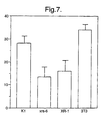
- Figure 7 shows the number of colonies of various cell types staining positive for ⁇ -galactosidase activity 48 hours after infection with VSV G glycoprotein pseudotyped MoMLV-based retroviral vector expressing LacZ.
- yeast S. cerevisiae was used as a model system.
- the Ku-associated DNA DSB repair system is highly conserved between yeast and humans (Boulton and Jackson, 1996a; Boulton and Jackson, 1996b and references therein).
- yeast retrotransposons Ty1 and Ty5 transpose through mechanisms that are highly related to those of retrotransposons and retroviruses in other organisms, including humans (Boeke et al., 1985; Garfinkel, 1985; Boeke and Sandmeyer, 1991).
- the galactose-inducible Ty1 transposition system (Curcio and Garfinkel 1991) was initially utilised.
- a his3 mutant derivative of the yeast strain under investigation is generated such that it contains an episomal replicating plasmid that directs the expression of Ty1 RNA from a galactose-inducible promoter.
- the Ty1 element contains within it the S. cerevisiae HIS3 gene that is interrupted by an intron in reverse (anti-sense) orientation.
- the yeast strain is phenotypically his- and cannot grow in the absence of histidine in the growth medium.
- the intron since the intron is in the sense orientation with respect to the Ty1 retroelement, it can become removed by splicing of the Ty1 RNA when this is produced in the presence of galactose. If this spliced RNA subsequently becomes reverse transcribed and integrated by the Ty1 integrase into the yeast genome, the now intron-less yeast HIS3 gene can now be expressed, and the resulting yeast strain is converted to a HIS+ phenotype. Hence, this assay system allows the efficiency of retrotransposition to be determined by quantifying the ability of the yeast strain being tested to generate HIS+ colonies after galactose induction.
- Transposition assays were performed as follows. Yeast strains were transformed with pGTy1-H3 mHIS3AI (Curcio and Garfinkel, 1991) or pSZ152 and plated to select for the URA3 gene on this plasmid (on synthetic media without uracil, SC-ura). These plasmids contain a galactose-inducible Ty1 or Ty5 element respectively, under control of the galactose inducible GAL1-10 promoter, and a HIS3 gene with an artificial intron in the reverse orientation. Expression of the HIS3 gene is dependent on transcription and transposition of the Ty1 element (Curcio and Garfinkel, 1991).
- a yeast strain deficient in the gene for yeast Ku70 gives rates of retrotransposition that are 5 to 10-fold lower (i.e. decrease of >80%) than that of the control yeast strain. That this defect is due to inactivation of YKU70 is revealed by the fact that the defect is observed with several independently-derived yku70 mutant strains (data not shown). Moreover, the transposition defect is fully complemented when the yku70 mutant strain contains an episomal plasmid containing the YKU70 gene ( Figure 1A). This demonstrates that Yku70p plays an important role in Ty retrotransposition.
- Ty1 retrotransposition is affected negatively by mutations in the genes for Yku70p and Yku80p but not by mutations in other DNA repair pathways analysed.
- transposition of the divergent retrotransposon Ty5 was also assessed.
- Yeast strains were transformed with a plasmid containing the Ty5 element under the control of the GAL1 promoter, and containing the same HIS3 artificial intron construct as pGTy1-H3mHIS3AI (plasmid psz152 Zou et al. 1996) and assays were performed as described above with reference to Figure 1.
- Yeast Ku does not affect the formation of functional virus-like particles
- Ku could affect the synthesis of the virus-like particles (VLPs) by affecting the synthesis of the Ty RNA, the synthesis of other viral components, or the reverse transcription of the RNA and its assembly into an infective VLP.
- VLPs virus-like particles
- Second, Ku could affect the stability of the VLP or the cDNA that it contains.
- Third, Ku could affect the ability of the VLP to integrate into target DNA.
- Fourth, Ku could be involved in DNA repair steps that occur subsequent to the initial integrase-mediated DNA strand cleavage and transfer reactions.
- Yku70p was thus detected in fractions 1 and 2 of extract from wild-type cells either lacking or containing actively transposing Ty1. Most significantly, however, yku70p was also detected in fraction 8 of wild-type Ty-containing extracts that contains peak RT activity, but was not detected in the equivalent fraction derived from cells lacking Ty1. The presence of Yku70p in fractions containing peak RT levels was found consistently in three independent VLP preparations. Furthermore, Western blot analysis of similar preparations from cells containing actively transposing Ty5 also showed an association of Yku70p with peak RT levels. Together, these data suggest strongly that Yku70p associates with Ty VLPs.
- VLPs isolated from Ku positive and Ku negative yeast cells differ functionally, the abilities of the two VLP preparations to integrate into a plasmid DNA molecule in vitro were compared. As shown in Figure 4, VLPs isolated from Ku deficient cells are no less active in mediating cDNA integration than the VLPs isolated from Ku positive yeasts.
- VLPs that had been purified from a wild-type or a yku70 mutant ( yku70 ) yeast strain, as described above with reference to Figure 3.
- Reactions contained 3 ml VLPs or Buffer B/Mg 2+ (negative control), 10 mM Tris pH 8.0, 15 mM MgCl 2 , 1 mM DTT, 5 % polyethylene glycol, and 1 mg of supercoiled plasmid DNA (pRS416; Stratagene). Reactions were incubated for 30 min at 25°C, and stopped by the addition of proteinase K to 0.5 mg/ml and SDS to 1.4 % followed by a further incubation at 25°C for 3h.
- the DNA was extracted with phenol/chloroform, precipitated with ethanol, washed with 70 % ethanol, resuspended in 10 mM Tris pH 8.0, and transformed into XL-1 cells (Stratagene). Colony hybridization was performed using a random-primed probe corresponding to the HIS3 gene. Positive colonies were counted relative to total colonies to give the average transposition frequency. Positive colonies were picked to ensure they contained the Ty1 element; as expected, reactions containing no VLPs yielded no positively hybridising colonies.
- yeast Ku function affects Ty transposition rates (established above) provides indication that, Ty transposition frequencies will be reduced in Ku positive cells by inhibitors of Ku action.
- One approach to demonstrate this principle involves introduction into YKU70 / YKU80 strains of plasmid molecules that direct the expression of mutated derivatives of Yku70p or Yku80p (using the vectors such as those described previously; Boulton and Jackson, 1996a; Boulton and Jackson, 1996b).
- the Ku mutants studied may for example include N-terminal deletion mutants, C-terminal deletion mutants, and point mutants in regions of the protein that are conserved throughout evolution (e.g. Feldmann and Winnacker, 1993; Boulton and Jackson, 1996b). Since the subunits of Ku function as a heterodimer and work in association with various other proteins, various mutated Ku molecules able to interact with their partner or with other components of the system will form non-functional complexes. Such dominant negative mutations, when used in Ty transposition studies, provide indication that inhibition of Ku function can impair Ty retrotransposition.
- the regions of the two Ku subunits that function in Ty retrotransposition may be defined by assessing the abilities of mutated derivatives of YKU70 and YKU80 to complement the transposition deficiencies of yku70 and yku80 mutant strains, respectively (using vectors such as those described previously; Boulton and Jackson, 1996a; Boulton and Jackson, 1996b).
- the ability of the mutated Yku70p and Yku80p derivatives to complement the DNA repair, radiosensitivity and telomeric loss phenotypes of Ku-deficient yeasts may also be tested using standard procedures (Boulton and Jackson, 1996a; Boulton and Jackson, 1996b; Porter et al., 1996). Similar approaches may also be used to define important functional regions of mammalian Ku70 and Ku80 and define functional regions of other components of the Ku-associated DNA repair apparatus (see below).
- LIG4 cerevisiae chromosome XV, accession number Z74913 of the yeast genome database, and encodes a protein with strong sequence similarity to mammalian ligase IV (Wei et al., 1995).
- Disruption of LIG4 results in defects in illegitimate end-joining as ascertained by plasmid repair assays and in radiosensitivity experiments and these defects are the same as those observed in strains disrupted for YKU80 (Boulton and Jackson, 1996a, 1996b).
- no additional defect in DNA repair is observed in double-mutant strains deficient in Ku plus LIG4, indicating that these genes function in the same pathway.
- the effect of mutating these genes on Ty retrotransposition frequencies may be tested using assays similar to those described for Ku.
- Figure 2D shows some decrease in retrotransposition rates in strains that have disruptions in either RAD50 or LIG4 . These have been shown to work in the same pathway as Ku in repairing ds breaks in yeast (Milne et al., 1996; Tsukamoto et al ., 1996; Teo et al ., 1997; Shar et al ., 1997; Wilson et al, 1997). The decreases were not as great as expected, suggesting that Ku might be facilitating retrotransposition in a manner distinct from its role in repairing DNA ds breaks.
- yeast homologue of the mammalian XRCC4 protein Li et al., 1995
- this will also be expected to be involved in Ty transposition because the mammalian factor functions as part of the Ku-associated DNA repair apparatus (and see below) and defects in mammalian XRCC4 negatively affect retrovirus integration (see below).
- any other components of the yeast Ku-associated DNA repair apparatus are defined, these will also be tested for their role in retrotransposition. Should mutation of any of these genes lead to reduced retrotransposition, then these factors, and their homologues in other organisms, will be attractive targets for the development of novel anti-retroviral agents.
- Steps to determine the site(s) of involvement of additional factors in retrotransposition and the development of strategies for drug screening etc. will be analogous to those described above and below for the Ku subunits.
- the Spe I products include a 287 bp fragment corresponding to the 3' end of the Ty1 element. If the ends were degraded significantly in the VLPs derived from yku70 cells, this band would be expected to run faster or appear smeared relative to the corresponding fragment from wild-type VLPs. However, no detectable differences were detected between the cDNAs products derived from wild-type and yku70 cells.
- VLPs from wild-type or yku70 strains were normalised by RT activity and incubated at room temperature in Buffer B/Mg 2+ (10 mM HEPES, pH 7.6, 15 mM KCl, 3 mM DTT, 10 mg/ml aprotinin, 5 mM MgCl 2 ).
- DNA was isolated by phenol/chloroform extraction at various time points and electrophoresed on a 1% agarose gel. The gel was transferred and analysed by Southern blott-hybridisation followed by autoradiography.
- VLP preparations as determined by RT activity were used for analyses of Ty1 DNA.
- DNA was isolated by incubation with 50 ng/ml proteinase K, 12.5 mM EDTA, and 0.5% SDS at 25°C for 2 hours followed by two phenol/chloroform extractions and ethanol precipitation.
- Ty1 DNA was analysed by 1& agarose electrophoresis and transferred to GeneScreeen Plus (DuPont/NEN). The membrane was probed with the Bam HI/ Hind III fragment of pGTy1H3m HIS 3AI that was labelled by nick translation (Promega).
- VLP DNA was incubated with radioactive dNTPs and the Klenow fragment of E. coli DNA polymerase, then was analysed by scintillation counting. Since Klenow polymerises in a 5' to 3' direction, the amount of incorporation is a relection of DNA nicks or recessed 3' ends. Significantly, cDNA isolated from yku70 VLPs incorporated ⁇ 2-fold more radiolabel than cDNA from wild-type VLPs ( Figure 5).
- Ty1 cDNA accumulates increased levels of DNA nicks in the absence of Ku and/or displays 3' to 5' degradation of the cDNA ends. Since Ty1 integrase requires either blunt ends or an overhanging 3'-OH to catalyse strand exchange (Eichinger and Boeke, 1990), such 3' to 5' degradation could adversely affect retrotransposition efficiency.
- VLP preparations derived from Ku positive and Ku negative yeast cells were incubated at room temperature for various lengths of time, then analysed the Ty1 DNA for degradation by Southern hybridisation analysis. Notably, these studies revealed that VLP-associated Ty1 DNA derived from yku70 cells degrades much more rapidly than that obtained from wild-type cells ( Figure 6a). By contrast, plasmid DNA degraded equally quickly when added to the two VLPs preparations ( Figure 6b).
- Ku Since the association of Ku with DNA ends is highly stable, it is conceivable that Ku remains associated with the Ty1 cDNA during transport into the nucleus and functions in subsequent steps in the retrotransposition process. For example, as Ku binds to DNA ss gaps with comparable affinity to DNA ds ends (Paillard and Strauss, 1991; Falson et al ., 1993), it might facilitate the repair of the single-stranded DNA gaps that arise as retrotransposition intermediates. Through binding to such structures and displacing integrase, Ku could also prevent the reversal of the transposition reaction, a process termed dis-integration (Moores et al., 1995; Dotan et al ., 1995).
- Ku affects retrotransposon and retrovirus propagation in mammalian systems
- the abilities of a mammalian retrovirus to integrate into the genome of mammalian cells that are proficient or deficient in the Ku-associated DNA repair apparatus were analysed.
- a derivative of the Moloney murine leukaemia virus (Mo-MLV) was used to infect various rodent cell lines (to allow infection, the virus was "pseudotyped" with the vesicular stomatitis virus G protein, yielding supernatents of an approximate titer of 1 x 10 7 ; Burns et al., 1993; Hopkins, 1993; Yee et al., 1994; and references therein).
- the involvement of other components of the mammalian Ku-associated DNA repair apparatus in efficient retroviral and retrotransposon integration may be established by assessing the efficiency of retroviral integration into cell lines deficient in other components of this system.
- mouse, hamster and human cell lines exist that are deficient in the catalytic subunit of DNA-dependent protein kinase (DNA-PKcs), which is part of the Ku-associated DNA repair machinery in mammalian cells (see e.g. Blunt et al., 1995; Lees-Miller et al., 1995; for reviews, see Jackson and Jeggo, 1995; Jackson, 1996).
- DNA-PKcs DNA-dependent protein kinase
- ligase IV e.g. defective in mammalian ligase IV, or defective in homologues of yeast Rad50p, Mre11p, Xrs2p, Sir2p, Sir3p and Sir4p.
- studies may be performed in cells rendered deficient in repair due to the expression of dominant negative mutants of factors such as ligase IV, Rad50p, Mre11p, and Xrs2p.
- ligase III is very like ligase IV in sequence
- cells deficient in ligase III or the associated XRCC1 protein may be tested for their ability to mediate retroviral or retrotransposon integration (the Chinese hamster ovary cell line derivatives EM-9 and EM-C11 lack functional XRCC1; Thompson et al. 1990; Caldecott et al. 1996; and references therein).
- test viruses include other animal tumour retroviruses, human T-cell leukaemia viruses and HIV-1, which causes AIDS (HIV can be used to infect human cells or can be derivatised to infect rodent cells; eg. Naldini et al., 1996).
- Inhibitors of the Ku-associated DNA repair apparatus protect against retroviral infection .
- dominant negative derivatives of Ku subunits and other components of the Ku-associated DNA repair apparatus can be used to show that inhibition of this repair apparatus in normal cells results in decreased ability to stably integrate retrovirus into the host cell genome.
- stable mammalian cell lines are generated that express the dominant negative mutant proteins. Wild-type mammalian cell lines are also treated with various drugs to show that this results in inhibition of retroviral integration.
- DNA-PK Ku-associated DNA-dependent protein kinase
- LY294002 has been shown to inhibit Ku-associated DNA-dependent protein kinase (DNA-PK) activity (Hartley et al., 1995; Vlahos et al. 1994; also unpublished data from the inventors' laboratory).
- DNA-PK inhibitors that are identified may be tested for effects. Although it is most simple to test agents initially on tissue culture cells, preliminary studies may subsequently be extended to involve animals such as mice (mice deficient or proficient in components of the Ku-associated DNA repair apparatus will be employed) and, ultimately, to human subjects.
- Determination of the mechanism by which the Ku-associated DNA repair machinery functions in retrovirus and retrotransposon integration facilitates design of assays that recapitulate these functions in defined in vivo or in vitro assays.
- assays are among those that may be used in screens for inhibitors, identifying substances as potential anti-retroviral agents.
- Assays include those that measure full retroviral integration or just measure the step(s) of the process that are affected by the Ku-associated machinery.
- yeast or mammalian cell lines may provide useful in vivo systems to test for effects.
- human Ku70 and Ku80 may be expressed in yeast cells for assessment of Ty transposition or other aspects of Ku-dependent events.
- Such a "humanised" yeast system may be used to screen for molecules that interfere with human Ku function.
- Another screen that may be used to identify novel anti-retroviral agents is one that identifies inhibitors of Ku-associated DNA-PK activity (for example, Dvir et al., 1992; Gottling and Jackson, 1993; Finnie et al., 1995; and references therein).
- Other screens may be for compounds that inhibit enzymatic activities associated with ligases III or IV, Rad50p and Mre11p (both putative nucleases), interfere with protein-protein interactions within the Ku-associated repair apparatus (for example, between Ku and other components of the apparatus, between Rad50p, Mre11p and Xrs2p, between XRCC1 and ligase III, or between XRCC4 and ligase IV), or interfere with associations between the repair machinery and the DNA substrate.
- Peptides or peptide mimetics that resemble important regions of components of the Ku-associated repair system may be tested in addition to small molecule drugs.
- drugs and their derivatives may be tested in cell, animal and ultimately human systems for effects on retroviral and retrotransposon integration and on retroviral infection.
- activators or inhibitors of Ku-associated processes will also be of utility in other systems.
- retrotransposons are very abundant in the genomes of many higher plants and many transpose relatively frequently (Wessler, 1996). Indeed, much of the problematic somaclonal variation that occurs after plants are regenerated from protoplast tissue cultures appears to arise through retrotransposition events (Wessler, 1996). Aspects of the present invention may be used for suppressing the generation of somaclonal variation in plants by inhibition of the plant Ku-associated DNA repair apparatus.
Landscapes
- Health & Medical Sciences (AREA)
- Life Sciences & Earth Sciences (AREA)
- Engineering & Computer Science (AREA)
- Biomedical Technology (AREA)
- Immunology (AREA)
- Hematology (AREA)
- Chemical & Material Sciences (AREA)
- Urology & Nephrology (AREA)
- Molecular Biology (AREA)
- Medicinal Chemistry (AREA)
- General Health & Medical Sciences (AREA)
- Microbiology (AREA)
- Biotechnology (AREA)
- Pathology (AREA)
- General Physics & Mathematics (AREA)
- Food Science & Technology (AREA)
- Cell Biology (AREA)
- Physics & Mathematics (AREA)
- Analytical Chemistry (AREA)
- Biochemistry (AREA)
- Toxicology (AREA)
- Tropical Medicine & Parasitology (AREA)
- Bioinformatics & Cheminformatics (AREA)
- Proteomics, Peptides & Aminoacids (AREA)
- Medicines That Contain Protein Lipid Enzymes And Other Medicines (AREA)
- Pharmaceuticals Containing Other Organic And Inorganic Compounds (AREA)
- Ultra Sonic Daignosis Equipment (AREA)
- Gyroscopes (AREA)
- External Artificial Organs (AREA)
- Medicines Containing Material From Animals Or Micro-Organisms (AREA)
- Dental Preparations (AREA)
- Investigating Or Analysing Biological Materials (AREA)
- Financial Or Insurance-Related Operations Such As Payment And Settlement (AREA)
Applications Claiming Priority (3)
| Application Number | Priority Date | Filing Date | Title |
|---|---|---|---|
| GB9700574 | 1997-01-13 | ||
| GBGB9700574.8A GB9700574D0 (en) | 1997-01-13 | 1997-01-13 | Methods and means relating to retrotransposon and retroviral integration |
| PCT/GB1998/000099 WO1998030903A1 (en) | 1997-01-13 | 1998-01-13 | Methods and means relating to retrotransposon and retroviral integration |
Publications (2)
| Publication Number | Publication Date |
|---|---|
| EP0965040A1 EP0965040A1 (en) | 1999-12-22 |
| EP0965040B1 true EP0965040B1 (en) | 2003-04-09 |
Family
ID=10805892
Family Applications (1)
| Application Number | Title | Priority Date | Filing Date |
|---|---|---|---|
| EP98900593A Expired - Lifetime EP0965040B1 (en) | 1997-01-13 | 1998-01-13 | Methods and means relating to retrotransposon and retroviral integration |
Country Status (12)
| Country | Link |
|---|---|
| US (1) | US6242175B1 (es) |
| EP (1) | EP0965040B1 (es) |
| JP (1) | JP2001508175A (es) |
| AT (1) | ATE237135T1 (es) |
| AU (1) | AU729066B2 (es) |
| CA (1) | CA2277483A1 (es) |
| DE (1) | DE69813193T2 (es) |
| DK (1) | DK0965040T3 (es) |
| ES (1) | ES2197454T3 (es) |
| GB (2) | GB9700574D0 (es) |
| PT (1) | PT965040E (es) |
| WO (1) | WO1998030903A1 (es) |
Families Citing this family (8)
| Publication number | Priority date | Publication date | Assignee | Title |
|---|---|---|---|---|
| GB9907687D0 (en) * | 1999-04-01 | 1999-05-26 | Kudos Pharm Ltd | Assays methods and means |
| US6569681B1 (en) | 2000-03-14 | 2003-05-27 | Transkaryotic Therapies, Inc. | Methods of improving homologous recombination |
| CA2414017A1 (en) * | 2000-05-30 | 2001-12-06 | Kudos Pharmaceuticals Limited | Inhibiting retrotransposon and retroviral integration by targeting the atm pathway |
| US7358040B2 (en) * | 2001-08-01 | 2008-04-15 | Rigel Pharmaceuticals, Incorporated | MRE 11: modulation of cellular proliferation |
| US7106469B2 (en) * | 2001-08-08 | 2006-09-12 | Hewlett-Packard Development Company, L.P. | Variable data printing with web based imaging |
| EP1436406A4 (en) * | 2001-09-24 | 2004-10-13 | Blood Ct Res Foundation | METHOD FOR MODULATING OR EXAMINING THE KU70 MIRROR IN CELLS |
| WO2003089573A2 (en) * | 2002-04-05 | 2003-10-30 | Fishel Richard A | Methods of identifying compounds that modulate a dna repair pathway and/or retroviral infectivity, the compounds, and uses thereof |
| US20060099583A1 (en) * | 2002-05-07 | 2006-05-11 | Devine Scott E | Compositions and methods for identifying antiviral agents |
Family Cites Families (2)
| Publication number | Priority date | Publication date | Assignee | Title |
|---|---|---|---|---|
| CA2132452C (en) * | 1993-01-21 | 2003-10-21 | The Salk Institute For Biological Studies | Casein kinase i-like protein kinase |
| AU7972594A (en) * | 1993-10-12 | 1995-05-04 | Baylor College Of Medicine | Hepatitis b virus interacts with cellular dna repair processes |
-
1997
- 1997-01-13 GB GBGB9700574.8A patent/GB9700574D0/en active Pending
-
1998
- 1998-01-13 JP JP53067198A patent/JP2001508175A/ja not_active Ceased
- 1998-01-13 US US09/341,515 patent/US6242175B1/en not_active Expired - Fee Related
- 1998-01-13 PT PT98900593T patent/PT965040E/pt unknown
- 1998-01-13 DE DE69813193T patent/DE69813193T2/de not_active Expired - Fee Related
- 1998-01-13 ES ES98900593T patent/ES2197454T3/es not_active Expired - Lifetime
- 1998-01-13 GB GB9800660A patent/GB2321702B/en not_active Expired - Fee Related
- 1998-01-13 AU AU55684/98A patent/AU729066B2/en not_active Ceased
- 1998-01-13 WO PCT/GB1998/000099 patent/WO1998030903A1/en not_active Ceased
- 1998-01-13 CA CA002277483A patent/CA2277483A1/en not_active Abandoned
- 1998-01-13 AT AT98900593T patent/ATE237135T1/de not_active IP Right Cessation
- 1998-01-13 DK DK98900593T patent/DK0965040T3/da active
- 1998-01-13 EP EP98900593A patent/EP0965040B1/en not_active Expired - Lifetime
Also Published As
| Publication number | Publication date |
|---|---|
| GB2321702A (en) | 1998-08-05 |
| DK0965040T3 (da) | 2003-07-21 |
| ES2197454T3 (es) | 2004-01-01 |
| AU5568498A (en) | 1998-08-03 |
| WO1998030903A1 (en) | 1998-07-16 |
| JP2001508175A (ja) | 2001-06-19 |
| GB2321702B (en) | 1998-12-23 |
| AU729066B2 (en) | 2001-01-25 |
| EP0965040A1 (en) | 1999-12-22 |
| DE69813193D1 (de) | 2003-05-15 |
| GB9700574D0 (en) | 1997-03-05 |
| US6242175B1 (en) | 2001-06-05 |
| DE69813193T2 (de) | 2004-03-04 |
| GB9800660D0 (en) | 1998-03-11 |
| PT965040E (pt) | 2003-08-29 |
| CA2277483A1 (en) | 1998-07-16 |
| ATE237135T1 (de) | 2003-04-15 |
Similar Documents
| Publication | Publication Date | Title |
|---|---|---|
| Schwartz et al. | FHA domain-mediated DNA checkpoint regulation of Rad53 | |
| Wen et al. | A mutant allele of MRE11 found in mismatch repair-deficient tumor cells suppresses the cellular response to DNA replication fork stress in a dominant negative manner | |
| US20100105064A1 (en) | Method of screening test substances for treating or preventing a disease mediated by plasma cells | |
| EP0965040B1 (en) | Methods and means relating to retrotransposon and retroviral integration | |
| WO2001097830A1 (en) | Modification of mdm2 activity | |
| AU724108B2 (en) | Assays, agents, therapy and diagnosis relating to modulation of cellular dna repair activity | |
| Young et al. | CAF-1 and Rtt101p function within the replication-coupled chromatin assembly network to promote H4 K16ac, preventing ectopic silencing | |
| US8586297B2 (en) | Modulating the Cdc14B-Cdh1-Plk1 axis and methods for sensitizing target cells to apoptosis | |
| CA2697887A1 (en) | Modulating and/or detecting activation induced deaminase and methods of use thereof | |
| US20040014701A1 (en) | Inhibiting retrotransposon and retroviral integration by targeting the atm pathway | |
| JP2005529591A (ja) | Dna修復経路及び/若しくはレトロウイルス感染を調節する化合物を同定する方法、その化合物、及びそれらの使用。 | |
| Guillen | Investigating the cellular functions of casein kinase 1 δ and ε through identification of interacting partners and substrates | |
| Hagan | Regulation of the spindle checkpoint by Mad2 binding proteins | |
| US20060057669A1 (en) | Inactive transcription factor tif-ia and uses thereof | |
| Sun | Rad53/Spk1, a central kinase of both the DNA damage and the replication checkpoints in Saccharomyces cerevisiae | |
| Nnakwe | Chromatin dynamics in the DNA damage response | |
| CA2493825A1 (en) | Means for use in treating diseases correlated with or caused by non-physiological levels of microtubule-associated pp2ac | |
| Nam | Phospho-regulation of the DNA damage response kinase ATR | |
| US20040197913A1 (en) | Methods and means for improving retroviral integration | |
| O'Connor | Maintenance of the spindle assembly checkpoint by PLK1 and CDC7 kinases and characterisation of cell lines carrying mutations in the genes coding for the CDC7 regulatory subunits | |
| 김진우 | The effect of chromatin assembly factor1 in ATM-dependent DNA damage response | |
| Ramey | The role of histone H3/H4 chaperone anti-silencing function 1 in maintaining genomic integrity | |
| GB2329469A (en) | Screening for predispositions to DNA repair disorders | |
| Das | Roles of the SNM1B DNA Nuclease in Resolution of Replication Stress and Maintenance of Genome Stability | |
| Sandoval Oporto | Conserved and Unconventional Responses to DNA Damage in Tetrahymena |
Legal Events
| Date | Code | Title | Description |
|---|---|---|---|
| PUAI | Public reference made under article 153(3) epc to a published international application that has entered the european phase |
Free format text: ORIGINAL CODE: 0009012 |
|
| 17P | Request for examination filed |
Effective date: 19990730 |
|
| AK | Designated contracting states |
Kind code of ref document: A1 Designated state(s): AT BE CH DE DK ES FI FR GB GR IE IT LI LU MC NL PT SE |
|
| 17Q | First examination report despatched |
Effective date: 20011002 |
|
| GRAH | Despatch of communication of intention to grant a patent |
Free format text: ORIGINAL CODE: EPIDOS IGRA |
|
| GRAH | Despatch of communication of intention to grant a patent |
Free format text: ORIGINAL CODE: EPIDOS IGRA |
|
| GRAA | (expected) grant |
Free format text: ORIGINAL CODE: 0009210 |
|
| RBV | Designated contracting states (corrected) |
Designated state(s): AT BE CH DE DK ES FI FR GR IE IT LI LU MC NL PT SE |
|
| AK | Designated contracting states |
Designated state(s): AT BE CH DE DK ES FI FR GR IE IT LI LU MC NL PT SE |
|
| REG | Reference to a national code |
Ref country code: CH Ref legal event code: EP |
|
| REG | Reference to a national code |
Ref country code: IE Ref legal event code: FG4D |
|
| REG | Reference to a national code |
Ref country code: SE Ref legal event code: TRGR |
|
| REG | Reference to a national code |
Ref country code: GR Ref legal event code: EP Ref document number: 20030402305 Country of ref document: GR |
|
| REG | Reference to a national code |
Ref country code: DK Ref legal event code: T3 |
|
| REG | Reference to a national code |
Ref country code: ES Ref legal event code: FG2A Ref document number: 2197454 Country of ref document: ES Kind code of ref document: T3 |
|
| ET | Fr: translation filed | ||
| PLBE | No opposition filed within time limit |
Free format text: ORIGINAL CODE: 0009261 |
|
| STAA | Information on the status of an ep patent application or granted ep patent |
Free format text: STATUS: NO OPPOSITION FILED WITHIN TIME LIMIT |
|
| 26N | No opposition filed |
Effective date: 20040112 |
|
| PGFP | Annual fee paid to national office [announced via postgrant information from national office to epo] |
Ref country code: ES Payment date: 20041110 Year of fee payment: 8 |
|
| PGFP | Annual fee paid to national office [announced via postgrant information from national office to epo] |
Ref country code: GR Payment date: 20041112 Year of fee payment: 8 Ref country code: PT Payment date: 20041112 Year of fee payment: 8 |
|
| PGFP | Annual fee paid to national office [announced via postgrant information from national office to epo] |
Ref country code: MC Payment date: 20050106 Year of fee payment: 8 |
|
| PGFP | Annual fee paid to national office [announced via postgrant information from national office to epo] |
Ref country code: FR Payment date: 20050125 Year of fee payment: 8 Ref country code: SE Payment date: 20050125 Year of fee payment: 8 Ref country code: NL Payment date: 20050125 Year of fee payment: 8 Ref country code: CH Payment date: 20050125 Year of fee payment: 8 |
|
| PGFP | Annual fee paid to national office [announced via postgrant information from national office to epo] |
Ref country code: IE Payment date: 20050126 Year of fee payment: 8 Ref country code: DK Payment date: 20050126 Year of fee payment: 8 Ref country code: BE Payment date: 20050126 Year of fee payment: 8 Ref country code: AT Payment date: 20050126 Year of fee payment: 8 |
|
| PGFP | Annual fee paid to national office [announced via postgrant information from national office to epo] |
Ref country code: FI Payment date: 20050127 Year of fee payment: 8 |
|
| PGFP | Annual fee paid to national office [announced via postgrant information from national office to epo] |
Ref country code: LU Payment date: 20050128 Year of fee payment: 8 |
|
| PGFP | Annual fee paid to national office [announced via postgrant information from national office to epo] |
Ref country code: DE Payment date: 20050131 Year of fee payment: 8 |
|
| PG25 | Lapsed in a contracting state [announced via postgrant information from national office to epo] |
Ref country code: IE Free format text: LAPSE BECAUSE OF NON-PAYMENT OF DUE FEES Effective date: 20060113 Ref country code: FI Free format text: LAPSE BECAUSE OF NON-PAYMENT OF DUE FEES Effective date: 20060113 Ref country code: AT Free format text: LAPSE BECAUSE OF NON-PAYMENT OF DUE FEES Effective date: 20060113 |
|
| PG25 | Lapsed in a contracting state [announced via postgrant information from national office to epo] |
Ref country code: SE Free format text: LAPSE BECAUSE OF NON-PAYMENT OF DUE FEES Effective date: 20060114 Ref country code: ES Free format text: LAPSE BECAUSE OF NON-PAYMENT OF DUE FEES Effective date: 20060114 |
|
| PG25 | Lapsed in a contracting state [announced via postgrant information from national office to epo] |
Ref country code: MC Free format text: LAPSE BECAUSE OF NON-PAYMENT OF DUE FEES Effective date: 20060131 Ref country code: LU Free format text: LAPSE BECAUSE OF NON-PAYMENT OF DUE FEES Effective date: 20060131 Ref country code: LI Free format text: LAPSE BECAUSE OF NON-PAYMENT OF DUE FEES Effective date: 20060131 Ref country code: FR Free format text: LAPSE BECAUSE OF NON-PAYMENT OF DUE FEES Effective date: 20060131 Ref country code: DK Free format text: LAPSE BECAUSE OF NON-PAYMENT OF DUE FEES Effective date: 20060131 Ref country code: CH Free format text: LAPSE BECAUSE OF NON-PAYMENT OF DUE FEES Effective date: 20060131 Ref country code: BE Free format text: LAPSE BECAUSE OF NON-PAYMENT OF DUE FEES Effective date: 20060131 |
|
| PGFP | Annual fee paid to national office [announced via postgrant information from national office to epo] |
Ref country code: IT Payment date: 20060131 Year of fee payment: 9 |
|
| PG25 | Lapsed in a contracting state [announced via postgrant information from national office to epo] |
Ref country code: PT Free format text: LAPSE BECAUSE OF NON-PAYMENT OF DUE FEES Effective date: 20060713 |
|
| PG25 | Lapsed in a contracting state [announced via postgrant information from national office to epo] |
Ref country code: NL Free format text: LAPSE BECAUSE OF NON-PAYMENT OF DUE FEES Effective date: 20060801 Ref country code: DE Free format text: LAPSE BECAUSE OF NON-PAYMENT OF DUE FEES Effective date: 20060801 |
|
| REG | Reference to a national code |
Ref country code: DK Ref legal event code: EBP |
|
| REG | Reference to a national code |
Ref country code: CH Ref legal event code: PL |
|
| EUG | Se: european patent has lapsed | ||
| REG | Reference to a national code |
Ref country code: PT Ref legal event code: MM4A Effective date: 20060713 |
|
| NLV4 | Nl: lapsed or anulled due to non-payment of the annual fee |
Effective date: 20060801 |
|
| REG | Reference to a national code |
Ref country code: IE Ref legal event code: MM4A |
|
| REG | Reference to a national code |
Ref country code: FR Ref legal event code: ST Effective date: 20060929 |
|
| REG | Reference to a national code |
Ref country code: ES Ref legal event code: FD2A Effective date: 20060114 |
|
| BERE | Be: lapsed |
Owner name: *KUDOS PHARMACEUTICALS LTD Effective date: 20060131 |
|
| PG25 | Lapsed in a contracting state [announced via postgrant information from national office to epo] |
Ref country code: GR Free format text: LAPSE BECAUSE OF NON-PAYMENT OF DUE FEES Effective date: 20060802 |
|
| PG25 | Lapsed in a contracting state [announced via postgrant information from national office to epo] |
Ref country code: IT Free format text: LAPSE BECAUSE OF NON-PAYMENT OF DUE FEES Effective date: 20070113 |