EP0961300A2 - Sintered body having non-linear resistance characteristic - Google Patents
Sintered body having non-linear resistance characteristic Download PDFInfo
- Publication number
- EP0961300A2 EP0961300A2 EP99109237A EP99109237A EP0961300A2 EP 0961300 A2 EP0961300 A2 EP 0961300A2 EP 99109237 A EP99109237 A EP 99109237A EP 99109237 A EP99109237 A EP 99109237A EP 0961300 A2 EP0961300 A2 EP 0961300A2
- Authority
- EP
- European Patent Office
- Prior art keywords
- mol
- ppm
- convened
- auxiliary
- sintered body
- Prior art date
- Legal status (The legal status is an assumption and is not a legal conclusion. Google has not performed a legal analysis and makes no representation as to the accuracy of the status listed.)
- Granted
Links
Images


Classifications
-
- H—ELECTRICITY
- H01—ELECTRIC ELEMENTS
- H01C—RESISTORS
- H01C7/00—Non-adjustable resistors formed as one or more layers or coatings; Non-adjustable resistors made from powdered conducting material or powdered semi-conducting material with or without insulating material
- H01C7/10—Non-adjustable resistors formed as one or more layers or coatings; Non-adjustable resistors made from powdered conducting material or powdered semi-conducting material with or without insulating material voltage responsive, i.e. varistors
- H01C7/105—Varistor cores
- H01C7/108—Metal oxide
- H01C7/112—ZnO type
Definitions
- the present invention relates to sintered bodies which can be used in resistors having a nonlinear resistance (hereinafter “non-linear resistors”) and which include zinc oxide (ZnO) as their principal composition.
- non-linear resistors which include zinc oxide (ZnO) as their principal composition.
- ZnO zinc oxide
- the present invention relates to a non-linear resistor with superior non-linear current/voltage characteristics, and also with a greatly improved ability to withstand surge current.
- a lightning arrester or a surge absorber is installed to protect the power system or the electronic equipment from the abnormal voltage.
- the lightning arrester or the surge absorber which is composed of a non-liner resistor having a sintered body, on the one hand exhibits an insulating property under normal voltages, but exhibits a low resistance property when an abnormal voltage is applied.
- These lightning arresters or surge absorbers are installed between a terminal of the equipment to be protected, or between the bus-line of the power system, and a ground.
- the non-linear resistors that are pan of the above-mentioned lightning arresters, etc. are produced by the following process.
- a raw material mixture is prepared by combining specified quantities of oxide powders such as Bi 2 O 3 , Sb 2 O 3 , Co 2 O 3 , MnO and Cr 2 O 3 , as auxiliary compositions, with zinc oxide (ZnO) powder, as the principal composition.
- oxide powders such as Bi 2 O 3 , Sb 2 O 3 , Co 2 O 3 , MnO and Cr 2 O 3
- ZnO zinc oxide
- the essential components of a lightning arrester or the like are formed by forming a high-resistance layer (i.e., side insulating layer) 2 on the side surface of a sintered body 1, which is the above-mentioned resistor, by coating and rebaking an insulating material to prevent creeping flash-over (see Fig.2), Then respective electrodes 3 are added after polishing the two end surfaces of the sintered body 1.
- a high-resistance layer i.e., side insulating layer
- a sintered body 1 which is the above-mentioned resistor
- a protection instrument which protects electrical equipment from a abnormal voltage.
- the protection instrument includes: a first terminal connected to the electrical equipment; the non-linear resistor described above; and a second terminal connected between the non-linear resistor and a ground.
- the sintered body may preferably contain 0.01 to 1000 ppm of at least one of sodium, potassium, chlorine and calcium, convened respectively to Na + , K + , Cl - and Ca 2+ , as an auxiliary composition.
- the present invention is broadly directed to sintered bodies which are preferably used in resistors having non-liner resistance.
- the performance of a resistor having non-liner resistance is generally defined by measuring the breakdown voltage.
- the breakdown voltage i.e., the value that current starts flowing by reduction of the electrical resistance following an increase in voltage
- the voltage/current non-liner property is evaluated.
- the breakdown voltage is measured as the discharge initiation voltage when a current of 1 mA is switched ON, while the voltage/current non-linear characteristics is shown by the value of the ratio shown in Equation (1) below.
- V 10kA / V 1mA V(Voltage when V 10KA current switched ON) V(Voltage when V 1mA current switched ON)
- V 10kA / V 1mA V(Voltage when V 10KA current switched ON)
- V 10kA / V 1mA V(Voltage when V 10KA current switched ON)
- V 10kA means a residual voltage
- V 1mA means a varistor voltage.
- these current values are used to evaluate the non-linear characteristic of the non-linear resistor.
- a large value of V 10kA means a maximum voltage that the protection instrument, such as the lighting arrester and surge absorber, can protect electrical equipment from abnormal voltage.
- a large value of V 10kA means the strength of the non-linear resistance is higher to mechanical destruction by the abnormal voltage.
- the resistors of the present invention preferably have a varistor voltage of > 400(v/mm), and more preferably > 600(v/mm); and a ratio of V 10kA : V 1mA of ⁇ 1.5, more preferably ⁇ 1.4.
- the composition of the sintered body includes ZnO as the principal composition (i.e., component) and bismuth (Bi), cobalt (Co), antimony (Sb), manganese (Mn) and nickel (Ni), as auxiliary compositions (i.e., components).
- principal composition is defined as the amount of ZnO present such that the total amount of ZnO and the auxiliary compositions are 90 mol% of the total composition after sintering, preferably 95 mol%, more preferably 98 mol%, most preferably 100 mol%, Minor amounts of impurities which do not substantially adversely effect the performance of the resistor made from the sintered body may also be present.
- the total composition which forms the sintered body also includes auxiliary compositions.
- the reason for the contents of bismuth (Bi), cobalt (Co), antimony (Sb), manganese (Mn) and nickel (Ni), as auxiliary compositions, convened respectively to Bi 2 O 3 , Co 2 O 3 , Sb 2 O 3 , MnO, and NiO, being in the range of 0.05 to 10 mol%, preferably, 0.05 to 10.0 mol%, respectively, is that, outside the above range, the non-linear resistance property and life property deteriorate.
- life property means a characteristic that the leakage current is at a stable low level over a long period of time.
- Bi 2 O 3 is a composition that manifests non-linear resistance by being present on the grain boundaries.
- Co 2 O 3 is also effective for greatly improving non-linear resistance by going into solid solution with ZnO, which is the principal composition.
- Sb 2 O 3 contributes to the improvement of the varistor voltage and the surge current-resistant capacity by forming spinel.
- MnO also improves the non-linear resistance by going into solid solution in the ZnO and the spinel, while NiO is also an effective composition for improving non-linear resistance and the life property.
- the content ratio of Bi 2 O 3 to NiO a mole ratio of 0.5 or more but 1.5 or less, and the content ratio of MnO to Sb 2 O 3 a mole ratio of 1.0 or less, it becomes possible to improve the non-linear resistance property and the life property.
- the moisture resistance property of the non-linear resistor can also be improved simultaneously, and a stable varistor property can be obtained over a long period.
- a MnO/Sb 2 O 3 ratio of 0.9 or less is even more desirable.
- the obtained granulated powders were respectively formed into disc-shaped moldings by pressure molding using a die press. Then, the molded bodies had the binder removed by heating in air at 500°C and, after the organic binder, etc., had been eradicated, they are were sintered in air at a temperature of 1200°C for 2 hours. Non-linear resistor test samples of diameter 20mm ⁇ thickness 2mm were respectively prepared by performing a grinding process on the surfaces of the obtained sintered bodies.
- a high-resistance layer (side insulation layer) 2 is formed on the side surface of a non-linear resistor 1 for each test sample by coating a high-resistance insulating substance composed of a thermo-setting resin and then baking.
- the non-linear resistor is produced by forming respective electrodes 3 by polishing the two end surfaces of a sintered body 1 and flame-coating aluminum on these two end surfaces.
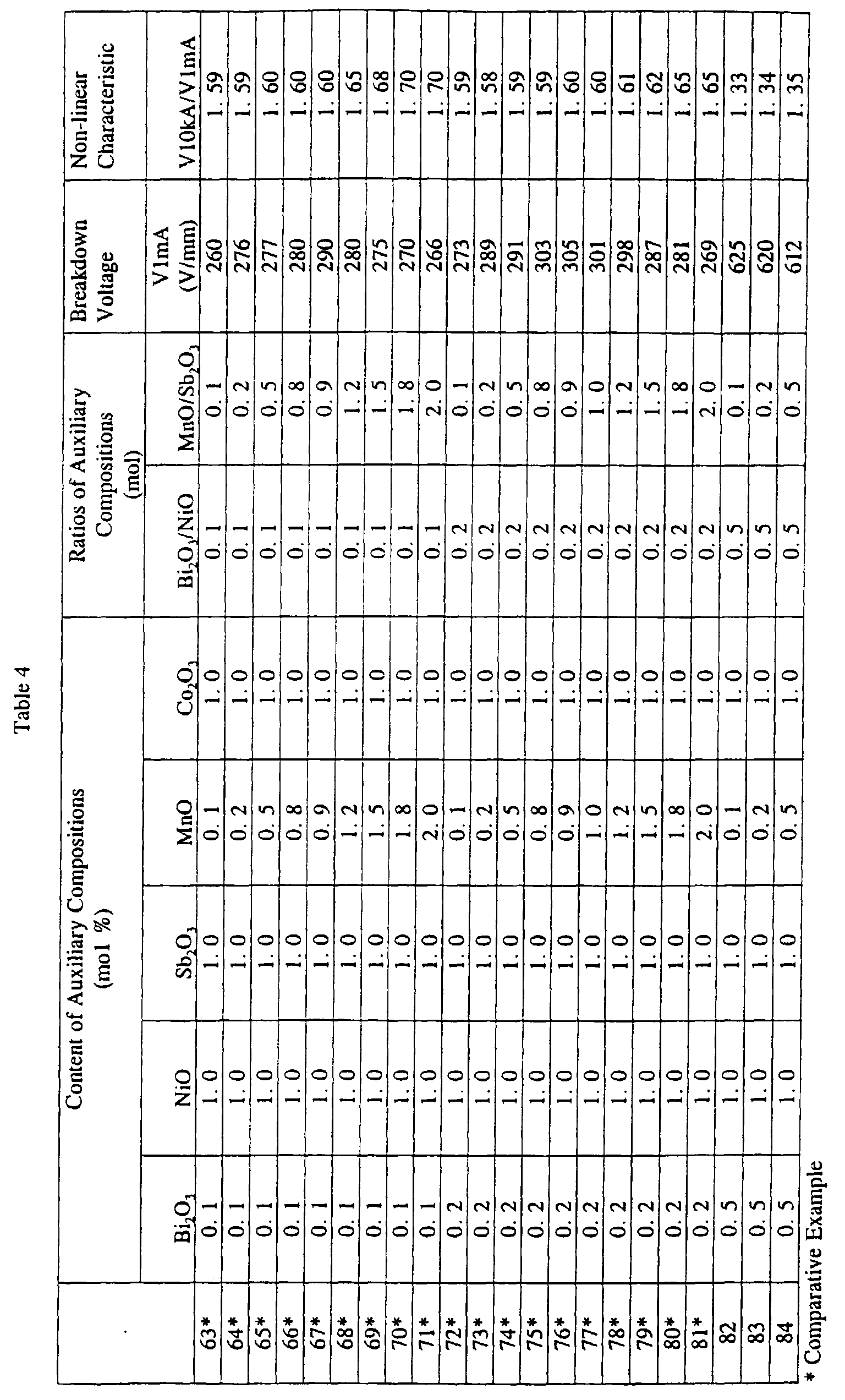
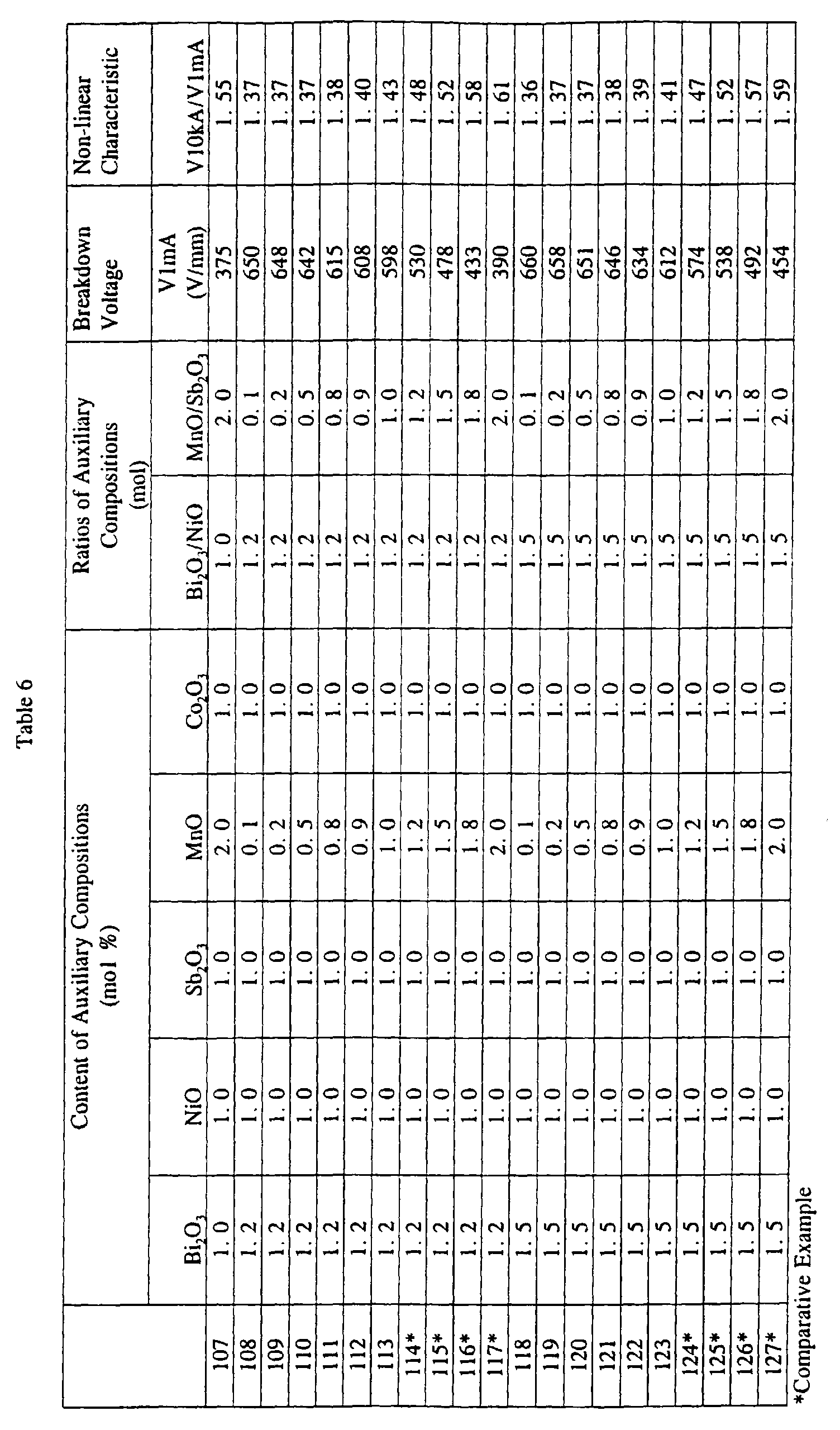
- Table 1 to Table 6 The breakdown voltage and non-linear characteristics measurement results for each non-linear resistance element are shown in Table 1 to Table 6.
- Tables 1 to 3 show the effect on breakdown voltage and non-linear characteristics when the contained quantities of auxiliary compositions Bi 2 O 3 , NiO, Sb 2 O 3 , MnO and Co 2 O 3 are changed.
- Tables 4 to 6 show the effect on breakdown voltage and non-linear characteristics when the content ratio of Bi 2 O 3 and NiO is changed.
- a raw material mixture was prepared by mixing a specified quantity of each of Bi 2 O 3 , NiO, Sb 2 O 3 , MnO and Co 2 O 3 , as auxiliary compositions, into ZnO powder, as the principal composition such that a non-liner resistor had a basic composition containing 0.6 mol% of Bi 2 O 3 , 1.0 mol% of Co 2 O 3 , 1.0 mol% of Sb 2 O 3 , 0.9 mol% of MnO and 0.4 mol% of NiO. Then, a uniform slurry is prepared by mixing water with this raw material mixture.
- non-liner resistor Test Samples 150 to 157 are respectively prepared by performing granulation, pressure-molding, heating to remove the binder and sintering, following the same production method as for Embodiment 1.
- the non-liner resistor relating to the present invention contains zinc oxide and the principal composition and bismuth, cobalt, antimony, manganese and nickel as auxiliary compositions.
- the content ratio of Bi 2 O 3 to NiO is generally in the range of 0.5 to 1.5, while the content ratio of MnO to Sb 2 O 3 is generally 1.0 or less. Therefore, it is possible to provide a non-linear resistor with a superior current/voltage non-linear resistance characteristics and also a high withstand-voltage.
- the non-linear resistance characteristics and the surge current withstand can be further improved.
- the preferred embodiment also includes 50 ppm of aluminum convened to Al 3+ as an auxiliary composition; 200 ppm of boron convened to B 3+ as an auxiliary composition; and 200 ppm of silver convened to Ag + as an auxiliary composition.
Landscapes
- Engineering & Computer Science (AREA)
- Microelectronics & Electronic Packaging (AREA)
- Physics & Mathematics (AREA)
- Electromagnetism (AREA)
- Compositions Of Oxide Ceramics (AREA)
- Thermistors And Varistors (AREA)
- Inorganic Compounds Of Heavy Metals (AREA)
Abstract
Description



| Operating start voltage | Non-linear characteristic | |||
| Composition | amount (ppm) | V1mA (V/mm) | V10kA/V1mA | |
| 128 | Al3+ | 0. 01 | 582 | 1. 45 |
| 129 | Al3+ | 0. 1 | 643 | 1. 40 |
| 130 | Al3+ | 1 | 698 | 1. 39 |
| 131 | Al3+ | 10 | 720 | 1. 39 |
| 132 | Al3+ | 100 | 702 | 1. 39 |
| 134 | Al3+ | 1000 | 650 | 1. 39 |
| 135 | Al3+ | 10000 | 567 | 1. 40 |
| 136 | B3+ | 0. 01 | 578 | 1. 42 |
| 137 | B | 0. 1 | 637 | 1. 40 |
| 138 | B3+ | 1 | 692 | 1.39 |
| 139 | B3+ | 10 | 711 | 1.38 |
| 140 | B3+ | 100 | 697 | 1. 39 |
| 141 | B3+ | 1000 | 640 | 1. 39 |
| 142 | B3+ | 10000 | 560 | 1. 40 |
| 143 | Ag+ | 0. 01 | 569 | 1. 41 |
| 144 | Ag+ | 0. 1 | 641 | 1. 40 |
| 145 | Ag+ | 1 | 695 | 1. 39 |
| 146 | Ag+ | 10 | 718 | 1. 39 |
| 147 | Ag+ | 100 | 709 | 1. 39 |
| 148 | Ag+ | 1000 | 653 | 1. 39 |
| 149 | Ag+ | 10000 | 559 | 1. 40 |
| Operating start voltage | Non-linear characteristic | |||
| Composition | Content (ppm) | V1mA (V/mm) | V10kA/V1mA | |
| 150 | Na+ | 0. 001 | 571 | 1. 42 |
| 151 | Na+ | 0. 01 | 658 | 1. 40 |
| 152 | Na+ | 0. 1 | 706 | 1. 39 |
| 153 | Na+ | 1 | 710 | 1. 39 |
| 154 | Na+ | 10 | 712 | 1. 39 |
| 155 | Na+ | 100 | 680 | 1. 39 |
| 156 | Na+ | 1000 | 662 | 1. 39 |
| 157 | Na+ | 10000 | 572 | 1. 40 |
| 158 | K+ | 0. 001 | 531 | 1. 40 |
| 159 | K+ | 0. 01 | 632 | 1. 40 |
| 160 | K+ | 0. 1 | 689 | 1. 39 |
| 161 | K+ | 1 | 702 | 1. 39 |
| 162 | K+ | 10 | 695 | 1. 39 |
| 163 | K+ | 100 | 664 | 1. 39 |
| 164 | K+ | 1000 | 641 | 1. 39 |
| 165 | K+ | 10000 | 562 | 1. 40 |
| 166 | Cl- | 0. 001 | 528 | 1. 40 |
| 167 | Cl- | 0. 01 | 624 | 1. 40 |
| 168 | Cl- | 0. 1 | 678 | 1. 39 |
| 169 | Cl- | 1 | 698 | 1. 39 |
| 170 | Cl- | 10 | 704 | 1. 38 |
| 171 | Cl- | 100 | 663 | 1. 39 |
| 172 | Cl- | 1000 | 618 | 1. 39 |
| 173 | Cl- | 10000 | 525 | 1. 40 |
| 174 | Ca2+ | 0. 001 | 576 | 1. 40 |
| 175 | Ca2+ | 0. 01 | 608 | 1. 39 |
| 176 | Ca2+ | 0. 1 | 638 | 1. 39 |
| 177 | Ca2+ | 1 | 642 | 1. 39 |
| 178 | Ca2+ | 10 | 651 | 1. 39 |
| 179 | Ca2+ | 100 | 639 | 1. 39 |
| 180 | Ca2+ | 1000 | 620 | 1. 39 |
| 181 | Ca2+ | 10000 | 584 | 1. 40 |
Claims (23)
- A sintered body comprising:zinc oxide; andbismuth, cobalt, antimony, manganese and nickel expressed as Bi2O3, Co2O3, Sb2O3, MnO and NiO,and containing 0.05 to 10 mol% of Bi2O3, 0.05 to 10 mol% of Co2O3, 0.05 to 10 mol% of Sb2O3, 0.05 to 10 mol% of MnO and 0.05 to 10 mol% of NiO as auxiliary compositions, wherein a content ratio of Bi2O3 to NiO is in a mole ratio of 0.5 or more but 1.5 or less, and wherein a content ratio of MnO to Sb2O3 is in a mole ratio of 1.0 or less.
- The sintered body according to claim 1, wherein:the sintered body has a non-linear electrical resistance characteristic.
- The sintered body according to claim 2, further comprising:0.5 to 500 ppm of aluminum convened to Al3+ as an auxiliary composition.
- The sintered body according to claim 2, further comprising:10 to 1000 ppm of boron convened to B3+ as an auxiliary composition.
- The sintered body according to claim 2, further comprising:10 to 1000 ppm of silver convened to Ag+ as an auxiliary composition.
- The sintered body according to claim 2, further comprising:0.01 to 1000 ppm of sodium convened to Na+ as an auxiliary composition.
- The sintered body according to claim 2, further comprising:0.01 to 1000 ppm of potassium convened to K+ as an auxiliary composition.
- The sintered body according to claim 2, further comprising:0.01 to 1000 ppm of chlorine convened to Cl- as an auxiliary composition.
- The sintered body according to claim 2, further comprising:0.01 to 1000 ppm of calcium convened to Ca2+ as an auxiliary composition.
- A non-linear resistor which is formed from a sintered body, comprising:zinc oxide as a principal composition; andbismuth, cobalt, antimony, manganese and nickel respectively convened Bi2O3, Co2O3, Sb2O3, MnO and NiO, and containing 0.05 to 10.0 mol% of Bi2O3, 0.05 to 10 mol% of Co2O3, 0.05 to 10 mol% of Sb2O3, 0.05 to 10 mol% of MnO and 0.05 to 10 mol% of NiO as auxiliary compositions, whereina content ratio of Bi2O3 to NiO is in a mole ratio of 0.5 or more but 1.5 or less, and whereina content ratio of MnO to Sb2O3 is in a mole ratio of 1.0 or less.
- The non-linear resistor according to claim 10, further comprising:0.5 to 500 ppm of aluminum convened to Al3+ as an auxiliary composition.
- The non-linear resistor according to claim 10, further comprising:10 to 1000 ppm of boron convened to B3+ as an auxiliary constituent.
- The non-linear resistor according to claim 10, further comprising:10 to 1000 ppm of silver convened to Ag+ as an auxiliary constituent.
- The non-linear resistor according to claim 10, further comprising:0.01 to 1000 ppm of sodium convened to Na+ as an auxiliary constituent.
- The non-linear resistor according to claim 10, further comprising:0.01 to 1000 ppm of potassium convened to K+ as an auxiliary constituent.
- The non-linear resistor according to claim 10, further comprising:0.01 to 1000 ppm of chlorine convened to Cl- as an auxiliary constituent.
- The non-liner resistor according to claim 10, further comprising:0.01 to 1000 ppm of calcium convened to Ca2+ as an auxiliary constituent.
- A protection instrument, which protects electrical equipment from abnormal voltage, comprising:a first terminal connected to the electrical equipment;the non-linear resistor according to claim 10; anda second terminal connected between the non-linear resistor and a ground.
- A method for manufacturing a sintered body of claim 1, comprising the steps of:mixing Bi2O3, Co2O3, Sb2O3, MnO and NiO, as auxiliary compositions, with ZnO powder to obtain a mixture;reducing the viscosity of the mixture;spraying the mixture after reducing viscosity to obtain a granular powder;pressing the granular powder into a mold by pressure to form a molded body;heating the molded body to remove the binder; andsintering the molded body by sintering at a temperature higher than the temperature of removing the binder to obtain the sintered body.
- The method according to claim 19, wherein:the heating to remove the binder step is performed in the air at 500°C; and the sintering step is performed in the air at 1200°C for 2 hours.
- The method according to claim 19, wherein the reducing step is performed by adding water, dispersion material and an organic binder.
- A non-linear resistor which is formed from a sintered body, comprising:zinc oxide;bismuth, cobalt, antimony, manganese and nickel expressed Bi2O3, Co2O3, Sb2O3, MnO and NiO, and containing 1 mol% of Bi2O3, 0.75 mol% of Co2O3, 1.75 mol% of Sb2O3, 1 mol% of MnO and 1.75 mol% of NiO as auxiliary compositions, wherein a content ratio of Bi2O3 to NiO is in a mole ratio of about 0.57, wherein a content ratio of MnO to Sb2O3 is in a mole ratio of about 0.57;50 ppm of aluminum converted to Al3+ as an auxiliary composition;200 ppm of boron convened to B3+ an auxiliary composition; and200 ppm of silver convened to Ag+ as an auxiliary composition.
- A non-linear resistor which is formed from a sintered body, comprising:zinc oxide;bismuth, cobalt, antimony, manganese and nickel expressed as and containing 0.5 to 2 mol% of Bi2O3, 0.25 to 1 mol% of Co2O3, 0.5 to 3 mol% of Sb2O3, 0.5 to 3 mol% of MnO and 0.5 to 3 mol% of NiO as auxiliary compositions, wherein a content ratio of Bi2O3 to NiO is in a mole ratio of about 0.57, wherein a content ratio of MnO to Sb2O3 is in a mole ratio of about 0.57;50 ppm of aluminum convened to Al3+ as an auxiliary composition;200 ppm of boron convened to B3+ as an auxiliary composition; and200 ppm of silver convened to Ag+ as an auxiliary composition.
Applications Claiming Priority (2)
| Application Number | Priority Date | Filing Date | Title |
|---|---|---|---|
| JP14350598 | 1998-05-25 | ||
| JP10143505A JPH11340009A (en) | 1998-05-25 | 1998-05-25 | Non-linear resistor |
Publications (3)
| Publication Number | Publication Date |
|---|---|
| EP0961300A2 true EP0961300A2 (en) | 1999-12-01 |
| EP0961300A3 EP0961300A3 (en) | 2000-03-22 |
| EP0961300B1 EP0961300B1 (en) | 2007-11-14 |
Family
ID=15340297
Family Applications (1)
| Application Number | Title | Priority Date | Filing Date |
|---|---|---|---|
| EP99109237A Revoked EP0961300B1 (en) | 1998-05-25 | 1999-05-25 | Non-linear resistor |
Country Status (5)
| Country | Link |
|---|---|
| US (1) | US6184771B1 (en) |
| EP (1) | EP0961300B1 (en) |
| JP (1) | JPH11340009A (en) |
| CN (1) | CN1214405C (en) |
| DE (1) | DE69937516T2 (en) |
Cited By (6)
| Publication number | Priority date | Publication date | Assignee | Title |
|---|---|---|---|---|
| EP2144256A1 (en) * | 2008-07-09 | 2010-01-13 | Kabushiki Kaisha Toshiba | Current/voltage nonlinear resistor |
| EP2194541A3 (en) * | 2008-12-04 | 2010-06-16 | Kabushiki Kaisha Toshiba | Current-voltage non-linear resistor and method of manufacture thereof |
| EP2305622A1 (en) | 2009-10-01 | 2011-04-06 | ABB Technology AG | High field strength varistor material |
| EP2367178A4 (en) * | 2008-11-17 | 2012-10-10 | Mitsubishi Electric Corp | VOLTAGE-NON-ALARM RESISTANCE, LIGHT-PROTECTION DEVICE EQUIPPED WITH VOLTAGE-NON-ALARM RESISTANCE AND PROCESS FOR PRODUCING A VOLTAGE-NON-ALARM RESISTANCE |
| EP2124233A4 (en) * | 2007-03-05 | 2018-03-28 | Kabushiki Kaisha Toshiba | Zno varistor powder |
| US11170917B1 (en) * | 2020-11-11 | 2021-11-09 | Ripd Intellectual Assets Ltd | Zinc oxide varistor ceramics |
Families Citing this family (20)
| Publication number | Priority date | Publication date | Assignee | Title |
|---|---|---|---|---|
| JP2001307909A (en) * | 2000-04-25 | 2001-11-02 | Toshiba Corp | Current-voltage non-linear resistor |
| US20050224899A1 (en) * | 2002-02-06 | 2005-10-13 | Ramsey Craig C | Wireless substrate-like sensor |
| US7289230B2 (en) * | 2002-02-06 | 2007-10-30 | Cyberoptics Semiconductors, Inc. | Wireless substrate-like sensor |
| US20050224902A1 (en) * | 2002-02-06 | 2005-10-13 | Ramsey Craig C | Wireless substrate-like sensor |
| JP3718702B2 (en) * | 2002-12-03 | 2005-11-24 | 独立行政法人物質・材料研究機構 | Zinc oxide resistor and manufacturing method thereof |
| JP4050742B2 (en) * | 2004-12-15 | 2008-02-20 | Tdk株式会社 | Multilayer chip varistor |
| US7804306B2 (en) * | 2006-02-21 | 2010-09-28 | CyterOptics Semiconductor, Inc. | Capacitive distance sensing in semiconductor processing tools |
| US7893697B2 (en) * | 2006-02-21 | 2011-02-22 | Cyberoptics Semiconductor, Inc. | Capacitive distance sensing in semiconductor processing tools |
| TW200849444A (en) * | 2007-04-05 | 2008-12-16 | Cyberoptics Semiconductor Inc | Semiconductor processing system with integrated showerhead distance measuring device |
| US20090015268A1 (en) * | 2007-07-13 | 2009-01-15 | Gardner Delrae H | Device and method for compensating a capacitive sensor measurement for variations caused by environmental conditions in a semiconductor processing environment |
| JP5334636B2 (en) * | 2009-03-13 | 2013-11-06 | 三菱電機株式会社 | Voltage non-linear resistor, lightning arrester equipped with voltage non-linear resistor, and method of manufacturing voltage non-linear resistor |
| US8399092B2 (en) * | 2009-10-07 | 2013-03-19 | Sakai Chemical Industry Co., Ltd. | Zinc oxide particle having high bulk density, method for producing it, exoergic filler, exoergic resin composition, exoergic grease and exoergic coating composition |
| CN111718192B (en) * | 2012-12-27 | 2023-07-21 | 东莞令特电子有限公司 | Zinc oxide based varistor and method of manufacture |
| DE102016104990A1 (en) | 2016-03-17 | 2017-09-21 | Epcos Ag | Ceramic material, varistor and method for producing the ceramic material and the varistor |
| CN108154983A (en) * | 2017-12-29 | 2018-06-12 | 国网湖南省电力有限公司 | Arrester zinc oxide resistance sheet and preparation method thereof |
| KR20200037511A (en) * | 2018-10-01 | 2020-04-09 | 삼성전기주식회사 | Varistor |
| CN109265161A (en) * | 2018-10-29 | 2019-01-25 | 惠州嘉科实业有限公司 | Middle pressure varistor and preparation method thereof |
| CN114400121A (en) * | 2021-12-17 | 2022-04-26 | 南阳金牛电气有限公司 | Manufacturing method of zinc oxide resistance card with high flux density |
| CN114907111A (en) * | 2022-05-07 | 2022-08-16 | 吉林昱丰电气科技有限公司 | High-energy high-residual-voltage-ratio nonlinear device and preparation method thereof |
| DE102025101950A1 (en) * | 2025-01-21 | 2026-07-23 | Illutherm Gmbh | Ceramics and manufacturing processes for ceramics |
Family Cites Families (16)
| Publication number | Priority date | Publication date | Assignee | Title |
|---|---|---|---|---|
| DE2345753C3 (en) * | 1972-09-11 | 1978-03-09 | Tokyo Shibaura Electric Co., Ltd., Kawasaki, Kanagawa (Japan) | Metal oxide varistor |
| JPS5827643B2 (en) * | 1979-07-13 | 1983-06-10 | 株式会社日立製作所 | Nonlinear resistor and its manufacturing method |
| DE3033511C2 (en) * | 1979-09-07 | 1994-09-08 | Tdk Corp | Voltage dependent resistance |
| JPS5799708A (en) | 1980-12-12 | 1982-06-21 | Matsushita Electric Industrial Co Ltd | Method of forming electrode of zinc oxide series voltage non-linear resistor |
| CA1206742A (en) | 1982-12-24 | 1986-07-02 | Hideyuki Kanai | Varistor |
| JPS59117202A (en) | 1982-12-24 | 1984-07-06 | 株式会社東芝 | Voltage current nonlinear resistor |
| US4460497A (en) * | 1983-02-18 | 1984-07-17 | Westinghouse Electric Corp. | Voltage stable nonlinear resistor containing minor amounts of aluminum and selected alkali metal additives |
| JPS62237703A (en) | 1986-04-09 | 1987-10-17 | 日本碍子株式会社 | Manufacture of voltage nonlinear resistance element |
| JPS63136603A (en) | 1986-11-28 | 1988-06-08 | 日本碍子株式会社 | Manufacture of voltage nonlinear resistor |
| US4939619A (en) | 1987-01-26 | 1990-07-03 | Northern Telecom Limited | Packaged solid-state surge protector |
| US5143711A (en) * | 1989-12-05 | 1992-09-01 | Asea Brown Boveri Ltd. | Process for manufacturing a precursor powder for use in making a varistor and a powder manufactured in this process |
| US5231370A (en) * | 1990-08-29 | 1993-07-27 | Cooper Industries, Inc. | Zinc oxide varistors and/or resistors |
| JPH05101907A (en) * | 1991-03-30 | 1993-04-23 | Toshiba Corp | Breaker for electric power and resistor for electric power |
| US5569495A (en) * | 1995-05-16 | 1996-10-29 | Raychem Corporation | Method of making varistor chip with etching to remove damaged surfaces |
| US5739742A (en) * | 1995-08-31 | 1998-04-14 | Matsushita Electric Industrial Co., Ltd. | Zinc oxide ceramics and method for producing the same and zinc oxide varistors |
| JPH11186006A (en) | 1997-12-22 | 1999-07-09 | Toshiba Corp | Non-linear resistor |
-
1998
- 1998-05-25 JP JP10143505A patent/JPH11340009A/en active Pending
-
1999
- 1999-05-24 CN CNB991075080A patent/CN1214405C/en not_active Expired - Lifetime
- 1999-05-24 US US09/317,111 patent/US6184771B1/en not_active Expired - Lifetime
- 1999-05-25 EP EP99109237A patent/EP0961300B1/en not_active Revoked
- 1999-05-25 DE DE69937516T patent/DE69937516T2/en not_active Revoked
Cited By (10)
| Publication number | Priority date | Publication date | Assignee | Title |
|---|---|---|---|---|
| EP2124233A4 (en) * | 2007-03-05 | 2018-03-28 | Kabushiki Kaisha Toshiba | Zno varistor powder |
| EP2144256A1 (en) * | 2008-07-09 | 2010-01-13 | Kabushiki Kaisha Toshiba | Current/voltage nonlinear resistor |
| EP2367178A4 (en) * | 2008-11-17 | 2012-10-10 | Mitsubishi Electric Corp | VOLTAGE-NON-ALARM RESISTANCE, LIGHT-PROTECTION DEVICE EQUIPPED WITH VOLTAGE-NON-ALARM RESISTANCE AND PROCESS FOR PRODUCING A VOLTAGE-NON-ALARM RESISTANCE |
| US8562859B2 (en) | 2008-11-17 | 2013-10-22 | Mitsubishi Electric Corporation | Voltage nonlinear resistor, lightning arrester equipped with voltage nonlinear resistor, and process for producing voltage nonlinear resistor |
| EP2194541A3 (en) * | 2008-12-04 | 2010-06-16 | Kabushiki Kaisha Toshiba | Current-voltage non-linear resistor and method of manufacture thereof |
| US8535575B2 (en) | 2008-12-04 | 2013-09-17 | Kabushiki Kaisha Toshiba | Current-voltage non-linear resistor and method of manufacture thereof |
| EP2305622A1 (en) | 2009-10-01 | 2011-04-06 | ABB Technology AG | High field strength varistor material |
| RU2570656C2 (en) * | 2009-10-01 | 2015-12-10 | Абб Текнолоджи Аг | Material for high field intensity varistor |
| US11170917B1 (en) * | 2020-11-11 | 2021-11-09 | Ripd Intellectual Assets Ltd | Zinc oxide varistor ceramics |
| US11501900B2 (en) | 2020-11-11 | 2022-11-15 | RIPD Intellectual Assets Ltd. | Zinc oxide varistor ceramics |
Also Published As
| Publication number | Publication date |
|---|---|
| EP0961300A3 (en) | 2000-03-22 |
| JPH11340009A (en) | 1999-12-10 |
| US6184771B1 (en) | 2001-02-06 |
| DE69937516D1 (en) | 2007-12-27 |
| DE69937516T2 (en) | 2008-09-18 |
| EP0961300B1 (en) | 2007-11-14 |
| CN1214405C (en) | 2005-08-10 |
| CN1236958A (en) | 1999-12-01 |
Similar Documents
| Publication | Publication Date | Title |
|---|---|---|
| US6184771B1 (en) | Sintered body having non-linear resistance characteristics | |
| EP2194541A2 (en) | Current-voltage non-linear resistor and method of manufacture thereof | |
| JP6756484B2 (en) | Voltage non-linear resistor | |
| EP1798741B1 (en) | Current/voltage nonlinear resistor | |
| JP6937390B2 (en) | Materials for current-voltage non-linear resistors, current-voltage non-linear resistors and their manufacturing methods | |
| JP4282243B2 (en) | Non-linear resistor | |
| EP2144256B1 (en) | Current/voltage nonlinear resistor | |
| JP2000232005A (en) | Non-linear resistor | |
| JP6508643B2 (en) | Method for producing composition for electronic component | |
| JP2692210B2 (en) | Zinc oxide varistor | |
| JP3256366B2 (en) | Method of manufacturing voltage non-linear resistor | |
| CN106946564B (en) | A kind of linear resistance material and preparation method thereof | |
| JP2003109806A (en) | Nonlinear resistor and method of manufacturing the same | |
| KR102615494B1 (en) | ZnO-BASED VARISTOR COMPOSITION AND VARISTOR INCLUDING THE SAME AND MANUFACTURING METHOD THEREOF | |
| JP2546726B2 (en) | Voltage nonlinear resistor | |
| JP2001093705A (en) | Nonlinear resistor and method of manufacturing the same | |
| JPS6115303A (en) | Method of producing oxide voltage nonlinear resistor | |
| JP2854387B2 (en) | Manufacturing method of zinc oxide arrester element | |
| JP2738089B2 (en) | Method of manufacturing voltage non-linear resistor | |
| JPH10241911A (en) | Non-linear resistor | |
| JPH08138909A (en) | Manufacture of voltage non-linearity resistor | |
| JP5929152B2 (en) | Method for manufacturing non-linear resistor element | |
| JPH10241910A (en) | Non-linear resistor | |
| JPH0773082B2 (en) | Method for producing zinc oxide varistor | |
| JPH08138911A (en) | Manufacture of voltage non-linearity resistor |
Legal Events
| Date | Code | Title | Description |
|---|---|---|---|
| PUAI | Public reference made under article 153(3) epc to a published international application that has entered the european phase |
Free format text: ORIGINAL CODE: 0009012 |
|
| 17P | Request for examination filed |
Effective date: 19990525 |
|
| AK | Designated contracting states |
Kind code of ref document: A2 Designated state(s): DE FR SE |
|
| AX | Request for extension of the european patent |
Free format text: AL;LT;LV;MK;RO;SI |
|
| PUAL | Search report despatched |
Free format text: ORIGINAL CODE: 0009013 |
|
| AK | Designated contracting states |
Kind code of ref document: A3 Designated state(s): AT BE CH CY DE DK ES FI FR GB GR IE IT LI LU MC NL PT SE |
|
| AX | Request for extension of the european patent |
Free format text: AL;LT;LV;MK;RO;SI |
|
| AKX | Designation fees paid |
Free format text: DE FR SE |
|
| GRAP | Despatch of communication of intention to grant a patent |
Free format text: ORIGINAL CODE: EPIDOSNIGR1 |
|
| RTI1 | Title (correction) |
Free format text: NON-LINEAR RESISTOR |
|
| GRAS | Grant fee paid |
Free format text: ORIGINAL CODE: EPIDOSNIGR3 |
|
| GRAA | (expected) grant |
Free format text: ORIGINAL CODE: 0009210 |
|
| AK | Designated contracting states |
Kind code of ref document: B1 Designated state(s): DE FR SE |
|
| REF | Corresponds to: |
Ref document number: 69937516 Country of ref document: DE Date of ref document: 20071227 Kind code of ref document: P |
|
| REG | Reference to a national code |
Ref country code: SE Ref legal event code: TRGR |
|
| ET | Fr: translation filed | ||
| PLAZ | Examination of admissibility of opposition: despatch of communication + time limit |
Free format text: ORIGINAL CODE: EPIDOSNOPE2 |
|
| PLBI | Opposition filed |
Free format text: ORIGINAL CODE: 0009260 |
|
| PLBA | Examination of admissibility of opposition: reply received |
Free format text: ORIGINAL CODE: EPIDOSNOPE4 |
|
| PLAX | Notice of opposition and request to file observation + time limit sent |
Free format text: ORIGINAL CODE: EPIDOSNOBS2 |
|
| 26 | Opposition filed |
Opponent name: ABB SCHWEIZ AG Effective date: 20080814 |
|
| PLAF | Information modified related to communication of a notice of opposition and request to file observations + time limit |
Free format text: ORIGINAL CODE: EPIDOSCOBS2 |
|
| RDAF | Communication despatched that patent is revoked |
Free format text: ORIGINAL CODE: EPIDOSNREV1 |
|
| PGFP | Annual fee paid to national office [announced via postgrant information from national office to epo] |
Ref country code: SE Payment date: 20090512 Year of fee payment: 11 Ref country code: FR Payment date: 20090515 Year of fee payment: 11 Ref country code: DE Payment date: 20090527 Year of fee payment: 11 |
|
| RDAG | Patent revoked |
Free format text: ORIGINAL CODE: 0009271 |
|
| STAA | Information on the status of an ep patent application or granted ep patent |
Free format text: STATUS: PATENT REVOKED |
|
| 27W | Patent revoked |
Effective date: 20090801 |
|
| REG | Reference to a national code |
Ref country code: SE Ref legal event code: ECNC |