EP0954041A2 - Ein Polysilamin und eine Säure enthaltender Gegenstand - Google Patents
Ein Polysilamin und eine Säure enthaltender Gegenstand Download PDFInfo
- Publication number
- EP0954041A2 EP0954041A2 EP99107866A EP99107866A EP0954041A2 EP 0954041 A2 EP0954041 A2 EP 0954041A2 EP 99107866 A EP99107866 A EP 99107866A EP 99107866 A EP99107866 A EP 99107866A EP 0954041 A2 EP0954041 A2 EP 0954041A2
- Authority
- EP
- European Patent Office
- Prior art keywords
- polysilamine
- composite
- group
- formula
- lower alkyl
- Prior art date
- Legal status (The legal status is an assumption and is not a legal conclusion. Google has not performed a legal analysis and makes no representation as to the accuracy of the status listed.)
- Granted
Links
Images








Classifications
-
- H—ELECTRICITY
- H01—ELECTRIC ELEMENTS
- H01M—PROCESSES OR MEANS, e.g. BATTERIES, FOR THE DIRECT CONVERSION OF CHEMICAL ENERGY INTO ELECTRICAL ENERGY
- H01M4/00—Electrodes
- H01M4/86—Inert electrodes with catalytic activity, e.g. for fuel cells
- H01M4/90—Selection of catalytic material
- H01M4/92—Metals of platinum group
- H01M4/925—Metals of platinum group supported on carriers, e.g. powder carriers
- H01M4/926—Metals of platinum group supported on carriers, e.g. powder carriers on carbon or graphite
-
- C—CHEMISTRY; METALLURGY
- C08—ORGANIC MACROMOLECULAR COMPOUNDS; THEIR PREPARATION OR CHEMICAL WORKING-UP; COMPOSITIONS BASED THEREON
- C08G—MACROMOLECULAR COMPOUNDS OBTAINED OTHERWISE THAN BY REACTIONS ONLY INVOLVING UNSATURATED CARBON-TO-CARBON BONDS
- C08G77/00—Macromolecular compounds obtained by reactions forming a linkage containing silicon with or without sulfur, nitrogen, oxygen or carbon in the main chain of the macromolecule
- C08G77/60—Macromolecular compounds obtained by reactions forming a linkage containing silicon with or without sulfur, nitrogen, oxygen or carbon in the main chain of the macromolecule in which all the silicon atoms are connected by linkages other than oxygen atoms
-
- C—CHEMISTRY; METALLURGY
- C08—ORGANIC MACROMOLECULAR COMPOUNDS; THEIR PREPARATION OR CHEMICAL WORKING-UP; COMPOSITIONS BASED THEREON
- C08G—MACROMOLECULAR COMPOUNDS OBTAINED OTHERWISE THAN BY REACTIONS ONLY INVOLVING UNSATURATED CARBON-TO-CARBON BONDS
- C08G77/00—Macromolecular compounds obtained by reactions forming a linkage containing silicon with or without sulfur, nitrogen, oxygen or carbon in the main chain of the macromolecule
- C08G77/60—Macromolecular compounds obtained by reactions forming a linkage containing silicon with or without sulfur, nitrogen, oxygen or carbon in the main chain of the macromolecule in which all the silicon atoms are connected by linkages other than oxygen atoms
- C08G77/62—Nitrogen atoms
-
- H—ELECTRICITY
- H01—ELECTRIC ELEMENTS
- H01M—PROCESSES OR MEANS, e.g. BATTERIES, FOR THE DIRECT CONVERSION OF CHEMICAL ENERGY INTO ELECTRICAL ENERGY
- H01M8/00—Fuel cells; Manufacture thereof
- H01M8/10—Fuel cells with solid electrolytes
- H01M8/1016—Fuel cells with solid electrolytes characterised by the electrolyte material
- H01M8/1018—Polymeric electrolyte materials
- H01M8/102—Polymeric electrolyte materials characterised by the chemical structure of the main chain of the ion-conducting polymer
- H01M8/103—Polymeric electrolyte materials characterised by the chemical structure of the main chain of the ion-conducting polymer having nitrogen, e.g. sulfonated polybenzimidazoles [S-PBI], polybenzimidazoles with phosphoric acid, sulfonated polyamides [S-PA] or sulfonated polyphosphazenes [S-PPh]
-
- H—ELECTRICITY
- H01—ELECTRIC ELEMENTS
- H01M—PROCESSES OR MEANS, e.g. BATTERIES, FOR THE DIRECT CONVERSION OF CHEMICAL ENERGY INTO ELECTRICAL ENERGY
- H01M8/00—Fuel cells; Manufacture thereof
- H01M8/10—Fuel cells with solid electrolytes
- H01M8/1016—Fuel cells with solid electrolytes characterised by the electrolyte material
- H01M8/1018—Polymeric electrolyte materials
- H01M8/102—Polymeric electrolyte materials characterised by the chemical structure of the main chain of the ion-conducting polymer
- H01M8/1037—Polymeric electrolyte materials characterised by the chemical structure of the main chain of the ion-conducting polymer having silicon, e.g. sulfonated crosslinked polydimethylsiloxanes
-
- H—ELECTRICITY
- H01—ELECTRIC ELEMENTS
- H01M—PROCESSES OR MEANS, e.g. BATTERIES, FOR THE DIRECT CONVERSION OF CHEMICAL ENERGY INTO ELECTRICAL ENERGY
- H01M8/00—Fuel cells; Manufacture thereof
- H01M8/10—Fuel cells with solid electrolytes
- H01M8/1016—Fuel cells with solid electrolytes characterised by the electrolyte material
- H01M8/1018—Polymeric electrolyte materials
- H01M8/1041—Polymer electrolyte composites, mixtures or blends
- H01M8/1046—Mixtures of at least one polymer and at least one additive
- H01M8/1048—Ion-conducting additives, e.g. ion-conducting particles, heteropolyacids, metal phosphate or polybenzimidazole with phosphoric acid
-
- H—ELECTRICITY
- H01—ELECTRIC ELEMENTS
- H01M—PROCESSES OR MEANS, e.g. BATTERIES, FOR THE DIRECT CONVERSION OF CHEMICAL ENERGY INTO ELECTRICAL ENERGY
- H01M8/00—Fuel cells; Manufacture thereof
- H01M8/10—Fuel cells with solid electrolytes
- H01M8/1016—Fuel cells with solid electrolytes characterised by the electrolyte material
- H01M8/1018—Polymeric electrolyte materials
- H01M8/1069—Polymeric electrolyte materials characterised by the manufacturing processes
- H01M8/1072—Polymeric electrolyte materials characterised by the manufacturing processes by chemical reactions, e.g. in situ polymerisation or in situ crosslinking
-
- H—ELECTRICITY
- H01—ELECTRIC ELEMENTS
- H01M—PROCESSES OR MEANS, e.g. BATTERIES, FOR THE DIRECT CONVERSION OF CHEMICAL ENERGY INTO ELECTRICAL ENERGY
- H01M8/00—Fuel cells; Manufacture thereof
- H01M8/10—Fuel cells with solid electrolytes
- H01M8/1004—Fuel cells with solid electrolytes characterised by membrane-electrode assemblies [MEA]
-
- Y—GENERAL TAGGING OF NEW TECHNOLOGICAL DEVELOPMENTS; GENERAL TAGGING OF CROSS-SECTIONAL TECHNOLOGIES SPANNING OVER SEVERAL SECTIONS OF THE IPC; TECHNICAL SUBJECTS COVERED BY FORMER USPC CROSS-REFERENCE ART COLLECTIONS [XRACs] AND DIGESTS
- Y02—TECHNOLOGIES OR APPLICATIONS FOR MITIGATION OR ADAPTATION AGAINST CLIMATE CHANGE
- Y02E—REDUCTION OF GREENHOUSE GAS [GHG] EMISSIONS, RELATED TO ENERGY GENERATION, TRANSMISSION OR DISTRIBUTION
- Y02E60/00—Enabling technologies; Technologies with a potential or indirect contribution to GHG emissions mitigation
- Y02E60/30—Hydrogen technology
- Y02E60/50—Fuel cells
-
- Y—GENERAL TAGGING OF NEW TECHNOLOGICAL DEVELOPMENTS; GENERAL TAGGING OF CROSS-SECTIONAL TECHNOLOGIES SPANNING OVER SEVERAL SECTIONS OF THE IPC; TECHNICAL SUBJECTS COVERED BY FORMER USPC CROSS-REFERENCE ART COLLECTIONS [XRACs] AND DIGESTS
- Y02—TECHNOLOGIES OR APPLICATIONS FOR MITIGATION OR ADAPTATION AGAINST CLIMATE CHANGE
- Y02P—CLIMATE CHANGE MITIGATION TECHNOLOGIES IN THE PRODUCTION OR PROCESSING OF GOODS
- Y02P70/00—Climate change mitigation technologies in the production process for final industrial or consumer products
- Y02P70/50—Manufacturing or production processes characterised by the final manufactured product
-
- Y—GENERAL TAGGING OF NEW TECHNOLOGICAL DEVELOPMENTS; GENERAL TAGGING OF CROSS-SECTIONAL TECHNOLOGIES SPANNING OVER SEVERAL SECTIONS OF THE IPC; TECHNICAL SUBJECTS COVERED BY FORMER USPC CROSS-REFERENCE ART COLLECTIONS [XRACs] AND DIGESTS
- Y10—TECHNICAL SUBJECTS COVERED BY FORMER USPC
- Y10T—TECHNICAL SUBJECTS COVERED BY FORMER US CLASSIFICATION
- Y10T428/00—Stock material or miscellaneous articles
- Y10T428/31504—Composite [nonstructural laminate]
- Y10T428/31652—Of asbestos
- Y10T428/31663—As siloxane, silicone or silane
Definitions
- the present invention relates to a composite of a poly-silamine and a strong acid.
- the composite of the present invention can be suitably used as the electrolyte membrane of a fuel cell.
- a cell has an electrolyte and a pair of electrodes separated by the electrolyte.
- a fuel for example, hydrogen
- an oxidizing agent for example, oxygen
- the electrolyte aims to permeate a hydrogen ion but not a reactant (hydrogen and oxygen).
- a fuel cell has a plurality of unit cells, and each unit cell has an electrolyte and a pair of electrodes separated by the electrolyte.
- a solid such as a polymer electrolyte membrane and a liquid such as phosphoric acid have been used as the electrolyte of the fuel cell in these days.
- a solid such as a polymer electrolyte membrane and a liquid such as phosphoric acid have been used as the electrolyte of the fuel cell in these days.
- polymer electrolyte membranes can be suitably employed as the electrolyte of the fuel cell.
- the polymer electrolyte includes, for example, a perfluorosulfonic acid polymer, and the perfluorosulfonic acid polymer typically has such a structure that to a perfluorocarbon backbone (for example, a copolymer of tetra-fluoroethylene and trifluorovinyl), side chains having a sulfonic group (for example, a side chain of a sulfonic group bonded to a perfluoroalkylene group) are bonded.
- the sulfonic acid group can dissociate a hydrogen ion therein to produce an anion thereby showing proton conductivity.
- a gel as the electrolyte is proposed.
- alkylphosphoric acids of polybenzimidazole are described in Japanese Patent Publication (Kokai) No. Hei 9-110982/1997. It is desirable to produce a polymer electrolyte, which is totally different.
- polysilamines are reported in the March (1995) issue of Polymer, vol. 44, p. 623.
- one aspect of the present invention provides a composite which comprises:
- a strong acid is retained in the polysilamine by a chemical bond, and thus, it is easy to handle the composite as is the case with a solid electrolyte membrane while the proton conductivity is maintained as is the case with the strong acid alone.
- the polysilamine is preferably crosslinked by means of a crosslinking agent.
- the composite preferably contains 0.05 to 2 mol of a strong acid per mol of the amino group and, in addition, preferably has a proton conductivity at 100°C of not less than 10 -6 S/cm.
- Another aspect of the present invention provides an electrolyte membrane formed from the composite in the shape of a membrane.
- Still another aspect of the present invention provides a fuel cell having a plurality of unit cells, each unit cell having the aforementioned electrolyte membrane and a pair of electrodes holding the electrolyte therebetween.
- the aforementioned formula includes three embodiments as follows: [-N(R 1 )-A 5 -Si(R 2 )(R 3 )-B-] n wherein
- polysilamine as used herein is not limited to a polymer and includes an oligomer thereof.
- the polysilamine may be a solid, a liquid or a gel depending on the degree of polymerization, temperatures, etc.
- lower refers to having 1 to 6 carbon atoms unless otherwise stated, and the term “lower alkyl group” as used herein refers to an alkyl group having 1 to 6 carbon atoms and includes a methyl group, an ethyl group, a propyl group, an isopropyl group, a butyl group, a 2-methyl-propyl group, a pentyl group, a hexyl group, etc.
- the lower alkyl group preferably has 1 to 3 carbon atoms.
- lower alkylene group refers to an alkylene group having 1 to 6 carbon atoms, and a group represented by the formula -(CH 2 ) p - (wherein p is an integer of 1 to 6) and includes, for example, a methylene group, an ethylene group, a propylene group, a butylene group, etc.
- the lower alkylene group more preferably has 1 to 3 carbon atoms.
- a polysilamine represented by formula (III) can be prepared by reacting a primary amine represented by formula (I) with a silicon compound represented by formula (II) in the presence of a base at room temperature or upon heating.
- R 1 , R 2 , R 3 and n are the same as defined;
- a 1a is a direct bond, a lower alkylene group which may be substituted by a lower alkyl group, a group of the formula -A 2b -N(R 4 )-A 3 - or a group of the formula -A 2b -N(R 4 )-A 3 -N(R 5 )-A 4 - (wherein A 3 , A 4 , R 4 and R 5 are the same as defined above;
- a 2b is a direct bond or a lower alkylene group which may be substituted by a lower alkyl group);
- B 1a is a direct bond or a lower alkylene group which may be substituted with a lower alkyl group.
- the hydrogen atom directly bonded to the N atom is reacted with the carbon-carbon double bond to effect polymerization.
- a small amount of ammonia may be added, and the polymer chain of the polysilamine may have branches.
- a strong base such as an alkyl lithium can be preferably used.
- polysilamine represented by formula (V) can be prepared by reacting a primary amine represented by formula (I) with a silicon compound represented by formula (IV) in the presence of a base at room temperature or upon heating.
- R 1 , R 2 , R 3 , A 1a , B 1b and n are the same as defined above;
- X is a halogen atom or an eliminating group such as a tosylate and the term "halogen" as used herein refers to a fluorine, a chlorine, a bromine or an iodine.
- the aforementioned base can be preferably used as the base.
- a polysilamine represented by formula (VIII) can be prepared by reacting a diamine represented by formula (VI) with a silicon compound represented by formula (VII) in the presence of a base at room temperature or upon heating.
- R 1 , R 2 , R 3 , B 1a and n are the same as defined above;
- a 2a is A 2 or a group represented by the formula -A 2 -N(R 4 )-A 3 -;
- a 3a is a direct bond or a lower alkylene group which may be substituted by a lower alkyl group.
- the aforementioned base can preferably be used.
- the primary amine represented by formula (I) may be added.
- a small amount of ammonia may be added, and the polymer chain of the polysilamine may have branches.
- a polysilamine represented by formula (X) can be prepared by reacting the diamine represented by formula (VI) with a silicon compound represented by formula (IX) in the presence of a base at room temperature or upon heating.
- R 1 , R 2 , R 3 , R 6 , A 2a , A 3a , B 1a and n are the same as defined above.
- the aforementioned base can preferably be used.
- the primary amine represented by formula (I) may be added.
- a small amount of ammonia may be added, and the polymer chain of the polysilamine may have branches.
- polysilamine is preferably crosslinked with a crosslinking agent.
- the polysilamine represented by formula (III), (V), (VIII) or (X) can be reacted with a crosslinking agent.
- a crosslinking agent Even when the polysilamine is a liquid or a gel, the polysilamine can be solidified or gelatinized by crosslinking with a crosslinking agent.
- a crosslinking agent is not necessarily used.
- the crosslinking agent is preferably an organic compound having not less than two epoxy groups and more preferably an organic compound having not less than three epoxy groups.
- the epoxy groups react with the amino groups, particularly primary or secondary amino groups in the polysilamine.
- the organic compound having not less than two epoxy groups includes, for example, an epoxy compound represented by formula (XI). Further, the hydrogen atoms in the epoxy groups of the epoxy compound represented by formula (XI) may be substituted by a halogen or a lower alkyl group.
- R 7 is a hydrocarbon group, including, for example, a linear chain or branched lower alky-lene group which may be substituted by a halogen atom, an oxygen atom, an epoxy group or an aryl group or a linear chain or branched lower alkoxyl group which may be substituted with a halogen atom, an oxygen atom, a epoxy group or an aryl group; and as the aryl group, a phenyl group, a naphthalenyl group and an indenyl group can be mentioned.
- R 7 examples include the following groups.
- n and ⁇ are the same or different and each is an integer of 1 to 6.
- the epoxy compound represented by formula (XI) is reacted with an amine compound represented by formula (XII) to form an aminoalcohol represented by formula (XIII).
- R 7 is the same as defined above; R 8 and R 9 are the same or different and show polymer chains of the polysilamine.
- a further aspect of the present invention provides a composite of the aforementioned polysilamine and a strong acid.
- the strong acid forms an acid-base interaction or a hydrogen bond with the nitrogen atom in the repeating unit of the polysilamine to impart proton conductivity.
- the proton conductivity increases.
- the composite of the present invention preferably has a proton conductivity at 100°C of not less than 1 ⁇ 10 -6 S/cm, more preferably not less than 5 ⁇ 10 -5 S/cm.
- a composite can be prepared by reacting a polysilamine with a strong acid.
- the composite may or may not be crosslinked.
- a composite containing a non-crosslinked polysilamine and a strong acid may be reacted with the aforementioned crosslinking agent to crosslink the polysilamine portion in the composite.
- phosphoric acid As the strong acid, phosphoric acid and sulfuric acid are preferred, and phosphoric acid is more preferred.
- phosphoric acid as used herein includes orthophosphoric acid (H 3 PO 4 ), diphosphoric acid (H 4 P 2 O 7 ), and metaphosphoric acid [(HPO 3 )r (wherein r is an integer of not less than 3)].
- the composite of the present invention preferably contains 0.05 to 2 mol of a strong acid per mol of amino group in the repeating unit, more preferably 0.1 to 1 mol of a strong acid and most preferably 0.15 to 0.8 mol of a strong acid.
- a strong acid per mol of amino group in the repeating unit
- the content of the strong acid in the composite can be controlled by varying the ratio of the polysilamine to the strong acid in the preparation of the composite.
- the reaction of the polysilamine to the strong acid may be carried out either under cooling or at room temperature or upon heating.
- the composite of the present invention has a heat resistance of, for example, about 200°C.
- R 1 , R 2 , R 3 , A 1 , B and n are the same as defined above.
- the polysilamine represented by formula (XIV) forms a composite represented by formula (XV) by the reaction with orthophosphoric acid.
- An acid-base interaction or a hydrogen bond is formed between the hydroxyl group of the ortho- phosphoric acid and the nitrogen atom in the repeating unit of the polysilamine.
- R 1 , R 2 , R 3 , R 6 , A 2a , B and n are the same as defined above.
- the polysilamine represented by formula (XVI) can form a composite represented by formula (XVII) by the reaction with orthophosphoric acid.
- the repeating unit of the polysilamine represented by formula (XVI) contains at least two nitrogen atoms, and an acid-base interaction or a hydrogen bond is formed between these two nitrogen atoms and the two hydroxyl groups of orthophosphoric acid in some cases.
- the composite of the present invention which is proton-conductive, can suitably be used as the electrolyte of cells.
- This composite can be used not only as the electrolyte of cells but also that of display elements, electrochromic elements and various sensors. Further, it can be used as a dispersing agent, an emulsifier, a water treating agent, a water holding agent, a thickener, a fiber treating agent and an ion exchange resin.
- an electrolyte membrane formed of the composite in the shape of a membrane is provided.
- Such an electrolyte membrane can suitably be used for a unit cell of a fuel cell.
- a unit cell 10 of a fuel cell has an electrolytic membrane 12 and a pair of electrodes 20 holding the electrolytic membrane 12 therebetween.
- the electrode 20 has a catalyst layer 14 for carrying out electrode reaction and a gas diffusion layer 22 for supplying a reactant gas to this catalyst layer 14.
- the catalyst layer 14 has a matrix 15 composed of an electrolyte membrane and at least two catalyst particles 16 dispersed in this matrix.
- the matrix 15 forms a hydrogen ion conduction channel with the electrolyte membrane 12.
- the material of the matrix 15 is preferably the same as that of the electrolyte membrane 12. These materials, however, may be different from each other.
- the matrix 15 may be porous so that the reaction gas passes therethrough.
- the catalyst particles 16 are preferably in contact with one another and forms an electron conduction channel.
- Each catalyst particle 16 has a conductive carrier 17 and a catalyst substance 18 supported on the surface of the conductive carrier 17.
- the conductive carrier 17 for example, carbon particles are used.
- the catalyst substance 18 platinum element, a platinum-based alloy, etc. are used.
- the catalyst substance 18 is coated onto the surface of the conductive carrier 17.
- the catalyst substance 18 may be in the shape of particles.
- the gas diffusion layer 22 is porous so as to allow a reaction gas to diffuse.
- the gas diffusion layer 22 is composed of at least two conductive particles 26 forming a gap 24.
- the conductive particles 26 for example, carbon particles are used, and the conductive particles 26 may be the same as the conductive carrier 17. Further, instead of the conductive particles 26, a conductive substance such as carbon fiber may be used.
- the composite of the present invention can be used as the electrolyte membrane 12. Further, a unit cell precursor having the electrolytic membrane 12 and one or both catalyst layers 14 can be prepared. In addition, by fixing such a precursor to the gas diffusion layer 22, a unit cell can be prepared.
- the infrared spectrum was measured by using SHIMADZU FT- IR 8000 and the measurement of 1 H-NMR was carried out at the Engineering Department of Science University of Tokyo.
- thermogravimetric analysis-differential thermal analysis (hereinatter referred to "TG-DTA"), TG-DTA 200 manu- factured by Seiko Instruments Inc. was used.
- DC VOLTAGE STANDARD TYP 2851 was used as the power source.
- an impedance analyzer YHP 41922ALE was used.
- N,N'-diethylenediamine a commercially available reagent was used as it is.
- dimethyl divinylsilane a commercially available reagent was refluxed upon heating for three hours and purified by distillation under an ambient atmosphere, and a fraction of 82°C was used.
- n-butyl lithium a commercially available reagent was used as it is.
- THF tetrahydrofuran
- diethyl ether a guaranteed reagent available from Wako Pure Chemical Co., Ltd. was used as it is.
- the ratio of N,N'-diethyl ethylenediamine to dimethyl vinylsilane to be charged was set to 21 : 20 so that the degree of polymerization of the polysilamine to be obtained was 20.
- the amount of n-BuLi was set to 1/21 of N,N'-diethyl ethylenediamine to obtain a degree of polymerization of 20 and the amount of THF was such that the concentration of N,N'-diethyl ethylenediamine was 1 mol/l.
- the solvent was removed from this solution by an evaporator and further by a vacuum evaporator to completely remove the solvent, unreacted N,N'-diethyl ethylenediamine and dimethylvinylsilane. Subsequently, the remaining was extracted with ether, and the extract was washed with an aqueous solution of NaOH having a pH of 9 to 10.
- the ether phase was dried by adding anhydrous magnesium sulfate thereto and stirring the mixture for one day, and the solvent was removed by an evaporator and the remaining was dried under a reduced pressure to obtain a yellow, transparent, viscous, and purified polysilamine.
- the purified polysilamine was dissolved in deuterated chloroform (CDCl 3 ), and the 1 H-NMR spectrum was measured. This spectrum is shown in Fig. 4.
- the polysilamine was put between a pair of KBr plates, and the infrared spectrum was measured in a nitrogen atmosphere at room temperature in the range of 650 cm -1 to 4000 cm -1 with the use of SHIMADZU FT-IR 8000.
- Example 1 a composite of a polysilamine and phosphoric acid was prepared.
- the content of phosphoric acid in the composite could be controlled by changing the ratio of the polysilamine to the phosphoric acid in the preparation.
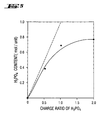
- the elemental analysis of the composite determined the content of phosphoric acid. It was found that the polysilamine/phosphoric acid (2 : 1) composite contained 0.4 mol of phosphoric acid per unit of polysilamine; the polysilamine/phosphoric (1 : 1) composite contained 0.7 mol of phosphoric acid per unit of polysilamine; and the polysilamine/phosphoric acid (1 : 2) composite contained 0.8 mol of phosphoric acid per unit of polysilamine.
- Fig. 5 the content of phosphoric acid versus the charge ratio of phosphoric acid is shown.
- membranes could not be formed by the casting membrane method.
- KBr was used as a standard sample, and a dry sample of the composite was molded into a pellet and the infrared spectrum was measured in a nitrogen atmosphere at room temperature in the range of 650 cm -1 to 3600 cm -1 with the use of SHIMADZU FT-IR 8000. Subsequently, this spectrum was compared to that of the polysilamine.
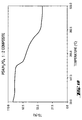
- the FT-IR spectrum of the polysilamine and that of the composite are shown in Fig. 6 and Fig. 7, respectively.
- the spectrum of the composite shows a strong peak at 900 to 1250 cm -1 attributed to phosphoric acid and accordingly, the results confirm that the composite contained phosphoric acid.
- the spectrum of the polysilamine shows an absorption due to the stretching vibration of C-N at 1457 cm -1 .
- the spectrum of the composite show that this absorption shifted to 1469 cm -1 .
- an absorption at 2800 to 3000 cm -1 appeared in the polysilamine.
- the absorption attributed to alkyl group came to a broad absorption in the composite.
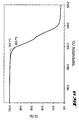
- the weight was not reduced up to around 200°C.
- the composites has heat resistance of about 200°C independent of the phosphoric acid content.
- the ion conductivity was measured with the use of an apparatus 30 as shown in Fig. 11 and Fig. 12.
- the apparatus 30 has a base 32 and a holder 34 releasably fixed to the base 32.
- the base 32 is provided with a terminal 38 and the base is made of a conductive material such as a metal.
- the holder 34 has, for example, a cylindrical shape and is provided with a cylindrical hole 35.
- the holder 34 is made of an insulating material such as a plastic and a polytetrafluoroethylene is preferably used.
- an O-ring 33 is provided at the end of the holder 34.
- a block member 36 fixed to the base 32, a sample 50 and a pair of electrodes 52 holding the sample therebetween, and a member 40 which presses the sample 50 in the direction of the base 32 can be set up.
- the member 40 has a block member 42, an elastic member 44 such as a spring fixed to the block member and a terminal 48 fixed to the elastic member.
- the electrodes 52 can closely be tightened on the block member 36 and the block member 42 to enable a more accurate measurement.
- the composite was crushed in a mortar and compressed to form a pellet. This pellet was used as the sample 50.
- This sample 50 was inserted between a pair of platinum electrodes 52 having a diameter of 13 mm. Then, the sample 50 and the platinum electrodes 52 were placed on the block member 36 and subsequently, the member 40 was placed on the sample and the platinum electrodes 52 and further, the holder 34 was fixed on the base 32.
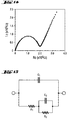
- the pellet in (6) was placed in a cell of the apparatus 30 as shown in Fig. 11 and Fig. 12 and then, the conductivity of the sample was measured with the use of a YHP 4192 ALF impedance analyzer. More specifically, the absolute value and the phase angle of the impedance of the cell were measured by the following conditions. Measurement Conditions Range of Wavenumber 5 Hz to 13 Hz Applied Potential 12mV Range of Temperature 20 to 160°C
- Fig. 16 shows the relationship between the charge ratio of phosphoric acid and the conductivity of the composite. The results show that increased charge ratios or contents of phosphoric acid increase the conductivity.
- Fig. 17 shows the temperature dependence of the conductivity of the composite is shown. Typically, increased temperatures increase the conductivity.
- Example 2 a polysilamine membrane was prepared.
- the polysilamine obtained in Reference Example was used as it is.
- This polysilamine was yellow and transparent had a little viscosity, and the molecular weight was 200.
- Epotort the one provided by Prof. Nagasaki of Science University of Tokyo that was a colorless, transparent, viscous substance was used as it is.
- the structural formula of Epotort is shown below.
- THF tetrahydrofuran
- This solution was poured into a 3 x 4 cm tray TEFLON® sheet and left to stand for one day in a thermostatic chamber maintained at 100°C to gel. Then, a membrane was formed by the casting method and dried under reduced pressure for two days to obtain a polysilamine membrane.
- the polysilamine membrane was placed on an aluminum pan and the heat resistance was evaluated by the TG-DTA (Seiko Instruments Inc., TG-DTA 2000).
- the composite of the present invention while the proton conductivity of a strong acid is maintained, it is easy to handle the composite as is the case of a solid electrolyte membrane.
Landscapes
- Chemical & Material Sciences (AREA)
- Chemical Kinetics & Catalysis (AREA)
- General Chemical & Material Sciences (AREA)
- Engineering & Computer Science (AREA)
- Manufacturing & Machinery (AREA)
- Electrochemistry (AREA)
- Sustainable Energy (AREA)
- Sustainable Development (AREA)
- Life Sciences & Earth Sciences (AREA)
- Organic Chemistry (AREA)
- Crystallography & Structural Chemistry (AREA)
- Health & Medical Sciences (AREA)
- Medicinal Chemistry (AREA)
- Polymers & Plastics (AREA)
- Composite Materials (AREA)
- Materials Engineering (AREA)
- Fuel Cell (AREA)
- Macromolecular Compounds Obtained By Forming Nitrogen-Containing Linkages In General (AREA)
- Compositions Of Macromolecular Compounds (AREA)
- Silicon Polymers (AREA)
Applications Claiming Priority (2)
| Application Number | Priority Date | Filing Date | Title |
|---|---|---|---|
| JP12240398A JP4160155B2 (ja) | 1998-05-01 | 1998-05-01 | ポリサイラミンと強酸との複合体 |
| JP12240398 | 1998-05-01 |
Publications (3)
| Publication Number | Publication Date |
|---|---|
| EP0954041A2 true EP0954041A2 (de) | 1999-11-03 |
| EP0954041A3 EP0954041A3 (de) | 2000-11-15 |
| EP0954041B1 EP0954041B1 (de) | 2004-11-24 |
Family
ID=14834941
Family Applications (1)
| Application Number | Title | Priority Date | Filing Date |
|---|---|---|---|
| EP99107866A Expired - Lifetime EP0954041B1 (de) | 1998-05-01 | 1999-04-21 | Ein Polysilamin und eine Säure enthaltender Gegenstand |
Country Status (4)
| Country | Link |
|---|---|
| US (1) | US6174615B1 (de) |
| EP (1) | EP0954041B1 (de) |
| JP (1) | JP4160155B2 (de) |
| DE (1) | DE69922081T2 (de) |
Cited By (1)
| Publication number | Priority date | Publication date | Assignee | Title |
|---|---|---|---|---|
| EP2009720A3 (de) * | 2001-01-19 | 2009-01-07 | Panasonic Corporation | Membranenelektrodenaufbauten für Brennstoffzelle |
Families Citing this family (2)
| Publication number | Priority date | Publication date | Assignee | Title |
|---|---|---|---|---|
| JP4577014B2 (ja) * | 2002-11-18 | 2010-11-10 | ソニー株式会社 | 電気化学キャパシタ |
| JP5231737B2 (ja) * | 2007-01-25 | 2013-07-10 | 学校法人中部大学 | 燃料電池固体電解質 |
Family Cites Families (11)
| Publication number | Priority date | Publication date | Assignee | Title |
|---|---|---|---|---|
| US4170700A (en) * | 1977-02-11 | 1979-10-09 | Sws Silicones Corporation | Method for accelerating surface curing of organopolysiloxane compositions |
| US4250074A (en) * | 1979-09-06 | 1981-02-10 | Ameron, Inc. | Interpenetrating polymer network comprising epoxy polymer and polysiloxane |
| US4826752A (en) * | 1986-06-25 | 1989-05-02 | Fuji Photo Film Co., Ltd. | Dry photosensitive lithographic plate comprising a silicon rubber layer containing an aromatic aminosilane |
| US5064722A (en) * | 1988-06-15 | 1991-11-12 | Hoechst Celanese Corporation | In-line aminosilane coated polyester film for glazing products |
| US5209871A (en) * | 1990-11-28 | 1993-05-11 | Ford Motor Company | Self-sealing liquid electrolyte useful in electrochromic device |
| US5225582A (en) * | 1990-12-17 | 1993-07-06 | Ford Motor Company | Epoxy curable ion-conducting electrolyte useful in electrochromic devices |
| US5138013A (en) * | 1990-12-17 | 1992-08-11 | Ford Motor Company | Epoxy curable ion-conducting electrolyte useful in electrochromic devices |
| JPH07291981A (ja) * | 1994-04-28 | 1995-11-07 | Asahi Chem Ind Co Ltd | ポリシルアミンオリゴマーおよび刺激応答性材料 |
| US5736245A (en) * | 1994-06-17 | 1998-04-07 | Lucent Technologies Inc. | Chemical treatment for silica-containing glass surfaces |
| JP3752010B2 (ja) * | 1995-07-04 | 2006-03-08 | 新日本石油株式会社 | 調光素子 |
| JP3724064B2 (ja) * | 1996-06-28 | 2005-12-07 | 住友化学株式会社 | 燃料電池用高分子電解質及び燃料電池 |
-
1998
- 1998-05-01 JP JP12240398A patent/JP4160155B2/ja not_active Expired - Fee Related
-
1999
- 1999-04-21 DE DE69922081T patent/DE69922081T2/de not_active Expired - Fee Related
- 1999-04-21 EP EP99107866A patent/EP0954041B1/de not_active Expired - Lifetime
- 1999-04-29 US US09/301,845 patent/US6174615B1/en not_active Expired - Fee Related
Cited By (2)
| Publication number | Priority date | Publication date | Assignee | Title |
|---|---|---|---|---|
| EP2009720A3 (de) * | 2001-01-19 | 2009-01-07 | Panasonic Corporation | Membranenelektrodenaufbauten für Brennstoffzelle |
| USRE41651E1 (en) | 2001-01-19 | 2010-09-07 | Panasonic Corporation | Method for manufacturing fuel cell electrolyte film-electrode bond |
Also Published As
| Publication number | Publication date |
|---|---|
| US6174615B1 (en) | 2001-01-16 |
| DE69922081D1 (de) | 2004-12-30 |
| EP0954041A3 (de) | 2000-11-15 |
| JPH11323137A (ja) | 1999-11-26 |
| JP4160155B2 (ja) | 2008-10-01 |
| EP0954041B1 (de) | 2004-11-24 |
| DE69922081T2 (de) | 2005-12-15 |
Similar Documents
| Publication | Publication Date | Title |
|---|---|---|
| Çelik et al. | Preparation and proton conductivity of acid-doped 5-aminotetrazole functional poly (glycidyl methacrylate) | |
| US20080090132A1 (en) | Proton Conducting Mediums for Electrochemical Devices and Electrochemical Devices Comprising the Same | |
| WO1996021639A1 (en) | Organic liquid electrolyte plasticizer | |
| EP1165670A1 (de) | Verfahren zur herstellung von verbrückten memranen und brennstoffzellen | |
| JP4036279B2 (ja) | プロトン伝導体及びこれを用いた燃料電池 | |
| KR100634513B1 (ko) | 프로톤 전도체 및 이를 이용한 연료전지 | |
| EP1474839B1 (de) | Polymerelektrolytmembranen zur verwendung in brennstoffzellen | |
| Michau et al. | Self-organized proton conductive layers in hybrid proton exchange membranes, exhibiting high ionic conductivity | |
| TW200838014A (en) | Arylene-fluorinated-sulfonimide ionomers and membranes for fuel cells | |
| US20120296065A1 (en) | Polyarylene ionomers membranes | |
| EP0954041B1 (de) | Ein Polysilamin und eine Säure enthaltender Gegenstand | |
| US8357817B2 (en) | Sulfone hybrid precursor, method of synthesizing same, and uses thereof | |
| WO2008091475A1 (en) | Sulfonyl grafted heterocycle materials for proton conducting electrolytes | |
| Özden et al. | Synthesis and proton conductivity studies of doped azole functional polymer electrolyte membranes | |
| US9593215B2 (en) | Polymer useful for an ion exchange membrane | |
| Jacob et al. | Proton conducting inorganic–organic matrices based on sulfonyl-and styrene derivatives functionalized polycondensates via sol–gel processing | |
| KR100634516B1 (ko) | 고체 고분자 전해질 및 이를 이용한 연료전지 | |
| US9029492B2 (en) | Superconducting electrolytic hybrid material, and preparation method and uses thereof | |
| Çelik et al. | Novel anhydrous proton conducting copolymers of 1‐vinyl‐1, 2, 4‐triazole and diisopropyl‐p‐vinylbenzyl phosphonate | |
| US20120302725A1 (en) | Polyarylene ionomers | |
| Xiang et al. | Effect of sulfonation degree on performance of proton exchange membranes for direct methanol fuel cells | |
| Çelik et al. | Novel boron-containing triazole functional copolymers as anhydrous proton conductive membranes | |
| JP5042026B2 (ja) | 高分子電解質膜としてのスルホン化ポリ(アリーレン)フィルム | |
| US20120289678A1 (en) | Method of making polyarylene ionomers and membranes | |
| WO2000077874A1 (en) | Proton conducting polymer membranes |
Legal Events
| Date | Code | Title | Description |
|---|---|---|---|
| PUAI | Public reference made under article 153(3) epc to a published international application that has entered the european phase |
Free format text: ORIGINAL CODE: 0009012 |
|
| AK | Designated contracting states |
Kind code of ref document: A2 Designated state(s): DE FR GB IT |
|
| AX | Request for extension of the european patent |
Free format text: AL;LT;LV;MK;RO;SI |
|
| RAP1 | Party data changed (applicant data changed or rights of an application transferred) |
Owner name: AXIVA GMBH |
|
| PUAL | Search report despatched |
Free format text: ORIGINAL CODE: 0009013 |
|
| AK | Designated contracting states |
Kind code of ref document: A3 Designated state(s): AT BE CH CY DE DK ES FI FR GB GR IE IT LI LU MC NL PT SE |
|
| AX | Request for extension of the european patent |
Free format text: AL;LT;LV;MK;RO;SI |
|
| RAP1 | Party data changed (applicant data changed or rights of an application transferred) |
Owner name: CELANESE VENTURES GMBH |
|
| 17P | Request for examination filed |
Effective date: 20010515 |
|
| AKX | Designation fees paid |
Free format text: DE FR GB IT |
|
| GRAP | Despatch of communication of intention to grant a patent |
Free format text: ORIGINAL CODE: EPIDOSNIGR1 |
|
| GRAS | Grant fee paid |
Free format text: ORIGINAL CODE: EPIDOSNIGR3 |
|
| RAP1 | Party data changed (applicant data changed or rights of an application transferred) |
Owner name: PEMEAS GMBH |
|
| GRAA | (expected) grant |
Free format text: ORIGINAL CODE: 0009210 |
|
| AK | Designated contracting states |
Kind code of ref document: B1 Designated state(s): DE FR GB IT |
|
| PG25 | Lapsed in a contracting state [announced via postgrant information from national office to epo] |
Ref country code: IT Free format text: LAPSE BECAUSE OF FAILURE TO SUBMIT A TRANSLATION OF THE DESCRIPTION OR TO PAY THE FEE WITHIN THE PRESCRIBED TIME-LIMIT;WARNING: LAPSES OF ITALIAN PATENTS WITH EFFECTIVE DATE BEFORE 2007 MAY HAVE OCCURRED AT ANY TIME BEFORE 2007. THE CORRECT EFFECTIVE DATE MAY BE DIFFERENT FROM THE ONE RECORDED. Effective date: 20041124 |
|
| REG | Reference to a national code |
Ref country code: GB Ref legal event code: FG4D |
|
| REF | Corresponds to: |
Ref document number: 69922081 Country of ref document: DE Date of ref document: 20041230 Kind code of ref document: P |
|
| PLBE | No opposition filed within time limit |
Free format text: ORIGINAL CODE: 0009261 |
|
| STAA | Information on the status of an ep patent application or granted ep patent |
Free format text: STATUS: NO OPPOSITION FILED WITHIN TIME LIMIT |
|
| 26N | No opposition filed |
Effective date: 20050825 |
|
| ET | Fr: translation filed | ||
| PGFP | Annual fee paid to national office [announced via postgrant information from national office to epo] |
Ref country code: DE Payment date: 20080418 Year of fee payment: 10 |
|
| PGFP | Annual fee paid to national office [announced via postgrant information from national office to epo] |
Ref country code: FR Payment date: 20080412 Year of fee payment: 10 |
|
| PGFP | Annual fee paid to national office [announced via postgrant information from national office to epo] |
Ref country code: GB Payment date: 20080421 Year of fee payment: 10 |
|
| GBPC | Gb: european patent ceased through non-payment of renewal fee |
Effective date: 20090421 |
|
| REG | Reference to a national code |
Ref country code: FR Ref legal event code: ST Effective date: 20091231 |
|
| PG25 | Lapsed in a contracting state [announced via postgrant information from national office to epo] |
Ref country code: DE Free format text: LAPSE BECAUSE OF NON-PAYMENT OF DUE FEES Effective date: 20091103 |
|
| PG25 | Lapsed in a contracting state [announced via postgrant information from national office to epo] |
Ref country code: GB Free format text: LAPSE BECAUSE OF NON-PAYMENT OF DUE FEES Effective date: 20090421 Ref country code: FR Free format text: LAPSE BECAUSE OF NON-PAYMENT OF DUE FEES Effective date: 20091222 |