EP0952124A2 - Method for producing sheets of solid surface and sheets produced thereby - Google Patents
Method for producing sheets of solid surface and sheets produced thereby Download PDFInfo
- Publication number
- EP0952124A2 EP0952124A2 EP99103893A EP99103893A EP0952124A2 EP 0952124 A2 EP0952124 A2 EP 0952124A2 EP 99103893 A EP99103893 A EP 99103893A EP 99103893 A EP99103893 A EP 99103893A EP 0952124 A2 EP0952124 A2 EP 0952124A2
- Authority
- EP
- European Patent Office
- Prior art keywords
- sheets
- surfacing
- slab
- blade
- polymeric
- Prior art date
- Legal status (The legal status is an assumption and is not a legal conclusion. Google has not performed a legal analysis and makes no representation as to the accuracy of the status listed.)
- Withdrawn
Links
- 239000007787 solid Substances 0.000 title claims abstract description 34
- 238000004519 manufacturing process Methods 0.000 title claims abstract description 17
- 239000002245 particle Substances 0.000 claims abstract description 36
- 238000000034 method Methods 0.000 claims abstract description 23
- 239000011159 matrix material Substances 0.000 claims abstract description 22
- 238000005520 cutting process Methods 0.000 claims description 20
- 229920005989 resin Polymers 0.000 claims description 20
- 239000011347 resin Substances 0.000 claims description 20
- 239000000203 mixture Substances 0.000 claims description 13
- 239000002318 adhesion promoter Substances 0.000 claims description 6
- 239000006188 syrup Substances 0.000 claims description 4
- 235000020357 syrup Nutrition 0.000 claims description 4
- 239000011248 coating agent Substances 0.000 claims description 3
- 238000000576 coating method Methods 0.000 claims description 3
- 239000002952 polymeric resin Substances 0.000 claims 1
- 229920003002 synthetic resin Polymers 0.000 claims 1
- 239000000463 material Substances 0.000 description 22
- 239000002969 artificial stone Substances 0.000 description 10
- 239000002826 coolant Substances 0.000 description 9
- 239000004575 stone Substances 0.000 description 7
- 238000005266 casting Methods 0.000 description 5
- 239000004593 Epoxy Substances 0.000 description 4
- 239000004793 Polystyrene Substances 0.000 description 4
- 229910000831 Steel Inorganic materials 0.000 description 4
- 239000010438 granite Substances 0.000 description 4
- 239000004579 marble Substances 0.000 description 4
- 239000008188 pellet Substances 0.000 description 4
- 229920002223 polystyrene Polymers 0.000 description 4
- 239000010959 steel Substances 0.000 description 4
- 229920001187 thermosetting polymer Polymers 0.000 description 4
- -1 AMINO Chemical class 0.000 description 3
- 229920000178 Acrylic resin Polymers 0.000 description 3
- 239000004925 Acrylic resin Substances 0.000 description 3
- 238000013459 approach Methods 0.000 description 3
- 230000008901 benefit Effects 0.000 description 3
- 230000009977 dual effect Effects 0.000 description 3
- 239000000499 gel Substances 0.000 description 3
- 229920005992 thermoplastic resin Polymers 0.000 description 3
- 239000004956 Amodel Substances 0.000 description 2
- 241001517013 Calidris pugnax Species 0.000 description 2
- PWKSKIMOESPYIA-BYPYZUCNSA-N L-N-acetyl-Cysteine Chemical compound CC(=O)N[C@@H](CS)C(O)=O PWKSKIMOESPYIA-BYPYZUCNSA-N 0.000 description 2
- 229920000877 Melamine resin Polymers 0.000 description 2
- 239000004952 Polyamide Substances 0.000 description 2
- BLRPTPMANUNPDV-UHFFFAOYSA-N Silane Chemical compound [SiH4] BLRPTPMANUNPDV-UHFFFAOYSA-N 0.000 description 2
- 229920006397 acrylic thermoplastic Polymers 0.000 description 2
- 150000004645 aluminates Chemical class 0.000 description 2
- 230000003466 anti-cipated effect Effects 0.000 description 2
- QHIWVLPBUQWDMQ-UHFFFAOYSA-N butyl prop-2-enoate;methyl 2-methylprop-2-enoate;prop-2-enoic acid Chemical compound OC(=O)C=C.COC(=O)C(C)=C.CCCCOC(=O)C=C QHIWVLPBUQWDMQ-UHFFFAOYSA-N 0.000 description 2
- 239000004568 cement Substances 0.000 description 2
- 230000008878 coupling Effects 0.000 description 2
- 238000010168 coupling process Methods 0.000 description 2
- 238000005859 coupling reaction Methods 0.000 description 2
- 230000000694 effects Effects 0.000 description 2
- 125000003700 epoxy group Chemical group 0.000 description 2
- 239000000945 filler Substances 0.000 description 2
- IVJISJACKSSFGE-UHFFFAOYSA-N formaldehyde;1,3,5-triazine-2,4,6-triamine Chemical compound O=C.NC1=NC(N)=NC(N)=N1 IVJISJACKSSFGE-UHFFFAOYSA-N 0.000 description 2
- SLGWESQGEUXWJQ-UHFFFAOYSA-N formaldehyde;phenol Chemical compound O=C.OC1=CC=CC=C1 SLGWESQGEUXWJQ-UHFFFAOYSA-N 0.000 description 2
- 230000001788 irregular Effects 0.000 description 2
- 230000007246 mechanism Effects 0.000 description 2
- 238000012986 modification Methods 0.000 description 2
- 230000004048 modification Effects 0.000 description 2
- 125000002524 organometallic group Chemical group 0.000 description 2
- 229920001568 phenolic resin Polymers 0.000 description 2
- 239000000049 pigment Substances 0.000 description 2
- 229920003229 poly(methyl methacrylate) Polymers 0.000 description 2
- 229920002647 polyamide Polymers 0.000 description 2
- 229920000515 polycarbonate Polymers 0.000 description 2
- 239000004417 polycarbonate Substances 0.000 description 2
- 229920000647 polyepoxide Polymers 0.000 description 2
- 229920000728 polyester Polymers 0.000 description 2
- 229920000098 polyolefin Polymers 0.000 description 2
- 229920002689 polyvinyl acetate Polymers 0.000 description 2
- 230000008569 process Effects 0.000 description 2
- 230000009467 reduction Effects 0.000 description 2
- 229910000077 silane Inorganic materials 0.000 description 2
- 230000000087 stabilizing effect Effects 0.000 description 2
- 230000001360 synchronised effect Effects 0.000 description 2
- ISXSCDLOGDJUNJ-UHFFFAOYSA-N tert-butyl prop-2-enoate Chemical compound CC(C)(C)OC(=O)C=C ISXSCDLOGDJUNJ-UHFFFAOYSA-N 0.000 description 2
- XQMTUIZTZJXUFM-UHFFFAOYSA-N tetraethoxy silicate Chemical compound CCOO[Si](OOCC)(OOCC)OOCC XQMTUIZTZJXUFM-UHFFFAOYSA-N 0.000 description 2
- 229920001169 thermoplastic Polymers 0.000 description 2
- 239000004634 thermosetting polymer Substances 0.000 description 2
- 239000004416 thermosoftening plastic Substances 0.000 description 2
- 229920006305 unsaturated polyester Polymers 0.000 description 2
- 229920001567 vinyl ester resin Polymers 0.000 description 2
- 125000000391 vinyl group Chemical group [H]C([*])=C([H])[H] 0.000 description 2
- 239000002699 waste material Substances 0.000 description 2
- 239000010456 wollastonite Substances 0.000 description 2
- 229910052882 wollastonite Inorganic materials 0.000 description 2
- WYTZZXDRDKSJID-UHFFFAOYSA-N (3-aminopropyl)triethoxysilane Chemical group CCO[Si](OCC)(OCC)CCCN WYTZZXDRDKSJID-UHFFFAOYSA-N 0.000 description 1
- 229910001369 Brass Inorganic materials 0.000 description 1
- 239000004698 Polyethylene Substances 0.000 description 1
- 239000004954 Polyphthalamide Substances 0.000 description 1
- 239000004699 Ultra-high molecular weight polyethylene Substances 0.000 description 1
- 239000006096 absorbing agent Substances 0.000 description 1
- 230000005540 biological transmission Effects 0.000 description 1
- 239000010951 brass Substances 0.000 description 1
- 239000000919 ceramic Substances 0.000 description 1
- 150000001875 compounds Chemical class 0.000 description 1
- 238000009749 continuous casting Methods 0.000 description 1
- 238000001816 cooling Methods 0.000 description 1
- 239000007822 coupling agent Substances 0.000 description 1
- 238000005336 cracking Methods 0.000 description 1
- 230000003247 decreasing effect Effects 0.000 description 1
- 230000007547 defect Effects 0.000 description 1
- 239000006185 dispersion Substances 0.000 description 1
- 238000009826 distribution Methods 0.000 description 1
- 239000000428 dust Substances 0.000 description 1
- 229920003247 engineering thermoplastic Polymers 0.000 description 1
- 239000012530 fluid Substances 0.000 description 1
- 239000011521 glass Substances 0.000 description 1
- 229910010272 inorganic material Inorganic materials 0.000 description 1
- 239000011147 inorganic material Substances 0.000 description 1
- 229910052500 inorganic mineral Inorganic materials 0.000 description 1
- JEIPFZHSYJVQDO-UHFFFAOYSA-N iron(III) oxide Inorganic materials O=[Fe]O[Fe]=O JEIPFZHSYJVQDO-UHFFFAOYSA-N 0.000 description 1
- 239000000314 lubricant Substances 0.000 description 1
- 239000011707 mineral Substances 0.000 description 1
- 239000012764 mineral filler Substances 0.000 description 1
- 150000004767 nitrides Chemical class 0.000 description 1
- 239000011368 organic material Substances 0.000 description 1
- 229920000573 polyethylene Polymers 0.000 description 1
- 229920000642 polymer Polymers 0.000 description 1
- 229920006375 polyphtalamide Polymers 0.000 description 1
- 230000002265 prevention Effects 0.000 description 1
- 239000010453 quartz Substances 0.000 description 1
- 238000004064 recycling Methods 0.000 description 1
- 150000004756 silanes Chemical class 0.000 description 1
- VYPSYNLAJGMNEJ-UHFFFAOYSA-N silicon dioxide Inorganic materials O=[Si]=O VYPSYNLAJGMNEJ-UHFFFAOYSA-N 0.000 description 1
- 239000007779 soft material Substances 0.000 description 1
- 239000008279 sol Substances 0.000 description 1
- 239000000126 substance Substances 0.000 description 1
- 230000003746 surface roughness Effects 0.000 description 1
- 229920000785 ultra high molecular weight polyethylene Polymers 0.000 description 1
- XLYOFNOQVPJJNP-UHFFFAOYSA-N water Substances O XLYOFNOQVPJJNP-UHFFFAOYSA-N 0.000 description 1
Images



Classifications
-
- B—PERFORMING OPERATIONS; TRANSPORTING
- B44—DECORATIVE ARTS
- B44F—SPECIAL DESIGNS OR PICTURES
- B44F9/00—Designs imitating natural patterns
- B44F9/04—Designs imitating natural patterns of stone surfaces, e.g. marble
-
- C—CHEMISTRY; METALLURGY
- C08—ORGANIC MACROMOLECULAR COMPOUNDS; THEIR PREPARATION OR CHEMICAL WORKING-UP; COMPOSITIONS BASED THEREON
- C08J—WORKING-UP; GENERAL PROCESSES OF COMPOUNDING; AFTER-TREATMENT NOT COVERED BY SUBCLASSES C08B, C08C, C08F, C08G or C08H
- C08J5/00—Manufacture of articles or shaped materials containing macromolecular substances
- C08J5/18—Manufacture of films or sheets
-
- B—PERFORMING OPERATIONS; TRANSPORTING
- B29—WORKING OF PLASTICS; WORKING OF SUBSTANCES IN A PLASTIC STATE IN GENERAL
- B29C—SHAPING OR JOINING OF PLASTICS; SHAPING OF MATERIAL IN A PLASTIC STATE, NOT OTHERWISE PROVIDED FOR; AFTER-TREATMENT OF THE SHAPED PRODUCTS, e.g. REPAIRING
- B29C70/00—Shaping composites, i.e. plastics material comprising reinforcements, fillers or preformed parts, e.g. inserts
- B29C70/58—Shaping composites, i.e. plastics material comprising reinforcements, fillers or preformed parts, e.g. inserts comprising fillers only, e.g. particles, powder, beads, flakes, spheres
- B29C70/64—Shaping composites, i.e. plastics material comprising reinforcements, fillers or preformed parts, e.g. inserts comprising fillers only, e.g. particles, powder, beads, flakes, spheres the filler influencing the surface characteristics of the material, e.g. by concentrating near the surface or by incorporating in the surface by force
-
- B—PERFORMING OPERATIONS; TRANSPORTING
- B44—DECORATIVE ARTS
- B44C—PRODUCING DECORATIVE EFFECTS; MOSAICS; TARSIA WORK; PAPERHANGING
- B44C5/00—Processes for producing special ornamental bodies
- B44C5/04—Ornamental plaques, e.g. decorative panels, decorative veneers
Definitions
- the present invention relates to sheets of polymeric surfacing and a method for producing such sheets. More particularly, the invention relates to processes for slicing slabs into sheets. The present invention also relates to the sheets produced thereby and their finished appearance, particularly sheets meant to simulate, for example, stone such as marble or granite.
- Solid polymeric surfacing has a variety of uses, including household, commercial, and industrial uses in which durable, sometimes renewable, decorative surfaces are desired. Such surfaces include, but are not limited to, kitchen and other countertops, table tops, bathroom vanities, divider panels, and wall surfacing. These surfacing products may be produced so as to simulate stone such as marble or granite.
- U.S. Pats. No. 4,433, 070, ad 4,446,177 disclose compositions for such products.
- U.S. Pat. No. 5,244,941 discloses a composition that is particularly useful as artificial stone surfacing, due to the inclusion of chips of a previously cured thermosetting resinous compound in the composition; also disclosed therein is the process for producing the surfacing. These products are typically produced in solid slabs about 1 ⁇ 2 inch in thickness. The result is surfacing of high quality, but relatively high cost.
- Lamellar, or disk-shaped, particles may be used, but with unacceptable results. Such particle shapes could have a maximum dimension that is greater than the sheet thickness and still fit within the sheet. However, the resin matrix typically is somewhat transparent, and the resultant effect from using lamellar shaped particles would not resemble the desirable "chunky" stone appearance. Instead the result would be oval and oblong particles that may partially disappear into the thickness of the sheet. Also, they may have a tendency to align during the sheet casting process, resulting in a less than random distribution of particles within the sheet.
- the only method of producing surfacing with a "chunky" look to date is by sanding or grinding relatively thick surfacing down in thickness to expose the interior (and thereby, a larger degree of flattened exposed surface area) of the particulate. This is necessary to produce a sheet with a surface look that is truly representative of the random nature of the particulate as dispersed in the resin matrix. As cast, the surface look of the slabs is not representative. Only the outer edges of the particulate approach the surface of the slab, and even then in only a tangential fashion. The random particulate pattern is not exposed until the sheet surface is sanded down.
- a method for producing sheets of polymeric surfacing characterized by:
- the final thickness of the sheets may vary to a minimum of about 1/8 inch.
- the disclosed method may include the steps of providing a resin matrix syrup, providing relatively solid polymeric particles, coating the particles with an adhesion promoter, combining the particles and the syrup into a mixture, forming the mixture into a solidified slab, and cutting the slab into sheets of surfacing.
- the particles may have a maximum linear dimension that is greater than the final thickness of the sheets.
- the apparatus includes a continuous blade band saw having a slicing blade with a cutting edge, and at least two blade guides to stabilize the position of the blade relative to the workpiece.
- the blade is under a tension of from about 7500 pounds per square inch (psi) to about 35000 psi.
- the blade has a width of from about 2 inches to about 4 inches, the cutting edge has from about 2 to about 4 teeth per inch, and the blade has a kerf of from about .050 inches to about .075 inches.
- the blade preferably travels at a linear speed of from about 5000 feet per minute to about 10000 feet per minute.
- a workpiece support member for supporting the workpiece during slicing
- a fluid supply for cooling the blade and workpiece during slicing
- a workpiece stabilizing member located between the support member and the blade.
- the workpiece-stabilizing member may be at least one set of pinch rollers, which preferably apply a pressure on the workpiece of from about 50 psi to about 100 psi, and more preferably from about 70 psi to about 90 psi.
- the workpiece has a longitudinal axis oriented perpendicular to a direction of blade travel during slicing.
- Workpiece guides maintain the longitudinal axis of the workpiece in a substantially perpendicular orientation to the direction of blade travel during slicing.
- the blade rides on a drive wheel and at least one idler wheel, which support and drive the blade.
- Each of these wheels preferably has a diameter of from about 24 inches to about 48 inches.
- a finished sheet after slicing has a maximum standard deviation in thickness of about .002 inches.
- the present method particularly allows the manufacture of solid surfacing veneer with a "chunky" appearance provided by the particulate in the surfacing.
- the "chunks" of particulate in the surface of the sheets have a maximum size or linear dimension that is greater than the thickness of the sheet.
- a portion of a sheet of veneer "V" of the present invention is shown having particles A and B encased in resin matrix C. Maximum linear dimensions of particles A and B are A1 and B1 respectively, both dimensions being greater than sheet thickness "T".
- Thickness "T” is typically on the order of about 1/8 inches. In the prior all, this "chunky" look has only been achieved in sheets greater than 1 ⁇ 4 inch in thickness, and only through sanding or grinding a relatively substantial amount of material from the sheet surface, resulting in increased production time and cost, and increased wasted material.
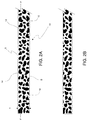
- FIG. 2A shows a slab of solid surfacing veneer 10 in the "as cast” form.
- Prior art slabs of this type are usually made using a two-belt casting system as described, for example, in U.S. Pats. No. 3,371,383 and 3,376,371. Shown are resin matrix 12 and particulate 14. Note that the maximum diameter of each piece of particulate 14 may not be greater than sheet thickness "T", or bulges would result in sheet 10 where particulate 14 extended out past surface "S" of slab 10; such bulges would interfere with the casting process and result in unacceptable product.
- Line F-F denotes the depth to which surface "S" is sanded to help expose a portion of the particulate thereby bringing out the artificial stone appearance. Note in Figure 2B that only a small amount of the particulate interior may be exposed by this prior art method. The result is an artificial stone appearance, but with a relatively small granular pattern.
- Figure 3A shows a piece of the relatively thick prior art slab of solid surfacing which may contain larger sized particles because of the greater slab thickness.
- the thickness of such a slab is typically on the order of about 1 ⁇ 2 inches.
- the surface of the slab must be ground down to the level at line F-F. The result is still a relatively thick and expensive product.
- the result is also a chunky appearance, as demonstrated by Figure 3B, but at the expense of increased manufacturing time and cost, and substantial wasted material.
- Figure 4A shows a slab of artificial stone of the present invention.
- Particulate may be of a diameter as great as the slab thickness.
- Figure 4B By slicing the slab through its thickness, multiple sheets of solid surface veneer are produced, as shown in Figure 4B. Note that because the particulate is sliced through its interior, the result is a "chunky" appearance without the need for the excessive surface grinding necessary in the prior art method to produce a similar appearance.
- a slab of about 1 ⁇ 2 inch in thickness may be sliced into 3 sheets of veneer each about 1/8 inch in thickness, accounting for material lost in the slicing operation. The material lost in the slicing operation is still a great reduction in waste over the prior art method of producing the "chunky" appearance.
- FIGS. 5A and 5B show an alternative of the present invention in which the size of a majority of the particulate used in the slab approaches the thickness of the slab. The result is a sheet of veneer with a "super-chunky" appearance.
- the present method may be used to overcome the problems described above in cutting sheets of various thicknesses from about 1/8 inches up to about 1/2 inches, or more if the specific application for thicker sheets warrants such.
- a 2 inch thick slab of solid polymeric surfacing may be sliced into three sheets of about, or a little less than, 1 ⁇ 2 inches in thickness, and three sheets of about, or a little less than, 1/8 inches in thickness, accounting for material lost during slicing.
- the present method achieves a chunky surface appearance without excessive surface grinding and wasted material.
- the particles that are added to the resin matrix to achieve the "chunky" artificial stone appearance may be composed of many different material types.
- particles may be made of thermoplastic resins such as acrylic resins, acrylic blends with polycarbonate or polystyrene, polyesters, polyamides, and polyolefins.
- Particles may also be made of thermoset resins such as unsaturated polyesters and blends with acrylics or polyvinylacetates or polystyrenes, melamine formaldehyde, phenol formaldehyde, epoxies, and vinyl esters.
- Particles may additionally be of organometallic resins such as the thermoplastics and thermosets listed above along with sol gel resins based on tetraethoxyortho silicate or triethoxy aluminate or tehtralkoxy titanates.
- particles may be composed of minerals like granite, marble, or quartz, or may be man made glass, ceramics, sol gels, or cement.
- the resin matrix may also be composed of many different material types.
- the resin matrix may be made of thermoplastic resins such as acrylic resins, acrylic blends with polycarbonate or polystyrene, polyesters, polyamides, and polyolefins.
- the matrix may also be made of thermoset resins such as unsaturated polyesters and blends with acrylics or polyvinylacetates or polystyrenes, melamine formaldehyde, phenol formaldehyde, epoxies, and vinyl esters.
- the matrix may additionally be of organometallic resins such as the thermoplastics and thermosets listed above along with sol gel resins based on tetraethoxyortho silicate or triethoxy aluminate or tetralkoxy titanates.
- the matrix may be composed of inorganics (e.g, cements).
- AMODEL 1460 is an engineering thermoplastic and is supplied in pellet form.
- the composition of the pellet is about 40% polyphthalamide resin and 60% wollastonite, a mineral filler known in the art. Pigments may be added to vary the color of the pellets. The weight percentage of wollastonite may be reduced to compensate for the addition of pigments.
- the pellets may be pulverized and sized according to the desired aesthetic effect in the final sheets of surfacing.
- the particles may be treated or coated with an adhesion promoter or coupling agent prior to being mixed with the resin matrix.
- the purpose of such coating is to promote adhesion between the surface of the particles and the resin matrix; in other words, the purpose is to form a bond between the particles and the matrix. This bond prevents gaps, inclusions, and the like from occurring between the particles and the resin matrix, which could initiate cracks, etc.
- Such treating is particularly important in the case of the present invention because inclusions in a slab of solid surfacing may result in stress cracking, crazing, and like defects after cutting through the slab, which will be disclosed in more detail below.
- adhesion promoters are the organofunctional silane products manufactured and sold by OSI of Tarrytown, NY (e.g, AMINO A-1100, METHACRYL A-172, and EPOXY A-187). These are dual-function molecules that contain an organofunctional group and a hydrolyzable group; they can react with a wide variety of organic and inorganic materials. They may be used as a filler treatment for improved filler-to-resin coupling and filler dispersion in thermoset and thermoplastic resins.
- the organofunctional silane sold by OSI under the trade name "AMINO A-1100", whose chemical name is gamma-aminopropyltriethoxysilane, is one adhesion promoter that is generally effective when coupling particles into an acrylic resin matrix.
- Dow Corning produces silanes, e.g, Z-6020 diamino and Z-6040 epoxy.
- the particles are coated with the adhesion promoter in a twin-shell blender of the type sold by Patterson-Kelly Co. of East Stroudsburg, PA.
- Figures 6 - 10 An embodiment of the solid surfacing slicing saw of the present invention is shown in Figures 6 - 10.
- Figure 6 shows an elevational view of the front of saw 20, or the area of saw 20 that the polymeric slabs or workpieces would be fed into.
- the slabs would be fed into saw 20 lying flat, or horizontally, on a conveyor belt, but it is also anticipated that slabs could be fed into saw 20 in a vertical orientation if saw 20 were configured to accommodate such vertical orientation.
- Blade 22 rides on and is driven by drive wheel 24 and idler wheel 26.
- Blade 22 is preferably from about 2 inches to about 4 inches in width, and has a cutting edge with preferably from about 2 to about 4 teeth per inch.
- the blade is typically made of steel and the teeth are preferably carbide tipped.
- the preferred range of blade kerf i.e., the thickness of the cut made by blade 22
- blade 22 travels at a preferred linear speed of from about 5000 feet per minute to about 10000 feet per minute, while under a tension of from about 7500 pounds per square inch (psi) to about 35000 psi. More preferred ranges of speed and tension are from about 8000 feet per minute to about 9000 feet per minute, and from about 10000 psi to about 25000 psi respectively.
- Drive wheel 24 and idler wheel 25 carry blade 22.
- Drive wheel 24 is driven by drive motor 26, typically through a drive belt (see drive belt enclosure 27 in Figure 9).
- Drive motor 26 is typically a 25 horsepower, 240/480 volt, 3 phase, AC/DC variable drive motor, to accommodate the pressure exerted on blade 22 during slicing.
- Wheels 24 and 25 are preferably from about 24 inches to about 48 inches in diameter, with the most preferred diameter being about 36 inches. Wheels 24 and 25 each ride on a 3 15/16 inch shaft using spherical roller bearings (e.g, Browning SFC1000E by Browning Manufacturing, Emerson Power Transmission Corp., Maysville, Kentucky).
- the horizontal position of idler wheel 26 is adjustable through blade tensioner 28, which provides for increasing or decreasing the tension on blade 22.
- Blade tensioner 28 is hydraulically controlled, but may also be mechanical, pneumatic, or the like.
- Upper primary pinch roller 30 and lower primary pinch roller 32 apply pressure to the polymeric slab and operate to drive the slab through blade 22.
- a second set of pinch rollers 31 and 33 (see Figures 9-10) is included between pinch rollers 30 and 32 and blade 22. The two sets of pinch rollers operate to stabilize the slab and to keep the plane of the slab substantially parallel to the plane of blade 22 during slicing.
- Upper pinch rollers 30 and 31 are typically about 6 inches in diameter, made of steel, and covered with ruff grip top belting material to firmly grasp the workpiece.
- Lower rollers 32 and 33 are typically about 6 inches in diameter, made of steel, precision ground (because their dimensions determine the thickness variation in the final sheets - see below), and nitride coated for wear resistance and rust prevention.
- Rollers 30, 31, 32, and 33 are hydraulically driven, but may be driven by mechanical, or other means known in the art.
- Pinch roller pressure applicator 34 operates to put upper pinch rollers 30 and 31 into pressurized contact with the slab to force the slab against lower pinch rollers 32 and 33, thereby keeping the slab stable as it passes through blade 22.
- the preferred range of pressure applied to the slab by pinch rollers 30, 31, 32, and 33 is from about 50 psi to about 100 psi, with a more preferred range being from about 70 psi to about 90 psi.
- the thickness of the slices produced by saw 20 are determined by the vertical distance between blade 22 and lower pinch rollers 32 and 33 in the cutting area of saw 20.
- the vertical position of blade 22 is fixed and the vertical position of lower pinch rollers 32 and 33 is adjustable; for best control over variation in thickness, finished sheets would therefore come off the bottom of the slab.
- the maximum standard deviation in thickness of finished sheets has been found to be about .002 inches.
- This level of precision cutting has never before been achieved with prior art band saws, and particularly in view of use with solid polymeric materials being sliced into relatively thin sheets over typical distances of about 36 inches to about 48 inches.
- the vertical position of lower rollers 32 and 33 is currently controlled by a mechanical adjustment, but such adjustment could be electronic, hydraulic, pneumatic, or the like.
- Pneumatic switch 44 and pneumatic controls 46 operate pinch roller pressure applicator 34, thereby raising and lowering pressure applicator 34 and controlling the amount of pressure that applicator 34 exerts on a slab during the slicing operation.
- Accumulator 48 operates to keep the tension on blade 22 constant during operation, by acting like a shock-absorber; if the blade is stressed during operation, accumulator 48 acts to automatically counter the stress and prevent breakage of blade 22.
- Hydraulic controls 50 operate blade tensioner 28, and the drive mechanism that turns pinch rollers 30 and 32.
- Dust collector 36 collects cutting debris, i.e. polymer chips, generated during the slicing operation.
- a coolant is used to cool, lubricate, and wash cutting debris from the slab and blade 22.
- coolant nozzles 52 bathe the slicing area of saw 20 with coolant before and after each blade guide 42.
- the coolant may be water or a low viscosity lubricant.
- the coolant then drains out coolant drain 38 into coolant pan 40, or more preferably through a recycling mechanism that filters the coolant and pumps it back onto the slab and blade 22.
- Blade guides 42 maintain the vertical position and stability of blade 22 during operation of saw 20. Blade guides 42 provide fixed position horizontal slits through which blade 22 travels during its cycle.
- Blade guides 42 may be made of ultra-high molecular weight polyethylene, brass which does not wear as fast as the polyethylene, or any similar relatively soft material.
- Blade rollers 54 positioned as shown in Figures 7 and 8, maintain the horizontal position and stability of blade 22 during operation of saw 20; they are typically made of steel and provide back support to blade 22 as the workpiece is being pushed into and through blade 22, thereby preventing horizontal deflection of blade 22.
- Figures 9 and 10 show feed conveyor 56, which supports and feeds a workpiece into saw 20, and back conveyor 58 which supports and takes up a finished workpiece after slicing (NJR Industries, Mobile, Alabama). These conveyors are made with ruff grip top belt material to prevent slippage during operation. Conveyor drives 60 operate movement and speed of conveyors 56 ad 58, and must be synchronized with the speed of pinch rollers 30, 31, 32, and 33 so that a workpiece may be fed through saw 20 at a steady, uniform rate. The edge of a slab or workpiece is lined up against workpiece guide rollers 62 on top of feed conveyor 56 to insure that the longitudinal axis of the workpiece remains substantially perpendicular to the direction of travel of blade 22 during the slicing operation.
- Figure 10 shows the position of a slab of polymeric material during the slicing operation.
- the height of the top surfaces of conveyors 56 and 58 are adjusted so as to align with the tops of lower rollers 32 and 33.
- This vertical position is set at some point below cutting level 64 on blade 22; level 64 corresponds to the lower vertical level of the cutting portion of blade 22.
- a typical distance between level 64 and the top level of alignment of rollers 32 and 33 and the top surfaces of conveyors 56 and 58 is about 1/8 inches.
- the speed of conveyors 56 and 58 and rollers 30, 31, 32, and 33 is then synchronized to provide for uniform stable feed of the slab or workpiece through saw 20.
- the slab is then laid flat on the top surface of conveyor 56, and the edge of the slab is positioned up against workpiece guide rollers 62. Rollers 62 are positioned along one edge of conveyor 56 so that the longitudinal axis of the slab may be positioned substantially perpendicular to the direction of travel of blade 22 as the slab is fed into saw 20.
- the slab is then fed forward into pinch rollers 30, 31, 32, and 33, which through pressurized contact hold the slab very stable and substantially parallel to blade 22 as the slab is fed into and passed through blade 22.
- coolant from nozzles 52 is sprayed onto the cutting area to cool, clean, and lubricate blade 22 and the workpiece.
- Blade guides 42 stabilize the vertical position and blade rollers 54 stabilize the horizontal position of blade 22 as it passes through the workpiece.
- the sliced slab then passes through the back of saw 20 onto back conveyor 58 which transfers the sliced slab away from saw 20.
- the main body of the previously sliced slab may then be run through saw 20 over again to produce another finished sheet, until the slab has been exhausted.
Landscapes
- Chemical & Material Sciences (AREA)
- Engineering & Computer Science (AREA)
- Manufacturing & Machinery (AREA)
- Organic Chemistry (AREA)
- Health & Medical Sciences (AREA)
- Chemical Kinetics & Catalysis (AREA)
- Medicinal Chemistry (AREA)
- Polymers & Plastics (AREA)
- Materials Engineering (AREA)
- Composite Materials (AREA)
- Mechanical Engineering (AREA)
- Processing Of Stones Or Stones Resemblance Materials (AREA)
- Laminated Bodies (AREA)
- Processing And Handling Of Plastics And Other Materials For Molding In General (AREA)
- Moulding By Coating Moulds (AREA)
- Casting Or Compression Moulding Of Plastics Or The Like (AREA)
Abstract
Description
Claims (8)
- A method for producing sheets of polymeric surfacing, characterized by:(a) providing a solid polymeric slab; and(b) cutting the slab into sheets of surfacing.
- A method for producing sheets of polymeric surfacing according to claim 1, further characterized by:(a) providing a resin matrix syrup;(b) providing relatively solid polymeric particles;(c) coating the particles with an adhesion promoter;(d) combining the particles and the syrup into a mixture;(e) forming the mixture into a solidified slab; and(f) cutting the slab into sheets of surfacing.
- A method according to claim 1 or claim 2, further characterized by cutting the sheets of surfacing to a thickness of less than 5/8 inch.
- A method according to claim 3, wherein the sheets of surfacing are cut to a thickness of between 1/8 inch and 1/2 inch.
- The method according to claim 3, wherein the sheets of surfacing are cut to a thickness of 1/8 inch.
- A sheet of polymeric surfacing produced by the method of any preceding claim.
- A sheet of polymeric surfacing according to claims 6, comprising a solid polymeric resin matrix; and a plurality of solid polymeric particles dispersed throughout the matrix; the particles having a maximum linear dimension that is greater than the thickness of the sheet.
- A sheet of polymeric surfacing according to claim 6 or claim 7, wherein the maximum linear dimension of most of the particles is substantially parallel to a planar surface of the sheet.
Applications Claiming Priority (2)
| Application Number | Priority Date | Filing Date | Title |
|---|---|---|---|
| US6581898A | 1998-04-23 | 1998-04-23 | |
| US65818 | 1998-04-23 |
Publications (2)
| Publication Number | Publication Date |
|---|---|
| EP0952124A2 true EP0952124A2 (en) | 1999-10-27 |
| EP0952124A3 EP0952124A3 (en) | 2001-03-07 |
Family
ID=22065312
Family Applications (1)
| Application Number | Title | Priority Date | Filing Date |
|---|---|---|---|
| EP99103893A Withdrawn EP0952124A3 (en) | 1998-04-23 | 1999-03-01 | Method for producing sheets of solid surface and sheets produced thereby |
Country Status (12)
| Country | Link |
|---|---|
| EP (1) | EP0952124A3 (en) |
| JP (1) | JPH11347989A (en) |
| KR (1) | KR19990083453A (en) |
| CN (1) | CN1236696A (en) |
| AU (1) | AU725887B2 (en) |
| BR (1) | BR9901377A (en) |
| CA (1) | CA2265031A1 (en) |
| ID (1) | ID23277A (en) |
| IL (1) | IL128696A0 (en) |
| NZ (1) | NZ334393A (en) |
| PL (1) | PL332662A1 (en) |
| ZA (1) | ZA992519B (en) |
Cited By (5)
| Publication number | Priority date | Publication date | Assignee | Title |
|---|---|---|---|---|
| FR2831092A1 (en) * | 2001-10-24 | 2003-04-25 | Boulenger Ets | Manufacture of polymer granules for e.g., producing surface coating, involves adding a shading colorant to mixture of base polymer and additives, and carrying out incomplete homogenization of shading colorant in the mixture |
| EP1306231A1 (en) * | 2001-10-24 | 2003-05-02 | Etablissements Boulenger | Polymeric article having a shaded appearance of anisotropic coloration made of divided elements and process for producing the same |
| US6787588B2 (en) | 2001-10-24 | 2004-09-07 | Etablissements Boulenger | Article made of polymer having a shaded appearance of anisotropic coloring constituted by individualized elements, the manufacturing thereof and the application thereof as a surface coating |
| WO2007031039A3 (en) * | 2005-09-14 | 2007-06-28 | Ivan Fucik | Synthetic stone of high translucence, method of its production and use |
| EP2165817A1 (en) | 2008-09-17 | 2010-03-24 | Schock GmbH | Moulded part, such as a kitchen sink, a washbasin or similar, and method for producing such a moulded part |
Families Citing this family (1)
| Publication number | Priority date | Publication date | Assignee | Title |
|---|---|---|---|---|
| CN1301199C (en) * | 2003-12-31 | 2007-02-21 | 杨德宁 | Coloured resin three dimensional pattern artificial stone slab material |
Family Cites Families (4)
| Publication number | Priority date | Publication date | Assignee | Title |
|---|---|---|---|---|
| EP0417164B1 (en) * | 1988-05-27 | 1994-01-12 | SCHULTZE-KRAFT, Andreas | Process for producing artificial stones, and their use |
| US5244941A (en) * | 1989-11-02 | 1993-09-14 | Ralph Wilson Plastics Company | Artificial stone compositions, process of producing the same, and apparatus employed in the production thereof |
| ATE141200T1 (en) * | 1991-05-23 | 1996-08-15 | Cca Inc | METHOD FOR PRODUCING A PATTERNED MOLDED BODY |
| US5166230A (en) * | 1991-09-16 | 1992-11-24 | Stecker William M | Method for producing a synthetic shaped article simulating marble, granite or the like |
-
1999
- 1999-02-24 IL IL12869699A patent/IL128696A0/en unknown
- 1999-02-26 NZ NZ334393A patent/NZ334393A/en unknown
- 1999-03-01 EP EP99103893A patent/EP0952124A3/en not_active Withdrawn
- 1999-03-04 AU AU18585/99A patent/AU725887B2/en not_active Ceased
- 1999-03-08 CA CA002265031A patent/CA2265031A1/en not_active Abandoned
- 1999-04-01 JP JP11094777A patent/JPH11347989A/en active Pending
- 1999-04-01 ZA ZA9902519A patent/ZA992519B/en unknown
- 1999-04-06 CN CN99104924A patent/CN1236696A/en active Pending
- 1999-04-20 BR BR9901377-0A patent/BR9901377A/en not_active Application Discontinuation
- 1999-04-21 PL PL99332662A patent/PL332662A1/en unknown
- 1999-04-23 KR KR1019990014708A patent/KR19990083453A/en not_active Ceased
- 1999-04-23 ID IDP990381D patent/ID23277A/en unknown
Cited By (7)
| Publication number | Priority date | Publication date | Assignee | Title |
|---|---|---|---|---|
| FR2831092A1 (en) * | 2001-10-24 | 2003-04-25 | Boulenger Ets | Manufacture of polymer granules for e.g., producing surface coating, involves adding a shading colorant to mixture of base polymer and additives, and carrying out incomplete homogenization of shading colorant in the mixture |
| EP1306231A1 (en) * | 2001-10-24 | 2003-05-02 | Etablissements Boulenger | Polymeric article having a shaded appearance of anisotropic coloration made of divided elements and process for producing the same |
| US6787588B2 (en) | 2001-10-24 | 2004-09-07 | Etablissements Boulenger | Article made of polymer having a shaded appearance of anisotropic coloring constituted by individualized elements, the manufacturing thereof and the application thereof as a surface coating |
| WO2007031039A3 (en) * | 2005-09-14 | 2007-06-28 | Ivan Fucik | Synthetic stone of high translucence, method of its production and use |
| US8362111B2 (en) | 2005-09-14 | 2013-01-29 | Michal Poljakov | Synthetic stone of high translucence, method of its production and use |
| USRE45529E1 (en) | 2005-09-14 | 2015-05-26 | Michal Poljakov | Synthetic stone of high translucence, method of its production and use |
| EP2165817A1 (en) | 2008-09-17 | 2010-03-24 | Schock GmbH | Moulded part, such as a kitchen sink, a washbasin or similar, and method for producing such a moulded part |
Also Published As
| Publication number | Publication date |
|---|---|
| JPH11347989A (en) | 1999-12-21 |
| PL332662A1 (en) | 1999-10-25 |
| ZA992519B (en) | 1999-10-05 |
| EP0952124A3 (en) | 2001-03-07 |
| BR9901377A (en) | 2000-04-11 |
| NZ334393A (en) | 2000-09-29 |
| ID23277A (en) | 2000-04-05 |
| CA2265031A1 (en) | 1999-10-23 |
| KR19990083453A (en) | 1999-11-25 |
| CN1236696A (en) | 1999-12-01 |
| AU1858599A (en) | 1999-11-04 |
| AU725887B2 (en) | 2000-10-26 |
| IL128696A0 (en) | 2000-01-31 |
Similar Documents
| Publication | Publication Date | Title |
|---|---|---|
| US6196104B1 (en) | Apparatus for producing sheets of solid surfacing | |
| US5496206A (en) | Building block face enhancement apparatus | |
| US3303245A (en) | Process for production of tile products | |
| CA1147542A (en) | Edge finishing machine | |
| CN104526494B (en) | A kind of Slabstone edge polisher | |
| AU725887B2 (en) | Method for producing sheets of solid surfacing and solid surfacing produced thereby | |
| US7909028B2 (en) | Inlaid stone composite | |
| EP2689905A2 (en) | Surface covering or forming products and mixture for the manufacture of surface covering or forming products | |
| IE49726B1 (en) | Method and apparatus for cutting stone panels | |
| US20150290838A1 (en) | Automatic sawing machine for cutting stones and materials of irregular shape and different sizes | |
| CA2590889A1 (en) | Portable apparatus for working, shaping and polishing stone and other hard materials | |
| CN216298897U (en) | Edge grinding machine for stone and rock plate | |
| KR100466793B1 (en) | Processing device of stone | |
| HK1022465A (en) | Method for producing sheets of solid surface and sheets produced thereby | |
| HK1023087A (en) | Apparatus for slicing off sheets containing polymeric particles with a dimension greater than thickness of the sheet | |
| RU2169071C2 (en) | Device and method for mechanical treatment of blank | |
| CN112643498B (en) | A grinding device for pipe processing | |
| EP0839608B1 (en) | A polishing and smoothing machine for slabs, tiles and the like. | |
| CN1059857C (en) | Digitally-controlled ultra-thin stone cutting machine | |
| CN2381459Y (en) | Digital controlled machine for stone materials with curved surfaces | |
| US1850432A (en) | Machine for finishing edges of strips of material | |
| CN211807036U (en) | Plane cutting forming device for artificial stone decorative stone | |
| CN220279912U (en) | High shearing precision gate type plate shearing machine | |
| CN2233824Y (en) | One-step shaping cutting machine for ultrawidth stone plain plate | |
| US3181279A (en) | Method and device for producing patterned-surface sheet material |
Legal Events
| Date | Code | Title | Description |
|---|---|---|---|
| PUAI | Public reference made under article 153(3) epc to a published international application that has entered the european phase |
Free format text: ORIGINAL CODE: 0009012 |
|
| 17P | Request for examination filed |
Effective date: 19990301 |
|
| AK | Designated contracting states |
Kind code of ref document: A2 Designated state(s): AT BE CH DE ES FR GB IT LI LU NL SE |
|
| AX | Request for extension of the european patent |
Free format text: AL;LT;LV;MK;RO;SI |
|
| PUAL | Search report despatched |
Free format text: ORIGINAL CODE: 0009013 |
|
| RIC1 | Information provided on ipc code assigned before grant |
Free format text: 7C 04B 26/00 A, 7B 44F 9/04 B, 7B 23D 53/00 B |
|
| AK | Designated contracting states |
Kind code of ref document: A3 Designated state(s): AT BE CH CY DE DK ES FI FR GB GR IE IT LI LU MC NL PT SE |
|
| AX | Request for extension of the european patent |
Free format text: AL;LT;LV;MK;RO;SI |
|
| AKX | Designation fees paid |
Free format text: AT BE CH DE ES FR GB IT LI LU NL SE |
|
| STAA | Information on the status of an ep patent application or granted ep patent |
Free format text: STATUS: THE APPLICATION IS DEEMED TO BE WITHDRAWN |
|
| 18D | Application deemed to be withdrawn |
Effective date: 20011002 |
|
| REG | Reference to a national code |
Ref country code: HK Ref legal event code: WD Ref document number: 1022465 Country of ref document: HK |