EP0951496B1 - Alkyd- oder aralkydderivate von phenolischen polymeren - Google Patents
Alkyd- oder aralkydderivate von phenolischen polymeren Download PDFInfo
- Publication number
- EP0951496B1 EP0951496B1 EP98910142A EP98910142A EP0951496B1 EP 0951496 B1 EP0951496 B1 EP 0951496B1 EP 98910142 A EP98910142 A EP 98910142A EP 98910142 A EP98910142 A EP 98910142A EP 0951496 B1 EP0951496 B1 EP 0951496B1
- Authority
- EP
- European Patent Office
- Prior art keywords
- phenolic
- ester
- polymer
- group
- blends
- Prior art date
- Legal status (The legal status is an assumption and is not a legal conclusion. Google has not performed a legal analysis and makes no representation as to the accuracy of the status listed.)
- Expired - Lifetime
Links
- ISWSIDIOOBJBQZ-UHFFFAOYSA-N phenol group Chemical group C1(=CC=CC=C1)O ISWSIDIOOBJBQZ-UHFFFAOYSA-N 0.000 title claims abstract description 349
- 229920000642 polymer Polymers 0.000 title claims abstract description 261
- 229920000180 alkyd Polymers 0.000 title description 73
- 238000000576 coating method Methods 0.000 claims abstract description 158
- 239000011248 coating agent Substances 0.000 claims abstract description 136
- 125000002887 hydroxy group Chemical group [H]O* 0.000 claims abstract description 72
- 229920005862 polyol Polymers 0.000 claims abstract description 47
- 150000003077 polyols Chemical class 0.000 claims abstract description 42
- 235000014113 dietary fatty acids Nutrition 0.000 claims abstract description 40
- 229930195729 fatty acid Natural products 0.000 claims abstract description 40
- 239000000194 fatty acid Substances 0.000 claims abstract description 40
- 150000004665 fatty acids Chemical class 0.000 claims abstract description 34
- 238000005809 transesterification reaction Methods 0.000 claims abstract description 14
- 125000005456 glyceride group Chemical group 0.000 claims abstract description 13
- 239000000203 mixture Substances 0.000 claims description 156
- -1 alkylene carbonates Chemical class 0.000 claims description 103
- 239000000047 product Substances 0.000 claims description 84
- 239000000178 monomer Substances 0.000 claims description 73
- 150000002148 esters Chemical class 0.000 claims description 64
- 239000007822 coupling agent Substances 0.000 claims description 47
- IISBACLAFKSPIT-UHFFFAOYSA-N bisphenol A Chemical class C=1C=C(O)C=CC=1C(C)(C)C1=CC=C(O)C=C1 IISBACLAFKSPIT-UHFFFAOYSA-N 0.000 claims description 45
- 150000003440 styrenes Chemical class 0.000 claims description 44
- 238000000034 method Methods 0.000 claims description 40
- PPBRXRYQALVLMV-UHFFFAOYSA-N Styrene Chemical compound C=CC1=CC=CC=C1 PPBRXRYQALVLMV-UHFFFAOYSA-N 0.000 claims description 35
- 239000007795 chemical reaction product Substances 0.000 claims description 27
- 239000002253 acid Substances 0.000 claims description 24
- 125000002947 alkylene group Chemical group 0.000 claims description 21
- NIXOWILDQLNWCW-UHFFFAOYSA-M Acrylate Chemical compound [O-]C(=O)C=C NIXOWILDQLNWCW-UHFFFAOYSA-M 0.000 claims description 19
- 239000003795 chemical substances by application Substances 0.000 claims description 19
- DXIJHCSGLOHNES-UHFFFAOYSA-N 3,3-dimethylbut-1-enylbenzene Chemical class CC(C)(C)C=CC1=CC=CC=C1 DXIJHCSGLOHNES-UHFFFAOYSA-N 0.000 claims description 18
- 150000002009 diols Chemical class 0.000 claims description 16
- 125000005442 diisocyanate group Chemical group 0.000 claims description 13
- JFMGYULNQJPJCY-UHFFFAOYSA-N 4-(hydroxymethyl)-1,3-dioxolan-2-one Chemical compound OCC1COC(=O)O1 JFMGYULNQJPJCY-UHFFFAOYSA-N 0.000 claims description 12
- 239000001257 hydrogen Substances 0.000 claims description 12
- 229910052739 hydrogen Inorganic materials 0.000 claims description 12
- QEDJMOONZLUIMC-UHFFFAOYSA-N 1-tert-butyl-4-ethenylbenzene Chemical compound CC(C)(C)C1=CC=C(C=C)C=C1 QEDJMOONZLUIMC-UHFFFAOYSA-N 0.000 claims description 11
- XYLMUPLGERFSHI-UHFFFAOYSA-N alpha-Methylstyrene Chemical compound CC(=C)C1=CC=CC=C1 XYLMUPLGERFSHI-UHFFFAOYSA-N 0.000 claims description 11
- BVKZGUZCCUSVTD-UHFFFAOYSA-L Carbonate Chemical compound [O-]C([O-])=O BVKZGUZCCUSVTD-UHFFFAOYSA-L 0.000 claims description 10
- 150000001993 dienes Chemical class 0.000 claims description 10
- 125000005587 carbonate group Chemical group 0.000 claims description 9
- RTZKZFJDLAIYFH-UHFFFAOYSA-N ether Substances CCOCC RTZKZFJDLAIYFH-UHFFFAOYSA-N 0.000 claims description 9
- WSFSSNUMVMOOMR-NJFSPNSNSA-N methanone Chemical compound O=[14CH2] WSFSSNUMVMOOMR-NJFSPNSNSA-N 0.000 claims description 9
- JLBJTVDPSNHSKJ-UHFFFAOYSA-N 4-Methylstyrene Chemical compound CC1=CC=C(C=C)C=C1 JLBJTVDPSNHSKJ-UHFFFAOYSA-N 0.000 claims description 8
- 150000007513 acids Chemical class 0.000 claims description 8
- MPMBRWOOISTHJV-UHFFFAOYSA-N but-1-enylbenzene Chemical class CCC=CC1=CC=CC=C1 MPMBRWOOISTHJV-UHFFFAOYSA-N 0.000 claims description 8
- 125000003055 glycidyl group Chemical group C(C1CO1)* 0.000 claims description 8
- HJWLCRVIBGQPNF-UHFFFAOYSA-N prop-2-enylbenzene Chemical class C=CCC1=CC=CC=C1 HJWLCRVIBGQPNF-UHFFFAOYSA-N 0.000 claims description 8
- 239000004593 Epoxy Substances 0.000 claims description 7
- 150000002596 lactones Chemical class 0.000 claims description 7
- 239000005056 polyisocyanate Substances 0.000 claims description 7
- SMFIQQSEBWDLIL-UHFFFAOYSA-N (2-tert-butyl-3,3-dimethylbut-1-enyl)benzene Chemical class CC(C)(C)C(C(C)(C)C)=CC1=CC=CC=C1 SMFIQQSEBWDLIL-UHFFFAOYSA-N 0.000 claims description 6
- XHUZSRRCICJJCN-UHFFFAOYSA-N 1-ethenyl-3-ethylbenzene Chemical compound CCC1=CC=CC(C=C)=C1 XHUZSRRCICJJCN-UHFFFAOYSA-N 0.000 claims description 6
- WHFHDVDXYKOSKI-UHFFFAOYSA-N 1-ethenyl-4-ethylbenzene Chemical compound CCC1=CC=C(C=C)C=C1 WHFHDVDXYKOSKI-UHFFFAOYSA-N 0.000 claims description 6
- STIAPHVBRDNOAJ-UHFFFAOYSA-N carbamimidoylazanium;carbonate Chemical compound NC(N)=N.NC(N)=N.OC(O)=O STIAPHVBRDNOAJ-UHFFFAOYSA-N 0.000 claims description 6
- HRPVXLWXLXDGHG-UHFFFAOYSA-N Acrylamide Chemical compound NC(=O)C=C HRPVXLWXLXDGHG-UHFFFAOYSA-N 0.000 claims description 5
- CERQOIWHTDAKMF-UHFFFAOYSA-N Methacrylic acid Chemical compound CC(=C)C(O)=O CERQOIWHTDAKMF-UHFFFAOYSA-N 0.000 claims description 5
- 125000001931 aliphatic group Chemical group 0.000 claims description 5
- 125000001424 substituent group Chemical group 0.000 claims description 5
- UFHFLCQGNIYNRP-UHFFFAOYSA-N Hydrogen Chemical compound [H][H] UFHFLCQGNIYNRP-UHFFFAOYSA-N 0.000 claims description 4
- OFOBLEOULBTSOW-UHFFFAOYSA-N Malonic acid Chemical compound OC(=O)CC(O)=O OFOBLEOULBTSOW-UHFFFAOYSA-N 0.000 claims description 4
- KFSLWBXXFJQRDL-UHFFFAOYSA-N Peracetic acid Chemical compound CC(=O)OO KFSLWBXXFJQRDL-UHFFFAOYSA-N 0.000 claims description 4
- 238000010526 radical polymerization reaction Methods 0.000 claims description 4
- 125000000999 tert-butyl group Chemical group [H]C([H])([H])C(*)(C([H])([H])[H])C([H])([H])[H] 0.000 claims description 4
- 230000009471 action Effects 0.000 claims description 3
- 125000000391 vinyl group Chemical group [H]C([*])=C([H])[H] 0.000 claims description 3
- GYZLOYUZLJXAJU-UHFFFAOYSA-N diglycidyl ether Chemical class C1OC1COCC1CO1 GYZLOYUZLJXAJU-UHFFFAOYSA-N 0.000 claims description 2
- CZRCFAOMWRAFIC-UHFFFAOYSA-N 5-(tetradecyloxy)-2-furoic acid Chemical compound CCCCCCCCCCCCCCOC1=CC=C(C(O)=O)O1 CZRCFAOMWRAFIC-UHFFFAOYSA-N 0.000 claims 2
- 150000001991 dicarboxylic acids Chemical class 0.000 claims 2
- 125000001570 methylene group Chemical group [H]C([H])([*:1])[*:2] 0.000 claims 2
- 229920001228 polyisocyanate Polymers 0.000 claims 2
- CHAKPLLOXDKZCE-UHFFFAOYSA-N 4-(hydroxymethyl)-1,3-dioxolan-2-one prop-2-enoic acid Chemical compound C(C=C)(=O)O.OCC1OC(OC1)=O CHAKPLLOXDKZCE-UHFFFAOYSA-N 0.000 claims 1
- 150000001244 carboxylic acid anhydrides Chemical class 0.000 claims 1
- VOZRXNHHFUQHIL-UHFFFAOYSA-N glycidyl methacrylate Chemical compound CC(=C)C(=O)OCC1CO1 VOZRXNHHFUQHIL-UHFFFAOYSA-N 0.000 claims 1
- RPQRDASANLAFCM-UHFFFAOYSA-N oxiran-2-ylmethyl prop-2-enoate Chemical compound C=CC(=O)OCC1CO1 RPQRDASANLAFCM-UHFFFAOYSA-N 0.000 claims 1
- 150000002924 oxiranes Chemical class 0.000 claims 1
- 238000005886 esterification reaction Methods 0.000 abstract description 28
- 239000003921 oil Substances 0.000 abstract description 27
- 230000032050 esterification Effects 0.000 abstract description 25
- 230000004048 modification Effects 0.000 abstract description 19
- 238000012986 modification Methods 0.000 abstract description 19
- 239000000463 material Substances 0.000 abstract description 17
- 235000013824 polyphenols Nutrition 0.000 description 221
- 238000006243 chemical reaction Methods 0.000 description 113
- WSFSSNUMVMOOMR-UHFFFAOYSA-N Formaldehyde Chemical compound O=C WSFSSNUMVMOOMR-UHFFFAOYSA-N 0.000 description 67
- 239000003054 catalyst Substances 0.000 description 56
- CTQNGGLPUBDAKN-UHFFFAOYSA-N O-Xylene Chemical compound CC1=CC=CC=C1C CTQNGGLPUBDAKN-UHFFFAOYSA-N 0.000 description 50
- KWYUFKZDYYNOTN-UHFFFAOYSA-M Potassium hydroxide Chemical compound [OH-].[K+] KWYUFKZDYYNOTN-UHFFFAOYSA-M 0.000 description 47
- 229960003742 phenol Drugs 0.000 description 47
- 239000011541 reaction mixture Substances 0.000 description 44
- 229910052500 inorganic mineral Inorganic materials 0.000 description 43
- 239000011707 mineral Substances 0.000 description 43
- 235000015096 spirit Nutrition 0.000 description 42
- 239000000944 linseed oil Substances 0.000 description 35
- 235000021388 linseed oil Nutrition 0.000 description 35
- WXZMFSXDPGVJKK-UHFFFAOYSA-N pentaerythritol Chemical group OCC(CO)(CO)CO WXZMFSXDPGVJKK-UHFFFAOYSA-N 0.000 description 27
- 235000019198 oils Nutrition 0.000 description 26
- LGRFSURHDFAFJT-UHFFFAOYSA-N Phthalic anhydride Natural products C1=CC=C2C(=O)OC(=O)C2=C1 LGRFSURHDFAFJT-UHFFFAOYSA-N 0.000 description 24
- JHIWVOJDXOSYLW-UHFFFAOYSA-N butyl 2,2-difluorocyclopropane-1-carboxylate Chemical compound CCCCOC(=O)C1CC1(F)F JHIWVOJDXOSYLW-UHFFFAOYSA-N 0.000 description 24
- 229940078552 o-xylene Drugs 0.000 description 24
- 238000002360 preparation method Methods 0.000 description 22
- 239000002904 solvent Substances 0.000 description 22
- WMFOQBRAJBCJND-UHFFFAOYSA-M Lithium hydroxide Chemical compound [Li+].[OH-] WMFOQBRAJBCJND-UHFFFAOYSA-M 0.000 description 21
- 238000007792 addition Methods 0.000 description 21
- MYRTYDVEIRVNKP-UHFFFAOYSA-N 1,2-Divinylbenzene Chemical class C=CC1=CC=CC=C1C=C MYRTYDVEIRVNKP-UHFFFAOYSA-N 0.000 description 20
- 125000000217 alkyl group Chemical group 0.000 description 20
- 239000002585 base Substances 0.000 description 20
- 229940106691 bisphenol a Drugs 0.000 description 20
- NIMLQBUJDJZYEJ-UHFFFAOYSA-N isophorone diisocyanate Chemical compound CC1(C)CC(N=C=O)CC(C)(CN=C=O)C1 NIMLQBUJDJZYEJ-UHFFFAOYSA-N 0.000 description 20
- 239000005058 Isophorone diisocyanate Substances 0.000 description 19
- 238000010348 incorporation Methods 0.000 description 19
- OKKJLVBELUTLKV-UHFFFAOYSA-N methanol Natural products OC OKKJLVBELUTLKV-UHFFFAOYSA-N 0.000 description 19
- 150000002989 phenols Chemical class 0.000 description 19
- 125000003118 aryl group Chemical group 0.000 description 18
- UKLDJPRMSDWDSL-UHFFFAOYSA-L [dibutyl(dodecanoyloxy)stannyl] dodecanoate Chemical compound CCCCCCCCCCCC(=O)O[Sn](CCCC)(CCCC)OC(=O)CCCCCCCCCCC UKLDJPRMSDWDSL-UHFFFAOYSA-L 0.000 description 17
- 230000015572 biosynthetic process Effects 0.000 description 17
- 125000003178 carboxy group Chemical group [H]OC(*)=O 0.000 description 17
- KAKZBPTYRLMSJV-UHFFFAOYSA-N Butadiene Chemical group C=CC=C KAKZBPTYRLMSJV-UHFFFAOYSA-N 0.000 description 16
- 125000003710 aryl alkyl group Chemical group 0.000 description 16
- 125000004432 carbon atom Chemical group C* 0.000 description 16
- 239000012975 dibutyltin dilaurate Substances 0.000 description 16
- 239000000376 reactant Substances 0.000 description 16
- XLYOFNOQVPJJNP-UHFFFAOYSA-N water Substances O XLYOFNOQVPJJNP-UHFFFAOYSA-N 0.000 description 16
- PEDCQBHIVMGVHV-UHFFFAOYSA-N Glycerine Chemical compound OCC(O)CO PEDCQBHIVMGVHV-UHFFFAOYSA-N 0.000 description 15
- 230000008901 benefit Effects 0.000 description 15
- 239000000243 solution Substances 0.000 description 15
- QIGBRXMKCJKVMJ-UHFFFAOYSA-N Hydroquinone Chemical compound OC1=CC=C(O)C=C1 QIGBRXMKCJKVMJ-UHFFFAOYSA-N 0.000 description 14
- 229920005989 resin Polymers 0.000 description 14
- 239000011347 resin Substances 0.000 description 14
- GHMLBKRAJCXXBS-UHFFFAOYSA-N resorcinol Chemical compound OC1=CC=CC(O)=C1 GHMLBKRAJCXXBS-UHFFFAOYSA-N 0.000 description 14
- 239000007787 solid Substances 0.000 description 14
- 239000002383 tung oil Substances 0.000 description 13
- 235000021122 unsaturated fatty acids Nutrition 0.000 description 13
- IJGRMHOSHXDMSA-UHFFFAOYSA-N Atomic nitrogen Chemical compound N#N IJGRMHOSHXDMSA-UHFFFAOYSA-N 0.000 description 12
- 239000003377 acid catalyst Substances 0.000 description 12
- 238000010438 heat treatment Methods 0.000 description 12
- 229920000728 polyester Polymers 0.000 description 12
- 230000008569 process Effects 0.000 description 12
- 238000006467 substitution reaction Methods 0.000 description 12
- 150000004670 unsaturated fatty acids Chemical class 0.000 description 12
- 238000001035 drying Methods 0.000 description 11
- RUOJZAUFBMNUDX-UHFFFAOYSA-N propylene carbonate Chemical compound CC1COC(=O)O1 RUOJZAUFBMNUDX-UHFFFAOYSA-N 0.000 description 11
- CURLTUGMZLYLDI-UHFFFAOYSA-N Carbon dioxide Chemical compound O=C=O CURLTUGMZLYLDI-UHFFFAOYSA-N 0.000 description 10
- LRHPLDYGYMQRHN-UHFFFAOYSA-N N-Butanol Chemical compound CCCCO LRHPLDYGYMQRHN-UHFFFAOYSA-N 0.000 description 10
- GOOHAUXETOMSMM-UHFFFAOYSA-N Propylene oxide Chemical compound CC1CO1 GOOHAUXETOMSMM-UHFFFAOYSA-N 0.000 description 10
- 229910000831 Steel Inorganic materials 0.000 description 10
- 125000005313 fatty acid group Chemical group 0.000 description 10
- 239000010959 steel Substances 0.000 description 10
- AFVFQIVMOAPDHO-UHFFFAOYSA-N Methanesulfonic acid Chemical class CS(O)(=O)=O AFVFQIVMOAPDHO-UHFFFAOYSA-N 0.000 description 9
- 238000006136 alcoholysis reaction Methods 0.000 description 9
- 150000001299 aldehydes Chemical class 0.000 description 9
- PQVSTLUFSYVLTO-UHFFFAOYSA-N ethyl n-ethoxycarbonylcarbamate Chemical compound CCOC(=O)NC(=O)OCC PQVSTLUFSYVLTO-UHFFFAOYSA-N 0.000 description 9
- 230000001965 increasing effect Effects 0.000 description 9
- 229940040692 lithium hydroxide monohydrate Drugs 0.000 description 9
- GLXDVVHUTZTUQK-UHFFFAOYSA-M lithium hydroxide monohydrate Substances [Li+].O.[OH-] GLXDVVHUTZTUQK-UHFFFAOYSA-M 0.000 description 9
- IAYPIBMASNFSPL-UHFFFAOYSA-N Ethylene oxide Chemical compound C1CO1 IAYPIBMASNFSPL-UHFFFAOYSA-N 0.000 description 8
- ZRALSGWEFCBTJO-UHFFFAOYSA-N Guanidine Chemical compound NC(N)=N ZRALSGWEFCBTJO-UHFFFAOYSA-N 0.000 description 8
- PXKLMJQFEQBVLD-UHFFFAOYSA-N bisphenol F Chemical compound C1=CC(O)=CC=C1CC1=CC=C(O)C=C1 PXKLMJQFEQBVLD-UHFFFAOYSA-N 0.000 description 8
- YCIMNLLNPGFGHC-UHFFFAOYSA-N catechol Chemical compound OC1=CC=CC=C1O YCIMNLLNPGFGHC-UHFFFAOYSA-N 0.000 description 8
- 150000001875 compounds Chemical class 0.000 description 8
- 238000010168 coupling process Methods 0.000 description 8
- 238000005859 coupling reaction Methods 0.000 description 8
- ZUOUZKKEUPVFJK-UHFFFAOYSA-N diphenyl Chemical compound C1=CC=CC=C1C1=CC=CC=C1 ZUOUZKKEUPVFJK-UHFFFAOYSA-N 0.000 description 8
- 238000004090 dissolution Methods 0.000 description 8
- 150000002118 epoxides Chemical group 0.000 description 8
- 0 *Nc(cc1)ccc1O Chemical compound *Nc(cc1)ccc1O 0.000 description 7
- 238000007605 air drying Methods 0.000 description 7
- 238000005804 alkylation reaction Methods 0.000 description 7
- 238000010533 azeotropic distillation Methods 0.000 description 7
- 230000008878 coupling Effects 0.000 description 7
- 230000007812 deficiency Effects 0.000 description 7
- 230000001976 improved effect Effects 0.000 description 7
- 239000011261 inert gas Substances 0.000 description 7
- 230000002829 reductive effect Effects 0.000 description 7
- 238000010992 reflux Methods 0.000 description 7
- 150000003839 salts Chemical class 0.000 description 7
- QHPQWRBYOIRBIT-UHFFFAOYSA-N 4-tert-butylphenol Chemical compound CC(C)(C)C1=CC=C(O)C=C1 QHPQWRBYOIRBIT-UHFFFAOYSA-N 0.000 description 6
- KMTRUDSVKNLOMY-UHFFFAOYSA-N Ethylene carbonate Chemical compound O=C1OCCO1 KMTRUDSVKNLOMY-UHFFFAOYSA-N 0.000 description 6
- UFWIBTONFRDIAS-UHFFFAOYSA-N Naphthalene Chemical compound C1=CC=CC2=CC=CC=C21 UFWIBTONFRDIAS-UHFFFAOYSA-N 0.000 description 6
- YXFVVABEGXRONW-UHFFFAOYSA-N Toluene Chemical compound CC1=CC=CC=C1 YXFVVABEGXRONW-UHFFFAOYSA-N 0.000 description 6
- 230000029936 alkylation Effects 0.000 description 6
- 229910052782 aluminium Inorganic materials 0.000 description 6
- 229910052799 carbon Inorganic materials 0.000 description 6
- 229910002092 carbon dioxide Inorganic materials 0.000 description 6
- 238000009833 condensation Methods 0.000 description 6
- 230000005494 condensation Effects 0.000 description 6
- 150000002431 hydrogen Chemical class 0.000 description 6
- 229910052757 nitrogen Inorganic materials 0.000 description 6
- 238000006068 polycondensation reaction Methods 0.000 description 6
- 238000012360 testing method Methods 0.000 description 6
- 229930185605 Bisphenol Natural products 0.000 description 5
- GXBYFVGCMPJVJX-UHFFFAOYSA-N Epoxybutene Chemical compound C=CC1CO1 GXBYFVGCMPJVJX-UHFFFAOYSA-N 0.000 description 5
- 239000000654 additive Substances 0.000 description 5
- 150000001298 alcohols Chemical class 0.000 description 5
- 150000001336 alkenes Chemical group 0.000 description 5
- 150000001412 amines Chemical class 0.000 description 5
- 239000012298 atmosphere Substances 0.000 description 5
- 230000004888 barrier function Effects 0.000 description 5
- 239000006227 byproduct Substances 0.000 description 5
- 150000004649 carbonic acid derivatives Chemical class 0.000 description 5
- 238000006555 catalytic reaction Methods 0.000 description 5
- 238000004132 cross linking Methods 0.000 description 5
- 229930195733 hydrocarbon Natural products 0.000 description 5
- 239000012948 isocyanate Substances 0.000 description 5
- 150000002513 isocyanates Chemical class 0.000 description 5
- 239000011572 manganese Substances 0.000 description 5
- 238000002844 melting Methods 0.000 description 5
- UHOVQNZJYSORNB-UHFFFAOYSA-N monobenzene Natural products C1=CC=CC=C1 UHOVQNZJYSORNB-UHFFFAOYSA-N 0.000 description 5
- 125000001997 phenyl group Chemical group [H]C1=C([H])C([H])=C(*)C([H])=C1[H] 0.000 description 5
- 150000003254 radicals Chemical class 0.000 description 5
- 239000008096 xylene Substances 0.000 description 5
- ZENYUPUKNXGVDY-UHFFFAOYSA-N 1,4-bis(prop-1-en-2-yl)benzene Chemical compound CC(=C)C1=CC=C(C(C)=C)C=C1 ZENYUPUKNXGVDY-UHFFFAOYSA-N 0.000 description 4
- GELKGHVAFRCJNA-UHFFFAOYSA-N 2,2-Dimethyloxirane Chemical compound CC1(C)CO1 GELKGHVAFRCJNA-UHFFFAOYSA-N 0.000 description 4
- VPWNQTHUCYMVMZ-UHFFFAOYSA-N 4,4'-sulfonyldiphenol Chemical class C1=CC(O)=CC=C1S(=O)(=O)C1=CC=C(O)C=C1 VPWNQTHUCYMVMZ-UHFFFAOYSA-N 0.000 description 4
- KWOLFJPFCHCOCG-UHFFFAOYSA-N Acetophenone Chemical compound CC(=O)C1=CC=CC=C1 KWOLFJPFCHCOCG-UHFFFAOYSA-N 0.000 description 4
- WVDDGKGOMKODPV-UHFFFAOYSA-N Benzyl alcohol Chemical compound OCC1=CC=CC=C1 WVDDGKGOMKODPV-UHFFFAOYSA-N 0.000 description 4
- OKTJSMMVPCPJKN-UHFFFAOYSA-N Carbon Chemical group [C] OKTJSMMVPCPJKN-UHFFFAOYSA-N 0.000 description 4
- 239000004215 Carbon black (E152) Substances 0.000 description 4
- JOYRKODLDBILNP-UHFFFAOYSA-N Ethyl urethane Chemical compound CCOC(N)=O JOYRKODLDBILNP-UHFFFAOYSA-N 0.000 description 4
- VEXZGXHMUGYJMC-UHFFFAOYSA-N Hydrochloric acid Chemical compound Cl VEXZGXHMUGYJMC-UHFFFAOYSA-N 0.000 description 4
- 239000002841 Lewis acid Substances 0.000 description 4
- 229920001730 Moisture cure polyurethane Polymers 0.000 description 4
- CHJJGSNFBQVOTG-UHFFFAOYSA-N N-methyl-guanidine Natural products CNC(N)=N CHJJGSNFBQVOTG-UHFFFAOYSA-N 0.000 description 4
- 125000003545 alkoxy group Chemical group 0.000 description 4
- XAGFODPZIPBFFR-UHFFFAOYSA-N aluminium Chemical compound [Al] XAGFODPZIPBFFR-UHFFFAOYSA-N 0.000 description 4
- 150000008064 anhydrides Chemical class 0.000 description 4
- 125000001743 benzylic group Chemical group 0.000 description 4
- 239000004305 biphenyl Substances 0.000 description 4
- 235000010290 biphenyl Nutrition 0.000 description 4
- 239000001569 carbon dioxide Substances 0.000 description 4
- 238000001212 derivatisation Methods 0.000 description 4
- 238000011161 development Methods 0.000 description 4
- SWSQBOPZIKWTGO-UHFFFAOYSA-N dimethylaminoamidine Natural products CN(C)C(N)=N SWSQBOPZIKWTGO-UHFFFAOYSA-N 0.000 description 4
- QQVIHTHCMHWDBS-UHFFFAOYSA-N isophthalic acid Chemical compound OC(=O)C1=CC=CC(C(O)=O)=C1 QQVIHTHCMHWDBS-UHFFFAOYSA-N 0.000 description 4
- 239000011968 lewis acid catalyst Substances 0.000 description 4
- 150000007517 lewis acids Chemical class 0.000 description 4
- 238000005259 measurement Methods 0.000 description 4
- 229910052751 metal Inorganic materials 0.000 description 4
- 239000002184 metal Substances 0.000 description 4
- 229940098779 methanesulfonic acid Drugs 0.000 description 4
- 125000002496 methyl group Chemical group [H]C([H])([H])* 0.000 description 4
- 239000012454 non-polar solvent Substances 0.000 description 4
- JRZJOMJEPLMPRA-UHFFFAOYSA-N olefin Natural products CCCCCCCC=C JRZJOMJEPLMPRA-UHFFFAOYSA-N 0.000 description 4
- OIPPWFOQEKKFEE-UHFFFAOYSA-N orcinol Chemical compound CC1=CC(O)=CC(O)=C1 OIPPWFOQEKKFEE-UHFFFAOYSA-N 0.000 description 4
- AZQWKYJCGOJGHM-UHFFFAOYSA-N para-benzoquinone Natural products O=C1C=CC(=O)C=C1 AZQWKYJCGOJGHM-UHFFFAOYSA-N 0.000 description 4
- 239000004814 polyurethane Substances 0.000 description 4
- 229920002635 polyurethane Polymers 0.000 description 4
- 239000002243 precursor Substances 0.000 description 4
- 230000009257 reactivity Effects 0.000 description 4
- 230000000717 retained effect Effects 0.000 description 4
- 239000000758 substrate Substances 0.000 description 4
- 150000003626 triacylglycerols Chemical class 0.000 description 4
- UFTFJSFQGQCHQW-UHFFFAOYSA-N triformin Chemical compound O=COCC(OC=O)COC=O UFTFJSFQGQCHQW-UHFFFAOYSA-N 0.000 description 4
- OKIRBHVFJGXOIS-UHFFFAOYSA-N 1,2-di(propan-2-yl)benzene Chemical class CC(C)C1=CC=CC=C1C(C)C OKIRBHVFJGXOIS-UHFFFAOYSA-N 0.000 description 3
- WEVYAHXRMPXWCK-UHFFFAOYSA-N Acetonitrile Chemical compound CC#N WEVYAHXRMPXWCK-UHFFFAOYSA-N 0.000 description 3
- YMWUJEATGCHHMB-UHFFFAOYSA-N Dichloromethane Chemical compound ClCCl YMWUJEATGCHHMB-UHFFFAOYSA-N 0.000 description 3
- HHLFWLYXYJOTON-UHFFFAOYSA-N Glyoxylic acid Natural products OC(=O)C=O HHLFWLYXYJOTON-UHFFFAOYSA-N 0.000 description 3
- 240000006240 Linum usitatissimum Species 0.000 description 3
- 235000004431 Linum usitatissimum Nutrition 0.000 description 3
- PWHULOQIROXLJO-UHFFFAOYSA-N Manganese Chemical compound [Mn] PWHULOQIROXLJO-UHFFFAOYSA-N 0.000 description 3
- 229920000877 Melamine resin Polymers 0.000 description 3
- MUBZPKHOEPUJKR-UHFFFAOYSA-N Oxalic acid Chemical compound OC(=O)C(O)=O MUBZPKHOEPUJKR-UHFFFAOYSA-N 0.000 description 3
- QAOWNCQODCNURD-UHFFFAOYSA-N Sulfuric acid Chemical compound OS(O)(=O)=O QAOWNCQODCNURD-UHFFFAOYSA-N 0.000 description 3
- 238000007171 acid catalysis Methods 0.000 description 3
- 235000019647 acidic taste Nutrition 0.000 description 3
- 229910052783 alkali metal Inorganic materials 0.000 description 3
- 150000001340 alkali metals Chemical class 0.000 description 3
- 239000007864 aqueous solution Substances 0.000 description 3
- 150000001735 carboxylic acids Chemical class 0.000 description 3
- 239000008199 coating composition Substances 0.000 description 3
- RWGFKTVRMDUZSP-UHFFFAOYSA-N cumene Chemical class CC(C)C1=CC=CC=C1 RWGFKTVRMDUZSP-UHFFFAOYSA-N 0.000 description 3
- 230000007423 decrease Effects 0.000 description 3
- 238000007865 diluting Methods 0.000 description 3
- 238000004821 distillation Methods 0.000 description 3
- 238000005516 engineering process Methods 0.000 description 3
- 125000003700 epoxy group Chemical group 0.000 description 3
- 235000004426 flaxseed Nutrition 0.000 description 3
- 238000001879 gelation Methods 0.000 description 3
- 239000011521 glass Substances 0.000 description 3
- 150000002430 hydrocarbons Chemical class 0.000 description 3
- 125000004435 hydrogen atom Chemical group [H]* 0.000 description 3
- 239000000543 intermediate Substances 0.000 description 3
- XEEYBQQBJWHFJM-UHFFFAOYSA-N iron Substances [Fe] XEEYBQQBJWHFJM-UHFFFAOYSA-N 0.000 description 3
- 150000002576 ketones Chemical class 0.000 description 3
- 125000005481 linolenic acid group Chemical group 0.000 description 3
- 229910052748 manganese Inorganic materials 0.000 description 3
- 238000004519 manufacturing process Methods 0.000 description 3
- JDSHMPZPIAZGSV-UHFFFAOYSA-N melamine Chemical compound NC1=NC(N)=NC(N)=N1 JDSHMPZPIAZGSV-UHFFFAOYSA-N 0.000 description 3
- 230000008018 melting Effects 0.000 description 3
- 238000007254 oxidation reaction Methods 0.000 description 3
- IPCSVZSSVZVIGE-UHFFFAOYSA-N palmitic acid group Chemical group C(CCCCCCCCCCCCCCC)(=O)O IPCSVZSSVZVIGE-UHFFFAOYSA-N 0.000 description 3
- 229920000647 polyepoxide Polymers 0.000 description 3
- 239000011369 resultant mixture Substances 0.000 description 3
- 239000003784 tall oil Substances 0.000 description 3
- 229920002554 vinyl polymer Polymers 0.000 description 3
- 150000003738 xylenes Chemical class 0.000 description 3
- IFFDQJRKOWILMI-UHFFFAOYSA-N (2-carboxyoxy-3-hydroxypropyl) prop-2-enoate Chemical compound OC(=O)OC(CO)COC(=O)C=C IFFDQJRKOWILMI-UHFFFAOYSA-N 0.000 description 2
- 125000000008 (C1-C10) alkyl group Chemical group 0.000 description 2
- HIACAHMKXQESOV-UHFFFAOYSA-N 1,2-bis(prop-1-en-2-yl)benzene Chemical compound CC(=C)C1=CC=CC=C1C(C)=C HIACAHMKXQESOV-UHFFFAOYSA-N 0.000 description 2
- 150000005206 1,2-dihydroxybenzenes Chemical class 0.000 description 2
- TUAMRELNJMMDMT-UHFFFAOYSA-N 3,5-xylenol Chemical compound CC1=CC(C)=CC(O)=C1 TUAMRELNJMMDMT-UHFFFAOYSA-N 0.000 description 2
- VLJSLTNSFSOYQR-UHFFFAOYSA-N 3-propan-2-ylphenol Chemical compound CC(C)C1=CC=CC(O)=C1 VLJSLTNSFSOYQR-UHFFFAOYSA-N 0.000 description 2
- YEJRWHAVMIAJKC-UHFFFAOYSA-N 4-Butyrolactone Chemical compound O=C1CCCO1 YEJRWHAVMIAJKC-UHFFFAOYSA-N 0.000 description 2
- FJKROLUGYXJWQN-UHFFFAOYSA-N 4-hydroxybenzoic acid Chemical compound OC(=O)C1=CC=C(O)C=C1 FJKROLUGYXJWQN-UHFFFAOYSA-N 0.000 description 2
- NTDQQZYCCIDJRK-UHFFFAOYSA-N 4-octylphenol Chemical compound CCCCCCCCC1=CC=C(O)C=C1 NTDQQZYCCIDJRK-UHFFFAOYSA-N 0.000 description 2
- NLHHRLWOUZZQLW-UHFFFAOYSA-N Acrylonitrile Chemical compound C=CC#N NLHHRLWOUZZQLW-UHFFFAOYSA-N 0.000 description 2
- BVKZGUZCCUSVTD-UHFFFAOYSA-M Bicarbonate Chemical class OC([O-])=O BVKZGUZCCUSVTD-UHFFFAOYSA-M 0.000 description 2
- 238000005033 Fourier transform infrared spectroscopy Methods 0.000 description 2
- RRHGJUQNOFWUDK-UHFFFAOYSA-N Isoprene Chemical compound CC(=C)C=C RRHGJUQNOFWUDK-UHFFFAOYSA-N 0.000 description 2
- NBIIXXVUZAFLBC-UHFFFAOYSA-N Phosphoric acid Chemical compound OP(O)(O)=O NBIIXXVUZAFLBC-UHFFFAOYSA-N 0.000 description 2
- VYPSYNLAJGMNEJ-UHFFFAOYSA-N Silicium dioxide Chemical compound O=[Si]=O VYPSYNLAJGMNEJ-UHFFFAOYSA-N 0.000 description 2
- DTQVDTLACAAQTR-UHFFFAOYSA-N Trifluoroacetic acid Chemical compound OC(=O)C(F)(F)F DTQVDTLACAAQTR-UHFFFAOYSA-N 0.000 description 2
- IKHGUXGNUITLKF-XPULMUKRSA-N acetaldehyde Chemical compound [14CH]([14CH3])=O IKHGUXGNUITLKF-XPULMUKRSA-N 0.000 description 2
- 230000002378 acidificating effect Effects 0.000 description 2
- 150000001252 acrylic acid derivatives Chemical class 0.000 description 2
- NIXOWILDQLNWCW-UHFFFAOYSA-N acrylic acid group Chemical group C(C=C)(=O)O NIXOWILDQLNWCW-UHFFFAOYSA-N 0.000 description 2
- 230000000996 additive effect Effects 0.000 description 2
- WNLRTRBMVRJNCN-UHFFFAOYSA-N adipic acid Chemical compound OC(=O)CCCCC(O)=O WNLRTRBMVRJNCN-UHFFFAOYSA-N 0.000 description 2
- 229910000272 alkali metal oxide Inorganic materials 0.000 description 2
- 150000004703 alkoxides Chemical class 0.000 description 2
- VSCWAEJMTAWNJL-UHFFFAOYSA-K aluminium trichloride Chemical compound Cl[Al](Cl)Cl VSCWAEJMTAWNJL-UHFFFAOYSA-K 0.000 description 2
- 150000001408 amides Chemical class 0.000 description 2
- HUMNYLRZRPPJDN-UHFFFAOYSA-N benzaldehyde Chemical compound O=CC1=CC=CC=C1 HUMNYLRZRPPJDN-UHFFFAOYSA-N 0.000 description 2
- YXVFYQXJAXKLAK-UHFFFAOYSA-N biphenyl-4-ol Chemical compound C1=CC(O)=CC=C1C1=CC=CC=C1 YXVFYQXJAXKLAK-UHFFFAOYSA-N 0.000 description 2
- WTEOIRVLGSZEPR-UHFFFAOYSA-N boron trifluoride Chemical compound FB(F)F WTEOIRVLGSZEPR-UHFFFAOYSA-N 0.000 description 2
- 229910052794 bromium Inorganic materials 0.000 description 2
- 150000001732 carboxylic acid derivatives Chemical class 0.000 description 2
- 230000015556 catabolic process Effects 0.000 description 2
- 230000003197 catalytic effect Effects 0.000 description 2
- 229910052801 chlorine Inorganic materials 0.000 description 2
- 229910017052 cobalt Inorganic materials 0.000 description 2
- 239000010941 cobalt Substances 0.000 description 2
- GUTLYIVDDKVIGB-UHFFFAOYSA-N cobalt atom Chemical compound [Co] GUTLYIVDDKVIGB-UHFFFAOYSA-N 0.000 description 2
- 238000010411 cooking Methods 0.000 description 2
- 238000001816 cooling Methods 0.000 description 2
- 230000007797 corrosion Effects 0.000 description 2
- 238000005260 corrosion Methods 0.000 description 2
- 150000005676 cyclic carbonates Chemical class 0.000 description 2
- JHIVVAPYMSGYDF-UHFFFAOYSA-N cyclohexanone Chemical compound O=C1CCCCC1 JHIVVAPYMSGYDF-UHFFFAOYSA-N 0.000 description 2
- HGCIXCUEYOPUTN-UHFFFAOYSA-N cyclohexene Chemical compound C1CCC=CC1 HGCIXCUEYOPUTN-UHFFFAOYSA-N 0.000 description 2
- ZSWFCLXCOIISFI-UHFFFAOYSA-N cyclopentadiene Chemical compound C1C=CC=C1 ZSWFCLXCOIISFI-UHFFFAOYSA-N 0.000 description 2
- LPIQUOYDBNQMRZ-UHFFFAOYSA-N cyclopentene Chemical compound C1CC=CC1 LPIQUOYDBNQMRZ-UHFFFAOYSA-N 0.000 description 2
- 238000006731 degradation reaction Methods 0.000 description 2
- 230000018044 dehydration Effects 0.000 description 2
- 238000006297 dehydration reaction Methods 0.000 description 2
- 238000010790 dilution Methods 0.000 description 2
- 239000012895 dilution Substances 0.000 description 2
- 230000000694 effects Effects 0.000 description 2
- 230000007613 environmental effect Effects 0.000 description 2
- 125000001495 ethyl group Chemical group [H]C([H])([H])C([H])([H])* 0.000 description 2
- 150000005194 ethylbenzenes Chemical class 0.000 description 2
- 239000012467 final product Substances 0.000 description 2
- 229910052731 fluorine Inorganic materials 0.000 description 2
- 238000009472 formulation Methods 0.000 description 2
- 238000007499 fusion processing Methods 0.000 description 2
- 150000004820 halides Chemical class 0.000 description 2
- VKYKSIONXSXAKP-UHFFFAOYSA-N hexamethylenetetramine Chemical compound C1N(C2)CN3CN1CN2C3 VKYKSIONXSXAKP-UHFFFAOYSA-N 0.000 description 2
- 150000004679 hydroxides Chemical class 0.000 description 2
- 238000011065 in-situ storage Methods 0.000 description 2
- 229910052742 iron Inorganic materials 0.000 description 2
- HJOVHMDZYOCNQW-UHFFFAOYSA-N isophorone Chemical compound CC1=CC(=O)CC(C)(C)C1 HJOVHMDZYOCNQW-UHFFFAOYSA-N 0.000 description 2
- 125000000654 isopropylidene group Chemical group C(C)(C)=* 0.000 description 2
- 230000000670 limiting effect Effects 0.000 description 2
- XMGQYMWWDOXHJM-UHFFFAOYSA-N limonene Chemical compound CC(=C)C1CCC(C)=CC1 XMGQYMWWDOXHJM-UHFFFAOYSA-N 0.000 description 2
- 239000007788 liquid Substances 0.000 description 2
- RLSSMJSEOOYNOY-UHFFFAOYSA-N m-cresol Chemical compound CC1=CC=CC(O)=C1 RLSSMJSEOOYNOY-UHFFFAOYSA-N 0.000 description 2
- 235000019988 mead Nutrition 0.000 description 2
- 125000001624 naphthyl group Chemical group 0.000 description 2
- 230000007935 neutral effect Effects 0.000 description 2
- 125000004971 nitroalkyl group Chemical group 0.000 description 2
- QWVGKYWNOKOFNN-UHFFFAOYSA-N o-cresol Chemical compound CC1=CC=CC=C1O QWVGKYWNOKOFNN-UHFFFAOYSA-N 0.000 description 2
- ZQPPMHVWECSIRJ-KTKRTIGZSA-N oleic acid group Chemical group C(CCCCCCC\C=C/CCCCCCCC)(=O)O ZQPPMHVWECSIRJ-KTKRTIGZSA-N 0.000 description 2
- 238000005457 optimization Methods 0.000 description 2
- 150000007524 organic acids Chemical class 0.000 description 2
- 150000007530 organic bases Chemical class 0.000 description 2
- 239000003960 organic solvent Substances 0.000 description 2
- QBDSZLJBMIMQRS-UHFFFAOYSA-N p-Cumylphenol Chemical compound C=1C=C(O)C=CC=1C(C)(C)C1=CC=CC=C1 QBDSZLJBMIMQRS-UHFFFAOYSA-N 0.000 description 2
- IWDCLRJOBJJRNH-UHFFFAOYSA-N p-cresol Chemical compound CC1=CC=C(O)C=C1 IWDCLRJOBJJRNH-UHFFFAOYSA-N 0.000 description 2
- NKTOLZVEWDHZMU-UHFFFAOYSA-N p-cumyl phenol Natural products CC1=CC=C(C)C(O)=C1 NKTOLZVEWDHZMU-UHFFFAOYSA-N 0.000 description 2
- YNPNZTXNASCQKK-UHFFFAOYSA-N phenanthrene Chemical compound C1=CC=C2C3=CC=CC=C3C=CC2=C1 YNPNZTXNASCQKK-UHFFFAOYSA-N 0.000 description 2
- 229920000058 polyacrylate Polymers 0.000 description 2
- 239000004417 polycarbonate Substances 0.000 description 2
- 238000006116 polymerization reaction Methods 0.000 description 2
- 238000007342 radical addition reaction Methods 0.000 description 2
- 230000035484 reaction time Effects 0.000 description 2
- 229920003987 resole Polymers 0.000 description 2
- 239000011435 rock Substances 0.000 description 2
- 229920006395 saturated elastomer Polymers 0.000 description 2
- 238000003786 synthesis reaction Methods 0.000 description 2
- FYSNRJHAOHDILO-UHFFFAOYSA-N thionyl chloride Chemical compound ClS(Cl)=O FYSNRJHAOHDILO-UHFFFAOYSA-N 0.000 description 2
- JHLNLKYQTWQERE-UHFFFAOYSA-N (2-methyl-1-phenylprop-1-enyl)benzene Chemical compound C=1C=CC=CC=1C(=C(C)C)C1=CC=CC=C1 JHLNLKYQTWQERE-UHFFFAOYSA-N 0.000 description 1
- AKOGNYJNGMLDOA-UHFFFAOYSA-N (4-acetyloxyphenyl) acetate Chemical compound CC(=O)OC1=CC=C(OC(C)=O)C=C1 AKOGNYJNGMLDOA-UHFFFAOYSA-N 0.000 description 1
- PMJHHCWVYXUKFD-SNAWJCMRSA-N (E)-1,3-pentadiene Chemical group C\C=C\C=C PMJHHCWVYXUKFD-SNAWJCMRSA-N 0.000 description 1
- BNRRFUKDMGDNNT-JQIJEIRASA-N (e)-16-methylheptadec-2-enoic acid Chemical compound CC(C)CCCCCCCCCCCC\C=C\C(O)=O BNRRFUKDMGDNNT-JQIJEIRASA-N 0.000 description 1
- WBYWAXJHAXSJNI-VOTSOKGWSA-M .beta-Phenylacrylic acid Natural products [O-]C(=O)\C=C\C1=CC=CC=C1 WBYWAXJHAXSJNI-VOTSOKGWSA-M 0.000 description 1
- JYEUMXHLPRZUAT-UHFFFAOYSA-N 1,2,3-triazine Chemical compound C1=CN=NN=C1 JYEUMXHLPRZUAT-UHFFFAOYSA-N 0.000 description 1
- WSLDOOZREJYCGB-UHFFFAOYSA-N 1,2-Dichloroethane Chemical compound ClCCCl WSLDOOZREJYCGB-UHFFFAOYSA-N 0.000 description 1
- RBACIKXCRWGCBB-UHFFFAOYSA-N 1,2-Epoxybutane Chemical compound CCC1CO1 RBACIKXCRWGCBB-UHFFFAOYSA-N 0.000 description 1
- PRJNEUBECVAVAG-UHFFFAOYSA-N 1,3-bis(ethenyl)benzene Chemical compound C=CC1=CC=CC(C=C)=C1 PRJNEUBECVAVAG-UHFFFAOYSA-N 0.000 description 1
- IBVPVTPPYGGAEL-UHFFFAOYSA-N 1,3-bis(prop-1-en-2-yl)benzene Chemical compound CC(=C)C1=CC=CC(C(C)=C)=C1 IBVPVTPPYGGAEL-UHFFFAOYSA-N 0.000 description 1
- LDVVTQMJQSCDMK-UHFFFAOYSA-N 1,3-dihydroxypropan-2-yl formate Chemical compound OCC(CO)OC=O LDVVTQMJQSCDMK-UHFFFAOYSA-N 0.000 description 1
- VKSWWACDZPRJAP-UHFFFAOYSA-N 1,3-dioxepan-2-one Chemical class O=C1OCCCCO1 VKSWWACDZPRJAP-UHFFFAOYSA-N 0.000 description 1
- WEERVPDNCOGWJF-UHFFFAOYSA-N 1,4-bis(ethenyl)benzene Chemical compound C=CC1=CC=C(C=C)C=C1 WEERVPDNCOGWJF-UHFFFAOYSA-N 0.000 description 1
- 150000005208 1,4-dihydroxybenzenes Chemical class 0.000 description 1
- MUVQKFGNPGZBII-UHFFFAOYSA-N 1-anthrol Chemical class C1=CC=C2C=C3C(O)=CC=CC3=CC2=C1 MUVQKFGNPGZBII-UHFFFAOYSA-N 0.000 description 1
- KJCVRFUGPWSIIH-UHFFFAOYSA-N 1-naphthol Chemical class C1=CC=C2C(O)=CC=CC2=C1 KJCVRFUGPWSIIH-UHFFFAOYSA-N 0.000 description 1
- LCJNYCWJKAWZKZ-UHFFFAOYSA-N 1-prop-1-en-2-ylnaphthalene Chemical compound C1=CC=C2C(C(=C)C)=CC=CC2=C1 LCJNYCWJKAWZKZ-UHFFFAOYSA-N 0.000 description 1
- SMSKIVCCLIQXFD-UHFFFAOYSA-N 1-tert-butyl-3-ethenylbenzene Chemical class CC(C)(C)C1=CC=CC(C=C)=C1 SMSKIVCCLIQXFD-UHFFFAOYSA-N 0.000 description 1
- HECLRDQVFMWTQS-RGOKHQFPSA-N 1755-01-7 Chemical compound C1[C@H]2[C@@H]3CC=C[C@@H]3[C@@H]1C=C2 HECLRDQVFMWTQS-RGOKHQFPSA-N 0.000 description 1
- SDJHPPZKZZWAKF-UHFFFAOYSA-N 2,3-dimethylbuta-1,3-diene Chemical compound CC(=C)C(C)=C SDJHPPZKZZWAKF-UHFFFAOYSA-N 0.000 description 1
- PQXKWPLDPFFDJP-UHFFFAOYSA-N 2,3-dimethyloxirane Chemical compound CC1OC1C PQXKWPLDPFFDJP-UHFFFAOYSA-N 0.000 description 1
- RBUCWOPWCLPZDB-UHFFFAOYSA-N 2-[bis(2-hydroxyethyl)amino]ethanol;diphosphono hydrogen phosphate Chemical compound OCCN(CCO)CCO.OP(O)(=O)OP(O)(=O)OP(O)(O)=O RBUCWOPWCLPZDB-UHFFFAOYSA-N 0.000 description 1
- YYOQJBLGFMMRLJ-UHFFFAOYSA-N 3,5-di(propan-2-yl)phenol Chemical compound CC(C)C1=CC(O)=CC(C(C)C)=C1 YYOQJBLGFMMRLJ-UHFFFAOYSA-N 0.000 description 1
- HSONPEIWAFGLCA-UHFFFAOYSA-N 4-chloro-1,3-dioxan-2-one Chemical compound ClC1CCOC(=O)O1 HSONPEIWAFGLCA-UHFFFAOYSA-N 0.000 description 1
- MGTVNFGFEXMEBM-UHFFFAOYSA-N 4-ethenyltriazine Chemical compound C=CC1=CC=NN=N1 MGTVNFGFEXMEBM-UHFFFAOYSA-N 0.000 description 1
- RGHHSNMVTDWUBI-UHFFFAOYSA-N 4-hydroxybenzaldehyde Chemical compound OC1=CC=C(C=O)C=C1 RGHHSNMVTDWUBI-UHFFFAOYSA-N 0.000 description 1
- 229940090248 4-hydroxybenzoic acid Drugs 0.000 description 1
- OIGWAXDAPKFNCQ-UHFFFAOYSA-N 4-isopropylbenzyl alcohol Chemical compound CC(C)C1=CC=C(CO)C=C1 OIGWAXDAPKFNCQ-UHFFFAOYSA-N 0.000 description 1
- JOOXCMJARBKPKM-UHFFFAOYSA-N 4-oxopentanoic acid Chemical class CC(=O)CCC(O)=O JOOXCMJARBKPKM-UHFFFAOYSA-N 0.000 description 1
- JBSCJHIMRZABKM-UHFFFAOYSA-N 4-penta-1,4-dien-3-yltriazine Chemical compound C=CC(C=C)C1=CC=NN=N1 JBSCJHIMRZABKM-UHFFFAOYSA-N 0.000 description 1
- RREANTFLPGEWEN-MBLPBCRHSA-N 7-[4-[[(3z)-3-[4-amino-5-[(3,4,5-trimethoxyphenyl)methyl]pyrimidin-2-yl]imino-5-fluoro-2-oxoindol-1-yl]methyl]piperazin-1-yl]-1-cyclopropyl-6-fluoro-4-oxoquinoline-3-carboxylic acid Chemical compound COC1=C(OC)C(OC)=CC(CC=2C(=NC(\N=C/3C4=CC(F)=CC=C4N(CN4CCN(CC4)C=4C(=CC=5C(=O)C(C(O)=O)=CN(C=5C=4)C4CC4)F)C\3=O)=NC=2)N)=C1 RREANTFLPGEWEN-MBLPBCRHSA-N 0.000 description 1
- 229910015900 BF3 Inorganic materials 0.000 description 1
- COVZYZSDYWQREU-UHFFFAOYSA-N Busulfan Chemical compound CS(=O)(=O)OCCCCOS(C)(=O)=O COVZYZSDYWQREU-UHFFFAOYSA-N 0.000 description 1
- QFCVBUGQEIJXOL-UHFFFAOYSA-N C1(=CC=CC=C1)O.C1(=CC=CC=C1)O.OC1=CC=C(C=C1)C1=CC=C(C=C1)O Chemical class C1(=CC=CC=C1)O.C1(=CC=CC=C1)O.OC1=CC=C(C=C1)C1=CC=C(C=C1)O QFCVBUGQEIJXOL-UHFFFAOYSA-N 0.000 description 1
- NTOXAXQNZZXUQQ-UHFFFAOYSA-N C1(OC(=C(C)C)O1)=O Chemical compound C1(OC(=C(C)C)O1)=O NTOXAXQNZZXUQQ-UHFFFAOYSA-N 0.000 description 1
- QAXQTVWXIPRDOC-UHFFFAOYSA-N CCCC1CCC(C)CC1 Chemical compound CCCC1CCC(C)CC1 QAXQTVWXIPRDOC-UHFFFAOYSA-N 0.000 description 1
- FNGIEXWCECUFGM-UHFFFAOYSA-N COc(cc1)ccc1Sc(cc1)ccc1O Chemical compound COc(cc1)ccc1Sc(cc1)ccc1O FNGIEXWCECUFGM-UHFFFAOYSA-N 0.000 description 1
- WBYWAXJHAXSJNI-SREVYHEPSA-N Cinnamic acid Chemical compound OC(=O)\C=C/C1=CC=CC=C1 WBYWAXJHAXSJNI-SREVYHEPSA-N 0.000 description 1
- 229920003270 Cymel® Polymers 0.000 description 1
- ZNZYKNKBJPZETN-WELNAUFTSA-N Dialdehyde 11678 Chemical compound N1C2=CC=CC=C2C2=C1[C@H](C[C@H](/C(=C/O)C(=O)OC)[C@@H](C=C)C=O)NCC2 ZNZYKNKBJPZETN-WELNAUFTSA-N 0.000 description 1
- 239000004641 Diallyl-phthalate Substances 0.000 description 1
- OTMSDBZUPAUEDD-UHFFFAOYSA-N Ethane Chemical compound CC OTMSDBZUPAUEDD-UHFFFAOYSA-N 0.000 description 1
- 238000005727 Friedel-Crafts reaction Methods 0.000 description 1
- AVXURJPOCDRRFD-UHFFFAOYSA-N Hydroxylamine Chemical class ON AVXURJPOCDRRFD-UHFFFAOYSA-N 0.000 description 1
- CNCOEDDPFOAUMB-UHFFFAOYSA-N N-Methylolacrylamide Chemical compound OCNC(=O)C=C CNCOEDDPFOAUMB-UHFFFAOYSA-N 0.000 description 1
- 238000005481 NMR spectroscopy Methods 0.000 description 1
- MYJOSPAKAREOGG-UHFFFAOYSA-N O=C.OS(O)=O.OS(O)=O.OS(O)=O Chemical compound O=C.OS(O)=O.OS(O)=O.OS(O)=O MYJOSPAKAREOGG-UHFFFAOYSA-N 0.000 description 1
- XMIIGOLPHOKFCH-UHFFFAOYSA-N OC(CCc1ccccc1)=O Chemical compound OC(CCc1ccccc1)=O XMIIGOLPHOKFCH-UHFFFAOYSA-N 0.000 description 1
- 229910019142 PO4 Inorganic materials 0.000 description 1
- 229930040373 Paraformaldehyde Natural products 0.000 description 1
- ABLZXFCXXLZCGV-UHFFFAOYSA-N Phosphorous acid Chemical compound OP(O)=O ABLZXFCXXLZCGV-UHFFFAOYSA-N 0.000 description 1
- ZLMJMSJWJFRBEC-UHFFFAOYSA-N Potassium Chemical compound [K] ZLMJMSJWJFRBEC-UHFFFAOYSA-N 0.000 description 1
- NPYPAHLBTDXSSS-UHFFFAOYSA-N Potassium ion Chemical compound [K+] NPYPAHLBTDXSSS-UHFFFAOYSA-N 0.000 description 1
- 229920001131 Pulp (paper) Polymers 0.000 description 1
- 235000019485 Safflower oil Nutrition 0.000 description 1
- QAOWNCQODCNURD-UHFFFAOYSA-L Sulfate Chemical compound [O-]S([O-])(=O)=O QAOWNCQODCNURD-UHFFFAOYSA-L 0.000 description 1
- NINIDFKCEFEMDL-UHFFFAOYSA-N Sulfur Chemical compound [S] NINIDFKCEFEMDL-UHFFFAOYSA-N 0.000 description 1
- 235000019486 Sunflower oil Nutrition 0.000 description 1
- 229910021627 Tin(IV) chloride Inorganic materials 0.000 description 1
- GSEJCLTVZPLZKY-UHFFFAOYSA-N Triethanolamine Chemical compound OCCN(CCO)CCO GSEJCLTVZPLZKY-UHFFFAOYSA-N 0.000 description 1
- XTXRWKRVRITETP-UHFFFAOYSA-N Vinyl acetate Chemical compound CC(=O)OC=C XTXRWKRVRITETP-UHFFFAOYSA-N 0.000 description 1
- KHMYONNPZWOTKW-VMPITWQZSA-N [(e)-pent-1-enyl]benzene Chemical compound CCC\C=C\C1=CC=CC=C1 KHMYONNPZWOTKW-VMPITWQZSA-N 0.000 description 1
- QROGIFZRVHSFLM-QHHAFSJGSA-N [(e)-prop-1-enyl]benzene Chemical compound C\C=C\C1=CC=CC=C1 QROGIFZRVHSFLM-QHHAFSJGSA-N 0.000 description 1
- 238000005299 abrasion Methods 0.000 description 1
- 239000003082 abrasive agent Substances 0.000 description 1
- 239000006096 absorbing agent Substances 0.000 description 1
- 238000007259 addition reaction Methods 0.000 description 1
- 239000000853 adhesive Substances 0.000 description 1
- 230000001070 adhesive effect Effects 0.000 description 1
- 239000001361 adipic acid Substances 0.000 description 1
- 235000011037 adipic acid Nutrition 0.000 description 1
- 125000003158 alcohol group Chemical group 0.000 description 1
- 150000007824 aliphatic compounds Chemical class 0.000 description 1
- 229910001854 alkali hydroxide Inorganic materials 0.000 description 1
- 229910052784 alkaline earth metal Inorganic materials 0.000 description 1
- 125000005907 alkyl ester group Chemical group 0.000 description 1
- 229910000147 aluminium phosphate Inorganic materials 0.000 description 1
- 238000004458 analytical method Methods 0.000 description 1
- 150000001454 anthracenes Chemical class 0.000 description 1
- 229910052787 antimony Inorganic materials 0.000 description 1
- 239000012435 aralkylating agent Substances 0.000 description 1
- 229910052785 arsenic Inorganic materials 0.000 description 1
- QVGXLLKOCUKJST-UHFFFAOYSA-N atomic oxygen Chemical compound [O] QVGXLLKOCUKJST-UHFFFAOYSA-N 0.000 description 1
- 230000009286 beneficial effect Effects 0.000 description 1
- QUDWYFHPNIMBFC-UHFFFAOYSA-N bis(prop-2-enyl) benzene-1,2-dicarboxylate Chemical compound C=CCOC(=O)C1=CC=CC=C1C(=O)OCC=C QUDWYFHPNIMBFC-UHFFFAOYSA-N 0.000 description 1
- 229910052797 bismuth Inorganic materials 0.000 description 1
- 230000000903 blocking effect Effects 0.000 description 1
- PBGVMIDTGGTBFS-UHFFFAOYSA-N but-3-enylbenzene Chemical compound C=CCCC1=CC=CC=C1 PBGVMIDTGGTBFS-UHFFFAOYSA-N 0.000 description 1
- 229930188620 butyrolactone Natural products 0.000 description 1
- BKNFOPLTDWYYLB-UHFFFAOYSA-N carbonic acid;n-(oxiran-2-ylmethyl)prop-2-enamide Chemical compound OC(O)=O.C=CC(=O)NCC1CO1 BKNFOPLTDWYYLB-UHFFFAOYSA-N 0.000 description 1
- 150000007942 carboxylates Chemical class 0.000 description 1
- 239000003518 caustics Substances 0.000 description 1
- 230000008859 change Effects 0.000 description 1
- 150000001805 chlorine compounds Chemical class 0.000 description 1
- FOCAUTSVDIKZOP-UHFFFAOYSA-N chloroacetic acid Chemical compound OC(=O)CCl FOCAUTSVDIKZOP-UHFFFAOYSA-N 0.000 description 1
- 235000013985 cinnamic acid Nutrition 0.000 description 1
- 229930016911 cinnamic acid Natural products 0.000 description 1
- 239000011247 coating layer Substances 0.000 description 1
- 229920001688 coating polymer Polymers 0.000 description 1
- 238000009675 coating thickness measurement Methods 0.000 description 1
- 150000001868 cobalt Chemical class 0.000 description 1
- 230000000052 comparative effect Effects 0.000 description 1
- 238000011109 contamination Methods 0.000 description 1
- 150000004292 cyclic ethers Chemical class 0.000 description 1
- 230000006378 damage Effects 0.000 description 1
- 230000020335 dealkylation Effects 0.000 description 1
- 238000006900 dealkylation reaction Methods 0.000 description 1
- 238000000354 decomposition reaction Methods 0.000 description 1
- 230000003247 decreasing effect Effects 0.000 description 1
- 125000002704 decyl group Chemical group [H]C([H])([H])C([H])([H])C([H])([H])C([H])([H])C([H])([H])C([H])([H])C([H])([H])C([H])([H])C([H])([H])C([H])([H])* 0.000 description 1
- 230000002939 deleterious effect Effects 0.000 description 1
- SWXVUIWOUIDPGS-UHFFFAOYSA-N diacetone alcohol Natural products CC(=O)CC(C)(C)O SWXVUIWOUIDPGS-UHFFFAOYSA-N 0.000 description 1
- 125000004386 diacrylate group Chemical group 0.000 description 1
- 150000004985 diamines Chemical class 0.000 description 1
- 239000012973 diazabicyclooctane Substances 0.000 description 1
- 150000005195 diethylbenzenes Chemical class 0.000 description 1
- 230000029087 digestion Effects 0.000 description 1
- 150000005205 dihydroxybenzenes Chemical class 0.000 description 1
- 239000003085 diluting agent Substances 0.000 description 1
- CJSBUWDGPXGFGA-UHFFFAOYSA-N dimethyl-butadiene Natural products CC(C)=CC=C CJSBUWDGPXGFGA-UHFFFAOYSA-N 0.000 description 1
- 238000006073 displacement reaction Methods 0.000 description 1
- 238000009826 distribution Methods 0.000 description 1
- TXKMVPPZCYKFAC-UHFFFAOYSA-N disulfur monoxide Inorganic materials O=S=S TXKMVPPZCYKFAC-UHFFFAOYSA-N 0.000 description 1
- 230000009977 dual effect Effects 0.000 description 1
- 125000006575 electron-withdrawing group Chemical group 0.000 description 1
- 230000002708 enhancing effect Effects 0.000 description 1
- 230000002255 enzymatic effect Effects 0.000 description 1
- GFJVXXWOPWLRNU-UHFFFAOYSA-N ethenyl formate Chemical compound C=COC=O GFJVXXWOPWLRNU-UHFFFAOYSA-N 0.000 description 1
- 150000002170 ethers Chemical class 0.000 description 1
- VGEWEGHHYWGXGG-UHFFFAOYSA-N ethyl n-hydroxycarbamate Chemical compound CCOC(=O)NO VGEWEGHHYWGXGG-UHFFFAOYSA-N 0.000 description 1
- 238000011156 evaluation Methods 0.000 description 1
- 230000001747 exhibiting effect Effects 0.000 description 1
- 150000002194 fatty esters Chemical class 0.000 description 1
- 239000000706 filtrate Substances 0.000 description 1
- 150000002222 fluorine compounds Chemical class 0.000 description 1
- 239000008098 formaldehyde solution Substances 0.000 description 1
- 125000000524 functional group Chemical group 0.000 description 1
- LEQAOMBKQFMDFZ-UHFFFAOYSA-N glyoxal Chemical compound O=CC=O LEQAOMBKQFMDFZ-UHFFFAOYSA-N 0.000 description 1
- 229940015043 glyoxal Drugs 0.000 description 1
- 229910052735 hafnium Inorganic materials 0.000 description 1
- 229910052736 halogen Inorganic materials 0.000 description 1
- 125000001475 halogen functional group Chemical group 0.000 description 1
- 150000002367 halogens Chemical class 0.000 description 1
- 150000002391 heterocyclic compounds Chemical class 0.000 description 1
- 239000004312 hexamethylene tetramine Substances 0.000 description 1
- 235000010299 hexamethylene tetramine Nutrition 0.000 description 1
- 229920001519 homopolymer Polymers 0.000 description 1
- 230000036571 hydration Effects 0.000 description 1
- 238000006703 hydration reaction Methods 0.000 description 1
- 150000004678 hydrides Chemical class 0.000 description 1
- 150000002483 hydrogen compounds Chemical class 0.000 description 1
- 230000003301 hydrolyzing effect Effects 0.000 description 1
- 150000002432 hydroperoxides Chemical class 0.000 description 1
- 230000002209 hydrophobic effect Effects 0.000 description 1
- XLYOFNOQVPJJNP-UHFFFAOYSA-M hydroxide Chemical compound [OH-] XLYOFNOQVPJJNP-UHFFFAOYSA-M 0.000 description 1
- XLSMFKSTNGKWQX-UHFFFAOYSA-N hydroxyacetone Chemical compound CC(=O)CO XLSMFKSTNGKWQX-UHFFFAOYSA-N 0.000 description 1
- 150000003949 imides Chemical class 0.000 description 1
- 230000006872 improvement Effects 0.000 description 1
- 239000012535 impurity Substances 0.000 description 1
- 230000001939 inductive effect Effects 0.000 description 1
- 230000005764 inhibitory process Effects 0.000 description 1
- 230000000977 initiatory effect Effects 0.000 description 1
- 229910052740 iodine Inorganic materials 0.000 description 1
- 125000000959 isobutyl group Chemical group [H]C([H])([H])C([H])(C([H])([H])[H])C([H])([H])* 0.000 description 1
- 125000000555 isopropenyl group Chemical group [H]\C([H])=C(\*)C([H])([H])[H] 0.000 description 1
- 125000001449 isopropyl group Chemical group [H]C([H])([H])C([H])(*)C([H])([H])[H] 0.000 description 1
- 238000005304 joining Methods 0.000 description 1
- 239000010410 layer Substances 0.000 description 1
- 229940087305 limonene Drugs 0.000 description 1
- 235000001510 limonene Nutrition 0.000 description 1
- 125000005647 linker group Chemical group 0.000 description 1
- 231100000053 low toxicity Toxicity 0.000 description 1
- 229910052749 magnesium Inorganic materials 0.000 description 1
- VZCYOOQTPOCHFL-UPHRSURJSA-N maleic acid Chemical compound OC(=O)\C=C/C(O)=O VZCYOOQTPOCHFL-UPHRSURJSA-N 0.000 description 1
- 239000011976 maleic acid Substances 0.000 description 1
- FPYJFEHAWHCUMM-UHFFFAOYSA-N maleic anhydride Chemical compound O=C1OC(=O)C=C1 FPYJFEHAWHCUMM-UHFFFAOYSA-N 0.000 description 1
- 150000007974 melamines Chemical class 0.000 description 1
- IBIKHMZPHNKTHM-RDTXWAMCSA-N merck compound 25 Chemical compound C1C[C@@H](C(O)=O)[C@H](O)CN1C(C1=C(F)C=CC=C11)=NN1C(=O)C1=C(Cl)C=CC=C1C1CC1 IBIKHMZPHNKTHM-RDTXWAMCSA-N 0.000 description 1
- 229910000000 metal hydroxide Inorganic materials 0.000 description 1
- 150000004692 metal hydroxides Chemical class 0.000 description 1
- VNWKTOKETHGBQD-UHFFFAOYSA-N methane Natural products C VNWKTOKETHGBQD-UHFFFAOYSA-N 0.000 description 1
- LGRLWUINFJPLSH-UHFFFAOYSA-N methanide Chemical compound [CH3-] LGRLWUINFJPLSH-UHFFFAOYSA-N 0.000 description 1
- XMYQHJDBLRZMLW-UHFFFAOYSA-N methanolamine Chemical compound NCO XMYQHJDBLRZMLW-UHFFFAOYSA-N 0.000 description 1
- 150000005217 methyl ethers Chemical class 0.000 description 1
- WBYWAXJHAXSJNI-UHFFFAOYSA-N methyl p-hydroxycinnamate Natural products OC(=O)C=CC1=CC=CC=C1 WBYWAXJHAXSJNI-UHFFFAOYSA-N 0.000 description 1
- 125000000325 methylidene group Chemical group [H]C([H])=* 0.000 description 1
- 150000007522 mineralic acids Chemical class 0.000 description 1
- 238000002156 mixing Methods 0.000 description 1
- PSCWDXZBRYGBDI-UHFFFAOYSA-N n-(oxiran-2-ylmethyl)prop-2-enamide Chemical compound C=CC(=O)NCC1CO1 PSCWDXZBRYGBDI-UHFFFAOYSA-N 0.000 description 1
- 125000004108 n-butyl group Chemical group [H]C([H])([H])C([H])([H])C([H])([H])C([H])([H])* 0.000 description 1
- 125000004123 n-propyl group Chemical group [H]C([H])([H])C([H])([H])C([H])([H])* 0.000 description 1
- NXPPAOGUKPJVDI-UHFFFAOYSA-N naphthalene-1,2-diol Chemical class C1=CC=CC2=C(O)C(O)=CC=C21 NXPPAOGUKPJVDI-UHFFFAOYSA-N 0.000 description 1
- PCILLCXFKWDRMK-UHFFFAOYSA-N naphthalene-1,4-diol Chemical class C1=CC=C2C(O)=CC=C(O)C2=C1 PCILLCXFKWDRMK-UHFFFAOYSA-N 0.000 description 1
- PSZYNBSKGUBXEH-UHFFFAOYSA-N naphthalene-1-sulfonic acid Chemical class C1=CC=C2C(S(=O)(=O)O)=CC=CC2=C1 PSZYNBSKGUBXEH-UHFFFAOYSA-N 0.000 description 1
- 238000006386 neutralization reaction Methods 0.000 description 1
- 230000003472 neutralizing effect Effects 0.000 description 1
- 229910052758 niobium Inorganic materials 0.000 description 1
- 150000002825 nitriles Chemical class 0.000 description 1
- 239000012299 nitrogen atmosphere Substances 0.000 description 1
- 229920003986 novolac Polymers 0.000 description 1
- 230000000269 nucleophilic effect Effects 0.000 description 1
- 125000002457 octadec-9-ynoyl group Chemical group C(CCCCCCCC#CCCCCCCCC)(=O)* 0.000 description 1
- 235000005985 organic acids Nutrition 0.000 description 1
- 150000002894 organic compounds Chemical class 0.000 description 1
- 235000006408 oxalic acid Nutrition 0.000 description 1
- 230000003647 oxidation Effects 0.000 description 1
- 230000001590 oxidative effect Effects 0.000 description 1
- 125000000466 oxiranyl group Chemical group 0.000 description 1
- 229910052760 oxygen Inorganic materials 0.000 description 1
- 239000001301 oxygen Substances 0.000 description 1
- MMSLOZQEMPDGPI-UHFFFAOYSA-N p-Mentha-1,3,5,8-tetraene Chemical compound CC(=C)C1=CC=C(C)C=C1 MMSLOZQEMPDGPI-UHFFFAOYSA-N 0.000 description 1
- 239000003973 paint Substances 0.000 description 1
- QNGNSVIICDLXHT-UHFFFAOYSA-N para-ethylbenzaldehyde Natural products CCC1=CC=C(C=O)C=C1 QNGNSVIICDLXHT-UHFFFAOYSA-N 0.000 description 1
- 229920002866 paraformaldehyde Polymers 0.000 description 1
- 230000036961 partial effect Effects 0.000 description 1
- RGSFGYAAUTVSQA-UHFFFAOYSA-N pentamethylene Natural products C1CCCC1 RGSFGYAAUTVSQA-UHFFFAOYSA-N 0.000 description 1
- 150000002978 peroxides Chemical class 0.000 description 1
- 150000002987 phenanthrenes Chemical class 0.000 description 1
- 150000004707 phenolate Chemical class 0.000 description 1
- ISWSIDIOOBJBQZ-UHFFFAOYSA-M phenolate Chemical group [O-]C1=CC=CC=C1 ISWSIDIOOBJBQZ-UHFFFAOYSA-M 0.000 description 1
- 229940031826 phenolate Drugs 0.000 description 1
- WVDDGKGOMKODPV-ZQBYOMGUSA-N phenyl(114C)methanol Chemical compound O[14CH2]C1=CC=CC=C1 WVDDGKGOMKODPV-ZQBYOMGUSA-N 0.000 description 1
- NBIIXXVUZAFLBC-UHFFFAOYSA-K phosphate Chemical compound [O-]P([O-])([O-])=O NBIIXXVUZAFLBC-UHFFFAOYSA-K 0.000 description 1
- 239000010452 phosphate Substances 0.000 description 1
- UEZVMMHDMIWARA-UHFFFAOYSA-M phosphonate Chemical compound [O-]P(=O)=O UEZVMMHDMIWARA-UHFFFAOYSA-M 0.000 description 1
- 150000003014 phosphoric acid esters Chemical class 0.000 description 1
- 229910052698 phosphorus Inorganic materials 0.000 description 1
- LFGREXWGYUGZLY-UHFFFAOYSA-N phosphoryl Chemical class [P]=O LFGREXWGYUGZLY-UHFFFAOYSA-N 0.000 description 1
- XHXFXVLFKHQFAL-UHFFFAOYSA-N phosphoryl trichloride Chemical class ClP(Cl)(Cl)=O XHXFXVLFKHQFAL-UHFFFAOYSA-N 0.000 description 1
- 230000000704 physical effect Effects 0.000 description 1
- 238000011548 physical evaluation Methods 0.000 description 1
- PMJHHCWVYXUKFD-UHFFFAOYSA-N piperylene Natural products CC=CC=C PMJHHCWVYXUKFD-UHFFFAOYSA-N 0.000 description 1
- 229920003192 poly(bis maleimide) Polymers 0.000 description 1
- 229920000768 polyamine Polymers 0.000 description 1
- 229920000515 polycarbonate Polymers 0.000 description 1
- 229920000098 polyolefin Polymers 0.000 description 1
- 150000008442 polyphenolic compounds Polymers 0.000 description 1
- 229910052700 potassium Inorganic materials 0.000 description 1
- 239000011591 potassium Substances 0.000 description 1
- XAEFZNCEHLXOMS-UHFFFAOYSA-M potassium benzoate Chemical compound [K+].[O-]C(=O)C1=CC=CC=C1 XAEFZNCEHLXOMS-UHFFFAOYSA-M 0.000 description 1
- 229910001414 potassium ion Inorganic materials 0.000 description 1
- 239000000843 powder Substances 0.000 description 1
- 150000003138 primary alcohols Chemical class 0.000 description 1
- 238000012545 processing Methods 0.000 description 1
- 230000001737 promoting effect Effects 0.000 description 1
- QROGIFZRVHSFLM-UHFFFAOYSA-N prop-1-enylbenzene Chemical class CC=CC1=CC=CC=C1 QROGIFZRVHSFLM-UHFFFAOYSA-N 0.000 description 1
- 230000005855 radiation Effects 0.000 description 1
- 239000002994 raw material Substances 0.000 description 1
- 230000008707 rearrangement Effects 0.000 description 1
- 230000001105 regulatory effect Effects 0.000 description 1
- 238000003303 reheating Methods 0.000 description 1
- 238000007151 ring opening polymerisation reaction Methods 0.000 description 1
- 238000005096 rolling process Methods 0.000 description 1
- 239000003813 safflower oil Substances 0.000 description 1
- 235000005713 safflower oil Nutrition 0.000 description 1
- CQRYARSYNCAZFO-UHFFFAOYSA-N salicyl alcohol Chemical compound OCC1=CC=CC=C1O CQRYARSYNCAZFO-UHFFFAOYSA-N 0.000 description 1
- 150000004671 saturated fatty acids Chemical class 0.000 description 1
- 238000003797 solvolysis reaction Methods 0.000 description 1
- 239000003549 soybean oil Substances 0.000 description 1
- 235000012424 soybean oil Nutrition 0.000 description 1
- 239000007858 starting material Substances 0.000 description 1
- 125000003011 styrenyl group Chemical group [H]\C(*)=C(/[H])C1=C([H])C([H])=C([H])C([H])=C1[H] 0.000 description 1
- 150000003871 sulfonates Chemical class 0.000 description 1
- 150000003457 sulfones Chemical class 0.000 description 1
- 150000003460 sulfonic acids Chemical class 0.000 description 1
- 239000011593 sulfur Substances 0.000 description 1
- 239000002600 sunflower oil Substances 0.000 description 1
- 230000008093 supporting effect Effects 0.000 description 1
- 229910052715 tantalum Inorganic materials 0.000 description 1
- 150000003512 tertiary amines Chemical class 0.000 description 1
- 229920001187 thermosetting polymer Polymers 0.000 description 1
- 229910052718 tin Inorganic materials 0.000 description 1
- HPGGPRDJHPYFRM-UHFFFAOYSA-J tin(iv) chloride Chemical compound Cl[Sn](Cl)(Cl)Cl HPGGPRDJHPYFRM-UHFFFAOYSA-J 0.000 description 1
- 229910052719 titanium Inorganic materials 0.000 description 1
- 239000010936 titanium Substances 0.000 description 1
- 150000003613 toluenes Chemical class 0.000 description 1
- 230000001988 toxicity Effects 0.000 description 1
- 231100000419 toxicity Toxicity 0.000 description 1
- VZCYOOQTPOCHFL-UHFFFAOYSA-N trans-butenedioic acid Natural products OC(=O)C=CC(O)=O VZCYOOQTPOCHFL-UHFFFAOYSA-N 0.000 description 1
- 229910052723 transition metal Inorganic materials 0.000 description 1
- 150000003624 transition metals Chemical class 0.000 description 1
- IMNIMPAHZVJRPE-UHFFFAOYSA-N triethylenediamine Chemical compound C1CN2CCN1CC2 IMNIMPAHZVJRPE-UHFFFAOYSA-N 0.000 description 1
- 239000013638 trimer Substances 0.000 description 1
- 238000005829 trimerization reaction Methods 0.000 description 1
- 150000004072 triols Chemical class 0.000 description 1
- KQBSGRWMSNFIPG-UHFFFAOYSA-N trioxane Chemical compound C1COOOC1 KQBSGRWMSNFIPG-UHFFFAOYSA-N 0.000 description 1
- 238000007039 two-step reaction Methods 0.000 description 1
- 150000003673 urethanes Chemical class 0.000 description 1
- 238000005292 vacuum distillation Methods 0.000 description 1
- 239000002966 varnish Substances 0.000 description 1
- 229940117958 vinyl acetate Drugs 0.000 description 1
- 229910052725 zinc Inorganic materials 0.000 description 1
- 229910052726 zirconium Inorganic materials 0.000 description 1
- PIAOXUVIBAKVSP-UHFFFAOYSA-N γ-hydroxybutyraldehyde Chemical compound OCCCC=O PIAOXUVIBAKVSP-UHFFFAOYSA-N 0.000 description 1
- PAPBSGBWRJIAAV-UHFFFAOYSA-N ε-Caprolactone Chemical compound O=C1CCCCCO1 PAPBSGBWRJIAAV-UHFFFAOYSA-N 0.000 description 1
Classifications
-
- C—CHEMISTRY; METALLURGY
- C07—ORGANIC CHEMISTRY
- C07C—ACYCLIC OR CARBOCYCLIC COMPOUNDS
- C07C69/00—Esters of carboxylic acids; Esters of carbonic or haloformic acids
- C07C69/52—Esters of acyclic unsaturated carboxylic acids having the esterified carboxyl group bound to an acyclic carbon atom
- C07C69/533—Monocarboxylic acid esters having only one carbon-to-carbon double bond
- C07C69/54—Acrylic acid esters; Methacrylic acid esters
-
- C—CHEMISTRY; METALLURGY
- C07—ORGANIC CHEMISTRY
- C07C—ACYCLIC OR CARBOCYCLIC COMPOUNDS
- C07C69/00—Esters of carboxylic acids; Esters of carbonic or haloformic acids
- C07C69/52—Esters of acyclic unsaturated carboxylic acids having the esterified carboxyl group bound to an acyclic carbon atom
Definitions
- This invention is directed to alkyd and aralkyd derivatives of phenolic polyol polymers.
- the invention is directed to the products resulting from the esterification or similar modification of reactive hydroxyl moieties on the phenolic polymers.
- the invention also relates to the use of such modified phenolic polymers in, e.g., coating systems.
- Phenolic polyols are a common component of coating systems. Phenolics can be "cooked” with other components, such as drying oils, or can be cold blended with other components to produce coating systems.
- Alkyd resins are commonly used in coating systems. Alkyd resins are formed through the incorporation of unsaturated fatty acid esters into polyester or polyurethane chain-extended polymer systems. The simplest alkyd polyesters are those based on reaction products of tri-glycerides of unsaturated fatty acids.
- transition metal complexes capable of catalyzing the auto-oxidation of the allylic hydrogens associated with the unsaturated fatty acids to generate hydroperoxides and peroxides which are capable of facilitating cross-link formation between fatty acid double bonds by initiating free radical addition processes
- Later versions of alkyds are based on transesterified tri-glycerides.
- a tri-glyceride is reacted with excess glycerol to generate a mixture of mono-, di-, and tri-glyceride, with the mono-glyceride component present in the largest amount.
- the resulting prepolymer is then reacted with di-acids or anhydrides, such as adipic acid, phthalic anhydride, or isophthalic acid, to produce chain-extended polyesters containing fatty acid ester side chains.
- di-acids or anhydrides such as adipic acid, phthalic anhydride, or isophthalic acid
- the polymers also are capable of being modified through the incorporation of other polyols, i.e., diols, triols, tetraols, or higher order alcohols.
- transesterification may be carried out with polyols other than glycerol.
- One polyol of particular interest is pentaerythritol, which is a primary tetraol.
- This material can be esterified with fatty acids through transesterification with naturally occurring triglycerides of unsaturated fatty acids or through the direct esterification with unsaturated fatty acids, such as those found in commercial tall oil fatty acid streams. In the latter case, pentaerythritol can be reacted with 1, 2, or 3 fatty acid moieties and incorporated into an alkyd coating system.
- Uralkyds are analogous to the polyester alkyds. Uralkyds are derived from substitution of di- or poly-isocyanate for a portion of the di-acid component to achieve chain extension or grafting. Uralkyds are produced from base alkyds having excess hydroxy functionality.
- the above-described polyols can be reacted at modest temperatures under catalysis with di-or poly-isocyanates to product urethane-linked coating systems having improved mechanical, environmental, and hydrolytic performance.
- Phenolics are used to impart desirable characteristics, such as adhesion and corrosion resistance, to coating systems.
- phenolics are not without drawbacks.
- phenolics typically have high viscosity, thus limiting their use in low VOC systems.
- Phenolics tend to darken with age, thus changing the color of the coating. Indeed, such a color change might "bleed through" subsequently-applied coating layers, thus reducing the suitability of a primer coat comprising a phenolic moiety.
- Typical phenolics are the product of polymerization of a phenol with a formaldehyde.
- Two such commonly-used phenolics are p -phenylphenol/formaldehyde polymer and p -t-butylphenol/formaldehyde polymer.
- the former is expensive and now is seldom used.
- the methylene linkages in the latter subject the phenolic polymer to increased risk of formation of quinone methides. Because it is the formation of quinone methides that causes the polymer to darken, p -t-butylphenol/formaldehyde polymer tends to darken and therefore is not completely satisfactory.
- polystyrene resin Another class of phenolic aralkylation polymers also is useful in coating systems.
- Polyol polymers of this class exhibit improved oil solubility, improved compatibility with oil and alkyd-based polymers, as well as urethanes, epoxies and acrylates and a decreased tendency for color body formation and resultant darkening of coatings in which they are incorporated.
- the polymers can be made free of formaldehyde and phenol.
- a lower melting polyol of this class is the phenolic aralkylation polymer reaction product obtained by aralkylating a phenolic monomer with at least one styrene derivative to obtain an aralkylated phenol, then reacting the aralkylated phenol with a coupling agent to obtain the phenol aralkylation polymer.
- Suitable coupling agents include aryl diolefins, formaldehyde, dialdehydes, and dibenzylic diols.
- the aralkylated phenol is joined to the coupling agent. Those skilled in the art will recognize the primary linkage is at the ortho position.
- a higher melting point polyol of this class is a phenolic aralkylation polymer formed by reacting a phenolic monomer with an aryl diolefin to obtain a phenol/aryl diolefin polymer and then aralkylating the phenol/aryl diolefin polymer with at least one styrene derivative to obtain phenol aralkylation polymer, with a portion of the phenolic component joined to the aryl diolefin with a portion of the phenolic linkages being para in orientation.
- the invention relates to polyol phenolic aralkylation polymers modified to improve the characteristics and properties of coating systems in which the modified materials are incorporated.
- the polymers are modified by esterification with fatty acids, transesterification with glyceride oils, or other modifications to reactive hydroxyl moieties.
- At least a portion of the hydroxyl moieties of the polyol is esterified or otherwise modified.
- the hydroxyl moieties include those that have been "chain-extended," if desired.
- Control of the degree of modification can provide a desired balance of properties of the modified polymer and of the coating system comprising it.
- retained hydroxyl functionality provides the ability to further react the modified polymer with di- and poly-isocyanates and with di- and poly-carboxylic acids.
- Modified polyols having a limited degree of retained hydroxyl functionality are satisfactorily grafted onto other coating polymer systems without gelation.
- Such a coating system is water-dispersible and air-drying. Incorporation of highly reactive fatty acid components achieves faster drying rates for air-drying coating systems.
- the invention is directed to polyol polymers modified by esterification with fatty acids, transesterification with glyceride oil, alkoxylation, other modification, or a combination thereof
- the modification of the polyols need not involve each hydroxyl moiety. Rather, the degree of modification affects the characteristics and properties of the modified polymer, and of a coating system comprising it, in a predictable matter.
- modified polyols having a limited degree of retained carboxyl functionality provide a water-dispersible, air-drying coating system.
- Polyol esterified with highly reactive fatty acid components would be expected to provide an air-drying coating system having faster drying rates.
- the invention will be described in detail as it relates to the class of polyol polymers described above as "phenol aralkylation polymers.” However, the invention also relates to other phenolics, including the p -phenylphenol, p -t-butylphenol, and bisphenol types described above, upon which modified phenolic polymers can be based. With the guidance provided herein, skilled practitioners will be able to apply the teachings of this document to not only select known compositions of matter but also to form modified products not described in detail herein.
- the phenolic aralkylation polymers particularly useful in the practice of the invention are derived from a phenolic monomer, at least one styrene derivative, and a coupling agent.
- the coupling agent can be an aryl diolefin, formaldehyde, a dialdehyde, or a dibenzylic diol. Combinations of coupling agents also can be used. An aromatic coupling agent is preferred. Other moieties may be present to form a product having particular properties.
- the phenol aralkylation polymers are produced by reacting these three components, preferably by a process having at least two reaction steps.
- the order of the reaction of the three reactants is arranged to provide a phenol aralkylation polymer product having desired properties. For instance, at least one styrene derivative is reacted with a phenolic monomer and then the product thereof is reacted with an aryl diolefin. Alternatively, a phenol monomer is reacted with an aryl diolefin, and then the product thereof is reacted with at least one styrene derivative.
- styrene or aryl diolefin may be withheld for later reaction to achieve a predetermined polymer composition exhibiting a desired performance characteristic.
- the phenolic hydroxyl moieties then can be alkoxylated to provide at leastone aliphatic hydroxyl moiety, if desired.
- the phenolic monomers include phenols which contain at least two free reactive positions.
- monomers contain at least two free reactive ( ortho- or para- positions).
- examples include phenol itself, o -, p - and m -cresol, m -isopropylphenol, 3,5-xylenol, 3,5-diisopropylphenol and mixtures of these compounds.
- Specific classes include:
- the phenolic monomers may be employed as an initial phenolic monomer in the reaction or may be employed as an additional phenolic monomer later in the reaction. Whether the phenolic monomer is used at an initial stage or as an additional component depends on the particular reaction scheme employed as discussed later.
- Preferred initial phenolic monomers are phenol, bisphenol A, bisphenol F, hydroquinone, resorcinol, 5-methylresorcinol, and catechol.
- Other preferred phenolic monomers include p -t-butylphenol, p -cumylphenol, and p -octylphenol which may be used as initial phenolic monomers or additional phenolic monomers depending on the particular reaction scheme employed. Polymers produced from the above monomers may also be used as the phenolic monomer.
- the styrene derivatives may be any of the aryl substituted alkene hydrocarbons. Examples include styrene, ⁇ -methylstyrene, p -methylstyrene, p -t-butylstyrene, ⁇ -methyl-p-methylstyrene, ⁇ -methylstyrene, m -ethylstyrene, p -ethylstyrene, p -vinyltoluene, mixed vinyltoluenes, mixed t-butylstyrenes, mixed ethylstyrenes, mixed t-butylstyrenes with di-t-butylstyrenes, isopropenylnaphthalene, 2-methyl-1,1-diphenylpropene, 1-phenyl-1-pentene, and the like.
- Mixed styrene derivatives means a mixture of, for example, p - and m- t-butylstyrenes.
- the preferred styrene derivatives are styrene and homologs of styrene of the formula where Ar may be phenyl, naphthyl, biphenyl, or substituted phenyl, naphthyl, or biphenyl. In the later case, examples of substitutions may be: where R 4 and R 5 are independently methyl, ethyl, C 3 to C 10 alkyl, or a halogen.
- R 1 , R 2 and R 3 are independently hydrogen, an alkyl radical containing 1 to 5 carbon atoms, an aromatic or an alkyl aromatic.
- R 1 , R 2 and R 3 can be other functionalities such as a carboxyl, as in the case of cinnamic acid. Such systems are particularly valuable as a means of introducing carboxyl functionality, as follows: R 1 , R 2 and R 3 can be alkoxy (-O-R') groups. Esters of styrene derivatives may also be used.
- the styrene derivative is styrene, ⁇ -methylstyrene, p -t-butylstyrene, m-ethylstyrene, p -ethylstyrene, p -vinyltoluene, mixed vinyltoluenes, mixed t-butylstyrenes, mixed ethylstyrenes, mixed t-butylstyrenes with di-t-butylstyrenes, or mixtures thereof.
- the preferred aryl diolefin coupling agent can be represented by the following formula: wherein Ar is benzene, naphthalene, or biphenyl; R 10 , R 11 and R 12 independently are a hydrogen or an akyl radical containing 1-5 carbon atoms. The orientation on the benzene ring is meta or para or mixtures thereof.
- naphthalene Possible substitutions for naphthalene include 1-3, 1-4, 1-5, 1-6, 1-7, 1-8, 2-4, 2-5, 2-6, 2-7, or 2-8 positions, and corresponding mixtures thereof.
- biphenyl Possible substitutions for biphenyl include 1-3, 1-2', 1-1', 1-3', 2-3', and 3-3' positions, and corresponding mixtures thereof.
- the aromatic nucleus may be substituted with various R groups, for example, methyl and t-butyl.
- the aryl diolefin is m- or p -diisopropenylbenzene (DIPB) or their m , p mixtures or mixed m / p divinylbenzene (DVB) of any of the commercially available concentrations.
- DIPB diisopropenylbenzene
- m -DIPB is commercially available at a 98 percent concentration
- DVB is available at concentrations of, for example, 53 percent, 62 percent, and 80 percent.
- Commercial sources of DVB also contain ethylstyrene (vinylethylbenzene). For instance, 80 percent DVB contains approximately 20 percent ethylstyrene.
- Diols derived from DIPB such as m or p diols of diisopropylbenzene are acceptable diolefin materials.
- Diols derived from hydration of DIPB such as m or p diols of diisopropenylbenzene are acceptable precursor materials for aryl diolefins since they can be considered blocked aryl diolefins.
- All or a portion of the styrene derivatives or aryl diolefin may be produced in situ by dehydration of methylbenzylic alcohols at reaction temperatures above 100°C and acidities sufficient to promote dehydration of the benzylic alcohols.
- the resulting styrene derivative or aryl diolefin may be reacted with a phenolic monomer.
- Other means to produce the reactants in situ that are within the skill of the art are within the scope of the present invention.
- Resin thus produced has low monomer content ( ⁇ 1 percent) and excellent yields without the use of another coupling agent, such as formaldehyde.
- another coupling agent may be substituted for all or part of the aryl diolefin.
- Another coupling agent may be added at any stage of the reaction to increase phenol monomer linking. Suitable coupling agents include the following:
- the coupling agent is used at a range of mole ratios relative to the phenolic component.
- the mole ratio of coupling agent to phenolic component may be from 0.2:1 to 1.1:1.
- the mole ratio >1 is used under circumstances in which alkyl or aralkyl substituted phenolics are used and in which high molecular weight product is desired.
- the lower end of the mole ratio range is employed under circumstances where a low level of chain extension is required.
- the amount of coupling agent also depends on the amount of phenolic hydroxy substitution on the phenolic pre-polymer or monomer used.
- the degree of styrenation employed with this polymer class can also vary.
- the degree of styrenation is defined as the ratio between the moles of styrene derivatives used and the molar equivalent of open reactive positions per phenolic monomeric component.
- the degree of styrenation is determined by subtracting the number of reactive positions used to couple with the aryl diolefin or other linking group from the total number of reactive positions per monomer. For example, phenol is considered to have 3 reactive positions. If two phenol molecules are coupled with an aryl diolefin, two open positions remain per phenol ring.
- the theoretical mole ratio for styrenation (moles of styrene per phenol molecule) is therefore 2.
- the effective range for styrenation is from 20 to 100 percent of the theoretical mole ratio, preferably 30 to 99 percent of theoretical, with the most effective range being 40 to 95 percent of theoretical.
- the phenolic aralkylation polymers can be further reacted with an alkoxylating agent selected from the group consisting of alkylene oxides and alkylene carbonates to provide at least one aliphatic hydroxyl moiety.
- Alkylene oxides contain an epoxide group. Suitable alkylene oxides are epoxides in which one or both of the epoxide carbons is substituted with hydrogen or a C 1 -C 10 alkyl, aryl, or aralkyl group. Preferred alkylene oxides are C 2 -C 4 epoxides, including ethylene oxide, propylene oxide, isobutylene oxide, 1,2-butylene oxide, and 2,3-butylene oxide. Alkylene oxides that contain halogenated alkyl groups, such as epihalohydrins, also can be used. Propylene oxide, ethylene oxide, and isobutylene oxide are particularly preferred.
- Alkylene carbonates are cyclic carbonates that contain -O-CO 2 - in a five-membered ring. Suitable alkylene carbonates are cyclic carbonates in which one or both of the aliphatic ring carbons is substituted with hydrogen or a C 1 -C 10 alkyl, aryl, or aralkyl group. Preferred alkylene carbonates are ethylene carbonate, propylene carbonate, and butylene carbonates.
- the aliphatic hydroxyl moiety is formed by opening of the oxirane or carbonate ring of the alkoxylating agent by the phenolic hydroxyl moiety.
- Other alkoxylating agents can be employed to provide other functional groups.
- reaction of a phenolic hydroxyl moiety with butadiene oxide provides a pendant substituent having both hydroxyl and vinyl moieties, as follows: wherein R is as defined herein for this type of composition.
- R is as defined herein for this type of composition.
- the presence of two potentially reactive moieties increases the range of reactivity possible for thus-formed phenolic polymers and allows incorporation of the alkoxylated substituent into free radical polymerization while retaining the ability to engage in phenolic aralkylation reactions.
- butadiene carbonate can be reacted with a phenolic hydroxyl moiety without the production of undesirable chain-extending byproduct.
- butadiene oxide dual olefin/hydroxyl functionality results, as shown in the following formula: wherein R is as defined herein for this type of composition.
- Two vicinal aliphatic hydroxyl functionalities can be introduced by alkoxylation of a phenolic hydroxyl moiety with glycerol carbonate, in accordance with the following reaction: wherein R is as defined herein for this type of composition.
- the resultant product is valuable in the preparation of "hyperbranched" esters of fatty acids and other reactive functionalities to give highly cross-linked systems, and is particularly useful in uralkyd applications.
- the vicinal diols can also be trans-esterified with ethylene carbonate to generate carbonate-substituted aralkylation phenolic compositions suitable for crosslinking with polyamines at low temperatures.
- Acrylate esters of glycerol carbonate are useful as intermediates by which acrylate functionality can be introduced to polymers of this invention, as follows: wherein R is as defined herein for this type of composition.
- Glycidyl (meth)acrylate can be reacted with a phenolic hydroxyl moiety in the presence of a basic or Lewis acid catalyst to provide an alkoxylated acrylate useful for generation of free radical thermoset polymer systems, as follows: wherein R is as defined herein for this type of composition.
- Lactones including but not limited to butyrolactone and caprolactone, react with the phenolic hydroxyl moiety to produce monomeric or chain-extended aromatic polyester, in accordance with the following reaction: wherein R is as defined herein for this type of composition.
- These resulting polyesters can be further acrylated or modified with TOFA to generate useful coating additives.
- diepoxies and higher additives of difunctional aralkylation polymers also are contemplated in accordance with this invention. Such products are generated from dihydroxyfunctional aralkylation products and difunctional epoxides.
- Suitable diepoxides include diglycidyl derivatives of bisphenol A and chain-extended derivatives thereof, aliphatic diepoxides based on the action of peracetic acid on cyclodiolefins, ester-linked cyclic diolefins, and diglycidyl ethers of diols and of other diols formed by alkoxylation of diols.
- a "star" polymer can be made by reaction of the epoxide with a phenolic aralkylation polymer having a functionality of at least 2.
- a linear polymer can be made by reaction of the epoxide with a difunctional phenolic polymer. The following formula is representative of the latter: Linear polymers of this type in solid form are powder coating components.
- One way of forming a phenol aralkylation polymer is by aralkylating a phenolic monomer with at least one styrene derivative to obtain an aralkylated phenol, then reacting the aralkylated phenol with a coupling agent to obtain the phenol aralkylation polymer, with the aralkylated phenol joined together by the coupling agent.
- aralkylated phenol with at least one styrene derivative to obtain an aralkylated phenol
- a coupling agent to obtain the phenol aralkylation polymer, with the aralkylated phenol joined together by the coupling agent.
- a phenolic monomer and at least one styrene derivative are reacted in the presence of an acid catalyst.
- the pH of the reaction mixture is lowered by means of acid catalyst addition. Since the system is generally low in water content, the effective acidity of the catalyst system is increased.
- Acid catalysts which may be used in preferred practice include but are not limited to:
- titanium alkoxides which are useful as transesterification catalyst, also can be used at elevated temperature to catalyze aralkylation with certain activated olefins, preferably a styrene derivative, which then are hydrated to provide alcohol moieties.
- Neutral or basic catalyst can be used to affect aralkylation of phenolic compounds. These catalyst systems are well known as ortho alkylation catalysts. These catalysts are suited to affect reaction between a phenolic molecule having at least one ortho -reactive position and an activated olefin, such as styrene or its derivatives, and diolefinic compounds.
- These catalysts may be any of the materials known to catalyze the ring alkylation of hydroxybenzene in the ortho position.
- Such materials include metal phenate derivatives of Al, Mg, Fe, Zn, P, As, Sb, Bi, and Sn; the polymeric or supported aluminum alcoholates of the type set forth in US Pat. No. 3,733,365; and the aluminum mixed salts described in US Pat. No. 3,267,154; both patents are incorporated herein by reference.
- the alkoxy derivatives of Zr, Hf, Nb, and Ta also are suitable catalysts.
- Aluminum is a preferred catalytic component.
- the aluminum alkoxide intermediates are believed to be analogues to those postulated in other reductive processes, illustrated as follows: wherein R is an aromatic moiety of the phenolate ion.
- Reactions of the type described above are useful in aralkylation of materials such as bisphenol-A without the undesirable retro-reaction of the isopropylidene coupling linkage that typically occurs in the acid catalyzed alkylation reaction.
- the amount of acid catalyst required depends on the effective acidity and type of catalyst selected. Strong acids such as sulfonic and methane sulfonic require quantities less than 0.20 percent based on the total reactive charge providing that said reactants do not contain basic impurities which would neutralize the catalyst. It will be noted that dilute solutions of said acids can be used provided that provisions are made to remove water from the reaction mixture. Weaker acids require the use of a larger quantity; skilled practitioners are familiar with methods for optimization thereof.
- the ortho orientation catalysts require an effective amount of catalyst, typically from about 0.001 mole of catalyst per mole of olefin hydrocarbon, up to about 0.1 mole of catalyst per mole of olefinic hydrocarbon.
- the temperature of the reaction depends on a number of factors and is preferably between 120-160°C.
- the temperature selected depends on the nature of the aralkylating agent and requires optimization for each system. In some instances, higher temperatures are desired to insure against O-aralkylation of the phenolics in accordance with the following reaction: whereas, in other instances, lower temperatures are desirable to minimize retroaralkenylation with the resultant formation of undesired aryl olefin-coupling homopolymeric products.
- the reaction time required can vary significantly, but the reaction is generally considered complete in the 10-30 minute time frame at the average (140°C) reaction temperature.
- This combination of conditions can be applied to all combinations of phenol, substituted phenols, and phenol aralkylation products with either styrene, its derivatives, or coupling agents. It is worth noting that the aralkylation reaction is stopped completely by neutralization of the acid catalyst, and that systems so stabilized can be heated to temperatures in the 200-250°C range for substantial periods without rearrangement, dealkylation, or other similar decompositions.
- the phenolic monomer is selected to provide an aralkylated phenol and is preferably selected from phenol, bisphenol A, bisphenol F, hydroquinone, catechol, or resorcinol. Additional phenolic monomers may be added prior to reacting the aralkylated phenol with the aryl diolefin such as p -t-butylphenol, p -cumylphenol and p -octylphenol. It is within the skill of the art to determine what phenolic monomers are appropriate to react with the styrene derivative to obtain an aralkylated phenol and what phenolic monomers may be added later to build the polymer.
- the aralkylated phenol product is then reacted with a coupling agent to obtain the phenol aralkylation polymer, with the aralkylated phenol joined to the coupling agent primarily at the o -position.
- the pH of the reaction mixture is lowered by means of acid catalyst addition.
- the coupling agent is a diolefin
- the same catalysts can be considered for the diolefin reaction with the styrenated phenols as were used to promote the reaction of phenol or its derivatives with aryl olefins. Indeed, in practice of this invention, the same catalyst system is normally used to conduct the divinyl aromatic-phenolic polymerization reaction as was used for the precursor phenolic " reactant styrenation.
- Acid catalysis can be used when an aldehyde, such as formaldehyde or glyoxyaldehyde, is used as coupling agent.
- a preferred embodiment of the invention is to conduct the reaction with formaldehyde as a "capping" reaction, i.e., the reaction mixture is heated to about 110 to 120°C with about 20-25 wt percent o -xylene in the reactor, with the aralkylated phenolic material making up the remainder of the reactor charge.
- the aldehyde reactant typically 50 wt percent formaldehyde solution, is added incrementally over a period of about 1 hour. The aldehyde reacts quickly at the acid catalyst concentration used to effect the initial aralkylation reaction.
- the formaldehyde solvent water is removed by azeotropic distillation with the o-xylene.
- the distillate is collected in a decanter, from which the water can be removed to recover the solvent.
- the efficiency of aldehyde usage is greater than about 95 wt percent.
- the final product is neutralized and made sufficiently basic to allow the desired degree of alkoxylation.
- a 50 wt percent aqueous solution of alkali metal oxide or hydroxide is used to neutralize the product.
- Potassium hydroxide is a preferred neutralizing agent.
- Another method of forming a phenol aralkylation polymer is to first react a phenolic monomer with a coupling agent to obtain a coupled phenol polymer and then to aralkylate the coupled phenol polymer with at least one styrene derivative to obtain the phenol aralkylation polymer, with the phenol joined, as those skilled in the art will recognize, to the coupling agent primarily at the ortho and para positions:
- a phenol and a coupling agent are reacted to form a coupled phenol polymer.
- the pH of this reaction mixture is lowered by means of acid catalyst additions.
- the same catalyst systems and processing conditions are required for these embodiments as were described earlier for aralkylation of the unsubstituted phenolic systems using styrene or substituted styrenes.
- the coupled phenol polymer is then aralkylated with a styrene derivative in the presence of an acid catalyst to obtain the phenol aralkylation polymer.
- the same acid catalysts can be considered for styrene aralkylation of the above phenol aralkylation polymer as were used to react the aryldiolefin with the phenolic reactant. Indeed, in practice of this invention, the same catalyst is used to catalyze both the styrene and diolefin reactions with phenol and its derivatives.
- the final product can be neutralized with caustic, potassium hydroxide, or an organic base such as guanidine carbonate. Any of these catalysts is capable of promoting the alkoxylation reactions, as described below. Potassium hydroxide is a preferred inorganic catalyst; guanidine carbonate is particularly advantageous when it is preferred to minimize salt contamination of the product.
- Polymers produced by initially reacting a phenol with an aryl diolefin generally result in higher melting point polymers than those produced by reaction of the aryl diolefin with preformed para styrenated phenolics.
- the phenolic monomer is reacted with a portion of the coupling agent, and then with the remaining coupling agent after aralkylation of the phenol with the styrene derivative.
- Polymers produced in this manner have advantages such as minimizing the potential for gel formation.
- Alkoxylation generally requires an alkoxylation catalyst. Catalyst can be omitted, but reaction times are longer, and higher temperatures are needed. Generally, the phenolic aralkylation polymer is heated with the alkylene carbonate or alkylene oxide in the presence of the alkoxylation catalyst under conditions effective to produce the desired reaction.
- Suitable alkoxylation catalysts include alkali metals; alkali metal and alkaline earth metal alkoxides, hydroxides, hydrides, carbonates, bicarbonates, oxides, sulfonates, amides, acetonylacetates, carboxylates, and phenolates; tertiary amines; alkylammonium halides, hydroxides, alkoxides, bicarbonates, and carbonates; Lewis acids (e.g., boron trifluoride, aluminum chloride, tin tetrachloride); inorganic acids (e.g., HCl, H 2 SO 4 ); carboxylic acids; sulfonic acids; metalloporphrins; dialkylzinc compounds; and double metal cyanide compounds.
- Lewis acids e.g., boron trifluoride, aluminum chloride, tin tetrachloride
- inorganic acids e.g., HCl, H 2 SO
- Potassium hydroxide is preferred catalyst when standard alkali metal catalysis is preferred. It is advantageous to use the known ease with which potassium ion forms alkoxide, then use the potassium ion to catalyze reaction between propylene oxide and the aliphatic hydroxyl moieties. Although the inventors do not wish to be bound by theory, it is believed that the reaction-initiating agent is phenoxide anion formed by the reaction of a phenolic hydroxyl moiety with the basic potassium salt. It is further believed that chain extension of the alkoxyl moieties occurs only after the phenolic hydroxyl moieties and water have reacted with the propylene oxide. Thus, when propylene oxide is employed as the alkoxylating agent, the system preferably is made nearly anhydrous.
- the alkylene carbonates generate CO 2 as a byproduct of the alkoxylation reaction, thus preventing the reaction mixture from attaining a pH which is sufficiently high to generate the alkoxide anion required to achieve alkoxylene chain extension.
- reaction of an alkylene carbonate with a phenolic hydroxyl moiety produces only monoalkoxylation products.
- guanidine carbonate is suitable as an alkoxylation catalyst. Skilled practitioners recognize that guanidine is the strongest neutral organic base. Indeed, guanidine has a basicity comparable to that of the alkali metal oxides and alkoxides.
- guanidine carbonate can be added to a phenolic alkylation polymer formed by acid catalysis to neutralize the product.
- a sufficiently high pH is achieved to readily catalyze the reaction between alkylene oxides, alkylene carbonates, diene oxides, diene carbonates, glycerol carbonate, glycerol carbonate (meth)acrylate, glydicyl (meth)acrylate, and lactones; preferably ethylene oxide, ethylene carbonate, propylene oxide, propylene carbonate; and the hydroxyl moieties of a phenolic aralkylation polymer.
- Such catalysis has at least three significant advantages, as follows:
- the amount of catalyst needed in any case depends on the type of catalyst used, the particular catalyst chosen, the reaction conditions used, the nature of the phenolic aralkylation polymer, and other factors. Generally, the amount of catalyst needed will be within the range of about 1 ppm to about 5 wt. percent based on the amount of phenolic aralkylation polymer. Those skilled in the art will understand how to adjust the amount of catalyst used based on these factors to permit an efficient synthesis of the phenolic aralkylation polymers.
- the relative amounts of alkylene carbonate or alkylene oxide used depend on the desired product. As set forth above, when an alkylene carbonate is used as the alkoxylating agent, a maximum of one alkoxylene unit is added to the phenolic aralkylation polymer, even if an excess amount of alkylene carbonate is used. If a phenolic aralkylation polymer containing both phenolic and aliphatic hydroxyls is to be produced, then the alkylene carbonate can be added in amount sufficient to cap only some of the phenolic hydroxyl groups. The reactivity of phenolic aralkylation polymers that have both phenolic and aliphatic hydroxyl groups can be adjusted by adjusting the amount of these moieties.
- alkoxylene units can be added to the phenolic hydroxyl groups of the phenolic aralkylation polymer.
- alkylene oxides can be added in amount sufficient to cap only some of the phenolic hydroxyl groups.
- alkylene oxides allow addition of multiple alkoxylene units to the phenolic hydroxyl groups. This feature permits the preparation of a wide variety of products that differ in the degree of alkoxylation. A large number of alkoxylene units may be desirable for many purposes, including introducing flexibility into coatings, modifying solubility characteristics of the polyols, or reducing viscosity.
- the alkoxylation may be performed at any desired temperature Generally, the alkoxylation occurs at a temperature within the range of about 20°C to about 250°C, but the required temperature depends significantly on the type of catalyst used. For example, alkoxylation using propylene carbonate and potassium hydroxide as a catalyst is most conveniently performed at temperatures in the 150°C to 200°C range. In contrast, propoxylation with propylene oxide using some Lewis acid catalysts can be performed at room temperature.
- insoluble salts or catalysts can be removed, if desired, by any convenient method.
- the phenolic aralkylation polymer is simply diluted with mineral spirits and is filtered using a filter aid (e.g., CELITE filter aids, or the like). Vacuum stripping of the mineral spirits gives a purified phenolic aralkylation polymer,
- catalyst chemistry can be modified to cause formation of soluble salts which can remain in the reaction product essentially without deleterious effect.
- n 0, 1, 2, 3, 4, ..., up to about 5.
- n is as for A above and each R is individually selected from the group consisting of styrene, vinyltoluene, ⁇ -methylstyrene, t-butylstyrene, hydrogen, and blends thereof.
- n is as in A above; R is as in B above; and each R' is individually selected from the group consisting of hydrogen and alkyl moieties having between 1 and about 10 carbon atoms, and blends thereof. and wherein n is as in A above and R is as in B above.
- catechol- ana hydroquinone-based analogues of these polymers also are preferred phenolic polymer compounds.
- R is as in B above and n is as in E above.
- Composition A represents the coupling of bisphenol-A with diisopropylbenzene to produce a polymer having a functionality of 2 + 2 n. Unlinked bisphenol-A (functionality of two) will be present in the reaction product.
- Composition B is a styrenated form of Composition A.
- Composition C represents phenolic aralkylation polymers represented by Compositions A and B with at least part of the bisphenol-A coupled by formaldehyde, acetaldehyde, and other aldehydes.
- this type of phenolic aralkylation polymer has a low polydispersity as compared to well-known phenol/formaldehyde novolac systems of similar molecular weight.
- these polymers can be described and illustrated as discrete molecular structures, and a particular functionality can be ascribed to each such structure.
- the functionality is defined as the number of reactive hydroxyl moieties on the structure.
- Skilled practitioners recognize that this functionality represents an average functionality of all molecules in the product, and that the product is, in reality, a mixture of molecular structures having functionality above and below the average. However, because such products have low polydispersity, they exhibit a greater tendency to behave as expected in view of the structures expressed.
- the present invention is particularly directed to ester derivatives and alkoxylated derivatives of phenolic polyols and to derivatives having both ester modifications and alkoxylation modifications.
- the invention will be described in detail as it relates to phenolic aralkylation polymers.
- the degree of modification is determined so as to impart to the resultant product the desired characteristics.
- ester-modified product having low residual free hydroxyl functionality is especially suited for grafting onto other polymer coating systems without inducing gelation.
- Ester-modified products also can be transesterified with reactive oils to incorporate more reactive fatty acid moieties, thus yielding faster drying coating systems.
- the modified phenolic aralkylation polymer of the invention is useful as a component of a coating system.
- hydroxyl moieties are esterified. It has been discovered that the products resulting from the esterification of at least one aliphatic hydroxyl moiety of a phenolic aralkylation polymer with an unsaturated fatty acid is particularly suitable for incorporation in alkyd coating systems. It has further been discovered that these ester products of phenolic aralkylation polymer and unsaturated fatty acid can be further modified, whether by transesterification or by another modification, to enhance their suitability for selected coating systems.
- the degree of esterification of the aliphatic hydroxyl moieties i.e., the number of aliphatic hydroxyl moieties esterified in comparison to the functionality of the phenolic aralkylation polymer molecule, is adjusted in accordance with the guidance found herein to yield esterified phenolic aralkylation polymers having desired characteristics.
- At least one aliphatic hydroxyl moiety is esterified; all aliphatic hydroxyl moieties on the polymer molecule can be esterified.
- phenolic hydroxyl moieties can be esterified by reaction with an anhydride, through transesterification, or by reaction with a lactone.
- the phenolic aralkylation polymer to be esterified must have an aliphatic hydroxyl moiety, it may be necessary to modify the polymer. Such modification is accomplished by alkoxylation. As described above, use of a plurality of oxyalkaline units to "chain extend" a hydroxyl moiety also can impart desirable characteristics, such as flexibility, solubility, and low viscosity.
- Suitable reactants include propylene oxide, ethylene oxide, isobutylene oxide, and butadiene oxide.
- the number of alkyloxide units added to each hydroxyl moiety is selected to impart the desired characteristics. Typically, between 1 and about 10 units, preferably between about 1 and 3 units, are added per hydroxyl moiety.
- the resultant chain-extended phenolic aralkylation polymer then can be esterified or otherwise modified as set forth below.
- fatty acids may be saturated (C n H 2n+1 COOH) or unsaturated (C n H 2n-1 COOH, C n H 2n-3 COOH, and C n H 2n-5 COOH).
- any of the commercially available fatty acids can be used to esterify the aliphatic hydroxyl moieties.
- To incorporate the ester product into an alkyd coating it is necessary for some of the esterified polymer molecules to be formed by reaction with unsaturated fatty acids. The unsaturation in the carbon chain provides cross-linking sites during formation of the coating. However, if the fatty acid or ester thereof is to be reacted into a coating other than by this cross-linking reaction, a saturated fatty acid or its ester is acceptable.
- TOFA tall oil fatty acid
- TOFA is the fatty acid fraction of a byproduct stream from sulfate digestion of wood pulp and comprises primarily unsaturated fatty acids.
- the four primary fatty acids found in TOFA, and the concentrations at which they are found, are palmitic (C 15 H 31 COOH, 5 percent), stearic (C 18 H 35 COOH, 2 percent), oleic (C 18 H 33 COOH, 48 percent), and linoleic (C 18 H 31 COOH, 45 percent).
- TOFA is a preferred source of fatty acids.
- esterification with (meth)acrylic acid also provides a product useful in coating systems.
- the product enables rapid crosslink formation by free radical polymerization in polymer formation.
- the degree of esterification of the aliphatic hydroxyl moieties of the phenolic aralkylation polymers can be adjusted to yield a product having preselected characteristics.
- One or all of the aliphatic hydroxyl moieties can be esterified.
- Esterification preferably is carried out under an inert atmosphere, such as nitrogen, and typically in the presence of a solvent.
- Solvent facilitates removal of byproducts, particularly water, by azeotropic distillation, but esterification can be adequately performed without solvent. Skilled practitioners recognize that both the product and the reactants must be sufficiently soluble in the solvent. Suitable solvents include o -xylene, mixed xylenes, ethylbenzenes, cumene, mineral spirits, and mixtures thereof.
- the esterification reaction is carried out under conditions sufficient to achieve esterification. Although completeness of the reaction can be determined in many ways, it is particularly convenient to measure the carboxyl number of the mixture.
- the acid number is equal to the milligrams of KOH required to neutralize carboxyl moieties per gram of sample solids. Skilled practitioners recognize that the carboxyl number decreases as the concentration of carboxylic moieties (i.e., free, unreacted fatty acid) decreases.
- Reaction typically is carried out until the carboxyl number, on a 100 percent solids equivalent basis, is less than about 8, preferably less than about six, and more preferably less than about 3. Then, the product is recovered, typically by removing the solvent by distillation.
- the esterification reaction typically is catalyzed by a basic composition, such as a metal hydroxide.
- a basic composition such as a metal hydroxide.
- Lithium hydroxide is preferred.
- Reaction is carried out at a temperature greater than or equal to 200°C, preferably between about 200-300°C, more preferably between about 225-275°C.
- color body concentration in esterified phenolic aralkylation polymer is minimized, and the degree of phenolic hydroxyl alkylation is increased.
- acid catalysis at a lower temperature i.e., about 100-150°C, preferably about 110-125°C, is preferred for esterification with (meth)acrylic acid.
- Transesterification of phenolic aralkylation polymer with glyceride oils is a preferred method of incorporating "reactive oils,” such as tung oil and linseed oil, with the phenolic aralkylation polymer.
- "Reactive oils” are so-called because the plural unsaturations in the fatty acid chains provide additional potential cross-linking sites during formation of a coating.
- Glyceride oils have the general structure where at least one of R', R", and R''' is a fatty acid residue.
- the variations in properties between different oils are a function of the variation in fatty acid structure. Because more than one type of fatty acid can be present per oil molecule, the properties of a particular oil can be directly related to the fatty acid composition.
- Some of the more important glyceride oils and their fatty acid compositions are compared in Table 1 below. This table is taken from P. Oldring, Resins for Surface Coatings, Volume 1, Chapter II (“Glyceride Oils”), p. 49-50. These oils include tung oil, linseed oil, and a range of other oils commonly used in the manufacture of paints and air-drying resins.
- esterification of phenolic aralkylation polymer with fatty acid will be expressed as follows: Therefore, reaction of 4 fatty acid moieties with a phenolic aralkylation polymer represented by the abbreviated formula S-4 is expressed as follows: Similarly, the same degree of esterification, i.e., 4 of the 6 aliphatic hydroxyl moieties of the chain-extended phenolic aralkylation polymer of abbreviated form S-5 is expressed as follows: Thus, it can be seen that these abbreviated formulae do not express the exact structure of the product of the esterification reaction, but rather the functionalities thereof.
- chain extension can be carried out after partial esterification. In this way, the characteristics and properties of the resultant product can be adjusted. After esterification, chain extension is effective only on aliphatic hydroxyl moieties. Thus, the 2 aliphatic hydroxyl moieties remaining on the product resulting from esterification of 4 positions of a 6-functional phenolic aralkylation polymer can be chain extended in accordance with the invention, as follows:
- phenolic aralkylation polymers are contemplated. These modifications are not limited to reaction with the aliphatic hydroxyl moieties; rather, any hydroxyl moiety is suitably used for these modifications.
- a phenol hydroxyl moiety can be reacted with alkylene oxide or akylene carbonate to yield an aliphatic hydroxyl moiety suitable for esterification.
- Preferred oxides include ethylene oxide, propylene oxide, isobutylene oxide, and butadiene oxide.
- Preferred carbonates include ethylene carbonate, propylene carbonate, isobutylene carbonate, and butadiene carbonate.
- oxides and carbonates having saturated carbon chains will alkoxylate a phenol hydroxyl moiety to yield a hydroxyl moiety pendant from an aliphatic chain.
- Oxides and carbonates having unsaturated carbon chains will yield an unsaturated chain.
- diene carbonate also can react with the phenolic aralkylation polymer to provide a pendant carbonate moiety.
- butadiene oxide is reacted with phenolic aralkylation polymer in the following ways to provide pendant carbonate moieties:
- a carbonate moiety is incorporated onto phenolic aralkylation polymer in accordance with the invention to take advantage of the reactivity of the carbonate moiety with primary and secondary di- and poly-amines at low temperatures to yield highly crosslinked systems.
- the carbonate/amine linkages are hydroxy urethane linkages which offer both a hydroxyl moiety, which improves coating-to-substrate adhesion, and a urethane linkage, which improves coating toughness characteristics, as known in the art. Additionally, skilled practitioners recognize that the carbonate moiety has low toxicity, which is a distinct advantage over isocyanates, acrylate, and oxirane reactive moieties, all of which are known to exhibit toxicity.
- phenolic aralkylation polymer can be derivatized with other functionalities.
- functionalities provide a particularly convenient manner of incorporating phenolic aralkylation polymer into other polymer systems, simultaneously achieving or realizing the advantages thereof.
- derivatization by glycerol carbonate introduces a diol ether.
- Such a moiety conveniently introduces high hydroxyl functionality into the resultant system.
- glycerol acrylate carbonate yields an acrylic-substituted polymer system component particularly suitable for incorporation into acrylate polymer systems.
- Acrylate functionality can be introduced by reacting glycidyl (meth)acrylate or glycidyl (meth)acrylate carbonate.
- coating systems comprising the modified phenolic aralkylation polymers of the invention can be provided with desirable characteristics and properties by selecting the type and degree of modification. Not only the functionality, but also the degree of modification, or proportionality thereof, and the identity of the functionalities combined on one molecule affect the use to which the modified molecule is advantageously put.
- the relatively large aromatic "hard block" segments yield improved hardness and better barrier properties.
- ester-modified phenolic aralkylation polymers of the invention form low-melting, low-viscosity coating systems in conjunction with other polymer systems. Viscosity can be lowered even further by alkylene oxide chain extension. Propylene oxide is preferred to provide highest solubility in non-polar solvents.
- modified molecules are compatible with organic solvents and, in particular, "safe" (i.e., environmentally friendly) solvents, such as mineral spirits.
- low-melting, low-viscosity molecules also are ideally introduced into water-borne coating systems. Such systems are capable of coalescing with only minimal addition of coalescing solvents.
- the "hard block” character of the modified polymers of the invention when combined with the “soft block” characteristics of the coating system into which it is incorporated, leads to excellent coating performance.
- esterified phenolic aralkylation polymers of the invention results in a new class of coating systems which have excellent water resistance while maintaining excellent barrier properties, adhesion, and other desirable characteristics.
- the presence of fatty acid esters greatly increases the solubility of thus-modified molecules in organic solvents. When air-dried, the resultant coating is inherently hydrophobic.
- the aromatic moieties greatly enhance the barrier characteristics and the adhesiveness to both substrates and prior layers of the coating system.
- Hydroxyl functionalities also can be used as a base for a chain-extending reaction with di- and poly-isocyanates and di- and poly-carboxylic acids. These extended-chain polymers also are suitable for use in combination with environmentally safe solvents such as mineral spirits and with metal drying systems to form coating systems.
- a two-step reaction of partly-esterified phenolic aralkylation polymer first with a minor quantity of di- or poly-carboxylic acid, then with a di- or poly-isocyanate, produces an extended-chain resin suitable for introduction into a coating system or for formation of a coating itself.
- the quantity of carboxylic acid is sufficient to produce a phenolic aralkylation polymer of desired molecular weight.
- using isocyanates to incorporate alkyd resin components to partially esterified phenolic aralkylation polymer results in a coating system that yields coatings having rapid hardness development, excellent scratch resistance, and high impact performance.
- Modified phenolic aralkylation polymers having relatively limited average secondary aliphatic hydroxyl functionality, i.e., up to about 2.5, preferably between about 0.8 and 2.0, free secondary aliphatic hydroxyl moieties per molecule, or free primary aliphatic hydroxyl moieties per molecule if modified with ethylene oxide or ethylene carbonate, are particularly suited for grafting on to other polymer systems without causing gelation.
- Such polymer systems are useful in forming coating systems that are air-drying and are water dispersible.
- Coating systems comprising esterified phenolic aralkylation polymers of the invention require significantly lower volatile organic content (i.e., solvent) than known phenolic-modified alkyd coatings.
- coatings comprising modified polymer of the invention can have higher solids concentration and lower viscosity.
- such coating systems can be water-borne, thus ameliorating environmental damage and simplifying application and clean-up.
- Ester-exchange products in which a TOFA-modified phenolic aralkylation polymer is trans-esterified with reactive oils, such as tung oil (which typically comprises about 80 percent elaeostearic (C 18 H 30 O 2 ) acid), incorporate more reactive fatty acid moieties. These reactive fatty acid moieties afford a higher drying rate in an air-dried coating system.
- reactive oils such as tung oil (which typically comprises about 80 percent elaeostearic (C 18 H 30 O 2 ) acid)
- the ester-modified phenolic aralkylation polymer of the invention typically is grit-free, i.e., is devoid of salts of the catalyst components, and has a light color.
- the fatty acid components apparently solubilize the salt components. Therefore, such polymers are suitably incorporated into coating systems. Because esterified phenolic aralkylation polymer is compatible with solvents used to carry alkyd and uralkyd coating systems, it is a convenient additive to such coating systems.
- the resultant uralkyd coating systems have good clarity, gloss, hardness, and toughness.
- the highly aromatic nature of the modified phenolic aralkylation polymer of the invention makes it especially suitable as a UV absorber for, e.g., exterior alkyd clear coatings. Further, because the aromatic phenolic moieties are reacted into the resultant polymer network, there is no "bleed out"-type degradation of the coating as is commonly found in aromatic phenolic-containing systems. The highly. aromatic nature also provides increased resistance to degradation by water. Further, esterified phenolic aralkylation polymer provides excellent adhesion not only with substrates but also between coats.
- esterified phenolic aralkylation polymer examples include tackifier for acrylate systems cured by exposure to UV radiation; epoxy alkyd precursor components (alkyds) for moisture-resistant abrasives and for water-borne alkyd coatings.
- Multiply-functional modified phenolic aralkylation polymers of the invention are particularly useful as compatiblizer between two systems that are or would otherwise be incompatible.
- such multiply-functional modified phenolic aralkylation polymer of the invention could be grafted into coating systems comprising polymethylol melamine systems, such as Cymel 303, or phenolic methylol systems.
- the modified molecule serves as a compatibilizer to couple normally incompatible agents into alkyd type coating systems and adhesive systems.
- the aliphatic hydroxyl moieties form ethers with the melamine or phenolic methylols.
- Ester-modified phenolic aralkylation polymers of the invention are cost-effective.
- formaldehyde-linked and non-aryl diolefin-linked systems based on bisphenol A, bisphenol F, or dihydroxybenzenes styrenated with low cost styrene derivatives (preferably ⁇ -methylstyrene and ring-substituted methyl styrenes) and alkoxylated with alkylene carbonate (preferably propylene carbonate), when esterified with unsaturated fatty acids, preferably TOFA, yields coating system components that enhance hardness and other performance attributes and characteristics of alkyd-based coatings.
- the fatty acid moieties increase the solubility and lower the viscosity of coating systems utilizing non-polar solvents.
- a "safe" solvent such as mineral spirits can be used as the sole diluting solvent in the coating system.
- alkoxylated versions of phenolic aralkylation polymers of the types represented by Compositions A, B, C, D-1, and D-2, and phenolic aralkylation polymer H are particularly useful for ester exchange with unsaturated tri-glyceride such as tung oil and linseed oil.
- the resultant polyol ester mixture comprises mono-, di-, and tri-glyceride of the parent unsaturated glyceride and the fatty acid ester exchange products of the phenolic aralkylation polymer.
- the resultant products exhibit excellent hydrocarbon (mineral spirits) solubility. This is believed to be due to the incorporation of styrenes, such as t-butyl styrene, which tend to increase the solubility of the resultant pre-polymer systems in non-polar solvent.
- Ester exchange products of this kind are capable of air-drying to cured coatings, showing reasonably good hardness. Further modification of these pre-polymers involves their further chain extension through reaction of the ester exchange reaction mixture with diisocyanates. These products show excellent hardness and durability and result in materials which can be blended into normal alkyd systems to increase toughness and hardness as well as inter-coat adhesion and improved adhesion to metal substrates.
- Alkoxylated phenolic aralkylation polymers of the types derived from polymers represented by Compositions B and C suitably are added to the glycerol/tri-glyceride ester exchange reaction mixture so that some of the unsaturated fatty acids are exchanged to the phenolic aralkylation polymer.
- the resultant mixture then can be used to produce alkyd or uralkyd coating systems.
- the distinct advantage here lies in the ability to incorporate some of the phenolic aralkylation polymer into the polyester, polyester urethane, or polyurethane chain-extending backbone formed during the chain extension. These harder segments of the phenolic aralkylation polymer greatly increase the hardness potential of the resultant coating while maintaining excellent mineral spirits solubility.
- a phenolic aralkylation polymer having 2 hydroxyl functionalities can be incorporated as a diol in either alkyd ester or uralkyd ester coating systems.
- the resulting highly aromatic diol increases hardness of the coating while allowing significant chain extension. With this type of modification, high increase of chain extension can be achieved, thus providing better toughness and hardness for the resultant coating system.
- Each of the phenolic aralkylation polymers in which the phenol hydroxyl moieties are converted to alkoxyl functionalities are suitably used as "direct drop-ins" to either uralkyd or alkyd coating systems.
- the hardness of the phenolic aralkylation polymer serves to provide durability in the resulting system similar to durability found in phenolic-modified alkyds and uralkyds.
- the clear advantage of the phenolic aralkylation polymers of the invention lies in the fact that the phenolic hydroxyl moieties are "blocked" by the alkoxylate moieties. These blocked materials show much better UV durability without discoloring the coating. Systems of this type maintain the advantage of good weatherability seen in phenolic-modified alkyds and uralkyds.
- An additional advantage is the much faster auto-oxidative cure rate of the alkoxylated phenolic aralkylation polymer of the invention, as compared to the cure rate of known systems containing underivatized phenolic hydroxyl moieties.
- the increase in rate is due to the lack of phenolic inhibition of the curing process.
- Phenolic aralkylation polymers represented by Composition B and alkoxylated versions of Compositions A-C desirability are reacted with diacids to produce diacid functional polyols.
- These polyol materials can be grafted into normal alkyd pre-polymers with the phenolic aralkylation polymer component being incorporated into the polyol backbone.
- a further advantage of these carboxyl-functional systems lies in their potential for curing with epoxide systems.
- polyols can be formed by reaction of these polymers with epoxies, phenolic resoles, melamines, diisocyanates, and the like.
- unsaturated fatty acids are directly esterified to the phenolic aralkylation polymer, with subsequent chain-extension by reaction with diacids, diisocyanates, diepoxides, and combinations thereof.
- diisocyanates are appropriately used if a deficiency of dicarboxylic acid is first used to form the polyester, as the hydroxyl moieties react preferentially with the more-reactive diisocyanates to achieve rapid chain growth.
- diepoxides are most efficient in reducing free carboxyl number in reactions in which a near-stoichiometric quantity of diacid reactant is used, as it is more expeditious to form epoxy linkages that it is to react with remaining hydroxyl moieties. Because of the higher than two functionality potential of phenolic aralkylation polymers, it is possible to incorporate a multiplicity of reactive functionalities into a single polymer system.
- a standard resin kettle was charged with bisphenol-A (565 grams) and heated to 120°C. At this point, t-butylstyrene (330 grams) was added. Methane sulfonic acid (70 percent, 0.7 grams) was added slowly over five minutes. The reactor charge was allowed to exotherm to 150-160°C and divinylbenzene (80 percent, 268 grams) was added over 15 minutes at 150-160°C. After completion of the divinylbenzene addition, the temperature was maintained for five minutes before the remaining t-butylstyrene was added over twenty minutes with the reactor maintained at 150°C. Heating was continued for ten minutes after the addition was complete. Then, aqueous potassium hydroxide (50 percent solution, 1.8 grams) was added and a vacuum applied to remove water from the system.
- Methane sulfonic acid 70 percent, 0.7 grams
- divinylbenzene 80 percent, 268 grams
- Propylene carbonate (505 grams) was added after the temperature was adjusted to 170°C. The mixture was heated at 170°C for fourteen hours in an open system to vent carbon dioxide generated by the reaction. Analysis by FTIR indicated greater than 90 percent conversion of propylene carbonate. Mineral spirits (450 grams) was added, and the mixture heated to 170°C. The hot mixture was filtered through a 30 micron fritted glass funnel and CELITE 545 filter aid. The filtrate was recharged to the reactor, heated to between about 160 and 170°C, and distilled under vacuum (twenty-seven inches Hg) to remove all solvent. The mixture was cast onto an aluminum pan and flaked.
- the molecular weight of the resultant phenolic aralkylation polymer was 2183, yielding an equivalent molecular weight (molecular weight per hydroxyl functionality) of 364.
- the starting mixture had a carboxyl number of 59 (TOFA having a carboxyl number of 180 comprises 32.6 weight percent of the mixture). Reaction was allowed to continue at 245°C until the carboxyl number equaled 2. The o-xylene was removed by distillation.
- the resultant product was a clear, light yellow (Gardner 1.5), highly viscous liquid infinitely soluble in mineral spirits.
- the quantity of tung oil was 60 grams (0.07 moles). This amount of tung oil is assumed to have one-half of it's weight of organic acid moieties transferred. After about two hours reaction, the viscosity reached a pre-determined value, as determined by using a spatula to draw resin "strings" from a room-temperature sample, and the o-xylene was distilled from the reaction mixture.
- the resultant product was a highly viscous liquid having Gardner 2 color and infinite solubility in mineral spirits.
- a standard one-liter resin kettle was charged with bisphenol-A (212 grams) and 50 grams of o -xylene. Heating the mixture to 140°C produced a clear solution of completely dissolved bisphenol-A in o -xylene. After methane sulfonic acid (70 percent, 0.25 grams) was added, divinylbenzene (99.7 grams, 80 percent) was added over fifteen minutes while maintaining the reaction mixture at 150°C. After divinylbenzene addition, the reactor temperature was held at 150°C for 15 minutes. Then, 298 grams of 95 percent p -t-butylstyrene was added over 30 minutes while maintaining the reactor temperature at 150°C. After p -t-butylstyrene addition, the reactor was held at 140°C for one hour. Next, aqueous potassium hydroxide (50 percent solution, 1.0 grams) was added.
- Propylene carbonate (190 grams) was added after the temperature of the reaction mixture was adjusted to 170°C. The mixture was heated at 170°C for fourteen hours in an open system to vent carbon dioxide generated by the reaction. The reaction was deemed complete when no further CO 2 evolution was observed. After dilution with mineral spirits, the reaction mixture was filtered, solvent was removed by distillation, and the product flaked in the matter previously described.
- the alkyd base, isophoronediisocyanate, and mineral spirits are mixed and heated with 1 drop of dibutyl tin dilaurate.
- the esterified phenolic aralkylation polymer then is added, and the mixture heated to 78°C and held there for about 90 minutes.
- a quantity of mineral spirits sufficient to reduce the solids concentration to 50 weight percent is added. Then a cobalt/manganese dryer package such as is known in the art is added. A coating is formed by drawing down on steel Q panels to a 1.0 mil dry coating thickness. The data illustrate that coatings comprising TOFA-esterified and tung-oil trans-esterified phenolic aralkylation polymers of the invention produce excellent coatings.
- a standard resin kettle equipped with nitrogen blanketing capability was charged with 456 grams bisphenol-A and 100 grams of o -xylene. Heating to 140°C produced a clear solution of completely dissolved bisphenol-A in o -xylene. Methane sulfonic acid (70 percent, 0.50 grams) was added. At this point, 320 grams of p -t-butylstyrene was added over ten minutes at a temperature of 150°C. At completion of the initial p -t-butylstyrene charge, addition of a quantity of divinylbenzene (80 percent, 162.5 grams) was initiated at a rate sufficient to complete addition in 15 minutes without allowing the temperature to exceed 160°C.
- Propylene carbonate (408 grams) was added after the temperature of the reaction mixture was adjusted to 170°C. The mixture was heated at this temperature for fourteen hours in an open system under a nitrogen blanket to vent carbon dioxide generated by the reaction. The reaction was completed when the normalized IR peak for the carbonate carbonyl indicated greater than 95 percent conversion. After dilution with mineral spirits, the reaction mixture was filtered, the solvent was distilled out, and the product was flaked in the manner described above.
- a first solution was prepared by dissolving 50 grams of the product of Part B of this example in 50 grams mineral spirits and heating to 150°C. Fifty grams of a commercial alkyd base (McWhorter Technologies 127-0547) were dissolved in 50 grams of mineral spirits to form a second solution. Seventeen grams of isophoronediisocyanate were added to the second solution. Then, the second solution and four drops of dibutyl tin dilaurate were added to the first solution. The resultant mixture was heated to 78°C for 90 minutes Then, three grams of butanol were added and heating was continued for an additional 30 minutes. The solution then was diluted to 50 percent solids by addition of mineral spirits, and a cobalt/manganese dryer system was added. Characteristics of the resulting coating system are summarized below.
- Esterified isopropoxylated 6-functional phenolic aralkylation polymer was prepared in accordance with the method set forth in Examples 1 and 2. These compositions of the invention then were incorporated into coating systems, as follows: Sample A B C D Esterified Phenolic Arakylation Polymer Identity (Example) 2 2 1 1 Quantity (grams) 50 50 50 50 50 Mineral Spirits (grams) 40 40 30 30 Dibutyl tin dilaurate (drops) 3 3 5 3 Isophoronediisocyanate (grams) 4 10 7 5 Alkyd Base 20 Material of Example 5, Part C 30 n-butanol (grams) 2 2 2 2 2 2 2 2
- n-butanol All components except n-butanol were charged to a stirred reactor and heated to about 78°C. This temperature was held for about 100 minutes. Then, the butanol was added.
- Coatings were formed from the compositions identified as 5 and 6 A-D in accordance with the techniques described in Example 4. The table below summarizes the results of these tests.
- the test panels were prepared by drawing down the coating with the described dryer packages on steel Q panels. Three wet coating thicknesses were applied to allow determination of coating hardness as a function of thickness. The dry coating thickness was confirmed by an Elcometer® eddy current coating thickness measurement device. The results indicate the exemplary characteristics of coatings comprising modified phenolic aralkylation polymers of the invention.
- Propylene carbonate (1299 grams) was added to the kettle and the material mixed and heated to 180-190°C. During the isopropoxylation reaction, the carbon dioxide generated was vented. The kettle was held at 180-190°C until the PC number by FTIR method was 1 or less, thus indicating a polycarbonate conversion of greater than 90 percent.
- Each chain extension was carried out in a 400 ml beaker located in a constant temperature oven regulated to 78°C. All coating systems were adjusted to 50 weight percent solids and had a dryer package added prior to coating evaluation, in accordance with the techniques described in the examples.
- Esterified composition of invention from Part C of this example (10,6 grams) was added to the beaker together with 5.6 grams of Composition of the Invention J, the structure of which is repeated below: Mineral spirits (18.7 grams) were added and the mixture was heated to 90°C and stirred to ensure complete dissolution. The contents then were cooled to 80°C and 2 drops of dibutyl tin dilaurate were added. Isophoronediisocyanate (1.6 grams) was mixed in. The beaker was allowed to sit in the 78°C oven for two hours.
- the beaker then was removed from the oven and 5.5 grams of a commercially available alkyd resin (McWhorter 057-4368) and 4.5 grams mineral spirits were added. The components were heated to 80°C and mixed. Additional dibutyl tin dilaurate (2 drops) and isophoronediisocyanate (1.6 grams) were mixed in. The contents of the beaker were allowed to react for an additional two hours in the 78 ° C oven.
- a commercially available alkyd resin McWhorter 057-4368
- mineral spirits 4.5 grams
- the structure of the resulting coating of the invention may be illustrated by the following formula, wherein U represent a urethane-type linkage resulting from the joining of two hydroxyl moieties by reaction with a diisocyanate and WWW represents the alkyd resin.
- Esterified composition of the invention from Part C of this example (15.5 grams) was charged to the reaction beaker together with Composition J (8.0 grams) and 26.8 grams mineral spirits. After ensuring complete dissolution of the reactants by heating to 90°C, the beaker was cooled to 80°C and 2 drops dibutyl tin dilaurate and 2.3 grams isophoronediisocyanate were mixed in. The beaker was placed in the 78°C oven for two hours.
- the beaker then was removed from the oven and 11.3 grams of a commercially available alkyd base (McWhorter 127-0547) and 8.9 grams mineral spirits were mixed in.
- the alkyd base described differs from the alkyd resin used in Part D 1 of this example in both molecular weight and hydroxyl equivalent weight, with the base lower in both respects. Additional dibutyl tin dilaurate (2 drops) and isophoronediisocyanate (2.2 grams) were added.
- the beaker was mixed and allowed to react for two additional hours at 78°C.
- Composition of the invention J (3.5 grams), 19.6 grams of commercial alkyd base from McWhorter (127-0547), and 25.9 grams mineral spirits were added to a reaction beaker, heated to 90°C, and mixed to ensure complete dissolution.
- Dibutyl tin dilaurate (2 drops) was added, the beaker was cooled to 80°C, and 1.9 grams isophoronediisocyanate was added.
- the beaker was placed into a constant temperature oven for 120 minutes at 78°C.
- the reaction beaker was heated for an additional 120 minutes at 78°C.
- composition 3A in the table below.
- a second coating composition was prepared with a different drying package containing additional manganese component to increase through-dry.
- the characteristics of coating from this composition are identified as “3B” in the table.
- a 26.6 grams portion from the first beaker was mixed with a 47.2 gram portion of the product in the second beaker.
- the combination was heated to 80°C and 2 drops dibutyl tin dilaurate and 1.1 grams isopropyldiisocyanate were added.
- the beaker then was placed in the 78 °C oven for two hours.
- composition of the invention can be represented by the following structure:
- Esterified composition of the invention of Part C of this example (22.3 grams), 11.8 grams of Composition J, 37.5 grams mineral spirits, and 2 drops dibutyl tin dilaurate were added to a beaker. The contents were heated to 90°C to ensure dissolution, then cooled to 80°C. After mixing in 3.3 grams isophoronediisocyanate, the beaker was left in the 78°C oven for two hours.
- composition of the invention can be represented in the following formula:
- the low cost systems of the invention provide a substantial advantage over even TOFA systems of the invention produced with more expensive components.
- Component Reactor Charge, (grams) Linseed Oil (First Grade) 49.9 Pentaerythritol 8.6 Lithium Hydroxide (alcoholysis catalyst) 0.01 Phthalic Anhydride 17.1 White Spirit Diluent 24.5
- a two-stage process was used with alcoholysis followed by polycondensation, using the fusion process technique.
- the linseed oil, pentaerythritol, and lithium hydroxide were heated together under an inert gas atmosphere at 245-250°C until a sample of the reaction mixture had a minimum tolerance of 25°C when 1 part sample is added to 3 parts anhydrous methanol.
- This tolerance test requires that the material tested, i.e., the pentaerythritol/linseed oil product, does not form a second phase in the methanol/sample mixture.
- the reaction mixture On completion of alcoholysis, the reaction mixture was cooled to 180°C and phthalic anhydride added. The anhydride was allowed to react with the hydroxyl moiety of the reaction mixture for 30 minutes at 180°C. The reactants then were heated to 240°C and held at this temperature, under an inert gas sweep, to remove o-xylene and water of condensation by azeotropic distillation. The course of the esterification was monitored by measurement of acid value and viscosity. The reaction was quenched by cooling to below 180°C and diluting with mineral spirits, when the acid value was less than 10 mg KOH/g and the viscosity (measured at a temperature of 25°C on a sample diluted to 75 percent in white spirit) reached between about 40-50 poise.
- composition of the Invention G was made in accordance with the methods set forth in Example 7.
- the linseed oil, Composition G, and lithium hydroxide were heated together under an inert gas atmosphere at 245-250°C. Alcoholysis was allowed to proceed for a period of two hours, at which time the pentaerythritol was added to the reaction mixture. The mixture was heated for an additional one hour or until the reaction mixture had a minimum tolerance at 25°C of 1 part sample to 3 parts methanol.
- the reaction mixture was cooled to 180°C and phthalic anhydride added.
- the anhydride was allowed to react with the hydroxyl moiety of the reaction mixture for 30 minutes at 180°C.
- the reactants then were heated to 240°C and held at this temperature, under an inert gas sweep, to remove o -xylene and water of condensation by azeotropic distillation.
- the course of the esterification was monitored by measurement of acid value and viscosity.
- the reaction was quenched by cooling to 180°C and diluting with mineral spirits, when the acid value fell below 15 mg KOH/g and a viscosity (measured at a temperature of 25°C on a sample diluted to 70 percent mineral spirits) of 40-50 poise was obtained.
- a series of Q panels was prepared from this coating system of the invention at 70 percent solids after addition of appropriate dryer system (Co/Mn/Zr dryers are added). Data from the panels are presented in the table.
- one-half of the linseed oil (174.5 grams) and 30.1 grams of pentaerythritol were co-reacted in the presence of the lithium hydroxide catalyst under an inert atmosphere at 245-250°C until a sample of the reaction mixture had a minimum tolerance (i.e., produces a clear solution) at 25°C of 1 part sample to 3 parts methanol.
- one-half of the linseed oil (174.5 grams) is reacted with 207.2 grams of composition of the invention G for two hours at a temperature of 245-250°C. Then, the contents of the pentaerythritol-containing reactor are transferred to the composition G-containing reactor.
- the reaction mixture was cooled to 180°C and phthalic anhydride added.
- the reactor temperature was held at 180°C for 30 minutes before heating to 240°C.
- the reactants were reacted at 240°C under an inert gas sweep, with o-xylene solvent and the water of condensation removed by azeotropic distillation. Reaction was terminated when the final acid number was below 15 mg. KOH per gram. The remainder of the process was as described for Section A. After completion of the coating system, the appropriate dryer package was added and samples were drawn at a finished coating weight of 0.5 mils.
- the method of preparation of this example allows the linseed oil and Composition G to react with all the phthalic anhydride prior to addition of the linseed oil/pentaerythritol reaction mixture.
- the reactants were reacted at 240°C and held at this temperature under an inert gas sweep, with removal of the water of condensation and o-xylene removed by azeotropic distillation. The reaction was terminated when the final acid number was below 15 mg. KOH per gram. The remainder of the process was as described for Section A.
- the coating system of the invention was diluted to 70 percent solids using mineral spirits.
- a series of panels was prepared at a dry coating thickness of 0.5 mils. Sward Rocker Hardness data for these panels are presented in the table below.
- reaction contents of the beaker were thoroughly mixed and was heated at 78°C for a period of 90 minutes. Then 133 grams of a 75 percent solids linseed resin of Part A was added to the reaction mixture. Reaction was allowed to proceed for an additional 90 minutes at 78°C. The reaction then was allowed to stand for 24 hours at room temperature. Samples of the reaction mixture were drawn into coating films and it was observed that a slow-drying coating was produced. An additional 2 grams of isophoronediisocyanate were added to the reaction mixture, and the mixture was allowed to react at 78°C for an additional 90 minutes. The resulting coating system was then diluted to 60 percent solids and an appropriate dryer package added. The resulting coating system was coated at 3 mils wet onto steel test panels. Sward Rocker hardness results are presented in the table below.
- This coating system exhibits high hardness and abrasion resistance.
- the objective of this example was to produce a hydroxy-terminated phenolic aralkylation polymer/linseed oil-based/pentaerythritol alkyd.
- Component Reactor Charge (grams) Linseed Oil 349.0
- Composition of the Invention G 207.2 Pentaerythritol 30.1
- Phthalic Anhydride 101.0 Lithium Hydroxide Monohydrate 0.2
- a one-liter reactor was charged with 49.0 grams of linseed oil and 207.2 grams of Composition G. Also, 0.2 grams of lithium hydroxide monohydrate was charged as a catalyst. The reaction mixture was heated for 3 hours at 250°C to allow the ester exchange reaction between the linseed oil and composition G. Then, 30.1 grams of pentaerythritol was added and the reaction was allowed to proceed for an additional 90 minutes at 250°C. The reactor then was cooled to 160°C and 104.0 grams of phthalic anhydride were added to the reaction mixture along with 100 grams of o -xylene. The reaction was allowed to proceed at 150°C for 30 minutes followed by reheating to 250°C for eight hours to effect condensation of the polyester.
- the reaction mixture was stripped of the remaining o -xylene and 150 grams of mineral spirits was added. The reaction mixture then was heated and filtered through a 40 micron fritted glass porous plugged funnel and a sample was treated with appropriate dryer and drawn down on a steel test panel for physical evaluation. Sward Rocker hardness data are presented in the table below.
- the objective of this example was to produce a hydroxy-terminated Composition G linseed oil-based alkyd suitable for finishing with a minimal quantity of a diisocyanate, such as isophoronediisocyanate.
- a 1-liter reactor was charged with 198.5 grams of linseed oil and 242 grams of Composition G, with 0.1 grams of lithium hydroxide monohydrate added as a catalyst.
- the reactor was heated to 250°C and held for a period of 5 hours under o -xylene reflux. At that point, the reactor was cooled to 160°C and 59.0 grams of phthalic anhydride were added with the temperature being held for 30 minutes before heating to 250°C for five hours under o -xylene reflux.
- the carboxyl equivalent determination was 18.
- An aliquot was treated with an amount of isophoronediisocyanate equivalent to the phthalic anhydride deficiency. The treated aliquot then was diluted to 75 percent solids with mineral spirits and filtered while hot. A sample was treated with the standard dryer package and coatings were drawn at 3 mils wet on steel panels. Sward Rocker Hardness data are presented in the table below.
- Coatings were prepared on steel Q panels in accordance with standard preparation procedures.
- Hardness data for the compositions of this Example are set forth in the following table: SWARD ROCKER HARDNESS (DOUBLE ROCKS) Product Drying Time, Days 1 2 7 14 21 8A 1 2 6 8 8B 10 13 18 8C 8D 14 18 8E 12 15 21 26 8F 9 11 13 8G 13 14 8H 24 8I 22 23 26 8J 22 24 8K 21 24 8L 22 25 8M 9 12
- a commercially available phenolic polymer of known composition was alkoxylated with ethylene carbonate in the presence of potassium hydroxide catalyst to form alkoxylated product in accordance with the following reaction: As can be seen, 4 of the 5 phenolic hydroxyl moieties were alkoxylated, as determined by NMR analysis
- the alkoxylated phenolic composition then was esterified with TOFA in quantity sufficient to esterify about 3 of the 4 aliphatic hydroxyl moieties to form esterified product, as follows:
- coating compositions of the invention exhibit properties superior to those of the prior art.
- the prior art alkyd system of Example 8A which was prepared from conventional alkyd starting materials using standard alkyd procedures, produced a coating system which has a high degree of scratch-resistance and toughness, but does not demonstrate a high Sward hardness. This failure to develop Sward hardness performance is somewhat due to the low initial molecular weight as well as the deficiency in the number of crosslinks.
- the linseed uralkyd of the invention, Example 8F1 produced by preparing the prior art system with 90 percent of the normal phthalic anhydride level and adding an isocyanate at a molar equivalent level to the phthalic anhydride deficiency, produced a system showing a slightly higher Sward Rocker hardness. This is believed to be attributable to the higher efficiency of the diisocyanate in producing crosslinks, which of course contribute to a higher degree of hardness development.
- phenolic aralkylation polymers are readily ester-exchangeable with an oil, such as linseed oil, to produce fatty acid substituted, i.e., esterified, phenolic aralkylation polymers suitable for incorporation into alkyd and uralkyd coating systems.
- the secondary hydroxyls on the phenolic aralkylation polymers do require a longer period for transesterification.
- Incorporation of esterified phenolic aralkylation polymers into alkyd resins in addition to or in lieu of the conventional polyols such as pentaerythritol provide a high degree of aromaticity and hydrophobicity of these systems.
- ester exchange with isopropoxylated phenolic aralkylation polymer is slower than that observed with normal primary alcohols such as glycerol or pentaerythritol.
- normal primary alcohols such as glycerol or pentaerythritol.
- good results are obtained
- pentaerythritol and a phenolic aralkylation polymer having 4 hydroxy functionalities are being reacted through an ester exchange with an oil such as linseed oil
Landscapes
- Organic Chemistry (AREA)
- Chemical & Material Sciences (AREA)
- Phenolic Resins Or Amino Resins (AREA)
- Compositions Of Macromolecular Compounds (AREA)
- Addition Polymer Or Copolymer, Post-Treatments, Or Chemical Modifications (AREA)
- Adhesives Or Adhesive Processes (AREA)
- Organic Low-Molecular-Weight Compounds And Preparation Thereof (AREA)
- Anti-Oxidant Or Stabilizer Compositions (AREA)
- Treatments For Attaching Organic Compounds To Fibrous Goods (AREA)
- Polyesters Or Polycarbonates (AREA)
- Polyamides (AREA)
- Polyoxymethylene Polymers And Polymers With Carbon-To-Carbon Bonds (AREA)
- Paints Or Removers (AREA)
Claims (36)
- Ester, umfassend das Reaktionsprodukt aus einer Fettsäure mit einer aliphatischen Hydroxylgruppe eines alkoxylierten Phenolaralkylierungspolymers, umfassend das Alkoxylierungsreaktionsprodukt von (1) einem Alkoxylierungsmittel, ausgewählt aus der Gruppe bestehend aus Alkylenoxiden, Alkylencarbonaten, Dienoxiden, Diencarbonaten, Glycerincarbonat, Glycerincarbonat(meth)acrylat, Glycidyl(meth)acrylat, Lactonen und Gemischen davon mit (2) einem Phenolaralkylierungspolymer, das das Reaktionsprodukt aus einem Phenolmonomer, das mindestens zwei freie reaktive Positionen aufweist, einem Styrolderivat und einem Kopplungsmittel umfaßt.
- Ester nach Anspruch 1, wobei die Fettsäure ausgewählt ist aus der Gruppe bestehend aus TOFA, (Meth)Acrylsäure und Gemischen davon, das Phenolmonomer, das mindestens zwei freie reaktive Positionen aufweist, ausgewählt ist aus der Gruppe bestehend aus Phenolmonomeren, die einkernige Phenolsubstituenten, einkernige Polyhydroxy- und mehrkernige Polyhydroxyphenolmonomere, mehrkernige Phenolmonomere und Gemische davon enthalten; das Styrolderivat ausgewählt ist aus der Gruppe bestehend aus Styrol, α-Methylstyrol, p-t-Butylstyrol, m-Ethylstyrol, p-Ethylstyrol, p-Vinyltoluol, gemischten Vinyltoluolen, gemischten t-Butylstyrolen, gemischten Ethylstyrolen, gemischten t-Butylstyrolen mit Di-t-Butylstyrolen, oder Gemischen davon; und das Kopplungsmittel ausgewählt ist aus der Gruppe bestehend aus Aryldiolefinen, Formaldehyd und Gemischen davon.
- Kettenverlängertes Polyol, umfassend das Alkoxylierungsprodukt von (1) einer nichtveresterten Hydroxylgruppe des Esters von Anspruch 1 mit (2) einer Menge eines Alkylenoxids, die ausreicht, um eine Mehrzahl von Alkylierungsgruppen mittels nichtveresterter Hydroxylgruppen bereitzustellen.
- Kettenverlängerter Ester, umfassend das Reaktionsprodukt von (1) einer Fettsäure mit (2) einer kettenverlängerten aliphatischen Hydroxylgruppe des Polyols von Anspruch 3.
- Kettenverlängertes Polyol, umfassend das Alkoxylierungsprodukt von (1) einer Hydroxylgruppe eines Phenolaralkylierungspolymers, umfassend das Reaktionsprodukt aus einem Phenolmonomer, das mindestens zwei freie reaktive Positionen aufweist, einem Styrolderivat und einem Kopplungsmittel, mit (2) einer Menge eines Alkylenoxids, die ausreicht, um eine Mehrzahl von Alkoxylierungsgruppen mittels nichtveresterter Hydroxylgruppen bereitzustellen.
- Ester, umfassend das Reaktionsprodukt einer Fettsäure mit dem kettenverlängerten Polyol von Anspruch 5.
- Ester nach Anspruch 6, wobei die Fettsäure ausgewählt ist aus der Gruppe bestehend aus TOFA, (Meth)Acrylsäure und Gemischen davon; das Phenolmonomer, das mindestens zwei freie reaktive Positionen aufweist, ausgewählt ist aus der Gruppe bestehend aus Phenolmonomeren, die einkernige Phenolsubstituenten, einkernige und mehrkernige Polyhydroxyphenolmonomere, mehrkernige Phenolmonomere und Gemische davon enthalten; das Styrolderivat ausgewählt ist aus der Gruppe bestehend aus Styrol, α-Methylstyrol, p-t-Butylstyrol, m-Ethylstyrol, p-Ethylstyrol, p-Vinyltoluol, gemischten Vinyltoluolen, gemischten t-Butylstyrolen, gemischten Ethylstyrolen, gemischten t-Butylstyrolen mit Di-t-Butylstyrolen, oder Gemischen davon; und das Kopplungsmittel ausgewählt ist aus der Gruppe bestehend aus Aryldiolefinen, Formaldehyd und Gemischen davon.
- Ester, umfassend das trans-Veresterungsprodukt eines Glyceridöls mit dem kettenverlängerten Polyol von Anspruch 5.
- Ester nach Anspruch 8, wobei das Glyceridöl ein reaktives Öl ist; das Phenolmonomer, das mindestens zwei freie reaktive Positionen aufweist, ausgewählt ist aus der Gruppe bestehend aus Phenolmonomeren, die einkernige Phenolsubstituenten, einkernige und mehrkernige Polyhydroxyphenolmonomere, mehrkernige Phenolmonomere und Gemische davon enthalten; das Styrolderivat ausgewählt ist aus der Gruppe bestehend aus Styrol, α-Methylstyrol, p-t-Butylstyrol, m-Ethylstyrol, p-Ethylstyrol, p-Vinyltoluol, gemischten Vinyltoluolen, gemischten t-Butylstyrolen, gemischten Ethylstyrolen, gemischten t-Butylstyrolen mit Di-t-Butylstyrolen, oder Gemischen davon; und das Kopplungsmittel ausgewählt ist aus der Gruppe bestehend aus Aryldiolefinen, Formaldehyd und Gemischen davon.
- Ester, umfassend das trans-Veresterungsprodukt eines Glyceridöls mit einer aliphatischen Hydroxylgruppe eines alkoxylierten Phenolaralkylierungspolymers, umfassend das Alkoxylierungsreaktionsprodukt von (1) einem Alkoxylierungsmittel, ausgewählt aus der Gruppe bestehend aus Alkylenoxiden, Alkylencarbonaten, Dienoxiden, Diencarbonaten, Glycerincarbonat, Glycerincarbonat(meth)acrylat, Glycidyl(meth)acrylat, Lactonen und Gemischen davon mit (2) einem Phenolaralkylierungspolymer, umfassend das Reaktionsprodukt aus einem Phenolmonomer, das mindestens zwei freie reaktive Positionen aufweist, einem Styrolderivat und einem Kopplungsmittel.
- Ester nach Anspruch 10, wobei das Glyceridöl ein reaktives Öl ist; das Phenolmonomer, das mindestens zwei freie reaktive Positionen aufweist, ausgewählt ist aus der Gruppe bestehend aus Phenolmonomeren, die einkernige Phenolsubstituenten, einkernige und mehrkernige Polyhydroxyphenolmonomere, mehrkernige Phenolmonomere und Gemische davon enthalten; das Styrolderivat ausgewählt ist aus der Gruppe bestehend aus Styrol, α-Methylstyrol, p-t-Butylstyrol, m-Ethylstyrol, p-Ethylstyrol, p-Vinyltoluol, gemischten Vinyltoluolen, gemischten t-Butylstyrolen, gemischten Ethylstyrolen, gemischten t-Butylstyrolen mit Di-t-Butylstyrolen, oder Gemischen davon; und das Kopplungsmittel ausgewählt ist aus der Gruppe bestehend aus Aryldiolefinen, Formaldehyd und Gemischen davon.
- Kettenverlängertes Polyol, umfassend das Alkoxylierungsprodukt von (1) einer nichtveresterten Hydroxylgruppe des Esters von Anspruch 8 mit (2) einer Menge eines Alkylenoxids, die ausreicht, um eine Mehrzahl von Alkoxylierungsgruppen mittels nichtveresterter Hydroxylgruppen bereitzustellen.
- Kettenverlängerter Ester, umfassend das Reaktionsprodukt von (1) einer Fettsäure mit (2) einer kettenverlängerten aliphatischen Hydroxylgruppe des Polyols von Anspruch 12.
- Dioletherpolyol, umfassend das Reaktionsprodukt von Glycerincarbonat mit einer phenolischen Hydroxylgruppe eines Phenolaralkylierungspolymers, wobei das Phenolaralkylierungspolymer das Reaktionsprodukt aus einem Phenolmonomer, das mindestens zwei freie reaktive Positionen aufweist, einem Styrolderivat und einem Kopplungsmittel umfaßt.
- Acrylat, umfassend das Reaktionsprodukt aus einem Acrylat, das ausgewählt ist aus der Gruppe bestehend aus Glycerincarbonat(meth)acrylat, Glycidyl(meth)acrylat, (Meth)Acrylsäure und Gemischen davon mit einer phenolischen Hydroxylgruppe eines Phenolaralkylierungspolymers, wobei das Phenolaralkylierungspolymer das Reaktionsprodukt aus einem Phenolmonomer, das mindestens zwei freie reaktive Positionen aufweist, einem Styrolderivat und einem Kopplungsmittel umfaßt.
- Ester, umfassend das Reaktionsprodukt eines Lactons mit einer phenolischen Hydroxylgruppe eines Phenolaralkylierungspolymers, wobei das Phenolaralkylierungspolymer das Reaktionsprodukt aus einem Phenolmonomer, das mindestens zwei freie reaktive Positionen aufweist, einem Styrolderivat und einem Kopplungsmittel umfaßt.
- Epoxy, umfassend das Reaktionsprodukt aus einem difunktionellen Epoxid, das ausgewählt ist aus der Gruppe bestehend aus Diglycidylderivaten von Bisphenol A und kettenverlängerten Derivaten davon, aliphatischen Diepoxiden, die auf der Wirkung von Peressigsäure auf Cyclodiolefine, esterverknüpfte cyclische Diolefine, Diglycidylether von Diolen und von anderen Diolen, die durch Alkoxylierung von Diolen gebildet sind, und Gemische davon beruhen, mit einer Hydroxylgruppe eines Polymers, das ausgewählt ist aus der Gruppe bestehend aus einem Phenolaralkylierungspolymer mit einer Hydroxylfunktionalität von mindestens 2, wobei das Phenolaralkylierungspolymer das Reaktionsprodukt aus einem Phenolmonomer, das mindestens zwei freie reaktive Positionen aufweist, einem Styrolderivat und einem Kopplungsmittel umfaßt; einem Phenolpolymer mit einer Hydroxylfunktionalität von mindestens 2, wobei das Phenolpolymer das Reaktionsprodukt aus einem Phenolmonomer mit mindestens zwei freien reaktiven Positionen und einem Styrolderivat und Gemischen davon umfaßt.
- Acrylamid, umfassend das Reaktionsprodukt aus einem Acrylamid, das ausgewählt ist aus der Gruppe bestehend aus Glycidyl(meth)acrylamid, Glycidyl(meth)acrylamidcarbonat und Gemischen davon, mit einer Hydroxylgruppe eines Phenolaralkylierungspolymers, wobei das Phenolaralkylierungspolymer das Reaktionsprodukt aus einem Phenolmonomer, das mindestens zwei freie reaktive Positionen aufweist, einem Styrolderivat und einem Kopplungsmittel umfaßt.
- Ester nach Anspruch 1, wobei das Phenolaralkylierungspolymer eine Hydroxylfunktionalität von zwischen etwa 4 und 10 aufweist.
- Ester nach Anspruch 1, wobei der Ester eine Hydroxylfunktionalität von weniger als etwa 2 aufweist.
- Alkoxyliertes Phenolaralkylierungspolymerpolyol, das einen Substituenten aufweist, an dem sowohl Hydroxyl- als auch Vinylgruppen hängen, wobei das alkoxylierte Phenolaralkylierungspolymer das Alkoxylierungsprodukt von (1) einem Oxiran- oder Carbonatring-enthaltenden Dien umfaßt, das ausgewählt ist aus der Gruppe bestehend aus Dienoxid, Diencarbonat und Gemischen davon, mit (2) einer phenolischen Hydroxylgruppe eines Phenolaralkylierungspolymers, das das Reaktionsprodukt aus einem Phenolmonomer, das mindestens zwei freie reaktive Positionen aufweist, einem Styrolderivat und einem Kopplungsmittel umfaßt.
- Ester, umfassend das Reaktionsprodukt von (1) einer Fettsäure mit (2) einer anhängenden Hydroxylgruppe des alkoxylierten Phenolaralkylierungspolymers von Anspruch 21.
- Verfahren zum Anbringen einer anhängenden Carbonatgruppe an ein alkoxyliertes Phenolaralkylierungspolymer, das umfaßt, daß man durch freie radikalische Polymerisation ein Diencarbonat auf eine Methylengruppe in einer Position α zu dem Phenolether auf dem alkoxylierten Aralkylierungspolymer pfropft.
- Alkylencarbonat, umfassend das Produkt der freien radikalischen Polymerisation eines Diencarbonats an eine Methylengruppe in einer Position α zu einem Phenolether auf ein alkoxyliertes Phenolaralkylierungspolymer.
- Verfahren zum katalytischen Alkoxylieren einer Zusammensetzung, die mindestens eine Hydroxylgruppe aufweist, mit einem Alkoxylierungsmittel unter Bildung eines Produkts, das eine Alkoxylierungskette umfaßt, die mindestens eine daran gebundene Hydroxylgruppe aufweist, wobei das Verfahren das Umsetzen eines Alkoxylierungsmittels, ausgewählt aus der Gruppe bestehend aus Alkylenoxiden, Alkylencarbonaten, Dienoxiden, Diencarbonaten, Glycerincarbonat, Glycerincarbonatacrylat, Glycidylmethacrylat, Glycidylacrylat, Lactonen und Gemischen davon mit einer Hydroxylgruppe in Gegenwart einer katalytisch wirksamen Menge Guanidincarbonat umfaßt.
- Verfahren nach Anspruch 25, wobei das Alkoxylierungsmittel Alkylenoxid ist und in einer Menge vorliegt, die ausreicht, um eine Mehrzahl von Alkoxylierungsmitteln pro Hydroxylgruppe der Zusammensetzung bereitzustellen, wodurch mindestens eine verlängerte Kette durch Alkoxylieren der an der Alkoxylierungskette hängenden Hydroxylgruppen gebildet wird.
- Ester, ausgewählt aus der Gruppe bestehend aus
 und Gemischen davon, wobei n = 1-10; jedes R1 separat ausgewählt ist aus Wasserstoff und TOFA-Ester, wobei mindestens ein R1 der Ester ist und jedes R2 separat ausgewählt ist aus t-Butyl und p-Hydroxycumyl, und Gemischen davon.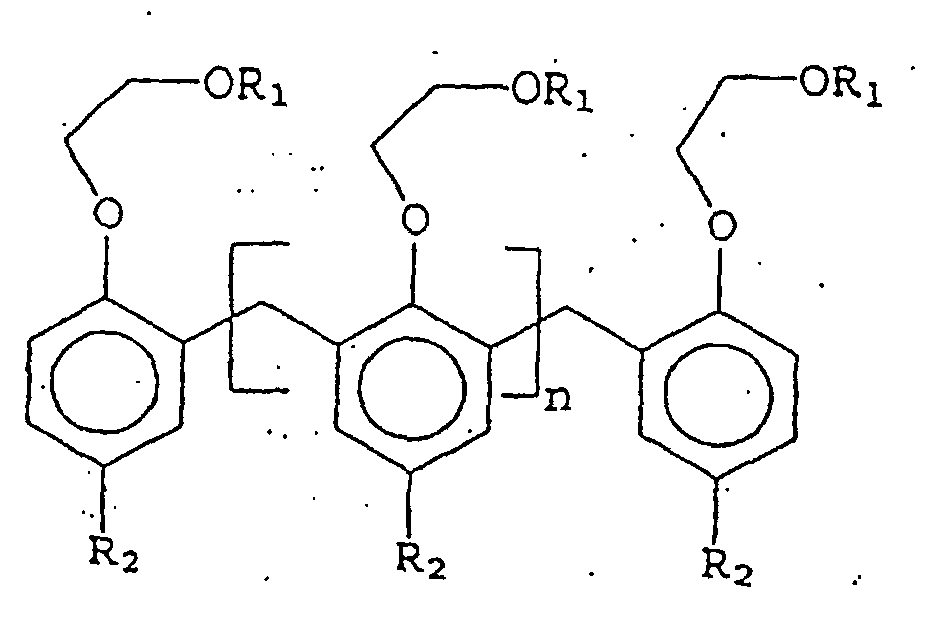
- Kettenverlängertes Phenolaralkylierungspolymer, umfassend das Reaktionsprodukt aus einem Kettenverlängerungsmittel, ausgewählt aus der Gruppe bestehend aus Dicarbonsäuren, Polycarbonsäuren, Dicarbonsäureanhydriden, Carbonsäureanhydriden, Diisocyanaten, Polyisocyanaten und Gemischen davon, mit einer nichtveresterten Hydroxylgruppe eines Esters, ausgewählt aus der Gruppe bestehend aus dem Ester von Anspruch 1, dem Ester von Anspruch 4, dem Ester von Anspruch 6, dem Ester von Anspruch 8, dem Ester von Anspruch 10, dem Ester von Anspruch 13, dem Ester von Anspruch 16, dem Ester von Anspruch 22, dem Ester von Anspruch 27 und Gemischen davon.
- Kettenverlängertes Phenolaralkylierungspolymer nach Anspruch 28, wobei die nichtveresterte Hydroxylgruppe des Esters nacheinander zuerst mit einem ersten Kettenverlängerungsmittel, ausgewählt aus der Gruppe bestehend aus Dicarbonsäuren, Polycarbonsäuren, Dicarbonsäureanhydriden, Carbonsäureanhydriden und Gemischen davon umgesetzt wird, dann mit einem zweiten Kettenverlängerungsmittel, ausgewählt aus der Gruppe bestehend aus Diisocyanaten, Polyisocyanaten und Gemischen davon umgesetzt wird.
- Beschichtungssystem, umfassend einen Ester ausgewählt aus der Gruppe bestehend aus dem Ester von Anspruch 1, dem Ester von Anspruch 4, dem Ester von Anspruch 6, dem Ester von Anspruch 8, dem Ester von Anspruch 10, dem Ester von Anspruch 13, dem Ester von Anspruch 16, dem Ester von Anspruch 22, dem Ester von Anspruch 27 und Gemischen davon.
- Beschichtungssystem, umfassend ein Polyol ausgewählt aus der Gruppe bestehend aus dem Polyol von Anspruch 3, dem Polyol von Anspruch 5, dem Polyol von Anspruch 12, dem Polyol von Anspruch 14, dem Polyol von Anspruch 21 und Gemischen davon.
- Beschichtungssystem, umfassend das Acrylat von Anspruch 15.
- Beschichtungssystem, umfassend das Epoxy von Anspruch 17.
- Beschichtungssystem, umfassend das Acrylamid von Anspruch 18.
- Beschichtungssystem, umfassend das Carbonat von Anspruch 24.
- Beschichtungssystem, umfassend das Polymer von Anspruch 28.
Applications Claiming Priority (3)
| Application Number | Priority Date | Filing Date | Title |
|---|---|---|---|
| US781669 | 1997-01-10 | ||
| US08/781,669 US5770750A (en) | 1997-01-10 | 1997-01-10 | Alkyd and aralkyd derivatives of phenolic polymers |
| PCT/US1998/004121 WO1998030596A2 (en) | 1997-01-10 | 1998-01-05 | Alkyd and aralkyd derivatives of phenolic polymers |
Publications (2)
| Publication Number | Publication Date |
|---|---|
| EP0951496A2 EP0951496A2 (de) | 1999-10-27 |
| EP0951496B1 true EP0951496B1 (de) | 2001-12-19 |
Family
ID=25123522
Family Applications (1)
| Application Number | Title | Priority Date | Filing Date |
|---|---|---|---|
| EP98910142A Expired - Lifetime EP0951496B1 (de) | 1997-01-10 | 1998-01-05 | Alkyd- oder aralkydderivate von phenolischen polymeren |
Country Status (12)
| Country | Link |
|---|---|
| US (1) | US5770750A (de) |
| EP (1) | EP0951496B1 (de) |
| JP (1) | JP2001509186A (de) |
| KR (1) | KR100491909B1 (de) |
| AT (1) | ATE211153T1 (de) |
| AU (1) | AU6445298A (de) |
| BR (1) | BR9807067A (de) |
| DE (1) | DE69803037T2 (de) |
| ES (1) | ES2170484T3 (de) |
| PL (1) | PL334484A1 (de) |
| WO (1) | WO1998030596A2 (de) |
| ZA (1) | ZA98135B (de) |
Families Citing this family (17)
| Publication number | Priority date | Publication date | Assignee | Title |
|---|---|---|---|---|
| US6127491A (en) | 1995-11-27 | 2000-10-03 | Gerorgia-Pacific Resins, Inc. | Phenolic resin polyols and polymers derived from the polyols |
| US6100364A (en) * | 1999-05-04 | 2000-08-08 | U.S. Polymers, Inc. | Water-reducible phenolic binders, methods of preparation and coating systems |
| US6166151A (en) | 1999-06-22 | 2000-12-26 | Georgia-Pacific Resins, Inc. | Lactone chain-extended phenolic polyester polyols |
| US6399740B1 (en) | 1999-07-06 | 2002-06-04 | Georgia-Pacific Resins, Inc. | Process for reducing mono-functional and non-functional by-products during aralkylation of phenolics |
| AU7075900A (en) * | 1999-08-31 | 2001-03-26 | Georgia-Pacific Resins, Inc. | Waterborne modified phenolics (arylzenetm) additives for improving environmental performance of waterborne, water reducible and water dispersible coatings |
| US7671097B2 (en) * | 2005-05-24 | 2010-03-02 | Georgia-Pacific Chemicals Llc | Stable phenolic resin polymer dispersions having low free aldehyde content |
| US7485603B2 (en) * | 2005-02-18 | 2009-02-03 | Infineum International Limited | Soot dispersants and lubricating oil compositions containing same |
| US7786057B2 (en) | 2007-02-08 | 2010-08-31 | Infineum International Limited | Soot dispersants and lubricating oil compositions containing same |
| TWI417656B (zh) | 2010-04-08 | 2013-12-01 | Founder Fine Chemical Industry Co Ltd | 輻射敏感組成物 |
| CN102236254B (zh) * | 2010-04-21 | 2013-01-02 | 品青企业股份有限公司 | 辐射敏感组合物 |
| US9458298B2 (en) | 2012-10-01 | 2016-10-04 | Georgia-Pacific Chemicals Llc | Methods for making lignocellulose containing composite products |
| US9586338B2 (en) | 2012-10-01 | 2017-03-07 | Georgia-Pacific Chemicals Llc | Methods for making lignocellulose containing composite products |
| NZ711575A (en) | 2013-03-14 | 2017-02-24 | Georgia Pacific Chemicals Llc | Binder compositions and methods for making and using same |
| US9587077B2 (en) | 2013-03-14 | 2017-03-07 | Georgia-Pacific Chemicals Llc | Methods for making composite products containing lignocellulose substrates |
| CA2944623A1 (en) | 2014-04-02 | 2015-10-08 | Georgia-Pacific Chemicals Llc | Methods for making lignocellulose composite products with oxidative binders and complexed metal catalyst |
| WO2015153520A1 (en) | 2014-04-02 | 2015-10-08 | Georgia-Pacific Chemicals Llc | Methods for making lignocellulose composite products with oxidative binders and encapsulated catalyst |
| TR201903909A2 (tr) * | 2019-03-15 | 2020-10-21 | Cukurova Kimya Enduestrisi A S | Aşındırıcı elemanlar için bir reçine ve bunun için bir üretim yöntemi. |
Family Cites Families (17)
| Publication number | Priority date | Publication date | Assignee | Title |
|---|---|---|---|---|
| US3267154A (en) * | 1963-08-13 | 1966-08-16 | Koppers Co Inc | Mixed salts of aluminum as ortho-alkylation catalysts |
| US3393243A (en) * | 1964-09-24 | 1968-07-16 | Jefferson Chem Co Inc | Process of preparing polyoxypropylene polyether polyols |
| US3379708A (en) * | 1964-11-23 | 1968-04-23 | Phillips Petroleum Co | Esters of tall oil pitch and polyoxyethylene compounds and their use as drilling fluid additives |
| US3461068A (en) * | 1964-11-23 | 1969-08-12 | Phillips Petroleum Co | Esters of tall oil pitch and polyoxyethylene compounds and their use as drilling fluid additives |
| US3733365A (en) * | 1969-05-05 | 1973-05-15 | Jefferson Chem Co Inc | Process for ortho-alkylation |
| JPS54123142A (en) * | 1978-03-17 | 1979-09-25 | Nippon Zeon Co Ltd | Water-based coating composition |
| JPS54150492A (en) * | 1978-05-19 | 1979-11-26 | Mitsui Petrochem Ind Ltd | Production of copolymer resin |
| US4595743A (en) * | 1985-01-22 | 1986-06-17 | The Dow Chemical Company | High modulus polyurea elastomers prepared with amine-initiated polyols |
| DE3636086A1 (de) * | 1986-10-23 | 1988-04-28 | Henkel Kgaa | Fettsaeureester von polyglycerinpolyglykolethern, ihre herstellung und ihre verwendung |
| US5057627A (en) * | 1988-06-09 | 1991-10-15 | Shell Oil Company | Alkoxylation process catalyzed by phosphate salts of the rare earth elements |
| US5106874A (en) * | 1989-06-16 | 1992-04-21 | The Dow Chemical Company | Process for preparing elastomeric polyurethane or polyurethane-urea polymers, and polyurethanes so prepared |
| US4962186A (en) * | 1989-07-10 | 1990-10-09 | Union Camp Corporation | Method of improving the color of tall oil rosin esters by recrystallizing and distilling rosin followed by esterifying |
| BR9103896A (pt) * | 1991-09-10 | 1992-03-17 | Rojek Metalgrafica | Processo para a formacao de um furo de alivio com lacre obturador destacavel,para facil abertura,em tampas metalicas,de fechamento a vacuo,de copos e outros recipientes de vidro,que se prestam de embalagem para produtos alimenticios |
| JP2528784B2 (ja) * | 1993-09-03 | 1996-08-28 | 三洋化成工業株式会社 | オキシアルキレンエ―テル、帯電防止剤および樹脂組成物 |
| US5362894A (en) * | 1993-11-12 | 1994-11-08 | Arco Chemical Technology, L.P. | Process for producing an esterified alkoxylated polyol |
| US5466843A (en) * | 1994-04-29 | 1995-11-14 | Arco Chemical Technology, L.P. | Process for preparing a C12 -C24 saturated fatty acid esterified alkoxylated polyol |
| US6127491A (en) * | 1995-11-27 | 2000-10-03 | Gerorgia-Pacific Resins, Inc. | Phenolic resin polyols and polymers derived from the polyols |
-
1997
- 1997-01-10 US US08/781,669 patent/US5770750A/en not_active Expired - Lifetime
-
1998
- 1998-01-05 PL PL98334484A patent/PL334484A1/xx unknown
- 1998-01-05 KR KR10-1999-7006232A patent/KR100491909B1/ko not_active Expired - Fee Related
- 1998-01-05 WO PCT/US1998/004121 patent/WO1998030596A2/en not_active Ceased
- 1998-01-05 AT AT98910142T patent/ATE211153T1/de not_active IP Right Cessation
- 1998-01-05 AU AU64452/98A patent/AU6445298A/en not_active Abandoned
- 1998-01-05 EP EP98910142A patent/EP0951496B1/de not_active Expired - Lifetime
- 1998-01-05 ES ES98910142T patent/ES2170484T3/es not_active Expired - Lifetime
- 1998-01-05 DE DE69803037T patent/DE69803037T2/de not_active Expired - Fee Related
- 1998-01-05 BR BR9807067-3A patent/BR9807067A/pt not_active IP Right Cessation
- 1998-01-05 JP JP53130198A patent/JP2001509186A/ja not_active Ceased
- 1998-01-08 ZA ZA98135A patent/ZA98135B/xx unknown
Also Published As
| Publication number | Publication date |
|---|---|
| ES2170484T3 (es) | 2002-08-01 |
| PL334484A1 (en) | 2000-02-28 |
| WO1998030596A2 (en) | 1998-07-16 |
| KR100491909B1 (ko) | 2005-05-27 |
| KR20000070013A (ko) | 2000-11-25 |
| JP2001509186A (ja) | 2001-07-10 |
| WO1998030596A3 (en) | 1998-09-17 |
| US5770750A (en) | 1998-06-23 |
| DE69803037D1 (de) | 2002-01-31 |
| ZA98135B (en) | 1998-08-11 |
| EP0951496A2 (de) | 1999-10-27 |
| BR9807067A (pt) | 2001-09-25 |
| AU6445298A (en) | 1998-08-03 |
| ATE211153T1 (de) | 2002-01-15 |
| DE69803037T2 (de) | 2002-08-22 |
Similar Documents
| Publication | Publication Date | Title |
|---|---|---|
| EP0951496B1 (de) | Alkyd- oder aralkydderivate von phenolischen polymeren | |
| US6569953B1 (en) | Phenolic resin polyols and polymers derived from the polyols | |
| US9796802B2 (en) | CNSL-based hydrocarbon resins, preparation and uses thereof | |
| EP2661430B1 (de) | Glycidylester von alpha, alpha-verzweigten säurezusammensetzungen | |
| US6150458A (en) | Process for preparing esters of (meth) acrylic acid | |
| US6291077B1 (en) | Lactone chain-extended phenolic polyester polyols | |
| KR20070038984A (ko) | 불포화 무정형 폴리에스테르 및 반응성 희석제로 이루어진방사선 경화성 조성물 | |
| JP2016194076A (ja) | アルファ,アルファ分枝酸のグリシジルエステル組成物 | |
| US20080039593A1 (en) | Aqueous, Unsaturated, Amorphous Polyesters that are Modified so as to be Radiation Curable | |
| US6451926B1 (en) | Coating compositions based on polyether alcohols prepared from 3,4-epoxy-1-butene | |
| US9663597B2 (en) | Acrylic polyol resins compositions | |
| US6153788A (en) | Process for preparing esters of ethylenically unsaturated carboxylic acids | |
| KR20070068362A (ko) | 방사선 경화성의 변형된 불포화 무정형 폴리에스테르 | |
| US9751982B2 (en) | Polyether polyol resins compositions | |
| JPH02147675A (ja) | 保護表面塗料組成物 | |
| US6319983B1 (en) | (Meth)acrylic esters containing urethane groups, their preparation, radiation-curable coating compositions and a process for preparing these coating compositions | |
| US2709690A (en) | Epoxy resins esterified with drying oil fatty acids and phosphoric acid | |
| GB1576159A (en) | Cathodically depositable thermosetting resin binders | |
| CA2005477C (en) | Polyether resins, and process for preparing the same | |
| US5100966A (en) | Water-dilutable, crosslinkable binder resin | |
| US10954346B2 (en) | Resin and ink | |
| US4130531A (en) | High solids, low viscosity thermosetting phenolic/epoxy coating system | |
| EP0002456A1 (de) | Harzzusammensetzung als Überzugsmittel | |
| JPS60237029A (ja) | 有機カルボン酸のヒドロキシル基含有アルコキシル化生成物の製造 | |
| US2907738A (en) | Mixed resin acid esters of 4, 4-bis(4-hydroxyaryl) pentanoic acid |
Legal Events
| Date | Code | Title | Description |
|---|---|---|---|
| PUAI | Public reference made under article 153(3) epc to a published international application that has entered the european phase |
Free format text: ORIGINAL CODE: 0009012 |
|
| 17P | Request for examination filed |
Effective date: 19990809 |
|
| AK | Designated contracting states |
Kind code of ref document: A2 Designated state(s): AT BE CH DE DK ES FI FR GB GR IE IT LI LU MC NL PT SE |
|
| AX | Request for extension of the european patent |
Free format text: AL PAYMENT 19990809;LT PAYMENT 19990809;LV PAYMENT 19990809;MK PAYMENT 19990809;RO PAYMENT 19990809;SI PAYMENT 19990809 |
|
| 17Q | First examination report despatched |
Effective date: 20000410 |
|
| GRAG | Despatch of communication of intention to grant |
Free format text: ORIGINAL CODE: EPIDOS AGRA |
|
| GRAG | Despatch of communication of intention to grant |
Free format text: ORIGINAL CODE: EPIDOS AGRA |
|
| GRAH | Despatch of communication of intention to grant a patent |
Free format text: ORIGINAL CODE: EPIDOS IGRA |
|
| GRAH | Despatch of communication of intention to grant a patent |
Free format text: ORIGINAL CODE: EPIDOS IGRA |
|
| GRAA | (expected) grant |
Free format text: ORIGINAL CODE: 0009210 |
|
| AK | Designated contracting states |
Kind code of ref document: B1 Designated state(s): AT BE CH DE DK ES FI FR GB GR IE IT LI LU MC NL PT SE |
|
| AX | Request for extension of the european patent |
Free format text: AL PAYMENT 19990809;LT PAYMENT 19990809;LV PAYMENT 19990809;MK PAYMENT 19990809;RO PAYMENT 19990809;SI PAYMENT 19990809 |
|
| PG25 | Lapsed in a contracting state [announced via postgrant information from national office to epo] |
Ref country code: NL Free format text: LAPSE BECAUSE OF FAILURE TO SUBMIT A TRANSLATION OF THE DESCRIPTION OR TO PAY THE FEE WITHIN THE PRESCRIBED TIME-LIMIT Effective date: 20011219 Ref country code: LI Free format text: LAPSE BECAUSE OF FAILURE TO SUBMIT A TRANSLATION OF THE DESCRIPTION OR TO PAY THE FEE WITHIN THE PRESCRIBED TIME-LIMIT Effective date: 20011219 Ref country code: GR Free format text: LAPSE BECAUSE OF FAILURE TO SUBMIT A TRANSLATION OF THE DESCRIPTION OR TO PAY THE FEE WITHIN THE PRESCRIBED TIME-LIMIT Effective date: 20011219 Ref country code: FI Free format text: LAPSE BECAUSE OF FAILURE TO SUBMIT A TRANSLATION OF THE DESCRIPTION OR TO PAY THE FEE WITHIN THE PRESCRIBED TIME-LIMIT Effective date: 20011219 Ref country code: CH Free format text: LAPSE BECAUSE OF FAILURE TO SUBMIT A TRANSLATION OF THE DESCRIPTION OR TO PAY THE FEE WITHIN THE PRESCRIBED TIME-LIMIT Effective date: 20011219 Ref country code: BE Free format text: LAPSE BECAUSE OF FAILURE TO SUBMIT A TRANSLATION OF THE DESCRIPTION OR TO PAY THE FEE WITHIN THE PRESCRIBED TIME-LIMIT Effective date: 20011219 |
|
| REF | Corresponds to: |
Ref document number: 211153 Country of ref document: AT Date of ref document: 20020115 Kind code of ref document: T |
|
| REG | Reference to a national code |
Ref country code: CH Ref legal event code: EP |
|
| REG | Reference to a national code |
Ref country code: GB Ref legal event code: IF02 |
|
| PG25 | Lapsed in a contracting state [announced via postgrant information from national office to epo] |
Ref country code: LU Free format text: LAPSE BECAUSE OF NON-PAYMENT OF DUE FEES Effective date: 20020105 |
|
| PG25 | Lapsed in a contracting state [announced via postgrant information from national office to epo] |
Ref country code: IE Free format text: LAPSE BECAUSE OF NON-PAYMENT OF DUE FEES Effective date: 20020107 |
|
| REG | Reference to a national code |
Ref country code: IE Ref legal event code: FG4D |
|
| REF | Corresponds to: |
Ref document number: 69803037 Country of ref document: DE Date of ref document: 20020131 |
|
| PG25 | Lapsed in a contracting state [announced via postgrant information from national office to epo] |
Ref country code: SE Free format text: LAPSE BECAUSE OF FAILURE TO SUBMIT A TRANSLATION OF THE DESCRIPTION OR TO PAY THE FEE WITHIN THE PRESCRIBED TIME-LIMIT Effective date: 20020319 Ref country code: PT Free format text: LAPSE BECAUSE OF FAILURE TO SUBMIT A TRANSLATION OF THE DESCRIPTION OR TO PAY THE FEE WITHIN THE PRESCRIBED TIME-LIMIT Effective date: 20020319 Ref country code: DK Free format text: LAPSE BECAUSE OF FAILURE TO SUBMIT A TRANSLATION OF THE DESCRIPTION OR TO PAY THE FEE WITHIN THE PRESCRIBED TIME-LIMIT Effective date: 20020319 |
|
| ET | Fr: translation filed | ||
| NLV1 | Nl: lapsed or annulled due to failure to fulfill the requirements of art. 29p and 29m of the patents act | ||
| REG | Reference to a national code |
Ref country code: CH Ref legal event code: PL |
|
| PG25 | Lapsed in a contracting state [announced via postgrant information from national office to epo] |
Ref country code: MC Free format text: LAPSE BECAUSE OF NON-PAYMENT OF DUE FEES Effective date: 20020801 |
|
| REG | Reference to a national code |
Ref country code: ES Ref legal event code: FG2A Ref document number: 2170484 Country of ref document: ES Kind code of ref document: T3 |
|
| PLBE | No opposition filed within time limit |
Free format text: ORIGINAL CODE: 0009261 |
|
| STAA | Information on the status of an ep patent application or granted ep patent |
Free format text: STATUS: NO OPPOSITION FILED WITHIN TIME LIMIT |
|
| REG | Reference to a national code |
Ref country code: IE Ref legal event code: MM4A |
|
| 26N | No opposition filed | ||
| NLV1 | Nl: lapsed or annulled due to failure to fulfill the requirements of art. 29p and 29m of the patents act | ||
| PGFP | Annual fee paid to national office [announced via postgrant information from national office to epo] |
Ref country code: DE Payment date: 20060103 Year of fee payment: 9 |
|
| PGFP | Annual fee paid to national office [announced via postgrant information from national office to epo] |
Ref country code: FR Payment date: 20060110 Year of fee payment: 9 |
|
| PGFP | Annual fee paid to national office [announced via postgrant information from national office to epo] |
Ref country code: AT Payment date: 20060111 Year of fee payment: 9 |
|
| PGFP | Annual fee paid to national office [announced via postgrant information from national office to epo] |
Ref country code: ES Payment date: 20060215 Year of fee payment: 9 |
|
| PG25 | Lapsed in a contracting state [announced via postgrant information from national office to epo] |
Ref country code: DE Free format text: LAPSE BECAUSE OF NON-PAYMENT OF DUE FEES Effective date: 20070801 |
|
| GBPC | Gb: european patent ceased through non-payment of renewal fee |
Effective date: 20070105 |
|
| REG | Reference to a national code |
Ref country code: FR Ref legal event code: ST Effective date: 20070930 |
|
| PG25 | Lapsed in a contracting state [announced via postgrant information from national office to epo] |
Ref country code: GB Free format text: LAPSE BECAUSE OF NON-PAYMENT OF DUE FEES Effective date: 20070105 Ref country code: AT Free format text: LAPSE BECAUSE OF NON-PAYMENT OF DUE FEES Effective date: 20070105 |
|
| REG | Reference to a national code |
Ref country code: ES Ref legal event code: FD2A Effective date: 20070108 |
|
| PG25 | Lapsed in a contracting state [announced via postgrant information from national office to epo] |
Ref country code: FR Free format text: LAPSE BECAUSE OF NON-PAYMENT OF DUE FEES Effective date: 20070131 |
|
| PG25 | Lapsed in a contracting state [announced via postgrant information from national office to epo] |
Ref country code: ES Free format text: LAPSE BECAUSE OF NON-PAYMENT OF DUE FEES Effective date: 20070108 |
|
| PGFP | Annual fee paid to national office [announced via postgrant information from national office to epo] |
Ref country code: GB Payment date: 20060104 Year of fee payment: 9 |
|
| PGFP | Annual fee paid to national office [announced via postgrant information from national office to epo] |
Ref country code: IT Payment date: 20100130 Year of fee payment: 13 |
|
| PG25 | Lapsed in a contracting state [announced via postgrant information from national office to epo] |
Ref country code: IT Free format text: LAPSE BECAUSE OF NON-PAYMENT OF DUE FEES Effective date: 20110105 |