EP0951180B1 - Verfahren zur Erfassung von Daten in einem Videosignal - Google Patents
Verfahren zur Erfassung von Daten in einem Videosignal Download PDFInfo
- Publication number
- EP0951180B1 EP0951180B1 EP99470011A EP99470011A EP0951180B1 EP 0951180 B1 EP0951180 B1 EP 0951180B1 EP 99470011 A EP99470011 A EP 99470011A EP 99470011 A EP99470011 A EP 99470011A EP 0951180 B1 EP0951180 B1 EP 0951180B1
- Authority
- EP
- European Patent Office
- Prior art keywords
- data
- interruption
- processor
- teletext
- management
- Prior art date
- Legal status (The legal status is an assumption and is not a legal conclusion. Google has not performed a legal analysis and makes no representation as to the accuracy of the status listed.)
- Expired - Lifetime
Links
- 238000000034 method Methods 0.000 title claims description 19
- 238000012545 processing Methods 0.000 claims description 19
- 230000015654 memory Effects 0.000 claims description 12
- 230000002093 peripheral effect Effects 0.000 claims description 6
- 238000012546 transfer Methods 0.000 claims description 2
- 230000003936 working memory Effects 0.000 claims description 2
- 238000007726 management method Methods 0.000 description 30
- 238000000605 extraction Methods 0.000 description 26
- 238000011282 treatment Methods 0.000 description 16
- 238000010586 diagram Methods 0.000 description 9
- 238000004891 communication Methods 0.000 description 7
- 230000005540 biological transmission Effects 0.000 description 4
- 238000013075 data extraction Methods 0.000 description 3
- 230000009977 dual effect Effects 0.000 description 3
- 238000004377 microelectronic Methods 0.000 description 3
- 230000008859 change Effects 0.000 description 2
- 230000008569 process Effects 0.000 description 2
- 230000002123 temporal effect Effects 0.000 description 2
- 230000009471 action Effects 0.000 description 1
- 230000001174 ascending effect Effects 0.000 description 1
- 230000006835 compression Effects 0.000 description 1
- 238000007906 compression Methods 0.000 description 1
- 238000012937 correction Methods 0.000 description 1
- 238000013500 data storage Methods 0.000 description 1
- 230000001419 dependent effect Effects 0.000 description 1
- 230000006872 improvement Effects 0.000 description 1
- 238000004519 manufacturing process Methods 0.000 description 1
- 238000003908 quality control method Methods 0.000 description 1
- 238000000926 separation method Methods 0.000 description 1
- 230000001960 triggered effect Effects 0.000 description 1
Images
Classifications
-
- H—ELECTRICITY
- H04—ELECTRIC COMMUNICATION TECHNIQUE
- H04N—PICTORIAL COMMUNICATION, e.g. TELEVISION
- H04N7/00—Television systems
- H04N7/08—Systems for the simultaneous or sequential transmission of more than one television signal, e.g. additional information signals, the signals occupying wholly or partially the same frequency band, e.g. by time division
- H04N7/087—Systems for the simultaneous or sequential transmission of more than one television signal, e.g. additional information signals, the signals occupying wholly or partially the same frequency band, e.g. by time division with signal insertion during the vertical blanking interval only
- H04N7/088—Systems for the simultaneous or sequential transmission of more than one television signal, e.g. additional information signals, the signals occupying wholly or partially the same frequency band, e.g. by time division with signal insertion during the vertical blanking interval only the inserted signal being digital
- H04N7/0882—Systems for the simultaneous or sequential transmission of more than one television signal, e.g. additional information signals, the signals occupying wholly or partially the same frequency band, e.g. by time division with signal insertion during the vertical blanking interval only the inserted signal being digital for the transmission of character code signals, e.g. for teletext
Definitions
- the invention relates to a method for acquiring data on a video signal. More specifically, the invention realizes a process carrying out the extraction, the processing and displaying type information "teletext".
- Analog video signals are divided into frames and lines. Each frame corresponds to an image and each line to a horizontal scan of a screen of TV. Conventionally, the frames include a more lines than the number of lines of the screen (in SECAM, for example, only 525 lines are used for a screen image on 625 lines transmitted). Unused lines for transmission television image serve on the one hand to the synchronization and secondly to the transmission of data. Among the data transmitted, we know the data relating to teletext.
- Teletext data is placed at the start of each frame, on a few lines. These data are structured in numbered pages. Each page represents approximately 1 kb of data in text format. For the transmission, the pages are divided into several pieces and coded. Despite page compression, a page is transmitted in pieces over several frames. In plus page data, additional data from communication and management are transmitted. next different standards, known as "basic”, “FLOF” and “TOP" data processing and management pages is more or less important. All of pages transmitted being commonly a few hundred of pages, the complete sequence of teletext pages can be transmitted in minutes.
- the management data In “basic”, the management data is limited to page numbers, so that a user can read them address.
- FLOF the management data associated with each page are the page number and others numbers, corresponding to other pages, which constitute links to allow a more page change fast for the user.
- TOP the data of management include page number and tables links at several levels forming a tree structure.
- the first televisions equipped could not operate only in "basic” and could only memorize the current page. Teletext was relatively slow for the user who had to wait for the moment when the desired page was transmitted in order to be able to view.
- a first improvement consisted in providing the televisions with a memory (for example 8 KB) for memorize a few pages. The TV memorizing successive pages to the current page, the user could scroll through the pages one by one without having systematically wait for the transmission of the page desired (provided you read the pages so successive).
- the "FLOF” improves user comfort because it allows the TV to memorize subsequent pages and pages corresponding to links. So a page of summary or referring to distant pages allows the user a page change not successive faster.
- a "FLOF” problem is one share the wait necessary when the user realizes two successive page breaks quickly and on the other hand the time it takes to return to a summary page on a bad choice if the summary page has already been crushed by another.
- the "TOP" overcomes these problems because the management data includes trees ascending and descending.
- the TV can then memorize one or two pages that refer to the page current, next few pages and pages to which the current page refers.
- the pages to which references the current page are already known by the television, which allows you to anticipate the loading of a new page.
- Teletext management is currently done in high-end televisions using circuits specialized who deal only with teletext as illustrated in document EP-A-0 591 880.
- the specialized circuits are large and therefore significant cost.
- To integrate teletext management in low-end televisions it is necessary to reduce the cost of components dedicated to teletext.
- the current televisions all having type circuits microcontroller using at least one processor, the skilled person had the idea of integrating on the microcontroller a circuit dedicated to data extraction is relating to teletext from the video signal.
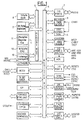
- FIG. 1 representing, as an indicative example, the diagram internal circuit sold by SGS-THOMSON MICROELECTRONICS under the reference ST92R195 which includes a raw extraction circuit.
- ST92R195 By raw extraction, it just understand the demodulation of the data and data storage immediately after demodulation.
- the skilled person can refer to manual of this circuit made available to the public by SGS-THOMSON MICROELECTRONICS since November 1997 under the title "ST92R195 8-bit MCU DATASHEET".
- ST92R195 8-bit MCU DATASHEET
- microcontrollers must then manage the entire teletext system in addition to the overall operation of the television. It may appear obvious to program a processor for all of these tasks. However, in the area of televisions, it is extremely expensive to use microcontrollers operating at a high clock frequency because a high clock frequency creates a source of additional noise you don't want to have. A problem then arises to perform both the TV management and system management teletext with the same processor which is limited in processing speed.
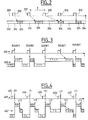
- FIG 2 shows timing diagrams on the one hand of the gross extraction 201 and on the other hand of the tasks of the processor 202 in a case where teletext is managed at same level as TV management.
- the extraction moments 203 which are cyclical with period T corresponding to the duration of a frame (20 ms or 16.6 ms depending on the country).
- the timing of tasks 202 shows the temporal sharing of the different tasks processed by the processor of the microcontroller.
- the different tasks here are separated into two types of tasks, the tasks related to the management of the television 204, and the management of the teletext 205.
- the management of different tasks 204 as well as the management of teletext 205 are of durations variables. Therefore, there is a time drift which can cause loss of information. You can see in Figure 1 a case of loss where new data extracted replace previously extracted data during the processing of previously extracted data. This results in data loss which requires waiting for the repetition of the data lost during their next show (a few minutes later).
- FIG. 3 shows timing diagrams on the one hand of the gross extraction 301 and on the other hand of the tasks of the processor 302.
- the extraction moments 303 are shown which are cyclical with period T corresponding to the duration a frame (20 ms or 16.6 ms depending on the country).
- the timeline of tasks 302 shows time sharing of the different tasks processed by the processor of the microcontroller.
- the different tasks are separated into two types of tasks, tasks related to the management of TTV television, and TTXT teletext management.
- Each TTXT teletext management task is triggered by a EOVBI IT image start interrupt (known in English) under the name of "End Of Vertical Blanking Interval interrupt ").
- An object of the invention is to propose a method of teletext management to remedy problems previously mentioned.
- the processing of data is separated into at least two tasks, a first task dealing with data from raw extraction, a second task doing the rest of treatment.
- the first task triggers the second task by priority software interruption lower than the start of image interrupt of such so that a next image start interrupt can interrupt the second task to perform a next first task.
- the subject of the invention is a method of acquisition and displaying data from a received video signal by a television which includes a processor, in which: the processor receives a first interrupt when the data has been extracted from the video signal and stored in a buffer memory; the first one interruption triggers first data processing intended to decode, select and transfer said data in a useful memory; the end of first treatment produces a second interruption of priority lower than the first interruption, the second interruption triggering a second treatment relating to teletext operations based on said data.
- the second treatment includes in particular page display operations and / or update operations of the different tables teletext management.
- the invention relates to a method for managing a television with a micro-controller which has a processor and related peripherals the overall operation of the television, in which the processor manages all peripherals of the television, and comprising the acquisition process and display of data from the video signal received by the television.
- Figure 1 represents a micro-controller for television sold by the company SGS-THOMSON MICROELECTRONICS under the reference ST92R195.
- This microcontroller is not fully described, man of the trade who can consult, for more details, the embedded "ST92R195 8-bit MCU DATASHEET" publication by reference.
- the microcontroller of FIG. 1 comprises a processor core 1, dual port memory 2, one raw extraction circuit 3, an extraction circuit of synchronization 4, of the first and second buses 5 and 6 of communication, a program memory 8 and at least one communication port 7.
- the processor core includes a processor 10, a register bank 11 and a circuit interrupt management 12.
- Processor core 1 and dual port memory 2 are both connected to the first and second bus 5 and 6.
- the first and second buses each constitute a full bus including data, address, and bus ordered.
- the processor core 1 also receives NMI AND INT interrupt threads [7: 0] from peripherals external to the microcontroller.
- the circuit extraction system 3, the extraction circuit of synchronization 4 and communication port 7 are all three connected to the second bus 6.
- the memory of program 8 is connected to the first bus.
- the gross extraction 3 and extraction circuits synchronization 4 each receive a video signal CVBS1 from: outside the microcontroller.
- the communication port 7 has at least one wire output to send a signal outside the microcontroller.
- processor core 1 When processor core 1 receives a interruption either of one of the buses 5 or 6, or of the wires NMI AND INT interrupt [7: 0], or either of processor 10, the interrupt management circuit 12 verifies that the interrupt received is of a priority level higher or lower than the priority level of the task being processed in the processor. Yes the interruption is of a level less than or equal to level of the task in progress, the management circuit 12 interrupts the interrupt. If by however, the interrupt received is of a priority level higher than the level of the task being executed, then, the processor 10 is stopped, the content of the processor 10 internal registers is stored in the register bank 11, and processor 10 will look for a program corresponding to the interrupt received.
- Interruptions can come from either of the internal or external peripherals of the microcontroller either be a software interruption created by the program running in processor 10.
- the interrupt management circuit 12 has a table allowing him to determine the different priorities between interruptions and allowing to associate a program address at each interruption.
- Interrupts are used in a TV for many accessories such as remote control, keyboard, quality control of sound and image, etc ...
- a start of image interruption is also produced by the synchronization extraction circuit 4.
- Figure 4 shows timing diagrams on the one hand of the gross extraction 401 and on the other hand of the tasks of the 402 processor.
- the extraction moments 403 to 407 are shown which are cyclical with period T corresponding to the duration a frame (20 ms or 16.6 ms depending on the country).
- the timeline of tasks 402 shows time sharing of the various tasks processed by the processor of the microcontroller.
- Raw data extraction is performed by the raw extraction circuit 3 from the video signal CVBS1.
- Raw extraction consists in demodulating the teletext data present on the video signal and at store a data packet in a memory area dual port 2, the area acting as memory buffer. It is also possible to use a memory additional. This extraction is carried out automatically via the second bus 6 without the intervention of processor 10 which can perform a other task.
- a first interruption noted IT1 corresponding to the interruption of image start, is produced.
- the first IT1 interruption triggers, if it has priority over the task in progress, a first treatment noted TX1 to TX5.
- the first TX1 to TX5 processing consists of perform all operations that require the presence of the data packet in the memory area buffer.
- the operations to be carried out are the decoding of data (Hamming error correction code with additional parity check), then identification data, and storing in a useful area of the working memory 2 if the data is identified as useful data.
- the first treatment is ends with the production of a second IT2 interrupt of lower priority than the first IT1 interrupt.
- the second IT2 interrupt triggers a second treatment T'1 to T'5.
- the second treatment is used to perform all teletext operations which are based on useful data namely page display and update of the various management tables of the teletext.
- the processor can resume priority task less than the second treatment, for example a task of general management of the television noted TV.
- a second treatment T'3 is particularly long, so it can be interrupted by a first IT1 interrupt to allow the realization of a new first TX4 processing.
- the second processing T'3 resumes, the second IT2 interruption produced by the new first TX4 processing being put on hold.
- the new second T'4 treatment begins after the end of the second treatment T'3.
- interruptions are priority by relation to teletext.
- interruptions priority we can cite interruptions corresponding to the control keyboard, the remote control, and the TV's internal clock. Now an action on the remote control can result in a succession very brief interruptions that lengthen considerably: the first and second treatments for an interval of time which may be greater than separation time between two frames.
- first and second interrupts IT1 and IT2 are successive priorities, the priority of the second IT2 interruption being immediately lower than the priority of the first IT1 interruption.
- these first and second interrupts IT1 and IT2 have higher priority over tasks long. By long tasks, we must understand the tasks which may have a duration greater than 1 ms.
- processor 10 it is possible that some microcontrollers do not allow software interruption with priority higher than one external interruption.
- a variant is to emulate the second interruption for example using a communication such as port 7 for example, the port of communication being connected from outside the microcontroller to one of the NMI AND trap inputs INT [7: 0].
- the invention is not limited to the family of microcontrollers cited above. It goes without saying that very numerous variants of the invention are possible, the variants being dependent on the different types of microcontrollers available on the market from different manufacturers.
Landscapes
- Engineering & Computer Science (AREA)
- Multimedia (AREA)
- Signal Processing (AREA)
- Television Systems (AREA)
Claims (7)
- Verfahren zum Erfassen und Darstellen von Teletext-Daten in einem Videosignal (CVBS1), das von einem Fernseher empfangen wird, der einen Prozessor (10) umfaßt, bei welchem:dadurch gekennzeichnet, daßder Prozessor (10) einen ersten Interrupt (IT1) empfängt, wenn die Daten aus dem Videosignal extrahiert wurden und in einem Zwischenspeicher (2) abgelegt wurden,der erste Interrupt (IT1) eine erste Verarbeitung (TX1 bis TX5) von Daten zum Dekodieren, Auswählen und Übertragen der Daten in einen Arbeitsspeicher (2) auslöst,
am Ende der ersten Verarbeitung (TX1 bis TX5) ein zweiter Interrupt (IT2) mit niedrigerer Priorität als der erste Interrupt (IT1) ausgelöst wird, wobei der zweite Interrupt (IT2) eine zweite Verarbeitung (T'1 bis T'5) zum Durchführen von Teletext-Operationen in Abhängigkeit von den Daten auslöst. - Verfahren nach Anspruch 1, dadurch gekennzeichnet, daß die zweite Verarbeitung (T'1 bis T'5) Seitendarstellungsoperationen umfaßt.
- Verfahren nach Anspruch 1 oder 2, dadurch gekennzeichnet, daß die zweite Verarbeitung Aktualisierungsoperationen verschiedener Tabellen für die Verwaltung des Teletextes umfaßt.
- Verfahren nach einem der Ansprüche 1 bis 3, dadurch gekennzeichnet, daß der erste Interrupt (IT1) eine niedrigere Priorität als Interrupts hat, die Verarbeitungen von einer Dauer von weniger als 1 ms entsprechen.
- Verfahren nach einem der Ansprüche 1 bis 4, dadurch gekennzeichnet, daß der erste und zweite Interrupt (IT1, IT2) aufeinanderfolgende Prioritäten haben.
- Verfahren zum Steuern eines Fernsehers mit einem Mikro-Controller, wobei der Mikro-Controller einen Prozessor (10) und Peripherieeinheiten (2, 3, 4, 5, 6, 7, 8) für die allgemeine Funktion des Fernsehers umfaßt, wobei bei dem Steuerverfahren der Prozessor die Steuerung aller Peripherieeinheiten des Fernsehers durchführt und das Steuerverfahren dadurch gekennzeichnet ist, daß es das Verfahren zum Erfassen und zum Darstellen nach einem der Ansprüche 1 bis 5 umfaßt.
- Fernseher, dadurch gekennzeichnet, daß er einen Mikro-Controller (1) umfaßt, der das Verfahren zum Erfassen und Darstellen nach einem der Ansprüche 1 bis 5 durchführt.
Applications Claiming Priority (2)
| Application Number | Priority Date | Filing Date | Title |
|---|---|---|---|
| FR9804987 | 1998-04-15 | ||
| FR9804987A FR2777729B1 (fr) | 1998-04-15 | 1998-04-15 | Procede d'acquisition de donnees sur un signal video |
Publications (2)
| Publication Number | Publication Date |
|---|---|
| EP0951180A1 EP0951180A1 (de) | 1999-10-20 |
| EP0951180B1 true EP0951180B1 (de) | 2001-09-12 |
Family
ID=9525499
Family Applications (1)
| Application Number | Title | Priority Date | Filing Date |
|---|---|---|---|
| EP99470011A Expired - Lifetime EP0951180B1 (de) | 1998-04-15 | 1999-04-02 | Verfahren zur Erfassung von Daten in einem Videosignal |
Country Status (4)
| Country | Link |
|---|---|
| US (1) | US6424378B1 (de) |
| EP (1) | EP0951180B1 (de) |
| DE (1) | DE69900272T2 (de) |
| FR (1) | FR2777729B1 (de) |
Families Citing this family (4)
| Publication number | Priority date | Publication date | Assignee | Title |
|---|---|---|---|---|
| FR2796798B1 (fr) * | 1999-07-19 | 2001-09-14 | St Microelectronics Sa | Procede d'affichage d'en-tetes teletexte |
| FR2808956B1 (fr) * | 2000-05-12 | 2002-08-16 | St Microelectronics Sa | Procede et dispositif d'affichage d'un sommaire de pages teletexte |
| DE10238019A1 (de) * | 2002-08-20 | 2004-03-11 | Diehl Munitionssysteme Gmbh & Co. Kg | Verfahren und Vorrichtung zur Echtzeit-Geländeaufklärung |
| US7460918B2 (en) * | 2004-06-10 | 2008-12-02 | Moteurs Leroy-Somer | Devices and methods for updating the programming of a system for controlling an electric rotary machine |
Family Cites Families (17)
| Publication number | Priority date | Publication date | Assignee | Title |
|---|---|---|---|---|
| US4439760A (en) * | 1981-05-19 | 1984-03-27 | Bell Telephone Laboratories, Incorporated | Method and apparatus for compiling three-dimensional digital image information |
| ES8501189A1 (es) * | 1983-03-02 | 1984-11-01 | Philips Nv | Una disposicion para visualizacion simultanea de datos durante un intervalo de tiempo |
| NL8500047A (nl) * | 1985-01-09 | 1986-08-01 | Philips Nv | Televisie ontvanger met teletext-decodeerschakeling en paginanummergeheugen. |
| GB2240697B (en) * | 1990-01-31 | 1994-06-29 | Philips Electronic Associated | Teletext decoders |
| GB2250404A (en) * | 1990-11-30 | 1992-06-03 | Philips Electronic Associated | Teletext decoder scans background memory in reverse order |
| KR940001367B1 (ko) * | 1991-04-12 | 1994-02-19 | 삼성전자 주식회사 | 텔레텍스트 목차 페이지 저장과 검색방법 및 장치 |
| JP3299771B2 (ja) * | 1992-02-18 | 2002-07-08 | パイオニア株式会社 | 文字放送受信機 |
| US5659759A (en) * | 1992-09-21 | 1997-08-19 | Kabushiki Kaisha Toshiba | Data processing device having improved interrupt controller to process interrupts of different priority levels |
| IT1257119B (it) * | 1992-10-06 | 1996-01-05 | Seleco Spa | Circuito ricevitore di segnali teletext con funzioni separate di acquisizione e visualizzazione. |
| JPH07107408A (ja) * | 1993-10-05 | 1995-04-21 | Mitsubishi Electric Corp | 画面表示装置内蔵のシングルチップマイクロコンピュータ |
| US5374961A (en) * | 1993-11-29 | 1994-12-20 | Samsung Electronics Co., Ltd. | Apparatus and method therefor for providing the latest information in receiving teletext |
| US5635987A (en) * | 1993-12-21 | 1997-06-03 | Goldstar Co., Ltd. | Method of an apparatus for displaying teletext information for a wide-screen television receiver |
| JPH08107550A (ja) * | 1994-10-05 | 1996-04-23 | Sony Corp | 文字表示制御装置 |
| GB9425333D0 (en) * | 1994-12-15 | 1995-02-15 | Philips Electronics Uk Ltd | Telivision receiver |
| JPH099218A (ja) * | 1995-06-20 | 1997-01-10 | Sony Corp | テレビ多重データ抽出装置 |
| FR2742954A1 (fr) | 1995-12-20 | 1997-06-27 | Philips Electronics Nv | Appareil d'affichage d'images sur un tube ecran, muni d'une alimentation a decoupage auto-oscillante |
| US5835153A (en) * | 1995-12-22 | 1998-11-10 | Cirrus Logic, Inc. | Software teletext decoder architecture |
-
1998
- 1998-04-15 FR FR9804987A patent/FR2777729B1/fr not_active Expired - Fee Related
-
1999
- 1999-04-02 EP EP99470011A patent/EP0951180B1/de not_active Expired - Lifetime
- 1999-04-02 DE DE69900272T patent/DE69900272T2/de not_active Expired - Lifetime
- 1999-04-14 US US09/291,363 patent/US6424378B1/en not_active Expired - Lifetime
Also Published As
| Publication number | Publication date |
|---|---|
| FR2777729B1 (fr) | 2000-06-02 |
| EP0951180A1 (de) | 1999-10-20 |
| US6424378B1 (en) | 2002-07-23 |
| DE69900272T2 (de) | 2002-06-27 |
| FR2777729A1 (fr) | 1999-10-22 |
| DE69900272D1 (de) | 2001-10-18 |
Similar Documents
| Publication | Publication Date | Title |
|---|---|---|
| EP2039159B1 (de) | Verfahren zum anzeigen eines mosaikbildes in einem empfänger zur auswahl audiovisueller programme, empfänger und diesbezügliche server | |
| EP0841813A1 (de) | Verfahren zum Aktualisieren der Software eines Videoempfängers | |
| FR2515847A1 (fr) | Circuit de lissage notamment pour appareil d'affichage | |
| EP0702810A1 (de) | System und verfahren zum interaktiven dialog zwischen einem benutzer und einem telematischen server | |
| EP0951180A1 (de) | Verfahren zur Erfassung von Daten in einem Videosignal | |
| EP1724665A1 (de) | Verfahren zur Auswahl von Elementen und Funktionen durch Anzeige eines spezifischen Ikons und Apparat zum Durchführen dieses Verfahrens | |
| EP1147663B1 (de) | Verfahren zur gleichzeitigen aufnahme und wiedergabe eines digitalen ton- und bild-datenstromes und empfänger zur verwirklichung des verfahrens | |
| FR2762956A1 (fr) | Dispositif et procede de telechargement pour un recepteur de diffusion numerique | |
| EP0571848A1 (de) | Lokale Funkempfänger | |
| EP1246471A1 (de) | Anordnung für gleichzeitige Nachbearbeitung und Decodierung von Daten | |
| FR2780184A1 (fr) | Procede et dispositif de decodage d'images, permettant un nombre reduit d'ouvertures de pages-memoire dans le traitement de prediction | |
| FR2800958A1 (fr) | Procede de transmission et de traitement d'informations de service dans un systeme de television, recepteur et emetteur dans un tel systeme | |
| EP0716395A1 (de) | Verfahren zum Dekodieren komprimierter Bilder | |
| EP0773689B1 (de) | Videodatenverabeitungsvorrichtung mit Pufferspeicher | |
| EP1120977B1 (de) | MPEG Dekoder von Bildern von mehreren Sequenzen | |
| EP2127384A2 (de) | Verfahren zur ausgabe von audio- und videodatensequenzen durch einen server | |
| WO2019025189A1 (fr) | Procede de lecture d'un flux multimedia chiffre avec acces rapide au contenu en clair et dispositif d'utilisation | |
| FR2808956A1 (fr) | Procede et dispositif d'affichage d'un sommaire de pages teletexte | |
| EP1096464B1 (de) | Verfahren und Gerät zur Anzeige von erweiterten Zeichen für die Auffrischung von Teletextseiten | |
| EP1759458B1 (de) | Verfahren zur validierung einer zahl in einer elektronischen vorrichtung und entsprechende elektronische vorrichtung | |
| FR2770711A1 (fr) | Methode de communication entre des terminaux repartis et une station centrale | |
| CA2087233A1 (fr) | Codeur multicomposante x-paquets et decodeur correspondant | |
| FR2765439A1 (fr) | Procede de selection adaptative pour la commande de priorite d'acces a la memoire dans une unite de traitement mpeg | |
| EP1531621B1 (de) | Verfahren zum Steuern eines Audio/Video-Wiedergabegerätes über eine eingeschränkte Schnittstelle | |
| EP0443987B1 (de) | Verfahren und Vorrichtung zur Verwürfelung und Entwürfelung eines Videosignals |
Legal Events
| Date | Code | Title | Description |
|---|---|---|---|
| PUAI | Public reference made under article 153(3) epc to a published international application that has entered the european phase |
Free format text: ORIGINAL CODE: 0009012 |
|
| AK | Designated contracting states |
Kind code of ref document: A1 Designated state(s): DE FR GB IT |
|
| AX | Request for extension of the european patent |
Free format text: AL;LT;LV;MK;RO;SI |
|
| 17P | Request for examination filed |
Effective date: 19991006 |
|
| 17Q | First examination report despatched |
Effective date: 20000211 |
|
| AKX | Designation fees paid |
Free format text: DE FR GB IT |
|
| GRAG | Despatch of communication of intention to grant |
Free format text: ORIGINAL CODE: EPIDOS AGRA |
|
| GRAG | Despatch of communication of intention to grant |
Free format text: ORIGINAL CODE: EPIDOS AGRA |
|
| GRAG | Despatch of communication of intention to grant |
Free format text: ORIGINAL CODE: EPIDOS AGRA |
|
| GRAH | Despatch of communication of intention to grant a patent |
Free format text: ORIGINAL CODE: EPIDOS IGRA |
|
| GRAH | Despatch of communication of intention to grant a patent |
Free format text: ORIGINAL CODE: EPIDOS IGRA |
|
| GRAA | (expected) grant |
Free format text: ORIGINAL CODE: 0009210 |
|
| AK | Designated contracting states |
Kind code of ref document: B1 Designated state(s): DE FR GB IT |
|
| PG25 | Lapsed in a contracting state [announced via postgrant information from national office to epo] |
Ref country code: IT Free format text: LAPSE BECAUSE OF FAILURE TO SUBMIT A TRANSLATION OF THE DESCRIPTION OR TO PAY THE FEE WITHIN THE PRESCRIBED TIME-LIMIT;WARNING: LAPSES OF ITALIAN PATENTS WITH EFFECTIVE DATE BEFORE 2007 MAY HAVE OCCURRED AT ANY TIME BEFORE 2007. THE CORRECT EFFECTIVE DATE MAY BE DIFFERENT FROM THE ONE RECORDED. Effective date: 20010912 |
|
| GBT | Gb: translation of ep patent filed (gb section 77(6)(a)/1977) |
Effective date: 20010912 |
|
| REF | Corresponds to: |
Ref document number: 69900272 Country of ref document: DE Date of ref document: 20011018 |
|
| RAP2 | Party data changed (patent owner data changed or rights of a patent transferred) |
Owner name: STMICROELECTRONICS S.A. |
|
| REG | Reference to a national code |
Ref country code: GB Ref legal event code: IF02 |
|
| PGFP | Annual fee paid to national office [announced via postgrant information from national office to epo] |
Ref country code: FR Payment date: 20020410 Year of fee payment: 4 |
|
| PLBE | No opposition filed within time limit |
Free format text: ORIGINAL CODE: 0009261 |
|
| STAA | Information on the status of an ep patent application or granted ep patent |
Free format text: STATUS: NO OPPOSITION FILED WITHIN TIME LIMIT |
|
| 26N | No opposition filed | ||
| PG25 | Lapsed in a contracting state [announced via postgrant information from national office to epo] |
Ref country code: FR Free format text: LAPSE BECAUSE OF NON-PAYMENT OF DUE FEES Effective date: 20031231 |
|
| REG | Reference to a national code |
Ref country code: FR Ref legal event code: ST |
|
| PGFP | Annual fee paid to national office [announced via postgrant information from national office to epo] |
Ref country code: GB Payment date: 20080326 Year of fee payment: 10 |
|
| GBPC | Gb: european patent ceased through non-payment of renewal fee |
Effective date: 20090402 |
|
| PG25 | Lapsed in a contracting state [announced via postgrant information from national office to epo] |
Ref country code: GB Free format text: LAPSE BECAUSE OF NON-PAYMENT OF DUE FEES Effective date: 20090402 |
|
| PGFP | Annual fee paid to national office [announced via postgrant information from national office to epo] |
Ref country code: DE Payment date: 20100407 Year of fee payment: 12 |
|
| REG | Reference to a national code |
Ref country code: DE Ref legal event code: R119 Ref document number: 69900272 Country of ref document: DE |
|
| REG | Reference to a national code |
Ref country code: DE Ref legal event code: R119 Ref document number: 69900272 Country of ref document: DE |
|
| PG25 | Lapsed in a contracting state [announced via postgrant information from national office to epo] |
Ref country code: DE Free format text: LAPSE BECAUSE OF NON-PAYMENT OF DUE FEES Effective date: 20111031 |