EP0949034B1 - Sawblade with unequal distance beween tooth groups - Google Patents
Sawblade with unequal distance beween tooth groups Download PDFInfo
- Publication number
- EP0949034B1 EP0949034B1 EP99850045A EP99850045A EP0949034B1 EP 0949034 B1 EP0949034 B1 EP 0949034B1 EP 99850045 A EP99850045 A EP 99850045A EP 99850045 A EP99850045 A EP 99850045A EP 0949034 B1 EP0949034 B1 EP 0949034B1
- Authority
- EP
- European Patent Office
- Prior art keywords
- group
- teeth
- pitch distance
- inter
- groups
- Prior art date
- Legal status (The legal status is an assumption and is not a legal conclusion. Google has not performed a legal analysis and makes no representation as to the accuracy of the status listed.)
- Expired - Lifetime
Links
Images
Classifications
-
- B—PERFORMING OPERATIONS; TRANSPORTING
- B23—MACHINE TOOLS; METAL-WORKING NOT OTHERWISE PROVIDED FOR
- B23D—PLANING; SLOTTING; SHEARING; BROACHING; SAWING; FILING; SCRAPING; LIKE OPERATIONS FOR WORKING METAL BY REMOVING MATERIAL, NOT OTHERWISE PROVIDED FOR
- B23D61/00—Tools for sawing machines or sawing devices; Clamping devices for these tools
- B23D61/12—Straight saw blades; Strap saw blades
- B23D61/121—Types of set; Variable teeth, e.g. variable in height or gullet depth; Varying pitch; Details of gullet
- B23D61/1212—Varying pitch
-
- B—PERFORMING OPERATIONS; TRANSPORTING
- B23—MACHINE TOOLS; METAL-WORKING NOT OTHERWISE PROVIDED FOR
- B23D—PLANING; SLOTTING; SHEARING; BROACHING; SAWING; FILING; SCRAPING; LIKE OPERATIONS FOR WORKING METAL BY REMOVING MATERIAL, NOT OTHERWISE PROVIDED FOR
- B23D61/00—Tools for sawing machines or sawing devices; Clamping devices for these tools
- B23D61/12—Straight saw blades; Strap saw blades
- B23D61/121—Types of set; Variable teeth, e.g. variable in height or gullet depth; Varying pitch; Details of gullet
- B23D61/1216—Repeating pattern of groups having three or more teeth
-
- Y—GENERAL TAGGING OF NEW TECHNOLOGICAL DEVELOPMENTS; GENERAL TAGGING OF CROSS-SECTIONAL TECHNOLOGIES SPANNING OVER SEVERAL SECTIONS OF THE IPC; TECHNICAL SUBJECTS COVERED BY FORMER USPC CROSS-REFERENCE ART COLLECTIONS [XRACs] AND DIGESTS
- Y10—TECHNICAL SUBJECTS COVERED BY FORMER USPC
- Y10T—TECHNICAL SUBJECTS COVERED BY FORMER US CLASSIFICATION
- Y10T83/00—Cutting
- Y10T83/929—Tool or tool with support
- Y10T83/9317—Endless band or belt type
Definitions
- the present invention relates to a bandsaw blade according to the preamble of claim 1 and as known for example from US-A-4 311 075.
- bandsaws for sawing thick metal should preferably have teeth with different pitch distances, to avoid vibration and corrugation of the cut sides.
- the teeth are then produced in recurrent groups, with variations of pitch distances, setting and height within the groups.
- the vibration damping and the cutting ability are best if the recurrent group consists of a large number of teeth, often seven or more.
- the first operation is milling, grinding or punching simultaneously the whole tooth group with the desired pitch distance and height. Very long recurrent groups will then require large milling cutters, heavy milling machinery and very strong clamping of the sawblade.
- the present invention concerns a bandsaw blade with a short recurrent tooth group where the pitch distances, the heights and the setting are equal from one group to another, but the same effect as a very long recurrent group is achieved by varying the intervals between the short groups. This allows setting of the teeth with higher capacity and precision.
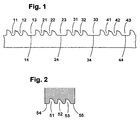
- a bandsaw blade according to the invention is described with reference to figure 1, which shows a side view of the blade, and figure 2 which shows a tool for producing such a sawblade.
- the teeth are arranged in groups, each group comprising the same number of teeth in the range from two to six.
- the figures show groups consisting of three teeth with pitch distances (11,12) which may be different within the group, but are the same in the other groups (21,22,31,32,41,42).
- the pitch distances are measured between the tips of the teeth. This makes it possible to have a simple punching, grinding or milling tool producing one group of teeth for each machine cycle, as shown in figure 2.
- the inter-group pitch distance (13,23,33,43) between the last tooth in one group and the first tooth in the following group is varied along the blade, randomly or according to a predetermined scheme.
- the front and rear slope of the teeth is constant and determined by the punching or milling tool, and the difference in inter-group pitch distance is achieved by varying the length of the gullet bottom (14,24,34,44). To do this, the blade blank is fed forward different amounts between machine cycles in production.
- the production tool can be a grinding wheel, a milling cutter or a punch, and is made with grooves (51,52,53) representing the teeth of the group, and flat stretches (54,55) in front and rear of the tooth group.
- the flat stretches should have basically the same length, and by letting them overlap to small or large extent, gullet bottoms can be produced with lengths between one and two times the length of a flat stretch.
- the length of each flat stretch should be at least equal to the difference between the longest and the shortest inter-group pitch distance. If desired, two consecutive tools can be used to produce the rake and clearance faces separately in order to get a sharper edge, or one tool twice with a short displacement in between.
- the forward feed between machine cycles may be varied to produce varying inter-group pitch distances (13,23,33,43) between groups. It should be avoided, however, to have inter-group pitch distances equal to multiples of the average pitch distanche within the group, since that would cause vibrations.
- a sawblade according to the invention can be easily set with high precision in either of two ways. If setting is done the traditional way one tooth at a time while indexing on a preceding tooth, preferably the leading tooth, and the number of teeth set in each direction within the recurring group is only one, the distance between index and setting anvil is constant and can be accurately adjusted. The same holds if the group contains two teeth set in each direction and the pitch distances are equal within the group, and the same indexing can be used.
- a sawblade according to the invention allows a shorter group and a simpler smaller hammer, while getting the vibration damping characteristic of a much longer group.
- the recurrent group should comprise three or four teeth, one set to each direction and one or two straight. If two straight teeth are used, the leading one of them should have large chamfers and be higher than the other. If the recurrent group has three teeth and five different inter-group distances are used, the vibration damping corresponds to a fifteen tooth group, which is a considerable improvement without production difficulties.
Landscapes
- Engineering & Computer Science (AREA)
- Mechanical Engineering (AREA)
- Milling Processes (AREA)
- Component Parts Of Construction Machinery (AREA)
- Processing Of Stones Or Stones Resemblance Materials (AREA)
- Processing Of Meat And Fish (AREA)
- Harvester Elements (AREA)
- Sawing (AREA)
- Heat Treatment Of Articles (AREA)
Abstract
Description
- The present invention relates to a bandsaw blade according to the preamble of claim 1 and as known for example from US-A-4 311 075.
- It is long known that bandsaws for sawing thick metal should preferably have teeth with different pitch distances, to avoid vibration and corrugation of the cut sides. For reasons related to production and maintenance of the sawblade, the teeth are then produced in recurrent groups, with variations of pitch distances, setting and height within the groups. It is also known that in general the vibration damping and the cutting ability are best if the recurrent group consists of a large number of teeth, often seven or more.
In production of the sawblade the first operation is milling, grinding or punching simultaneously the whole tooth group with the desired pitch distance and height. Very long recurrent groups will then require large milling cutters, heavy milling machinery and very strong clamping of the sawblade. - It is also known from US 4,827,822 that a long six tooth group can be achieved by combining a short recurrent pitch and height group with three teeth with another short recurrent setting group with two teeth. As long as each tooth is individually set this is feasible, but if it is desired to do the setting simultaneously for the setting group of two, the setting hammers will strike the teeth differently because the pitch distance is different and varies according to the pitch and height group.
- The present invention concerns a bandsaw blade with a short recurrent tooth group where the pitch distances, the heights and the setting are equal from one group to another, but the same effect as a very long recurrent group is achieved by varying the intervals between the short groups. This allows setting of the teeth with higher capacity and precision.
- A bandsaw blade according to the invention is described with reference to figure 1, which shows a side view of the blade, and figure 2 which shows a tool for producing such a sawblade.
- The teeth are arranged in groups, each group comprising the same number of teeth in the range from two to six. The figures show groups consisting of three teeth with pitch distances (11,12) which may be different within the group, but are the same in the other groups (21,22,31,32,41,42). The pitch distances are measured between the tips of the teeth. This makes it possible to have a simple punching, grinding or milling tool producing one group of teeth for each machine cycle, as shown in figure 2.
- On the sawblade, the inter-group pitch distance (13,23,33,43) between the last tooth in one group and the first tooth in the following group is varied along the blade, randomly or according to a predetermined scheme. The front and rear slope of the teeth is constant and determined by the punching or milling tool, and the difference in inter-group pitch distance is achieved by varying the length of the gullet bottom (14,24,34,44). To do this, the blade blank is fed forward different amounts between machine cycles in production.
- The production tool can be a grinding wheel, a milling cutter or a punch, and is made with grooves (51,52,53) representing the teeth of the group, and flat stretches (54,55) in front and rear of the tooth group. The flat stretches should have basically the same length, and by letting them overlap to small or large extent, gullet bottoms can be produced with lengths between one and two times the length of a flat stretch. The length of each flat stretch should be at least equal to the difference between the longest and the shortest inter-group pitch distance. If desired, two consecutive tools can be used to produce the rake and clearance faces separately in order to get a sharper edge, or one tool twice with a short displacement in between.
- The forward feed between machine cycles may be varied to produce varying inter-group pitch distances (13,23,33,43) between groups. It should be avoided, however, to have inter-group pitch distances equal to multiples of the average pitch distanche within the group, since that would cause vibrations.
- A sawblade according to the invention can be easily set with high precision in either of two ways. If setting is done the traditional way one tooth at a time while indexing on a preceding tooth, preferably the leading tooth, and the number of teeth set in each direction within the recurring group is only one, the distance between index and setting anvil is constant and can be accurately adjusted. The same holds if the group contains two teeth set in each direction and the pitch distances are equal within the group, and the same indexing can be used.
- If setting is done simultaneously for the whole group of teeth by using a multiple hammer and anvil and indexing on the leading tooth, a sawblade according to the invention allows a shorter group and a simpler smaller hammer, while getting the vibration damping characteristic of a much longer group.
- Preferably, the recurrent group should comprise three or four teeth, one set to each direction and one or two straight. If two straight teeth are used, the leading one of them should have large chamfers and be higher than the other. If the recurrent group has three teeth and five different inter-group distances are used, the vibration damping corresponds to a fifteen tooth group, which is a considerable improvement without production difficulties.
Claims (5)
- Bandsaw blade with teeth in recurrent groups, where all groups contain the same number of teeth, said number being from two to six, and where the teeth within one group have the same heights, setting and pitch distance as corresponding teeth in any other group, characterized by the inter-group pitch distance (13,23,33,43) from the last tooth in one group to the first tooth in the following group being different between successive pairs of groups.
- Bandsaw blade according to claim 1, characterized by the bottom of the gullet between two successive groups comprising a generally flat portion (14,24,34,44) which is at least as long as the difference between the longest and the shortest inter-group pitch distance, and at most twice as long as that.
- Bandsaw blade according to claim 1, characterized by the inter-group pitch distance being chosen sequentially among a limited number of distance values not coinciding with a multiple of the average pitch distance within the group.
- Bandsaw blade according to claim 1, characterized by the inter-group pitch distance being chosen randomly while avoiding distance values coinciding with multiples of the average pitch distance within the group.
- Bandsaw blade according to claim 3 or 4, characterized by the longest inter-group pitch distance (34) being less than twice the length of the shortest inter-group pitch distance (14).
Applications Claiming Priority (2)
| Application Number | Priority Date | Filing Date | Title |
|---|---|---|---|
| US09/058,358 US6119571A (en) | 1998-04-10 | 1998-04-10 | Sawblade having unequal spacing between identical tooth groups |
| US58358 | 1998-04-10 |
Publications (3)
| Publication Number | Publication Date |
|---|---|
| EP0949034A2 EP0949034A2 (en) | 1999-10-13 |
| EP0949034A3 EP0949034A3 (en) | 2001-04-04 |
| EP0949034B1 true EP0949034B1 (en) | 2004-06-23 |
Family
ID=22016334
Family Applications (1)
| Application Number | Title | Priority Date | Filing Date |
|---|---|---|---|
| EP99850045A Expired - Lifetime EP0949034B1 (en) | 1998-04-10 | 1999-03-23 | Sawblade with unequal distance beween tooth groups |
Country Status (5)
| Country | Link |
|---|---|
| US (1) | US6119571A (en) |
| EP (1) | EP0949034B1 (en) |
| JP (1) | JPH11320247A (en) |
| AT (1) | ATE269773T1 (en) |
| DE (1) | DE69918209T2 (en) |
Families Citing this family (29)
| Publication number | Priority date | Publication date | Assignee | Title |
|---|---|---|---|---|
| DE19820431B4 (en) * | 1997-05-08 | 2009-11-19 | Amada Co., Ltd., Isehara | band saw blade |
| DE10063567A1 (en) * | 2000-12-20 | 2002-07-04 | Scintilla Ag | sawblade |
| US7036417B2 (en) * | 2001-11-13 | 2006-05-02 | William George Alton | Bandsaw blade with cutting extensions |
| DE20316149U1 (en) * | 2003-10-18 | 2005-02-24 | Robert Bosch Gmbh | Fret=saw blade, has teeth arranged in groups with increasing numbers of teeth per group towards mounting end of blade |
| US7174823B2 (en) * | 2004-09-22 | 2007-02-13 | Irwin Industrial Tool Company | Saw blade having increased tooth stiffness and resistance to fatigue failure |
| US8210081B2 (en) | 2007-06-12 | 2012-07-03 | Irwin Industrial Tool Company | Reciprocating saw blade having variable-height teeth and related method |
| DE102007054601A1 (en) * | 2007-11-15 | 2009-05-20 | WIKUS-Sägenfabrik Wilhelm H. Kullmann GmbH & Co. KG | Saw blade with a basic body and teeth with cutting edges |
| US8826790B2 (en) * | 2008-07-09 | 2014-09-09 | The L.S. Starrett Company | Saw blade |
| JP5238406B2 (en) * | 2008-08-20 | 2013-07-17 | 株式会社アマダ | Band saw blade |
| EP2564966B1 (en) | 2010-04-22 | 2017-04-12 | Milwaukee Electric Tool Corporation | Saw blade |
| US10189099B2 (en) | 2010-04-22 | 2019-01-29 | Milwaukee Electric Tool Corporation | Saw Blade |
| US9375796B2 (en) | 2010-05-07 | 2016-06-28 | Irwin Industrial Tool Company | Saw blade with robust tooth form |
| DE102010028748A1 (en) | 2010-05-07 | 2011-11-10 | Robert Bosch Gmbh | sawblade |
| USD642028S1 (en) | 2010-05-21 | 2011-07-26 | Irwin Industrial Tool Company | Reciprocating saw blade |
| US9248518B2 (en) | 2010-06-30 | 2016-02-02 | Irwin Industrial Tool Company | Saw blade tooth form for abusive cutting applications |
| US20120042765A1 (en) | 2010-08-20 | 2012-02-23 | Kazda Austin J | Reciprocating saw blade |
| AT510911B1 (en) * | 2010-11-18 | 2013-03-15 | Fill Gmbh | BAND SAW BLADE |
| USD841417S1 (en) | 2011-04-22 | 2019-02-26 | Milwaukee Electric Tool Corporation | Saw blade |
| US20140150620A1 (en) * | 2012-11-30 | 2014-06-05 | Irwin Industrial Tool Company | Saw Blade Having Different Material Teeth and Method of Manufacture |
| CN104339422B (en) * | 2014-10-22 | 2016-07-06 | 东莞市益松数控科技有限公司 | Linearly saw and use its processing method and numerically controlled processing equipment |
| US10625353B2 (en) | 2015-09-01 | 2020-04-21 | Wood-Mizer, Llc | Wood cutting band saw blade having reduced kerf dust |
| EP3370910B1 (en) | 2015-11-02 | 2025-09-10 | Milwaukee Electric Tool Corporation | Saw blade |
| US10926343B2 (en) * | 2016-04-19 | 2021-02-23 | The M. K. Morse Company | Ground set saw blade |
| EP3625012B1 (en) | 2017-05-16 | 2022-07-06 | Milwaukee Electric Tool Corporation | Saw blade |
| CN114985838A (en) * | 2017-05-18 | 2022-09-02 | 米沃奇电动工具公司 | Saw blade and method for manufacturing the same |
| US10537951B2 (en) | 2017-08-16 | 2020-01-21 | Black & Decker Inc. | Band saw blade for cutting structural workpieces |
| US10239138B1 (en) * | 2017-11-06 | 2019-03-26 | FilletZall Holdings, LLC | Reciprocating saw blade for preparing fish |
| US12605781B2 (en) | 2019-01-14 | 2026-04-21 | Black & Decker Inc. | Circular saw blades |
| JP7091483B2 (en) | 2019-06-27 | 2022-06-27 | 湖南泰嘉新材料科技股▲ふん▼有限公司 | Band saw blade |
Family Cites Families (14)
| Publication number | Priority date | Publication date | Assignee | Title |
|---|---|---|---|---|
| US14305A (en) * | 1856-02-26 | Mill-saw | ||
| US154104A (en) * | 1874-08-11 | Improvement in saws | ||
| US82289A (en) * | 1868-09-22 | Benjamin f | ||
| US81413A (en) * | 1868-08-25 | Peters | ||
| US566865A (en) * | 1896-09-01 | John morrish | ||
| US869182A (en) * | 1907-01-29 | 1907-10-22 | Christian F W Buente | Crosscut-saw. |
| US2568870A (en) * | 1945-10-31 | 1951-09-25 | Lerned F Ronan | Saw |
| SE411722B (en) * | 1978-01-12 | 1980-02-04 | Sandvik Ab | MADE TOOLS |
| US4179967A (en) * | 1978-08-28 | 1979-12-25 | Stanadyne, Inc. | Variable tooth saw blade |
| JPS58137520A (en) * | 1982-01-13 | 1983-08-16 | Amada Co Ltd | Band saw blade |
| CA1277573C (en) * | 1985-04-03 | 1990-12-11 | Sumio Yoshida | Saw blade |
| US5606900A (en) * | 1992-05-11 | 1997-03-04 | The L.S. Starrett Company | Variable height, high performance, bandsaw blade and method of manufacture therefor |
| SE500675C2 (en) * | 1992-10-28 | 1994-08-08 | Jan Lundh | Process for producing saw blades, wherein the blank or tool is angled between each operation, and saw blades produced according to the method |
| US5477763A (en) * | 1993-01-12 | 1995-12-26 | Wikus-Sagenfabrik, Wilhelm H. Kullmann | Saw blade |
-
1998
- 1998-04-10 US US09/058,358 patent/US6119571A/en not_active Expired - Fee Related
-
1999
- 1999-03-23 EP EP99850045A patent/EP0949034B1/en not_active Expired - Lifetime
- 1999-03-23 AT AT99850045T patent/ATE269773T1/en not_active IP Right Cessation
- 1999-03-23 DE DE69918209T patent/DE69918209T2/en not_active Expired - Fee Related
- 1999-04-08 JP JP11101239A patent/JPH11320247A/en active Pending
Also Published As
| Publication number | Publication date |
|---|---|
| JPH11320247A (en) | 1999-11-24 |
| DE69918209D1 (en) | 2004-07-29 |
| EP0949034A2 (en) | 1999-10-13 |
| EP0949034A3 (en) | 2001-04-04 |
| ATE269773T1 (en) | 2004-07-15 |
| US6119571A (en) | 2000-09-19 |
| DE69918209T2 (en) | 2005-07-07 |
Similar Documents
| Publication | Publication Date | Title |
|---|---|---|
| EP0949034A2 (en) | Sawblade with unequal distance beween tooth groups | |
| US6220140B1 (en) | Tooth arrangement of metal-cutting bandsaw blade | |
| US7127979B2 (en) | Saw blade for hand-held tools | |
| EP1009600B1 (en) | Improved bandsaw | |
| US6427573B1 (en) | Saw blade tooth form and method therefor | |
| EP1237674B1 (en) | Band saw blade having reduced noise and uniform tooth loading characteristics | |
| US4423553A (en) | Blade for a saw and a method for manufacturing the same | |
| US4727788A (en) | Saw blade | |
| US5603252A (en) | Saw blade | |
| GB2113144A (en) | Saw blade | |
| CA2223613A1 (en) | Improved hole cutting tool | |
| US20030014067A1 (en) | Surgical saw blade | |
| US7178441B2 (en) | Versatile bandsaw blade | |
| EP0669861B1 (en) | Saw blade, and a method and a device for making a saw blade, whereby the tool or blank is angularly displaced between each cut | |
| JP2006510497A5 (en) | ||
| CA2052019C (en) | Variable-tooth saw blades | |
| CN212761509U (en) | Bimetal grinding band saw blade | |
| JPH0724973B2 (en) | Saw blade | |
| SU1039657A1 (en) | Slotter | |
| JPS625730B2 (en) | ||
| US20230249266A1 (en) | Carbide tip hole saw | |
| SU1676798A1 (en) | Circular saw for wood working | |
| RU2120360C1 (en) | Carbide-tipped hobbing cutter | |
| SU1028447A1 (en) | Apparatus for cutting teeth of cylindrical gears | |
| JPH10202426A (en) | Saw blade |
Legal Events
| Date | Code | Title | Description |
|---|---|---|---|
| PUAI | Public reference made under article 153(3) epc to a published international application that has entered the european phase |
Free format text: ORIGINAL CODE: 0009012 |
|
| AK | Designated contracting states |
Kind code of ref document: A2 Designated state(s): AT DE ES FR GB IT SE |
|
| AX | Request for extension of the european patent |
Free format text: AL;LT;LV;MK;RO;SI |
|
| RAP1 | Party data changed (applicant data changed or rights of an application transferred) |
Owner name: KAPMAN AB |
|
| PUAL | Search report despatched |
Free format text: ORIGINAL CODE: 0009013 |
|
| AK | Designated contracting states |
Kind code of ref document: A3 Designated state(s): AT BE CH CY DE DK ES FI FR GB GR IE IT LI LU MC NL PT SE |
|
| AX | Request for extension of the european patent |
Free format text: AL;LT;LV;MK;RO;SI |
|
| RIC1 | Information provided on ipc code assigned before grant |
Free format text: 7B 23D 61/12 A, 7B 23D 61/02 B |
|
| 17P | Request for examination filed |
Effective date: 20011004 |
|
| AKX | Designation fees paid |
Free format text: AT DE ES FR GB IT SE |
|
| GRAP | Despatch of communication of intention to grant a patent |
Free format text: ORIGINAL CODE: EPIDOSNIGR1 |
|
| GRAS | Grant fee paid |
Free format text: ORIGINAL CODE: EPIDOSNIGR3 |
|
| GRAA | (expected) grant |
Free format text: ORIGINAL CODE: 0009210 |
|
| AK | Designated contracting states |
Kind code of ref document: B1 Designated state(s): AT DE ES FR GB IT SE |
|
| PG25 | Lapsed in a contracting state [announced via postgrant information from national office to epo] |
Ref country code: IT Free format text: LAPSE BECAUSE OF FAILURE TO SUBMIT A TRANSLATION OF THE DESCRIPTION OR TO PAY THE FEE WITHIN THE PRESCRIBED TIME-LIMIT;WARNING: LAPSES OF ITALIAN PATENTS WITH EFFECTIVE DATE BEFORE 2007 MAY HAVE OCCURRED AT ANY TIME BEFORE 2007. THE CORRECT EFFECTIVE DATE MAY BE DIFFERENT FROM THE ONE RECORDED. Effective date: 20040623 Ref country code: AT Free format text: LAPSE BECAUSE OF FAILURE TO SUBMIT A TRANSLATION OF THE DESCRIPTION OR TO PAY THE FEE WITHIN THE PRESCRIBED TIME-LIMIT Effective date: 20040623 |
|
| REG | Reference to a national code |
Ref country code: GB Ref legal event code: FG4D |
|
| REF | Corresponds to: |
Ref document number: 69918209 Country of ref document: DE Date of ref document: 20040729 Kind code of ref document: P |
|
| PG25 | Lapsed in a contracting state [announced via postgrant information from national office to epo] |
Ref country code: SE Free format text: LAPSE BECAUSE OF FAILURE TO SUBMIT A TRANSLATION OF THE DESCRIPTION OR TO PAY THE FEE WITHIN THE PRESCRIBED TIME-LIMIT Effective date: 20040923 |
|
| PG25 | Lapsed in a contracting state [announced via postgrant information from national office to epo] |
Ref country code: ES Free format text: LAPSE BECAUSE OF FAILURE TO SUBMIT A TRANSLATION OF THE DESCRIPTION OR TO PAY THE FEE WITHIN THE PRESCRIBED TIME-LIMIT Effective date: 20041004 |
|
| PGFP | Annual fee paid to national office [announced via postgrant information from national office to epo] |
Ref country code: FR Payment date: 20050228 Year of fee payment: 7 |
|
| PGFP | Annual fee paid to national office [announced via postgrant information from national office to epo] |
Ref country code: GB Payment date: 20050303 Year of fee payment: 7 |
|
| PGFP | Annual fee paid to national office [announced via postgrant information from national office to epo] |
Ref country code: DE Payment date: 20050324 Year of fee payment: 7 |
|
| ET | Fr: translation filed | ||
| PLBE | No opposition filed within time limit |
Free format text: ORIGINAL CODE: 0009261 |
|
| STAA | Information on the status of an ep patent application or granted ep patent |
Free format text: STATUS: NO OPPOSITION FILED WITHIN TIME LIMIT |
|
| 26N | No opposition filed |
Effective date: 20050324 |
|
| PG25 | Lapsed in a contracting state [announced via postgrant information from national office to epo] |
Ref country code: GB Free format text: LAPSE BECAUSE OF NON-PAYMENT OF DUE FEES Effective date: 20060323 |
|
| PG25 | Lapsed in a contracting state [announced via postgrant information from national office to epo] |
Ref country code: DE Free format text: LAPSE BECAUSE OF NON-PAYMENT OF DUE FEES Effective date: 20061003 |
|
| GBPC | Gb: european patent ceased through non-payment of renewal fee |
Effective date: 20060323 |
|
| REG | Reference to a national code |
Ref country code: FR Ref legal event code: ST Effective date: 20061130 |
|
| PG25 | Lapsed in a contracting state [announced via postgrant information from national office to epo] |
Ref country code: FR Free format text: LAPSE BECAUSE OF NON-PAYMENT OF DUE FEES Effective date: 20060331 |