EP0947519B1 - Water-base lubricant containing sulfur as coordinate atom, and use thereof - Google Patents
Water-base lubricant containing sulfur as coordinate atom, and use thereof Download PDFInfo
- Publication number
- EP0947519B1 EP0947519B1 EP97912498A EP97912498A EP0947519B1 EP 0947519 B1 EP0947519 B1 EP 0947519B1 EP 97912498 A EP97912498 A EP 97912498A EP 97912498 A EP97912498 A EP 97912498A EP 0947519 B1 EP0947519 B1 EP 0947519B1
- Authority
- EP
- European Patent Office
- Prior art keywords
- metal
- ligand
- sulfur
- zinc
- aqueous lubricant
- Prior art date
- Legal status (The legal status is an assumption and is not a legal conclusion. Google has not performed a legal analysis and makes no representation as to the accuracy of the status listed.)
- Expired - Lifetime
Links
- 239000000314 lubricant Substances 0.000 title claims description 57
- 229910052717 sulfur Inorganic materials 0.000 title claims description 46
- 239000011593 sulfur Substances 0.000 title claims description 46
- NINIDFKCEFEMDL-UHFFFAOYSA-N Sulfur Chemical compound [S] NINIDFKCEFEMDL-UHFFFAOYSA-N 0.000 title claims description 43
- 229910052751 metal Inorganic materials 0.000 claims description 107
- 239000002184 metal Substances 0.000 claims description 107
- 239000013522 chelant Substances 0.000 claims description 93
- 239000003446 ligand Substances 0.000 claims description 69
- 150000001875 compounds Chemical class 0.000 claims description 54
- 230000001050 lubricating effect Effects 0.000 claims description 47
- NBIIXXVUZAFLBC-UHFFFAOYSA-K phosphate Chemical compound [O-]P([O-])([O-])=O NBIIXXVUZAFLBC-UHFFFAOYSA-K 0.000 claims description 45
- 229910019142 PO4 Inorganic materials 0.000 claims description 44
- 239000010452 phosphate Substances 0.000 claims description 44
- XEEYBQQBJWHFJM-UHFFFAOYSA-N Iron Chemical compound [Fe] XEEYBQQBJWHFJM-UHFFFAOYSA-N 0.000 claims description 42
- 238000000034 method Methods 0.000 claims description 29
- HCHKCACWOHOZIP-UHFFFAOYSA-N Zinc Chemical compound [Zn] HCHKCACWOHOZIP-UHFFFAOYSA-N 0.000 claims description 28
- 229910052725 zinc Inorganic materials 0.000 claims description 27
- 239000011701 zinc Substances 0.000 claims description 27
- XLYOFNOQVPJJNP-UHFFFAOYSA-N water Substances O XLYOFNOQVPJJNP-UHFFFAOYSA-N 0.000 claims description 26
- 229910052742 iron Inorganic materials 0.000 claims description 25
- -1 iron ion Chemical class 0.000 claims description 24
- 239000007769 metal material Substances 0.000 claims description 22
- 239000012190 activator Substances 0.000 claims description 17
- ZOKXTWBITQBERF-UHFFFAOYSA-N Molybdenum Chemical compound [Mo] ZOKXTWBITQBERF-UHFFFAOYSA-N 0.000 claims description 16
- 239000002253 acid Substances 0.000 claims description 16
- 239000011733 molybdenum Substances 0.000 claims description 16
- 229910052750 molybdenum Inorganic materials 0.000 claims description 16
- 230000008569 process Effects 0.000 claims description 16
- 239000007864 aqueous solution Substances 0.000 claims description 14
- 239000004033 plastic Substances 0.000 claims description 14
- ATJFFYVFTNAWJD-UHFFFAOYSA-N Tin Chemical compound [Sn] ATJFFYVFTNAWJD-UHFFFAOYSA-N 0.000 claims description 13
- 229910052718 tin Inorganic materials 0.000 claims description 13
- 229910052787 antimony Inorganic materials 0.000 claims description 12
- WATWJIUSRGPENY-UHFFFAOYSA-N antimony atom Chemical compound [Sb] WATWJIUSRGPENY-UHFFFAOYSA-N 0.000 claims description 12
- WPBNNNQJVZRUHP-UHFFFAOYSA-L manganese(2+);methyl n-[[2-(methoxycarbonylcarbamothioylamino)phenyl]carbamothioyl]carbamate;n-[2-(sulfidocarbothioylamino)ethyl]carbamodithioate Chemical compound [Mn+2].[S-]C(=S)NCCNC([S-])=S.COC(=O)NC(=S)NC1=CC=CC=C1NC(=S)NC(=O)OC WPBNNNQJVZRUHP-UHFFFAOYSA-L 0.000 claims description 12
- 150000003839 salts Chemical class 0.000 claims description 11
- 239000011135 tin Substances 0.000 claims description 11
- PTFCDOFLOPIGGS-UHFFFAOYSA-N Zinc dication Chemical compound [Zn+2] PTFCDOFLOPIGGS-UHFFFAOYSA-N 0.000 claims description 8
- 238000001035 drying Methods 0.000 claims description 8
- 238000000465 moulding Methods 0.000 claims description 8
- XLYOFNOQVPJJNP-UHFFFAOYSA-M hydroxide Chemical compound [OH-] XLYOFNOQVPJJNP-UHFFFAOYSA-M 0.000 claims description 7
- 150000003013 phosphoric acid derivatives Chemical class 0.000 claims description 6
- 238000011049 filling Methods 0.000 claims description 2
- 239000007787 solid Substances 0.000 claims 2
- 125000004429 atom Chemical group 0.000 description 32
- 239000000126 substance Substances 0.000 description 21
- 238000011282 treatment Methods 0.000 description 15
- 239000003921 oil Substances 0.000 description 13
- HEMHJVSKTPXQMS-UHFFFAOYSA-M Sodium hydroxide Chemical compound [OH-].[Na+] HEMHJVSKTPXQMS-UHFFFAOYSA-M 0.000 description 12
- 125000000129 anionic group Chemical group 0.000 description 12
- 239000000463 material Substances 0.000 description 12
- 239000000725 suspension Substances 0.000 description 12
- 150000002739 metals Chemical class 0.000 description 10
- 239000000243 solution Substances 0.000 description 10
- 238000003756 stirring Methods 0.000 description 10
- 125000000217 alkyl group Chemical group 0.000 description 7
- 239000000203 mixture Substances 0.000 description 7
- 235000019832 sodium triphosphate Nutrition 0.000 description 7
- 125000004432 carbon atom Chemical group C* 0.000 description 6
- 239000006185 dispersion Substances 0.000 description 6
- 239000000344 soap Substances 0.000 description 6
- HNUALPPJLMYHDK-UHFFFAOYSA-N C[CH]C Chemical compound C[CH]C HNUALPPJLMYHDK-UHFFFAOYSA-N 0.000 description 5
- 239000003945 anionic surfactant Substances 0.000 description 5
- 125000000484 butyl group Chemical group [H]C([*])([H])C([H])([H])C([H])([H])C([H])([H])[H] 0.000 description 5
- 230000000052 comparative effect Effects 0.000 description 5
- 238000004519 manufacturing process Methods 0.000 description 5
- 239000002736 nonionic surfactant Substances 0.000 description 5
- 239000002244 precipitate Substances 0.000 description 5
- RYYKJJJTJZKILX-UHFFFAOYSA-M sodium octadecanoate Chemical compound [Na+].CCCCCCCCCCCCCCCCCC([O-])=O RYYKJJJTJZKILX-UHFFFAOYSA-M 0.000 description 5
- RZLVQBNCHSJZPX-UHFFFAOYSA-L zinc sulfate heptahydrate Chemical compound O.O.O.O.O.O.O.[Zn+2].[O-]S([O-])(=O)=O RZLVQBNCHSJZPX-UHFFFAOYSA-L 0.000 description 5
- IIVWHGMLFGNMOW-UHFFFAOYSA-N 2-methylpropane Chemical compound C[C](C)C IIVWHGMLFGNMOW-UHFFFAOYSA-N 0.000 description 4
- KTOQRRDVVIDEAA-UHFFFAOYSA-N 2-methylpropane Chemical compound [CH2]C(C)C KTOQRRDVVIDEAA-UHFFFAOYSA-N 0.000 description 4
- 238000011109 contamination Methods 0.000 description 4
- 235000014113 dietary fatty acids Nutrition 0.000 description 4
- 229950004394 ditiocarb Drugs 0.000 description 4
- 239000000194 fatty acid Substances 0.000 description 4
- 229930195729 fatty acid Natural products 0.000 description 4
- WWGXHTXOZKVJDN-UHFFFAOYSA-M sodium;n,n-diethylcarbamodithioate;trihydrate Chemical compound O.O.O.[Na+].CCN(CC)C([S-])=S WWGXHTXOZKVJDN-UHFFFAOYSA-M 0.000 description 4
- QGZKDVFQNNGYKY-UHFFFAOYSA-N Ammonia Chemical class N QGZKDVFQNNGYKY-UHFFFAOYSA-N 0.000 description 3
- 239000002671 adjuvant Substances 0.000 description 3
- 230000008901 benefit Effects 0.000 description 3
- 230000015572 biosynthetic process Effects 0.000 description 3
- 239000011248 coating agent Substances 0.000 description 3
- 238000000576 coating method Methods 0.000 description 3
- 238000005238 degreasing Methods 0.000 description 3
- 230000000694 effects Effects 0.000 description 3
- 125000000956 methoxy group Chemical group [H]C([H])([H])O* 0.000 description 3
- 229910052760 oxygen Inorganic materials 0.000 description 3
- 239000001301 oxygen Substances 0.000 description 3
- 230000009467 reduction Effects 0.000 description 3
- 239000011734 sodium Substances 0.000 description 3
- 229910052708 sodium Inorganic materials 0.000 description 3
- 239000004094 surface-active agent Substances 0.000 description 3
- 238000012360 testing method Methods 0.000 description 3
- 238000005406 washing Methods 0.000 description 3
- RKQOSDAEEGPRER-UHFFFAOYSA-L zinc diethyldithiocarbamate Chemical compound [Zn+2].CCN(CC)C([S-])=S.CCN(CC)C([S-])=S RKQOSDAEEGPRER-UHFFFAOYSA-L 0.000 description 3
- DGAQECJNVWCQMB-PUAWFVPOSA-M Ilexoside XXIX Chemical compound C[C@@H]1CC[C@@]2(CC[C@@]3(C(=CC[C@H]4[C@]3(CC[C@@H]5[C@@]4(CC[C@@H](C5(C)C)OS(=O)(=O)[O-])C)C)[C@@H]2[C@]1(C)O)C)C(=O)O[C@H]6[C@@H]([C@H]([C@@H]([C@H](O6)CO)O)O)O.[Na+] DGAQECJNVWCQMB-PUAWFVPOSA-M 0.000 description 2
- IOEJYZSZYUROLN-UHFFFAOYSA-M Sodium diethyldithiocarbamate Chemical compound [Na+].CCN(CC)C([S-])=S IOEJYZSZYUROLN-UHFFFAOYSA-M 0.000 description 2
- 239000003568 Sodium, potassium and calcium salts of fatty acids Substances 0.000 description 2
- XLOMVQKBTHCTTD-UHFFFAOYSA-N Zinc monoxide Chemical compound [Zn]=O XLOMVQKBTHCTTD-UHFFFAOYSA-N 0.000 description 2
- 230000002378 acidificating effect Effects 0.000 description 2
- 239000000654 additive Substances 0.000 description 2
- 238000000354 decomposition reaction Methods 0.000 description 2
- SZRLKIKBPASKQH-UHFFFAOYSA-M dibutyldithiocarbamate Chemical compound CCCCN(C([S-])=S)CCCC SZRLKIKBPASKQH-UHFFFAOYSA-M 0.000 description 2
- 239000010419 fine particle Substances 0.000 description 2
- 230000002209 hydrophobic effect Effects 0.000 description 2
- 239000010687 lubricating oil Substances 0.000 description 2
- 238000005461 lubrication Methods 0.000 description 2
- 229910021645 metal ion Inorganic materials 0.000 description 2
- 229910052976 metal sulfide Inorganic materials 0.000 description 2
- 239000003960 organic solvent Substances 0.000 description 2
- 238000010422 painting Methods 0.000 description 2
- 238000001556 precipitation Methods 0.000 description 2
- 238000005507 spraying Methods 0.000 description 2
- 229940007718 zinc hydroxide Drugs 0.000 description 2
- 229910021511 zinc hydroxide Inorganic materials 0.000 description 2
- LRXTYHSAJDENHV-UHFFFAOYSA-H zinc phosphate Chemical compound [Zn+2].[Zn+2].[Zn+2].[O-]P([O-])([O-])=O.[O-]P([O-])([O-])=O LRXTYHSAJDENHV-UHFFFAOYSA-H 0.000 description 2
- 229910000165 zinc phosphate Inorganic materials 0.000 description 2
- GFYUFTPCZWQPOC-UHFFFAOYSA-L zinc;diethylcarbamodithioic acid;[hydroxy(phosphonooxy)phosphoryl] phosphate Chemical compound [Zn+2].CCN(CC)C(S)=S.OP(O)(=O)OP(O)(=O)OP([O-])([O-])=O GFYUFTPCZWQPOC-UHFFFAOYSA-L 0.000 description 2
- RYHBNJHYFVUHQT-UHFFFAOYSA-N 1,4-Dioxane Chemical compound C1COCCO1 RYHBNJHYFVUHQT-UHFFFAOYSA-N 0.000 description 1
- WEYSQARHSRZNTC-UHFFFAOYSA-N 1h-benzimidazol-2-ylcarbamic acid Chemical class C1=CC=C2NC(NC(=O)O)=NC2=C1 WEYSQARHSRZNTC-UHFFFAOYSA-N 0.000 description 1
- QRNATDQRFAUDKF-UHFFFAOYSA-N 2-carbamothioylsulfanylethyl carbamodithioate Chemical class NC(=S)SCCSC(N)=S QRNATDQRFAUDKF-UHFFFAOYSA-N 0.000 description 1
- 229910000851 Alloy steel Inorganic materials 0.000 description 1
- 0 C*(C*)NC(SC)=S Chemical compound C*(C*)NC(SC)=S 0.000 description 1
- 206010010904 Convulsion Diseases 0.000 description 1
- 229910000640 Fe alloy Inorganic materials 0.000 description 1
- 229910001335 Galvanized steel Inorganic materials 0.000 description 1
- PWHULOQIROXLJO-UHFFFAOYSA-N Manganese Chemical group [Mn] PWHULOQIROXLJO-UHFFFAOYSA-N 0.000 description 1
- 239000004721 Polyphenylene oxide Substances 0.000 description 1
- 230000000996 additive effect Effects 0.000 description 1
- 239000000853 adhesive Substances 0.000 description 1
- 230000001070 adhesive effect Effects 0.000 description 1
- 238000013019 agitation Methods 0.000 description 1
- 150000001298 alcohols Chemical class 0.000 description 1
- 125000005263 alkylenediamine group Chemical group 0.000 description 1
- 229910052782 aluminium Inorganic materials 0.000 description 1
- XAGFODPZIPBFFR-UHFFFAOYSA-N aluminium Chemical compound [Al] XAGFODPZIPBFFR-UHFFFAOYSA-N 0.000 description 1
- 229910021529 ammonia Inorganic materials 0.000 description 1
- 239000002518 antifoaming agent Substances 0.000 description 1
- FAWGZAFXDJGWBB-UHFFFAOYSA-N antimony(3+) Chemical compound [Sb+3] FAWGZAFXDJGWBB-UHFFFAOYSA-N 0.000 description 1
- ZDINGUUTWDGGFF-UHFFFAOYSA-N antimony(5+) Chemical compound [Sb+5] ZDINGUUTWDGGFF-UHFFFAOYSA-N 0.000 description 1
- QGJOPFRUJISHPQ-NJFSPNSNSA-N carbon disulfide-14c Chemical compound S=[14C]=S QGJOPFRUJISHPQ-NJFSPNSNSA-N 0.000 description 1
- 125000003178 carboxy group Chemical group [H]OC(*)=O 0.000 description 1
- 230000008859 change Effects 0.000 description 1
- 239000002738 chelating agent Substances 0.000 description 1
- 238000006243 chemical reaction Methods 0.000 description 1
- 239000003795 chemical substances by application Substances 0.000 description 1
- 239000008199 coating composition Substances 0.000 description 1
- 239000012141 concentrate Substances 0.000 description 1
- 239000002270 dispersing agent Substances 0.000 description 1
- 238000010894 electron beam technology Methods 0.000 description 1
- 239000003995 emulsifying agent Substances 0.000 description 1
- 150000002118 epoxides Chemical class 0.000 description 1
- 238000001125 extrusion Methods 0.000 description 1
- 239000003063 flame retardant Substances 0.000 description 1
- 239000012530 fluid Substances 0.000 description 1
- 238000005242 forging Methods 0.000 description 1
- 239000000417 fungicide Substances 0.000 description 1
- 239000008397 galvanized steel Substances 0.000 description 1
- 238000010438 heat treatment Methods 0.000 description 1
- 125000004435 hydrogen atom Chemical group [H]* 0.000 description 1
- 230000007062 hydrolysis Effects 0.000 description 1
- 238000006460 hydrolysis reaction Methods 0.000 description 1
- 238000007654 immersion Methods 0.000 description 1
- 229910052500 inorganic mineral Inorganic materials 0.000 description 1
- 239000000797 iron chelating agent Substances 0.000 description 1
- 229940075525 iron chelating agent Drugs 0.000 description 1
- 229910000398 iron phosphate Inorganic materials 0.000 description 1
- WBJZTOZJJYAKHQ-UHFFFAOYSA-K iron(3+) phosphate Chemical compound [Fe+3].[O-]P([O-])([O-])=O WBJZTOZJJYAKHQ-UHFFFAOYSA-K 0.000 description 1
- 150000002576 ketones Chemical class 0.000 description 1
- 239000010410 layer Substances 0.000 description 1
- 229910052748 manganese Inorganic materials 0.000 description 1
- 239000011572 manganese Substances 0.000 description 1
- 238000005555 metalworking Methods 0.000 description 1
- 239000011707 mineral Substances 0.000 description 1
- 235000010755 mineral Nutrition 0.000 description 1
- 239000002480 mineral oil Substances 0.000 description 1
- 235000010446 mineral oil Nutrition 0.000 description 1
- 239000003595 mist Substances 0.000 description 1
- MEFBJEMVZONFCJ-UHFFFAOYSA-N molybdate Chemical compound [O-][Mo]([O-])(=O)=O MEFBJEMVZONFCJ-UHFFFAOYSA-N 0.000 description 1
- 150000002751 molybdenum Chemical class 0.000 description 1
- KHYKFSXXGRUKRE-UHFFFAOYSA-J molybdenum(4+) tetracarbamodithioate Chemical compound C(N)([S-])=S.[Mo+4].C(N)([S-])=S.C(N)([S-])=S.C(N)([S-])=S KHYKFSXXGRUKRE-UHFFFAOYSA-J 0.000 description 1
- 229920000570 polyether Polymers 0.000 description 1
- 229920005862 polyol Polymers 0.000 description 1
- 150000003077 polyols Chemical class 0.000 description 1
- 239000011591 potassium Substances 0.000 description 1
- 229910052700 potassium Inorganic materials 0.000 description 1
- 235000013966 potassium salts of fatty acid Nutrition 0.000 description 1
- 239000003755 preservative agent Substances 0.000 description 1
- 238000003825 pressing Methods 0.000 description 1
- 239000000047 product Substances 0.000 description 1
- 239000011241 protective layer Substances 0.000 description 1
- 238000005096 rolling process Methods 0.000 description 1
- 235000013875 sodium salts of fatty acid Nutrition 0.000 description 1
- 239000010959 steel Substances 0.000 description 1
- 238000003860 storage Methods 0.000 description 1
- QAOWNCQODCNURD-UHFFFAOYSA-N sulfuric acid Substances OS(O)(=O)=O QAOWNCQODCNURD-UHFFFAOYSA-N 0.000 description 1
- 238000004381 surface treatment Methods 0.000 description 1
- 230000002195 synergetic effect Effects 0.000 description 1
- UNXRWKVEANCORM-UHFFFAOYSA-I triphosphate(5-) Chemical compound [O-]P([O-])(=O)OP([O-])(=O)OP([O-])([O-])=O UNXRWKVEANCORM-UHFFFAOYSA-I 0.000 description 1
- WMYJOZQKDZZHAC-UHFFFAOYSA-H trizinc;dioxido-sulfanylidene-sulfido-$l^{5}-phosphane Chemical compound [Zn+2].[Zn+2].[Zn+2].[O-]P([O-])([S-])=S.[O-]P([O-])([S-])=S WMYJOZQKDZZHAC-UHFFFAOYSA-H 0.000 description 1
- PBYZMCDFOULPGH-UHFFFAOYSA-N tungstate Chemical compound [O-][W]([O-])(=O)=O PBYZMCDFOULPGH-UHFFFAOYSA-N 0.000 description 1
- 238000003466 welding Methods 0.000 description 1
- 150000003751 zinc Chemical class 0.000 description 1
- 239000011787 zinc oxide Substances 0.000 description 1
- 235000014692 zinc oxide Nutrition 0.000 description 1
- MBBWTVUFIXOUBE-UHFFFAOYSA-L zinc;dicarbamodithioate Chemical class [Zn+2].NC([S-])=S.NC([S-])=S MBBWTVUFIXOUBE-UHFFFAOYSA-L 0.000 description 1
- QGDIJZMKEQCRBX-UHFFFAOYSA-N zinc;ethene Chemical group [Zn+2].[CH-]=C.[CH-]=C QGDIJZMKEQCRBX-UHFFFAOYSA-N 0.000 description 1
- 239000004711 α-olefin Substances 0.000 description 1
Classifications
-
- C—CHEMISTRY; METALLURGY
- C10—PETROLEUM, GAS OR COKE INDUSTRIES; TECHNICAL GASES CONTAINING CARBON MONOXIDE; FUELS; LUBRICANTS; PEAT
- C10M—LUBRICATING COMPOSITIONS; USE OF CHEMICAL SUBSTANCES EITHER ALONE OR AS LUBRICATING INGREDIENTS IN A LUBRICATING COMPOSITION
- C10M173/00—Lubricating compositions containing more than 10% water
- C10M173/02—Lubricating compositions containing more than 10% water not containing mineral or fatty oils
-
- C—CHEMISTRY; METALLURGY
- C10—PETROLEUM, GAS OR COKE INDUSTRIES; TECHNICAL GASES CONTAINING CARBON MONOXIDE; FUELS; LUBRICANTS; PEAT
- C10M—LUBRICATING COMPOSITIONS; USE OF CHEMICAL SUBSTANCES EITHER ALONE OR AS LUBRICATING INGREDIENTS IN A LUBRICATING COMPOSITION
- C10M135/00—Lubricating compositions characterised by the additive being an organic non-macromolecular compound containing sulfur, selenium or tellurium
- C10M135/12—Thio-acids; Thiocyanates; Derivatives thereof
- C10M135/14—Thio-acids; Thiocyanates; Derivatives thereof having a carbon-to-sulfur double bond
- C10M135/18—Thio-acids; Thiocyanates; Derivatives thereof having a carbon-to-sulfur double bond thiocarbamic type, e.g. containing the groups
-
- C—CHEMISTRY; METALLURGY
- C10—PETROLEUM, GAS OR COKE INDUSTRIES; TECHNICAL GASES CONTAINING CARBON MONOXIDE; FUELS; LUBRICANTS; PEAT
- C10M—LUBRICATING COMPOSITIONS; USE OF CHEMICAL SUBSTANCES EITHER ALONE OR AS LUBRICATING INGREDIENTS IN A LUBRICATING COMPOSITION
- C10M159/00—Lubricating compositions characterised by the additive being of unknown or incompletely defined constitution
- C10M159/12—Reaction products
- C10M159/18—Complexes with metals
-
- C—CHEMISTRY; METALLURGY
- C10—PETROLEUM, GAS OR COKE INDUSTRIES; TECHNICAL GASES CONTAINING CARBON MONOXIDE; FUELS; LUBRICANTS; PEAT
- C10M—LUBRICATING COMPOSITIONS; USE OF CHEMICAL SUBSTANCES EITHER ALONE OR AS LUBRICATING INGREDIENTS IN A LUBRICATING COMPOSITION
- C10M2201/00—Inorganic compounds or elements as ingredients in lubricant compositions
- C10M2201/02—Water
-
- C—CHEMISTRY; METALLURGY
- C10—PETROLEUM, GAS OR COKE INDUSTRIES; TECHNICAL GASES CONTAINING CARBON MONOXIDE; FUELS; LUBRICANTS; PEAT
- C10M—LUBRICATING COMPOSITIONS; USE OF CHEMICAL SUBSTANCES EITHER ALONE OR AS LUBRICATING INGREDIENTS IN A LUBRICATING COMPOSITION
- C10M2207/00—Organic non-macromolecular hydrocarbon compounds containing hydrogen, carbon and oxygen as ingredients in lubricant compositions
- C10M2207/09—Metal enolates, i.e. keto-enol metal complexes
-
- C—CHEMISTRY; METALLURGY
- C10—PETROLEUM, GAS OR COKE INDUSTRIES; TECHNICAL GASES CONTAINING CARBON MONOXIDE; FUELS; LUBRICANTS; PEAT
- C10M—LUBRICATING COMPOSITIONS; USE OF CHEMICAL SUBSTANCES EITHER ALONE OR AS LUBRICATING INGREDIENTS IN A LUBRICATING COMPOSITION
- C10M2219/00—Organic non-macromolecular compounds containing sulfur, selenium or tellurium as ingredients in lubricant compositions
- C10M2219/06—Thio-acids; Thiocyanates; Derivatives thereof
- C10M2219/062—Thio-acids; Thiocyanates; Derivatives thereof having carbon-to-sulfur double bonds
- C10M2219/066—Thiocarbamic type compounds
- C10M2219/068—Thiocarbamate metal salts
-
- C—CHEMISTRY; METALLURGY
- C10—PETROLEUM, GAS OR COKE INDUSTRIES; TECHNICAL GASES CONTAINING CARBON MONOXIDE; FUELS; LUBRICANTS; PEAT
- C10M—LUBRICATING COMPOSITIONS; USE OF CHEMICAL SUBSTANCES EITHER ALONE OR AS LUBRICATING INGREDIENTS IN A LUBRICATING COMPOSITION
- C10M2227/00—Organic non-macromolecular compounds containing atoms of elements not provided for in groups C10M2203/00, C10M2207/00, C10M2211/00, C10M2215/00, C10M2219/00 or C10M2223/00 as ingredients in lubricant compositions
- C10M2227/09—Complexes with metals
-
- C—CHEMISTRY; METALLURGY
- C10—PETROLEUM, GAS OR COKE INDUSTRIES; TECHNICAL GASES CONTAINING CARBON MONOXIDE; FUELS; LUBRICANTS; PEAT
- C10N—INDEXING SCHEME ASSOCIATED WITH SUBCLASS C10M RELATING TO LUBRICATING COMPOSITIONS
- C10N2010/00—Metal present as such or in compounds
- C10N2010/04—Groups 2 or 12
-
- C—CHEMISTRY; METALLURGY
- C10—PETROLEUM, GAS OR COKE INDUSTRIES; TECHNICAL GASES CONTAINING CARBON MONOXIDE; FUELS; LUBRICANTS; PEAT
- C10N—INDEXING SCHEME ASSOCIATED WITH SUBCLASS C10M RELATING TO LUBRICATING COMPOSITIONS
- C10N2010/00—Metal present as such or in compounds
- C10N2010/08—Groups 4 or 14
-
- C—CHEMISTRY; METALLURGY
- C10—PETROLEUM, GAS OR COKE INDUSTRIES; TECHNICAL GASES CONTAINING CARBON MONOXIDE; FUELS; LUBRICANTS; PEAT
- C10N—INDEXING SCHEME ASSOCIATED WITH SUBCLASS C10M RELATING TO LUBRICATING COMPOSITIONS
- C10N2010/00—Metal present as such or in compounds
- C10N2010/10—Groups 5 or 15
-
- C—CHEMISTRY; METALLURGY
- C10—PETROLEUM, GAS OR COKE INDUSTRIES; TECHNICAL GASES CONTAINING CARBON MONOXIDE; FUELS; LUBRICANTS; PEAT
- C10N—INDEXING SCHEME ASSOCIATED WITH SUBCLASS C10M RELATING TO LUBRICATING COMPOSITIONS
- C10N2010/00—Metal present as such or in compounds
- C10N2010/12—Groups 6 or 16
-
- C—CHEMISTRY; METALLURGY
- C10—PETROLEUM, GAS OR COKE INDUSTRIES; TECHNICAL GASES CONTAINING CARBON MONOXIDE; FUELS; LUBRICANTS; PEAT
- C10N—INDEXING SCHEME ASSOCIATED WITH SUBCLASS C10M RELATING TO LUBRICATING COMPOSITIONS
- C10N2010/00—Metal present as such or in compounds
- C10N2010/14—Group 7
-
- C—CHEMISTRY; METALLURGY
- C10—PETROLEUM, GAS OR COKE INDUSTRIES; TECHNICAL GASES CONTAINING CARBON MONOXIDE; FUELS; LUBRICANTS; PEAT
- C10N—INDEXING SCHEME ASSOCIATED WITH SUBCLASS C10M RELATING TO LUBRICATING COMPOSITIONS
- C10N2010/00—Metal present as such or in compounds
- C10N2010/16—Groups 8, 9, or 10
-
- C—CHEMISTRY; METALLURGY
- C10—PETROLEUM, GAS OR COKE INDUSTRIES; TECHNICAL GASES CONTAINING CARBON MONOXIDE; FUELS; LUBRICANTS; PEAT
- C10N—INDEXING SCHEME ASSOCIATED WITH SUBCLASS C10M RELATING TO LUBRICATING COMPOSITIONS
- C10N2040/00—Specified use or application for which the lubricating composition is intended
- C10N2040/20—Metal working
-
- C—CHEMISTRY; METALLURGY
- C10—PETROLEUM, GAS OR COKE INDUSTRIES; TECHNICAL GASES CONTAINING CARBON MONOXIDE; FUELS; LUBRICANTS; PEAT
- C10N—INDEXING SCHEME ASSOCIATED WITH SUBCLASS C10M RELATING TO LUBRICATING COMPOSITIONS
- C10N2040/00—Specified use or application for which the lubricating composition is intended
- C10N2040/20—Metal working
- C10N2040/24—Metal working without essential removal of material, e.g. forming, gorging, drawing, pressing, stamping, rolling or extruding; Punching metal
-
- C—CHEMISTRY; METALLURGY
- C10—PETROLEUM, GAS OR COKE INDUSTRIES; TECHNICAL GASES CONTAINING CARBON MONOXIDE; FUELS; LUBRICANTS; PEAT
- C10N—INDEXING SCHEME ASSOCIATED WITH SUBCLASS C10M RELATING TO LUBRICATING COMPOSITIONS
- C10N2040/00—Specified use or application for which the lubricating composition is intended
- C10N2040/20—Metal working
- C10N2040/241—Manufacturing joint-less pipes
-
- C—CHEMISTRY; METALLURGY
- C10—PETROLEUM, GAS OR COKE INDUSTRIES; TECHNICAL GASES CONTAINING CARBON MONOXIDE; FUELS; LUBRICANTS; PEAT
- C10N—INDEXING SCHEME ASSOCIATED WITH SUBCLASS C10M RELATING TO LUBRICATING COMPOSITIONS
- C10N2040/00—Specified use or application for which the lubricating composition is intended
- C10N2040/20—Metal working
- C10N2040/242—Hot working
-
- C—CHEMISTRY; METALLURGY
- C10—PETROLEUM, GAS OR COKE INDUSTRIES; TECHNICAL GASES CONTAINING CARBON MONOXIDE; FUELS; LUBRICANTS; PEAT
- C10N—INDEXING SCHEME ASSOCIATED WITH SUBCLASS C10M RELATING TO LUBRICATING COMPOSITIONS
- C10N2040/00—Specified use or application for which the lubricating composition is intended
- C10N2040/20—Metal working
- C10N2040/243—Cold working
-
- C—CHEMISTRY; METALLURGY
- C10—PETROLEUM, GAS OR COKE INDUSTRIES; TECHNICAL GASES CONTAINING CARBON MONOXIDE; FUELS; LUBRICANTS; PEAT
- C10N—INDEXING SCHEME ASSOCIATED WITH SUBCLASS C10M RELATING TO LUBRICATING COMPOSITIONS
- C10N2040/00—Specified use or application for which the lubricating composition is intended
- C10N2040/20—Metal working
- C10N2040/244—Metal working of specific metals
-
- C—CHEMISTRY; METALLURGY
- C10—PETROLEUM, GAS OR COKE INDUSTRIES; TECHNICAL GASES CONTAINING CARBON MONOXIDE; FUELS; LUBRICANTS; PEAT
- C10N—INDEXING SCHEME ASSOCIATED WITH SUBCLASS C10M RELATING TO LUBRICATING COMPOSITIONS
- C10N2040/00—Specified use or application for which the lubricating composition is intended
- C10N2040/20—Metal working
- C10N2040/244—Metal working of specific metals
- C10N2040/245—Soft metals, e.g. aluminum
-
- C—CHEMISTRY; METALLURGY
- C10—PETROLEUM, GAS OR COKE INDUSTRIES; TECHNICAL GASES CONTAINING CARBON MONOXIDE; FUELS; LUBRICANTS; PEAT
- C10N—INDEXING SCHEME ASSOCIATED WITH SUBCLASS C10M RELATING TO LUBRICATING COMPOSITIONS
- C10N2040/00—Specified use or application for which the lubricating composition is intended
- C10N2040/20—Metal working
- C10N2040/244—Metal working of specific metals
- C10N2040/246—Iron or steel
-
- C—CHEMISTRY; METALLURGY
- C10—PETROLEUM, GAS OR COKE INDUSTRIES; TECHNICAL GASES CONTAINING CARBON MONOXIDE; FUELS; LUBRICANTS; PEAT
- C10N—INDEXING SCHEME ASSOCIATED WITH SUBCLASS C10M RELATING TO LUBRICATING COMPOSITIONS
- C10N2040/00—Specified use or application for which the lubricating composition is intended
- C10N2040/20—Metal working
- C10N2040/244—Metal working of specific metals
- C10N2040/247—Stainless steel
-
- C—CHEMISTRY; METALLURGY
- C10—PETROLEUM, GAS OR COKE INDUSTRIES; TECHNICAL GASES CONTAINING CARBON MONOXIDE; FUELS; LUBRICANTS; PEAT
- C10N—INDEXING SCHEME ASSOCIATED WITH SUBCLASS C10M RELATING TO LUBRICATING COMPOSITIONS
- C10N2050/00—Form in which the lubricant is applied to the material being lubricated
- C10N2050/01—Emulsions, colloids, or micelles
Definitions
- the present invention relates to aqueous lubricants that are coated onto either the surface of a metal material or the molding surface of a metal mold, or both, to form a lubricating film on the metal surface, so that friction between the material and the mold is reduced, thereby enabling satisfactory plastic working of the metal.
- the present invention further relates to methods of using the aqueous lubricant and to chemical substances that are particularly suited for production of the aqueous lubricant.
- a lubricant film When a metal material is subjected to plastic working, such as forging, extrusion, drawing, rolling or pressing, a lubricant film must be disposed on the surface of the metal material and/or the molding surface of the metal mold to reduce friction between the material and the mold and the prevent the generation of drag, seizures and the like.
- the metal is immersed in a zinc phosphate solution to produce a zinc phosphate or iron phosphate chemical film (hereafter referred to as "phosphate film") on the surface, and then further immersed in a sodium soap or the like to produce a metallic soap layer on the surface.
- phosphate film zinc phosphate or iron phosphate chemical film
- This process creates a surface protective layer of satisfactory quality, and allows heavy working (meaning working of material surfaces with large elongation rates).
- this process requires washing treatments with cold water, hot water or acid, as well as different types of equipment. Such treatments also require long periods of time, thus lengthening the lead time. Usually, 30 minutes or longer is necessary to complete a series of treatments. It is also necessary to accomplish a single surface treatment of the entire portion of the metal that is subjected to plastic working in a subsequent step during the treatment time, and therefore this process is not suitable for production of small, sundry products.
- Japanese Laid-Open Patent Publication No. 7-118682 teaches a working oil prepared by dispersing in a mineral oil a zinc or molybdenum salt, such as zinc dithiophosphate, molybdenum dithiocarbamate or the like, which has been rendered lipophilic by the introduction of a higher alkyl group.
- This working oil solves most of the aforementioned problems, but because the main component is oil, it creates problems, such as contamination due to adhesion of the oil to surrounding machines and generation of oil mist. In other words, contamination of the working environment is unavoidable.
- a number of other problems also remain, such as the need to degrease the material surface after plastic working.
- compositions and methods related to aqueous lubricating compositions containing multi ligand chelate compounds having sulfur are disclosed.
- JP-A-58063794 is disclosed an aqueous. lubricating composition which contains 0.05-30 weight.% of a molybdenum complex and is used with an appropriate dispersant or solubilising agent.
- an aqueous acidic lubricant coating composition which comprises a concentrate which is adapted to be diluted with water, if desired, to produce an aqueous acidic operating bath containing a controlled effective amount of phosphate ions to form a phosphate coating on the clean metal surface in combination with an emulsified organic lubricant agent, an emulsifying agent and an iron chelating agent
- an application of an aqueous soap to a phosphatized metal surface which is improved by including in the soap composition a complex former stable to hydrolysis and capable of forming a water-soluble complex with the metal of the phosphate coating.
- EP-A-61823 is disclosed water-based hydraulic fluids and metalworking lubricants which are thickened with a polyether polyol having a molecular weight of about 1000 to about 75,000 modified with an alpha-olefin epoxide having about 12 to about 18 carbon atoms.
- JP-A- 53032274 is disclosed a fire-retardant lubricating oil composition which consists of water-glycol lubricating oil containing >0.1 wt.% of a dithiocarbamide derivative.
- EP-A-28848 is disclosed a process of producing concentrated sulfuric acid.
- JP-A-7118283 is disclosed a process for production of metal dithioxanthates which comprises reacting a dithioxanthate with a molybdate or tungstate in the presence of mineral acid.
- JP-A-50062207 is disclosed a lubricating composition containing as a main additive a molyblenium complex.
- EP-A-223001 is disclosed a process for synthesising ammonia complexes of zinc bisdithiocarbamates, starting from carbon disulfide, ammonia, an alkylenediamine and zinc oxide.
- JP-B-47045487 are disclosed agricultural fungicides containing double salt of zinc ethylene bis dithiocarbamae
- EP-A434213 are disclosed monosubstituted dithiooxamide compounds and their use.
- FR-A-2583753 are disclosed metal complex salts of ethylene-bis-dithiocarbamate and benzimidazolyl-carbamate.
- JP-A- 4239096 is disclosed a process for lubricating pretreatment of galvanized steel plates.
- the present invention overcomes the problems mentioned above, and allows formation of lubricating films on surfaces by application of aqueous lubricants containing no oil. Because no oil is used, the problems of working environment contamination and the need for subsequent degreasing treatment are solved. Because a simple application is sufficient, a solution is also provided to the problems of large equipment requirements and the need to accomplish simultaneous treatment of large volumes of materials.
- the invention relates to the aqueous lubricant itself, in which the aqueous lubricant comprises a metal chelate compound suspended or dispersed in water.
- the metal chelate compound described herein comprises a polydentate or multidentate chelate ligand in which at least one of the coordinating atoms is sulfur, coordinated to a coordination site of at least one metal species selected from among zinc, manganese, iron, molybdenum, tin and antimony.
- the term "suspension” is intended to mean a metal chelate compound distributed in water, for example, by continuous stirring.
- dispersion is intended to mean a metal chelate compound distributed in water without precipitation, by use of a surfactant or the like.
- Anionic and non-ionic surfactants are suitable for dispersion of the metal chelate compounds in water.
- the metal may have multiple coordination sites and the chelate ligand may be coordinated to all the multiple coordination sites. Alternatively, the chelate ligand may be coordinated to only some of the multiple coordination sites, thereby allowing coordination of a species other than the chelate ligand to the remaining coordination sites.
- the lubricant can be produced by dispersing the prepared metal chelate compound in water, or it may be produced by adding the chelate ligand to an aqueous solution containing a metal salt.
- the metal species may be any of one or more desired species, and a greater number of species will expand the range of workable conditions and workable metals.
- the aqueous lubricant is applied onto the surface of a metal material and/or the molding surface of a metal mold to form an effective lubricating film on the metal surface. Because the lubricating film has sulfur as a coordinating atom, extreme pressure produces sulfur radicals through decomposition by friction or tribo-chemical reactions.
- the sulfur radicals are highly reactive, and react rapidly with the metal surface to produce metal sulfides, which have a lubricating effect.
- the sulfur radicals also react with the metal ions (one or more selected from among zinc, manganese, iron, molybdenum, tin and antimony) produced by decomposition of the metal chelate compound, also producing metal sulfides having a lubricating effect.
- the aqueous lubricant thus exhibits a satisfactory lubricating effect.
- the invention relates to chemical substances particularly suited for production of the aqueous lubricant.
- the chemical substances are multi-ligand metal chelate compounds, in which a polydentate or multidentate chelate ligand having sulfur as at least one of the coordinating atoms coordinates by partially filling the multiple coordination sites of the one or more metal species selected from among zinc, manganese, iron, molybdenum, tin and antimony, whereas ligands that do not have sulfur as a coordinating atom coordinate to the remaining coordination sites. That is, the chelate ligand is characterized as having sulfur as a coordinating atom that does not fill all the coordination sites of the metals, so that it is not coordinated to some of the coordination sites.
- the multi-ligand metal chelate compound is used as an aqueous lubricant suspended or dispersed in water, a very satisfactory lubricating film is produced.
- the invention according to claim 1 also relates to a chemical substance particularly suited for production of the aqueous lubricant.
- the chemical substance is characterized in that a chelate ligand having sulfur as a coordinating atom is coordinated to some of the multiple coordination sites of the metal, whereas a hydroxide ion, condensed phosphate, polycarboxylic high molecular activator and/or polyoxycarboxylic acid are coordinated to the remaining coordination sites.
- a chelate ligand having sulfur as a coordinating atom is strongly coordinated with the metal, and a hydroxide ion, condensed phosphate, polycarboxylic high molecular activator and/or polyoxycarboxylic acid are weakly coordinated with the metal via oxygen anions.
- a very satisfactory lubricating film is produced.
- the aqueous lubricant according to claim 3 has a soluble condensed phosphate salt, a soluble polycarboxylic high molecular activator and/or a soluble polyoxycarboxylic acid salt added to the aforementioned aqueous lubricant. Addition of these adjuvants improves the performance of the lubricating film.
- a soluble condensed phosphate salt will associate with the surfactant present in the system, thus increasing the dispersability of the metal chelate compound that forms hydrophobic fine particles.
- a soluble polycarboxylic high molecular activator or soluble polyoxycarboxylic acid salt will increase the adhesion of the lubricating film to the metal surface. Using an aqueous lubricant containing such adjuvants will allow more intense heavy working.
- the invention according to claim 4 relates to a process of forming a lubricating film on a phosphate film using an aqueous solution, if the phosphate film had already been formed on a metal surface.
- a metal material on which the phosphate film has already been formed is immersed in an aqueous solution of a multidentate or polydentate chelate ligand having sulfur as at least one of the coordinating atoms, so that the chelate ligand reacts with the zinc ion and/or iron ion in the phosphate film to produce a crystalline multi-ligand metal chelate compound on the phosphate film.
- This process takes advantage of both the lubricating effect of the phosphate film and the lubricating action of the metal chelate compound, in which sulfur is a coordinating atom chelated to the zinc ion and/or iron ion.
- the invention according to claim 5 also relates to a process of forming a lubricating film on a phosphate film.
- the phosphate film is formed on a metal material and the metal material is then immersed in an aqueous lubricant according to claim 2 or 3.
- a ligand which is not a ligand having sulfur as a coordinating atom, reacts with the zinc ion and/or iron ion in the phosphate film to produce a crystalline polynuclear metal chelate compound on the phosphate film.
- This process takes advantage of both the lubricating effect of the phosphate film and the lubricating action of the metal chelate compound, in which sulfur is a coordinating atom chelated to a metal.
- the invention according to claim 6 relates to a method of using the aqueous lubricant, in which prior to plastic working of the metal material, an aqueous lubricant according to claim 2 or 3 is applied onto either or both surfaces of the metal material and the molding surface of the metal mold to form lubricating films on those surfaces, thus allowing plastic working of the metal material with a lubricating film formed on the surface.
- a metal chelate compound in which at least one metal species selected from among zinc, manganese, iron, molybdenum, tin and antimony is chelated and at least one of the coordinating atoms is sulfur.
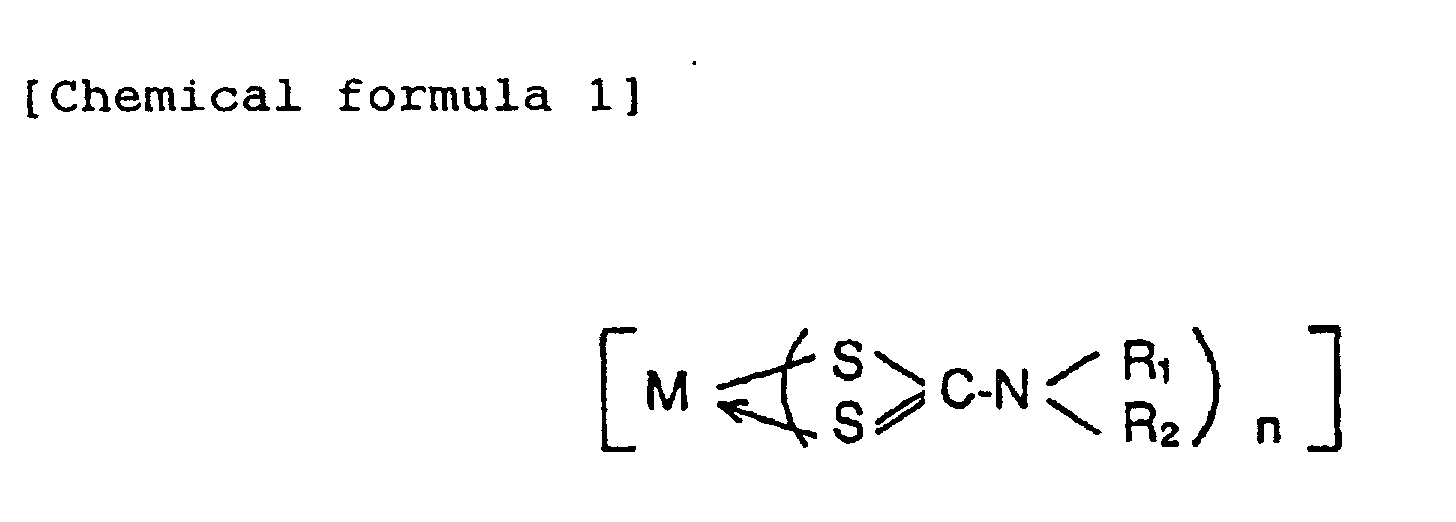
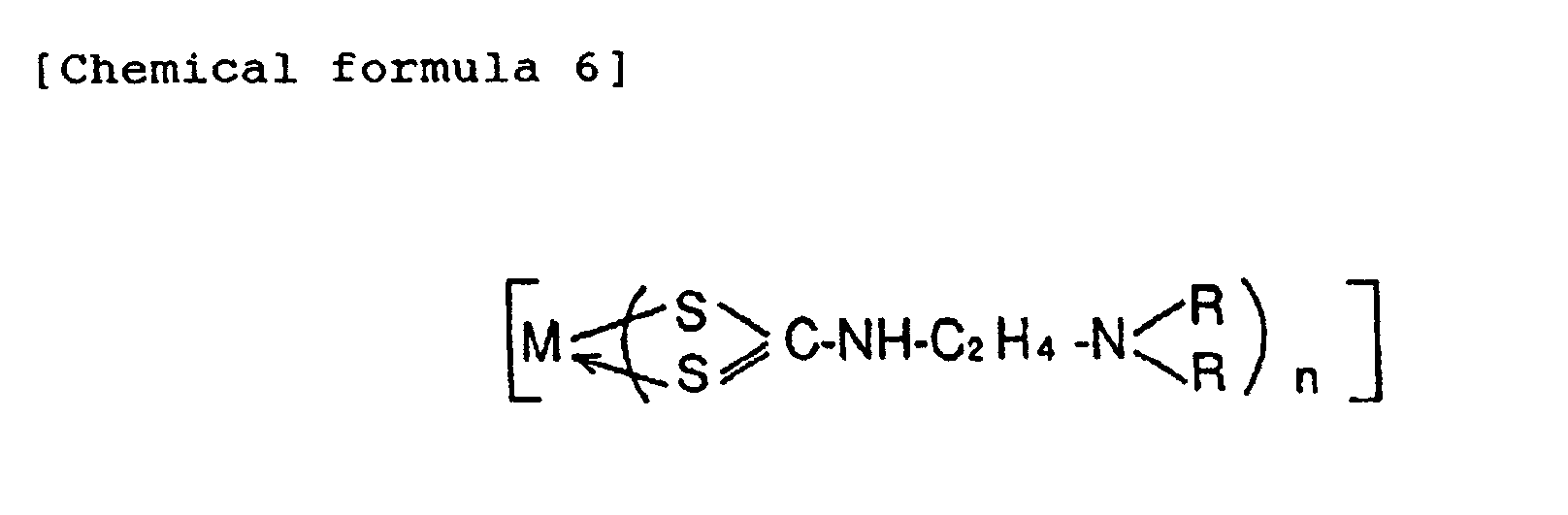
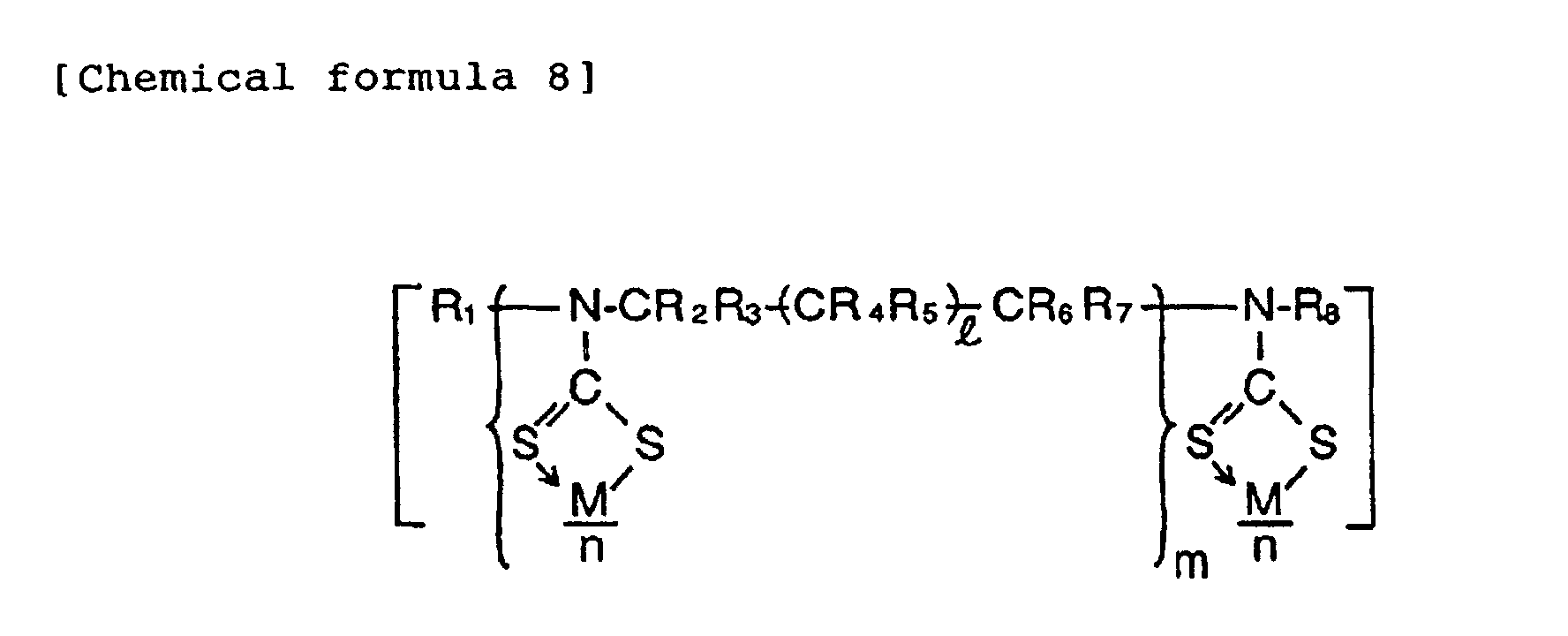
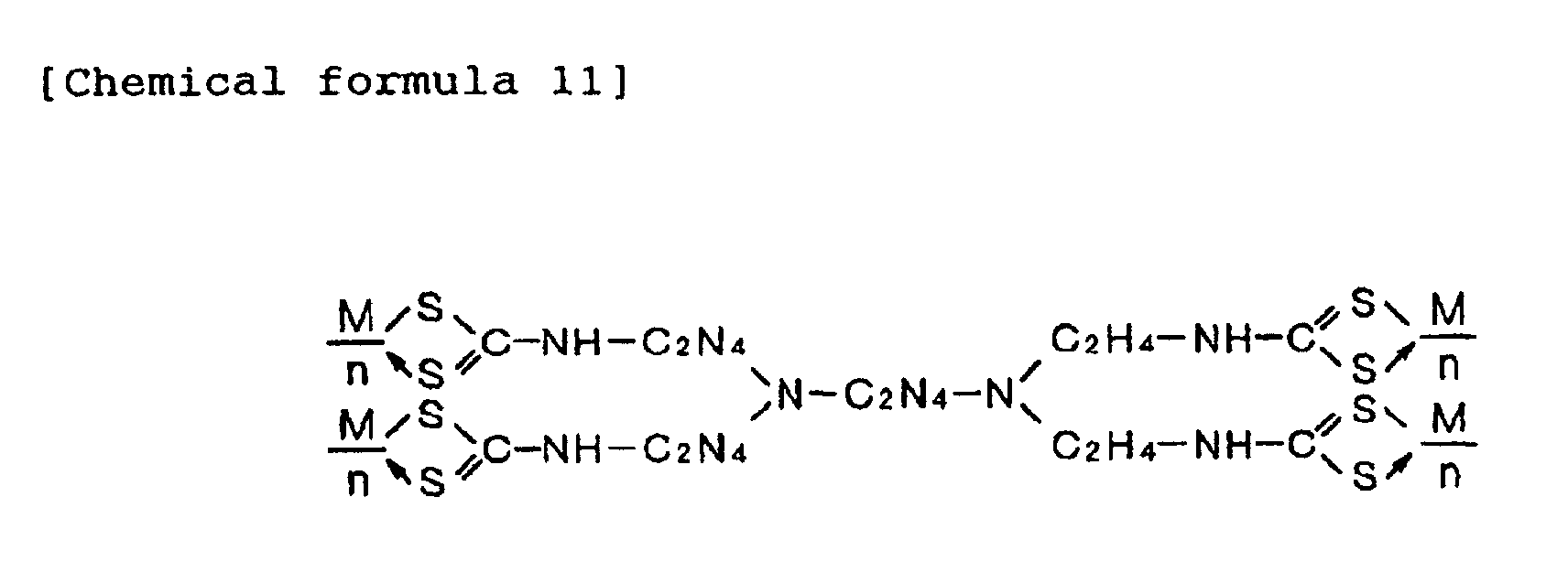
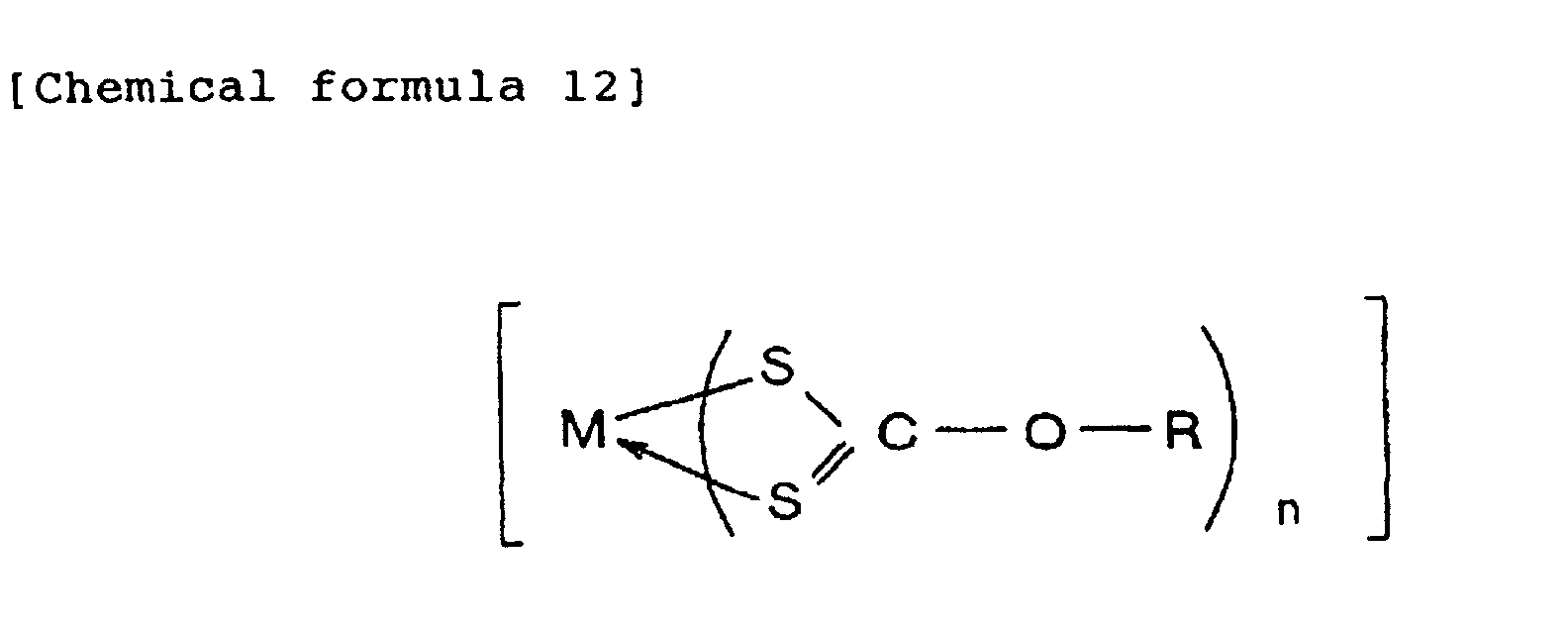
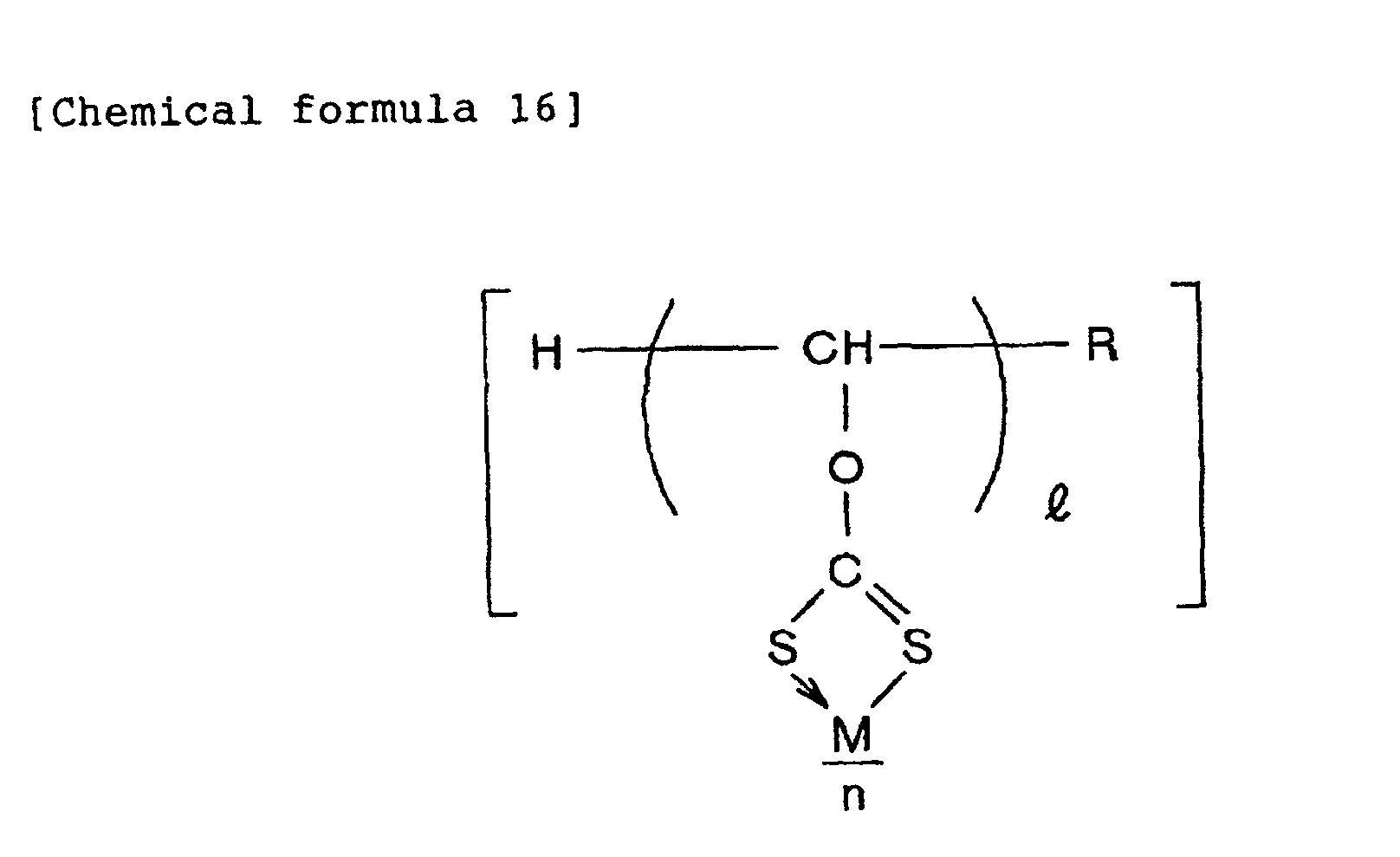
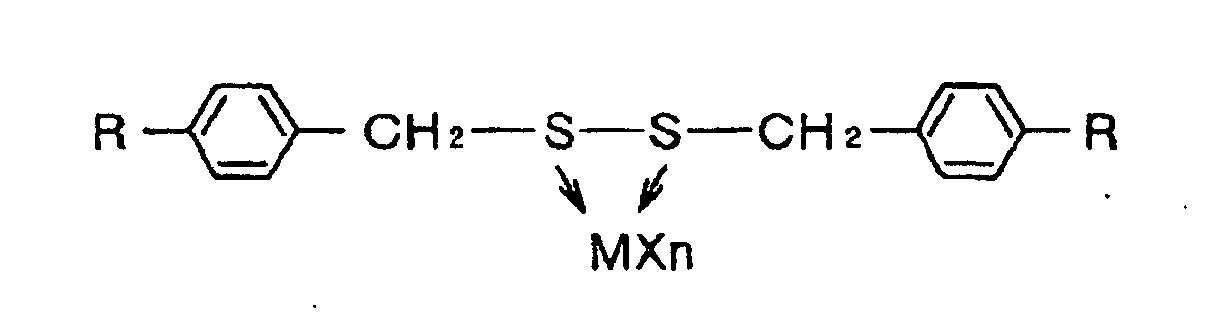
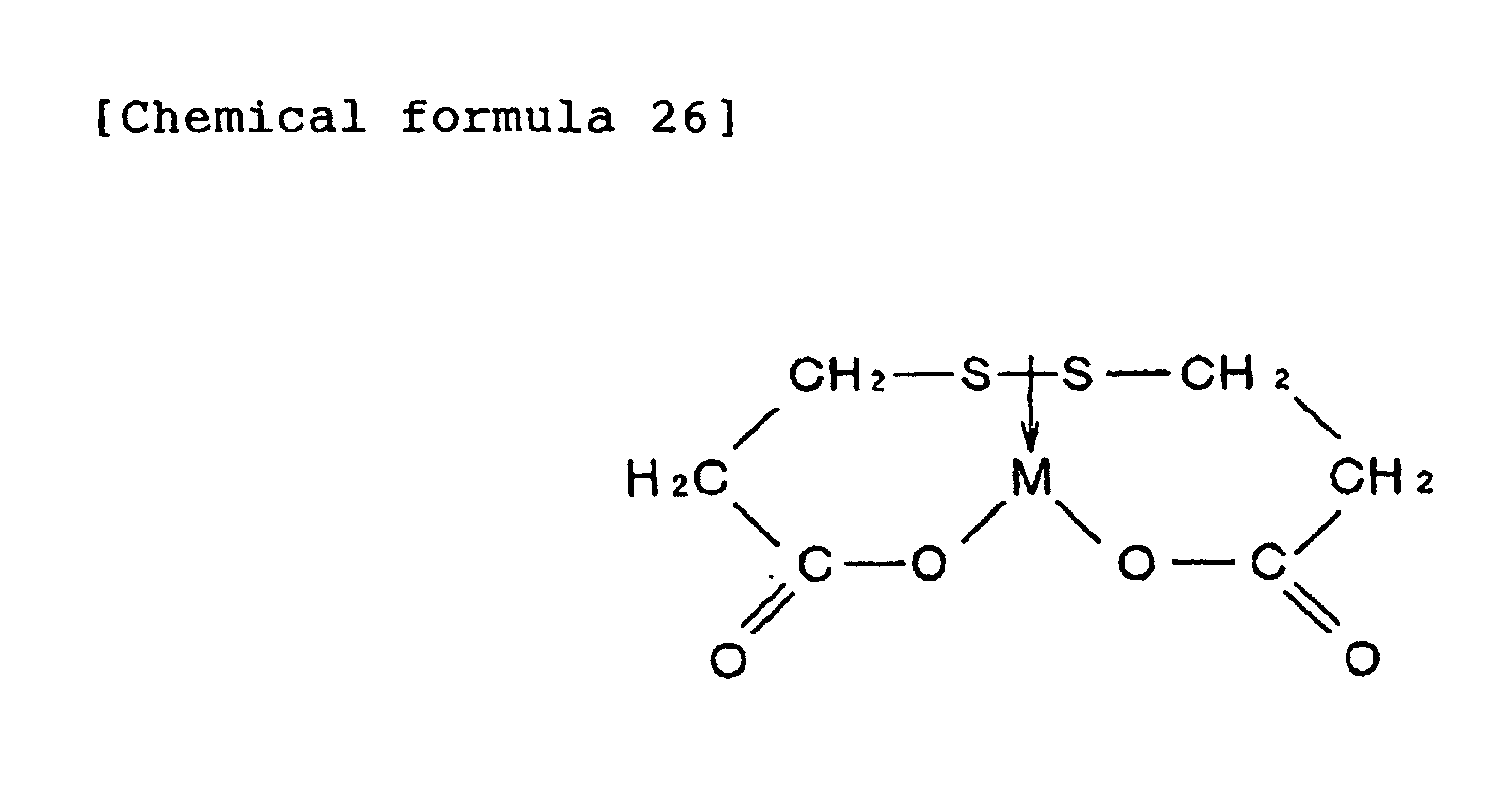
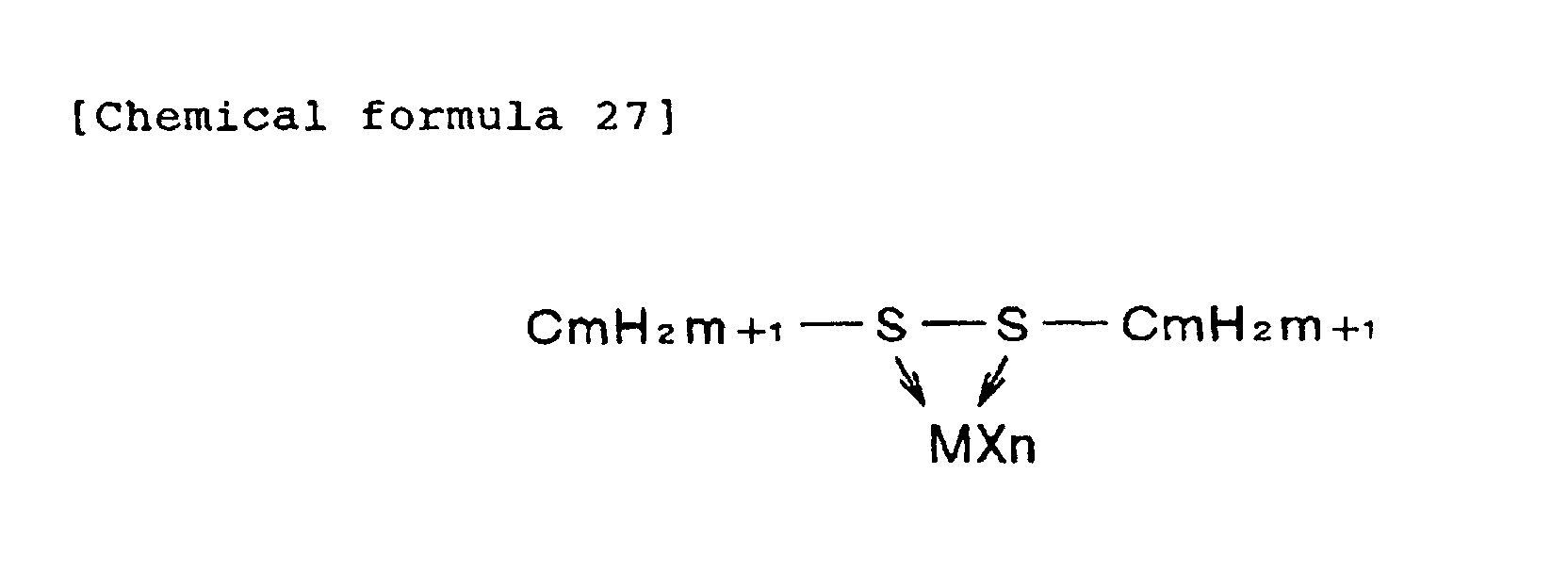
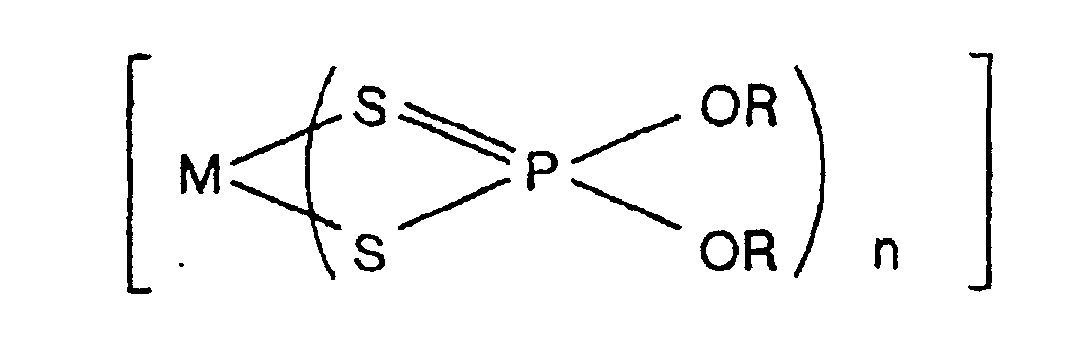
- Chemical structures 1-28 below are examples of such metal chelate compounds, and the chelate ligands in chemical structures 1-28 (the compounds adjacent to M in the structures) react with the above-mentioned metal ions in aqueous solution or in water or organic solvents (alcohols, ketones and dioxane) to produce crystalline precipitates that are insoluble in water.
- the coordinated structures of the crystalline precipitates are shown in chemical structures 1 through 28.
- the crystalline precipitates produced thereby are metal chelate compounds.
- the crystalline precipitated metal chelate compounds are made minute and one, two or more different metal chelate compounds are suspended or dispersed in water to generate aqueous lubricants.
- M represents divalent zinc, divalent or trivalent manganese, divalent or trivalent iron, trivalent, tetravalent or pentavalent molybdenum, divalent [(MoOS) 2 ] 2+ , divalent [Mo 2 S 4 ] 2+ , divalent or tetravalent tin, trivalent or pentavalent antimony, divalent MoO or monovalent MoOS.
- the two remaining coordination sites coordinate with a chelate ligand that does not have sulfur as a coordinating atom, such as a hydroxide ion, condensed phosphate, polycarboxylic high molecular activator and/or polyoxycarboxylic acid.
- a chelate ligand that does not have sulfur as a coordinating atom, such as a hydroxide ion, condensed phosphate, polycarboxylic high molecular activator and/or polyoxycarboxylic acid.
- a chelate ligand containing no sulfur such as hydroxide ion, condensed phosphate, polycarboxylic high molecular activator and/or polyoxycarboxylic acid
- R 1 and R 2 also may be different, and when R 1 is H, R 2 is -CH 3 , -C 2 H 5 , -C 3 H 7 (straight chain), iso-C 3 H 7 , -C 4 H 9 (straight chain), iso-C 4 H 9 , tert-C 4 H 9 or -C 4 H 9 (straight chain).
- R 1 is -CH 3 or -C 2 H 5
- R 2 is -C 6 H 5 .
- R is H, -CH 3 or -C 2 H 5 .
- R is ortho-NO 2 , para-NO 2 , meta-OCH 3 , meta-CH 3 ormeta-C 2 H 5 .
- R is -CH 3 , -C 2 H 5 , -C 3 H 7 (straight chain) or iso-C 3 H 7 .
- R is a hydrogen atom or an alkyl group of 1-12 carbon atoms.
- At least one coordinating atom is sulfur, which is chelated to at least one metal species selected from among zinc, manganese, iron, molybdenum, tin and antimony.
- the metal chelate compounds are hydrophobic fine particles, but at pH 8.0-13.0, they disperse in water with anionic or non-ionic surfactants and are maintained as stable dispersions in water. If the metal chelate compounds are instead made minute, they can be suspended for relatively long periods without precipitation, even if a surfactant or the like is not used, and a physical suspension also can be created by stirring or agitation. Thus, an aqueous lubricant can be realized that does not require any oil or organic solvent.
- a lubricating film is formed on the coated surface.
- the lubricating film adheres well to the surface and does not easily peel from the surface during plastic working of the metal material. It also has satisfactory lubricating properties and effectively prevents seizing of the material and the mold.
- This lubricant has the advantage of adhering well to the coated metal surface as long as no oil is present on that surface, and also has the feature of not requiring preparatory steps, such as degreasing and washing. In addition, the lubricant requires no special management and can be recycled, so that the only management necessary is re-supply of the consumed portion. Stringent washing is not required, even when electron beam welding is performed after plastic working.
- a number of methods can be used for the application, and for example, application onto the surface of the material can be accomplished by any desired method, such as immersion of the material in the lubricant, painting with a brush or spraying.
- the method employed may be painting with a brush, spraying or the like.
- the lubricant-coated material or mold may be permitted to stand so that the lubricant may naturally dry, but if necessary, it may be forcibly dried.
- the method employed for forcibly drying the lubricant may be any desired method, such as exposure to hot air, preheating the material or mold or drying by high-frequency heating.
- the extent of drying can be adjusted, if necessary, to achieve total dryness or partial dryness.
- the extent of drying can be adjusted, as desired, by varying the drying temperature and drying time.
- the metal chelate compound may be produced in solution instead of preparing the metal chelate compound beforehand and adding it to water. That is, the lubricant used can have one or more chelating agents in which at least one of the coordinating atoms is sulfur, and adding thereto a salt, oxide or hydroxide of one or more metals selected from among zinc, manganese, iron, molybdenum, tin and antimony and an anionic or non-ionic surfactant. This type of lubricant can be used in exactly the same manner.
- chelate ligands in which sulfur is a coordinating atom, may be coordinated to all the coordination sites of the metals.
- chelate ligands, in which sulfur is a coordinating atom may be coordinated to only some of the coordination sites of the metals, and other ligands, in which sulfur is not a coordinating atom, are coordinated to the remaining coordination sites.
- Suitable examples of ligands in which sulfur is not a coordinating atom are hydroxide ions, condensed phosphate, polycarboxylic high molecular activators and/or polyoxycarboxylic acid.
- Chemical structures 1-28 also show compounds in which chelate ligands having sulfur as a coordinating atom, as represented in the structures, are coordinated to only some of the coordination sites of the metals.
- the metal When a phosphate film has been formed on the metal surface, and the metal is immersed in an aqueous solution of any of the chelate ligands (the compounds adjacent to M in the structures) represented in chemical structures 1-28, the chelate ligand having sulfur as a coordinating atom coordinates with the zinc ion or iron ion present in the phosphate film to produce a crystalline multi-ligand metal chelate compound on the phosphate film, which results in a lubricating effect.
- the chelate ligands the compounds adjacent to M in the structures
- the lubricating film includes two or more different types of metal chelate compounds, their lubricating effects are synergistic, so that a highly satisfactory effect is achieved.
- the lubricant described above forms a lubricating film by strong adhesion to surfaces of primarily iron, especially steel and iron alloys, but it can also be used for non-ferrous metals, such as aluminum.
- additives such as pH adjusters, viscosity controllers, preservatives, antifoaming agents and the like may also be added to the lubricant. It is particularly preferred to add soluble condensed phosphate salts, fatty acid sodium salts, fatty acid potassium salts, soluble polycarboxylic high molecular activators and/or soluble polyoxycarboxylic acid salts. These compounds increase the dispersability of the metal chelate compound in water, and improve the adhesive strength of the lubricating film to the metal surface.
- the metal chelate compound is not limited to zinc bis-(N,N-diethyldithiocarbamate), and it may be replaced with any of the species represented by chemical structures 1-28, such as N,N-dibutyldithiocarbamate oxymolybdenumsulfate.
- Sodium stearate was used as the anionic or non-ionic surfactant in this experimental example, but adjustment to pH 8.0-13.0 with any other well-known anionic or non-ionic surfactants, such as sodium salts of fatty acids and/or potassium salts of fatty acids, can effect adequate dispersion of the metal chelate compound in water.
- a similar aqueous lubricant can be obtained by making the metal chelate compound fine, adding water and stirring it to create a suspension.
- a 50 g/200 ml aqueous solution of zinc sulfate heptahydrate was added to a 78 g/300 ml aqueous solution of sodium N,N-diethyldithiocarbamate trihydrate, while stirring, to prepare a suspension of zinc bis-(N,N-diethyldithiocarbamate).
- a suspension was created by dispersing 100 g of N.N-dibutyldithiocarbamate oxymolybdenumsulfate in a warm solution (500 ml) containing 20 g of sodium stearate, 20 g of sodium tripolyphosphate and 20 g of a polycarboxylic high molecular activator. Both suspensions were mixed together by stirring to obtain an aqueous lubricant.
- the following examples are analogous as aqueous lubricants to this Experimental Example 2.
- the aqueous solution of zinc sulfate hydrate that produces a metal chelate compound may be replaced with another water-soluble zinc salt or zinc hydroxide compound. It may also be replaced with a water-soluble salt of manganese, iron, molybdenum, tin or antimony.
- Experimental Example 2 differs from Experimental Example 1 primarily in using a metal chelate compound of two or more different metals, and zinc and molybdenum are used here. Any combination of two or more metals from among zinc, manganese, iron, molybdenum, tin and antimony may be used.
- the chelate ligand used can be any of those represented in chemical structures 1-28.
- Sodium tripolyphosphate need not be included, but its addition will improve the dispersability of the metal chelate compound.
- the polycarboxylic activator also need not be included, but its addition will improve adhesion of the lubricating film to the metal.
- a soluble polyoxycarboxylic acid salt may be added instead of a polycarboxylic high molecular activator.
- Zinc mono-(N,N-diethyldithiocarbamate)-hydroxoaqua has a chelate ligand with sulfur as a coordinating atom strongly coordinated to some of the coordination sites of zinc, and sodium hydroxide ion weakly coordinated to the remaining coordination sites.
- Zinc mono-(N,N-diethyldithiocarbamate)-hydroxoaqua can be dispersed in water with a sodium fatty acid salt and/or potassium fatty acid salt, such as sodium stearate.
- the following examples are analogous as aqueous lubricants to this Experimental Example 3.
- the chelate ligand having sulfur as a coordinating atom that chelates to some of the coordination sites of the metal can be replaced with any desired ligand represented in chemical structures 1-28.
- the sodium hydroxide ion that coordinates to the remaining coordination sites can be replaced with any other desired hydroxide ion, except for sulfur.
- soluble condensed phosphate salts may be added when necessary.
- soluble polycarboxylic high molecular activators may be added when necessary.
- a suspension was prepared by dispersing 100 g of N,N-dibutyldithiocarbamate oxymolybdenumsulfate in a solution of 20 g of sodium stearate, 10 g of sodium tripolyphosphate and 12 g of a polycarboxylic activator dissolved in 500 ml of hot water (hereunder, "H"). G and H were mixed together by stirring to obtain a yellow dispersion that was used as a lubricant.
- H hot water
- the zinc mono-(N,N-diethyldithiocarbamate)-triphosphate has a chelate ligand, with sulfur as a coordinating atom, strongly coordinated to some of the coordination sites of zinc, and sodium tripolyphosphate weakly coordinated to the remaining coordination sites via an oxygen anion.
- the species weakly coordinated to the remaining coordination sites via the oxygen anion is not limited to a condensed phosphate, such as sodium tripolyphosphate, and it may be replaced with a polycarboxylic high molecular activator and/or polyoxycarboxylic acid.
- Experimental Example 4 differs from Experimental Example 3 primarily in using a metal chelate compound of two or more different metals, and zinc and molybdenum are used here.
- any combination of two or more metals selected from among zinc, manganese, iron, molybdenum, tin and antimony may be used.
- they may both have chelate ligands, in which sulfur is a coordinating atom, coordinated to some of the coordination sites of the metal, but as explained above, either of the metal chelate compounds may also have a chelate ligand with sulfur as a coordinating atom that coordinates to all the coordination sites of the metal.
- the chelate ligand used can be any of those represented in chemical structures 1-28.
- a metal material on which a phosphate film had already been formed was immersed in a warm solution of 5% sodium N,N-diethyldithiocarbamate (pH 10), and the crystalline multi-ligand zinc chelate compound produced on the phosphate film was used as a lubricant.
- the sodium N,N-diethyldithiocarbamate (ligand with sulfur as a coordinating atom) coordinates with the zinc ion or iron ion in the phosphate film to produce a crystalline multi-ligand zinc or iron chelate compound on the phosphate film, thus forming a lubricating film.
- the chelate ligands may be any desired ones represented by chemical structures 1-28.
- I zinc mono-(N,N-diethyldithiocarbamate)-hydroxoaqua
- a crystalline polynuclear zinc chelate can also be disposed on the phosphate film by immersing the metal material with a phosphate film already formed thereon in any of the lubricants obtained in Experimental Examples 1 to 4 .
- the chelate ligand can be any one represented in chemical structures 1-28, and it is particularly preferred for a chelate ligand with sulfur as a coordinating atom to be coordinated to some of the coordination sites of the metal and chelate ligands without sulfur coordinated to the remaining coordination sites.
- the sulfur-containing chelate ligand coordinates with the metal while the non-sulfur-containing chelate ligand reacts with the zinc ions or iron ions in the phosphate film to produce a crystalline polynuclear metal chelate compound.
- Each of the lubricants prepared in Examples 1-6 was coated onto the perforated side of a perforated testing billet (for area reduction of 12%: a cylindrical member was used and having an inner diameter of 15 mm, an outer diameter of 29.9 mm and a length of 50 mm), and dried by exposure to 150°C hot air for 60 seconds. The time required for this treatment was about 2 minutes.
- a phosphate film was formed on the same type of billet and a metallic soap film was disposed on top of the phosphate film (Comparative Example 1). The time required for this treatment was over 30 minutes.
- each of the billets was subjected to a ball-push test. This test measured the load required for plastic deformation of a billet when an iron ball with a larger diameter than the diameter of the perforation in the billet was forcibly pushed through the billet perforation. The lubricating performance was evaluated based upon the surface condition of the inner diameter of the billet. A smaller load indicates more satisfactory lubrication, allowing smoother plastic deformation.
- the results are listed in the following table. In the table, the area reductions are the rates of change in the billet perforations before and after deformation, with larger values indicating a higher degree of deformation, i.e. heavy working.
- NG indicates seizing between the iron ball and the billet, showing that a satisfactory surface condition was not obtained.
- Not all of the experimental examples of the invention were suitable for heavy working, but light working was possible in all of the experimental examples, and satisfactory lubricating performance was confirmed in all of the experimental examples, as compared with using oil. Heavy working is also possible by appropriate selection among the lubricants of the invention.
- lubricating films can be formed by a simple application process, which films exhibit performance comparable to that achieved by the troublesome and difficult procedure of forming phosphate films and disposing metallic soap films on the metal object. Because the present invention does not use oil, the problems of working environment contamination and the need for subsequent degreasing treatment do not occur. Because a simple application is sufficient, a solution is also provided to the problems of large equipment requirements and the need to perform simultaneous treatment of large volumes of materials. Apparatus can therefore be installed for formation of lubricating films in the narrow spaces adjacent to the apparatus for plastic working of materials, forming the lubricating films in sequence with the plastic working apparatus cycles without requiring extra storage between the two treatments, so that it becomes possible to shorten lead times.
Landscapes
- Chemical & Material Sciences (AREA)
- Chemical Kinetics & Catalysis (AREA)
- General Chemical & Material Sciences (AREA)
- Oil, Petroleum & Natural Gas (AREA)
- Organic Chemistry (AREA)
- Lubricants (AREA)
Description
In JP-A-58063794 is disclosed an aqueous. lubricating composition which contains 0.05-30 weight.% of a molybdenum complex and is used with an appropriate dispersant or solubilising agent.
In US-A-4,289,547 is disclosed an aqueous acidic lubricant coating composition which comprises a concentrate which is adapted to be diluted with water, if desired, to produce an aqueous acidic operating bath containing a controlled effective amount of phosphate ions to form a phosphate coating on the clean metal surface in combination with an emulsified organic lubricant agent, an emulsifying agent and an iron chelating agent
In US-A-4,199,381 is disclosed an application of an aqueous soap to a phosphatized metal surface which is improved by including in the soap composition a complex former stable to hydrolysis and capable of forming a water-soluble complex with the metal of the phosphate coating.
In EP-A-61823 is disclosed water-based hydraulic fluids and metalworking lubricants which are thickened with a polyether polyol having a molecular weight of about 1000 to about 75,000 modified with an alpha-olefin epoxide having about 12 to about 18 carbon atoms.
In JP-A- 53032274 is disclosed a fire-retardant lubricating oil composition which consists of water-glycol lubricating oil containing >0.1 wt.% of a dithiocarbamide derivative.
In EP-A-28848 is disclosed a process of producing concentrated sulfuric acid.
In JP-A-7118283 is disclosed a process for production of metal dithioxanthates which comprises reacting a dithioxanthate with a molybdate or tungstate in the presence of mineral acid.
In JP-A-50062207 is disclosed a lubricating composition containing as a main additive a molyblenium complex.
In EP-A-223001 is disclosed a process for synthesising ammonia complexes of zinc bisdithiocarbamates, starting from carbon disulfide, ammonia, an alkylenediamine and zinc oxide.
In JP-B-47045487 are disclosed agricultural fungicides containing double salt of zinc ethylene bis dithiocarbamae
In EP-A434213 are disclosed monosubstituted dithiooxamide compounds and their use.
In FR-A-2583753 are disclosed metal complex salts of ethylene-bis-dithiocarbamate and benzimidazolyl-carbamate.
In JP-A- 4239096 is disclosed a process for lubricating pretreatment of galvanized steel plates.






When m=1 and l=1,
When m=1 and l=2-7,
When m=2-9 and l=0,
When m=2-9 and l=1,






| Values in table indicate loads (units: t) | |||||
| Area Reduction | 6% | 8% | 10% | 12% | Treatment Time |
| Exp. Example 1 | 19.625 | NG | NG | NG | 2 min. |
| Exp. Example 2 | 11.676 | 15.858 | 20.721 | NG | 2 min. |
| Exp. Example 3 | 13.930 | 16.710 | NG | NG | 2 min. |
| Exp. Example 4 | 9.265 | 9.876 | 11.934 | 15.992 | 2 min. |
| Exp. Example 5 | 10.176 | 13.945 | 17.116 | 20.174 | 2 min. |
| Exp. Example 6 | 8.096 | 9.371 | 10.767 | 15.130 | 2 min. |
| Comp. Example 1 | 8.383 | 10.128 | 14.068 | 18.060 | 30 min. |
| Comp. Example 2 | 21.391 | NG | NG | NG | 30 sec. |
Claims (9)
- A multi-ligand metal chelate compound, and polydentate or multidendate chelate ligand having sulfur as at least one of the coordinating atoms coordinates by partially filling the multiple coordination sites of the one or more metal species selected from among zinc, manganese, iron, molybdenum, tin and antimony, while a hydroxide ion, condensed phosphate, polycarboxylic high molecular activator, and/or polyoxycarboxylic acid are coordinated to the remaining coordination sites.
- An aqueous lubricant prepared by suspending or dispersing in water a multi-ligand metal chelate compound according to claim 1.
- An aqueous lubricant prepared by adding a soluble condensed phosphate salt, a soluble polycarboxylic high molecular activator and/or a soluble polyoxycarboxylic acid salt to an aqueous lubricant according to claim 2.
- A process whereby a metal material on which a phosphate film has already been formed is immersed in an aqueous solution of a multidentate or polydentate chelate ligand having sulfur as at least one of the coordinating atoms, so that said chelate ligand reacts with zinc ion and/or iron ion in said phosphate film to produce a crystalline multi-ligand metal chelate compound on said phosphate film.
- A process whereby a metal material on which a phosphate film has already been formed is immersed in an aqueous lubricant according to claim 2 or 3, and a ligand which is not a ligand having sulfur as a coordinating atom reacts with zinc ion and/or iron ion in said phosphate film to produce a crystalline polynuclear metal chelate compound on said phosphate film.
- A method of using an aqueous lubricant according to claim 2 or 3, in which prior to plastic working of a metal material, the aqueous lubricant according to claim 2 or 3 is applied to either or both the surface of the metal material and the molding surface of a metal mold to form lubricating films on those surfaces, thus allowing plastic working of the metal material with a lubricating film formed on the surface.
- A method of using an aqueous lubricant according to claim 6, characterized in that a drying step is added after the application.
- A method of plastically working a metal comprising the steps of preparing an aqueous lubricant by suspending or dispersing in water a metal chelate compound comprising a polydentate or multidentate chelate ligand having sulfur as at least one of the coordinating atoms, coordinated at the coordination site of at least one metal species selected from among zinc, manganese, iron, molybdenum, tin and antimony, applying the aqueous lubricant to either or both the surface of the metal material and the molding surface of a metal mold, drying those surfaces to form solid lubricating films thereon ; and
plastically working the metal material with a solid lubricating film formed on the surface. - The method of plastically working a metal according to claim 8, wherein a soluble condensed phosphate salt, a soluble polycarboxylic high molecular activator and/or a soluble polyoxycarboxylic acid salt is added to the aqueous lubricant.
Applications Claiming Priority (3)
| Application Number | Priority Date | Filing Date | Title |
|---|---|---|---|
| JP30691096 | 1996-11-18 | ||
| JP30691096 | 1996-11-18 | ||
| PCT/JP1997/004197 WO1998022472A1 (en) | 1996-11-18 | 1997-11-18 | Water-base lubricant containing sulfur as coordinate atom, and use thereof |
Publications (3)
| Publication Number | Publication Date |
|---|---|
| EP0947519A1 EP0947519A1 (en) | 1999-10-06 |
| EP0947519A4 EP0947519A4 (en) | 2000-12-20 |
| EP0947519B1 true EP0947519B1 (en) | 2003-06-04 |
Family
ID=17962751
Family Applications (1)
| Application Number | Title | Priority Date | Filing Date |
|---|---|---|---|
| EP97912498A Expired - Lifetime EP0947519B1 (en) | 1996-11-18 | 1997-11-18 | Water-base lubricant containing sulfur as coordinate atom, and use thereof |
Country Status (4)
| Country | Link |
|---|---|
| EP (1) | EP0947519B1 (en) |
| JP (1) | JP3217072B2 (en) |
| DE (1) | DE69722658T2 (en) |
| WO (1) | WO1998022472A1 (en) |
Families Citing this family (4)
| Publication number | Priority date | Publication date | Assignee | Title |
|---|---|---|---|---|
| JP4164230B2 (en) | 2000-12-21 | 2008-10-15 | 株式会社メックインターナショナル | Cross-linked complex-containing lubricant |
| WO2006006519A1 (en) * | 2004-07-09 | 2006-01-19 | Sanyo Chemical Industries, Ltd. | Additive for lubricants and lubricant compositions |
| JP4991133B2 (en) * | 2005-09-14 | 2012-08-01 | 三洋化成工業株式会社 | Antioxidant improver for lubricant and lubricant composition |
| DE102007061109B4 (en) | 2007-12-19 | 2013-01-17 | Henkel Ag & Co. Kgaa | A treatment solution for coating a steel strip, a method of applying the same, and a steel strip having a coating obtained from the processing solution to improve the forming behavior |
Family Cites Families (12)
| Publication number | Priority date | Publication date | Assignee | Title |
|---|---|---|---|---|
| JPS5724799B2 (en) * | 1973-10-05 | 1982-05-26 | ||
| JPS5332274A (en) * | 1976-09-07 | 1978-03-27 | Idemitsu Kosan Co | Flame resisting oil composite |
| DE2736874C2 (en) * | 1977-08-16 | 1987-03-26 | Metallgesellschaft Ag, 6000 Frankfurt | Processes to facilitate cold forming of metals |
| US4289547A (en) * | 1979-08-07 | 1981-09-15 | Hooker Chemicals & Plastics Corp. | Aqueous acidic lubricant coating composition and method |
| US4253975A (en) * | 1979-08-27 | 1981-03-03 | Mobil Oil Corporation | Aqueous lubricants containing metal hydrocarbyl dithiophosphates |
| EP0061823B1 (en) * | 1981-04-01 | 1985-06-05 | Basf Wyandotte Corporation | Synergistically thickened water-based hydraulic or metal-working fluid |
| JPH0227392B2 (en) * | 1981-10-12 | 1990-06-15 | Asahi Denka Kogyo Kk | MIZUKEIJUNKATSUSOSEIBUTSU |
| CH664562A5 (en) * | 1985-07-10 | 1988-03-15 | Stepan Safronovich Kukalenko | ZINC AND COPPER COMPLEX SALTS OF THE AETHYLENE-B-DITHIOKARBAMID ACID AND N- (BENZIMIDAZOLYL-2) CARBAMID ACID METHYL ESTER, METHOD FOR THE PRODUCTION AND USE THEREOF. |
| DE3534245A1 (en) * | 1985-09-26 | 1987-03-26 | Akzo Gmbh | METHOD FOR PRODUCING AN AMMONIA COMPLEX OF ZINC-BIS-DITHIOCARBAMATE |
| US5124308A (en) * | 1989-11-17 | 1992-06-23 | Albin Loren D | Monosubstituted dithiooxamide compounds and their use |
| JPH04239096A (en) * | 1991-01-11 | 1992-08-26 | Nippon Parkerizing Co Ltd | Method for lubricating pretreatment of galvanized steel sheet |
| JPH07118283A (en) * | 1993-10-26 | 1995-05-09 | Tonen Corp | Process for producing metal salt of dithioxanthogenic acid |
-
1997
- 1997-11-18 WO PCT/JP1997/004197 patent/WO1998022472A1/en not_active Ceased
- 1997-11-18 JP JP52346698A patent/JP3217072B2/en not_active Expired - Fee Related
- 1997-11-18 DE DE69722658T patent/DE69722658T2/en not_active Expired - Lifetime
- 1997-11-18 EP EP97912498A patent/EP0947519B1/en not_active Expired - Lifetime
Also Published As
| Publication number | Publication date |
|---|---|
| WO1998022472A1 (en) | 1998-05-28 |
| DE69722658D1 (en) | 2003-07-10 |
| JP3217072B2 (en) | 2001-10-09 |
| EP0947519A1 (en) | 1999-10-06 |
| DE69722658T2 (en) | 2004-04-29 |
| EP0947519A4 (en) | 2000-12-20 |
Similar Documents
| Publication | Publication Date | Title |
|---|---|---|
| EP2247701B1 (en) | Method for coating metallic surfaces with a wax-containing lubricant composition | |
| EP2220200B1 (en) | Dry-film, anti-corrosive cold forming lubricant | |
| EP2311928A2 (en) | Aqueous solution containing an organic phosphoric acid ester for producing a metal sheet coated with lubricant with improved reforming characteristics | |
| EP2238227A1 (en) | Method for coating metal surfaces with a phosphate layer and then with a polymer lubricant layer | |
| CA1110611A (en) | Preparation of metals for cold forming | |
| US5116521A (en) | Aqueous lubrication treatment liquid and method of cold plastic working metallic materials | |
| EP0412788B1 (en) | Lubrication method for cold plastic working of metallic materials | |
| JPWO2002012420A1 (en) | Water-based lubricant for plastic working of metal materials and method for forming lubricating film | |
| CA1240908A (en) | Compositions and methods for removing sealant compositions | |
| KR0144646B1 (en) | Composition and process for surface treating metal prior to cold working | |
| US2739915A (en) | Multiple action lubricating composition | |
| EP1316602A1 (en) | Aqueous one step type lubricating agent for efficient cold forging | |
| EP0947519A1 (en) | Water-base lubricant containing sulfur as coordinate atom, and use thereof | |
| US20020111278A1 (en) | Water-based lubricants containing sulfur as a coordinating atom and uses thereof | |
| CN107523404B (en) | Water-based antirust metal cold forging lubricant and preparation method thereof | |
| KR100268118B1 (en) | Aqueous lubricant containing metal chelate having sulfur as ligand and method of using same | |
| US4289546A (en) | Aqueous acidic lubricant composition and method for coating metals | |
| CA1149370A (en) | Aqueous acidic lubricant composition and method for coating metals | |
| JPWO1998022472A1 (en) | Water-based lubricant containing sulfur as a coordinating atom and method of using the same | |
| US3932287A (en) | Reactive cold forming lubricant | |
| EP0025236A1 (en) | Reactive lubricant and process for the preparation of metals for cold forming | |
| JP2001323294A (en) | Aqueous lubricant with sulfur as coordinating atom and method of use | |
| JP2006527301A (en) | Methods and compositions for conversion surface generation | |
| EP1535989B1 (en) | Gear part with lubrication coating and method of manufacturing the same | |
| EP0200167B1 (en) | Process to facilitate cold forming |
Legal Events
| Date | Code | Title | Description |
|---|---|---|---|
| PUAI | Public reference made under article 153(3) epc to a published international application that has entered the european phase |
Free format text: ORIGINAL CODE: 0009012 |
|
| 17P | Request for examination filed |
Effective date: 19990618 |
|
| AK | Designated contracting states |
Kind code of ref document: A1 Designated state(s): DE FR GB |
|
| A4 | Supplementary search report drawn up and despatched |
Effective date: 20001106 |
|
| AK | Designated contracting states |
Kind code of ref document: A4 Designated state(s): DE FR GB |
|
| RIC1 | Information provided on ipc code assigned before grant |
Free format text: 7C 07F 3/06 A, 7C 07F 7/22 B, 7C 07F 9/90 B, 7C 07F 11/00 B, 7C 07F 13/00 B, 7C 07F 15/02 B, 7C 10M 135/18 B, 7C 10M 139/00 B, 7C 10M 173/00 B, 7C 10M 173/02 B, 7C 23C 22/83 B, 7C 10M 173/02 J, 7C 10M 159:18 J, 7C 10N 40:22 Z, 7C 10N 40:08 Z |
|
| 17Q | First examination report despatched |
Effective date: 20011214 |
|
| GRAH | Despatch of communication of intention to grant a patent |
Free format text: ORIGINAL CODE: EPIDOS IGRA |
|
| GRAH | Despatch of communication of intention to grant a patent |
Free format text: ORIGINAL CODE: EPIDOS IGRA |
|
| GRAA | (expected) grant |
Free format text: ORIGINAL CODE: 0009210 |
|
| AK | Designated contracting states |
Designated state(s): DE FR GB |
|
| REG | Reference to a national code |
Ref country code: GB Ref legal event code: FG4D |
|
| REF | Corresponds to: |
Ref document number: 69722658 Country of ref document: DE Date of ref document: 20030710 Kind code of ref document: P |
|
| ET | Fr: translation filed | ||
| PLBE | No opposition filed within time limit |
Free format text: ORIGINAL CODE: 0009261 |
|
| STAA | Information on the status of an ep patent application or granted ep patent |
Free format text: STATUS: NO OPPOSITION FILED WITHIN TIME LIMIT |
|
| 26N | No opposition filed |
Effective date: 20040305 |
|
| PGFP | Annual fee paid to national office [announced via postgrant information from national office to epo] |
Ref country code: FR Payment date: 20101123 Year of fee payment: 14 |
|
| PGFP | Annual fee paid to national office [announced via postgrant information from national office to epo] |
Ref country code: DE Payment date: 20101110 Year of fee payment: 14 |
|
| PGFP | Annual fee paid to national office [announced via postgrant information from national office to epo] |
Ref country code: GB Payment date: 20101117 Year of fee payment: 14 |
|
| GBPC | Gb: european patent ceased through non-payment of renewal fee |
Effective date: 20111118 |
|
| REG | Reference to a national code |
Ref country code: FR Ref legal event code: ST Effective date: 20120731 |
|
| REG | Reference to a national code |
Ref country code: DE Ref legal event code: R119 Ref document number: 69722658 Country of ref document: DE Effective date: 20120601 |
|
| PG25 | Lapsed in a contracting state [announced via postgrant information from national office to epo] |
Ref country code: GB Free format text: LAPSE BECAUSE OF NON-PAYMENT OF DUE FEES Effective date: 20111118 |
|
| PG25 | Lapsed in a contracting state [announced via postgrant information from national office to epo] |
Ref country code: FR Free format text: LAPSE BECAUSE OF NON-PAYMENT OF DUE FEES Effective date: 20111130 |
|
| PG25 | Lapsed in a contracting state [announced via postgrant information from national office to epo] |
Ref country code: DE Free format text: LAPSE BECAUSE OF NON-PAYMENT OF DUE FEES Effective date: 20120601 |