EP0947433A1 - Device for opening packages of pourable food products - Google Patents

Device for opening packages of pourable food products Download PDF

Info

Publication number
EP0947433A1
EP0947433A1 EP98106164A EP98106164A EP0947433A1 EP 0947433 A1 EP0947433 A1 EP 0947433A1 EP 98106164 A EP98106164 A EP 98106164A EP 98106164 A EP98106164 A EP 98106164A EP 0947433 A1 EP0947433 A1 EP 0947433A1
Authority
EP
European Patent Office
Prior art keywords
cap
tubular member
frame
opening
axis
Prior art date
Legal status (The legal status is an assumption and is not a legal conclusion. Google has not performed a legal analysis and makes no representation as to the accuracy of the status listed.)
Withdrawn
Application number
EP98106164A
Other languages
German (de)
French (fr)
Inventor
Antonio Troiano
Current Assignee (The listed assignees may be inaccurate. Google has not performed a legal analysis and makes no representation or warranty as to the accuracy of the list.)
Tetra Laval Holdings and Finance SA
Original Assignee
Tetra Laval Holdings and Finance SA
Priority date (The priority date is an assumption and is not a legal conclusion. Google has not performed a legal analysis and makes no representation as to the accuracy of the date listed.)
Filing date
Publication date
Application filed by Tetra Laval Holdings and Finance SA filed Critical Tetra Laval Holdings and Finance SA
Priority to EP98106164A priority Critical patent/EP0947433A1/en
Priority to US09/601,744 priority patent/US6364164B1/en
Priority to AU33329/99A priority patent/AU3332999A/en
Priority to PCT/EP1999/002215 priority patent/WO1999051502A1/en
Publication of EP0947433A1 publication Critical patent/EP0947433A1/en
Withdrawn legal-status Critical Current

Links

Images

Classifications

    • BPERFORMING OPERATIONS; TRANSPORTING
    • B65CONVEYING; PACKING; STORING; HANDLING THIN OR FILAMENTARY MATERIAL
    • B65DCONTAINERS FOR STORAGE OR TRANSPORT OF ARTICLES OR MATERIALS, e.g. BAGS, BARRELS, BOTTLES, BOXES, CANS, CARTONS, CRATES, DRUMS, JARS, TANKS, HOPPERS, FORWARDING CONTAINERS; ACCESSORIES, CLOSURES, OR FITTINGS THEREFOR; PACKAGING ELEMENTS; PACKAGES
    • B65D5/00Rigid or semi-rigid containers of polygonal cross-section, e.g. boxes, cartons or trays, formed by folding or erecting one or more blanks made of paper
    • B65D5/42Details of containers or of foldable or erectable container blanks
    • B65D5/72Contents-dispensing means
    • B65D5/74Spouts
    • B65D5/746Spouts formed separately from the container
    • B65D5/747Spouts formed separately from the container with means for piercing or cutting the container wall or a membrane connected to said wall
    • B65D5/748Spouts formed separately from the container with means for piercing or cutting the container wall or a membrane connected to said wall a major part of the container wall or membrane being left inside the container after the opening
    • BPERFORMING OPERATIONS; TRANSPORTING
    • B65CONVEYING; PACKING; STORING; HANDLING THIN OR FILAMENTARY MATERIAL
    • B65DCONTAINERS FOR STORAGE OR TRANSPORT OF ARTICLES OR MATERIALS, e.g. BAGS, BARRELS, BOTTLES, BOXES, CANS, CARTONS, CRATES, DRUMS, JARS, TANKS, HOPPERS, FORWARDING CONTAINERS; ACCESSORIES, CLOSURES, OR FITTINGS THEREFOR; PACKAGING ELEMENTS; PACKAGES
    • B65D2251/00Details relating to container closures
    • B65D2251/10Details of hinged closures
    • B65D2251/1016Means for locking the closure in closed position
    • BPERFORMING OPERATIONS; TRANSPORTING
    • B65CONVEYING; PACKING; STORING; HANDLING THIN OR FILAMENTARY MATERIAL
    • B65DCONTAINERS FOR STORAGE OR TRANSPORT OF ARTICLES OR MATERIALS, e.g. BAGS, BARRELS, BOTTLES, BOXES, CANS, CARTONS, CRATES, DRUMS, JARS, TANKS, HOPPERS, FORWARDING CONTAINERS; ACCESSORIES, CLOSURES, OR FITTINGS THEREFOR; PACKAGING ELEMENTS; PACKAGES
    • B65D2255/00Locking devices
    • B65D2255/20Locking devices with coacting elements, e.g. ratchet and pawl, formed integrally in the container and closure or dispensing device, e.g. spout, for permanently preventing removal of the latter
    • BPERFORMING OPERATIONS; TRANSPORTING
    • B65CONVEYING; PACKING; STORING; HANDLING THIN OR FILAMENTARY MATERIAL
    • B65DCONTAINERS FOR STORAGE OR TRANSPORT OF ARTICLES OR MATERIALS, e.g. BAGS, BARRELS, BOTTLES, BOXES, CANS, CARTONS, CRATES, DRUMS, JARS, TANKS, HOPPERS, FORWARDING CONTAINERS; ACCESSORIES, CLOSURES, OR FITTINGS THEREFOR; PACKAGING ELEMENTS; PACKAGES
    • B65D2401/00Tamper-indicating means

Definitions

  • Another prior solution known from European Patent No. 108444 envisages the provision of a pre-punched hole in the packaging material, covered by a tab of material which a user can grip and tear-off, in order to pour the contents through the pre-punched hole.
  • the above-described cartons are made of a laminated material comprising a layer of fibre-based material such as paper having an appropriate degree of stiffness, and covered on both sides with a heat-sealable plastics material.
  • an aseptic barrier layer constituted e.g., by an aluminium foil layer, is applied to side of the packaging material which is destined to be located on the inside of the carton.
  • the aseptic barrier layer is, in turn, covered with a layer of food-compatible plastics material.
  • the pre-punched hole extends through the paper and through the heat-sealable plastics material covering the paper. However, the aseptic barrier layer remains intact.
  • the pull-tab is affixed to the aseptic barrier layer in the pre-punched hole. In this way, the aseptic qualities of the package are guaranteed, until such time that a user pulls the tab to tear open the aseptic barrier layer in the pre-punched hole. This arrangement made it very quick and simple to open a package.
  • Laid-open Japanese Patent No. 63-149818 describes an opening device having a frame bearing two upright semi-circular walls.
  • a lever having a matching semi-circular configuration is journalled between the walls for rotation about an axis passing substantially through the centers of the planar bases of the semi-circular walls, parallel and adjacent to the surface of the package.
  • the lower portion of the lever facing the package has teeth for rupturing the packaging material, and a grip-tab, whereby a user can open the package by rotating the lever in one direction, and reclose the package by rotating the lever in the opposite direction.
  • this kind of opening device is not suitable for direct drinking from the package and requires the application of significant force in order to drive the teeth through the packaging material. This may lead to inadvertent spillage of the contents of the package.
  • Laid-open Japanese Patent Application No. 64-2727 describes an opening device having a frame defining a tubular portion, a sleeve arranged slideably within the tubular portion and connected to the frame by a collapsible bellows, and a cap hinged to the frame and overlying the open uppermost end of the sleeve in a closed position.
  • a user has to apply pressure on the cap, which is transferred to the sleeve, thereby collapsing the bellows.
  • the lower end of the sleeve punctures the packaging material of the container and the reclosable cap can be opened to pour the contents.
  • the cap can be knocked during handling and transportation, thereby inadvertently collapsing the bellows and causing the sleeve to puncture the underlying packaging material.
  • a three-piece opening device consisting of a frame having an externally threaded portion, a screw-cap which can be screwed onto the frame, and a sleeve located in a tubular portion of the frame and having a lower toothed edge which, when actuated by screwing the cap onto the frame, perforates the laminated packaging material of a container.
  • a main aim of the invention is to provide a new type of device for opening packages of pourable food products which overcomes the drawbacks encountered in the prior art opening devices.
  • an object of the invention is to provide a device for opening packages of pourable food product, especially for portion packs, which prevents opening of the package until an aseptic barrier layer in a pre-punched hole has been completely ruptured, so as to guarantee correct pouring once the package has been opened.
  • Another object of the invention is to provide a device for opening packages of pourable food product which can be quickly and easily re-closed, and which is completely reliable and safe in use.
  • the invention provides a device for opening packages of pourable food product comprising a frame fixable on a package, a tubular member connected to said frame and internally defining a pouring opening, and a cap pivotally connected to said tubular member for rotation about a first axis for opening and closing said pouring opening, characterized in that said tubular member is movably connected to said frame for rotation about a second axis extending substantially perpendicularly with respect to said first axis.
  • the reference numeral 1 generally indicates the device for opening packages of pourable food product according to the invention.
  • the device 1 has a frame 2 provided with a flange 3, which can be affixed to a package 4.
  • Figure 10 illustrates the opening device 1 with the flange 3 of the frame 2 fixed to a package which, in the illustrated example, has a substantially parallelepiped configuration with beveled corners.
  • the fixing of the frame to the package 4 may be achieved with any conventional fixing means available to one skilled in the art such as e.g., by hot-melt adhesive, microflame welding, or laser welding.
  • the frame is advantageously provided with a flat upper surface 5, structurally reinforced by a plurality of ribs 6, provided on the lower surface of the frame which is destined to be affixed to a package and thus hidden from view.
  • This arrangement provides adequate strength while minimizing the overall quantity of plastics material employed for manufacture of the device.
  • the frame 2 defines an annular sleeve 7, composed of a lower portion 8 and an upper portion 9.
  • the lower portion of the annular sleeve protrudes upwardly from the upper surface 5 of the frame and has internal threads 10 formed on its inner surface, and at least one ratchet tooth 11, provided adjacent the threads 10.
  • the upper portion 9 is arranged concentrically with respect to the lower portion and has a slightly greater diameter than the lower portion. More specifically, the inner diameter of the upper portion 9 is slightly greater than the outer diameter of the lower portion 8, and the upper edge 12 of the lower portion is connected to the lower edge 13 of the upper portion by rupturable connection means 14, which preferably comprise a plurality of rupturable bridges 14a, 14b, 14c, 14d, 14e and 14f.
  • the upper portion 9 of the annular sleeve has a slot 15 formed therein, and both the upper and lower portions preferably have formed thereon aligned indicia 16, 17 for indicating the relative position of the upper portion with respect to the lower portion of the annular sleeve, in an intact condition of the device, thereby providing a tamper evidence for the consumer.
  • the frame 2 also has an arc-shaped wall 18, which is spaced from and partly circumscribes the lower portion 8 of the annular sleeve 7, and has a height which is slightly less than that defined by the lower portion 8.
  • a retaining protuberance 19 protrudes radially inwardly from the uppermost edge of the arc-shaped wall 18 towards the lower portion 8, and a gap 20 is defined between the retaining protuberance 19, and the lower portion 8.
  • a block or index element 21 is also provided on the frame adjacent an end 18a of the arc-shaped wall 18.
  • the device also has a tubular member 22, which has external threads 23 formed thereon for screw thread engagement with the threads 10 provided on the internal surface of the lower portion 8 of the threaded annular sleeve 7, and internally defines a pouring opening 24 extending co-axially with respect to the annular sleeve.
  • a cap 25 having an inner sealing rim 26, is pivotally connected to the tubular member 22 by means of a conventional elastic hinge 27, for rotation about a first axis 28.
  • the cap is rotatable through substantially 180 degrees about the first axis for opening and closing the pouring opening.
  • the cap 25 closes on the tubular member in a snap-together manner, with the rim 26 sealingly engaging an upper sealing edge 29 of the tubular member 22.
  • the external threads 23 engage the threads 10 to movably connect the tubular member 22 to the frame 2 for rotation about a second axis 30, which extends perpendicularly with respect to the first axis 28.
  • a plurality of indentations 31 is provided on the outer surface of the tubular member for unidirectional movement over the ratchet pawl 11, provided in the lower portion 8 of the annular sleeve 7.
  • the indentations are configured in a saw-tooth manner, such that they can easily slide over the ratchet paw 11 in one direction when the tubular member 22 is rotated in the direction of the arrow 40, but any reverse movement of the tubular member is prevented, whereby to prevent any possibility of returning the cap and the tubular member to its original position, once it has been operated or tampered with.
  • Cutting means constituted by at least one cutting tooth 32, are defined on the lowermost edge of the tubular member for penetrating a portion of a package 4 underlying the pouring opening 24 upon movement of the tubular member 22 with respect to the frame 2 about the second axis 30 in the direction of the arrow 40.
  • the cutter and the threaded members are arranged in such a manner as to enable the cutter to cut completely through the packaging material and ensure insertion of the tubular member 22 into the hole in the packaging material, upon rotating the cap and the tubular member with respect to the frame, substantially through 180 degrees.
  • Means are also provided for rotationally engaging the cap 25 and the upper portion 9 of the annular sleeve 7, and include at least one lug 33 connected to an inner surface 25a of the cap 25.
  • the lug 33 slideably engages the above-mentioned slot 15 provided on the upper portion 9 during rotation of the cap 25.
  • torsional force applied to the cap 25 is transmitted to the rupturable connection bridges 14a-14f, in order to break the rupturable connection bridges 14a-14f.
  • the upper portion 9 is free to slide downwardly over the lower portion 8 of the annular sleeve 7, during rotation of the cap 25 cap with respect to the frame 2.
  • the device for opening packages of pourable food products also has means for preventing rotation of the cap 25 about the first axis 28, during rotation of the tubular member 22 about the second axis 30, until completion of a predetermined angular displacement of the tubular member 22 with respect to the frame 2.
  • the latter-mentioned means are preferably constituted by the above-mentioned arc-shaped wall 18 connected to the frame 2, the protuberance 19 protruding radially inwardly from the upper portion of the arc-shaped wall 18, and at least one tab 34 connected to the cap 25 and slidingly engaging the protuberance.
  • the tab 34 protrudes radially outwardly from the cap 25 and is located beneath the protuberance during rotation of the cap 25 with respect to the frame 2.
  • the cap 25 cannot be opened until it has been rotated to such an extent that the tab 34 exits from beneath the protuberance, i.e., when the packaging material has been perforated by the cutter 32 and the tubular member 22 is inserted into the perforation.
  • the cap 25 preferably has a protruding lug 35 which covers the elastic hinge 27, and a protruding tab 36, located diametrically opposite the protruding lug and preferably having a flat end portion 36a, adapted to be lifted by a user in order to rotate the cap 25 about the hinge 27.
  • two knurled or ribbed portions 37a,37b extend between the protruding lug and the protruding tab at diametrically opposite sides of the cap 25.
  • Figure 10 illustrates a package for pourable food products provided with a device 1 according to the invention.
  • figure 10 illustrates a carton of the type having a substantially parallelepiped configuration with bevelled corners
  • the device can be used on cartons containing pourable of any shape, such as parallepiped cartons with straight corners, tetrahedral cartons, etc.
  • the flat end portion 36a is located adjacent to the index element 21, and the indicia 16,17 are aligned, thereby providing a clear indication of the integrity of the package.
  • a user grips the ribbed portions 37a,37b and starts to rotate the cap 25 in an anti-clockwise direction indicated by the arrow 40.
  • the external threads 23 of the tubular member engage the matching internal threads 10 in the lower portion 8 of the annular sleeve 7.
  • the lug 33 slides along the slot 15, and when the lug 33 abuts the end 15a of the slot 15, the torsional force applied to the cap is transmitted to the rupturable connection bridges through the upper portion 9 if the annular sleeve 7. This causes breakage of the connection bridges 14a-14f, and the upper portion 9 of the annular sleeve 7 starts moving downwardly over the lower portion 8 thereof, due to the combined axial downward movement and rotational movement of the cap 25 and the tubular member 22.
  • the flat end portion 36a is moved away from the index element 21, and the indicia 16,17 become misaligned, thereby providing a clear indication that the device has been operated.
  • the indentations 31 move unidirectionally over the ratchet pawl 11 (see figure 8) and prevent any return movement of the cap and the tubular element. Since any tampering with the opening devices is clearly indicated, and since the cap and the tubular member cannot be rotated in a reverse direction, any packages which have been tampered with can be immediately seen by a consumer or store personnel.
  • the above-described embodiment exemplifies one structural arrangement of the device for opening packages of pourable food product according to the invention, which fully meets the above-mentioned aim and objects of the invention.
  • a new device has been provided which enables direct drinking from a package of pourable food product, such as tea, fruit-juice etc, without the drawbacks encountered in the known devices.
  • the device according to the invention prevents opening of the package until an aseptic barrier layer in a pre-punched hole has been completely ruptured, so as to guarantee correct pouring once the package has been opened.
  • the device once the device has been applied to a carton and actuated to cut through the packaging material constituting the carton, it cannot be returned to its original state, thereby providing an extremely visible tamper evidence for the consumer.
  • the device is also very practical in that it can be quickly and easily re-closed and is completely reliable and safe in use.

Landscapes

  • Engineering & Computer Science (AREA)
  • Mechanical Engineering (AREA)
  • Cartons (AREA)
  • Closures For Containers (AREA)

Abstract

The device has a frame (2) fixable on a package, a tubular member (22) connected to the frame (2) and internally defining a pouring opening (24), and a cap (25) connected by an elastic hinge (27) to the tubular member (22) for rotation about a first axis for opening and closing the pouting opening (24). The tubular member (22) is movably connected to the frame (2) for rotation about a second axis (30) extending perpendicularly with respect to the first axis (28). A lug (34) connected to the cap (25) slideably engages a protrusion (19) connected to the frame (2) for preventing rotation of the cap (25) about the first axis (28), during rotation of the tubular member (22) about the second axis (30), until completion of a predetermined angular displacement of the tubular member (22) with respect to said frame (2). <IMAGE>

Description

TECHNICAL FIELD
The present invention relates to a device for opening sealed packages of pourable food product. The device is especially useful for opening sealed aseptic cartons of the type commonly used for packaging a wide range of food products including wine, tea, tomato puree, fruit juice, mineral water, yogurt, cream, and thermally treated milk, i.e., milk treated at ultra-high temperature, commonly known as UHT milk. Typical examples of such packages are the parallelepiped-shaped packages known by the registered trademarks Tetra Brik ® and Tetra Brik Aseptic ®, and the parallelepiped packages with bevelled comers, known by the registered trademarks Tetra Prisma ® and Tetra Prisma Aseptic ®, which are manufactured using machines for packaging pourable food products such as the TBA/21™ filling machine, available from Tetra Brik Packaging Systems, Via Delfini, Modena, Italy.
BACKGROUND ART
Various solutions have been proposed for permitting a user to conveniently open the above-mentioned type of package and access the products contained therein in a convenient manner.
According to one prior solution known from United States patent No. 4655387, a perforated line was provided diagonally across the corner flap of a package. By lifting the corner flap and tearing along the perforated line, a user could open the package. This arrangement was simple and permitted an inexpensive means of allowing a user to open and pour contents from a package. However, although the corner flap could be folded to prevent insects or dust entering any product remaining in the carton after a first use, the carton could not be re-closed in a reliable manner and in the event that the carton was tipped over, product spillage was inevitable.
Another prior solution known from European Patent No. 108444, envisages the provision of a pre-punched hole in the packaging material, covered by a tab of material which a user can grip and tear-off, in order to pour the contents through the pre-punched hole. As known, the above-described cartons are made of a laminated material comprising a layer of fibre-based material such as paper having an appropriate degree of stiffness, and covered on both sides with a heat-sealable plastics material. In the case of an aseptic package, an aseptic barrier layer constituted e.g., by an aluminium foil layer, is applied to side of the packaging material which is destined to be located on the inside of the carton. The aseptic barrier layer is, in turn, covered with a layer of food-compatible plastics material. The pre-punched hole extends through the paper and through the heat-sealable plastics material covering the paper. However, the aseptic barrier layer remains intact. The pull-tab is affixed to the aseptic barrier layer in the pre-punched hole. In this way, the aseptic qualities of the package are guaranteed, until such time that a user pulls the tab to tear open the aseptic barrier layer in the pre-punched hole. This arrangement made it very quick and simple to open a package.
Further developments saw the introduction of opening devices such as the ones known from European Patent No. 558946, and from European Patent No. 658,480 having a frame surrounding the pre-punched hole and pull-tab, and a reclosable lid hinged the frame. These known arrangements provide easy opening and permit packages to be reclosed. Although these opening devices have gained widespread consumer acceptance, they are mainly used on packages having a volume of at least 500ml, and have been particularly appreciated when used on large-volume packages containing, for example, 1000ml or 1500ml of liquid-food product, when it is often desired to serve some of the product, then reclose the package and store the remaining product.
For small volume packages containing a single serving of food product, such as e.g., 200ml or 330ml cartons of fruit juice, commonly known as portion packages, the opening arrangements have mainly been in the form of a small, pre-punched straw hole. The consumer simply perforates the aseptic barrier layer in the pre-punched hole with a drinking straw in order to consume the product contained in the carton. Also known from DE-U1-26919195, is a device having a threaded tubular member defining a pouring opening therein and adapted for screwing into the straw hole of a package, and a cap for closing the pouring opening which is connected by a flexible hinge to the tubular member. A user simply screws the tubular member into the straw hole and opens the cap in order to allow product to flow through the pouring opening. However, these solutions imply providing and individually packaging drinking straws or opening devices, and either applying a suitably packed drinking straw to the outside of every carton, or purchasing the opening device for screwing into the straw hole of the cartons separately. Although the use of individually packed drinking straws attached to each carton has found wide consensus among consumers, especially children, it does not allow direct drinking from the smaller-volume carton without a straw, which is the manner of drinking preferred by youths and young adults.
As a partial solution to this problem, portion packages have been provided which have a larger pre-punched hole of such a size as to permit direct drinking from the carton, and a pull-tab device covering the large pre-punched hole. In this way, a consumer simply removes the large pull-tab in order to drink directly from the carton. However, if one does not desire to consume all of the contents, the package cannot be resealed and is susceptible to spillage. Furthermore, in some countries, consumers strongly dislike having to touch the laminated packaging material with the lips.
Many opening devices are known which have means of cutting through a portion of a carton, such as the aseptic barrier layer, during opening.
Laid-open Japanese Patent No. 63-149818 describes an opening device having a frame bearing two upright semi-circular walls. A lever having a matching semi-circular configuration is journalled between the walls for rotation about an axis passing substantially through the centers of the planar bases of the semi-circular walls, parallel and adjacent to the surface of the package. The lower portion of the lever facing the package has teeth for rupturing the packaging material, and a grip-tab, whereby a user can open the package by rotating the lever in one direction, and reclose the package by rotating the lever in the opposite direction. However, this kind of opening device is not suitable for direct drinking from the package and requires the application of significant force in order to drive the teeth through the packaging material. This may lead to inadvertent spillage of the contents of the package.
Laid-open Japanese Patent Application No. 64-2727 describes an opening device having a frame defining a tubular portion, a sleeve arranged slideably within the tubular portion and connected to the frame by a collapsible bellows, and a cap hinged to the frame and overlying the open uppermost end of the sleeve in a closed position. A user has to apply pressure on the cap, which is transferred to the sleeve, thereby collapsing the bellows. The lower end of the sleeve punctures the packaging material of the container and the reclosable cap can be opened to pour the contents. However, the cap can be knocked during handling and transportation, thereby inadvertently collapsing the bellows and causing the sleeve to puncture the underlying packaging material.
Also known from laid-open Japanese Patent Application No. 63-156928 is a three-piece opening device consisting of a frame having an externally threaded portion, a screw-cap which can be screwed onto the frame, and a sleeve located in a tubular portion of the frame and having a lower toothed edge which, when actuated by screwing the cap onto the frame, perforates the laminated packaging material of a container.
However, in all of these latter-mentioned devices provided with means for cutting through packaging material when opening a carton, there is the drawback that the contents of the package may be accessed by a user when the cutting of the packaging material is incomplete. This means that there may be an insufficient opening to provide for correct pouring of the product from the carton. This drawback is especially serious when drinking directly from the carton, because if the product does not pour in a sufficient quantity, a user may be tempted to squeeze the carton, causing an increase in pressure in its interior. If the increased pressure suddenly ruptures the partly-cut packaging material, the product would gush out of the carton, with obvious inconveniences for the consumer.
OBJECTS OF THE INVENTION
Accordingly, a main aim of the invention is to provide a new type of device for opening packages of pourable food products which overcomes the drawbacks encountered in the prior art opening devices.
Within this aim, an object of the invention is to provide a device for opening packages of pourable food product, especially for portion packs, which prevents opening of the package until an aseptic barrier layer in a pre-punched hole has been completely ruptured, so as to guarantee correct pouring once the package has been opened.
Another object of the invention is to provide a device for opening packages of pourable food product, which permits direct drinking from small cartons or portion packages, without a consumers lips contacting the laminated packaging material surrounding the device.
A further object of the invention is to provide a device for opening packages of pourable food product which, once applied to a carton and actuated to cut through the packaging material constituting the carton, cannot be returned to its original state, whereby to provide extremely visible tamper evidence for the consumer.
Another object of the invention is to provide a device for opening packages of pourable food product which can be quickly and easily re-closed, and which is completely reliable and safe in use.
DISCLOSURE OF THE INVENTION
With the above aim and objects in view, the invention provides a device for opening packages of pourable food product comprising a frame fixable on a package, a tubular member connected to said frame and internally defining a pouring opening, and a cap pivotally connected to said tubular member for rotation about a first axis for opening and closing said pouring opening, characterized in that said tubular member is movably connected to said frame for rotation about a second axis extending substantially perpendicularly with respect to said first axis.
Further features of the invention are defined in the sub-claims.
According to another aspect of the present invention, there is also provided a package of pourable food product, characterized in that it comprises an opening device as defined in claims 1-9.
BRIEF DESCRIPTION OF THE DRAWING FIGURES
Further features and advantages of the device for opening packages of pourable food product, according to the invention, will become apparent from the following detailed description of a preferred embodiment thereof, and from the attached accompanying drawing figures wherein:
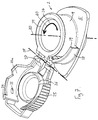
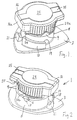
  • Figure 1 is a top perspective view of the device for opening packages of pourable food product according to the invention, viewed from one side thereof, shown in a closed condition;
  • Figure 2 is a top perspective view of the device of figure 1, viewed from an opposite side thereof;
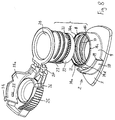
  • Figure 3 is an exploded bottom perspective view of the device for opening packages of pourable food product of figure 2, shown to a smaller scale;
  • Figure 4 is an exploded top perspective view of the device of figure 3;
  • Figure 5 is an exploded top perspective view of the device of figure 1;
  • Figure 6 is an enlarged-scale top perspective view of the device for opening packages of pourable food product shown in figures 1-5, viewed from one side thereof, and shown in an opened condition;
  • Figure 7 is a top perspective view of the device of figure 6 as viewed from an opposite side thereof;
  • Figure 8 is an exploded top perspective view of the device of figure 7;
  • Figure 9 is an exploded top perspective view of the device of figure 6, and;
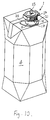
  • Figure 10 is a perspective view of a package provided with a device for opening packages of pourable food product according to the invention.
  • DESCRIPTION OF THE PREFERRED EMBODIMENT
    With reference to the above-described drawing figures, the reference numeral 1 generally indicates the device for opening packages of pourable food product according to the invention. The device 1 has a frame 2 provided with a flange 3, which can be affixed to a package 4. Figure 10 illustrates the opening device 1 with the flange 3 of the frame 2 fixed to a package which, in the illustrated example, has a substantially parallelepiped configuration with beveled corners. The fixing of the frame to the package 4 may be achieved with any conventional fixing means available to one skilled in the art such as e.g., by hot-melt adhesive, microflame welding, or laser welding. The frame is advantageously provided with a flat upper surface 5, structurally reinforced by a plurality of ribs 6, provided on the lower surface of the frame which is destined to be affixed to a package and thus hidden from view. This arrangement provides adequate strength while minimizing the overall quantity of plastics material employed for manufacture of the device.
    The frame 2 defines an annular sleeve 7, composed of a lower portion 8 and an upper portion 9. The lower portion of the annular sleeve protrudes upwardly from the upper surface 5 of the frame and has internal threads 10 formed on its inner surface, and at least one ratchet tooth 11, provided adjacent the threads 10. The upper portion 9 is arranged concentrically with respect to the lower portion and has a slightly greater diameter than the lower portion. More specifically, the inner diameter of the upper portion 9 is slightly greater than the outer diameter of the lower portion 8, and the upper edge 12 of the lower portion is connected to the lower edge 13 of the upper portion by rupturable connection means 14, which preferably comprise a plurality of rupturable bridges 14a, 14b, 14c, 14d, 14e and 14f. The upper portion 9 of the annular sleeve has a slot 15 formed therein, and both the upper and lower portions preferably have formed thereon aligned indicia 16, 17 for indicating the relative position of the upper portion with respect to the lower portion of the annular sleeve, in an intact condition of the device, thereby providing a tamper evidence for the consumer. The frame 2 also has an arc-shaped wall 18, which is spaced from and partly circumscribes the lower portion 8 of the annular sleeve 7, and has a height which is slightly less than that defined by the lower portion 8. A retaining protuberance 19 protrudes radially inwardly from the uppermost edge of the arc-shaped wall 18 towards the lower portion 8, and a gap 20 is defined between the retaining protuberance 19, and the lower portion 8. A block or index element 21 is also provided on the frame adjacent an end 18a of the arc-shaped wall 18.
    The device also has a tubular member 22, which has external threads 23 formed thereon for screw thread engagement with the threads 10 provided on the internal surface of the lower portion 8 of the threaded annular sleeve 7, and internally defines a pouring opening 24 extending co-axially with respect to the annular sleeve. A cap 25 having an inner sealing rim 26, is pivotally connected to the tubular member 22 by means of a conventional elastic hinge 27, for rotation about a first axis 28. The cap is rotatable through substantially 180 degrees about the first axis for opening and closing the pouring opening. The cap 25 closes on the tubular member in a snap-together manner, with the rim 26 sealingly engaging an upper sealing edge 29 of the tubular member 22. The external threads 23 engage the threads 10 to movably connect the tubular member 22 to the frame 2 for rotation about a second axis 30, which extends perpendicularly with respect to the first axis 28.
    A plurality of indentations 31 is provided on the outer surface of the tubular member for unidirectional movement over the ratchet pawl 11, provided in the lower portion 8 of the annular sleeve 7. The indentations are configured in a saw-tooth manner, such that they can easily slide over the ratchet paw 11 in one direction when the tubular member 22 is rotated in the direction of the arrow 40, but any reverse movement of the tubular member is prevented, whereby to prevent any possibility of returning the cap and the tubular member to its original position, once it has been operated or tampered with. Cutting means, constituted by at least one cutting tooth 32, are defined on the lowermost edge of the tubular member for penetrating a portion of a package 4 underlying the pouring opening 24 upon movement of the tubular member 22 with respect to the frame 2 about the second axis 30 in the direction of the arrow 40. Preferably, the cutter and the threaded members are arranged in such a manner as to enable the cutter to cut completely through the packaging material and ensure insertion of the tubular member 22 into the hole in the packaging material, upon rotating the cap and the tubular member with respect to the frame, substantially through 180 degrees. In this manner, a user simply has to grip the cap and rotate the tubular member through 180 degrees about the second axis 30, in the illustrated example, in an anti-clockwise direction as indicated by the arrow 40 in figure 7, and then rotate the cap through approximately 180 degrees about the mutually perpendicular first axis 28, in order to enable product to be poured through the pouring opening 24.
    Means are also provided for rotationally engaging the cap 25 and the upper portion 9 of the annular sleeve 7, and include at least one lug 33 connected to an inner surface 25a of the cap 25. The lug 33 slideably engages the above-mentioned slot 15 provided on the upper portion 9 during rotation of the cap 25. When the lug 33 abuts the end 15a of the slot 15, torsional force applied to the cap 25 is transmitted to the rupturable connection bridges 14a-14f, in order to break the rupturable connection bridges 14a-14f. In practice, once the bridges 14a-14f are broken, the upper portion 9 is free to slide downwardly over the lower portion 8 of the annular sleeve 7, during rotation of the cap 25 cap with respect to the frame 2.
    In accordance with the invention, the device for opening packages of pourable food products also has means for preventing rotation of the cap 25 about the first axis 28, during rotation of the tubular member 22 about the second axis 30, until completion of a predetermined angular displacement of the tubular member 22 with respect to the frame 2. The latter-mentioned means are preferably constituted by the above-mentioned arc-shaped wall 18 connected to the frame 2, the protuberance 19 protruding radially inwardly from the upper portion of the arc-shaped wall 18, and at least one tab 34 connected to the cap 25 and slidingly engaging the protuberance. The tab 34 protrudes radially outwardly from the cap 25 and is located beneath the protuberance during rotation of the cap 25 with respect to the frame 2. In this manner, the cap 25 cannot be opened until it has been rotated to such an extent that the tab 34 exits from beneath the protuberance, i.e., when the packaging material has been perforated by the cutter 32 and the tubular member 22 is inserted into the perforation.
    For completeness of description, as can be seen in the drawing figures, in the embodiment of the invention illustrated in the drawings, the cap 25 preferably has a protruding lug 35 which covers the elastic hinge 27, and a protruding tab 36, located diametrically opposite the protruding lug and preferably having a flat end portion 36a, adapted to be lifted by a user in order to rotate the cap 25 about the hinge 27. Advantageously, two knurled or ribbed portions 37a,37b extend between the protruding lug and the protruding tab at diametrically opposite sides of the cap 25. Figure 10 illustrates a package for pourable food products provided with a device 1 according to the invention. Although figure 10 illustrates a carton of the type having a substantially parallelepiped configuration with bevelled corners, it will be understood that the device can be used on cartons containing pourable of any shape, such as parallepiped cartons with straight corners, tetrahedral cartons, etc.
    The operation of the device for opening packages of pourable food products according to the invention will now be described:
    With reference to figure 10, it can be seen that the on the package 4 provided with the device according to the invention, the flat end portion 36a is located adjacent to the index element 21, and the indicia 16,17 are aligned, thereby providing a clear indication of the integrity of the package. In order to open the package, a user grips the ribbed portions 37a,37b and starts to rotate the cap 25 in an anti-clockwise direction indicated by the arrow 40. The external threads 23 of the tubular member engage the matching internal threads 10 in the lower portion 8 of the annular sleeve 7. During rotation of the cap, the lug 33 slides along the slot 15, and when the lug 33 abuts the end 15a of the slot 15, the torsional force applied to the cap is transmitted to the rupturable connection bridges through the upper portion 9 if the annular sleeve 7. This causes breakage of the connection bridges 14a-14f, and the upper portion 9 of the annular sleeve 7 starts moving downwardly over the lower portion 8 thereof, due to the combined axial downward movement and rotational movement of the cap 25 and the tubular member 22.
    At this point, the flat end portion 36a is moved away from the index element 21, and the indicia 16,17 become misaligned, thereby providing a clear indication that the device has been operated. The indentations 31 move unidirectionally over the ratchet pawl 11 (see figure 8) and prevent any return movement of the cap and the tubular element. Since any tampering with the opening devices is clearly indicated, and since the cap and the tubular member cannot be rotated in a reverse direction, any packages which have been tampered with can be immediately seen by a consumer or store personnel.
    Continued rotation of the cap about the second axis 30 causes the cap to move downwardly during its rotation, the tab 34 passes beneath the protuberance 19 of the arc-shaped wall, and the cutter 32 starts to cut the underlying packaging material. Not only is reverse rotational movement of the tubular member 22 prevented by the engagement of the indentations with the ratchet pawl 11, but also the cap 25 is prevented from rotating about the first axis 28 defined by the elastic hinge 27. To this end, the tab 34 remains slideably engaged beneath the protuberance 19, for a predetermined angular displacement of the tubular member 22 with respect to the frame 2, determined by the length of the arc-shaped wall 18, which is calculated so as to ensure that opening of the cap 25 is prevented until the cutter 32 has completely perforated the underlying packaging material and the tubular member 22 is inserted into the thus-formed perforation. Only thereafter, when the cap 25 has been rotated through substantially 180 degrees and the tab 34 exits from beneath the protuberance 19, can the cap 25 be opened to enable a consumer to pour the contents of the package through the pouring opening 24.
    In a fully opened condition of the package, the cap 25 has been rotated through approximately 180 degrees about the first axis 28, the tubular member has been rotated through approximately 180 degrees about the second axis 30, the upper portion 9 of the annular sleeve 7 has slid downwardly over the lower portion 8 thereof, the tubular member and the cutter 32 protrude below the flange 3 of the frame 2, and the elastic hinge 27 is located adjacent to the index element 21.
    The above-described embodiment exemplifies one structural arrangement of the device for opening packages of pourable food product according to the invention, which fully meets the above-mentioned aim and objects of the invention. In particular, a new device has been provided which enables direct drinking from a package of pourable food product, such as tea, fruit-juice etc, without the drawbacks encountered in the known devices. The device according to the invention prevents opening of the package until an aseptic barrier layer in a pre-punched hole has been completely ruptured, so as to guarantee correct pouring once the package has been opened. Furthermore, once the device has been applied to a carton and actuated to cut through the packaging material constituting the carton, it cannot be returned to its original state, thereby providing an extremely visible tamper evidence for the consumer. The device is also very practical in that it can be quickly and easily re-closed and is completely reliable and safe in use.
    The invention as set forth herein is susceptible to modifications, without thereby departing from the purview of the appended claims.
    Claims (10)

    1. A device for opening packages of pourable food product comprising a frame (2) fixable on a package (4), a tubular member (22) connected to said frame (2) and internally defining a pouring opening (24), and a cap (25) pivotally connected to said tubular member (22) for rotation about a first axis (28) for opening and closing said pouring opening (24), characterized in that said tubular member (22) is movably connected to said frame (22) for rotation about a second axis (30) extending substantially perpendicularly with respect to said first axis (28).
    2. A device for opening packages of pourable food product according to claim 1, characterized in that it comprises means (18,19,34) for preventing rotation of said cap (25) about said first axis (28), during rotation of said tubular member (22) about said second axis (30), until completion of a predetermined angular displacement of said tubular member (22) with respect to said frame (2).
    3. A device for opening packages of pourable food product according to claim 1, characterized in that said frame (2) has a threaded annular sleeve (7), said tubular member (22) having threads (23) engaging said threaded annular sleeve (7) and cutting means (32) defined thereon for penetrating a portion of a package (4) underlying said pouring opening (24) upon movement of said tubular member (22) with respect to said frame (2) about said second axis (30), said second axis (30) corresponding to a longitudinal mid-axis of said tubular member (22) and said annular sleeve (7).
    4. A device for opening packages of pourable food product according to claim 2, characterized in that said means (18,19,34) for preventing rotation of said cap (25) about said first axis (28), during rotation of said tubular member (22) about said second axis (30), until completion of a predetermined angular displacement of said tubular member (22) with frame (2), and a tab (34) connected to said cap (25) and slidingly engaging said protuberance (19).
    5. A device for opening packages of pourable food product according to claim 4, characterized in that it further comprises an arc-shaped wall (18) connected to said frame (2) and partially circumscribing said annular sleeve (7), said protuberance (19) protruding radially inwardly from an upper portion of said arc-shaped wall (18), said tab (34) protruding radially outwardly from said cap (25) and being locatable beneath said protuberance (19) during rotation of said cap (25) with respect to said frame (2).
    6. A device for opening packages of pourable food product according to claim 2, characterized in that it comprises means (11,31) for preventing unscrewing of said tubular member (22) from said annular sleeve (7), said means including at least one ratchet pawl (11) provided in said annular sleeve (7), and a plurality of indentations formed on said tubular member (22) and adapted for unidirectional movement over said ratchet pawl (11).
    7. A device for opening packages of pourable food product according to claim 3, characterized in that said annular sleeve (7) comprises a lower portion (8) fixed to said frame (2), and an upper portion (9) having a greater diameter than said lower portion (8) and connected thereto by rupturable connection means (14a-14f).
    8. A device for opening packages of pourable food product according to claim 7, characterized in that it comprises means (15,33) for rotationally engaging said cap (25) and said upper portion (9) of said annular sleeve (7) during rotation of said cap (25) with respect to said frame (2), for breaking said rupturable connection means (14a-14f).
    9. A device for opening packages of pourable food product according to claims 7 and 8, characterized in that said means (15,33) for rotationally engaging said cap (25) and said upper portion (9) comprise at least one lug (33) connected to an inner surface (25a) of said cap (25), and at least one slot (15) provided in said upper portion (9), said lug (33) engaging said slot (15) during rotation of said cap (25) for transmitting force applied to said cap to break said rupturable connection means (14a-14f) during rotation of said cap (25), said upper portion (9) circumscribing and sliding downwardly over said lower portion (8) during rotation of said cap (25) with respect to said frame (2).
    10. A package containing a pourable food product, characterized in that it comprises an opening device (1) as defined in one or more of the preceding claims 1-9.
    EP98106164A 1998-04-03 1998-04-03 Device for opening packages of pourable food products Withdrawn EP0947433A1 (en)

    Priority Applications (4)

    Application Number Priority Date Filing Date Title
    EP98106164A EP0947433A1 (en) 1998-04-03 1998-04-03 Device for opening packages of pourable food products
    US09/601,744 US6364164B1 (en) 1998-04-03 1999-03-31 Device for opening packages of pourable food products
    AU33329/99A AU3332999A (en) 1998-04-03 1999-03-31 Device for opening packages of pourable food products
    PCT/EP1999/002215 WO1999051502A1 (en) 1998-04-03 1999-03-31 Device for opening packages of pourable food products

    Applications Claiming Priority (1)

    Application Number Priority Date Filing Date Title
    EP98106164A EP0947433A1 (en) 1998-04-03 1998-04-03 Device for opening packages of pourable food products

    Publications (1)

    Publication Number Publication Date
    EP0947433A1 true EP0947433A1 (en) 1999-10-06

    Family

    ID=8231715

    Family Applications (1)

    Application Number Title Priority Date Filing Date
    EP98106164A Withdrawn EP0947433A1 (en) 1998-04-03 1998-04-03 Device for opening packages of pourable food products

    Country Status (4)

    Country Link
    US (1) US6364164B1 (en)
    EP (1) EP0947433A1 (en)
    AU (1) AU3332999A (en)
    WO (1) WO1999051502A1 (en)

    Cited By (14)

    * Cited by examiner, † Cited by third party
    Publication number Priority date Publication date Assignee Title
    WO2001049579A1 (en) * 1999-12-29 2001-07-12 Unilever Plc Thermoformed closure for cartons
    US6772910B1 (en) * 1999-11-17 2004-08-10 Fredrick Michael Coory Piercing cap for a container
    AT502389B1 (en) * 2003-12-18 2007-03-15 Buchinger Hans OUTLET, OPENING AND CLOSURE DEVICE
    WO2010097476A1 (en) * 2009-02-27 2010-09-02 Sig Technology Ag Lid arrangement with originality seal
    WO2011138069A1 (en) * 2010-05-04 2011-11-10 Robert Bosch Gmbh Closure device
    US8100879B2 (en) 2002-11-18 2012-01-24 Nestec S.A. Connector device for enteral administration set
    US9676512B2 (en) 2006-03-31 2017-06-13 Tetra Laval Holdings & Finance S.A. Forming device, machine, packaging laminate web, forming method and process in producing packages
    WO2020128056A1 (en) * 2018-12-21 2020-06-25 Société des Produits Nestlé S.A. Enteral nutrition container cap and methods of making and using the cap
    IT201900017249A1 (en) * 2019-09-25 2021-03-25 Easy Plast S R L Opening / closing device for a container for pourable products
    WO2021059172A1 (en) * 2019-09-25 2021-04-01 Easy Plast S.R.L. Opening/closing device for a container for pourable products
    EP3868680A1 (en) * 2020-02-19 2021-08-25 Tetra Laval Holdings & Finance S.A. Spout for a container and package-spout assembly
    WO2022029110A1 (en) * 2020-08-03 2022-02-10 Rosti Group AB Multipart closure
    EP4234430A2 (en) 2019-09-30 2023-08-30 Tetra Laval Holdings & Finance S.A. Closure assembly for a container and container having a closure assembly
    RU2816374C1 (en) * 2019-09-25 2024-03-28 Изи Пласт С.Р.Л. Opening and closing device for containers for liquid products

    Families Citing this family (26)

    * Cited by examiner, † Cited by third party
    Publication number Priority date Publication date Assignee Title
    EP1289848B1 (en) * 2000-06-15 2004-08-25 CROWN Packaging Technology, Inc. Fitment assembly for containers
    DE50304066D1 (en) * 2002-05-31 2006-08-10 Sig Technology Ltd SELF-OPENER LOCK FOR COMPOSITE PACKAGING OR FILM MATERIAL-LOCKED TANK SUPPORT
    US20040007587A1 (en) * 2002-07-09 2004-01-15 Westphal Scott K. Membrane piercing closure
    US20040026422A1 (en) * 2002-07-09 2004-02-12 Technology Center Membrane penetrating closure with deformable top surface
    US7429386B2 (en) * 2004-09-03 2008-09-30 Allergan, Inc. Stretch mark treatment
    CH698661B1 (en) * 2006-01-29 2009-09-30 Belcap Switzerland Ag Closing device with partially circular cutting ring.
    DK2055640T3 (en) * 2007-11-05 2011-04-04 Tetra Laval Holdings & Finance Reclosable opening device for packaging for pourable food products
    AU2011315715B2 (en) * 2010-10-12 2016-08-04 Société des Produits Nestlé S.A. Capsule opening kit
    DE102011080923A1 (en) * 2011-08-12 2013-02-14 Robert Bosch Gmbh Plastic closure device for tubular bags
    DE102011084508B4 (en) * 2011-10-14 2022-03-03 Syntegon Pouch Systems Ag Plastic closure device for a tubular bag
    DE102012012937B3 (en) * 2012-06-29 2013-03-21 Sig Technology Ag Composite package e.g. parallelepiped cardboard/plastic composite package for pourable products e.g. orange juice, has cutting element provided for tearing a tearing line formed in opening region
    US11317647B2 (en) * 2014-12-02 2022-05-03 Monarch Media, Llc Coconut water removal device and method therefor
    US10287081B2 (en) 2015-09-03 2019-05-14 Fres-Co System Usa, Inc. Aseptic package fluid dispensing apparatus
    US10179677B2 (en) * 2015-09-03 2019-01-15 Fres-Co System Usa, Inc. Aseptic package fluid dispensing apparatus and methods of dispensing liquids from flexible packages
    US11220017B2 (en) * 2018-08-01 2022-01-11 The Green Twist LLC Cutting device
    IT201800010569A1 (en) * 2018-11-26 2020-05-26 Easy Plast S R L Opening / closing device for a container for pourable products
    EP3915895A1 (en) * 2019-02-04 2021-12-01 Tetra Laval Holdings & Finance S.A. Spout for a package and package-spout assembly
    ES2778373A1 (en) * 2019-02-08 2020-08-10 Nypro Inc Locking device tied (Machine-translation by Google Translate, not legally binding)
    CN113853343B (en) * 2019-04-05 2024-06-14 耐普罗公司 Tethered caps and spouts
    US11059633B2 (en) 2019-10-31 2021-07-13 Cheer Pack North America Flip-top closure for container
    WO2021153227A1 (en) * 2020-01-31 2021-08-05 株式会社フジシールインターナショナル Package body for pouch container and pouch container package
    WO2021156704A1 (en) * 2020-02-07 2021-08-12 Novembal Usa Inc. Hinged stopper
    US12304702B2 (en) * 2020-04-09 2025-05-20 Tetra Laval Holdings & Finance S.A. Lid assembly for a container, container having a lid assembly and method of coupling a lid assembly to a spout
    JP2024535253A (en) * 2021-09-30 2024-09-30 テトラ ラバル ホールディングス アンド ファイナンス エス エイ Opening device for a package, mold for molding the opening device for a package, and package having the opening device
    DE102022104645A1 (en) 2022-02-25 2023-08-31 PAPACKS SALES GmbH Container with resealable lid
    GB202210103D0 (en) * 2022-07-09 2022-08-24 Obrist Closures Switzerland Cap

    Citations (4)

    * Cited by examiner, † Cited by third party
    Publication number Priority date Publication date Assignee Title
    EP0328652A1 (en) * 1987-06-30 1989-08-23 Toppan Printing Co., Ltd. Spout for liquid containers
    US5141133A (en) * 1990-03-06 1992-08-25 Marubeni Corporation Pouring plug of a container
    WO1996011850A1 (en) * 1994-10-12 1996-04-25 Ingenius S.R.L. Improved pouring spout for a liquid container
    EP0770555A1 (en) * 1995-10-24 1997-05-02 Unilever Plc Carton packaging system

    Family Cites Families (12)

    * Cited by examiner, † Cited by third party
    Publication number Priority date Publication date Assignee Title
    SE434250B (en) 1982-11-08 1984-07-16 Tetra Pak Int PACKAGING CONTAINER OPENING DEVICE
    SE451320B (en) 1983-02-07 1987-09-28 Tetra Pak Ab PACKAGING DEVICE
    JPS63149818A (en) 1986-12-15 1988-06-22 Matsushita Electric Ind Co Ltd magnetic head device
    JPS63156928A (en) 1986-12-19 1988-06-30 Matsushita Electric Ind Co Ltd Controller of cooking apparatus and the like
    JPS642727A (en) 1987-06-23 1989-01-06 Ig Tech Res Inc Form rolling equipment for metal sheet material
    SE9200391L (en) 1992-02-11 1993-08-12 Tetra Laval Holdings & Finance Opening device
    SE501329C2 (en) 1993-12-17 1995-01-16 Tetra Laval Holdings & Finance Opening device for liquid packaging
    US5564622A (en) * 1995-09-15 1996-10-15 Wald; Hy Reusable device having pour spout for cartons having gable tops
    DE29619195U1 (en) 1996-11-05 1997-03-06 Erpenbeck, Stephan, Dipl.-Ing., 49219 Glandorf Sealable, reusable pouring spout for packaging and containers containing a flowable substance or liquid
    IT1289960B1 (en) * 1997-02-24 1998-10-19 Tetra Laval Holdings & Finance OPENING DEVICE FOR PACKAGING OF VERSABLE FOOD PRODUCTS
    IT1290079B1 (en) * 1997-03-14 1998-10-19 Tetra Laval Holdings & Finance RE-SEALABLE OPENING DEVICE FOR PACKAGING FOR VERSABLE FOOD PRODUCTS
    US5853109A (en) * 1998-04-29 1998-12-29 Aptargroup, Inc. Dispensing structure with displaceable penetrator and bistable cover actuator

    Patent Citations (4)

    * Cited by examiner, † Cited by third party
    Publication number Priority date Publication date Assignee Title
    EP0328652A1 (en) * 1987-06-30 1989-08-23 Toppan Printing Co., Ltd. Spout for liquid containers
    US5141133A (en) * 1990-03-06 1992-08-25 Marubeni Corporation Pouring plug of a container
    WO1996011850A1 (en) * 1994-10-12 1996-04-25 Ingenius S.R.L. Improved pouring spout for a liquid container
    EP0770555A1 (en) * 1995-10-24 1997-05-02 Unilever Plc Carton packaging system

    Cited By (29)

    * Cited by examiner, † Cited by third party
    Publication number Priority date Publication date Assignee Title
    US6772910B1 (en) * 1999-11-17 2004-08-10 Fredrick Michael Coory Piercing cap for a container
    WO2001049579A1 (en) * 1999-12-29 2001-07-12 Unilever Plc Thermoformed closure for cartons
    US6394339B1 (en) 1999-12-29 2002-05-28 Unilever Home & Personal Care Usa, Division Of Conopco, Inc. Thermoformed closure for cartons
    US8100879B2 (en) 2002-11-18 2012-01-24 Nestec S.A. Connector device for enteral administration set
    EP2609958A2 (en) 2002-11-18 2013-07-03 Nestec S.A. Connector device
    AT502389B1 (en) * 2003-12-18 2007-03-15 Buchinger Hans OUTLET, OPENING AND CLOSURE DEVICE
    US9676512B2 (en) 2006-03-31 2017-06-13 Tetra Laval Holdings & Finance S.A. Forming device, machine, packaging laminate web, forming method and process in producing packages
    WO2010097476A1 (en) * 2009-02-27 2010-09-02 Sig Technology Ag Lid arrangement with originality seal
    WO2011138069A1 (en) * 2010-05-04 2011-11-10 Robert Bosch Gmbh Closure device
    CN102883963A (en) * 2010-05-04 2013-01-16 罗伯特·博世有限公司 Closure device
    WO2020128056A1 (en) * 2018-12-21 2020-06-25 Société des Produits Nestlé S.A. Enteral nutrition container cap and methods of making and using the cap
    CN113194903A (en) * 2018-12-21 2021-07-30 雀巢产品有限公司 Enteral nutrition container cap and methods of making and using the same
    AU2019410752B2 (en) * 2018-12-21 2025-06-26 Société des Produits Nestlé S.A. Enteral nutrition container cap and methods of making and using the cap
    EP4397295A1 (en) * 2018-12-21 2024-07-10 Société des Produits Nestlé S.A. Enteral nutrition container cap and methods of making and using the cap
    IT201900017249A1 (en) * 2019-09-25 2021-03-25 Easy Plast S R L Opening / closing device for a container for pourable products
    WO2021059172A1 (en) * 2019-09-25 2021-04-01 Easy Plast S.R.L. Opening/closing device for a container for pourable products
    RU2816374C1 (en) * 2019-09-25 2024-03-28 Изи Пласт С.Р.Л. Opening and closing device for containers for liquid products
    US11708191B2 (en) 2019-09-25 2023-07-25 Easy Plast S.R.L. Opening/closing device for a container for pourable products
    EP4234430A2 (en) 2019-09-30 2023-08-30 Tetra Laval Holdings & Finance S.A. Closure assembly for a container and container having a closure assembly
    US12258182B2 (en) 2019-09-30 2025-03-25 Tetra Laval Holdings & Finance S.A. Closure assembly for a container and container having a closure assembly
    EP3868680A1 (en) * 2020-02-19 2021-08-25 Tetra Laval Holdings & Finance S.A. Spout for a container and package-spout assembly
    EP4234424A3 (en) * 2020-02-19 2023-11-01 Tetra Laval Holdings & Finance S.A. Spout for a container and package-spout assembly
    US20230044435A1 (en) * 2020-02-19 2023-02-09 Tetra Laval Holdings & Finance S.A. Spout for a container and package-spout assembly
    EP4342809A3 (en) * 2020-02-19 2024-05-29 Tetra Laval Holdings & Finance S.A. Spout for a container and package-spout assembly
    RU2822500C1 (en) * 2020-02-19 2024-07-08 Тетра Лаваль Холдингз Энд Файнэнс С.А. Neck for container and assembly containing package and neck
    CN114981174A (en) * 2020-02-19 2022-08-30 利乐拉瓦尔集团及财务有限公司 Spout and packaging and spout assembly for a container
    WO2021165131A1 (en) * 2020-02-19 2021-08-26 Tetra Laval Holdings & Finance S.A. Spout for a container and package-spout assembly
    US12365510B2 (en) * 2020-02-19 2025-07-22 Tetra Laval Holdings & Finance S.A. Spout for a container and package-spout assembly
    WO2022029110A1 (en) * 2020-08-03 2022-02-10 Rosti Group AB Multipart closure

    Also Published As

    Publication number Publication date
    AU3332999A (en) 1999-10-25
    WO1999051502A1 (en) 1999-10-14
    US6364164B1 (en) 2002-04-02

    Similar Documents

    Publication Publication Date Title
    US6364164B1 (en) Device for opening packages of pourable food products
    EP1007419B1 (en) Reclosable opening device for packages for pourable food products
    US5947318A (en) Opening device for packages of pourable food products
    EP0531813B1 (en) Opening arrangement for a container package
    US7997436B2 (en) Reclosable pouring element for liquid foodstuffs contained in composite cardboard/plastic packaging
    HUP0102897A2 (en) Improvements in or relating to packaging
    EP0577865B1 (en) Aseptic liquid packaging container with reclosable opening member
    EP0577867B1 (en) Aseptic liquid packaging container with reclosable opening member
    EP1167216B1 (en) Carton with pour spout
    US8770450B2 (en) Cylindrical spout for disposable cartons
    WO2005075302A1 (en) A cubical beverage packaging unit that includes a pouring orifice
    GB2233315A (en) Container spout
    EP2417034B1 (en) Tamper-evident dispensing spout
    EP0577866B1 (en) Single piece reclosable opening member for liquid packaging container
    AU2001100585A4 (en) Improvements relating to pourers for packaged goods
    RU2267451C2 (en) Movable resealable opening device for packs with pourable food product
    EP2411295A1 (en) Improvements in relation to packaging
    MXPA99008010A (en) Reclosable opening device for packages for pourable food products
    HK1027079B (en) Reclosable opening device for packages for pourable food products
    JP2013220819A (en) Opening device and packaging container
    TH89483A (en) Re-sealable pour-out component for liquid food packaged in cardboard / plastic composite packaging.

    Legal Events

    Date Code Title Description
    PUAI Public reference made under article 153(3) epc to a published international application that has entered the european phase

    Free format text: ORIGINAL CODE: 0009012

    AK Designated contracting states

    Kind code of ref document: A1

    Designated state(s): AT CH DE DK ES FR GB IT LI NL SE

    AX Request for extension of the european patent

    Free format text: AL;LT;LV;MK;RO;SI

    17P Request for examination filed

    Effective date: 20000329

    AKX Designation fees paid

    Free format text: AT CH DE DK ES FR GB IT LI NL SE

    17Q First examination report despatched

    Effective date: 20021113

    GRAP Despatch of communication of intention to grant a patent

    Free format text: ORIGINAL CODE: EPIDOSNIGR1

    STAA Information on the status of an ep patent application or granted ep patent

    Free format text: STATUS: THE APPLICATION IS DEEMED TO BE WITHDRAWN

    18D Application deemed to be withdrawn

    Effective date: 20040304