EP0945798A2 - Hochgeschwindigkeits -Steuerungsvorrichtung für Fernspeicher und Clusterschnittstellen - Google Patents
Hochgeschwindigkeits -Steuerungsvorrichtung für Fernspeicher und Clusterschnittstellen Download PDFInfo
- Publication number
- EP0945798A2 EP0945798A2 EP99302070A EP99302070A EP0945798A2 EP 0945798 A2 EP0945798 A2 EP 0945798A2 EP 99302070 A EP99302070 A EP 99302070A EP 99302070 A EP99302070 A EP 99302070A EP 0945798 A2 EP0945798 A2 EP 0945798A2
- Authority
- EP
- European Patent Office
- Prior art keywords
- remote
- controller
- data
- rsc
- interface
- Prior art date
- Legal status (The legal status is an assumption and is not a legal conclusion. Google has not performed a legal analysis and makes no representation as to the accuracy of the status listed.)
- Withdrawn
Links
Images






Classifications
-
- G—PHYSICS
- G06—COMPUTING OR CALCULATING; COUNTING
- G06F—ELECTRIC DIGITAL DATA PROCESSING
- G06F9/00—Arrangements for program control, e.g. control units
- G06F9/06—Arrangements for program control, e.g. control units using stored programs, i.e. using an internal store of processing equipment to receive or retain programs
- G06F9/46—Multiprogramming arrangements
- G06F9/50—Allocation of resources, e.g. of the central processing unit [CPU]
- G06F9/5005—Allocation of resources, e.g. of the central processing unit [CPU] to service a request
- G06F9/5027—Allocation of resources, e.g. of the central processing unit [CPU] to service a request the resource being a machine, e.g. CPUs, Servers, Terminals
- G06F9/505—Allocation of resources, e.g. of the central processing unit [CPU] to service a request the resource being a machine, e.g. CPUs, Servers, Terminals considering the load
-
- G—PHYSICS
- G06—COMPUTING OR CALCULATING; COUNTING
- G06F—ELECTRIC DIGITAL DATA PROCESSING
- G06F15/00—Digital computers in general; Data processing equipment in general
- G06F15/16—Combinations of two or more digital computers each having at least an arithmetic unit, a program unit and a register, e.g. for a simultaneous processing of several programs
-
- G—PHYSICS
- G06—COMPUTING OR CALCULATING; COUNTING
- G06F—ELECTRIC DIGITAL DATA PROCESSING
- G06F12/00—Accessing, addressing or allocating within memory systems or architectures
- G06F12/02—Addressing or allocation; Relocation
- G06F12/08—Addressing or allocation; Relocation in hierarchically structured memory systems, e.g. virtual memory systems
- G06F12/0802—Addressing of a memory level in which the access to the desired data or data block requires associative addressing means, e.g. caches
- G06F12/0806—Multiuser, multiprocessor or multiprocessing cache systems
- G06F12/0815—Cache consistency protocols
- G06F12/0817—Cache consistency protocols using directory methods
Definitions
- This invention is related to computer systems and particularly shows a high speed remote storage cluster interface controller.
- the shared bus method usually provides the most cost efficient system design since a single bus protocol can service multiple types of resources. Furthermore, additional processors, clusters or peripheral devices can be attached economically to the bus to grow the system. However, in large systems the congestion on the system bus coupled with the arbitration overhead tends to degrade overall system performance. These problems can be daunting for symmetric multiprocessor systems employing processors running at frequencies in excess of 500 MHz.
- the highly parallel method usually offers the advantage of equal latency to shared resources for all processors in the system.
- equal latency allows multiple applications, or parallel threads within an application, to be distributed among the available processors without any foreknowledge of the system structure or memory hierarchy.
- These types of systems are generally implemented using one or more large cross-bar switches to route data between the processors and memory.
- the underlying design often translates into large I/O requirements and the need for expensive high level packaging.
- the tightly coupled clustering method serves as the compromise solution.
- the tightly coupled nature of the processors within a cluster provides excellent performance when the data remains in close proximity to the processors that need it.
- it usually leads to more cost-efficient packaging when compared to the giant N-way cross-bar switches found in the highly parallel implementations.
- the clustering method can lead to poor performance if processors frequently require data from other clusters, and the ensuing latency is significant, or the bandwidth is inadequate.
- the present invention obviates many of the deficiencies with traditional cluster interface designs so that the system can maximize processor performance without the need for expensive high level packages or excessive on-board caches.
- the prior art in the field relating to the present invention teach various approaches to solving isolated aspects of the overall problem of designing a cost effective, high frequency Storage Controller. However, as shown in the following examples, they fall short in providing a complete solution which meets the objectives bestowed upon the present invention.
- a system comprised of two clusters of symmetric multiprocessors is described in U.S. Patent 4503497 (issued to Krygowski et al. on 03/05/85).
- the invention teaches improved methods of maintaining cache coherency between processors with private store-in caches. However, it doesn't address various issues associated with store-in pipelined Level 2 (L2) caches residing within the cluster, but shared by all processors connected to that cluster. It also fails to focus on maximizing the total efficiency of the cluster interface for all types of operations (processor, I/O, memory, broadcast signalling, cross cluster synchronization, etc.).
- L2 Level 2
- the computer system achieves its performance objectives by relying on a combination of large cross-bar switches, a highly interleaved shared main memory, a series of inbound and outbound queues to stage transactions until a path between the source and destination becomes available, and a set of global resources within the cluster arbitration means which are used for synchronization and sharing data.
- the disclosure also teaches an architecture which dispenses from using a hierarchical memory system (including second level caches) to realize a more efficient means of partitioning jobs among a plurality of parallel processors.
- the invention also employs several reliability and availability features which allow the communications subsystem to continue processing remote peripheral transmissions even when the host system incurs an outage. Also the techniques disclosed can certainly improve performance problems at the I/O subsystem level, they fail to address the need for high speed data transfer between two processors or one processor and main memory in a host computer system.
- Patent 4445174 (issued to Fletcher on 04/24/84) teaches a means for interlocking processors with private caches and a shared Level 2 (L2) cache, but doesn't address bandwidth and latency problems associated with cluster-to-cluster interfaces.
- U.S. Patent 5185875 (issued to Chinnaswamy et al. on 02/03/93) teaches a method to reduce data transfer latency between storage control units by routing the data to the requested processor in parallel to loading it into the cache. Although similar techniques are widely used in the design of computer systems today, this invention doesn't solve the problems created when the storage control unit can't afford a dedicated I/O interface for each system resource (including I/O and memory) that requires access to the cache.
- U.S. Patent 4785395 (issued to Keeley on 11/15/88) teaches a method for sharing a cache among at least a pair of processors. However, it assumes all processors can access the cache with equal latency.
- U.S. Patent 4785394 (issued to Fischer on 11/15/88) describes a method for arbitrating usage of a shared bus. Their technique involves giving a responder preference over an initiator and allowing requests to be initiated to a receiving module, even if it is busy. The present invention improves on this arbitration operation by busying the cluster-to-cluster interface only when resources on the remote side can accommodate the work. In addition, arbitration between responders and initiators is performed dynamically each cycle with no fixed preference.
- U.S. Patent 4570220 (issued to Tetrick et al.
- the present invention accordingly provides a remote resource management system for managing resources in a symmetrical multiprocessing environment comprising, a plurality of clusters of symmetric multiprocessors having interfaces between cluster nodes of the symmetric multiprocessor system, a local interface and interface controller, one or more remote storage controllers each having its local interface controller, and a local-to-remote data bus, a remote resource manager for manages the interface between two clusters of symmetric multiprocessors each of which clusters has a plurality of processors, a shared cache memory, a plurality of I/O adapters and a main memory accessible from the cluster, said remote resource manager managing resources with a remote storage controller to distribute work to a said remote controller acting as an agent to perform a desired operation without requiring knowledge of a requester who initiated the work request, work being transferred only when a remote requester is available for processing of the work, without a need for constant communication between said clusters of symmetric multiprocessors.
- a remote resource management system as described having a single interface macro on each cluster is preferably responsible for control of interface tasks including prioritizing queued requests, sending new operations across the interface, handling returning responses from the other side, and overseeing the transfer of all data between the clusters, and wherein said local interface controller not only initiates the work request to the remote side, but manages the fetch/store controllers on the remote side, thereby immediately routing the new operation to an available remote controller whereby said remote controller becomes an agent who works on behalf of the local interface controller, who in turn works on behalf of a requester eliminating any need to send information identifying the owner of the operation.
- a remote resource management system as described further preferably has a command remapping operation which permits several local operations to be combined into a single atomic remote operation.
- a remote resource management system as described is preferably one wherein a processor fetch request for a read-only copy of data, and fetch request for read-only data including a storage protection key, require the fetch controller on the remote cluster to utilize identical state diagrams and cache management operations, and said interface controller will remap both of these into a single simplified Remote Storage Cluster (RSC) Interface Controller command known as a Read Only Line Fetch to reduce the number of operations that must be handled by the Remote Storage Cluster Interface Controller (RSC).
- RSC Remote Storage Cluster
- a remote resource management system as described is preferably one wherein when transferring store data would unnecessarily tie up the local-to-remote data bus and additional control lines would be required to send the directory information, said interface controller remaps the transfer commands into a "force cast out” or a "read-only invalidate” command, based on directory status.
- a remote resource management system as described preferably has an interface with a high-end storage subsystem that contains a large number of fetch and store remote controllers servicing a one or more pipelined hierarchical level caches and wherein a series of priority stations selects a request to send across the interface and when multiple pipes are involved, a pre-priority station in each pipe chooses a fetch or store request to forward to the RSC IC and during the same cycle, the remote storage controller's interface controller employs a priority operation to select the optimal request based on command type and resource availability.
- a remote resource management system as described further preferably has, for said priority operation, since multiple pipes can request use of the interface on any given cycle, the operation will favour a fetch over a store as long as a remote fetch controller is available; otherwise, the store will be taken as long as a remote store controller is available, and a data path is available for those store operations which require one, and if both requests are fetches, and both have available resources, a round robin determines which request is honoured, but in the case of both requests being stores, the winner is determined by whichever pipe has the available resources and if both have all the available resources, the round robin is used.
- a remote resource management system as described is further preferably one having a manager of remote resources within each local Interface Controller, ensures that interface cycles will not be wasted transmitting work that winds up being queued on the remote side.
- a remote resource management system as described is further preferably one wherein each remote storage controller's local interface controller employs both a synchronous and asynchronous response bus to maintain cache coherency while maximizing performance and wherein an asynchronous response bus is used for all final responses which mark the official end of the remote operation and are often forwarded to the original requester and wherein said final responses are tagged with change line information which permits the local directory to be updated with the correct final state.
- a remote resource management system as described is further preferably one wherein said remote controller's interface controller manager manages all cluster to cluster dataflows and compares requests from the local store controller with requests from a resident Remote Fetch controller trying to return fetch data, and wherein during cycles where both compete for the data path, preference is given to the returning fetch data, and wherein in the case where fetch data is acquired from remote main memory, the said remote controller's interface controller manager monitors and manages the corresponding data path as the data is accessed from the memory banks, and when the remote storage controller data path is available, the data will bypass the remote fetch buffer, thereby reducing the normal latency associated with temporarily buffering the data.
- a remote resource management system as described is further preferably one wherein for improving management of remote storage controller resources that have been replicated to improve overall system throughput, said remote controller's interface controller manager manages successive fetch requests that hit a remote cache with alternate work requests between the duplicate Remote Fetch resources, and sends a second fetch request to a duplicate remote controller, if it's available, allowing the duplicate remote controller to begin loading it's buffer, while the first remote controller buffer is still completing its data transfer, to permit the second buffer to transfer its data across the interface immediately upon completion of the first buffer's transfer.
- a remote resource management system as described is further preferably one wherein said remote controller's interface controller manager manages a deadlock avoidance mechanism designed to monitor operational sequences which can result in a cross-cluster deadlock, and upon detecting such a scenario, the said remote controller's interface controller manager will reject the pending operation by returning a special reject response back to the initiating cluster, the remote controller's interface controller will, in turn, forward the reject to the originating fetch/store controller so the operation can be retried and continuously rejected and retried until the deadlock window disappears.
- said remote controller's interface controller manager manages a deadlock avoidance mechanism designed to monitor operational sequences which can result in a cross-cluster deadlock, and upon detecting such a scenario, the said remote controller's interface controller manager will reject the pending operation by returning a special reject response back to the initiating cluster, the remote controller's interface controller will, in turn, forward the reject to the originating fetch/store controller so the operation can be retried and continuously rejected and retried until the
- a remote resource management system as described is further preferably one wherein when an interface parity error is detected on any of the control information accompanying a new remote storage controller operation a synchronous interface is used to transmit interface error status within a fixed number of cycles after the command is sent, and in the event of an error, the originating fetch/store controller is notified and subsequently determines the eligibility for recovery, and the remote storage controller's interface controller automatically resets the corresponding remote storage controller's resource to permit the operation to be requested again.
- a remote resource management system as described is preferably one wherein said system includes a command remapping facility for remapping a superset of commands into a smaller more efficient subset which reduces the complexity of the remote controllers and improves interface efficiency by preventing unnecessary data transfers.
- a remote resource management system as described is further preferably one wherein said command remapping uses flip bits to reduce the required number of gates yet permit the function to be performed within a single logical cycle to improve system performance.
- a remote resource management system as described is further preferably one wherein is provided unified controls for handling locally initiated operations and remote returns which permits outbound and inbound data to share said data bus, thereby reducing interface I/O and yet enabling said bus to be managed in a highly efficient manner with regard to overall system performance.
- a remote resource management system as described is further preferably one wherein said priority operation dynamically analyzes the requests and remote storage controller resources every cycle in order to efficiently balance system performance with interface utilization by favouring fetch requests over store requests, taking into account both locally initiated requests and responses to remotely initiated operations, data path availability for operations that require a data path and only permitting operations to be sent across the interface if an appropriate resource is available.
- a remote resource management system as described is preferably one wherein remote resource management manager provides for a synchronous cross interrogate which permits resources to be automatically released within a fixed amount of time in the event of a directory miss in the remote cache; and pipe fast-pathing for CP fetches whereby RSC IC monitors the pipelines looking for CP fetches, and upon finding one, attempts to initiate it one cycle earlier than the normal case wherein the fetch must load into an LFAR Controller prior to being presented to the RSC IC; and supports Early PMA Fetch w/ Cancel in which the local PMA begins fetching the data at the same time the Cross Interrogate is sent across the interface, but in the event of a hit in the remote cache, the RSC IC signals the local LFAR Controller to cancel the early PMA fetch in order to free up the memory interleaves; and Fetch Buffer bypass on a hierarchical cache access, said RSC IC monitoring the cluster-to- cluster data path while the data is being received from the hierarchical cache (PMA), and if said
- a remote resource management system as described is preferably one wherein remote resource management manager provides for a using a single crosspoint controller to manage four data paths, capable of 4-way simultaneous data transfers, each of which said data path multiplexes locally initiated and remotely initiated operations, and whereby availability of the data paths is transmitted to a priority mechanism in determining a next operation to dispatch.
- a remote resource management system as described is preferably one wherein said remote resource management manager provides for: an accelerated Read Only Invalidate operations whereby the local LFAR Controllers can be released before the remote side completes all the steps required in a read-only invalidation, such that said LFAR Controller is free to being a new operation, including one which may involve sending a remote operation, even a subsequent read-only invalidation; use of a synchronous interface check to enable RSC resources to be automatically reset in the event of an interface parity error, including the notification of the associated LFAR or LSAR Controller so that said controller can retry the operation, if so desired; means for cross cluster deadlock avoidance whereby the remote RFAR or RSAR controller detects a potential deadlock and transmits a reject response which is forwarded to the corresponding LFAR or LSAR controller so that said controller can retry the operation; use of Paired RSC Resources such that consecutive data fetches are distributed to alternating resources in a "pair" of RFAR or RSAR resources, when
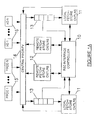
- FIGURE 1a depicts a single Storage Controller cluster of a bi-nodal symmetric multiprocessor system.
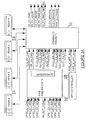
- FIGURE 1b depicts the Response Handler responsible for handling all response traffic returning from the remote cluster, the detailed interfaces and the sub-units that comprise the remote storage controller RSC IC (10), and also shows interfaces between the Remote Fetch/Store Controllers (12) and the RSC IC.
- FIGURE 2 illustrates the preferred embodiment implementation of the Command Translation in hardware.
- FIGURE 3 shows the overall priority station with its Pipeline Pre-Priority station (32) feeding the main Command Priority station (33).
- FIGURE 3b depicts the logic block diagram showing the interaction between the aforementioned mechanism and the RSC Priority station (21).
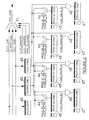
- FIGURE 4 illustrates how the command is staged into the proper holding register.
- FIGURE 5 depicts a detailed view of a single Set of Resource Registers (59a through 59f) which provides a Disable bit, a Valid bit, the Command register, the original Requester ID register, the LFSAR Controller ID register and the LFSAR Buffer register.
- FIGURE 6 shows a staging mechanism and how the Response Handler (22) tracks the XI response using the staging mechanism.
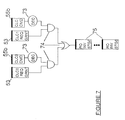
- FIGURE 7 depicts the Read-Only Invalidate Staging Pipeline (75) which works in a similar fashion to other described staging pipelines.
- FIGURE 8 shows the internal logic of one Pipeline's receiving and driving XPTs within one RSC IC.
- FIGURES may be separated in parts and as a convention we place the top of the FIGURE as the first sheet, with subsequent sheets proceeding down and across when viewing the FIGURE, in the event that multiple sheets are used.
- the present preferred embodiment of our invention is a remote resource management system for managing resources with a remote storage controller to distribute work to a remote controller acting as an agent to perform the desired operation without requiring knowledge of a requester who initiated the work request. work is distributed only when a remote requester is available for processing of the work, without a need for constant communication between multiple clusters of symmetric multiprocessors. It uses a minimum of interface I/O signals.
- Our remote resource management system manages the interface between two clusters of symmetric multiprocessors in a highly efficient manner using a reduced number of input and output pins.
- a single interface macro on each cluster is responsible for complete control of the interface. This includes prioritizing queued requests, sending new operations across the interface, handling returning responses from the other side, and overseeing the transfer of all data between the clusters. Due to the limited number of control I/O, our invention uses a novel combination of remote resource management coupled with command remapping to minimize the amount of information that needs to be transmitted.
- the local Interface Controller not only initiates the work request to the remote side, but manages the fetch/store controllers on the remote side, thereby immediately routing the new operation to an available controller.
- the remote fetch/store controller simply becomes an agent who works on behalf of the local interface controller, who in turn works on behalf of a requester. By operating in this manner, it eliminates the need to send information identifying the owner of the operation,-since the remote side has no reason to know.
- An additional advantage of this remapping operation is the ability to manage the interface data paths more efficiently by eliminating unnecessary data transfers.
- Command remapping offers several advantages. First, it simplifies the Remote Fetch/Store controller design since many operations can be mapped into a subset of simpler atomic interface operations. Secondly, no additional control I/O is required to send directory information between the clusters. Third, to prevent any increase in latency, the command remapping is performed within the same cycle that priority is issued for a new command to cross the interface.
- the remote management system is-designed to interface with a high-end Storage subsystem that contains a large number of fetch and store controllers servicing a single or a plurality of pipelined Level 2 caches.
- a series of priority stations is used to ultimately select a request to send across the interface.
- a pre-priority station in each pipe chooses one of fetch or store request to forward to the RSC IC.
- the RSC IC employs a high performance priority operation to select the optimal request based on command type and resource availability. Since multiple pipes can request use of the interface on any given cycle, the operation will favour a fetch over a store as long as a remote fetch controller is available.
- the store will be taken as long as a remote store controller is available, and a data path is available for those store operations which require one. If both requests are fetches, and both have available resources, a simple round robin determines which request is honoured. In the case of both requests being stores, the winner is determined by whichever pipe has the available resources. Once again, if both have all the available resources, the simple round robin is used. This method virtually guarantees that a command will be transmitted as long as there are work requests and available resources. In addition, the preferential treatment afforded to processor fetches improves overall system performance. Finally, management of the remote resources within the local Interface Controller, ensures that interface cycles will not be wasted transmitting work that winds up being queued on the remote side.
- the RSC IC employs a "fast-pathing" technique during cycles where no fetch or store controller is requesting use of the interface. During these cycles, all pipes are monitored for valid CP fetches. If one is found, it is immediately dispatched to the remote side, while the fetch controller is being loaded in parallel. This allows a fetch request to get a one cycle head start to the remote side, thereby reducing the latency of the returning data.
- the RSC IC Since a large disparity can exists between the best-case latency for data fetches that hit the remote cache versus data accesses from local main memory, the RSC IC has the ability to communicate remote cache hits to the local fetch controller, thereby allowing the main storage access to be cancelled. This contributes to overall system performance by freeing up memory banks to work on another request.
- the RSC IC employs both a synchronous and asynchronous response bus to maintain cache coherency while maximizing performance. Because it's impossible to determine the exact number of pipe cycles to complete an operation prior to the request testing the cache state on the remote side, an asynchronous response bus is used for all final responses. These responses mark the official end of the remote operation and are often forwarded to the original requester. In addition, the final responses are tagged with change line information which permits the local directory to be updated with the correct final state. Since the final response can be delayed due to contention for a single final response interface bus, performance can be improved by reporting the result of the initial remote cache cross interrogation (XI) as soon as it's known.
- XI remote cache cross interrogation
- the RSC is always able to report this XI result in the minimum timeframe using a synchronous XI response bus. This is made possible because the SC's Central Priority station guarantees that any new request received from the remote side will be immediately admitted into the appropriate pipeline.
- the initial directory look-up is performed in a fixed pipe cycle and the results are shipped back across the XI response bus.
- the Interface Controller who initiated the operation knows an XI response will be available in a fixed number of future cycles, so a simple staging mechanism is used to forward the hit/miss result to the requesting fetch/store controller.
- the RSC IC In addition to managing the control interface, the RSC IC also manages all cluster to cluster dataflows.
- the present embodiment contains enough dataflow I/O to permit each pipe to transfer 16 bytes per cycle in both directions, and the RSC IC is capable of exploiting the potential 64 bytes per cycle maximum throughput.
- a given data path must serve as a conduit for store data going from cluster A to cluster B "and" returning fetch data from cluster B to cluster A.
- the RSC IC not only prevents collisions, but does so without reserving the bus in advance. This, in turn, allows the RSC IC to compare requests from the local Store controller with requests from the resident Remote Fetch controller to trying to return fetch data.
- the RSC IC monitcrs the corresponding data path as the data is accessed from the memory banks. If the RSC data path is available, the data will bypass the remote fetch buffer, thereby reducing the normal latency associated with temporarily buffering the data.
- the RSC IC abates this scenario by sending the second fetch request to the duplicate Remote Fetch controller, if it's available. This allows the second Remote Fetch controller to begin loading its buffer, while the first buffer is still completing its data transfer. This permits the second buffer to transfer its data across the interface immediately upon completion of the first buffer's transfer.
- the Remote interface also exhibits a high degree of reliability, and availability by allowing many operations to be retriable in the event an operation can't complete successfully on the remote side.
- These types of problems fall into two major categories&colon. remote rejects and interface errors.
- An operation may be rejected by the remote cluster to avoid a potential cross-cluster deadlock.
- These deadlocks can occur when there are more storage subsystem fetch and store controllers than RSC resources to service them.
- the remote fetch and store controllers contain a deadlock avoidance mechanism designed to monitor operational sequences which can result in a cross-cluster deadlock. Upon detecting such a scenario, the controller will reject the pending operation by returning a special reject response back to the initiating cluster.
- the RSC IC will, in turn, forward the reject to the originating fetch/store controller so the operation can be retried. Operations can be continuously rejected and retried until the deadlock window disappears.
- the other type of recovery occurs when an interface parity error is detected on any of the control information accompanying a new RSC operation.
- a synchronous interface is used to transmit interface error status within a fixed number of cycles after the command is sent.
- the originating fetch/store controller is notified and subsequently determines the eligibility for recovery.
- the RSC IC automatically resets the corresponding RSC resource to permit the operation to be requested again.
- FIGURE 1a depicts a single Storage Controller cluster of a bi-nodal symmetric multiprocessor system.
- the present embodiment is represented as the Remote Storage Cluster Interface Controller (RSC IC 10) which interacts with a twin set of Local Fetch/Store Controllers (11), Remote Fetch/Store Controllers (12) and Centralized Multi-Stage Pipelines (13). These Pipelines are fed by a Central Priority (14) Station which prioritizes asynchronous work requests emanating from N Central Processing Unit Controllers (15) or N I/O Adapters Controllers (16).
- Each CPU Controller can has an affinity to a particular Central Processor (CPU) in the SMP system.
- CPU Central Processor
- the Pipelines comprise a shared Level 2 store in cache to which all Central Processing Units, I/O adapters and Local and Remote Fetch/Store Controllers have read and write access.
- the cache coherency operation employed in the preferred embodiment permits data to reside in the cache in a read-only state which permits all processors and I/O adapters on both clusters to access copies of the data, or an exclusive ownership state whereby a single processor can own the data at any time. Any processor on any cluster may request ownership of data at any time, even if another processor currently owns that data.
- the preferred embodiment utilizes a dual pipeline design in which the Central Pipelines (13), Remote Fetch/Store Controllers (12) and Local Fetch/Store Controllers (11) are all duplicated.
- the concepts disclosed in the present invention are independent of the surrounding structure of the Storage Controller (SC) and can be just as effectively implemented in a more traditional single pipeline SC design or a less traditional SC design employing three or more pipelines.
- SC Storage Controller
- One skilled in the art will appreciate how the RSC IC (10) interfaces and internal functional blocks can be easily scaled to adapt to almost any SC structure.
- the RSC Interface Controller (10) is comprised of several sub-units which interact with various SC functional units. Since there is only a single Remote Storage Cluster interface to service requests from twin sets of Pipelines (13) and Fetch/Store Controllers (11,12), the solitary RSC IC has to accommodate a multitude of local interfaces as well as the cluster-to-cluster interface. In addition, it has to manage traffic flowing from the local cluster 'to' the remote cluster as well as traffic flowing 'from' the remote cluster.
- FIGURE 1b depicts the detailed interfaces and the sub-units that comprise the RSC IC (10).
- the majority of the requests come from the Local Fetch/Store Controllers (11). These requests are broken down into fetch requests known as LFAR requests, and store requests known as LSAR requests.. In the preferred embodiment there are 4 LFAR and 4 LSAR requestors for each Pipeline, thus totalling 16 possible LFSAR requestors vying for use of the RSC interface.
- a pre-priority station within the LFSAR Controllers chooses one requester from each pipe and forwards, at most, two requests to the RSC IC on any one clock cycle. Once again, the present invention would permit any number of LFAR and LSAR requestors, distributed among any number of Pipelines.
- the pre-priority station within the LFSAR Controllers (11) can be incorporated directly into the Command Priority unit within the RSC IC.
- Each interface consists of a Request bus, C3 Command bus, C3 Requester ID bus and C3 Address bus.
- the 8 bit Request bus contains one bit for each LFAR and LSAR requester, of which only one bit can be active on any cycle. This bit denotes the ID of the LFAR or LSAR controller chosen by the pre-priority station on that cycle.
- the corresponding busses convey the command, address and ID of the CPU, I/O Adapter or SC Controller which initiated the command into the Pipeline.
- the LFSAR Controllers may continue presenting the same request or dynamically select a new request on the next cycle.
- the Pipelines (13) themselves also serve as requestors which permits an operation called "Fast-Pathing".
- Fast-Pathing enables the RSC to monitor both pipes and launch a remote fetch operation if one is required and no work is pending from either of the LFSAR Controllers (11).
- the C1 Command, C1 Address, and C1 Requester ID is obtained from the first stage (C1 cycle) of each pipe and sent to a pre-priority station within the 'RSC Priority' (21) sub-unit of the RSC IC.
- the output of the pre-priority station is forwarded to the main priority station (also located within the 'RSC Priority' (21) sub-unit. where it competes with the requests from the LFSAR Controllers (11).
- the 'RSC Priority' (21) station examines the pending work requests and uses a high performance operation to determine which request should be permitted to cross the interface. Upon choosing one, a grant is sent to the LFSAR Controller (11) corresponding to the Pipeline of the selected operation. The grant indicates whether the chosen operation was a pending request from the LFSAR Controller (11) or a Fast-Path operation initiated from the Pipeline (13). while the grant is being issued to the LFSAR Controller, the chosen Command along with it's associated Address, Requester ID, and tag lines indicating the RSC Resource are sent across the RSC interface to the remote cluster.
- All RSC operations require some type of completion response from the remote cluster.
- data fetches also require a Cross Interrogate (XI) response indicating whether the requested data is present in the remote cache.
- All responses are processed through the RSC IC (10) and either forwarded directly or indirectly to the original requester. Most of the time the responses are decoded and appropriate status, release and cache coherency information are passed on to the LFAR or LSAR controller. However, many operations involve sending the response back to the original CPU Controller (CFAR 15). Regardless of the final destination of the responses, the RSC IC tracks all the necessary information for every operation such that response information for all RSC operations can be multiplexed over a single Encoded Response bus. The RSC IC receives incoming responses into the 'Response Handler' (22), whose job it is to decode the response and transmit the appropriate information to the LFSAR Controllers (11) or the CPU Controllers (15).
- FIGURE 1b also shows interfaces between the Remote Fetch/Store Controllers (12) and the RSC IC.
- the Remote Fetch/Store Controller is broken down into separate Remote Fetch (RFAR 12a) and Remote Store (RSAR 12b) Controllers.
- the Remote Fetch Controller (12a) is responsible for receiving fetch requests from the other cluster, processing them through the Pipeline (13) and returning the data (if possible) along with the necessary response information.
- the Remote Store Controller (12b) is responsible for receiving incoming store operations (and any accompanying data), processing them through the Pipeline (13), and returning the necessary response information.
- Each Pipeline has an RFAR (12a) and an RSAR (12b) Controller associated with it, therefore a maximum of four requests can be presented to the RSC IC to return information on the Encoded Response bus in a given cycle.
- the 'Response Priority' (23) sub-unit within the RSC IC arbitrates among these requests and manages the traffic on the Encoded Response bus. If an RFAR Controller needs to return fetch data, the 'Response Priority' (23) station communicates with the 'RSC Priority' (21) and 'XPT Controller' (25) to ensure a data path is available.
- 'Resource Registers' (24) to track all the remote activity on the local side.
- the RSC IC acts as an agent for the original requester on the local side. It tracks the RFAR and RSAR resources on the remote side eliminating the need for constant cluster-to-cluster communication.
- the 'Resource Registers' (24) interact with the 'RSC Priority' (21) station to ensure that an operation is initiated only if an RSC resource is available.
- the RSC IC marks the chosen RFAR or RSAR as "in use", and that resource remains in use until a response is received indicating completion of the operation. These responses are then used to reset the resource and make it available for a new operation.
- RSC 'Resource Registers' comprised of 2 RFARs and 2 RSARs for each Pipeline.
- Each of the two RFARs/RSARs are identical to one another and exist primarily to improve performance by allowing multiple remote fetch and store operations to be processed simultaneously by each pipe.
- the present invention does not require, nor is it limited to, 2 RFARs and 2 RSARs per pipe. All remote resources are tracked in the same manner regardless of the number in existence.
- the original Pipeline command Prior to selecting an operation, the original Pipeline command undergoes translation to an RSC command. In many cases the resulting RSC command is identical to the original command, but in certain cases the command codepoint is remapped to allow similar operations to share a single RSC codepoint. This step also ensures that all RSC fetch commands fall within a contiguous range ('01'x-'1F'x in the preferred embodiment), while all store commands fall within a different contiguous range ('20'x - '3F'x in the preferred embodiment).
- the RSC IC uses two select bits to indicate to the other side which of the 8 resources should service the newly selected operation. The two bits refer to the Pipeline and which of the twin resources within that Pipeline should process the command.
- the final sub-unit is the 'Cross-point (XPT) Controller' (25), who is responsible for managing the four data paths connecting the clusters.
- XPT 'Cross-point
- Controller' 25
- Each data path has it's own XPT bus such that the four operations can occur simultaneously.
- the data paths are 16 bytes wide, and can transfer a quadword (16 bytes) every cycle.
- the cycle time of the preferred embodiment permits a theoretical sustained transfer rate of 12.8 GB/sec.
- One aspect of the present invention is to exploit the use of remote resource management to minimize the size and complexity of the Remote Fetch/Store Controllers (12) as well as the amount of information that must be exchanged across the cluster-to-cluster interface.
- Remote Fetch/Store Controllers (12) In high-end SMP systems with complex Storage Controllers virtually every command that can be initiated within a local cluster can also be sent across the interface for processing on the remote cluster. when these commands are decomposed into a series of atomic operations, one finds that the RSC Fetch/Store Controller (12) on the remote side can use identical state machines to process several similar commands. Therefore, in order to simplify the RSC design, some of the original commands on the local side are remapped into an equivalent "base" RSC command.
- a "fetch exclusive with storage protect key” results in the same Pipeline sequences and directory update actions as a "fetch exclusive without key”. Therefore, the RSC Interface Controller will remap a fetch exclusive with key command ('06'x) into a simple fetch exclusive command ('02'x) prior to sending it across the interface.
- the preferred embodiment implements the Command Translation in hardware as shown in FIGURE 2.
- the original command enters the 'Flip Bit Generator' (26) which is comprised of the logic gates required to implement the 'Flip Bits' column of the Command Translation Tables (28).
- the original command is combined with the 'Directory Status' and the 'Target L3' to determine which bits, if any, need to be flipped.
- the resulting Flip Bits are exclusive or'd with the original command in the XLAT (27) block to produce the desired RSC Base Command shown in the 'RSC Command' column of the Command Translation Tables (28).
- the RSC Command Translator is designed to perform the translation within a single clock cycle and is an independent functional unit.
- the Command Translator can be physically implemented as part of the RSC Interface Controller (10) or it can be included within the controllers that initiate work requests to the RSC.
- the translator can be integrated into the same logical cycle as the RSC Command Priority station, or it can be performed in an earlier cycle if the original command is available.
- the Pipeline "Fast-Path" command is available in the second Pipeline stage (C2), thus it can translated prior to the RSC Command Priority cycle.
- Command Translation improves interface efficiency in several ways. To begin with, many operations don't need to interrqgate the remote side if the desired data resides in the local cache. Therefore, the Command Translator will use the directory status to exclude these types of operations from requesting use of the RSC interface. Secondly, command translation guarantees that data transfers only need to be sent in one direction rather than being transferred once, processed, then returned back to the original side. For example, an I/O Store 64 Byte (Command 28) without translation would result in an unconditional transmission of 64 bytes of data even if the final destination for the data is the local L3 memory.
- the third possible scenarios for I/O Stores is the case where the target data resides in a read-only state in both caches.
- the I/O Store data can be merged with the local copy of the data so it's unnecessary to transfer any data across the interface. Instead the original command is translated to a "Read Only Invalidate" command which is forwarded to the Remote Fetch Controller (12a) so that the copy of the data in the remote cache can be marked invalid.
- FIGURE 3 shows the overall priority station which consists of a 'Pipeline Pre-Priority' station (32) feeding the main 'Command Priority' station (33).
- the 'Pipeline Pre-Priority' station monitors the first stage (C1) of both Pipelines looking for "Fast-Path" candidates. Any CPU fetch command ('01'x-'07'x) is considered a candidate for "Fast-Pathing". If either Pipe command is a candidate, it enters the 'Pre-priority' station (32) and competes with the other Pipeline command for selection into the C2 staging area. If only one Pipe has a valid candidate on that cycle, it will automatically be selected. If both Pipes have valid candidates, a simple round-robin determines whose turn is next.
- the command is forwarded to the main 'Command Priority' station (33) where it competes with requests from both LFSAR Controllers (11).
- the 'Command Priority' station (33) receives a set of signals from each LFSAR Controller (11) as well as the Pipeline Fast Path information forwarded from the 'Pipeline Pre-Priority' station (32). In addition, it also interfaces with the eight 'Resource Registers' (24) and the 'XPT Controller' (25) so it can intelligently select a suitable operation.
- the operation will always try to select an LFSAR operation if one is pending, and the RSC resource is available. If only a single LFSAR Controller (11) is requesting, and the RSC resource is available, it gets selected. If both LFSAR Controllers (11) are requesting, and only one has the available resources, it will win. If both LFSARs are requesting, and both have available resources, a fetch type of operation will take precedence over a store type. In the event both requests are of the same type, a simple round-robin determines whose turn is next. Finally, if no LFSAR Controllers (11) are requesting, or no resources are available to honor the LFSAR requests, then a Fast-Path request is selected.
- Availability of resources varies depending on the type of operation. Fetches are the simplest case since the only resource required is a Remote Fetch Controller (RFAR 12a) corresponding to the Pipeline processing the fetch operation. RFARs could be unavailable because they are busy processing other fetch operations, or because the resource Disable switch could be active.
- the 'Command Priority' station (33) monitors each RSC Resource's 'Disable Switch' and 'Valid Bit' to determine availability. .* RFAR Toggle
- the priority operation works in conjunction with the 'Response Handler' (22) to maximize the efficiency of remote fetches.
- a fetch will be dispatched to the next available 'RFAR Controller' (12a)
- the RFAR on the remote cluster will process the fetch request in the Pipeline and begin loading its data buffer. Simultaneously it will make a request to the 'RSC IC' (10) on the remote side to return the final response and data across the interface. As soon as the final response is transmitted, that RFAR resource is considered available and can accept new work. If a new non-data operation is sent to that RFAR, it can process it while the trailing bytes from the previous fetch are still being read out of the data buffer. However, if the new operation is a second data fetch, it will be recycled through the Pipeline on the remote side continuously until the buffer becomes available.
- the present embodiment circumvents this scenario by ensuring that consecutive data fetches will be sent to alternating RFAR Controllers, if both resources are available at the time the second fetch request arrives. For example, if RFAR A0 is processing the first fetch, and a second fetch arrives while RFAR A0 is still busy, it will be routed to RFAR A1 (assuming RFAR A1 is available) . In addition, if RFAR A0 becomes available due to the final response being transmitted, and then the second fetch arrives, it would also be routed to RFAR A1 (since the RFAR A0 buffer is still transferring data).
- a non-data operation like a Read-Only Invalidate arrived while RFAR A0 is still busy, it would be routed to RFAR A1. If this is followed by a third operation, which is a data fetch, and RFAR A0 is available, this new data fetch would be sent to RFAR A0, even if the buffer is still busy transferring trailing bytes. In other words the mechanism to alternate the requests to different RFARs is subservient to availability of either resource in the pair.
- FIGURE 3b depicts the logic block diagram showing the interaction between the aforementioned mechanism and the 'RSC Priority' station (21).
- a Resource Toggling function exists within the RSC IC for each pair of 'RSC Resources' (24).
- a single 'Resource Toggler' (35) representing the RFAR pair for Pipeline A is depicted in FIGURE 3b. It receives availability signals from each RFAR Resource (A0 and A1). These availability signals, along with those from the 6 other RSC Resources, also feed the 'RSC Priority' station (21).
- the Pipe A fetch grant signal generated by the RSC Priority station, also feeds the 'Resource Toggler' (35).
- the 'Resource Toggler' uses a 'Toggle Possession Latch' (36) to control which one of the resource pair will be assigned the next operation, if the right conditions are present.
- the 'Resource Toggler' produces a single select signal which is "ANDed" with the fetch grant signal twice to produce the 'LOAD RFAR A0' and 'LOAD RFAR A1' signals that are forwarded to the RFAR A0 and A1 resource registers.
- the 'Toggler Truth Table' (37) shown in FIGURE 3b describes how the select signal and 'Toggle Possession Latch' (36) are updated. If only one of the two resources is available, the select signal will default to the available resource, regardless of the state of the 'Toggle Possession Latch' (36) . If both resources are available, and a fetch grant was issued for this Pipeline, then the present state of the Toggle Possession Latch drives the select signal. Furthermore, the Toggle Latch is updated on the next cycle in anticipation of a subsequent fetch which should be steered to the "other" resource, if it's available.
- the available signals are a function of the resource 'Valid Bit' (59a), 'Disable Bit' (59f) and a 'RST_RFAR_A0' latch which indicates a final response was received for this resource and it is considered "available" on this cycle.
- the 'Command Priority' station (33) determines part of the availability for Remote Store Controllers (RSAR 12b) in the same manner as RFARs; by testing the 'Disable Switches' and the 'Valid Bits'.
- the 'Command Priority' station (33) decodes the RSC Base Command to see if it requires a data transfer. If the command does require a data transfer, then the data bus must be tested for availability. In order to pass this test, two conditions must be met:
- the aforementioned priority operation ensures that a new operation will be forwarded to the remote side as long as the resource is available. Furthermore, by favouring the LFSAR Controllers (11), it improves the throughput of the LFSAR resources, thereby reducing resource congestion and deadlocks caused by resources that get interlocked waiting on each other to complete.
- the command (either in its original or remapped codepoint) is sent across the RSC interface with the full 27 bit address.
- the RSC Command distributor on the remote side routes the command to an RFAR or RSAR depending on the value of bit 0 of the 'c0_c1_cmd' command bus.
- 'c0_c1_pipe_sel' and 'c0_c1_req_reg_sel' are used to steer the command to the selected RFSAR Controller (12a or 12b) associated with the Pipeline processing the operation.
- This remote resource management technique enables a large number of Storage Controller resources, spread among multiple Pipelines, to utilize a shared RSC Interface using a limited number of I/O.
- the 'co_c1_reqid' is the ID of the originating requester which is sent across the interface, but does not take part in the remote management operation. This ID is treated purely as information which is forwarded to the remote side, and passed along to the Storage Controller resource who needs it.
- the 'Command Priority' station (33) Upon issuing a new RSC operation, the 'Command Priority' station (33) issues a grant to the corresponding LFSAR Controller (11). In the preferred embodiment a critical timing path is alleviated by delaying this grant by one cycle. However, this delay means that the request line from the LFSAR Controller will be active one cycle longer than necessary. The RSC Priority station takes this into account when analyzing the requests for the next operation, such that it won't waste a cycle selecting that same operation again.
- FIGURE 4 illustrates how the command is staged into the proper holding register.
- the purpose of the 'CLC Command' (42) and the 'C3 Pipe Command' (43) staging registers is to alleviate the timing on critical path through the 3-way mux (41) in the upper right corner of FIGURE 4. All CLC commands originate from the LFSAR Controllers (11) and are timing critical. In order to improve overall system performance, remote operations are sent across the interface in a single cycle. Since this same command must traverse the priority logic and a small cross point switch to reach the appropriate RSC Resource register, this presents a challenging path.
- the preferred embodiment resolves this by staging the incoming CLC commands and the Pipe command prior to sending it through the crosspoint switch.
- each LFSAR Controller (11) request are staged into the 'CLC Command' staging registers (42).
- the C2 Pipeline command selected by the 'Pipeline Pre-Priority' station (32) is staged into the 'C3 Pipe Command' staging register (43).
- the CLC and Pipe commands flow through the '3-way Mux' (41). This mux is controlled by the grant lines coming from the 'Command Priority' station (33).
- Each CLC command can be loaded into either of the two 'RFAR Command' (45) or 'RSAR Command' (47) registers associated with that CLC's Pipeline. This means each CLC command has four possible destinations.
- the RSC contains eight 'Resource Registers' (24) which handle all cross-cluster operations. This permits two fetch and two store operations for each Pipeline to occur simultaneously. Since the entire operation is tracked by the local RSC Interface Controller (10), all the information required to complete the operation must be held within the 'Resource Registers' (24).
- FIGURE 5 depicts a detailed view of a single 'Set of Resource Registers' (59) which consists of a Disable bit, a Valid bit, the Command register, the original Requester ID register, the LFSAR Controller ID register and the LFSAR Buffer register.
- FIGURE 5 the diagram illustrates the detail of an RFAR resource which is slightly more complex since it includes both the 'C3 Fast-Path Staging Registers' (55a) and the 'CLC Staging Registers' (55b).
- FIGURE 4 illustrated just the Command portion of the Resource Registers, but depicted all eight Resource Registers.
- FIGURE 5 shows a single Resource but shows how all the information required to track a given RSC operation is loaded into a Resource register. All the control signals emanate from the 'Command Priority' station (33).
- This diagram uses only the priority grants (which is a subset of the actual signals used) to depict the logical timing of how the various resource registers get loaded.
- the valid bit (59a) is loaded on the cycle after an operation is issued a grant.
- the 'OR gate' (54) ensures that the Valid bit is loaded regardless of whether the operation is a regular CLC operation or a Pipeline Fast-Path operation. Since the Valid bits play an important role in determining if a resource is available, this assures the resource is marked as unavailable on the next priority cycle.
- our invention takes advantage of the fact that the remaining information can be delayed before loading.
- CLC operations those which are issued from an LFSAR Controller (11), are the simplest in terms of the logical timing.
- the staged 'CLC Grant' (53) controls the '2-Way Mux' (56) and the 'Gateway' (58) through the 'OR Gate' (54).
- this grant is active, all information comprising 'CLC Staging Registers' (55b) gets loaded into the remaining 'Set of Resource Registers' (59b thru 59d) on the cycle following the loading of the 'Valid bit' (59a).
- Pipeline Fast-Path operations are staged into the 'C3 Fast Path Staging Registers' (55a) of which there are only a C3 Command and Requester ID register.
- the staged 'Fast-Path Grant LC' selects the C3 Pipeline Command and Requester ID through the '2-Way Mux' (56) and loads them into the Command (59b) and Requester ID (59c) Resource registers.
- these Fast-Path operations reach the third stage of the Pipeline, they are loaded into an LFAR resource and assigned to an LFAR Buffer. This is necessary since many CPU Fetch operations require multiple Pipeline passes so an LFAR is required to manage the entire fetch operation.
- the LFSAR Controller (11) will raise a special request to the RSC IC (10) on the cycle immediately following the Pipeline Fast-Path operation.
- the LFSAR interface will contain the LFAR ID and LFAR Buffer ID.
- the RSC IC uses the 'Fast-Path Grant LC2' trigger to time when the information will be available in the 'CLC BFR and CLC REQ' registers (55b).
- the preferred embodiment also depicts the use of an 'Encoder' (57) which performs an 8-to-3 encoding of the 8 request signals residing in the 'CLC REQ' register, and stores the ID as a 3 bit value in the 'LFSAR ID' register (59e).
- One additional bit, denoted as the 'Disable' register (59f) is also included for completeness.
- This single bit register is a scannable register which can also be loaded via the preferred embodiment's Universal Bus (UBUS).
- Each RSC Resource Register has such a 'Disable' bit which permits the resource to be disabled either permanently or temporarily through microcode, firmware loads, system resets, etc. Although this bit plays no role in the normal system operation of the RSC IC (10), it serves as an aid in engineering debug and interface performance analysis.
- the 'Response Handler' (22), shown in FIGURE 1b, is responsible for handling all response traffic returning from the remote cluster, and forwarding the appropriate completion signal to the initiator.
- Many of the RSC operations include a remote "Cross Interrogation" (XI) to determine if the data resides in the remote cache. Whenever one of these operations is invoked, the command is received on the other side and enters the remote pipe using a guaranteed priority level. This guaranteed entry into the pipe permits a synchronous relationship to exist between the time the operation is launched across the interface, and the time that the hit/miss result is known.
- the XI response is returned four cycles after the command is presented on the RSC interface.
- the 'Response Handler' (22) tracks the XI response using the staging mechanism shown in FIGURE 6.
- the RSC IC uses an address bit which denotes whether the fetch targets the local L3 or remote L3 memory, coupled with the synchronous interface, to determine whether to automatically retire the operation. For example, if the fetch targets the remote L3, then the RSC resource must remain valid until the operation completes because the desired data will either come from the remote cache or the remote L3. However, if the address targets the local L3, and the data doesn't reside in the remote cache, then the resource can be freed up to work on a new operation since the data fetch can be handled by the local LFAR controller.
- each of the 'CLC Command' registers (55b) is analyzed by the 'Decoder' (61) to see if it's one of the fetch commands which require a Cross Interrogation (XI).
- This result is combined with the 'CLC Local L3' bit (60) and a signal from the 'RSC Priority' station (21) indicating this CLC Op was issued a grant.
- the 'C3 Pipe Local L3' bit is compared with a similar signal from the 'RSC Priority' station (21) indicating a Fast-Path operation was issued a grant.
- all Fast-Path operations require Cross Interrogations. Since the grants are mutually exclusive, only one branch can be active on any cycle.
- Stage 6 of the pipeline corresponds to the cycle when the XI Response is received by the 'Response Handler' (22). If any of the four bits are active and the XI Response is a miss, then the corresponding RSC Resource Register is reset by turning off the 'Valid Bit' (59a).
- FIGURE 6 also shows the 'RFSAR Staging Pipeline' (67) which is loaded with every newly initiated RSC operation.
- Each 'RSC Resource Register' (24) contains a single bit latch indicating that the resource was loaded on the last cycle.
- These 8 'Resource Load Latches' (65) are orthogonal since only one resource can be loaded with a new operation each cycle.
- the outputs of these 8 registers are encoded using the '8-to-3 Encoder' (66) and the 3 bit encoded value is stored into the 'RFSAR Staging Pipe' (67).
- This pipeline also begins with Stage 2 and ends with Stage 6.
- the 3 bit RSC Resource ID coupled with a valid bit, is pipelined through the stages each cycle until it reaches Stage 6.
- the logical timing is such that this ID arrives at Stage 6 which is the same cycle that the XI response and the Remote Interface Error signal are received.
- the 3 bit RFSAR ID is decoded and used to reset the 'RSC Resource Registers' (21) involved in the operation.
- a hardware 'Lookup Table' (68) is employed to use the 3 bit RSC ID to index into that resource register's 'LFSAR ID' (59e) register.
- the contents of the LFSAR ID register are further decoded and used to send an interface error signal to the appropriate LFAR or LSAR Controller. For example, if Stage 6 of the 'RFSAR Staging Pipeline' (67) contains a value of "010", this indicates that RSAR 0 of Pipe A is the RSC Resource.
- the 'Lookup Table' (68) would then decode the LFSAR ID register within the Pipe A RSAR 0 resource, and that value would point to the LSAR associated with this particular operation.
- the ability to associate a given operation with the corresponding local LFAR or LSAR Controller permits many of the RSC operations to be retried. Often the interface error is intermittent, thus the ability to retry the operation prevents unnecessary system outages.
- One additional system performance improvement, which utilizes the 'RFSAR Staging Pipeline' (67) is the "Fast Read-Only Invalidate".
- One of the RSC Operations is a Read-Only Invalidation in which a read-only copy of the data residing in the cache must be invalidated on the remote side. This occurs, for example, when a CPU wants to fetch data with exclusive ownership and other CPUs have read-only copies of the data. If the other CPUs are on the remote side, the RSC IC will send a Read-Only Invalidate command which the Remote Fetch Controller (12a) on the other cluster will process. Normally this results in a simple Pipeline pass to invalidate the directory entry.
- FIGURE 7 depicts the 'Read-Only Invalidate Staging Pipeline' (75) which works in a similar fashion to the other two aforementioned staging pipelines.
- the 'CLC Command' registers (55b) for both Pipelines are decoded using the 'ROI Decoder' (73) which filters out Read-Only invalidate operations. This, coupled with the 'CLC Grant' (53) indicates that a valid Read-Only operation was initiated. Once again, only one of these can be initiated on any given cycle.
- the results are fed into the 'ROI Mux' (74) and used to set Stage 2 of the 'Read-Only Invalidate Staging Pipeline' (75).
- This bit is pipelined down to Stage 6 where it lines up with the XI Response received in the 'Response Handler' (22). If the RO Invalidate Stage 6 bit is active and the XI Response is a miss, the 'RFSAR Stage 6 Register' (63) and the 'LFSAR Lookup Table' (68) are employed to release the associated LFAR Controller and allow it to complete the initial operation.
- the Remote Fetch Controller continues to process the Read-Only Invalidate so the RSC Resource Valid bit remains active. Once the Remote Fetch Controller (12a) completes the operation, it returns a final response which retires the operation and allows the resource to accept a new piece of work. In the meantime, the LFAR associated with the Read-Only Invalidate may have started a new operation.
- the RSC IC contains holding registers for each RFAR resource.
- the appropriate holding register is set whenever the "Fast Read-Only Invalidate" mechanism is used to release an LFAR, and it blocks the forthcoming final response from signalling that LFAR. Once the final response is received, and the operation is officially completed, the holding register is reset along with the remaining resource registers.
- the 'Response Handler' uses the Encoded Response ID bus to match the response with the LFSAR ID who initiated the operation.
- the RSC IC (10) signals the originating LFSAR Controller that the operation is complete so they can release their resources.
- a data advance is sent to the corresponding local LFAR Controller so it can update the local directory status.
- signals are sent to the 'XPT Controller' (25) to permit the RSC XPT codepoint to be sent to the dataflow chips.
- a subset of remote operations also require the entire response code to be forwarded to the CFAR Controller (15).
- the CFAR Controller has to use this single response to send an early and final response back to the Central Processing Unit.
- bits 0 and 1 are not included in the actual response value. Instead, they have the following special meaning:
- the remaining bits are encoded to indicate various completion codes depending on the initiating operation.
- the RSC IC In addition to handling responses returning from the remote side, the RSC IC also employs a 'Response Priority' function to transmit responses to the remote side. These responses are in the form of Cross Interrogate (XI) and final responses for operations initiated from the remote cluster and processed on the local cluster.
- XI Cross Interrogate
- the local RFAR (12a) and RSAR (12b) Controllers from each Pipeline present XI Responses and requests to transmit a final response to the RSC IC (10).
- Cross Interrogates only pertain to fetch operations, therefore only the RFAR Controllers (12a) can present XI Responses.
- Final Response requests can emanate from RFAR (12a) and RSAR (12b) Controllers and since remote operations vary widely in length, the responses occur asynchronously.
- the 'Response Priority' (23) logic interacts with the 'RSC Priority' station (21) to determine whether any of the final response requests can be honoured.
- the response logic uses a simple priority operation to choose one of the four RFSARs and forward the response across the interface. If more than one RFSAR issues a request on the same cycle, the operation favours RFARs over RSARs. This improves system performance by ensuring fetch data required by a CPU is not delayed unnecessarily by RSAR response traffic.
- the operation uses a round robin to select one of the RFARs.
- a simple round robin chooses an RSAR.
- One aspect of the present invention is the interaction between the 'Response Priority' function (23) and the 'RSC Priority' station (21) to maximize the efficiency of the shared data busses. Since returning fetch data (pertaining to remotely initiated fetches) must share the same data path as locally initiated store operations, the potential exists for a fetch to be delayed while waiting for a store transfer to complete. The 'Response Priority' reduces this potential by em the following operation for final response requests to return fetch data.
- both priority functions are cyclically dynamic which means they evaluate the current environment each cycle and make all decisions within a single cycle. Therefore, in cases where a request is delayed due to unavailability of a data path, it will be serviced on the first cycle that it can be serviced.
- a request is chosen for transmission across the interface, a grant is sent to the requesting RFSAR so it can drop the current request and issue a new one on the next cycle.
- the RSC IC also transmits a 3 bit Encoded Response ID bus which indicates which RFSAR is returning the response.
- the 'Response Handler' (22) on the other side decodes this 3 bit ID to resolve which RSC Resource Register needs to be reset.
- the RSC interface in our preferred embodiment supports a total of four quadword (QW) data paths.
- QW quadword
- SCD chips IBM's storage controller dataflow chips
- DW doubleword
- the data path connecting the remote SC to the local SC could, at any time, be used for returning data in response to a locally initiated fetch request, or it could be used to deliver store data accompanying a store operation initiated by the remote side.
- these operations would be segregated with separate data paths, but packaging limitations prevent this.
- unidirectional busses exist both ways, for each pipe, does permit the simultaneous movement of four QWs (64 bytes) per cycle.
- the RSC IC contains a 'Crosspoint (XPT) Controller' (25) who is responsible for supervising all four data paths. In fact, half of each data path is controlled by the 'XPT Controller' on each cluster. For example, data travelling from the local SC to the remote SC is being driven by the local RSC IC and received by the remote RSC IC. Thus, the "driving" portion of the XPT bus emanates from the local RSC IC while the "receiving" portion comes from the remote RSC IC. All four data paths are controlled by an 11 bit control bus where bits (0:5) control the receiving side and bits (6:10) control the driving side.
- These partial XPT busses are hereafter referred to as the 'receive XPT (RCV XPT)' and 'driving XPT (DRV_XPT)'.
- FIGURE 8 shows the internal logic of one Pipeline's receiving and driving XPTs within one RSC IC.
- XPT information is set up in advance whenever possible.
- the role of the 'XPT GEN' (81a) logic is to use a combination of RSC Resource information and external signals to set up the appropriate data path controls.
- the 'Triggers' (82a and 82b) act as a gate to release the XPT information onto the RSC XPT bus at exactly the right time with respect to the moving data.
- the bits of the RSC XPT bus are received by various buffer controllers and crosspoint switches on the data chips.
- This logic consists of simple decoders which activate buffer address and write controls as well as selectors.
- the RSC XPT bus Since the data chips have no knowledge of the logical operation behind the data transfer, the RSC XPT bus must be "pulsed" once for each QW being transferred. Thus, if a line of data requires movement, the RSC IC must hold the appropriate value on the RSC XPT bus for 16 consecutive cycles.
- the XPT GEN logic uses the information in the 'Cmd' (59b), 'Req ID' (59c), 'LFAR Buffer' (59d) and 'LFAR ID' (59e) registers to calculate the value of the RCV_XPT and determine the data transfer length. If the length is greater than 1 QW, then the 'XPT_CNTR' (83) is loaded with the appropriate number of cycles. All of this occurs shortly after the command is dispatched across the interface. When the data returns, the first QW is always accompanied by an encoded response of '03'x, '23'x, '05'x or '18'-'1B'x.
- Receipt of one of these responses into the 'Trigger Logic' (82a), triggers the release of the RCV_XPT onto the RSC_XPT bus.
- the XPT_CNTR will continue to supply the RCV_XPT value until the count is exhausted.
- the RCV_XPT will direct the data to the proper CPU port, I/O port, LSAR Buffer and/or LFAR Buffer (for later inclusion into the cache) depending on the operation. Under certain circumstances data destined for a local CPU must be blocked from being sent to the CPU at the last moment.
- the RSC IC receives several block signals from each 'LFAR' (11) and 'CFAR' (15) controller which are used to suppress the trigger.
- the second scenario regarding use of the RCV_XPT bus involves receipt of store data initiated from the remote cluster. Since this is a completely asynchronous event, the 'XPT GEN' (81a) and 'Trigger Logic' (82a) are invoked simultaneously.
- the RSC IC monitors a portion of the incoming RSC_CMD bus as well as a data advance trigger from the local (RSAR controller' (12b). If the RSAR_DADV is active and the subset of the command decodes to a proper value, then the RCV_XPT is set up and presented to the RSC XPT bus so the local data path chips can be directed to accept the incoming data and route it to an RSAR Buffer.
- the driving XPT (DRV_XPT) works in a similar fashion. Once again, two scenarios require use of this data path. The first involves a locally initiated store operation. In this case, the RSAR resource registers hold all the necessary information to set up the DRV_XPT and load the 'XPT_CNTR' (83), if necessary. An RSAR_ST_OP signal, received by the 'Trigger Logic' (82b), controls the timing of when the data should begin to move with respect to launching the command across the interface. The RSAR on the other side will activate the RSAR_DADV to the remote RSC IC so it can "wake up" and accept the store data.
- the RSAR_ST_OP signals are simply decodes of the RSAR 'Command' (59b) register to determine if the current operation requires a store data transfer. All store data emanates from the LSAR Buffers on the local side, and the DRV_XPT will control reading of these buffers.
- the other scenario involves returning fetch data requested by the other side. Since the source of this data can be an RFAR buffer, the Primary Memory Adapter (PMA) interface or any of the CPU Remote Sense Registers, the 'XPT GEN' (81b) logic uses a combination of signals from the 'RFAR Controller' (12a) in addition to an MBA_ID. A non-zero MBA_ID implies the data will come from the Remote Sense register corresponding to the ID. If the ID is zero, then the various RFAR signals are used to determine whether the data comes from an RFAR buffer or the PMA interface.
- PMA Primary Memory Adapter
- the 'XPT GEN' (81b) logic uses a combination of signals from the 'RFAR Controller' (12a) in addition to an MBA_ID.
- a non-zero MBA_ID implies the data will come from the Remote Sense register corresponding to the ID. If the ID is zero, then the various RFAR signals are used to determine whether the data comes from an RFAR buffer or the PMA interface.
- the PMA_DATA_RDY signal is raised by the 'RFAR Controller' (12a) during the window of time that data is being transferred from the L3 memory to the Storage Controller. If the 'Response Priority' (23) can process the RFAR Encoded Response request during this window, then the data can bypass the RFAR Buffer and transfer directly to the RSC Interface. On the other hand, if the end of the window is reached before the 'Response Priority' (23) issues a grant to the requesting RFAR, then the PMA_DATA_RDY signal is dropped.
- the 'XPT GEN' (81b) logic will then route the data into the buffer until such time that the RSC Interface is available and able to move the data from the buffer onto the interface.
- This aspect of the present invention further improves system performance by eliminating unnecessary buffer loading and unloading during CP Fetches to the remote cluster.
- the 'Trigger Logic' (82b) is activated by an RFAR Grant from the 'Response Priority' station coupled with an ENC_RESP value indicating "returning fetch data". This allows the DRV_XPT to be released onto the second half of the RSC_XPT bus.
- the 'XPT_CNTR' (83) continuously activates the RSC_XPT until the counter is exhausted.
- the asynchronous nature of the RSC leads to frequent conflicts such as the local RSC attempting to initiate a store operation while simultaneously trying to return data for a remote fetch operation.
- the 'XPT Controller' (25) interacts closely with the 'Priority Stations' to ensure that returning fetch data has priority whenever possible.
- the priority station immediately focuses on initiating new operations which don't require the data path in an effort to always keep the work moving between the clusters.
- Data paths are managed by the RSC IC (10) by named drivers (such as RCV_XPT and DRV_XPT) which have respective code point definitions for destination and source respectively.
- drivers such as RCV_XPT and DRV_XPT
- Each of the RSC Resource registers contains a single bit 'Disable' (59f) latch depicted in FIGURE 5. This latch can be scanned to a '1' to permanently disable any combination of the resources. In addition, these latches can also be set through the use of four bits in a UBUS register.
- the Storage Controller depicted in the preferred embodiment contains a series of these UBUS registers which can be read, written and modified through firmware and CP millicode. Since the 'Disable' latches can be controlled via one of these millicode controllable UBUS registers, dynamic disabling of the RSC resources can be achieved as part of a millicode routine or a temporary patch. One such use might be comparative performance analysis to determine the effect of the duplicate resources on various workloads. Code points control the resulting action that will occur in the RSC IC for these disable switches.
- the lower code points ('1'x thru '6'x) work differently than code points '8'x thru 'F'x. Invoking code points '8'x thru 'F'x simply disables the selected resource by activating the associated disable bit within the RSC IC. Successive UBUS write operations can be used to disable multiple resources in any desired combination.
- the lower code points result in disable scenarios whereby the priority logic within the RSC IC will monitor the disable mode to restrict the interface activity in the appropriate manner. For example, if mode '2'x is chosen, the priority logic ensures that a second operation will not be launched until the first completes.
Landscapes
- Engineering & Computer Science (AREA)
- Theoretical Computer Science (AREA)
- Software Systems (AREA)
- Physics & Mathematics (AREA)
- General Engineering & Computer Science (AREA)
- General Physics & Mathematics (AREA)
- Computer Hardware Design (AREA)
- Memory System Of A Hierarchy Structure (AREA)
- Multi Processors (AREA)
- Memory System (AREA)
Applications Claiming Priority (2)
| Application Number | Priority Date | Filing Date | Title |
|---|---|---|---|
| US46430 | 1993-04-12 | ||
| US09/046,430 US6038651A (en) | 1998-03-23 | 1998-03-23 | SMP clusters with remote resource managers for distributing work to other clusters while reducing bus traffic to a minimum |
Publications (2)
| Publication Number | Publication Date |
|---|---|
| EP0945798A2 true EP0945798A2 (de) | 1999-09-29 |
| EP0945798A3 EP0945798A3 (de) | 2005-06-15 |
Family
ID=21943414
Family Applications (1)
| Application Number | Title | Priority Date | Filing Date |
|---|---|---|---|
| EP99302070A Withdrawn EP0945798A3 (de) | 1998-03-23 | 1999-03-17 | Hochgeschwindigkeits -Steuerungsvorrichtung für Fernspeicher und Clusterschnittstellen |
Country Status (6)
| Country | Link |
|---|---|
| US (1) | US6038651A (de) |
| EP (1) | EP0945798A3 (de) |
| JP (1) | JP3589394B2 (de) |
| KR (1) | KR100297908B1 (de) |
| CN (1) | CN1133943C (de) |
| CA (1) | CA2262314C (de) |
Cited By (4)
| Publication number | Priority date | Publication date | Assignee | Title |
|---|---|---|---|---|
| US6738872B2 (en) * | 2000-12-22 | 2004-05-18 | International Business Machines Corporation | Clustered computer system with deadlock avoidance |
| US6738870B2 (en) * | 2000-12-22 | 2004-05-18 | International Business Machines Corporation | High speed remote storage controller |
| US6738871B2 (en) * | 2000-12-22 | 2004-05-18 | International Business Machines Corporation | Method for deadlock avoidance in a cluster environment |
| WO2004095262A3 (en) * | 2003-04-24 | 2005-11-10 | Ibm | Distributed shared resource management |
Families Citing this family (124)
| Publication number | Priority date | Publication date | Assignee | Title |
|---|---|---|---|---|
| DE69817192D1 (de) * | 1997-09-05 | 2003-09-18 | Sun Microsystems Inc | Mehrprozessorrechnersystem mit verwendung eines gruppenschutzmechanismus |
| JP3636871B2 (ja) * | 1997-09-16 | 2005-04-06 | 株式会社日立製作所 | 並列プロセッサシステム |
| EP1141838A1 (de) * | 1998-12-21 | 2001-10-10 | Advanced Micro Devices, Inc. | Einsparung der systemspeicherbandbreite und aufrechterhaltung der cachespeicherkohärenz mit speicherannulierungsnachrichten |
| JP3858492B2 (ja) | 1998-12-28 | 2006-12-13 | 株式会社日立製作所 | マルチプロセッサシステム |
| US7051085B1 (en) * | 1999-08-02 | 2006-05-23 | Tae Gyu Lee | Remote saving method of the search information on the internet |
| US7996843B2 (en) | 1999-08-25 | 2011-08-09 | Qnx Software Systems Gmbh & Co. Kg | Symmetric multi-processor system |
| US6920519B1 (en) | 2000-05-10 | 2005-07-19 | International Business Machines Corporation | System and method for supporting access to multiple I/O hub nodes in a host bridge |
| US6826619B1 (en) | 2000-08-21 | 2004-11-30 | Intel Corporation | Method and apparatus for preventing starvation in a multi-node architecture |
| US6751721B1 (en) * | 2000-08-31 | 2004-06-15 | Hewlett-Packard Development Company, L.P. | Broadcast invalidate scheme |
| US6487643B1 (en) | 2000-09-29 | 2002-11-26 | Intel Corporation | Method and apparatus for preventing starvation in a multi-node architecture |
| US6671793B1 (en) | 2000-10-02 | 2003-12-30 | International Business Machines Corporation | Method and system for managing the result from a translator co-processor in a pipelined processor |
| US6640289B2 (en) * | 2000-11-15 | 2003-10-28 | Unisys Corporation | Software controlled cache line ownership affinity enhancements in a multiprocessor environment |
| US6772298B2 (en) | 2000-12-20 | 2004-08-03 | Intel Corporation | Method and apparatus for invalidating a cache line without data return in a multi-node architecture |
| US6791412B2 (en) * | 2000-12-28 | 2004-09-14 | Intel Corporation | Differential amplifier output stage |
| US7234029B2 (en) * | 2000-12-28 | 2007-06-19 | Intel Corporation | Method and apparatus for reducing memory latency in a cache coherent multi-node architecture |
| US6721918B2 (en) | 2000-12-29 | 2004-04-13 | Intel Corporation | Method and apparatus for encoding a bus to minimize simultaneous switching outputs effect |
| US20020087766A1 (en) * | 2000-12-29 | 2002-07-04 | Akhilesh Kumar | Method and apparatus to implement a locked-bus transaction |
| US20020087775A1 (en) * | 2000-12-29 | 2002-07-04 | Looi Lily P. | Apparatus and method for interrupt delivery |
| US6785773B2 (en) * | 2001-03-29 | 2004-08-31 | International Business Machines Corporation | Verification of global coherence in a multi-node NUMA system |
| US6918021B2 (en) * | 2001-05-10 | 2005-07-12 | Hewlett-Packard Development Company, L.P. | System of and method for flow control within a tag pipeline |
| US6785758B1 (en) * | 2001-06-01 | 2004-08-31 | Advanced Micro Devices, Inc. | System and method for machine specific register addressing in a split transactional unidirectional bus architecture |
| US6971098B2 (en) | 2001-06-27 | 2005-11-29 | Intel Corporation | Method and apparatus for managing transaction requests in a multi-node architecture |
| US7159216B2 (en) * | 2001-11-07 | 2007-01-02 | International Business Machines Corporation | Method and apparatus for dispatching tasks in a non-uniform memory access (NUMA) computer system |
| US20030101160A1 (en) * | 2001-11-26 | 2003-05-29 | International Business Machines Corporation | Method for safely accessing shared storage |
| DE10164338A1 (de) * | 2001-12-28 | 2003-07-17 | Thomson Brandt Gmbh | Verfahren zur Einstellung eines Betriebsparameters in einem Peripherie-IC und Vorrichtung zur Durchführung des Verfahrens |
| US7792978B2 (en) * | 2001-12-28 | 2010-09-07 | At&T Intellectual Property I, L.P. | System and method to remotely manage and audit set top box resources |
| US7219121B2 (en) * | 2002-03-29 | 2007-05-15 | Microsoft Corporation | Symmetrical multiprocessing in multiprocessor systems |
| US8103748B2 (en) * | 2002-05-20 | 2012-01-24 | International Business Machines Corporation | Rule-based method and system for managing heterogenous computer clusters |
| US7155525B2 (en) * | 2002-05-28 | 2006-12-26 | Newisys, Inc. | Transaction management in systems having multiple multi-processor clusters |
| US7281055B2 (en) * | 2002-05-28 | 2007-10-09 | Newisys, Inc. | Routing mechanisms in systems having multiple multi-processor clusters |
| US7103636B2 (en) * | 2002-05-28 | 2006-09-05 | Newisys, Inc. | Methods and apparatus for speculative probing of a remote cluster |
| US7243282B2 (en) * | 2002-07-29 | 2007-07-10 | Hewlett-Packard Development Company, L.P. | Method and apparatus for implementing multiple remote diagnose register chains |
| US20040039816A1 (en) * | 2002-08-23 | 2004-02-26 | International Business Machines Corporation | Monitoring method of the remotely accessible resources to provide the persistent and consistent resource states |
| US7577755B2 (en) * | 2002-11-19 | 2009-08-18 | Newisys, Inc. | Methods and apparatus for distributing system management signals |
| US7228351B2 (en) * | 2002-12-31 | 2007-06-05 | International Business Machines Corporation | Method and apparatus for managing resource contention in a multisystem cluster |
| US20040139142A1 (en) * | 2002-12-31 | 2004-07-15 | International Business Machines Corporation | Method and apparatus for managing resource contention |
| US7047370B1 (en) * | 2003-01-14 | 2006-05-16 | Cisco Technology, Inc. | Full access to memory interfaces via remote request |
| US7380082B2 (en) * | 2003-03-25 | 2008-05-27 | Emc Corporation | Reading virtual ordered writes at local storage device |
| US20040199727A1 (en) * | 2003-04-02 | 2004-10-07 | Narad Charles E. | Cache allocation |
| US7085897B2 (en) * | 2003-05-12 | 2006-08-01 | International Business Machines Corporation | Memory management for a symmetric multiprocessor computer system |
| US7437728B2 (en) * | 2003-06-12 | 2008-10-14 | Microsoft Corporation | System and method for CPU bandwidth allocation |
| US7386626B2 (en) * | 2003-06-23 | 2008-06-10 | Newisys, Inc. | Bandwidth, framing and error detection in communications between multi-processor clusters of multi-cluster computer systems |
| US7577727B2 (en) | 2003-06-27 | 2009-08-18 | Newisys, Inc. | Dynamic multiple cluster system reconfiguration |
| US7117419B2 (en) * | 2003-08-05 | 2006-10-03 | Newisys, Inc. | Reliable communication between multi-processor clusters of multi-cluster computer systems |
| US7395347B2 (en) * | 2003-08-05 | 2008-07-01 | Newisys, Inc, | Communication between and within multi-processor clusters of multi-cluster computer systems |
| US7103823B2 (en) * | 2003-08-05 | 2006-09-05 | Newisys, Inc. | Communication between multi-processor clusters of multi-cluster computer systems |
| US7159137B2 (en) * | 2003-08-05 | 2007-01-02 | Newisys, Inc. | Synchronized communication between multi-processor clusters of multi-cluster computer systems |
| US7426578B2 (en) | 2003-12-12 | 2008-09-16 | Intercall, Inc. | Systems and methods for synchronizing data between communication devices in a networked environment |
| US7590845B2 (en) * | 2003-12-22 | 2009-09-15 | Lenovo Singapore Pte. Ltd. | Key cache management through multiple localities |
| US7380039B2 (en) * | 2003-12-30 | 2008-05-27 | 3Tera, Inc. | Apparatus, method and system for aggregrating computing resources |
| US7757033B1 (en) | 2004-02-13 | 2010-07-13 | Habanero Holdings, Inc. | Data exchanges among SMP physical partitions and I/O interfaces enterprise servers |
| US7664110B1 (en) | 2004-02-07 | 2010-02-16 | Habanero Holdings, Inc. | Input/output controller for coupling the processor-memory complex to the fabric in fabric-backplane interprise servers |
| US7633955B1 (en) | 2004-02-13 | 2009-12-15 | Habanero Holdings, Inc. | SCSI transport for fabric-backplane enterprise servers |
| US7860961B1 (en) | 2004-02-13 | 2010-12-28 | Habanero Holdings, Inc. | Real time notice of new resources for provisioning and management of fabric-backplane enterprise servers |
| US7843907B1 (en) | 2004-02-13 | 2010-11-30 | Habanero Holdings, Inc. | Storage gateway target for fabric-backplane enterprise servers |
| US8868790B2 (en) | 2004-02-13 | 2014-10-21 | Oracle International Corporation | Processor-memory module performance acceleration in fabric-backplane enterprise servers |
| US7860097B1 (en) | 2004-02-13 | 2010-12-28 | Habanero Holdings, Inc. | Fabric-backplane enterprise servers with VNICs and VLANs |
| US7685281B1 (en) | 2004-02-13 | 2010-03-23 | Habanero Holdings, Inc. | Programmatic instantiation, provisioning and management of fabric-backplane enterprise servers |
| US7953903B1 (en) | 2004-02-13 | 2011-05-31 | Habanero Holdings, Inc. | Real time detection of changed resources for provisioning and management of fabric-backplane enterprise servers |
| US7990994B1 (en) | 2004-02-13 | 2011-08-02 | Habanero Holdings, Inc. | Storage gateway provisioning and configuring |
| US8145785B1 (en) * | 2004-02-13 | 2012-03-27 | Habanero Holdings, Inc. | Unused resource recognition in real time for provisioning and management of fabric-backplane enterprise servers |
| US7873693B1 (en) | 2004-02-13 | 2011-01-18 | Habanero Holdings, Inc. | Multi-chassis fabric-backplane enterprise servers |
| US7843906B1 (en) | 2004-02-13 | 2010-11-30 | Habanero Holdings, Inc. | Storage gateway initiator for fabric-backplane enterprise servers |
| US8112584B1 (en) * | 2004-06-28 | 2012-02-07 | Cisco Technology, Inc | Storage controller performing a set of multiple operations on cached data with a no-miss guarantee until all of the operations are complete |
| US20140067771A2 (en) * | 2004-07-09 | 2014-03-06 | International Business Machines Corporation | Management of a Scalable Computer System |
| US8713295B2 (en) | 2004-07-12 | 2014-04-29 | Oracle International Corporation | Fabric-backplane enterprise servers with pluggable I/O sub-system |
| US7840731B2 (en) * | 2004-08-25 | 2010-11-23 | Cisco Technology, Inc. | Accelerated data switching on symmetric multiprocessor systems using port affinity |
| US8254411B2 (en) * | 2005-02-10 | 2012-08-28 | International Business Machines Corporation | Data processing system, method and interconnect fabric having a flow governor |
| US20060176890A1 (en) * | 2005-02-10 | 2006-08-10 | International Business Machines Corporation | Data processing system, method and interconnect fabric for improved communication in a data processing system |
| US8230178B2 (en) * | 2005-02-10 | 2012-07-24 | International Business Machines Corporation | Data processing system and method for efficient coherency communication utilizing coherency domain indicators |
| US7765405B2 (en) * | 2005-02-25 | 2010-07-27 | Microsoft Corporation | Receive side scaling with cryptographically secure hashing |
| CN1317447C (zh) * | 2005-05-09 | 2007-05-23 | 烟台万华超纤股份有限公司 | 一种阻燃性聚氨酯合成革及其制备方法 |
| US8429630B2 (en) * | 2005-09-15 | 2013-04-23 | Ca, Inc. | Globally distributed utility computing cloud |
| JP4584124B2 (ja) * | 2005-11-24 | 2010-11-17 | エヌイーシーコンピュータテクノ株式会社 | 情報処理装置およびそのエラー処理方法ならびに制御プログラム |
| US7587543B2 (en) * | 2006-01-23 | 2009-09-08 | International Business Machines Corporation | Apparatus, method and computer program product for dynamic arbitration control |
| US20080022079A1 (en) * | 2006-07-24 | 2008-01-24 | Archer Charles J | Executing an allgather operation with an alltoallv operation in a parallel computer |
| US8495308B2 (en) * | 2006-10-09 | 2013-07-23 | International Business Machines Corporation | Processor, data processing system and method supporting a shared global coherency state |
| US8161480B2 (en) | 2007-05-29 | 2012-04-17 | International Business Machines Corporation | Performing an allreduce operation using shared memory |
| US20090006663A1 (en) * | 2007-06-27 | 2009-01-01 | Archer Charles J | Direct Memory Access ('DMA') Engine Assisted Local Reduction |
| KR20090004266A (ko) * | 2007-07-06 | 2009-01-12 | 한국전자통신연구원 | 자체 제어 기능을 갖는 기능 모듈 및 이의 동작 제어방법과, 이를 이용한 시스템 |
| US7818504B2 (en) * | 2007-09-26 | 2010-10-19 | International Business Machines Corporation | Storage system that prioritizes storage requests |
| US8422402B2 (en) | 2008-04-01 | 2013-04-16 | International Business Machines Corporation | Broadcasting a message in a parallel computer |
| US8484440B2 (en) | 2008-05-21 | 2013-07-09 | International Business Machines Corporation | Performing an allreduce operation on a plurality of compute nodes of a parallel computer |
| US7836185B2 (en) * | 2008-06-27 | 2010-11-16 | International Business Machines Corporation | Common resource management in a server cluster |
| US8281053B2 (en) | 2008-07-21 | 2012-10-02 | International Business Machines Corporation | Performing an all-to-all data exchange on a plurality of data buffers by performing swap operations |
| KR20100026509A (ko) * | 2008-08-29 | 2010-03-10 | 삼성전자주식회사 | 복수의 데이터 플로우를 전송하는 반도체 장치 |
| US8122132B2 (en) * | 2008-12-16 | 2012-02-21 | International Business Machines Corporation | Techniques for dynamically assigning jobs to processors in a cluster based on broadcast information |
| US8239524B2 (en) | 2008-12-16 | 2012-08-07 | International Business Machines Corporation | Techniques for dynamically assigning jobs to processors in a cluster based on processor workload |
| US9384042B2 (en) * | 2008-12-16 | 2016-07-05 | International Business Machines Corporation | Techniques for dynamically assigning jobs to processors in a cluster based on inter-thread communications |
| US9396021B2 (en) * | 2008-12-16 | 2016-07-19 | International Business Machines Corporation | Techniques for dynamically assigning jobs to processors in a cluster using local job tables |
| US20110145837A1 (en) * | 2009-12-14 | 2011-06-16 | Bower Kenneth S | Filtering Broadcast Recipients In A Multiprocessing Environment |
| US8332460B2 (en) | 2010-04-14 | 2012-12-11 | International Business Machines Corporation | Performing a local reduction operation on a parallel computer |
| US9424087B2 (en) | 2010-04-29 | 2016-08-23 | International Business Machines Corporation | Optimizing collective operations |
| US8949577B2 (en) | 2010-05-28 | 2015-02-03 | International Business Machines Corporation | Performing a deterministic reduction operation in a parallel computer |
| US8688880B2 (en) * | 2010-06-23 | 2014-04-01 | International Business Machines Corporation | Centralized serialization of requests in a multiprocessor system |
| US8776081B2 (en) | 2010-09-14 | 2014-07-08 | International Business Machines Corporation | Send-side matching of data communications messages |
| US8566841B2 (en) | 2010-11-10 | 2013-10-22 | International Business Machines Corporation | Processing communications events in parallel active messaging interface by awakening thread from wait state |
| US8635411B2 (en) | 2011-07-18 | 2014-01-21 | Arm Limited | Data processing apparatus and method for managing coherency of cached data |
| US8893083B2 (en) | 2011-08-09 | 2014-11-18 | International Business Machines Coporation | Collective operation protocol selection in a parallel computer |
| US8667501B2 (en) | 2011-08-10 | 2014-03-04 | International Business Machines Corporation | Performing a local barrier operation |
| US8910178B2 (en) | 2011-08-10 | 2014-12-09 | International Business Machines Corporation | Performing a global barrier operation in a parallel computer |
| US8996718B2 (en) * | 2012-02-02 | 2015-03-31 | Apple Inc. | TCP-aware receive side coalescing |
| US8706847B2 (en) | 2012-02-09 | 2014-04-22 | International Business Machines Corporation | Initiating a collective operation in a parallel computer |
| US9495135B2 (en) | 2012-02-09 | 2016-11-15 | International Business Machines Corporation | Developing collective operations for a parallel computer |
| CN104145251B (zh) * | 2012-03-02 | 2017-06-09 | Arm 有限公司 | 具有第一协议域和第二协议域的数据处理装置及其方法 |
| KR101366967B1 (ko) * | 2012-06-12 | 2014-02-25 | 엘에스산전 주식회사 | 메모리 공유 회로 |
| CN102880585B (zh) * | 2012-09-28 | 2015-05-06 | 无锡江南计算技术研究所 | 用于具有多个处理器核心的处理器系统的同步器 |
| US9925492B2 (en) * | 2014-03-24 | 2018-03-27 | Mellanox Technologies, Ltd. | Remote transactional memory |
| US9858189B2 (en) | 2015-06-24 | 2018-01-02 | International Business Machines Corporation | Hybrid tracking of transaction read and write sets |
| US9760494B2 (en) | 2015-06-24 | 2017-09-12 | International Business Machines Corporation | Hybrid tracking of transaction read and write sets |
| US10642780B2 (en) | 2016-03-07 | 2020-05-05 | Mellanox Technologies, Ltd. | Atomic access to object pool over RDMA transport network |
| US10387415B2 (en) * | 2016-06-28 | 2019-08-20 | International Business Machines Corporation | Data arrangement management in a distributed data cluster environment of a shared pool of configurable computing resources |
| US10380034B2 (en) * | 2017-07-14 | 2019-08-13 | International Business Machines Corporation | Cache return order optimization |
| US10552367B2 (en) | 2017-07-26 | 2020-02-04 | Mellanox Technologies, Ltd. | Network data transactions using posted and non-posted operations |
| CN110532195B (zh) * | 2018-05-23 | 2023-04-07 | 爱思开海力士有限公司 | 存储器系统的工作负荷分簇及执行其的方法 |
| CN109388609B (zh) * | 2018-09-30 | 2020-02-21 | 中科驭数(北京)科技有限公司 | 基于加速核的数据处理方法和装置 |
| US10802966B2 (en) | 2019-02-14 | 2020-10-13 | International Business Machines Corporation | Simultaneous, non-atomic request processing within an SMP environment broadcast scope for multiply-requested data elements using real-time parallelization |
| JP6894459B2 (ja) * | 2019-02-25 | 2021-06-30 | 華邦電子股▲ふん▼有限公司Winbond Electronics Corp. | 疑似スタティックランダムアクセスメモリとその動作方法 |
| US11099905B2 (en) | 2019-02-26 | 2021-08-24 | International Business Machines Corporation | Efficient remote resource allocation within an SMP broadcast scope maintaining fairness between operation types |
| CN111367672A (zh) * | 2020-03-05 | 2020-07-03 | 北京奇艺世纪科技有限公司 | 数据缓存方法、装置、电子设备及计算机存储介质 |
| EP4127892B1 (de) * | 2020-09-28 | 2025-12-31 | VMware LLC | Verteilte speicherdienste unterstützt von nic |
| CN115114188B (zh) * | 2022-06-23 | 2023-04-07 | 云南大学 | 一种嵌入式处理器高速缓存器结构及控制方法 |
| CN115981816A (zh) * | 2022-12-28 | 2023-04-18 | 北京天融信网络安全技术有限公司 | 一种任务管理方法、装置、存储介质及设备 |
| CN119030940B (zh) * | 2024-08-22 | 2025-02-18 | 广州智之安智能科技有限公司 | 一种网络交换机远程数据交互方法及系统 |
Citations (3)
| Publication number | Priority date | Publication date | Assignee | Title |
|---|---|---|---|---|
| US4570220A (en) | 1983-11-25 | 1986-02-11 | Intel Corporation | High speed parallel bus and data transfer method |
| EP0801349A1 (de) * | 1996-04-08 | 1997-10-15 | Sun Microsystems, Inc. | Deterministisches Kohärenzprotokoll für verteilten Multicache-Speicher |
| EP0817073A2 (de) * | 1996-07-01 | 1998-01-07 | Sun Microsystems, Inc. | Multiprozessorsystem ausgestaltet zur effizienten Ausführung von Schreiboperationen |
Family Cites Families (12)
| Publication number | Priority date | Publication date | Assignee | Title |
|---|---|---|---|---|
| US4156907A (en) * | 1977-03-02 | 1979-05-29 | Burroughs Corporation | Data communications subsystem |
| US4200930A (en) * | 1977-05-23 | 1980-04-29 | Burroughs Corporation | Adapter cluster module for data communications subsystem |
| US5204954A (en) * | 1987-11-18 | 1993-04-20 | International Business Machines Corporation | Remote storage management mechanism and method |
| US4939724A (en) * | 1988-12-29 | 1990-07-03 | Intel Corporation | Cluster link interface for a local area network |
| US5197130A (en) * | 1989-12-29 | 1993-03-23 | Supercomputer Systems Limited Partnership | Cluster architecture for a highly parallel scalar/vector multiprocessor system |
| US5168547A (en) * | 1989-12-29 | 1992-12-01 | Supercomputer Systems Limited Partnership | Distributed architecture for input/output for a multiprocessor system |
| US5513325A (en) * | 1992-12-23 | 1996-04-30 | Unisys Corporation | Technique for coupling CTOS units to non-CTOS host |
| JPH08235092A (ja) * | 1995-02-22 | 1996-09-13 | Kofu Nippon Denki Kk | データ転送制御装置 |
| US6105053A (en) * | 1995-06-23 | 2000-08-15 | Emc Corporation | Operating system for a non-uniform memory access multiprocessor system |
| US5887146A (en) * | 1995-08-14 | 1999-03-23 | Data General Corporation | Symmetric multiprocessing computer with non-uniform memory access architecture |
| US5784697A (en) * | 1996-03-27 | 1998-07-21 | International Business Machines Corporation | Process assignment by nodal affinity in a myultiprocessor system having non-uniform memory access storage architecture |
| US5878268A (en) * | 1996-07-01 | 1999-03-02 | Sun Microsystems, Inc. | Multiprocessing system configured to store coherency state within multiple subnodes of a processing node |
-
1998
- 1998-03-23 US US09/046,430 patent/US6038651A/en not_active Expired - Lifetime
-
1999
- 1999-02-22 CA CA002262314A patent/CA2262314C/en not_active Expired - Lifetime
- 1999-03-12 KR KR1019990008429A patent/KR100297908B1/ko not_active Expired - Lifetime
- 1999-03-17 EP EP99302070A patent/EP0945798A3/de not_active Withdrawn
- 1999-03-19 JP JP07553199A patent/JP3589394B2/ja not_active Expired - Lifetime
- 1999-03-22 CN CNB991041674A patent/CN1133943C/zh not_active Expired - Lifetime
Patent Citations (3)
| Publication number | Priority date | Publication date | Assignee | Title |
|---|---|---|---|---|
| US4570220A (en) | 1983-11-25 | 1986-02-11 | Intel Corporation | High speed parallel bus and data transfer method |
| EP0801349A1 (de) * | 1996-04-08 | 1997-10-15 | Sun Microsystems, Inc. | Deterministisches Kohärenzprotokoll für verteilten Multicache-Speicher |
| EP0817073A2 (de) * | 1996-07-01 | 1998-01-07 | Sun Microsystems, Inc. | Multiprozessorsystem ausgestaltet zur effizienten Ausführung von Schreiboperationen |
Non-Patent Citations (2)
| Title |
|---|
| KAELI ET AL., IBM JNL. RES. DEVELOP, vol. 41, no. 3, pages 205 - 214 |
| MAK ET AL.: "Shared Cache Clusters in a System with a Fully Shared Memory", IBM JNL. RES. DEVELOP, vol. 41, no. 4/5, pages 429 - 448 |
Cited By (5)
| Publication number | Priority date | Publication date | Assignee | Title |
|---|---|---|---|---|
| US6738872B2 (en) * | 2000-12-22 | 2004-05-18 | International Business Machines Corporation | Clustered computer system with deadlock avoidance |
| US6738870B2 (en) * | 2000-12-22 | 2004-05-18 | International Business Machines Corporation | High speed remote storage controller |
| US6738871B2 (en) * | 2000-12-22 | 2004-05-18 | International Business Machines Corporation | Method for deadlock avoidance in a cluster environment |
| WO2004095262A3 (en) * | 2003-04-24 | 2005-11-10 | Ibm | Distributed shared resource management |
| US7383336B2 (en) | 2003-04-24 | 2008-06-03 | International Business Machines Corporation | Distributed shared resource management |
Also Published As
| Publication number | Publication date |
|---|---|
| EP0945798A3 (de) | 2005-06-15 |
| JP2000076130A (ja) | 2000-03-14 |
| CN1133943C (zh) | 2004-01-07 |
| US6038651A (en) | 2000-03-14 |
| KR19990077851A (ko) | 1999-10-25 |
| CA2262314C (en) | 2002-08-13 |
| KR100297908B1 (ko) | 2001-09-26 |
| CA2262314A1 (en) | 1999-09-23 |
| CN1236136A (zh) | 1999-11-24 |
| JP3589394B2 (ja) | 2004-11-17 |
Similar Documents
| Publication | Publication Date | Title |
|---|---|---|
| US6038651A (en) | SMP clusters with remote resource managers for distributing work to other clusters while reducing bus traffic to a minimum | |
| US11907528B2 (en) | Multi-processor bridge with cache allocate awareness | |
| US6738871B2 (en) | Method for deadlock avoidance in a cluster environment | |
| US6738872B2 (en) | Clustered computer system with deadlock avoidance | |
| US7953936B2 (en) | Hiding conflict, coherence completion and transaction ID elements of a coherence protocol | |
| US6738870B2 (en) | High speed remote storage controller | |
| KR100404607B1 (ko) | 물리적으로 분산된 대칭형 멀티프로세서 시스템에서 버스메모리 트랜잭션간의 올바른 순서화를 달성하기 위한 방법및 장치 | |
| KR100404608B1 (ko) | 대칭형 멀티프로세서용 버스식 캐시-코히런스 프로토콜을지원하기 위해 분산 시스템 구조를 이용하는 방법 및 장치 | |
| US7991964B2 (en) | Pre-coherence channel | |
| US6263405B1 (en) | Multiprocessor system | |
| US20040230751A1 (en) | Coherency management for a "switchless'' distributed shared memory computer system | |
| US20040230752A1 (en) | Bus protocol for a "switchless" distributed shared memory computer system | |
| US20030046356A1 (en) | Method and apparatus for transaction tag assignment and maintenance in a distributed symmetric multiprocessor system | |
| US7739451B1 (en) | Method and apparatus for stacked address, bus to memory data transfer | |
| EP1412871B1 (de) | Verfahren und vorrichtung zur übertragung von paketen in einem symmetrischen mehrprozessorsystem | |
| US7383336B2 (en) | Distributed shared resource management | |
| US6842827B2 (en) | Cache coherency arrangement to enhance inbound bandwidth | |
| US6996645B1 (en) | Method and apparatus for spawning multiple requests from a single entry of a queue | |
| US6754775B2 (en) | Method and apparatus for facilitating flow control during accesses to cache memory | |
| KR100378389B1 (ko) | 글로벌 코히런스를 제공하는 데이터처리시스템 | |
| JPH05242022A (ja) | データ・バスを確保する方法及び装置 | |
| US6430658B1 (en) | Local cache-to-cache transfers in a multiprocessor system | |
| US7003628B1 (en) | Buffered transfer of data blocks between memory and processors independent of the order of allocation of locations in the buffer | |
| US20080109604A1 (en) | Systems and methods for remote direct memory access to processor caches for RDMA reads and writes | |
| US20070073977A1 (en) | Early global observation point for a uniprocessor system |
Legal Events
| Date | Code | Title | Description |
|---|---|---|---|
| PUAI | Public reference made under article 153(3) epc to a published international application that has entered the european phase |
Free format text: ORIGINAL CODE: 0009012 |
|
| AK | Designated contracting states |
Kind code of ref document: A2 Designated state(s): AT BE CH CY DE DK ES FI FR GB GR IE IT LI LU MC NL PT SE |
|
| AX | Request for extension of the european patent |
Free format text: AL;LT;LV;MK;RO;SI |
|
| PUAL | Search report despatched |
Free format text: ORIGINAL CODE: 0009013 |
|
| AK | Designated contracting states |
Kind code of ref document: A3 Designated state(s): AT BE CH CY DE DK ES FI FR GB GR IE IT LI LU MC NL PT SE |
|
| AX | Request for extension of the european patent |
Extension state: AL LT LV MK RO SI |
|
| 17P | Request for examination filed |
Effective date: 20051121 |
|
| AKX | Designation fees paid |
Designated state(s): DE FR GB |
|
| 17Q | First examination report despatched |
Effective date: 20051220 |
|
| STAA | Information on the status of an ep patent application or granted ep patent |
Free format text: STATUS: THE APPLICATION HAS BEEN WITHDRAWN |
|
| 18W | Application withdrawn |
Effective date: 20101011 |